

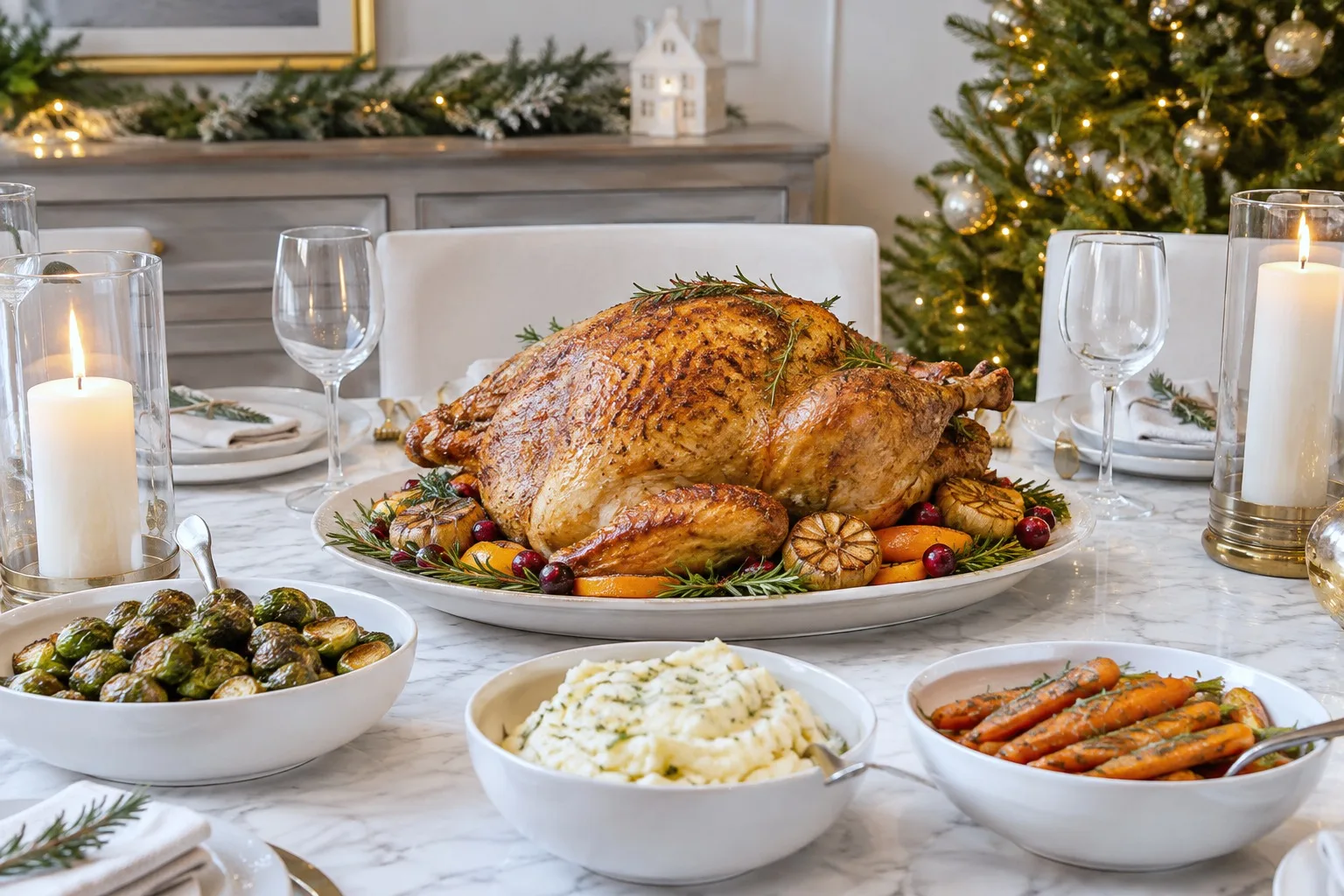
Nobody fights about the mashed potatoes. The argument happens over what sits in the center of the table and whether it earns the good platter. These sixteen christmas dinner ideas for main dishes settle that argument, running from a pastry-wrapped showstopper down to a slow cooker roast that asks for about ten minutes of your actual attention.
Work from the top of the list if you want a gasp when the dish lands on the table, or skip straight to the bottom for a smaller gathering with no audience to perform for. Every entry comes with a serving count and the side dish that suits it, so that part of the planning is already done.
A few of these simmer in red wine, stout or port, so pour for the grown-ups at the table and keep a non-alcoholic jus on hand for anyone skipping it. Expect gluten in the pastry and breadcrumbs and dairy in the butter and cream sauces, worth flagging before anyone with allergies fills a plate.
Once the main dish is settled, 31 Christmas Table Decorations for a Table That Seats More Than It Should covers the part that holds the platter, and 20 Christmas Dishes and Hosting Finds Your Holiday Table Has Been Waiting For covers what it sits on.
For the courses on either side, Christmas Appetizers: 12 Party Themes and Recipe Collections handles the wait before dinner, and 24 Christmas Recipes Dessert Easy Enough to Make While the Kettle Boils handles what comes after.
This post contains affiliate links. If you buy through them, I may earn a small commission at no extra cost to you.
Table of Contents
- Beef Wellington
- Prime Rib Roast with Garlic Herb Crust
- Crown Roast of Pork with Apple Stuffing
- Roast Goose with Orange Glaze
- Beef Tenderloin with Horseradish Cream
- Rack of Lamb with Rosemary Dijon Crust
- Braised Short Ribs in Red Wine
- Duck Breast with Cherry Port Sauce
- Stuffed Pork Tenderloin with Apples and Sage
- Stout and Honey Pot Roast
- Apple Dijon Pork Roast
- Herb Roasted Chicken with Vegetables in the Pan
- Salmon en Croute with Dill Cream
- Cornish Hens with Citrus and Herbs
- Slow Cooked Ham with Pineapple Brown Sugar Sauce
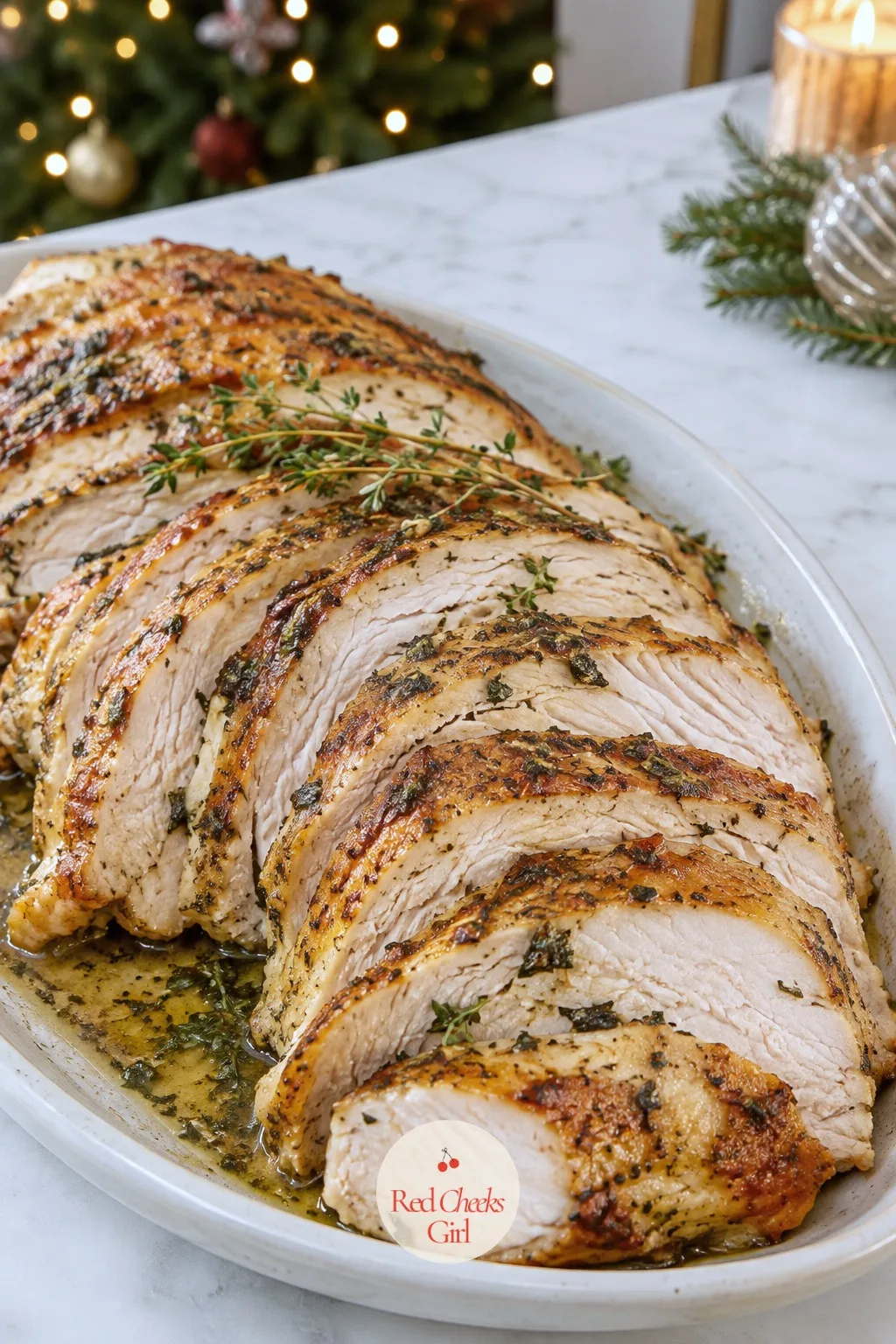
- Turkey Breast with Herb Butter
- Frequently Asked Questions
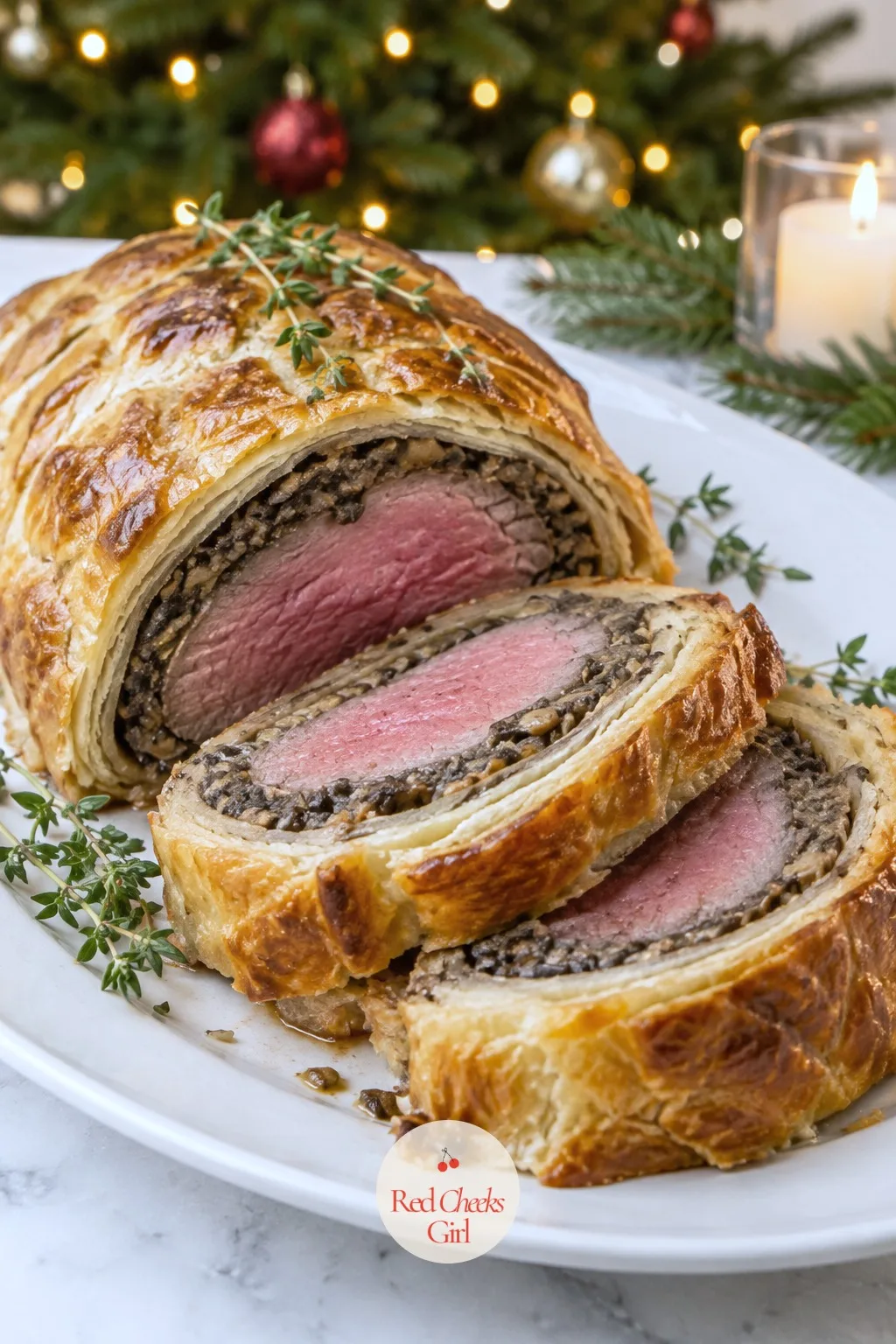
Beef Wellington
Puff pastry wrapped around a whole tenderloin sounds like a restaurant trick, not something you’d attempt on a Tuesday before guests arrive at six. It isn’t, once you know the one thing that actually matters: cooking the mushroom filling bone dry before it ever meets the pastry.
Skip that step and the bottom goes soggy. Get it right and you get a crust that shatters under the knife while the beef inside stays rosy. It serves six to eight and wants nothing more than roasted asparagus and a simple potato beside it, so the pastry stays the star.
Ingredients
- 2 lb center-cut beef tenderloin, trimmed
- Kosher salt and black pepper
- 2 tablespoons olive oil
- 1 lb cremini mushrooms, finely chopped
- 2 shallots, minced
- 2 cloves garlic, minced
- 2 tablespoons butter
- 8 slices prosciutto
- 2 tablespoons Dijon mustard
- 1 sheet puff pastry (14 ounces), thawed
- 2 egg yolks, beaten with 1 tablespoon water
- All-purpose flour, for rolling
Instructions
- Pat the tenderloin dry, season all over with salt and pepper, and sear in the hot olive oil over high heat for about 8 minutes total, turning to brown every side to a deep crust.
- Remove the meat, brush it with the Dijon mustard while still warm, and set aside to cool completely.
- In the same pan, cook the mushrooms, shallots and garlic in the butter over medium-high heat for about 10 minutes, stirring often, until every bit of liquid has cooked off and the mixture looks dry and dark, not wet: this is the duxelles that keeps the pastry crisp.
- Lay a large sheet of plastic wrap on the counter and arrange the prosciutto slices on it, overlapping slightly into a rectangle.
- Spread the duxelles over the prosciutto, set the cooled tenderloin on top, and use the plastic wrap to roll the prosciutto tightly around the meat, twisting the ends like a candy wrapper. Chill 30 minutes.
- On a floured surface, roll the puff pastry into a rectangle large enough to wrap the beef. Unwrap the tenderloin, place it in the center, and fold the pastry around it, sealing every seam with a little water. Chill, seam-side down, for 20 minutes.
- Preheat the oven to 400°F. Score the pastry lightly in a crosshatch pattern without cutting through, then brush all over with the egg wash.
- Bake 35 to 40 minutes, until the pastry is deep golden and a thermometer inserted in the center reads 125°F for medium-rare.
- Rest 10 minutes before slicing; the internal temperature will climb to about 130 to 135°F as it sits.
Prime Rib Roast with Garlic Herb Crust
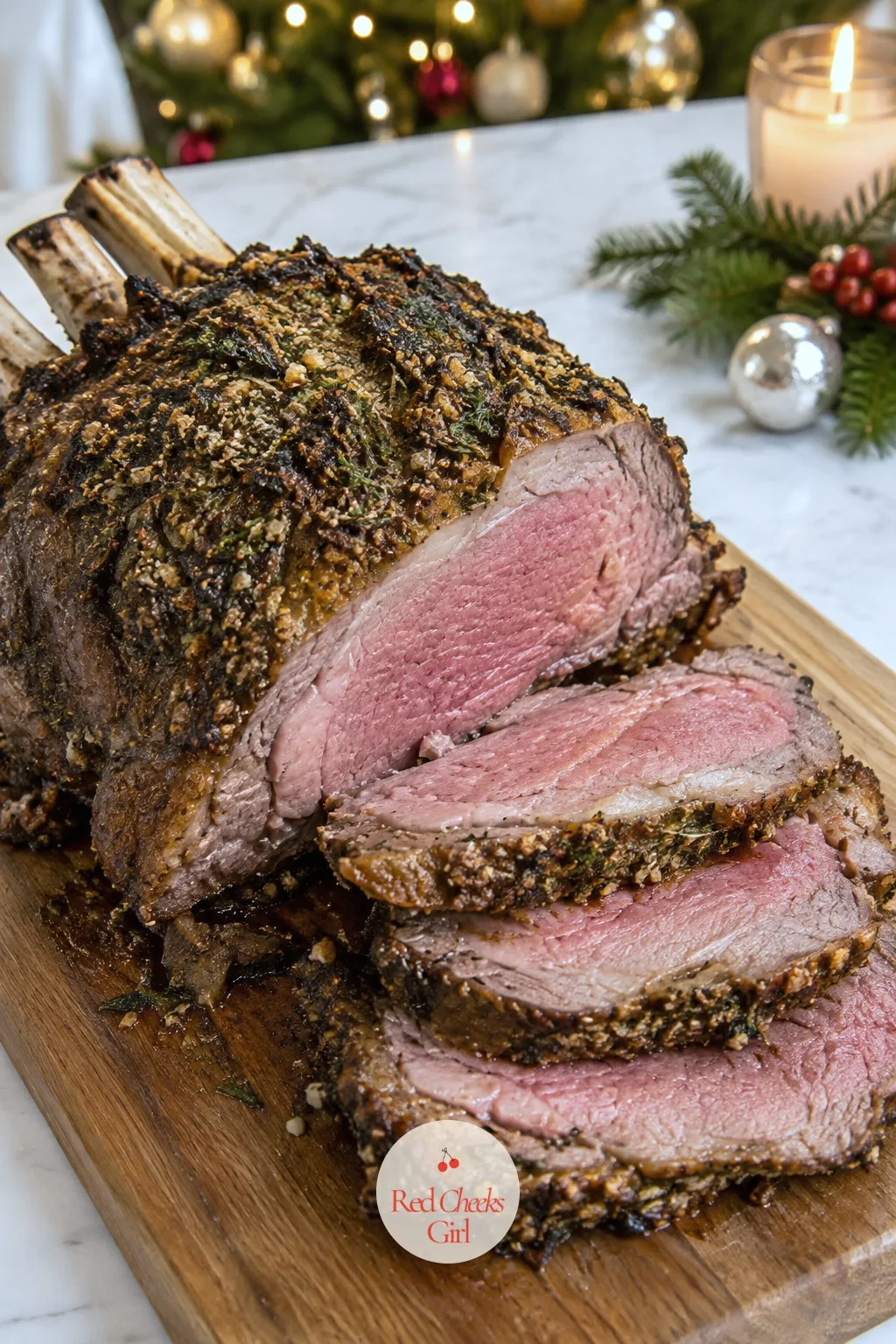
This is the roast that makes people stop talking when it comes out of the oven. A standing rib roast does most of the impressing on its own; your job is mostly staying out of its way and trusting the thermometer over the clock.
Salt it the night before if you can. It is the difference between seasoned-through meat and a roast that only tastes good at the edges. Figure ten to twelve servings, and let it sit beside Yorkshire pudding or creamed spinach, something rich enough to match the jus.
Ingredients
- One 6-pound bone-in standing rib roast (3 ribs)
- 3 tablespoons kosher salt
- 2 teaspoons black pepper
- 6 cloves garlic, minced
- 2 tablespoons fresh rosemary, chopped
- 2 tablespoons fresh thyme, chopped
- 4 tablespoons butter, softened
- 2 tablespoons olive oil
Instructions
- The night before, season the roast all over with the kosher salt, set it uncovered on a rack in the fridge, and let it sit overnight: the salt draws out moisture, then pulls it back in, seasoning the meat straight through.
- About 2 hours before cooking, pull the roast out and let it come to room temperature on the counter.
- Preheat the oven to 450°F. Mash the garlic, rosemary, thyme, butter and olive oil into a paste, and rub it over every surface of the roast along with the pepper.
- Set the roast fat-side up on a rack in a roasting pan and roast at 450°F for 20 minutes, until the crust browns.
- Lower the oven to 325°F and continue roasting about 13 to 15 minutes per pound, until a thermometer inserted in the thickest part reads 120°F for rare or 125°F for medium-rare.
- Tent the roast loosely with foil and rest 20 to 25 minutes before carving; the internal temperature will climb to about 130 to 135°F as it rests.
- Carve between the bones into thick slices and serve with any collected pan juices.
🛍 Shopping guide
Crown Roast of Pork with Apple Stuffing
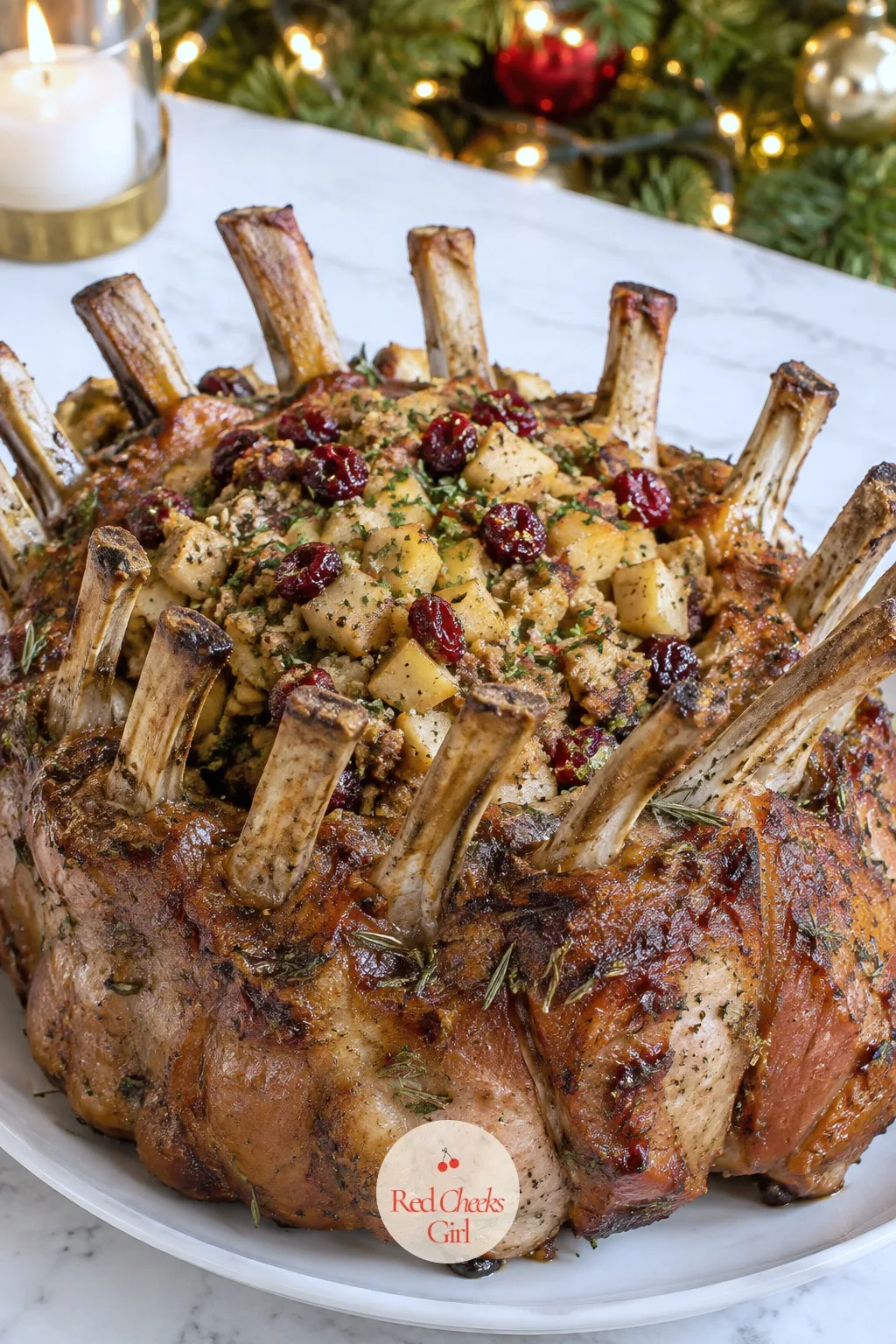
A crown roast looks like it needed a professional, which is exactly the point when you want the table to gasp without actually doing anything harder than a regular pork roast. The butcher ties the ring; you just fill the middle.
The stuffing bakes right inside the ring of ribs, soaking up drippings the whole time. Serves eight to ten, and wants nothing fussier beside it than roasted root vegetables, since the stuffing already does the carb and the center-of-plate job at once.
Ingredients
- One 8-rib crown roast of pork (about 6 pounds, tied by the butcher)
- Salt and black pepper
- 2 tablespoons olive oil
- 6 cups cubed day-old bread
- 2 apples, diced
- 1 onion, diced
- 2 celery stalks, diced
- 1/2 cup dried cranberries
- 2 teaspoons dried sage
- 1 teaspoon dried thyme
- 3/4 cup chicken broth
- 2 eggs, beaten
- 4 tablespoons butter
Instructions
- Preheat the oven to 450°F. Season the crown roast all over with salt and pepper and rub with the olive oil.
- Cover the exposed rib tips with foil to keep them from burning, set the roast in a roasting pan, and roast at 450°F for 20 minutes to brown the outside.
- Meanwhile, melt the butter in a skillet and cook the onion and celery over medium heat for 5 minutes, until softened.
- Stir in the apples, cranberries, sage and thyme, cook 3 more minutes, then toss with the bread cubes, broth and eggs until evenly moistened.
- Lower the oven to 325°F. Spoon the stuffing into the center well of the crown roast, mounding it slightly, and cover the stuffing loosely with foil.
- Roast at 325°F for about 20 minutes per pound, until a thermometer in the thickest part of the meat (not the stuffing) reads 145°F.
- Remove the foil from the stuffing for the last 15 minutes so the top turns golden.
- Rest the roast 15 minutes before removing the string and carving between the ribs into individual chops.
🛍 Shopping guide
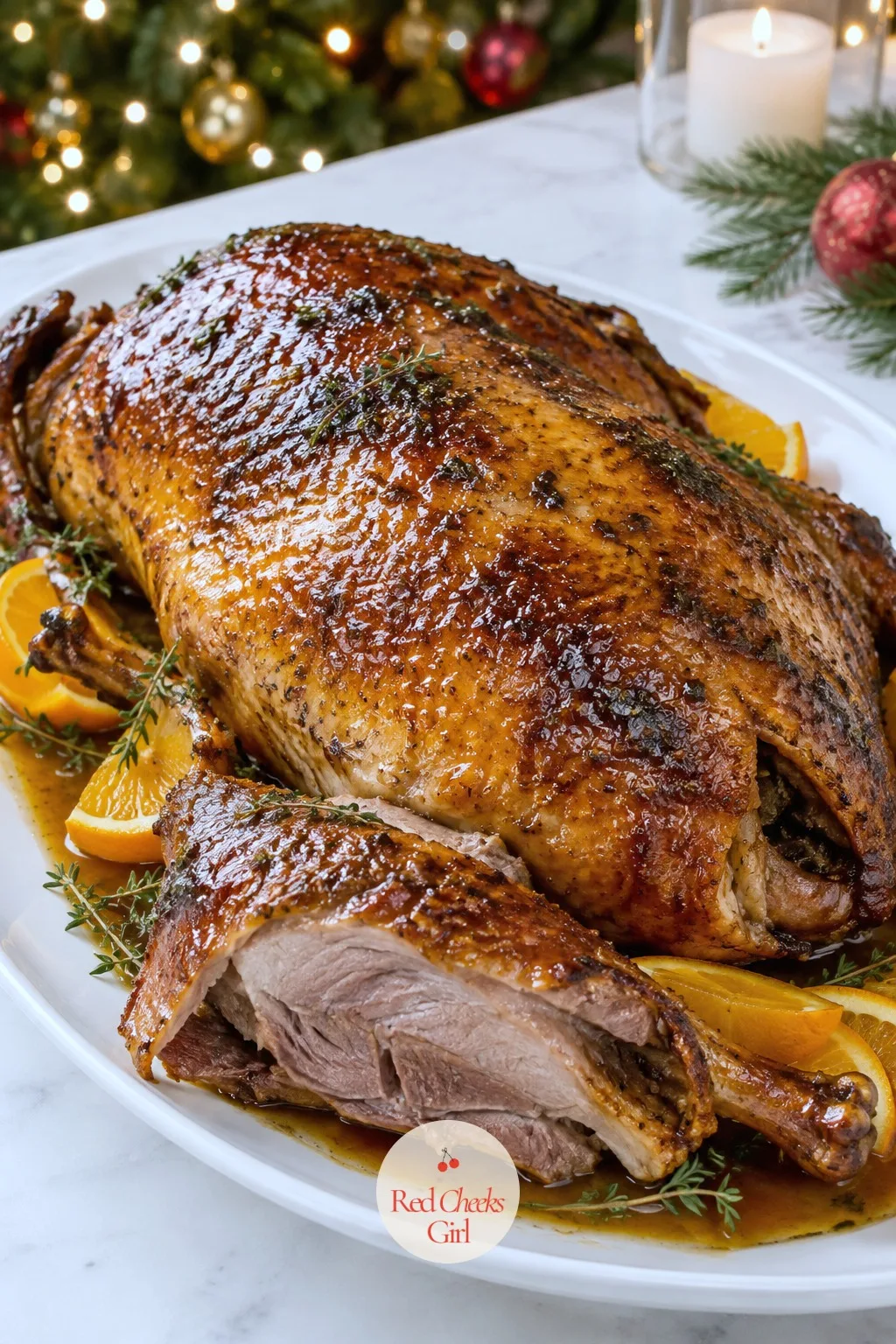
Roast Goose with Orange Glaze
A goose feels like a decision, not a default, which is exactly why it lands on the table as something people remember. The skin crisps to a deep mahogany while the meat stays rich and dark, closer to duck than to turkey.
Order one ahead, since most grocery stores do not keep it in the case. It serves six to eight and goes best with something to cut its richness, braised red cabbage or a sharp green salad rather than another heavy side.
Ingredients
- One 10 to 12 pound goose, giblets removed
- Salt and black pepper
- 1 orange, halved
- 1 onion, quartered
- A few sprigs fresh thyme
- 1 cup orange marmalade
- 1/4 cup honey
- 2 tablespoons orange juice
- 1 tablespoon Dijon mustard
Instructions
- Preheat the oven to 325°F. Prick the goose skin all over with a fork, avoiding the meat, to help the fat render out as it cooks.
- Season the cavity with salt and pepper and stuff it with the orange halves, onion quarters and thyme.
- Set the goose breast-side up on a rack in a roasting pan and roast at 325°F for about 20 minutes per pound.
- Every 45 minutes, carefully drain the rendered fat from the pan into a heatproof container (save it, it is excellent for roasting potatoes).
- In a small saucepan, warm the marmalade, honey, orange juice and mustard over low heat until smooth, about 3 minutes.
- For the last 30 minutes of roasting, brush the goose generously with the glaze every 10 minutes, until the skin turns deep mahogany.
- Roast until a thermometer inserted in the thickest part of the thigh reads 165°F, then rest 20 minutes before carving.
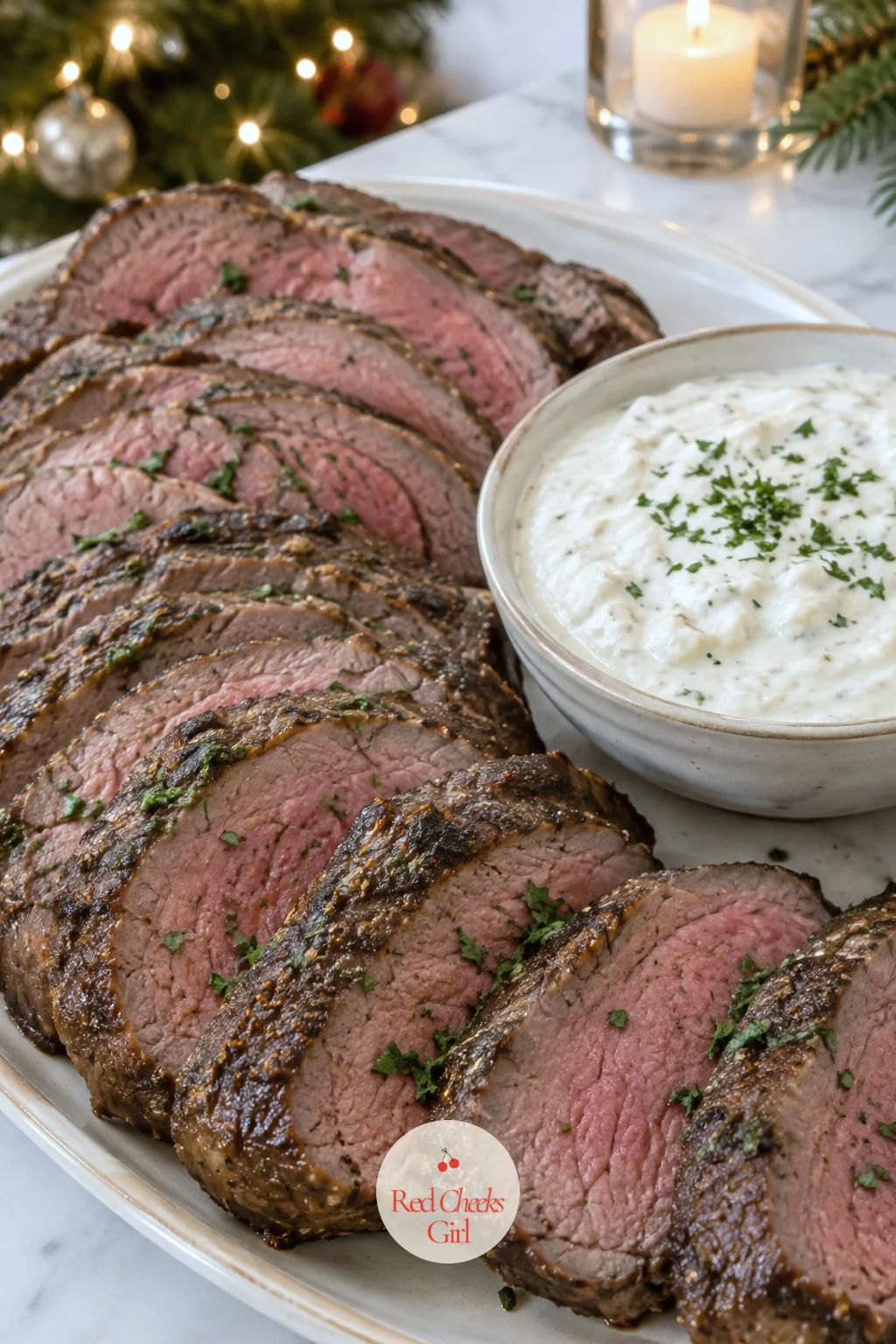
Beef Tenderloin with Horseradish Cream
She wants something that looks worthy of the occasion without the drama of pastry or a bird the size of a toddler. Tenderloin does that: a quick sear, a short stint in the oven, and a sauce that takes five minutes while the meat rests.
The horseradish cream is what makes it taste like Christmas instead of a Tuesday roast. Serves eight, and sits happily beside garlic mashed potatoes, which can simmer unattended while the tenderloin is in the oven.
Ingredients
- One 4-pound center-cut beef tenderloin, trimmed and tied
- Salt and black pepper
- 2 tablespoons olive oil
- 4 cloves garlic, smashed
- 2 sprigs fresh rosemary
- 2 sprigs fresh thyme
- 1 cup sour cream
- 1/4 cup prepared horseradish
- 1 tablespoon Dijon mustard
- 1 tablespoon lemon juice
- 2 tablespoons chopped chives
Instructions
- Preheat the oven to 425°F. Season the tenderloin generously with salt and pepper.
- Heat the olive oil in a large oven-safe skillet over high heat and sear the tenderloin on all sides, about 2 minutes per side, until deeply browned.
- Add the garlic, rosemary and thyme to the pan, then transfer the whole skillet to the oven.
- Roast 25 to 35 minutes, until a thermometer inserted in the center reads 125°F for medium-rare.
- While the meat rests, whisk together the sour cream, horseradish, mustard, lemon juice and chives for the sauce.
- Rest the tenderloin 10 minutes before slicing into thick medallions, then serve with the horseradish cream on the side.
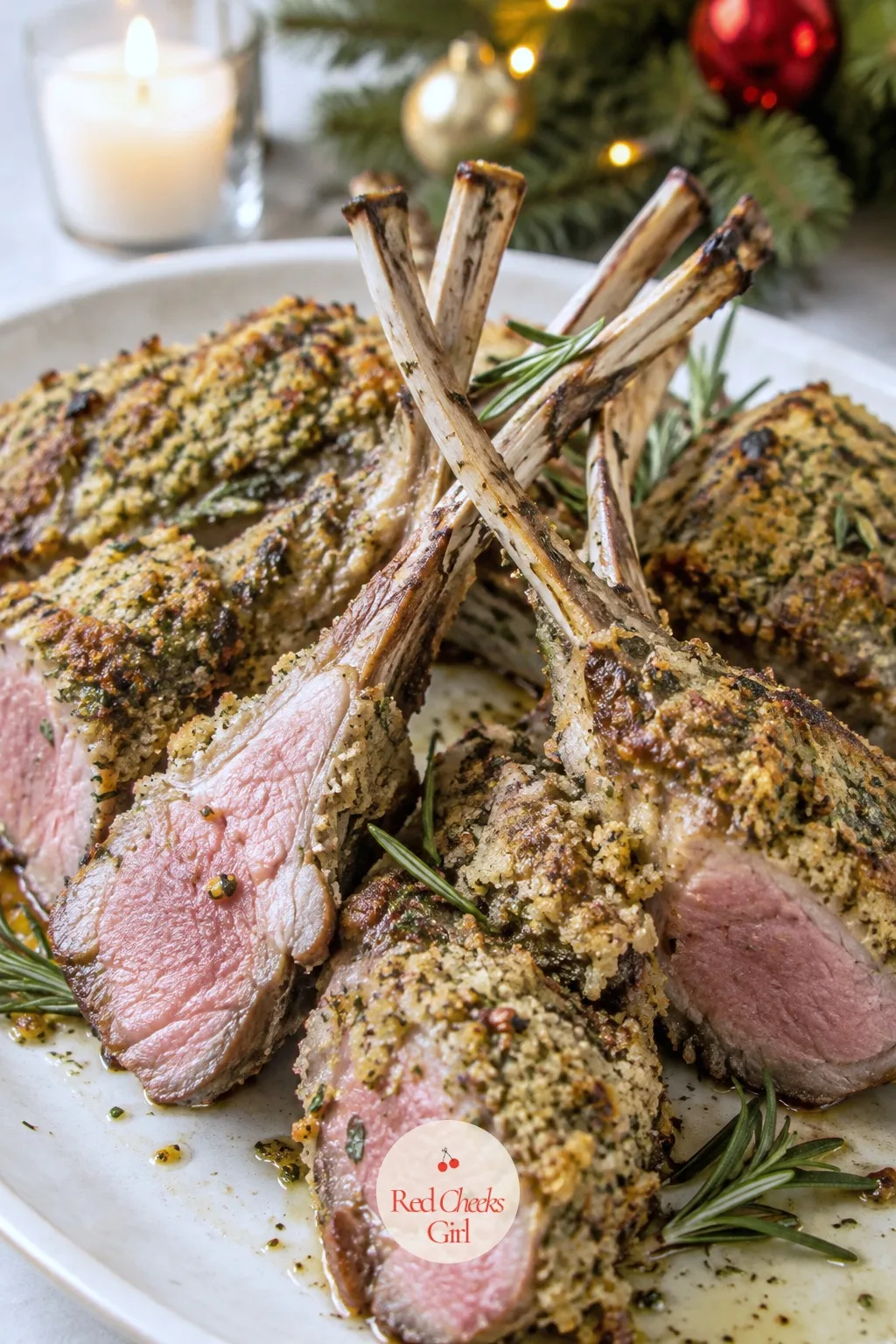
Rack of Lamb with Rosemary Dijon Crust
Rack of lamb reads as fine dining, but the actual work is a sear, a brush of mustard, a press of crumbs. The crust is what keeps everyone else from noticing how fast it came together.
Watch the temperature closely; lamb goes from pink to gray faster than beef. Serves four to six and sits well with roasted fingerling potatoes, something simple enough to let the crust be the texture on the plate.
Ingredients
- 2 racks of lamb (8 ribs each), frenched
- Salt and black pepper
- 3 tablespoons Dijon mustard
- 2 cloves garlic, minced
- 1 cup panko breadcrumbs
- 2 tablespoons chopped fresh rosemary
- 2 tablespoons olive oil
Instructions
- Preheat the oven to 400°F. Season the lamb racks with salt and pepper.
- Heat 1 tablespoon of the olive oil in a skillet over high heat and sear the racks fat-side down for 2 to 3 minutes, until deeply browned, then flip and sear the other side for 1 minute.
- Mix the mustard and garlic, then brush it over the fat side of each rack.
- Combine the panko, rosemary and remaining olive oil, and press the mixture firmly onto the mustard-coated side.
- Set the racks crust-side up on a rimmed baking sheet and roast 18 to 20 minutes, until a thermometer inserted away from the bone reads 130 to 135°F for medium-rare.
- Rest 10 minutes, then slice between the ribs into individual or double chops.
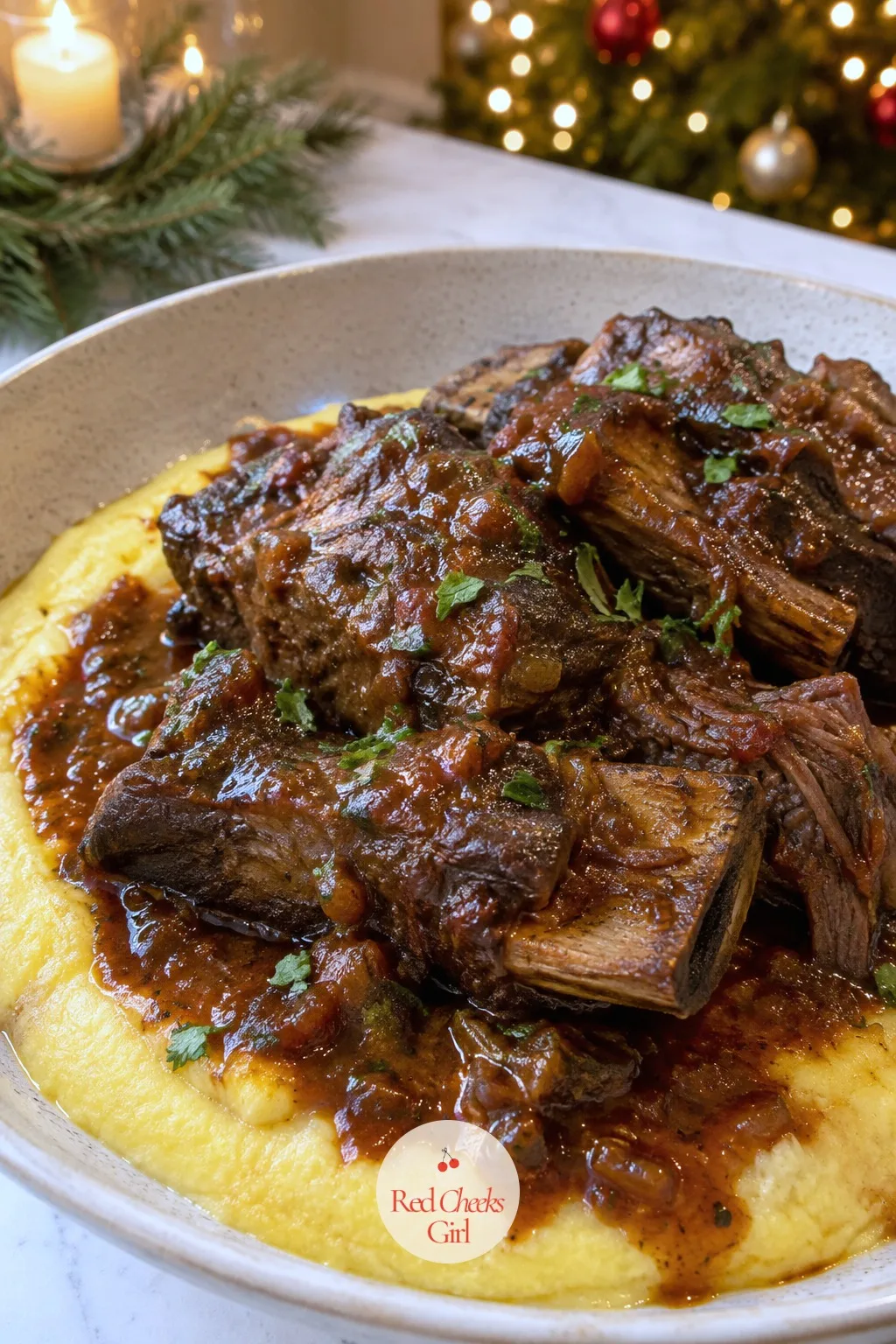
Braised Short Ribs in Red Wine
This is the dish for the table that wants to feel cozy rather than formal, the kind of meal that fills the house with a smell before anyone sits down. The oven does the real work while you deal with everything else.
Short ribs forgive timing mistakes; thirty extra minutes in the braise only makes them more tender. Serves six and belongs over creamy polenta, which catches every bit of the wine sauce.
Ingredients
- 4 pounds bone-in beef short ribs
- Salt and black pepper
- 1/4 cup all-purpose flour
- 2 tablespoons olive oil
- 1 onion, chopped
- 2 carrots, chopped
- 2 celery stalks, chopped
- 4 cloves garlic, smashed
- 2 cups dry red wine
- 2 cups beef broth
- 2 tablespoons tomato paste
- 2 bay leaves
- A few sprigs fresh thyme
Instructions
- Preheat the oven to 300°F. Season the short ribs with salt and pepper, then dredge them in the flour, shaking off the excess.
- Heat the olive oil in a large Dutch oven over medium-high heat and sear the ribs on all sides, about 8 minutes total, until deeply browned. Remove and set aside.
- Add the onion, carrots and celery to the pot and cook 5 minutes, until softened.
- Stir in the garlic and tomato paste and cook 1 minute, until fragrant.
- Pour in the red wine, scraping up the browned bits from the bottom of the pot, and simmer 3 minutes to cook off the raw alcohol smell.
- Return the ribs to the pot, add the broth, bay leaves and thyme, and bring to a simmer.
- Cover and transfer to the oven. Braise 2 1/2 to 3 hours, until the meat is fork-tender and pulls away from the bone easily.
- Skim the fat from the surface, discard the bay leaves, and simmer the sauce on the stovetop for 5 to 10 minutes to thicken slightly before serving.
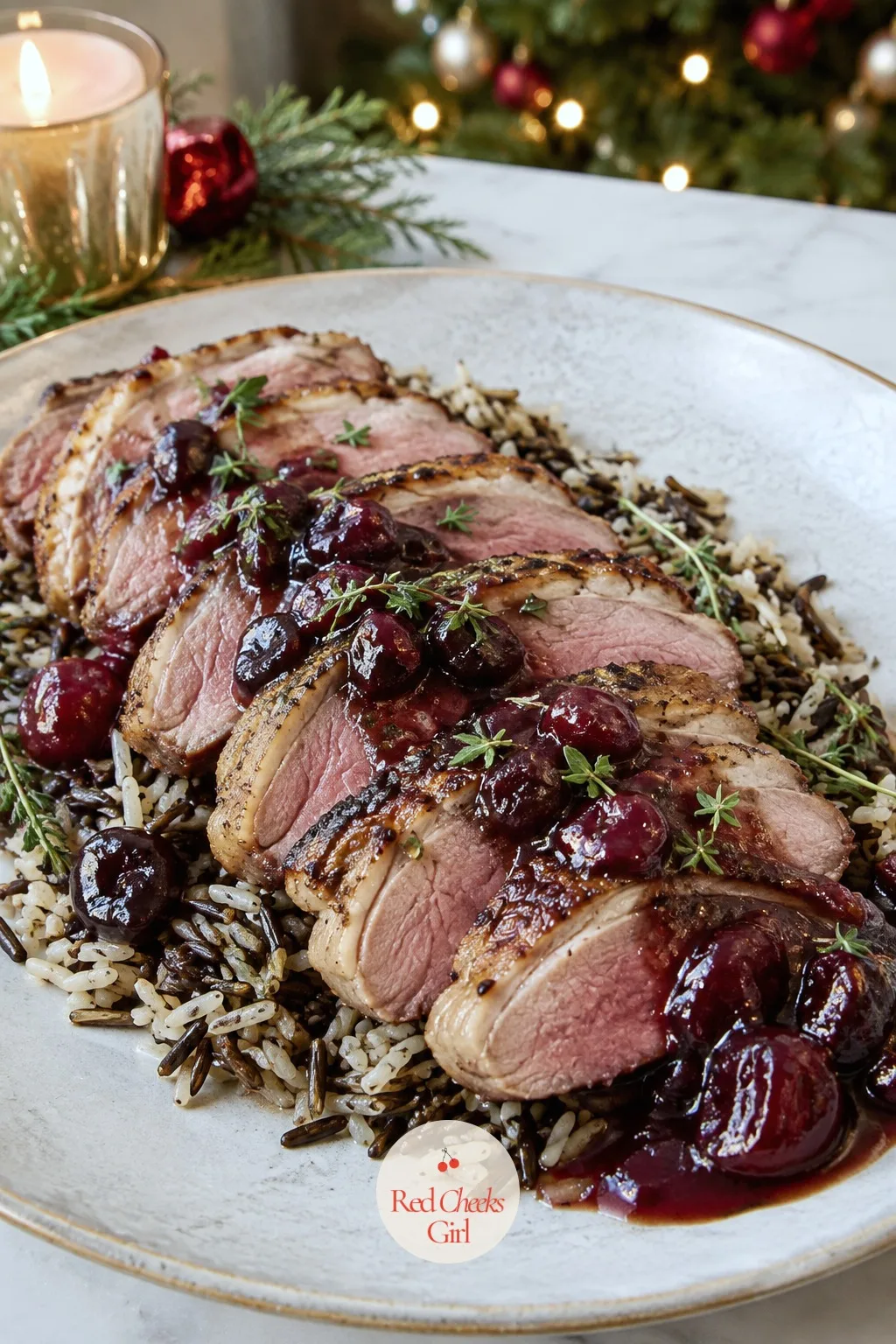
Duck Breast with Cherry Port Sauce
Duck breast suits the smaller table, the one with four place settings and a bottle of something good already open. It cooks in under fifteen minutes, almost entirely skin-side down, rendering its own fat as it goes.
The cherry port sauce comes together in the same pan while the duck rests, so nothing sits waiting. Serves four and pairs naturally with wild rice pilaf, which soaks up the sauce without competing with it.
Ingredients
- 4 boneless duck breasts, skin on
- Salt and black pepper
- 1 cup port wine
- 1 cup dried cherries
- 1 cup chicken stock
- 1 shallot, minced
- 2 tablespoons butter
Instructions
- Score the duck skin in a crosshatch pattern without cutting into the meat, and season both sides with salt and pepper.
- Place the breasts skin-side down in a cold, dry skillet, then set the heat to medium: this renders the fat slowly without scorching the skin.
- Cook 8 to 10 minutes, until the skin is deep golden brown and most of the fat has rendered, pouring off excess fat as it collects.
- Flip and cook 3 to 4 minutes on the meat side, until a thermometer reads 130°F for medium-rare.
- Remove the duck to rest, and pour off all but 1 tablespoon of fat from the pan.
- Add the shallot and cook 1 minute, then add the port and cherries, scraping up the browned bits.
- Add the chicken stock and simmer 6 to 8 minutes, until reduced by half and syrupy enough to coat the back of a spoon.
- Swirl in the butter off heat, slice the duck breasts on the diagonal, and spoon the sauce over.
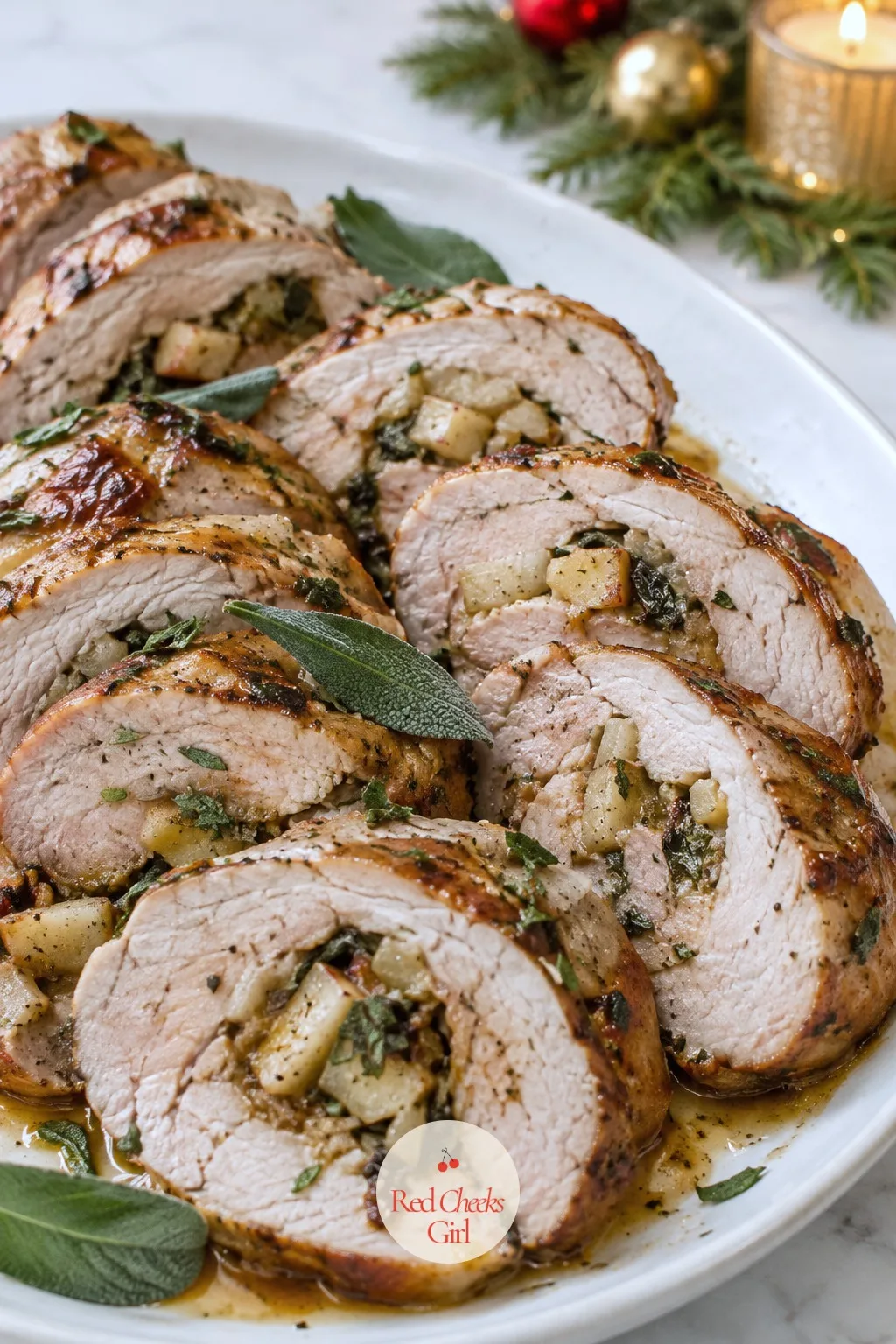
Stuffed Pork Tenderloin with Apples and Sage
Butterflying a tenderloin sounds harder than it is. Once it lies flat, the filling goes in, the roll ties shut, and what used to look like a plain cut of pork turns into something with a spiral pattern on every slice.
The apple and sage filling is what makes it taste distinctly of the season rather than just dinner. Serves four to six and suits butternut squash, which echoes the same sweetness without repeating it.
Ingredients
- 2 pork tenderloins (1 to 1 1/4 pounds each)
- Salt and black pepper
- 2 tablespoons butter
- 1 apple, diced
- 1/2 onion, diced
- 2 teaspoons chopped fresh sage
- 1/2 cup breadcrumbs
- 1/4 cup chicken broth
- 2 tablespoons olive oil
- Kitchen twine
Instructions
- Butterfly each tenderloin lengthwise, cutting almost but not all the way through, then open it flat like a book and pound gently to an even thickness.
- Melt the butter in a skillet over medium heat and cook the apple and onion for 5 minutes, until softened.
- Stir in the sage, breadcrumbs and broth, and cook 1 more minute until the mixture holds together when pressed. Let it cool slightly.
- Season the inside of the tenderloins with salt and pepper, spread the filling down the center of each, then roll them closed and tie with kitchen twine at 1-inch intervals.
- Preheat the oven to 375°F. Season the outside of the rolls with salt and pepper.
- Heat the olive oil in an oven-safe skillet over medium-high heat and sear the rolls on all sides, about 5 minutes total, until browned.
- Transfer the skillet to the oven and roast 25 to 30 minutes, until a thermometer inserted in the center reads 145°F.
- Rest 10 minutes, remove the twine, and slice into thick medallions so the filling shows in a spiral.
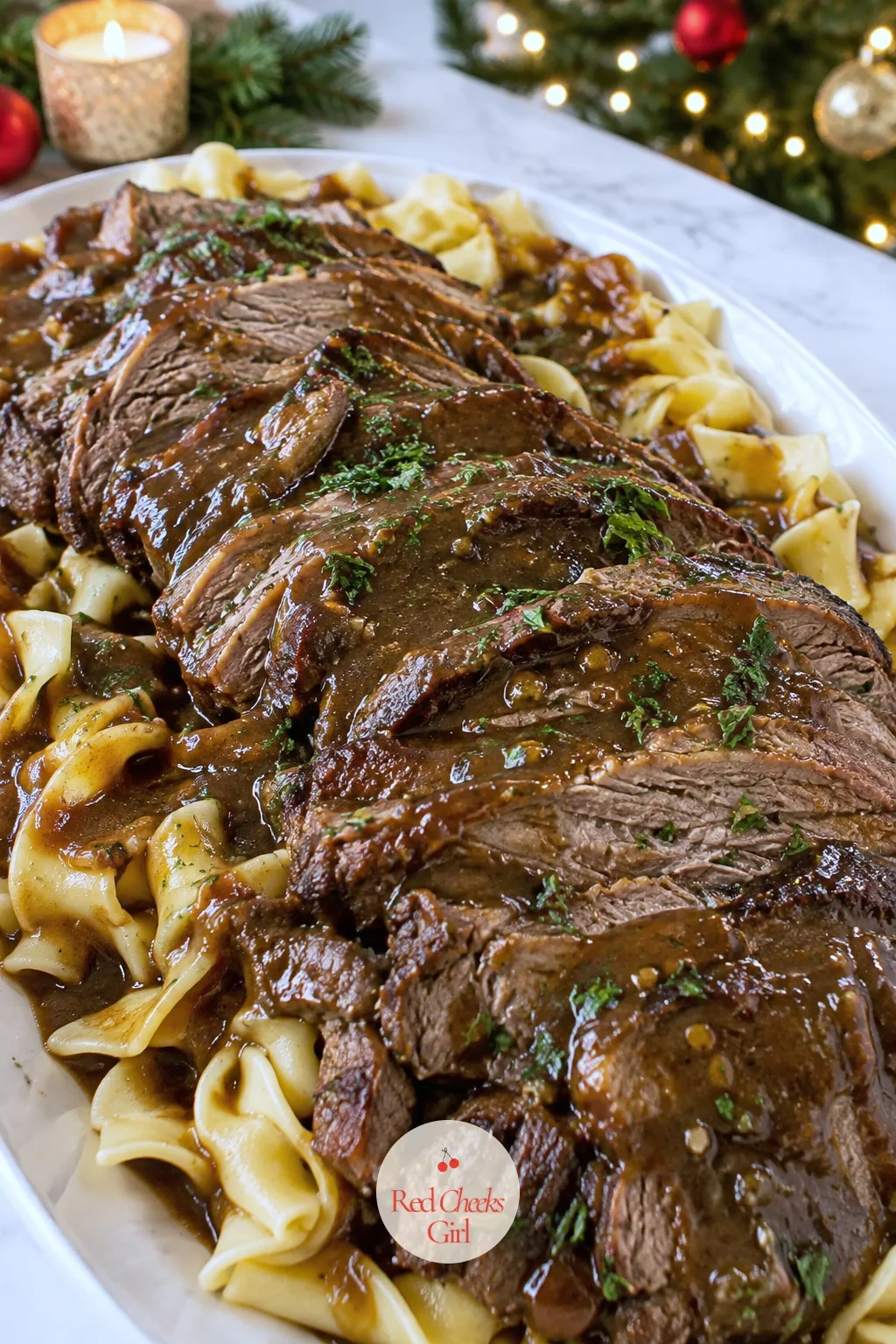
Stout and Honey Pot Roast
Some years the table wants something that tastes like it simmered all day, because it did, without anyone standing over it. A stout and honey braise turns a cheap cut of chuck into something that falls apart at the touch of a fork.
The beer adds a bitter edge the honey balances out, so the sauce reads rich rather than sweet. Serves six to eight over buttery egg noodles, which need nothing more than the gravy spooned on top.
Ingredients
- 3 to 4 pound boneless chuck roast
- Salt and black pepper
- 1/4 cup all-purpose flour
- 2 tablespoons olive oil
- 1 onion, chopped
- 3 carrots, chopped
- 3 celery stalks, chopped
- 4 cloves garlic, smashed
- One 12-ounce bottle stout beer
- 1 cup beef broth
- 1/4 cup honey
- 2 tablespoons Worcestershire sauce
- 2 bay leaves
Instructions
- Preheat the oven to 300°F. Season the chuck roast with salt and pepper, then dredge it in the flour, shaking off the excess.
- Heat the olive oil in a Dutch oven over medium-high heat and sear the roast on all sides, about 8 minutes total, until well browned. Remove and set aside.
- Add the onion, carrots and celery to the pot and cook 5 minutes, until softened, then stir in the garlic and cook 1 more minute.
- Pour in the stout, scraping up the browned bits from the bottom of the pot.
- Stir in the broth, honey, Worcestershire and bay leaves, then return the roast to the pot.
- Cover and braise in the oven 3 to 3 1/2 hours, until the meat shreds easily with a fork.
- Skim the fat from the surface, discard the bay leaves, and reduce the sauce on the stovetop for 5 minutes if it needs thickening.
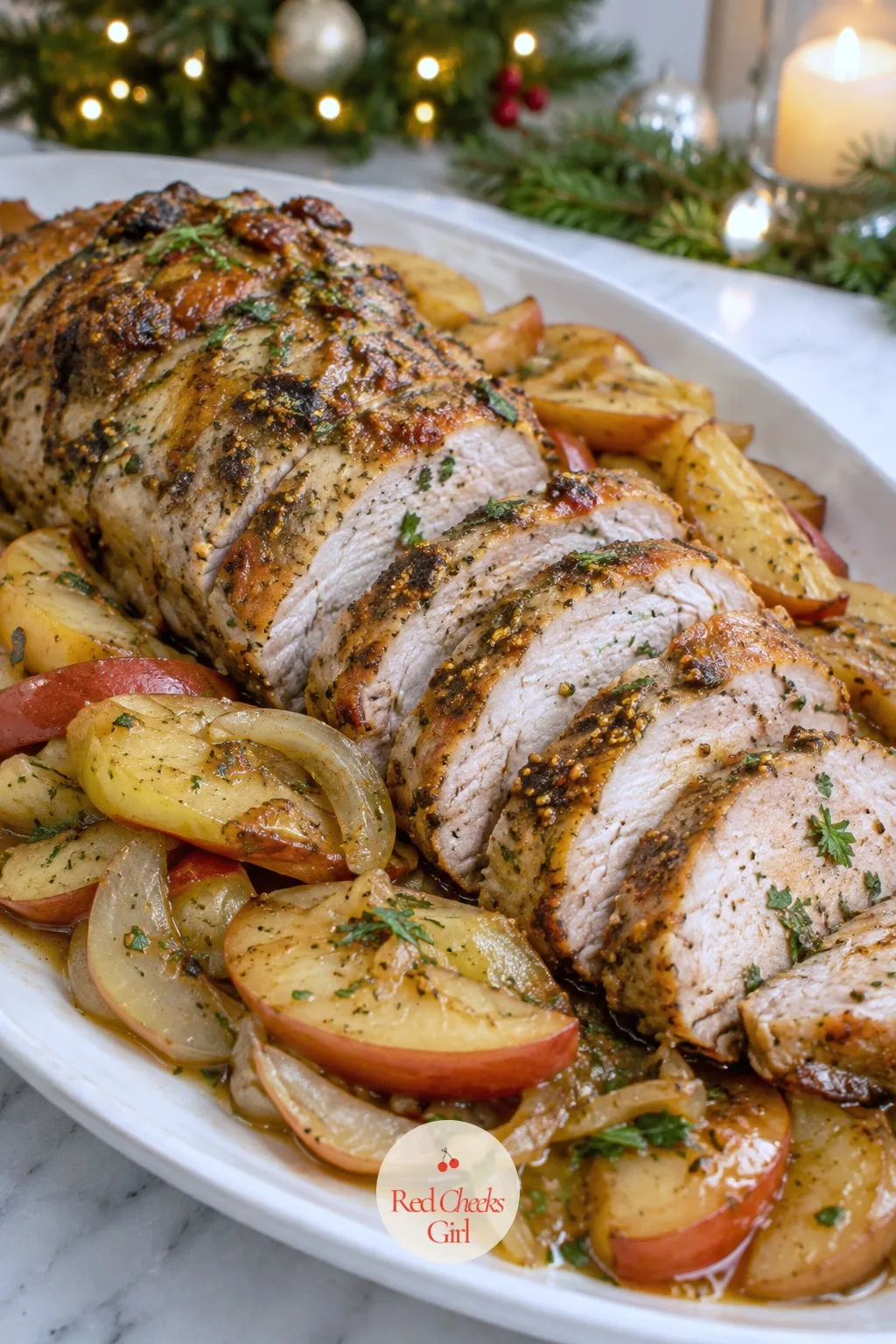
Apple Dijon Pork Roast
This is the roast for the night you want something that tastes like fall held on a little longer. Mustard and honey form a glaze that caramelizes around the edges while apples soften underneath, taking on all the drippings.
It needs under an hour in the oven, which leaves room for everything else to finish at the same time. Serves six and wants roasted Brussels sprouts, something with a little bitterness to offset the sweet glaze.
Ingredients
- 3-pound boneless pork loin roast
- Salt and black pepper
- 3 tablespoons Dijon mustard
- 2 tablespoons honey
- 2 apples, sliced
- 1 onion, sliced
- 1/2 cup apple cider
- A few sprigs fresh thyme
- 1 tablespoon olive oil
Instructions
- Preheat the oven to 375°F. Season the pork roast with salt and pepper.
- Heat the olive oil in an oven-safe skillet over medium-high heat and sear the roast on all sides, about 6 minutes total, until browned.
- Whisk together the mustard and honey, then brush it over the top and sides of the roast.
- Scatter the apple and onion slices around the roast in the skillet and pour the apple cider into the pan.
- Tuck the thyme sprigs among the apples and roast 55 to 65 minutes, until a thermometer inserted in the center reads 145°F.
- Rest the roast 10 minutes, then slice and serve with the roasted apples, onions and pan juices spooned over.
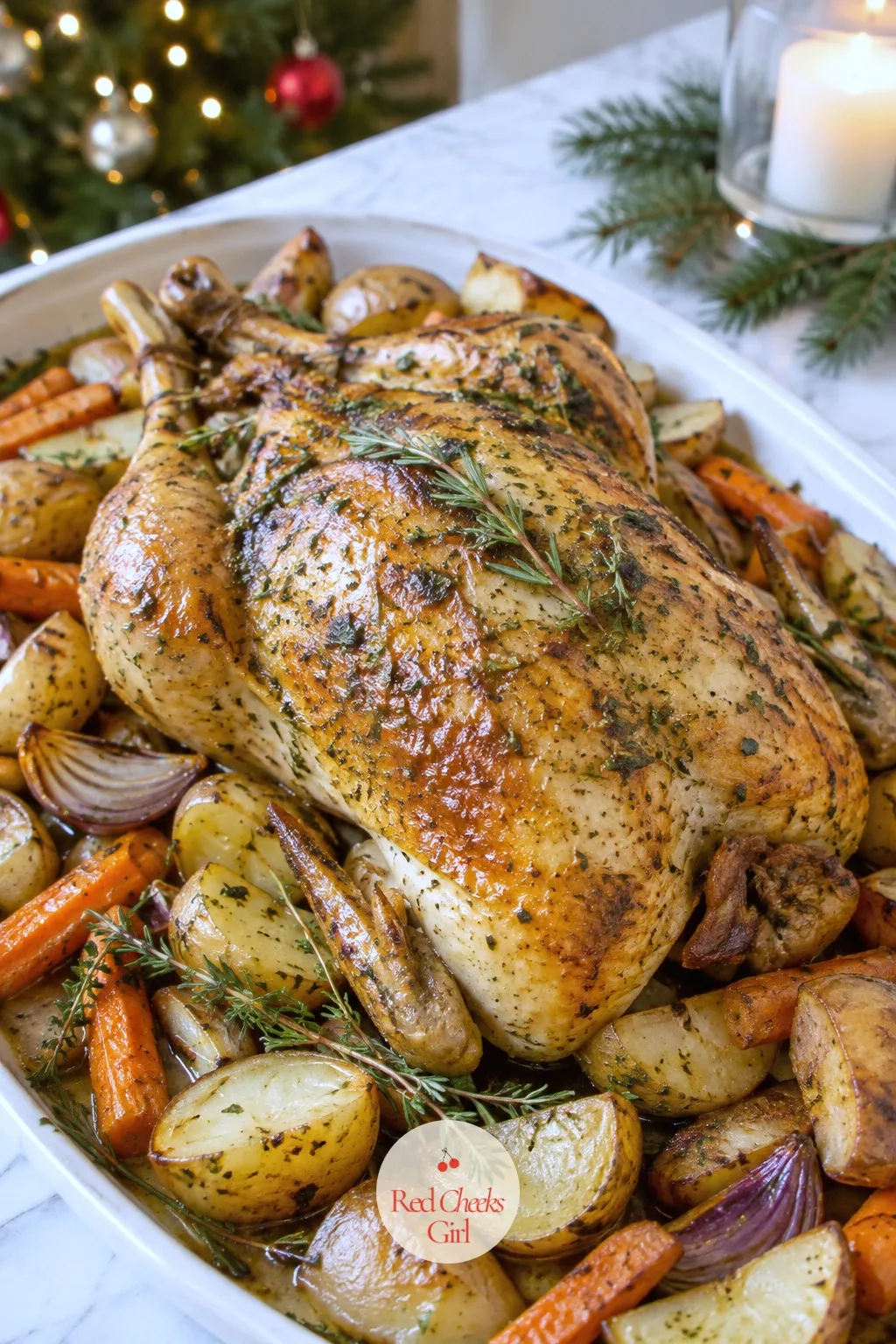
Herb Roasted Chicken with Vegetables in the Pan
Not every Christmas table needs a show. Some just need dinner, and a whole roast chicken with the vegetables cooking underneath does that honestly, no extra pots, no extra dishes beyond the one pan it all came out of.
The potatoes and carrots catch the drippings as the chicken roasts above them, so they finish better than any side cooked on its own. Serves four and needs only crusty bread to mop up what’s left in the pan.
Ingredients
- One 4 to 5 pound whole chicken
- Salt and black pepper
- 4 tablespoons butter, softened
- 2 tablespoons chopped fresh herbs (rosemary, thyme, sage)
- 1 lemon, halved
- 1 head garlic, halved crosswise
- 1 pound baby potatoes, halved
- 3 carrots, cut into chunks
- 1 onion, cut into wedges
- 2 tablespoons olive oil
Instructions
- Preheat the oven to 425°F. Pat the chicken dry and season the cavity with salt and pepper.
- Mix the butter with the chopped herbs, then loosen the skin over the breast with your fingers and push most of the butter underneath; rub the rest over the outside.
- Stuff the cavity with the lemon halves and garlic, then tie the legs together with kitchen twine.
- Toss the potatoes, carrots and onion with the olive oil, salt and pepper, and scatter them in a large roasting pan.
- Set the chicken on top of the vegetables and roast 1 hour 15 minutes to 1 hour 25 minutes, until a thermometer in the thickest part of the thigh reads 165°F and the juices run clear.
- Rest the chicken 15 minutes, then toss the vegetables in the pan drippings before serving alongside.
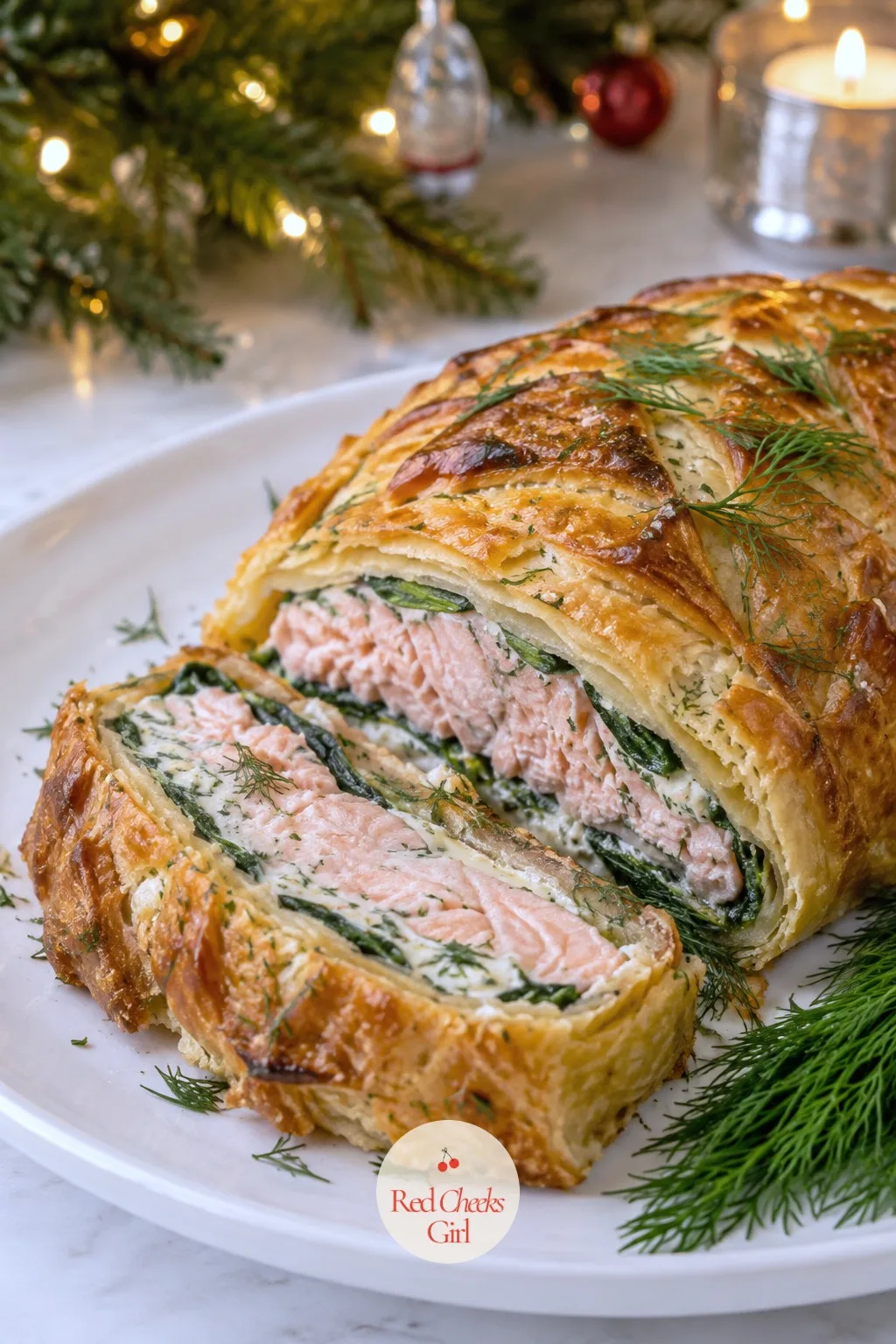
Salmon en Croute with Dill Cream
For the table that wants something lighter than another roast but still wants pastry, salmon wrapped in puff pastry splits the difference. It slices into clean layers of pink fish, green spinach and golden crust.
It also solves the fish-eater-at-the-table problem without a separate menu. Serves four to six and needs nothing heavier beside it than a simple green salad with a sharp vinaigrette.
Ingredients
- 2-pound center-cut salmon fillet, skin removed
- Salt and black pepper
- 1 sheet puff pastry, thawed
- 4 ounces cream cheese, softened
- 2 tablespoons chopped fresh dill
- 1 tablespoon lemon zest
- 2 cups baby spinach, wilted and squeezed dry
- 1 egg, beaten with 1 tablespoon water
Instructions
- Preheat the oven to 400°F. Season the salmon with salt and pepper.
- Mix the cream cheese with the dill and lemon zest until smooth.
- Roll the puff pastry on a floured surface into a rectangle large enough to wrap the salmon with a couple inches to spare.
- Spread the cream cheese mixture over the center of the pastry, top with the wilted spinach, then set the salmon on top.
- Fold the pastry over the salmon, sealing the seams with a little water, and chill 15 minutes seam-side down.
- Score the top lightly in a few diagonal lines and brush with the egg wash.
- Bake 25 to 30 minutes, until the pastry is deep golden and a thermometer inserted in the thickest part of the salmon reads 125°F.
- Rest 5 minutes before slicing into thick portions so the spinach and cream cheese layer shows in cross-section.
🛍 Shopping guide
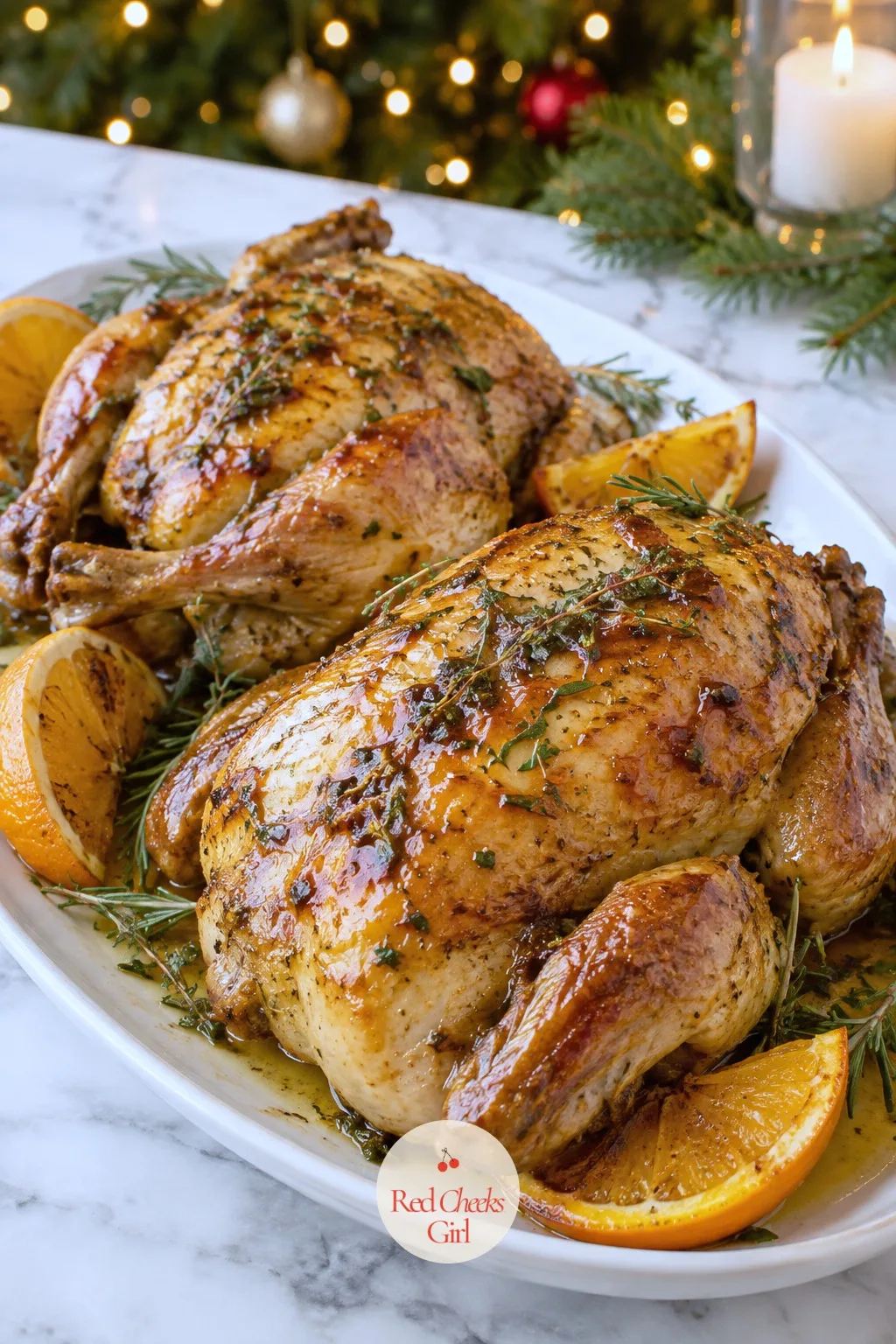
Cornish Hens with Citrus and Herbs
Individual hens solve the carving problem entirely: everyone gets their own, already portioned, already looking a little special on the plate. No one has to argue over who gets a drumstick.
They also cook in under an hour, which is a relief when the oven is already doing other work! Serves four and suits wild rice, which can simmer on the stovetop while the hens roast.
Ingredients
- 4 Cornish hens (1 1/4 to 1 1/2 pounds each)
- Salt and black pepper
- 1 orange, zested and quartered
- 2 tablespoons butter, softened
- A few sprigs fresh rosemary and thyme
- 2 tablespoons honey
- 2 tablespoons olive oil
Instructions
- Preheat the oven to 400°F. Pat the hens dry and season the cavities with salt and pepper.
- Mix the butter with the orange zest and chopped herbs, then rub it under the skin of each hen and over the outside.
- Tuck an orange quarter and a sprig of rosemary and thyme into each cavity, then tie the legs together.
- Set the hens in a roasting pan, drizzle with olive oil, and roast 45 to 50 minutes, until a thermometer in the thigh reads 165°F.
- Warm the honey slightly and brush it over the hens for the last 10 minutes of roasting, until the skin turns glossy and deep golden.
- Rest 10 minutes before serving one hen per person, or splitting each in half for a lighter portion.
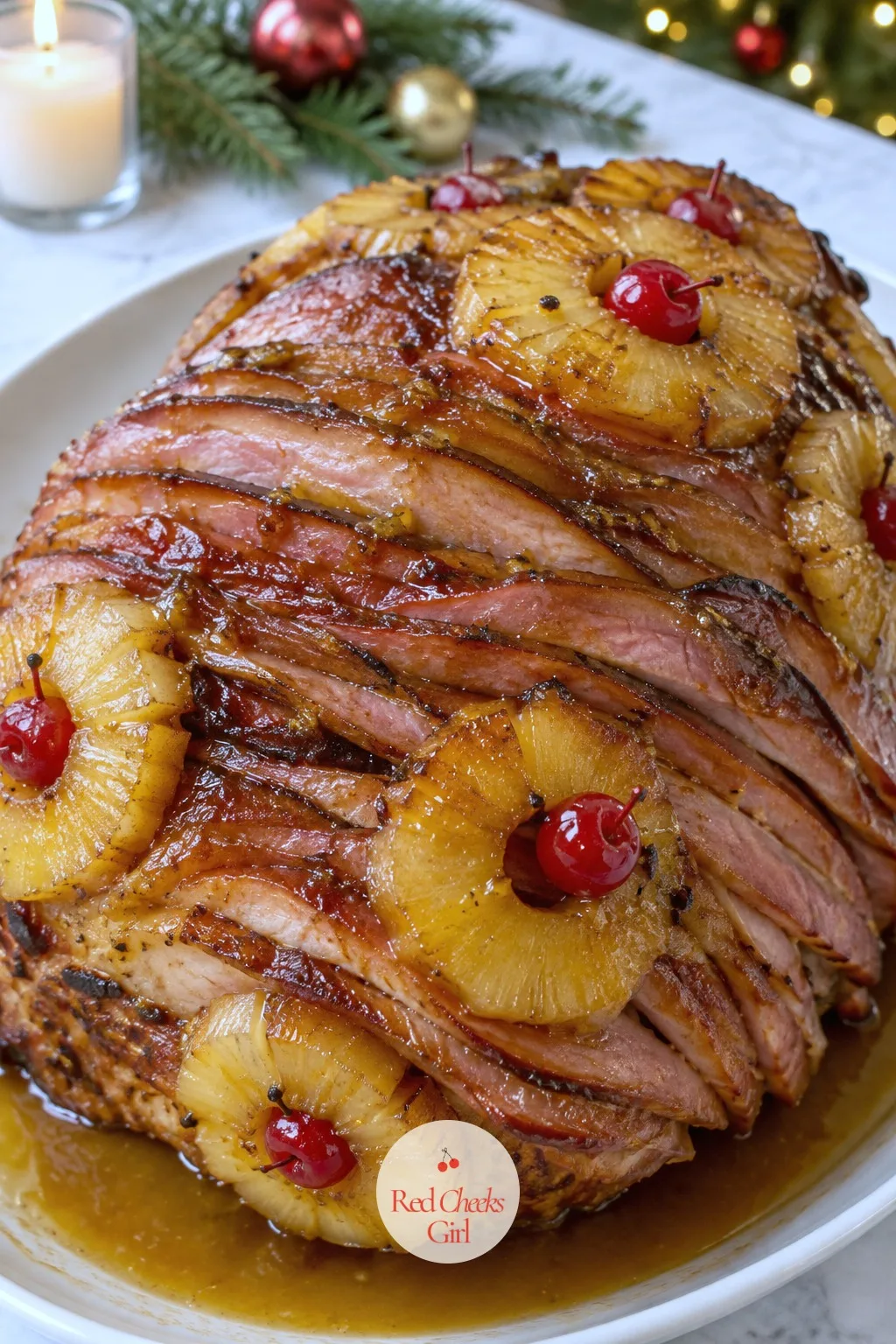
Slow Cooked Ham with Pineapple Brown Sugar Sauce
For the year the oven is already full of sides, a ham that cooks in the slow cooker is a genuine relief! It frees up every burner and rack for everything else happening at the same time.
Pineapple rings and brown sugar turn into a glossy sauce as the ham cooks, basting itself the whole afternoon. Serves eight to ten and wants scalloped potatoes beside it, a side with no oven-timing conflict.
Ingredients
- One 7 to 8 pound bone-in spiral-cut ham half
- 1 cup brown sugar
- 1 cup pineapple juice
- 1 can (20 ounces) pineapple rings, juice reserved
- Maraschino cherries
- 2 tablespoons Dijon mustard
- 1/4 cup butter, melted
Instructions
- Set the ham cut-side down in a large slow cooker (at least 6 quarts).
- Whisk together the brown sugar, pineapple juice, mustard and melted butter, and pour it evenly over the ham.
- Arrange the pineapple rings over the top of the ham and tuck a cherry into the center of each ring.
- Cover and cook on low 4 to 5 hours, basting with the sauce from the bottom every hour or so, until a thermometer inserted in the thickest part reads 140°F.
- Lift the ham onto a platter, keeping the pineapple rings in place, and let it rest 10 minutes.
- Pour the remaining sauce from the slow cooker into a saucepan and simmer 5 minutes, until slightly syrupy, then spoon it over the sliced ham.
🛍 Shopping guide
Turkey Breast with Herb Butter
For the smallest table, the one with four or six chairs and no need for a whole bird, a bone-in turkey breast does the job without the leftovers taking over the fridge for a week.
The slow cooker handles the cooking; a quick pass under the broiler at the end handles the skin. Serves four to six and needs only a simple gravy and cranberry sauce to feel complete.
Ingredients
- One 3 to 4 pound bone-in turkey breast
- 4 tablespoons butter, softened
- 2 cloves garlic, minced
- 1 tablespoon chopped fresh rosemary
- 1 tablespoon chopped fresh thyme
- 1 tablespoon chopped fresh sage
- Salt and black pepper
- 1 cup chicken broth
Instructions
- Mix the butter with the garlic, rosemary, thyme and sage, and season generously with salt and pepper.
- Loosen the skin of the turkey breast with your fingers and spread most of the herb butter directly onto the meat, then rub the rest over the skin.
- Pour the chicken broth into the bottom of the slow cooker and set the turkey breast on top, skin-side up.
- Cover and cook on low 4 to 5 hours, until a thermometer inserted in the thickest part reads 165°F.
- For crisp skin, transfer the breast to a baking sheet and broil 3 to 5 minutes, watching closely, until golden.
- Rest 10 minutes before slicing, and strain the cooking liquid for a quick gravy.
Frequently Asked Questions
What is the traditional main dish for Christmas dinner?
Ham, roast turkey and prime rib are the most popular traditional choices for American Christmas dinner, with ham and turkey both polling as essential to many holiday meals.
What can I make for Christmas dinner besides ham and turkey?
Roast beef, crown roast pork, leg of lamb, standing rib roast, beef tenderloin, salmon, or roasted poultry like Cornish hens, goose or duck all work as alternatives to ham and turkey.
How much meat do I need per person for Christmas dinner?
Plan on about 1/2 to 3/4 pound of boneless meat per person, or close to 1 pound per person for bone-in cuts like prime rib, ham or a whole bird.
How do I keep the main dish warm while the sides finish cooking?
Tent the rested roast loosely with foil and set it in a low oven (around 200°F) or on a warming tray; it holds its temperature for 30 to 45 minutes without drying out.
Can I prep a Christmas roast the day before?
Yes, seasoning, searing, or fully braising a roast a day ahead is safe and often improves the flavor; refrigerate it covered and bring it back to temperature gently before serving.
Can I freeze leftover Christmas roast or ham?
Most cooked roasts and hams freeze well for up to three months in an airtight container; thaw in the fridge overnight and reheat gently with a splash of broth to keep it moist.
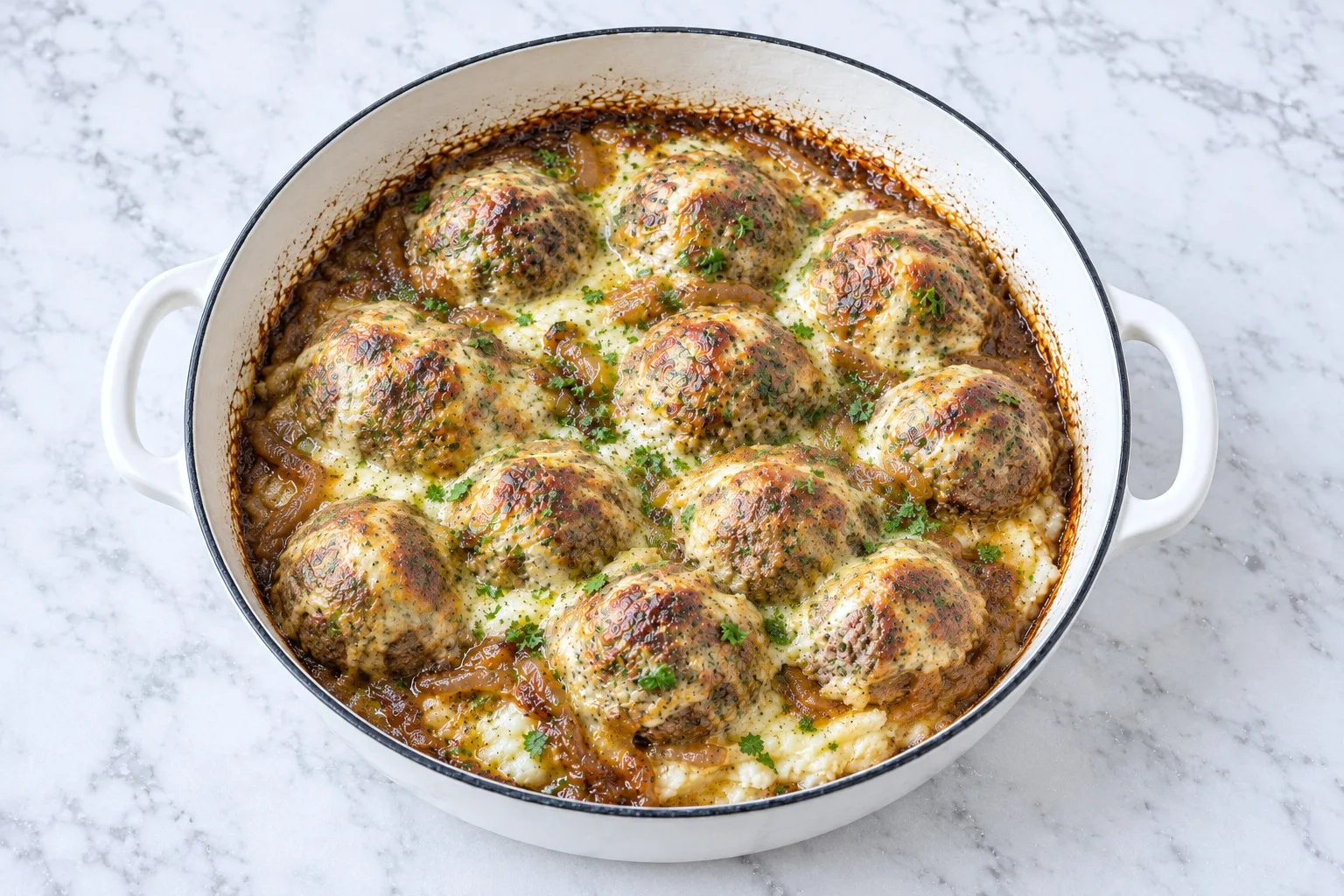
French onion meatballs bring caramelized onion, beef broth and melted Gruyere together in one skille
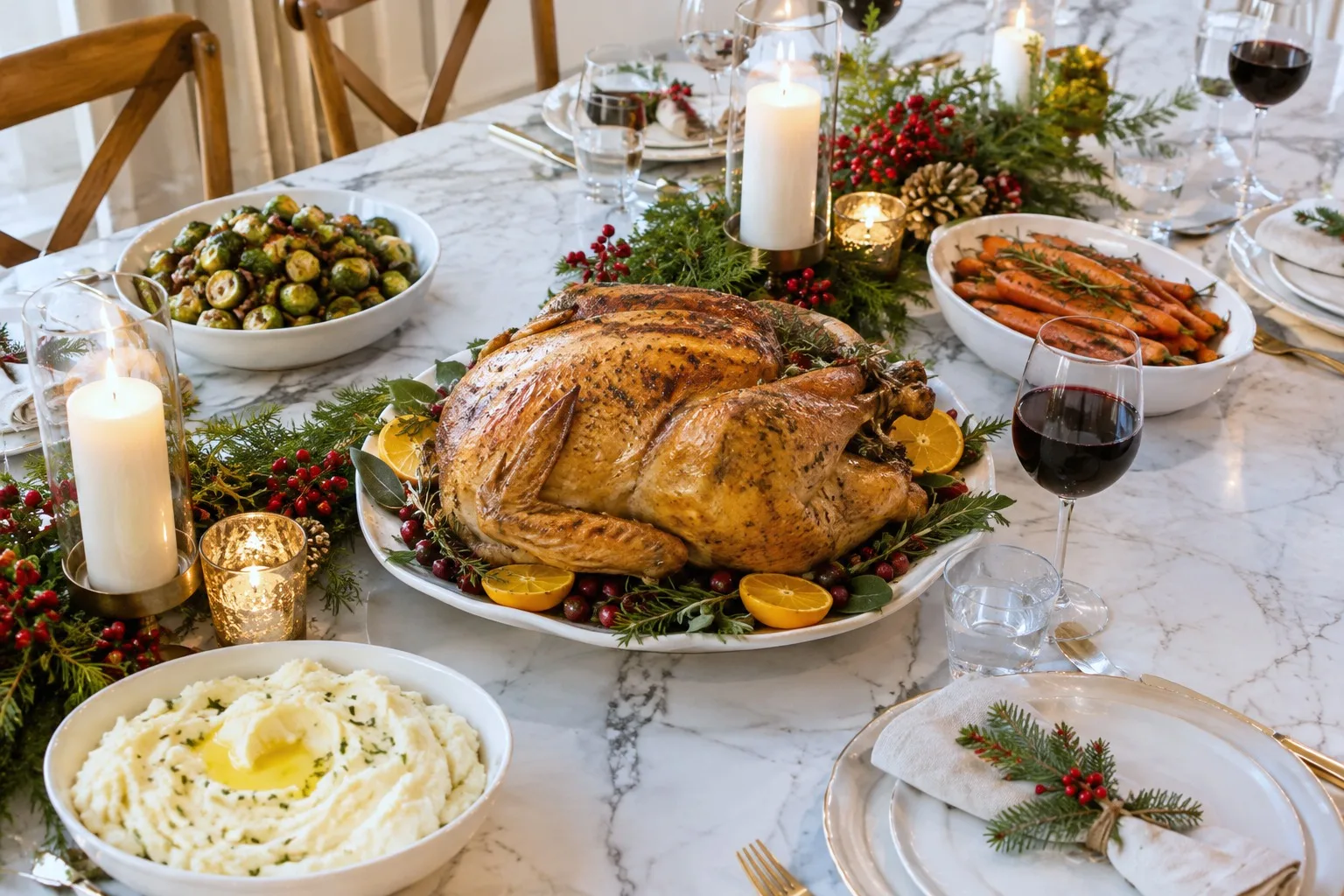
14 Italian Christmas dinner recipes, from antipasto and lasagna to Sunday gravy meatballs and make-a
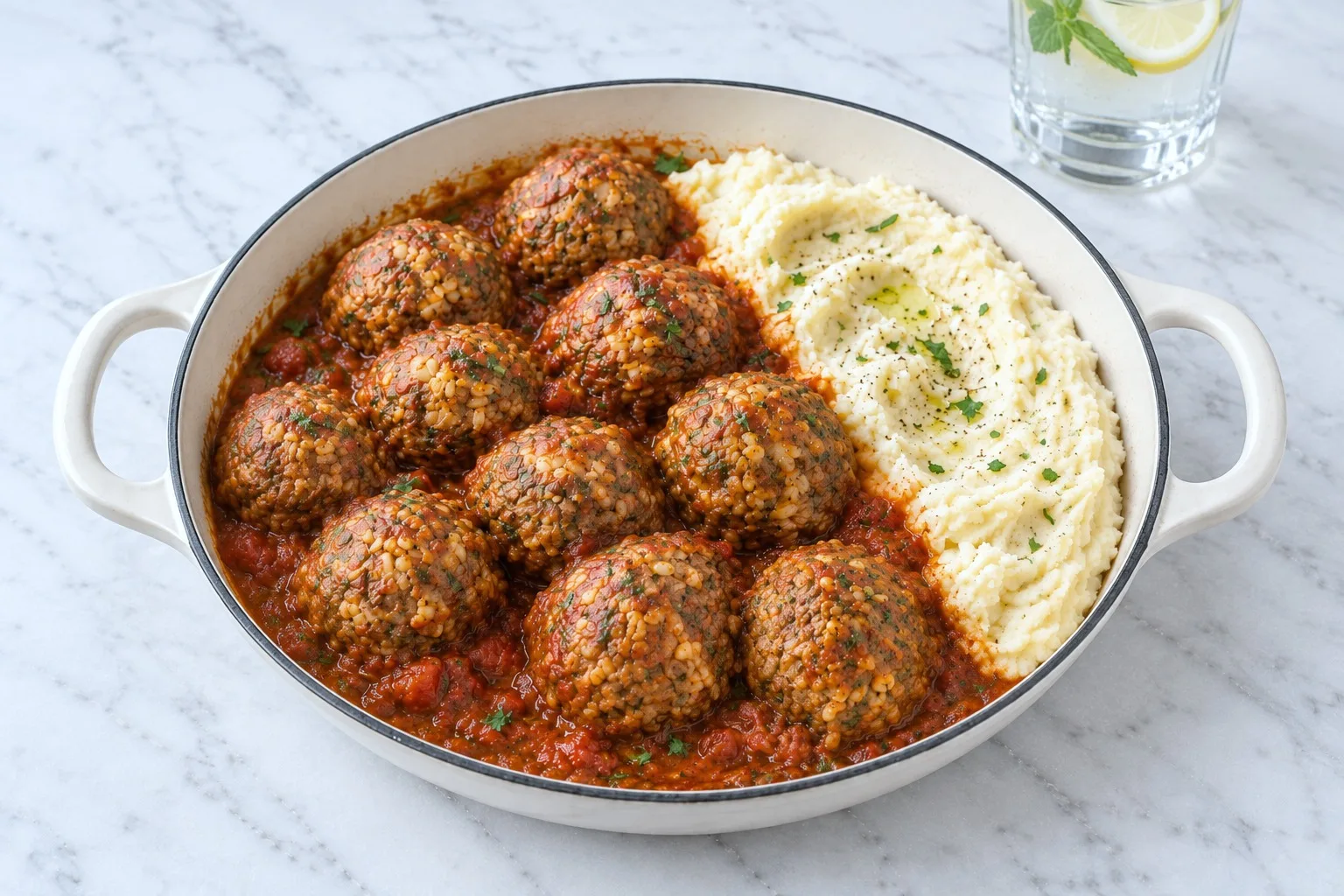
Porcupine meatballs bake covered in tomato sauce so raw rice turns tender and pokes through like qui
Leave a Reply