

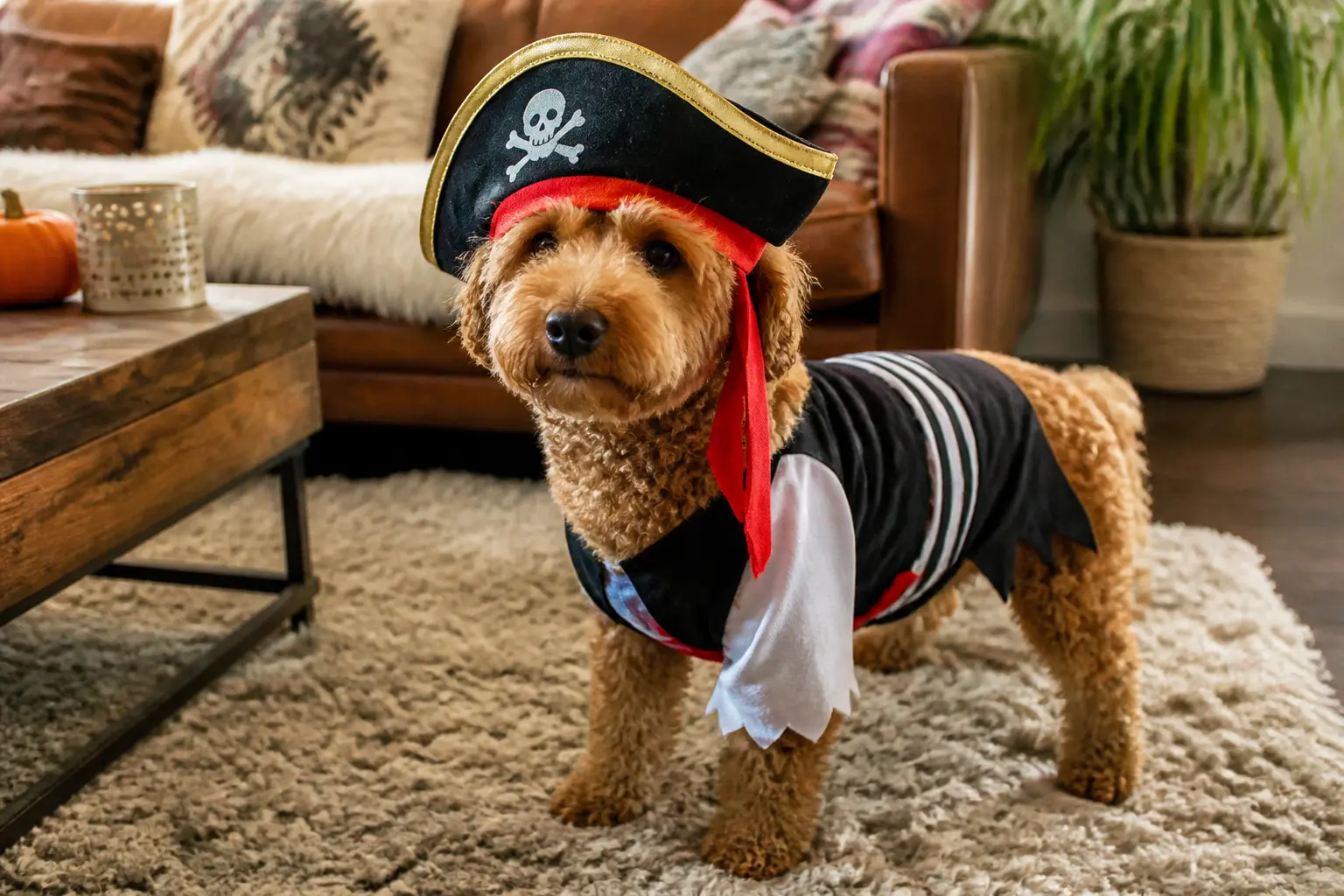
Your dog will wear this for forty minutes, tops. That window has to count. These twenty costumes are built around that reality: each one attaches to a harness or a simple collar loop, uses materials that weigh almost nothing, and photographs in under a second because the dog is not actively trying to escape.
The ideas here lean into body shape. Long dogs, round dogs, fluffy dogs, enormous golden dogs with the patience of a saint, all have something in this list that makes the silhouette funnier and more recognizable. None of them require a sewing machine, and most cost under fifteen dollars in materials.
If you want the rest of your Halloween sorted while you are here, 20 Budget-Friendly DIY Halloween Party Games and 15 Easy DIY Halloween Decorations With Three Steps or Fewer both live on this site and share the same low-spend, high-payoff approach.
This post contains affiliate links. If you buy through them, I may earn a small commission at no extra cost to you.
Harness-Mounted Wings and Backs
The harness is already on the dog. These costumes clip or velcro directly onto it, so nothing loops around legs, nothing tightens on the neck, and the dog forgets it is wearing anything within three minutes. That is your window: take the photo fast.
Felt, craft foam, and thin cardboard all weigh almost nothing and hold a shape well enough to read clearly in a photograph from six feet away.
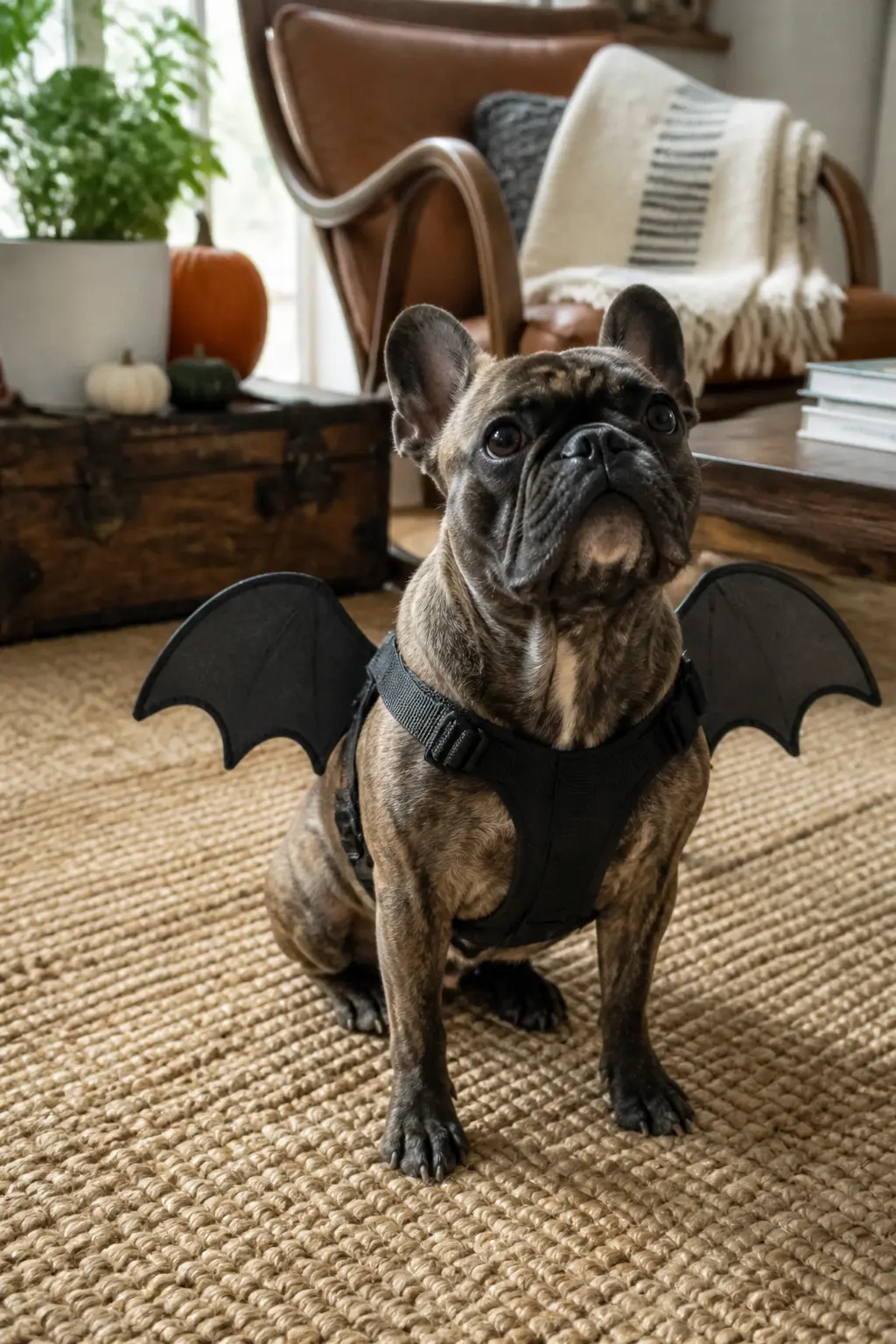
Bat Wings on a Harness
Cut two bat-wing shapes from black craft foam, roughly palm-sized for a small dog and dinner-plate-sized for a medium one. Score a gentle curve along the top edge so they arc upward naturally. Hot-glue a two-inch velcro strip to the flat base of each wing, press the other half of the velcro to the back strap of the harness, and that is the whole construction.
The brindle coat of a French bulldog, or any dark short coat, reads as part of the costume: the dog is already the right color. Photograph from a low angle so the wings appear to spread above the silhouette.
🛍 Shopping guide
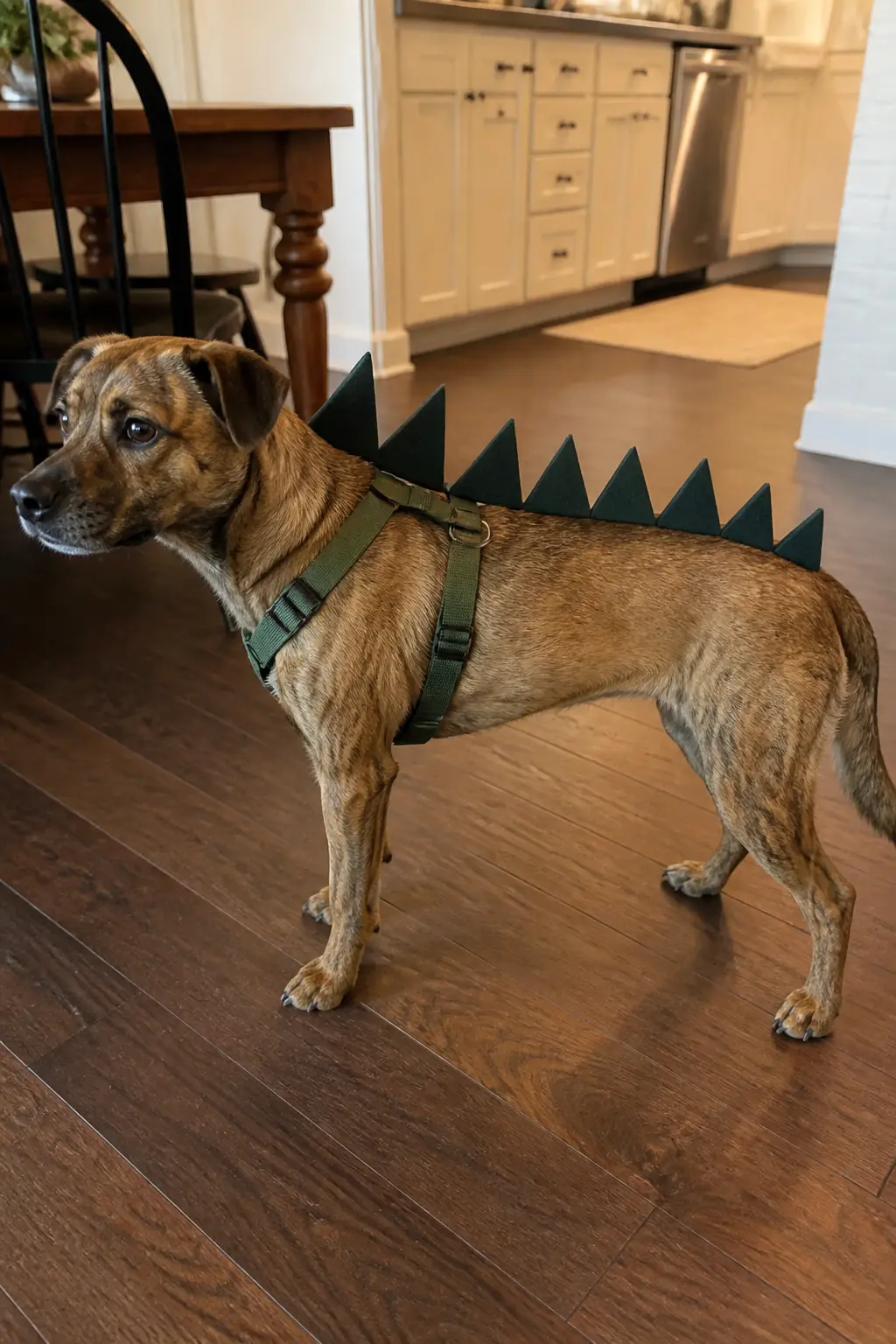
Dragon Spine Ridge
Cut a row of graduated triangles from forest-green craft foam, largest at the shoulder and tapering down to the tail. Punch two small holes at the base of each triangle and thread a ribbon through all of them so they sit in a line, like vertebrae. Tie the ribbon ends to the back D-rings of a harness.
The ridge floats just above the spine and sways a little when the dog walks, which is exactly what makes it photograph so well in motion. Works best on a medium-to-large dog with a level back.
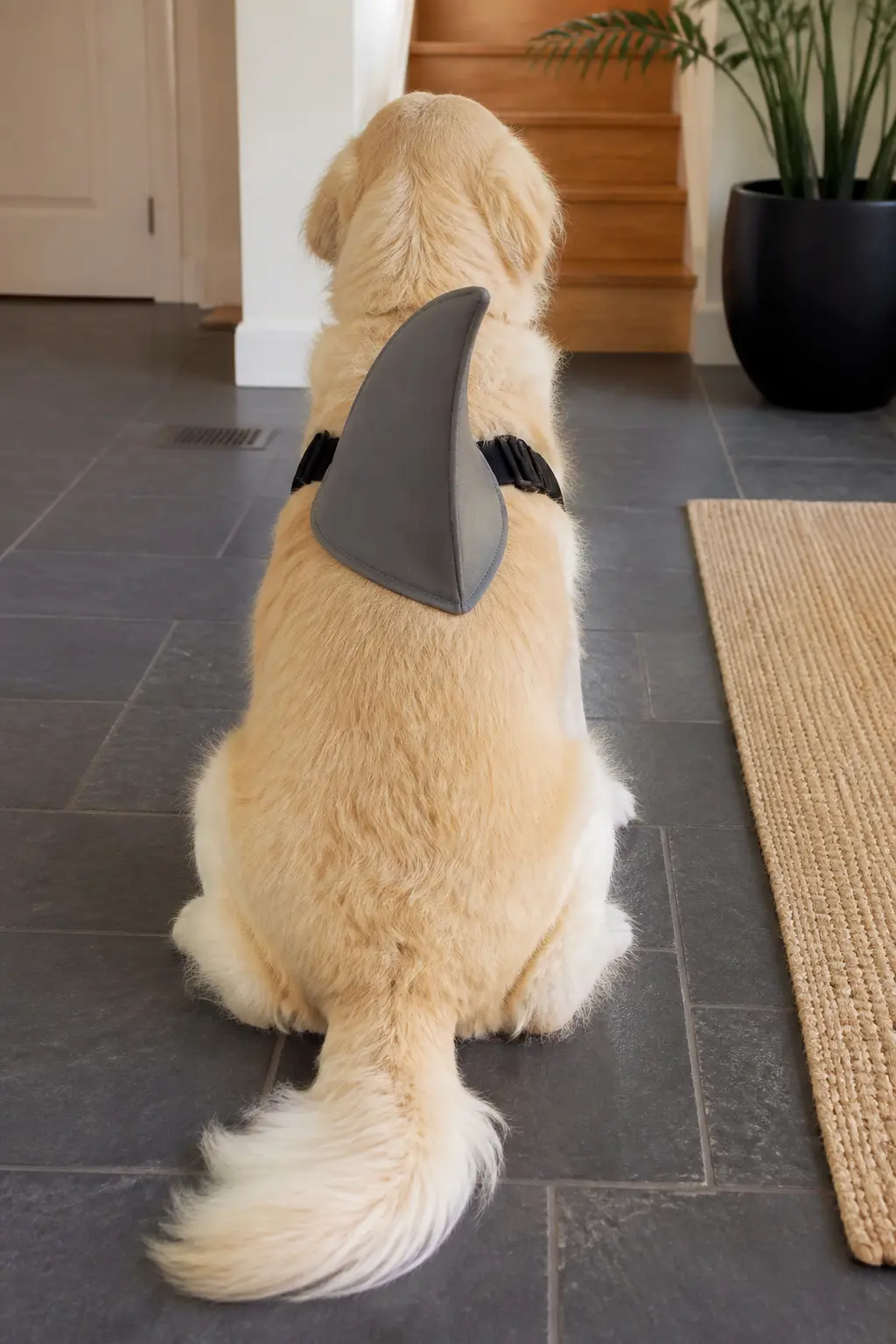
Shark Fin
One stiff grey foam triangle, about six inches tall, with a flat base that velcros to the widest back strap of the harness. Score and bend a slight backward lean into the fin before the glue sets. That lean is what makes it read as speed rather than a party hat.
Grey or blue dogs disappear into the joke. A pale golden dog against a dark floor creates the most contrast. Keep the background simple: this costume needs no help.
Cone Collar Transformations
A soft or clear plastic e-collar becomes a bowl, a dish, a frame. The dog’s face is the food. This category photographs better than almost anything else because the composition is built in: face centered, prop surrounding it, done.
Buy a cone one size up from what your vet would prescribe, so there is room to glue things to the rim without crowding the dog’s ears.
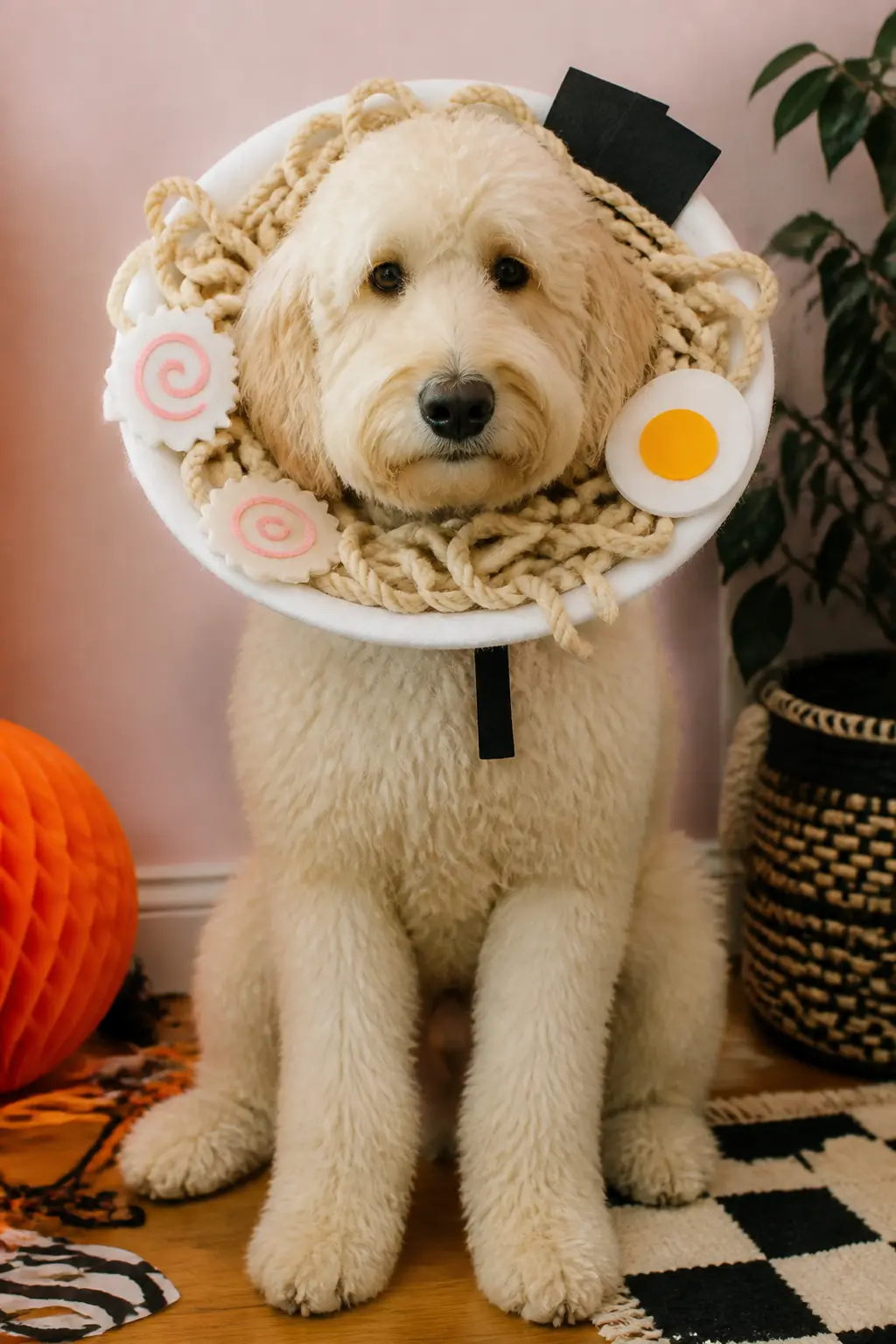
Ramen Bowl Collar
Take a soft e-collar one size up, cover the outside with white felt, and hot-glue cream-colored rope yarn around the rim to suggest noodles. Cut a narutomaki swirl and a half-egg from white and orange craft foam, glue them to the rope, and add a few snipped green pipe-cleaner rings for scallion. A bamboo skewer taped to the outside of the cone completes the bowl illusion.
The dog’s face becomes the broth. Fluffy cream or apricot dogs sell this hardest, but any dog with a calm expression in front of a plain wall will land it. Photograph straight on, portrait orientation.
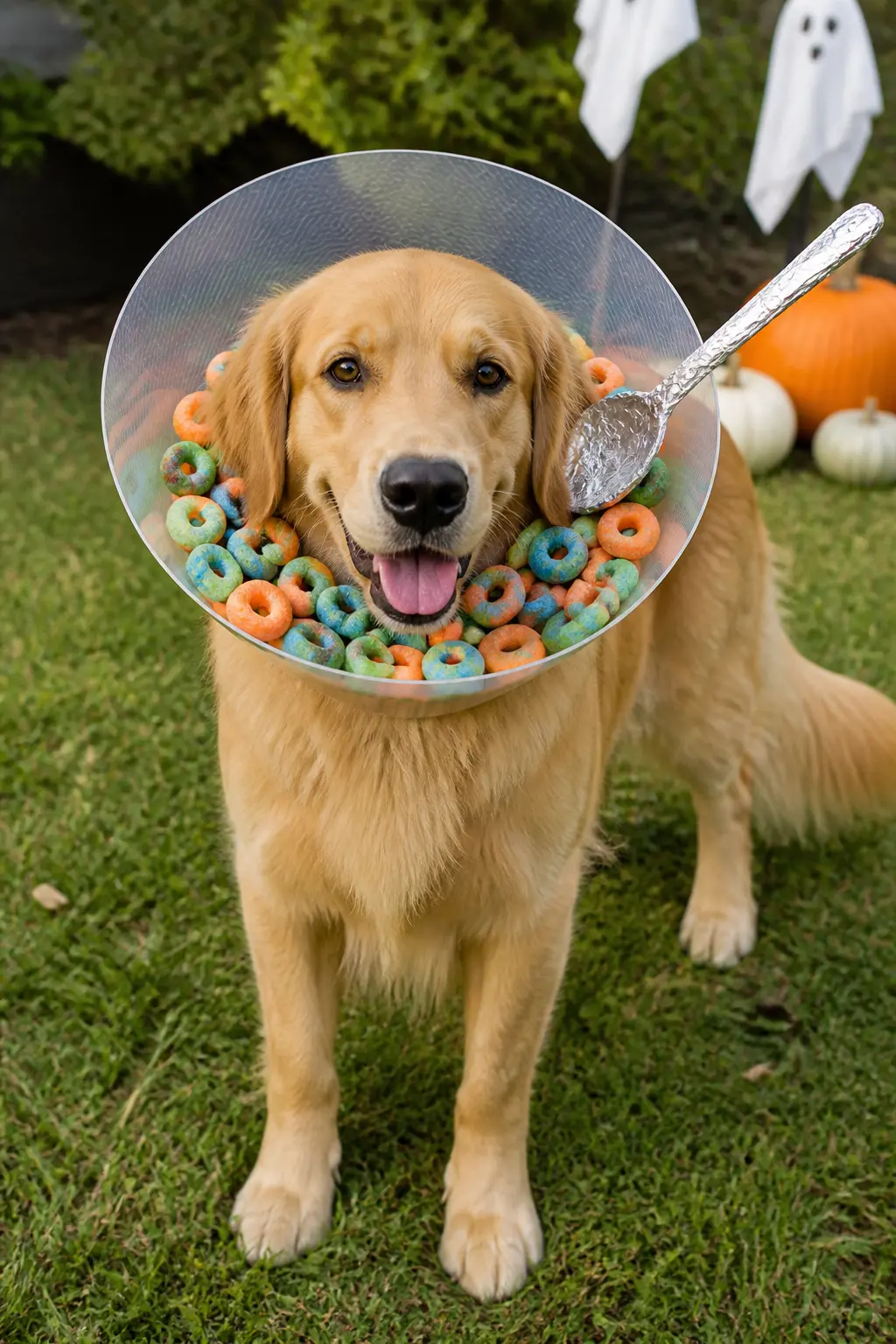
Cereal Bowl Collar
A clear plastic e-collar is already translucent, which reads as a bowl without any painting. Hot-glue foam pool-noodle rings (cut about an inch thick) in orange, blue, and green around the inside of the cone. Wrap a strip of foil around a chopstick and tape it to the outside at a diagonal for the spoon.
A golden-coated dog photographed against a wooden fence or a neutral wall looks exactly like a cereal advertisement gone wrong, which is the entire point. Shoot from slightly above so you see the rings inside the cone.
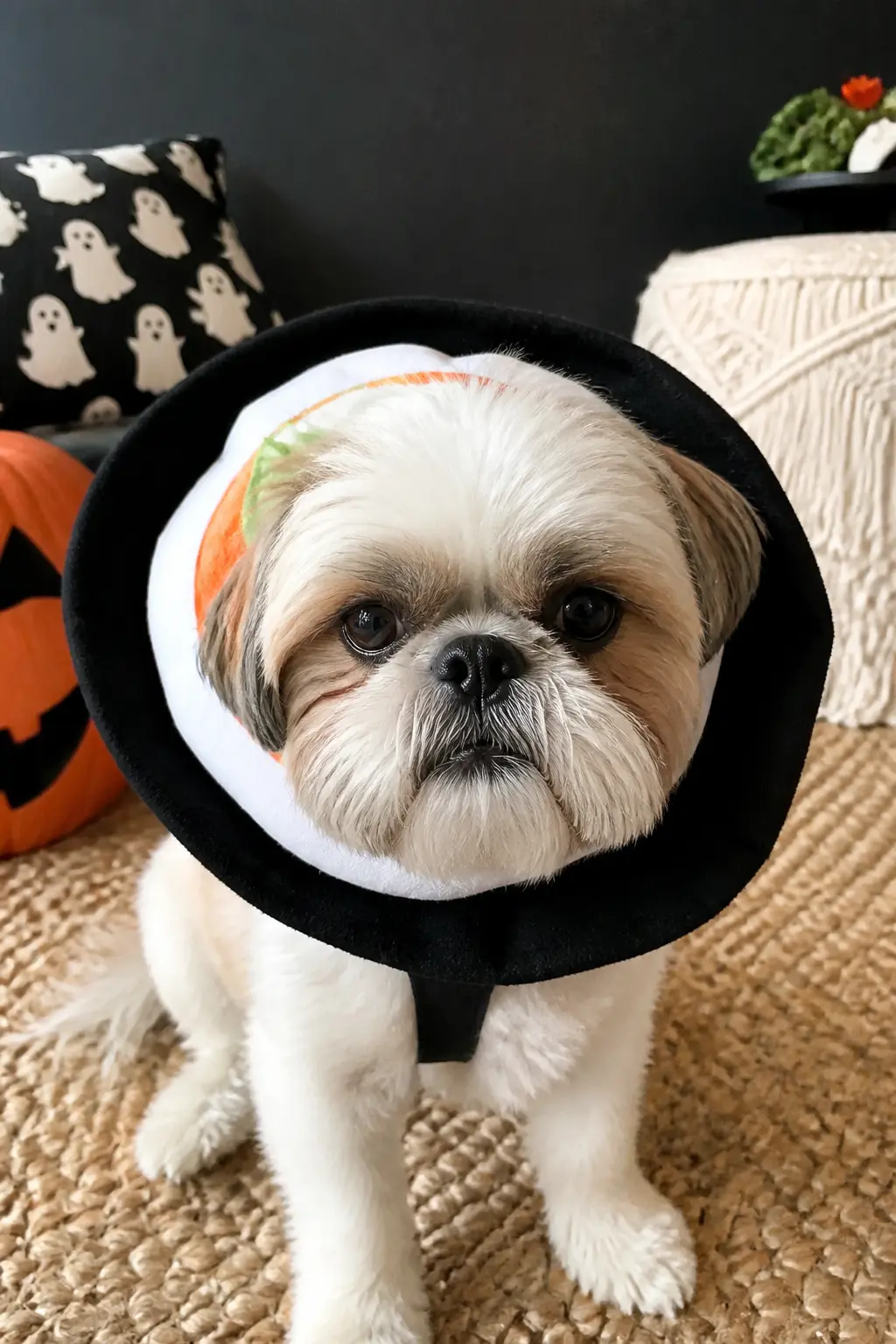
Sushi Roll Collar
Cover the outside of a soft cone with black felt, then wrap a band of white felt around the lower rim. The dog’s face is the fish. Add a strip of orange foam at the top edge of the white band for salmon color, and that is genuinely it: three materials, one joke that reads from twenty feet away.
Small dogs with round faces and wide eyes photograph best here because they look the most like actual fish. Photograph against a dark background so the white band pops.
🛍 Shopping guide
Cardboard Body Shells
Corrugated cardboard is light, easy to score and bend, and takes acrylic paint well. Cut a body-shaped panel, paint it, and attach it with two ribbon loops that rest over the harness. The dog reads as a completely different creature from twenty feet away.
Score the back of any curve you want before bending: it will not crack, and it will hold the arc all evening.
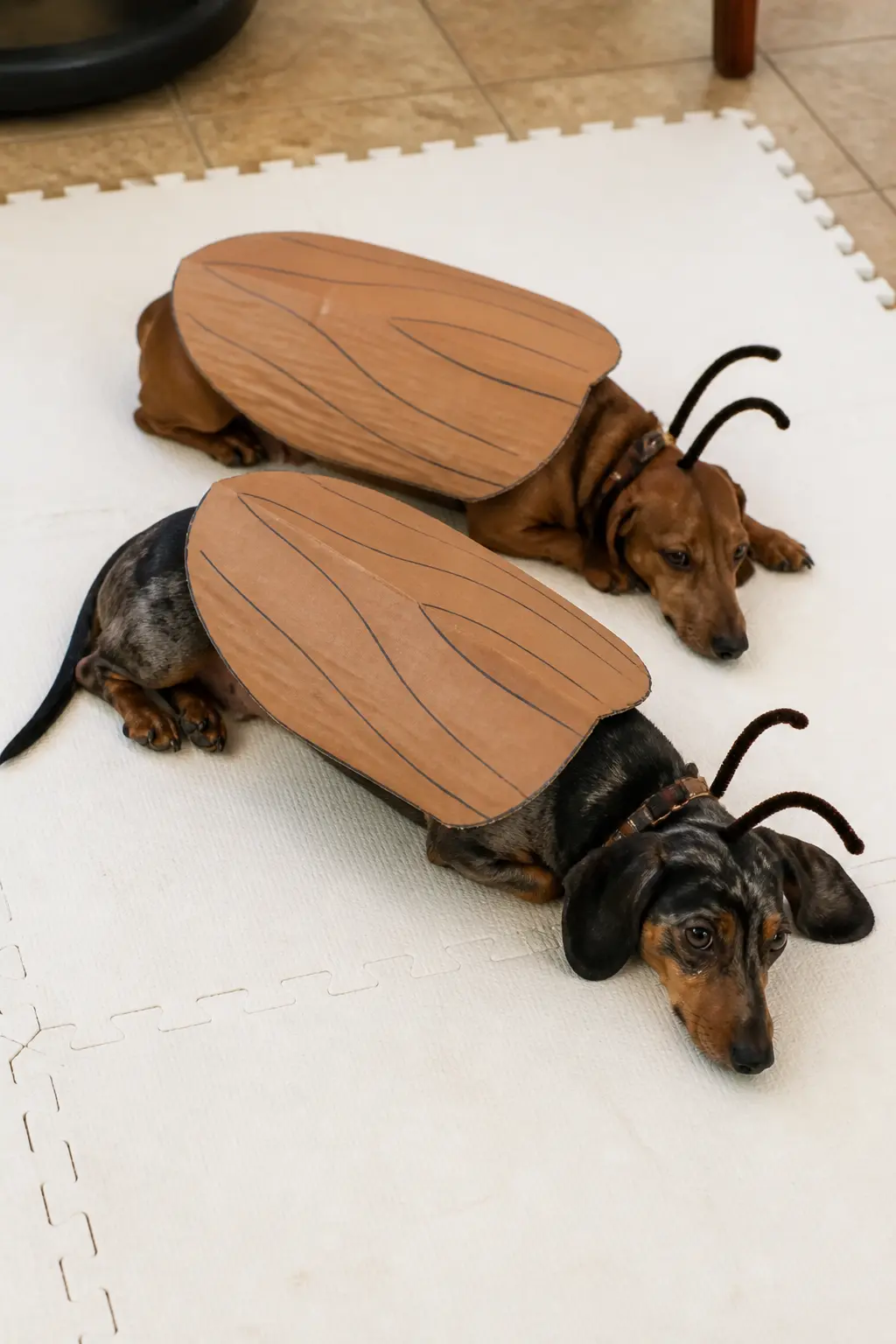
Giant Cockroach Shell
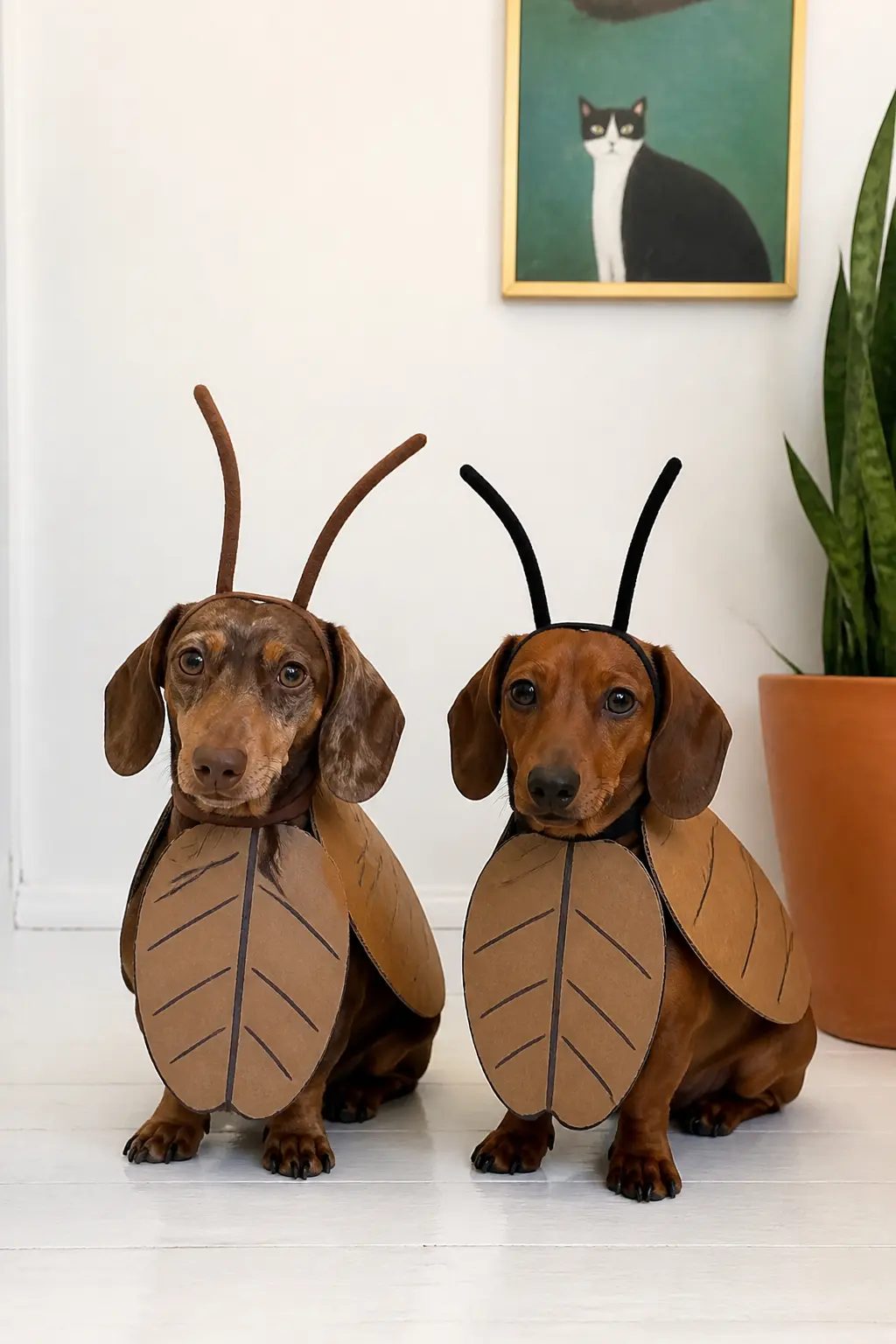
Trace a wing shape onto corrugated cardboard, two panels meeting at a centre seam, and draw parallel lines across them with a brown marker to suggest wing venation. Paint the whole piece in warm brown, let it dry, then run a darker brown wash over the lines. Punch four holes along the centre seam and thread ribbon through to tie under the dog’s belly over the harness.
Pipe cleaner antennae clip to the collar: two brown ones for a cockroach. Long low dogs own this costume. The elongated body reads as an abdomen before you even add the wings, and two matching dogs together push it into performance-art territory.
🛍 Shopping guide
Turtle Shell
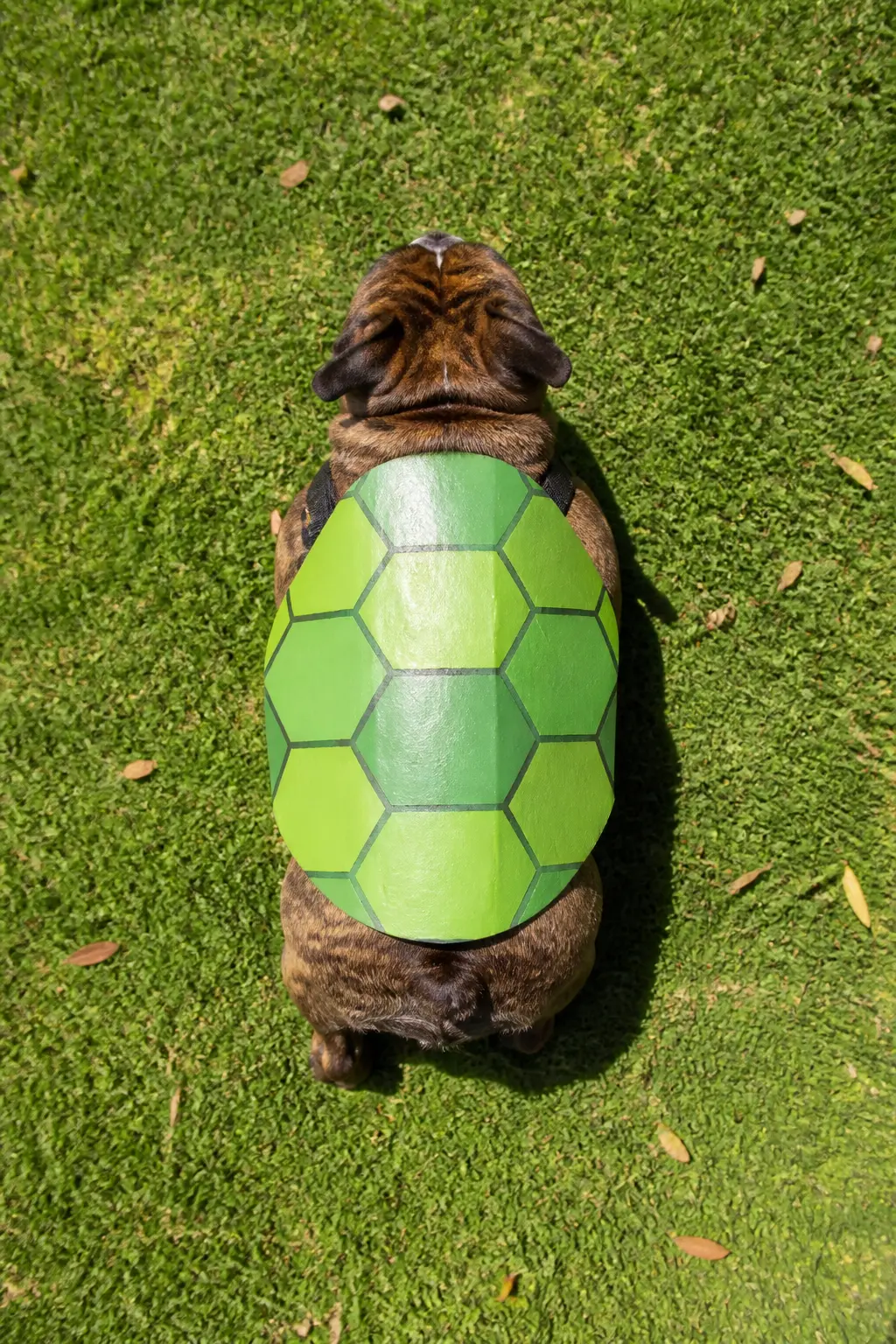
Cut a rough oval from cardboard, score a hexagonal grid across the top with a ballpoint pen, and paint it dark olive green with lighter green inside each hexagon. Glue a layer of thin foam underneath to give the shell a slight dome. Two ribbon loops hang from the short ends and rest over the harness back strap.
Bulldogs, pugs, and any dog with a naturally low, wide stance disappear into this costume in the best possible way. Photograph from directly above on a grass or green surface for the most coherent image.
Lobster Claw Backpack
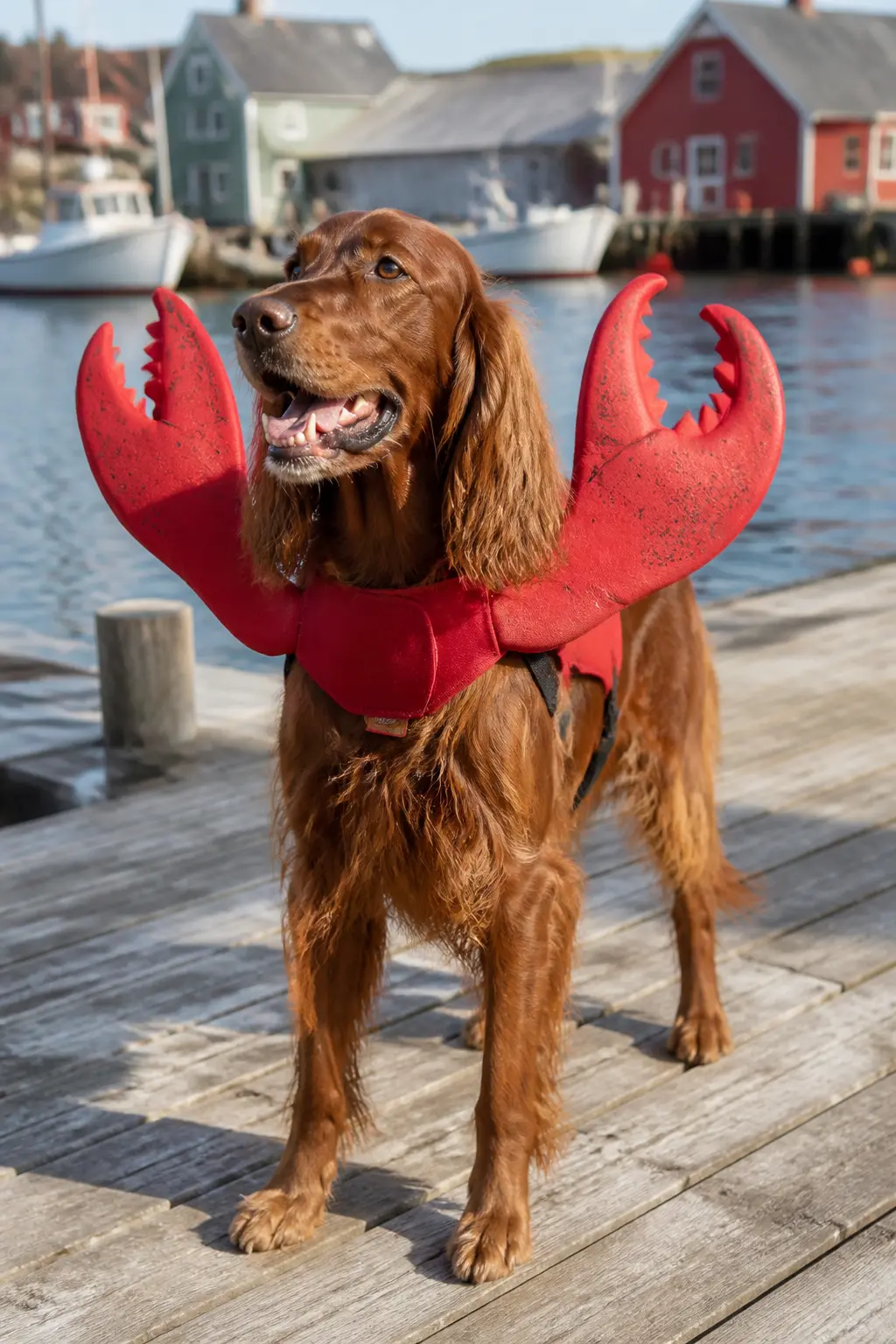
Cut two oversized claw shapes from red craft foam, score the hinge line and fold, then stuff the fold lightly with cotton batting to hold the claw open. Glue each claw to the shoulder section of a red dog shirt or harness panel. The dog now appears to be a lobster holding its claws aloft at all times, which suits the energy of most retrievers precisely.
Red dogs (Irish setters, red-coated mixes) blend into the costume and look like the whole animal. Pale dogs create a sharper contrast. Shoot outdoors near a weathered wood surface for the seafood-shack reference to land.
Food Costumes
The dog-as-food genre works because the absurdity is immediate and the materials are everywhere. Foam noodles, pipe cleaners, craft foam cut into egg shapes, all of it glues to a cone or a cardboard ring with a hot-glue gun in under an hour.
Pick a food with a strong silhouette. Ramen, cereal, sushi, taco: anything that reads in a thumbnail.
Taco
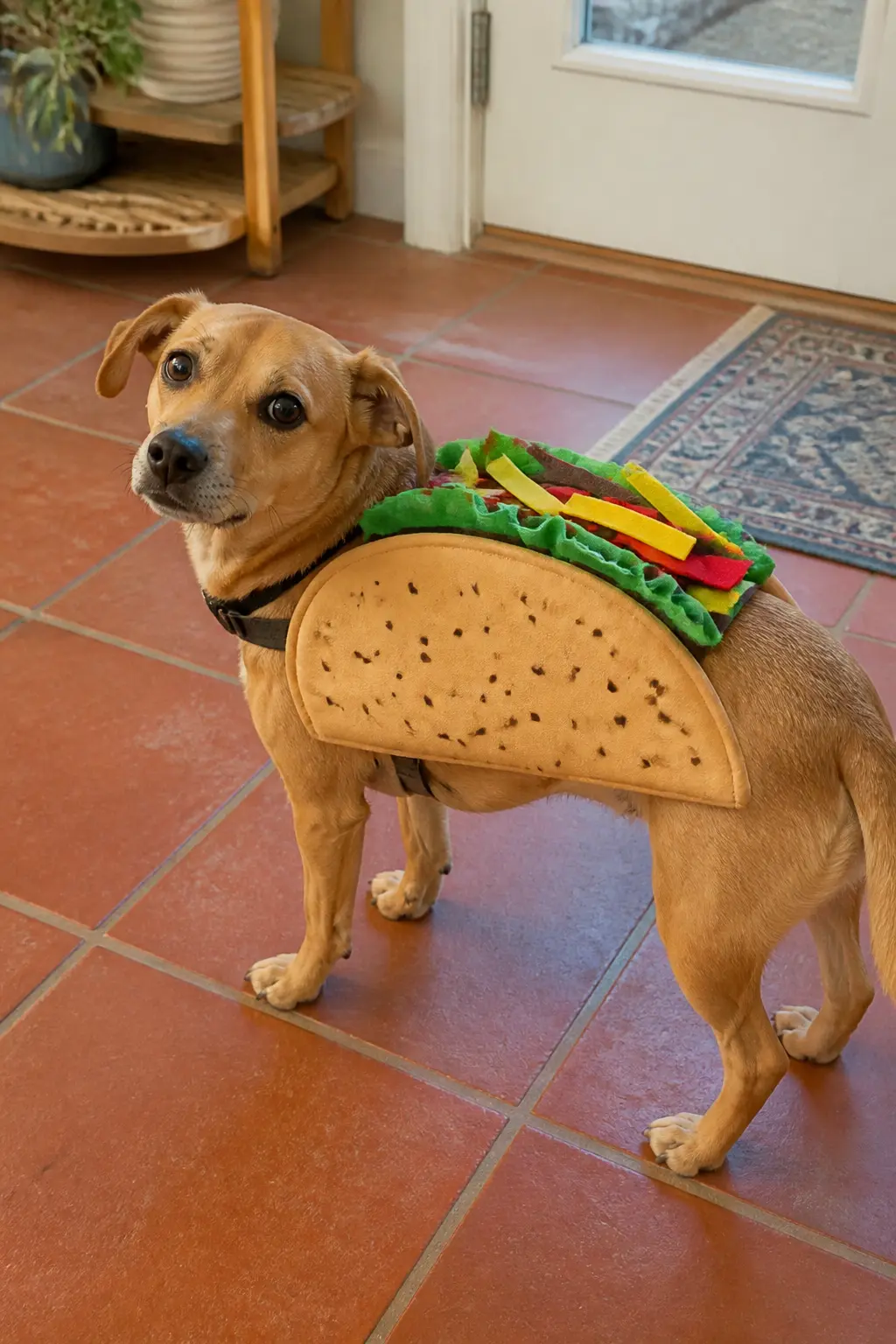
Cut a half-circle from tan felt and fold it gently in half: that is the tortilla shell. Hot-glue strips of green felt (lettuce), red felt (tomato), and yellow felt (cheese) along the fold. Attach the whole piece to a back harness strap with two velcro patches so it sits upright on the dog’s back like an open taco standing on its edge.
A medium dog with a tawny or brown coat looks like the meat filling, no additional prop needed. The taco reads best from a slight overhead angle so you see into the fold. Keep the background neutral so the felt colors pop.
Fried Egg
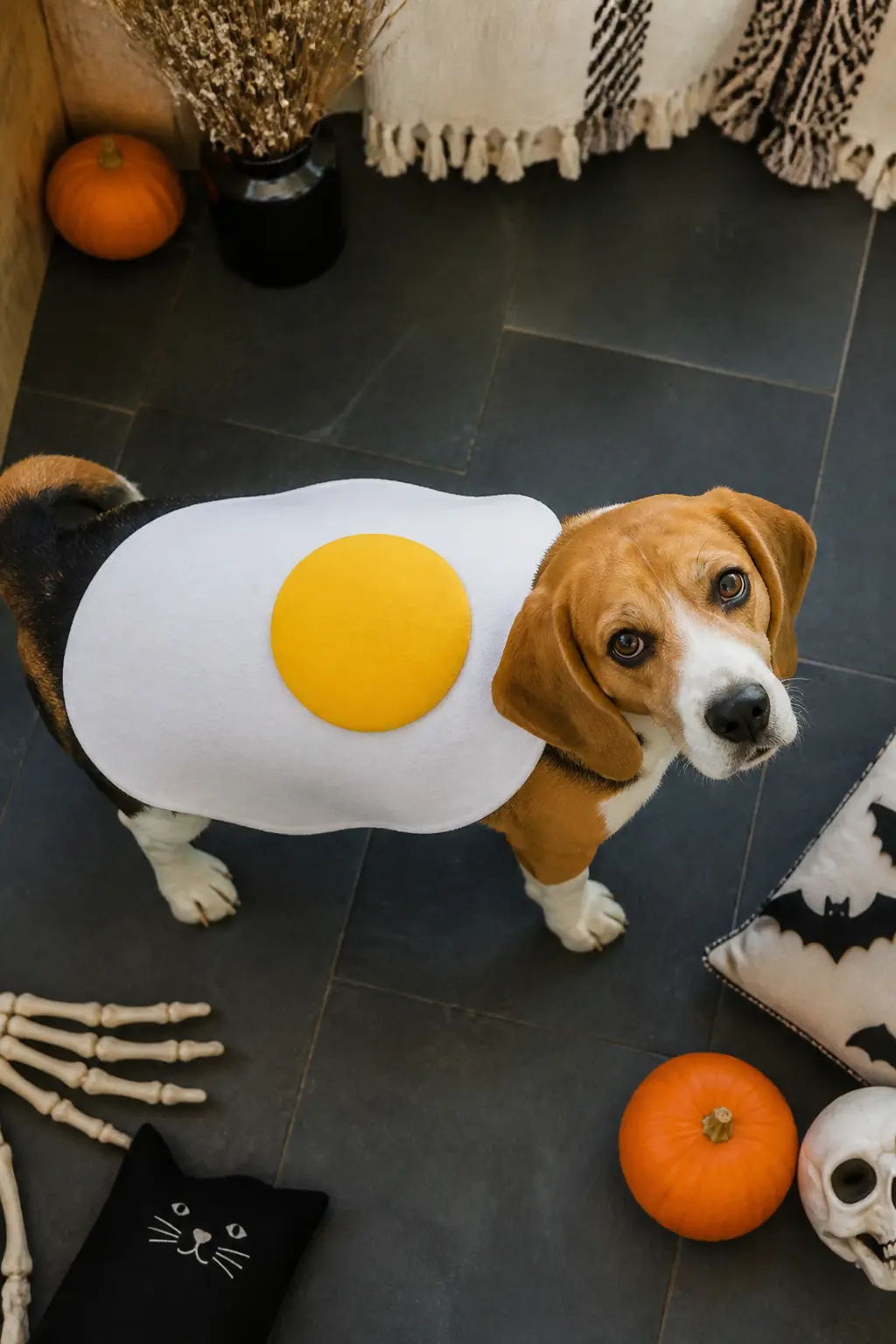
Cut a large irregular white felt oval for the white, then a yellow foam circle for the yolk. Layer them, sew or glue together, and attach a ribbon loop at each short end so it drapes over the dog’s back like a saddle. The dog is the pan. Short, flat-backed dogs wear it flattest and read clearest.
This photograph works best from directly above, looking down at the dog’s back, which is not the angle most pet photos are taken from. That alone makes it stand out in a feed. Shoot on a dark floor to make the white pop.
🛍 Shopping guide
Hot Dog in a Bun
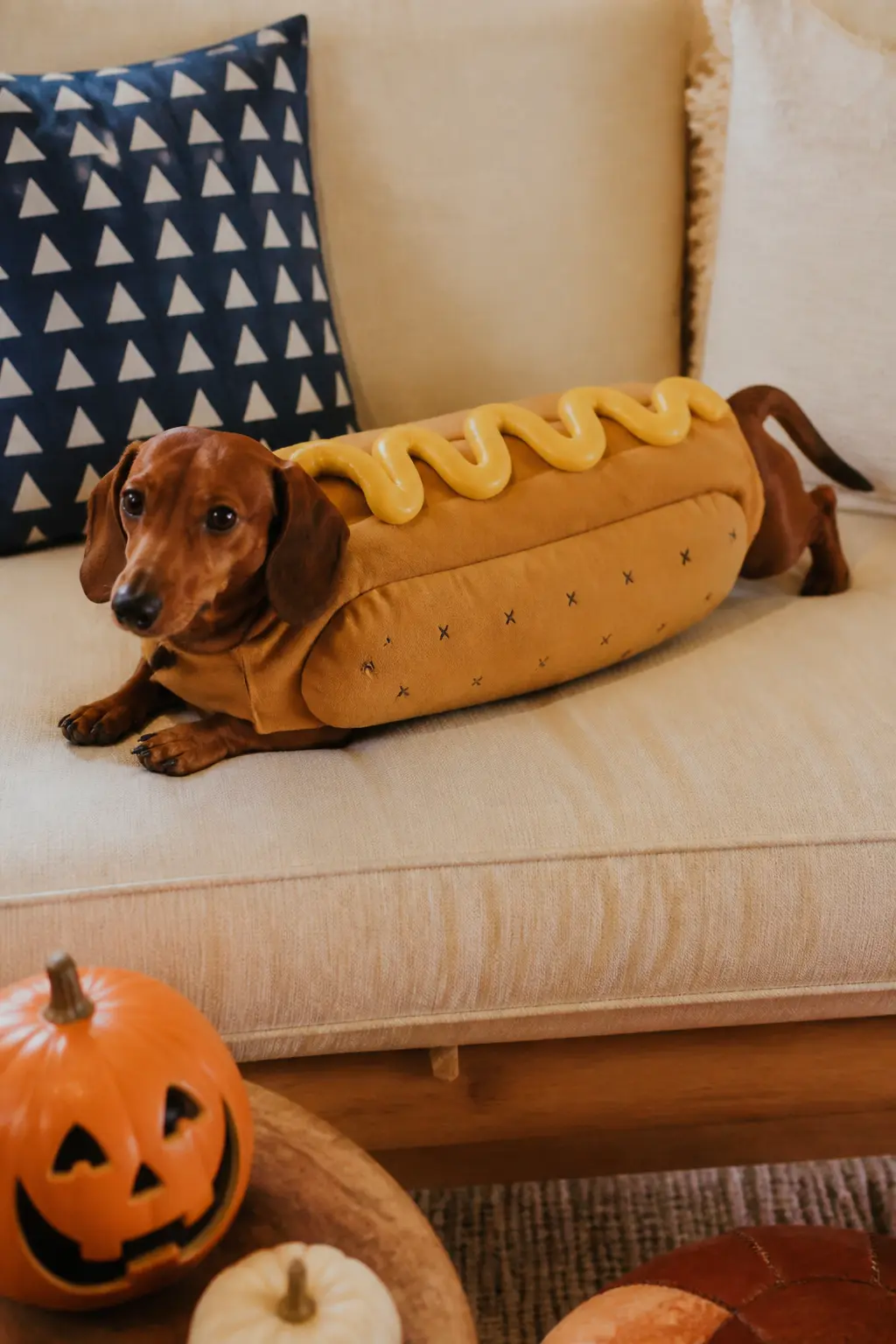
Sew or hot-glue two long tan felt panels together along the bottom edge, leaving the top open: that is the bun. Paint or cut a mustard-yellow zigzag from yellow felt and lay it along the top. Slip the whole thing over a dachshund like a sleeping bag, leaving the head and tail out. Close the sides with velcro so it sits snug without constricting.
The dachshund’s own body color does every bit of the sausage work. Reddish-brown coats are the most convincing. A slightly overhead angle from the side shows the mustard line and the dog’s face in the same frame.
🛍 Shopping guide
Croissant
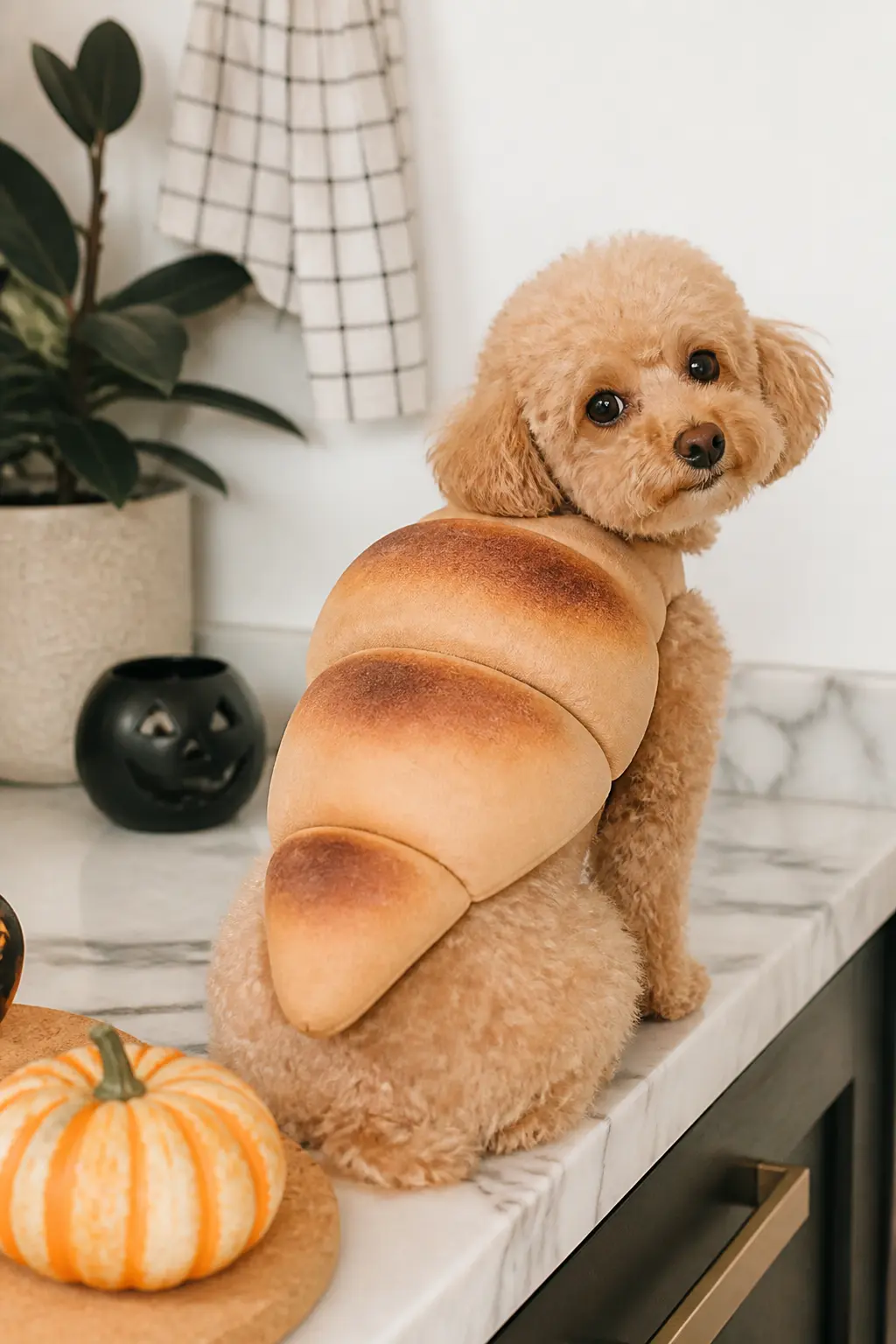
Cut a long curved crescent shape from tan felt, stuff it lightly with fiberfill to give it volume, and close the edges with a whipstitch or a line of hot glue. Paint the top with a diluted brown wash for the baked look. Attach velcro tabs to the underside and press them to the harness back strap.
Cream, apricot, and caramel-coated dogs photograph as if they are actually made of pastry. This costume earns its keep on a fluffy dog because the coat texture reads as layers. Photograph in morning light near a kitchen window for the brunch-table reference.
🛍 Shopping guide
Paired and Multi-Dog Costumes
Two dogs in matching costumes doubles the comment count on any post, and the effort is barely more than making one. Cut two sets of identical pieces on the same afternoon. Same paint batch, same ribbon, done.
Long, low dogs are the easiest canvas for a paired body-shell look because the shape is already comedic before you add a single prop.
Matching Cockroaches
Follow the cardboard shell method above, make two identical sets in one session, and paint both from the same brown-and-dark-brown paint batch so the color matches exactly. The antennae matter: use two different shades of brown pipe cleaner between the two dogs, one dog gets warm brown, the other gets near-black, so you can tell them apart in the photo.
Keep both dogs on a plain light surface so the brown wings read clearly. An overhead shot turns this into a creature illustration. A straight-on shot at ground level turns it into a horror film still, which is also correct.
🛍 Shopping guide
Salt and Pepper Shakers
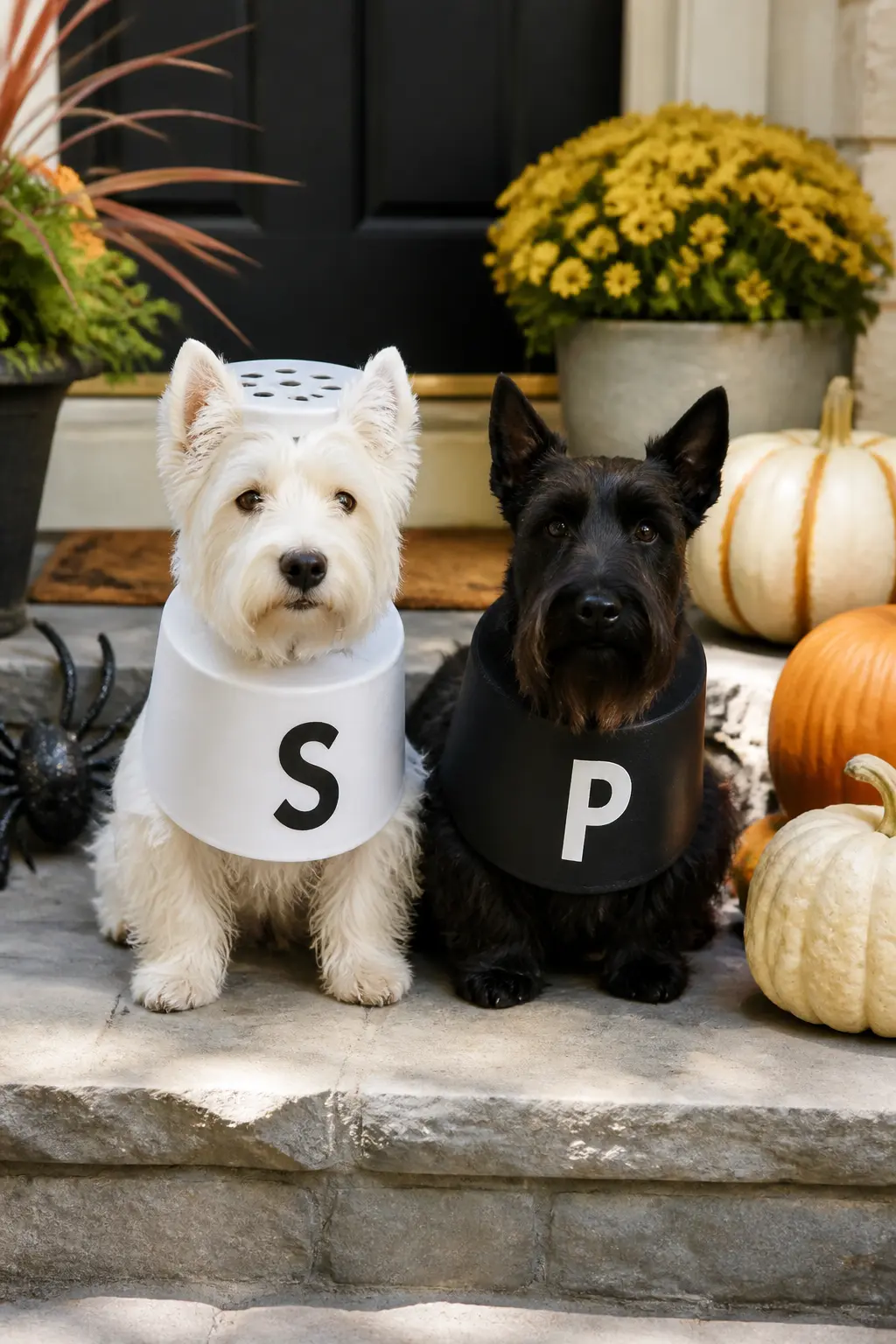
Make two cylinder collars from thin cardboard: one white, one black. Write ‘S’ and ‘P’ in a simple serif font on each in the contrasting color. Punch dots across the lid of each cylinder (a hole punch does this in ten seconds) and glue the cylinder to a collar attachment plate that hooks to the dog’s existing collar.
A black-and-white dog pair is the obvious casting, but a white Westie and a black Scottish terrier would be the correct answer if you happen to own that combination. Photograph from slightly above so you see both cylinder tops at once.
Ketchup and Mustard
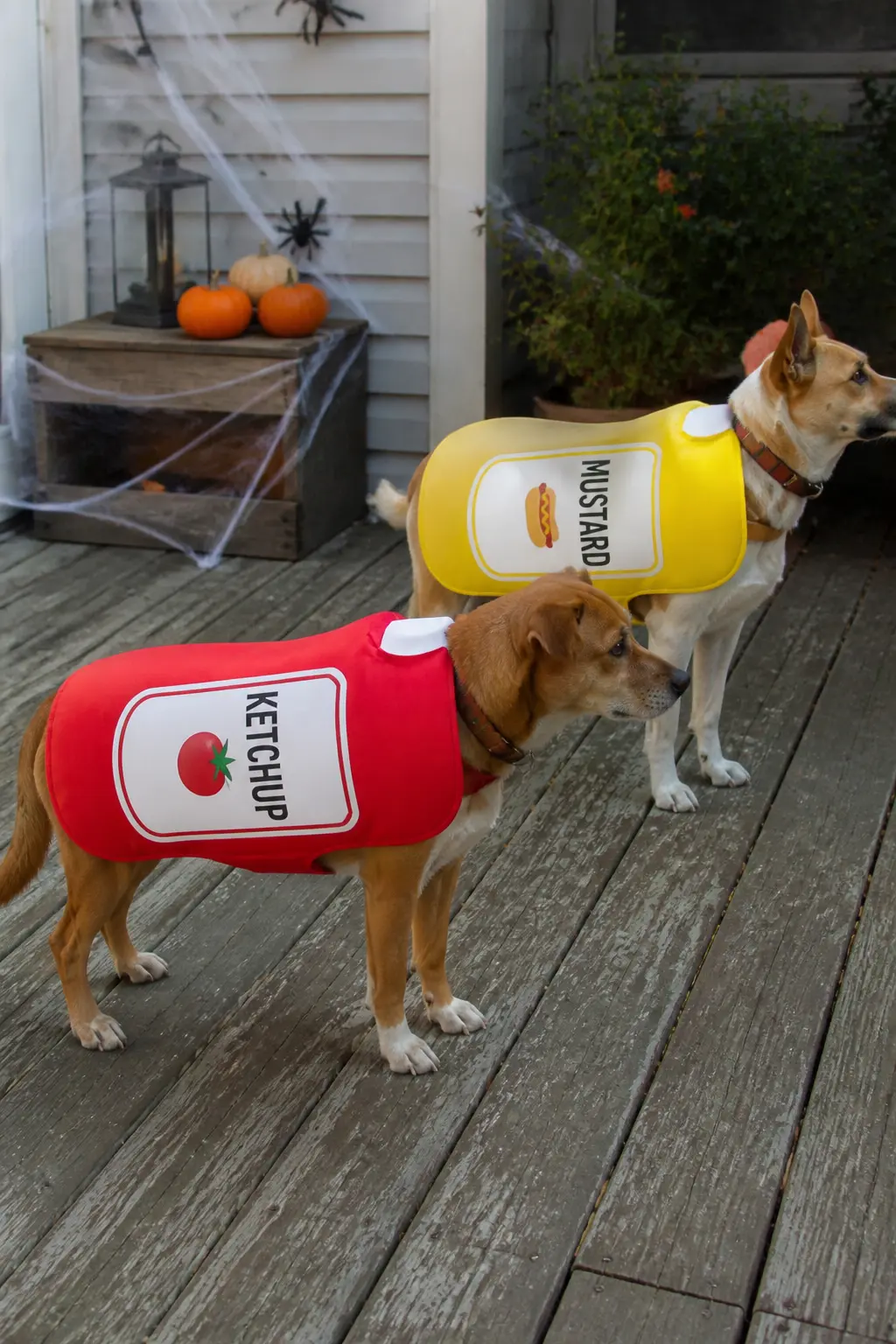
Cut a large bottle silhouette from red craft foam for one dog and yellow for the other. Each panel attaches to the harness back with velcro. Write the condiment name in white marker across the label area, add a simple rectangular cap shape at the top, and the read is instant even from across a yard.
Any two dogs of similar size work. Medium breeds with short, flat coats show the color panels most clearly. Photograph outdoors at a barbecue or on a back-deck surface so the scene makes immediate contextual sense without any explanation.
🛍 Shopping guide
Minimalist One-Piece Looks
Sometimes the funniest costume is the simplest one: a single accessory placed with precision. A tiny chef’s toque on a bulldog. A velvet scrunchie collar on a standard poodle. The dog’s expression does the rest of the work.
These are also the costumes dogs tolerate longest, which matters if you are taking the dog to a party rather than just onto the front step for a photo.
Tiny Chef’s Toque
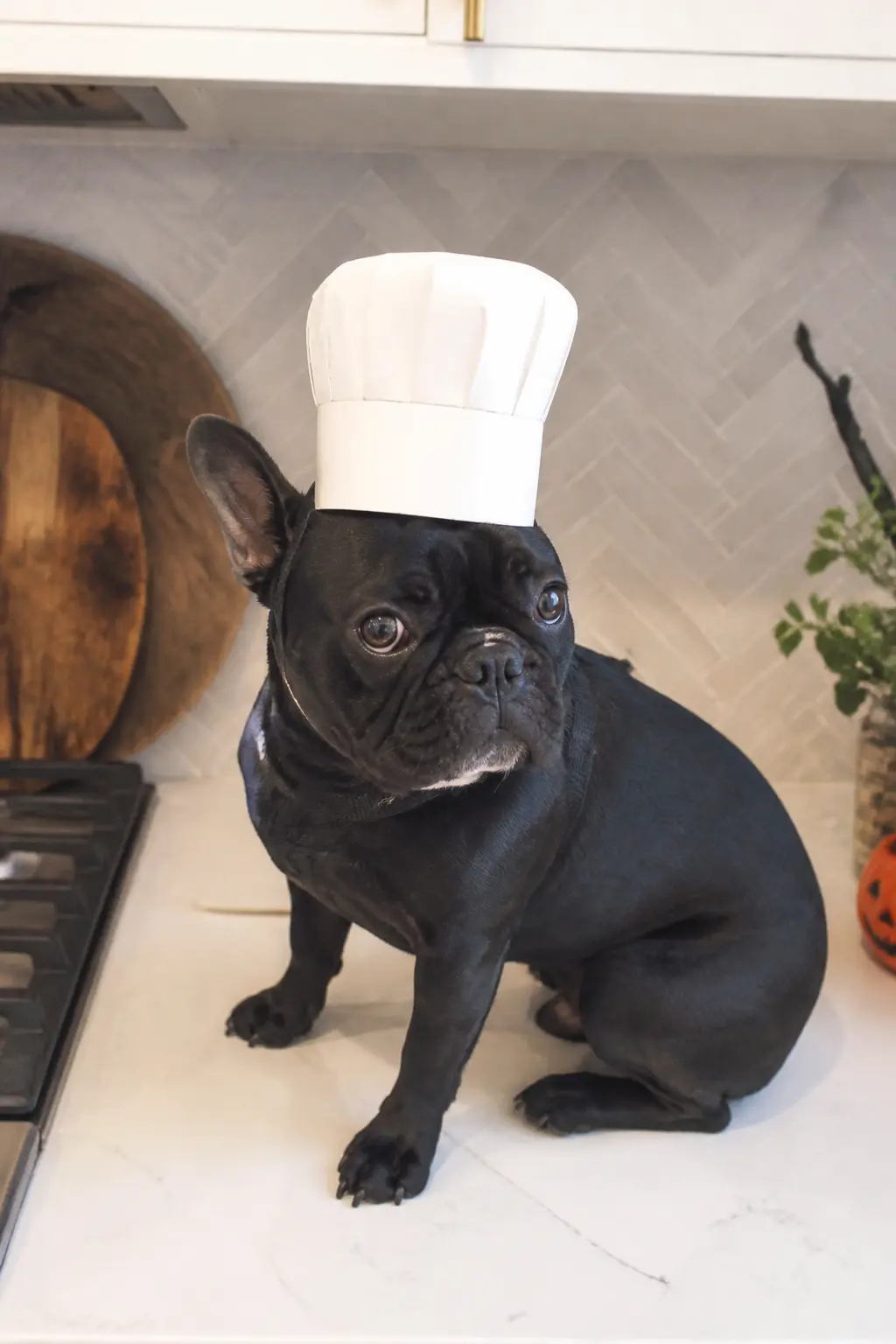
Roll a strip of white cardboard into a cylinder, glue it closed, then stuff a white fabric circle into the top to create the puff. Attach two narrow elastic loops to the base that hook around the dog’s ears or sit behind them on the skull. Photograph immediately, because this is the costume most likely to stay on without a fight.
Flat-faced dogs (French bulldogs, pugs, Boston terriers) wear the toque with the most deadpan authority. A dark-colored dog against a kitchen backdrop makes this feel like a magazine editorial. That is the shot worth going for.
Vampire Cape Collar
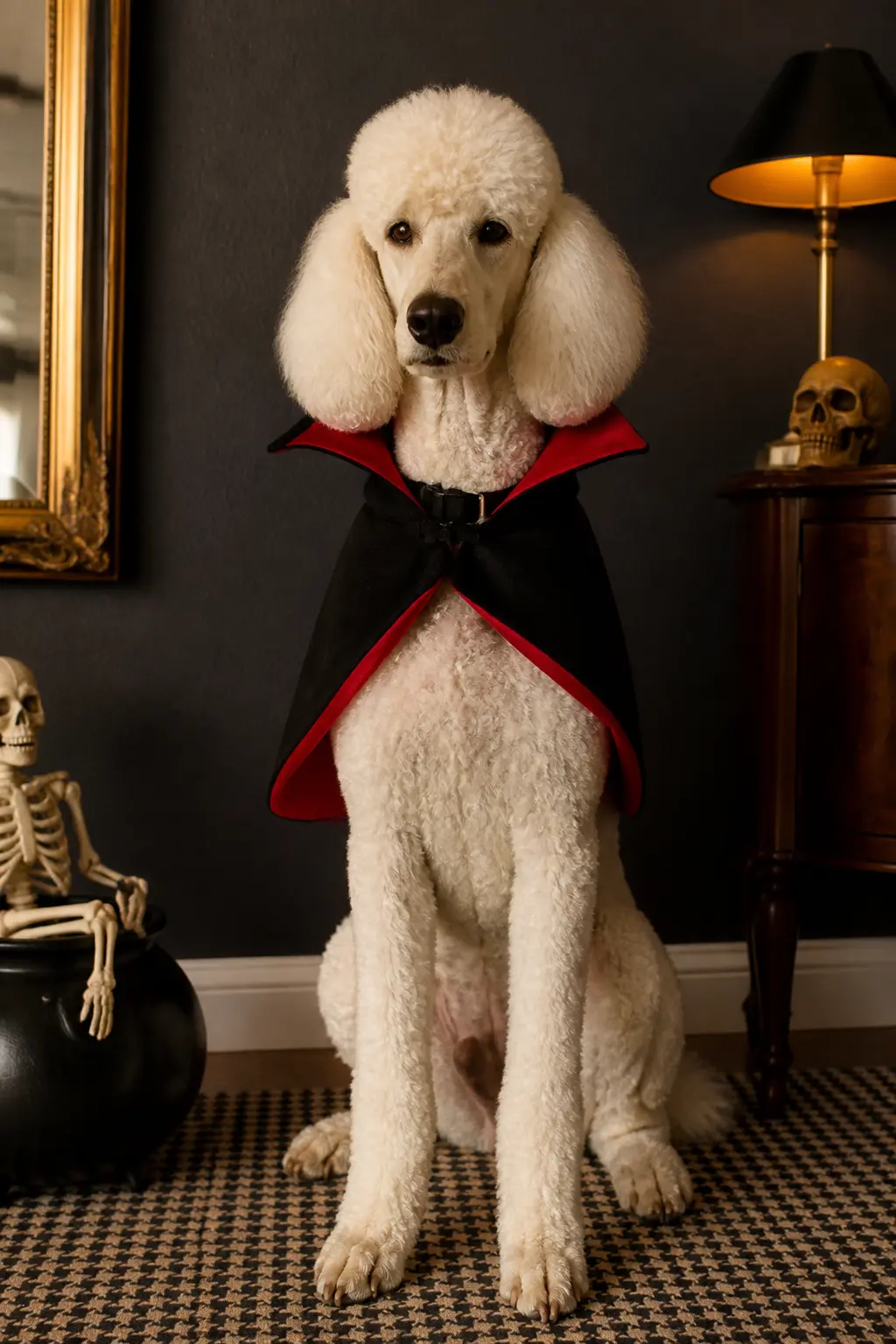
Cut a short half-circle from black felt, no longer than the dog’s shoulder blades, and line the inside edge with red felt. Add a simple tie or velcro closure at the neck. That is the cape. Nothing else. The costume lives or dies on proportions: the cape should be short enough that it does not catch the dog’s back legs when it moves.
Dogs with naturally serious or imperious expressions carry this with the most style. Long-eared dogs gain a bonus because the ears frame the collar like a high-fashion neckline. Photograph at eye level against a dark wall in warm candlelight or low amber lamp light.
🛍 Shopping guide
Skeleton Jacket
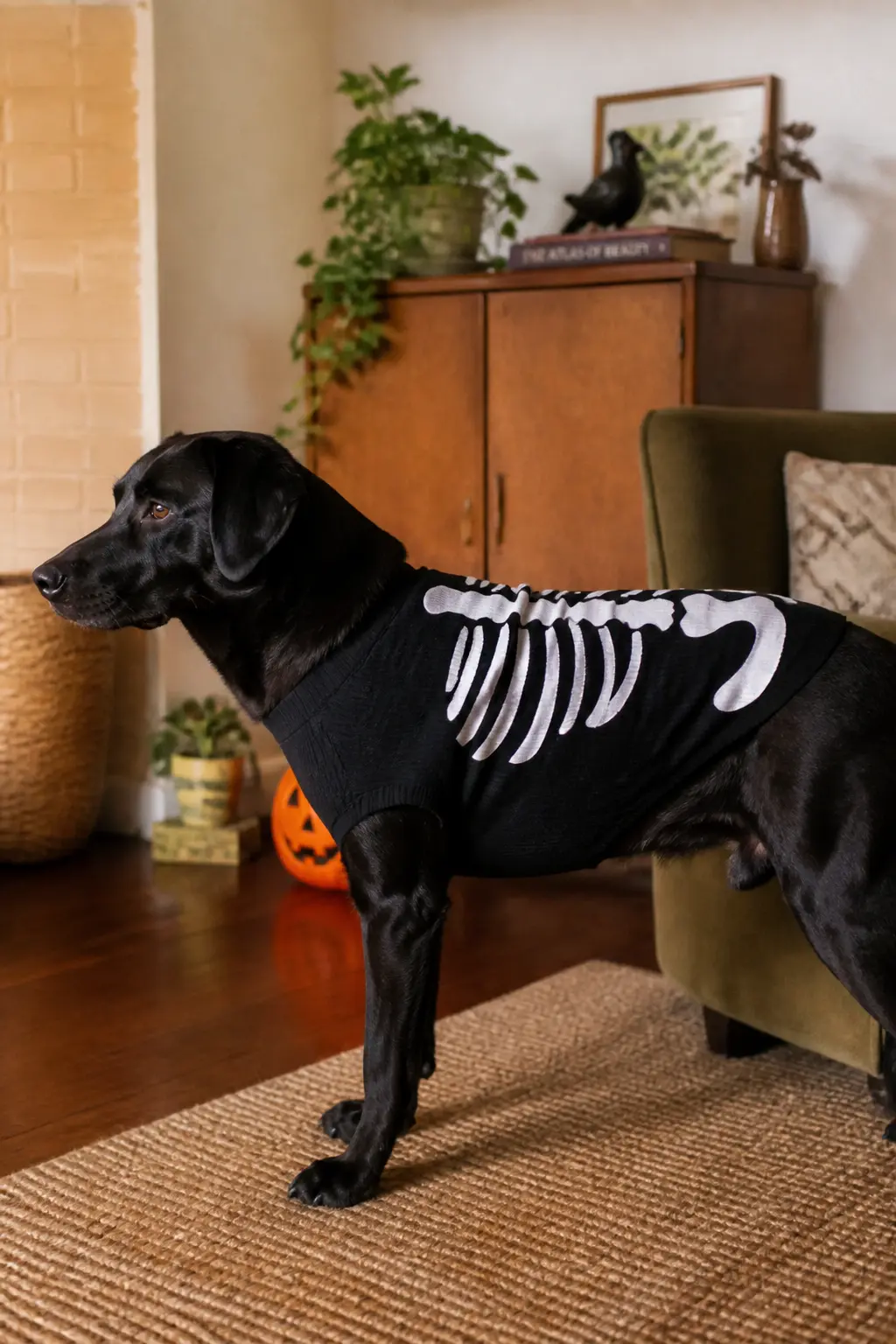
Buy a plain black dog sweater one size up, then use white fabric paint and a flat brush to paint a simplified ribcage and spine directly onto the fabric. Let it cure fully before putting it on the dog. The paint flexes with the knit if you use fabric-specific paint, so it will not crack after the first wear.
Black dogs wearing a black sweater disappear from the waist down in low light and the skeleton floats mid-air in photographs. That is an accidental special effect worth staging on purpose: shoot in a dim room with a single lamp behind the camera.
Plant in a Pot
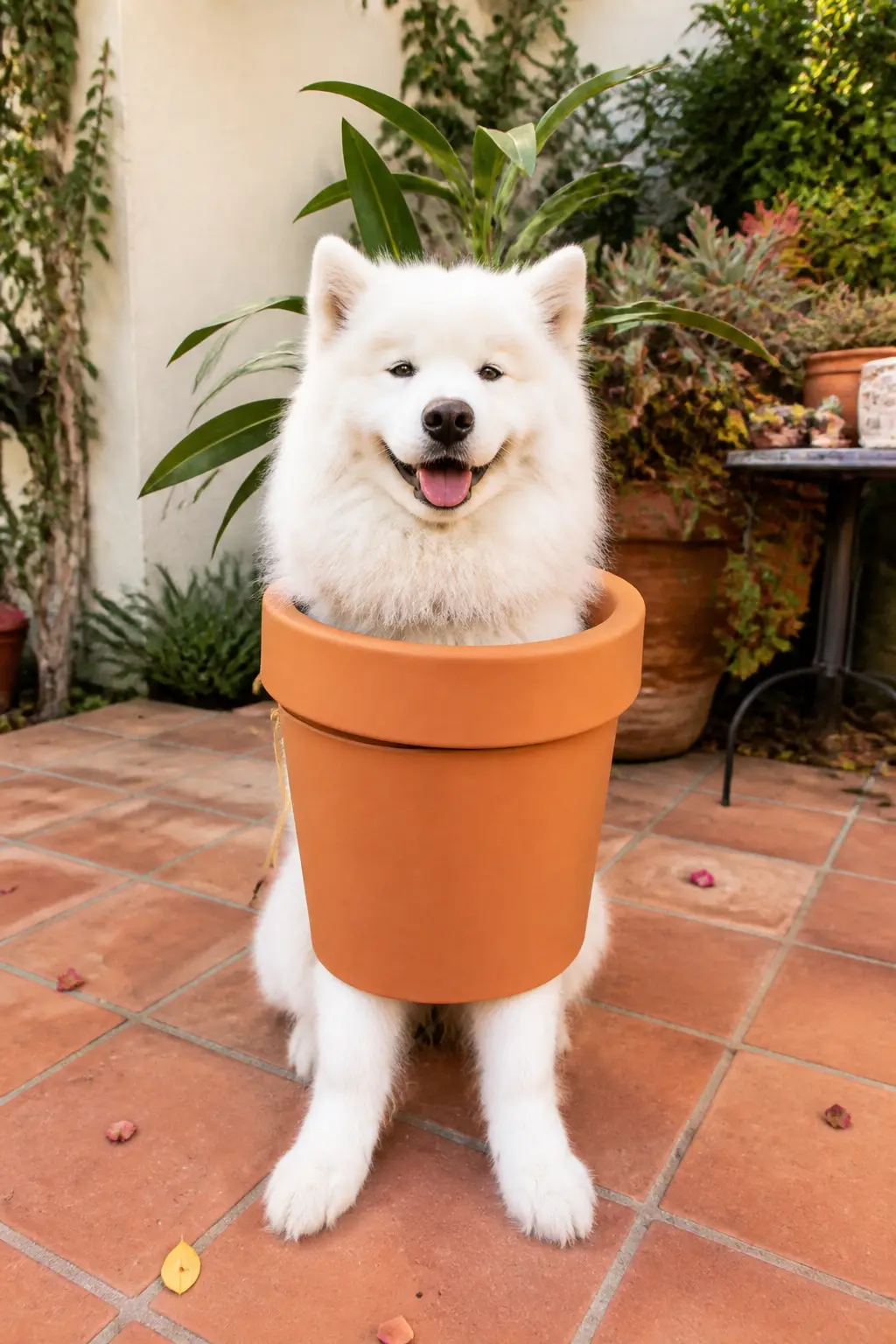
Cut a terra-cotta pot silhouette from orange-brown craft foam, large enough to cover the dog’s lower half when viewed from the front. Punch two holes at the top corners and run a ribbon through them to tie behind the dog’s back. The dog’s head and upper body become the plant growing out of the pot.
Fluffy dogs, especially those with green-tinted or mossy-toned coats (unlikely, but you know the dog), look extraordinary. Any dog with a large head relative to its body makes the proportions work. Photograph straight-on at ground level, close, so the pot edge and the dog’s face are both sharp.
🛍 Shopping guide
Frequently Asked Questions
How do you get a dog to keep a costume on?
Attach it to something the dog already wears, like a harness or a collar. Costumes that loop over bare legs or tighten around the belly are the first things dogs shed. Weight matters too: anything heavier than a light scarf will be shaken off within minutes. Do a five-minute test session before the actual day so the dog gets one boring practice run where nothing exciting happens and the costume becomes ordinary.
What materials are safe for a DIY dog costume?
Craft foam, felt, lightweight cardboard, and cotton fabric are all fine for short wear. Avoid small glued-on pieces that could be chewed off and swallowed, and skip any costume that covers the face, the ears, or restricts the dog’s mouth. Hot glue is safe once it is fully set and cool, but check every seam before you put the costume on the dog.
How long does a dog usually tolerate a Halloween costume?
Honestly, fifteen to forty minutes for most dogs, longer if the costume is light and attaches to a harness rather than the body directly. Take the photographs and the video in the first ten minutes. After that, let the dog be a dog.
Do cone collar costumes bother dogs?
Soft e-collars bother dogs much less than rigid plastic ones. Buy a size up from what your vet recommends so there is room to glue decorations on the outside of the rim without the inside pressing on the dog’s ears. Most dogs accept a soft cone within a few minutes, especially if they have worn one for post-surgery recovery before.
Which dog breeds suit which costume styles?
Long low dogs (dachshunds, corgis) suit body-shell costumes because the silhouette does half the work. Flat-faced dogs (French bulldogs, pugs, Boston terriers) suit collar-based costumes and single-prop headpieces because their expression sells the joke without any help. Large dogs with level backs suit harness-mounted props and saddle-style costumes. Fluffy dogs suit anything food-adjacent because the coat texture reads as filling or topping.
17 Halloween paper crafts that use only scissors, glue, and cardstock. Cut, fold, layer, and weave y
33 pink painted pumpkin ideas sorted by shade, from barely-there blush to hot pink, with every finis
Turn scattered props into 15 Halloween yard decorations that each tell a story from the street. Ever
Leave a Reply