

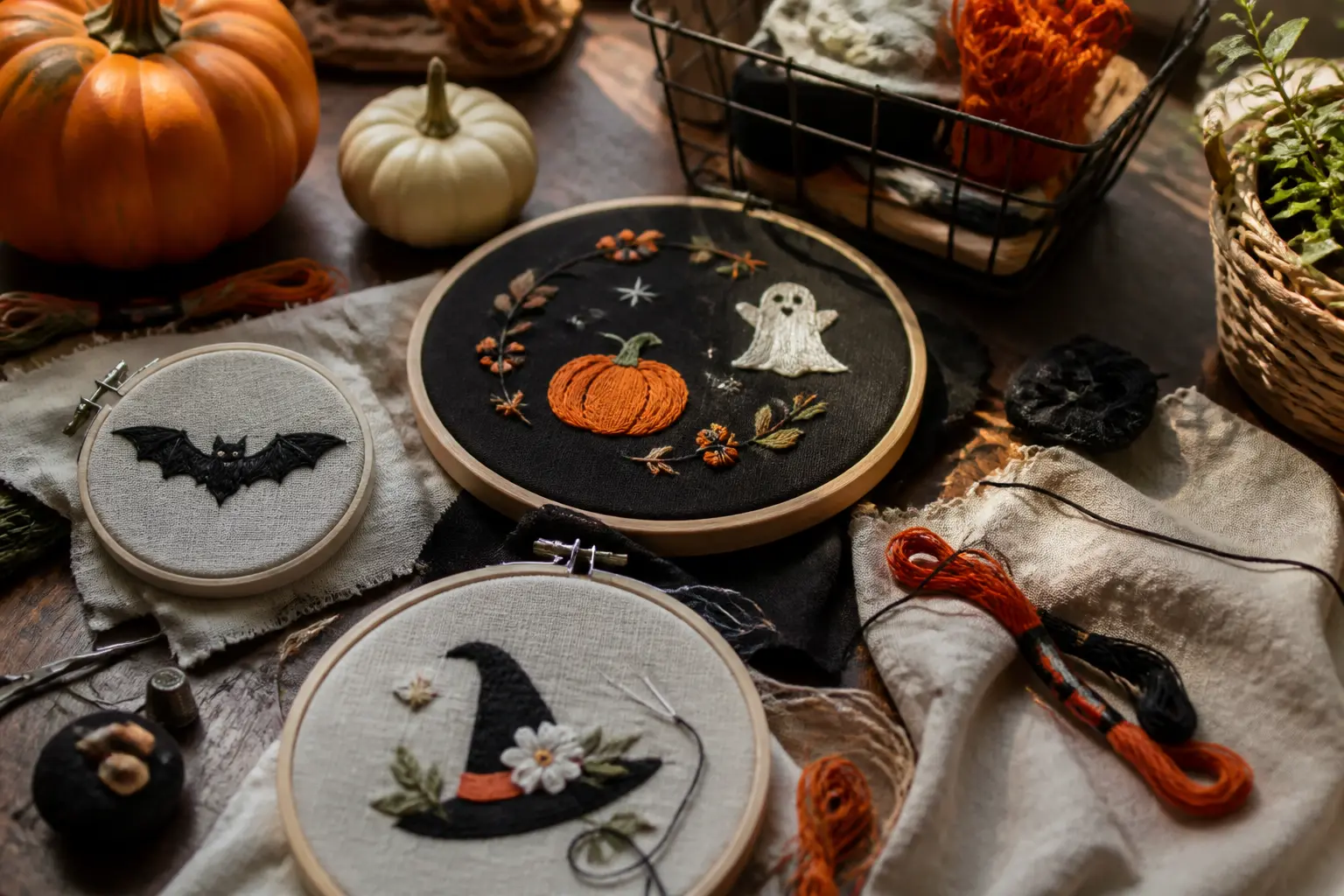
One evening is enough. Pick a 5-inch hoop, thread a needle, and by the time a good film finishes you have a piece of seasonal decor that looks genuinely considered. These 40 ideas stay achievable because they treat the hoop as the finished frame, not a holding device you remove later.
The palette running through all of them is burnt orange, ink black and warm natural linen, with the occasional hit of dusty gold or muted plum.
That discipline is what makes each piece look like it belongs with the others, so you can cluster several hoops on a wall without having to think hard about arrangement.
For more ways to fill an autumn evening with something handmade, the 24 crochet fall decor pieces round-up works on the same one-sitting principle.
Stitch counts and difficulty ratings are absent on purpose. If you can do a satin stitch and a stem stitch, every idea here is within reach. If you are newer than that, French knots and running stitch will carry you through at least half of them.
This post contains affiliate links. If you buy through them, I may earn a small commission at no extra cost to you.
Classic Halloween Icons, Remixed
The obvious motifs, skulls, bats, pumpkins, earn their place because they read instantly from across a room. The trick is to stitch them in a way that feels considered rather than clipart. Varying stitch direction, layering two thread weights or framing the motif with a wreath of tiny leaves are the moves that separate these from a beginner kit.
Keep the background fabric natural linen or pale grey. White feels clinical; natural linen makes the orange and black pop without any extra work on your part.
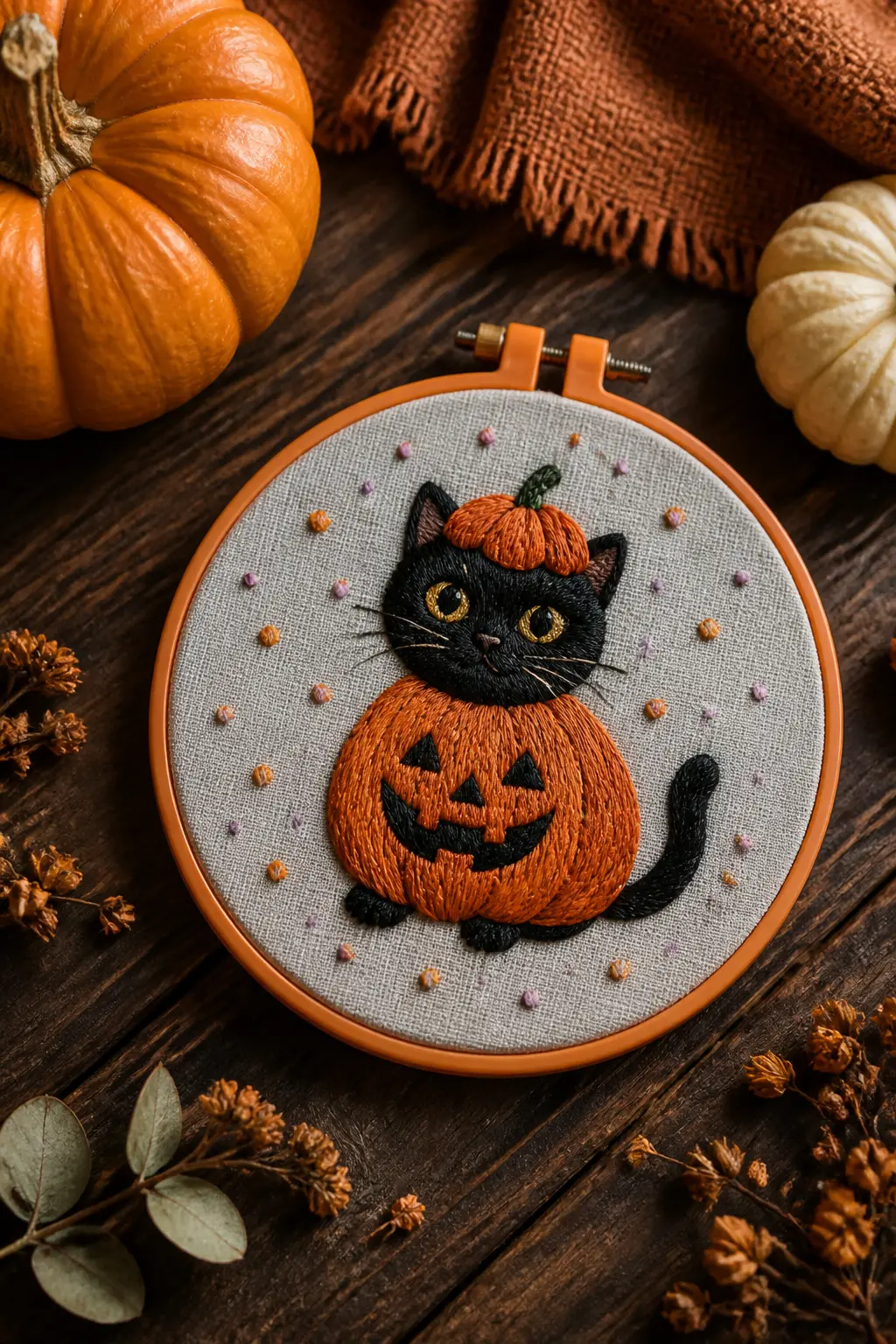
Black Cat in a Pumpkin Costume
A small black cat silhouette wearing an oversized round pumpkin body, stitched onto pale grey linen inside a bright orange plastic hoop. The cat’s head pokes above the pumpkin, ears alert, with a single pink French-knot nose. The pumpkin is filled with long horizontal satin stitches in burnt orange, with a jack-o-lantern face cut through in black.
Scatter tiny French knots in orange and purple across the background to break the emptiness without adding more motifs. Use three strands for the cat body and two strands for the knots, so the texture shifts between foreground and background without any extra planning. This one fits a 4-inch hoop and finishes in under two hours.
🛍 Shopping guide
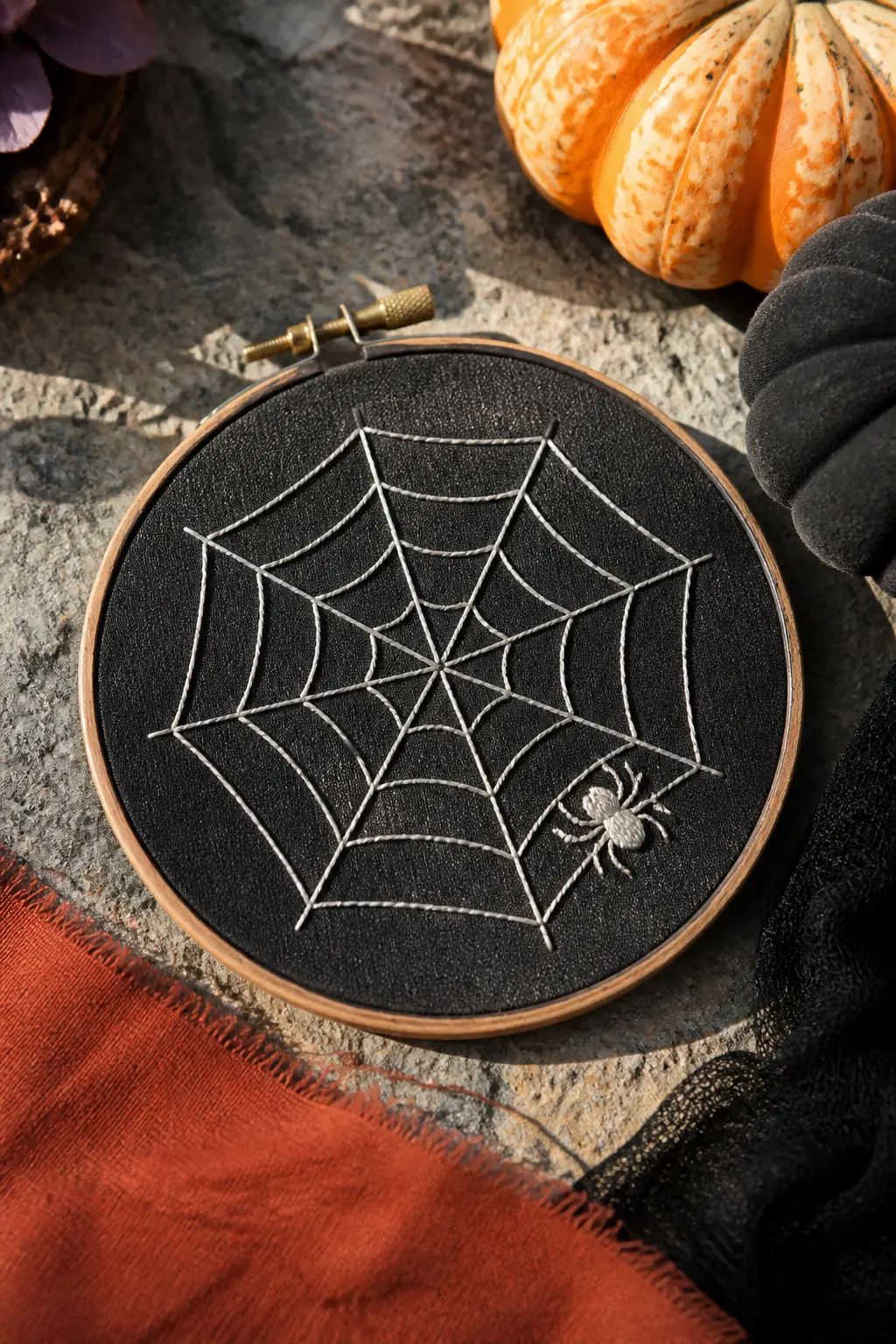
Spider Web on Black Linen
A geometric spider web in cream or bone-white thread on black linen: straight-stitch spokes radiating from a centre point, with woven horizontal rungs worked in a single strand.
A tiny spider in dark charcoal satin stitch hangs from a single descent thread at one corner of the web. The contrast between the pale thread and the black ground is high enough that the geometry reads instantly even at a small scale.
Use a disappearing-ink fabric pen to mark the spoke positions before you stitch, and the geometry stays clean without any counting. Six or eight spokes are enough; more than eight starts to look crowded at 5 inches. This is one of the fastest pieces in the list: under ninety minutes from threading to knot-off.
🛍 Shopping guide
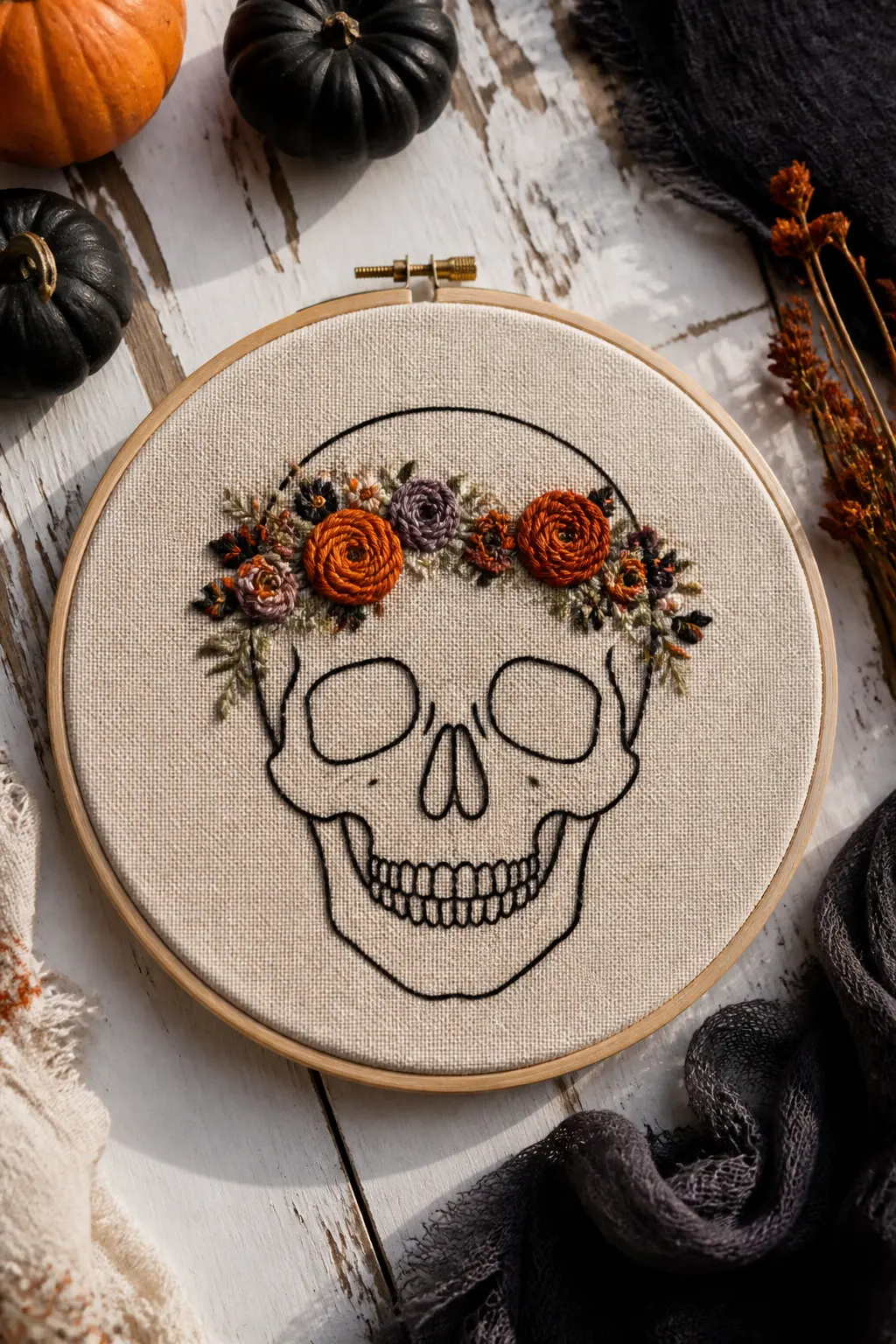
Skull with a Floral Crown
A front-facing skull in outline stitch, small enough to fit comfortably in a 4-inch hoop, with a wreath of small roses and leaves sitting across the forehead.
The skull itself stays as bare outline work in two strands of black; the flowers are lazy-daisy petals in dusty rose and cream with French-knot centres.
The contrast between the spooky motif and the delicate botanicals is precisely what makes this appealing to an adult room.
The eye sockets can be left as open outline or filled with a single large French knot in deep purple. Either choice works; the knot version takes four extra minutes and reads as more finished from a distance.
Stitch the skull first, then the floral crown, so you can adjust the flower placement around the bone structure rather than guessing in advance.
🛍 Shopping guide
Witch Hat with a Ribbon
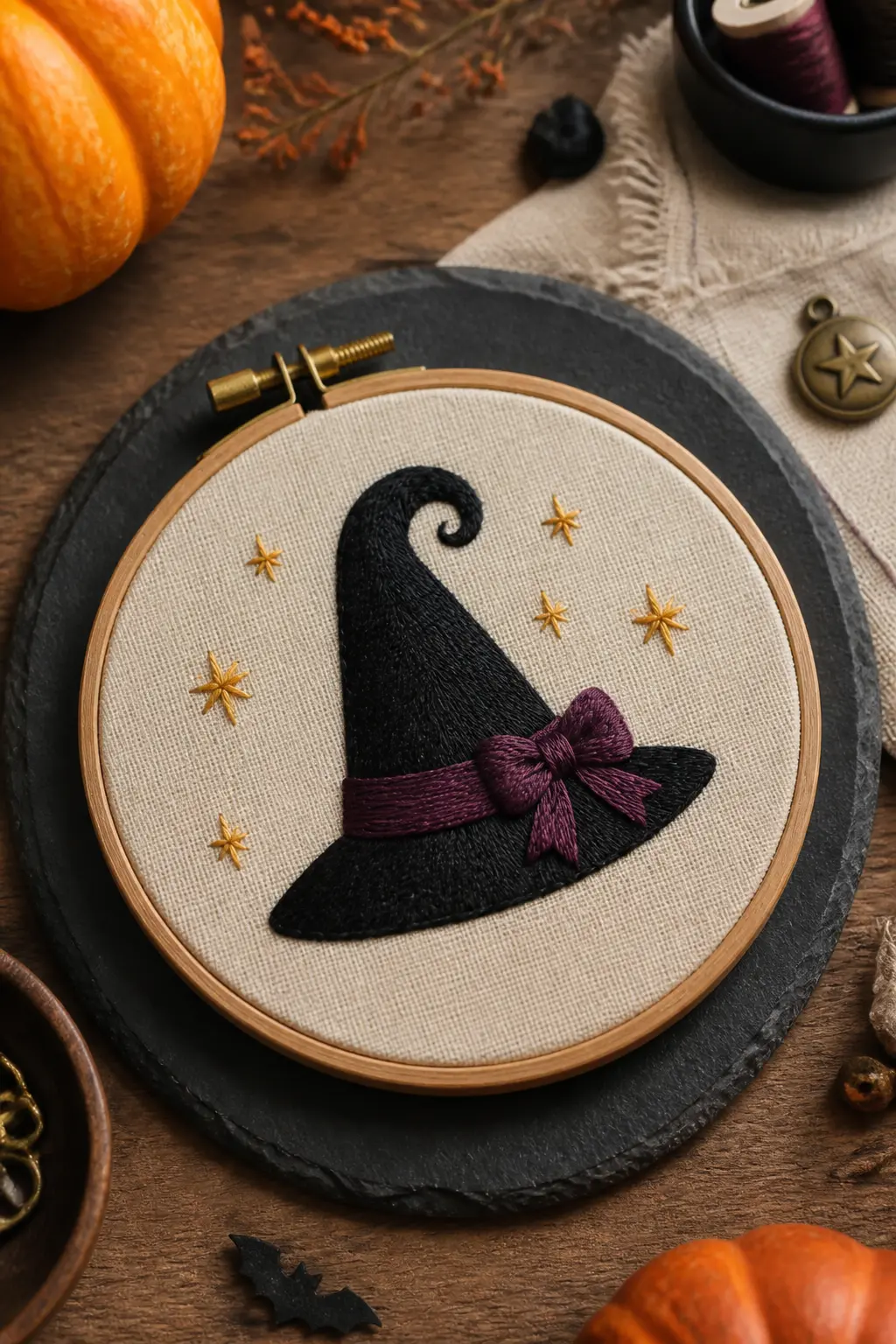
A side-profile witch hat in satin stitch, with the brim worked in two close rows of chain stitch to give it a slightly raised edge. A narrow ribbon band in dusty plum split stitch wraps just above the brim, with a tiny bow at the front. A few small stars in running stitch scatter above and to the right.
The charm of this piece is in its simplicity: one hat, a ribbon, stars. Nothing else competes with it.
Work the hat in four strands of ink black, the ribbon in two strands of dusty plum, and the stars in a single strand of gold metallic thread.
The weight contrast between the dense hat body and the delicate stars creates all the visual interest you need.
🛍 Shopping guide
Pumpkin Patch Row
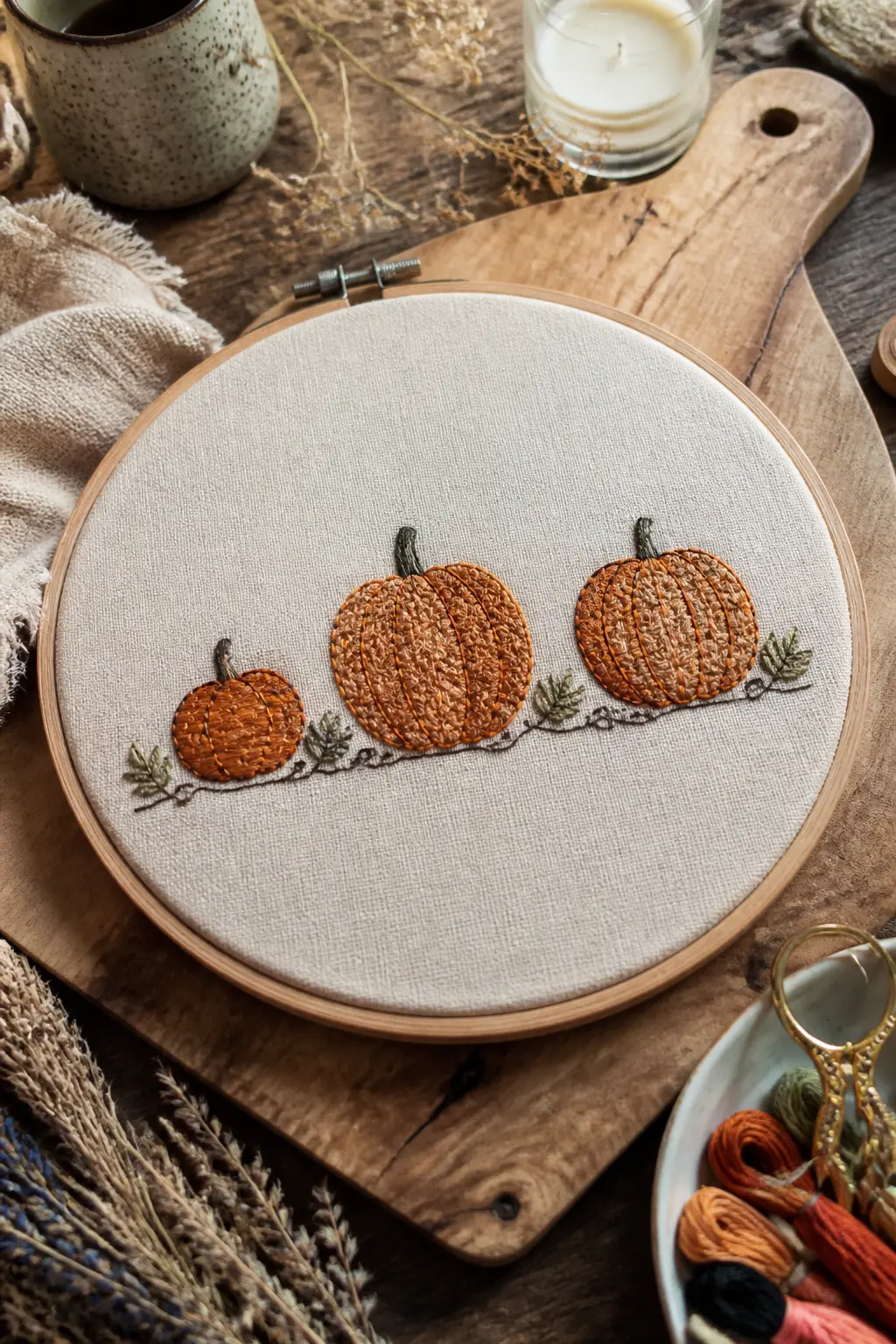
Three pumpkins in a row, each a different size and each with a slightly different stem, stitched in adjacent satin-stitch segments. The smallest uses two strands for a finer look; the largest uses four. A low ground line in stem stitch and three small leaf clusters tie them into a single composition rather than three separate motifs floating on linen.
Vary the orange between the three pumpkins: one in pure burnt orange, one with a strand of rust mixed in, one with a strand of amber. Same thread weight, different shade combination. The subtle variation reads as seasonal richness rather than inaccuracy, and it uses up oddments from other projects without any extra shopping.
🛍 Shopping guide
Cauldron with Rising Steam
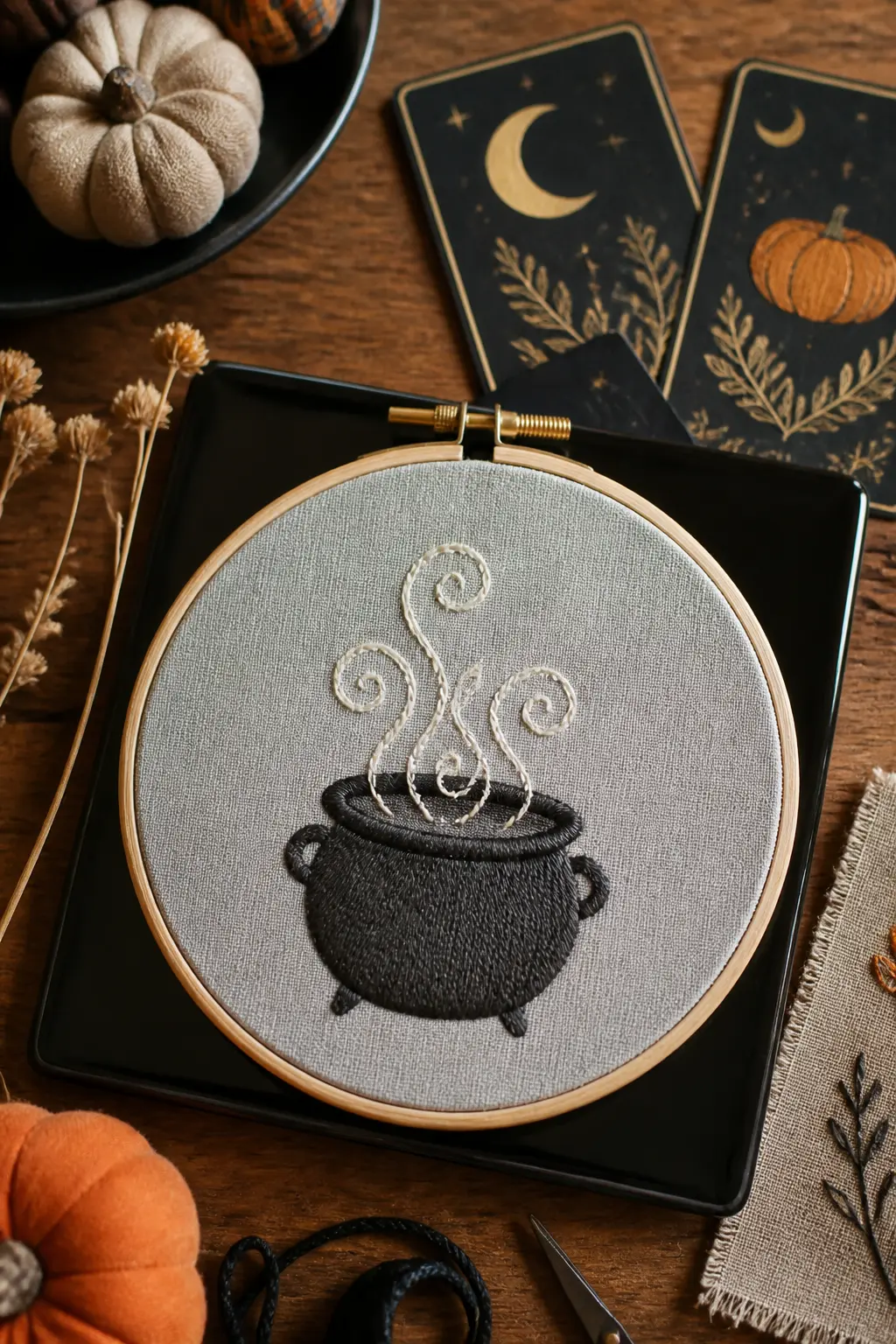
A round cauldron in dark charcoal satin stitch, its base resting on three short legs in stem stitch. Three curling wisps of steam rise from the top in pale cream or pale grey chain stitch, each curl a different height. A few small bubbles, rendered as single French knots, sit just inside the cauldron rim to suggest a bubbling brew.
The cauldron silhouette is simple enough to draw freehand on the fabric with a water-erasable pen. The steam curls are where the personality lives: make each one arc in a different direction so they move rather than stand straight. Total stitching time is about one hour, making this one of the most efficient pieces in the collection.
🛍 Shopping guide
Serpent in a Pumpkin
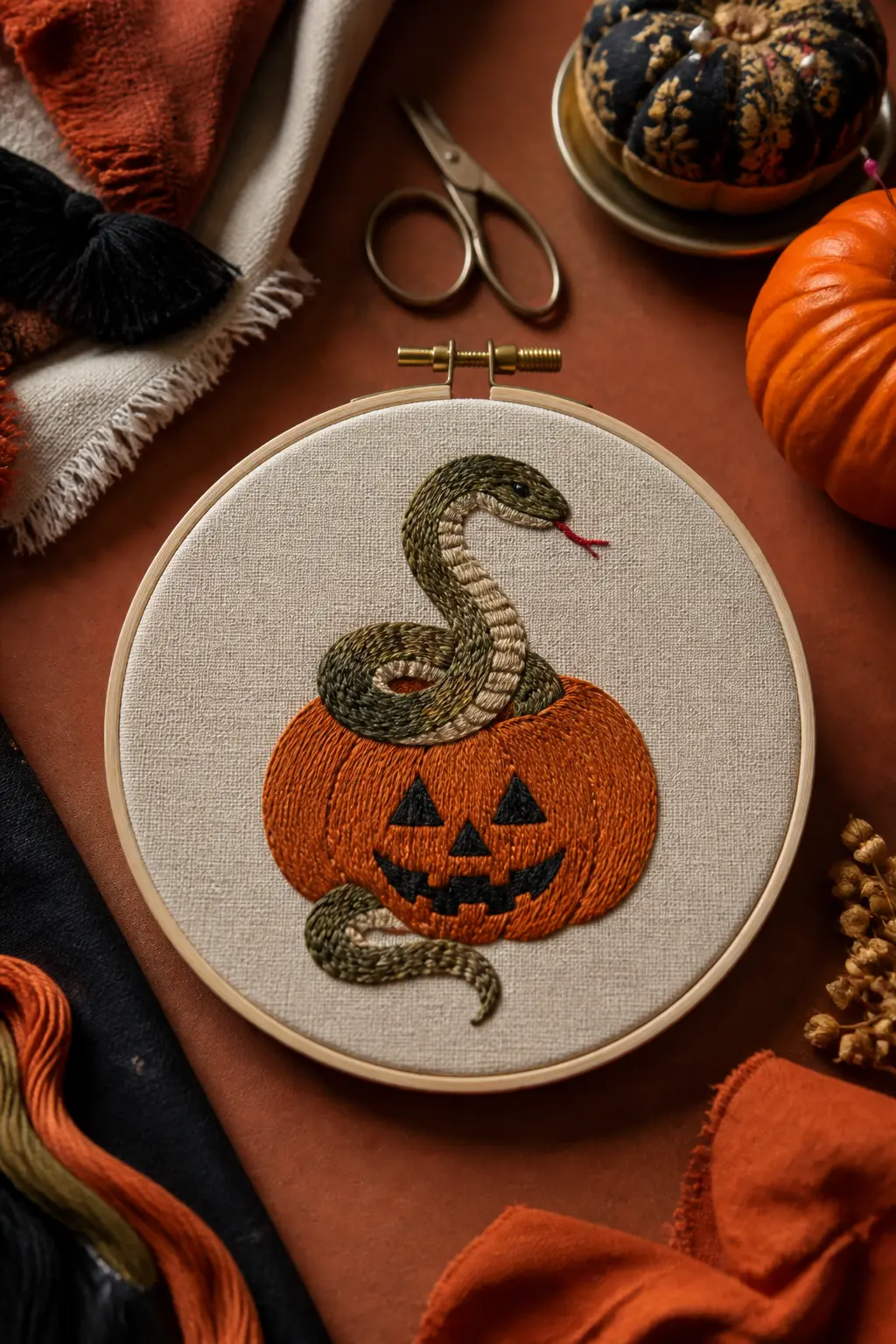
A coiled serpent emerging from an open pumpkin top, its body in long-and-short satin stitch using dark olive, warm tan and cream to suggest scales. The pumpkin below is a compact rounded satin-stitch shape in burnt orange.
Only the serpent’s head and upper coils are above the pumpkin rim; the rest is implied. A small forked tongue in red split stitch gives the face its expression.
Scale suggestion in satin stitch comes from changing stitch direction every few rows, which catches the light differently and creates the visual impression of overlapping scales without any actual scale drawing. Two strands for the body, one strand for the tongue.
The burnt orange pumpkin and the dark olive serpent share enough yellow undertone to feel like a deliberate palette rather than a clash.
🛍 Shopping guide
Poison Apple
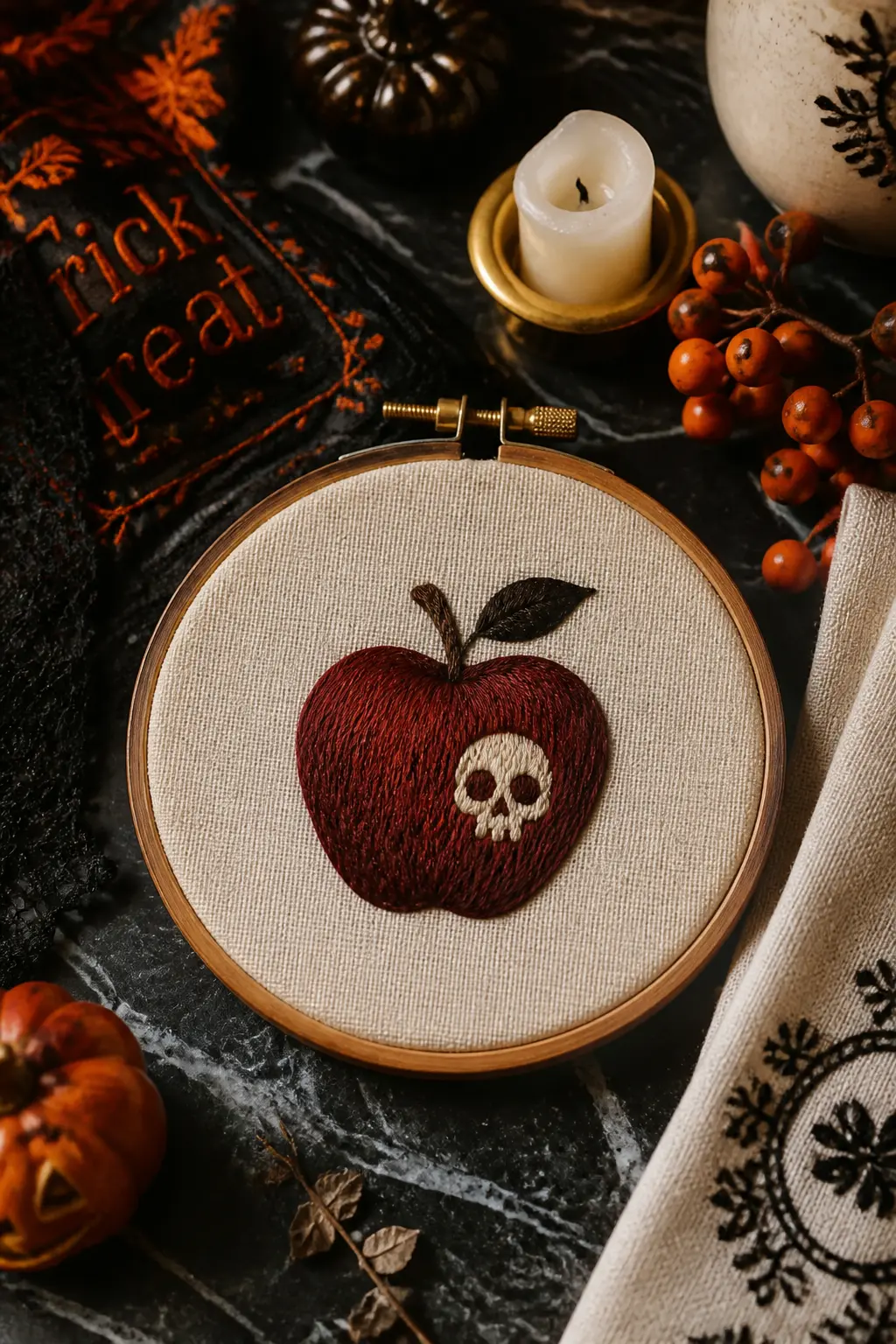
A single apple in long-and-short satin stitch, deep red shading to dark garnet at the base, with a small satin-stitch leaf and a twisted stem.
A tiny skull and crossbones in cream thread sits on the apple surface, small enough to be read as a label rather than a warning.
The apple rests on no ground line: it floats, which makes it look more like a botanical illustration plate than a spooky prop.
The red-to-garnet gradient in long-and-short stitch is built with three values of red thread, the lightest at the top highlight and the darkest at the shadowed base. Five strands of thread give a dense satin finish that catches light richly.
This is a piece where thread quality matters: silk floss or a premium cotton produces a noticeably more lustrous result than standard budget thread.
🛍 Shopping guide
Floral and Botanical Overlays
The idea is simple: take a Halloween silhouette and fill it entirely with flowers instead of solid stitching. A pumpkin outline packed with lazy-daisy roses in burnt orange reads as botanical first, seasonal second. That double register is exactly why it works as decor you want to keep out past November.
Black stem-stitch leaves and tendrils between the blooms keep the silhouette readable. Do not outline the whole shape in one heavy line; let the botanicals define the edge instead. This is the approach that photographs best on a natural-wood hoop hung against a plaster wall.
Floral Pumpkin Outline
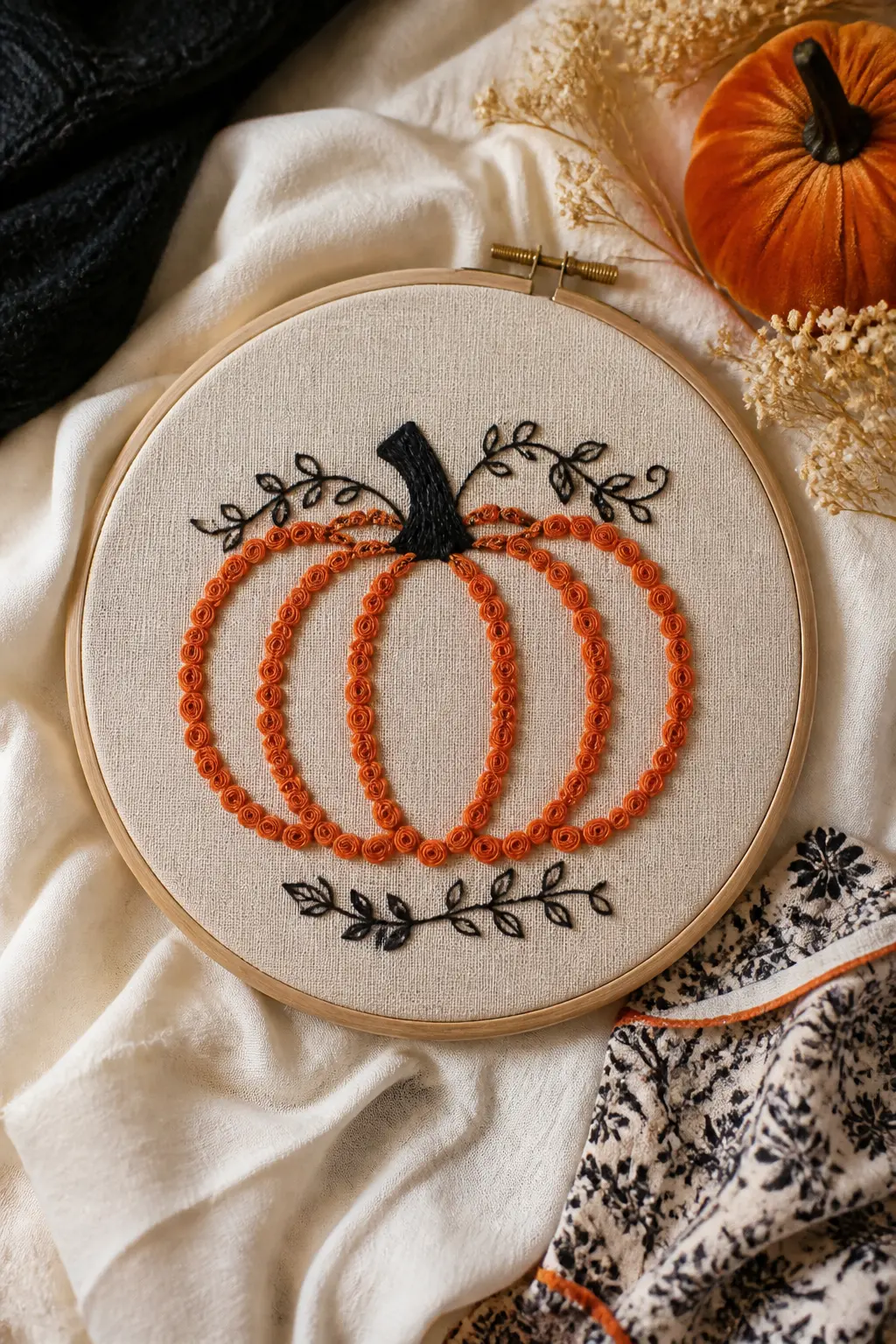
The pumpkin silhouette is filled entirely with tightly coiled French-knot roses in burnt orange, with black stem-stitch leaves and vine tendrils threaded between them. No solid-fill stitching anywhere: the flowers define the shape, and the natural linen shows between clusters. A single black satin-stitch stem and two small curling tendrils at the top complete it.
Work from the outside edge inward, placing the larger rose clusters first so the smaller ones fill the gaps naturally. Three strands of orange floss and two of black keep the weight balanced. The finished piece reads as botanically detailed from a metre away and as Halloween-coded up close, which is exactly the balance worth chasing.
🛍 Shopping guide
Mushroom and Bat Cluster
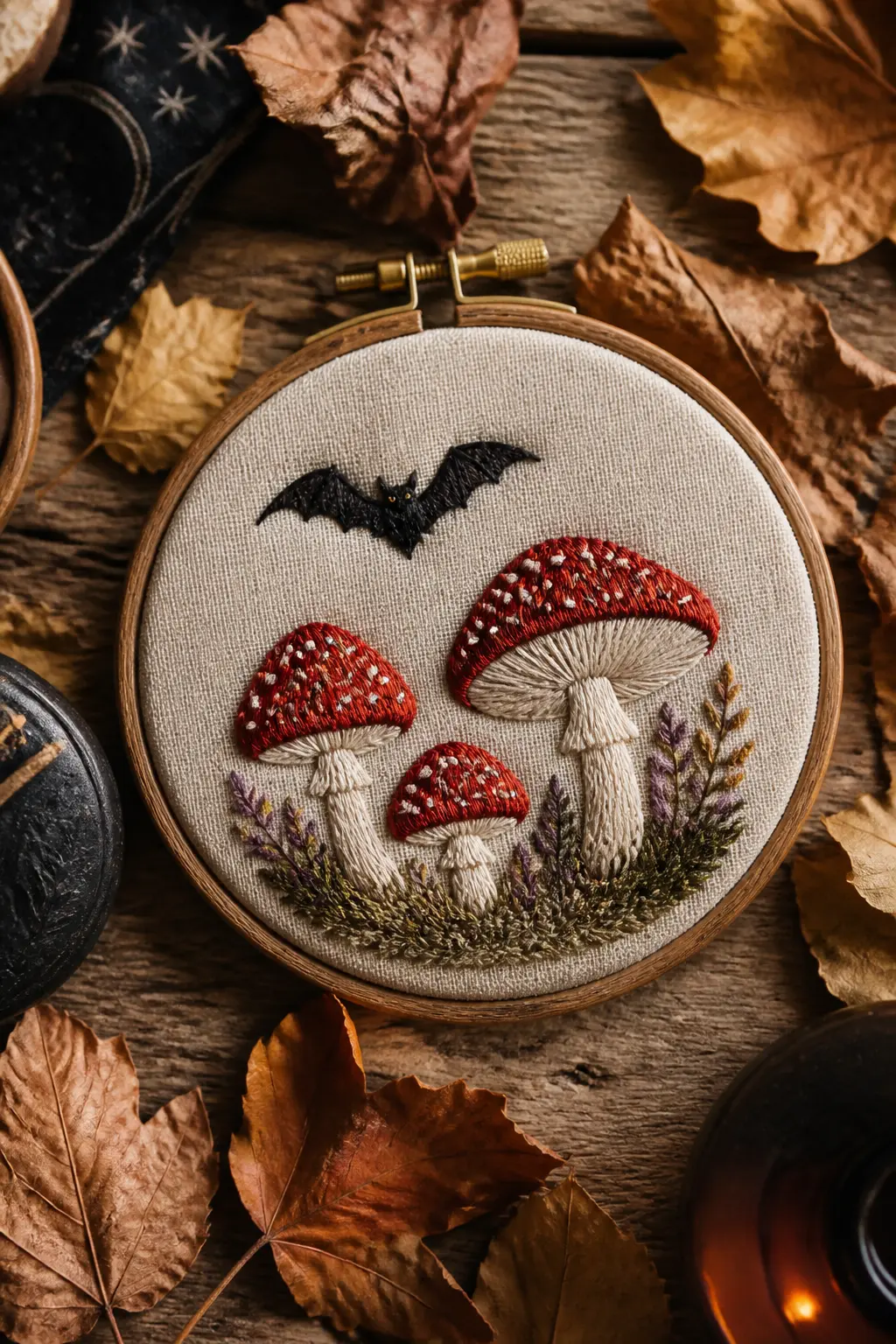
Two or three fly agaric mushrooms (red caps with white spots, white stems) growing from a leaf-littered ground, with a small bat flying above the largest cap. The mushrooms use satin stitch for the caps and split stitch for the stem edges. White French knots across the cap surfaces create the spots without requiring any masking or layering of colour.
The red cap on natural linen is a strong enough contrast that no background stitching is needed. A single strand of dark olive for the fallen leaves at the base keeps the ground suggestion delicate. This is a piece that looks specifically autumnal rather than generically Halloween, which extends its wall life considerably.
🛍 Shopping guide
Floral Bat
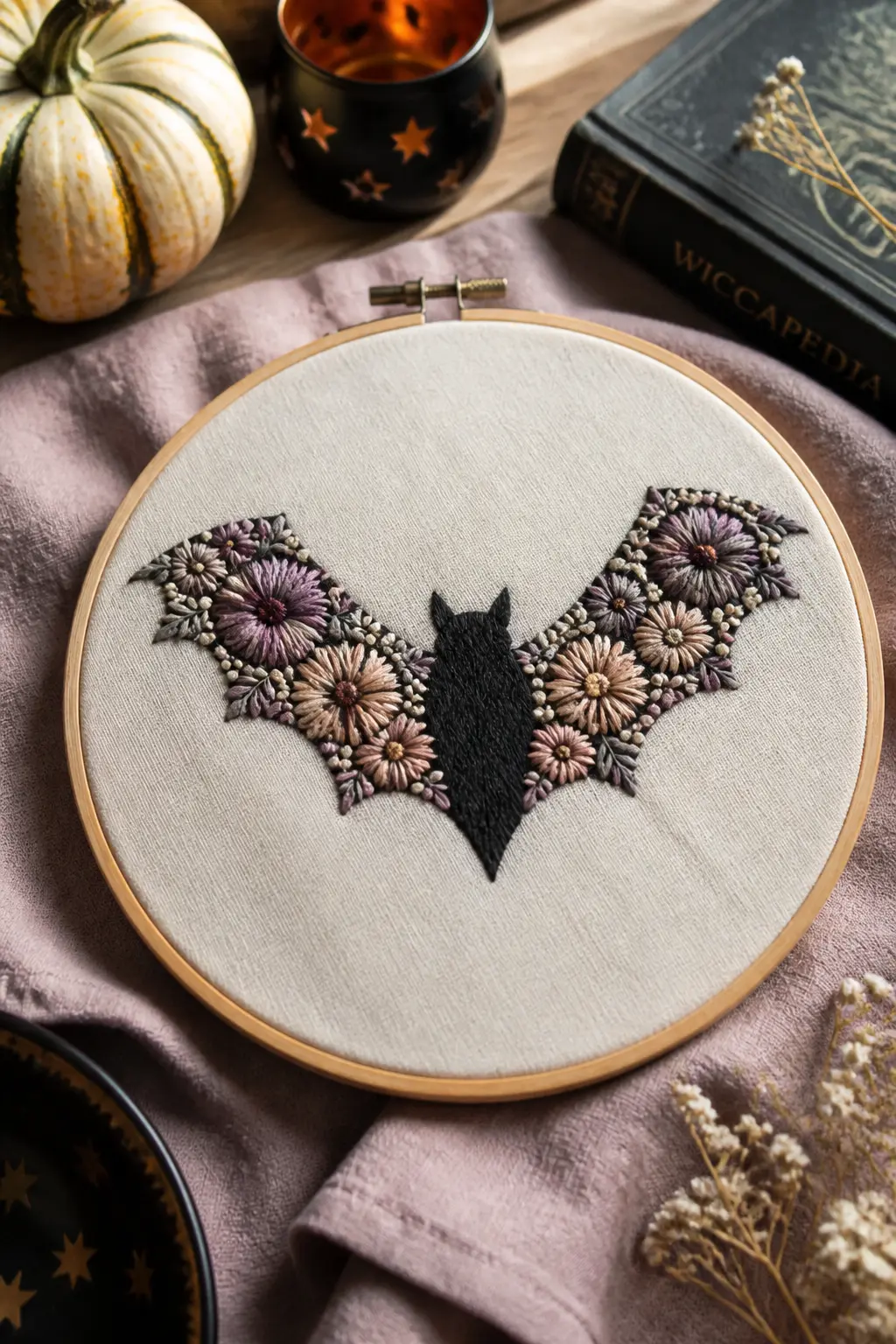
A bat silhouette with wings spread wide, filled entirely with small lazy-daisy flowers in muted purple and dusty pink instead of solid satin stitch. The flower stems use two strands of dark olive split stitch.
The bat body at the centre is a small solid circle in near-black satin stitch, and two tiny French-knot eyes sit above it. The bat outline itself is only suggested by where the flowers end.
This is a piece where the boundary between flowers and background is deliberately soft, so the shape emerges gradually as you stitch. Start with the body, then work the flowers outward in rough wing shape.
The lack of a hard outline is the design choice, not an oversight: it gives the whole motif a botanical-print quality that makes it apartment-friendly all year round.
🛍 Shopping guide
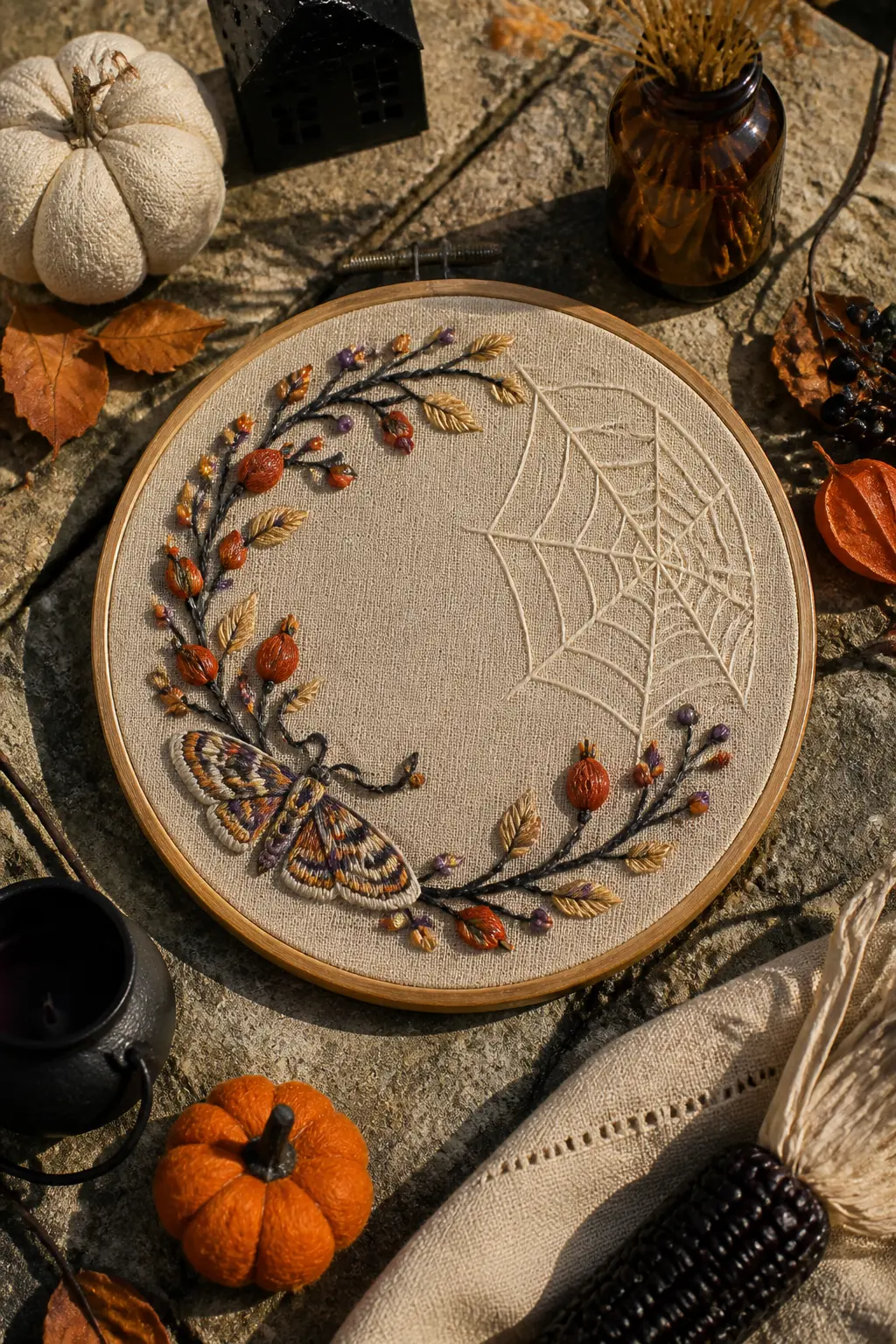
Spiderweb Wreath
A circular wreath frame built from intertwined bare branches in stem stitch, with a partial spiderweb filling one lower quadrant of the interior, and small floral elements, rosehips, berries, a moth, filling the rest.
The web spokes and rungs are in a single strand of cream; the branches and botanicals use three strands for weight contrast. One small spider in the web centre completes the composition.
The wreath format is a reliable compositional structure because the circular frame gives every element a natural place to land. Build the branch framework first, then add the web in one quadrant before filling the remaining three with botanical details. Work densely enough that the wreath reads as lush, not sparse, from wall-hanging distance.
🛍 Shopping guide
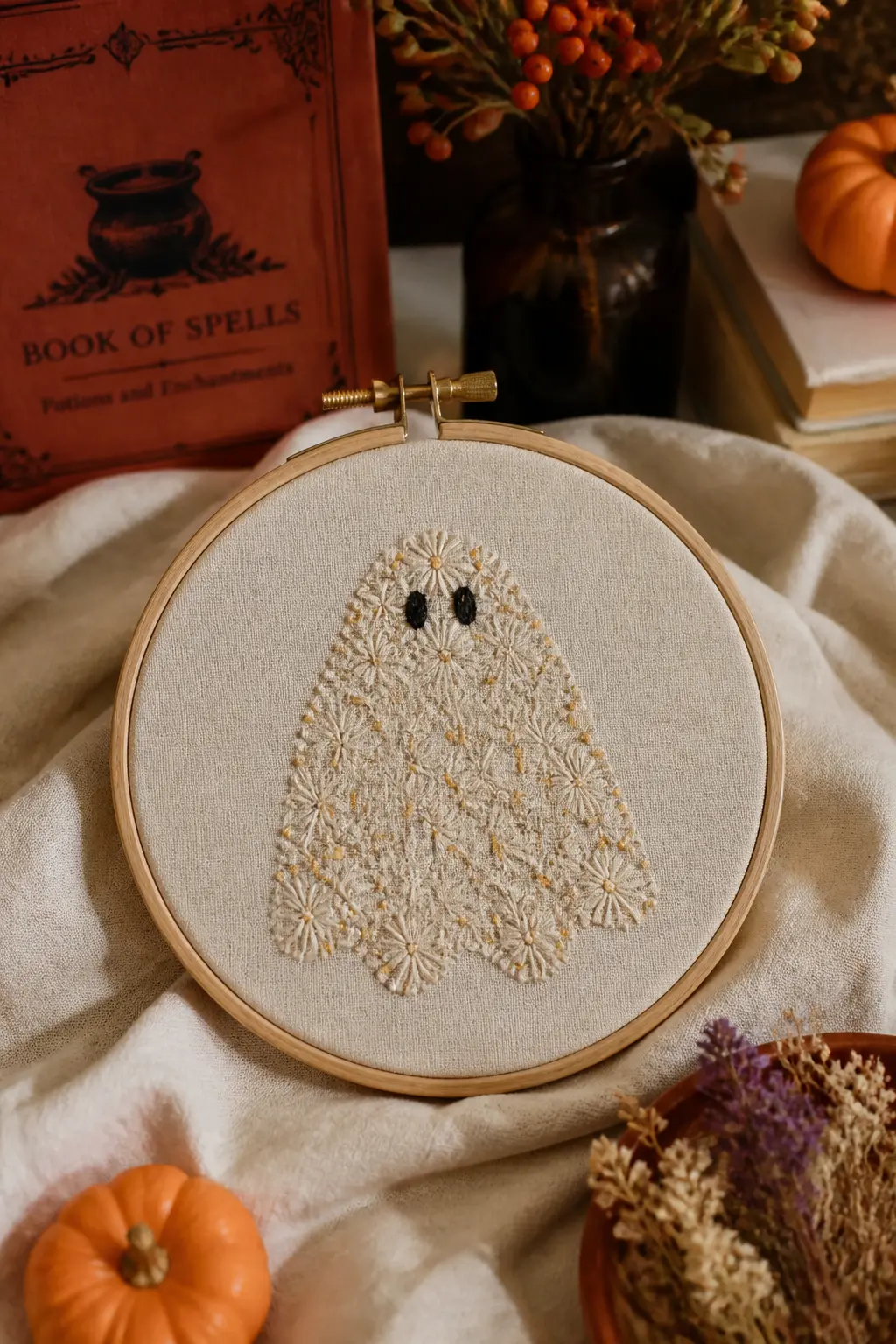
Floral Ghost
A ghost silhouette filled entirely with tiny flowers and leaves rather than solid thread, in the same logic as the floral pumpkin. Cream lazy-daisy flowers with gold French-knot centres form the ghost body, threaded through with dark olive stem-stitch vines.
Two small black satin-stitch eyes sit at the top of the floral mass. The ghost edge is never outlined: the flowers define it.
The botanical ghost is a piece that confuses pleasingly: botanical wreath or ghost? The ambiguity extends its decorating life well past October.
Use a light pencil outline of the ghost shape as your planting guide, and work the flowers outward from the ghost body centre to the silhouette edge.
The flowers at the very edge can spill very slightly beyond the drawn line for a soft organic finish.
🛍 Shopping guide
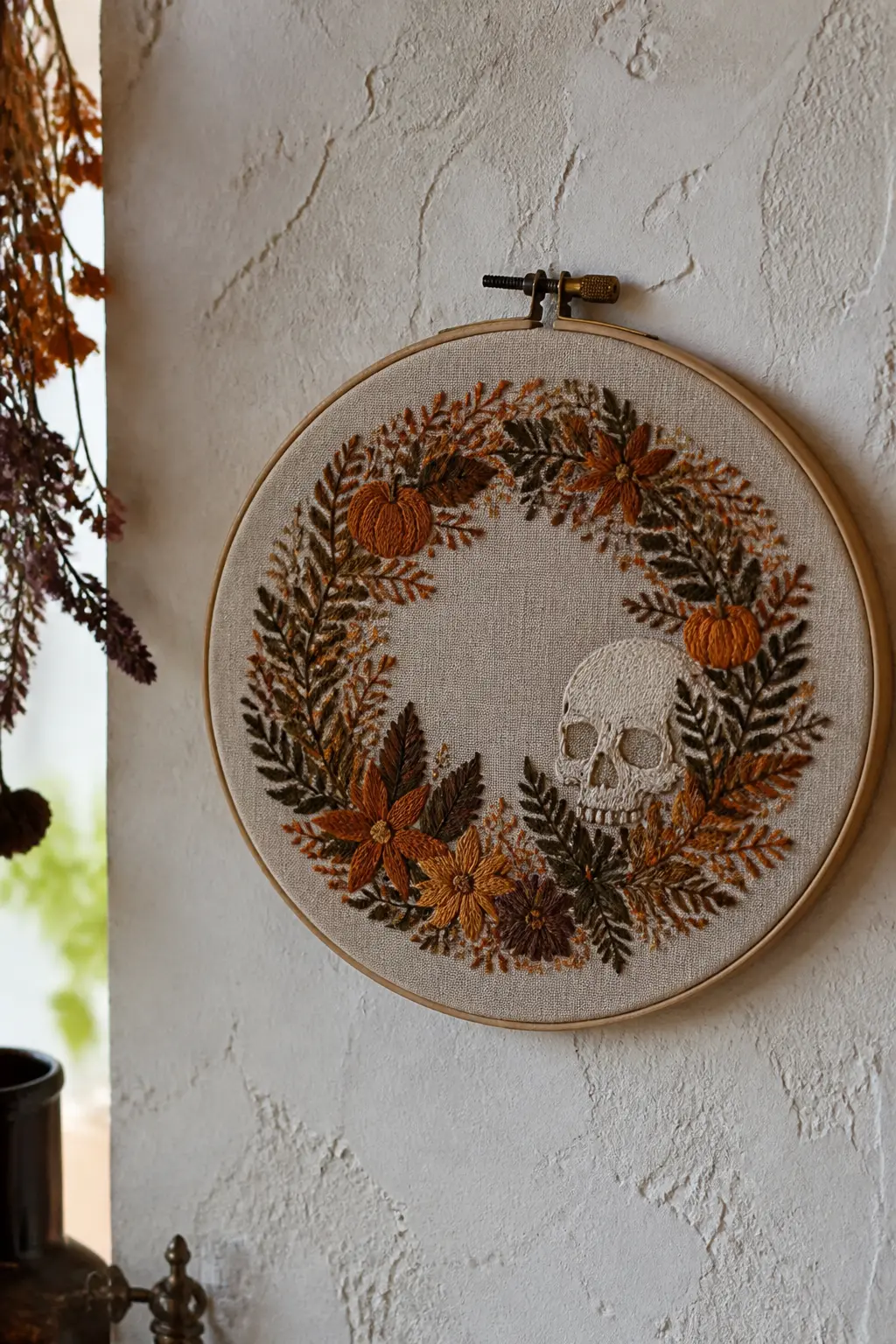
Autumn Wreath with Hidden Skull
A full circular wreath of embroidered botanicals: rosehips, dried seed heads, small oak leaves, fern fronds, all in burnt orange, rust and dark olive. Tucked into one section of the wreath, visible but not immediately obvious, a small cream skull outline, about the size of a thumbnail, nestles between the botanicals. No other Halloween element appears.
The hidden skull is the detail that makes people lean in and look again, which is what good wall art does. Position it at the lower right of the wreath so it reads as a discovery rather than the focal point.
The wreath itself is the main event, and it should look like a botanical illustration first. Stitch the full wreath before adding the skull, so you can choose its position based on where the negative space naturally falls.
🛍 Shopping guide
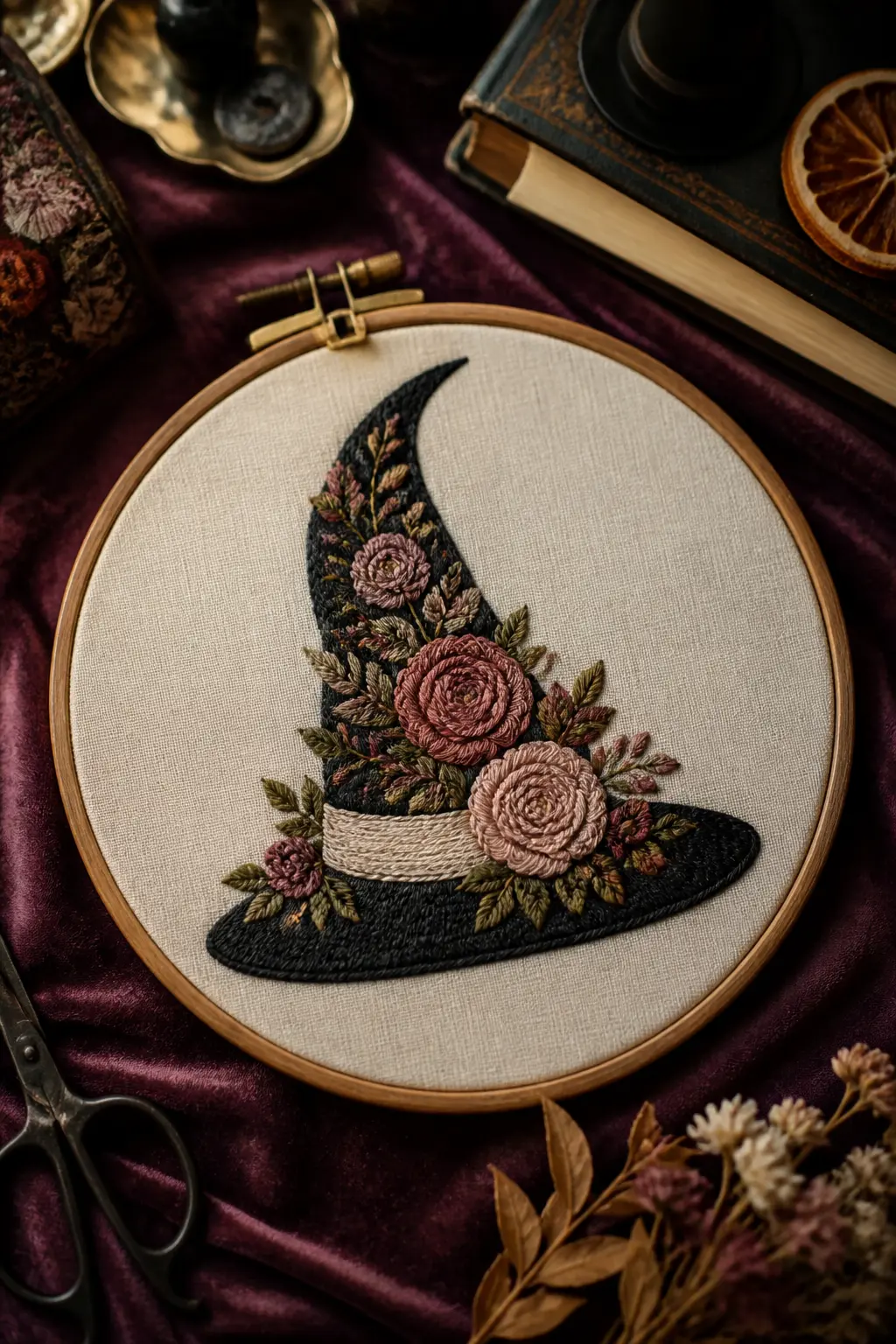
Peony Witch Hat
A witch hat silhouette, wide brimmed and sharply pointed, filled entirely with tightly packed peony roses in dusty rose and deep plum, with dark olive foliage between them. The hat crown and brim are defined by where the flowers end, not by any outline stitch.
A single cream ribbon band across the hat base is the one non-floral element, in three strands of satin stitch.
Peonies in embroidery are built from concentric lazy-daisy petals layered outward from a French-knot centre, working from small inner petals to larger outer ones. Three layers of petals per rose gives a full, rounded look at the scale needed here.
The dark olive leaves between roses prevent the composition from reading as a flat floral surface: they create shadow and depth without any shading technique.
🛍 Shopping guide
Woodland Creatures in Autumn Dress
Foxes in knitted scarves, hedgehogs carrying lanterns, owls perched on pumpkins: these are the ideas that cross over from Halloween decor into year-round hoop art. They suit an adult room because the subject matter is charming without being childish, and the stitching demands enough detail (long-and-short stitch fur, satin-stitch eyes) to keep the evening genuinely absorbing.
Limit the palette to the thread colours already in your kit. Burnt orange, dark brown, forest green and cream cover every woodland creature that belongs in this canon, and the restraint makes the finished piece look deliberate rather than scrappy.
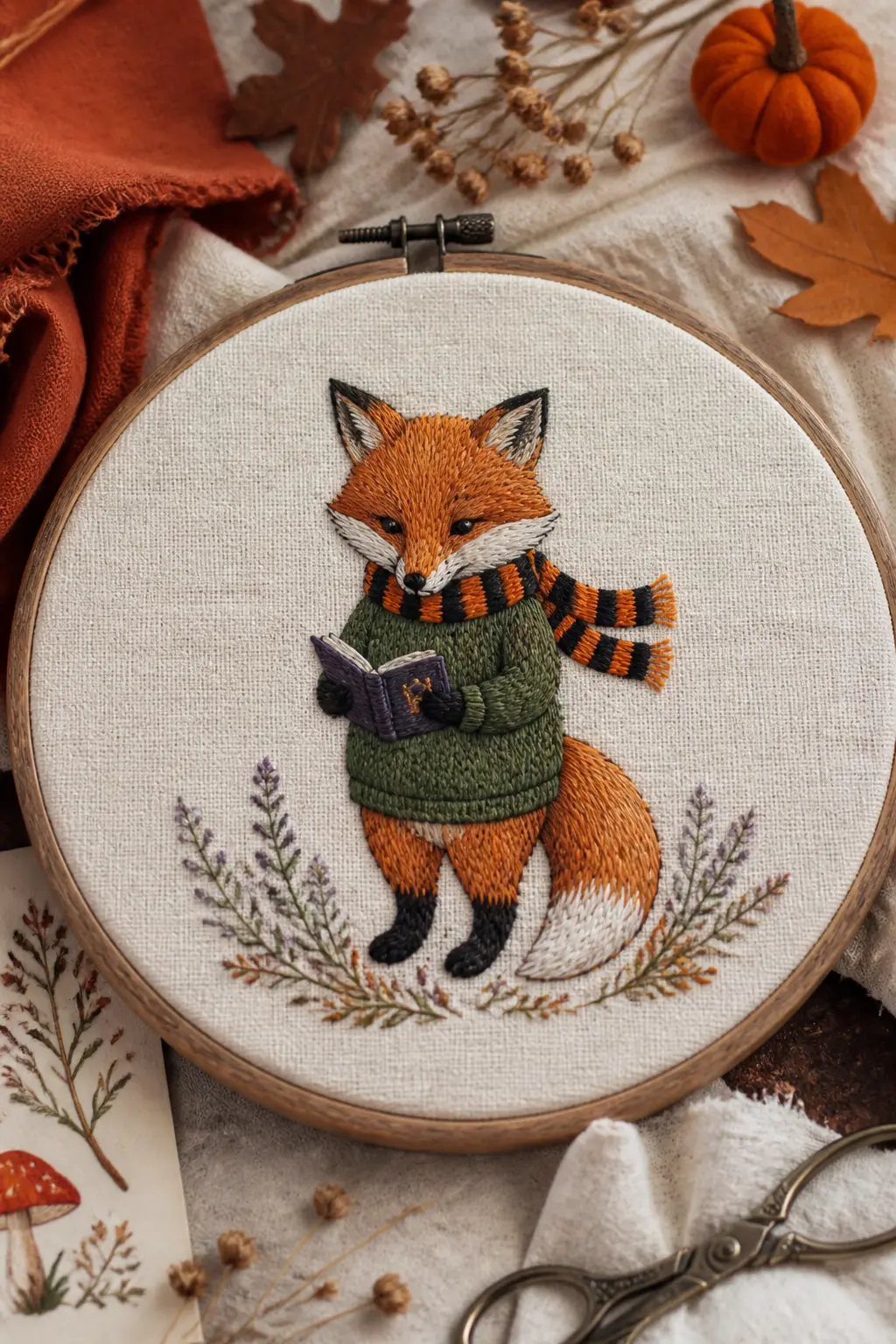
Autumn Fox with a Scarf
A fox in a forest-green jumper and teal trousers, holding a tiny book and a cream mug, stitched in long-and-short satin stitch for the fur and split stitch for the clothing.
The colour shift from burnt orange at the ears through amber to cream at the muzzle is what makes this piece look genuinely skilled, even though each zone is just satin stitch in a slightly different shade.
Ground the figure with two small embroidered herb sprigs at the base, one in forest green and one in rust, so the fox appears to stand on something rather than float. Leave the surrounding linen bare. The character is detailed enough that negative space is a compositional asset here, not an oversight.
🛍 Shopping guide
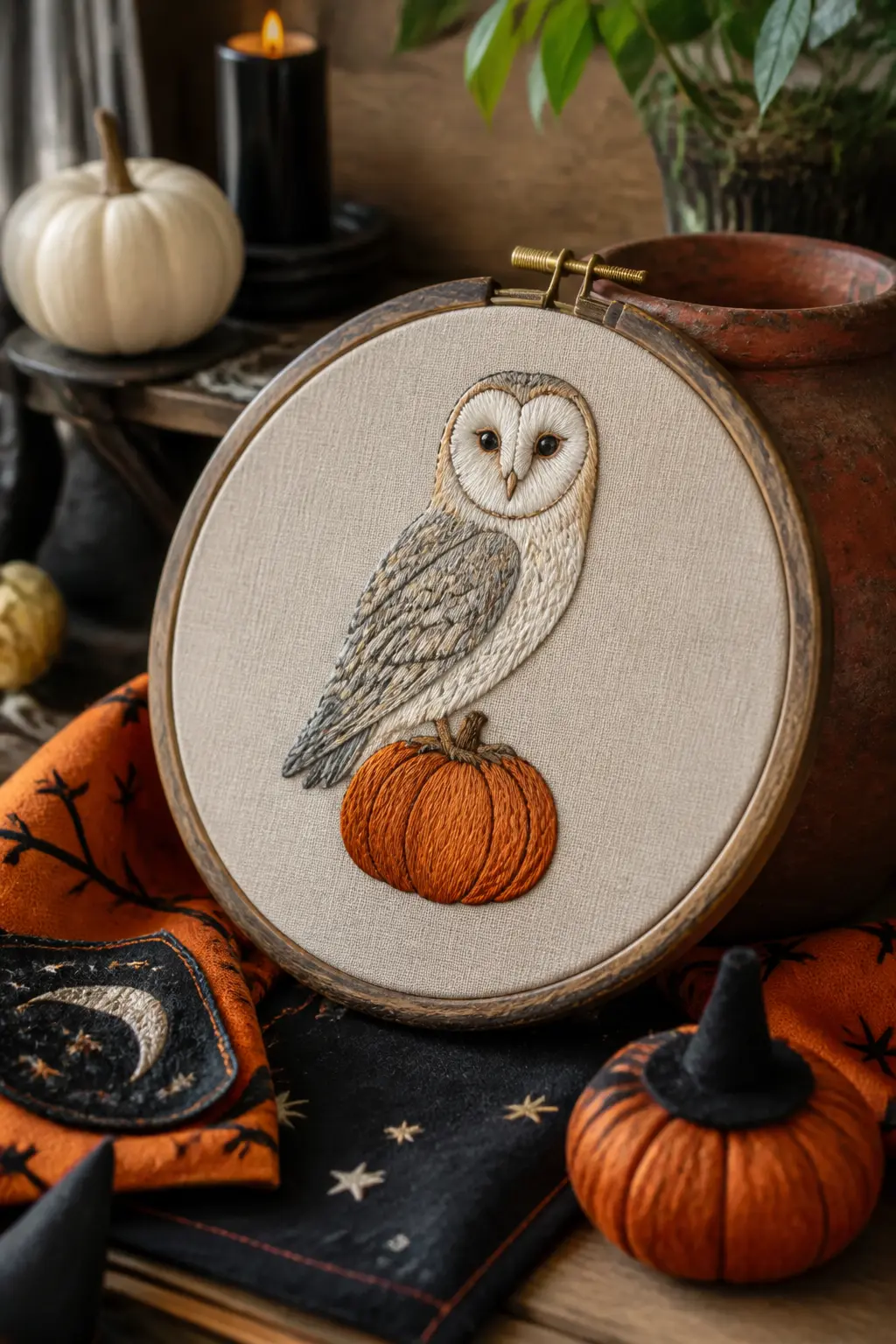
Owl on a Pumpkin
A round barn owl perched on top of a small satin-stitch pumpkin, stitched in split stitch and long-and-short stitch. The owl’s feathers use cream, warm grey and a touch of burnt orange at the wing tips to tie it to the pumpkin below.
Two large satin-stitch eyes in pale gold anchor the face. A few stem-stitch branch lines extend from below the pumpkin to suggest the owl has a proper perch.
The pumpkin needs only four or five vertical satin-stitch segments in burnt orange to read correctly at this scale. Resist the urge to add a jack-o-lantern face: the plain pumpkin lets the owl carry the narrative. Frame in a 6-inch hoop and leave the background bare.
🛍 Shopping guide
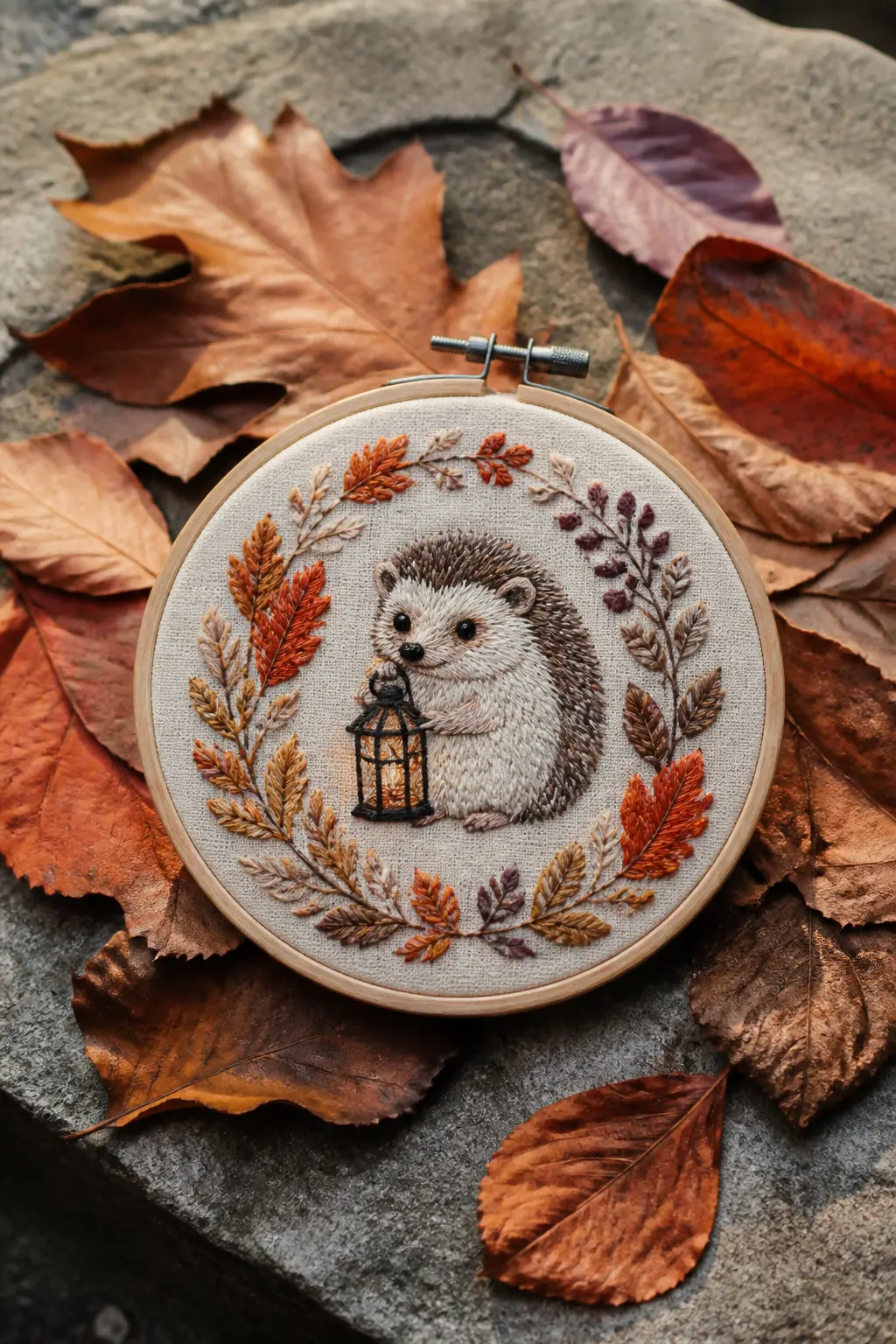
Hedgehog with a Lantern
A small round hedgehog carrying a tiny embroidered lantern, stitched in straight stitches radiating outward for the spines and a satin-stitch face and paws in warm cream. The lantern is four straight stitches forming a rectangle with an amber satin-stitch glow in the centre and a chain-stitch handle above. Fallen leaves in rust and gold scatter around the base.
The straight-stitch spine technique is fast and forgiving: work outward from the centre of the back, varying the length slightly for each stitch, and the texture emerges naturally. No counting, no transfer required. The lantern glow is the detail people notice and comment on; spend the extra five minutes on the amber fill to make it warm.
🛍 Shopping guide
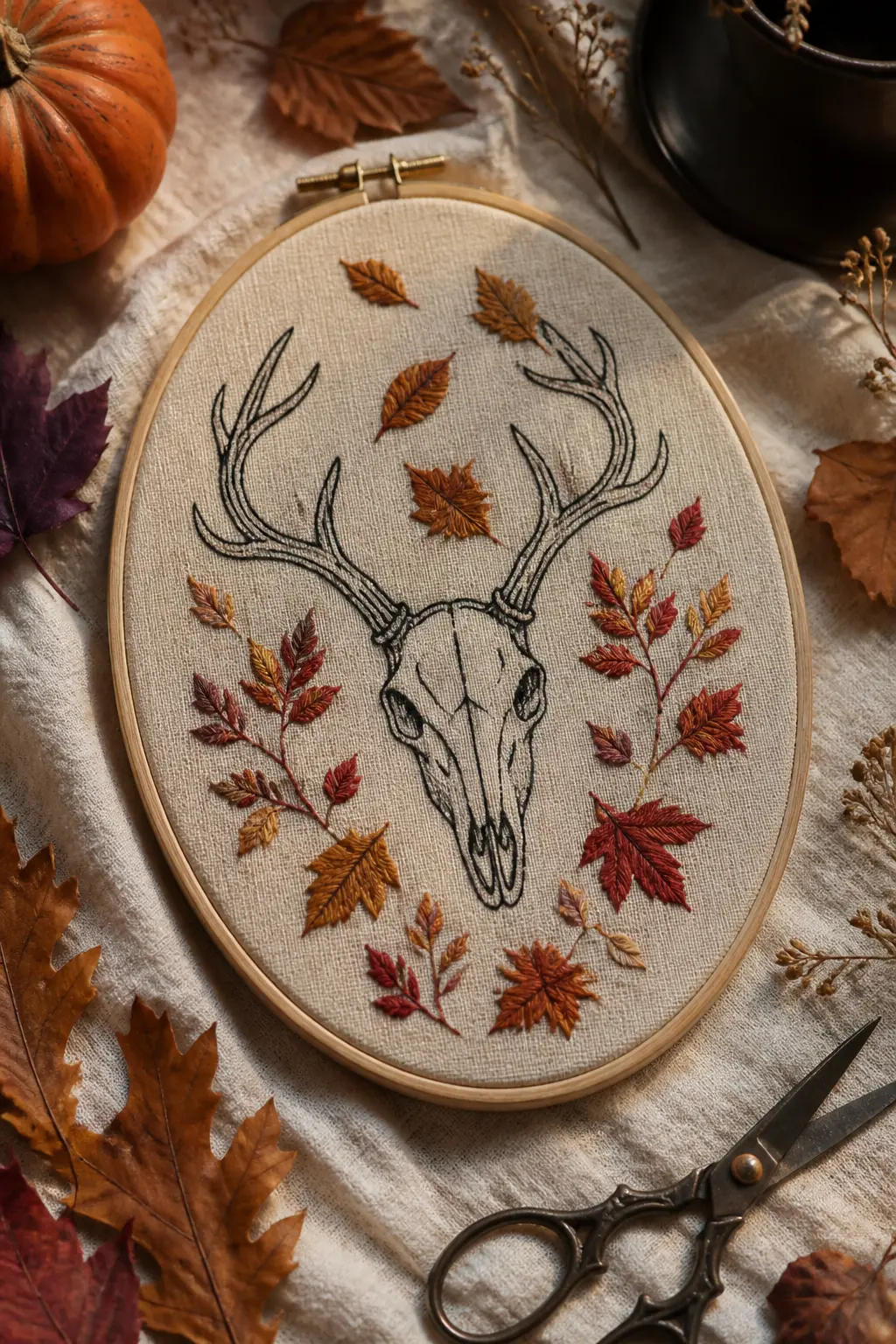
Deer Skull with Autumn Leaves
A front-facing deer skull in outline and sparse satin-stitch fill, with two antlers extending above it framed by clusters of autumn leaves in rust, amber and forest green.
The skull stays largely un-filled so the linen ground shows through and keeps the image light rather than heavy. The leaves are lazy-daisy and satin stitch, scattered as if they have fallen into the antler space.
This is an image that reads differently to different viewers: some see spooky, some see woodland, which is exactly why it works for an adult room. Mount it in a wide oval hoop to give the antlers room to spread.
Dark brown for the antler lines ties them to the leaf colours without requiring any additional thread purchases beyond a basic earth-tone set.
🛍 Shopping guide
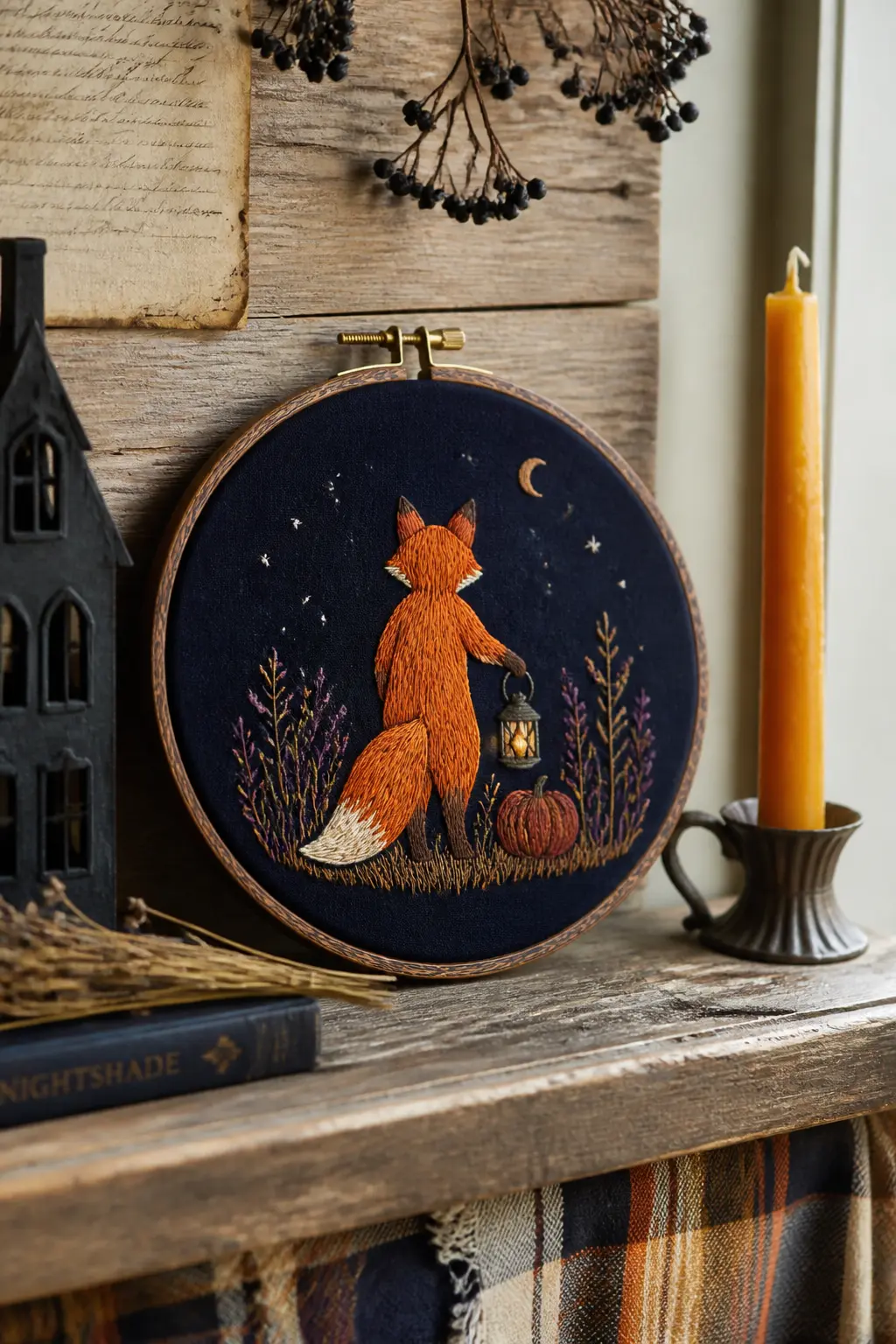
Fox with a Lantern at Night
A walking fox from behind, tail raised and curling, carrying a small lantern by its handle. The fox is stitched in long-and-short satin stitch using the same warm orange-to-cream gradient used in fox portraiture, but the rear view means the composition hinges on the silhouette and the tail volume rather than facial expression. The lantern swings slightly to one side.
The rear view is underused in embroidery motifs and creates immediate interest. Ground the fox on a simple stem-stitch path with two or three autumn leaves scattered beside it.
The dark sky behind (long running stitches, three or four values of indigo layered) makes the amber lantern glow the clear focal point even though the lantern itself is a small element.
🛍 Shopping guide
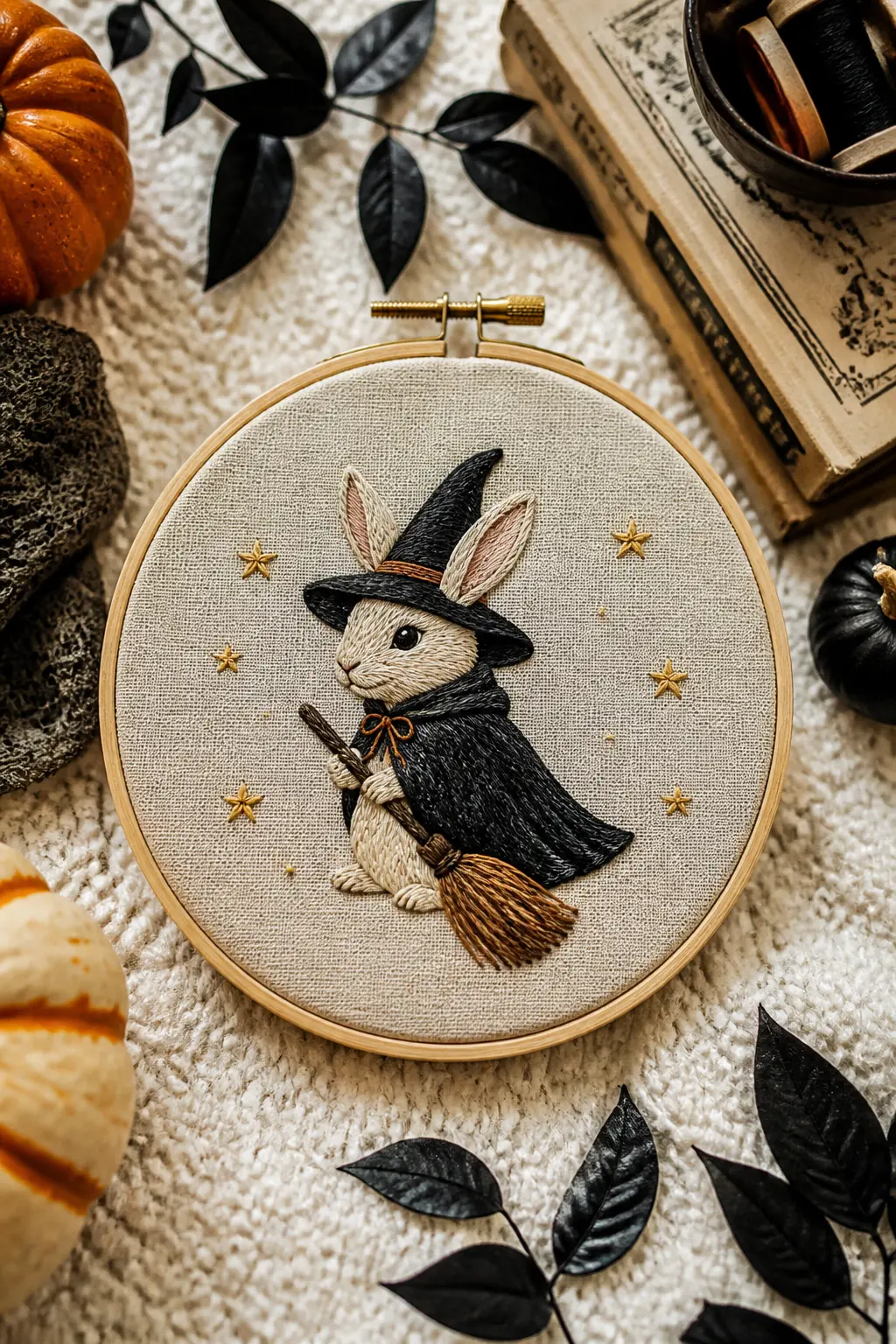
Rabbit Witch
A small upright rabbit wearing a tiny black witch hat and a dark cloak, rendered in split stitch for the outline and long-and-short satin stitch for the body. The rabbit’s fur uses warm cream and pale grey; the hat and cloak use near-black.
A miniature broom trails behind one back leg, and two small stars flank the hat brim in gold thread.
The witch hat on a woodland creature is the design move that makes this cross from cute into considered. Keep the hat proportionally large, slightly too big for the rabbit’s head, because the oversized hat is where the character lives.
The broom requires only four straight stitches in brown plus a cluster of short stitches at the base for the bristles. Finishes in two hours in a 5-inch hoop.
🛍 Shopping guide
Moon, Stars and Celestial Spookiness
A crescent moon in satin stitch takes about twenty minutes. Add a scattering of French-knot stars and a lazy stem of dried herb below it and the hoop is done. Celestial motifs suit Halloween because they suggest the veil-between-worlds idea without leaning on any single icon.
Gold thread is the one place to break the orange-black-cream rule here. A single strand of DMC light gold through a satin-stitch moon catches the light in a way that no amount of orange thread can replicate. Use it sparingly: one metallic element per hoop, maximum.
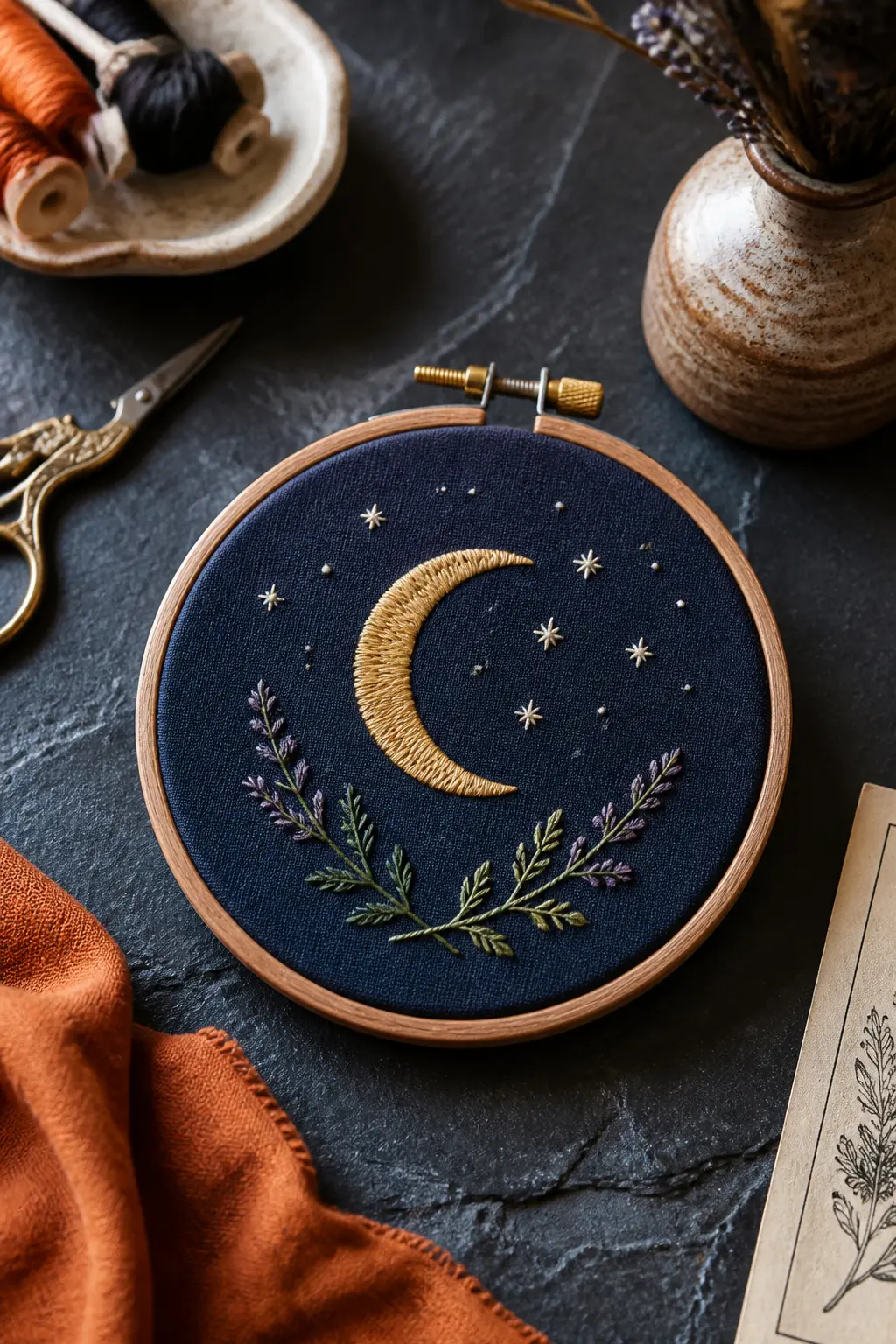
Crescent Moon with Herb Sprigs
A satin-stitch crescent moon in pale gold DMC thread, centred in a 5-inch hoop on dark midnight-blue linen. French-knot stars of varying sizes orbit it, and two sprigs of lavender or rosemary in split stitch hang below, as if the moon is a botanical label for a night garden. Nothing else in the frame.
The restraint is the point. One metallic thread, one background colour that is not the expected cream, two plant forms: this is a piece that looks considered rather than ambitious, and it finishes in an hour. Dark linen costs slightly more than pale, but it eliminates all the background stitching you would otherwise need to add depth.
🛍 Shopping guide
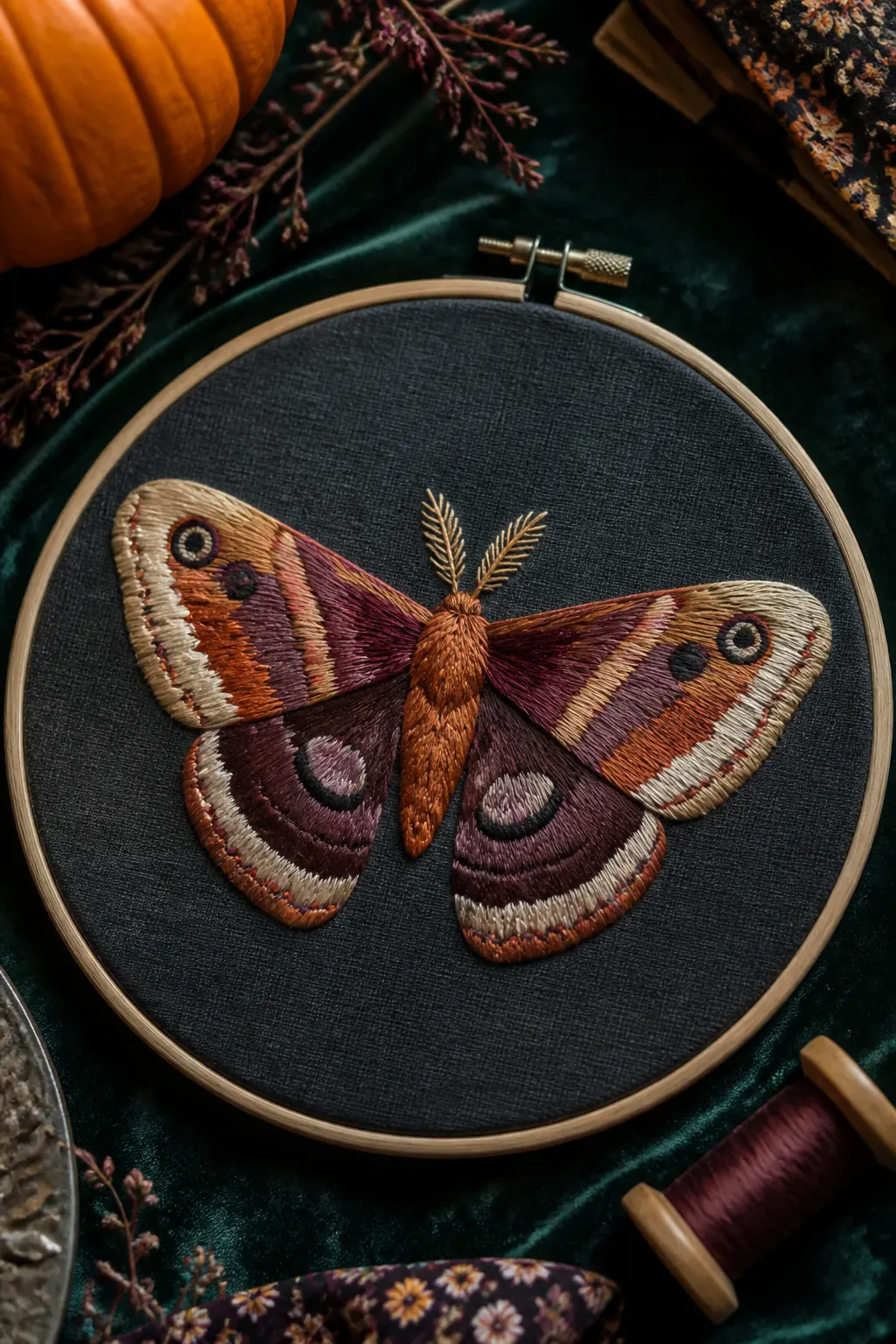
Moth on Dark Ground
A large atlas moth, wings spread symmetrically, stitched in long-and-short satin stitch on charcoal or dark forest-green linen. The wing colours stay autumnal: burnt sienna, warm buff, cream and a touch of dusty plum at the lower wing tips. The body is a raised padded satin stitch using a few layers of thread beneath the final layer.
Moths read as Halloween-adjacent without being literal about it, which makes this a piece that lives on a wall long after October. The dark ground fabric means no background stitching and the wing symmetry gives you a built-in compositional anchor. Draw the mirror line first, transfer one wing, flip it, and both sides will match without any counting.
🛍 Shopping guide
Pentagram with Botanical Fill
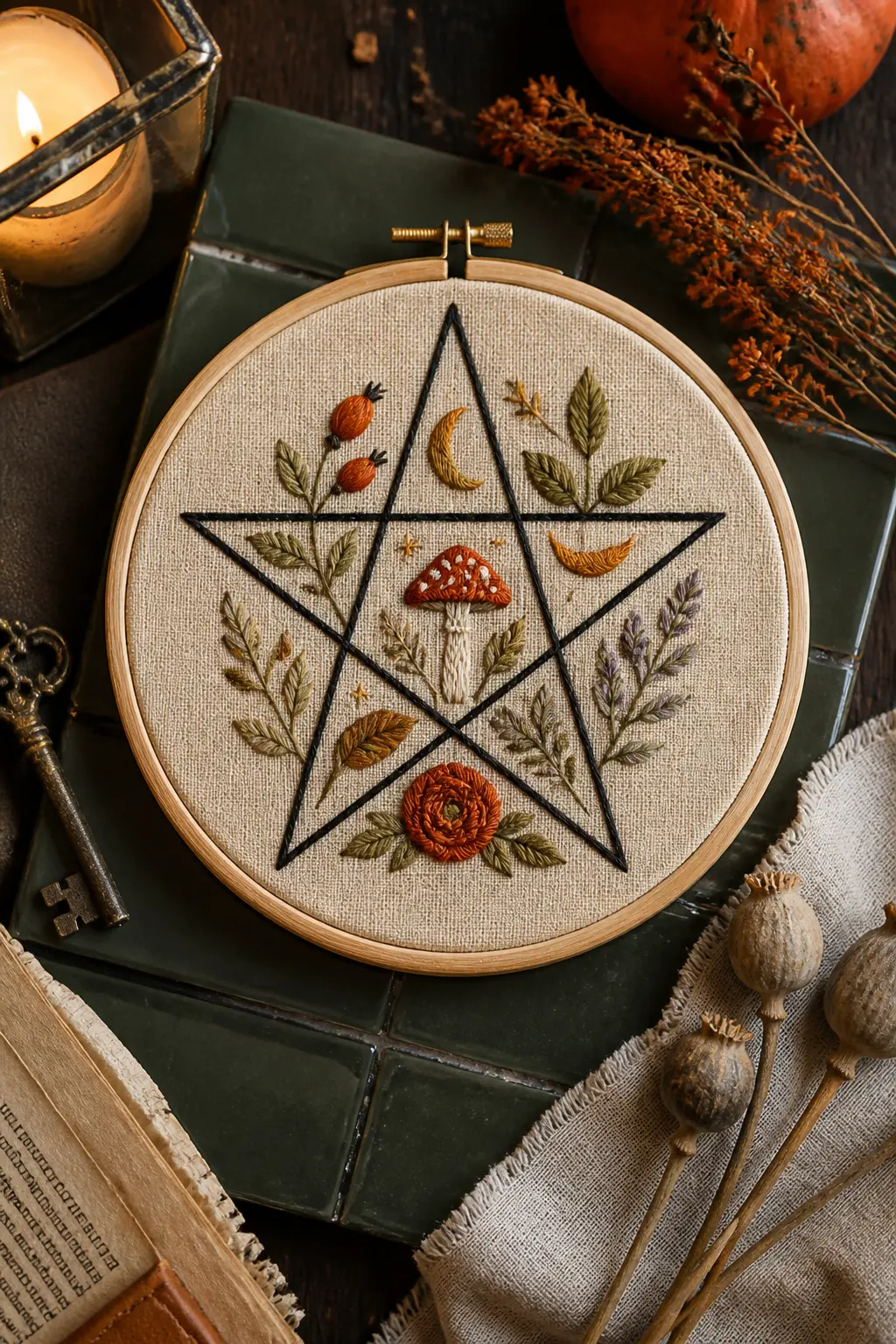
A five-pointed star outline in two strands of black split stitch, with small botanical elements filling each segment of the interior: a rosehip, a sprig of dried herb, a tiny mushroom, a leaf cluster, a small moon. Each element is stitched in muted naturalistic colours so the overall effect reads as an apothecary illustration rather than a spooky symbol.
The contrast between the hard geometric outline and the soft botanical interiors is where all the charm comes from. Keep the botanicals small enough that each one sits cleanly within its triangle of space without crowding the lines. Work the outline first, then fill each segment independently. A 7-inch hoop gives you enough room to make the interior details legible.
🛍 Shopping guide
Candle with Moth
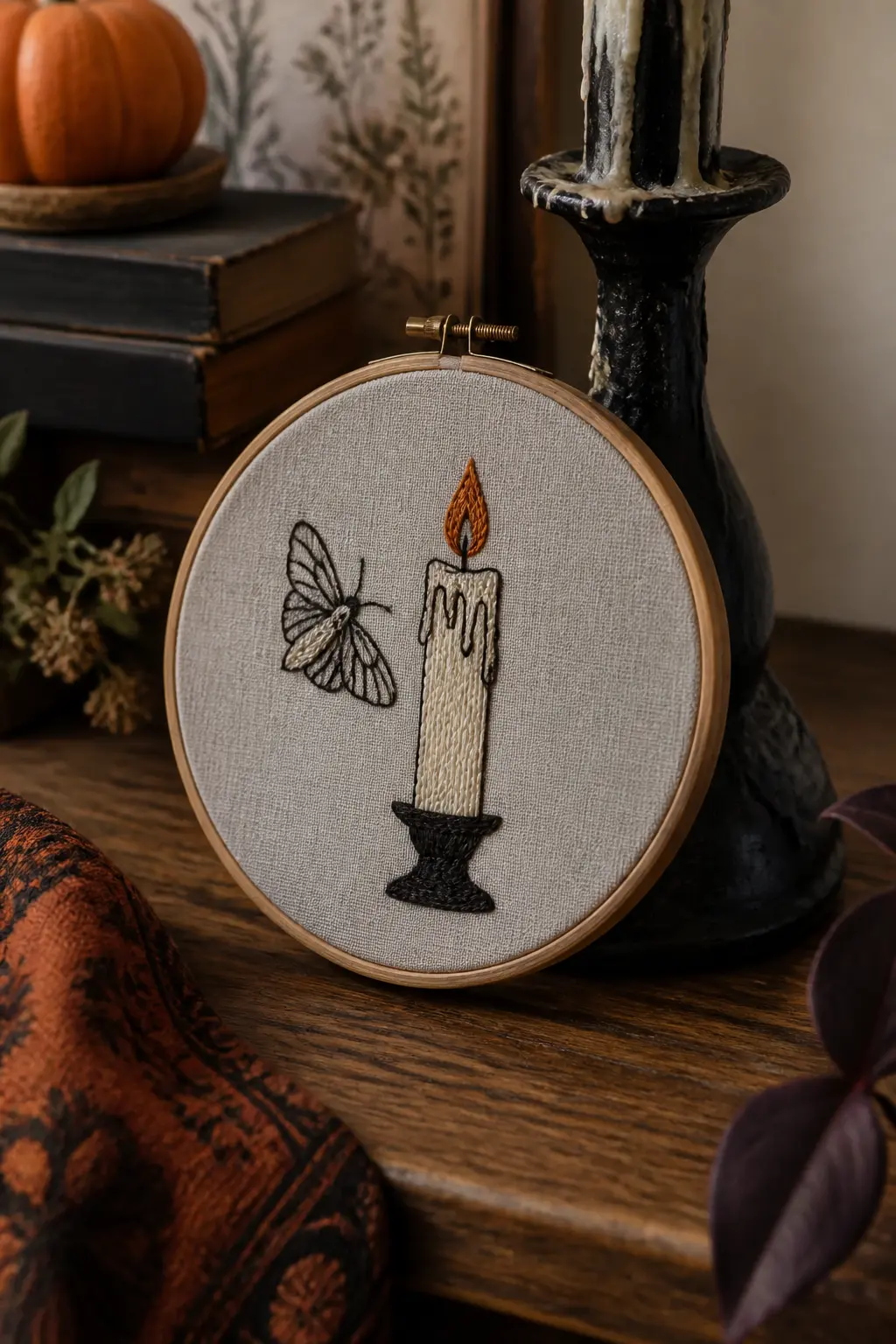
A tall taper candle in cream satin stitch, its flame rendered in amber and pale gold long stitches that splay upward. A single moth in outline stitch approaches the flame from the left, wings open.
Wax drips on the candle sides are a few lazy curved satin-stitch shapes in off-white. The background linen stays entirely bare except for one small French-knot star far to the upper right.
The moth-and-flame combination carries its own symbolism, which is exactly why it works on a wall as something more than seasonal decoration. Keep the moth in outline only: a filled moth next to a detailed candle would compete, and you want the flame to win. Total stitching time about ninety minutes, most of it spent on the candle body shading.
🛍 Shopping guide
Starling Murmuration
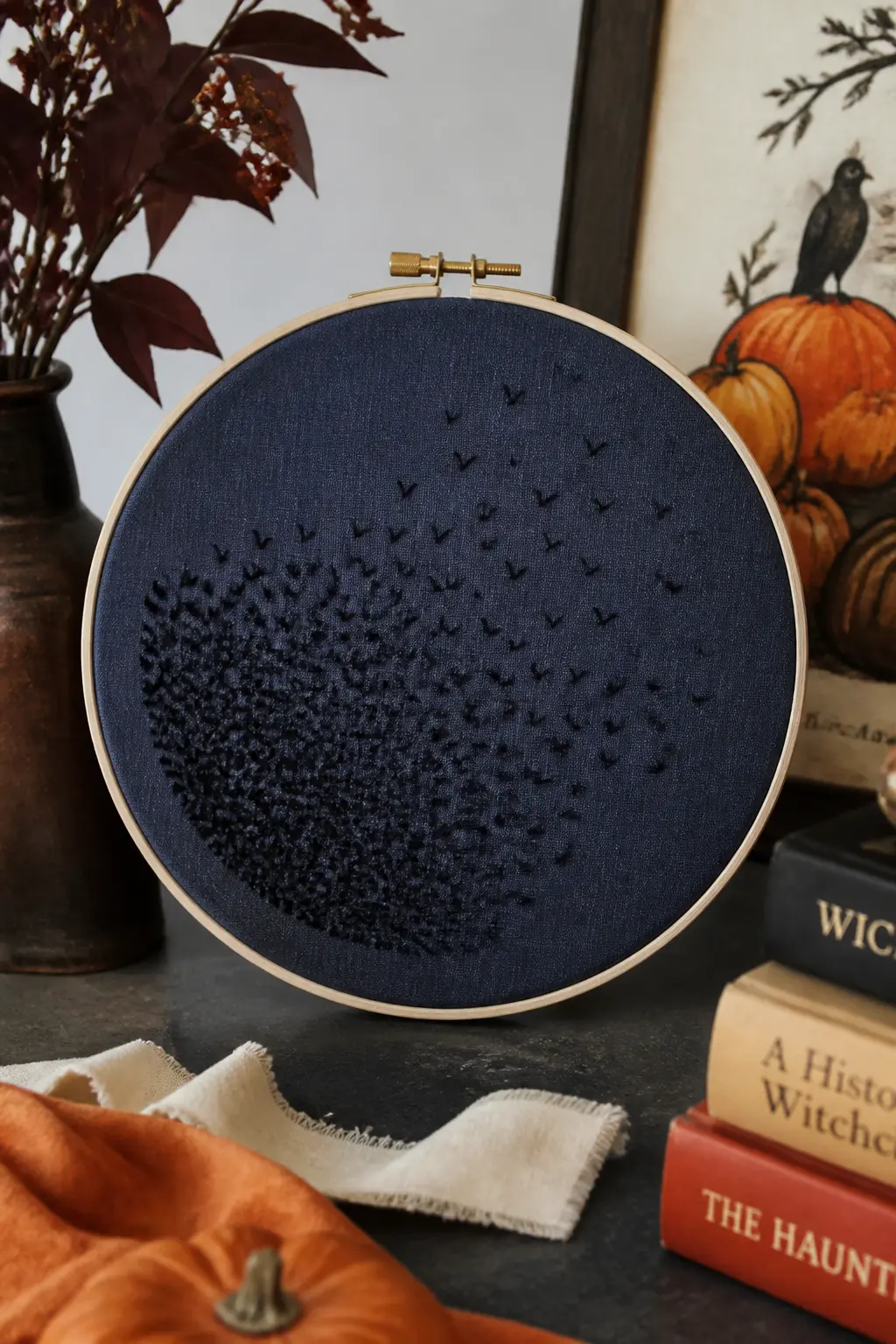
Dozens of tiny v-shaped birds in a single strand of near-black thread, scattered across dark indigo linen in a loose murmuration pattern that swirls toward the upper right. No other motifs. No botanical additions.
The power of this piece is in the density and movement suggested by the v-shapes alone, with a few shapes larger at the bottom (closer) and progressively smaller toward the top (farther away).
Each bird is three stitches: two diagonal straights and one small horizontal. At a single strand, each shape takes under thirty seconds. An eight-inch hoop with seventy to one hundred birds fills in about forty-five minutes of meditative stitching.
The visual effect from across a room is of a living, moving cloud, which makes this one of the most striking pieces in the collection despite being technically the simplest.
🛍 Shopping guide
Tarot Card Sun Motif
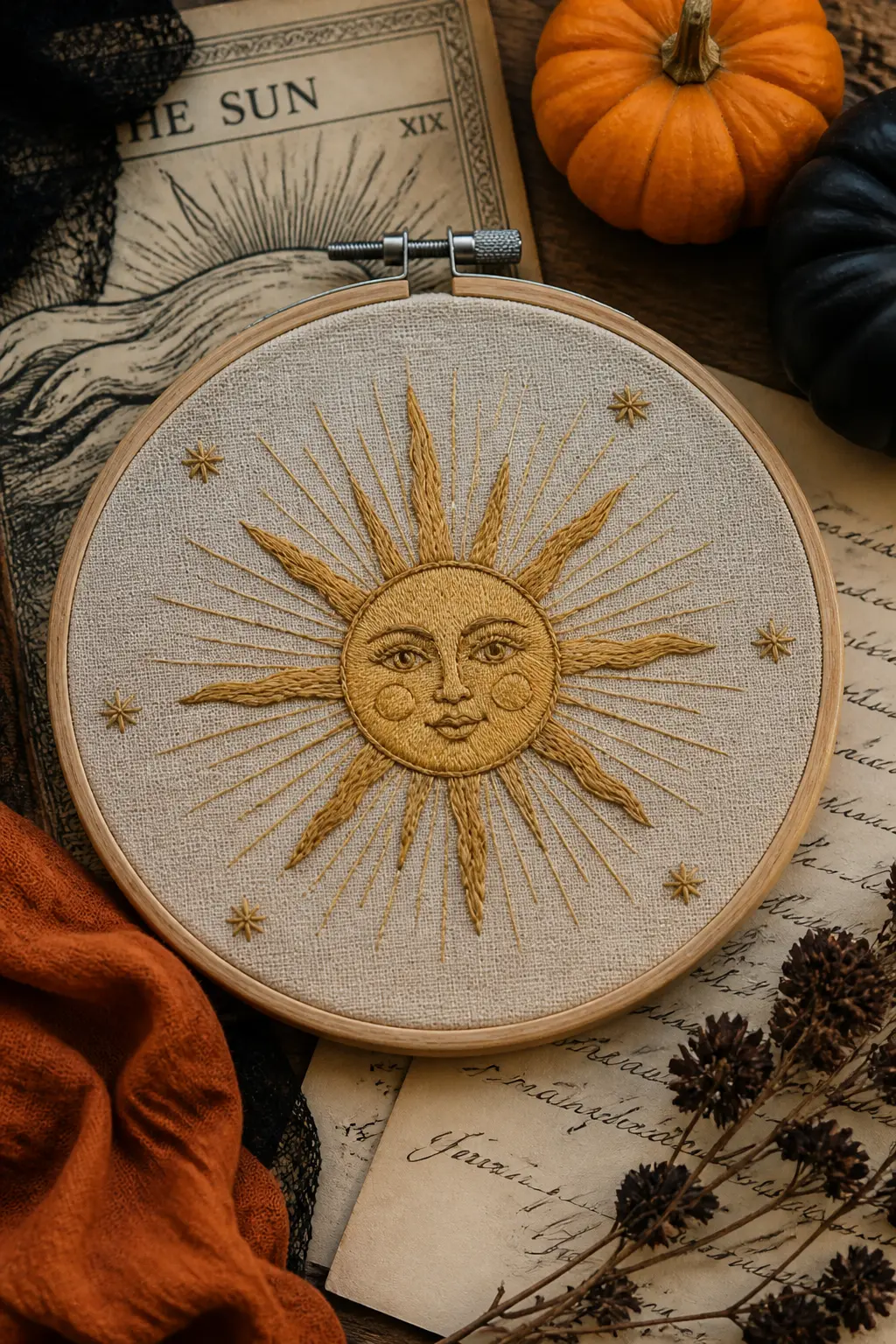
A round sun face in satin stitch with long straight-stitch rays radiating outward, worked in warm gold and pale amber.
The face features are small and stylised, two almond-shaped eyes in split stitch and a curved mouth, reminiscent of a vintage tarot illustration rather than a modern cartoon. French-knot stars fill the four corners of the surrounding linen inside the hoop.
The tarot sun reads as mystical and Halloween-adjacent without being directly spooky, which makes it appropriate for a room that needs atmosphere without full Halloween commitment.
The circular sun face sits naturally in a round hoop, so the hoop itself becomes a second sun shape echoing the motif. Work the rays before the face so the starting points of the rays are hidden under the circular face stitching.
🛍 Shopping guide
Ghosts with Character
A ghost is three curved lines and two French-knot eyes. The version worth stitching, though, has tiny details: a miniature pumpkin bucket hanging from one arm, a bat perched on a shoulder, a crescent moon embroidered on its chest. Felt applique for the body with embroidery for all the surrounding detail is a technique that goes fast and looks layered.
Orange printed fabric as the hoop background, rather than linen, is worth trying here. The contrast between the cream felt ghost and the speckled orange ground does visual work that a plain background cannot, and it cuts the amount of background stitching to zero.
For a whole evening of spooky making, pair this with a selection from the Halloween movie night ideas list and set up at the kitchen table.
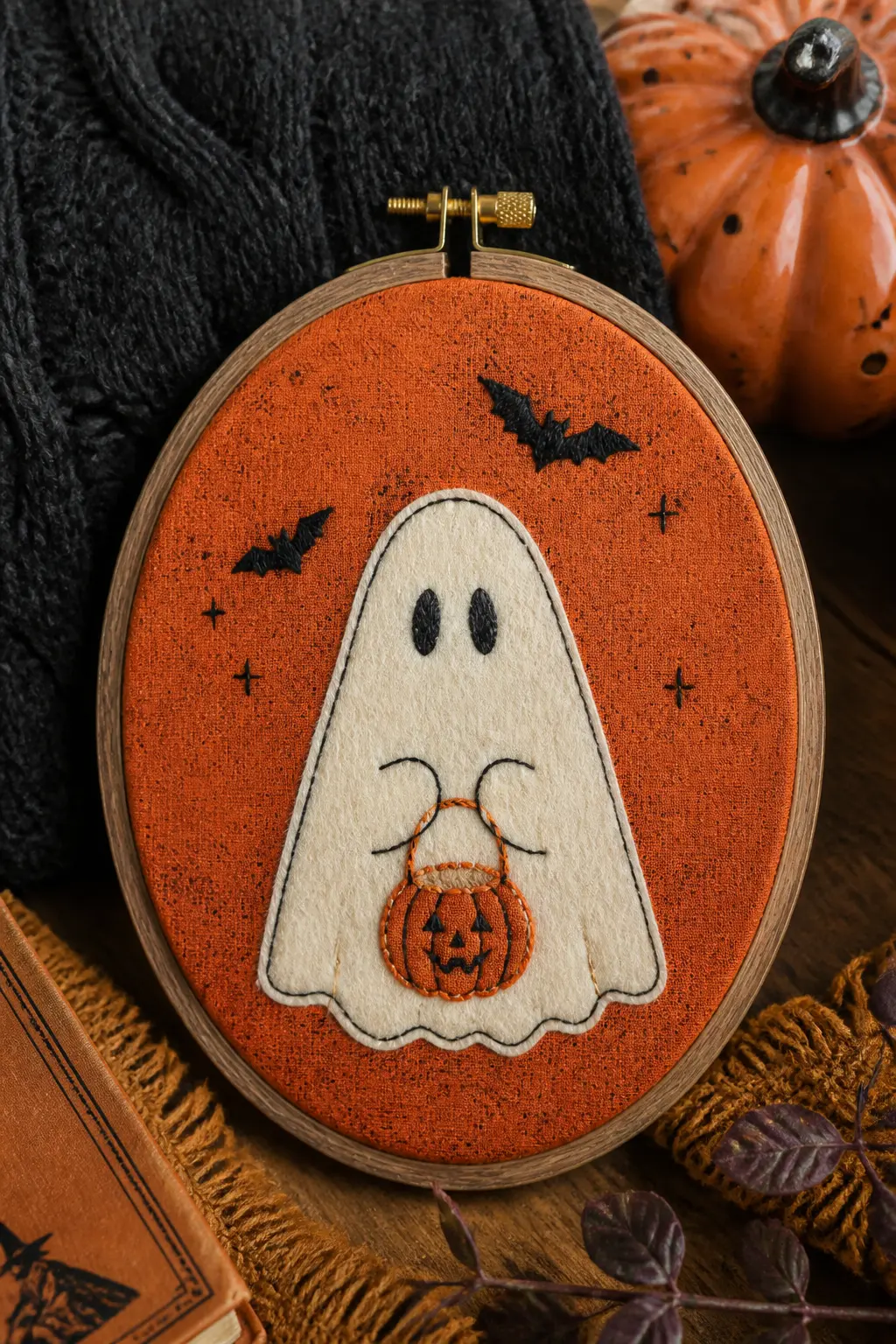
Ghost with a Pumpkin Bucket
The ghost body is a piece of cream felt cut to a soft rounded shape and whip-stitched onto an orange patterned fabric background.
Embroidered details sit on top: two tiny black French-knot eyes, a curved split-stitch smile, and a miniature jack-o-lantern bucket hanging from one extended arm in satin-stitched orange. A dark charcoal satin-stitch bat perches near the top of the frame.
The orange patterned fabric background does the heavy lifting, so you skip all background embroidery and spend your time on the character details. A crescent moon in pale gold thread and a scattering of gold star stitches fill the upper corners without crowding the ghost.
Mount this in a walnut-stained oval hoop for a piece that looks deliberate enough to gift.
🛍 Shopping guide
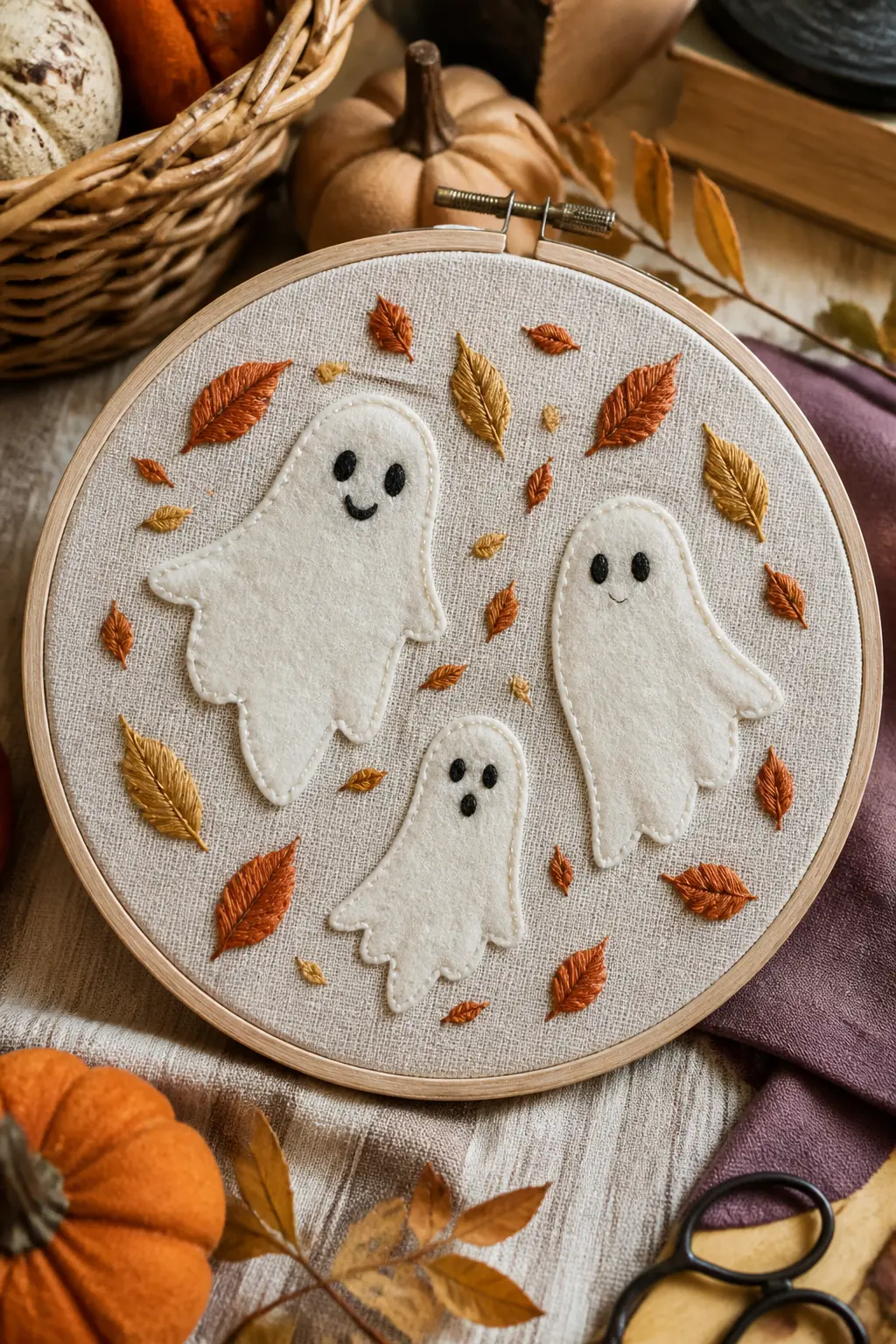
Ghost Trio in Falling Leaves
Three small ghosts of different sizes, each in a slightly different pose, surrounded by falling satin-stitch leaves in rust, amber and deep olive.
The ghosts are felt applique in cream, each with two tiny French-knot eyes and an individual detail: one wears a tiny embroidered bow, one carries a miniature broom, one has a crescent moon on its body. The leaves spiral around all three.
The individuality of each ghost is what elevates this from a pattern repeat to a proper small scene. Work the falling leaves last, after the ghosts are fixed, so you can tuck leaf stitches partially behind the felt edges for depth. Mount in a wide 8-inch hoop to give all three characters room without crowding.
🛍 Shopping guide
Miniature Scenes and Storytelling Hoops
A miniature scene fits inside a 6-inch hoop and tells a whole story: a cottage window with candlelight glowing behind the stitched curtains, a graveyard gate with a lantern hanging from it, a witch’s cottage door with a broom leaning against the frame. The pleasure here is in the specificity of small details rather than in technical difficulty.
Split stitch for architecture, satin stitch for the light sources and French knots for texture on stone walls: three stitches and you can build almost any scene. Keep the sky area deliberately simple, a wash of long horizontal running stitches in dark indigo or near-black, so the focal point stays on the scene below it.
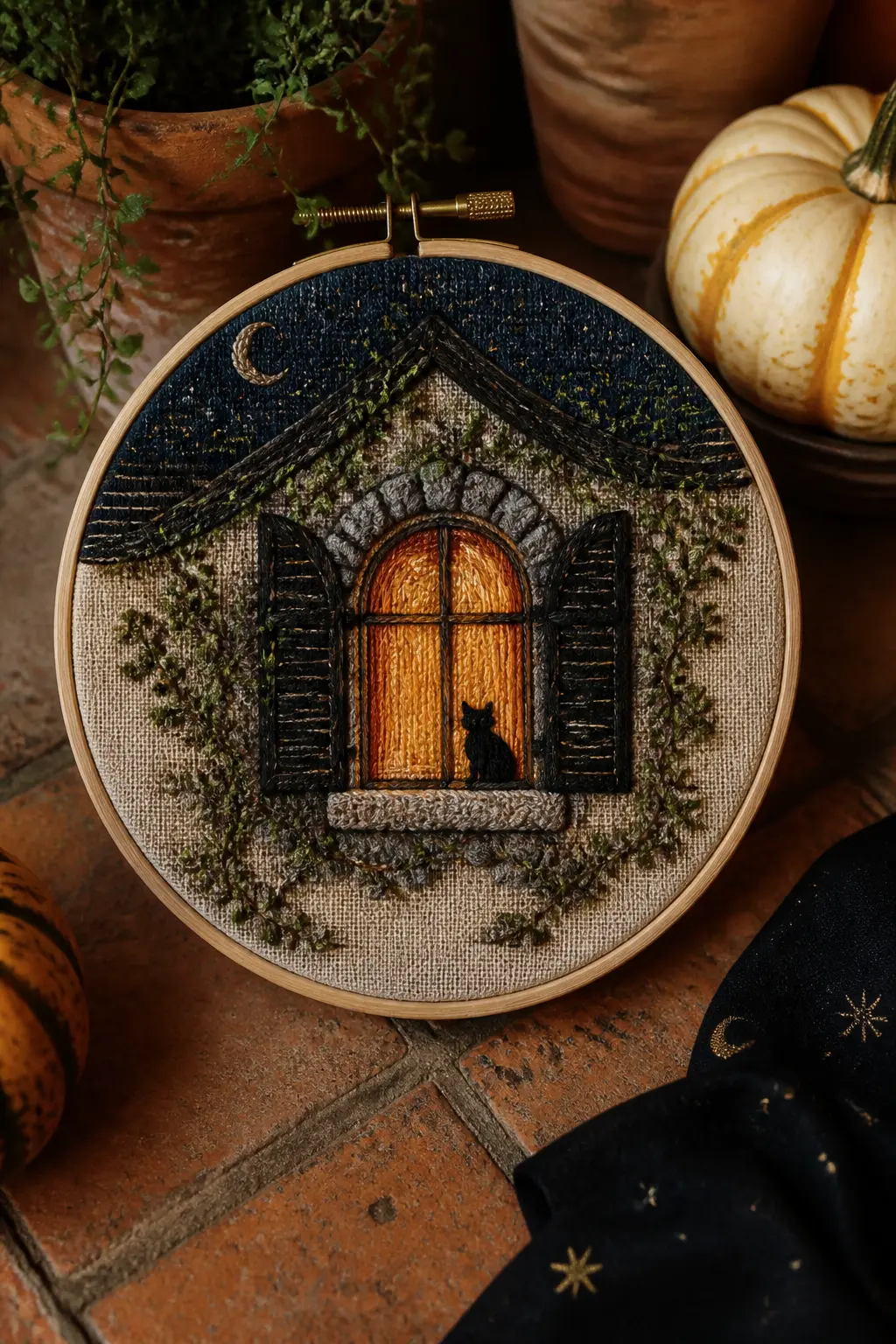
Cottage Window at Night
A stone cottage window frame in split stitch, with amber satin-stitch light behind the panes suggesting a candle inside. Tiny French-knot ivy dots climb the left edge of the frame, and a small crescent moon sits in the upper right corner of the sky area.
The sky itself is long horizontal running stitches in dark indigo, light enough to be suggestive rather than fully filled.
The illusion of light behind glass comes from working the amber stitches first, then laying the window-frame lines over the top in a darker thread.
Two or three strands of dark grey for the frame, and two of warm amber for the light: the layering reads as depth without requiring any special technique. This fits a 7-inch hoop and takes two to three hours.
🛍 Shopping guide
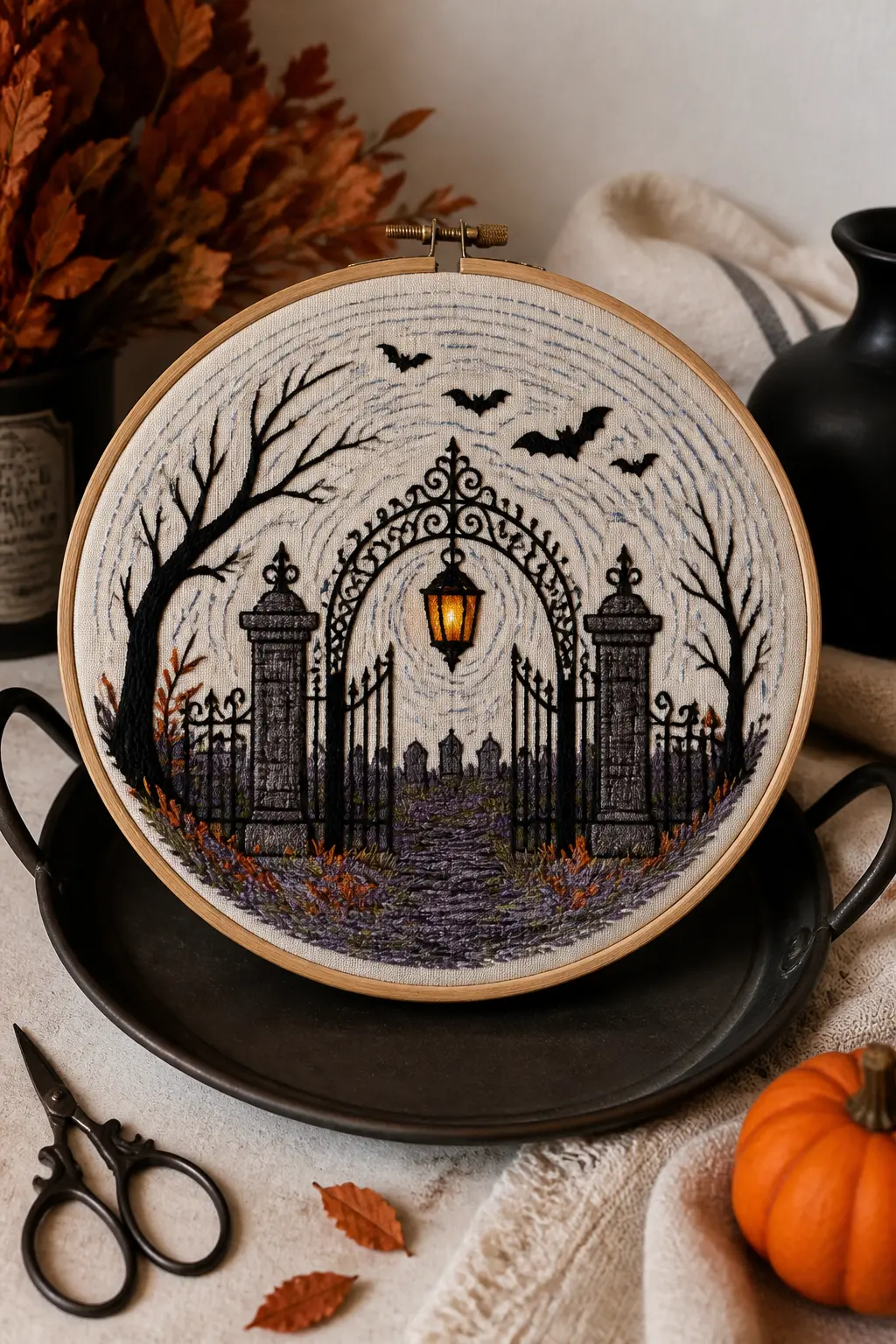
Graveyard Gate at Dusk
Two iron gate posts in dark grey split stitch with a simple arched gate between them, a lantern hanging from the arch centre in warm amber. A low stone wall extends from each post.
Above the arch, a crescent moon and three small bats in flight against a barely-stitched indigo sky. One small tombstone in the lower right corner, just readable as a rounded rectangle with a tiny cross on top.
Work the architecture in two strands for clean lines, the sky in a single strand of long running stitches so it reads as tone rather than texture. The lantern amber is the only warm element in a cool dark composition, and that single hit of warmth is what makes the whole scene cosy rather than grim.
🛍 Shopping guide
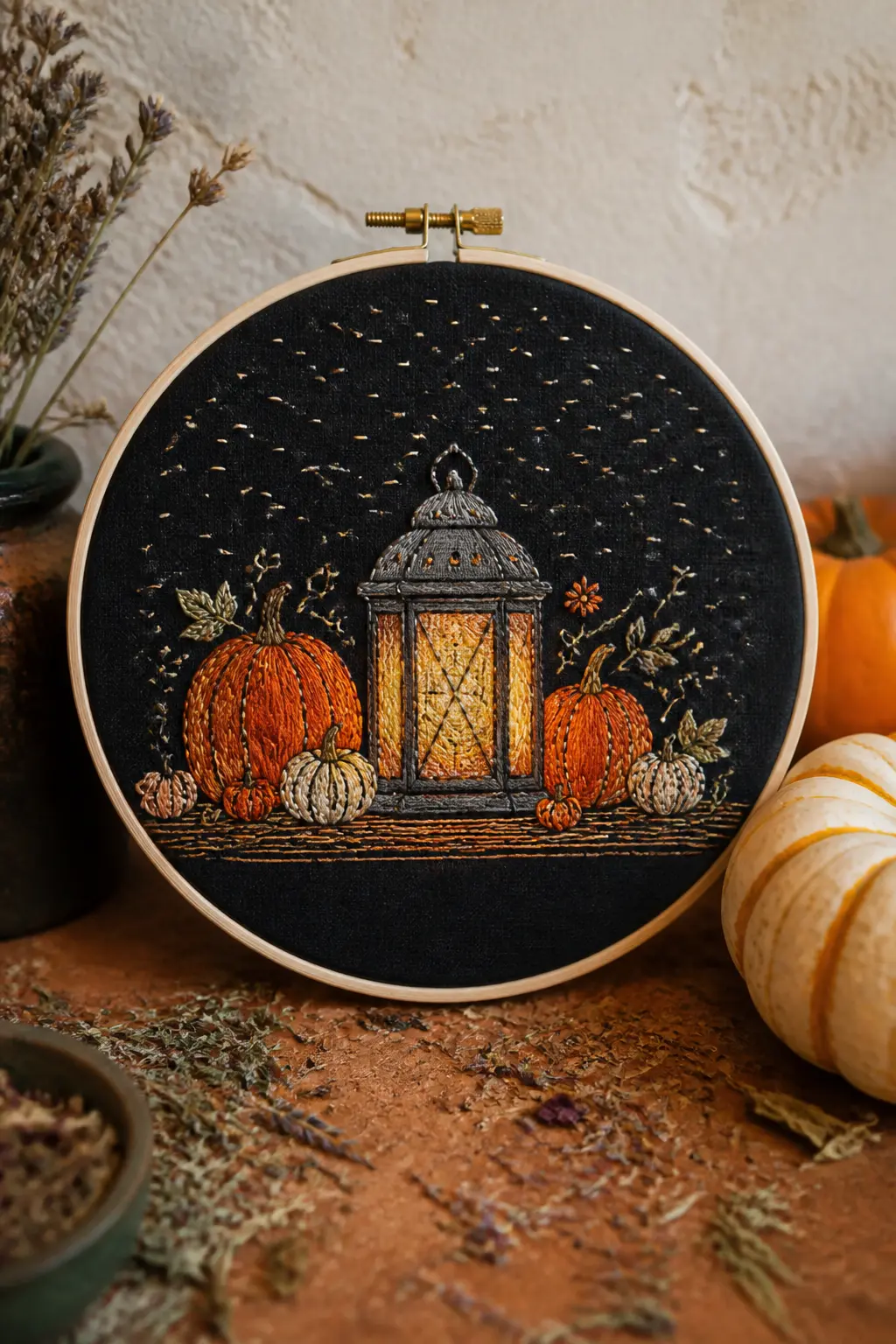
Lantern Among Pumpkins
A simple iron lantern in split stitch and straight stitch, glowing amber at the centre, flanked by two small pumpkins and a few dried leaf shapes on the ground. The ground line is a single stem stitch across the lower fifth of the hoop.
Above the lantern, a starless dark sky in long running stitches fades out before it reaches the top edge of the fabric.
The warmth of the amber lantern glow against the cool dark sky does all the atmosphere building.
Use three strands of dark charcoal for the lantern frame and one strand of warm amber for the glow, working the glow in concentric layers of straight stitch so it appears to radiate outward. A 7-inch hoop gives the scene enough ground space to breathe.
🛍 Shopping guide
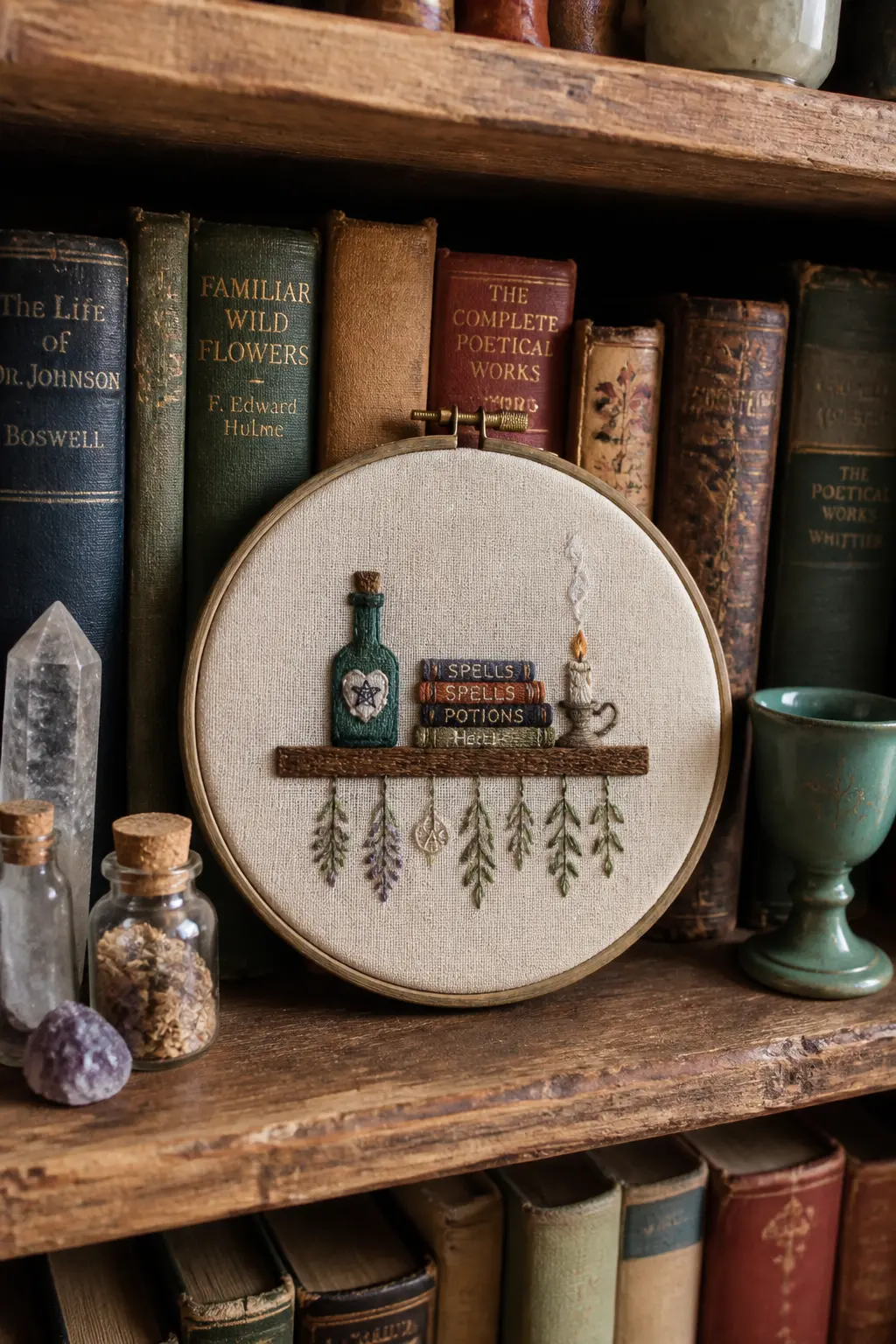
Witchcraft Shelf Scene
A tiny shelf in split stitch with three objects on it: a round potion bottle in dusty teal, a small stack of two books in dark brown and cream, and a single candle in cream with an amber flame.
Below the shelf, trailing herb sprigs in dark olive hang from two tiny hooks. The whole scene is contained within a 7-inch hoop on natural linen with no sky or background fill.
The shelf line is a single row of chain stitch that gives visual weight without bulk. Keep each object simple enough to be identifiable at small scale: one colour for each bottle, a simple rectangle for each book, a thin rectangle for the candle.
The trailing herbs below the shelf add a vertical element that anchors the whole composition to the lower half of the hoop.
🛍 Shopping guide
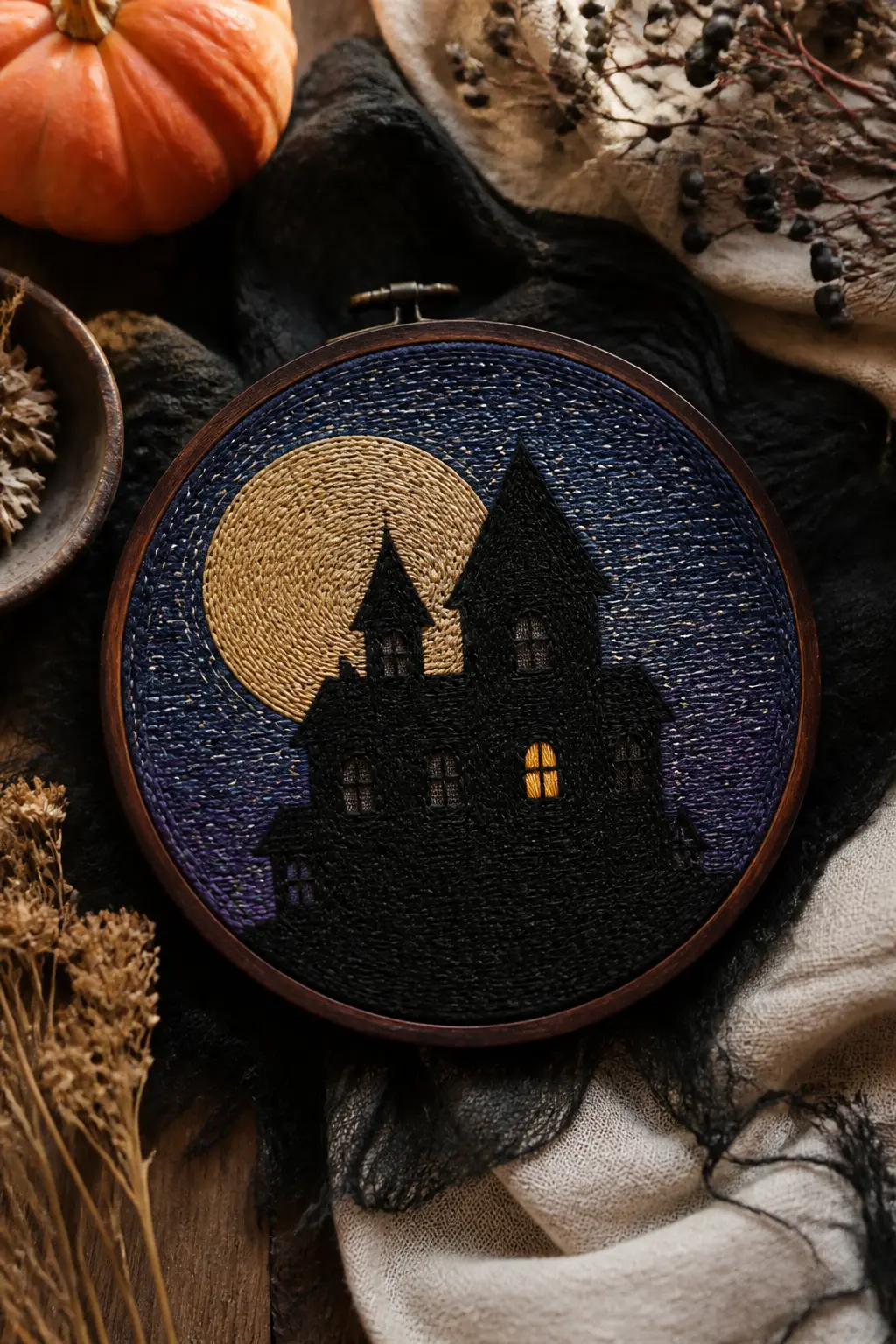
Haunted House in Silhouette
A Victorian house silhouette in solid near-black satin stitch, with a full moon in pale gold satin stitch rising behind it. Two bats in simple outline stitch fly above the roofline.
The sky around the moon graduates from pale cream to medium indigo in long running stitches. A single lighted window on the house front, in a four-stitch amber rectangle, is the one detail break in the solid silhouette.
The sky graduation is built by working three concentric zones of running stitch in progressively darker values of blue-grey, starting from around the moon outward.
No blending required: the running stitch lines create the graduation through density rather than thread mixing, and it is faster than it looks. Mount in a 7-inch hoop in a dark finish to complement the night palette.
🛍 Shopping guide
Cats, Bats and Familiars
A black cat in a pumpkin costume is the kind of idea that sounds kitsch but stitches up as genuinely appealing. The key is proportion: make the cat small and the pumpkin costume large and round, so the personality comes from the contrast in scale.
Scattered French-knot dots in orange and purple across the background linen add rhythm without requiring more planning.
Bats work best in clusters rather than alone. Three bats in flight, each a slightly different size, carry more visual energy than one centred bat ever will. Stitch the wings in satin stitch, alternate the angle of each bat, and leave the negative space between them empty.
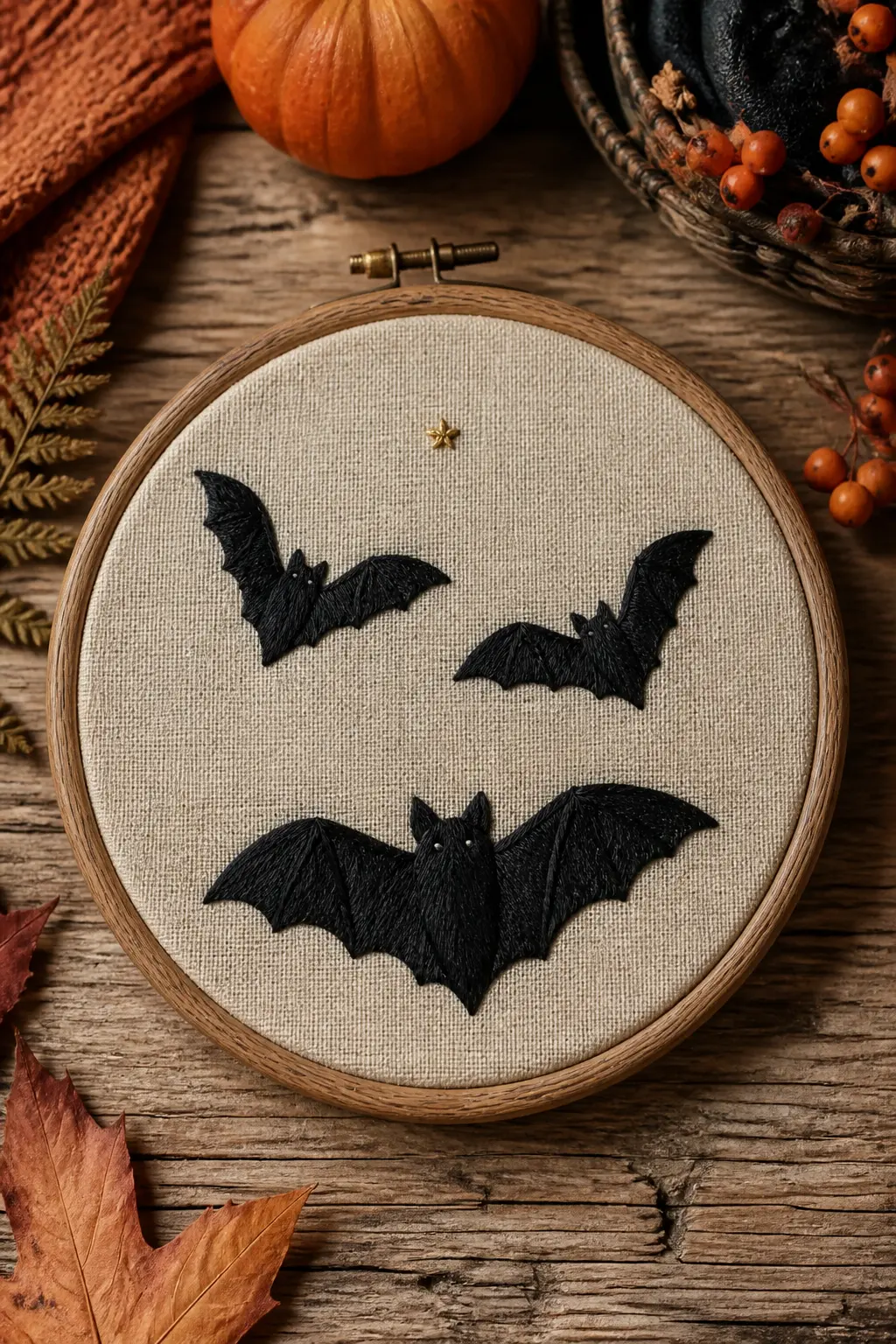
Three Bats in Flight
Three bats stitched in satin stitch, each angled differently and each a slightly different size, scattered across natural linen inside a 6-inch hoop. No background stitching, no border, no wreath: just three bats and the linen ground. The arrangement asymmetry is deliberate and is what stops the composition from looking centred-and-safe.
Use four strands of near-black thread (DMC 3799 reads warmer and less flat than true black at this scale) and vary the wing angle so each bat has a different attitude in flight.
A single small French-knot star in gold thread near the top corner adds a night-sky suggestion without committing to a full celestial background. Total stitch time: about an hour.
🛍 Shopping guide
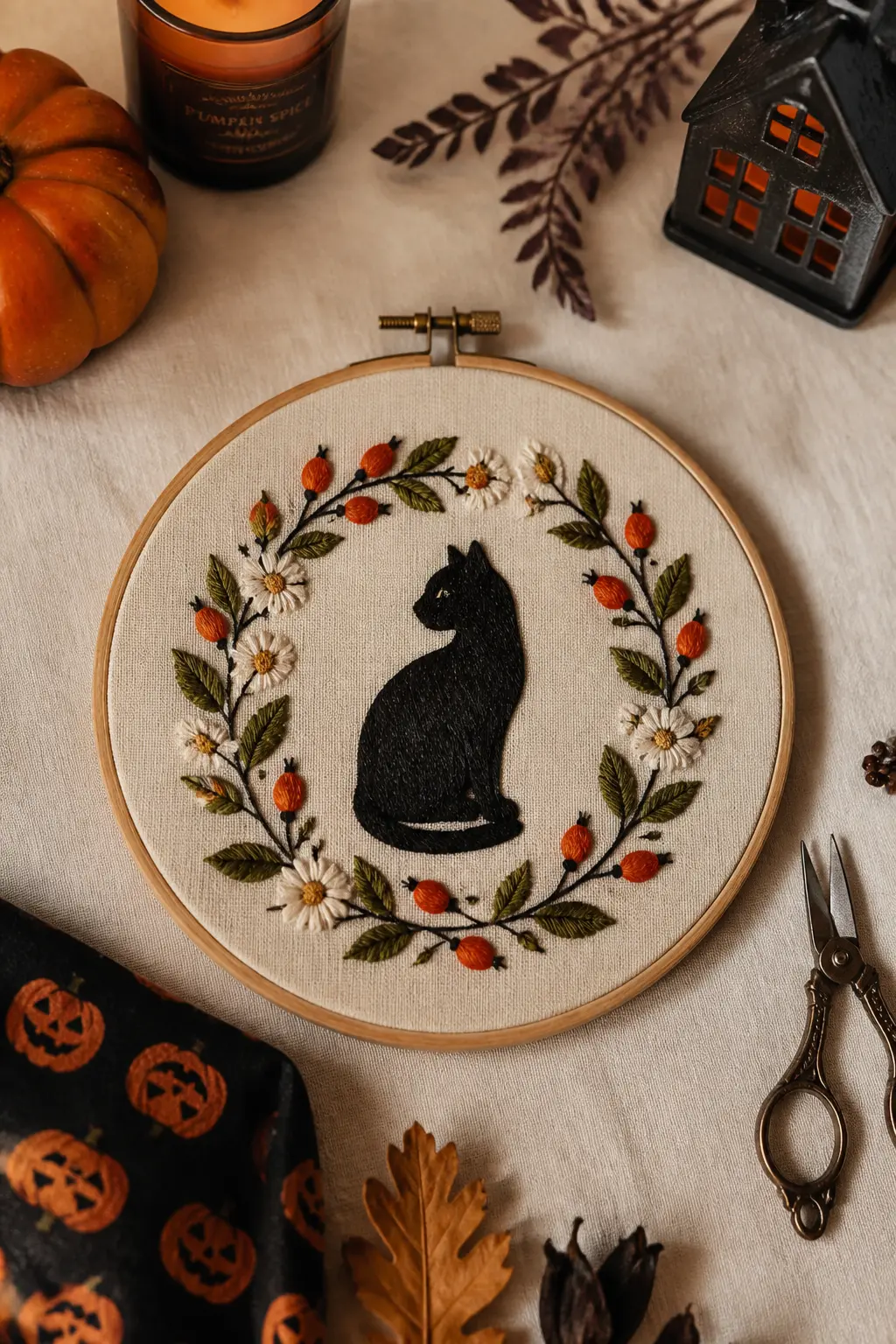
Black Cat Silhouette Wreath
A sitting black cat silhouette in solid satin stitch, surrounded by a wreath of small embroidered botanicals: rosehips in rust, leaves in forest green, and a few tiny five-petal flowers in cream. The wreath sits right against the cat’s outline so it reads as a single composed motif rather than a subject and a separate border.
Stitch the cat body first in four strands, then build the wreath outward from where the cat’s silhouette ends. The botanical elements can be completed in any order, but anchoring the larger rosehips first gives you the structure to fill the gaps with leaves without the arrangement becoming congested. Fits neatly in a 6-inch hoop.
🛍 Shopping guide
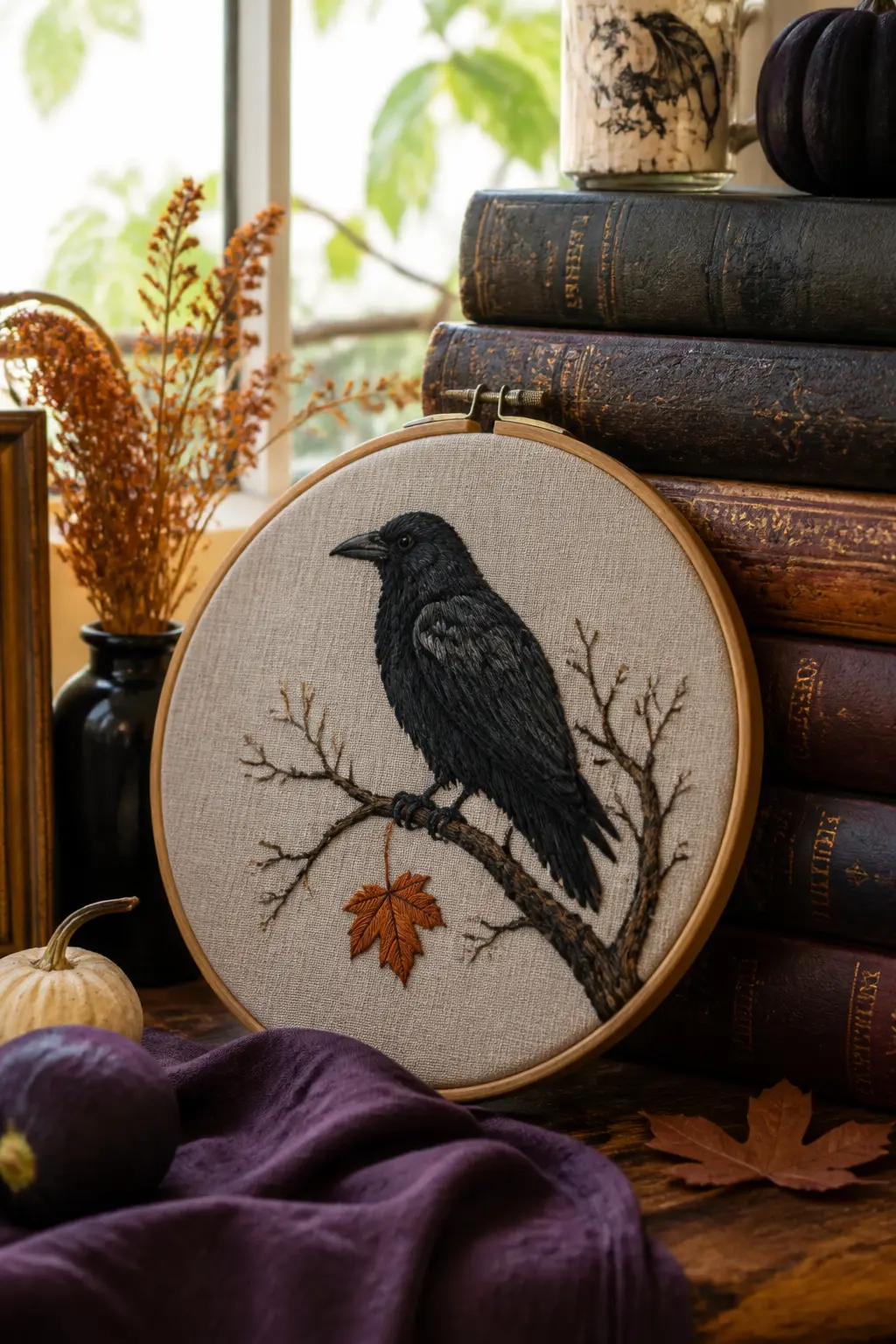
Raven on a Branch
A raven in profile, perched on a bare branch, stitched in long-and-short satin stitch using near-black and dark charcoal threads to suggest the iridescent sheen of real feathers. The branch extends across the lower quarter of the hoop in split stitch. A single autumn leaf clings to one twig end, in rust satin stitch. Nothing else fills the frame.
The iridescence effect comes from alternating strands of DMC 310 (black) and 3799 (dark pewter) within the same long-and-short rows, so the colour shifts depending on how the light hits the thread.
It is a two-colour trick that reads as far more complex than it is. Work the beak in one strand of dark grey split stitch for a clean hard edge against the soft body stitching.
🛍 Shopping guide
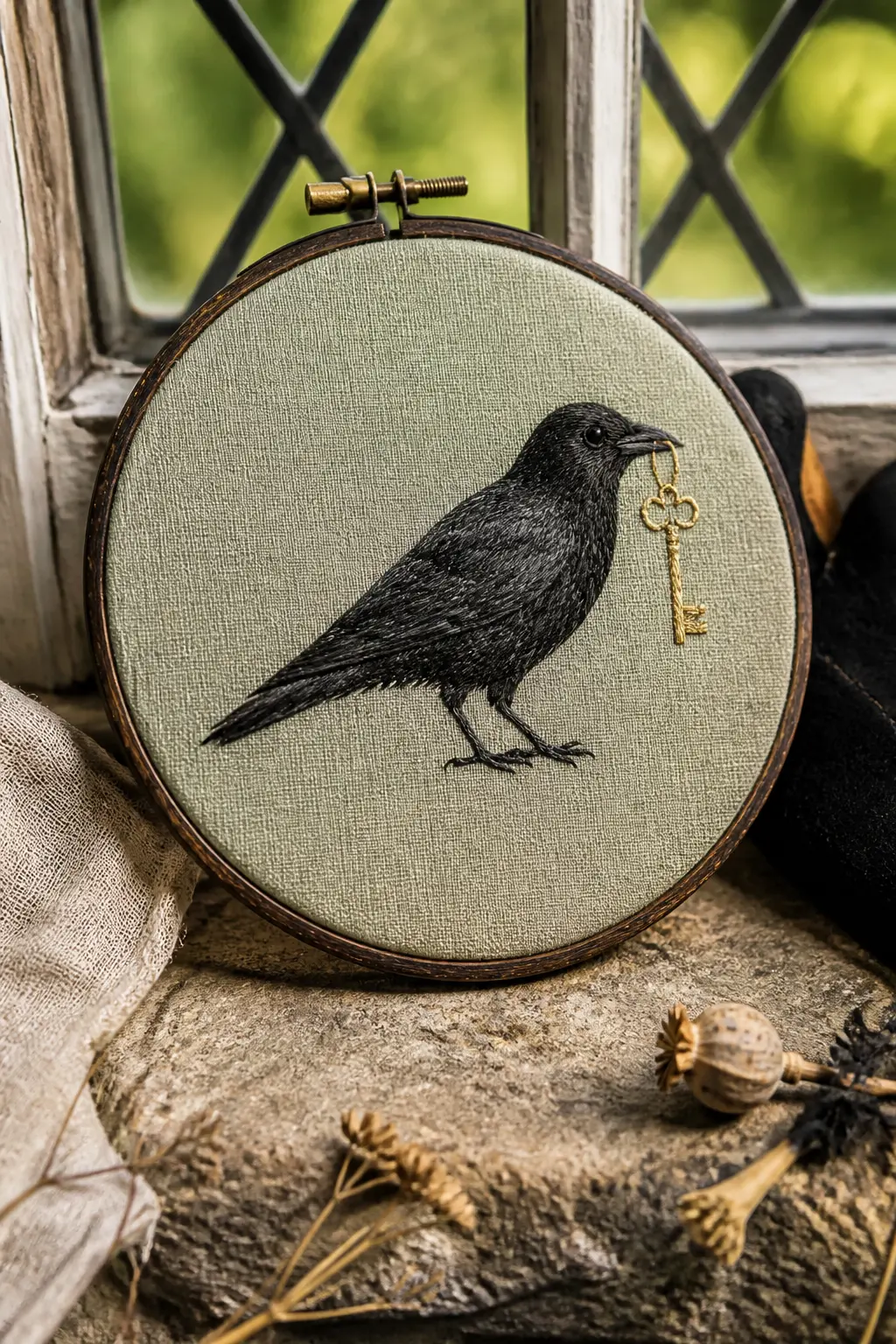
Crow and Key
A crow in three-quarter view holding an old-fashioned key in its beak, stitched in long-and-short satin stitch with the same near-black-and-dark-pewter layering technique used for the raven.
The key hangs below the beak in split stitch with a round bow at the top and a simple bit at the bottom. The key is in warm gold thread, the one colour break in an otherwise monochrome bird.
The crow-and-key combination has a folktale quality that positions the hoop as decor for all year rather than a seasonal ornament. The key takes about fifteen minutes to stitch and has an outsized effect on the whole composition.
Mount in a 6-inch dark-stained hoop to complement the monochrome palette of the bird and let the gold key read as a warm accent.
🛍 Shopping guide
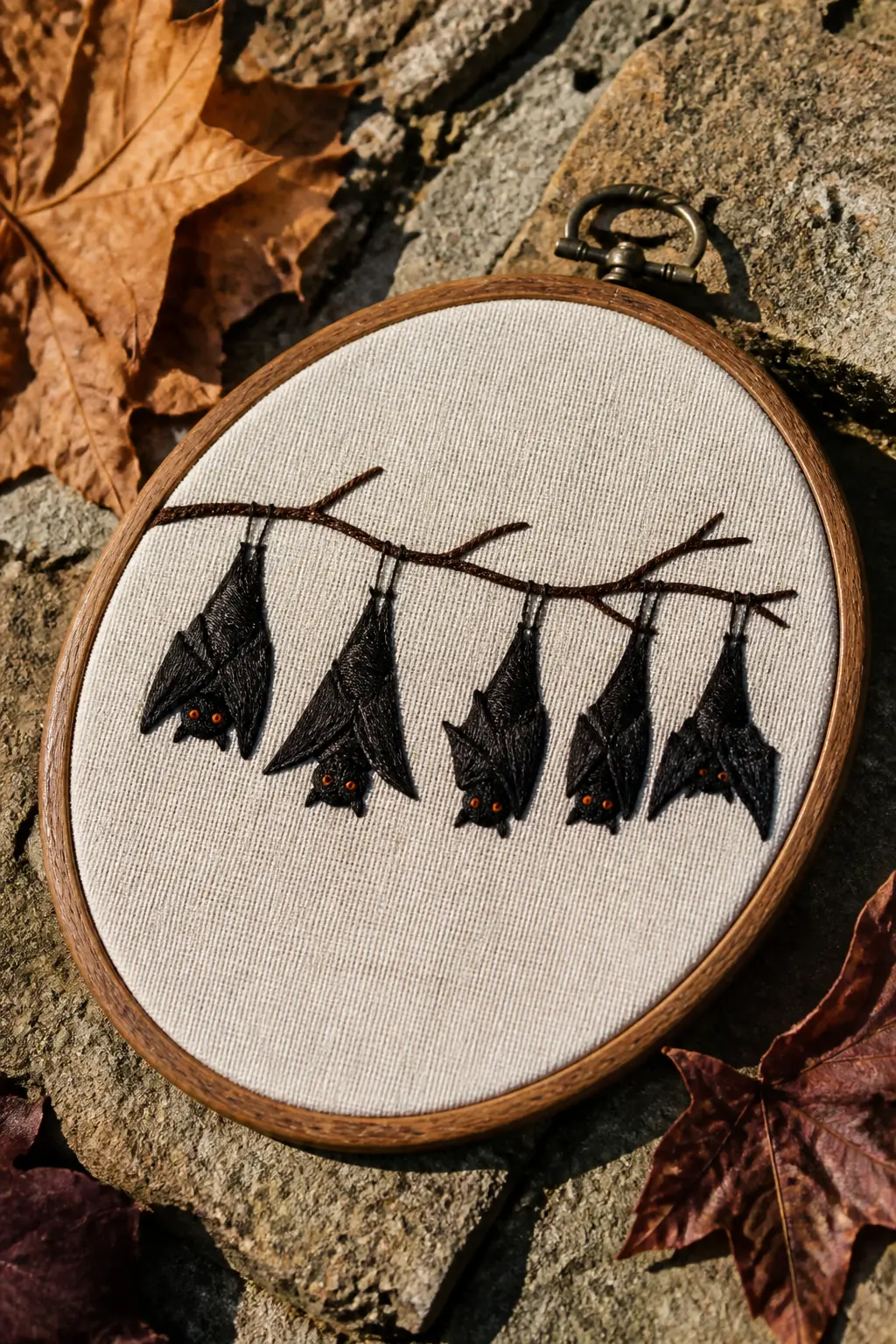
Bat Colony on Branch
A bare horizontal branch in dark brown stem stitch, with five bats hanging upside down from it in various states of wing-fold, rendered in dark charcoal satin stitch. Wings range from fully open to tightly wrapped around the body. A few lazy-stitch leaves cling to the branch ends. The background is bare natural linen.
The hanging bats read differently from flying bats: slower, more settled, more atmospheric. The variation in wing position prevents the row from feeling like a pattern repeat.
Work the branch first so the bats have an anchor, then attach each bat by starting each one at the claws at the top and working downward. A horizontal 8-inch or oval hoop suits the branch format better than a round one.
🛍 Shopping guide
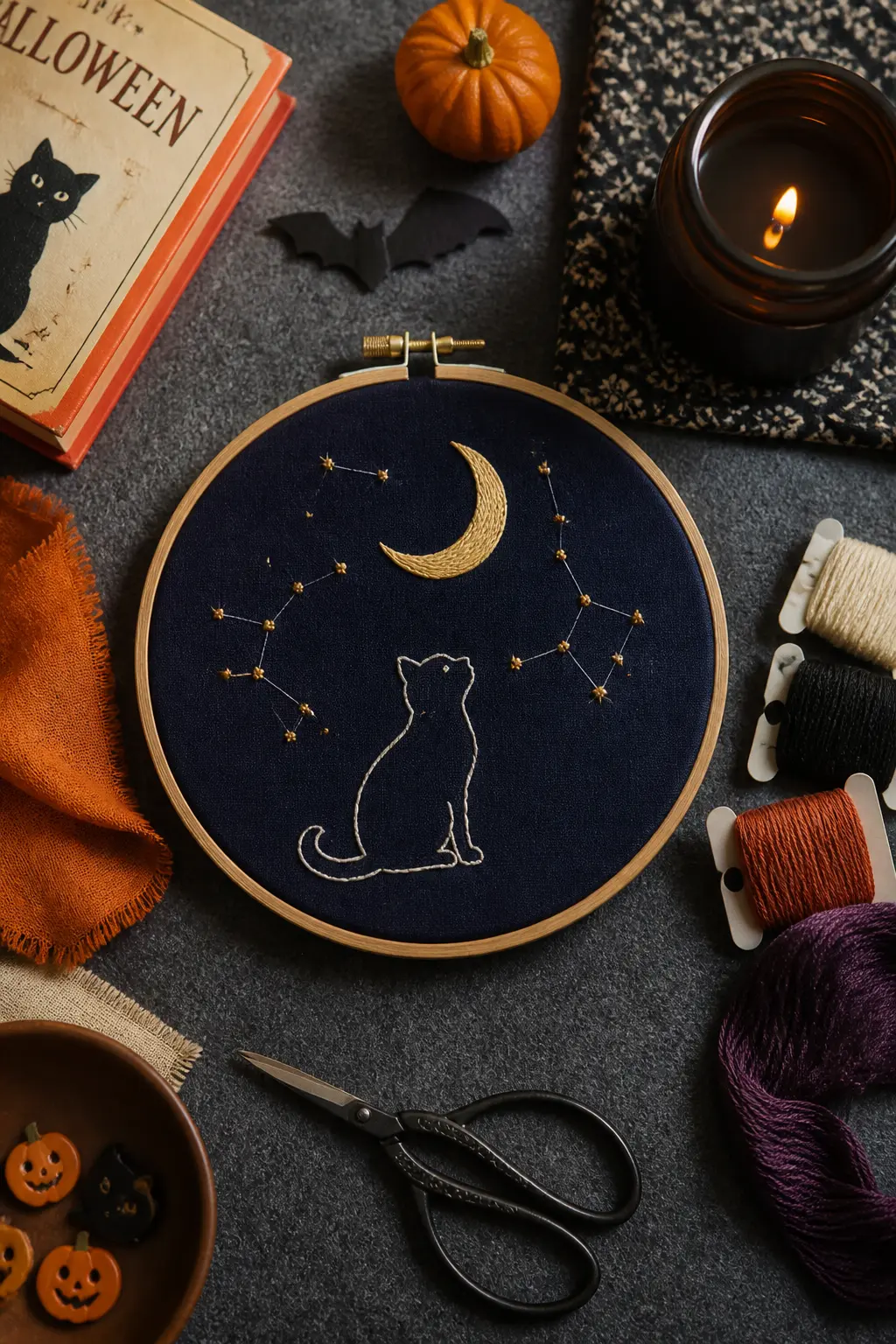
Cat and Moon Constellation
A sitting cat silhouette in outline stitch only (two strands, no fill), with a crescent moon in satin stitch sitting just above its head and a constellation of French-knot stars connected by single-strand straight stitches mapping the cat’s body shape.
The constellation lines turn the cat into its own star map. One small bat in the upper left corner completes the night-sky register.
The unfilled cat outline is the crucial choice: a filled silhouette next to a constellation would compete for attention. The outline lets the constellation behind and around it become part of the motif.
Draw the cat outline first, then plan the star positions so each knot falls on a feature, ear tip, chin, paw, tail curl, before connecting them with the constellation lines. Fits cleanly in a 6-inch hoop on dark fabric.
🛍 Shopping guide
Slow-Stitch Texture Pieces
These are the entries where the stitch itself is the subject: a pumpkin built entirely from rows of long-and-short satin stitch that convey the ridges without any outlines, or a spiderweb where every spoke is a single straight stitch and every rung is a tiny woven thread.
The motif is almost secondary; what you are really making is a study in thread texture.
Slow-stitch pieces suit an evening when you want to be absorbed rather than challenged. Put on something good to listen to, work in good light, and let the repetition of the stitch be the point.
These are also the hoops that tend to earn the most comments when you hang them, because the texture reads as skill even when the technique is meditative and accessible.
Frequently Asked Questions
What stitches do most of these Halloween embroidery ideas use?
The majority use satin stitch, split stitch, stem stitch and French knots. A few include lazy-daisy stitch and long-and-short satin stitch for shading. If you are comfortable with those six, every idea here is within reach. If you are newer to embroidery, about half the ideas can be completed using only running stitch, French knots and basic satin stitch.
What hoop size works best for these designs?
Most ideas fit a 5-inch or 6-inch hoop, which is the standard size sold in starter kits. Miniature scene designs and wreath-format pieces benefit from a 7-inch or 8-inch hoop. Very simple motifs, the cauldron, the pumpkin with a moon hat, the three bats, work well at 4 inches as small-scale accent pieces you can cluster together on a wall.
Can these be finished in a single evening if you are a beginner?
Simpler motifs (cauldron, spider web, three bats, crescent moon with herbs) finish in 60 to 90 minutes even for newer stitchers. More detailed pieces such as the fox or the miniature scene designs take two to three hours. The title refers to a comfortable evening session of about three hours: most beginner-appropriate ideas land well within that.
What fabric works best for Halloween embroidery hoops?
Natural linen or a linen-cotton blend is the most forgiving choice: it holds its shape in the hoop, takes all standard stitches well and its warm neutral colour flatters the seasonal palette. For darker-ground pieces (starling murmuration, moth, crescent moon), dark navy or charcoal quilting cotton is an affordable alternative to specialist dark linen.
How do you display embroidery hoops on a wall?
The simplest method is a small adhesive hook or a single nail through the fabric at the top of the hoop, using the screw hardware of a wooden hoop as the hang point.
For a cluster of different-sized hoops, arrange them on the floor first to work out the spacing before committing any holes to the wall. Odd numbers of hoops and a mix of sizes (4-inch, 6-inch, 8-inch) make the most natural-looking gallery wall.
Where can you find free Halloween embroidery patterns?
Many independent designers release seasonal patterns on Etsy, Ravelry and their own blogs, often as free PDFs with a newsletter sign-up. Pinterest is useful for finding motif references to trace yourself using a light pad or a window.
For printable Halloween activities of all kinds to accompany a crafting session, the classroom Halloween activities round-up also links out to several printable resources.
14 Halloween charcuterie board for kids ideas that look wildly spooky and take under 30 minutes to a
16 Halloween rice krispie treats shaped, dipped, and decorated from one base recipe. Pumpkins, ghost
15 fun halloween icebreaker games to warm up strangers fast — zero prep, big laughs, perfect for p
Leave a Reply