

18 Christmas Trivia Questions and Answers Free Printable Printable Rounds for Mixed Ages

These christmas trivia questions and answers free printable printable rounds solve the one problem every family quiz runs into: the round that kills half the room.
All 18 rounds here are graded by age rather than by topic, so the seven-year-old wins the picture round, the teenagers dominate the film round, grandparents clean up the seventies music section, and no one stares at the ceiling waiting for their turn to matter.
Printable rounds come first with their sheet format listed; read-aloud rounds follow, needing nothing but a voice. Keep score on a phone or any scrap of paper, and print only the sheets that suit your group.
This post contains affiliate links. If you buy through them, I may earn a small commission at no extra cost to you.
- Picture Round for Under-Eights
- Carol First Line Round
- Christmas Film Round for Teenagers
- Food and Tradition Round
- Christmas Around the World Round
- Seventies and Eighties Round for Grandparents
- True or False Round Anyone Can Guess
- Numbers Round
- Nativity Round
- Christmas Number Ones Round
- Read-Aloud Round with No Sheet
- Whole-Family Answers-Together Round
- Close-Up Picture Round
- Questions Written by the Children
- Tiebreaker: Guess the Number
- Emoji-Free Word Round
- Our Own Christmases Round
- Lightning Round: Ten Short Answers
- Frequently Asked Questions
1. Picture Round for Under-Eights
Each child gets a single A4 sheet printed one-up, showing eight large, clear illustrations of Christmas objects: a stocking, a robin, a candy cane, a Christmas tree, a star, a cracker, a bauble and a reindeer. Players circle or name what they see. No reading required, no timer pressure.
Print one sheet per child on plain paper. Coloured pencils help younger players feel like they are doing something proper while the rest of the room finishes harder rounds. This works for groups of any size and takes about four minutes.
If a child freezes on a word, tell them to draw a small sketch instead and award the point anyway. For a child who can read, add a word bank at the bottom so they practise spelling. Keep this round as round one so the youngest players start strong and stay engaged.
- Ages 5 to 8
- Works as a solo activity while adults argue over film answers
- No reading needed

🛍 Shopping guide
2. Carol First Line Round
Players get a sheet listing ten carol opening lines with the title and first word or two blanked out. They write the carol’s title in the space provided. The lines are chosen so children know at least three and grandparents know all ten, keeping everyone honest.
Good lines to use: ‘Hark, the herald angels ___’; ‘O come all ye ___’; ‘Silent night, holy ___’; ‘Good King Wenceslas looked ___’; ‘We three kings of Orient ___’; ‘Away in a ___, no crib for a bed’; ‘Deck the halls with boughs of ___’; ‘In the bleak midwinter, frosty wind made ___’; ‘Once in royal David’s ___’; ‘The first ___’.
The answer key prints at the foot of the sheet in tiny type. One sheet per team, or one per player for a competitive round.
The common mistake is giving the full first line and only blanking the title, which makes it too easy.
Blank the last word of the line instead: players have to recall the lyric to confirm their guess, and that small friction separates confident answers from lucky guesses. Teams of two or three across generations work best because grandparents carry the obscure ones.
Play a three-second clip of each carol after answers are revealed: it rewards correct guessers and soothes wrong ones.

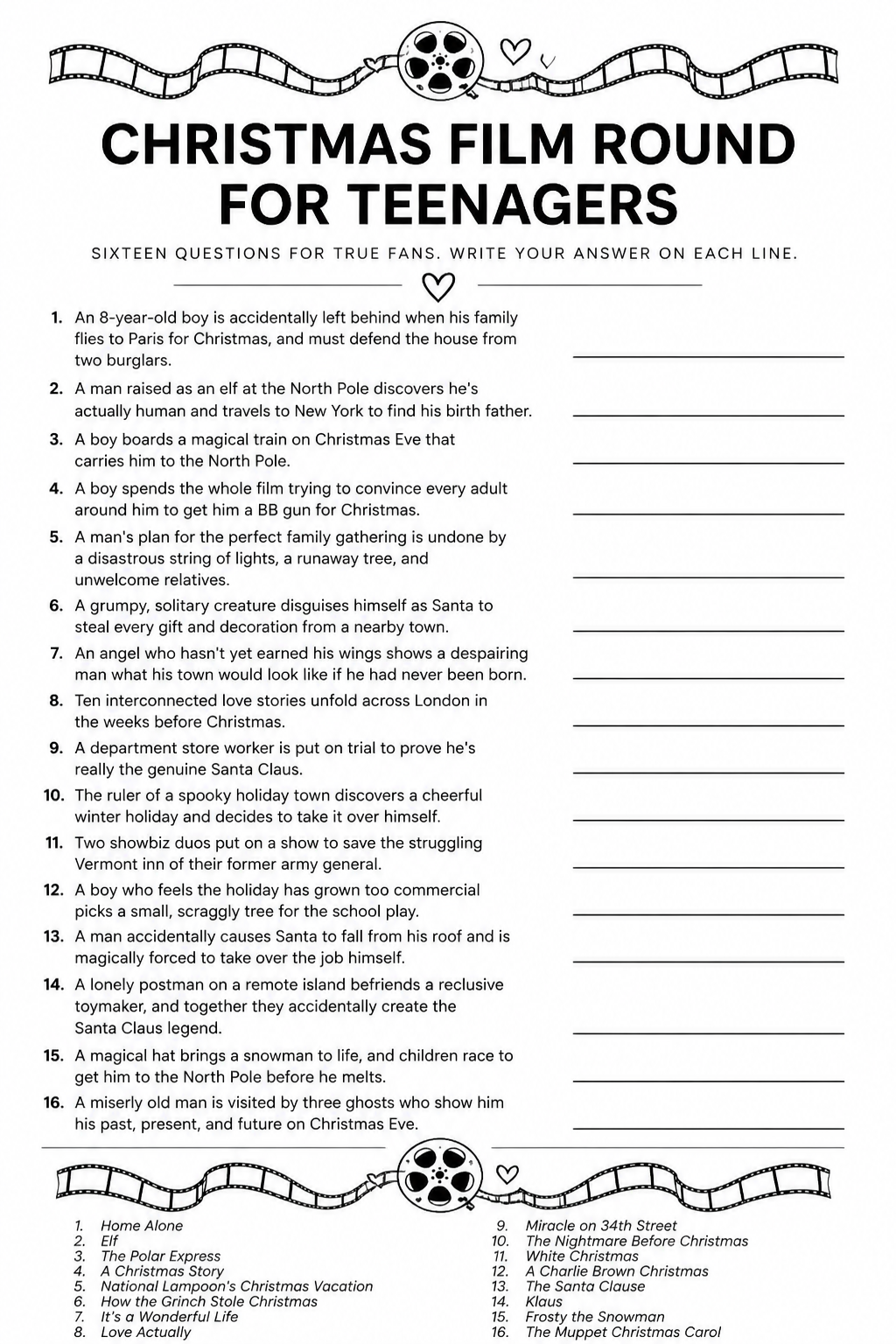
3. Christmas Film Round for Teenagers
Ten questions pitched squarely at people who have spent every Christmas Eve on a sofa rewatching the same films. Questions cover plot details, character names, quotes and one trick question about a film most people misremember as a Christmas film.
Good questions: Who voices the Grinch in the 2018 animated film? What is the name of Kevin’s home-invading antagonists in Home Alone? In Elf, what are the four food groups Buddy lives by? Which Christmas film is set almost entirely in a department store lift?
Print one sheet per team on cardstock. Teenagers tend to play this round with alarming confidence, so include at least two questions that require specific detail: exact character names, exact years, exact lines of dialogue. A quote-identification question (“Who said it and in which film?”) works well and wrong answers are usually funnier than right ones.
The variation that works especially well for mixed-age tables: award double points if a grandparent can correctly name the film from the teenager’s whispered one-sentence description. It inverts the power dynamic neatly and usually produces chaos. More film and pop-culture Christmas trivia rounds are listed separately if this group wants a full film-only quiz.
- One printed sheet per team
- A pen per team
- Optional: a phone to settle the Elf food groups argument
4. Food and Tradition Round
Questions focus on the edible and ceremonial side of Christmas that spans generations: why mince pies were once meat pies, which country invented the Christmas cracker, what figgy pudding actually is, how many days the twelve days run, and what a wassail bowl contains. Every player has an opinion and at least one confident wrong answer.
Ten questions per sheet. Print one per team. Estimated playing time is six minutes. This round rewards older players who actually remember when certain traditions started and younger players who looked things up online all year without meaning to. Mixing a culinary question with a ceremonial one in alternating order stops any single generation dominating a run of five.
Warn the room before reading answers that the mince pie question causes arguments every time. The meat filling was standard until the Victorian era: this is a real fact and not a quiz-host invention.
If the family includes a keen baker, add a bonus question about a recipe detail they submitted in advance, making them the only person who can answer it. Printable Christmas trivia rounds with full answer keys include a longer food-only version for cooking-obsessed households.
- Covers a topic every age group actually knows something about
- Wrong answers generate better conversation than right ones

5. Christmas Around the World Round
Ten questions on how other countries celebrate: which country hides a pickle ornament on the tree, where children leave shoes rather than stockings, which country has a tradition of eating KFC on Christmas Day, what Krampus is and which region he haunts, and where the Yule Lads come from.
Every question opens a small door onto a tradition the family probably did not know existed.
Print one per team. This round pairs well with a brief pause where each table guesses which answer surprised them most.
For a household that has lived abroad or has international family members, let those players nominate one bonus question from their own knowledge before the quiz starts, and add it as question eleven.
Track christmas traditions around the world for a full country-by-country breakdown that pairs with this round.
The trap round designers fall into is including only European traditions, which makes this feel like a geography test with one answer. Deliberately include Japan, Australia and at least one Latin American country so the room genuinely does not know what is coming.
After the answer reveal, ask the table to vote on which tradition they most want to adopt. It runs itself for five minutes.

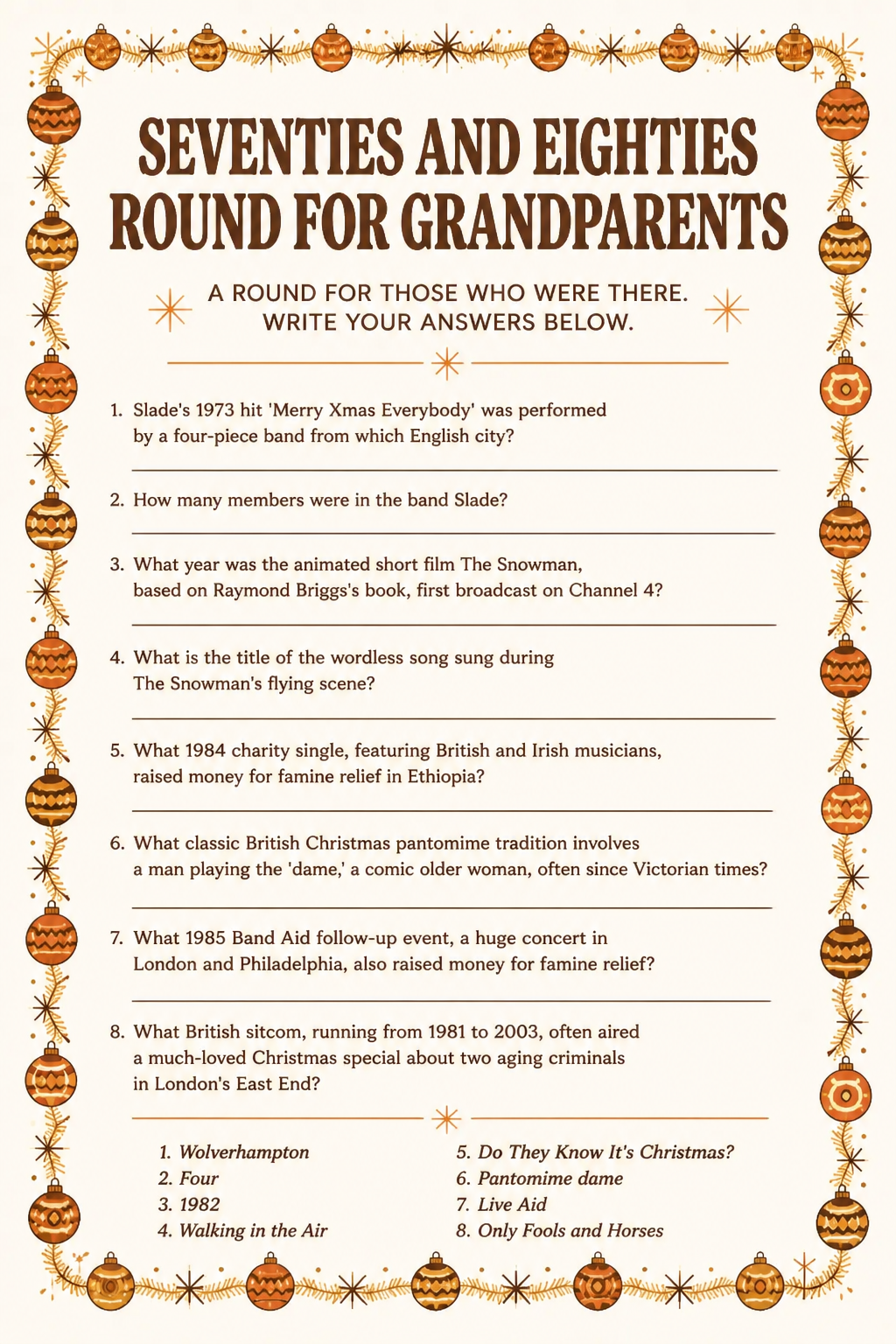
6. Seventies and Eighties Round for Grandparents
Ten questions that belong entirely to the people who lived through brown wallpaper and a Top of the Pops Christmas special on one channel. Which band had a Christmas number one for four consecutive years in the seventies?
What was the name of the BBC variety show that always aired on Christmas Day? Which toy was the impossible-to-find gift of 1983? What did a typical TV Christmas dinner look like in 1978, and which presenter served it?
Print one sheet per team, but position this round so grandparents sit at the table where younger players cannot Google. The honest version of this round is played on paper with phones face-down.
Time limit is five minutes, which is tight enough to reward genuine memory over deliberation. This is the round where the seven-year-old writes down what their grandparent whispers, and both of them enjoy it.
Avoid questions that are technically from this era but have since become general knowledge (Slade, Wizzard). Go deeper: ask about presenters, adverts, specific chart positions. Grandparents who get eight out of ten deserve a round of applause and the right to tell the story behind their answer.
- Add a small word bank for children helping their grandparents write
- Award a bonus point for any answer that comes with a story
7. True or False Round Anyone Can Guess
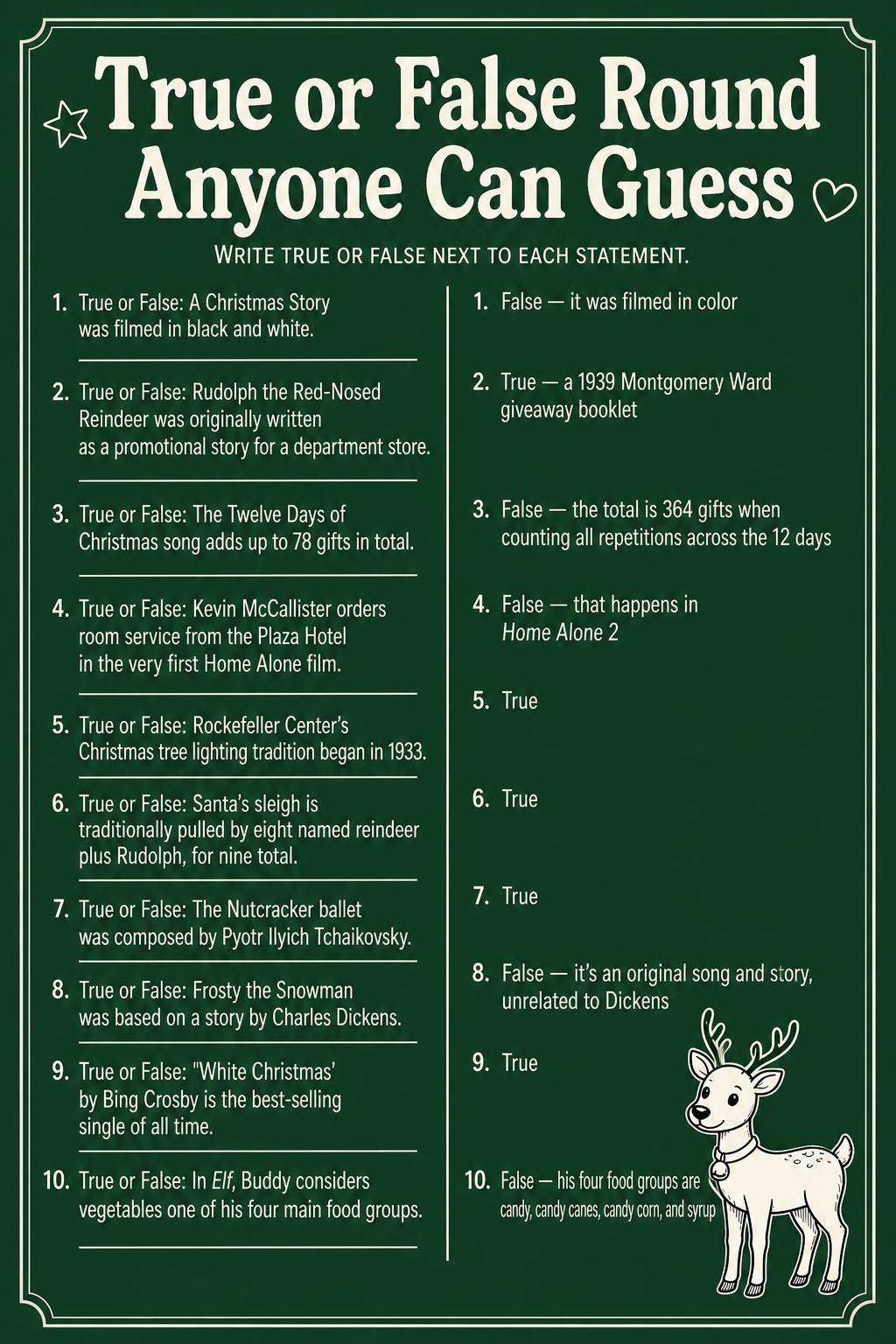
Fifteen statements, each either true or false, covering everything from reindeer biology to Christmas myths: Santa’s red suit was popularised by Coca-Cola (false, it predates the adverts), reindeer are the only deer species where females have antlers (true), Christmas was banned in England in 1647 (true), and tinsel was originally made from real silver (true).
The scoring is obvious, the tension is real, and a confident wrong answer lands exactly as well as a right one.
One sheet per player works here, because this round is quick to mark independently. Players circle T or F beside each statement and swap with a neighbour to mark. No pencil needed beyond a pen, no setup beyond printing. Estimated time is four minutes for the round, two for the reveal.
The calibration trick: include three statements that sound obviously false but are true, and three that sound plausible but are false. If every statement reads as genuinely uncertain, the round becomes a coin-flip with no skill involved. The pleasure is the moment someone realizes they talked themselves out of the right answer.
- Each player circles T or F on their own sheet
- Swap sheets with a neighbour for marking
- Read answers aloud one by one for maximum drama
8. Numbers Round
Every answer is a number. How many gifts appear in total across the twelve days of Christmas (364)? How many points does a snowflake always have (six)? In what year did the first Christmas card go on sale in the UK (1843)?
How many ghosts visit Scrooge (four, including Marley)? How old was Jesus traditionally thought to be at the Epiphany (two, not a newborn)? Numbers rounds reward lateral thinking over cultural knowledge and level the playing field sharply.
Print one per team. No word bank. Players write a numeral, no justification needed. Mark strictly: close is wrong. Estimated time is five minutes. This is a round teenagers often win because they remember the twelve-days sum from a maths class and everyone else forgot they ever calculated it.
A strong variation: tell the room before the round that every answer is a whole number between zero and one thousand. It removes the category of answers that require only knowing whether a number is very large or very small, and it keeps guessing honest.
For more family trivia questions built around numbers and logic, there is a full set with age-graded rounds.
- Numbers cross language, age and pop-culture gaps
- No ambiguity in marking: right or wrong, no argument

9. Nativity Round
Ten questions on the nativity story as told across the Gospels and tradition: which Gospel mentions the wise men but not the shepherds, what gifts the Magi brought and what they symbolise, what the word Bethlehem means, who was the Roman emperor at the time of the census, and what an inn really was in first-century Judea.
This round cuts across secular and religious knowledge without being a Sunday-school test.
Print one per team.
This round is worth running in a household with any Christian members, but it works equally well as a history and literature question: the nativity is one of the most retold stories in Western culture, and most players know more than they think.
The questions that surprise people most are usually the ones about what the text does not say: no number of wise men is mentioned, no ox or donkey appears in the Gospels. Those answers always start a conversation.
For a household that wants to go deeper on biblical knowledge, Bible trivia questions for groups offer escalating-difficulty rounds that pair well with this section.
Frame it as history and story, not a test of faith, and the whole table leans in rather than opting out.

10. Christmas Number Ones Round
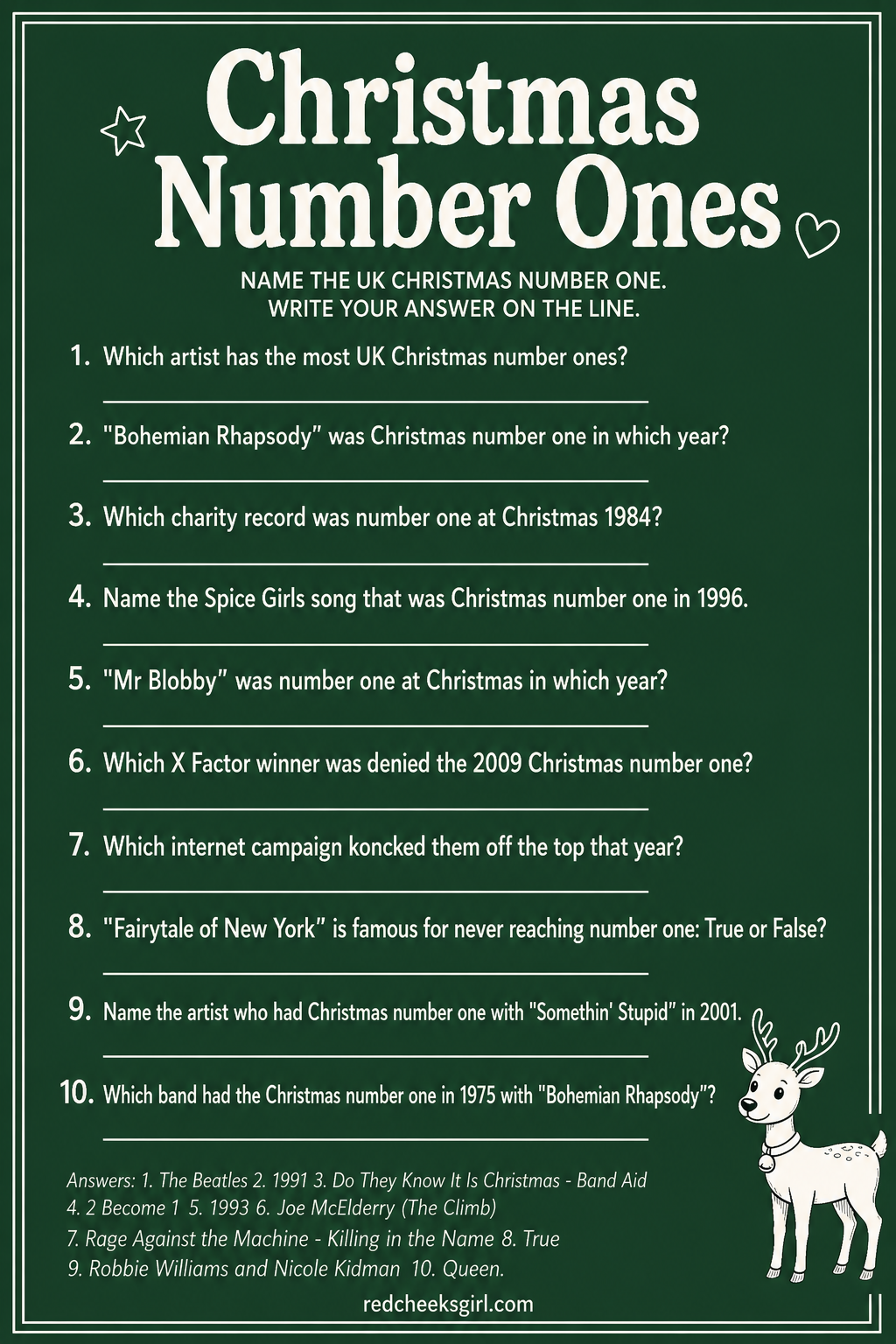
Ten questions on the UK Christmas number one chart, from the era of novelty singles to the streaming age. Which artist holds the record for most Christmas number ones? Which song spent the most weeks at number one over the Christmas period across all years?
Which year did a charity record knock a pop act off the top spot for the first time? Name the Christmas number one from the year the host nominates.
Print one per team on plain paper. This round rewards grandparents on the seventies and eighties questions, parents on the nineties and noughties, and teenagers on recent years, which means almost every team has at least one expert.
Estimated playing time is five minutes with a lively reveal. Keep the answers strictly to the UK chart unless the host prefers the US Billboard, and state the choice before the round starts.
A practical note: if the family disputes a year, the host’s printed answer key is final. Print the key on a separate page kept behind the sofa. Do not read it out as you go: write the question, hear the argument, then reveal. The argument is at least forty percent of the entertainment.
- One printed sheet per team
- Host answer key printed separately
- A phone to play a ten-second clip of each song during the reveal
11. Read-Aloud Round with No Sheet
The host reads ten questions aloud, one at a time, with a twenty-second pause between each. Players or teams shout or write answers on any scrap of paper. No printed sheet, no setup, nothing to distribute.
Questions should mix quick-fire facts with ones that need a moment of thought: what colour is a Christmas cactus flower, which letter does Santa sign off with, what is the Latin name for a robin.
This round works as a palate cleanser between two printable rounds. It gives the host a moment to collect printed sheets without the room noticing they are doing admin. Keep the questions punchy. Ten questions, five minutes total, no equipment. Teams keep score on their own scrap of paper and report their total at the end.
The pacing is everything. Leave a genuine twenty-second pause after each question: a host who rushes from question to answer teaches the room to stop trying. Speak slowly, repeat the question once, then move on. Any faster and the round feels like a test rather than a game.
- Mid-quiz energy reset
- Works when the printer ran out of paper
- Ideal for groups where reading is slow or difficult
12. Whole-Family Answers-Together Round
One question at a time, the host gives the entire room three minutes to agree on a single answer. No teams. No individual sheets. The room negotiates, argues and lands on one collective answer, which a volunteer writes on a large notepad and holds up.
The host confirms or denies. The round works because it makes disagreement visible and funny, and because the youngest person in the room occasionally turns out to be right.
Ten questions, thirty seconds of discussion per question, one collective answer. The host acts as referee for deadlock: if the room cannot agree in thirty seconds, the majority rules.
Good questions for this round are ones with a single definitive answer that the room is likely to split on: Is a Christmas pudding technically a cake? How many reindeer in total has Rudolph?
Which of the two Home Alone films is set in New York?
This is the round that generates the most noise and the longest table conversation afterward. Resist the urge to run it as a competition: the point is the collective experience, not the score. Keep score on a phone if you must, but the room rarely cares by this stage.
- Forces generations to actually talk to each other
- No reading, no writing, no equipment
- The argument is the game
🛍 Shopping guide
13. Close-Up Picture Round
Eight photographs printed on one sheet, each showing a Christmas object cropped to an extreme close-up: the tip of a star topper, the weave of a Christmas stocking, the wax drip on a candle, the text on a cracker joke strip, the texture of a candy cane, a pine needle cluster, a bauble reflection, the metal spring of a Christmas cracker snap.
Players name the object. All ages can attempt every question, but children with sharp eyes often win.
Print one sheet per team, one-up on A4. Source or commission eight close-up photographs before the quiz, or take them yourself the week before using a phone macro lens. Print in colour for best results. Estimated time is four minutes.
This round requires no reading and no cultural knowledge, which makes it the most accessible round in the quiz alongside the under-eights picture round.
The variation that amps up the difficulty: add one close-up of something that looks like a Christmas object but is not (a pine cone looks like a star topper; a red pompom looks like a bauble). The decoy question is worth double and generates excellent table debate.
- Colour printer
- Eight macro close-up photographs of Christmas objects
- One sheet per team

🛍 Shopping guide
14. Questions Written by the Children
Twenty minutes before the quiz starts, give the children a piece of paper each and ask them to write three Christmas questions. The host picks the best ten, reads them aloud in this round, and the adults answer. Children mark the answers.
The child who wrote each question is the only one who knows the correct answer, so arguments go to them as final arbiter.
No setup beyond paper and a pen. Estimated time for the round is six minutes. The questions range from genuinely hard (a seven-year-old who has memorised all reindeer names will ask you to name them in order) to wonderfully surreal (what colour is Santa’s hat inside). All of them are worth four minutes of family conversation.
The practical note: brief the children in advance that the question must have one definite answer, not “what is your favourite Christmas film.” A parent can sit with them for two minutes to help, but the question has to come from the child’s own knowledge.
Adults tend to underestimate children’s questions until they are sitting in front of one about reindeer hierarchy and realise they cannot answer it.
Collect the children’s questions before the quiz starts, remove any that have no real answer, and you have a ready round with zero prep cost.
15. Tiebreaker: Guess the Number
One question, one number, closest answer wins.
Good tiebreaker questions: how many Christmas trees are sold in the UK each year, how many miles does Santa travel on Christmas Eve according to NORAD tracking, how many ornaments does the average decorated tree hold, or how many pounds of sprouts are sold in the UK in the week before Christmas.
Players write their guess on any scrap of paper. No sheet needed.
Run this only if two teams are tied after all other rounds.
Read the question once, give thirty seconds for teams to write their guess, collect all answers, announce the correct figure, and award the round to the closest without going over (or simply the closest, the host decides in advance which rule applies and states it before guesses are submitted).
One practical detail that matters: seal the answer in an envelope before the quiz starts and hand it to an uninvolved guest to hold. It removes any suspicion that the host adjusted the answer to favour a team, and it gives the reveal a genuinely satisfying theatrical beat.
- One question, one number
- Closest answer wins
- Seal the answer in an envelope before the quiz for drama
16. Emoji-Free Word Round
The host describes a Christmas word or phrase using only words, no hand gestures, no drawing, no humming. Players shout answers. The constraint that makes it work: the host cannot use the word itself, any part of it, or any direct synonym.
Describing “Christmas pudding” without saying pudding, cake, dessert, round, dark, brandy or Christmas is harder than it sounds and funnier than most planned games.
Ten words or phrases, thirty seconds per description, one point per correct answer. Works for the whole room at once or as a head-to-head with two players at a time while the rest guess. Good words: advent calendar, Christmas cracker, mistletoe, figgy pudding, Rudolph, Boxing Day, eggnog, Epiphany, star of Bethlehem, Elf on a Shelf.
The rule that makes this work for mixed ages: children answer for child-appropriate words and adults answer for adult-appropriate ones. The host decides which is which before the round. A child describing “Elf on a Shelf” to a grandparent who has never heard of it produces the exact kind of bewildered comedy that makes this worth running every year.
- Waking the room up after a long printable section
- No equipment, no printing, no setup
- Ages ten and up for the describer role
17. Our Own Christmases Round
The host collects one Christmas memory or fact from each household member in the days before the quiz: the year a specific gift went wrong, the family member who always falls asleep before the Queen’s Speech, the first year a child stopped believing in Father Christmas, the meal that has appeared every year without fail.
These become the questions for this round, read aloud with no sheet. The answer is always a name or a year, and only this household knows it.
Ten questions, five minutes. Teams write answers on any scrap of paper. This round cannot be googled, cannot be revised for, and cannot be won by cultural knowledge. It rewards the people who pay attention to the family they are actually in.
It also tends to produce the funniest answers, because memory is unreliable and everyone’s version of the same Christmas is different.
Collect the facts by text or email in the week before, filter out anything that might embarrass a specific person, and keep the source of each question private until after the answer is revealed. The reveal of who submitted which fact is often funnier than the question itself.
- Completely un-googleable
- Rewards attention to family rather than pop culture
- Generates stories that run for the rest of the evening
18. Lightning Round: Ten Short Answers
Ten questions, one word or number answers only, five seconds between each. The host reads fast, teams write fast, no discussion allowed. Questions: What colour are holly berries? How many lords are leaping? What does Santa say?
Name one of the Muppets in A Muppet Christmas Carol. What is Rudolph’s most famous physical feature? What does advent mean? Name Santa’s home. What does “Yuletide” refer to? What is myrrh used for? How many points on a snowflake?
Answers in one word or number: if a team writes more than three words, the answer does not count.
This is the closing round. Run it at speed. Five seconds is genuinely tight, which produces the best noise in the room. Players who write slowly should pair with someone who shouts the answer while they write. No second chances, no repetition of questions. Teams report their score to the host at the end and the quiz is done.
One variation that works well for christmas games for kids: let the children handle this round entirely as the scribes, since writing fast under time pressure is something seven-year-olds find genuinely exciting rather than stressful.
- Ten questions, five seconds each
- One word or number only per answer
- No discussion, no repetition
- Read at speed without pausing
Frequently Asked Questions
What are good Christmas trivia questions for families?
The best family Christmas trivia questions work across a wide age range rather than targeting one generation.
Mix questions that younger children can answer from what they know (picture-based, simple number questions, nativity basics) with questions that reward adults and grandparents (seventies chart history, food traditions, international customs).
Avoid questions that require reading fast or specialist knowledge, and always include at least one round where younger players have the advantage.
How many rounds should a Christmas quiz have?
Eight to twelve rounds is a practical range for a family quiz lasting around ninety minutes. Fewer than eight rounds and the quiz feels thin; more than twelve and the room loses focus before the end.
If you have a wide age range, grading rounds by generation rather than by topic keeps everyone engaged across the full quiz.
Use this collection of christmas trivia questions and answers free printable printable rounds and select the ones that fit your household, rather than running all eighteen at once.
How do you make a quiz fair for mixed ages?
Grade rounds by age rather than by topic. A food-and-tradition round gives grandparents a genuine edge. A film round suits teenagers. A picture round with no reading needed levels the field for young children. A numbers round rewards logical thinkers regardless of age.
When every player has at least one round they are likely to win, the competitive atmosphere stays friendly rather than lopsided. Running team rounds with mixed-age teams also helps: a grandparent and a seven-year-old together cover more ground than either would alone.
How long should a Christmas quiz last?
Aim for seventy-five to ninety minutes including answer reveals and natural pauses. Ten rounds of ten questions each, with about five minutes per round and a two-minute reveal, lands at roughly ninety minutes.
Adjust by removing rounds rather than rushing them: a quiz that ends five minutes early feels satisfying, while one that runs twenty minutes over loses the room.
Keep score on a phone or scrap of paper rather than stopping for a formal tally between rounds, which saves five to ten minutes across the whole quiz.

20 slim Christmas tree ideas for tight corners, from flocked pencil trees to pruned firs, each with

18 gorgeous Christmas party invitation ideas from classic red and green to modern minimalist — all

Need diy christmas decorations easy enough to finish tonight? All 29 use two to four materials, take
Leave a Reply