

15 Winter Party Games With Free Printables for the Months With Nothing In Them

These winter party games are for the gathering that needs no excuse: a dark Tuesday in January, six people on your sofa, and a pot of something hot on the stove.
Half the list prints in minutes, the other half needs nothing at all, and the whole thing is built for a mixed crowd that has not been handed a theme.
This post contains affiliate links. If you buy through them, I may earn a small commission at no extra cost to you.
- Winter Trivia in Three Rounds
- The Blind Cocoa Tasting
- Would You Rather, Cosy Edition
- Charades by Lamplight
- Guess How Many Marshmallows
- The Playlist Everyone Adds To
- Two Truths About the Winter So Far
- The Memory Tray Under a Tea Towel
- Winter Bingo
- One Word Story Around the Table
- The Cocoa Rating Card
- Guess the Song From Three Seconds
- Predictions for Spring
- The Card Game Nobody Explains
- Guess the Song From the Decade
- Frequently Asked Questions
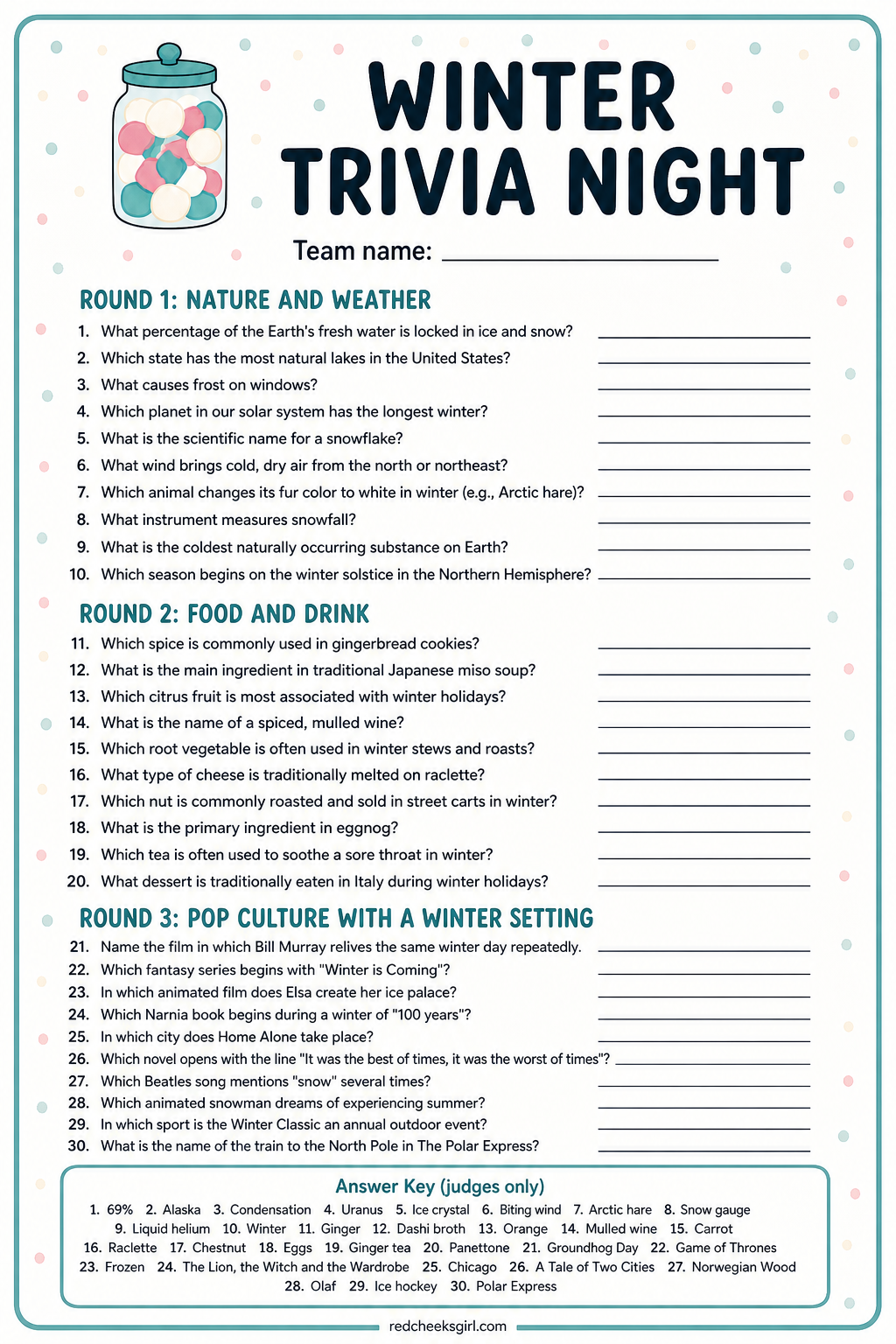
1. Winter Trivia in Three Rounds
Split guests into teams of two or three and hand each team a quiz sheet. Round one covers nature and weather, round two covers food and drink, round three covers pop culture with a winter setting. Each round is a separate sheet so you can pause, score, and top up drinks between them.
Print one quiz set per team plus one scorecard per table. Each round has ten questions, so the full game runs about twenty-five minutes with scoring. You need pens and a calm voice to read answers aloud from the key.
The most common hitch is one person on a team who refuses to write and just shouts the answers. Give that person the pen specifically and watch the dynamic shift. For a quieter crowd, skip the teams and play it as individual sheets, then compare totals at the end.
Read the answers aloud yourself rather than passing the key around: it keeps the pace and stops people skipping ahead.
🛍 Shopping guide
2. The Blind Cocoa Tasting
Prepare three to five mugs of hot cocoa made with different bases: one with milk, one with oat milk, one with a dark chocolate bar, one from a packet, one with a pinch of cayenne.
Number the mugs, blindfold each taster in turn, and ask them to rank the mugs from favourite to least favourite and guess one ingredient that sets each apart.
No printing needed. You need the mugs, a blindfold or simply the honour system with eyes closed, and small numbered stickers on the handles. Allow about three minutes per person. With six guests this fills twenty minutes easily and generates a lot of opinions.
The cayenne mug derails almost everyone, which is the point. If a guest has a dairy intolerance, label those mugs before the game starts so they can skip selectively without breaking the blind format for others. A shared tally on a whiteboard or scrap of paper keeps the scores visible.
- 3-5 mugs numbered with stickers
- distinct cocoa recipes or bases
- a blindfold or the honour system
- small notepad for a shared tally
🛍 Shopping guide
3. Would You Rather, Cosy Edition
Each card poses a choice between two genuinely specific winter scenarios: blizzard with good wifi or mild grey rain with no signal, bed socks forever or never again, fireplace you cannot turn off or central heating that only works on Tuesdays.
Someone reads a card aloud, everyone commits to an answer at the same time by holding up one finger or two, then the room argues about it for ninety seconds.
Print the sheet as a card set, six cards per page, and cut along the lines before guests arrive. No pens, no scoring, no setup beyond the scissors. Works for any group size from four upward and can run for as long as the cards last or as long as the conversation keeps going, which is usually longer.
The game stalls if people refuse to commit and say both. Enforce the rule cheerfully: you must pick one, no hedging.
For a larger group, deal two cards face-down per person and take turns reading your own, which spreads the pace out and stops one person dominating.
If you want more questions to choose from, this collection of this-or-that questions has over a hundred ready to borrow.
- Any group size from 4 upward
- No pens or scoring required
- Good as a warm-up before a longer game

4. Charades by Lamplight
Standard charades, played in two teams, with a category list slanted toward winter: films set in the cold, things you do when the heating breaks, hibernating animals, winter foods, and phrases like ‘it is absolutely freezing in here.’ One person acts, their team guesses within sixty seconds, then teams swap.
No printing needed. Write the prompts on torn scraps of paper before guests arrive, fold them, and drop them into two mugs on the table. Keep a phone timer visible. Aim for ten rounds total, five per team. The whole game runs about thirty minutes.
The classic failure is prompts that are too abstract to mime. Stick to nouns and short actions. If a round stalls beyond twenty seconds, allow one verbal sound effect, which almost always breaks the deadlock. Teams of four work better than teams of two because the guessing energy is louder.
- Write prompts on paper scraps, fold and split into two mugs
- 60 seconds per turn, teams alternate
- 10 rounds total, tally one point per correct guess
- Allow one sound effect if a round stalls past 20 seconds
5. Guess How Many Marshmallows
Fill a clear jar with mini marshmallows before guests arrive and note the exact count on a slip of paper you keep hidden. Each guest gets a tally card, writes their name and their guess, and the person closest without going over wins the jar to take home.
Print four tally cards per sheet, cut and hand one to each guest as they arrive. You also need the jar and the marshmallows, which cost almost nothing and double as a hot-cocoa topping after the reveal. No correct answer key on the sheet: the host holds the number.
Count the marshmallows before you fill the jar, not after, because they settle and compress. A wide-mouth jar gives a clearer view than a narrow one. If two guests guess the same number, whoever wrote it down first wins, so timestamps matter: ask guests to write the time of their guess in the corner of the card.
- Clear wide-mouth jar
- Bag of mini marshmallows
- Slip of paper with the exact count, kept hidden

🛍 Shopping guide
6. The Playlist Everyone Adds To
Open a shared playlist on whatever streaming service the room uses and pass the phone around. Each guest adds exactly two songs, no skips allowed, before passing it on.
The rule: one song you genuinely love and one song you think at least one other person in the room will hate. The playlist runs for the rest of the evening and the group votes thumbs up or down on each track as it plays.
No printing needed. The only setup is opening the app and handing over the phone. This works for any group size and runs in the background rather than stopping conversation. For a longer evening, do a second pass at the halfway point and let people add one more each.
The game within the game is figuring out who added what, which people speculate about loudly. If someone adds something genuinely polarising, let it play out: that is the entertainment. The only rule to enforce is two songs only on the first pass, or the boldest person in the room will take up half the queue.
- Runs in the background and does not stop the conversation
- The argument about who added which song lasts all evening
7. Two Truths About the Winter So Far
A riff on two truths and a lie, but grounded in the actual past few weeks. Each card gives a guest space to write two things that genuinely happened to them this winter and one invented detail, all framed as short statements. The group reads them aloud and votes on which detail is the lie.
Print six cards per sheet, cut and hand out with pens as guests arrive. Ask people to fill them in quietly before the game starts.
The host collects the cards and reads them aloud one by one, anonymously if the group is shy, with names if they are not. No answer key on the card: the writer reveals the lie after the vote.
The game lands better when people write specific details rather than vague ones. Prompt them: not ‘I went somewhere cold’ but ‘I stood outside in minus four waiting for a bus that never came.’ The more specific the detail, the harder the lie is to spot and the better the story that follows the reveal.
Tell guests to write before the game starts, not during: cold thinking produces better lies than on-the-spot panic.

8. The Memory Tray Under a Tea Towel
Arrange fifteen to twenty small objects on a tray: a teabag, a coin, a cinnamon stick, a clothes peg, a button, a battery, a lip balm, a dried leaf. Cover the tray with a tea towel.
Uncover it for sixty seconds while guests look, then cover it again. Everyone writes down every object they can remember, no talking allowed until the pencils are down.
No printing needed, just scrap paper and pens already on the table. The host reads the list aloud and guests tick off what they got right. The person with the most correct items wins, or tie-break by who remembered the most obscure object. Setup takes five minutes if you raid your kitchen drawers.
The mistake is making the tray too easy by grouping similar things. Mix textures and categories deliberately: something shiny next to something dull, something edible next to something mechanical. Fifteen objects is the sweet spot, twenty is genuinely hard and works better for competitive groups. Do not let anyone take notes during the reveal, some people try.
Drop to 10 objects for a first round, then repeat with 15 for a harder second round using different objects
9. Winter Bingo
Four unique bingo grids, each filled with winter-specific squares: woolly socks, frost on a windscreen, soup for dinner, cancelled plans, power cut candles, gloves in every pocket. The host works from a separate call list, reading out items one at a time. First grid to five in a row wins.
Print four grids, one per player or team, and the call list for the host only. Each game round takes about twelve minutes. Guests mark their squares with coins, torn paper scraps, or a pen. For a larger group, print multiple copies of each grid and let people share: it just means more winners per round.
Bingo works best as a warm-up game rather than a centrepiece.
Run two or three rounds back to back, swap grids between players for the second round, and keep a small prize for the winner of each round, a wrapped chocolate bar or priority pick of the cocoa mug.
The call list is host-only: if it circulates, someone will skip ahead.
- Groups of 4-12
- Works as a warm-up before a longer game
- Swap grids between rounds to keep it fresh

🛍 Shopping guide
10. One Word Story Around the Table
One person says a single word to begin a story. The next person adds one word. The story builds around the table, one word at a time, until it reaches a natural ending or collapses into nonsense, whichever comes first. The rule is that you must always say the first word that comes to you: no pausing to plan.
No printing needed. No setup, no materials, no scoring. Works for any size group from four upward. A full round lasts about four minutes, so run two or three in a row and compare which story was strangest. The host nominates the person who ends the story, which adds light pressure to whoever gets stuck holding the thread.
The game derails when someone tries to control the narrative by using conjunctions strategically (‘and’, ‘but’, ‘however’). That is technically allowed and also the point where it gets funny. For a harder version, restrict each person to nouns and verbs only, no connectives, which produces much stranger sentences much faster.
No materials, no setup, fills a gap between longer games naturally
11. The Cocoa Rating Card
Each guest gets a card and rates the cocoa you served on five specific criteria: temperature on arrival, thickness, chocolate depth, sweetness balance, and topping-to-liquid ratio. They score each out of ten and add one written note: what they would change about it if they were making it themselves.
Print four cards per sheet, cut and hand out when you serve the drinks. This works as a slow game running alongside other activities, guests fill it in as they drink rather than all at once. Read the totals and the written comments aloud at the end of the evening. No answer key: there is no correct score.
The card works best when the cocoa genuinely varies across the evening: serve one batch with oat milk and one with whole milk, or offer a dark chocolate version and a sweeter one.
Give the card to guests before they know there will be a comparison: the anticipation of being asked changes how carefully they drink. For more on warm drinks worth rating, this guide to herbal teas has options worth adding to the tray.
Hand the card out before you tell guests there will be a reveal: it makes people actually pay attention to the drink.

12. Guess the Song From Three Seconds
The host plays exactly three seconds of a song from a phone or speaker, then cuts it immediately. The first person to shout the correct title and artist wins the point. No teams, pure first-to-answer. Build a playlist of twenty songs beforehand, mixing decades and genres so no one demographic dominates the whole game.
No printing needed. You need a phone, a speaker, and the playlist ready before guests arrive. Mark your three-second clip points in advance so you are not scrubbing around mid-game. Run twenty rounds with a brief pause for drinks between round ten and eleven. The whole game takes about fifteen minutes.
Three seconds sounds generous until you try it with an intro that is all synth pad. Use a mix of intros and mid-song drops so the difficulty is genuinely varied.
If someone shouts the title without the artist, or vice versa, make a house rule before you start: either it counts or it does not. Inconsistency on that point causes the only real arguments of the evening.
Extend clips to five seconds for a first round, drop to three for the second round once people are warmed up
🛍 Shopping guide
13. Predictions for Spring
Each guest fills in a card with specific predictions about the coming months: the first warm weekend, a friend’s big news, something they will finally finish, a film they will see, a habit they will drop by April. Cards get collected in an envelope, sealed, and opened at a future gathering or mailed back to guests in May.
Print four cards per sheet, cut and hand out with pens after dinner. Allow ten quiet minutes for filling them in. The host seals the envelope in front of the group and writes a target date on the outside. No answer key because the answers live inside the sealed envelope.
The game only works if the envelope actually gets opened. Set a phone reminder on the night and tell two people in the group about it so the accountability is distributed. If mailing them back to individuals is too much effort, a group reading over video call in April or May works just as well and is often funnier.
- A sealable envelope
- A pen to write the target date on the outside
- A phone reminder set before guests leave

🛍 Shopping guide
14. The Card Game Nobody Explains
Take any standard deck of cards and deal seven to each player. The host announces there are rules but will not explain them. Players take turns placing a card face-up in the centre.
The host reacts: thumbs up means the play was legal, thumbs down means pick up two penalty cards. Players must figure out the rule through observation.
The actual rule can be anything repeatable: odd numbers only, cards played must be higher than the previous, suits must alternate.
No printing needed. You need one deck of cards and a host willing to keep a straight face. The game runs until someone correctly states the rule aloud, which typically takes eight to fifteen minutes depending on how obvious you make your reactions. Set a five-minute timer as a hint deadline if the group is stuck.
The host’s poker face is the whole game. A visible wince or a too-quick thumbs down gives it away. Choose a rule that has enough edge cases to stay interesting but can be demonstrated clearly enough that the group does not give up entirely.
Avoid rules that depend on the colour of the card in low light, which is an easy mistake in a lamp-lit room.
- Deal 7 cards each
- Host knows the rule, nobody else does
- Thumbs up: legal play. Thumbs down: pick up 2
- First to state the rule correctly wins the round
🛍 Shopping guide
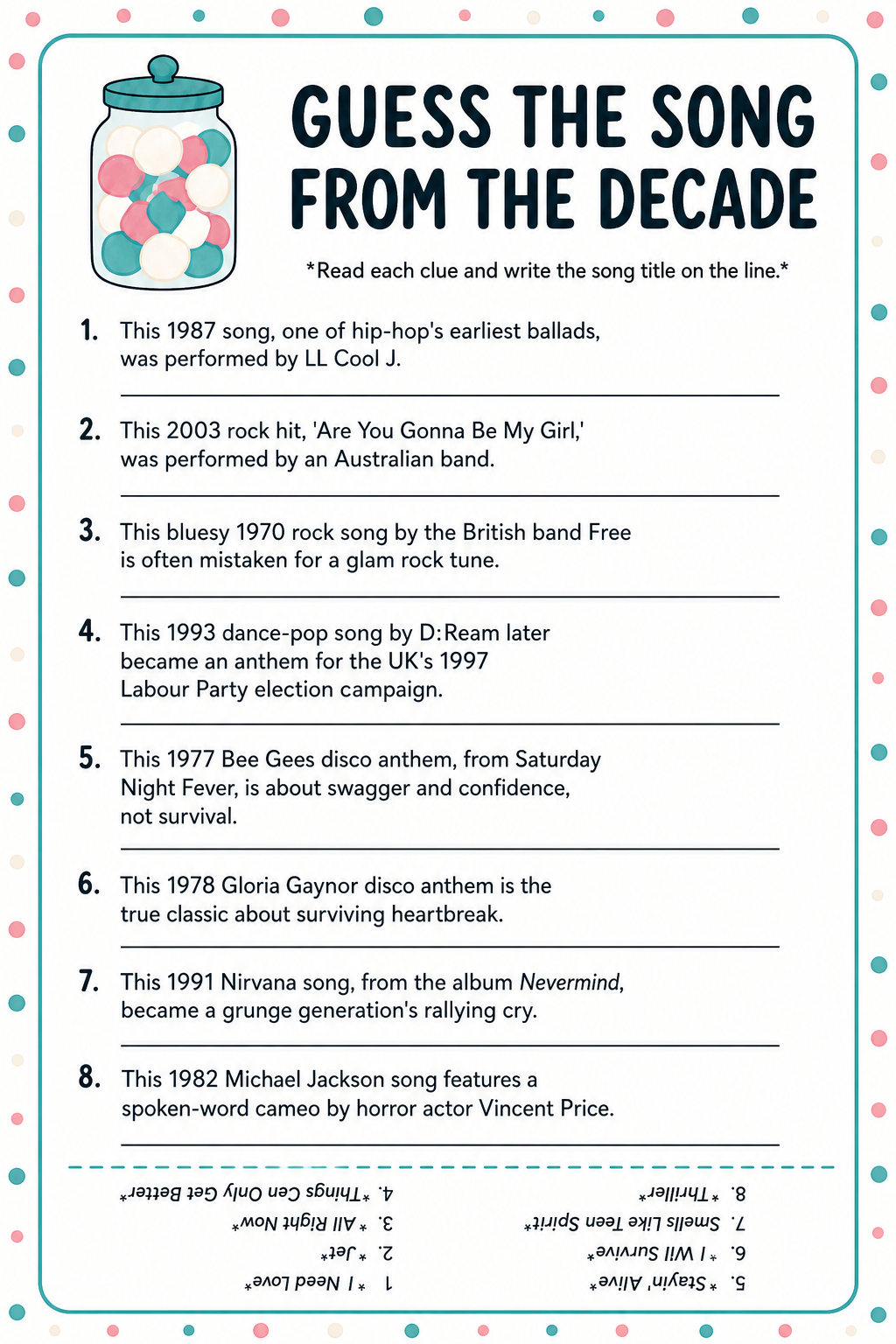
15. Guess the Song From the Decade
A printed quiz sheet with twenty song clues, each clue describing a hit without naming the song or artist: ‘A 1980s power ballad about needing somebody, not just anybody’ or ‘A 2000s UK chart-topper about the night the lights went out in a very specific city.’ Guests write the title and artist for each, working alone or in pairs.
Print one sheet per person or pair. Allow twelve minutes for completing it, then the host reads the answer key aloud. Score one point for the title, one for the artist, two points maximum per question. The full game including scoring takes about twenty minutes and needs no equipment beyond pens.
Write the clues at a consistent level of difficulty across decades so the quiz does not skew toward one age group. If your crowd skews older, anchor the harder clues in the 1990s and early 2000s rather than recent years.
For a larger group, collect the sheets and mark them yourself rather than having people self-score: it stops the inevitable argument about whether a close-enough artist name counts.
- Mixed age groups when clues span 5 decades
- Pairs work better than solo if the group is competitive
- Score separately for title and artist to reward partial knowledge
Frequently Asked Questions
How many games should I plan for a three-hour winter gathering?
Three to four games is enough for three hours. One icebreaker printable as guests arrive, one active group game mid-evening, one quieter game after dinner, and the playlist or cocoa tasting running in the background. More than four and you spend the evening herding people rather than talking to them.
Which of these winter party games work for a mixed age group?
The Memory Tray, Winter Bingo, Charades by Lamplight, and the Guess How Many Marshmallows jar all work regardless of age. The song quizzes are the ones to calibrate: span five decades in the clue list and no single age group dominates.
What is the easiest game to set up with no notice?
One Word Story Around the Table needs literally nothing. The Card Game Nobody Explains needs only a deck of cards. Both can start within sixty seconds of deciding to play a game, which makes them useful when the evening has stalled.
How do I print the card sets so they cut neatly?
Print on 80lb cardstock rather than standard printer paper and use a paper trimmer rather than scissors if you have one. The dashed cut lines on each sheet are your guide. Cut the columns first, then the rows, and the cards stay square.
Which sheets do I print one per person and which are shared?
Print one per person: the Guess How Many Marshmallows tally card, the Cocoa Rating Card, and the Guess the Song From the Decade quiz sheet. Print one per team: the Winter Trivia sheets and scorecard.
Print four total and swap between players: the Winter Bingo grids. Cut and share from a single sheet: the Would You Rather cards, Two Truths cards, and Predictions for Spring cards.
Can these winter party games work for a larger group of fifteen or more?
Yes, with minor adjustments. Split into teams for trivia and charades. Print extra bingo grids, duplicate grids are fine for larger groups. The song-from-three-seconds and the memory tray work best with a clear moderator and a signal for answers so the room does not become one large shout.

72 this or that questions for kids sorted into six rounds. Read them aloud, print the cards and watc
20 family game night ideas for large groups — team games, printable sheets & station games so nobo
Find the right family games fast — reunions, road trips, BBQs, camping and more, sorted by occasio
Leave a Reply