


Hour one of a long drive is easy. Someone is eating snacks, someone is watching the scenery, and everyone is still politely pretending to enjoy each other’s company.
Hour four is a different story — the snacks are gone, the scenery has been exactly the same for forty minutes, and the question “are we nearly there yet?” has been asked eleven times.
That is exactly the moment a good road trip game earns its place in the family playbook.
Every game in this list was chosen because it works inside a moving vehicle with no table, no loose pieces that roll under the seat, and no setup time longer than thirty seconds.
Some are classic games that have been keeping passengers sane for generations; others come with a free printable sheet you can run off the night before you leave. All eighteen survive hour four — and most of them are still going strong at hour six.
This post contains affiliate links — if you buy through them, I may earn a small commission at no extra cost to you.
Table of Contents
- I Spy
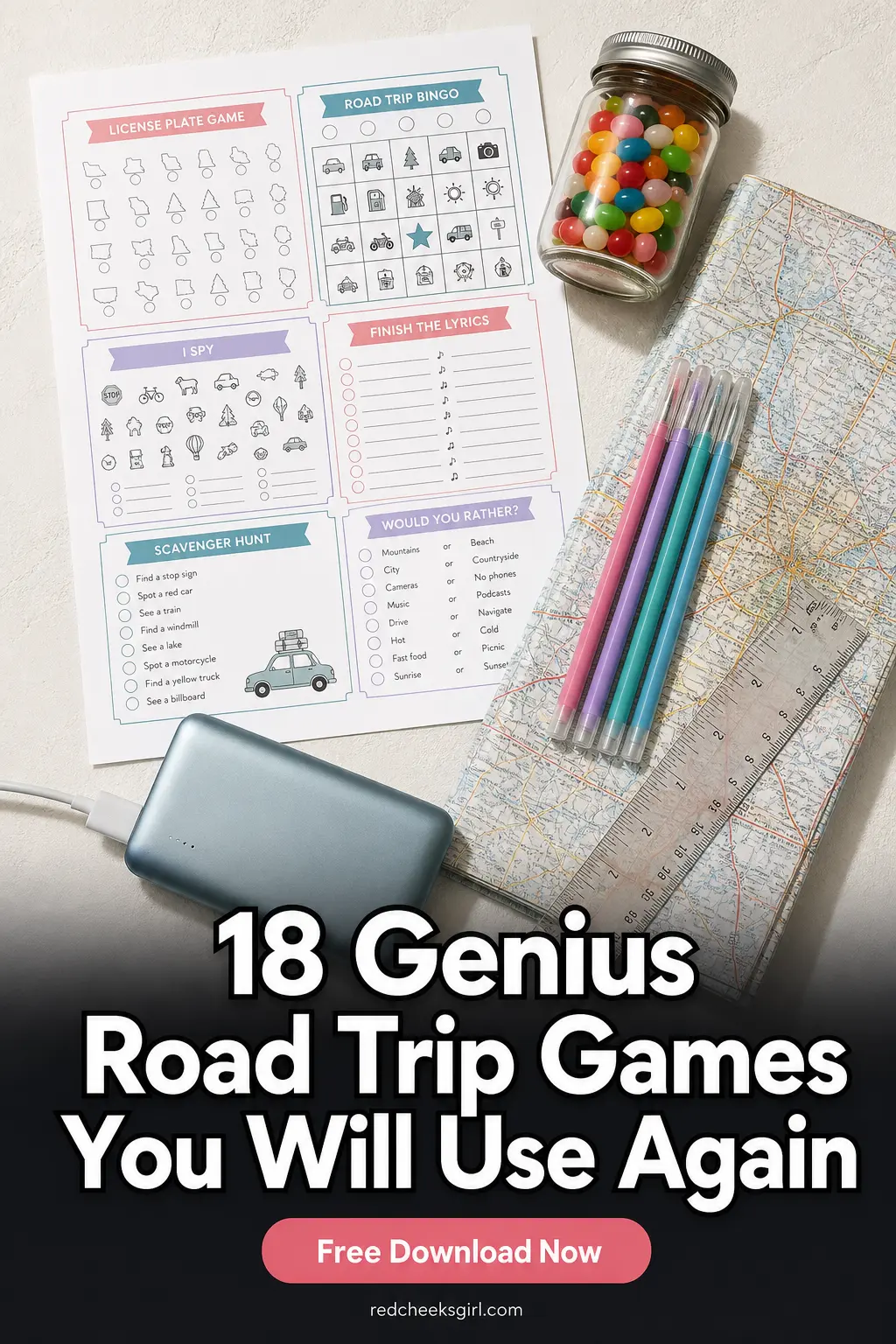
- Licence Plate Hunt
- Twenty Questions
- The Alphabet Game
- Road Trip Bingo
- Would You Rather – Car Edition
- Story Chain One Sentence Each
- Guess the Song Intro
- Categories Round
- Car Colour Count Sheet
- Two Truths and a Lie
- Road Trip Scavenger Hunt
- Road Trip Mad Libs
- Road Trip Trivia
- Emoji Road Trip Decode
- The Quiet Game with a Twist
- Name That Place
- The Fortunately Unfortunately Game
1. I Spy
One player silently picks an object they can see — inside the car or through the window — and announces “I spy with my little eye, something beginning with…” followed by the first letter of the object.
Everyone else takes turns guessing until someone names it correctly, and that person becomes the next spy.
The beauty of the game is that it updates itself constantly: the object can be a road sign, a cloud formation, a sticker on someone’s water bottle, or the colour of an overpass.
Nothing is off limits as long as the spy can still see it.
You need nothing at all — not even a pencil. It works for two players or twelve, and a single round typically lasts between two and ten minutes depending on how devious the spy decides to be.
Younger children usually pick the most obvious thing in sight, which makes them feel triumphant when it is guessed quickly; older players tend toward the fiendishly subtle. Both are valid strategies.
Host tip: allow the spy to use colour instead of a letter with very young players — “I spy something red” removes the alphabet pressure and keeps the youngest passengers in the game without frustration.
2. Licence Plate Hunt
Before you leave, print one Licence Plate Hunt sheet per passenger. The sheet lists all fifty US states (or all regions relevant to your route) and players mark off each one as they spot a matching plate on the road.
It sounds straightforward, but the competitive edge that emerges when two people are racing to be the first to call out “Montana!” is surprisingly fierce.
Players scan every vehicle around them — trucks, RVs, cars at rest stops — and the first person to complete their sheet wins, though you can also play cooperatively as a family trying to fill a single sheet together.
All you need is the printed sheet and a pen or pencil per player. It scales beautifully from two players to a full seven-seat SUV and plays out over however long the journey takes — on a cross-country drive it can last all three days.
The printable format means everyone has their own personal record of the trip, which doubles as a small souvenir.
Host tip: on shorter regional drives, circle only the states or provinces you are realistically likely to see before departure so the sheet feels achievable rather than impossible — nothing kills enthusiasm faster than a near-empty card at the end of a five-hour drive.

🛍 Shopping guide
3. Twenty Questions
One player thinks of a person, place, animal, or object and keeps it secret. Everyone else gets exactly twenty yes-or-no questions to figure out what it is. Good opening questions narrow the field fast: “Is it alive?” “Is it bigger than a car?”
“Could you find it in a house?” Each answer chips away at the possibilities until someone is ready to guess outright or the questioners run out of chances and lose.
The thinker must answer honestly every time, which keeps the game fair and occasionally reveals fascinating logic gaps in what people consider “alive.”
No materials required. Two to eight players works well, and a single round runs about five to fifteen minutes.
The game is naturally self-paced — if the answer comes quickly, a new round starts immediately; if it drags, the mounting tension of dwindling questions becomes the entertainment.
It suits a wide age range as long as younger players pick things within their own experience rather than characters from a book nobody else has read.
Host tip: agree before the first round whether abstract concepts and fictional characters are allowed — “justice” and “Sherlock Holmes” are both technically valid but will split opinion on whether they are fair game, and settling that upfront prevents arguments mid-round.
4. The Alphabet Game
Players race through the alphabet in order, A to Z, by spotting letters on road signs, billboards, lorry logos, shop fronts, or any other text visible from the car.
The first person to call out a word containing the current letter and point to where it appears claims it and everyone moves on to the next letter.
Q and X are the legendary sticking points — a “Quick Oil Change” sign at the right moment feels like striking gold. The game can be played competitively (one point per letter, highest score wins) or collaboratively as a group working through the alphabet together.
You need nothing but eyes and a reasonable density of roadside signage — rural motorways with long empty stretches make Z genuinely difficult, which adds drama.
Two to six players is the sweet spot, and a full A-to-Z run takes anywhere from ten minutes on a busy highway to forty-five minutes on a quiet country road. Both timescales produce their own particular tension.
Host tip: ban the interiors of the vehicle itself — no reading the cereal box in the backseat for J — otherwise the game collapses into whoever grabbed the most printed packaging before departure.
5. Road Trip Bingo
Each player gets a printed Road Trip Bingo card filled with things commonly spotted on a long drive — a water tower, a tractor, a yellow car, a dog in a car window, a toll booth, a red barn, and so on.
As you drive, players mark off squares when they spot the matching item. First to complete a row horizontally, vertically, or diagonally shouts “Bingo!” and wins the round.
Because the cards are pre-printed with different layouts, two players can be looking at the same stretch of road and have completely different experiences of it.
All you need is the printed card and something to mark squares with — a pen, a pencil, or even small stickers work.
It plays well with two to six passengers, and a round typically lasts between twenty minutes and an hour depending on traffic and terrain.
The printable format means you can run multiple games on a very long drive by using a fresh card for each round.
Host tip: laminate a set of cards and pack dry-erase markers so the same cards can be wiped and reused on the return journey — it takes two minutes of preparation and saves you reprinting entirely.

🛍 Shopping guide
6. Would You Rather – Car Edition
One player reads a dilemma from the printed Would You Rather – Car Edition sheet — each question offers two equally ridiculous or difficult options and players must choose one and defend it.
“Would you rather have to sing every time you speak, or hop everywhere instead of walking?” The defending is the game: a quick vote is interesting, but hearing everyone’s reasoning is hilarious.
There are no right answers, which means no one can lose, and disagreements are settled by laughter rather than argument.
You only need the printed sheet and a reader. It works for any group size from two upward, and you can burn through five questions in five minutes or spend twenty minutes on a single particularly divisive one.
The car edition specifically frames questions around travel scenarios and everyday life rather than obscure hypotheticals, so even young children can picture the choices clearly and participate fully.
Host tip: go around the car so every passenger reads at least one question aloud — it prevents the game from becoming a performance by one person and gives quieter passengers a natural moment to lead.

7. Story Chain One Sentence Each
One person opens with a single sentence that establishes something — a character, a place, an unusual situation. The next person adds exactly one sentence to continue the story.
Play passes around the car in order, each passenger contributing one sentence at a time, and the narrative evolves in completely unpredictable directions. The only rule is that your sentence must connect logically (or at least grammatically) to the one before it.
What begins as “A small dog found a golden key in the park” can, within four turns, become a deep-sea adventure involving a submarine and a talking crab.
Nothing is needed — no paper, no props, no prep. Two players can do this, but four to seven people is where the story really derails in entertaining ways.
There is no set endpoint; you continue until someone delivers a natural conclusion or until everyone dissolves into laughter and agrees to start fresh. A single story typically runs five to twenty minutes.
Host tip: set a loose genre at the start — “this is a mystery,” “this is a fairy tale,” “this is set in space” — to give the chain just enough structure that it doesn’t collapse into chaos in the first three sentences.
8. Guess the Song Intro
One player hums, whistles, or taps the rhythm of a song’s opening bars — no words, no singing the melody with lyrics — and everyone else races to name the song. The first correct answer earns a point and gets to perform the next intro.
The person humming must keep going until someone guesses or everyone gives up, which means the performer is often more entertained than the guessers. Any genre is fair game as long as the performer knows it well enough to reproduce it recognisably.
No materials needed. It works from two players upward, though five or six creates the best competitive buzz. A round per song runs thirty seconds to two minutes, so you can easily play for twenty or thirty minutes in a relaxed rotation.
Agree beforehand whether tapping a rhythm counts as a valid performance — it absolutely should for anyone who genuinely cannot hum in tune.
Host tip: create a loose rule that each player must pick a song from a different decade than the previous one — it forces the playlist to span generations and prevents one person from monopolising every round with songs only they know.
9. Categories Round
One player names a category — “types of breakfast food,” “countries in South America,” “things you find in a garage” — and play passes around the car with each person naming one item that fits.
Anyone who repeats an item already said, hesitates longer than five seconds, or cannot think of anything is eliminated. The last player still going wins that round and picks the next category.
The game sounds gentle until someone picks “Olympic sports” and you realise you cannot remember whether curling counts as a summer or winter event.
No materials required at all. It works for two players and scales easily to eight or nine. A single category round lasts two to eight minutes, and you can run as many as you like back to back.
Choosing the category well is itself a skill — too broad and it goes on forever; too narrow and it ends in two turns — so experienced players learn to pitch it perfectly.
Host tip: allow the driver to participate passively by just listening and shouting an answer when inspired — keep the pace slow enough that the game never demands sustained concentration from whoever is at the wheel.
10. Car Colour Count Sheet
Print one Car Colour Count sheet per player before you leave.
The sheet lists a range of car colours — red, white, silver, black, blue, yellow, green, and a few others — and players make a tally mark every time they spot a vehicle in that colour.
At the end of a set time (fifteen or thirty minutes works well) players compare totals and discuss which colour dominated the roads that day.
It sounds simple, and it is — deliberately so, because it keeps young children productively occupied without requiring them to read, strategise, or compete stressfully.
You need the printed sheet and a pencil. A single player can do this independently, which makes it an excellent activity for the child who wants something to do while the adults are deep in another game.
Families can also play cooperatively, with each passenger tracking a different colour so the final tally covers every car that went past. The data comparison at the end generates a surprising amount of genuine conversation.
Host tip: challenge older kids to predict before the session which colour will win — writing down a hypothesis and then checking it against the real data turns a simple counting exercise into a mini science experiment and keeps them invested in the result.

🛍 Shopping guide
11. Two Truths and a Lie
Each player thinks of three statements about themselves — two that are completely true and one that is a convincing lie — and reads them out in a neutral tone. Everyone else discusses and votes on which statement they believe is the lie.
The goal is to craft your lie so plausibly that people believe it, and to make your truths just unusual enough that people doubt them. The game rewards people with genuinely surprising life histories and punishes anyone whose lies are too obviously out of character.
No materials needed. Two players is the minimum but five to eight is the sweet spot — more perspectives mean more debate. A single turn per player runs three to eight minutes depending on how much arguing the statements provoke.
It is one of the few games that gets better as the journey goes on, because passengers become more invested in what they know (and don’t know) about each other.
Host tip: encourage players to mix statements across different time periods — something from childhood, something recent, something from a trip or unusual experience — so the truths feel varied enough that the lie is genuinely hard to identify rather than obviously standing out by category alone.
12. Road Trip Scavenger Hunt
Print one Road Trip Scavenger Hunt sheet per player (or one per team if the car is full).
The sheet lists things to spot along the route — a horse in a field, a rest stop with a particular feature, a specific type of road sign, an aeroplane contrail, a rainbow, a speed camera — and players tick each one off as they see it in real life.
Unlike Bingo, the scavenger hunt is not about completing rows: it is about finding as many items as possible before the journey ends, with the highest total winning.
All you need is the printed sheet and a pen. It works for solo players or teams and scales to any group size.
The sheet is designed to last an entire long journey rather than a single stretch, with items that range from easy (a petrol station) to genuinely rare (a double rainbow or a vintage car).
That range means everyone gets early wins while the competitive finish stays interesting for hours.
Host tip: award double points for photographing a spotted item with a phone — it prevents disputes about whether something was really seen and creates a small photo album of the journey that passengers enjoy scrolling through at the destination.

🛍 Shopping guide
13. Road Trip Mad Libs
The Road Trip Mad Libs sheet contains several short stories with key words removed and replaced by blanks labelled by part of speech — “noun,” “adjective,” “verb,” “silly word,” “name of a person in the car.”
One player asks the others to supply words for each blank without revealing the story, collects all the answers, and then reads the completed story aloud.
The results are almost always ridiculous, frequently hilarious, and occasionally something that gets quoted for the rest of the trip. The humour comes entirely from the mismatch between the earnest story structure and the chaotic words people contributed.
You need the printed sheet and a pen. One story per player works well as a rotation, or a single player can read-and-record all the stories in sequence.
Two to eight players is the ideal range, and a single story takes about three to five minutes to complete from first blank to final reading. The printable format includes multiple stories so you have material for a long journey without repetition.
Host tip: ask for words fast, without pausing to think — the spontaneous, slightly random answers produce far better results than the carefully considered ones, and the speed keeps energy high in the back seat.

🛍 Shopping guide
14. Road Trip Trivia
The Road Trip Trivia sheet contains a set of printed questions across several categories — geography, science, history, pop culture, and general knowledge — calibrated so that some questions are accessible to children and others will genuinely challenge adults.
One player serves as quizmaster and reads questions aloud while everyone else writes or shouts their answers. Points accumulate over the sheet, and the highest total at the end wins. Because the categories vary, no single passenger can dominate every round on specialist knowledge alone.
You need the printed sheet for the quizmaster and optionally a notepad and pen for scoring. Two players works fine, but four to six creates a team dynamic where passengers can confer quietly before answering.
The full sheet typically provides thirty to forty-five minutes of play, making it one of the longest-running single activities in this list.
It can also be split into halves — one set of questions now, one set after the next rest stop — to spread the entertainment across the journey.
Host tip: read each question twice before accepting answers — in a moving car, road noise swallows words and half the arguments about wrong answers are actually about mishearing the question rather than getting it wrong.

🛍 Shopping guide
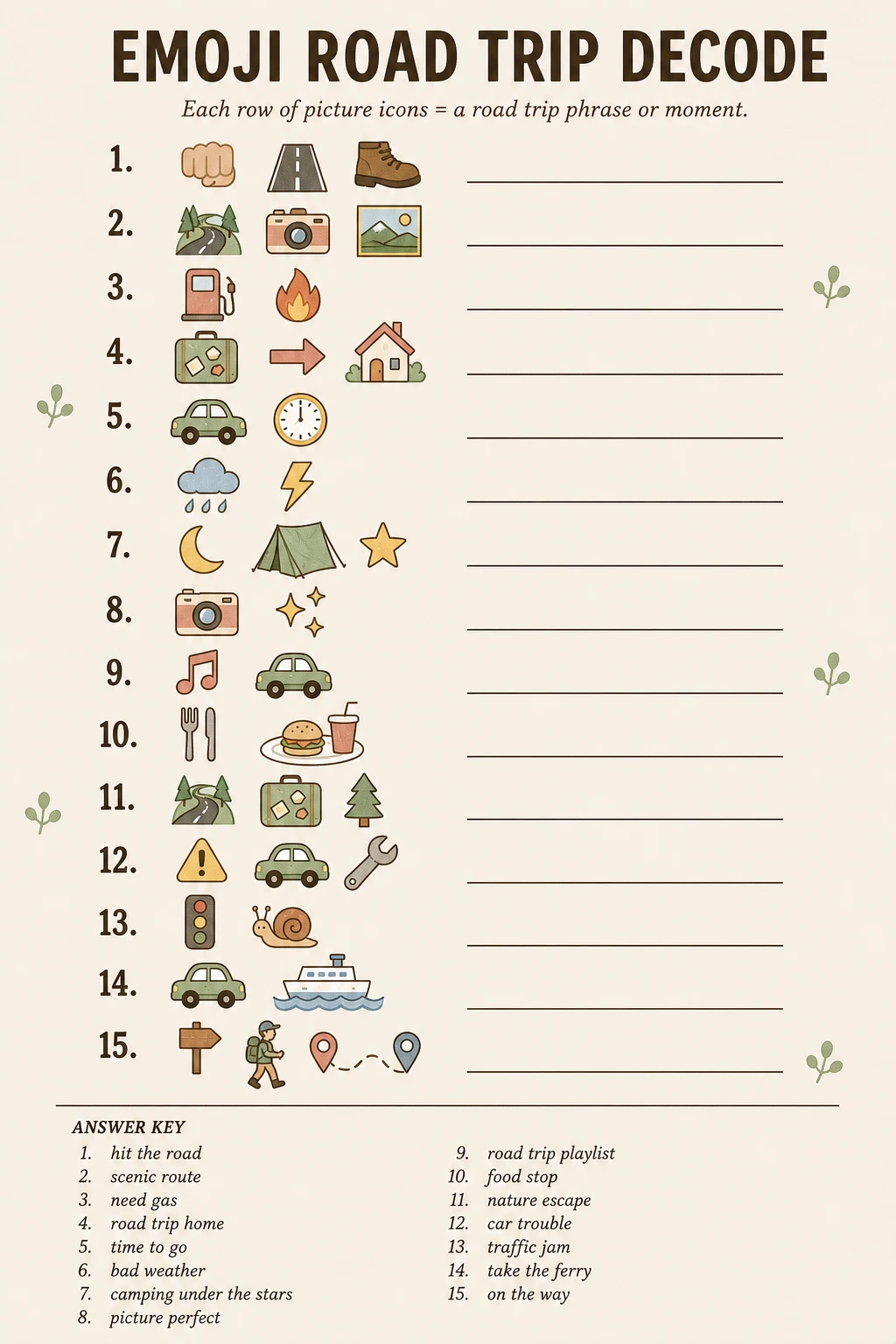
15. Emoji Road Trip Decode
The Emoji Road Trip Decode sheet presents sequences of printed emoji images arranged into groups, and players work out what road-trip-related phrase, destination, or travel scenario each sequence represents — think a picture of a sun, a car, and a mountain printed side by side suggesting a scenic mountain drive.
Unlike a rebus, every answer is confirmed right there on the answer key on the back of the sheet, so there is no ambiguity about whether a solution is correct.
Players can work individually racing to finish first, or the group can tackle each puzzle together and discuss the logic before committing to an answer.
You need the printed sheet and a pen to circle or write answers. It works for a single player or a full car, and the sheet is designed to take fifteen to twenty-five minutes at a relaxed pace.
The visual format makes it accessible to players who cannot yet read fluently, since the emoji images carry the meaning rather than written text, giving younger passengers a genuine chance to contribute answers alongside older players and adults.
Host tip: cover the answer key with a sticky note rather than tearing it off entirely — that way you can do a group reveal at the end that feels satisfying rather than discovering answers accidentally mid-game.
🛍 Shopping guide
16. The Quiet Game with a Twist
Everyone in the car falls completely silent. The last person to make any sound — speaking, laughing, humming, even a deliberate cough — wins the round. That is the classic version, and it lasts about twelve seconds with most families.
The twist is that the driver is allowed to make one comment, observation, or question at any point during the silence, and resisting the instinct to respond is far harder than it sounds.
A well-timed “Wow, that’s a big cow” from the front seat at minute three has ended more rounds than anything else.
Nothing is needed. Two players is technically enough, though the more passengers the better because there are more potential sources of accidental noise. A round lasts anywhere from thirty seconds to a genuinely impressive five minutes if the competitive instinct kicks in.
In addition to the entertainment value, the game produces one to five minutes of actual quiet, which the driver will likely appreciate deeply.
Host tip: run this game immediately after a long, loud stretch of singing or storytelling — the contrast between the noise that just happened and the sudden silence makes everyone giggle involuntarily within the first thirty seconds, which paradoxically makes the game more competitive rather than less.
17. Name That Place
One player thinks of a real geographical location — a city, a country, a river, a mountain range, a famous landmark — and gives one cryptic clue to start. “I’m thinking of a place. First clue: it is famous for its bridges.”
Other players ask yes-or-no questions or make direct guesses. If no one guesses correctly, the thinker gives a second clue, then a third, progressively more obvious, until someone identifies the place.
The fewer clues needed, the more points the guesser earns — five points for the first clue, four for the second, and so on down to one point if the answer only emerges after the fifth clue.
No materials needed. Two to seven players works well, and a single round runs three to ten minutes.
The game quietly doubles as a geography lesson — players who had never thought about where the Strait of Magellan is tend to remember it after arguing about it for six minutes in a car.
Keep a rough mental tally of points across several rounds and announce a winner after a set number of turns each.
Host tip: encourage players to pick places they have actually visited or that genuinely interest them rather than obscure capital cities chosen to be deliberately unknowable — personal connection to the place produces better, more passionate clues and makes the reveal more satisfying for everyone.
18. The Fortunately Unfortunately Game
One player starts a story with a fortunate event: “Fortunately, we found a map that led to a hidden treasure.” The next player immediately introduces a setback beginning with “Unfortunately” — “Unfortunately, the map was written in a language no one could read.”
The following player reverses it with “Fortunately” again, and so the story seesaws between good luck and bad, building an increasingly absurd narrative that goes wherever the passengers take it.
The game ends when everyone agrees the story has reached a satisfying (or completely ridiculous) conclusion.
Nothing is required — no paper, no setup, no props. Two players can play, but three to six gives the story more variety and keeps any single person from controlling the direction for too long.
A full storytelling session runs ten to twenty minutes depending on pace, and the game can be restarted with a completely new opening fortune whenever energy dips.
The alternating structure means every player always knows exactly what grammatical form their contribution must take, which removes the blank-page anxiety of open-ended storytelling.
Host tip: if the story gets stuck in a loop of increasingly minor misfortunes and recoveries, the driver or a designated story warden can call “big unfortunately” — signalling that the next player must introduce a truly dramatic reversal that shakes up the entire narrative and sends it somewhere new.
Frequently Asked Questions
Do any of these road trip games need a screen or special equipment?
None of the eighteen games require a screen, an app, or any electronic device. Several are completely equipment-free — you need nothing but voices and imagination.
The printable games need a sheet of paper and a pen, both of which you can prepare the night before you travel. The printable sheets are the most involved form of preparation in this entire list, and they take less than five minutes to produce.
How many of these games work for very young children, say ages four to six?
At least eight of the eighteen games work well with children aged four to six, including I Spy, Road Trip Bingo, Car Colour Count Sheet, Road Trip Scavenger Hunt, Story Chain One Sentence Each, The Quiet Game with a Twist, Road Trip Mad Libs, and Emoji Road Trip Decode.
For the printable games, a parent or older sibling can manage the sheet while the young child provides answers and does the spotting — participation matters more than independent reading at that age.
What is the best road trip game to start with when the journey begins?
I Spy is the traditional opener because it requires zero setup, works before the car has even left the driveway, and immediately involves every passenger.
Once everyone is settled and the journey is underway, Road Trip Bingo and the Licence Plate Hunt are good games to distribute as ongoing background activities that run beneath whatever else is happening.
Save the more structured games — Trivia, Would You Rather, Twenty Questions — for the middle stretch when restlessness peaks and a clear activity with a defined format is most welcome.
Can the driver join in these games?
Most of these games work for a listening, occasionally-shouting driver who keeps both eyes on the road.
Categories Round, Guess the Song Intro, Twenty Questions, and I Spy all work well because the driver can answer or contribute without needing to hold anything or look away from the road.
Avoid putting the driver in charge of reading from a printed sheet or keeping score — give those roles to a front-seat passenger instead. Safety always comes first, and a driver who is half-distracted by a game is not what anyone wants.
How do I keep score across multiple games on a long journey?
The simplest method is a single notepad page kept by the front-seat passenger, with player names across the top and a tally mark added after each game.
Declare an overall champion at the end of the journey rather than after every individual game — it keeps everyone invested across the full trip rather than losing interest after one bad round.
Small prizes at the destination (choosing dinner, picking the first activity, or simply bragging rights) give the tally real stakes without requiring you to carry prizes in the car.
📌 Save These for Later
Loved these? Pin your favorite image below so you can find this list again when you’re planning.
Build a family game night gift basket that wins the school silent auction — what to pack, how to p

Winter activities for kids that actually work indoors: 14 free printables plus 8 no-prep ideas for t

20 family game night ideas for large groups — team games, printable sheets & station games so nobo
Leave a Reply