

24 Halloween Activities for Kids With Free Printables to Cut, Count and Colour

These halloween activities for kids cover every table, corner and spare minute of the day, from printable sheets that keep four-year-olds busy with scissors to active games that burn off the sugar before bedtime. There are 16 ready-to-print pages and 8 ideas that need nothing from the printer at all. The mix suits a classroom party, a home afternoon, or the chaotic hour before trick-or-treating begins.
This post contains affiliate links. If you buy through them, I may earn a small commission at no extra cost to you.
- Colour by Number Pumpkin
- Ghost Bowling With Paper Cups
- Cut and Glue the Skeleton
- Mummy Wrap Relay
- Count the Bats
- The Craft Box With Card, Glue and Googly Eyes
- Trace the Spider Web
- Pumpkin Painting on Newspaper
- Halloween Maze
- Monster Freeze Dance
- I Spy and Count
- The Sensory Bin of Dried Pasta and Small Toys
- Spot the Difference
- Torchlight Shadow Puppets
- Match the Shadow
- Eyeball Spoon Race
- Roll and Cover the Pumpkin
- Dot Marker Ghosts
- The Costume Parade Around the Room
- Cut Out Paper Puzzle
- Finish the Pattern
- Apple Bobbing Outside
- Build a Paper Lantern
- Draw the Rest of the Monster
- Frequently Asked Questions
1. Colour by Number Pumpkin
Children look at the numbered region on the pumpkin, find the matching colour in the key at the bottom of the sheet, and fill in that patch. Six regions keep the task short enough for a four-year-old but varied enough that older kids still have to pay attention.
Print one sheet per child. Crayons, coloured pencils or washable markers all work. Allow five to ten minutes. No scissors, no glue, no setup beyond handing out pencils.
The most common snag is children ignoring the key and free-colouring. A quick demonstration before you hand out the sheets fixes this almost instantly. For children who finish early, ask them to add a background sky or grass in any colour they choose.
- crayons or coloured pencils
- one printed sheet per child

🛍 Shopping guide
2. Ghost Bowling With Paper Cups
Stack ten white paper cups into a triangle at one end of a hallway or outdoor path, draw a wobbly ghost face on each cup with a marker, and let children roll a soft ball from a taped line to knock them down. Each child gets two rolls per turn.
No printing needed. You need ten paper cups, a marker, a soft foam ball and a strip of painter’s tape for the throwing line. Set up takes under three minutes. Works well for groups of four to eight children aged four and up, running in rounds of two to three minutes each.
Cups slide on smooth floors, so lay down a strip of tape behind the back row as a stopper. If the lane is very short, move the throwing line further back for older or stronger children to keep it fair.
Draw a ghost face on each cup before the party so the ink is dry by the time children arrive.
🛍 Shopping guide
3. Cut and Glue the Skeleton
The sheet shows a blank body outline at the top and a row of skeleton body parts along the bottom, each surrounded by a dashed cut line. Children cut out the pieces and glue them onto the outline in the right positions to build a complete skeleton.
Print one per child. You need child-safe scissors, a glue stick and a flat surface. Allow ten to fifteen minutes. This is a genuine scissor-skills task, so it works well as a settling activity when children arrive at different times.
Younger children (four to five) often struggle with the small finger and toe pieces. Cut those out in advance and leave only the larger limb and skull pieces for them to cut. Older children can attempt the full set.
- Pre-cut the smallest pieces for children under five
- Use a glue stick rather than liquid glue to avoid soggy sheets

🛍 Shopping guide
4. Mummy Wrap Relay
Split children into pairs. One child is the mummy, one is the wrapper. On go, the wrapper winds a full roll of toilet paper around their partner from shoulders to ankles as fast as possible. The first fully wrapped mummy wins the round.
No printing needed. Each pair needs one roll of toilet paper. Works outdoors or on a clear indoor floor. Best with four to twelve children aged five and up, and rounds last about sixty to ninety seconds each.
The paper tears constantly, which is half the fun but also the main delay. Tell wrappers to keep tension loose and overlap each pass slightly. Run three rounds so every child gets a turn as the mummy.
- one toilet paper roll per pair
- clear floor space or grass
🛍 Shopping guide
5. Count the Bats
Five numbered rows of cartoon bats fill the sheet. Children count the bats in each row and write the total in the box at the end of that row. The numbers increase across the rows, giving a gentle counting challenge rather than a flat worksheet feel.
Print one sheet per child. A pencil is all that is needed. Allow five to eight minutes. Works well for ages four to seven as an individual quiet task or as a paired activity where children check each other’s answers.
Children who count quickly sometimes skip bats that overlap. Draw their attention to the ‘wings touching’ bats before they start. The answer key sits at the bottom of the sheet so the host can check finished pages, but children should fold it under while counting.
- Ages 4 to 7
- Solo or paired counting practice
- Filling the first five minutes while latecomers arrive

6. The Craft Box With Card, Glue and Googly Eyes
Set out a low table with coloured card, scraps of black and orange paper, googly eyes in two or three sizes, glue sticks and markers. Children make whatever Halloween creature they want with no template and no instructions beyond ‘make a monster.’
No printing needed. The supply list is the whole setup. Allow twenty to thirty minutes. This suits ages four to nine and works especially well as the first activity of the session, because children can join or leave as they arrive without disrupting anything.
The only problem is running out of googly eyes, which children hoard. Put eyes in a small shared bowl in the centre of the table rather than passing the bag, and each child takes what they need per visit.
🛍 Shopping guide
7. Trace the Spider Web
A spider web made of dotted lines radiates from a central point. Children trace each line with a pencil or crayon, following the dots from the centre outward to complete the web. A small cartoon spider sits in one corner for company.
Print one per child. A pencil or crayon does the job. Allow three to five minutes. This is a fine-motor warm-up that works especially well at the very start of a session, giving children something to do the moment they sit down.
Children who rush produce wobbly lines that jump off the dots. Encourage them to go slowly and keep the tip on the dots. Older children (seven to nine) can trace in pen first, then colour the web sections in alternating colours for extra detail.
- Builds pencil grip and hand control
- Completed in under five minutes so nobody waits
- Zero mess, zero setup

8. Pumpkin Painting on Newspaper
Lay several sheets of newspaper across the table and place a small white or pale pumpkin in front of each child. Children paint their pumpkin with tempera or acrylic craft paint in any design they choose, no carving required.
No printing needed. You need small pumpkins (one per child), paint in Halloween colours, brushes and newspaper for the table. Allow twenty to thirty minutes plus drying time. This works best outdoors or in a room with good ventilation.
The single reliable problem is paint dripping onto the newspaper and then onto hands and clothes. Aprons or old shirts save the day. Offer a cup of water per child for rinsing brushes, and change the water halfway through.
🛍 Shopping guide
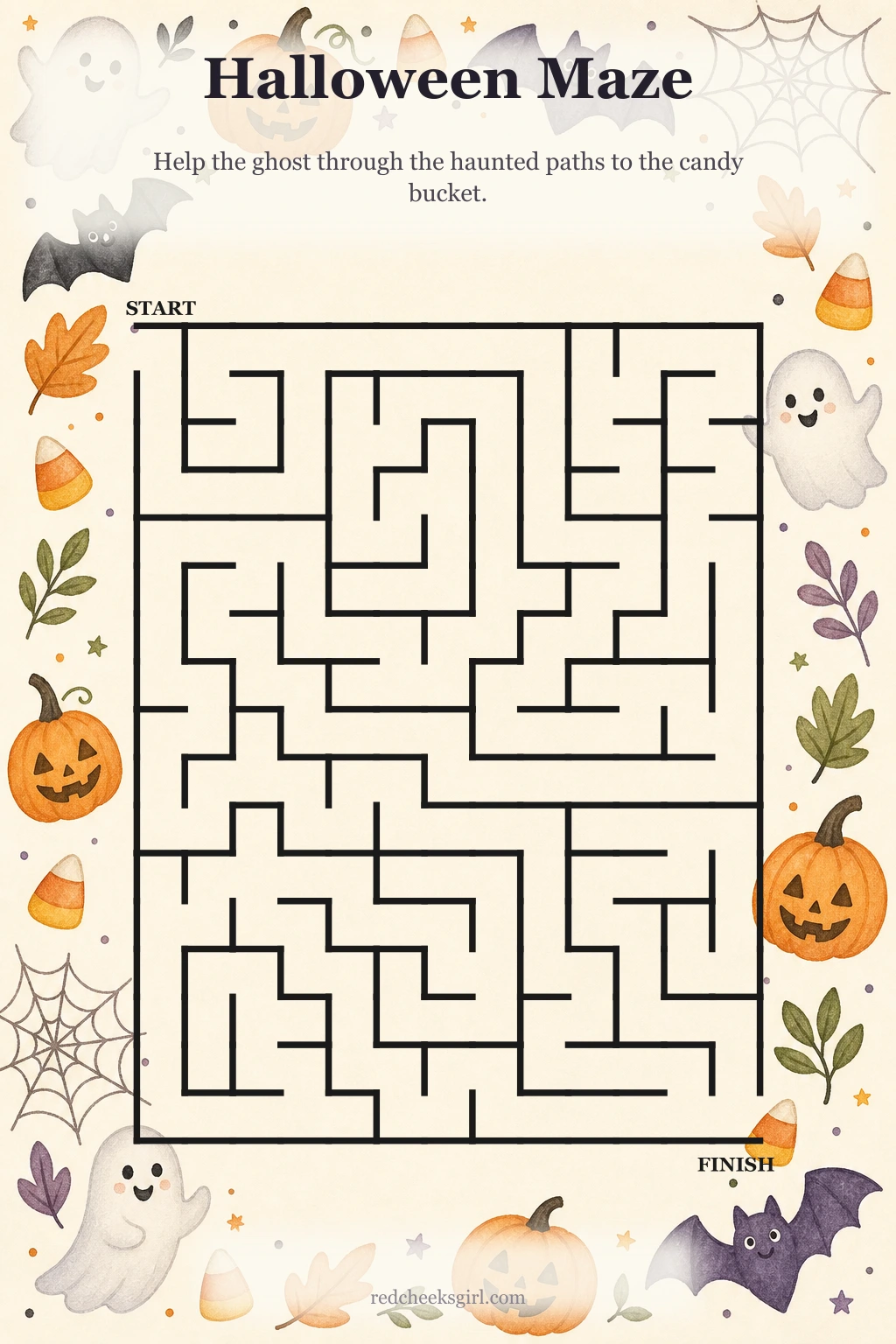
9. Halloween Maze
Children trace a path from the entrance (a broomstick icon) to the exit (a cauldron icon) through a winding maze that has three dead ends. The path is clear enough for a five-year-old to solve but not instantly obvious.
Print one per child. A pencil works best so mistakes can be erased. Allow three to six minutes. Works well between two louder activities as a short calm-down task.
Some children trace all the dead ends first out of curiosity, which is fine and actually good spatial practice. If a child gets genuinely stuck, prompt them to start from the exit and work backward, which often reveals the correct path immediately.
Laminate a few copies so children can redo the maze with a dry-erase marker, useful for groups where one sheet serves several children.
10. Monster Freeze Dance
Play Halloween music (the Monster Mash works perfectly) and children dance like monsters: stomping, lurching, waving their arms. When the music stops, everyone freezes in the scariest monster pose they can hold. Anyone who moves is out, or in a gentler version, does a silly forfeit and stays in.
No printing needed. You need a speaker and a playlist. Works for groups of four to twenty children aged four and up. Rounds last thirty seconds to two minutes. The whole game runs ten to fifteen minutes.
Children under five often forget to freeze in the excitement. A visual cue (raising a cardboard ‘STOP’ sign when the music cuts) helps younger groups follow the rule without feeling caught out.
- Dance while music plays
- Freeze the moment music stops
- Hold the pose until music starts again
- Move during freeze = silly forfeit or sit out
11. I Spy and Count
A busy Halloween scene (a night sky above a haunted street) is scattered with hidden icons: bats, pumpkins, black cats, ghosts, spiders and witches hats. Below the scene, each icon appears with its name and an empty tally box. Children find and count every instance of each icon, then write the total in the box.
Print one per child (or laminate one per table for shared use). A pencil or crayon to mark the tally boxes. Allow eight to twelve minutes. This rewards careful looking rather than speed, so it suits a range of ages at the same time.
Children who race through tend to undercount because they scan instead of search. Suggest they tick each item lightly as they find it to keep a running tally. The answer key at the foot of the sheet lets the host confirm totals without memorising counts.
- Ages 4 to 9 at the same table
- Pairs or solo play
- Filling ten quiet minutes mid-party

12. The Sensory Bin of Dried Pasta and Small Toys
Fill a shallow plastic storage tub with dried pasta (penne or rotini both work), then bury six to ten small Halloween toys or figures in it: a plastic spider, a tiny pumpkin, a ghost eraser, whatever is in the drawer. Children reach in, search by feel and pull out every hidden item they find.
No printing needed. You need a large flat tub, two to three bags of dried pasta and a handful of small toys. Works for one to three children at a time, ages three to seven. Replace toys between turns or let several children dig at once.
The pasta ends up on the floor. Put the tub on a tray or a plastic tablecloth so the scatter stays contained and sweeping up takes thirty seconds rather than ten minutes.
🛍 Shopping guide
13. Spot the Difference
Two haunted house pictures sit side by side. The right image has five deliberate differences from the left: a missing window, a different moon, a bat replaced by a star, a changed door colour and an extra ghost. Children circle the differences they find directly on the sheet.
Print one per child. A pencil or marker for circling. Allow six to ten minutes. This works well for ages five to nine and is quiet enough to run alongside a craft table without anyone interfering with anyone else.
Children sometimes spot the same difference twice and miss others entirely. If they think they have found all five but have fewer than five circles, ask them to compare the pictures section by section from top to bottom rather than scanning randomly.
- Look at both pictures carefully
- Circle each difference you find on the right-hand picture
- Find all five to complete the sheet

14. Torchlight Shadow Puppets
Dim the lights, point a torch (or a phone flashlight) at a plain wall, and show children how to hold their hands to make a bat, a spider or a witch silhouette on the wall. Each child takes a turn making a shadow creature while the others guess what it is.
No printing needed. You need one torch per group and a pale wall or hung sheet. Works for two to eight children aged four and up. Allow one to two minutes per child so the game moves briskly.
Younger children find complex two-handed shapes difficult. Stick to single-hand shapes (a bat uses both hands together, palms touching, thumbs linked, fingers spread) and demonstrate each shape slowly before children try. Older children can invent their own and challenge the group.
🛍 Shopping guide
15. Match the Shadow
Six costume illustrations appear in a column on the left: a vampire, a witch, a ghost, a robot, a dinosaur and a superhero. Six black silhouettes appear in a scrambled column on the right. Children draw a line from each costume to its matching shadow.
Print one per child. A pencil for drawing the lines. Allow four to seven minutes. This suits ages four to eight and works well as a five-minute filler between activities.
Some children draw all their lines to the same silhouette out of guessing fatigue. Encourage them to eliminate: start with the easiest match (the ghost is usually the most distinctive shape) and cross that silhouette off mentally before moving on.
- Builds shape recognition and visual logic
- Self-checking: children can see if any silhouette is unmatched
- Quiet, independent, takes under ten minutes

16. Eyeball Spoon Race
Paint ping-pong balls to look like eyeballs (red veins, a dark pupil) before the party. Each child balances one eyeball on a plastic spoon and walks a course from a start line to a bucket at the other end, drops the eyeball in, and runs back. Dropped eyeballs go back to start.
No printing needed. You need one decorated ping-pong ball per child, plastic spoons and a bucket. Works for four to sixteen children aged five and up. Each relay heat runs two to three minutes.
The painted surface makes the ball slide off spoons more easily than a plain ball. A strip of masking tape on the spoon bowl adds just enough grip without making the race too easy for older children.
- ping-pong balls
- red marker for veins
- black marker for pupil
- plastic spoons
- one bucket per team
🛍 Shopping guide
17. Roll and Cover the Pumpkin
The sheet shows a large pumpkin outline divided into spaces, each printed with a number from one to six. Children take turns rolling a dice and covering the matching number on their pumpkin with a counter, sticker or coloured dot. First child to cover all spaces wins.
Print one per child. Each child needs one dice and a set of counters, stickers or a bingo dauber. Allow ten to fifteen minutes for a full game. Works for two to four children aged four to seven playing at the same table.
Some numbers come up repeatedly while others stay uncovered, which frustrates younger children. Reassure them this is normal probability at work, and run a second round so they can see the pattern shift. Using stickers instead of counters means the sheet becomes a finished piece to take home.
- Use large foam dice for smaller hands
- Dot stickers work as counters and double as a craft keepsake

🛍 Shopping guide
18. Dot Marker Ghosts
Two or three large friendly ghost outlines fill the sheet, each one covered with empty circles of different sizes. Children press a dot marker into each circle to fill it, working their way across the ghost until every dot is covered.
Print one per child. Dot markers (bingo daubers) are the ideal tool, but a chunky crayon works for children who do not have them. Allow five to ten minutes. This is a pure fine-motor activity with a satisfying visual payoff.
Dot markers bleed through standard copy paper. Print on cardstock or place a scrap sheet underneath to protect the table. If a child finishes early, invite them to add a face to each ghost using a marker.
- dot markers or bingo daubers
- cardstock or a scrap sheet underneath

🛍 Shopping guide
19. The Costume Parade Around the Room
Every child in costume joins a loop around the room or hall while music plays. When the music stops, children strike their best monster pose and hold it for a count of five. Run three or four loops, then let the group vote by pointing to their favourite costume with eyes closed.
No printing needed. You need a speaker and a loop route (chairs pushed back, a cleared hallway or an outdoor path). Works for any group size aged three and up. The whole activity runs five to ten minutes.
Voting with eyes open turns into a popularity contest rather than a genuine costume vote. Eyes closed, point on the count of three, works for groups of up to about fifteen. For bigger groups, have a panel of two or three adults judge instead.
20. Cut Out Paper Puzzle
A Halloween scene (a witch flying over a full moon) fills the sheet, divided into six pieces by bold dashed lines. Children cut along every dashed line, mix the pieces up face down, then flip and reassemble the picture without looking at the original.
Print one per child. Children need scissors and a flat surface. Allow ten to fifteen minutes. Older children (seven to nine) can flip the pieces picture-side down and assemble by shape alone for an extra challenge.
Pieces drift off the table constantly. Give each child a tray or a large piece of card to work on so pieces stay together. If children want to keep the puzzle, they can glue the assembled picture onto a fresh sheet of card to take home.
- Cutting along the dashed lines is its own motor skill task
- Reassembling trains spatial reasoning
- The finished picture is a natural take-home keepsake

🛍 Shopping guide
21. Finish the Pattern
Four rows of Halloween sweets (candy corn, lollipops, chocolate bars and jelly worms) each follow a repeating pattern. The last two spaces in every row are blank. Children study the pattern and draw or write the missing sweets to complete each row.
Print one per child. A pencil or crayons. Allow five to eight minutes. This suits ages four to seven and works as a solo table task or as a paired game where partners take turns completing one row each.
Children who cannot yet draw the sweet shapes can write the first letter of each sweet name instead (C for candy corn, L for lollipop), which is an accepted shortcut noted in the instructions. The answer key at the foot confirms the pattern for each row.
Accept letters instead of drawings for children who find illustrating difficult: the pattern logic is what matters.

22. Apple Bobbing Outside
Fill a large tub or bucket with cold water and float six to eight apples in it. Children kneel in front of the tub, hands behind their backs, and try to bite an apple out of the water. First to surface a full apple wins the round.
No printing needed. You need a large tub, water, apples and towels. Run this outside or on a waterproof floor with an absorbent mat underneath. Best for ages five and up in groups of two to four at a time, with the rest cheering.
Hair gets soaked every time. Tie long hair back before each child’s turn. Have a stack of towels within arm’s reach rather than across the room, and change the water between rounds if hygiene is a concern for the group.
🛍 Shopping guide
23. Build a Paper Lantern
The sheet shows a rectangle printed with vertical cut lines from the bottom edge to a stopping point near the top, leaving a one-inch uncut border. Two tabs on the short edges are labelled ‘Glue here.’ Children cut along the lines, curve the sheet into a cylinder and glue the tabs together. A paper handle can be added.
Print one per child, on cardstock for best results. Children need scissors and a glue stick. Allow ten to fifteen minutes. The finished lantern hangs from a string or sits as a table decoration. Ages six and up can do this mostly independently; ages four to five need an adult to hold the cylinder while the glue sets.
The most common mistake is cutting past the stopping line and splitting the top border. Mark the stopping point with a bold orange dot or a printed ‘STOP’ label on the sheet. A bulldog clip holds the cylinder in shape for thirty seconds while the glue grabs.
- cardstock for printing
- scissors
- glue stick
- bulldog clip to hold while drying
- string or ribbon for hanging

🛍 Shopping guide
24. Draw the Rest of the Monster
The left half of a monster is drawn on the left side of the page. A bold centre line divides the sheet. The right half is completely blank. Children study the left half and draw the matching right half to complete the monster, then colour the whole thing in.
Print one per child. Pencil first, then crayons or markers. Allow eight to fifteen minutes. This works for ages five to nine and produces genuinely different results from every child, which makes a great display or take-home piece.
Children who are not confident about drawing often freeze at the blank half. The fix is to ask them to draw just one feature at a time: ‘Find the eye on the left, now draw an eye on the right in the same spot.’ Breaking it into steps removes the blank-page fear almost completely.
- Builds symmetry awareness
- No two results look the same
- Colouring the finished monster makes it feel like a genuine art project

Frequently Asked Questions
What can kids do on Halloween instead of trick-or-treating?
Plenty of halloween activities for kids work indoors or in a garden without any door-knocking. Pumpkin painting, a costume parade around the room, a sensory bin, apple bobbing and ghost bowling all deliver the spooky atmosphere without the dark streets. Add a handful of the printable sheets from this list and the whole evening is covered.
What are fun Halloween activities to do at home with kids?
The best home activities combine making with moving. Set up a craft table with card, googly eyes and glue, run a mummy wrap relay in the hallway, do torchlight shadow puppets against a pale wall, and finish with the Roll and Cover the Pumpkin dice game at the kitchen table. Mix active and quiet activities so energy levels stay manageable.
What Halloween activities are good for a classroom party?
Classroom parties need activities that work across a range of abilities at the same time. The printable sheets in this list (Trace the Spider Web, Count the Bats, Finish the Pattern, Trace and Write the Words) fit neatly into a twenty-minute table rotation alongside a craft station and one active game like Monster Freeze Dance in the corridor. For more classroom-friendly ideas, the Halloween Games And Activities For Kids roundup has options that scale for larger groups.
What are easy Halloween crafts for kids?
The Cut and Glue the Skeleton, Build a Paper Lantern, Dot Marker Ghosts and the open craft box with googly eyes and card are all genuinely easy to run. None of them needs pre-teaching, each child works at their own pace, and the finished piece goes straight into a bag to take home. Cut out Paper Puzzle doubles as both a craft and a game.
What Halloween games can kids play at a party?
A good party mix covers active games (Mummy Wrap Relay, Monster Freeze Dance, Eyeball Spoon Race, Ghost Bowling), printable games children work on between louder activities (Halloween Maze, I Spy and Count, Spot the Difference), and one group game to close the party (the Costume Parade vote). Aim for at least three different activity types so no child is bored or overwhelmed. The Halloween Party Games for Kids list adds twenty-five more options if you want to extend the session.
22 Halloween crafts for elementary kids that use real techniques and materials you can grab in one s
39 Halloween door decorations for classroom doors built entirely from paper, organized by theme so t

20 clever adult Halloween party games that are actually fun — active, printable & immersive. No fi
Leave a Reply