

14 Thanksgiving Table Games With Free Printables Played Without Leaving Your Seat
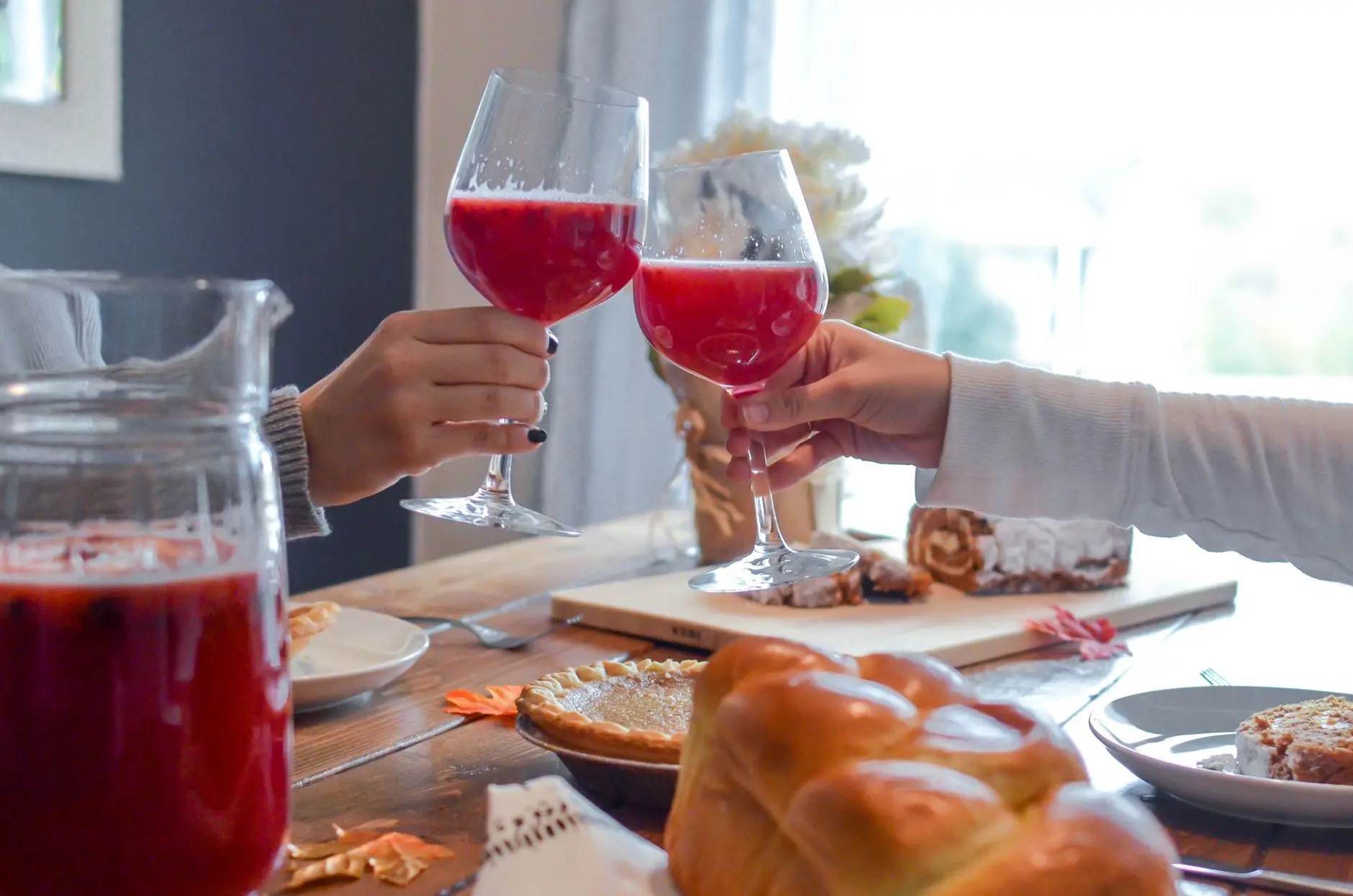
These thanksgiving table games are designed for exactly one situation: a long table, full plates, and people who are not getting up. Eight of them come with a free printable you can run off the night before.
The other six need nothing but the people already sitting there. All fourteen fit between courses, take under ten minutes each, and work for any mix of ages.
This post contains affiliate links. If you buy through them, I may earn a small commission at no extra cost to you.
- Conversation Cards at Every Place
- One Word Around the Table
- Thankful A to Z Around the Table
- The Story Everyone Adds a Sentence To
- Trivia Read From One Sheet
- Guess the Ingredient in the Stuffing
- Would You Rather Cards in the Centre
- The Memory Round on What Was Served
- The Placemat Quiz
- Thankful Statements in Turn
- Guess Who Said It
- Gratitude Cards Collected at the End
- The Table Sweepstake
- The Napkin Note Passed to Your Left
- Frequently Asked Questions
1. Conversation Cards at Every Place
Before anyone sits down, tuck one card under each plate or prop it against the glass.
The cards carry Thanksgiving-themed conversation starters, one per card, and guests read theirs aloud at any lull: favorite family food memory, a tradition they wish had continued, something they are genuinely proud of this year. The table chooses the order, or it goes clockwise.
Nobody is put on the spot because every prompt is low-stakes and specific enough to spark a real answer rather than a shrug.
Print the sheet on cardstock, cut along the grid lines, and you have six cards per sheet. Make as many sheets as you need to put one at every place. No scissors skills required: the grid lines do the work. A fine-tip marker in a dark color writes beautifully on cardstock if guests want to add notes.
The only failure mode is printing on regular paper, which flops and looks cheap. Cardstock fixes that entirely. If the table is very long and voices do not carry, the reader just passes the card down while they speak rather than holding it up.
Print on cardstock and cut the night before. Stack them face-down so guests discover the prompt when they flip it.

🛍 Shopping guide
2. One Word Around the Table
The host picks a category and each person around the table says exactly one word that fits, without repeating what anyone else said.
Classic categories that work well here: things on the Thanksgiving table, words that describe your grandmother, sounds from a football game, smells from this kitchen. The catch is you cannot hesitate for more than three seconds or you are out for that round.
No setup, no printing, nothing needed. Works with any number of people and takes about four minutes per round. The host keeps track of who hesitates or repeats, but the honor system works fine for a family table. Run two or three rounds to fill a gap between courses.
It stalls when the category is too broad. Keep them specific: “things Aunt Carol has brought to Thanksgiving” is funnier and harder than “Thanksgiving foods.” If it dies mid-round, just pick a new category and restart. No one minds.
Filling a five-minute gap while the host is carving or plating. Fast, zero prep, resets the energy at the table.
3. Thankful A to Z Around the Table
Each guest gets a single worksheet with the alphabet running down the left side and a blank line next to each letter.
The task: fill in something you are thankful for that starts with that letter, working solo in two minutes, then the table shares answers aloud. The funny ones always surface around Q, X, and Z. “Xtra gravy” appears at every table eventually.
One sheet per guest, printed single-sided. Two minutes on a phone timer is plenty; serious gaps appear by the time anyone hits M and the pressure makes it entertaining. No pens needed if guests already have one from another game, but a cup of pens in the center of the table solves it.
The mistake is giving too long. More than three minutes and people overthink it and go quiet. Two minutes of mild panic produces the best answers. If the table is competitive, tally how many letters each person completed and give a very small, very silly prize to the winner.
- One printed sheet per guest
- A pen or pencil per person
- A phone timer set to two minutes

🛍 Shopping guide
4. The Story Everyone Adds a Sentence To
The host starts a story with one sentence: something absurd enough to get traction but grounded in Thanksgiving. “The turkey had been acting strange since Tuesday” is a reliable opener. Each person around the table adds exactly one sentence, building on whatever came before.
The story keeps going until it reaches the last person or reaches a natural end. Then the table votes on the best single line.
Needs nothing printed. Works especially well at the end of a meal when people are relaxed and not trying too hard. The round takes about six minutes for a table of ten. Let it run longer if it is going somewhere genuinely funny.
It collapses when someone tries to end the story prematurely. Establish the rule at the start: no ending the story until it has gone all the way around at least once. The person who adds “and they all lived happily ever after” on sentence three has broken the game and must add another sentence immediately to fix it.
Write down the funniest lines as they happen. Reading them back at the end of the night is the actual payoff.
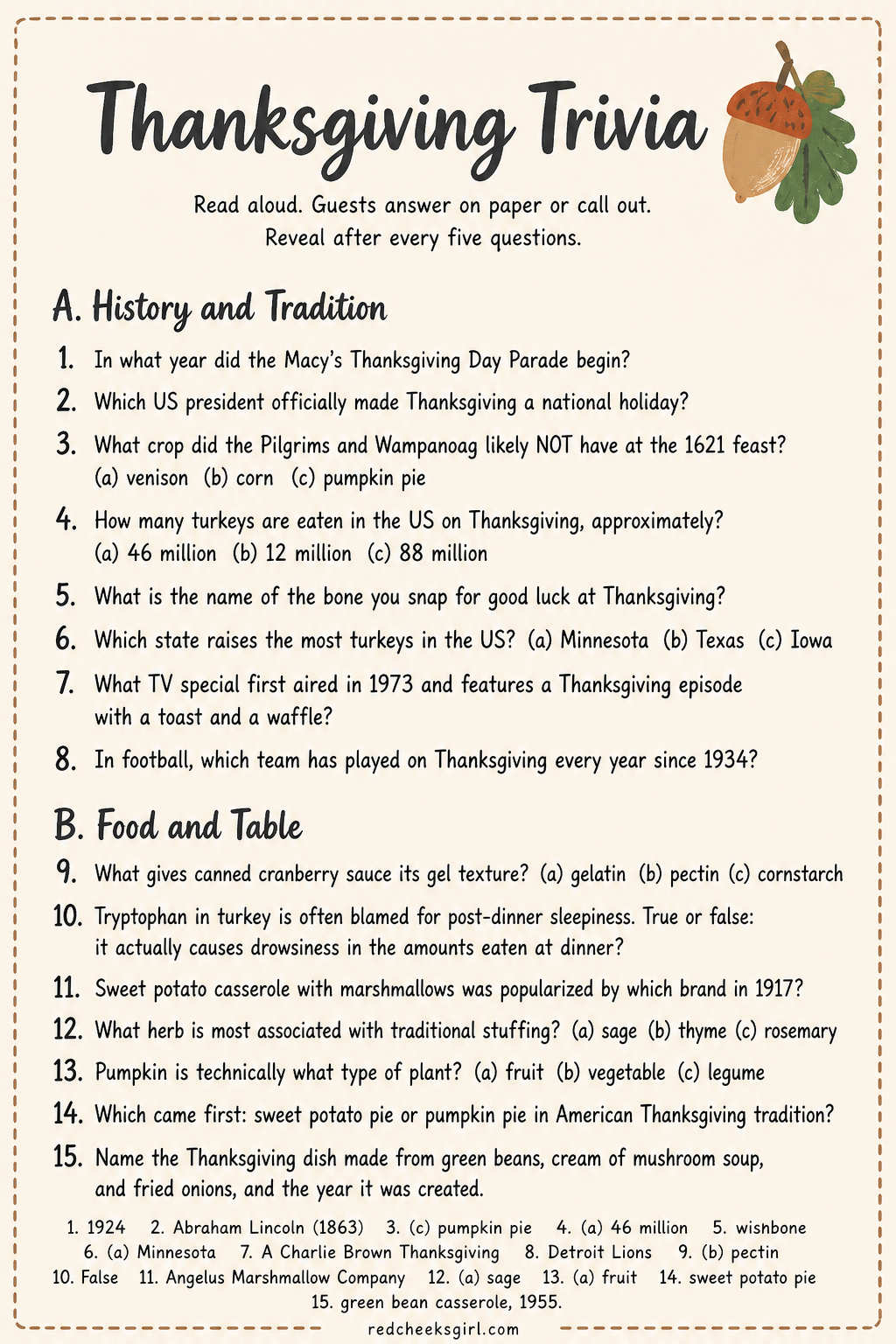
5. Trivia Read From One Sheet
One person reads the questions aloud from a single quiz sheet and everyone answers on scrap paper or just calls out, depending on how competitive the table is. The questions cover Thanksgiving history, food facts, and a few pop-culture rounds about holiday films and football.
The answer key sits at the bottom of the same sheet, folded up or covered with a finger until the reveal.
Print one sheet for the reader, or print one per team if the table wants to play in pairs. Fifteen questions takes about eight minutes with discussion. The reader does not play. Rotate the reader each round if you run a second set.
Avoid reading every answer immediately after each question. The best flow is: read five questions, everyone locks in answers, then reveal all five at once. That keeps momentum and stops the first correct answer from spoiling the fun for the rest of the table.
- Host reads five questions, guests write answers
- Reveal all five at once before moving to the next set
- Tally scores after question 15
🛍 Shopping guide
6. Guess the Ingredient in the Stuffing
The host knows what went into the stuffing and the table tries to guess every ingredient, calling them out in turn.
Each person gets one guess per turn, and the host says hot, warm, or cold depending on how close they are (obscure herb is cold; sage is hot). The round ends when every ingredient is named or the table gives up and demands the recipe.
No printing. No props. This one literally runs itself as long as the host made the stuffing or knows exactly what is in it. Works with any centerpiece dish: the gravy, the pie filling, the cranberry sauce. Five to eight minutes depending on how many ingredients there are and how competitive the table gets about herbs.
The trap is playing it with a store-bought dish where the ingredient list is just preservatives and sadness. Use a homemade dish or one where the recipe is genuinely interesting. If the table guesses everything too quickly, add a bonus round for exact quantities.
Give the number of ingredients upfront so the table knows when they are done. It focuses the guessing significantly.
7. Would You Rather Cards in the Centre
A stack of cards goes face-down in the center of the table and guests take turns flipping one and reading the dilemma aloud. Every card poses two Thanksgiving-specific options: “Would you rather eat only stuffing for a year or never eat pie again?”
The reader answers first, then the table goes around. No voting, no scoring. The conversation that follows is the point.
Print on cardstock, cut into six cards per sheet. Make two or three sheets for a larger table. These sit in the center all evening and guests can grab one whenever conversation dips. No facilitator needed after the first round.
Avoid questions that are actually upsetting rather than funny. “Would you rather lose the recipe or lose the dish” lands differently for the cook who spent four hours on it. Keep every prompt genuinely playful. If a card lands badly, flip the next one immediately and move on.
Tables with a wide age range. These questions work equally well for a twelve-year-old and a seventy-year-old and the contrast in answers is the entertainment.

🛍 Shopping guide
8. The Memory Round on What Was Served
After the main plates are cleared, the host asks the table to recall every dish that was on the table during dinner, in order from first to last. The group works together, no notes, no peeking at the kitchen.
Each person adds one dish per turn and the chain grows until someone draws a blank or the list is complete. The host is the judge and confirms at the end.
No printing needed. This one is best played about ten minutes after the main course when things are starting to clear and the dessert has not arrived yet. It works well because everyone is confident they remember and then is surprised by how quickly they forget the third vegetable side. Five minutes, no materials.
The game falls apart if the host also forgets what was served. A quick mental checklist before dinner is all the preparation needed. It also gets more interesting the more dishes were served: a table with fifteen sides is a genuine challenge, a table with four is too easy to be worth playing.
It doubles as a genuine compliment to everyone who cooked. Naming something a guest made means you noticed and remembered it.
9. The Placemat Quiz
Each guest finds a quiz sheet at their place before they sit down.
The sheet has twenty short questions covering the same range as a trivia night: Thanksgiving history, food facts, family-specific questions the host fills in by hand before printing, and a couple of seasonal pop-culture questions.
Guests fill it in solo during the meal, whenever they have a free moment between bites, and hand it in before dessert. The host scores them during pie.
One sheet per person, printed landscape or portrait to sit alongside the plate without covering the place setting. Use a slightly heavier paper so it survives a dinner table. Supply one pen per place. The host announces scores after dessert and gives the winner first pick of leftovers, which is a genuinely good prize.
The weak point is the family-specific questions: if the host skips them and leaves the generic version, the sheet loses its personality. Three questions written specifically for this table make the whole thing feel custom. “How many Thanksgivings has Grandma hosted?” is a better question than anything generic could be.
- One printed sheet per guest
- One pen per place
- A quiet two minutes to score during dessert

🛍 Shopping guide
10. Thankful Statements in Turn
Starting with the youngest person at the table and moving clockwise, each guest completes one of three rotating prompts: “I am grateful for something I can see from this chair,” “I am grateful for something that happened in the last twelve months,” or “I am grateful for someone at this table, and here is why.”
The host says which prompt applies to each person as they go, mixing them so no two consecutive guests answer the same one.
Nothing needed. This takes about eight minutes for a table of ten and works best right before the meal begins or just as dessert arrives, not mid-meal when people are distracted.
The three-prompt structure stops anyone from giving the same answer the person before them just gave, which is the main thing that kills a standard “say what you are thankful for” round.
The risk is that someone gives a one-word answer and kills the momentum. The host’s job is to follow up with one genuine question: “Tell me more about that” is enough. Do not move on until there is at least one sentence. That is all the facilitation it needs.
Rotating the prompt removes the awkward silence of people trying not to repeat each other. The specific constraint produces more honest answers than an open prompt.
11. Guess Who Said It
Before the meal, the host asks every guest to text or email one anonymous quote: a real thing someone in the family once said at Thanksgiving, a genuine opinion about the holiday, or a strong food take.
The host collects them, formats them on the quiz sheet, and guests try to match each quote to its author. The results are funnier than any trivia question could be because the table already knows the people involved.
Print one sheet per guest with the quotes numbered down the left and the names listed at the bottom as a matching pool. Guests work alone, then compare answers aloud. No answer key is printed because the authors reveal themselves. Five to eight minutes, one sheet per person, one pen each.
The game only works if the quotes are genuinely specific. “I love stuffing” reveals nothing. “I do not understand why people put raisins in things that are not dessert” is attributable. Brief the guests in advance to send something with personality. If someone sends a bland quote, swap in a memorable thing you actually remember them saying.
Send the collection text two days before. It gives people time to think of something genuinely good rather than the first thing that comes to mind.

🛍 Shopping guide
12. Gratitude Cards Collected at the End
Each guest finds a small card at their place alongside the silverware.
During the meal they write one thing they want the host (or a specific person at the table) to know they noticed: the effort behind a dish, a conversation they appreciated, something that mattered.
At the end of the night, the host collects them in a bowl and reads a few aloud, or keeps them privately. Either way, the act of writing it down changes the register of the evening.
Print four to a sheet on cardstock and cut them apart. One card per guest is enough. Supply a fine-tip pen at each place. The card needs only a few lines of writing space and a header that names the occasion. No prompting needed mid-meal: the card sitting there is its own prompt.
Do not announce them mid-meal or pressure anyone to have finished writing. Some guests will write immediately, some will wait until the end. Collect them quietly rather than asking each person to read theirs aloud, which puts the shyer guests in an uncomfortable spot. Reading selected ones yourself at the end is warmer and safer.
A card is more lasting than a toast. The host can read it again the next morning when the cleanup is done and the gratitude is actually needed.

🛍 Shopping guide
13. The Table Sweepstake
One shared poster goes up on the table or the wall before guests arrive.
It lists ten Thanksgiving predictions: who will fall asleep first, which dish will run out, who will bring up a topic the host asked them not to, what time the youngest child will ask to leave, which pie gets finished first.
Each guest writes their name in the column next to their prediction. At the end of the night, the host tallies who called the most outcomes correctly.
One large sheet, printed once, displayed all evening. Guests fill it in when they arrive and check back throughout the day. A small prize for the winner is optional but a good reason to announce the results formally. The poster doubles as decor if printed on a warm-toned background.
The categories only land if they are specific to this group. Generic predictions bore everyone. The host needs to write at least five that are inside jokes or genuine bets the family has been making for years. The sheet provides the format; the host writes the content that makes it theirs.
Leave two or three rows blank so guests can add their own predictions when they arrive. Those are always the best ones.

14. The Napkin Note Passed to Your Left
Near the end of the meal, each guest writes one anonymous compliment or appreciation on their paper napkin, folds it once, and passes it to the person on their left. That person opens it, reads it silently, and then reads it aloud if they choose.
No attribution, no signing. The anonymity makes it easier to write something genuinely true rather than something polite.
No printing needed. Paper napkins are already on the table. If the table uses cloth napkins, keep a stack of paper ones in the center for this round. A pen per guest is the only requirement, and if another game already used pens, they are already there. The whole round takes four minutes.
It only works if the host models the tone by going first and writing something specific, not vague. “You are kind” is easy to write but lands like wallpaper. “The way you always remember what everyone is allergic to” lands and stays. Say that before the round starts and the whole table writes better notes.
If the group feels too self-conscious to go anonymous, drop the anonymity and just pass a note to the person on your left with your name on it. The warmth is the same.
Frequently Asked Questions
How many thanksgiving table games should you actually play in one afternoon?
Three to four games is a realistic afternoon. One before or during the meal, one between the main course and dessert, one after pie. More than five and the table starts to feel managed rather than relaxed. Pick games with different energy levels so there is variety without exhaustion.
Do thanksgiving table games work with a mixed age group including kids and grandparents?
Yes, with the right choices. Trivia and Would You Rather work across ages because the questions can be answered at different levels. One Word Around the Table and the story game both work with children. Avoid anything that requires reading a sheet solo if younger children are playing: pair them with an adult instead.
What is the easiest thanksgiving table game to run with no preparation?
One Word Around the Table needs nothing and starts in under thirty seconds. Thankful Statements in Turn is equally fast and has a warmer tone if the group is in a reflective mood. Both work with any number of people and any age range.
How do you keep thanksgiving table games from feeling forced?
Keep each game under ten minutes, pick a natural pause to start (clearing the main plates, waiting for pie), and do not announce the game list at the beginning of the day.
Introduce each one as it happens rather than scheduling the afternoon like a conference agenda. The table should feel like things are happening, not like they are on a program.
Can you run thanksgiving table games with a very large table of twenty or more?
Printable games work well because everyone plays at once. Trivia, The Placemat Quiz, and the Sweepstake poster all scale to any number. For verbal games like One Word, consider splitting into two ends of the table running simultaneously and comparing notes. Avoid any game that requires the full group to hear one person speak quietly.
Do printable thanksgiving table games need to be laminated or are printed sheets fine?
Printed sheets on standard paper work perfectly. Print on slightly heavier paper (24lb rather than 20lb) if a sheet needs to sit on the table during a meal, since it handles spills slightly better. Cardstock is worth it for anything you cut into cards. Nothing needs laminating unless you want to reuse the same sheets next year.
14 easy Thanksgiving crafts for preschool that are cheap per child, dry fast, and go home the same d
14 Thanksgiving crafts for toddlers using materials you already own. No scissors, no overnight dryin

Hosting three generations for six hours? These 14 Thanksgiving party ideas fill the gap between arri
Leave a Reply