

16 Thanksgiving Games With Free Printables That Keep Children Out of the Kitchen
The best thanksgiving games for kids are the ones that genuinely absorb children in another room while the adults finish the gravy. This list gives you eight print-and-go sheets plus eight no-prep activities, all chosen because a child aged four to ten can start and sustain them without you standing there. Mix a printable with an active game, hand the box of supplies to the oldest child in the group, and walk back to the kitchen.
This post contains affiliate links. If you buy through them, I may earn a small commission at no extra cost to you.
- Turkey Colouring Sheets
- The Craft Box With Feathers and Card
- Thanksgiving Picture Bingo
- Musical Statues in the Hallway
- Match the Food to the Plate
- Pin the Feather on the Turkey
- Thankful Drawing Frame
- The Feely Box With Autumn Objects
- Spot the Difference, Harvest Scene
- Turkey Trot Around the Garden
- Count the Corn
- Leaf Hunt Outside
- The Placemat to Colour While Waiting
- Pass the Pumpkin
- Thanksgiving Maze
- Icing Plain Biscuits at the Kids Table
- Frequently Asked Questions
1. Turkey Colouring Sheets
Each child gets one sheet showing a large outlined turkey with feathers, a pilgrim hat, and a harvest border ready to colour. The brief is simple: colour everything before the timer runs out. Set a sand timer for fifteen minutes and let them race at their own pace, or skip the timer entirely and let it run as long as needed to buy you peace.
Print one sheet per child on plain paper, set out a tub of crayons or coloured pencils, and walk away. No scissors, no glue, nothing that needs adult intervention. Age range is wide: a three-year-old scribbles happily while a seven-year-old adds careful shading.
The most common problem is fighting over a specific crayon colour. Solve it before it starts by putting out two tubs of crayons on opposite ends of the table so no one has to reach across. Finished sheets double as placemats or take-home keepsakes.
Tape each sheet to the table with a small piece of painter’s tape so it doesn’t slide while small hands colour.

🛍 Shopping guide
2. The Craft Box With Feathers and Card
A shallow cardboard box filled with craft supplies sits on a low table. Children pull out feathers, card offcuts, stickers, pipe cleaners, googly eyes, and glue sticks, then build whatever turkey or harvest creature they invent. No instructions, no template, no adult directing the outcome.
No printing needed. Load the box the night before, set it on the table with a roll of masking tape and some safety scissors, and it is ready. Works for ages three and up; younger children stick feathers to card, older ones construct elaborate standing turkeys.
Glue sticks dry faster than liquid glue and leave no drips, which is the single most important supply choice here. Keep a damp cloth nearby rather than calling you for every sticky hand. If children run out of ideas, a small stack of reference pictures of turkeys printed from any search engine is enough to restart them.
- Craft feathers in autumn colours
- Googly eyes
- Glue sticks
- Card offcuts or thick paper
- Pipe cleaners
3. Thanksgiving Picture Bingo
Four different bingo grids each show a four-by-four arrangement of small Thanksgiving pictures: turkey, pie, corn, pumpkin, pilgrim hat, acorn, apple, leaf, and more. The caller reads from a separate call list, children mark squares with a dried bean or a penny, and the first to complete a row shouts. The whole game runs without an adult once a confident reader has the call list.
Print all four grids plus the call list, cut the call list into strips, fold them into a bowl, and hand the bowl to the oldest child to draw from. Each round takes around ten minutes. Run three rounds before swapping to another activity.
The classic problem: two children finish at the same moment and both claim the win. Solve it by writing a tiebreaker rule on the call list sheet: the player who has the most squares marked overall wins. Keep a bag of small wrapped sweets as prizes so the winner has something to show for it.
- Ages 4 and up
- Groups of 2 to 8 children
- A confident reader aged 7 or older as caller

🛍 Shopping guide
4. Musical Statues in the Hallway
A Bluetooth speaker plays a harvest-themed playlist, children dance freely, and the moment the music stops everyone freezes. Any child who moves is out and becomes a judge for the remaining rounds. Last one standing wins. The hallway is ideal because it is long enough to move, contained enough that children cannot disappear.
No printing needed. Set the speaker on a shelf out of reach, queue a playlist of fifteen or twenty songs so it runs without anyone managing it, and teach the oldest child to pause and resume the music. The game polices itself once the children understand the freeze rule.
Children often argue about whether someone moved. Appoint the eliminated children as judges before the argument starts: they stand on the side and vote by raised hands. This gives eliminated players a role and removes the dispute from your earshot entirely.
Use a playlist of 20 short songs so the game fills a full 30 minutes without anyone coming to ask you to restart it.
5. Match the Food to the Plate
The left column shows eight Thanksgiving dishes as small illustrations with their names scrambled or hidden: turkey, cranberry sauce, stuffing, pumpkin pie, sweet potato, green beans, gravy, and corn. The right column shows eight decorated plates in a different order. Children draw a line from each dish to its matching plate using the clues on the sheet. An answer key sits at the bottom in tiny print.
Print one sheet per child or one per pair. All they need is a pencil. The sheet takes five to eight minutes per child, which makes it a good settling activity right as children arrive, before the bigger games begin.
Younger children sometimes draw lines to all plates from one dish. Draw a sample match on a scrap piece of paper before you leave the room so they understand the one-to-one rule. If the sheet finishes too quickly, ask children to colour each dish on the back of the sheet for extra time.
For under-5s, reduce to four matches and draw the connecting lines lightly in pencil so they trace rather than originate them.

6. Pin the Feather on the Turkey
A large poster of a tailless turkey hangs on a wall at child height. Each child gets a construction-paper feather with a loop of tape on the back, puts on a blindfold, and tries to place the feather closest to the tail spot. The child whose feather lands nearest wins the round. It is the Thanksgiving cousin of a classic party game and requires zero explanation once children have seen it once.
No printing needed. Draw the turkey poster on a large sheet of craft paper or stick printed turkey clip-art to the centre of a sheet of brown paper, then mark the target spot with a small X. Cut feathers from orange, red, and yellow card the night before. The game runs itself after the first demonstration.
Blindfolds slip on small heads. Use a sleep mask or a folded scarf tied loosely rather than a paper blindfold. Spin each child once or twice before sending them forward, just enough to disorient without making anyone dizzy or upset.
- Large sheet of craft paper
- Printed or hand-drawn turkey outline
- Coloured card cut into feather shapes
- Sleep masks or soft scarves for blindfolds
🛍 Shopping guide
7. Thankful Drawing Frame
Each child receives a sheet with a large decorative border of leaves, pumpkins, and acorns surrounding a completely blank centre space. The instruction at the top reads: draw one thing you are thankful for. No words required, just a picture. Children draw freely, and the finished sheets can go home as keepsakes or be arranged on a table for adults to guess.
Print one per child on plain paper and hand out pencils and crayons. The activity takes as long as the child wants: a four-year-old finishes in three minutes, a seven-year-old spends twenty adding detail. It works well as a quiet wind-down between active games.
Some children freeze when the prompt is too open. Write three starter ideas lightly in pencil at the bottom of the sheet before printing: your pet, your home, your favourite food. They cross one out and draw it, which is easier than inventing from nothing.
It produces a take-home keepsake with zero extra cost, and the adults love seeing what the children drew.

8. The Feely Box With Autumn Objects
A shoebox has a hole cut in one end just big enough for a small hand. Inside sit six or eight autumn objects: a pine cone, a smooth conker, a small gourd, a dried corn cob, a cinnamon stick, a walnut, a rubber pumpkin, and a dried leaf. Each child reaches in without looking, feels one object, and whispers their guess to the child next to them before pulling it out to check. The group keeps a tally of who guessed correctly.
No printing needed. Assemble the box the night before and tape the lid shut. Set a rule that children feel gently and do not squeeze hard. The game runs as many rounds as there are children, then objects can be swapped to keep it going.
Younger children get nervous about putting their hand in without seeing. Let them peek at the objects before the game starts so they know exactly what is in the box, then close it. That removes the fear while keeping the guessing challenge intact.
- A shoebox with a hand-sized hole cut in one end
- 6 to 8 autumn objects (pine cone, conker, small gourd, cinnamon stick, walnut, dried leaf)
🛍 Shopping guide
9. Spot the Difference, Harvest Scene
Two side-by-side harvest scenes look almost identical but one hides eight deliberate differences: a missing pumpkin, an extra bird, a changed colour on a haystack, and so on. Children circle the differences they find directly on the sheet. Finished early? They can colour both scenes in. The game is entirely self-contained.
Print one sheet per child, landscape orientation, and hand out pencils. It suits ages five and up independently, and four-year-olds can play with a slightly older child pointing and them circling. Expect it to occupy children for ten to fifteen minutes.
The answer key at the bottom prevents disputes. When a child claims to have found all eight, they check their own sheet against the key. No adult arbitration needed, which is exactly the point.
Print a spare sheet and keep it in the kitchen. If a child comes to ask you something, hand them the sheet and send them back.

10. Turkey Trot Around the Garden
Children line up at one end of the garden and race to the other end moving like turkeys: arms bent like wings, knees high, and gobbling the whole way. First one to the finish line without dropping their wings wins the round. Run heats of three or four children at a time so everyone gets multiple turns.
No printing needed. Mark the start and finish lines with two sticks or two pieces of ribbon tied to garden chairs. The oldest child calls the start. On a cold day, this burns off the pre-dinner energy that would otherwise end up in the kitchen underfoot.
Some children find the gobbling embarrassing and go quiet. Make the gobbling mandatory by ruling that a silent turkey is disqualified, which usually produces loud gobbling almost immediately from peer pressure alone. If the garden is very small, run the race in a figure-eight loop instead of a straight line.
- Ages 3 to 9
- Groups of 4 or more
- Outdoors or in a large hallway
- Right before lunch when energy peaks
11. Count the Corn
The sheet shows six sections, each containing a different number of illustrated corn kernels scattered across a cob outline, from a simple group of five up to a trickier forty-two. Children count each group and write their answer in the numbered box beside it. The answer key sits at the foot of the page in small print so children can self-check.
Print one per child on plain paper and hand out pencils. The activity levels up naturally: younger children handle the first three sections, older children tackle all six. It doubles as a quiet calm-down sheet after an active game.
Children sometimes count the same kernel twice on the denser sections. Suggest they cross out each kernel lightly in pencil as they count it. That one tip eliminates most of the frustrated re-counting and makes the sheet manageable for a six-year-old working alone.
Print two copies per child so they can try again if the first gets scribbled over during checking.

12. Leaf Hunt Outside
Before the guests arrive, hide twenty or thirty silk or real autumn leaves around the garden or porch. Give each child a small paper bag and a list of five leaf colours to collect: one red, one orange, one yellow, one brown, and one with a pattern. The child who fills their list first wins, but every child keeps their bag of leaves to take home.
No printing needed. Write the five-item list on each bag with a marker the morning of the party. Real fallen leaves work perfectly and cost nothing. This game can run unsupervised for fifteen to twenty minutes if the garden boundary is clear.
Set the boundary rule clearly before sending children out: stay inside the fence, no climbing. Walk the boundary with them once as a group, point to the edge, and they will generally respect it. For very young children, keep the hunt to a small patio area rather than a full garden.
Write ‘Find: one RED, one ORANGE, one YELLOW, one BROWN, one PATTERNED leaf’ on each paper bag before guests arrive so children can start immediately.
🛍 Shopping guide
13. The Placemat to Colour While Waiting
A full-page illustrated placemat covered in turkeys, pumpkins, leaves, and simple Thanksgiving doodles sits at each child’s place setting. While adults are still carrying dishes and finding seats, children colour quietly. The mat is already where it needs to be, requires no explanation, and keeps small hands off the good crockery.
Print one per child, ideally on slightly heavier paper so it lies flat under a plate. Set out a small cup of four crayons at each place: one orange, one brown, one red, one yellow. That limits colour disputes entirely and gives the table a coordinated look.
If a child finishes colouring before the meal is served, flip the placemat and let them draw on the back. Laminating a blank version and placing dry-erase markers at each seat turns this into a reusable activity, though that requires prep the week before.
It bridges the fifteen-minute gap between children sitting down and food arriving, which is when things unravel fastest.

🛍 Shopping guide
14. Pass the Pumpkin
Children sit in a circle and pass a small decorative pumpkin from player to player while music plays. When the music stops, whoever holds the pumpkin sits out and joins the circle as a referee. The last child without a pumpkin-holding stop wins. It is Hot Potato with an autumn prop, and it runs itself entirely.
No printing needed. A lightweight foam or rubber pumpkin is safer than a real one for indoor play. The same Bluetooth speaker from Musical Statues works here, operated by the oldest child. The game fits four to twelve children and lasts as long as the group.
Children sometimes throw the pumpkin rather than pass it gently, especially under time pressure. Before the game starts, demonstrate a two-handed pass and announce that throws are automatic eliminations. That keeps the pumpkin airborne at ankle height rather than flying across the room.
- One small foam or rubber decorative pumpkin
- A music player one child can pause and resume
🛍 Shopping guide
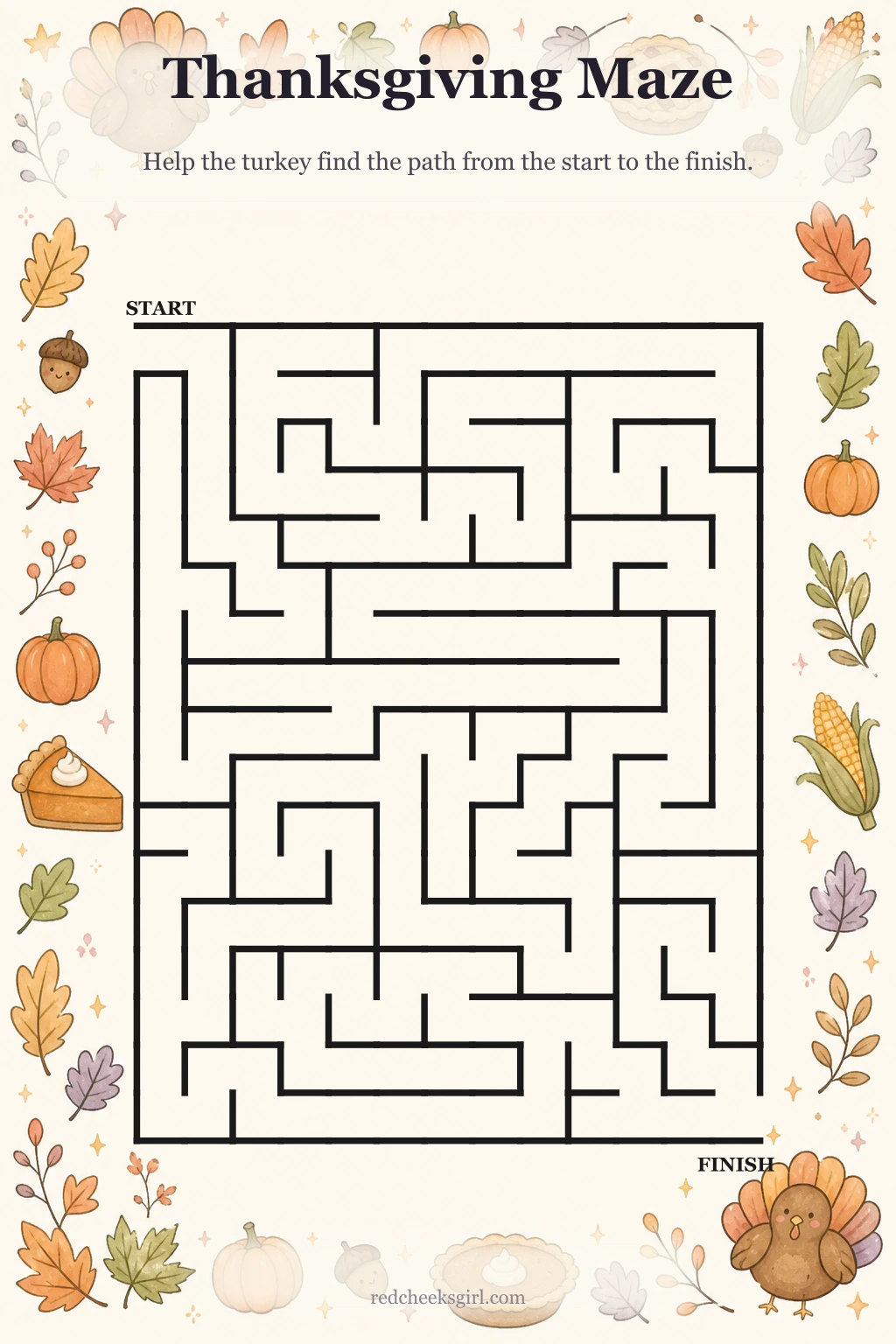
15. Thanksgiving Maze
A single-page maze shows a cartoon turkey at the entrance and a Thanksgiving table at the exit. Children trace the correct path with a pencil through a field of dead ends, harvest imagery, and wrong turns. The answer key at the bottom shows the solution path so children can self-check without arguing. For a group, hold a quiet race: first child to complete the maze correctly calls time.
Print one sheet per child on plain paper and hand out pencils. The maze takes three to eight minutes depending on age and persistence. Pair it with the Spot the Difference sheet as a two-page quiet pack for children who need more contained time.
Children who get stuck often scribble over the whole sheet in frustration. Solve this by printing two copies per child: one to attempt, one as a clean backup. Alternatively, slide the sheet inside a clear plastic sleeve and let them use a dry-erase marker so mistakes wipe off cleanly.
Slide the printed sheet inside a clear plastic sleeve and hand out dry-erase markers so children can try as many times as they need.
🛍 Shopping guide
16. Icing Plain Biscuits at the Kids Table
A low table holds a plate of plain round biscuits, small bowls of ready-made icing in orange, yellow, and brown, plastic knives, and a scattering of sprinkles in autumn colours. Each child ices their own biscuits however they like, eats them immediately or saves them to show the adults. The activity is its own reward and generates genuine concentration.
No printing needed. Buy ready-to-use tube icing or thin down a tub of cream-cheese frosting with a splash of milk and divide it into small bowls with a drop of food colouring in each. Use plain digestive biscuits or any simple round biscuit. Set out one plastic knife per child and cover the table with a wipe-clean cloth.
Icing wars start fast. Limit each child to their own biscuits by placing four biscuits on a small paper plate per child before they sit down: their plate, their biscuits, their decision. That removes the territorial dispute entirely. This activity pairs well with the Thanksgiving Minute To Win It games as a calmer follow-up to burn the last of the energy.
Lay a wipe-clean tablecloth or a roll of butcher paper across the kids’ table before setting out the icing. Cleanup takes thirty seconds.
🛍 Shopping guide
Frequently Asked Questions
What are good thanksgiving games for kids that need no adult supervision?
The best choices are self-contained: printable sheets like colouring pages, mazes, and spot-the-difference need only a pencil. Active games like Turkey Trot, Pass the Pumpkin, and Musical Statues run on their own once an older child takes the caller or music role. Set up the activity, explain the rule once, and leave.
How do I keep kids from coming into the kitchen during Thanksgiving?
Give them a specific room or space with a clear activity already started before the cooking gets serious. A craft box, a biscuit-icing table, or a stack of printed game sheets provides immediate direction. Children interrupt when they are bored, not when they are busy. The first fifteen minutes of engagement are the ones you have to engineer.
What age are these thanksgiving games for kids suitable for?
Most games here suit ages three to ten, and several work across that full range at the same time. Colouring sheets, Pass the Pumpkin, and the Craft Box work for threes and fours. Spot the Difference, the Maze, and Bingo work better from age five upward. The Feely Box and Turkey Trot land well across the whole group together.
How far in advance do I need to prepare the printable thanksgiving games?
The printable sheets need only an evening. Print everything the night before, stack each game in a labelled folder, and set out pencils and crayons in a tub beside them. The active-game props (the pumpkin, the craft box, the feely box) take under an hour to assemble and can be done two days ahead.
What do I do if children finish a game too quickly?
Layer the activities: printable sheets can be coloured after the game side is done, mazes have a clean-copy backup, and biscuit icing extends as long as the icing holds out. Having three or four games set up simultaneously rather than running them in strict sequence means a child who finishes early can drift to the next activity without fetching you.
How do I handle mixed ages at a Thanksgiving kids game table?
Pair an older child with a younger one as a helper, not a competitor. In bingo, an older child reads the call list. In the Feely Box, an older child manages the tally. Giving the oldest children a small role keeps them engaged at games they might find easy and solves the supervision gap at the same time.
14 Thanksgiving sangria recipes built around fruit that shows through the glass. Apple cider, cranbe
20 thanksgiving party games for every moment — icebreakers, big group showstoppers & wind-down fun
Find the right Thanksgiving games for your crowd: family, Friendsgiving, work, or drinks, all sorted
Leave a Reply