

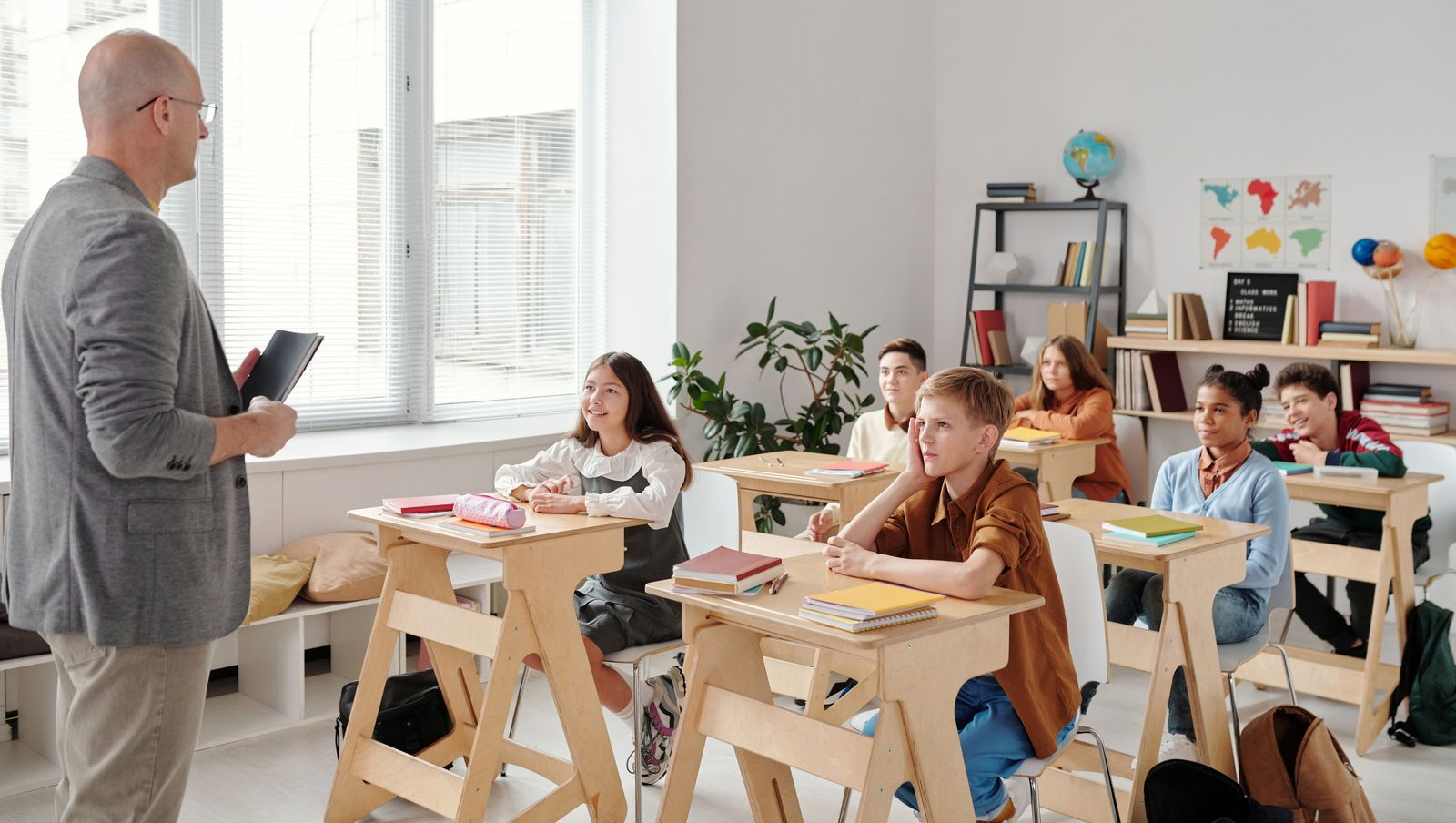
Classroom parties are the highlight of the school year, but that 30-minute window between the bell and the sugar crash is unforgiving.
You need games that fill the room with energy, require almost no setup, leave zero mess for the janitor, and still feel special enough that kids talk about them for weeks.
That is a taller order than most party-planning lists acknowledge, which is why this one was built specifically for teachers running a real classroom with real desks and a real clock on the wall.
Every game below has been chosen because it works in a standard rectangular classroom, scales to 20–30 children, and can be started, played, and wrapped up inside a tight time slot.
The 22 options range from printable sheets you can run off the night before to standing games that need nothing more than the chairs already in the room.
Mix and match a few to fill your slot, or run the whole list across a longer celebration day. Either way, the fun is ready when you are.
This post contains affiliate links — if you buy through them, I may earn a small commission at no extra cost to you.
Table of Contents
- Classroom Bingo
- Charades Cards
- Four Corners
- Heads Up Seven Up
- Silent Ball
- Picture Round
- Team Relay at Desks
- Would You Rather? Kids Edition
- I Spy Sheets
- Simon Says
- Categories Round
- Colour by Number Sheets
- Trivia Quiz
- Mad Libs Story
- THIS OR THAT VOTE CARDS
- Map It Bingo
- Emoji Decode
- Freeze Dance
- Pass the Story
- Alphabet Race
- Human Knot
- Classroom Pictionary Relay
1. Classroom Bingo
Print one unique bingo card per child — each card has a five-by-five grid filled with seasonal words, funny school phrases, or party-themed pictures instead of plain numbers.
The teacher draws cards or calls words from a shuffled deck and reads them aloud one at a time. Children mark their sheets with a crayon or place a small counter on each square they hear called.
First to complete a row — across, down, or diagonal — shouts “Bingo!” and wins a small prize or simply the glory of being first.
You will need one printed card per child plus a calling deck, which can be as simple as the words cut apart and dropped into a cup. Counters are optional; a crayon works perfectly.
The game seats the whole class at once and takes about 10 minutes for one full round, though most teachers run two or three rounds back-to-back to fill the slot.
Different winning patterns — full card, four corners, or a T-shape — keep later rounds feeling fresh without any extra prep.
Host tip: print a second copy of every card and keep it at your desk so you can quickly verify a winning card by eye without holding up the room. Calling at a steady, unhurried pace gives slower readers a fair chance to find each square before you move on.

🛍 Shopping guide
2. Charades Cards
Divide the class into two teams and place a shuffled stack of printed charades cards face-down in the centre.
One player from the acting team draws a card, reads it silently, then has 60 seconds to act out the word or phrase using only body movements — no talking, no mouthing words, no pointing at objects in the room. Their teammates shout guesses freely.
A correct guess before the timer earns one point for the team, then play passes to the other side.
The printable sheet gives you a ready-made set of kid-appropriate prompts: animals, sports, everyday actions, and silly scenarios that children aged 5–11 can both perform and guess. All you need beyond the sheet is a simple countdown timer on your phone.
The game comfortably handles 20–30 players split into two teams and runs for about 15 minutes, making it one of the best all-class warmers in the set.
Host tip: laminate a set and keep them in your party kit permanently — they survive every celebration from Halloween to end-of-year. Shuffle in a few blank cards where children write their own prompts during a quiet moment; the homemade ones always get the biggest laughs.

3. Four Corners
Label each corner of the classroom with a number — one through four — using a sticky note or a small sign.
One child stands in the middle with eyes closed and counts slowly to ten while every other player quietly moves to any corner they choose.
When the count ends, the child in the middle calls out a number without looking, and everyone standing in that corner sits down. Play continues, with the last child standing earning the win.
No materials are required beyond four sticky notes, making this the fastest-setup game on the list.
It works for the full class of 20–30 and typically runs 10 to 12 minutes before a winner emerges, though you can speed the pace by having the middle child count to five instead of ten once the group gets smaller.
Children who sit out cheer for friends rather than waiting in silence, which keeps the energy high throughout.
Host tip: once only a handful of players remain, remind the middle child to genuinely not peek — suspense is the whole game. If two children end up in the same corner, they are both out at once, which narrows the field quickly and makes the final rounds thrillingly tense.
4. Heads Up Seven Up
Seven children are chosen to stand at the front. The rest put their heads down on their desks and extend one thumb upward. The seven walk silently through the room and each presses down exactly one thumb.
When all seven have chosen someone, they return to the front and call “Heads up, seven up!”
Everyone lifts their head, and the seven children whose thumbs were pressed stand up one at a time to guess which of the seven at the front chose them.
A correct guess means the guesser swaps places with the child who chose them; an incorrect guess means the child at the front stays put.
A full round takes about five minutes, so you can easily cycle through three rounds in a 20-minute window and give most of the class a turn at the front.
No materials whatsoever are needed — this is pure organised chaos powered entirely by suspense and whispered strategy.
Host tip: remind the seven choosers to vary their walking pace so they do not give away who they pressed by arriving back too quickly or too slowly. Children quickly learn to watch feet under the desks, so a rule about keeping eyes fully closed levels the playing field and sharpens the genuine mystery.
5. Silent Ball
Children stand beside or on top of their desks (check your school’s furniture rules first — standing in the aisle works equally well). A soft foam ball is tossed randomly around the room in complete silence.
Any child who drops a catch, makes a bad throw, or — crucially — makes any sound at all must sit down immediately. The last child standing wins the round.
The only material you need is one soft foam ball small enough to throw safely indoors. The game seats 20–30 children and a round lasts between three and eight minutes depending on how quickly the field narrows.
Because the rule of silence applies to everyone including the teacher, the atmosphere becomes wonderfully absurd: children mime dramatic reactions, clap hands over mouths, and suppress laughter with heroic effort.
Host tip: appoint yourself as the sole judge of questionable calls so disputes do not break the silence rule themselves. Foam cubes work better than round balls in tight classrooms because they travel more slowly and bounce less unpredictably off furniture, giving children a fairer chance to react.
🛍 Shopping guide
6. Picture Round
Each child receives a printed sheet showing a grid of close-up photographs or simple line drawings of familiar objects, animals, or foods — all cropped or angled just enough to make them slightly tricky to identify.
Children write their best guess beside each image individually or work in pairs, then the teacher reads the answers aloud at the end for a satisfying reveal. The team or individual with the most correct guesses wins.
The printable sheet does all the heavy lifting, so you need nothing else beyond pencils.
It works beautifully as a calm, seated game for the full class and takes about eight minutes to complete, making it a perfect opener while stragglers are still arriving or a quieter cool-down after a more energetic activity.
Because children work at their own pace on paper, it naturally accommodates different reading speeds and confidence levels without anyone feeling left behind.
Host tip: read the answers slowly and theatrically — pausing before each one and letting children react builds far more excitement than a quick run-through. Add one or two pictures from inside your own classroom (the stapler, the clock, the reading corner rug) and watch the room light up at the hyper-local detail.

7. Team Relay at Desks
Arrange children in rows or groups of five or six. The teacher sets a task — drawing a shape, writing a word, stacking three small items — and on “go” the first child in each row completes it, then tags the next.
The relay continues down the line until every member of the team has taken a turn. The first team to finish all steps correctly wins the round, and a new task begins immediately for the next round.
Tasks can be entirely paper-based (passing a sheet and each person adding one line to a drawing) or object-based (stacking erasers, moving a pencil case from desk to desk). No special equipment is needed beyond what already lives in children’s pencil cases.
The whole class plays simultaneously, which means zero waiting around, and a set of five rounds fills about 12 minutes comfortably. Mixing paper tasks with physical ones keeps every round feeling different.
Host tip: keep a list of eight to ten relay tasks prepared in advance so you can call the next one the moment a round ends — dead air between rounds is when behaviour unravels fastest.
Writing the tasks on folded slips of paper and having a child draw one at random adds a fun lottery element that the class loves.
8. Would You Rather? Kids Edition
Print and cut apart the “Would You Rather? Kids Edition” cards, each posing a choice between two silly, imaginative, or mildly outrageous options — would you rather have spaghetti for hair or crayons for fingers?
The teacher reads a card aloud, and children vote by moving to one side of the room for Option A or the other side for Option B. Once everyone has chosen, a few volunteers share their funniest reasons before the next card is read.
The printable sheet provides a ready stack of age-tested questions that keep the content appropriate and the energy light. No additional materials are needed.
The game handles any class size and one full set of cards takes about 10 minutes, though you can easily trim or extend it by controlling how many reasoning speeches you invite.
Because every child participates in every question, no one is ever watching from the sidelines.
Host tip: after the vote, always ask for one reason from each side rather than just the majority — hearing a child passionately defend the less popular choice is reliably the funniest moment of the game and gives quieter children a natural opening to speak up without feeling put on the spot.

9. I Spy Sheets
Hand each child a printed “I SPY” sheet packed with a dense, detailed illustration containing dozens of small hidden objects. Alongside the image sits a list of items to find, each accompanied by a tally box.
Children scan the picture carefully, circling or ticking each object as they locate it. The child who finds the most items correctly within a set time limit — typically five to seven minutes — wins the round.
All you need is the printed sheet and a pencil. Because the activity is entirely self-contained on paper, it runs silently and independently, making it one of the best games to deploy when you need a settled, focused five minutes inside a busy party schedule.
It works for the full class simultaneously and the difficulty can be quietly adjusted just by setting a shorter or longer time limit for different age groups.
Host tip: rather than announcing the time limit upfront, warn children when one minute remains — the scramble that follows is thrilling, and it stops faster finishers from disrupting those still searching. Pair children who finish early to double-check each other’s answers, which keeps them engaged without giving away positions to those still hunting.

10. Simon Says
The teacher (or a chosen child leader) plays Simon and gives physical commands prefaced with “Simon says” — Simon says pat your head, Simon says stand on one foot, Simon says wave to the person next to you.
The catch: if a command is given without the phrase “Simon says,” anyone who follows it is out. Eliminated players sit down and help spot mistakes for the rest of the round.
Absolutely no materials are needed. Simon Says fills the full class instantly and a round runs anywhere from three to eight minutes depending on how tricky Simon wants to be.
Using classroom-specific commands — Simon says touch your reading book, Simon says point to the whiteboard — adds a delightful in-the-moment flavour that generic lists cannot replicate and keeps even the most distracted child tuned in.
Host tip: the best Simon players vary their rhythm deliberately — give three fast commands then pause unexpectedly before a slow one. Children anticipate speed, so slowing down before a trap command catches far more players than simply speeding up does, and the groans of delight from those caught are half the fun.
11. Categories Round
Print one answer sheet per child or pair. The teacher calls out a category — things you find in a kitchen, animals beginning with B, sports played with a ball — and children have 60 seconds to write down as many examples as they can.
At the end of each round, children read their lists aloud and cross off any answer that someone else also wrote. Only unique answers score a point. The child with the most unique answers across five rounds wins.
You need the printed answer sheet and a pencil. The game works beautifully for the full class and five category rounds take about 12 minutes including reading-out time.
The unique-answers rule is the brilliant twist: it rewards lateral thinking over simply knowing the most examples, so a child who writes “wok” when everyone else writes “pot” earns the point, and the room buzzes with the strategy of trying to think differently from everyone else.
Host tip: choose one wildly broad category per game (things that can be blue) and one very narrow one (things smaller than a thumb) — the contrast in strategy produces the most interesting answer comparisons and sparks the best conversations when lists are read aloud. Read answers at a brisk pace to maintain energy.

12. Colour by Number Sheets
Each child receives a printed “Colour by Number” sheet showing a festive or seasonal line drawing divided into numbered sections. A colour key at the bottom tells them which crayon or coloured pencil to use for each number.
Children work independently, colouring each section according to the key until the full image is revealed. The finished pictures make a lovely spontaneous display pinned to the classroom wall at the end of the party.
You need the printed sheet and a basic set of crayons or coloured pencils per child. The activity works for the full class at once and fills eight to twelve minutes depending on the complexity of the design.
It is especially useful as a calm anchor activity — something children can return to during transitional moments between more active games without needing any re-explanation from the teacher.
Host tip: choose a design with at least eight distinct colour zones so that children with different colouring speeds all have enough to do for the full window. If your school has a limited supply of one colour, quietly pre-check the sheet so you are not scrambling for fifteen green crayons when the party is already underway.

🛍 Shopping guide
13. Trivia Quiz
Print one quiz sheet per child or pair, containing 20 multiple-choice questions across categories such as animals, science, geography, and pop-culture-free general knowledge. Children work through the sheet individually in silence, circling their chosen answer for each question.
When time is called — usually after eight to ten minutes — the teacher reads the correct answers aloud one by one, and children mark their own papers with a tally of correct responses. The highest scorer wins.
All you need is the printed sheet and a pencil. Running it as a pairs activity stretches the sheet across the full class with fewer copies and naturally generates quiet debate between partners, which is half the educational value.
A full 20-question quiz with marking takes about 12 minutes, fitting neatly into the second half of a party slot after a more physical opener.
Bonus rounds — nearest to the right answer for a number question — can be used as tiebreakers without any extra printing.
Host tip: read the answers with theatrical pauses and let wrong answers land before revealing the right one — “The answer is… not a dolphin… it’s actually a manatee!” generates far more delight than a plain read-through. Awarding one bonus point for the most creative wrong answer keeps children who score low still emotionally invested in the finale.

14. Mad Libs Story
Print one “Mad Libs Story” sheet per child or small group.
Before the story is revealed, the teacher calls out the type of word needed for each blank — a noun, an adjective, a food, an animal — and children write their answers in the numbered boxes at the top of the sheet without knowing the story context.
Once all blanks are filled, children read the words into the story in order and discover the wonderfully ridiculous tale that results.
You need the printed sheet and a pencil. This works beautifully as a paired or small-group activity for the full class and takes six to eight minutes from blank-filling to first reading.
The game is reliably hilarious because the mismatch between a child’s random word choices and the story’s structure produces sentences nobody could have planned — a knight who defeats a dragon using a soggy sandwich and a pair of swimming goggles, for instance.
Host tip: after pairs finish reading their own version silently, invite two or three groups to read their story aloud to the class — the variation between groups, all working from the same template, never fails to produce huge laughs and shows children how much the word choices shape the whole story.

15. THIS OR THAT VOTE CARDS
Distribute a printed “This or That” vote card to each child — each card lists a series of either/or choices (pizza or pasta, beach or mountains, summer or winter) with two columns to tick.
Children fill in their own preferences independently, then the teacher tallies votes for each question on the whiteboard by a show of hands, revealing which option the class collectively prefers.
Children compare their personal cards to the class result to see how many of their choices matched the majority.
You need the printed card and a pencil. The full class completes the sheet simultaneously in about five minutes, and the whole-class tally and comparison takes another five, making it a crisp 10-minute activity.
The personal-versus-class comparison at the end is what elevates it beyond a simple vote — children are genuinely curious to see whether they are a majority or a minority thinker, and the gentle surprise of finding that most of the class agrees with them (or absolutely does not) is its own small drama.
Host tip: after revealing the class tally, ask one child on the losing side of the most lopsided vote to make their best case for their choice — this generates cheerful, low-stakes debate and stretches the activity naturally if you have a few extra minutes to fill without any additional prep.

16. Map It Bingo
Each child receives a printed “Map It Bingo” card featuring a simple outline grid with country names, capital cities, flags, or continent labels in place of numbers.
The teacher calls items aloud from a shuffled deck — or reads from a prepared list — and children mark off any matching square on their card.
Because every card has a different arrangement of the same pool of answers, the game plays exactly like classic bingo while quietly reinforcing geography knowledge.
You need the printed cards plus a calling list or cut-apart call cards, and pencils or small counters for marking. The full class plays at once, and two to three rounds take about 12 minutes.
The educational layer is invisible to children in the moment — they are focused entirely on winning — but teachers report that children spontaneously recall capital cities and flag colours in lessons weeks after the party, which is a rather satisfying side effect of a party game.
Host tip: laminate the cards if you plan to reuse them across multiple class parties — a dry-erase marker replaces the need for counters and the cards last for years. For mixed-ability classes, call the item with a short clue before the answer (“It’s the capital of Japan… Tokyo!”) so every child has a moment to search before confirming.

🛍 Shopping guide
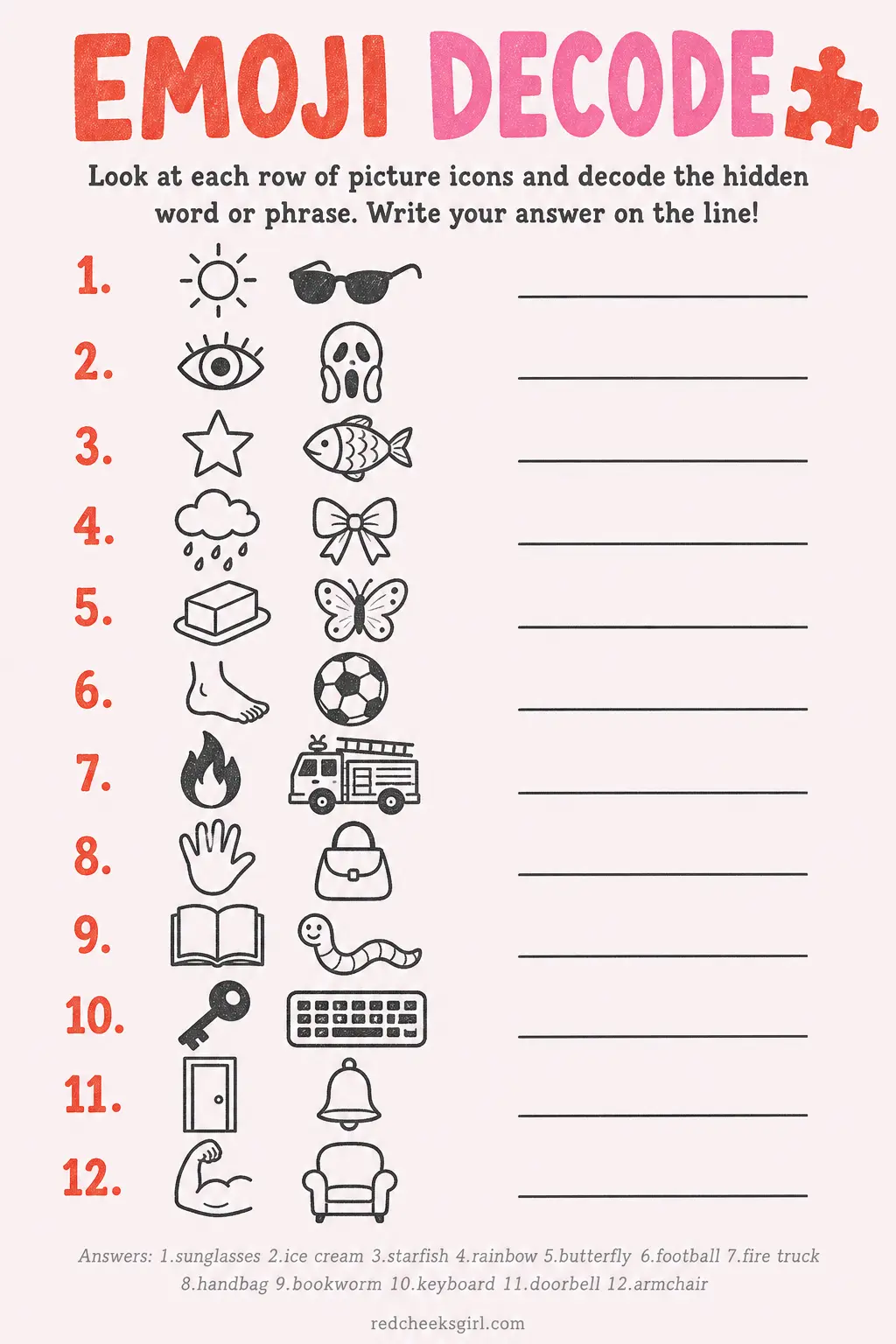
17. Emoji Decode
Hand each child a printed “Emoji Decode” sheet showing rows of printed emoji-style symbols — faces, objects, animals, and food icons drawn in a simple, non-licensed style — each row representing a word or short phrase.
Children study the symbol combinations and write their best interpretation of what each row is communicating in the answer column. At the end of the round, the teacher reveals the intended answers and children discover how many they decoded correctly.
You need the printed sheet and a pencil. The activity works for the full class simultaneously and takes six to eight minutes to complete, making it a tidy self-contained round that needs no additional setup or materials.
Because the symbols on the sheet are hand-drawn in a neutral, brand-free style, there are no trademark concerns, and the teacher can preview every answer in advance to confirm each one resolves unambiguously — the sheet is designed so that every combination points clearly to one specific word or phrase.
Host tip: read the answers aloud slowly and let children react before moving to the next one — the mix of triumphant shouts and surprised groans at unexpected answers is genuinely entertaining and rewards the whole class for engaging, not just the top scorers.
If you spot a row where multiple answers seem reasonable, acknowledge those alternatives generously before stating the official answer.
18. Freeze Dance
Push a small gap in the rows of desks if possible, or simply have children stand in the aisle beside their chair. The teacher plays a short burst of upbeat, classroom-appropriate music — 10 to 15 seconds at a time — and children dance freely.
The moment the music stops, every child must freeze completely still. Anyone caught still moving after the music cuts sits down. The last child dancing wins the round.
All you need is a phone or tablet with a music app and a small speaker. The game works for any class size and a full round typically lasts four to six minutes.
It is one of the few games on this list that provides genuine physical release without requiring any open floor space, because children dance in their own small spot rather than moving around the room, making it safe and manageable even in a densely furnished classroom.
Host tip: vary the gap between music stints unpredictably — two seconds of silence followed by more music fools children into moving too soon, and the resulting laughter resets the energy of the entire room. Choosing one song the class currently loves and one deliberately old-fashioned one creates a fun contrast in how enthusiastically children dance to each.
🛍 Shopping guide
19. Pass the Story
Children sit in a circle or remain at their desks in rows.
The teacher starts a story with a single opening sentence — “One morning, a dragon arrived at the school gates with a very important message…” — and a soft ball or rolled-up paper tube is passed to the next child, who must add exactly one sentence before passing it on.
The story continues around the room, building in whatever absurd direction the group takes it, until every child has contributed.
No materials are needed beyond something to pass as a speaking token. The game works for the full class and takes 10 to 15 minutes depending on class size and how elaborate each contribution becomes.
Because every child adds only one sentence, no one is required to perform at length, which makes it inclusive for shy speakers and naturally prevents any one child from dominating the narrative.
Host tip: seed two or three unexpected details in your opening sentence — a specific unusual object, a named but unknown character, an unresolved mystery — because children will pick up those threads without prompting and the story becomes far more coherent and funny than an open-ended start typically produces.
Write down the story as it unfolds and read it back at the end; the class always wants to hear it again.
20. Alphabet Race
The teacher calls out a broad category — animals, foods, things you pack for a holiday — and children have exactly two minutes to write one word beginning with each letter of the alphabet that fits the category.
Letters Q, X, and Z earn a bonus point automatically if answered, because they are so hard to fill. When time is called, children swap papers with a neighbour to mark, and the teacher works through the alphabet calling accepted answers aloud.
You need a piece of plain paper and a pencil per child, making this a true zero-prep activity that can be pulled out at any moment. The game works for the full class simultaneously and two rounds with marking takes about 12 minutes.
Because children are racing against the clock rather than against each other in real time, the atmosphere is energised but not competitive in a way that isolates slower writers.
Host tip: allow any reasonable answer for disputed letters rather than ruling strictly — the goal is enthusiasm, not a spelling test. Announcing the letter totals at the end (“Four people found a Z word — let’s hear them!”) creates a brilliant bonus moment of shared pride that costs you nothing and lands every time.
21. Human Knot
Gather children in groups of eight to ten and have each group stand in a tight circle. Everyone reaches across the circle with both hands and grabs two different hands belonging to two different people — not the person immediately beside them.
The resulting tangle of arms is the “knot.” Without releasing any grip, the group must communicate, step over and under each other’s arms, and rotate to untangle themselves into a standing circle again.
No materials are needed at all. Each group of eight to ten takes about five to seven minutes to untangle successfully (or to cheerfully fail), and the activity works with the full class split into three or four simultaneous groups.
It is a genuine team-building puzzle that requires children to listen to each other, negotiate movement, and stay patient — qualities that are rarely exercised so concretely in a standard school day.
Host tip: before starting, remind children that hands must stay connected but grips can be adjusted to avoid discomfort — giving children explicit permission to gently re-position a grip means the game stays comfortable for everyone and runs without interruption.
If a group gets completely stuck, allow one “free move” where they can release and rejoin one pair of hands, which usually unlocks the whole knot within seconds.
22. Classroom Pictionary Relay
Divide the class into two or three teams, each with a row or cluster of desks. A simple vocabulary list of kid-appropriate words is prepared in advance — school objects, animals, food, weather — and kept at the teacher’s desk.
One child from each team comes to the front, sees the same word written on a slip of paper, then races back to their team and draws the word on a piece of paper passed along the row.
No letters or numbers allowed in the drawing. The first team to guess the word correctly and call it out wins the round.
You need small slips of paper with words, blank paper for drawing, and a pencil per team. A full game of eight rounds takes about 12 minutes and keeps all teams active simultaneously rather than watching one team draw while everyone else waits.
Rotating who comes forward to see the word means every child gets a turn as the artist across the course of the game, and because teams are guessing their own drawing rather than a stranger’s, the frantic miscommunication between artist and team is where most of the comedy lives.
Host tip: avoid words with strong phonetic clues in the drawing — “cloud” is easier to draw than “weather” but both work well, whereas “beautiful” sends children into drawing spirals that waste a minute.
Stick to concrete nouns and simple actions, and prepare at least 15 words so you can skip any that seem too easy or too hard for your particular group on the day.
Frequently Asked Questions
How many games should I plan for a 30-minute classroom party?
Two or three games is the sweet spot for a 30-minute slot. Choose one active standing game, one printable seated activity, and one whole-class round game to give the session rhythm and variety without rushing any single activity. Always have a fourth option ready in case a game ends sooner than expected — children’s pace is famously unpredictable.
What is the easiest classroom party game that needs no preparation at all?
Simon Says and Four Corners both require literally nothing beyond the children already sitting in the room. Heads Up Seven Up is a very close third. All three can be explained and started within 60 seconds, which makes them invaluable when a party begins earlier than planned or a prepared activity falls apart at the last moment.
How do I manage a classroom party game with a very mixed age group?
Choose games where the mechanic is simple enough for the youngest child to understand in one sentence, but where depth or strategy keeps older children engaged. Bingo, Would You Rather, and Categories Round all work this way naturally.
For relay and team games, mix ages across teams deliberately so older children support younger ones rather than the two groups competing separately.
Are printable classroom party games worth the effort of printing?
Absolutely, particularly for the seated portion of your party. A printed sheet gives every child something to hold, removes the logistics of explaining rules verbally to 30 excited children at once, and produces a take-home souvenir that parents genuinely appreciate. Print at least two extra copies beyond your class count to cover late arrivals and accidental spills.
How do I keep noise at a manageable level during classroom party games?
Set a clear noise expectation before each game begins rather than trying to manage it once the game is underway.
A simple visual cue — a hand raised, a specific word called — that signals “voices off” works far better than repeating instructions over the noise.
Silent Ball is a brilliant reset game: running it for five minutes after a noisy round restores calm almost instantly.
📌 Save These for Later
Loved these? Pin your favorite image below so you can find this list again when you’re planning.
19 road trip games for teens that actually work — printable card decks, laugh-out-loud rounds, and

72 truth or dare questions for best friends at a sleepover, sorted into six rounds that build all ni

120 silly would you rather questions for kids — 5 themed lists plus free printable card decks for
Leave a Reply