

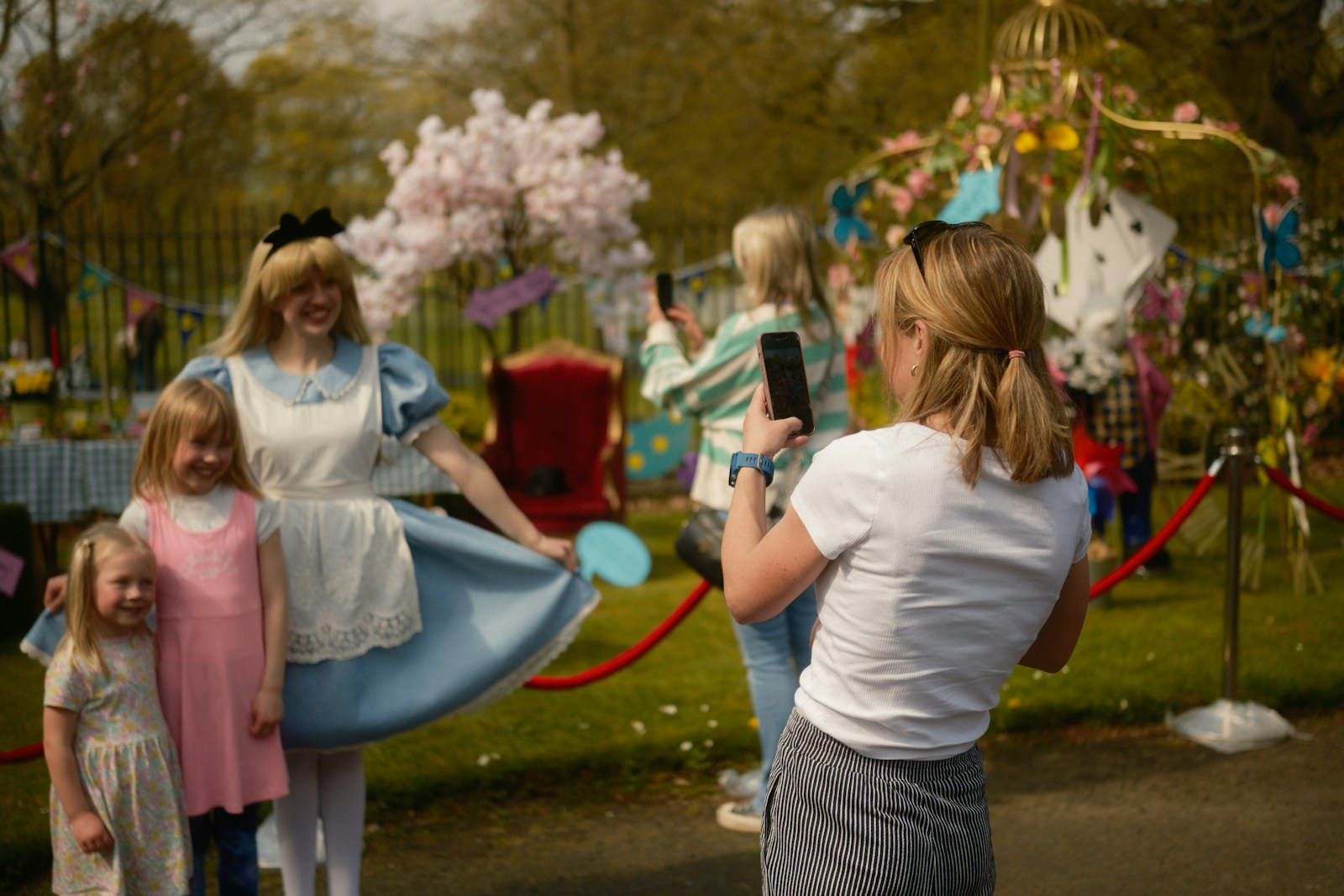
These Alice in Wonderland birthday party games are made for children aged 5-10, with printable cards, grids and game sheets you can prepare the night before. The list mixes quiet table games with active options, and says exactly which ones need an adult to run them.
This post contains affiliate links — if you buy through them, I may earn a small commission at no extra cost to you.
- Mad Hatter Riddle Cards
- The Queen Says
- Follow the White Rabbit Scavenger Hunt
- Flamingo Croquet Relay
- Painting the Roses Red
- Drink Me Bottle Toss
- Wonderland Bingo
- Tea Cup Tower
- Unbirthday Card Match
- Which Way to Wonderland? Signpost Charades
- Curiouser and Curiouser Would You Rather
- Pin the Grin on the Cat
- Wonderland I Spy
- Alice’s Curious Quiz
- Caterpillar’s Color-Change Challenge
- Pin the Key in the Lock
- Cheshire Cat Freeze Dance
- Tea Party Picture Match
- White Rabbit Hop Race
- Queen of Hearts Card Sort
- Mad Hatter Tea Tray Memory
- Curiouser Caterpillar Path
- Queen’s Croquet Hoop Toss
- Wonderland Bingo Caller Cards
- A Mad Tea Party Spoon Relay
- Frequently Asked Questions
1. Mad Hatter Riddle Cards
Cut apart the eight riddle cards, then let one child read a card while everyone guesses the answer. The riddles use Wonderland objects such as hats, keys, roses and pocket watches, so it feels tied to the party rather than being a general children’s quiz.
Print one sheet for the group, cut along the card borders, and keep the answer key at the foot of the page for the adult reader. An adult should run this for younger children, while confident readers aged 8-10 can take turns reading the cards.
Give each child a chance to answer before moving on. The cards work best at the tea table or while the children are waiting for food, and the whole game takes about 10 minutes.
- Ages 6-10
- One shared sheet
- About 10 minutes

🛍 Shopping guide
2. The Queen Says
This is Simon Says with the Queen of Hearts running the court. The adult says, The Queen says touch your crown, and the children copy only commands that begin with The Queen says; anyone who follows an order without those words sits out for one round.
Use commands that suit a living room, such as hop like the White Rabbit, freeze like a playing card, bow to the Queen, or pretend to paint a rose. An adult needs to run the game and should keep the first few rounds easy for ages 5-6.
Do not eliminate children for long. Let anyone sitting out become a royal guard who watches for mistakes, then bring everyone back in after a few commands so the game stays lively.
- Use a clear starting phrase
- Keep commands safe indoors
- Bring children back in after one round
3. Follow the White Rabbit Scavenger Hunt
Cut out the eight numbered clue cards and hide them around the party space. Each clue sends the children to the next Wonderland location, ending with a small group prize or the tea table.
Print one sheet for the adult hiding the cards, then cut the cards apart before guests arrive. One copy is enough because the children follow the same trail together, and an adult needs to read the clues aloud for younger readers.
Hide the cards in places children can reach without climbing. Start with the first card in your hand, and send the group together so one fast reader does not disappear around the house with everyone else chasing after them.
- Cut out all eight cards
- Hide cards 2-8 before guests arrive
- Read each clue aloud

4. Flamingo Croquet Relay
Split the children into teams and give each team a soft mallet, a ball and a hoop course. One child at a time taps the ball through the hoops, runs back, and hands the mallet to the next player.
Set the hoops on grass or a clear indoor floor with plenty of space between them. Use soft equipment, mark a short start line, and have an adult supervise the turns because children aged 5-6 tend to swing first and check the surroundings later.
Keep the course short enough that children finish in under a minute. Let teams cheer from behind the start line, and call it a draw if the last players arrive close together rather than turning the relay into a maths lesson.
- Soft mallets
- Soft balls
- Hoops
- A clear course
🛍 Shopping guide
5. Painting the Roses Red
Give each child a rose outline and set a short timer. When the adult says paint the roses red, everyone colours as much of the printed rose as possible before the timer ends.
Print one sheet per guest because each child needs a separate rose page. Put red crayons or pencils on the table, explain that staying inside the outline is optional, and have an adult start and stop the timer.
Run this as a quick five-minute table game rather than a serious art contest. Younger children can colour one large rose, while older children can try to fill the leaves and petals before time is called.
- Use thick crayons
- Give younger children one large rose
- Set the timer for a short round

6. Drink Me Bottle Toss
Line up bottles labelled with Wonderland drink names and have children toss rings over them from a marked line. Each child gets the same number of turns, aiming for the bottle marked Drink Me.
Use empty plastic bottles with secure lids and place them on a low table or the floor. An adult should supervise the throwing line and retrieve rings between turns, especially when children aged 5-6 are playing.
Give the nearest bottle the easiest target and place the Drink Me bottle in the middle. This keeps the game playable for smaller children, who are rarely impressed by a target they cannot reach.
- Ages 5-10
- About 10 minutes
- An adult at the throwing line
🛍 Shopping guide
7. Wonderland Bingo
Give each child a bingo card filled with pocket watches, keys, teacups and toadstools. The adult calls the Wonderland pictures from a separate call strip, and the first child to complete the agreed line calls Bingo.
Print four different card layouts and enough copies for the children playing, one card per guest. Print one extra call strip for the adult, cut or cover each picture as it is called, and use crayons or small paper scraps as markers.
Use one row for a short game with younger children and a full card for ages 8-10. Check the winning card before starting another round because children are excellent at announcing victory several squares early.
- Print one card per guest
- Use one shared call strip
- Use a single row for ages 5-6

🛍 Shopping guide
8. Tea Cup Tower
Give each child or team a stack of lightweight tea cups and start the timer. They build the tallest tower they can before the time ends, then step away while an adult checks which towers are still standing.
Use plastic or paper cups on a flat table and give every player the same number. An adult should run the timer and keep the table clear, while children aged 5-6 can build in pairs instead of racing alone.
A narrow tower is harder than a wide one, so let children test both. Run two short rounds if the first tower collapses quickly, which it usually does when somebody decides the top cup needs a dramatic flourish.
- Lightweight tea cups
- A flat table
- A timer
🛍 Shopping guide
9. Unbirthday Card Match
Cut out the playing-card style squares and place them face down in rows. Children take turns turning over two cards, trying to find matching Wonderland pairs such as two teacups or two white rabbits.
Print one sheet for each small group of two to four children, then cut out all the cards before the party. An adult can help younger children remember where cards were placed, but the children should turn the cards themselves.
Use fewer pairs for ages 5-6 and the full set for ages 8-10. Keep matched pairs face up, and stop after every pair has been found rather than stretching the game through a second tea refill.
- Ages 5-10
- Two to four players per sheet
- About 10 minutes

10. Which Way to Wonderland? Signpost Charades
Cut out the illustrated action cards and place them in a hat or bowl. One child draws a card and acts it out without speaking while the others guess the Wonderland action.
Print one shared sheet and cut out the cards along their borders. An adult should read a card quietly to a child who cannot read it yet, and keep the guessing area clear for hopping, spinning and pretending to sip tea.
Give each actor about 30 seconds, then move to the next child even if the group is still guessing. The game works especially well after a quieter table game because children get to move without needing a large running space.
- Cut out the action cards
- Place them in a hat
- Give each actor about 30 seconds

11. Curiouser and Curiouser Would You Rather
Cut out the dilemma cards and read them aloud one at a time. Children choose which Wonderland situation they would rather face, then give a short reason if they want to.
Print one shared sheet and cut out the six cards. An adult should read the cards for younger children, and there is no answer key because the choices are personal rather than right or wrong.
Use this while children are eating or waiting for cake. Let children move to one side of the room for one choice and the other side for the second choice if you want a little movement without turning the tea table into a football pitch.
- Read one card at a time
- Let children explain their choices
- Use it while food is being served

12. Pin the Grin on the Cat
Pin or tape the striped cat poster to a wall, blindfold one child at a time, and let each child place a paper grin where they think the Cheshire Cat’s mouth should go. The closest grin wins that round.
Print one poster for the group and one sheet of cut-out grins for the children, then cut out the grins before guests arrive. An adult must supervise the blindfold, turn each child around gently, and keep everyone else behind the waiting line.
Use removable tape rather than pins for a party with younger children. Give each child a different turn and let them help judge distance from the correct mouth position, since exact measuring takes the fun out of a game involving a floating cat grin.
- Use removable tape
- Skip the blindfold for younger children
- Mark a clear waiting line

13. Wonderland I Spy
Give each child an I Spy sheet packed with small Wonderland pictures, then let them find and mark each item in the busy scene. The first child to spot every listed object brings the sheet to the adult for a check.
Print one copy per guest because each child marks a personal sheet. Put pencils or crayons on the table, and read the list aloud for ages 5-6 so the game tests looking rather than reading speed.
Use it as children arrive or while the adult is setting out food. The page should include a white rabbit, red rose, key, pocket watch, teacup, toadstool, crown and flamingo, with each object appearing once so the check is quick.
- Ages 5-10
- One sheet per guest
- Arrival activity

14. Alice’s Curious Quiz
Read the eight Wonderland questions aloud and let children answer individually or in pairs. The questions cover recognizable characters and objects from Alice’s story, with the adult checking the key at the bottom.
Print one sheet per guest if children will write answers, or print one shared copy for an adult-led group round. An adult should read the questions for younger children and accept spoken answers before revealing the key.
Give ages 5-6 two answer choices for each question and let older children answer without help. Keep this to about 10 minutes, then move on before the Queen starts demanding a recount.
- Read the questions aloud
- Print one per guest for written answers
- Use spoken answers for younger children

15. Caterpillar’s Color-Change Challenge
Give each child a caterpillar sheet and call out colour changes in Wonderland order. Children colour the next empty caterpillar segment with the colour the adult names, trying to complete the creature before the timer ends.
Print one sheet per guest and place crayons or pencils within reach. An adult runs the game by calling the colours and starting the timer, while children aged 5-6 can use a slower pace and larger crayons.
Use six segments for a short round, then let children add spots, shoes or a tiny hat after the timer. The activity keeps hands busy at the table and does not require anyone to read a card.
- One sheet per guest
- Crayons or pencils
- A timer
- An adult caller
16. Pin the Key in the Lock
Use a large printed Wonderland door with a blank keyhole and let blindfolded children place a paper key as close to the lock as they can. Each child gets one turn, and the closest key wins.
Print one shared door poster and one sheet of cut-out keys. An adult runs the game, handles the blindfold and guides children back to the starting point, while the other guests wait behind a marked line.
Write each child’s name on the back of a key if you need to identify turns, but do not print names on the sheet. Removable tape works better than pins on a party wall, particularly when the game takes place indoors.
- Print one poster for the group
- Cut out one key per child
- Use removable tape

17. Cheshire Cat Freeze Dance
Play music while the children dance like curious cats, White Rabbits or Queen’s guards. Stop the music without warning, and everyone must freeze until the music starts again.
An adult runs the music and calls a new Wonderland movement before each round, such as slinking like the Cheshire Cat or hopping through a rabbit hole. Clear the floor first, and use a short playlist so the game lasts about 10 minutes.
Do not make children sit out when they wobble. Let the adult call out a funny freeze pose instead, which keeps five-year-olds involved and gives older children a reason to make their poses increasingly ridiculous.
- Use a clear floor
- Call the movement before each round
- Keep everyone playing after a wobble
18. Tea Party Picture Match
Children match eight Wonderland objects to their matching picture partners on the sheet. They draw a line between each pair, matching the object on the left with the same object on the right.
Print one copy per guest and provide pencils or crayons. An adult can name the pictures for younger children, and the answer key at the foot of the page lets you check the lines without guessing what a child’s drawing was meant to connect.
Use large pictures and keep the two columns spread apart so the lines do not become a tangled bowl of spaghetti. The game takes about eight minutes and works well at the tea table.
- Ages 5-8
- One sheet per guest
- About 8 minutes

19. White Rabbit Hop Race
Mark a start and finish line, then have children hop like the White Rabbit from one line to the other and back. Run the children in small groups so they have room to land safely.
Use painter’s tape indoors or two visible points outdoors, and keep the course short. An adult should call each heat, watch for pushing and remind children to walk back rather than racing through the next group.
Let children choose rabbit ears made from their hands or simply hop with both feet. For ages 5-6, run it as a cooperative race where the whole group tries to finish together instead of making the slowest child feel like the rabbit who missed the train.
- Run small groups
- Keep the course short
- Have children walk back
20. Queen of Hearts Card Sort
Children sort a mixed sheet of Wonderland playing cards into four groups: hearts, tea, rabbits and roses. They cut out the cards and place each picture beneath its matching heading.
Print one copy per guest or one per pair, depending on table space. An adult should cut the cards for younger children, and the sheet includes a key at the foot so the sorting groups are clear and every card has one home.
Use pairs for ages 5-6 and let ages 8-10 race to complete the four groups. The game is quiet enough for food time but still gives children something definite to do with their hands.
- Cut out the picture cards
- Sort cards into four groups
- Use the key to check the groups

21. Mad Hatter Tea Tray Memory
Place six Wonderland objects on a tray and let the children look for 30 seconds. Cover the tray, remove one object, and ask the group to name what the Mad Hatter has taken away.
Use objects already at the party, such as a teacup, spoon, hat, key, rose and pocket watch. An adult runs the game and handles the tray, while children aged 5-6 can play in pairs and older children can remember two missing objects.
Change the missing object each round and let the child who spots it choose the next removal. Keep the tray on the table rather than carrying it around a crowded room, because a dramatic tea spill ends the game rather efficiently.
- A tray
- Six Wonderland objects
- A tea towel or cloth
22. Curiouser Caterpillar Path
Children trace a path through a printed Wonderland garden by following the caterpillar from the mushroom to the teacup. They must stay on the winding path and avoid the dead ends.
Print one sheet per guest and provide pencils or crayons. An adult can point out the start and finish for younger children, but the path itself is printed clearly and does not need an answer key because the finished route depends on the page layout rather than written answers.
Use this as a quiet arrival game or a short rest after active play. Print a large, winding route with three tempting dead ends, so children have to look carefully without facing the misery of a tiny maze.
- Ages 5-9
- One sheet per guest
- Quiet arrival play

23. Queen’s Croquet Hoop Toss
Set hoops on the ground and let children toss soft balls through them from a marked line. Each child takes a turn trying to send the ball through the Queen’s croquet hoops without stepping over the line.
Use large hoops for ages 5-6 and place them close to the throwing line. An adult should supervise the turn order and collect balls after each round, especially if the game is being played indoors.
Add one hoop decorated as the Queen’s target and let children aim for it last. Keep the round short, then move to another game before children start inventing their own rules about whether a ball that rolls backward counts.
- Use large hoops
- Move hoops closer for younger children
- Collect balls between turns
🛍 Shopping guide
24. Wonderland Bingo Caller Cards
This is a separate picture-calling game using cards rather than a bingo grid. The adult draws one caller card at a time and children act out the picture before the next card is drawn.
Print one shared sheet and cut out the twelve caller cards. An adult needs to run the game and read the action aloud, while the children copy movements such as bowing, hopping and pretending to sip tea.
Use it when the children need a quick movement break between seated games. Keep the cards in a hat, and stop after every child has had a turn instead of running through the whole pack twice.
- Cut out the twelve cards
- Put them in a hat
- Give every child one turn

25. A Mad Tea Party Spoon Relay
Children carry a lightweight ball or pom-pom on a spoon from the start line to a teacup and back. If the ball falls, the child stops, replaces it, and continues from that spot before passing the spoon to the next player.
Set up two short lanes with a cup at each far end, using a spoon and soft item for every team. An adult should explain the route, watch for running into other lanes and let ages 5-6 walk while older children try a careful fast pace.
Use a white rabbit rule that makes the relay harder only after children understand it: hop once beside the cup, then walk back. This keeps the Wonderland connection without making the first round impossible.
- Spoons
- Soft balls or pom-poms
- Teacups
- A clear route
🛍 Shopping guide
Frequently Asked Questions
How many children can play these Alice in Wonderland birthday party games?
Most of the printable games work with one child per sheet or one small group around a table. The active games work best in small turns or teams, so a larger party does not leave every child waiting.
Which Alice in Wonderland games need an adult?
An adult should run The Queen Says, the scavenger hunt, the timed rose colouring, Pin the Grin on the Cat, the bottle toss and the tray memory game. An adult also needs to call the bingo pictures, read the riddle cards and supervise any game involving blindfolds, throwing or running.
How many copies of the printable games should I print?
Print one per guest for Painting the Roses Red, Wonderland I Spy, Alice’s Curious Quiz, Tea Party Picture Match, Caterpillar’s Color-Change Challenge and Curiouser Caterpillar Path. Print one shared copy for the scavenger hunt, charades, Would You Rather, Pin the Grin on the Cat and the card-sort games.
What age are these Wonderland party games best for?
The games are aimed at ages 5-10. Children aged 5-6 usually need an adult to read cards, explain turns and manage timers, while children aged 8-10 can handle most card games with less help.
Can I run these games indoors?
Yes, the printable games, The Queen Says, Tea Cup Tower, memory games and freeze dance fit indoors. For croquet, bottle toss and relays, clear furniture first and use soft equipment.
What should I prepare the night before?
Print the personal sheets, cut out the card games, gather crayons, and hide the scavenger hunt cards in order. Put the physical-game supplies in one box so you are not searching for hoops while the children are already at the door.
Best party games for kids ages 5-12, indoors or out, six to thirty guests. Quick setup, zero special

24 football theme party ideas for watch parties, tailgates and championship nights. Décor, table st

Light up your next party with 20 epic neon glow party games perfect for a blacklight night your teen
Leave a Reply