

Rain hammering the windows, kids ricocheting off the walls, and a whole afternoon stretching ahead — sound familiar?
The good news is that a rainy day trapped indoors is one of the best opportunities your family will ever get to actually play together, laugh until someone snorts, and make the kind of memories that get retold at every holiday dinner for years.
You don’t need expensive equipment, a massive house, or a Pinterest-perfect craft room. You need a plan, and that’s exactly what this list is.
These twenty indoor games for family cover every age and energy level — from calm, thinking games that settle the room down to rowdy physical challenges that burn off the wiggles.
Several come with free printable sheets you can run off in two minutes, and the rest need nothing more than items you already own.
Pick one to start, let the kids vote on the next, and before you know it the rain will have stopped and nobody will want to go outside anyway.
This post contains affiliate links — if you buy through them, I may earn a small commission at no extra cost to you.
Table of Contents
- Indoor Scavenger Hunt
- Charades Family Edition
- Sock Basketball
- Balloon Keep-Up
- Family Trivia Rounds
- Blanket Fort Challenge
- Pictionary Family Edition
- Memory Tray Game
- Would You Rather Family Edition
- Paper Aeroplane Contest
- Indoor Bowling
- Story Dice Round
- Family Emoji Decode
- Family Mad Libs
- Rainy Day Bingo
- The Floor Is Lava
- Name That Sound
- Minute to Win It Challenges
- Two Truths and a Tall Tale
- Newspaper Fashion Show
1. Indoor Scavenger Hunt
Print the sheet, hand each player or team their copy, and send everyone racing through the house to find or photograph the listed objects before time runs out.
The sheet is designed around things found in any ordinary home — a red item smaller than your fist, something that makes noise, an object older than you are — so nothing needs to be hidden in advance.
Players tick or photograph each find on their phone, then regroup to verify. The first team to complete the full list, or the team with the most ticks when the timer sounds, wins.
This works brilliantly for mixed ages because younger children can be paired with older ones, and the hunt itself doubles as a gentle tour of the house that gives parents five minutes of relative peace.
All you need is the printed sheet, a pen per player, and optionally a phone for photographing harder-to-carry items. Group size is two to ten players and a full round takes about twenty minutes.
The printable sheet acts as both the prompt list and the score sheet, so there’s nothing else to prepare.
Host tip: Set a “no running” rule upfront and watch everyone immediately forget it — so instead, tell players they must walk backwards between rooms. It slows things down just enough to prevent chaos and adds a layer of comedy that kids love.

🛍 Shopping guide
2. Charades Family Edition
Charades needs no introduction, but the printable sheet does all the heavy lifting that usually kills the game before it starts — namely, nobody being able to think of anything when it’s their turn.
The sheet is pre-loaded with family-friendly prompts across categories: animals, movies, everyday actions, and silly scenarios. Cut the prompts into strips, fold them, drop them in a bowl, and you’re ready.
One player draws a strip, acts out the prompt without speaking or pointing at objects in the room, and their team tries to guess within sixty seconds.
Teams of two work well, but with a bigger family you can play as one rotating group with everyone shouting guesses. You’ll need the printed and cut sheet, a bowl or hat, and a phone timer.
The game suits four to twelve players and runs for as long as you like — just keep cycling through the bowl. It’s genuinely one of the best indoor games for family gatherings because even grandparents and toddlers can participate at their own level.
Host tip: Keep a “challenge” rule: if an actor accidentally makes a sound or mouths a word, the opposing team can steal the point. This one rule doubles the attention everyone pays and stops the competitive ones from getting lazy.

3. Sock Basketball
Pair up every odd sock in the laundry basket into tight balls and place a laundry basket or large mixing bowl at the end of the hallway.
Players take turns shooting from three marked distances — a strip of masking tape on the floor works perfectly — scoring one, two, or three points depending on how far back they stand.
Everyone gets five throws per round, scores are tallied, and the player with the most points after three rounds wins. Swap the basket for a bin or a cardboard box if needed; the game is just as good.
All you need is a pile of socks and a container — nothing purchased, nothing prepared. Two to eight players is the sweet spot and a full game takes around fifteen minutes, or you can keep it going indefinitely as a knock-out tournament.
The soft sock balls mean it’s genuinely safe to play in a living room without fear of breaking anything, which is what makes it one of the most reliably useful indoor games for family days.
Host tip: Let the youngest player in the group choose where the closest tape line goes. Giving them that small power means they feel invested in the game rather than disadvantaged by it, and it keeps the competition friendly.
4. Balloon Keep-Up
Inflate one balloon per player and announce a simple rule: no balloon is allowed to touch the floor. Players bat, head, elbow, and knee their balloons to keep them airborne while moving around the playing space.
Add a twist every minute — “one hand behind your back,” “knees only,” “you must be sitting down” — and the game evolves from a simple task into a genuinely hilarious physical challenge that works up a sweat without requiring a single piece of sports equipment.
For a competitive version, eliminate players whose balloon touches the floor, last one airborne wins. For a cooperative version, the whole family works together to keep every balloon up simultaneously, racing against the clock.
You’ll need one balloon per person and clear floor space — push the coffee table aside. Group size is two to eight players and a session lasts as long as you want; energy levels usually decide the end point.
Keep a few spare balloons inflated because they will pop.
Host tip: If you have a very mixed age group, give younger children two balloons while older players have one — it sounds counter-intuitive but it actually makes it harder for the little ones because two balloons move in different directions, which levels the playing field perfectly.
🛍 Shopping guide
5. Family Trivia Rounds
The printable sheet delivers a ready-made quiz in themed rounds — nature, history, food, sport, and a wild-card round — with questions calibrated so that children can answer some and adults need to think hard about others.
Divide into teams, appoint a quizmaster (often the most competitive adult in the room, who will absolutely read the questions with dramatic pauses), and work through each round.
Teams write answers on scrap paper, reveal simultaneously at the end of each round, and the quizmaster marks from the answer key printed on the sheet.
The simultaneous reveal is crucial — it stops early finishers from influencing other teams and keeps the tension alive right to the last question.
You need the printed sheet, scrap paper, pens, and something to use as a buzzer for tiebreakers (a wooden spoon on a table works fine). Four to twelve players suits the format well and a full quiz takes thirty to forty-five minutes.
It’s a natural anchor for the afternoon because it settles everyone down and uses brainpower rather than energy.
Host tip: Read the question, then immediately say “no shouting out” — if a team calls an answer aloud before writing it down, they forfeit that question. This single rule prevents the loudest family member from dominating every round.

6. Blanket Fort Challenge
Divide the family into two or three teams, give each team an identical pile of blankets, sofa cushions, and pillows, and set a timer for twenty minutes.
Each team must build the most impressive fort they can using only what’s in their pile plus any furniture already in the room — no tape, no extra props.
When time is up, a neutral judge (or the youngest non-competing family member) tours the forts and scores them on three things: structural stability, interior comfort, and creativity.
The team with the highest combined score wins bragging rights and first choice of movie for the evening.
You need blankets, cushions, and pillows — nothing else. Two to eight players works well and the build phase takes twenty minutes, with judging and deliberation adding another ten.
The game is beautifully flexible: for a simpler version just build together as one family with no competition, and the result is an afternoon den that becomes the venue for every other game that follows.
It’s one of those indoor games for family that tends to generate its own sequels.
Host tip: Give teams a “secret requirement” in a sealed envelope they open at the ten-minute mark — something like “your fort must have a working entrance tunnel.” Introducing a late constraint forces creative problem-solving and genuinely changes the outcome in the most entertaining way.
7. Pictionary Family Edition
The printable prompt cards cover four categories — people, places, actions, and things — with a mix of easy draws for younger players and genuinely tricky concepts for adults. Cut the cards, shuffle them into a pile, and split into two teams.
The drawer picks a card, gets thirty seconds to study it, and then has ninety seconds to draw while their team guesses. No letters, numbers, or spoken clues — just the drawing.
If the team guesses correctly in time, they score a point; if not, the other team gets one free guess to steal.
All you need is the printed and cut cards, large sheets of paper or a whiteboard, and markers. Four to ten players is the sweet spot and a full game of twenty cards per team takes about forty minutes.
The steal mechanic keeps the non-drawing team completely focused because a moment of inattention means a lost point, which is exactly what you want in a family game that might otherwise have half the room on their phones.
Host tip: Let the youngest player on each team go first every round. They almost always choose the simplest interpretation of the prompt, and watching adults try to guess a five-year-old’s drawing of “volcano” is consistently the funniest part of the entire game.

8. Memory Tray Game
Place fifteen to twenty small household objects on a tray — a spoon, a coin, a rubber band, a crayon, a key, a button, and so on — and cover it with a tea towel. Reveal the tray for sixty seconds, then cover it again.
Players write down every object they can remember. After everyone has written their list, uncover the tray and count correct answers. The player who remembered the most objects wins the round.
Run three rounds with a different tray each time, changing some objects between rounds to keep it fresh.
You need a tray or large plate, assorted small household objects, a tea towel, paper, and pens. The game works for two to ten players and a three-round session takes about twenty minutes.
It’s one of the best calm-down indoor games for family afternoons because it requires silence and concentration, which naturally settles the room after something more chaotic. All ages can play competitively — children often outperform adults on pure visual memory.
Host tip: Between rounds, remove two or three objects from the tray but don’t tell players — ask them to write what’s missing rather than what’s there. This reversal is significantly harder and gives experienced players a fresh challenge without changing the game at all.
9. Would You Rather Family Edition
The printable sheet presents a series of carefully chosen dilemmas — “Would you rather be able to fly but only at walking speed, or run at the speed of a car?” — with an answer grid so every player marks their choice before anyone reveals.
Once everyone has answered, go around the table and defend your decision. There are no right answers, only surprisingly passionate arguments about why living underwater would be better than living in a treehouse.
The discussion is the game, and it will go on longer than you plan for.
Print the sheet, hand out pens, and you’re ready — no other materials needed. The format works for three to twelve players and a full sheet runs thirty to forty-five minutes, though you can stop anywhere.
It’s particularly good for mixed ages because the questions are designed so that a seven-year-old’s logic is just as valid as an adult’s, which levels the playing field in a way few indoor games for family can manage.
Nobody gets eliminated and there’s nothing to lose, which keeps the atmosphere relaxed and conversational.
Host tip: Add a “unanimous bonus” — if everyone in the group picks the same answer, the whole family earns a collective point toward a shared reward, like choosing the evening’s dessert. This turns occasional moments of agreement into celebrations rather than anti-climaxes.

10. Paper Aeroplane Contest
Give every player three sheets of plain A4 paper and five minutes to fold their best aeroplane. No templates, no looking at phones — pure memory and instinct.
Once time is up, hold three contests in sequence: longest flight down the hallway, most accurate landing on a target (a hula hoop or a drawn circle of newspaper on the floor), and most loops completed before landing.
Score three points for first, two for second, one for third in each contest, and total up the scores across all three disciplines for an overall champion.
All you need is plain paper — which is almost certainly already in the house — and a measuring tape or a length of string for the distance contest.
Two to eight players works well and the full event takes about thirty minutes including folding time.
The three-discipline format is important because it means the plane that flies farthest isn’t automatically the winner, which gives every design a chance and keeps the competition alive until the final throw.
Host tip: Let players make one “revised” plane after the first contest — seeing how their design performed gives them real information, and watching someone completely unfold and refold from scratch with total conviction is always worth seeing.
11. Indoor Bowling
Line up ten plastic bottles, cardboard tubes, or stacked tin cans in a triangle formation at one end of the hallway.
Use a soft ball — a rolled pair of socks, a foam ball, or a slightly deflated rubber ball — and bowl from a tape-line at the other end.
Each player gets two rolls per frame, just like real bowling, and scores are kept on a piece of paper using standard bowling notation or simply by counting pins knocked down.
Play ten frames for a full game or five frames for a quicker round with younger children.
Empty plastic bottles filled with a little water or sand at the base stand up reliably and fall satisfyingly — this is the key prep step that takes two minutes and makes the whole game work.
Two to eight players is comfortable and a ten-frame game takes about twenty to thirty minutes.
It’s one of those indoor games for family that works on hard floors or carpet equally well, though the ball rolls faster on wood, so adjust the throwing distance accordingly.
Host tip: Assign each pin a point value written on a sticky note before the game — some pins are worth one point, one is worth five, and knocking that specific one down on the second roll when all others are standing earns a ten-point bonus. This single twist makes every frame interesting regardless of how many pins fall.
🛍 Shopping guide
12. Story Dice Round
The printable sheet is designed to be cut out and folded into paper dice, each face showing a simple illustrated icon — a castle, a storm cloud, a talking animal, a mysterious door, a treasure chest, a lost traveller.
One player rolls all the dice, looks at the faces showing uppermost, and has two minutes to tell a story that incorporates every single image in the order they choose. When the timer sounds, the next player rolls fresh dice for their own story.
After everyone has had a turn, the group votes on their favourite — the most creative, the funniest, or the one that most convincingly used every image.
Cut and fold the dice from the printed sheet before playing — it takes about ten minutes and kids can do it themselves, which is itself a worthwhile activity. You’ll need scissors, the printed sheet, and a timer.
Three to eight players is ideal and a full round takes twenty to thirty minutes. The game is outstanding for quiet storytelling time after lunch, and the paper dice genuinely roll and land face-up reliably if the tabs are folded neatly.
Host tip: If a player gets stuck mid-story, introduce a “rescue roll” — they can roll one die again for a new image that must now appear in the next sentence. It sounds like a lifeline but it actually makes the story harder to finish, which the rest of the family will find enormously entertaining.

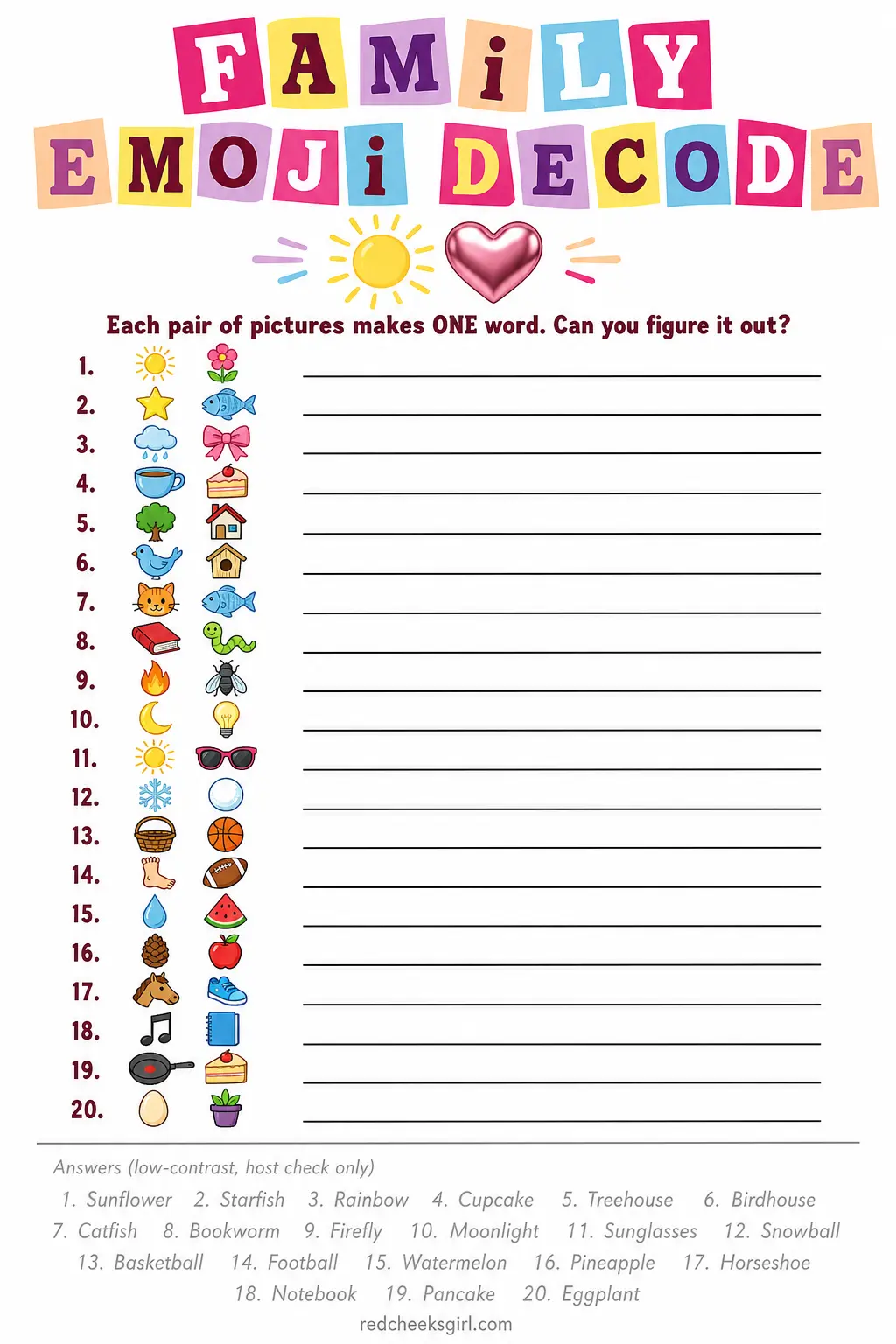
13. Family Emoji Decode
The printable sheet presents rows of emoji sequences that represent common phrases, sayings, film titles, or book titles — players write their answer beside each row and the person with the most correct answers wins.
Read through the sheet together as a group or set a ten-minute timer and work independently before comparing answers.
The sheet works as a team activity too: call out each sequence aloud and let families buzz in with their answers for a more energetic, quiz-show feel.
All you need is the printed sheet and a pen per player or team. Two to twelve players can play simultaneously and a full sheet takes ten to fifteen minutes, making it an ideal warm-up before a longer game or a quick filler between activities.
Because the sequences on the sheet decode to real, confirmed answers printed on the answer key, every round has a definitive resolution — no ambiguous interpretations, no arguments about whether something “counts.”
Host tip: For the team version, introduce a thirty-second discussion window before anyone writes an answer — this stops the fastest reader from immediately dominating and gives quieter family members a chance to contribute their interpretation, which is often the correct one.
14. Family Mad Libs
The printable sheet contains a series of short stories with key words replaced by blanks, each labelled with a word type: noun, verb, adjective, silly sound, and so on.
Without showing anyone the story, the host asks each player in turn to call out a word of the required type.
Once all blanks are filled, the host reads the completed story aloud — the results are almost always chaotic and hilarious, especially when a five-year-old’s noun ends up in a very serious sentence about a famous explorer’s journey.
The family votes on the funniest completed story and that sheet gets pinned to the fridge.
You need the printed sheet, one pen for the host, and absolutely nothing else. The game works for two to ten players and a single story takes five minutes; a full sheet of four or five stories runs twenty to twenty-five minutes.
It’s one of the most effective indoor games for family in the younger-children category because it teaches parts of speech effortlessly while everyone is laughing too hard to notice they’re learning anything.
Host tip: Before starting, go around the room and collect one silly word from each player to use as wildcards — whenever anyone is stuck, they can “spend” a wildcard from the pool. It speeds up the game and ensures the silliest words always end up in the stories one way or another.

15. Rainy Day Bingo
The printable bingo sheet replaces numbers with rainy-day-themed pictures and phrases — a mug of hot chocolate, someone reading under a blanket, a dog looking sadly at the window, the sound of rain on glass, and so on.
Each player’s sheet has the same items arranged in a different grid order. The host calls items from a shuffled list and players mark them off. First to complete a row — horizontal, vertical, or diagonal — calls “Bingo!” and wins the round.
Play multiple rounds by rotating the caller.
Print one sheet per player, provide a pen or counters (dried pasta, coins, or small buttons all work), and you’re ready.
Three to twelve players is the comfortable range and a single round takes five to ten minutes, so you can easily run four or five rounds in half an hour.
The rainy-day theme makes it feel specifically designed for exactly this moment, which children appreciate far more than a generic number grid. It also doubles as a gentle observation prompt — kids start noticing rainy-day details in their own home.
Host tip: After the first winner, don’t stop — keep calling until someone gets a full house (every square covered). Offer a small second prize for the full house so players who didn’t win the first row stay fully engaged rather than drifting away.

16. The Floor Is Lava
Announce that the floor has suddenly become lava and anyone who touches it is out. Players must move around the room using only the sofa cushions, pillows, folded blankets, or any soft objects you place as “stepping stones” on the floor beforehand.
Set a route — living room to kitchen and back, for example — and race to complete it without touching the floor. For a longer game, remove one stepping stone every thirty seconds, forcing increasingly creative leaps and balancing acts as the route becomes harder.
You need sofa cushions and pillows — nothing else. Two to eight players works well and a session lasts as long as the stepping stones hold out, usually fifteen to twenty minutes before someone inevitably touches the lava and the chaos becomes unmanageable.
It’s a full-body activity that requires no equipment and no setup beyond tossing cushions on the floor, making it one of the fastest indoor games for family to get started when energy is running high and patience is running low.
Host tip: Designate one adult as the “lava controller” who can suddenly declare that a stone is “crumbling” and must be moved — this prevents children from simply memorising a safe route and keeps every crossing genuinely unpredictable and exciting.
17. Name That Sound
One player is the sound-maker and goes into an adjacent room or behind a closed door with a collection of household objects.
They create a sound — tapping a spoon on a glass, scrunching newspaper, filling a cup with water, zipping a bag — and players in the main room write down what they think they’re hearing. After five sounds, the maker returns and reveals the answers.
Score one point for each correct guess, tally across three rounds with different sound-makers, and the most perceptive listener wins.
You need a collection of ten to fifteen household objects with interesting sounds, paper, and pens — everything already exists somewhere in your kitchen. Three to ten players works perfectly and a three-round game takes about twenty-five minutes.
It’s one of the quietest indoor games for family on this list, which makes it a genuinely useful tool when the afternoon has gone loud and you need something that brings the energy down without anyone feeling like the fun has stopped.
Host tip: Include at least one decoy sound per round — something that sounds almost identical to another object, like tapping a ceramic mug versus a glass. The argument about whether the answer was “tapping” or “clinking” will be more entertaining than the game itself.
18. Minute to Win It Challenges
Set up a sequence of sixty-second physical challenges using household objects: stack six biscuits from your elbow to your hand and catch them in your mouth, keep a feather airborne using only your breath, transfer ten cotton balls from one bowl to another using only a spoon held in your teeth, or balance a ruler on one finger for a full minute.
Each player attempts the same challenge; those who complete it in sixty seconds score a point. Run six to eight challenges and the player with the most points wins.
The materials vary by challenge but everything on the list above is already in a typical home — biscuits, a feather from a cushion, cotton balls, bowls, and a ruler.
Two to eight players is ideal and a set of six challenges runs about thirty to forty minutes. The format is endlessly scalable: add more challenges, create custom ones, or let children invent their own for the adults to attempt.
Watching a grown adult try to balance a ruler on one finger with fierce concentration is worth the entire afternoon.
Host tip: Let each player choose which three challenges they want to attempt from the full list rather than forcing everyone through every round — this lets confident players choose harder tasks while younger ones pick what they think they can do, which keeps the competition feeling fair without adjusting the rules.
19. Two Truths and a Tall Tale
Each player thinks of three statements about themselves — two are completely true and one is a convincing exaggeration or outright invention, the “tall tale.”
They read all three aloud in a deadpan voice and the rest of the group votes on which one is the tall tale. The player reveals the answer, and anyone who guessed correctly scores a point.
Go around the table twice so everyone gets two turns, and the player with the most correct guesses at the end wins. The game is funnier and more revealing than you expect, especially with family members who think they know each other well.
No materials needed — just people, a little creativity, and the willingness to tell a convincing lie to your family.
Four to twelve players is the ideal range and a full two rounds takes twenty to thirty minutes depending on how much debate each statement generates.
It works exceptionally well for mixed-age groups because children’s tall tales are gloriously transparent and adults find themselves genuinely stumped by the real things their kids have done that they didn’t know about.
Host tip: Enforce a rule that the tall tale must be plausible — no “I flew to the moon last Tuesday.” The tall tale should be something that could theoretically have happened, which makes it genuinely hard to detect and keeps everyone honest about how well they actually know each other.
20. Newspaper Fashion Show
Divide the family into pairs or small teams and give each team an equal stack of newspaper pages, plus a roll of masking tape.
Each team nominates one member as the model and has ten minutes to design and construct an outfit from newspaper and tape alone — hat, jacket, skirt, shoes, accessories, whatever they can engineer.
When time is up, hold a runway walk down the hallway with commentary provided by the non-competing family members. The audience votes on the winner using three categories: most creative, best construction, and most likely to survive an actual rainy day.
You need newspaper and masking tape — that’s it. Two to eight players works well and the build plus runway takes about twenty-five minutes.
It’s an indoor game for family that works on multiple levels: it’s competitive, creative, physical, and funny, and it produces photographs that will be looked at for years.
The ten-minute build window is short enough to maintain urgency and long enough for teams to produce something genuinely impressive if they work efficiently.
Host tip: Announce that one “bonus material” will be available five minutes in — a piece of aluminium foil, a paper plate, or a length of string — which teams can request. The scramble to decide whether to use it and how adds a mid-game decision that completely changes some teams’ designs in the most unpredictable ways.
🛍 Shopping guide
Frequently Asked Questions
What indoor games for family work best with very young children under five?
Balloon Keep-Up, The Floor Is Lava, and Sock Basketball are the most accessible for under-fives because they require no reading, no complex rules, and produce instant, visible results. Pair very young children with an older sibling or adult for games like the Indoor Scavenger Hunt and they’ll participate enthusiastically even if they need a little help reading the list.
How do I keep older teenagers engaged with family games?
Teenagers respond best when they’re given a role rather than just a seat. Make them the quizmaster for Family Trivia Rounds, the judge for the Blanket Fort Challenge, or the runway commentator for the Newspaper Fashion Show.
Two Truths and a Tall Tale and Would You Rather Family Edition also tend to land well with teenagers because the format values their opinions rather than testing knowledge they may not have.
How many of these games use printable sheets?
Nine of the twenty games feature printable sheets — Indoor Scavenger Hunt, Charades Family Edition, Family Trivia Rounds, Pictionary Family Edition, Would You Rather Family Edition, Story Dice Round, Family Emoji Decode, Family Mad Libs, and Rainy Day Bingo.
Each sheet is designed to be printed on standard A4 or letter-size paper and used immediately with no laminating or special preparation required.
Can these games be played with just two people?
Most of them adapt well to two players. Memory Tray Game, Paper Aeroplane Contest, Name That Sound, and Two Truths and a Tall Tale all work naturally as head-to-head games. For team-format games like Charades or Pictionary, two players can simply take turns being the actor or drawer while the other guesses, keeping score over ten rounds each.
Do I need to buy anything before playing these games?
The vast majority of games on this list use items you already own — socks, cushions, paper, household objects, and pens.
The only items worth having on hand are balloons for Balloon Keep-Up and a soft foam ball for Indoor Bowling if you don’t have something suitable already.
Everything else, including all the printable sheets, costs nothing beyond a few sheets of paper and a little printer ink.
📌 Save These for Later
Loved these? Pin your favorite image below so you can find this list again when you’re planning.


72 truth or dare questions for classmates, split into six rounds with free printable card decks. Saf
72 kind truth or dare questions for kids, sorted into 6 rounds for sleepovers and birthdays. Safe, s
18 clever family game night ideas for adults — competitive, a little cheeky, drink in hand. Free p
Leave a Reply