

Planning a Sweet 16 that feels genuinely cool — not like a kindergarten birthday party with candles on top — is harder than it looks.
Teens have a finely tuned detector for anything that feels forced or babyish, and the wrong game can clear a dance floor faster than a bad playlist.
The twenty sweet 16 party games in this list were chosen specifically because they are social, competitive, a little chaotic, and designed for the way teenagers actually hang out: in groups, on their feet, with their phones nearby and their opinions very much ready.
About half of the games come with printable sheets you can prep ahead of time so the night runs smoothly without you hovering. The other half need nothing more than a speaker, some open floor space, or supplies you probably already have.
Mix and match based on your crowd size and energy level, and use the host tips scattered throughout — they come from real experience running these games with real teens who would absolutely have said something if a game was not fun.
This post contains affiliate links — if you buy through them, I may earn a small commission at no extra cost to you.
Table of Contents
- Photo Challenge Checklist Sweet 16 Edition
- Music Intro Speed Round
- Sweet 16 Trivia: How Well Do You Know The Birthday Girl?
- Most Likely To Sweet 16 Edition
- Emoji Song Decode
- Would You Rather Teen Edition
- Dance Battle Bracket Sweet 16
- Speed Drawing Duel
- Guess the Throwback Photo!
- Sweet 16 Scattergories
- Karaoke Bracket Sweet 16 Showdown
- Happy Sweet 16!
- Sweet 16 Mad Libs: The Birthday Girl’s Epic Night
- Sweet 16 Superlatives Cast Your Votes
- Balloon Pop Dare Dash
- Two Truths and a Sweet 16 Lie
- Freeze Dance Showdown
- Hot Take Tower
- Compliment Popcorn
- Prediction Envelope Challenge
1. Photo Challenge Checklist Sweet 16 Edition
Print one checklist per guest and hand them out the moment people arrive.
Each sheet lists a series of specific photos to capture during the party — things like “a shot with someone wearing the same color as you,” “a candid of the birthday girl laughing,” or “a group photo with at least six people making the same face.”
Guests work individually or in pairs, hunting through the crowd to complete as many shots as possible before a set deadline, usually forty-five minutes to an hour into the party.
At the deadline, everyone submits their camera roll for review — either by showing the host or by sending favorites to a shared album.
Points go to whoever completes the most items, but you can also vote for a “best shot” in a few categories to keep things fun for people who did not finish the whole list.
This game is brilliant for the first hour because it gets guests moving, mixing, and actually talking to people they might not know yet.
Works best with ten or more guests, and the game runs itself once you hand out the sheets.
The host tip that makes this game: add two or three nearly impossible “bonus” items at the bottom of the list — like “a photo where everyone in the frame has their eyes closed” — so there is always something to chase and no one finishes too early and stops playing.

🛍 Shopping guide
2. Music Intro Speed Round
This is the game that turns a living room into a concert hall of shouting.
Print one answer sheet per player or team, then queue up a playlist of song intros — just the first three to five seconds of each track, covering pop, throwbacks, and whatever the birthday girl loves.
Play the clip, and guests race to write down the song title and artist before you move on.
First team to call it out correctly scores the point if you are playing verbally, or you tally written answers between rounds if you want it slightly calmer.
You will need a speaker, a prepared playlist (streaming services make this easy — just pause after a few seconds), and the printed answer sheets. Groups of eight to twenty-five work perfectly, and a full round of twenty songs takes about fifteen to twenty minutes.
Keep the energy high by moving quickly between clips — the fast pace is exactly what makes it exciting.
The one host tip that changes everything: include at least four or five songs that are deeply personal to the birthday girl — her all-time favorite, the song from a specific trip or memory, the track she played on repeat for a month in seventh grade.
Her reaction when a close friend gets it immediately is a genuinely sweet moment, and it makes the game feel like it was made for her, because it was.

🛍 Shopping guide
3. Sweet 16 Trivia: How Well Do You Know The Birthday Girl?
Before the party, the host sits down with the birthday girl and fills in a trivia answer key — her favorite movie, the city she wants to visit most, her most embarrassing moment, her go-to late-night snack, the first song she ever memorized, and anything else that reveals who she actually is.
Print an answer sheet for every guest with the questions but not the answers, and run it as a quiz during a natural pause in the party, like right after food.
Read each question aloud, give everyone fifteen seconds to write their answer, then reveal the real answer and watch the chaos unfold. Guests score a point for each correct answer, and the person who knows her best wins.
The birthday girl gets to be the expert on herself for once, and the wrong answers are usually funnier than the right ones — especially when someone is absolutely convinced they know her better than they do.
Plan for twenty to twenty-five questions to fill about fifteen minutes of play. The host tip here is to include at least two questions that no one outside her very closest circle would know — it rewards her real best friends and creates a little moment of recognition that feels meaningful without being sentimental to the point of awkwardness.

4. Most Likely To Sweet 16 Edition
Print a sheet with twenty-five to thirty “Most Likely To” statements tailored to the group — “Most Likely To become famous,” “Most Likely To text back three days late,” “Most Likely To trip walking into prom,” and so on.
Guests read each statement and write down the name of whoever in the room fits best. At the end, tally the votes and announce the results one by one, giving each “winner” a moment of glory or gentle roasting.
This game needs nothing beyond the printed sheets and pens, works with any group of eight or more, and takes about twenty minutes from start to announcement.
Keep the statements funny rather than mean-spirited — the goal is the kind of roasting that makes people laugh and feel seen, not embarrassed.
Customize at least a third of the statements specifically to inside jokes or things you know about this particular friend group for maximum impact.
The host tip: read the results dramatically, give the birthday girl her own dedicated category at the end (“And the person most likely to have the best Sweet 16 ever is…”), and let guests cheer for each result. Teens love a little ceremony, and this format delivers it without feeling forced.

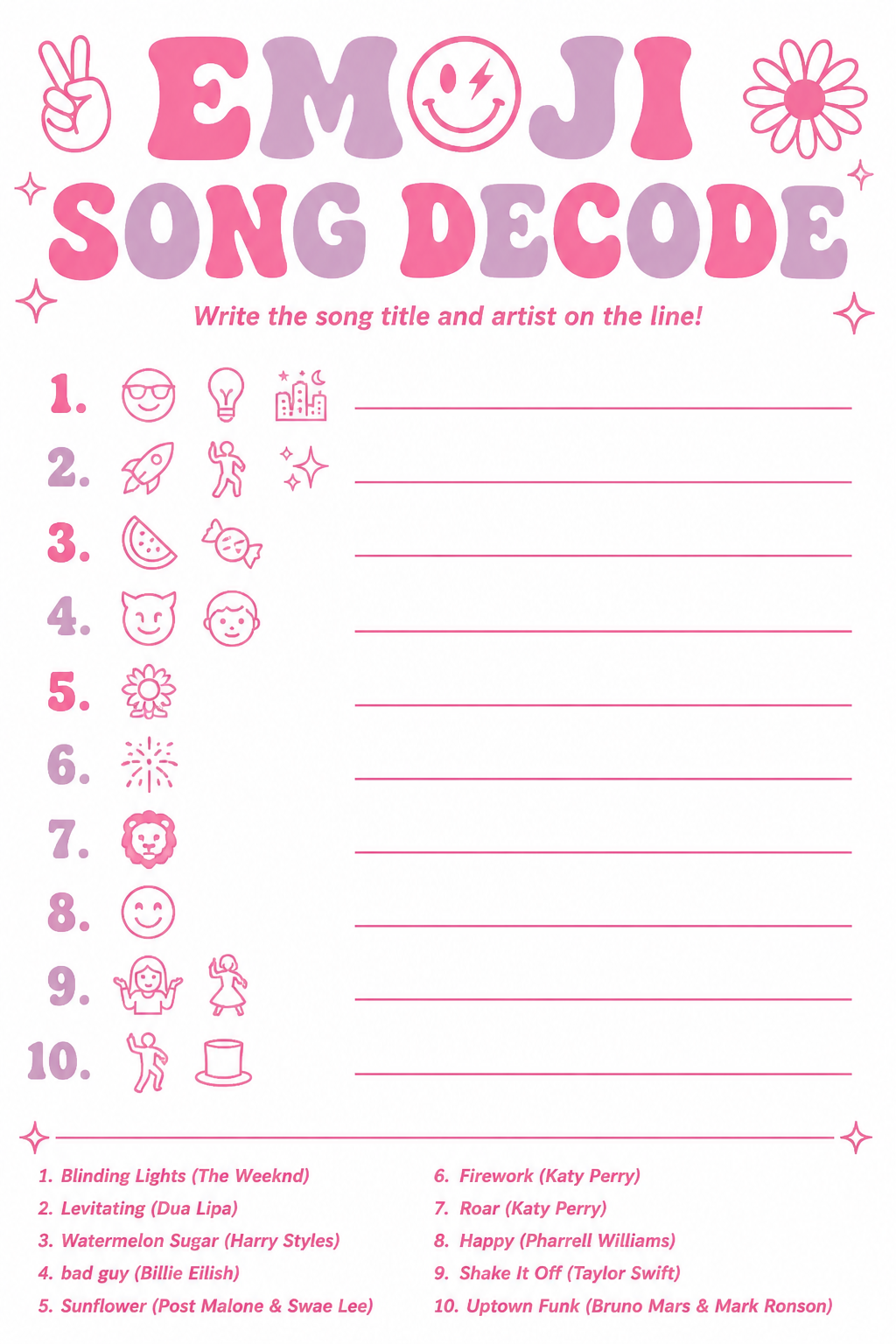
5. Emoji Song Decode
Print one sheet per guest featuring rows of emoji sequences, each representing a well-known song title or lyric.
Players study each sequence and write down the song they think it represents — for example, a string of emojis suggesting themes of rain, umbrellas, and dancing might point to a classic pop hit with those images in the lyrics.
The player who decodes the most songs correctly before time runs out wins the round.
This game works well as a quiet, seated activity during a meal break or between more energetic rounds.
It needs only the printed sheets and pens, suits any group size from six to thirty, and a round of fifteen sequences takes about ten to twelve minutes.
Keep a printed answer key handy so you can reveal and explain the logic behind each one — half the fun is the “oh, obviously!” moment when a tricky one finally makes sense.
The host tip: build the sheet around songs the birthday girl actually loves rather than just chart toppers. Guests who know her music taste will have a real advantage, which makes the game feel personal, and the ones who get stumped will want to ask her what they missed — which is a natural, fun conversation starter.
6. Would You Rather Teen Edition
Print a sheet of “Would You Rather” dilemmas designed specifically for a teen audience — real choices with no obvious right answer, like “Would you rather have every teacher forget your name or have your parents remember every embarrassing story forever?”
Players mark their answer on the sheet privately, then the host reads each question aloud and everyone reveals their choice at the same time. The debate that follows is the actual game.
You do not need to keep score unless you want to — the magic is in the discussion. Someone will have a strong opinion about every single question, and you will learn a surprising amount about people by which way they land.
Works with six to thirty guests and you can run as many or as few questions as the energy supports, usually fifteen to twenty questions takes about twenty minutes.
Host tip: stack the most divisive questions in the middle of the sheet rather than saving them for last.
Energy tends to dip toward the end of a seated activity with teens, so hitting the most controversial choice while everyone is still fully engaged gets you the loudest, most memorable reactions. Save one gentle, birthday-girl-specific question for last as a sweet closer.

7. Dance Battle Bracket Sweet 16
Set up a single-elimination bracket before the party — print it out and hang it somewhere visible, or project it on a TV screen. Guests sign up individually or in pairs, and the tournament runs on the dance floor in head-to-head rounds.
Each competitor or duo has thirty to sixty seconds to show what they have got while a designated song plays.
A panel of three judges — ideally the birthday girl plus two guests — scores each round on creativity, energy, and crowd reaction, and the winner advances.
You need a good speaker, a prepared playlist of banger-level tracks, and the printed bracket sheet. The format works beautifully with twelve to twenty-four players and the full tournament, depending on bracket size, runs forty-five minutes to an hour with breaks built in.
Guests who are eliminated become the loudest audience members, which keeps the energy in the room high all the way to the final.
The single most important host tip for this game: seed the bracket so that the two or three most naturally confident dancers are on opposite sides. If they meet too early, the rest of the bracket feels anticlimactic. Save the best matchup for the final, and the whole room will be invested by the time it happens.

🛍 Shopping guide
8. Speed Drawing Duel
Pair guests up head-to-head and give each pair the same prompt — “draw a celebrity in ten seconds,” “draw the birthday girl’s face from memory,” “draw a smartphone with no hands.”
Both players draw simultaneously on their own paper or mini whiteboard, and when time is called, the group votes on which drawing better captures the prompt. Winners move on, losers become judges, and the tournament continues until one person is crowned the speed-drawing champion.
You need paper or small whiteboards, markers or pens, and the printed prompt list to keep things moving fast. Works well with eight to twenty-four players, and a full tournament of sixteen takes about thirty to thirty-five minutes. The prompts are everything — make them specific enough to be funny when they go wrong, which they almost always will.
Host tip: include at least three prompts that require drawing something about the party itself or the birthday girl specifically — her outfit, her signature pose, the cake.
Those rounds always get the most crowd reaction because everyone has a shared reference point, and the birthday girl’s face when she sees how guests picture her is usually the highlight of the whole game.

🛍 Shopping guide
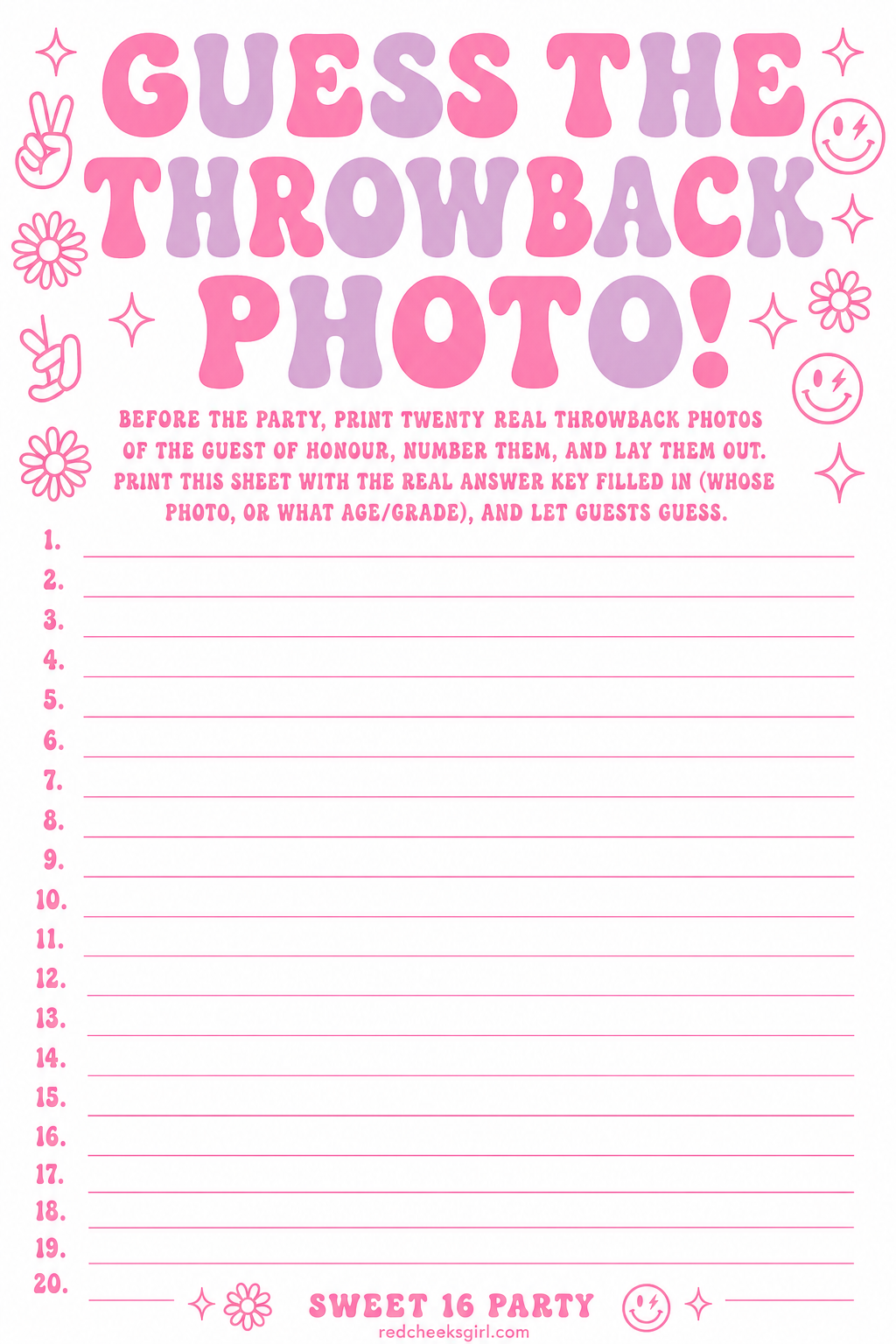
9. Guess the Throwback Photo!
Before the party, collect baby and childhood photos of every guest — send a group message or ask parents quietly in the weeks before. Print them out or display them on a slideshow, numbered but without names.
Each guest receives an answer sheet and tries to match every photo to the right person in the room. The person who correctly identifies the most classmates from their tiny, unrecognizable childhood selves wins.
The game needs the printed photos or a display screen, answer sheets, and a little preparation time in advance — but that prep pays off enormously on the night.
Works with any group of eight to thirty, and twenty photos takes about fifteen to twenty minutes to complete before the big reveal. The reveal itself, where you show who each photo actually is, is genuinely funny every single time.
The best host tip for this one: always include a photo of the birthday girl that no one has seen before — something her parents provided and she does not know is in the mix.
Her reaction when her own photo comes up is a guaranteed crowd moment, and it makes the game feel like it was planned with real love rather than just downloaded from a party ideas list.
10. Sweet 16 Scattergories
Print one answer sheet per player featuring a grid of Sweet 16 party categories — things like “a song you would play at a party,” “something you would find in a birthday girl’s bag,” “a place teens like to hang out,” and “a word that describes tonight.”
Before each round, draw or spin a random letter, start a sixty-second timer, and players race to fill every category with an answer that starts with that letter.
At the end of the round, players share their answers, and any answer that no one else wrote scores a point.
The beauty of Scattergories is that originality is rewarded over correctness — the goal is to think of answers that are both valid and unique. Print enough sheets for everyone, have pens ready, and pick someone to manage the timer.
Works with four to thirty guests, and three rounds takes about twenty-five minutes. Debates over whether an answer counts are completely expected and absolutely part of the game.
Host tip: make one category on the sheet something hyper-specific to the birthday girl, like “something [her name] says all the time” or “a place [her name] loves.”
It slows the round down in the best way because everyone has to actually think about her specifically, and it turns a standard game into something that belongs at this party and nowhere else.

11. Karaoke Bracket Sweet 16 Showdown
Run karaoke as a proper tournament rather than a casual sing-along and watch it become one of the best events of the night.
Set up the bracket in advance — print it, hang it, and let guests sign up before the party starts so no one is put on the spot.
Each performer gets one song, sixty to ninety seconds of it, judged by the birthday girl and two rotating panel members on stage presence, enthusiasm, and crowd connection. Accuracy of pitch is officially not a criterion, which instantly makes nervous singers willing to participate.
You need a karaoke app or a lyrics video playlist, a microphone (even a basic one makes a huge difference), a speaker, and the printed bracket.
Works best with eight to twenty guests for a manageable tournament length, and a sixteen-person bracket takes about an hour with natural breaks between rounds. The semi-finals and final should be your loudest moments — let the crowd get rowdy.
The host tip that separates a great karaoke bracket from a mediocre one: let the birthday girl perform outside the bracket as a special guest act between the semi-finals and the final.
She gets a moment that is entirely hers, the crowd is already hyped from the semi-finals, and it gives the final something to follow rather than it being an awkward comedown after the birthday girl’s set.

🛍 Shopping guide
12. Happy Sweet 16!
This is the birthday wishes wall — set it up as an interactive station where every guest receives a large, beautifully printed card and a marker, and writes a personal message, memory, or wish for the birthday girl before the night is over.
The cards are designed to look great on a wall or bulletin board when displayed together, turning the collection into both a game-adjacent activity and a keepsake the birthday girl takes home at the end of the night.
Position the station near the entrance or the snack table so guests encounter it naturally rather than needing to be directed.
Have a few conversation-starter prompts printed nearby — “Write a memory you share,” “Give her one piece of advice for the next year,” “Predict where she will be at age twenty-six” — to help guests who freeze up when faced with a blank card.
Groups of any size work, and the station stays open the entire party rather than running on a timer.
The host tip: assign one person — a sibling or a close friend who is not shy — to gently remind guests to visit the station during the first half of the party.
People always mean to do it and then forget until they are leaving with their coat on.
Getting most of the cards filled in before the final hour means the birthday girl can actually read some of them while people are still there to celebrate the sweet ones together.

13. Sweet 16 Mad Libs: The Birthday Girl’s Epic Night
Mad Libs for a Sweet 16 works differently from the childhood version — instead of random, disconnected silliness, the story is a full narrative account of the birthday girl’s “epic night,” written in advance by the host with blanks for specific parts of speech dropped into the most pivotal moments.
Guests fill in the blanks without seeing the story, calling out adjectives, nouns, verbs, and names, and then the host reads the completed story aloud from start to finish.
Print one fill-in sheet per group of four to six, or run it as a whole-room activity where everyone shouts answers and one person records them on a master sheet.
The story should reference real things — the birthday girl’s school, her friend group, her goals — so that the absurd combinations land with full context.
A well-written Mad Libs story for this format takes three to four minutes to read aloud and generates laughs throughout.
Host tip: write the story in advance so the narrative arc actually goes somewhere satisfying — the birthday girl “arrives at her party in a [adjective] [noun], greeted by her best friend [name] who was wearing nothing but a [noun] and seventeen [plural noun].”
The funnier the context around the blank, the funnier the fill-in, so spend time on the setup sentences rather than just dropping blanks randomly into boring sentences.

14. Sweet 16 Superlatives Cast Your Votes
Think yearbook superlatives but live, in the room, with everyone present to see the results announced in real time.
Print a ballot sheet with fifteen to twenty categories — “Best Dancer,” “Most Likely to Be Famous,” “The One Who Always Has a Snack,” “Best Dressed Tonight,” “Most Dramatic (Affectionately)” — and let guests vote by filling in the name of whoever they think fits each one.
Collect the ballots, tally quickly, and announce winners one by one with a little fanfare.
The game needs printed ballots, pens, and a few minutes of tallying time — enlist a helper to count while the party continues so there is no awkward dead pause.
Works with ten or more guests and the announcement segment takes ten to fifteen minutes depending on how much you ham up each reveal. Give each winner a small prize, a ribbon, or just a dramatic round of applause to make the moment feel real.
Host tip: create one superlative category that only applies to the birthday girl, announced as the final award — something like “Most Epic Person to Celebrate Tonight” or a category named specifically after something she is known for.
Saving her for last means the whole announcement segment builds to a moment that is entirely about her, which is exactly right for a Sweet 16.

15. Balloon Pop Dare Dash
Before the party, write individual party dares or challenges on small slips of paper — nothing mean or embarrassing, just fun physical challenges like “do your best runway walk across the room,” “give the birthday girl your most dramatic movie monologue,” or “teach someone a dance move right now.”
Fold each slip, stuff it inside a balloon, and inflate the balloons so they are scattered around the party space or piled in a corner.
When the game begins, each player grabs a balloon and pops it however they want — sitting on it, stomping it, clapping it between their hands — then reads their dare aloud and completes it in front of the group.
The crowd reacts, the host can award points for best performance, and the game continues until all balloons are popped or the group decides to stop. Works with eight to thirty guests and a round of twenty balloons takes about twenty-five minutes.
Host tip: make sure every dare is something the most shy person in the room could still do without dying of embarrassment. The energy of the game comes from the performance, not from making anyone uncomfortable.
Write the dares with your actual guest list in mind, not a generic one — if you know your crowd, you know exactly what will make them laugh versus what will make someone want to disappear.
🛍 Shopping guide
16. Two Truths and a Sweet 16 Lie
A teenage spin on the classic icebreaker, restructured for a party setting.
Every guest writes down three statements about themselves — two true and one false — but all three must be about things that could plausibly happen at or relate to a Sweet 16 party context: a party memory, a bold fashion choice, a song they know every word to, something they have done at a birthday party before.
The Sweet 16 constraint makes the lies harder to spot because everyone is working in the same subject area.
Players take turns reading their three statements while the rest of the group votes on which one is the lie, using a show of hands or written votes.
The reader reveals the truth, explains the real story behind the true ones, and the person who stumped the most people at the end of the game wins. Works with six to twenty-five guests, and fifteen minutes covers most groups comfortably.
Host tip: play a practice round using statements about the birthday girl before opening it up to everyone. It warms the group up, gives her a spotlight moment right at the start, and models exactly how the game should be played so even shy guests immediately understand the format and feel ready to join in.
17. Freeze Dance Showdown
This is freeze dance but played at a level that actually engages teenagers — the DJ (which can be a guest with a good playlist and a speaker) controls the music and can stop it at any moment, including after just two or three seconds of playing.
Anyone caught still moving when the music stops is out, and the last person standing wins.
The trick is that a good DJ is unpredictable, restarting the music immediately after a pause to catch people relaxing, or letting a long stretch play out to build false confidence.
All you need is a speaker, a great playlist, and enough open floor space for the whole group to dance comfortably. Works with eight to forty guests and a round runs about fifteen to twenty minutes depending on how quickly people get eliminated.
Keep eliminated players as hype people on the sidelines rather than sending them to sit quietly — their job is to try to make the remaining dancers laugh and break their freeze, which adds a whole layer of strategy.
Host tip: let the birthday girl be the DJ for at least one round.
She knows the room, she knows who is going to crack under pressure, and giving her the control of the music for a few minutes is a natural, fun way to put her at the center of the action without making it feel like a formal “birthday girl moment.”
18. Hot Take Tower
Write controversial-but-harmless teen opinions on individual cards — “Texting is better than calling,” “Pineapple belongs on pizza,” “Staying in is better than going out,” “Morning people are wrong about everything” — and stack them face-down in a pile in the center of the table.
Players take turns drawing a card, reading the hot take aloud, and then defending that position for thirty seconds whether they agree with it or not. After the defense, the group votes thumbs up or down on whether the argument was convincing.
You need the prepared cards (cardstock works well), a timer, and a group of six to twenty guests who are not afraid to talk.
The game runs about twenty-five to thirty minutes for a full stack of twenty cards, and it can go longer if the group is into it.
The debates are the entertainment — some people are unexpectedly brilliant at arguing positions they hate, and that discovery is genuinely fun to watch.
Host tip: include three or four cards that are hot takes specifically about the birthday girl’s known opinions — things her friends know she feels strongly about.
When someone has to argue the opposite of her actual position with her sitting right there making faces, the room absolutely loses it. Clear those specific cards with her in advance so she is in on the joke rather than blindsided.
🛍 Shopping guide
19. Compliment Popcorn
Guests sit in a circle and the birthday girl starts by pointing to someone across the circle.
That person stands up and gives her a genuine, specific compliment — not “you are nice” but something real, like recalling a specific moment when she did something kind or funny or brave.
After delivering the compliment, that person points to someone else across the circle, who then gives a compliment to the birthday girl as well. It continues popcorn-style, fast and unpredictable, until everyone in the circle has had a turn.
No materials needed beyond the people in the room and enough seating for everyone to form a rough circle. Works with eight to twenty-five guests and the full round takes ten to fifteen minutes.
This game is best placed near the end of the night, when the group has warmed up and guests actually know each other well enough to say something meaningful rather than something generic.
Host tip: prime two or three of the birthday girl’s closest friends before the game starts and ask them to prepare something specific and heartfelt rather than winging it.
When the first two or three compliments are genuinely touching, the rest of the group rises to match that energy instead of defaulting to surface-level comments.
The birthday girl will remember this part of the night long after she has forgotten who won the dance battle.
20. Prediction Envelope Challenge
At the start of the party, every guest receives a small card and is asked to write down three predictions for the night — “who will be the last person still dancing,” “which song will get the biggest reaction,” “who will eat the most cake.”
Cards are sealed in labeled envelopes and held by the host. At the end of the night, just before guests leave, the envelopes are opened and read aloud, and whoever got the most predictions right wins a small prize or bragging rights.
You need small cards, envelopes, pens, and a host who remembers to collect them at the start before people forget.
Works with any group size and the opening at the end of the night takes about ten minutes — it is a natural, low-effort way to close out the party with a callback to how it started.
The predictions also create a nice bookend feeling to the evening, which teens often respond to more than adults expect.
Host tip: after revealing the winners, keep all the cards and include them with the birthday girl’s keepsakes from the night alongside the wish wall cards and any photos.
Years later, a sealed envelope with her friends’ predictions from her Sweet 16 is exactly the kind of thing that becomes genuinely meaningful — and it costs nothing to make sure it is saved.
Frequently Asked Questions
How many games should I actually plan for a Sweet 16 party?
Aim for four to six games across a three-to-four-hour party, not all twenty at once. Pick a mix of active and seated games so the energy has natural peaks and valleys.
Have two or three backup options ready in case a game wraps up faster than expected or the group is not feeling it — but do not force every game on the list just because it is there.
Teens can tell when a schedule feels overstuffed, and leaving a little room for genuine hangout time is always the right call.
What if some guests refuse to participate in certain games?
Build in roles for people who do not want to be in the middle — every game in this list has a natural judge, DJ, scorekeeper, or hype crowd role that keeps reluctant participants involved without putting them on the spot.
Never force anyone onto a dance floor or in front of a microphone.
The games that work best for mixed-comfort groups are the ones where participation looks different for different people, and the best host tip is simply to read the room and skip anything that would clearly make someone miserable.
Do I need to print all the printable game sheets professionally?
No — a standard home printer on regular paper works fine for most of these sheets. If you want them to feel more special, printing on cardstock rather than copy paper makes them sturdier and easier to write on.
For anything going on a wall or displayed during the party, a quick trip to a print shop for color printing is worth the small cost, but it is absolutely not required. The game is what matters, not the paper it is printed on.
When is the best time during a Sweet 16 to run the games?
Start with the Photo Challenge Checklist right as guests arrive — it gives early arrivals something to do and gets the whole crowd interacting before everyone is there.
Run higher-energy games like the Dance Battle Bracket and Karaoke Showdown in the middle of the party when everyone is warmed up and the room is at peak energy.
Save quieter, more sentimental activities like Compliment Popcorn and the Prediction Envelope reveal for the end of the night, when the mood naturally softens and guests are ready for something a little more meaningful before they head home.
📌 Save These for Later
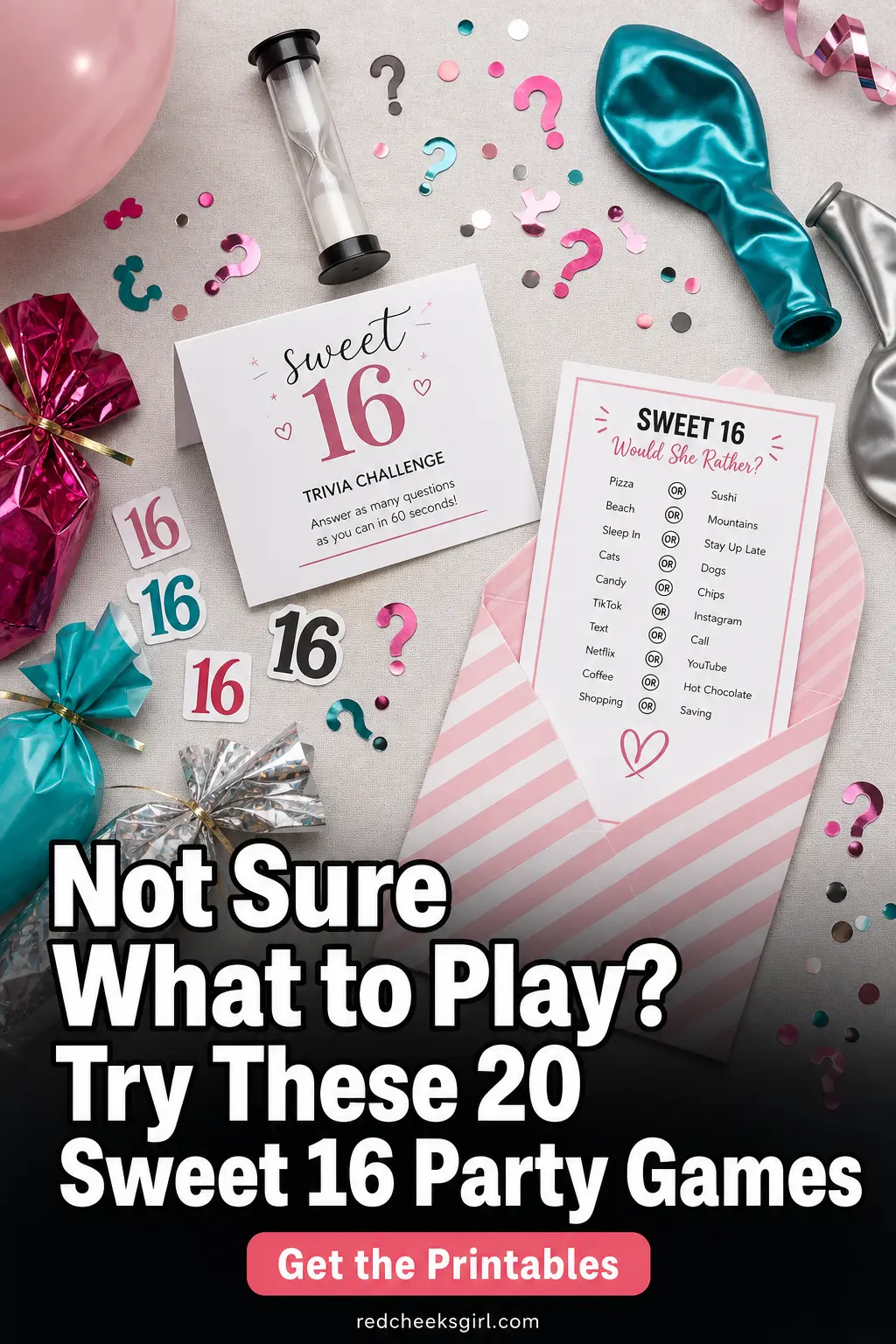
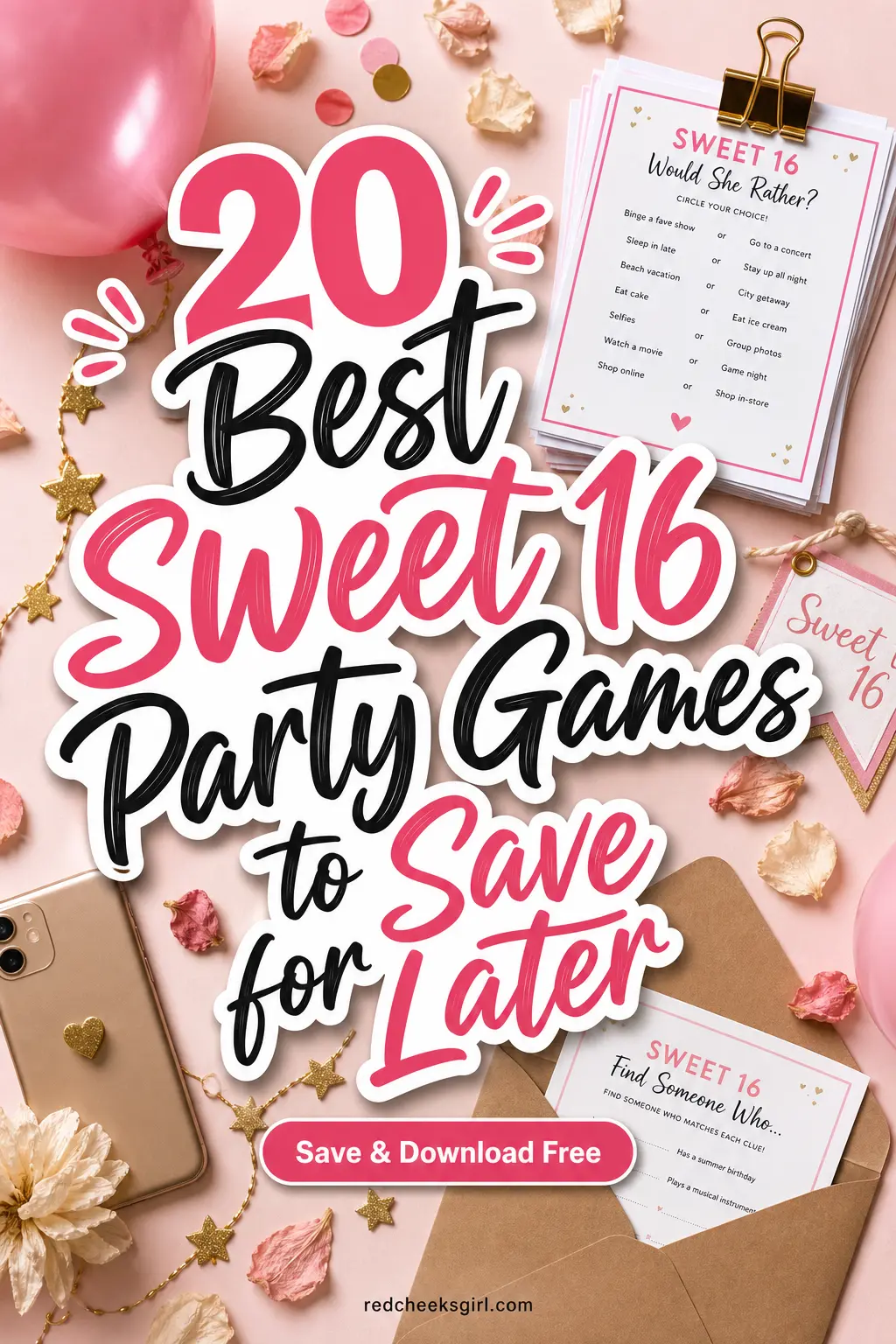
Loved these? Pin your favorite image below so you can find this list again when you’re planning.

20 birthday party themes for adults built for adult tastes from the start: speakeasy nights, supper
36 cherry birthday party theme ideas for backdrops, balloons, centerpieces, tables and favors, style
Skip the trinket bag. These 12 first birthday party favors are chosen because guests actually use th
Leave a Reply