


Easter has a way of sneaking up on you — one minute you’re buying chocolate eggs for the kids’ baskets, the next you’re standing around a brunch table wondering what everyone is actually going to do for the next three hours.
The truth is, adults deserve just as much structured fun as the little ones hunting eggs in the backyard, and a well-chosen lineup of games can turn a pleasant gathering into one of those afternoons people talk about for years.
Whether your crowd leans competitive, creative, or just in it for the laughs, the right game makes the difference between a nice brunch and an unforgettable one.
This list covers all eighteen games you need to fill your Easter celebration from mimosas to dessert — including trivia rounds, blind taste tests, relay races, and a handful of clever printables you can prep the night before.
Each one is designed for adults who want real entertainment, not a watered-down version of the children’s party next door. Grab your printed sheets, your jelly beans, and your most competitive friends, and let’s get into it.
This post contains affiliate links — if you buy through them, I may earn a small commission at no extra cost to you.
Table of Contents
- Easter Trivia Rounds
- Guess the Chocolate Blindfolded
- Easter Would You Rather
- Egg Decorating Contest Ballot
- Spring Scattergories
- Adult Egg Hunt With Clues
- Easter Charades
- Guess How Many Jelly Beans!
- Name That Spring Song
- Brunch Table Topics
- Egg and Spoon Relay
- Easter Bingo
- Easter Emoji Decode
- Easter Mad Libs
- Easter I Spy Around the Table
- Spring Quote Fill-In-The-Blank
- Two Truths and an Easter Lie
- Spring Trivia Tower
1. Easter Trivia Rounds
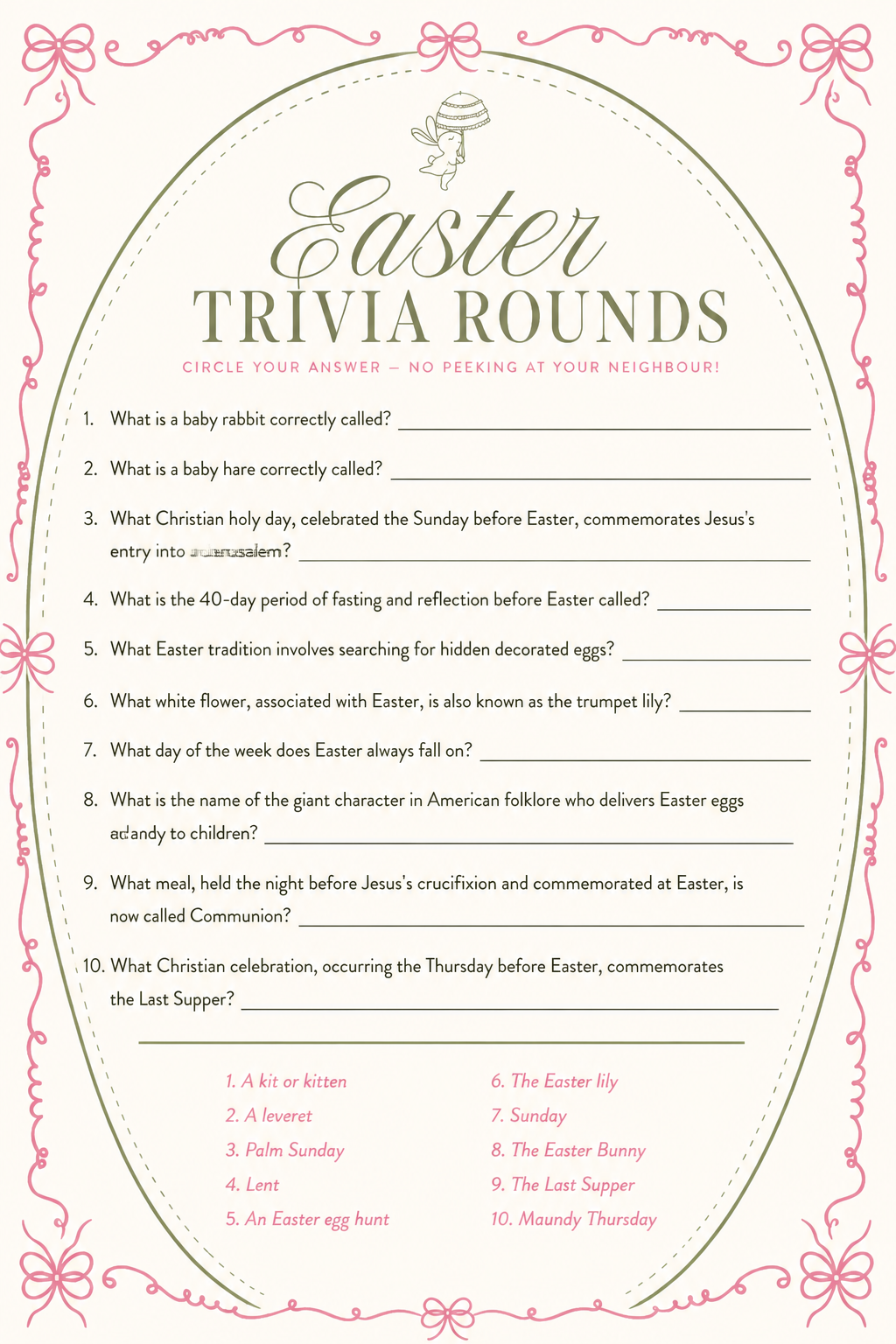
Print one answer sheet per player, then divide your group into teams of two to four. The host reads questions aloud in rounds — typically covering Easter history and traditions, spring nature facts, food and candy knowledge, and a pop culture wildcard round.
Teams huddle briefly, write their best answers, and swap sheets with another team for scoring after each round. A running leaderboard on a whiteboard or large notepad keeps the energy high and gives slower teams a clear target to chase.
What makes this format work for adults is the round structure: it naturally builds tension toward the final round, and mixing an easy category with a genuinely hard one keeps both trivia nerds and casual players engaged.
Aim for eight to ten questions per round and four rounds total, which puts total play time at about forty-five minutes including scoring pauses. You’ll need the printed answer sheets, pens, and a scorekeeper who enjoys a little drama.
Host tip: write two or three bonus tiebreaker questions on a separate slip and keep them in your pocket. Close scores almost always end in a tie, and pulling out a crisp tiebreaker question feels impressively premeditated — even if you scribbled it that morning.
🛍 Shopping guide
2. Guess the Chocolate Blindfolded
Set up a tasting station with eight to twelve unwrapped chocolate pieces — mix milk chocolate, dark chocolate, white chocolate, chocolate with fillings, and a few Easter-specific shapes like hollow eggs or cream-filled varieties.
Each taster is blindfolded in turn, handed a piece, and given thirty seconds to taste, chew, and write their guess on a numbered slip.
The player who correctly identifies the most varieties wins, though the real entertainment comes from watching confident chocolate lovers completely miss a straightforward milk chocolate bar.
This game works brilliantly as a rotating station during pre-brunch mingling, so you don’t need the whole group seated at once. Four to twelve players is ideal; with a larger group, run two simultaneous stations. Allow about twenty-five minutes from first taster to final scoring.
You’ll need a blindfold, a numbered tasting plate or board, small slips for answers, and enough chocolate that nobody feels shortchanged after the game ends — which means buying more than you think you need.
Host tip: keep a small card listing all the chocolates in order for your own reference, and shuffle the order for each new taster. Players who watch earlier rounds quickly learn the sequence if you don’t, turning a taste test into a memory game by accident.
🛍 Shopping guide
3. Easter Would You Rather
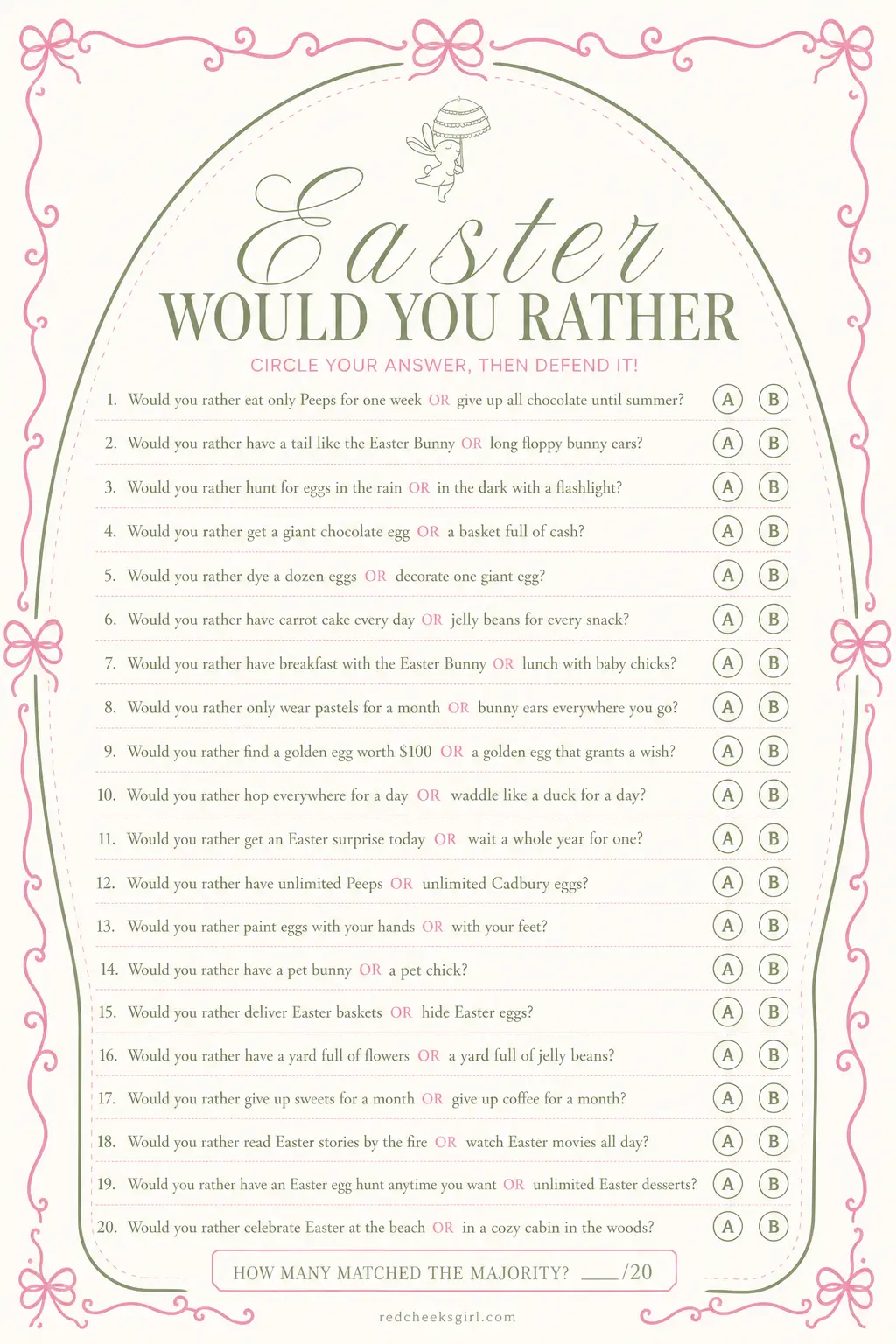
Print one card or sheet per player — each sheet contains a series of Easter and spring-themed “would you rather” dilemmas ranging from the silly to the surprisingly philosophical.
Players read each prompt silently, circle their answer, then the host reveals the choices one by one and asks players to defend their picks.
The defending is the entire point: nobody cares whether you’d rather eat only marshmallow chicks or only jelly beans for a week, but everyone has a strong opinion and three reasons why their choice is obviously correct.
This is a perfect opener or gap-filler because it requires zero competitive pressure and works for groups of four to twenty. No winners, no losers — just conversation starters with a spring theme.
Budget about twenty minutes for a full sheet of twelve prompts, though groups that love to debate will happily stretch it to forty. All you need are the printed sheets and pens to mark answers before the discussion.
Host tip: seed the sheet with one or two genuinely divisive questions near the middle, not at the start. Once the group has warmed up through a few lighthearted ones, a real debate lands much harder and the energy in the room spikes noticeably.
4. Egg Decorating Contest Ballot
Before the gathering, invite guests to decorate a hard-boiled or blown egg at home and bring it to display on a communal table.
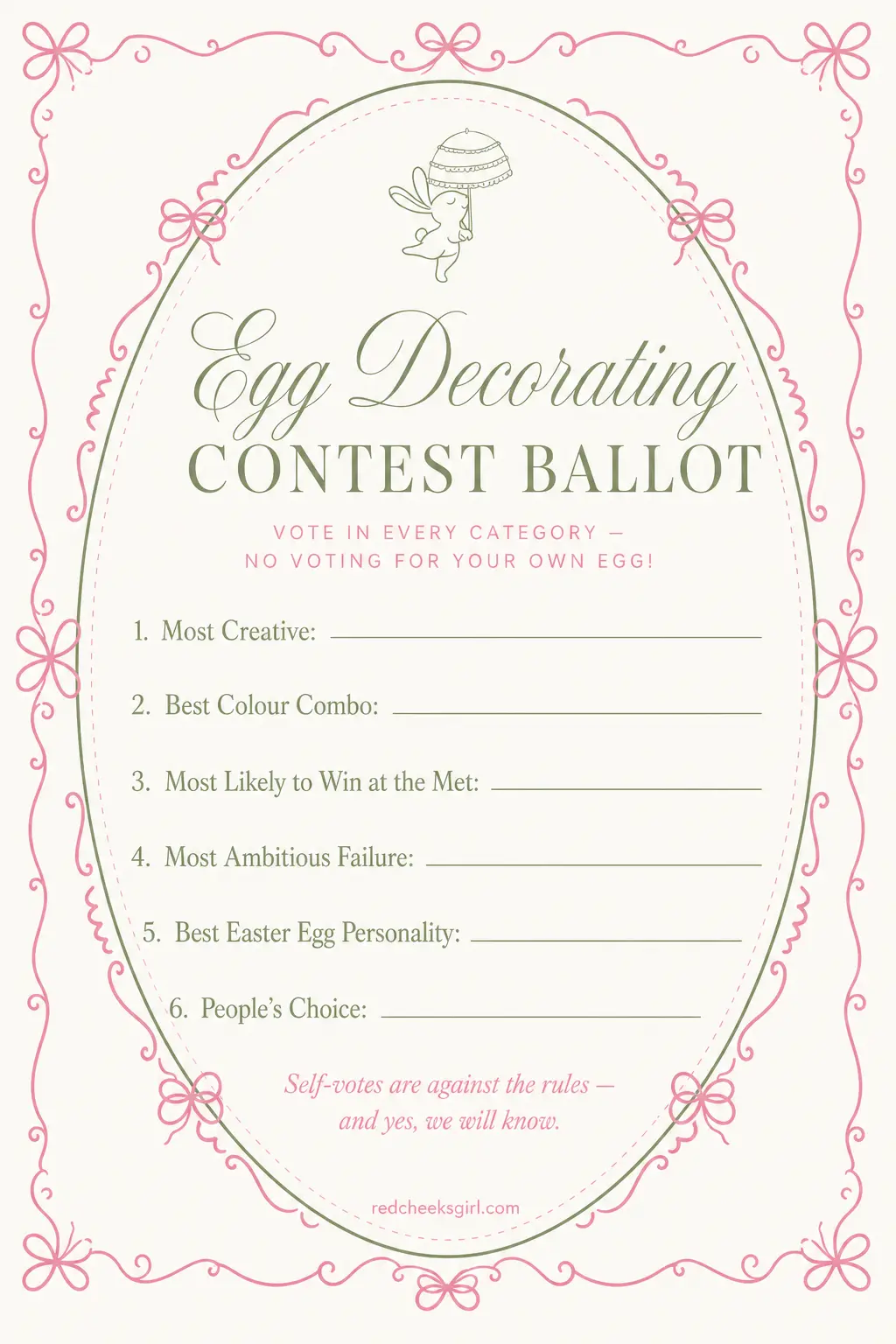
During brunch, guests circulate, admire the entries, and then receive a printed ballot with categories like Most Creative, Most Technically Impressive, Best Easter Theme, and the all-important Most Likely to Win a Real Competition.
Each person votes privately, ballots are collected, and the host tallies results and announces winners with as much ceremony as possible.
The ballot format removes the awkward public hand-raise vote and lets people be honest — your best friend’s egg will not get a sympathy win just because she’s standing right there.
Works for any group size from six to thirty, and the egg display itself doubles as table décor throughout the event. The only supplies beyond the printed ballot are pens and whatever prizes or ribbons you want to award.
Plan fifteen minutes for voting and five for the announcement.
Host tip: add a write-in category called “Egg I Would Most Like to Eat” — it gets big laughs and guarantees the person who brought a simple but beautifully dyed egg gets at least one category to compete in against the elaborate sculpted masterpieces.
🛍 Shopping guide
5. Spring Scattergories
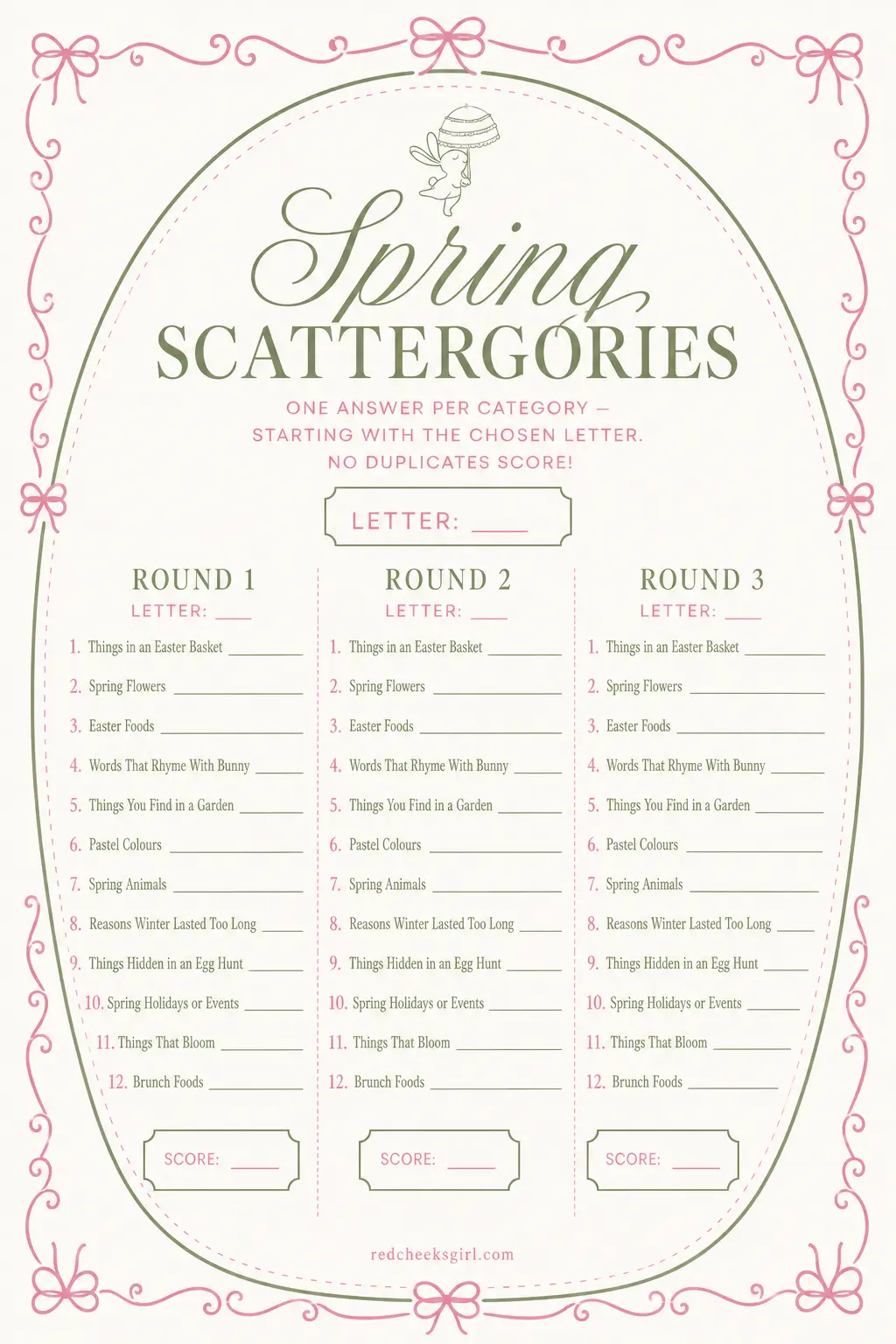
Each player receives a printed sheet with a grid of spring and Easter-themed categories down the left side — things like “something you find in a garden,” “a word that sounds like spring,” or “a candy you’d find in an Easter basket.”
A letter die is rolled and a timer is set for ninety seconds. Every player independently fills in one answer per category that starts with the rolled letter.
When time is up, answers are read aloud: any answer no one else wrote earns a point, duplicates score zero. Play three to five rounds with a new letter each time.
The adult version of this game gets interesting because categories can be slightly more sophisticated — “a reason to call in sick the Monday after Easter” or “something your grandmother brings that you didn’t ask for” add personality without being mean-spirited.
Groups of four to ten work best; larger groups can split into two competing tables. Rounds move quickly, so budget about thirty minutes for five letters.
You’ll need the printed category sheets, pens, and either a letter die or a simple app to generate random letters.
Host tip: declare that proper nouns are allowed, but only if you can explain the connection to the category in one sentence. This rule prevents arguments and accidentally produces the funniest moments of the game when someone stretches a connection to its absolute limit.
🛍 Shopping guide
6. Adult Egg Hunt With Clues
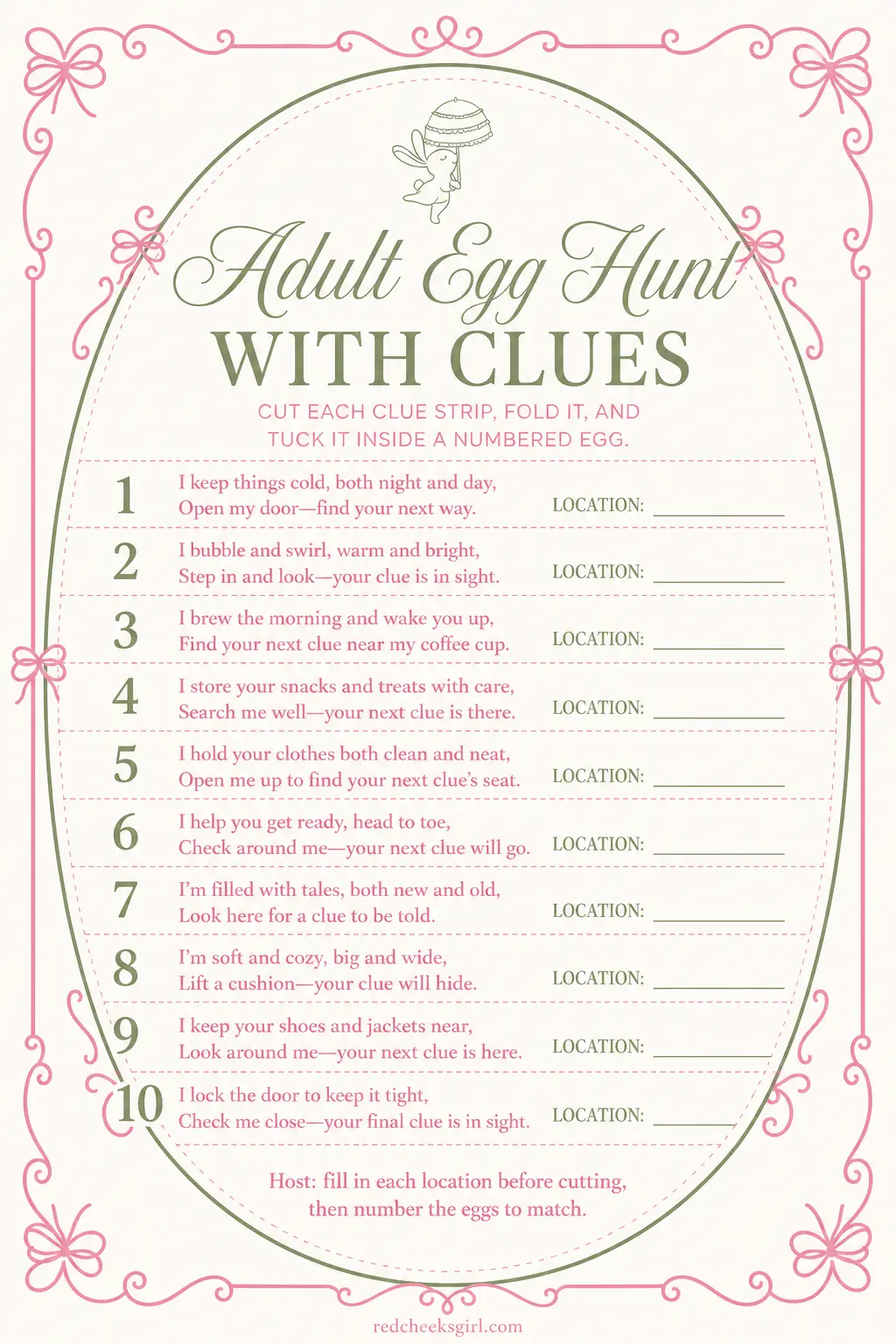
Hide plastic eggs around your space — indoors, outdoors, or both — but instead of a straightforward find-and-grab hunt, each egg contains a clue that points to the next egg’s location.
Think of it as a relay hunt: the first egg is handed to the group, and the clue inside sends them to the next one, and so on through a chain of eight to twelve eggs.
The final egg contains a group prize, a bottle of wine, or a comically anticlimactic reward that is funny precisely because of how hard everyone worked for it.
The printed clue sheets give you a template to write location clues in the style of riddles, rhymes, or complete non sequiturs — which works surprisingly well for adults who enjoy lateral thinking.
This format works for groups of six to twenty people and takes about twenty to thirty minutes depending on how devious your hiding spots are. You’ll need plastic eggs, printed clue cards cut to fit inside them, and a prize for the final egg.
Host tip: place one deliberately obvious decoy egg — bright, large, sitting in plain sight — that contains a note reading “Nice try. Keep looking.” Adults who breeze past the real hiding spots often grab this one first, and the crowd reaction is worth every second of the setup.
🛍 Shopping guide
7. Easter Charades
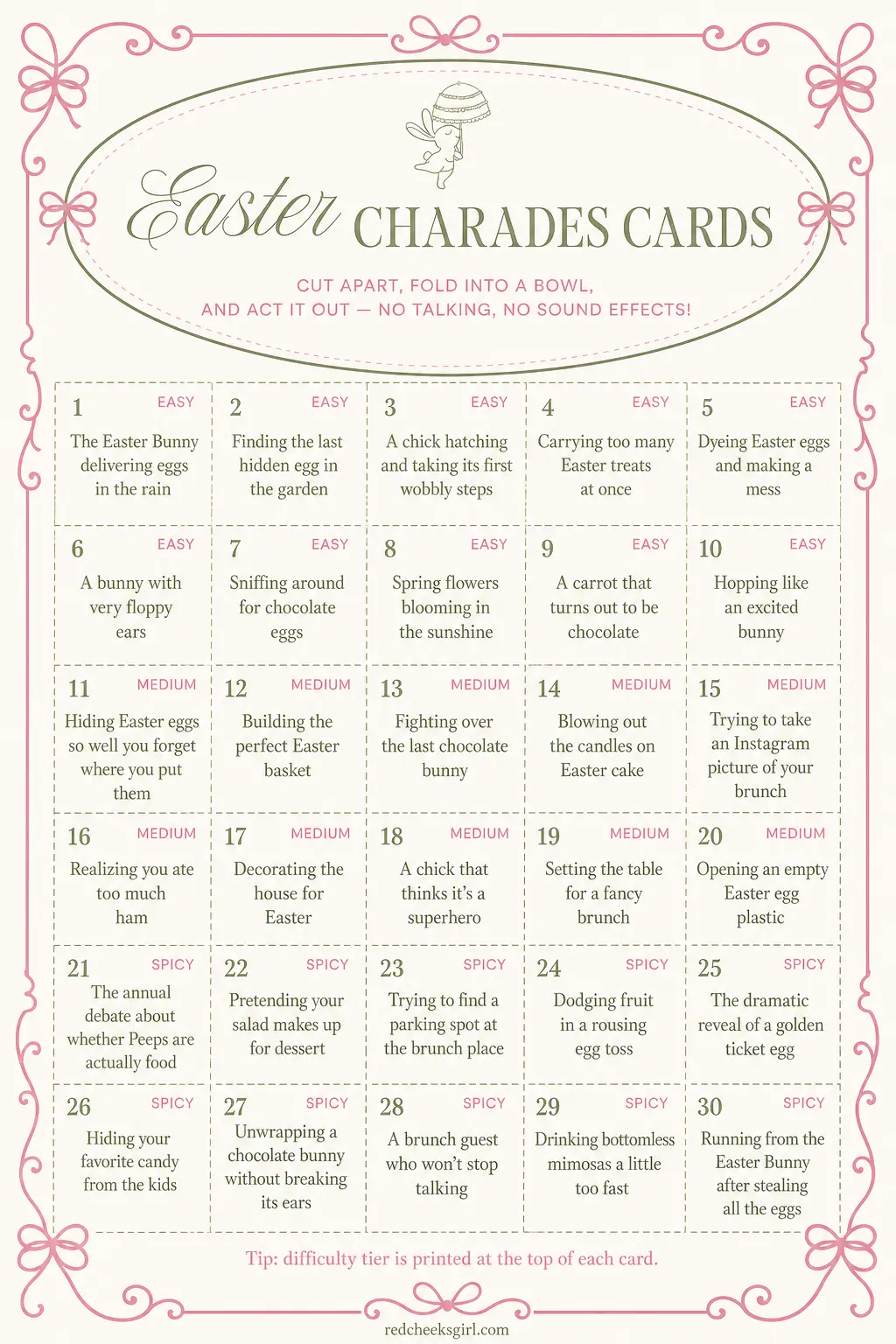
Print and cut the charades cards ahead of time — each card has a word or phrase related to Easter, spring, or seasonal traditions that a player must act out silently while their team guesses. Divide your group into two teams and alternate turns.
The acting player draws a card, has three seconds to read it, then has sixty seconds to get their team to say the exact word or phrase. No sounds, no mouthing words, no pointing at actual objects in the room.
A correct guess earns the team a point; missed cards go to the other team for a steal attempt.
Easter-themed charades has a natural advantage over the generic version because spring and Easter imagery — a butterfly emerging from a cocoon, someone hiding eggs behind their back, a suspicious wobble that is either a baby chick or someone who ate too much brunch — gives the actors rich physical material to work with.
Eight to twenty players works well; with smaller groups, play individually rather than in teams. Budget thirty to forty-five minutes for a satisfying match. You’ll only need the printed and cut cards plus a timer.
Host tip: stack the deck subtly by mixing easy single-word cards with longer phrase cards. When a team is behind by two or three points, a streaky run of easy cards can bring them back quickly and keeps the game competitive deep into the final rounds rather than becoming a blowout early.
8. Guess How Many Jelly Beans!
Fill a clear jar with jelly beans before guests arrive and count carefully as you go — or fill it first, then count a measured portion and calculate the total.
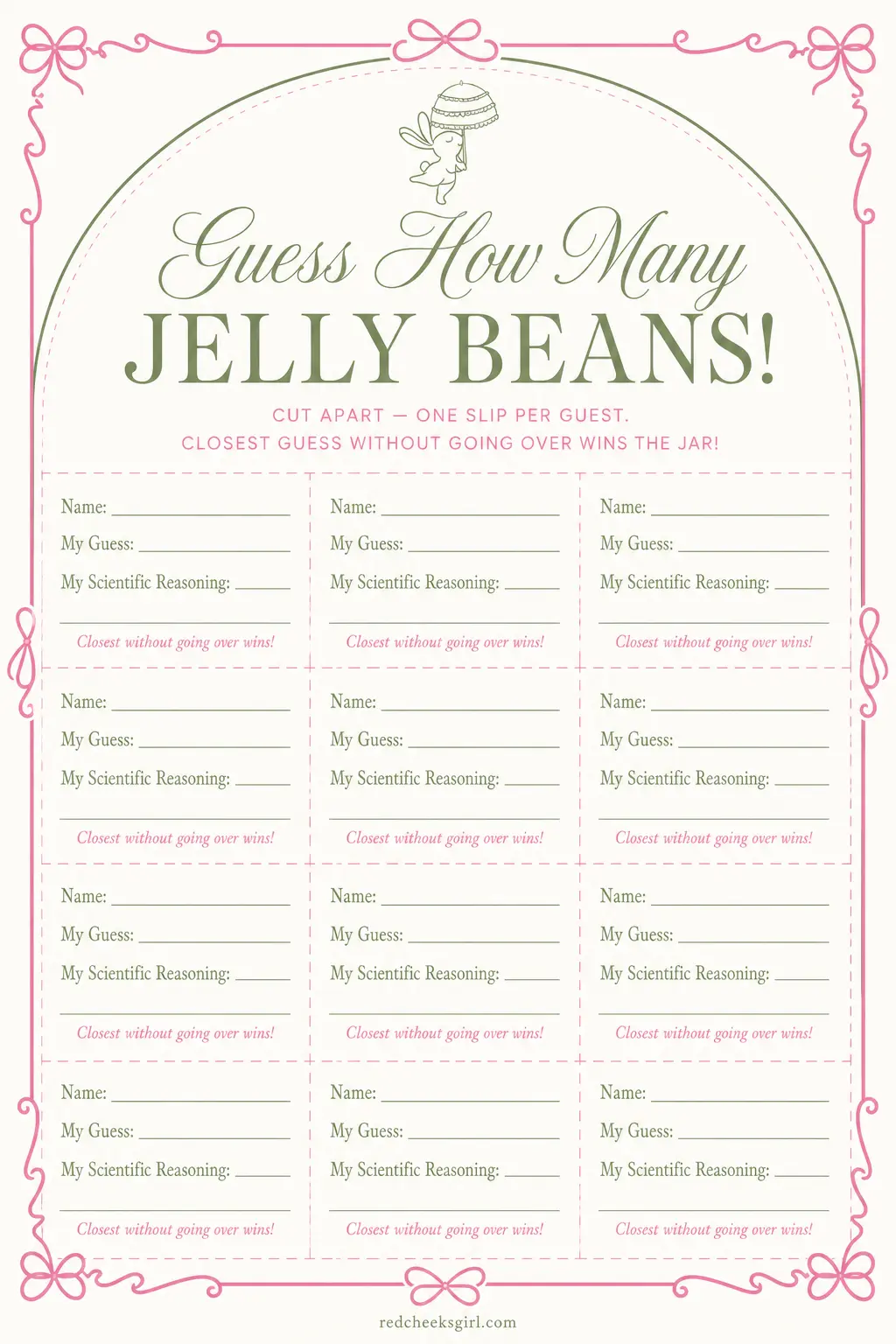
Each player receives a printed guess slip and writes their name and their best estimate of the total number of jelly beans in the jar. Slips are collected at the end of the gathering and the closest guess wins the jar.
The beautiful simplicity of this game is that it runs in the background while everything else happens: players cast their guess when they arrive and forget about it until the big reveal.
The printed slip elevates a classic guessing game into something that feels official and deliberate, which makes the reveal moment land better. Works for any group size — the more guesses, the wilder the range and the funnier the final comparison.
No time commitment beyond two minutes per player to study the jar and fill in the slip. You’ll need a clear glass jar, jelly beans, printed slips, and a pen at the station.
Host tip: write the actual answer on a slip of paper and seal it in an envelope placed visibly next to the jar before guests arrive. This prevents any last-minute suspicion that you adjusted the number — the sealed envelope is proof the answer was fixed before the first guess was made.
🛍 Shopping guide
9. Name That Spring Song
Create a playlist of fifteen to twenty songs that feature spring, Easter, or seasonal themes — this includes obvious choices like classic Easter hymns and well-known pop songs about sunshine and renewal, but also sneaky additions like any song with “rain,” “bloom,” or “rise” in the title.
Play the first five to eight seconds of each track and challenge players to name the song and artist on their answer slips. Score one point for the song title and one for the artist; partial credit for either keeps it from becoming a shutout.
This game rewards music lovers across different generations if you deliberately span decades — a 1960s classic followed by a recent chart hit keeps no single age group dominant. Four to twenty players works comfortably; larger groups can pair up.
Budget thirty minutes for twenty songs including scoring. You’ll need a device and speaker for playback, printed or blank answer slips, and pens. A simple numbered answer slip is all the printable you need.
Host tip: include one completely obscure deep cut that virtually nobody gets — it resets overconfident players and makes the group laugh together. Then follow it immediately with a song so obvious that everyone gets it, which releases the tension and brings the energy back up fast.
🛍 Shopping guide
10. Brunch Table Topics
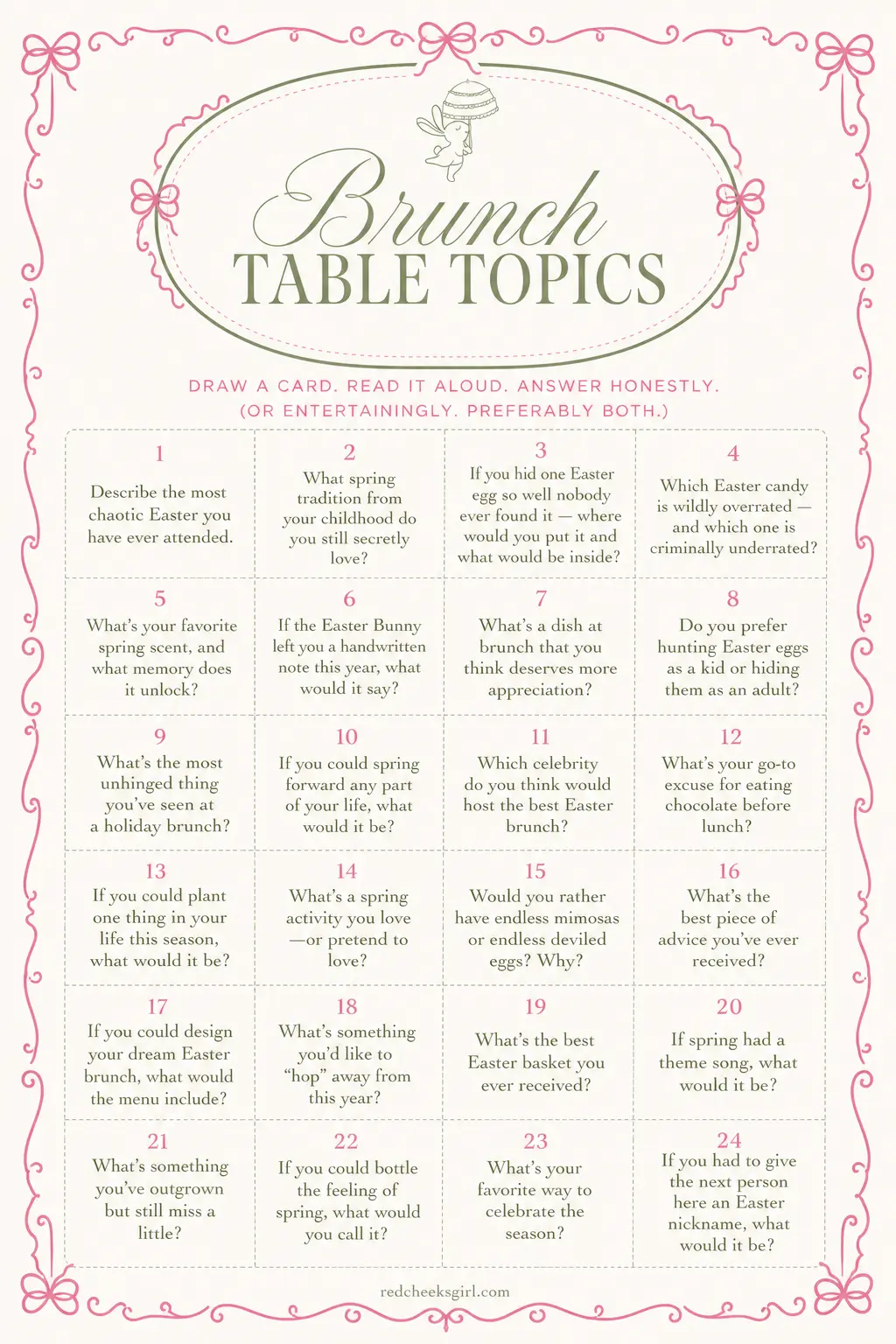
Place the printed Brunch Table Topics cards or sheet at the center of the table before guests sit down.
Each prompt is a conversation starter themed around spring, Easter memories, and seasonal reflection — things like “describe your most memorable Easter as a kid” or “what’s one spring tradition you’d invent if you could?”
Players take turns drawing or being assigned a prompt and answering for sixty to ninety seconds while the table listens. This is not a scored game; it’s a structured way to turn brunch chatter into genuine conversation.
Table Topics shines when a group includes people who don’t know each other well, because the prompts do the social heavy lifting that awkward small talk cannot. It also works beautifully between scored rounds of other games as a palate-cleanser.
Any group size from four to twelve fits comfortably around a table; larger groups can split the sheet between two tables. No time limit — let it breathe as long as the conversation wants to run.
All you need is the printed sheet and the willingness to actually listen.
Host tip: read the prompts in advance and flag two or three that feel tailor-made for specific guests — a prompt about childhood Easter egg hunts for the guest who grew up on a farm, or a question about favorite spring foods for the person who catered their own wedding.
Quietly directing those cards to those guests produces storytelling that surprises everyone at the table, including the teller.
11. Egg and Spoon Relay
Divide your group into two or more teams and set up a relay course outdoors — or down a long hallway if the weather refuses to cooperate.
Each player must carry a hard-boiled egg on a large spoon from the start line to a turnaround point and back without using their hands to steady it. Drop the egg and you restart from the beginning of your leg.
The team that completes the relay first wins, though you may want to run it twice because the first round inevitably produces at least one spectacular drop that everyone insists must be avenged.
For adults, the relay gets genuinely competitive in a way that surprises people who haven’t played since primary school.
The egg wobbles differently depending on speed and surface, and the strategy of “go slow and steady” versus “go fast and risk it” plays out in real time. Four to twenty players works well; odd numbers can have one person run twice.
Budget fifteen to twenty-five minutes including two rounds. You’ll need hard-boiled eggs, large spoons — one per team — and a clear course with enough space for competitive elbowing.
Host tip: use hard-boiled eggs rather than raw ones, obviously, but keep one raw egg in your pocket and dramatically “accidentally” reveal it mid-game. The alarm on people’s faces before you clarify it’s a joke is a highlight every single time.
🛍 Shopping guide
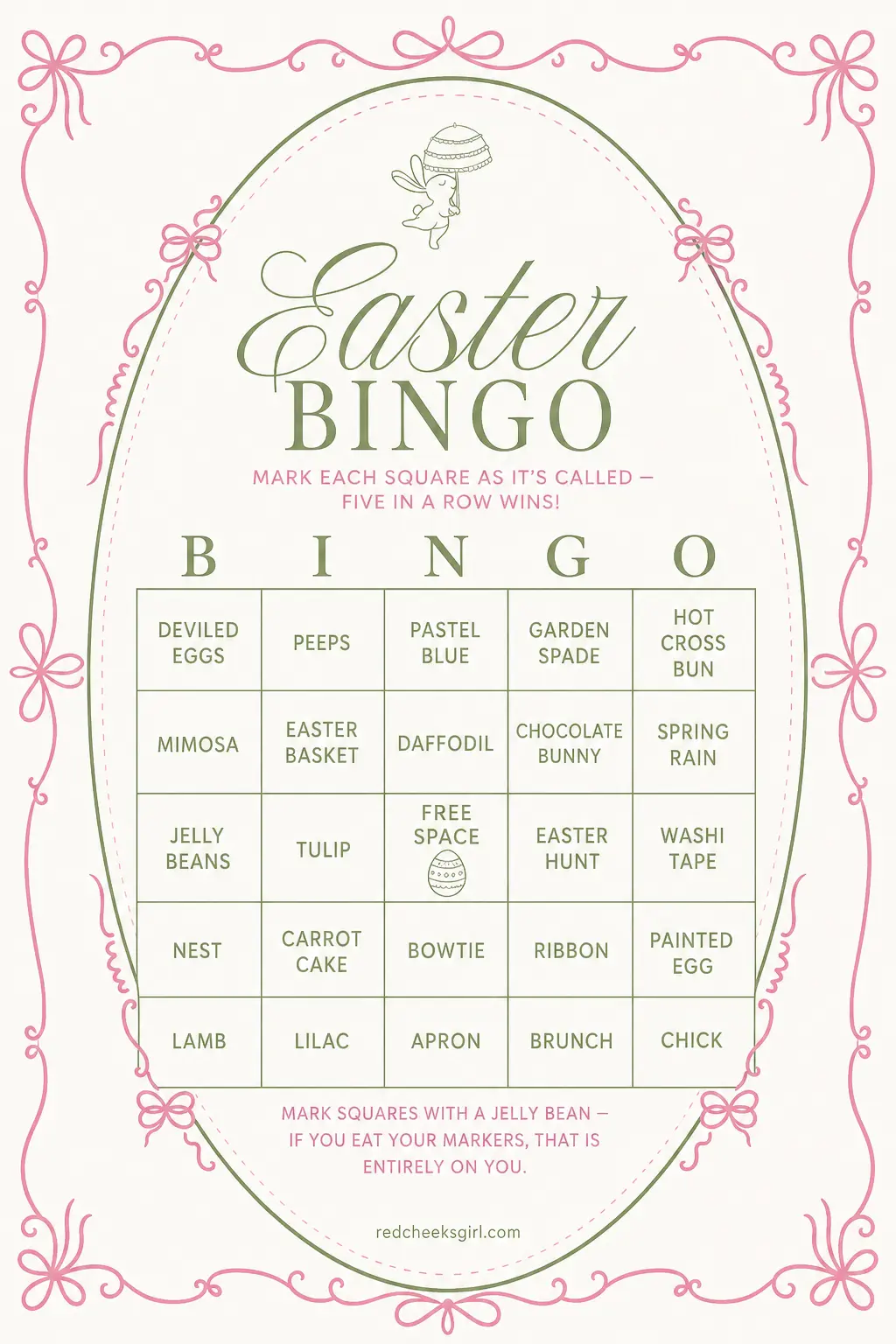
12. Easter Bingo
Print one unique bingo card per player — each card has a five-by-five grid filled with Easter and spring-themed images or words instead of numbers: a chocolate bunny, a daffodil, a painted egg, a rain shower, a hot cross bun, and so on.
The host draws caller cards from a shuffled deck and announces each item; players mark off matches on their card. First player to complete a row, column, or diagonal calls out and wins that round.
Run multiple rounds to give more players a chance to win, using a different pattern — full card blackout, four corners, or an X — for variety.
Easter Bingo works for any group size and any age mix, which makes it genuinely versatile when your gathering spans a wide range of guests.
It’s also one of the easiest games to run back-to-back because a fresh round takes only seconds to start once the caller reshuffles. Budget twenty to thirty minutes for three rounds.
You’ll need the printed bingo cards — every card must be unique — plus small markers like jelly beans or candy-coated chocolates, which double as a reward for the winner.
Host tip: use jelly beans as markers rather than chips or coins, and announce at the start that players may eat their markers whenever they like — but if they eat a marker off a square they need, that square is uncovered and lost. This rule adds a delightfully self-destructive risk that adults find irresistible.
🛍 Shopping guide
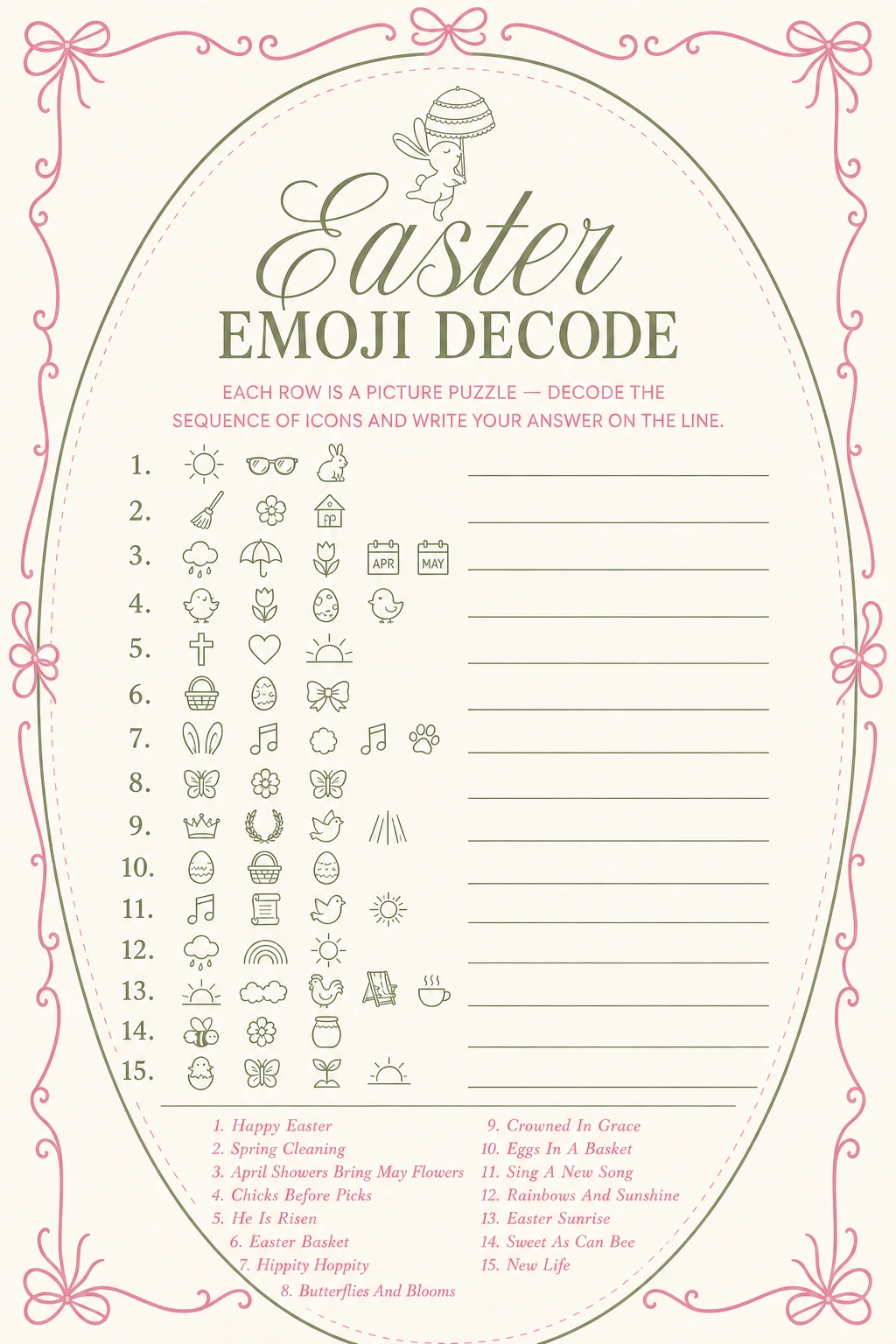
13. Easter Emoji Decode
The printed Easter Emoji Decode sheet presents a series of sequences — each one is a visual puzzle using emoji-style spring and Easter icons arranged in a row, and players must decode what Easter word, phrase, or tradition each sequence represents.
Think of it as a pictographic crossword: a chick plus a shell plus a crack equals “hatching,” or a basket plus pastel ovals plus ribbon equals “Easter basket.”
Players work individually or in pairs, filling in their answers within a time limit, then sheets are swapped and scored against an answer key the host reads aloud.
What makes this work for adults specifically is the lateral-thinking element: the connection between the symbols and the answer is always logical, but often requires stepping back and thinking about the concept rather than the literal images.
Four to twenty players is comfortable; it runs as an individual game or a team challenge equally well. Budget fifteen to twenty minutes for a sheet of twelve to fifteen sequences. All you need are the printed sheets and pens.
Host tip: read a few of the trickier answers with a brief explanation of the logic — “the sun plus a seedling plus an upward arrow equals ‘spring growth'” — because hearing the reasoning out loud makes players groan and nod simultaneously, which is the sound of a game working exactly as intended.
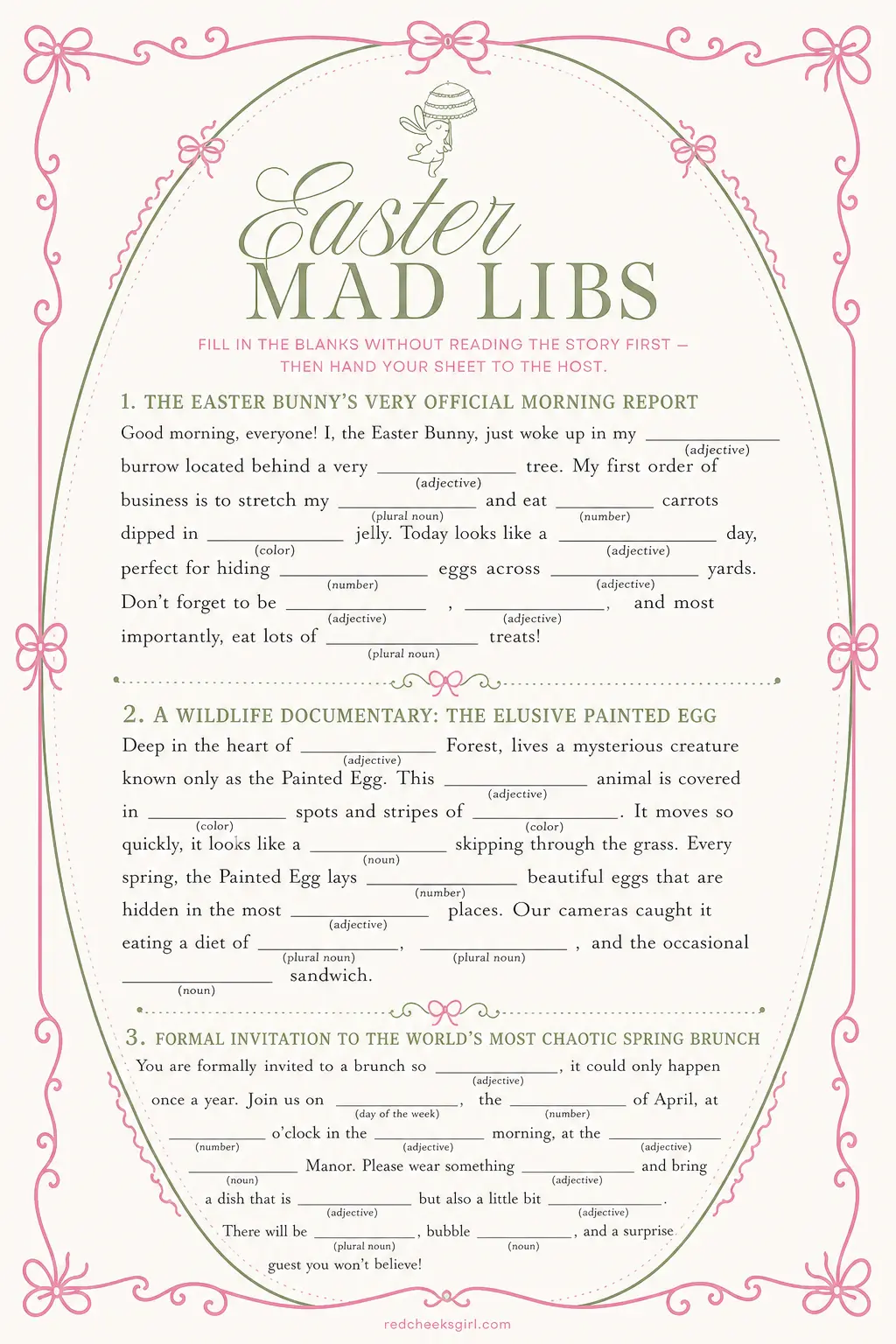
14. Easter Mad Libs
The printed Easter Mad Libs sheet contains a short story with strategic blanks — each blank is labeled with a part of speech (noun, verb, adjective, past tense verb, and so on) but the surrounding story is hidden.
One player acts as the collector, going around the table and asking each person for a word that fits the labeled part of speech without revealing any context. Once all blanks are filled, the collector reads the completed story aloud in full.
The results are reliably absurd and almost always specific to your group in ways that land harder than any pre-written joke could.
Mad Libs reward groups that like wordplay and have no shortage of opinions — which describes most adult brunch tables. You can run one sheet as a full-group activity or print several and run them simultaneously at different tables, then share the results.
Works for four to twenty people; the reading-aloud moment scales to any crowd. Budget ten to fifteen minutes per story. All you need are the printed sheets and pens.
Host tip: when collecting words, ask people two or three seats away from the person whose word will appear in the most ridiculous context. The distance between word-giver and word-receiver means the person who contributed the funniest term rarely realizes it until the reading, and their delayed reaction is half the entertainment.
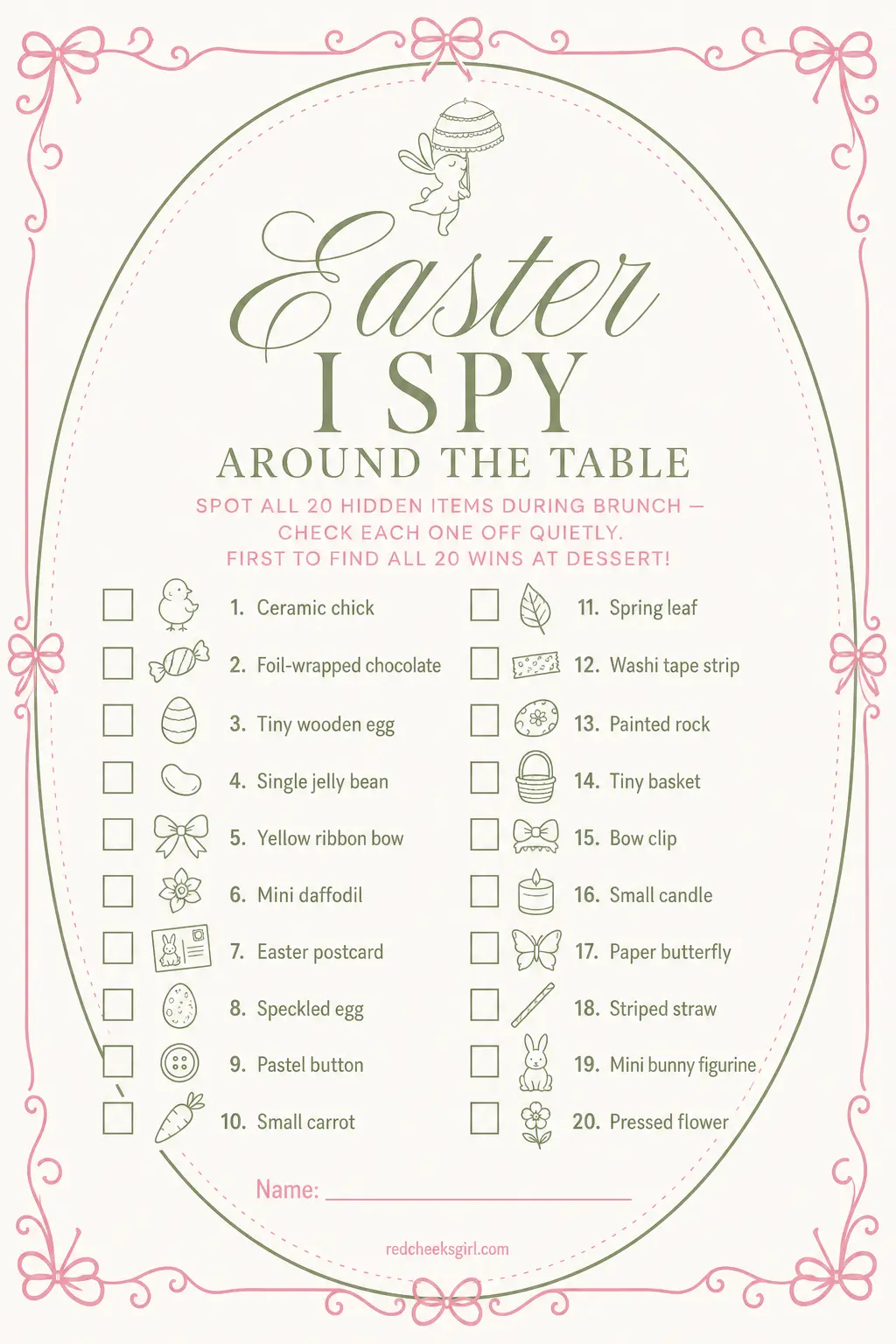
15. Easter I Spy Around the Table
The printed Easter I Spy Around the Table sheet gives each player a checklist of specific Easter and spring items to find among the actual table décor, food, and accessories already present at the gathering — a speckled egg on the centerpiece, a yellow flower in someone’s outfit, a candy wrapper with a bunny on it, a napkin folded into a peak.
Players circulate or observe carefully from their seats and check off each item as they spot it. First to complete the full list wins; if no one finishes, whoever has the most checked off at the time limit wins.
The genius of this game is that the host builds the hunt into the table setting itself — you decorate for Easter anyway, so the game costs nothing extra and rewards guests who actually pay attention to their surroundings.
It doubles as an icebreaker because players naturally start pointing things out to each other, then catch themselves and stop sharing leads. Four to thirty players works; the room size determines the upper limit. Budget fifteen minutes. Only the printed checklist and pens are needed.
Host tip: plant three items on the list that are slightly hidden — a small painted egg tucked behind a vase, a sprig of flowers under a serving plate edge — so that sharp-eyed guests feel genuinely rewarded for looking closely rather than just glancing around the room once.
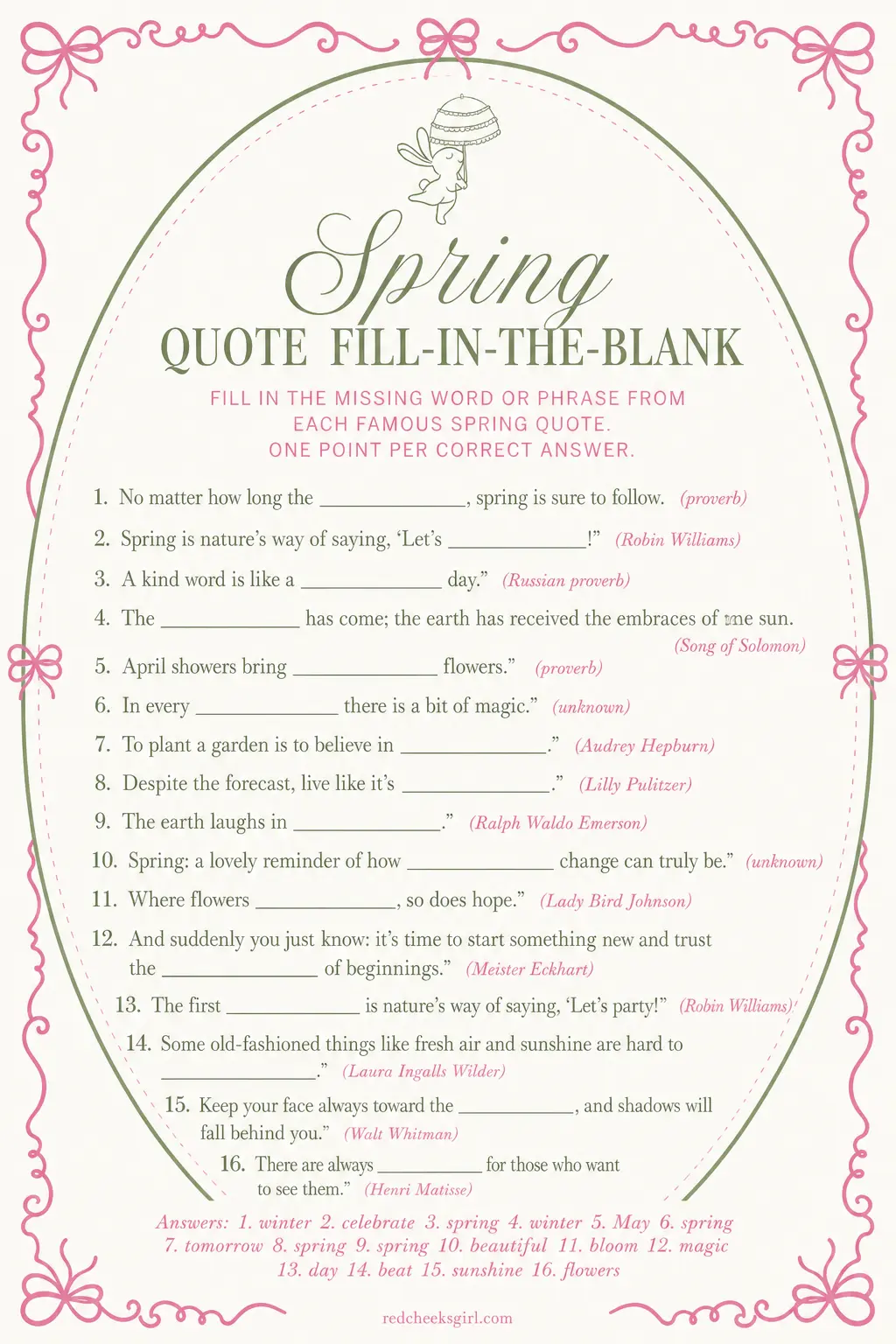
16. Spring Quote Fill-In-The-Blank
The printed Spring Quote Fill-In-The-Blank sheet presents well-known quotes about spring, renewal, and new beginnings with one or two key words removed from each.
Players read each partial quote and fill in what they believe the missing word or words to be, then sheets are scored against the actual quotes — one point per correct blank.
The tricky part is that many quotes share similar themes, so players often insert a word that is tonally perfect but not the precise original phrasing, which sparks surprisingly good debates about word choice and meaning.
This game rewards people with a love of literature and language, but it’s not a trivia shutout — educated guesses that are logically defensible often score partial credit if you choose to allow it, and that flexibility keeps everyone in the game.
Four to twenty players works well as an individual activity. Budget fifteen to twenty minutes. All you need are printed sheets and pens, and a host who has the answer key ready to read aloud with the full context of each quote.
Host tip: after scoring, read the full original quote for each one rather than just the answer word. Hearing the complete sentence in context prompts mini-conversations about which quotes guests recognize, which they love, and which ones they intend to steal for their own use — and that conversation is better than any prize.
17. Two Truths and an Easter Lie
Each player prepares three statements about themselves related to Easter or spring — two are completely true and one is a convincing fabrication.
Statements can cover anything seasonal: childhood Easter traditions, opinions about specific spring foods, a claim about egg-decorating skill, a vacation taken over a spring holiday, or a confession about how many chocolate eggs they’ve eaten in a single sitting.
The player reads all three aloud; everyone else votes privately on which statement they believe is the lie, then the player reveals the answer and explains the truth behind all three.
The Easter theme constrains the category just enough to produce statements that are genuinely revealing — you learn real things about people you thought you knew well, which is the quiet superpower of this format.
It works for groups of four to sixteen; with larger groups it can run long, so set a sixty-second discussion cap per player before the vote. Budget thirty to forty minutes for a full round with ten players.
No supplies needed beyond paper slips or a show-of-hands vote.
Host tip: ask players to write their three statements on a slip before the gathering starts — either by sending the prompt in advance or having paper ready when guests arrive. Impromptu statements under pressure tend toward the obvious; prewritten ones are craftier and produce better reveals.
18. Spring Trivia Tower
Build a physical question tower out of a standard block-stacking game: write or tape a spring and Easter trivia question to the end of each block before guests arrive.
Players take turns carefully extracting a block from the tower, reading the question on it aloud, and answering it — correctly answered blocks go into a personal scoring pile, wrong answers require the block to be balanced back somewhere on the tower.
The game ends when the tower falls; the player with the most blocks in their pile wins, and the person who toppled the tower faces a suitably dramatic forfeit of the group’s choosing.
The physical tension of a wobbling tower combined with trivia pressure produces exactly the kind of shrieking, groaning, delighted atmosphere that marks a successful party game.
It scales to groups of four to twelve comfortably around a table; larger groups can split into two simultaneous towers and compare scores at the end. Budget forty-five minutes for a full game.
You’ll need a block-stacking game set, masking tape or sticky labels, and a pen to write the trivia questions before the party.
Host tip: write questions on the ends of blocks that face inward when the tower is built, not the outward-facing ends. Players won’t be able to read — and therefore cherry-pick — questions before they extract the block, which keeps every draw genuinely unpredictable and eliminates the temptation to target easy questions strategically.
🛍 Shopping guide
Frequently Asked Questions
How many players do most of these Easter games for adults need?
Most games on this list work comfortably with four to twelve players, and several — like Easter Bingo, Easter Trivia Rounds, and the Egg Decorating Contest Ballot — scale up to thirty or more without any structural changes.
Games like Egg and Spoon Relay and Spring Trivia Tower work best with a smaller, more focused group.
When in doubt, look at the group size note for each game and consider splitting larger gatherings into two simultaneous tables for any game that runs better under fifteen people.
Do I need to print anything in advance?
About half the games on this list use printable sheets, and yes — printing in advance is strongly recommended.
Most sheets only need a standard home printer and regular paper, though cardstock holds up better for anything that gets passed around a lot, like charades cards or bingo boards.
Give yourself at least the evening before to print, cut, and organize everything so you’re not rushing on the day. Keep a master answer key for each printable game in a separate folder so you can score quickly without fumbling.
What’s the best order to run these games at an Easter brunch?
Start with something low-pressure and conversational — Brunch Table Topics or Easter Would You Rather — while people are still arriving and settling in.
Move into individual games like Spring Quote Fill-In-The-Blank or Easter I Spy Around the Table during the meal itself, when standing up isn’t practical.
Save physical games like Egg and Spoon Relay and team games like Easter Charades or Spring Trivia Tower for after eating, when everyone has energy and a little friendly competition feels welcome.
End with the Guess How Many Jelly Beans reveal, which gives the gathering a natural closing moment.
What prizes should I give out for Easter games?
Small prizes work best because they don’t overshadow the fun itself. Mini chocolate eggs, small candles, packets of spring flower seeds, a nice soap bar, or a small bottle of flavored syrup for cocktails all land well with adult guests.
If you’re running multiple games, consider a running leaderboard and one larger prize for the overall winner at the end of the afternoon rather than individual prizes per game — it keeps everyone invested across the whole event rather than checking out after their best game.
Can these games work indoors if the weather is bad?
Almost all of them do. The only game that genuinely benefits from outdoor space is the Egg and Spoon Relay, and even that can be adapted to a long hallway or cleared living room.
All the printable games, trivia rounds, bingo, charades, Mad Libs, and the block tower game are fully indoor-friendly. If you’re planning an outdoor event and the weather turns, you can run the entire list inside without losing a single game.
📌 Save These for Later
Loved these? Pin your favorite image below so you can find this list again when you’re planning.




Discover 22 fun Easter party games for kids ages 3–10, from egg-and-spoon races to printable bingo

22 fun Easter party games for kids ages 3-10 — active races, printable sheets & quiet keepsakes be
Twenty tried-and-tested Easter games for large groups, perfect for church halls, community centers,
Leave a Reply