

If you’ve been Googling easter party games for kids because you know an egg hunt alone is not going to cut it for a group of sugar-charged three-to-ten-year-olds, you are absolutely in the right place.
I’ve hosted more Easter parties than I care to count (the year I trusted a raw egg for the spoon race indoors is a memory I am actively suppressing), and I promise there is a whole universe of giggles, wiggles, and printable fun waiting beyond that classic basket scramble.
Every single game on this list has been chosen with your real party in mind — whether you’re setting up in a garden bursting with spring sunshine or herding little ones around a living-room course because it decided to pour with rain.
You’ll find lively races, calm printable sheets kids can take home, and a few surprises in between. Grab a coffee, have a scroll, and pick your favourites — there are 22 to choose from, so you really are spoilt for choice.
(And if you need a brilliant morning-of-party fuel-up, this Amish Breakfast Casserole is a total crowd-pleaser that you can throw together the night before.)
This post contains affiliate links — if you buy through them, I may earn a small commission at no extra cost to you.
- Egg and Spoon Race
- Bunny Hop Relay
- Easter Picture Bingo
- Pin the Tail on the Bunny
- Egg Toss Buckets
- Easter I Spy Sheet
- Carrot Ring Toss
- Egg Rolling Race
- Easter Matching Game
- Chick Freeze Dance
- Egg Colour Sorting Relay
- Easter Colour by Number
- Easter Egg Obstacle Course
- Bunny Ears Balloon Balance
- Easter Trivia for Kids
- Hot Boiled Egg
- Easter Emoji Decode
- Spring Scavenger Hunt
- Chick Hatch Balloon Pop
- Easter Basket Mad Libs
- Rabbit Tail Bean Bag Toss
- Easter Feelings Colouring Keepsake
- Guess How Many Eggs
- Frequently Asked Questions
1. Egg and Spoon Race
The Egg and Spoon Race is the undisputed champion of Easter party games for kids and, honestly, it earns its crown every single time.
Each child balances a plastic or hard-boiled egg on a large spoon, holds the spoon handle in one hand, and keeps the other arm tucked behind their back — then races from a start line to a finish line without dropping it.
If the egg falls, they must stop, pop it back on the spoon, and carry on. First across the line with the egg still balanced wins.
You can run it as a straight individual race or split everyone into two or three teams and make it a relay, where kids pass the spoon to the next teammate when they return to the start.
For a party covering ages 3–10, use plastic Easter eggs for the little ones (less mess, more confidence) and hard-boiled or wooden eggs for the older crowd who want a real challenge.
Mark your course with painter’s tape indoors or garden canes outdoors — aim for about four to six metres for preschoolers and eight to ten metres for school-age kids.
If you have mixed ages, simply shorten the little ones’ course so everyone finishes at a similar time and nobody feels left out. A whistle to start each round adds a delicious layer of drama.
The game runs beautifully in about ten to fifteen minutes including two or three heats, works for any group size from four to twenty-plus, and needs almost zero setup.
The host tip that nobody tells you until it’s too late: use a dessert spoon rather than a tablespoon for ages 6 and up — the smaller bowl makes the race genuinely challenging and means it doesn’t all wrap up in thirty seconds with the egg glued to a giant ladle.
Younger kids get the big serving spoon; older kids get the dessert spoon. Everyone has the right amount of fun.
Give older kids a dessert spoon and younger kids a large serving spoon — same game, perfectly calibrated difficulty for every age at the table.
🛍 Shopping guide
2. Bunny Hop Relay
Bunny Hop Relay is the kind of game that turns an ordinary garden into a full-blown Easter comedy show. Split the kids into two or three equal teams and line them up behind a start line.
On ‘Go!’, the first player on each team must bunny-hop — both feet together, arms tucked in front like little paws — all the way to a turning cone or marker, then bunny-hop back and tag the next player in line.
The team whose last player crosses back first wins. Simple, hilarious, and burns off an absolutely impressive amount of pre-lunch energy.
You’ll need one cone or marker per team (small orange traffic cones work great, or just use a stack of paper plates weighted with a stone), a bit of clear space, and absolutely nothing else.
Set the hopping distance to about five metres for the 3–5 age group and stretch it to eight or ten metres for the older kids.
If you have a very mixed group, pair a younger child with an older buddy so nobody feels anxious going it alone.
You can add a silly Easter twist by giving each child a pair of cardboard bunny ears to wear — bonus photo opportunity, and the ears flopping around mid-hop is exactly as funny as you’re imagining right now.
This relay runs in around ten minutes, works for groups of six to twenty, and needs no printables or prep beyond marking the course.
The insider host tip: tell the kids the golden rule upfront — both feet must leave the ground at the same time, or they have to go back to the start of their turn.
Without that rule, you’ll inevitably get a very enthusiastic ‘shuffle’ that somehow qualifies as a hop, and the resulting debate will eat up half your party time. Trust me on this one.
- Ages 3–10, groups of 6–20
- Outdoors or in a cleared living room or hall
- Great as an energiser right after a sit-down printable game
🛍 Shopping guide
3. Easter Picture Bingo
Easter Picture Bingo swaps numbers for colourful Easter images — chicks, eggs, bunnies, carrots, tulips, baskets, and more — making it completely accessible for non-readers as young as three. Each child gets a unique 4×4 bingo card covered in little Easter pictures.
The host draws calling cards one at a time from a shuffled pile (or a bag) and holds up or announces each picture; players cover the matching picture on their card with a mini Easter egg, a button, or a paper counter.
First to cover four in a row — across, down, or diagonally — shouts ‘Happy Easter!’ and wins. Run multiple rounds so everyone gets at least one win.
Print one card per child on cardstock for durability, plus a full set of caller cards (which you cut apart and fold into a bowl or bag).
For counters, wrapped mini chocolate eggs are a genius move — kids get to eat their winnings at the end of each round, which is exceptional motivation for staying focused.
Aim for at least ten different card layouts so no two children have an identical board; the printable sheet below gives you a ready-to-go set. You’ll also want a flat surface for each player — a tray, a book, or a table works perfectly.
The game takes about fifteen to twenty minutes for three or four rounds and works brilliantly for groups of four to twenty-four.
It’s one of those rare easter party games for kids that works for literally every age in the 3–10 range simultaneously, because a three-year-old recognising a chick picture plays just as happily as a ten-year-old strategising their coverage.
Host tip: laminate the cards if you’re planning to reuse them year after year — one wipe with a damp cloth and they’re ready for next Easter, which your future self will absolutely thank you for.
- Printed bingo cards (one unique layout per child)
- Caller picture cards, cut and placed in a bowl
- Small counters — mini eggs, buttons, or paper squares work perfectly

🛍 Shopping guide
4. Pin the Tail on the Bunny
Pin the Tail on the Bunny is a classic that earns its place at every Easter party because it requires zero skill, creates maximum suspense, and produces the most wonderfully chaotic results.
Print and assemble a large bunny poster — a simple side-on outline of a big white bunny with no tail — and fix it to a wall or fence at child height.
Cut out a separate fluffy cotton-ball tail (or a printed circular tail for each player). Blu-Tack or double-sided tape works better than actual pins for younger children.
Blindfold each child one at a time, spin them gently two or three times, point them toward the bunny, and let them go. The child who sticks their tail closest to the correct spot wins — but the real prize is watching everyone try.
The printable below gives you the full-size bunny poster (print across two A4 sheets and tape together for a good size, or send to a print shop for A3) plus a set of numbered tails — one per player — so you can mark each child’s attempt with a small sticker and measure at the end who was closest.
For younger children skip the spin entirely and simply blindfold them; eliminating the dizzy factor keeps everyone upright and happy. Have a grown-up gently guide each child by the shoulders so they walk safely toward the wall.
This game takes about fifteen minutes for a group of up to twelve kids, needs minimal materials beyond the printout, and is endlessly replayable.
The host tip that genuinely changes everything: draw a small X on the bunny’s tail area in pencil before you stick it up, so you have an objective reference point for judging ‘closest’ — otherwise you’ll spend ten minutes arguing about whose tail was technically nearer, and at a party full of competitive six-year-olds, that’s a situation you absolutely want to avoid.
- Skip the spinning for ages 3–5 — just the blindfold is plenty of disorientation for little ones
- Use Blu-Tack loops instead of pins so it’s completely safe for all ages

🛍 Shopping guide
5. Egg Toss Buckets
Egg Toss Buckets is the Easter answer to basketball — and if you have never watched a five-year-old attempt an underarm toss from two metres away, you are genuinely missing out.
Set up three buckets or baskets in a row at increasing distances from a throwing line: the nearest one scores one point, the middle scores two, and the farthest scores three.
Each player gets five plastic eggs to toss (one at a time), and they choose which bucket to aim for on each throw. Once all five eggs are thrown, tally the score.
Play two or three rounds per child, and the highest total wins a little prize — stickers, a small chocolate egg, whatever works for your crowd.
You’ll need three buckets — washing-up bowls, Easter baskets, or even cardboard boxes work perfectly — and ten to fifteen plastic eggs per team (so you can reset quickly). Mark the throwing line with a strip of painter’s tape.
For younger children, move the nearest bucket very close — about a metre — so they absolutely land at least one throw and leave feeling brilliant about themselves. Older kids can attempt the farthest bucket from a proper challenge distance of three to four metres.
You can also run this as a team game: two teams race to get the most points in a set time, taking turns at the throwing line.
Games run in about ten to fifteen minutes for a group of six to sixteen, and the competitive edge makes it a big hit with ages 5–10 in particular.
This is one of the most replayable games on the list because kids will ask for ‘just one more round’ on a loop.
Host tip: fill the buckets with a tiny bit of scrunched tissue paper or a damp cloth — it stops the plastic eggs from bouncing straight back out on impact, which means fewer disputed points and a much smoother game overall.
The tiered scoring system means every child plays their own risk-reward strategy, so even the youngest feels genuinely invested in the outcome — not just ‘doing their turn’.
🛍 Shopping guide
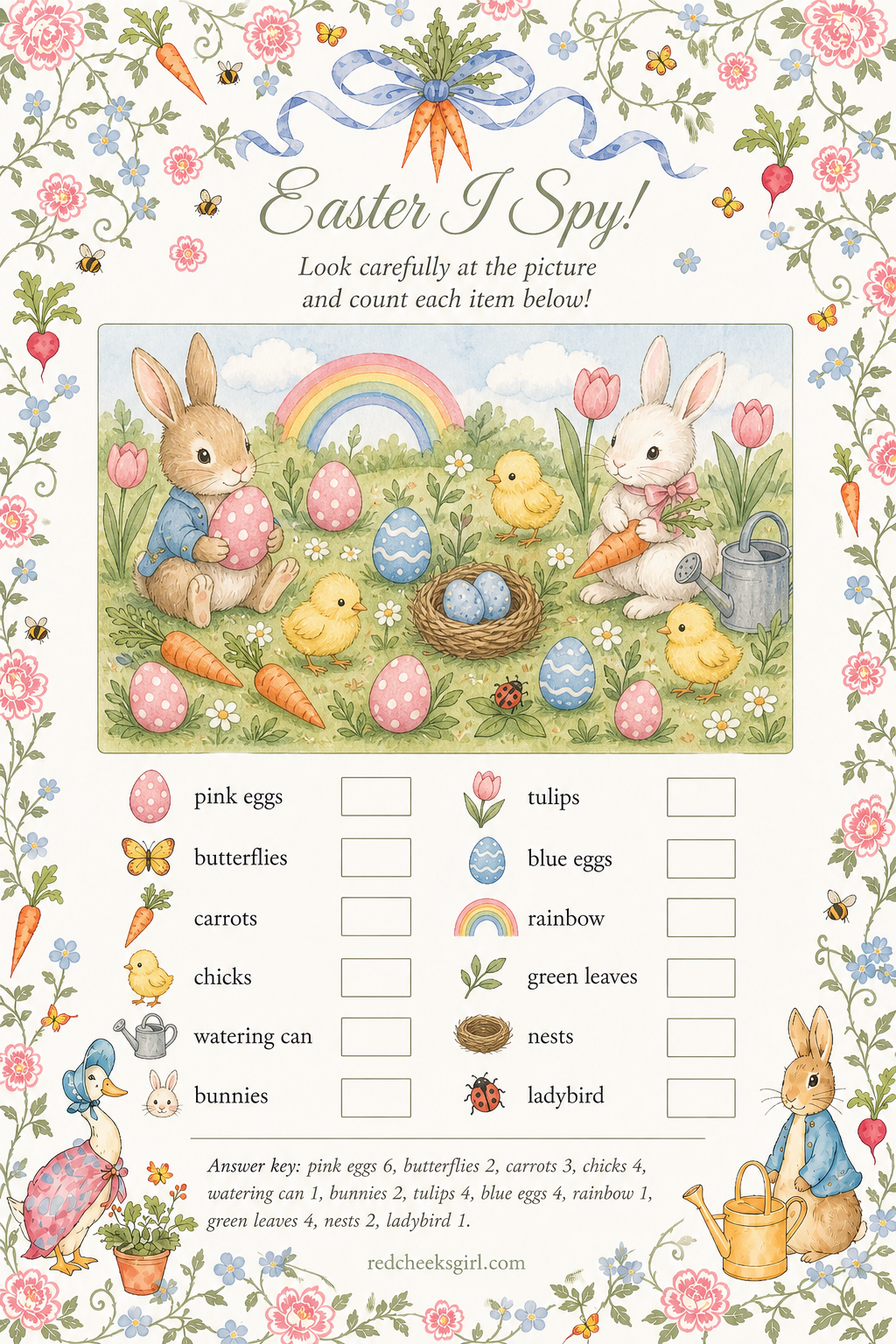
6. Easter I Spy Sheet
Easter I Spy Sheet is the quiet, focused game that saves your party when you need five minutes to sort out snacks or re-hide the eggs for round two.
Each child gets their own illustrated I Spy sheet packed with a cheerful Easter scene — think garden full of eggs, bunnies, chicks, flowers, baskets, butterflies, and little spring details all layered together.
Along the bottom (or side) of the sheet sits a count-and-find list: ‘Can you find 4 pink eggs? 2 butterflies? 1 watering can?’ Kids go through the scene systematically and write or circle their count for each item.
Because there’s no one right answer to argue about — only the host’s answer key — it stays calm and companionable.
Print one sheet per child on standard paper — no cardstock needed, since it’s not a card game. Provide crayons or pencils for circling finds and writing numbers.
For children aged 3–5 who aren’t yet writing confidently, have them simply point and tell an adult their answers out loud while the adult jots them down. For 7–10 year olds, add a timed challenge: who can complete the whole list first?
The printable below has twelve items to find, with quantities ranging from one to eight hidden in the scene, and includes a small answer key for the host at the bottom of the sheet.
This game works for any group size — even thirty kids, since it’s entirely individual — and fills about ten to fifteen focused minutes. It’s also a brilliant take-home keepsake because kids love showing their parents ‘I found everything!’ on the drive home.
Host tip: count the items in the scene yourself before printing and double-check the answer key matches — it sounds obvious, but if you change the scene in a graphic editor or the printer clips the edge, your counts can go off by one and you’ll have very indignant eight-year-olds on your hands (rightly so).
- All ages 3–10 simultaneously
- A calm interlude between active races
- Works as a take-home activity too — print extras!
7. Carrot Ring Toss
Carrot Ring Toss is so simple to set up that you’ll feel slightly smug about how well it goes down.
Cut or buy a set of cardboard or foam carrot shapes — tall orange triangles with green tops — and stand them up in a row using small plastic cups or cardboard tube bases.
Players take turns tossing small plastic rings (like those from a classic ring toss set) or simple DIY rings made from paper plates with the centres cut out, trying to loop them over the tops of the carrots.
Assign point values: a ring on the nearest carrot scores one, the middle carrot two, and the far carrot three. First to fifteen points wins, or simply play a set number of throws per child.
You can DIY the entire thing in twenty minutes: print and colour simple carrot outlines on orange cardstock, roll them into cones, and tape them to empty loo rolls as bases.
Space them about thirty centimetres apart in a line, and mark the throwing line with tape. For younger throwers aged 3–5, use larger rings (a bangle bracelet or a hoop cut from a plastic bottle works) and stand closer.
For older kids, switch to smaller rings and move the throwing line back. Running it as a team competition — two teams, alternating throws — keeps everyone engaged even when it’s not their turn.
Carrot Ring Toss handles six to twenty players beautifully, runs in about ten to fifteen minutes per round, and requires no explanation beyond ‘throw the ring onto the carrot.’
It’s also wonderfully repeatable — kids will keep asking for ‘one more go’ in a very pleasant loop.
Host tip: weigh the carrot bases down with a small pebble or a dollop of playdough inside the tube before the party — otherwise a slightly enthusiastic near-miss will send all the carrots flying and you’ll be resetting the game every thirty seconds.
Learn from my mistakes, friends.
- Carrot cutouts or foam carrot shapes (DIY or bought)
- Plastic rings or paper-plate rings (cut centre from a paper plate)
- Painter’s tape for the throwing line
🛍 Shopping guide
8. Egg Rolling Race
Egg Rolling Race is a wonderfully old-fashioned game with roots going back centuries — and it is still absolutely brilliant fun for kids today.
Each child gets a hard-boiled egg (decorated if you like) or a plastic egg, and a spoon, a wooden stick, or simply their nose (yes, really — the traditional version has players nudging the egg along the ground with just their nose!).
Mark a start and finish line on a grassy slope or a smooth flat surface, and on the count of three, everyone rolls their egg forward using only their chosen implement. First egg to cross the finish line wins the round.
For an indoor version on a hard floor, plastic eggs work perfectly — they roll beautifully and don’t crack on impact with skirting boards. Outside on grass, hard-boiled eggs have a wonderfully unpredictable wobble that makes the race hilariously non-linear.
Give each child a long-handled wooden spoon or a chopstick to push their egg, since this is far easier to manage for ages 3–6 than getting on hands and knees.
For ages 7–10, try the classic nose-rolling version — lay down a plastic tablecloth first if you’re worried about muddy knees. Run it as a relay or an individual race depending on your group size.
This game works for groups of four to sixteen over about ten to fifteen minutes, and the unpredictable rolling behaviour of real eggs is genuinely funny enough that even the kids who lose immediately want another go.
It’s one of the most beloved easter party games for kids in the traditional toolkit for good reason.
Host tip: give each child’s egg a small sticker flag or a unique dab of nail polish before the race so you can identify whose egg crossed the line first — when eight eggs are all rolling in the same direction at once, you will absolutely need a way to tell them apart.
- Give under-5s a large serving spoon to push with — way easier than nudging with a nose!
- Use a gently sloped surface outdoors so eggs roll naturally and little ones don’t get tired pushing uphill
🛍 Shopping guide
9. Easter Matching Game
Easter Matching Game is the printable equivalent of a memory card flip game — except all the action happens right there on a single sheet, so no cards to drop, lose, or argue about.
Each child gets a sheet showing two columns of Easter images: the left column has ten Easter pictures in a set order (egg, chick, bunny, flower, basket, carrot, butterfly, nest, lamb, rainbow), and the right column shows the same ten images in a completely scrambled order.
Players draw a line to match each item in the left column to its identical twin in the right column, working as fast as they can. The child who correctly matches all ten items first shouts ‘Found them all!’ and wins.
Print one sheet per child on standard A4 paper and provide one pencil or crayon per child.
For a non-competitive version, simply set a two-minute timer and challenge everyone to match as many as possible — no ‘winner’, just a cheerful ‘How many did you get?’ comparison at the end.
For the 3–5 age group, reduce the number of pairs to six and make the images larger and more distinct; you can do this easily by simply crossing out four pairs before photocopying and enlarging the remaining ones.
The sheet below includes ten pairs with a clear answer key printed in tiny italic text at the very bottom so the host can verify results quickly.
This game is great for groups of any size — even a whole classroom — and takes about five to ten minutes per round.
It’s low-setup, low-mess, and genuinely educational without feeling like homework (matching supports visual discrimination and concentration, if you want the science bit). Host tip: do a quick practice round by talking through the first pair together as a group before saying ‘Go!’
— this takes thirty seconds but completely eliminates the confused stares from the younger children, and the older kids will thank you for clarifying what ‘identical twin’ actually means in this context before a debate breaks out mid-game.
- Draw a line from each Easter image in column A to its exact match in column B
- Work as fast as you can — first to match all 10 correctly wins!
- Younger players: only match the 6 bigger pictures at the top

10. Chick Freeze Dance
Chick Freeze Dance is the Easter remix of the beloved Freeze Dance game, and it is basically a guaranteed energy explosion in the best possible way.
Put on some upbeat, cheerful music — anything with a good beat works — and all the children dance and wriggle around the space moving like baby chicks: waddling, flapping their ‘wings’, pecking the air, the whole thing.
When the music stops, everyone freezes instantly in their best chick pose. Any child who keeps moving after the music stops sits down for that round. Last chick standing wins!
Keep rounds short (thirty to sixty seconds of music) so even the kids who are out quickly get back in for the next round.
You need nothing more than a speaker and your music playlist — zero setup, zero printables, zero budget. Clear a central space of about three by four metres for up to twelve kids, or use a garden lawn for larger groups.
To keep the Easter theme delightful rather than forced, announce each round with a different chick instruction: ‘This round we’re hatching from our eggs!’ (kids start curled on the floor and slowly unfurl), or ‘This round we’re learning to fly!’ (arms outstretched, lots of running).
These little variations stop the game feeling repetitive and keep even the oldest children surprisingly engaged.
Chick Freeze Dance runs beautifully for three to five rounds over about ten minutes, and works for any group size from four to thirty.
It’s one of those easter party games for kids that requires literally no explanation — you say ‘dance like a chick, freeze when the music stops’ and they’re off.
Host tip: use a Bluetooth speaker with a physical pause button you can press without fumbling with a phone screen, because trying to pause Spotify while twenty children watch you with enormous expectation is a lot of pressure, and the three-second lag while you find the button completely ruins the freeze-catch moment.
Invest twenty seconds in queuing the playlist before the party and thank yourself later.
No equipment, no reading, no prep — just press play and watch the magic happen. It’s the perfect game to slot in between a printable activity and the next race.
11. Egg Colour Sorting Relay
Egg Colour Sorting Relay is a fantastic team game that mashes up a relay race with a sorting challenge — and the result is wonderfully frantic in the best way. Divide the kids into two or three teams of equal size.
At one end of the course, tip out a big pile of mixed plastic eggs in four or five colours — red, yellow, blue, green, and purple work beautifully. At the other end, set out a labelled basket or coloured bowl for each colour.
On ‘Go!’, the first player from each team runs to the pile, picks up ONE egg, runs to the correct coloured basket, drops it in, and sprints back to tag the next player.
The team whose correct basket fills up first wins — but if an egg ends up in the wrong basket, that whole team must run it back before continuing.
You’ll need about forty to fifty plastic eggs in four or five colours (roughly eight to ten per colour), one large mixing pile, four to five labelled baskets or bowls per team, and a clear running lane per team.
This works beautifully indoors (use a hallway) or outdoors on a lawn.
To keep the youngest players (ages 3–4) involved, give them a shorter running lane and the job of sorting a separate smaller pile right next to their start position — they’re still part of the team effort without the long sprint.
The ‘wrong basket’ penalty is the key rule that turns a simple relay into a strategy game for the older kids.
Groups of six to eighteen work perfectly, and the game runs in about ten to fifteen minutes including two or three rounds.
It’s one of those games where every age from 3 to 10 is genuinely useful to their team, which makes it an exceptionally inclusive choice for a mixed-age party.
Host tip: pre-sort the eggs into a single jumbled bucket before tipping them out, rather than mixing them on the ground during the party — it saves two minutes of faffing and means your pile stays satisfyingly chaotic rather than accidentally pre-sorted by the competitive eight-year-old who got there first.
- 40–50 plastic eggs in 4–5 distinct colours
- One labelled basket or coloured bowl per colour per team
- Clear relay lanes — tape on the floor indoors, garden canes outdoors
12. Easter Colour by Number
Easter Colour by Number is the calm-down, creative, take-your-time game that every party needs after the relay races — and it doubles as a beautiful take-home keepsake.
Each child gets a sheet featuring a large Easter scene — a bunny in a flower garden, perhaps, or a chick just hatching from a decorated egg — divided into numbered sections.
A colour key at the side tells players which colour corresponds to which number: ‘1 = yellow, 2 = pink, 3 = green’ and so on.
Kids work through the scene at their own pace, colouring each section the correct colour, and the full picture gradually reveals itself as they go. It’s genuinely satisfying even for adults (I may or may not have had a go at one myself during testing).
Print one sheet per child on standard white paper — brighter colours show up better on a heavier 90gsm or 100gsm paper if you have it.
Provide a good set of coloured pencils or crayons for every two children so nobody’s waiting for the green one for five minutes.
For the 3–5 age group, use a version with only four or five colours and large, clearly defined sections; for 7–10 year olds, a more complex scene with eight to ten colours feels genuinely rewarding.
The sheet below uses eight colours and includes twelve numbered sections so even the quickest colourist gets about eight to twelve minutes of focused activity.
This is a game that works for any group size from one child to thirty, runs for ten to twenty minutes depending on age and enthusiasm, and needs no explanation beyond pointing at the key and saying ‘match the number to the colour.’
It’s one of the most universally beloved easter party games for kids because it’s a genuine choice — nobody is competing, nobody feels singled out, everyone is just happily colouring their own little masterpiece.
Host tip: write each child’s name lightly in pencil on the back of their sheet before you hand them out — sheets look identical before they’re coloured, and swapping or losing someone’s half-finished work mid-party is a genuine tragedy that a small label completely prevents.
Write each child’s name on the back before handing sheets out — sheets look the same until they’re half-coloured, and a lost masterpiece mid-party is a genuine disaster!

🛍 Shopping guide
13. Easter Egg Obstacle Course
Easter Egg Obstacle Course is what happens when you combine a relay race with a mini adventure, and the result is the kind of game kids talk about for weeks after the party.
Set up a short course — six to eight metres — with three or four obstacles: crawl under a table, hop through a line of hula hoops, step over a row of pool noodles laid on the ground, and finally drop a plastic egg into a basket.
Each child completes the whole course solo while being timed, or you run two courses side by side and children race head-to-head. The twist?
They must carry a plastic egg in one hand the entire time without dropping it — if it drops at any obstacle, they go back to that obstacle and try again.
For setup, you genuinely need only items you probably already have: chairs pushed together to crawl under, three to four hula hoops laid flat as stepping stones, two pool noodles on the ground as a step-over, and a basket at the finish.
Mark the start and end clearly with coloured tape. Adapt the obstacles for age — the tiniest ones skip the under-crawl and just walk through a doorway, while the older kids do the full circuit.
Running two identical courses side by side makes head-to-head racing possible for larger groups of eight or more, and the simultaneous action keeps the waiting children watching and cheering rather than wandering off.
This game works for four to sixteen children over about fifteen minutes and is endlessly customisable — swap out obstacles based on what you have available and the session never gets stale.
It’s a legitimately brilliant example of easter party games for kids because the Easter egg prop makes it themed without requiring any Easter-specific equipment.
Host tip: do one slow demonstration walk-through of the full course yourself before starting — including the crawl, because otherwise guaranteed one child will stand upright under the table and knock the whole thing over in the first five seconds.
A quick adult demo sets the standard and saves the furniture.
- 3–4 chairs or a low table for crawling under
- 3–4 hula hoops laid flat as stepping-stone rings
- 2 pool noodles as step-overs
- 1 basket at the finish line per course
- 1 plastic egg per player
🛍 Shopping guide
14. Bunny Ears Balloon Balance
Bunny Ears Balloon Balance is one of those games where the concept sounds almost too easy — and then you try it and realise that balancing a balloon on your head while walking is absolutely not as straightforward as it sounds.
Every child wears a pair of cardboard or headband bunny ears, then balances a balloon on top of their ears (not held in place by hands!) and walks from a start line to a finish line without it falling off.
Any child whose balloon falls must freeze in place, pick the balloon up without squashing it, return to start, and try again. The child who crosses the line first with the balloon still in place wins the round.
You need one balloon per child (pastel yellow and pink are very on-theme) and one pair of bunny ears per child — the cheap foam or cardstock headband variety works perfectly because the ears create a slightly raised platform.
Inflate balloons to about the same size so the game is fair, and make sure the space is clear of sharp objects (balloons and sharp table corners are not friends).
For younger children aged 3–5, allow them to use one finger to help balance — it’s enough help to make it achievable while still being genuinely challenging. Run multiple rounds with progressively longer distances to keep the game going.
Bunny Ears Balloon Balance handles four to twenty children over about ten to fifteen minutes and is one of the few games on this list that’s as funny to watch as it is to play — which makes it an instant crowd-pleaser even for the kids who are standing on the sideline between turns.
It works indoors or outdoors (avoid outdoor play in wind, for obvious balloon-related reasons).
Host tip: blow up two or three extra balloons before the party and keep them hidden — balloon casualties happen, and a seamless ‘here’s another one’ swap keeps the game momentum going without a two-minute pause while you blow up a replacement on the spot.
Allow under-5s to rest one fingertip on the balloon for balance — still a real challenge, but genuinely achievable for little ones
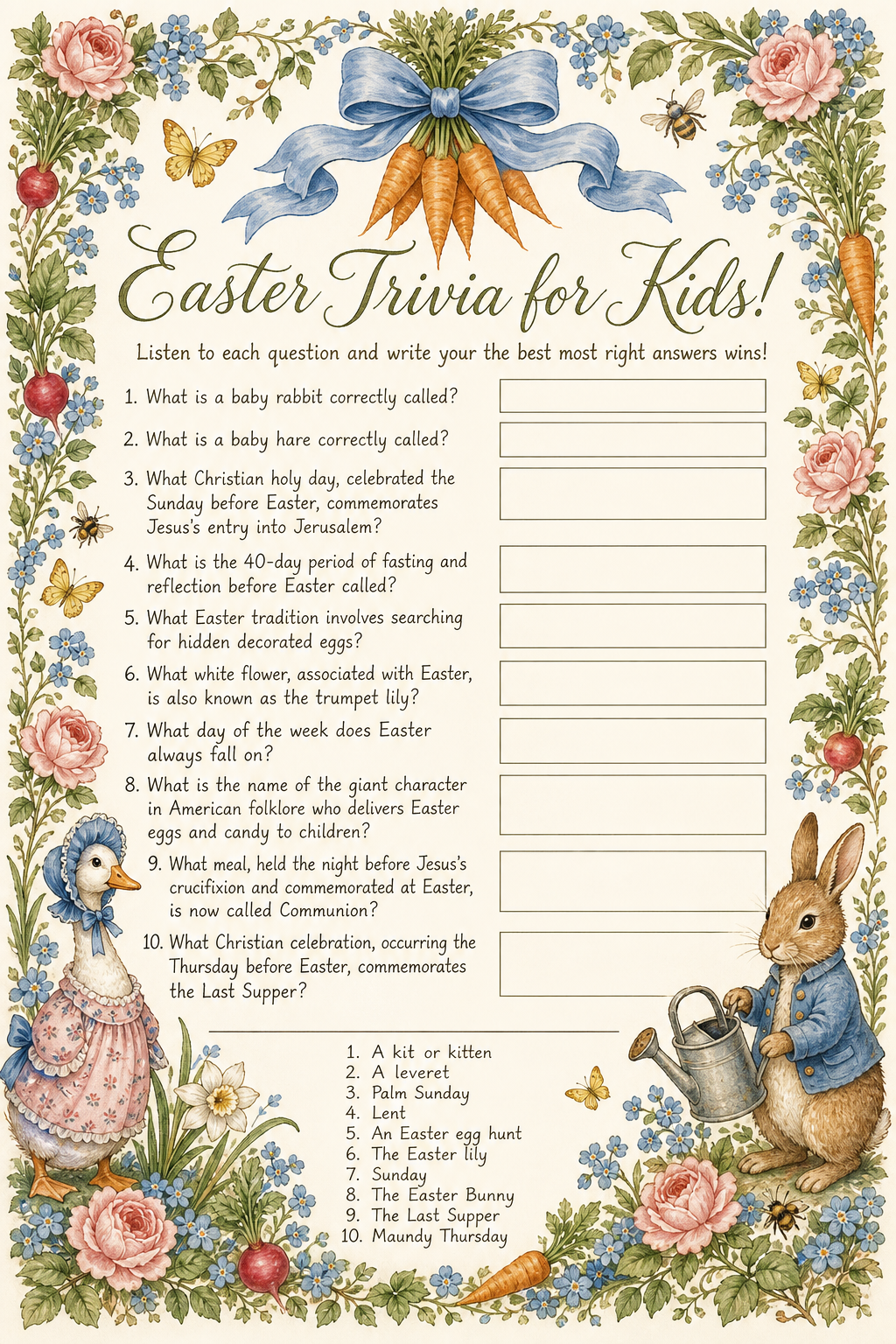
15. Easter Trivia for Kids
Easter Trivia for Kids is a brilliantly inclusive printable quiz game that you can run as a whole-group shout-out activity or hand out as individual sheets — your choice depending on your crowd.
The sheet has twenty fun, age-appropriate questions about Easter traditions, spring nature, and adorable animal facts (did you know a baby rabbit is called a kitten?).
Run it as a classroom-style quiz: read each question aloud and have the children write (or draw) their answer on their sheet, then reveal the correct answer together after everyone’s had a guess.
The child with the most correct answers at the end takes home a little prize — but honestly, the ‘baby rabbit is actually called a kitten’ fact alone is worth the whole game.
Print one sheet per child on standard paper and supply pencils.
For non-writers aged 3–6, run the whole thing as a verbal shout-out game with no sheets at all — read the question, say ‘whisper your answer to the grown-up next to you,’ then reveal together.
This version is wonderful for mixed ages because even the littlest kids can shout ‘BUNNY!’ when they know the answer and feel fully part of the game.
The sheet below is divided into four sections of five questions each (General Easter, Baby Animals, Spring Nature, and Colours and Shapes) numbered continuously 1 through 20, with a complete answer key in small italic text at the very bottom for the host.
The game runs for about fifteen to twenty minutes for a full twenty-question round, works for any group size, and requires absolutely no physical setup beyond printing and pencils. It’s one of the most effortlessly scalable easter party games for kids on this whole list.
Host tip: read each question in a slightly theatrical, game-show voice and pause dramatically before accepting answers — kids absolutely eat this up, and even the shyest child in the room will be whispering their answer to their neighbour with a huge grin.
A bit of hosting theatre costs you nothing and doubles the fun.
Read questions in your best game-show voice and pause for dramatic effect — it sounds silly but it genuinely doubles the excitement for every age group at the table.
16. Hot Boiled Egg
Hot Boiled Egg is the Easter spin on Hot Potato — and if that game wasn’t already fun enough, adding an egg and some very dramatic narration by the host takes it to another level entirely. All children sit in a circle.
A plastic Easter egg is passed rapidly around the circle from child to child while the host (you!) plays music or counts loudly.
When the music stops (or when you shout ‘Crack!’), whoever is holding the egg is ‘cracked’ and does a fun Easter-themed forfeit — hop like a bunny five times, cluck like a chick, do five star jumps — and then stays happily in the game.
This version has no elimination, just forfeits, which means every child stays engaged and nobody sits out feeling sad.
You need one plastic egg (large enough to hold comfortably but small enough to pass quickly), a speaker for music, and a list of four or five forfeit ideas.
Keep forfeits physical and funny rather than embarrassing — ‘do your best chick impression for five seconds’ is a guaranteed laugh; ‘tell us a secret’ is absolutely not on the list.
You can pre-write the forfeits on strips of paper tucked inside the egg, so the ‘cracked’ child opens the egg to find their forfeit, which adds a satisfying reveal moment.
This works brilliantly for ages 3–10 because the forfeits are immediately achievable for the youngest and delightfully silly for the oldest.
Hot Boiled Egg works for groups of five to twenty in a circle and runs for about ten to fifteen minutes over multiple rounds.
It’s an excellent indoor game for when the weather doesn’t cooperate and is one of those all-ages-together games that parents and helpers can join in without it feeling forced.
Host tip: vary the length between music stops — some rounds stop after five seconds, some after twenty — because predictable timing means the savvy eight-year-old at the party starts passing with suspicious speed at the exact moment they expect the music to stop.
Unpredictability is everything in this game.
No eliminations — everyone stays in the whole game. The forfeit system means getting ‘caught’ is actually the fun bit rather than a disappointment.
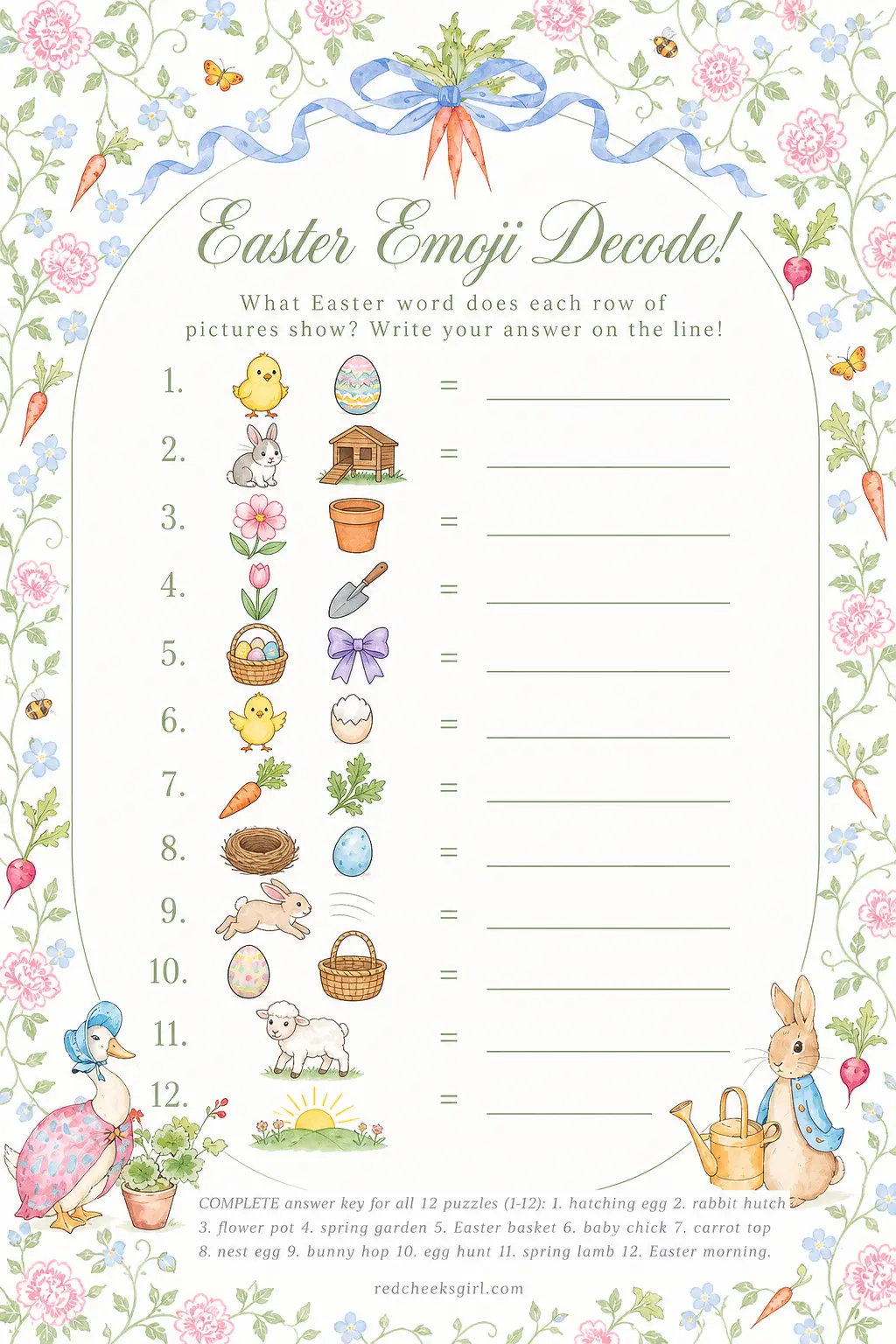
17. Easter Emoji Decode
Easter Emoji Decode is a printable guessing game where rows of small illustrated picture icons (a chick, a flower, a basket) represent an Easter-themed word or phrase — and players have to figure out what each sequence of icons is saying.
Think of it as picture-puzzle rebus decoding: the icons combine to suggest sounds or meanings that spell out the hidden answer.
For example, a picture of a bee + a tiny nest could decode to ‘been in a nest’ / ‘nest’ — or simpler still, a chick + a single egg icon means ‘baby chick’ or ‘hatching egg.’
The twelve puzzles on the sheet range from simple single-concept ones for younger players to fun two-step combinations for older kids.
Print one sheet per child and provide pencils. The icons are drawn as small, clean picture illustrations — NOT written-out words in brackets — so decoding is a genuine picture-reading challenge.
Each puzzle row ends with a blank write-in line where the player writes their answer. For the 3–5 age group, work through the first three puzzles as a whole group so they understand the concept, then let them attempt the rest with a partner.
For ages 7–10, it’s a satisfying solo challenge. Run it as a race (first to decode all twelve wins) or as a cooperative group activity where everyone shouts out their ideas together.
This game runs beautifully in ten to fifteen minutes, suits groups of any size, and generates the most wonderful little debates (‘Is that a carrot or a rocket?’) that you’ll be repeating as family legends for years.
It requires no physical setup beyond printing and is one of those easter party games for kids that children genuinely want to take home and show their parents.
Host tip: do a loud, theatrical read-through of puzzle number one together as a group before anyone starts writing — the concept of ‘picture clues’ is obvious to adults but not necessarily obvious to a four-year-old who has never played a rebus puzzle before, and thirty seconds of explanation saves five minutes of confused expressions.
- Look at each row of picture icons
- Figure out what Easter word or phrase they represent
- Write your answer on the blank line after each row
- First to decode all 12 correctly wins!
18. Spring Scavenger Hunt
Spring Scavenger Hunt is a garden game that sends kids exploring with purpose — no random running, just focused, curious wandering that even the most easily distracted three-year-old can get into with a helper by their side.
Give each child (or pair of children) a checklist of ten things to find in the garden or party space: something yellow, a smooth pebble, a flower with five petals, a leaf bigger than your hand, something that smells nice, a bug (spotted only, no touching!), a seed pod, something soft, a feather, and something that makes a sound in the wind.
They check off or circle each item as they find it — no collecting required, just spotting and ticking. First team to tick all ten wins.
Print one checklist sheet per child or pair on standard paper, include small pencils or crayons for ticking, and set clear boundaries (‘stay within the garden fence’ or ‘between the patio and the apple tree’).
For indoor parties, adapt the list: something blue, something round, something furry, something made of wood, something that slides, something that bounces, a book about animals, something stripy, something sparkly, something square.
The indoor version is just as engaging and takes only slightly longer because kids dig into corners of the room with enormous determination. You can run this entirely independently once kids have their sheets, giving you a wonderful five to ten minutes to sort snacks.
Spring Scavenger Hunt works for four to thirty children either solo or in pairs, takes about fifteen minutes, and is deeply satisfying for the 5–10 age group while remaining accessible (with adult support) for the 3–4 group.
It’s also one of those easter party games for kids that naturally slows the party’s pace in the best way — everyone comes back calmer, chattier, and full of discoveries to share.
Host tip: pair an older child with a younger one deliberately rather than leaving it to chance — the older child becomes a wonderful mini-guide, the younger child adores the attention, and you get genuine cross-age cooperation without any adult effort whatsoever.
- Ages 4–10, pairs work best
- Outdoors in a garden or park space
- Doubles as a calming transition between high-energy games
19. Chick Hatch Balloon Pop
Chick Hatch Balloon Pop is a riotously fun Easter game that taps into every child’s irresistible urge to pop things.
Before the party, stuff small pieces of paper inside yellow balloons before inflating them — each paper slip has a mini Easter challenge, a silly forfeit, or a small prize token written on it (‘Do ten chick hops!’, ‘Prize token — swap for a sticker!’, ‘Cluck like a chicken for 5 seconds!’).
Blow the balloons up, tie them, and pile them in a ‘giant nest’ (a hula hoop on the ground works perfectly). Each child takes turns picking one balloon from the nest and sitting on it to ‘hatch’ it.
They read out (or an adult reads) what’s inside and complete their challenge or claim their prize.
You’ll need one balloon per child plus a few spares, yellow balloons for the best chick-hatching effect, and small slips of paper with challenges pre-written.
Make about a third of the slips prize tokens, a third silly forfeits, and a third Easter trivia questions (right answer = bonus sweet).
Tie the balloons loosely rather than tightly so they pop with a satisfying pop rather than requiring the full weight of an adult to dislodge.
Younger children aged 3–4 may need help sitting on the balloon without fear — sit together with them the first time so they see it’s just a pop and not a scary explosion.
Chick Hatch Balloon Pop works for groups of six to twenty over about fifteen minutes and doubles as a prize-giving activity so you don’t need a separate podium moment.
It’s genuinely one of the most memorable easter party games for kids because the sensory drama of the pop is completely unforgettable. (Also a great photo opportunity.)
Host tip: inflate the balloons the night before and store them in a large bin bag — day-of balloon inflating with a lungful of helium you forgot to buy is a situation best avoided.
And skip the helium entirely: these balloons need to sit in a hoop on the ground, not float away into next-door’s garden.
- 1 yellow balloon per child plus spares
- Printed or handwritten challenge/prize slips (1 per balloon)
- A hula hoop as the ‘giant nest’ on the ground
🛍 Shopping guide
20. Easter Basket Mad Libs
Easter Basket Mad Libs is the printable game that produces the funniest results of anything on this list — and the even better news is that kids have absolutely no idea how funny it’s going to be until you read the story aloud at the end.
Each child gets a sheet with a short Easter story about a bunny delivering eggs, but key words have been replaced with numbered blanks.
Before anyone sees the story, the host asks the group to shout out words to fill each blank: ‘Give me a funny animal!’ (blank 1), ‘Give me a silly noise!’ (blank 2), ‘Give me a colour!’ (blank 3), and so on.
These are written into the blanks on everyone’s sheet simultaneously. Then you all read the finished story aloud together — and the results are magnificently absurd.
Print one sheet per child on standard paper and provide pencils.
The sheet has a short twenty-to-thirty word story with eight to ten blanks calling for words like an adjective, an animal, a number, a colour, a silly noise, a type of food, a name, and an action word.
For children aged 3–6 who can’t yet write confidently, pair them with an older child or adult who writes the words in for them — they still shout out all the words and feel completely part of the game.
Read the finished stories aloud at the end as a group for maximum comedy effect. If you have multiple groups, compare stories — you’ll have at least five wildly different versions of the same tale.
Easter Basket Mad Libs takes about fifteen minutes including the reading-aloud section, works for any group size from four to thirty, and is a beloved format for ages 5–10 in particular (the 7–10 crowd will request it again immediately after finishing).
It’s also one of those gentle, cooperative easter party games for kids where nobody wins or loses — you all just end up laughing together, which is honestly a better outcome anyway.
Host tip: write the categories on the board or read them aloud before collecting answers, and deliberately avoid saying ‘what comes after this word in the story’ — keeping the story secret until the reveal is the whole punchline.
A single spoiler kills the joke completely.
- Host calls out what type of word is needed for each blank (colour, animal, silly noise…)
- Kids shout out their answers WITHOUT seeing the story — that’s the key!
- Everyone fills in the same words, then reads the finished story aloud together for maximum chaos

21. Rabbit Tail Bean Bag Toss
Rabbit Tail Bean Bag Toss is a throwing game with a brilliant Easter twist: a large cardboard box decorated to look like a cartoon bunny’s bottom, complete with a big round tail hole cut in the middle.
Players take turns standing behind a throwing line and tossing small white bean bags (or pompom balls — the fluffier the better) through the hole. Each successful ‘tail throw’ scores a point. Miss the hole and score nothing.
Play to ten points or give each child five throws and compare scores. The bunny-bum theme is undeniably silly, which is precisely why every child at the party will be absolutely delighted by it.
DIY the box the evening before: a large cardboard box, a circle cut in the middle, white and grey paint or paper to cover it, two large cardboard circles for ears on top, and a bold black nose and eyes on the front facing away from players (they see the ‘back’ of the bunny).
The circle hole should be about twenty centimetres in diameter for younger players and fifteen centimetres for the challenge version for older kids. Set the throwing line at one and a half metres for ages 3–5 and two to three metres for ages 6–10.
Bean bags work better than balls because they don’t bounce out — but white pompom balls from a craft shop are an adorably on-theme alternative.
Rabbit Tail Bean Bag Toss handles four to sixteen children over ten to fifteen minutes, works equally well indoors and outdoors, and requires practically no bought materials if you have a spare cardboard box and a bit of craft paint.
It’s also a game where every age can genuinely compete because you simply adjust the throwing distance — the same box serves a three-year-old and a ten-year-old with a minor step backward.
Host tip: prop the box at a slight angle (tilt it forward fifteen degrees using a folded towel underneath) so the hole faces slightly upward — this means underarm tosses from short kids land inside rather than bouncing off the bottom edge, dramatically increasing everyone’s hit rate and therefore everyone’s happiness.
Adjustable throwing distance means the exact same game genuinely challenges every age from 3 to 10 — just step the older kids back two metres and you’re done.
🛍 Shopping guide
22. Easter Feelings Colouring Keepsake
Easter Feelings Colouring Keepsake is the calm, creative wind-down game for the end of the party — or a perfect quiet corner activity for shy children who need a moment away from the group energy.
Each child gets a simple, beautiful keepsake sheet featuring a large Easter scene (a meadow, a chick, spring flowers) divided into areas they can colour freely however they like, plus a small prompt section at the bottom with three sentence starters: ‘My favourite part of today was…’, ‘My favourite Easter food is…’, and ‘Next Easter I want to…’
Children colour the scene and fill in the prompts, then take the finished sheet home as a memory of the party.
Print on standard paper or thicker cartridge paper for a more luxurious feel.
Provide a nice set of coloured pencils or crayons — this is the one game where quality of colouring materials genuinely shows in the end result, so if you have nice pencils, break them out now.
For non-writers, the three prompts can be answered verbally to an adult who writes the child’s exact words in for them, which makes the keepsake even more charming.
The sheet includes the party date as a blank line the host fills in before printing: ‘Party date: ________’ so children remember when this was.
This activity takes fifteen to twenty minutes, suits any number of children, and is the quietest, most companionable thing on the list — perfect background music, low voices, a table full of focused colouring.
Parents consistently tell me it’s the thing their child treasures most from a party because it has their own words and colours on it.
Host tip: if you’re planning to use this as a craft keepsake moment similar to a Mother’s Day gift activity, have children sign their name in the corner in their own handwriting before they leave — small ones especially are fiercely proud of their name in their own handwriting and will announce it to approximately everyone in the building.
- End-of-party wind-down or quiet corner for shy guests
- Ages 3–10 (adjust prompt help by age)
- Doubles as a party favour — every child takes home something they made

🛍 Shopping guide
23. Guess How Many Eggs
Guess How Many Eggs is the classic guessing-jar game dressed up in its Easter finest — and it’s a beautiful, low-key activity that can run quietly in the background for the whole party while everything else is happening around it.
Before the party, fill a clear jar with small wrapped chocolate mini eggs or jellybeans, count them carefully, and write the number down somewhere secret. Display the jar prominently at the party entrance or on the snack table.
Give each child a small slip of paper and a pencil to write their name and their guess. At the end of the party, reveal the real number and whoever guessed closest wins the whole jar — which is, obviously, an absolutely legendary prize.
You need one clear glass or plastic jar (a large mason jar or a wide-mouth sweet jar works brilliantly), enough small eggs or sweets to fill it, slips of paper, pencils, and a prize label to stick on the jar.
Count the contents as you fill it — this sounds obvious but in the excitement of party prep it is genuinely easy to lose count and have to start over.
Set the jar at a height where children can peer at it from multiple angles, which influences their guessing strategy in delightful ways.
Provide a reference card next to the jar (‘Each sweet is about this big: ●’) to give younger children a helpful comparison without giving the answer away.
Guess How Many Eggs needs zero running time — it just sits there being tempting — and works for any number of children.
It’s one of the most naturally engaging easter party games for kids because the jar draws every single child in as soon as they arrive, sets up a party-long suspense, and ends with a glorious big reveal moment that makes the whole room go ‘OHHHH!’
Host tip: if you have a large age spread, run two jars — a small jar with ten to thirty sweets (for the under-5s whose guesses will be delightfully in the range of ‘3’ and ‘1,000,000’) and a larger jar for the 6–10 age group.
It keeps the guessing challenge age-appropriate and means you have two satisfying winners at the reveal.
Run two jars — one small (10–30 sweets) for under-5s and one large for 6–10s. Two winners, two reveal moments, double the drama.
🛍 Shopping guide
Frequently Asked Questions
What are the best Easter party games for kids aged 3–5?
For the 3–5 age group, the best Easter party games are ones with simple rules and immediate action.
Chick Freeze Dance, Easter Picture Bingo, and Bunny Hop Relay are all brilliant for this age because there’s no reading required, no complex strategy, and every child feels successful.
Egg and Spoon Race also works beautifully if you use large spoons and plastic eggs and keep the course short — about three to four metres is plenty for little legs.
The golden rule for this age group is: no eliminations, no long waits between turns, and lots of enthusiastic cheering from adults.
How many games should I plan for a two-hour Easter party?
For a two-hour party with kids aged 3–10, plan for four to six games — that gives each game roughly fifteen to twenty minutes with transitions built in.
A good formula is: one energetic opener (like Bunny Hop Relay), one printable quiet activity (like Easter Picture Bingo or Colour by Number), one big active game (like Egg Toss Buckets or the Obstacle Course), one final whole-group game (like Chick Freeze Dance), and then the Guess How Many Eggs reveal as a closing ceremony.
Have one or two backup games ready in case you finish early — Easter Feelings Colouring Keepsake is perfect for filling the last fifteen minutes while parents arrive.
Can Easter party games for kids work indoors?
Absolutely — nearly every game on this list works indoors with minor adaptations. The Egg and Spoon Race, Bunny Hop Relay, and Egg Colour Sorting Relay all work in a cleared hallway or living room.
Egg Toss Buckets works indoors with lighter plastic eggs and baskets placed on a non-slippery surface. The printable games (Bingo, I Spy, Trivia, Matching, Mad Libs, Emoji Decode) require zero outdoor space at all.
The main things to clear before starting indoor active games are fragile ornaments, rugs that could slip, and any furniture with sharp corners at child height.
What do I need to buy for an Easter party game set?
You honestly need very little to run a full Easter party.
The essentials are: a bag of plastic Easter eggs (one bag handles four or five different games), a set of large wooden or plastic spoons, painter’s tape for marking courses, a speaker for music games, and basic craft supplies (pencils, crayons, cardstock) for printable games.
If you print the game sheets from this list, you have five printable activities at zero cost beyond ink and paper.
Optional extras that elevate the party: bunny ear headbands, mini wrapped chocolate eggs as game counters, and a clear jar for Guess How Many Eggs. Total budget for a well-stocked game station is genuinely under £20 or $25.
How do I handle mixed ages (3-year-olds and 10-year-olds) in the same games?
Mixed ages are actually easier than they look with the right setup. For physical games, simply use a shorter course or closer throwing line for younger children — the same game runs simultaneously at different difficulty levels.
For printable games, pair a younger child with an older one as a reading helper: the older child feels important and helpful, the younger child stays fully engaged. For competitive games, group children by age rather than random teams.
Games like Chick Freeze Dance, Hot Boiled Egg, Easter Basket Mad Libs, and Easter Picture Bingo work beautifully across the full 3–10 range with zero adaptation because they don’t require reading or physical precision.
Are there Easter party games that work as take-home party favours?
Yes — several games on this list double as keepsakes! The Easter Feelings Colouring Keepsake sheet is designed specifically to go home with children as a memory of the day.
Easter Colour by Number, Easter I Spy, Easter Emoji Decode, and Easter Basket Mad Libs are all printable sheets that children naturally want to keep and show their parents.
Easter Picture Bingo cards can be taken home too — they’re essentially personalised Easter art by the end of the party.
Sending children home with something they made or played with at the party is a lovely touch that costs almost nothing and makes parents very happy on the walk to the car.
📌 Save These for Later
Loved these? Pin your favorite image below so you can find this list again when you’re planning.
Discover 22 fun Easter party games for kids ages 3–10, from egg-and-spoon races to printable bingo
Twenty tried-and-tested Easter games for large groups, perfect for church halls, community centers,

Discover 18 fun Easter games for adults perfect for brunch, backyard gatherings, and lightly competi
Leave a Reply