


The this or that questions game is one of the few party games that works for any age, any crowd size, and zero prep time beyond printing a card deck. Every player picks a side, the room splits, and suddenly everyone has an opinion about things they have never thought about before. Six rounds, 84 pairs, one winner: here is everything you need to run it properly.
This post contains affiliate links. If you buy through them, I may earn a small commission at no extra cost to you.
How to Play It as a Game, With Scoring
Divide players into two teams of any size, or play as individuals if the group is small. A host reads one pair aloud (or holds up a card) and every player commits to a choice before anyone else speaks, either by raising a hand, moving to a side of the room, or writing a letter on a scrap of paper. In team play, a team earns one point for every member who matches the majority vote of that team: so if five of six teammates choose mountains over beach, those five score. In individual play, the player who guesses which option the full group will pick more often scores the point, making it a read-the-room game rather than a personal-preference quiz. Run all twelve pairs in a round, tally scores, then move to the next round. Rounds escalate in difficulty: easy warm-up pairs come first, the tie-breaker round comes last, and the tie-breaker is played one pair at a time, sudden-death, until one team or player pulls ahead.
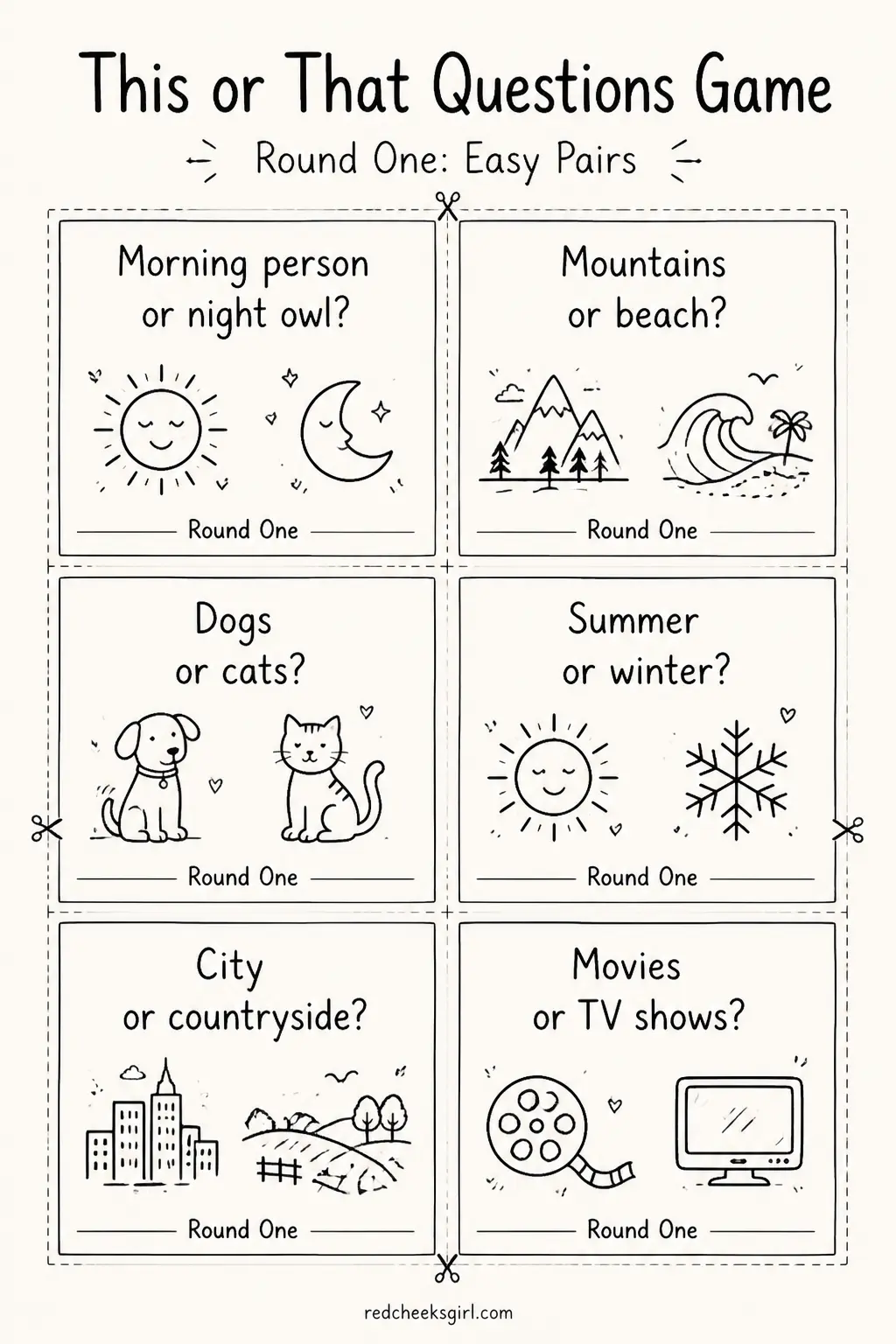
Round One: Easy Pairs
Start here to warm the room up: these pairs are obvious enough that almost everyone has a fast answer, which gets players talking before the harder rounds arrive.
- Morning person or night owl?
- Mountains or beach?
- Dogs or cats?
- Summer or winter?
- City or countryside?
- Movies or TV shows?
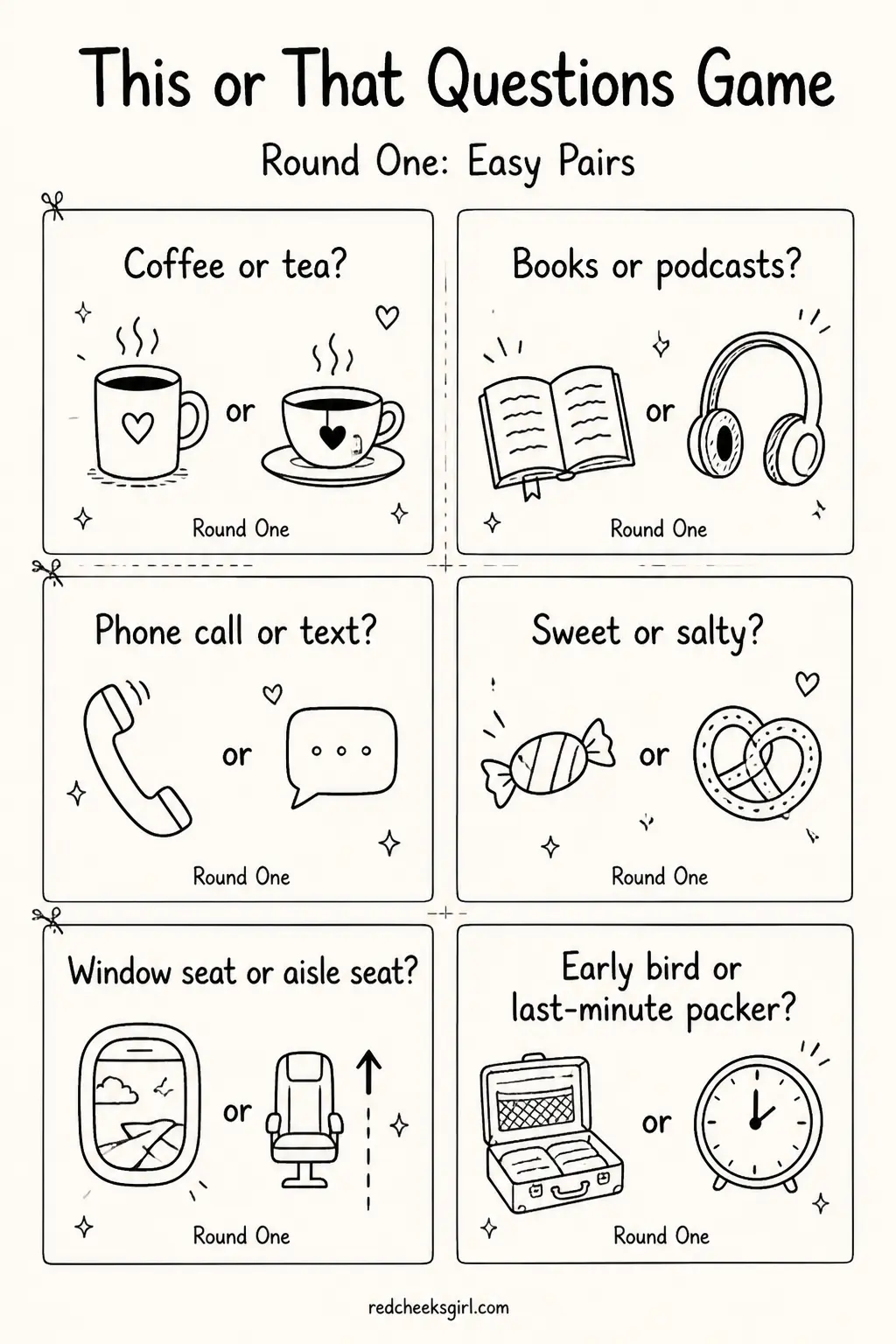
- Coffee or tea?
- Books or podcasts?
- Phone call or text?
- Sweet or salty?
- Window seat or aisle seat?
- Early bird or last-minute packer?
Round Two: Food
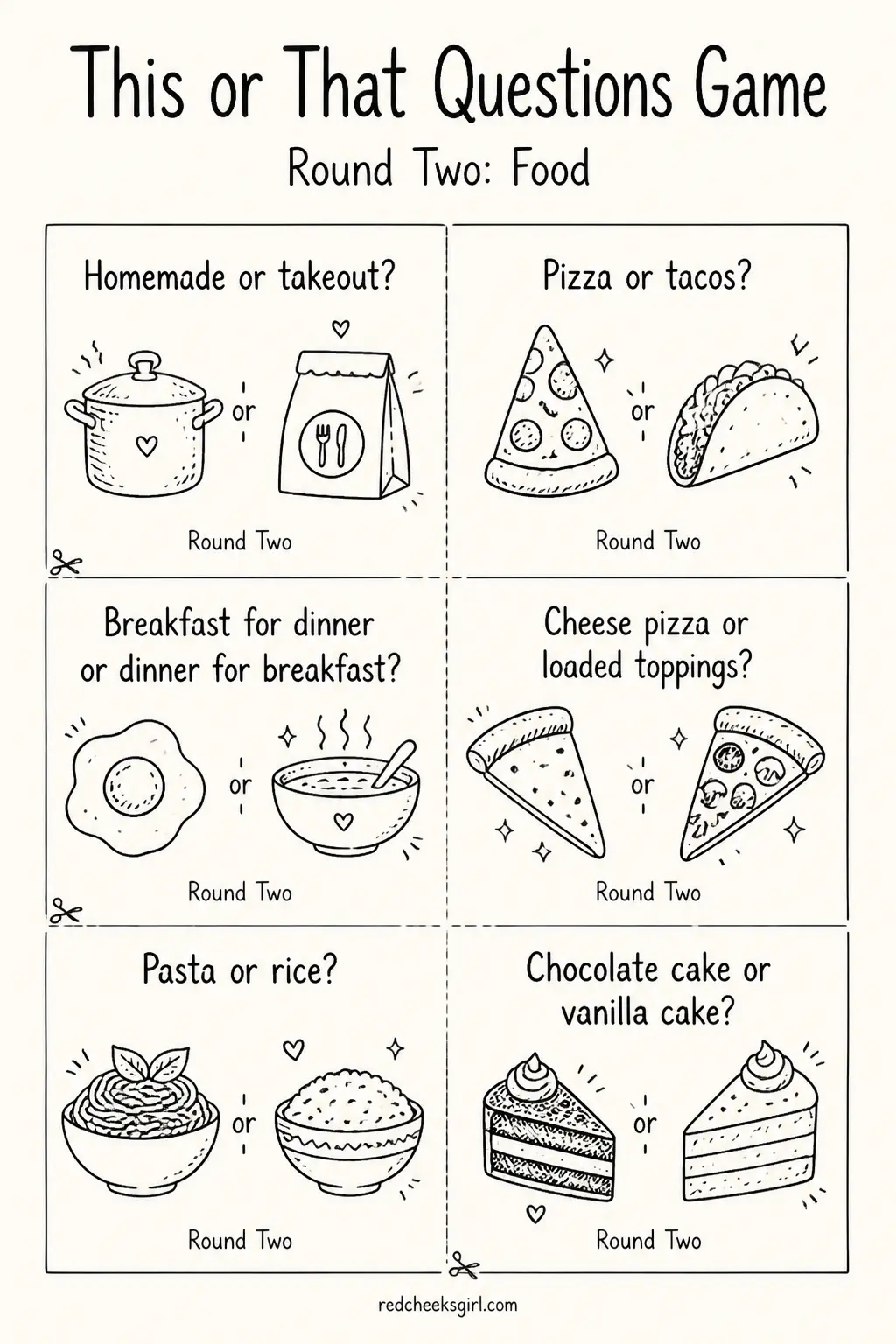
Food pairs work because everyone has a real preference and almost no one stays quiet: expect the room to argue these more than any other round.
- Homemade or takeout?
- Pizza or tacos?
- Breakfast for dinner or dinner for breakfast?
- Cheese pizza or loaded toppings?
- Pasta or rice?
- Chocolate cake or vanilla cake?
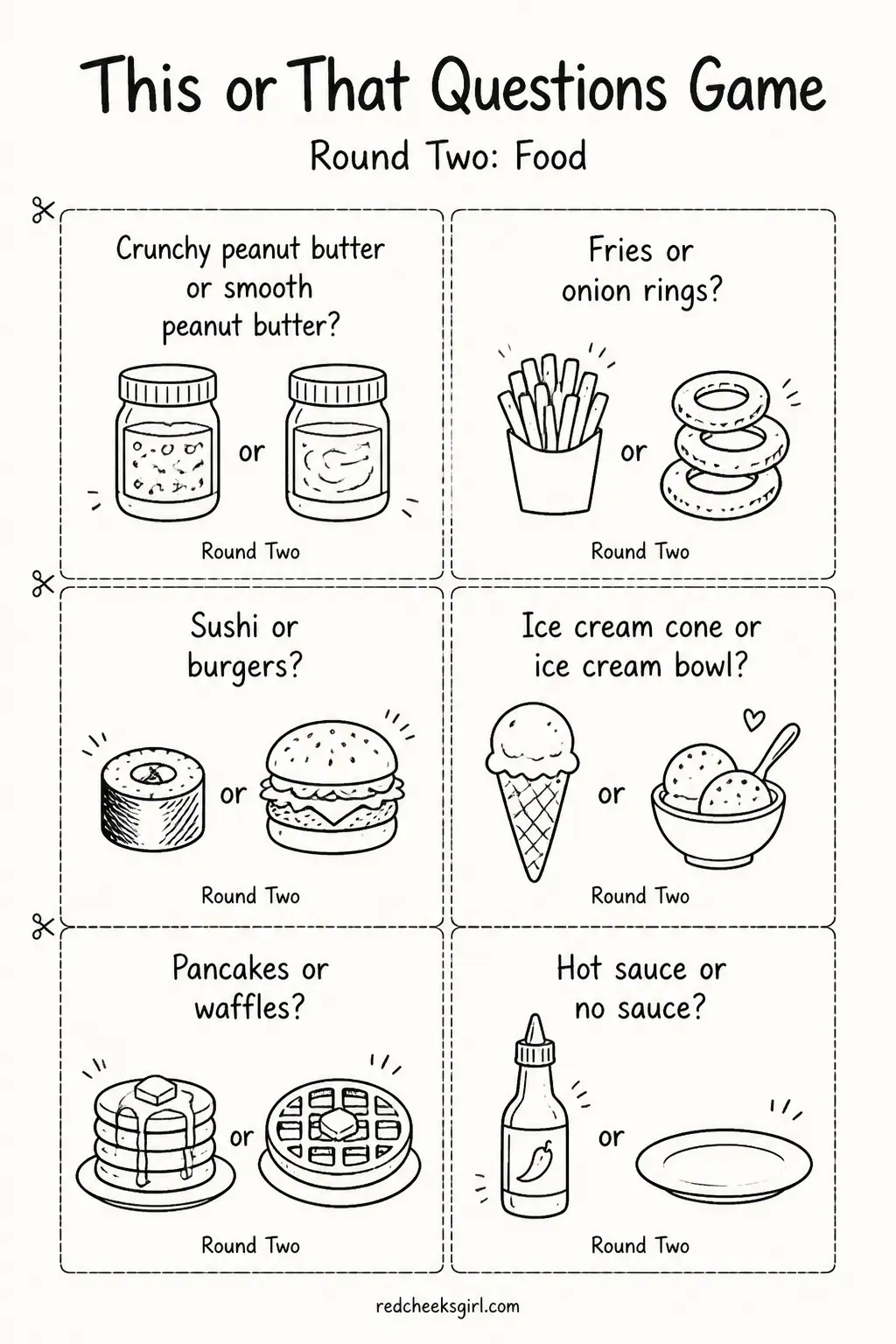
- Crunchy peanut butter or smooth peanut butter?
- Fries or onion rings?
- Sushi or burgers?
- Ice cream cone or ice cream bowl?
- Pancakes or waffles?
- Hot sauce or no sauce?
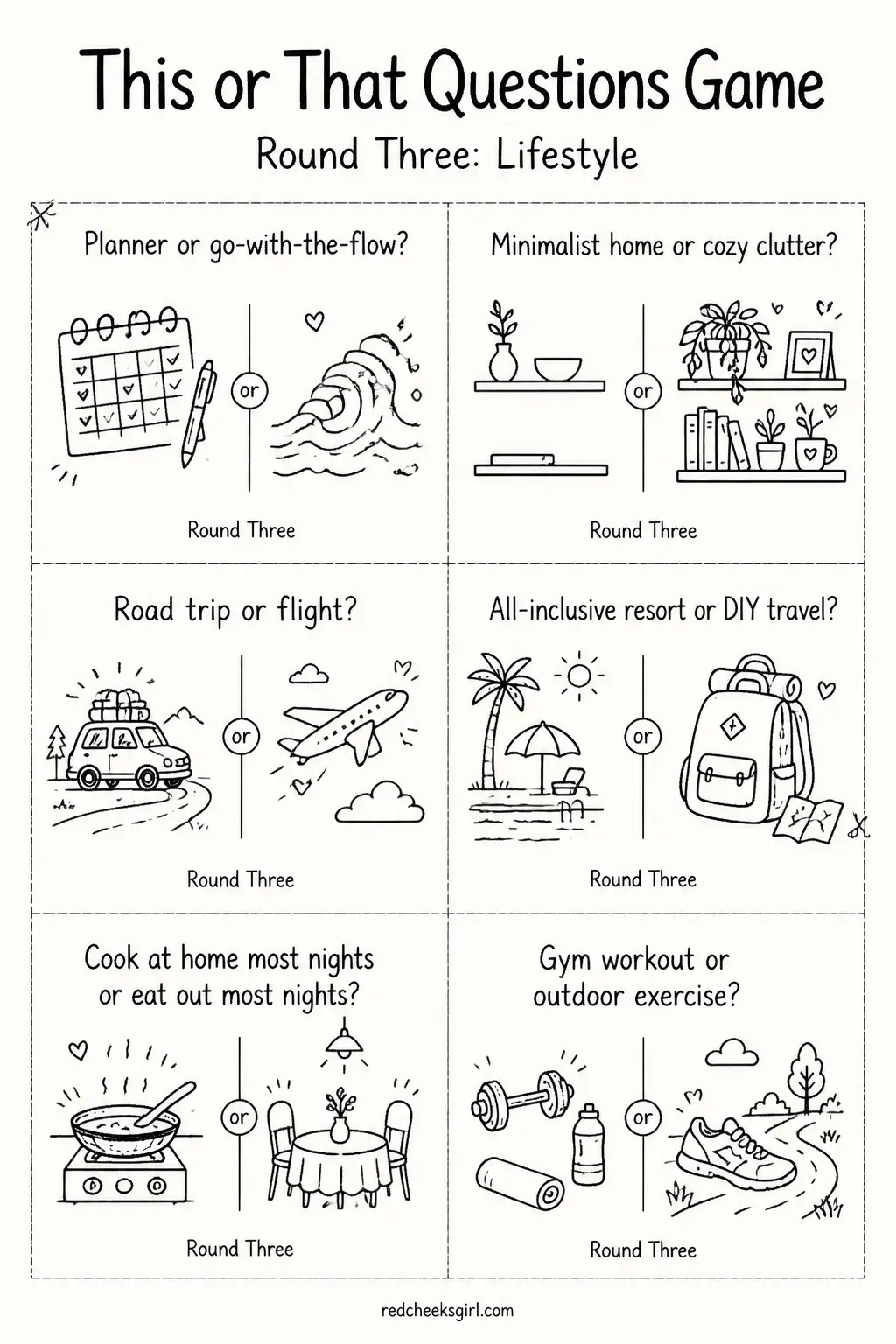
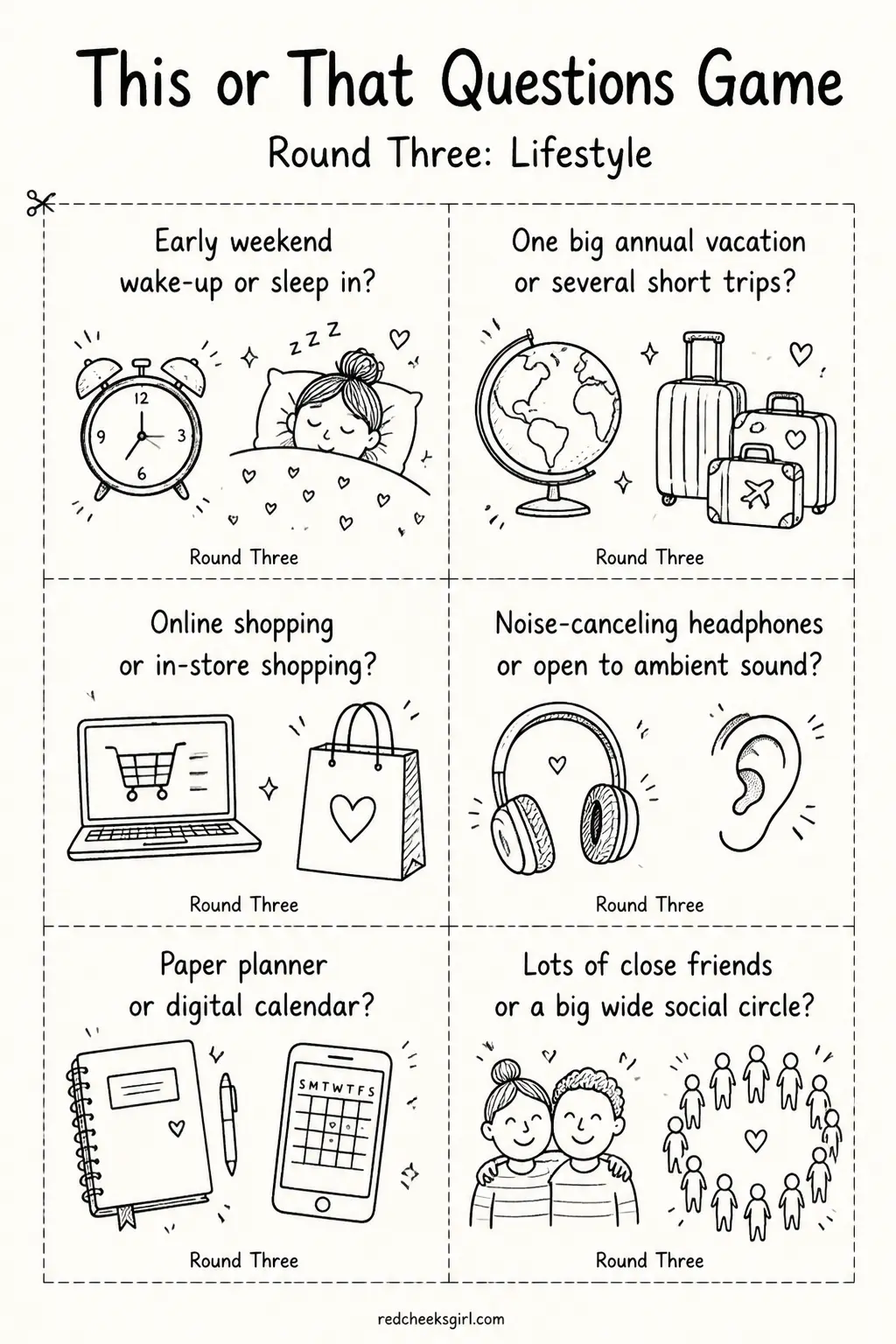
Round Three: Lifestyle
Lifestyle pairs reveal how people actually live versus how they imagine they do, which makes the reveal moment genuinely funny.
- Planner or go-with-the-flow?
- Minimalist home or cozy clutter?
- Road trip or flight?
- All-inclusive resort or DIY travel?
- Cook at home most nights or eat out most nights?
- Gym workout or outdoor exercise?
- Early weekend wake-up or sleep in?
- One big annual vacation or several short trips?
- Online shopping or in-store shopping?
- Noise-canceling headphones or open to ambient sound?
- Paper planner or digital calendar?
- Lots of close friends or a big wide social circle?
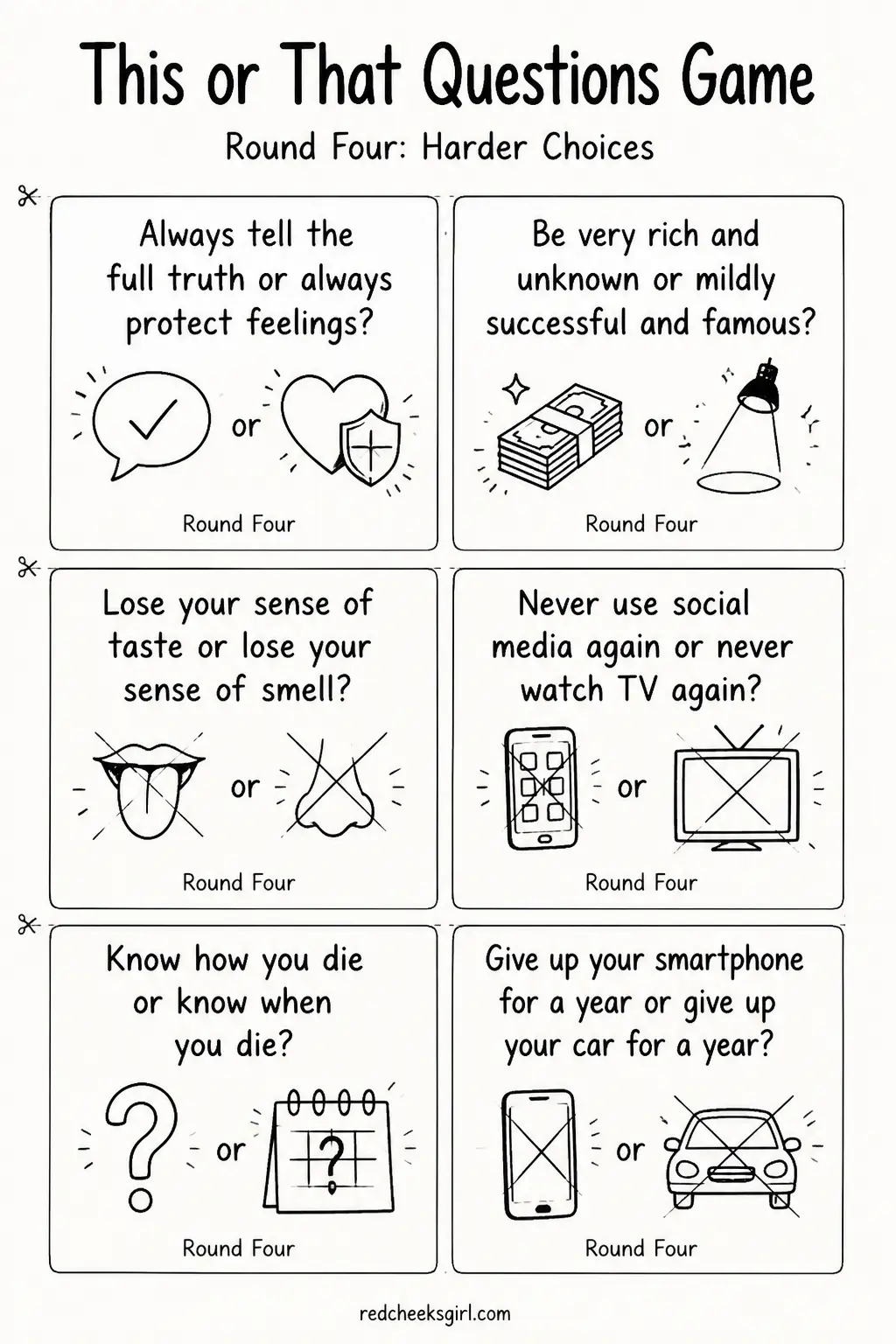
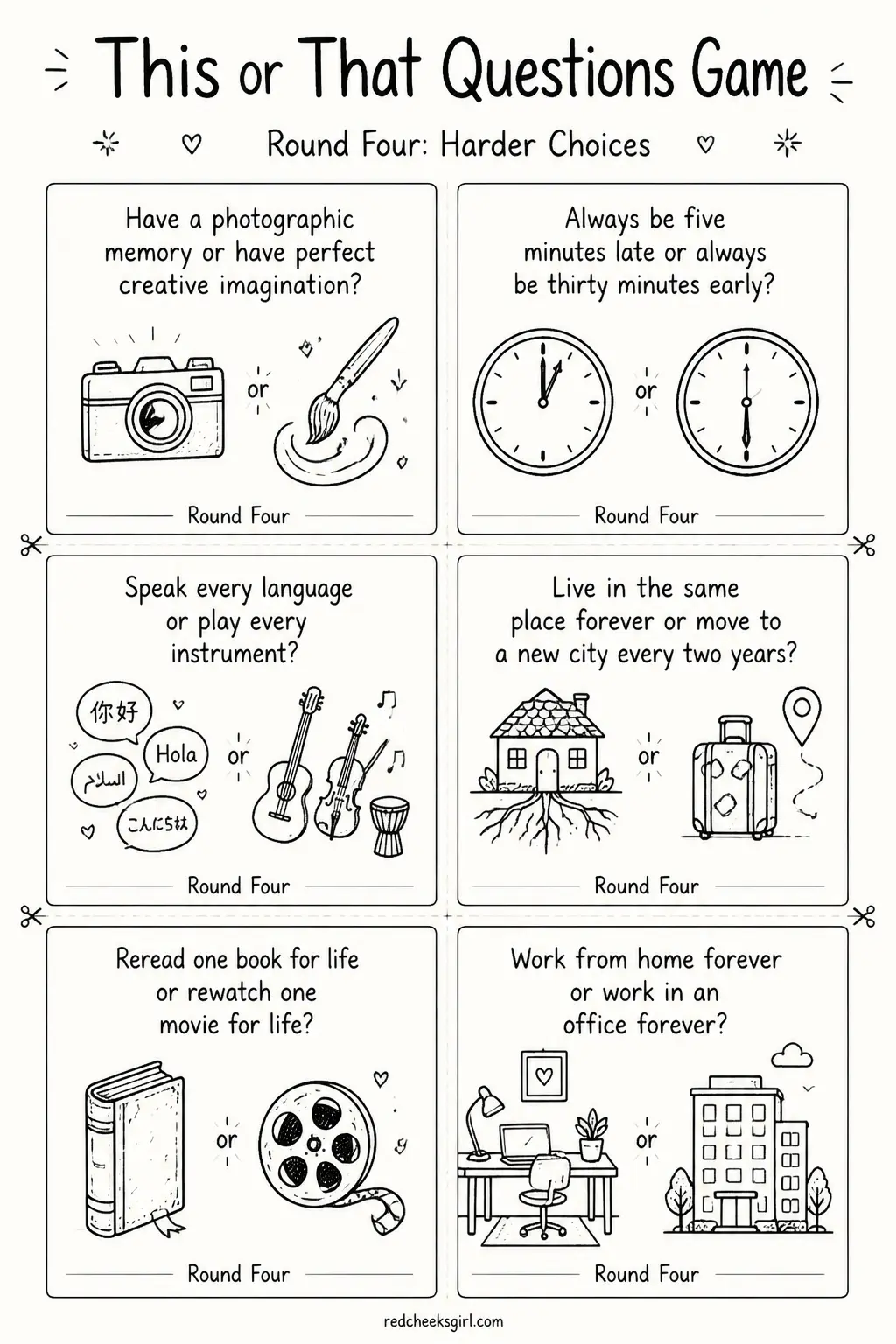
Round Four: Harder Choices
These pairs are deliberately uncomfortable because both options cost something real: expect pauses, second-guessing, and the first genuine arguments of the night. A link to 120 Would You Rather Questions has more of this style if you want to extend the night.
- Always tell the full truth or always protect feelings?
- Be very rich and unknown or mildly successful and famous?
- Lose your sense of taste or lose your sense of smell?
- Never use social media again or never watch TV again?
- Know how you die or know when you die?
- Give up your smartphone for a year or give up your car for a year?
- Have a photographic memory or have perfect creative imagination?
- Always be five minutes late or always be thirty minutes early?
- Speak every language or play every instrument?
- Live in the same place forever or move to a new city every two years?
- Reread one book for life or rewatch one movie for life?
- Work from home forever or work in an office forever?
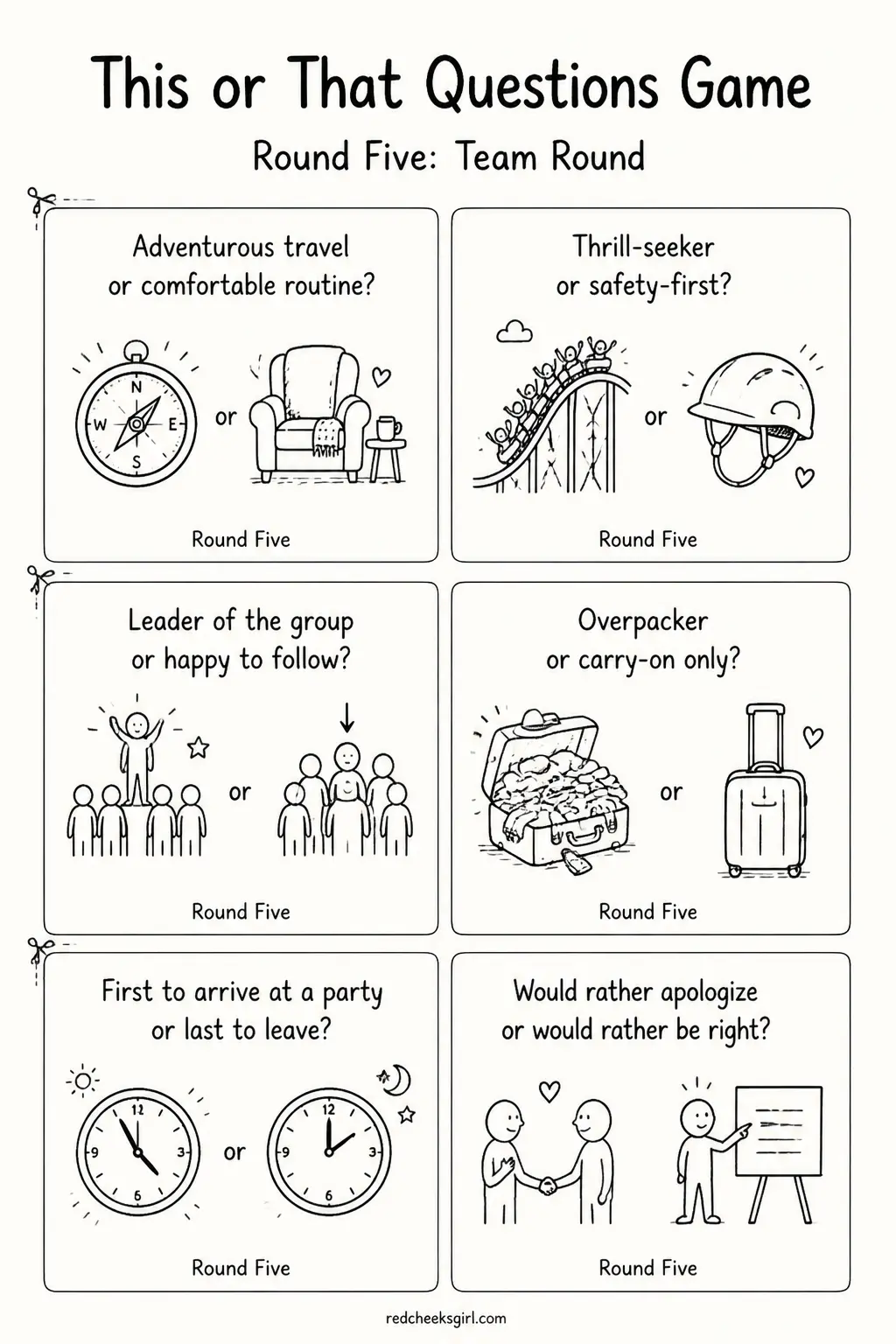
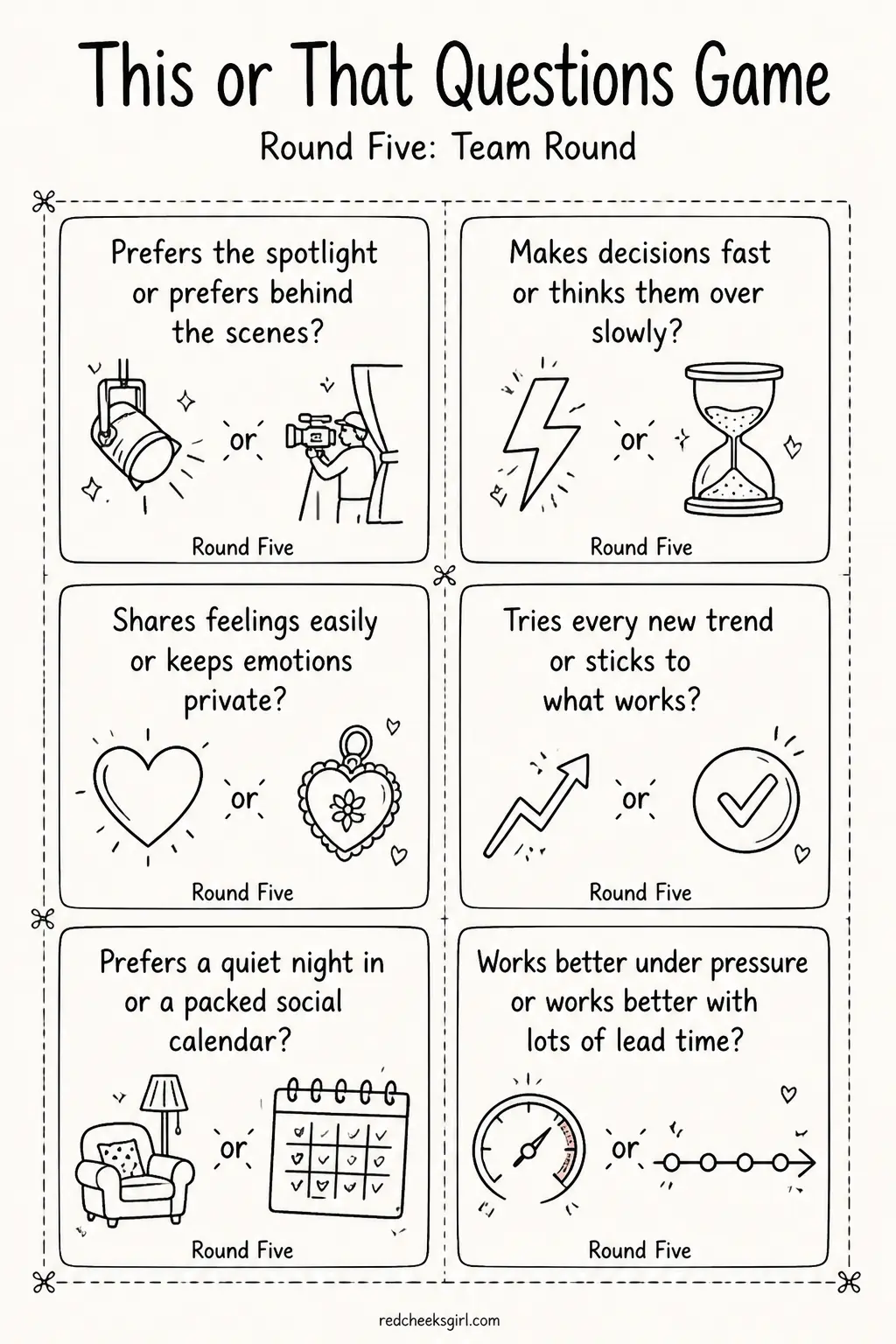
Round Five: Team Round
The team round runs on prediction: before the host reads the pair, each team privately writes down which option they think the OTHER team will pick more, then scores a point for every correct prediction. It flips the game from preference to strategy. If you enjoy party games for teenagers, this round translates perfectly to a younger crowd too.
- Adventurous travel or comfortable routine?
- Thrill-seeker or safety-first?
- Leader of the group or happy to follow?
- Overpacker or carry-on only?
- First to arrive at a party or last to leave?
- Would rather apologize or would rather be right?
- Prefers the spotlight or prefers behind the scenes?
- Makes decisions fast or thinks them over slowly?
- Shares feelings easily or keeps emotions private?
- Tries every new trend or sticks to what works?
- Prefers a quiet night in or a packed social calendar?
- Works better under pressure or works better with lots of lead time?
Round Six: The Tie Breaker
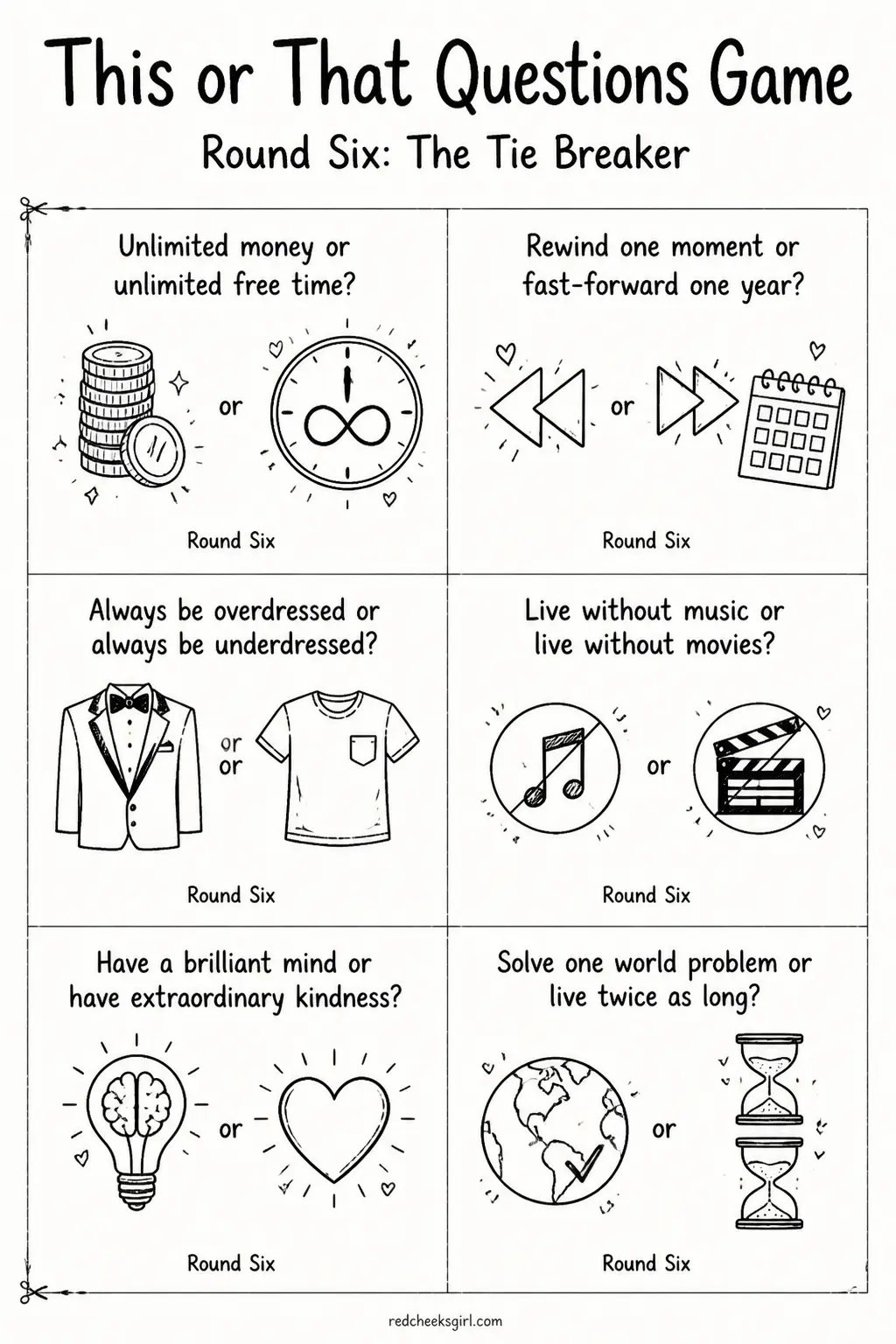
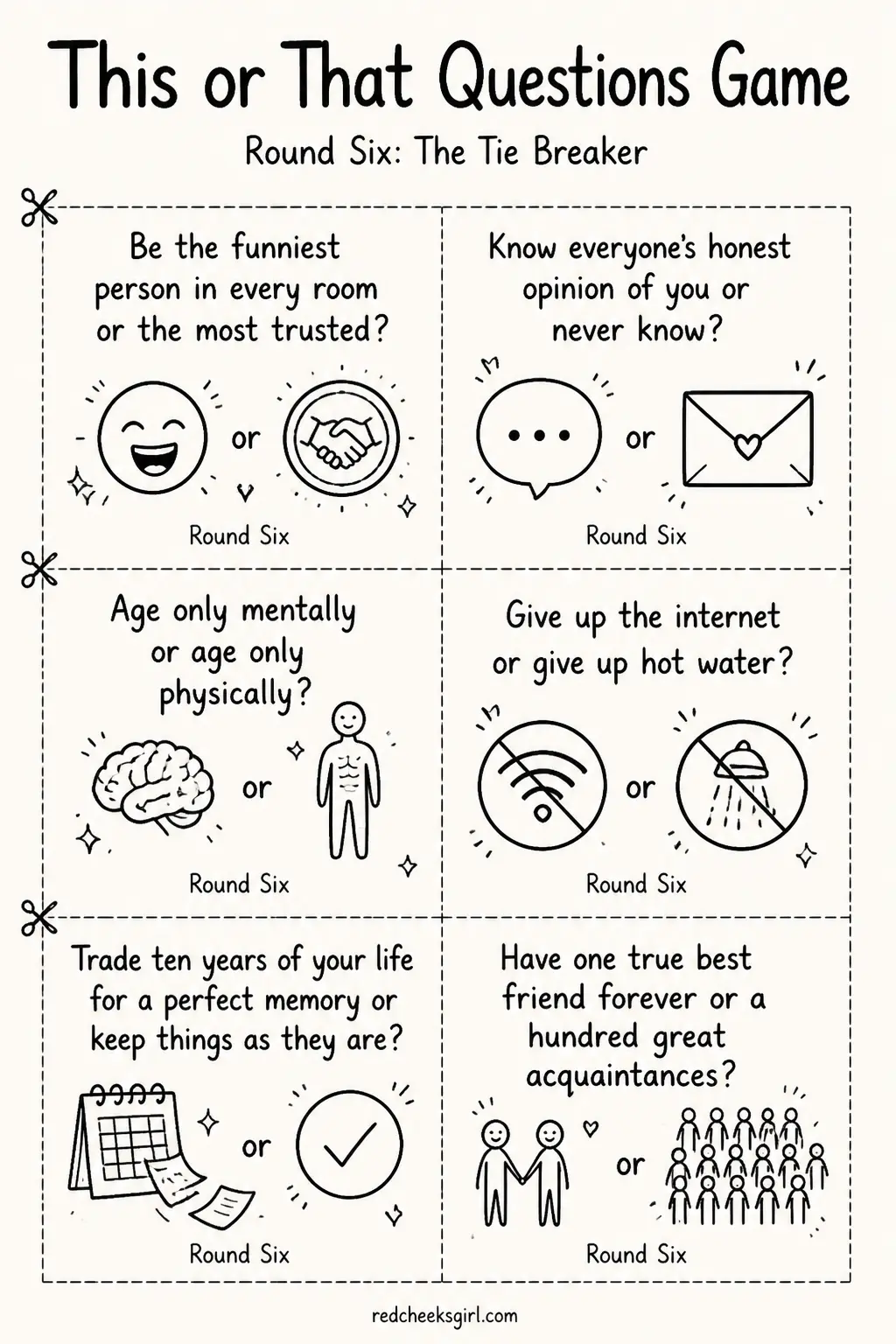
Play these one at a time, sudden-death: the first team or player to score three in a row wins the game. These pairs are the hardest to call because the room genuinely splits on all of them. For more games that work the same way, these Christmas games for large groups use a similar reveal mechanic.
- Unlimited money or unlimited free time?
- Rewind one moment or fast-forward one year?
- Always be overdressed or always be underdressed?
- Live without music or live without movies?
- Have a brilliant mind or have extraordinary kindness?
- Solve one world problem or live twice as long?
- Be the funniest person in every room or the most trusted?
- Know everyone’s honest opinion of you or never know?
- Age only mentally or age only physically?
- Give up the internet or give up hot water?
- Trade ten years of your life for a perfect memory or keep things as they are?
- Have one true best friend forever or a hundred great acquaintances?
How to Keep It Moving and When to Stop
The one rule that saves every game night: set a timer. Give each pair thirty seconds from reading to reveal, and stick to it even when the debate is good. Argument is the point, but dragging one pair past its moment kills the energy for the next five.
If the group is large, skip the hand-raise and use movement instead: one side of the room means option A, the other means option B. Splits are visible instantly, scoring takes five seconds, and no one can cheat by watching others first.
Know when to call the final round. Six rounds at twelve pairs each gives you seventy-two decisions plus a sudden-death tie-breaker, which lands at roughly forty-five minutes for a fast group and ninety minutes for a talkative one. When energy dips after round four, skip round five and go straight to the tie-breaker: the game ends on a high rather than fading out. Print the card decks on cardstock, clip each round together with a binder ring, and the whole set stores in a small box for next time.
Frequently Asked Questions
How many players do you need for this or that questions game?
Two players can enjoy it as a conversation game, but it works best with six or more, because bigger groups produce visible splits and more debate. Teams of four to eight players per side give the best energy.
How do you score it fairly in teams?
In team mode, one point goes to every player who matches the majority vote of their own team. In individual mode, players score by correctly predicting which option the full group will choose most. Tally after each of the twelve pairs in a round, then reset.
Can kids play this game?
Rounds one and two are fully family-friendly for any age. Round four and six include some philosophical pairs that suit players twelve and up. Skip or swap any pair that does not fit your crowd: the game works fine with fewer pairs per round.
How do I print the card decks?
Print each sheet on cardstock at actual size, no scaling. Cut along the thin lines, sort each round into its own clip or binder ring, and store all six rounds in a small index card box. Laminating before cutting makes the cards reusable.
What happens if the tie-breaker round is also tied?
Keep drawing from the tie-breaker deck one pair at a time. The sudden-death rule means the first team to win three consecutive pairs takes the game. If you run out of pairs, the host reads any pair from earlier rounds as a bonus sudden-death card.
Can this game work at a large party or event?
Yes. For very large groups, replace hand-raises with room movement: one wall is option A, the opposite wall is option B. The split is visible instantly, and the host can count rough percentages rather than exact tallies. It stays fast and loud at any size.

130 bold truth or dare questions for adults: six escalating rounds, printable card decks, and rules

72 truth or dare Jenga questions short enough to fit on a block, split into six escalating rounds wi

72 fun this or that questions split into six escalating rounds, plus free printable card sheets for
Leave a Reply