

14 Kids Birthday Party Activities With Free Printables for Grass and Wind

These kids birthday party activities are built for real outdoor conditions: a large lawn, gusts that steal paper, twenty children who cannot all hear you at once, and two other adults who need to run stations without a briefing. Every game here works on grass.
Eight come with a free printable, six need nothing printed at all. Between them, you have a full two-hour party that runs itself once you press go.
This post contains affiliate links. If you buy through them, I may earn a small commission at no extra cost to you.
- Nature Scavenger Checklist (checklist, one per child)
- The Relay Between Two Cones (no printing needed)
- Treasure Hunt Clue Cards
- Sack Race Across the Grass (no printing needed)
- I Spy and Count in the Park
- Sleeping Lions on the Blanket (no printing needed)
- The Team Scorecard (scorecard, one per team)
- The Water Cup Relay (no printing needed)
- Tally Cards for Each Station (tally card, one per child)
- Follow the Leader Around the Field (no printing needed)
- The Tournament Bracket (single shared poster)
- Statues When the Music Stops (no printing needed)
- Roll and Cover, Outdoor Edition (game board, one per child)
- Certificates for Every Team (certificate, one per child)
- Frequently Asked Questions
1. Nature Scavenger Checklist (checklist, one per child)
Each child gets a checklist and a pencil at the start of the party.
They work the field on their own or in pairs, ticking off items as they find them: a smooth stone, something yellow, a feather, a curly leaf, a seed pod, bark with a pattern, something soft, a shadow that looks like an animal.
Finding all ten earns a sticker at the table.
Print one sheet per child on standard copy paper, but clip a bulldog clip to each one before handing them out: wind folds unclamped sheets in half and children abandon them. Pencils on a short string attached to the clip keep everything together. Allow ten to fifteen minutes, which also gives you time to finish setting up the relay course.
If the field has very few natural objects, add man-made park items: a painted line, a bench leg, a bin, a red object anywhere. Swap any item that does not match your location before printing. Children who finish early can hunt for a bonus item of their choice and draw it in the blank square at the bottom.
Pre-clip each sheet to a piece of cardboard the night before so children have a writing surface and the paper cannot blow away.

🛍 Shopping guide
2. The Relay Between Two Cones (no printing needed)
Split the group into four teams of five. Each team lines up behind a cone. On the signal, the first runner sprints to a second cone twenty metres away, touches it, runs back, and tags the next runner.
First team to have every member run both legs wins. This is the loudest game of the day and burns the most energy, so run it early.
No printing needed for this one. You need two cones per team, so eight cones total, plus a flat stretch of grass and one adult stationed at the far end to confirm touches.
With twenty children, four lanes keep waiting time short: nobody stands still for more than ninety seconds. Mark the start line with a stripe of flour or a strip of tape on a flat surface.
The most common problem is children starting before the tag lands. Station one helper at the start line to send each runner back if they leave early. A clear physical tag (palm to palm rather than a brush of fingers) stops arguments. For younger children, shorten the distance to ten metres and allow a high-five instead of a full sprint.
- 8 sports cones (2 per team)
- Flour or chalk for the start line
- 1 helper at the far cones
🛍 Shopping guide
3. Treasure Hunt Clue Cards
Six clues, each pointing to the next location on the field, lead the group to a hidden prize box at the end. Clue 1 is handed to the birthday child at the start.
Read the clue aloud together, run to the spot, find the next card tucked under a cone or taped to a fence post, and repeat. The final clue leads to the prize box, which holds small wrapped treats for every player.
Print the sheet six-up (all six cards on one A4 sheet), cut along the straight grid lines into six equal rectangles, laminate if possible, and hide them before guests arrive. Each card is numbered and states the location in simple picture-friendly language.
Cards placed under cones stay put in wind; cards taped to vertical surfaces need strong outdoor tape. Allow fifteen minutes for the full hunt.
With twenty children running as one group, the bottleneck is reading the clue: one strong reader per group or one adult who reads it aloud solves this instantly. If the group is mixed ages, pair younger children with older ones. Hide a backup copy of each card in your pocket in case one blows away or gets crumpled beyond reading.
- Ages 5 and up
- Works best as a whole-group activity, not split teams

🛍 Shopping guide
4. Sack Race Across the Grass (no printing needed)
Children climb into hessian sacks, grip the top edge, and jump from a start line to a finish cone twenty metres away. First to cross wins their heat.
Run heats of four or five at a time so the group stays engaged without a long queue. This is a classic kids birthday party activity for good reason: no explanation needed, the children understand it on sight.
No printing needed. You need one sack per lane, which is five to six sacks for heats of that size. Rotate sacks quickly between heats so the second batch starts within two minutes of the first finishing. Keep the grass flat stretch clear of stones before play. One adult manages the start, one manages the finish and collects sacks.
Children sometimes pull the sack too low and trip immediately. Show them before the first heat: the sack should sit at hip height, not ankle height.
Bare or socked feet grip the inside of a hessian sack better than trainers do, but this is not worth enforcing on a big group. If a child cannot jump in the sack, let them walk-shuffle: the point is the laughing, not the technique.
Let younger children hold the sack with one hand and keep the other arm free for balance.
🛍 Shopping guide
5. I Spy and Count in the Park
The sheet shows a busy illustrated park scene packed with hidden objects: ten butterflies, three red hats, five dogs, four bicycles, two kites, and more. Children circle each type of object and write the count in the box beside it.
Every answer is fixed and checkable, so this game has a real answer key printed in tiny text at the bottom of the sheet.
Print one sheet per child on cardstock rather than copy paper so it holds its shape on a windy day. Attach a clip and short pencil as with the scavenger checklist.
This one works well as a calm activity at a picnic table between active rounds: hand it out while children eat a snack and collect the sheets before cake. Allow ten minutes.
The trap with a shared scene is children copying neighbours. Space children apart at the table or let them sit on the grass at arm’s length. If a child finishes quickly, challenge them to find the one hidden birthday cake the illustrator tucked into the scene: a bonus item not listed on the sheet that rewards careful looking.
Children at different reading levels can all play: the pictures do the work and the numbers are simple.

🛍 Shopping guide
6. Sleeping Lions on the Blanket (no printing needed)
Every child lies completely still on the grass, eyes closed, arms at their sides. Two adults walk slowly among them, watching for movement: a twitch, a smile, an open eye, a lifted finger.
Any child who moves is tapped on the shoulder and sits up to watch. The last child still completely motionless wins. This is the best game for bringing a frantic group back to calm before cake.
No printing needed. Spread one or two large picnic blankets to define the playing area and encourage children to lie on them rather than bare grass. This game runs with zero equipment and zero noise from the adults, which is the entire point.
It takes about three to four minutes for twenty children: long enough to be effective, short enough to hold attention.
Children will giggle. That is fine; a giggle with a still body is acceptable if you want to be generous. The adults must be completely deadpan and deliberate, moving slowly and making eye contact with children who are clearly suppressing a smile.
If the game ends too fast because children cannot hold it, announce a thirty-second countdown instead of open-ended time.
Run this immediately before cutting the cake: it brings heart rates down and gets children seated in one place.
7. The Team Scorecard (scorecard, one per team)
This sheet lives with the team captain or the adult running each station. After every competitive game, the relevant team scores a point and one adult makes a tally mark in the correct box.
At the end of the afternoon, total the tallies and crown the winning team. It is the spine that turns a collection of separate games into a tournament.
Print one scorecard per team, four teams means four sheets. Clip each to a piece of cardboard and assign one to each team’s adult helper at the start. The sheet has rows for each game being scored and a tally column per team.
Keep a master copy on a clipboard at your central table. Teams can be the same groups used for the relay, which saves re-sorting twenty children mid-party.
Points disputes are the main hazard. Settle them by ruling that the adult with the clipboard decides, full stop, no appeals. Make this clear before the first scored game. If one team falls badly behind by mid-afternoon, award a bonus point for the best team cheer during the next game: it costs nothing and keeps morale from collapsing.
- Assign one adult per team to hold the scorecard
- Mark one tally per game won
- Total tallies before the certificate ceremony

8. The Water Cup Relay (no printing needed)
Teams of five line up.
The first player fills a paper cup from a bucket, walks quickly (no running: that is the rule) to a second bucket ten metres away, pours in whatever water remains, and walks back to hand the empty cup to the next player.
After every child has gone once, measure which bucket holds the most water. The team that spills least wins. Children aged five to nine find this genuinely tense.
No printing needed. You need two buckets per team, one large measuring jug for judging at the end, and a pack of paper cups. Set the buckets firmly in the grass so they do not tip.
One adult at the start manages the fill bucket and enforces the no-running rule; one at the far end watches for cheating pours. Play this before children are hot and fractious, mid-morning works well.
Wind is the enemy here: it blows cups sideways while children walk. Use slightly wider, heavier cups rather than thin pointed ones. If spills are catastrophic for every team equally, declare whoever spilled least (even if that is still a lot) the winner without apology. A warm day turns this into a welcome splash regardless of the competitive result.
- 4 large plastic buckets
- Pack of paper or plastic cups
- 1 measuring jug for judging
🛍 Shopping guide
9. Tally Cards for Each Station (tally card, one per child)
Set up three or four activity stations around the field: ring toss, bean bag throw, balloon keep-up, and hoopla. Each child carries their own tally card and records their own score at each station.
At the final station, they add up their tallies and bring the card to the central table. Highest total across all stations earns a prize. This format lets twenty children spread across the field simultaneously rather than queuing.
Print one card per child on cardstock and write the child’s name on the back in advance, or leave a name line at the top for the child to fill in. Each station has its own column on the card.
Place a pencil on a string at each station so children do not need to carry one. One helper circulates rather than being fixed at a station, keeping the flow moving and settling disputes.
Children will forget to mark a tally or mark too many. Keep the stakes light: the prize for the highest total is the same modest treat bag that every child receives at the end. This removes the incentive to cheat and keeps the activity about participation. Stations should each take no more than two minutes so no queue builds up.
- Ages 6 and up
- Runs simultaneously across the field, no waiting

🛍 Shopping guide
10. Follow the Leader Around the Field (no printing needed)
One child leads a single-file line of twenty around the field, doing actions everyone must copy: skipping, hopping on one foot, walking backwards, waving arms, crawling briefly, spinning, stopping dead still.
After sixty seconds, the leader peels off to the back of the line and the next child leads. Every child gets a turn. The actions get more creative as confidence grows.
No printing needed. This game requires nothing: no equipment, no preparation, no adult involvement beyond starting it and keeping the line moving. It works brilliantly as a filler between set-up moments or when one adult needs to sort something and the other needs to keep children occupied. The line naturally wraps around the available space.
The only failure mode is a leader who freezes with shyness. Walk alongside the shy leader for a few seconds, whisper a suggestion (try hopping), and step back once they find momentum.
Confident children naturally take bigger turns; let them, it sets a richer example for the ones who follow. Keep turn lengths strict at sixty seconds or the queue at the back grows impatient.
No equipment, no noise from adults, runs itself, and every child gets to be in charge for sixty seconds.
11. The Tournament Bracket (single shared poster)
One large poster, printed on A3 or taped together from two A4 sheets, shows the full tournament structure: four teams, which game they play in which round, who faces whom, and the running total from The Team Scorecard.
Pin it to a fence or tape it to a folding table so the whole party can see it. Children check it between activities; adults update it with a marker after each result.
Print this as a single large-format sheet if your printer handles A3, or tile it across two A4 sheets and tape the join on the back. A thick permanent marker makes updates visible from two metres away.
Laminate it so wind and damp grass do not wreck it before the afternoon ends. This is a shared prop, not a per-child sheet.
Keep the bracket simple: with four teams and six scored activities, a round-robin grid is cleaner than a knock-out bracket because every team stays in until the final ceremony.
Label the teams before the party using the colour of their team bibs or wristbands, not names, so the bracket reads clearly from a distance. Add a row at the bottom for the grand total so the winner is obvious at a glance.
Prepare team names and colours the night before and write them on the bracket before the party starts.

🛍 Shopping guide
12. Statues When the Music Stops (no printing needed)
Children dance freely across the grass while music plays from a portable speaker. The moment the music cuts, every child freezes in whatever position they are in.
Any child who wobbles, shifts, laughs and moves, or does not freeze is out and sits on the edge to watch. The last child still frozen when the music stops wins the round. Run two or three rounds back to back.
No printing needed. You need one portable speaker and one adult controlling the music, cutting it at unpredictable intervals (never less than ten seconds apart, never more than thirty). The adult facing the group has the harder job: watching twenty children for movement simultaneously. Station them at the edge so all children are within their sightline.
The elimination format removes children early, which some find upsetting. Run an inclusive version: eliminated children become the music-stoppers, clapping once in time with the adult to cut the track.
This keeps them involved and makes the role feel like a promotion rather than a punishment. On a windy day, play the music louder than you think necessary: children on the far side of the field cannot hear the stop if the volume is low.
Eliminated children become official music-stoppers so nobody is left sitting out for long.
🛍 Shopping guide
13. Roll and Cover, Outdoor Edition (game board, one per child)
Each child gets a game board printed with a 6×6 grid. Every square holds a number from 1 to 6, each number appearing six times in a scrambled layout.
The child rolls a large foam die, finds any uncovered square showing that number, and covers it with a pebble or a torn grass blade. First child to cover an entire row, column, or diagonal shouts ‘Done’ and wins the round.
This is one of the most adaptable kids birthday party activities in the set.
Print one board per child on cardstock. Each child also needs six to ten small pebbles, which they can collect from the edge of the path before the game starts: collecting them is itself a two-minute activity.
Alternatively, bring a bag of flat craft stones from home. Use a large foam die, at least 10cm, so it does not roll away in the grass or vanish. Allow three rounds of five minutes each.
The big outdoor problem is the die rolling too far. Designate a small square of flattened grass as the rolling zone, or bring a shallow tray or upturned frisbee for children to roll inside.
Children at the edges of the group drift apart; keep them seated in a rough circle within arm’s reach of each other. Rotate boards between rounds so every child faces a fresh layout.
- 1 large foam die (10cm+)
- Flat pebbles or craft stones for covering
- Cardstock boards clipped to cardboard backing

🛍 Shopping guide
14. Certificates for Every Team (certificate, one per child)
Every child receives a certificate at the end of the party, regardless of which team won the tournament.
Certificates name the child, the occasion, and a specific role or achievement: ‘Fastest in the Relay’, ‘Champion of Roll and Cover’, ‘Best Freeze in Statues’, ‘Top Explorer on the Scavenger Hunt’. The birthday child gets a separate ‘Birthday Star’ certificate.
These go home and stay on fridges for a month.
Print one certificate per child on cardstock in a landscape orientation.
Write the child’s name and their specific achievement in pen before the party if you know the group, or leave the name and achievement lines blank for the adult to fill in with a marker during the final game.
More ideas for kids birthday party games are worth checking before you decide the full order of activities.
The achievement line is what makes the certificate feel personal rather than generic. Prepare a list of twelve different achievement titles in advance so no two children in the same group get the same one.
Roles like ‘Official Cheerleader’ and ‘Bravest Player’ cover children who did not win anything competitive but participated well. Laminating these the night before makes them feel substantial rather than disposable.
Every child leaves with something tangible that names them specifically, which lands better than a generic party bag toy.

🛍 Shopping guide
Frequently Asked Questions
How many games do you need for a two-hour outdoor birthday party with twenty children?
Plan eight to ten activities across two hours, including setup and transition time. Not all of them need to be structured games: the scavenger checklist and tally card stations run quietly in the background while active games fill the main slots. Leave fifteen minutes for cake without trying to squeeze in another game.
How do you keep paper printables from blowing away in wind?
Clip every sheet to a small piece of cardboard using a bulldog clip before handing it out. Children can hold the board in one hand and write with the other. For shared poster sheets like the tournament bracket, tape them to a fence or vertical surface using outdoor adhesive tape, never lay them flat on a table.
What is the best way to divide twenty children into teams fairly and quickly?
Count them off by colour: hand each child a coloured wristband or sticker as they arrive and that is their team for the afternoon. Aim for four teams of five. This also lets you use the tournament bracket and scorecards from the start without re-sorting anyone mid-party.
Which of these kids birthday party activities work for mixed ages from five to ten?
The nature scavenger checklist, sleeping lions, follow the leader, sack race, and statues all work across that full age range without modification. Roll and Cover can be made easier for younger children by allowing any cover (not just row or column) to count as a win. The treasure hunt works best when older children help younger ones read the clues.
Do you need a lot of equipment for an outdoor kids party on grass?
Six of the fourteen activities here need no equipment at all. The active relay games need cones, sacks, and buckets, all of which pack flat and cost little. The roll and cover game uses pebbles the children collect themselves. The only item worth buying specifically is a large foam die and a portable speaker.
How do you keep children engaged when they cannot all hear one adult at once?
Use visual signals and peer-led mechanics rather than voice. The tournament bracket on the fence tells children what is next without an announcement. Station games are self-explanatory once one child demonstrates. The team captain model, where one child per team relays instructions, carries information across a noisy field faster than any adult shouting.

Fourteen fourth birthday party ideas chosen because four-year-olds can actually run them. One adult
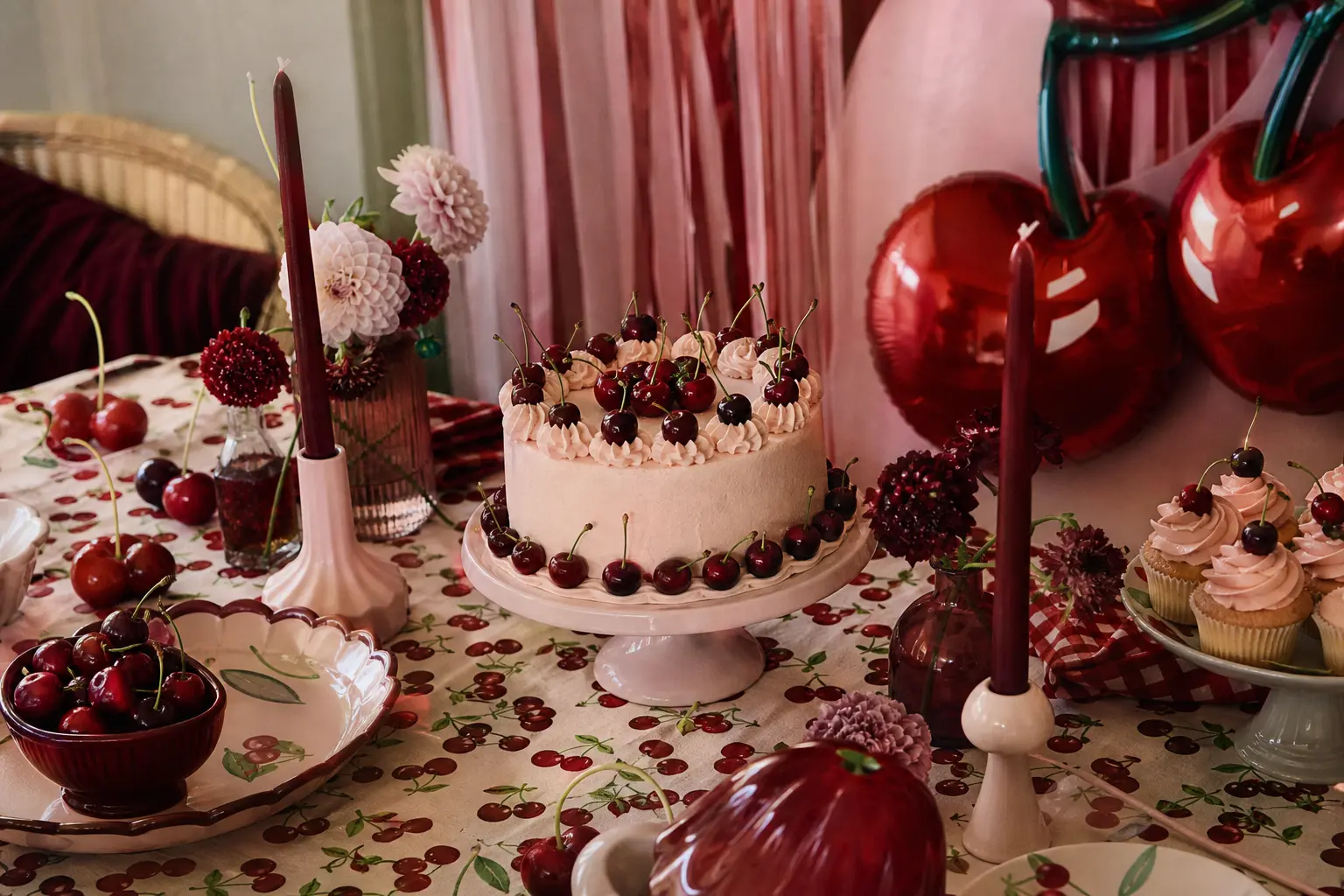
36 cherry birthday party theme ideas for backdrops, balloons, centerpieces, tables and favors, style
Fourteen low-key setups for a 17th birthday at home: warm, low-lit, no ceremony, and every one tells
Leave a Reply