

16 Birthday Party Activities for Kids With Free Printables, All Playable Indoors
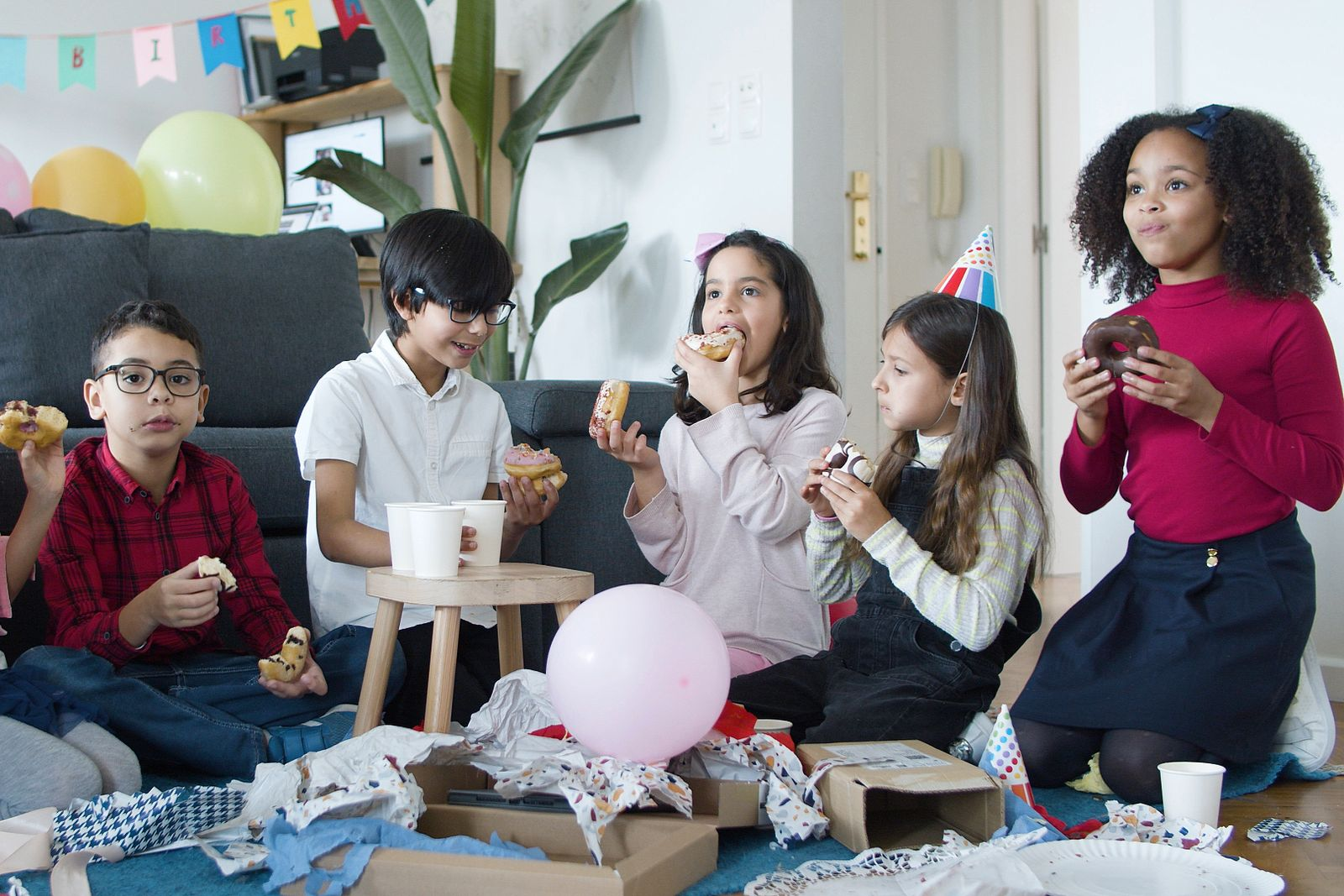
The best birthday party activities for kids are the ones that work when the weather refuses to cooperate: everything here runs at one table or on the living-room rug, handles twelve children at once, and fills a full three hours without anyone needing to go outside.
You get ten printable game sheets (most with an answer key where answers actually exist) plus six no-prep games that need nothing but the children themselves and whatever small objects are already in your kitchen drawer.
This post contains affiliate links. If you buy through them, I may earn a small commission at no extra cost to you.
- Party Bingo With Pictures (4 bingo grids + call list)
- Sleeping Lions on the Rug
- Colour by Number Birthday Scene (colouring page, one per child)
- The Memory Tray of Small Objects
- I Spy and Count the Party Things
- Pass the Parcel With a Layer Each
- Spot the Difference, Two Cakes
- Charades From the Sofa
- Finish the Pattern of Bunting
- Guess the Sound Behind the Door
- Odd One Out in Each Row
- Six Piece Rectangle Puzzle
- Draw the Other Half of the Cake
- Musical Statues With One Adult on the Music
- Roll and Cover the Balloons (game board, one per child)
- The Certificate for the Winner (certificate, one per child)
- Frequently Asked Questions
1. Party Bingo With Pictures (4 bingo grids + call list)
Each child gets one of four unique bingo grids printed with small birthday pictures: a cake, a balloon, a party hat, a candle, a present, a streamer, a star, a whistle and a cupcake.
The host reads from a separate call list, holding up or announcing each image name. Children mark their squares with small sweets or dried beans, and the first to complete a row shouts “Bingo.”
Print four grids on one sheet and cut them apart, or print each grid on its own card and laminate for reuse. Twelve children means three full rounds before anyone sees the same card twice. Keep a bag of small tokens, dried lentils or mini marshmallows as markers.
Because all four grids are in rotation across twelve players, multiple children will call bingo in the same round. Solve this by making the prize a sticker rather than a sweets bag so everyone wins something small and no tears are shed over a near-miss. Running three rounds covers about fifteen minutes.
Shuffle the call list and read slowly: it keeps children focused longer than a fast caller does.

🛍 Shopping guide
2. Sleeping Lions on the Rug
Every child lies completely still on the rug, eyes closed, arms flat, pretending to be a sleeping lion.
One or two adults (the “hunters”) walk slowly between the bodies, talking quietly, pulling funny faces and doing anything short of touching to make a child move, giggle or open their eyes. The moment a child moves, they are out and join the hunters.
No equipment at all: this is the game to play in the ten minutes after cake when twelve children are sugar-high and you need them horizontal. It works in any size sitting room because everyone is already on the floor. Last lion lying wins.
The game naturally gets harder as more children become hunters, because more faces are being pulled at once. If the whole group goes out within two minutes (common with the under-fives), start again immediately: children happily play four or five rounds back to back. No printing needed.
The frantic ten minutes right after birthday cake when energy is at its peak and you need everyone horizontal fast.
3. Colour by Number Birthday Scene (colouring page, one per child)
Each child receives their own sheet showing a large birthday scene, a table loaded with cake, balloons, bunting and presents, where every section is labelled with a number from 1 to 10.
A colour key at the bottom of the page tells them which colour matches which number. They fill it in independently, which means twelve children sit quietly at the table at the same time and the adult is free to refill drinks.
Print one per child on plain paper; crayons or felt-tips both work. The scene is detailed enough to absorb a child for fifteen to twenty minutes. Collect finished sheets and display them on a wall with sticky tack for an instant gallery that keeps parents entertained at pick-up time.
Children who finish early can add their own colours and details in any blank areas: give them explicit permission and they will not feel they have done it wrong. Avoid providing only red and blue felt-tips; a full set of at least ten colours makes the numbered system genuinely satisfying to complete.
- Crayons or felt-tip pens, one set per two children
- Sticky tack to display finished artwork

🛍 Shopping guide
4. The Memory Tray of Small Objects
Arrange fifteen small household objects on a tray: a spoon, a rubber, a coin, a hair clip, a mini car, a button, a birthday candle, a small rubber duck and similar items. Show the tray to all twelve children for sixty seconds.
Cover it with a tea towel, then ask every child to write down as many objects as they can remember on a scrap of paper. The child with the most correct items wins.
No printing needed. The tray takes two minutes to assemble from whatever is in the kitchen drawer and the birthday table. Scrap paper and pencils are all the children need. Runs in about eight minutes total, including the reveal at the end where you uncover the tray and children count their own scores.
For a harder version, secretly remove one object while the tray is covered, then ask the children to spot what is missing rather than list everything. This version works better for older children (seven and up) because it requires a different kind of focus and produces a single dramatic reveal.
For under-fives, use eight objects instead of fifteen and give ninety seconds of viewing time.
5. I Spy and Count the Party Things
A single busy scene, packed with birthday items, sits on the sheet. Below it, ten questions tell the child to find and count specific things: “How many balloons can you spot?” or “Find and circle all the party hats.”
Every answer is a fixed number determined by what is drawn on the sheet, so a complete answer key is included at the bottom of the page.
Print one per child on plain paper and hand out pencils or crayons. The sheet holds a child’s attention for ten to fifteen minutes. It works as an arrival activity while latecomers trickle in, because each child starts independently and finishes in their own time.
The most common mistake is printing the scene too small. Use US Letter, print at full page, and choose a scene with objects spread to the edges rather than clustered in the centre. Children who finish first can be challenged to find one extra hidden star or extra item you announce verbally, buying another two minutes without any additional printing.
Hand this out the moment the first child arrives: it occupies early guests while you answer the door.

6. Pass the Parcel With a Layer Each
Wrap a small prize in the centre in as many layers of newspaper or wrapping paper as there are children, twelve in this case, with a tiny forfeit or treat tucked inside each layer: a sticker, a joke on a slip of paper, or a mini sweet.
Children sit in a circle on the rug. Music plays, the parcel passes around, and when the music stops the child holding it unwraps one layer and does whatever the forfeit says.
No printing needed. Prep the parcel the night before: it takes about twenty minutes to wrap twelve layers but makes the game completely fair because every child is guaranteed a turn. Use a mix of forfeits, “do a star jump”, “tell a joke”, “say the alphabet backwards” so each layer is a small moment of its own.
Keep the music controller in the same room as the circle and pause it when each child’s back is turned to avoid accusations of cheating. For twelve children, the game runs about twelve to fifteen minutes, which is exactly right: long enough to feel substantial, short enough that no one loses interest before their turn.
- Wrapping paper or newspaper for 12 layers
- One small prize for the centre
- A phone or speaker for music
🛍 Shopping guide
7. Spot the Difference, Two Cakes
Two almost-identical birthday cake illustrations sit side by side on the sheet. Ten small differences are hidden between them: a missing candle, a different colour on one tier, an extra cherry, a changed pattern on the bunting, and similar subtle swaps.
Children circle each difference they find with a pencil or crayon, then check against the answer key printed in small type at the bottom.
Print one per child. The activity takes between eight and fifteen minutes depending on age, which makes it useful both as a filler and as a focused quiet game. Pencils work better than thick felt-tips here because the differences are small and precision matters to children who take it seriously.
Children who finish fast tend to start coaching their neighbours, which is fine and keeps the table social.
If you want to use this competitively, ask children to keep their sheets face-down until you say go: the first child to circle all ten differences correctly wins a sticker.
More competitive birthday party games for kids that need no outdoor space are worth bookmarking alongside this one.
Ages 5 and up as a solo activity, or as a race for ages 7 and up with sheets kept face-down until the signal.

8. Charades From the Sofa
One child stands in front of the sofa while the rest of the group shouts guesses.
The child acts out a birthday-themed word or phrase with no speaking and no pointing at objects in the room: cake, blowing out candles, unwrapping a present, a balloon popping, singing happy birthday, party hat, bouncy castle, magic trick.
A one-minute timer runs on a phone. If the group guesses correctly, the actor swaps with the guesser who called it first.
No printing needed. For a list of 40 themed charades words sorted by difficulty, this charades guide for kids has everything you need to copy onto slips of paper the night before. Write each word on a folded slip and keep them in a bowl so children draw blind rather than choosing their favourites.
Very young children (under five) often freeze when they stand up alone. Solve it by letting them choose a partner to act with: two children miming together removes the stage fright almost entirely. Keep rounds to one minute and rotate fast: twelve children means the energy stays high and no one waits longer than two minutes for their turn.
- Write 15 birthday words on folded slips and put them in a bowl
- Child draws a slip, acts it out silently
- First correct guesser takes the next turn
9. Finish the Pattern of Bunting
Six rows of bunting flags appear on the sheet, each row following a simple repeating pattern: triangle, circle, triangle, circle or star, heart, diamond, star, heart, blank.
Children look at the pattern in each row and draw or write what comes next in the blank flags at the end. Each row is slightly more complex than the last, so the sheet works across a range of ages at the same table.
Print one per child. Pencils or felt-tips both work. The sheet takes between five and ten minutes, making it a good gap-filler between two noisier games rather than a standalone activity. An answer key in small type at the bottom removes any dispute about what the correct answer is in the harder rows.
The most common frustration is children not being sure whether to draw the shape or colour it. Add a one-line instruction at the top of the sheet: “Draw the missing shape in each blank flag.” That single line prevents five minutes of hand-raising and confusion at the table.
For under-fives, cover rows 5 and 6 with a strip of paper before printing so only the simpler patterns show.

10. Guess the Sound Behind the Door
One adult stands just outside the closed sitting-room door and makes a sound: tearing wrapping paper, blowing up a balloon, shaking a box of sweets, squeezing a rubber duck, pouring water, crumpling newspaper. Children sit on the rug and shout their guesses.
First correct guess earns a point. Run ten sounds in a row and tally the scores on a whiteboard or a piece of paper on the wall.
No printing needed. The prep takes three minutes: gather ten objects that make distinct sounds and line them up in the hall. This game lands especially well after a quiet activity because the sudden sounds from behind a door produce real surprise, even in children who can see what is coming next.
Avoid sounds that are too similar, a bag of crisps and crumpled newspaper both sound like rustling and cause arguments.
Test each sound yourself before the party by closing a door and listening: if you cannot tell what it is from ten feet away, swap it for something clearer.
A balloon pop at the end makes an excellent finale that the whole group reacts to at once.
- 10 objects with distinct sounds (see body text)
- A closed door between adult and children
- Paper and pen to tally scores
11. Odd One Out in Each Row
Eight rows of four pictures appear on the sheet. In each row, three pictures belong to the same category and one does not. Examples: three birthday cakes and a pizza, three balloons and an apple, three party hats and a sock.
Children circle the odd one out in each row and write a short reason on the line below it.
The reason line is what makes this work for a range of ages: younger children circle and move on, older ones write “because it isn’t a party food” and feel the challenge is real.
Print one per child. This is a good table activity for mixed ages because the earlier rows are obvious and the later rows require slightly more lateral thinking. An answer key with brief explanations is printed at the bottom in small type.
The reason line is the part children skip most often. If you want them to use it, say before you hand out the sheets: “The winner is the first child who has all eight circles AND all eight reasons written in.” That framing makes the writing feel like part of the game, not like homework.
Mixed ages can sit together because the first rows are easy enough for a four-year-old and the last rows are genuinely tricky for a seven-year-old.

12. Six Piece Rectangle Puzzle
A single birthday scene, a cake with candles and confetti, is printed on the sheet and pre-divided into six equal rectangles by bold straight cut lines. The host cuts each sheet into six pieces along those lines before the party.
Children receive the six scrambled pieces and race to reassemble the image correctly on the table. First child to complete it wins a sticker.
Print one sheet per child and cut them all the night before: with twelve children, that is twelve sets of six pieces, kept in twelve small envelopes or twelve folded pieces of paper.
Plain scissors work fine because every cut is a straight horizontal or vertical line with no curves or interlocking tabs. The race takes under three minutes once the envelopes are handed out.
For a cooperative version instead of a race, combine two sets (twelve pieces from two children) and ask partners to work together. This doubles the solving time and removes the competitive element entirely, which suits quieter children or a group where ages are very mixed.
Store cut pieces in small zip-lock bags if you want to send them home as a party favour.
Cut all twelve sheets the evening before and store each set in a small envelope: handing out pre-cut envelopes takes thirty seconds, cutting at the party takes ten minutes you do not have.

🛍 Shopping guide
13. Draw the Other Half of the Cake
The left half of a detailed birthday cake is printed on the sheet, complete with tiers, candles, icing details and a cherry on top. A vertical centre line divides the page. The right side is completely blank.
Children draw the mirror image of the left half to complete the cake, adding their own decorations once the basic shape is done. No two finished cakes look the same.
Print one per child on plain paper. Pencils first, then felt-tips or crayons for colouring in. The activity runs fifteen to twenty minutes and produces a finished piece of art every child is proud of. Pin them to the wall beside the colour-by-number sheets for a full birthday gallery.
Children who feel they “can’t draw” always get stuck at the symmetry step. Tell them before they start: “Make your best guess at the shape, it does not have to be perfect, then add your own icing and sprinkles.”
That permission to personalise removes the pressure of getting the mirror exactly right and keeps every child drawing instead of staring at the page.
Every child produces a unique finished artwork with zero competitive pressure, which means no crying and a wall of things to photograph at pick-up.

14. Musical Statues With One Adult on the Music
Music plays and children dance freely in the sitting room. The moment the music stops, every child freezes like a statue. One adult watches for any movement, wobble or giggle. Any child who moves is out and sits on the sofa. Last child standing wins.
This is the version where the adult controlling the music also watches for movers: two separate adults, one on music and one as judge, removes every argument about whether a child moved or not.
No printing needed. Push chairs to the edges of the room before you start so the floor is clear. For twelve children in a standard sitting room, use a playlist with cuts between fifteen and forty seconds so the game moves fast. The whole game takes eight to twelve minutes depending on how quickly children are eliminated.
The fairness issue that derails this game is children near the speaker cheating by watching the adult’s hand rather than listening to the music. Face the speaker away from the group or use a wireless speaker across the room.
For very competitive groups, run it in two heats of six children and bring the two winners together for a final round: that structure gives eliminated children a clear moment to cheer for their heat’s finalist.
- One adult controls music, one adult watches for movement
- Any movement or wobble when music stops means you are out
- Sit eliminated children on the sofa as the official ‘judges’
15. Roll and Cover the Balloons (game board, one per child)
The game board shows a grid of balloons, each printed with a number from 1 to 6. Players take turns rolling a single die, then cover one balloon showing the matching number with a small token, dried bean or mini sweet.
The aim is to be the first to cover all six number groups on their own board. Because each child has their own board, twelve children can play simultaneously with one die shared around the table.
Print one board per child on cardstock if possible. Supply one die per two children to keep the game moving without long waits.
The game runs about ten minutes for a group of four to six, slightly longer with twelve because the die passes more hands. It doubles as a number-recognition activity for younger children who are still learning their one-to-six.
Stock up on something small to use as covering tokens: dried lentils, mini marshmallows, or the flat plastic counters from any board game in the house.
If a child knocks their board and scatters their tokens, mark their covered balloons lightly in pencil before the game starts so they can recover their position.
More birthday party games sorted by age and group size sit alongside this one if you need to extend the afternoon.
- One die per two children
- Small tokens or sweets as covers (one per number per board)
- Cardstock for a sturdier board

🛍 Shopping guide
16. The Certificate for the Winner (certificate, one per child)
A proper printed certificate sits at the end of the party, one per child, each with a blank line for the child’s name and a blank line for whatever they won or achieved: best dancer, fastest puzzle, bingo champion, most creative cake drawing.
The host fills in names and achievements by hand before handing them out, which takes about four minutes with twelve children and a felt-tip pen.
Print one certificate per child on plain paper or light cardstock. Hand them out in the final ten minutes of the party as a mini ceremony: call each child’s name, read their achievement aloud, and hand it over. Every child goes home with something personalised that cost nothing to produce. Parents photograph them at the door almost without exception.
The key to making certificates feel real rather than like a consolation prize is specificity. “Best at Sleeping Lions” feels earned. “Participation” does not.
Keep a running note on your phone during the party of one specific thing each child did well, and that note becomes the certificate text.
One minute of note-taking during the games saves three minutes of blank staring at the stack of unsigned certificates at the end.
Write all 12 names and achievements on the certificates during naptime the day before if you already know the children well, or fill them in during the last quiet activity when the group is heads-down on their drawings.

Frequently Asked Questions
How many birthday party activities for kids do you need for a three-hour party?
Plan eight to ten activities for a three-hour party, but expect to use six or seven of them. Children take longer than expected to settle into each game, and cake, food and present-opening each absorb twenty to thirty minutes you did not budget for.
Build a list longer than you think you need and treat the extras as backup rather than the programme.
Which printable sheets need one per child and which are shared?
Print one per child: Colour by Number Birthday Scene, I Spy and Count the Party Things, Spot the Difference Two Cakes, Finish the Pattern of Bunting, Odd One Out in Each Row, Draw the Other Half of the Cake, Roll and Cover the Balloons, and The Certificate for the Winner.
That is eight sheets times twelve children: 96 sheets total, so print in bulk the night before.
The only shared printables are the Party Bingo grids (four cards printed once and passed between three rounds) and the Six Piece Rectangle Puzzle (one sheet per child, but shared in the sense that children can swap and compare finished puzzles).
What is the best order to run birthday party activities for kids indoors?
Start with a quiet printable (I Spy or Colour by Number) as children arrive, so early guests are occupied before the group is complete. Move to an active game (Pass the Parcel or Musical Statues) once everyone is there and energy is high.
Alternate quiet and active through the middle of the party. Save Sleeping Lions for right after cake when sugar levels peak, and close with certificates and one final quiet printable so the room is calm when parents arrive to collect.
How do you handle a wide age range at a kids’ birthday party?
Choose activities with a built-in difficulty slope: Odd One Out and Finish the Pattern both start simple and get harder row by row, so a four-year-old and a seven-year-old can sit side by side without either being bored or lost. For team games, deliberately mix ages within each team rather than letting children self-select, which always produces an age-segregated split.
Do you need to print all the sheets in colour?
Colour by Number requires colour printing because the numbered key only makes sense if children can see the colour swatches. All other sheets work in black and white: children add colour themselves with crayons or felt-tips during the activity.
Black-and-white printing also costs a fraction of colour and produces crisper lines for drawing activities like Draw the Other Half of the Cake.
How do you keep twelve children engaged without losing control of the room?
Run activities in parallel where possible: three tables of four playing Roll and Cover the Balloons simultaneously is quieter and more manageable than twelve children in one competitive round.
Designate one corner of the room as the finished-work display wall so children who complete a sheet have a clear next step (pin it up) rather than roaming.
Keep the next activity ready before the current one ends so there is never a gap where twelve children are unoccupied.
Fifteen bold, warm 21st birthday party ideas that feel like a milestone without a six-month deposit.

Fourteen low-key 40th birthday setups for the man who asked for nothing. No speeches, no spotlights,
Browse 25 birthday party themes with real styling ideas for girls, boys and toddlers, so you can pic
Leave a Reply