

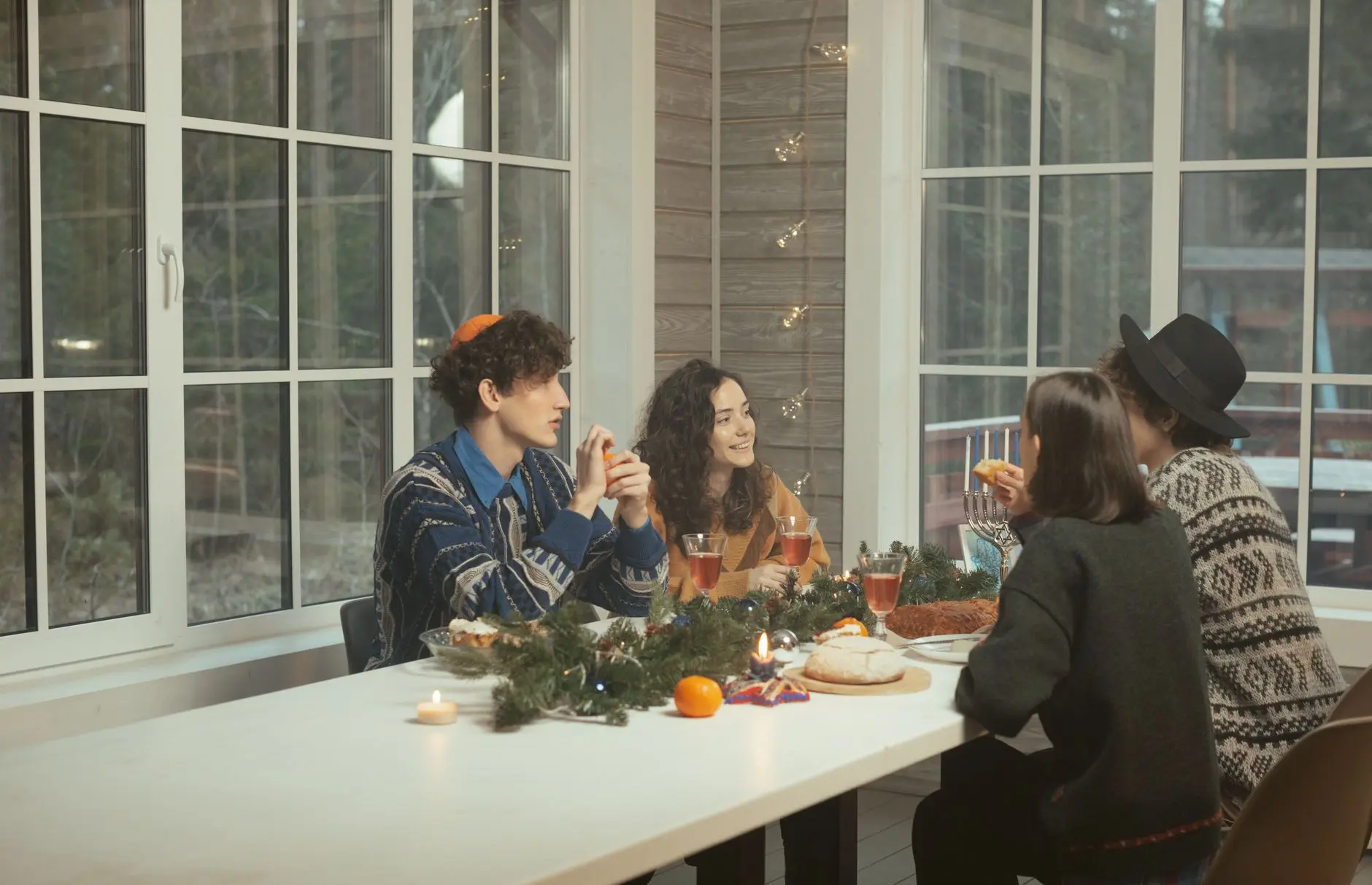
These hanukkah party games are built for the full eight nights: some need a printed sheet, some need nothing but the people already at your table, and none of them involve a dreidel.
The list runs from a timed trivia quiz to a charades round using only real family stories, so there is always something for the cousin who is eight and the great-aunt who is eighty.
This post contains affiliate links. If you buy through them, I may earn a small commission at no extra cost to you.
- Hanukkah Trivia in Two Rounds
- The Latke Taste Test Between Two Recipes
- Match the Blessing to the Night
- The Memory Tray of Objects From the Table
- Gelt Guessing Tally
- Charades, Family Stories Only
- Eight Nights Bingo
- Latke Rating Card
- The Gelt Stacking Race
- Would You Rather, Family Edition
- The Candle Count Memory Sheet
- Songs Sung Together
- Wishes for the Year
- One Word Story Around the Table
- Frequently Asked Questions
1. Hanukkah Trivia in Two Rounds
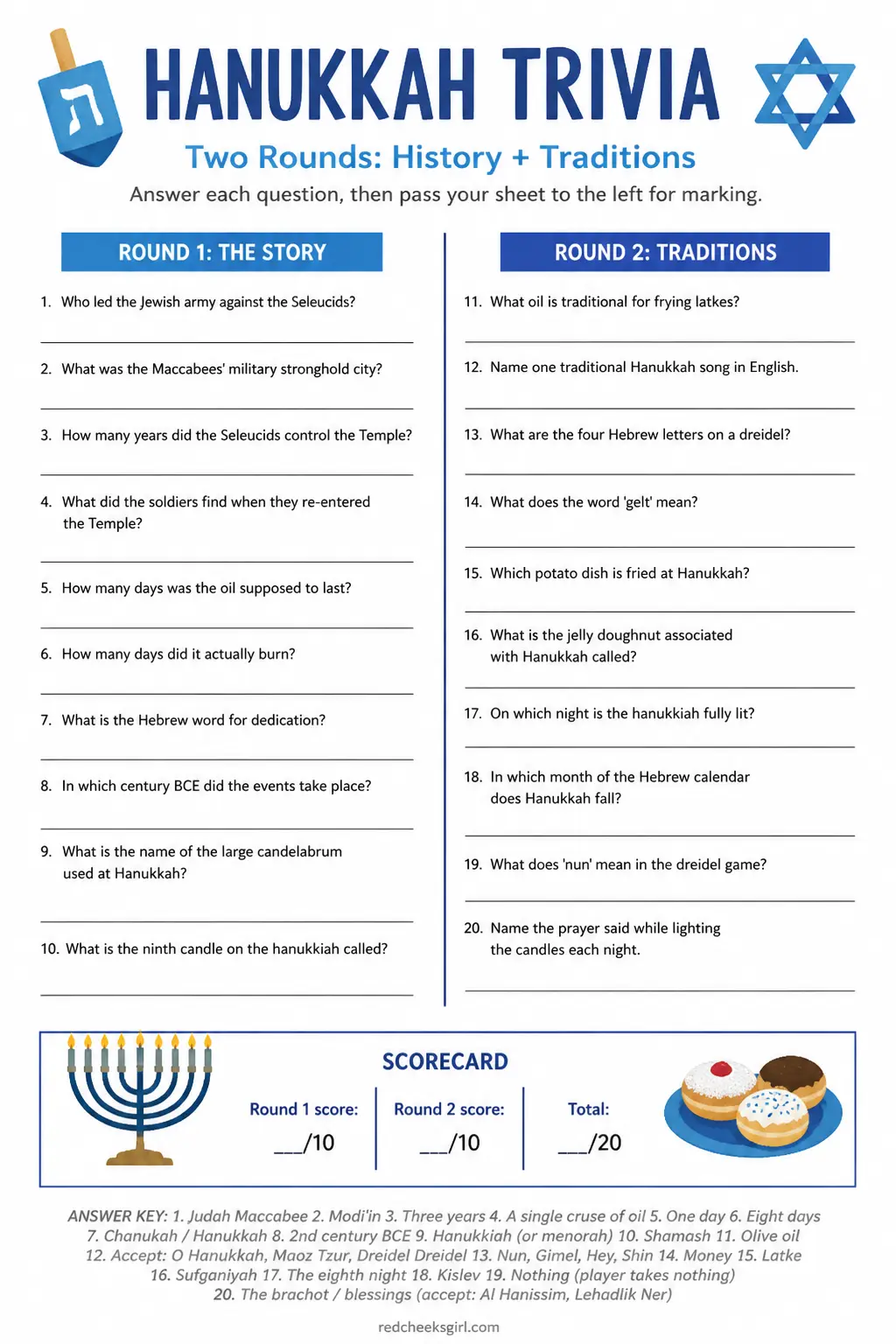
Round One covers the story of Hanukkah itself: the Maccabees, the Temple, the oil, the dates. Round Two shifts to traditions, food, music and modern Hanukkah culture.
Each player gets a quiz sheet, fills it in silently, then hands it to the person on their left to mark against the answer key.
The scorecard at the bottom tracks both rounds so you have one winner per evening, or cumulative scores across several nights if you want a slow-burn champion.
Print two quiz sheets per person (one per round), two answer keys to share around the table, and one scorecard per person. A fine-tip pen or pencil per player is all you need. Each round runs about eight minutes; judging takes another five. Works best with four or more players old enough to write independently.
Kids under ten will find Round One manageable but Round Two harder. The fix: pair each child with an adult and let them confer, awarding points as a team. If the group is very mixed in age, read the questions aloud and let everyone shout answers instead of writing, using the scorecard as a show-of-hands tally.
- Ages 10 and up solo, all ages in teams
- 4 to 16 players
- Works on any of the eight nights
🛍 Shopping guide
2. The Latke Taste Test Between Two Recipes
Two latke recipes compete head to head: one classic (potato, onion, egg, matzo meal) and one with a twist such as sweet potato, zucchini or a different binder. Label them only A and B, plate them on separate dishes, and let everyone taste both before casting a vote on a small slip of paper or simply by raising a hand.
No printing needed. You need two frying pans, two recipes prepared in advance or by two different family members, small plates and napkins, and something to write tallies on (a whiteboard, a notepad, the back of an envelope). The whole tasting and vote takes about fifteen minutes. Feeds as many people as you have batter for.
The common snag is that A and B go cold at different rates. Serve both straight from the pan in quick succession rather than making one batch then the other, or use an oven at low heat to keep the first batch warm.
A second variation: make it a blind three-way with applesauce, sour cream, and a wild card topping as the variable instead of the batter.
Label the plates with a sticky note under the platter, not on top, so nobody peeks the recipe name.
3. Match the Blessing to the Night
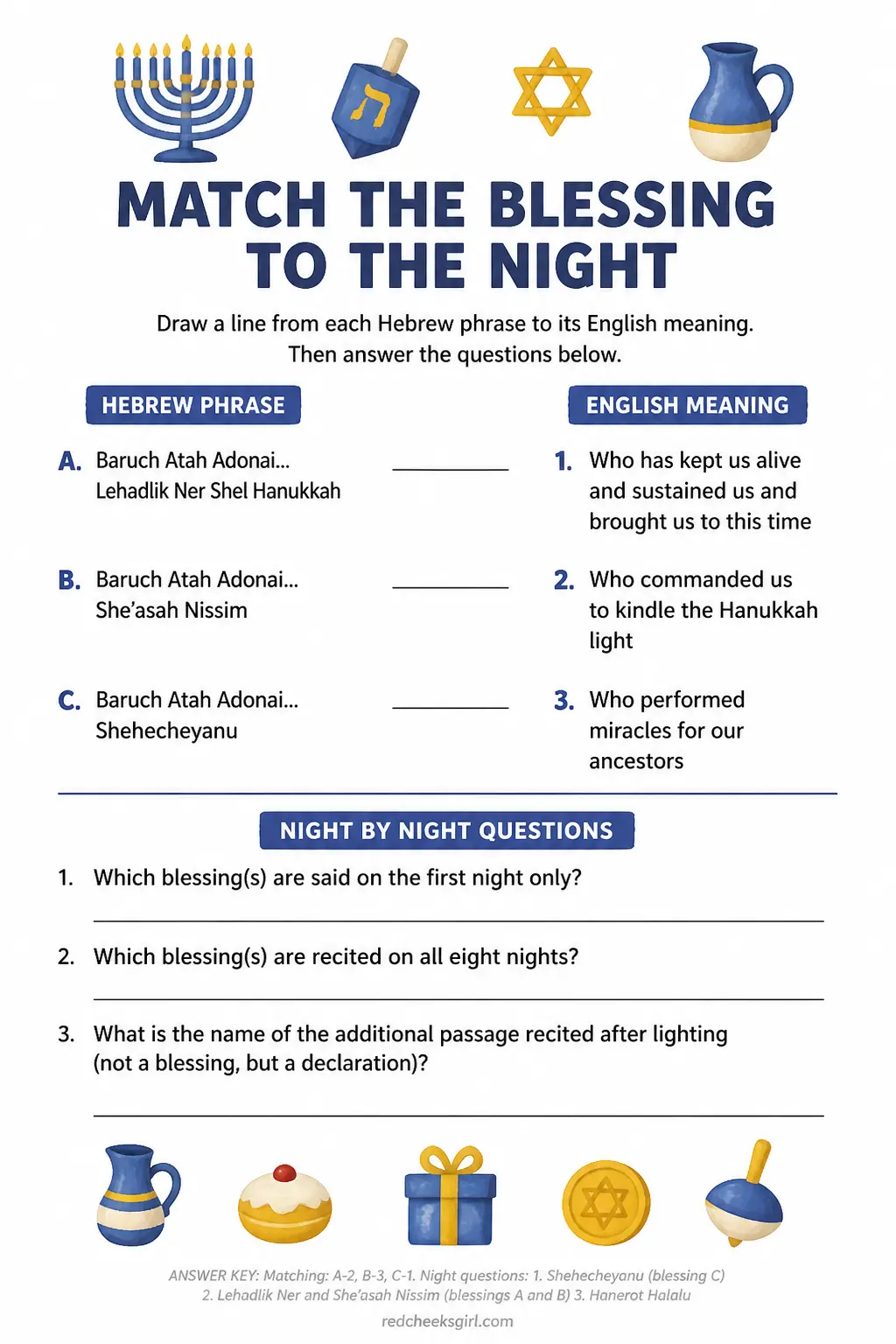
The sheet lists the three blessings recited at candle lighting, each split into a Hebrew phrase on the left column and its English translation on the right column, but shuffled. Players draw a line connecting each Hebrew phrase to its correct English meaning.
A second section on the lower half asks which blessings are said on night one only, which are said on all eight nights, and which appears only on the first night of a holiday.
It is quiet, it is genuinely educational, and the kids learn something without realizing it.
Print one sheet per player; no other materials required. A pencil works better than pen here so lines can be erased and redrawn. The game takes about five minutes to complete and another two to review together using the answer key, which is printed separately and read aloud by the host.
Adults with strong Hebrew literacy will finish quickly. Keep the pace fair by asking fast finishers to write one sentence about what each blessing means to them before anyone looks at the key. An alternative use: skip the competitive element entirely and use it as a quiet learning card on the first night of Hanukkah for younger children.
For children under 8, print only the English column and read the Hebrew phrases aloud one at a time, letting them point to the match.
4. The Memory Tray of Objects From the Table
Arrange twelve to fifteen small objects on a tray: a dreidel, a coin, a small candle, a sprig of rosemary, a matchbox, a napkin ring, a mini bottle of olive oil, a gelt wrapper, a small figurine, and whatever else is on the dinner table that evening.
Everyone studies the tray for sixty seconds. Cover it with a tea towel. Players write down every object they remember on any scrap of paper.
No printing needed. You need a tray, a tea towel, assorted small household objects (twelve to fifteen works well), and something to write on. The game takes about ten minutes total. It scales from two players to twenty, and younger children can pair with an older one to share memory lists.
The most common problem: someone peeks. Keep the covered tray behind you or in another room while players write. A good variation for repeat nights is to change the object count (ten on night one, fifteen on night five) or swap out two or three objects so regular players cannot rely on muscle memory from a previous round.
- A tray or large plate
- 12-15 small table objects
- A tea towel to cover them
- Scrap paper and pencils
5. Gelt Guessing Tally
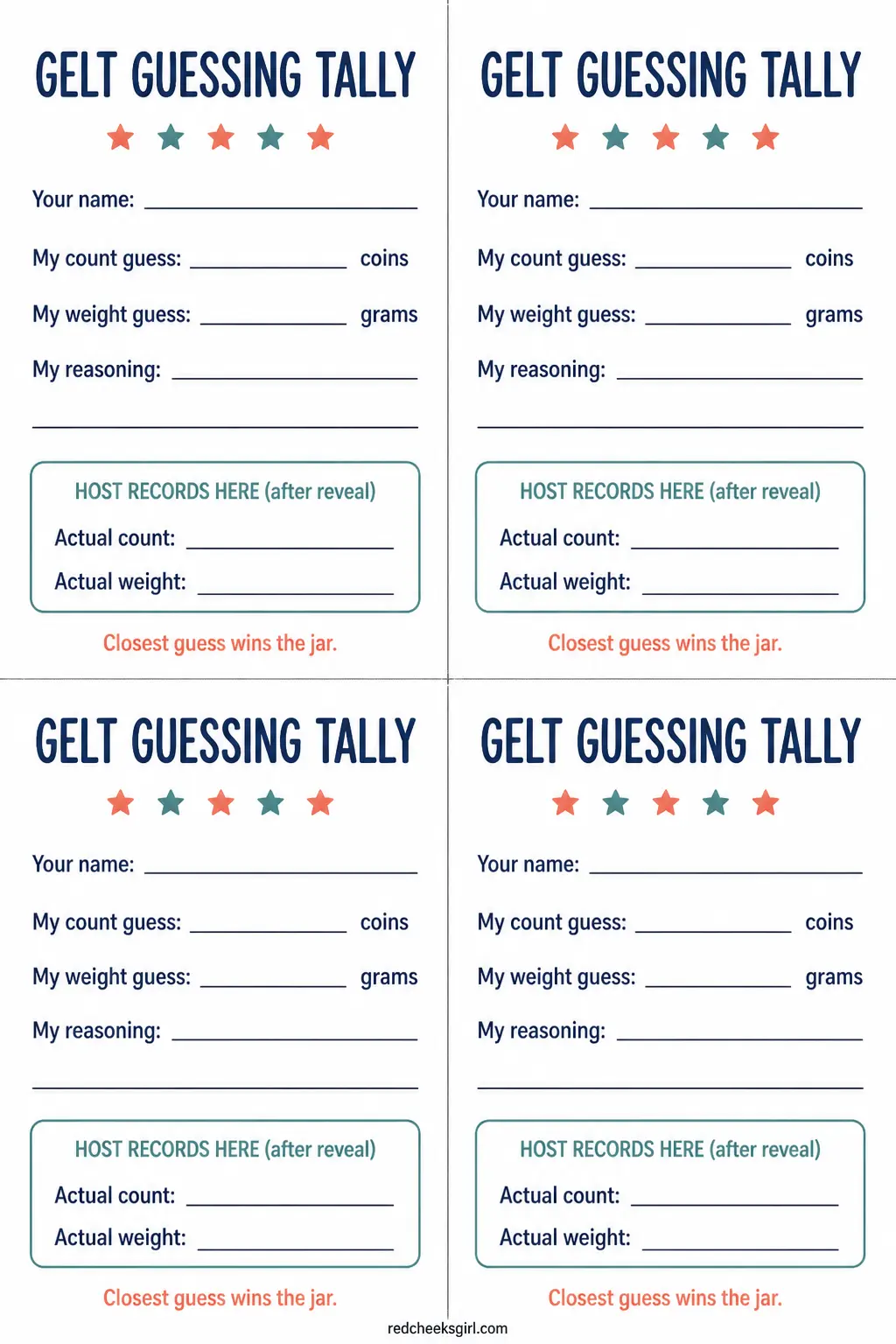
Fill a clear jar with chocolate gelt coins before the evening starts. Each guest gets a tally card and writes down their guess for the total count. The card also has space for a second guess: total weight in grams.
At the end of the evening (or the end of the night’s candle lighting), the host counts and weighs and crowns the closest guesser. The winner takes the jar.
Print one tally card per guest. You also need a clear jar or bowl, a supply of wrapped chocolate gelt, a kitchen scale, and a pen per person. Setup takes two minutes. The guessing itself happens in the first five minutes of the evening and needs no group coordination at all.
Gelt coins vary a lot in size by brand, so weigh the jar before the party and keep that number private. If the group is large and two people tie on count, the weight guess breaks the tie.
A family variation: let children guess count only and adults guess both, levelling the playing field without making it obvious you are doing so.
- Clear glass jar
- Wrapped chocolate gelt coins
- Kitchen scale
🛍 Shopping guide
6. Charades, Family Stories Only
Standard charades rules, but the only valid subjects are real events, people or running jokes from your own family history.
Before the game starts, everyone spends two minutes writing one or two family moments on separate slips of paper: the time someone dropped the menorah, the infamous road trip, the cousin’s terrible haircut, the Hanukkah gift that caused an argument.
Fold the slips and drop them in a bowl. Teams take turns drawing and acting.
No printing needed. You need a bowl, small slips of paper, and a timer (a phone works fine). Teams of two to four work best, and you want at least eight slips in the bowl before you start. Each turn runs sixty seconds. The game goes until the bowl is empty, usually thirty to forty minutes for a full group.
The obvious snag: a story that only one branch of the family knows. Keep it fair by asking each person to whisper their slip to the host first, who quietly replaces anything too inside-reference with a gentle prompt to try again.
A simpler variation for younger children: allow one word of spoken context before the timer starts so small kids can still compete.
Collect slips at dinner before the game begins so there is no lull waiting for people to think of ideas at game time.
7. Eight Nights Bingo
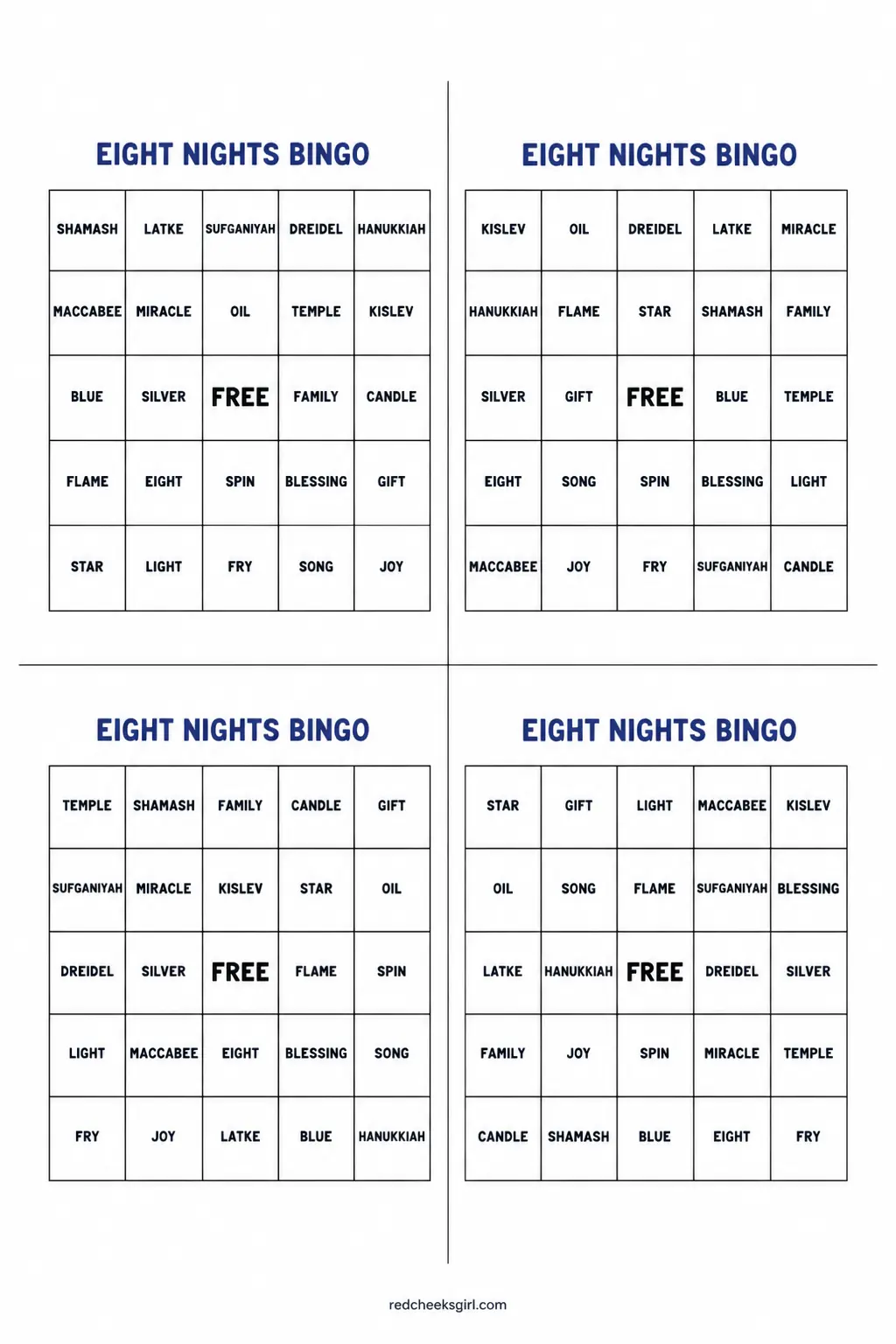
Each of the four bingo grids uses a five-by-five layout filled with Hanukkah-themed words and images: shamash, gelt, latke, sufganiyah, dreidel, hanukkiah, Maccabee, miracle, oil, Temple, Kislev, blue, silver, family, candle, flame, eight, spin, blessing, gift, star, light, fry, song, joy.
The host draws from the call list one term at a time, calling it aloud. First player to complete a row, column or diagonal calls out and wins that round.
Print four grids (the grids differ so four players can compete simultaneously without identical cards), plus one call list for the host to use and cross off as terms are drawn. A token per player to mark squares, a bowl of gelt works perfectly.
The game runs fifteen to twenty minutes per round, and you can replay with the same sheets by clearing the tokens.
With more than four players, pair up so each grid is shared by two people. The call list includes all twenty-five terms; the host crosses each off as it is called so nothing repeats. If the group wants a longer game, require two lines or a full card instead of one line to win.
- Small tokens or gelt coins to mark squares
- A bowl or bag to keep the call list slips
- One caller per game
🛍 Shopping guide
8. Latke Rating Card
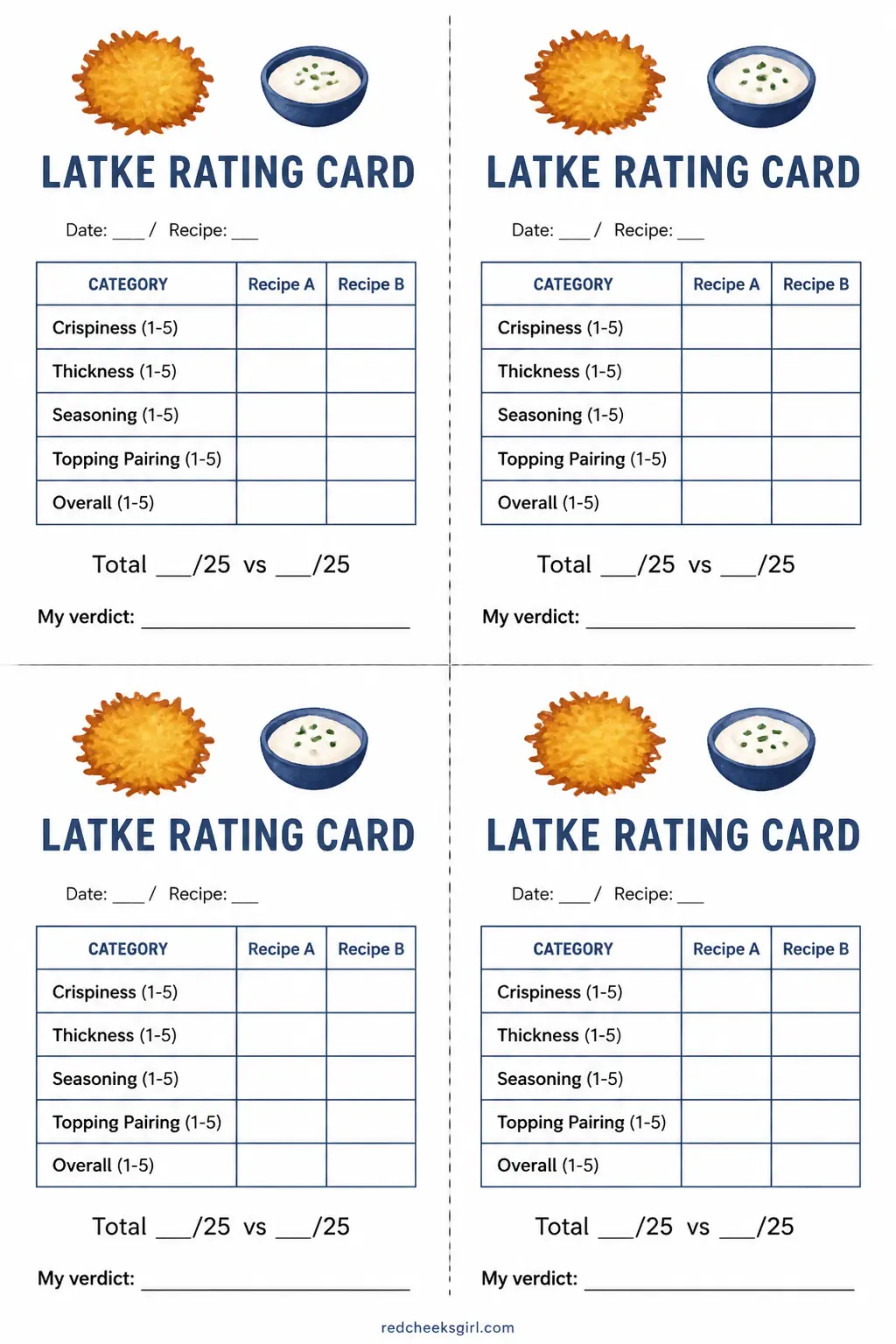
At the Hanukkah table, latkes arrive hot and everyone has an opinion but nobody writes it down. This card gives each person five rating categories: crispiness, thickness, seasoning, topping pairing and overall.
Each category scores one to five, with a total out of twenty-five at the bottom and a line for a one-sentence verdict.
If two recipes are being compared (see the Taste Test game above), the card has a column for Recipe A and a column for Recipe B side by side.
Print four cards per sheet; cut along the crop marks. Hand one to each guest as the latkes arrive. A pencil per person, nothing else. The card doubles as a keepsake and sparks a real conversation about what made one batch better than another. Takes about two minutes to fill in and zero time to explain.
If the family does not do a two-recipe comparison, simply white-out the second column before printing or tell guests to use only the left column. The card also works across multiple nights if the cook experiments with a new recipe each evening: date the card at the top and keep a folder of them as a low-key recipe journal.
It turns a passive eating moment into something everyone has a stake in, and the cook gets actual feedback instead of just ‘delicious.’
9. The Gelt Stacking Race
Each player gets a stack of ten chocolate gelt coins. On go, everyone races to build the tallest stable tower using only one hand. The tower must stand unsupported for three seconds to count. Whoever stacks the most coins in ninety seconds without toppling wins the round. Eat the coins after.
No printing needed. You need one stack of ten gelt coins per player and a flat table surface. Clear the area of plates and glasses first. The game takes under five minutes including setup. It works for all ages; small children may need lighter, larger coins, and foil-wrapped chocolate gelt varies in thickness by brand, which changes the difficulty usefully.
The common problem is that chocolate coins warp in a warm room and become impossible to stack. Run this game before the candles warm the table, or refrigerate the gelt for ten minutes beforehand. A variation for older players: use only the non-dominant hand and add a second rule that coins must alternate face-up and face-down.
For very young children, use plastic dreidel tokens or large buttons instead of chocolate so the stakes of toppling feel lower.
🛍 Shopping guide
10. Would You Rather, Family Edition
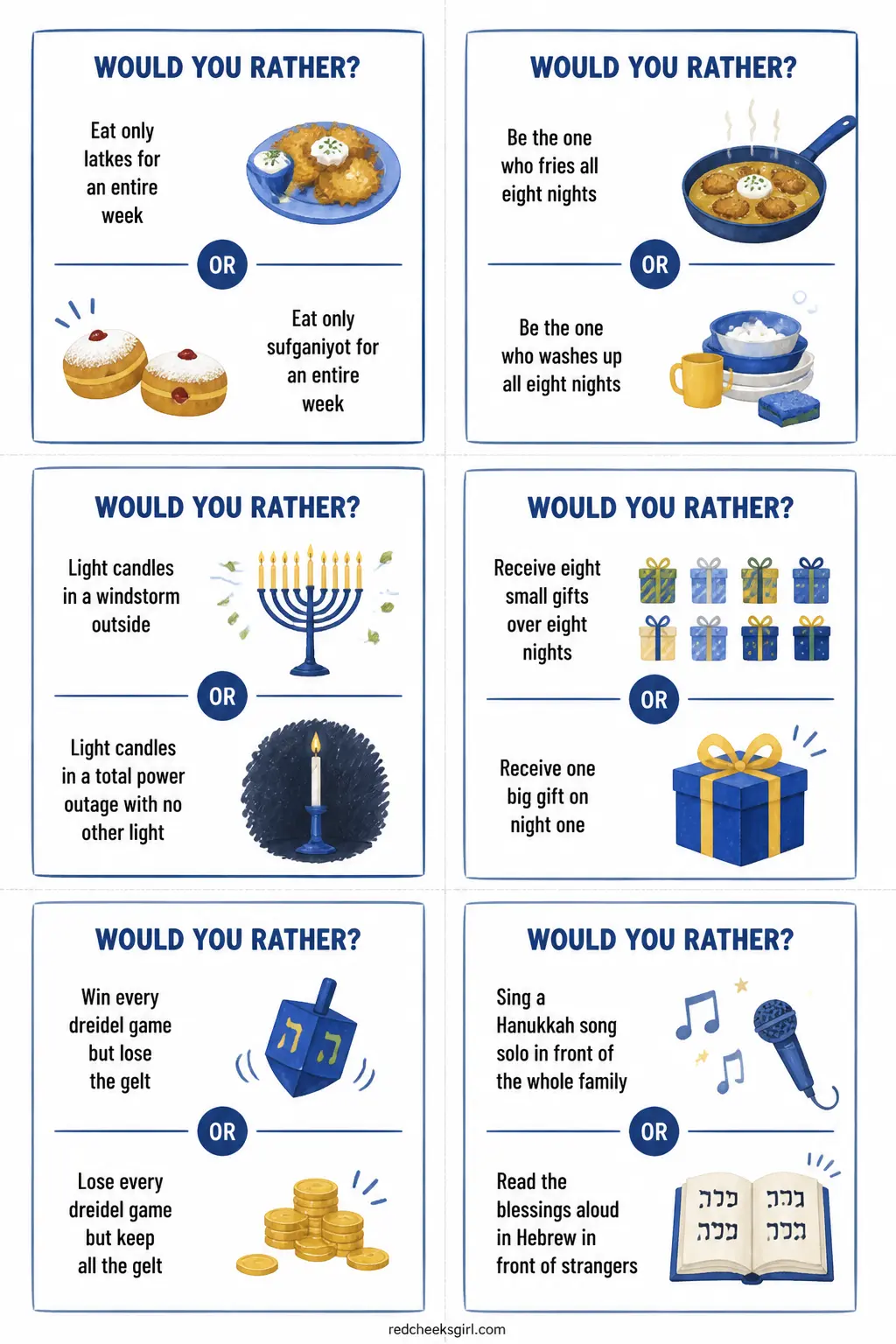
Each card presents two Hanukkah-themed (and family-life-themed) dilemmas: Would you rather eat only latkes for a week or only sufganiyot? Would you rather light candles in a power outage with no other light or in a windstorm outside?
Would you rather be the one who fries all eight nights or the one who washes up all eight nights? Players hold up fingers (one for left option, two for right) simultaneously so no one is swayed by the group before committing.
Then everyone argues their case for thirty seconds.
Print one sheet of six cards per person and cut along the crop marks, or print a single set and place cards face-down in a stack for the host to read aloud one at a time. No other materials needed.
Each card takes about two minutes with discussion; six cards fill fifteen to twenty minutes easily. The game suits all ages because there are no right answers.
The format works across every night of Hanukkah if you rotate which family member reads the card aloud, giving younger children a turn to run the game. Write your own extra prompts on the blank backs of cut cards if the group wants more rounds: the best ones come from real family debates already happening at the table.
Read both options with equal enthusiasm so the group does not read your preference before voting.
11. The Candle Count Memory Sheet
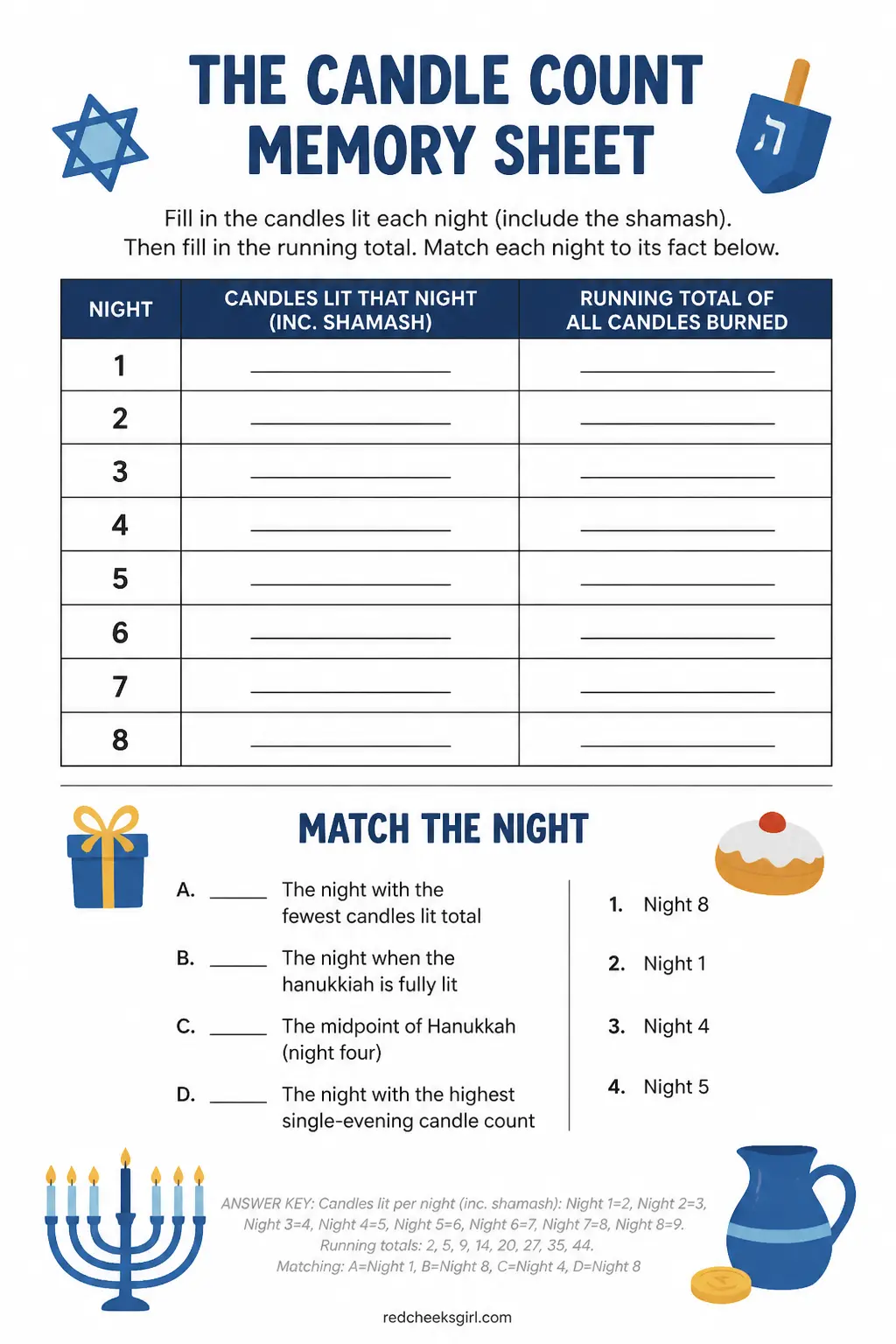
The sheet shows eight hanukkiahs drawn in outline, each labelled with a night number one through eight.
Players must write, next to each hanukkiah, the total number of candles lit on that night (including the shamash) and the cumulative total of candles burned so far across all nights up to that point. It sounds easy. It is not.
The matching section below asks players to connect each night number to a key fact: which night a historical milestone is traditionally marked, which night is the midpoint, which night uses the most candles in a single lighting.
Print one sheet per player; pencils only. The game takes about eight minutes. Review the answers together using the answer key printed separately and read aloud by the host. Works from ages twelve and up independently; younger children can join as part of a team.
The cumulative column trips everyone up because it is easy to forget that the shamash is lit every night and must be counted. Make that the post-game teaching moment rather than a frustration. A simpler version for younger players: cover the cumulative column entirely and focus only on the per-night candle count (shamash included).
The math is genuinely surprising: the total candles burned across all eight nights is 44. Most adults get it wrong on the first try.
12. Songs Sung Together
One person hums or claps the rhythm of a Hanukkah song (no words, no instruments). Everyone else races to name it. The first to name it correctly takes a turn humming the next one.
Songs can include O Hanukkah, Maoz Tzur, Dreidel Dreidel Dreidel, Mi Yimalel, Sevivon Sov Sov Sov, Al Hanissim, or any song the family sings together. Once identified, the group sings the first verse together before the next round begins.
No printing needed. No materials at all. The game works from two players to the full table and takes as long as the group wants it to: stop at three songs or go for fifteen. It works especially well between other games as a palate cleanser, or right after candle lighting when the mood is already warm.
The problem is that not everyone knows the same songs, especially in mixed families. The simple fix: before starting, spend one minute as a group calling out song titles so everyone knows what is in the pool.
That way, a player who has never heard Sevivon is not at a disadvantage if it comes up, because they at least know the title exists and can listen for it.
- All ages, no materials needed
- Works as a two-minute filler between longer games
- Strongest right after candle lighting
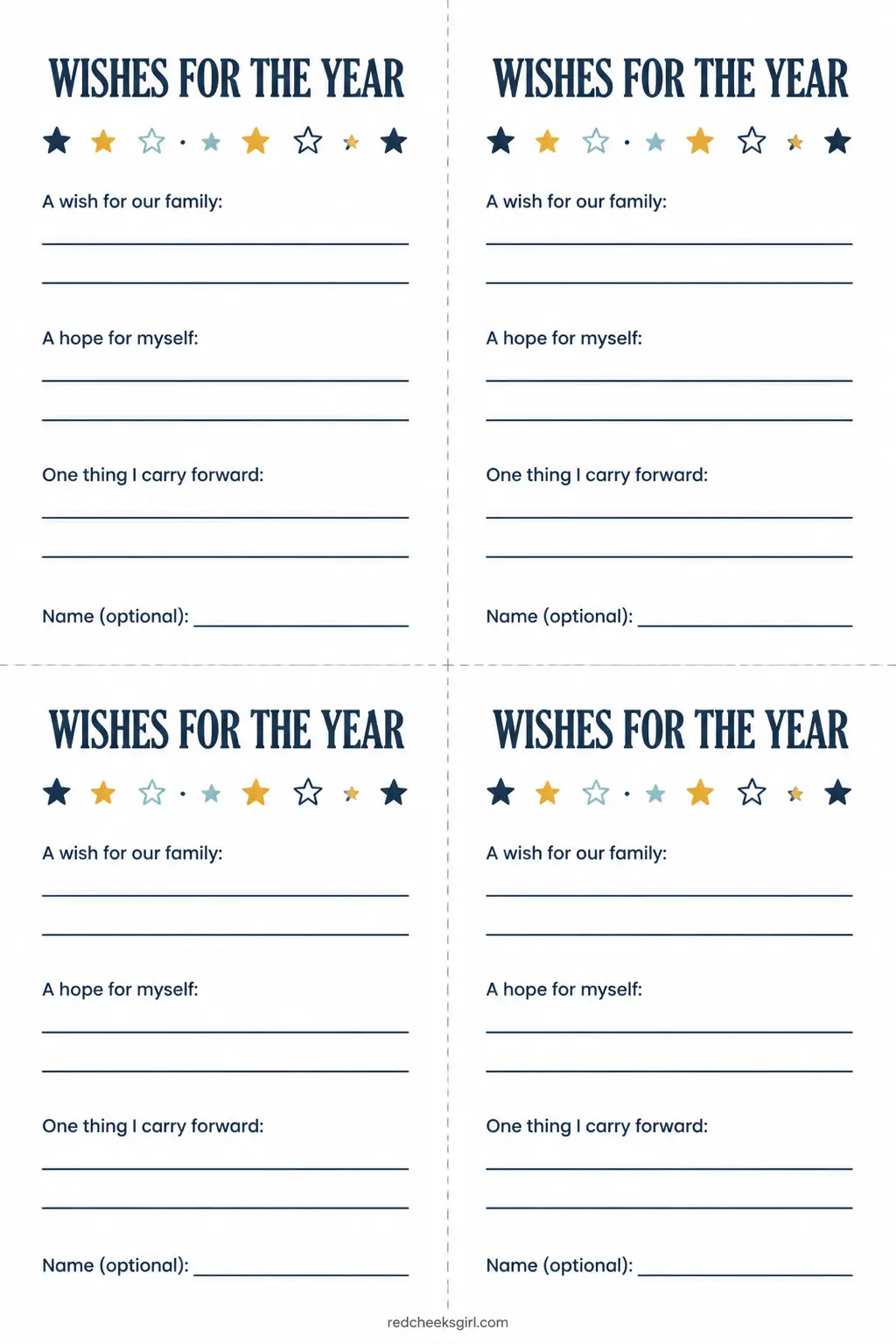
13. Wishes for the Year
Each person receives a keepsake card and writes one wish for the family for the coming year, one personal hope, and one thing from the past year they want to carry forward.
Cards are signed, collected by the host, and read aloud one at a time around the table. No attribution needed if anyone prefers anonymity: the host reads them without naming the writer unless the writer opts in.
Print four cards per sheet. A pen per person, about three minutes of quiet writing time, and then ten to fifteen minutes for the reading aloud depending on group size.
This one works best on night eight as a closing ritual, or on night one as an intention-setting moment for the festival. It is the quietest game on this list and the one most people remember.
If the group skews young and the children cannot write much yet, let them draw a single image instead of writing words. The host translates the drawing into a sentence when reading aloud. Families who do this across several years often keep all the cards in a box and reread the previous years’ wishes together before writing new ones.
- Night one or night eight
- All ages (drawers welcome)
- Families who want a moment of stillness in the evening
14. One Word Story Around the Table
The host starts a Hanukkah story with one word. The next person adds exactly one word. Continue around the table, each person adding one word at a time, building a ridiculous and increasingly unhinged narrative. No planning, no skipping turns, no adding punctuation verbally.
The story ends when it reaches a natural full stop, or after two full circuits of the table, whichever comes first.
No printing needed, no materials at all. The game runs five to ten minutes. It scales to any group size: smaller groups move faster and the story stays more coherent; larger groups push it into pure chaos, which is often funnier. Children as young as four can play because single words are all that is required.
The snag is that someone inevitably tries to steer the story with a very specific word, derailing whatever the previous person set up. That is the game. Lean into it rather than correcting anyone.
A good variation for a second round: add a rule that every fifth word must be a Hanukkah-related word (oil, candle, latke, gelt, miracle), nominated by the host before the game starts.
- Host says one word to open
- Each player adds exactly one word, no skipping
- No planning your word before it is your turn
- Story ends after two full table circuits
Frequently Asked Questions
Which hanukkah party games work best for a mixed age group?
The Gelt Stacking Race, Eight Nights Bingo and One Word Story Around the Table work for all ages without modification. For games with reading or writing, pair a younger child with an older player as a team. Would You Rather needs no reading if the host reads the cards aloud.
How many games should you plan for one Hanukkah evening?
Two to three games fill an evening comfortably without feeling rushed or padded. One active game, one printable round and one quiet or table game is a solid structure. Keep one game in reserve in case energy is high and the group wants more.
Which sheets should you print one per child versus one to share?
Print one per child (or per player): the trivia quiz sheets, the Gelt Guessing Tally, the Latke Rating Card, the Would You Rather cards and the Wishes for the Year card.
Print one set to share: the Eight Nights Bingo call list (host only), the Match the Blessing answer key (read aloud after), and the Candle Count answer key (read aloud after). The bingo grids print four per sheet, enough for four players per sheet.
Can these hanukkah party games be spread across all eight nights?
Yes, that is exactly the point. Use the Wishes for the Year card on night one and night eight as bookends. Save the Latke Taste Test for a night when someone is frying anyway. Run Trivia on a night with a larger group and the quieter games on smaller, calmer evenings.
Do you need to buy anything special for these games?
The only purchase worth making is a bag of chocolate gelt, which does double duty in the Gelt Guessing Tally and the Gelt Stacking Race. Cardstock for printing and fine-tip pens are useful but not essential. Everything else uses objects already on the Hanukkah table.
What is a good hanukkah game for a family that is not very observant or does not know the prayers?
Start with Would You Rather, the Memory Tray or the One Word Story, none of which require any religious knowledge.
The Candle Count Memory Sheet and Match the Blessing work as gentle learning tools rather than tests, so they suit families who want to know more without feeling put on the spot.
The Hanukkah games for kids guide has additional low-stakes options for younger or less familiar players.
15 fun Hanukkah games for kids rooted in real traditions — dreidel, gelt, menorahs & more. Perfect
18 fun Hanukkah games rooted in real traditions — dreidel, gelt, menorahs & more. Perfect for fami
Leave a Reply