


If you’ve ever hosted a Halloween party where half the room ends up glued to their phones while four brave souls play a game in the corner, first of all — same.
Planning halloween games for large groups is a whole different beast from planning games for a cozy dinner party of eight, and most game lists out there conveniently forget that.
So this one is specifically for the crowded living rooms, the packed backyards, and the community center Halloween bashes where you’ve got 20, 30, maybe 50 people who all need something to do.
Every single game below is built to scale, and most of them run best when the room is loud, chaotic, and full of people in questionable costumes.
I’ve organized this list into a mix of active games that get people moving, printable games everyone plays at once, and a few quieter group games that work as a cool-down between the chaos.
The printable ones are especially great for large groups because everyone participates at the same time — no one’s stuck waiting. Grab the ones that fit your vibe, print a stack, and get ready for the best Halloween party you’ve ever hosted.
(Your guests in their off-brand witch hats will thank you.)
This post contains affiliate links — if you buy through them, I may earn a small commission at no extra cost to you.
- Halloween Human Bingo
- Mummy Wrap Team Relay
- Costume Contest Categories
- Halloween Scavenger Hunt
- Monster Mash Freeze Dance
- Team Pumpkin Carving Vote
- Halloween Family Feud
- Pass the Pumpkin
- Group Ghost Story Chain
- Halloween Picture Round
- Candy Relay Race
- Spooky Charades Teams
- Witch Hat Ring Toss
- Halloween Would You Rather Voting Showdown
- Eyeball Spoon Race
- Halloween Emoji Decode
- Spooky Trivia Lightning Round
- Zombie Freeze Tag
- Halloween Mad Libs
- Pumpkin Bowling
- Frequently Asked Questions
1. Halloween Human Bingo
Halloween Human Bingo is the perfect icebreaker for a big group because it gets every single person out of their seat and talking to strangers within the first five minutes — which, tbh, is the hardest part of any large party.
Each guest gets a 5×5 bingo card printed with Halloween-themed descriptions in each square: things like ‘wearing a cape,’ ‘came as a duo costume,’ ‘has face paint on,’ ‘dressed as a food item,’ or ‘made their own costume.’
Players circulate around the room and find real people who match each description, writing that person’s name in the square. You can only use each guest’s name once per card, which forces people to keep mingling rather than having their best friend sign every box.
Print enough cards for every guest plus a few extras for latecomers — one sheet per person is all you need. Set a timer for 15–20 minutes and let the chaos unfold.
The first guest to fill a full row (horizontal, vertical, or diagonal) shouts ‘BOO!’ and wins a small prize.
For groups of 30 or more, consider calling multiple winners: first bingo, first blackout (all 25 squares filled), and ‘most creative find’ for whoever got the weirdest match.
This game works brilliantly right as guests arrive, when the awkward milling-around energy is at its peak. The sneaky secret is that it doubles as a low-key costume-noticing contest — people actually look at each other’s costumes because they’re hunting for specific details.
Host tip: use a free square in the center labeled ‘You’re HERE — happy Halloween!’ so no one wastes five minutes looking for something impossible. It keeps the card solvable and the energy positive.
Pre-fill each card with squares in different randomized orders so no two guests have the same card — a quick copy-paste shuffle in Word before printing does the trick.

🛍 Shopping guide
2. Mummy Wrap Team Relay
This is the game that will produce at least three photos worth saving forever, and also probably a lot of toilet paper on the floor.
Split your crowd into teams of four to six — for a group of 20 or more, aim for four or five teams running simultaneously. Each team picks one volunteer to be their mummy, and the remaining members split the toilet paper rolls between them.
On ‘GO,’ wrappers race to cover their mummy from shoulders to ankles while keeping the arms mobile enough to walk. The first team to use up all their toilet paper AND have their mummy successfully shuffle to the finish line and back wins.
You’ll want to clear a decent runway — about 15 feet per lane works well — and tape start and finish lines on the floor with painter’s tape.
Give each team two to three rolls of basic white toilet paper (the cheap stuff actually holds together better than the quilted kind, weirdly). Play a spooky playlist in the background because nothing adds urgency like a ticking horror movie soundtrack.
A referee per lane helps call disputes about incomplete wrapping — the mummy must be at least 70% covered or the team has to go back and fix it.
The relay twist that makes this work for huge groups: rather than all wrappers working at once, have them take turns — wrapper one does the legs, wrapper two does the torso, wrapper three does the arms — passing the roll like a baton.
This stretches the game out so every teammate has a real job, and it stops four people from tangling each other trying to circle the mummy at the same time.
Host tip: buy two extra rolls per team than you think you need, because toilet paper always rips at the worst possible moment and nothing kills the energy faster than stopping to troubleshoot a tear.
- Groups of 20–50 split into 4–5 teams
- Indoors or outdoors with a clear runway
- Ages 8 and up
- Playing time: 15–20 minutes including setup
🛍 Shopping guide
3. Costume Contest Categories
A standard costume contest with one winner is a recipe for drama and hurt feelings — I say this from experience (the year the obviously-best costume lost to the host’s boyfriend is forever burned into my memory).
The Category Costume Contest fixes this by splitting the vote into five or six themed categories so more people win and the judging feels genuinely fair.
Categories like Scariest, Funniest, Most Creative, Best Group Costume, Best DIY, and Best Pun give guests clear criteria to vote on, and because everyone’s evaluating different things, almost every costume gets a moment in the spotlight.
Print one ballot per guest. The sheet lists all the categories with a blank line underneath each one where voters write in a costume description or the wearer’s name.
Collect all ballots around the halfway point of the party, tally in the back room while guests enjoy snacks, and then do a big dramatic reveal. Hand out small prizes — a candy bag, a novelty trophy, a gift card — for each category winner.
If you want to go fully extra (and I always recommend going fully extra), have a mini ‘runway walk’ moment where winners parade across the room while you announce their category.
The printable ballot is key here because it makes voting feel official and deliberate rather than a casual show-of-hands that always favors the loudest personality in the room.
It also creates a record of the night — guests love holding onto a ballot as a little keepsake.
Host tip: add a seventh write-in category at the bottom (‘Best in Show — your personal favorite’) so guests who feel torn between categories can still honor their true winner. It generates the most interesting answers of the whole ballot, tbh.
Multiple winners means fewer hurt feelings and more genuine celebration — the ballot format keeps judging anonymous and fair even in a room full of friends.

4. Halloween Scavenger Hunt
A team scavenger hunt at a Halloween party is one of those games that sounds like a lot of work to organize but is actually about 20 minutes of prep for a solid 30–40 minutes of pure guest entertainment.
Divide guests into teams of four to six and hand each team a printed list of 20 Halloween-themed items, clues, or photo challenges to find or complete around the party space (and if you’re indoors, around the house or building).
Items can be physical finds — ‘a piece of candy that’s orange,’ ‘something shaped like a bat,’ ‘a fake spider’ — or photo tasks: ‘get a photo of your whole team making the scariest face,’ ‘find someone in a witch hat and pose with them.’
Teams use a shared phone to photograph their finds and completions, then return to base when their 30-minute timer runs out.
The host reviews the phones quickly — or projects them on a TV for the whole crowd — and awards one point per completed item. Bonus points for creativity or especially hilarious photos.
The team with the most points wins, but honestly the slideshow of found items and silly photos at the end is really the main event. It gets the whole room laughing together, which is worth more than any prize.
Print the list double-sided if you’re also using the back as a tally sheet — it keeps things tidy. Laminating a master copy for yourself lets you reuse it year after year with just a few item swaps.
Host tip: include two or three near-impossible items on the list (like ‘something purple with polka dots’) because the teams that decide to create their own version rather than find one always produce the funniest photos of the night, and it rewards creative thinking over just speed.
- Printed scavenger hunt lists (one per team)
- A phone per team for photo challenges
- Small prizes for the winning team
- A 30-minute timer

5. Monster Mash Freeze Dance
Do not underestimate the Freeze Dance.
I know it sounds like a children’s birthday party game, and okay, technically it is — but put 30 costumed adults in a room, blast a Halloween playlist, and shout ‘FREEZE’ at the wrong moment and you will witness some of the most genuinely funny physical comedy of your entire life.
The rules are simple: everyone dances when the music plays, and when it stops, everyone must freeze in exactly the position they were in.
Anyone caught moving after the music stops is out and joins the ‘Monster Judges’ panel, which gives them the job of calling out rule-breakers in future rounds. Last person dancing wins.
The Monster Mash twist is to add character-specific dance styles between rounds. Call out a monster type — ‘everyone dance like a zombie!’ or ‘werewolf mode!’ or ‘you’re all melting witches!’ — and players must incorporate that style into their dancing until the next freeze.
This stops people from just swaying gently to stay safe, and it produces incredible mid-freeze poses.
A Bluetooth speaker and a curated Halloween playlist are your only tech requirements, and the DJ role (pausing and restarting music at unpredictable intervals) is genuinely fun for a co-host to manage.
For groups of 20 or more, do two heats — split the room in half so people have space to actually move, then run the two winners against each other in a champion round.
It doubles the playing time and ensures nobody’s just crammed in a corner hoping not to get noticed.
Host tip: freeze the music right at a big bass drop — players who were mid-jump or mid-spin when it stopped create the most spectacular freeze-frames, and it’s the moment that gets the loudest reaction from the crowd every single time.
Use a phone timer app set to random intervals between 20–60 seconds so you don’t have to manually watch the music — it removes the temptation to freeze it strategically against a specific player.
🛍 Shopping guide
6. Team Pumpkin Carving Vote
Team Pumpkin Carving Vote turns a classic solo Halloween activity into a rowdy, competitive group event where even the people who can’t carve a straight line to save their lives get to be involved.
Divide guests into teams of four to six and give each team one medium pumpkin, a carving kit, and a 20-minute timer.
Teams collaborate on a design — the catch is they can only use what’s in their kit, and they don’t get to see what the other teams are making until reveal time.
At the end of the carving window, all pumpkins are lined up, lit with a tea light, and every guest votes for their favorite (not their own team’s) by placing a sticker dot next to their pick.
Set up the carving stations before guests arrive — plastic tablecloths under each station make cleanup a thousand times easier.
Each team’s kit should include a small serrated carving knife or pumpkin-specific saw, a scoop tool, a marker for sketching the design, and a paper towel roll.
For groups that include kids or nervous carvers, provide foam pumpkins alongside real ones — the foam ones can be carved safely with a plastic knife and reused next year, which is honestly a pro move regardless of who’s in attendance.
The voting element is what elevates this from a craft project to a party game — it creates a competitive edge and gives everyone a stake in the outcome even if they weren’t on the winning team.
Award a prize to each member of the winning team, and then keep the pumpkins lit as Halloween decorations for the rest of the party.
Host tip: sneak a wild-card rule in at the five-minute mark — announce a bonus element that every team must incorporate, like ‘your pumpkin must now have a hat’ — teams scramble to improvise and the resulting chaos is incredible to watch.
Buy all pumpkins the same size so no team has a structural advantage — oddly sized pumpkins are harder to carve and can quietly rig the contest before it even starts.
🛍 Shopping guide
7. Halloween Family Feud
Halloween Family Feud is one of those games where the wrong answers get just as many laughs as the right ones, which makes it absolutely perfect for a mixed crowd where some people are diehard Halloween enthusiasts and some people showed up in regular clothes claiming ‘this IS my costume.’
Split guests into two or more teams of five to eight. A host reads a survey-style question — ‘Name something people put in a jack-o-lantern’ or ‘Name a classic movie monster’ — and teams compete to name the top answers from a pre-written list.
Teams buzz in by slapping the table or raising a hand first, then guess answers until they either clear the board or rack up three strikes.
The printed answer sheet is the host’s secret weapon: it lists the questions, the top answers, and the point value for each answer (higher points for less obvious answers).
You don’t need a game show setup — just a printed host sheet and a printed player sheet that shows the categories but not the answers. Run through eight to ten rounds, keeping a running team score on a whiteboard or paper.
The energy naturally escalates as the rounds progress, especially if you build in a double-point Lightning Round at the end where teams can steal points from each other.
The best questions for this game are ones where the ‘obvious’ answer isn’t necessarily on the list — it forces teams to think creatively and argue loudly amongst themselves about what to say, which is 90% of the fun.
Host tip: print two copies of the host answer sheet and have a co-host act as a second judge, because when it’s close, having a second set of eyes on the answers prevents arguments about whether a synonym counts as a correct response (it usually does, but agreeing on that in advance saves everyone three minutes of debate).
- Teams of 5–8 people, 2–4 teams
- Groups of 20–40 guests total
- Playing time: 25–35 minutes
- Mixed ages — questions can be adjusted for any crowd

8. Pass the Pumpkin
Pass the Pumpkin is the Halloween answer to Hot Potato, and it is guaranteed to produce at least one spectacular near-drop moment that the entire room gasps at simultaneously.
Everyone stands in a large circle — or multiple circles for very large groups — and passes a small decorative pumpkin (real or foam) around the ring while spooky music plays.
When the music stops, whoever is holding the pumpkin is out and takes a seat. The circle gets smaller, the music intervals get shorter, and the tension gets almost absurdly high for a game involving a vegetable. Last person standing wins.
For groups of 30 or more, run two simultaneous circles and have the two survivors face off in a final round.
Use a small sugar pumpkin (about the size of a softball) rather than a full-sized carving pumpkin — it’s much easier to pass quickly and won’t break anyone’s toes if it gets fumbled.
The DJ controls the music from a phone and should deliberately tease the stops by fading the music and then bringing it back up — it creates incredible fake-out moments where half the circle drops the pumpkin in a panic and then has to scramble to pick it back up.
A variation that works brilliantly for mixed-age groups: instead of elimination, each time the music stops the person holding the pumpkin has to answer a quick Halloween trivia question or do a silly dare (say something like ‘do your best zombie walk across the circle’).
This keeps everyone in the game longer, which matters when you’ve got older relatives or younger kids who might feel bad about sitting out early.
Host tip: keep a second pumpkin ready to swap in if the first one splits — sugar pumpkins are more delicate than they look, and a high-stakes rapid-pass situation will test their structural integrity faster than you’d expect.
The whole room watches every pass — unlike elimination games where ousted players drift away, the shrinking circle here creates a natural audience that stays engaged right to the end.
🛍 Shopping guide
9. Group Ghost Story Chain
Group Ghost Story Chain is the game that usually starts as a quick five-minute activity and somehow turns into 25 minutes of genuinely spine-tingling collaborative fiction — and the moment the room goes quiet and the story gets really good is one of the best party memories you can create.
Seat everyone in a circle (this works especially well after dinner when people are in a comfortable, settled mood).
One person starts the story with a single opening sentence: ‘It was the night before Halloween when the lights went out for the very last time…’ Each person around the circle adds exactly one sentence, picking up exactly where the last person left off.
The chain continues until it loops back to the original storyteller, who must deliver the final line.
No props, no setup, no materials required beyond a circle of chairs. The magic is in the constraint — one sentence forces even reluctant participants to contribute, and it’s short enough that no one can claim they ‘can’t think of anything.’
The wilder the directions the story takes mid-chain, the better. For extra structure with a large group, you can divide into teams of eight to ten and have each team build their own story simultaneously, then share the results at the end.
The contrast between what each group created from the same opening line is always fascinating.
Dim the lights for this one. Genuinely. Even if you feel a little dramatic about it.
The shift in atmosphere transforms a simple talking game into something that actually raises the hair on your arms a little, and your guests will lean in rather than zone out.
Host tip: plant a ‘twist agent’ in each circle — someone you’ve quietly briefed beforehand to introduce a wild plot curveball right at the midpoint of the chain (something like suddenly introducing that everyone in the story is actually a ghost).
It derails the narrative in the funniest possible way and guarantees the final sentence lands like a punchline.
If your crowd is shy, give each person a ‘plot card’ face-down with one single word on it (e.g., ‘mirror,’ ‘door,’ ‘scream’) that they must work into their sentence — it removes the blank-page panic completely.
10. Halloween Picture Round
The Halloween Picture Round is a visual quiz where guests identify spooky images, iconic Halloween symbols, and classic horror-adjacent scenes from printed pictures alone — no words, just images.
It’s styled like a pub quiz picture round, and it works brilliantly at Halloween parties because the images can range from genuinely obvious (a carved jack-o-lantern, a black cat) to delightfully tricky (a close-up of a classic monster’s eye, a silhouette of a witch on a broomstick).
Hand one sheet per guest or one per team, give them ten minutes to fill in as many answers as they can, then read out the answers together as a full-group reveal.
Print the sheet with 20 numbered images — a mix of Halloween symbols, monster silhouettes, spooky scene details, and classic horror-adjacent imagery that doesn’t require specific franchises or licensed characters. Leave a numbered blank line beside each image where guests write their guess.
Collect sheets or have teams call out answers round by round — the group reveal format works especially well in a large room because you get a collective groan when someone gets an obvious one wrong and a collective cheer when someone correctly identifies a tricky one.
Scale this up for large groups by running it as a team game — four to six people per team, one sheet per team, ten minutes on the clock.
Teams can discuss and debate their answers quietly, which adds a wonderful layer of social energy to what would otherwise be a solo activity.
Host tip: include two or three ‘bonus’ images that are genuinely difficult — obscure Halloween symbols or unusual monster types — and award double points for those.
The teams that get them right feel like absolute geniuses, and the ones that don’t will spend the rest of the party arguing about what they should have written.
- One sheet per team
- 10 minutes to identify all 20 images
- Write guesses on numbered blank lines
- Read answers aloud as a group — most points wins

11. Candy Relay Race
The Candy Relay Race is a high-energy team game that gets the whole room screaming, and the best part is the only supplies it requires are things you almost certainly have at a Halloween party already.
Teams of five to eight line up in relay-race formation. The challenge: carry a piece of candy (a fun-size candy bar works great) from one end of the room to the other using only a plastic spoon — no hands allowed.
If the candy drops, the player must stop, pick it up with the spoon (still no hands), and carry on.
The relay baton is the spoon itself, passed from one teammate to the next, and the first team to have every member complete the run wins.
Set up the course with painter’s tape markers on the floor indicating the turn-around point, and designate a clear lane per team so runners aren’t colliding mid-race.
For an extra Halloween twist, use eyeball-shaped gumballs instead of candy bars — they’re harder to balance and much funnier to watch roll across the floor when they escape.
You can also escalate the rounds: round one uses spoons, round two uses the spoon held in the player’s mouth (no hands on the spoon either), and round three is the spoon held in the mouth with everyone walking backwards.
Each escalation gets louder and more ridiculous.
This game is one of the best halloween games for large groups because it’s genuinely universal — any age can play, the rules take 30 seconds to explain, and the relay format means every single person gets a turn rather than watching from the sidelines.
Host tip: assign a ‘lane judge’ for each team who watches specifically for dropped candy and ensures the no-hands rule is enforced — without a judge, every team will have one person who ‘accidentally’ steadies the candy with a finger and then acts very innocent about it.
- Plastic spoons (one per team)
- Fun-size candy bars or gumballs (one per player)
- Painter’s tape for course markers
- A clear open runway of at least 15 feet
🛍 Shopping guide
12. Spooky Charades Teams
Spooky Charades Teams takes the classic party game and scales it up beautifully for large groups by running multiple teams simultaneously in a structured tournament format. Divide guests into teams of five to six.
Each round, one player from each team draws a Halloween charades card and acts it out for their team simultaneously — so instead of one person performing at a time, you’ve got four or five actors going at once across the room, which is absolute visual chaos in the best way.
Each team has 90 seconds to guess as many cards as possible. Correct guesses earn one point each, and after three rounds per player, the team with the most points wins.
Print and cut the charades cards before the party — each card has one Halloween-themed word or phrase to act out, no speaking or mouthing allowed.
Categories include Halloween creatures (werewolf, vampire, zombie), Halloween actions (trick-or-treating, carving a pumpkin, bobbing for apples), spooky settings (haunted mansion, graveyard, dark forest), and Halloween costumes (black cat, skeleton, ghost).
Having enough printed cards for three full rounds per team means printing about 60–80 cards total for a large group, which sounds like a lot but takes about ten minutes flat.
The simultaneous-team format is what makes this work for a crowd — in traditional charades, 80% of the room watches while one person acts.
Here, everyone is either acting or guessing at all times, which means the energy level stays consistently high for the entire game.
Host tip: make one category of cards genuinely difficult — things like ‘full moon rising over a graveyard’ or ‘a vampire discovering his reflection is gone’ — and award double points for those, because the performance attempts for impossible prompts are comedy gold and people will talk about them for years.
Laminate a set of cards so they survive the party and can be reused next Halloween — between grease from snacks and enthusiastic gesturing, paper cards get destroyed faster than you’d think.

13. Witch Hat Ring Toss
Witch Hat Ring Toss is the Halloween party game that requires almost zero setup, scales to any group size, and somehow always draws a crowd of spectators even when it’s not their turn.
Set up five to seven plastic witch hats on the floor in a row at increasing distances from the toss line — the nearest hat is worth one point, the farthest is worth five.
Players take turns tossing glow-in-the-dark rings (or standard plastic rings from a ring toss set) from behind the line, trying to loop them over the hat brims.
Each player gets three tosses per turn, and after every person in the room has had a turn, the highest cumulative score wins a prize.
The setup is literally five witch hats, a bag of plastic rings, and a strip of painter’s tape on the floor for the toss line.
Run it carnival-booth style — it can be a side game running parallel to other activities rather than a full-room main event, which is ideal for large groups where not everyone wants to be in the spotlight at once.
Set it up in a corner and let guests drift over throughout the party to take their turn, keeping a running leaderboard on a small whiteboard next to the game.
The competitive element simmers in the background all night and boils over into an exciting final ranking reveal.
Glow-in-the-dark rings are genuinely transformative here — dim the lights slightly, and the toss line becomes a mini light show that draws people across the room like moths.
For an escalating tournament, run an official final-round playoff between the top five scorers from the open play period.
This game is also one of the best low-pressure options for guests who are more introverted — taking a turn at a side-game station is much less intimidating than performing in front of the whole room.
Host tip: weight the hats down with a small handful of candy inside each one so they don’t slide or tip when a ring clips the brim — a sliding hat invalidates every score within a three-foot radius and causes more disputes than you can handle.
- 5–7 plastic witch hats (dollar store works great)
- Glow-in-the-dark plastic rings
- Painter’s tape for the toss line
- A small whiteboard or paper for the leaderboard
🛍 Shopping guide
14. Halloween Would You Rather Voting Showdown
Halloween Would You Rather Voting Showdown is the game where everyone realizes exactly how wrong their friends’ priorities are, and it’s a perfect large-group game because the whole point is that everyone votes and then argues about it.
Print one card per guest — each card has 12 Halloween-themed ‘would you rather’ questions, and guests circle their answer for each one.
After ten minutes, the host reads each question aloud and the room votes by show of hands: ‘Okay, who said they’d rather be chased by a zombie horde than have to eat a bowl of mystery Halloween candy?’
The majority answer is revealed, dissenters defend themselves, and chaos reigns. No elimination, no scoring — just gloriously opinionated group discussion.
The questions are the heart of this game, so make them genuinely interesting rather than just gross-or-grosser. Good examples: ‘Would you rather spend Halloween night in a real haunted house OR give up candy forever?’
or ‘Would you rather have your costume fall apart at the worst moment OR have your face paint smear halfway through the night?’
Include a few that are genuinely divisive — questions where you genuinely cannot predict which way the room will split — because those generate the best arguments. Print on cardstock so guests can keep their sheet as a little party keepsake.
For groups of 30 or more, split into two halves of the room after the initial vote reveal — left side for option A, right side for option B — and give each side 60 seconds to shout their case to a designated ‘undecided’ row in the middle, who then physically walks to the side that convinced them.
It’s equal parts debate class and chaos, and it’s one of those games that builds exactly the kind of rowdy party energy that keeps people from sneaking off home before midnight.
Host tip: the funniest questions are always the ones where the ‘obviously correct’ answer varies wildly by age group — throw in one that will perfectly split your crowd along generational lines and watch both sides become extremely passionate.
- All group sizes — works for 20 to 100+ guests
- Mixed ages (adjust question difficulty)
- Playing time: 15–20 minutes
- Zero setup beyond printing

15. Eyeball Spoon Race
The Eyeball Spoon Race is technically the same mechanics as an egg-and-spoon race, but swap in ping-pong balls painted to look like bloodshot eyeballs and suddenly it becomes one of the most talked-about games of the night.
Guests race side by side down a course carrying their ‘eyeball’ on a plastic spoon — no hands on the ball, no shortcuts. First to cross the finish line without dropping it wins.
If an eyeball hits the floor, the racer must stop, retrieve it, place it back on the spoon using only the spoon (no fingers), and then continue.
Run heats of eight to ten racers at a time and bring the heat winners back for a grand finale.
Make the eyeballs ahead of time by painting white ping-pong balls with red squiggly lines for veins and a black iris in the center — acrylic paint works, it dries in about an hour, and the finished product is genuinely unsettling and delightful.
Buy a few extra blank balls in case of losses. Plastic teaspoons (not tablespoons — teaspoons make it harder and funnier) from a party supply store work perfectly.
Lay out the course with painter’s tape, keep it at about 20 feet for best dramatic tension, and add a mid-course obstacle — a single orange cone they have to circle — for the grand finale heat.
This game has incredible spectator energy. Even guests who aren’t racing are completely invested in whether someone’s eyeball is about to roll off the spoon, and the slow-motion wobble of a ball on the edge of tipping will have the whole room holding their breath.
It’s one of those halloween games for large groups that rewards watching as much as playing, which means no one disengages even when it’s not their heat.
Host tip: run the ‘eyeball drop’ count as a side stat — announce at the end how many total eyeball drops happened across all heats — it’s always a funnier number than people expect and gives everyone who dropped theirs a collective redemption moment.
Heats of 8–10 keep the pace fast, the audience engaged, and give every guest in a big group a real racing moment — no one just watches the whole time.
🛍 Shopping guide
16. Halloween Emoji Decode
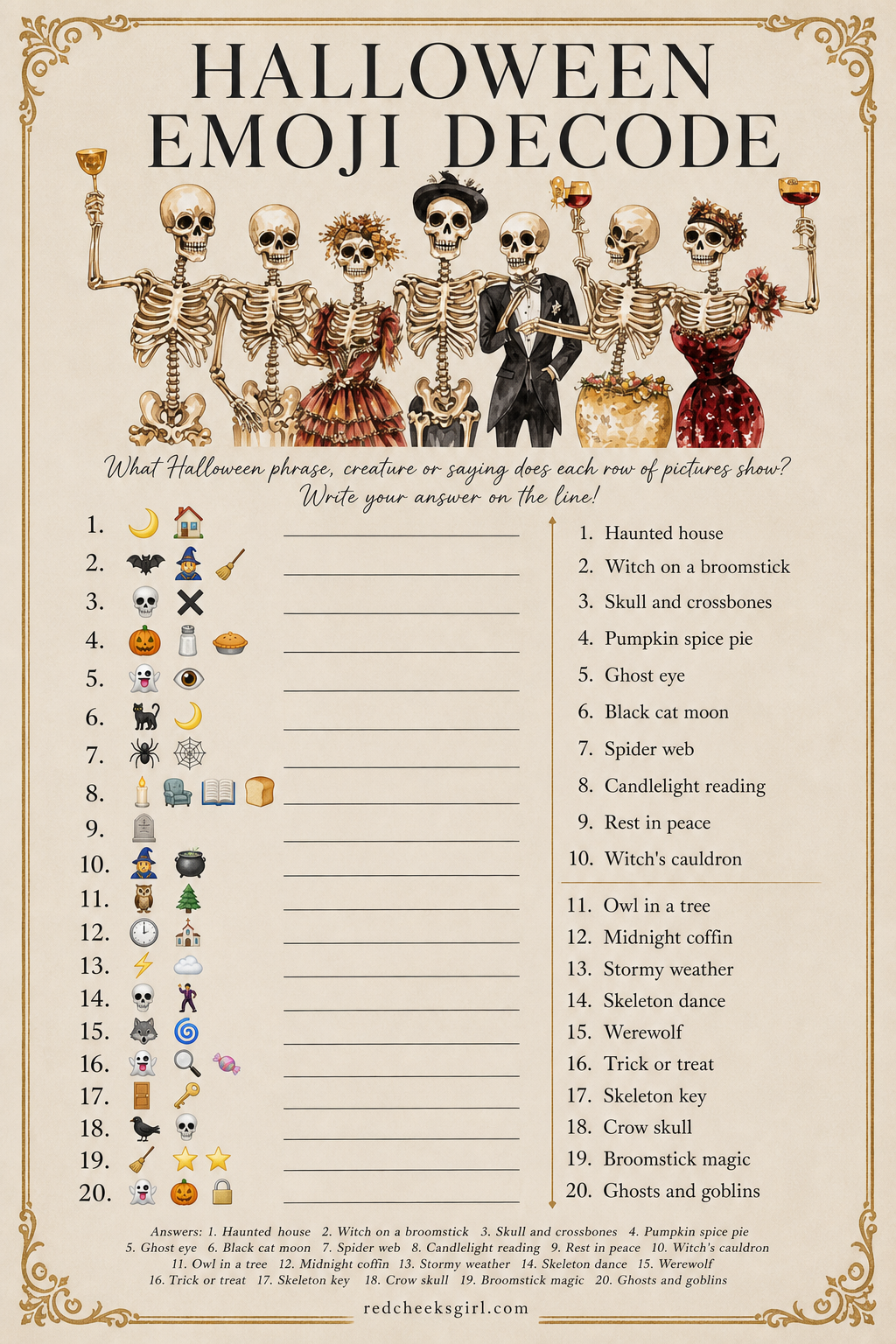
Halloween Emoji Decode is a printable puzzle game where guests decode Halloween phrases, movies, and spooky concepts represented entirely by rows of small illustrated emoji-style icons — no words, just pictures.
Think: a little moon icon, a house icon, and a ghost icon in a row = ‘haunted house.’ Each row of icons represents a different Halloween phrase, creature, activity, or spooky saying, and guests write their guess on the blank line next to each row.
The game runs best as a team activity — hand one sheet to each team of four to six, give them ten minutes, then do a group reveal with a big cheer for whoever got the most right.
Print the sheet on cardstock for a nicer feel, one per team.
Run it mid-party as a structured ten-minute activity between the bigger active games — it creates a natural energy pause that lets people catch their breath, refresh their drinks, and engage their brain in a different way before the next round of chaos.
The reveal is the real payoff: read each answer aloud, let teams hold up how many fingers for how many they got right, and give a small prize to the highest-scoring team.
The trick to making this genuinely fun rather than frustrating is calibrating the difficulty range.
Include five ‘easy’ ones (everyone gets them, room feels smart), ten ‘medium’ ones (real debate between teammates), and five ‘hard’ ones (usually only one person in the room gets each one, and they feel like absolute heroes).
That curve ensures every team has something to celebrate. Host tip: after the reveal, do a quick ‘honor roll’ of the hardest question — ask who got it right and have them briefly explain how they figured it out.
It’s a great thirty-second spotlight moment for your quirkiest, most lateral-thinking guests.
- One sheet per team of 4–6
- 10 minutes to decode all emoji rows
- Write guesses on numbered blank lines
- Group reveal — most correct answers wins
17. Spooky Trivia Lightning Round
Spooky Trivia Lightning Round is the printable game for the people at your Halloween party who secretly read Wikipedia articles about the history of Halloween for fun — you know exactly who they are, and this is their moment to absolutely shine.
It’s also one of the most reliably fun halloween games for large groups because every person plays at once: hand out one sheet per guest, give them eight minutes to answer all 20 questions solo, then collect and read the answers aloud.
Guests call out their answers, score their own neighbor’s sheet, and the guest with the most points wins. Simple, fast, satisfying.
The sheet covers five categories of Halloween trivia: Origins and History (e.g., what ancient festival inspired Halloween?), Classic Monsters (e.g., what is the traditional weakness of a vampire?), Halloween Symbols (e.g., what vegetable was originally used to make jack-o-lanterns before pumpkins?), Spooky Superstitions (e.g., according to folklore, what does a black cat crossing your path mean?), and Pop Culture (e.g., what color is associated with Halloween alongside orange?).
Questions 1–4 are history, 5–8 are monsters, 9–12 are symbols, 13–16 are superstitions, 17–20 are pop culture — numbered continuously 1–20 throughout.
The lightning round format — everyone answering at once rather than taking turns — is what makes this work at a party of 20 or more.
There’s no waiting, no dead air, and the shared groan when the host reveals that the original jack-o-lanterns were made from turnips is one of the great unifying party moments.
For extra competitive drama, run a playoff between the top three scorers with five sudden-death bonus questions answered verbally, fastest hand up wins.
Host tip: write the tiebreaker questions on a separate card and keep them face-down until you need them — at every single party I’ve run this game, there has been a tie, and having the tiebreaker ready means the energy doesn’t stall while you scramble to think of a question on the spot.
- Solo play, all 20+ guests at once
- Ages 12 and up (adjust for younger groups)
- Playing time: 8 minutes play + 5 minutes scoring = 13 minutes total
- Pairs perfectly with a brief intermission or snack break

18. Zombie Freeze Tag
Zombie Freeze Tag is what happens when you give the classic schoolyard game a Halloween makeover and a room full of costumed adults, and it is objectively hilarious to watch someone in a full vampire cape try to outrun a zombie.
One player starts as the zombie — arms outstretched, shuffling walk, the whole committed performance — and tries to tag other players. Anyone tagged must freeze in place like a statue and strike their spookiest pose.
They can only be unfrozen if an untagged player crawls through their legs or taps both their shoulders simultaneously. As more players get tagged, the zombie’s team grows and the survivors dwindle.
For groups of 20 or more, start with two zombies to keep the pace moving, and add a rule that any player who has been frozen three times total joins the zombie team permanently.
This creates a constantly shifting dynamic where the room never fully stalls — even if the zombies are slow, the survivor pool shrinks steadily. Play in rounds of five to seven minutes, reset, pick new starting zombies, and run another round.
It works best outdoors or in a large cleared indoor space where there’s genuine room to run without knocking into furniture or each other.
This is the game that produces the best party photos — frozen players holding ridiculous poses while chaos swirls around them is pure gold.
Set up a designated ‘safe zone’ (a small mat or marked area) where players can rest for a maximum of 15 seconds before re-entering the game, which prevents the strategy of just camping safely forever.
Host tip: choose starting zombies who will commit to the bit — a half-hearted zombie shuffle kills the energy, but someone who really leans into the lurching, moaning performance sets the tone and the whole room follows.
Bribe them with first pick of the candy bowl if you have to.
Play indoors with slower zombie-shuffle rules only (no running for zombies) so the game works in a tighter space — it slows the tag pace and extends the fun without needing a backyard.
19. Halloween Mad Libs
Halloween Mad Libs is the printable game that can make 30 people simultaneously howl with laughter at a story involving a ‘slimy, ferocious spatula’ haunting a haunted ‘laundromat,’ and I cannot overstate what a gift that is at a party where the energy needs a boost.
Each guest gets their own Mad Libs sheet — a short Halloween ghost story with 15 to 20 key words blanked out, labeled only by part of speech (noun, adjective, verb, scary place, spooky sound, etc.).
Guests fill in all the blanks without seeing the story first, then pass their sheet to a neighbor who reads the completed version aloud. Run it in teams or as a full-group read-aloud where each person reads their own story — both formats work brilliantly.
Print one sheet per guest on regular paper — it doesn’t need to be cardstock, since this is a fill-and-read-aloud activity.
Each sheet should have the instructions at the top (‘Fill in a word for each blank BEFORE reading the story!’), the blank-fill section with labeled blanks, and the full story beneath with those same slots ready to receive the filled-in words.
The stories themselves should be Halloween-themed: a ghost who can’t scare anyone, a witch whose spell goes wrong, a vampire who keeps sneezing at the wrong moment. Short, punchy, and full of opportunities for absurdist words to land perfectly.
The read-aloud reveal is the absolute best part, and it works especially well with large groups because you get waves of laughter as the story gets read and the increasingly unhinged word choices pile up.
For maximum chaos in a group of 20 or more, have everyone read their own story simultaneously at the count of three — the cacophony of 20 different Halloween disaster tales being recited at once, with everyone laughing at their neighbor’s story, is the kind of pure party moment that money genuinely cannot buy.
Host tip: include one completely unexpected blank labeled ‘your host’s least favorite vegetable’ — it lands as a personalized callback joke every single time and gets the loudest laugh on the first read-through.
Every guest produces a completely unique result from the same template — with 20+ players, no two stories will be alike, which means the read-aloud phase has 20 different punchlines.

20. Pumpkin Bowling
Pumpkin Bowling is exactly what it sounds like, and it is deeply, unreasonably satisfying. Set up ten plastic ghost-face cups (or white plastic cups with drawn-on faces) in a classic bowling triangle at one end of a clear hallway or outdoor path.
Players take turns rolling a small round sugar pumpkin down the lane toward the pins, aiming to knock down as many as possible in two rolls. Keep score on a whiteboard like real bowling — strikes, spares, and all.
Run the game as an open station throughout the party, similar to the ring toss, and do a final tournament-style playoff between the top scorers at the end of the night.
Use sugar pumpkins rather than decorative ones — they’re rounder, more uniformly shaped, and roll more predictably, which makes the game actually playable rather than a random luck fest.
For the ‘pins,’ white plastic party cups with googly eyes and a marker-drawn mouth drawn on work perfectly and survive multiple games without crumpling.
Set up the pin formation on a hard floor surface, not carpet — carpet slows the pumpkin too much and makes strikes nearly impossible. An eight-foot lane is short enough to be accessible but long enough to make it genuinely challenging.
Pumpkin Bowling is one of those halloween games for large groups that works as a continuous side activity rather than a scheduled group game — guests drift over, bowl a frame, then drift back to conversations, and the scoreboard slowly fills up all evening.
The final playoff at the end of the night gives the side-game a satisfying conclusion that ties it back into the main party energy.
Host tip: keep the backup pumpkin (you should always have a backup pumpkin) right next to the lane — round two guests will inevitably try to throw it faster than its structural integrity can handle, and a split seam right at the start of someone’s turn is both hilarious and a lane-closing emergency at once.
- 3–4 small round sugar pumpkins
- 10 white plastic cups per lane
- Black permanent marker for ghost faces
- Hard floor surface with 8-foot clear lane
- Whiteboard or paper scorecard
🛍 Shopping guide
Frequently Asked Questions
What are the best Halloween games for large groups of 20 or more?
The best halloween games for large groups run simultaneously rather than one-at-a-time, so nobody spends the whole night watching.
Top picks include Halloween Human Bingo (everyone plays at once as an icebreaker), Mummy Wrap Team Relay (multiple teams race simultaneously), Monster Mash Freeze Dance (whole room dances together), and team-based printable games like Halloween Family Feud and Spooky Trivia Lightning Round.
The key is to have a mix of active games, team printables, and a few quieter group games so different personality types all have something they love.
How do you keep a Halloween party game going with 30 or 40 people?
For very large groups, the secret is running games in heats or simultaneously rather than sequentially. For relay races like the Mummy Wrap or Candy Relay Race, run four or five teams at once and bring winners back for a grand final.
For printable games, every single guest participates at the same time.
Side-station games like Witch Hat Ring Toss and Pumpkin Bowling can run all evening as drop-in activities with a running leaderboard, so you always have something for guests who’ve just arrived or want a break from the main action.
Which Halloween party games work for both kids and adults?
The best mixed-age Halloween games are ones where physical size and knowledge level don’t create an unfair advantage. Pass the Pumpkin, Monster Mash Freeze Dance, Zombie Freeze Tag, and Pumpkin Bowling all scale beautifully across ages.
For printable games, the Halloween Picture Round and Spooky Charades Teams work for any age because teams naturally balance themselves out — kids often spot visual clues faster than adults, which gives younger guests a genuine competitive advantage they love.
How much setup time do I need for 20 Halloween party games?
Most of the active games on this list require under ten minutes of setup: painter’s tape for lanes, hats for ring toss, toilet paper for the mummy wrap.
The printable games take the most prep — budget about 30 minutes total to print, cut (for charades cards and Mad Libs), and organize all sheets.
The big wins are the games that set themselves up naturally, like Group Ghost Story Chain (zero setup, just circle of chairs) and Monster Mash Freeze Dance (just a playlist). Print everything the day before and you’ll be stress-free on the actual party day.
How do I make a Halloween costume contest fair for a large group?
The single best fix for a large-group costume contest is splitting judging into clear categories — Scariest, Funniest, Most Creative, Best Group, Best DIY, Best Pun — so more people can win and voters have specific criteria rather than vague ‘best costume’ to evaluate.
More winners, anonymous voting, and category prizes all but eliminate the hurt feelings that kill a standard costume contest.
Can I run Halloween party games without a big outdoor space?
Absolutely — most of the games in this list work indoors. Printable games like Halloween Human Bingo, Halloween Family Feud, Spooky Trivia Lightning Round, and Halloween Mad Libs need nothing more than a table and chairs.
Active games like Monster Mash Freeze Dance, Pass the Pumpkin, and Group Ghost Story Chain work in any cleared living room or community hall.
For relay races, a hallway or long room works fine — just use painter’s tape to define lanes and keep the course short. The only game that genuinely benefits from outdoor space is Zombie Freeze Tag, which works better with room to run.
📌 Save These for Later
Loved these? Pin your favorite image below so you can find this list again when you’re planning.
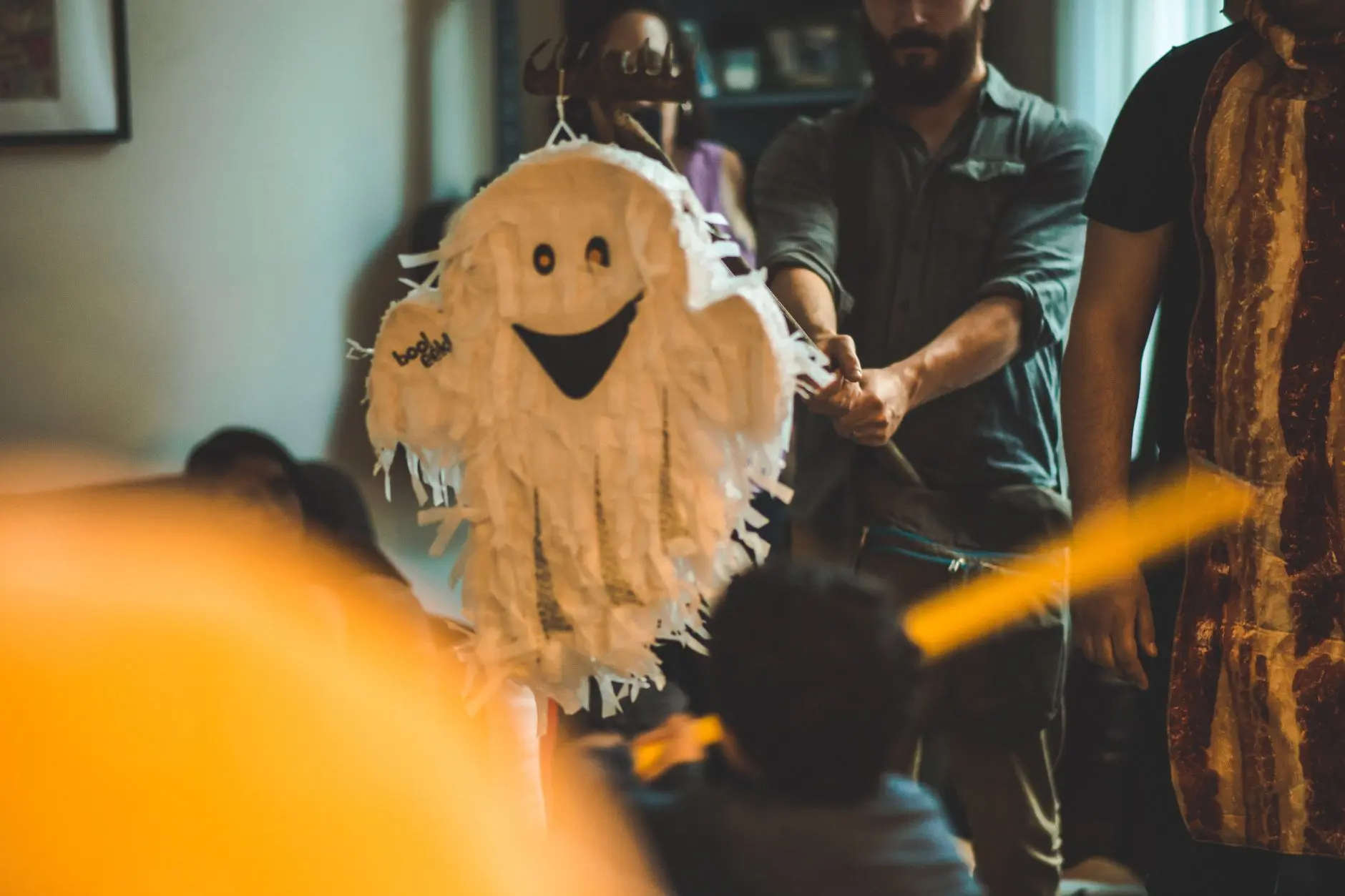
16 Halloween games and activities for kids — active, printable, and quiet. Perfect for class parti
28 outdoor Halloween decor ideas tested by a wet, windy October. Find out what material actually sur
32 sealed, shelf-worthy glitter pumpkin designs from fully covered to a single sparkling detail, plu
Leave a Reply