

Halloween class party games have a reputation for going sideways fast — and I say that with the deepest respect for every room parent who has ever watched 24 sugar-fueled second graders simultaneously lose their minds over a candy relay.
If you are staring down a 30-minute party slot, a classroom full of kids in full costume, and zero desire to spend November scraping fake cobwebs off the ceiling, you are in exactly the right place.
Every single game on this list was chosen because it actually works in a real classroom: low mess, low prep, high energy in the best possible way.
I have sorted these halloween class party games so they naturally alternate between active, printable, and quiet — meaning you can run them as stations, pick a handful for a single all-class session, or hand this list to a parent volunteer and walk away with confidence.
(Okay, maybe not completely walk away. But at least check your email in peace for five minutes.) Print the sheets on cardstock the night before, grab a pack of straws and some painter’s tape, and you are genuinely set. Let’s get into it!
This post contains affiliate links — if you buy through them, I may earn a small commission at no extra cost to you.
- Halloween Bingo
- Pumpkin Toss Buckets
- Halloween Charades Cards
- Spider Race Straw Blow
- Monster Draw and Pass
- Halloween Would You Rather Kids
- Costume Parade Vote
- Candy Corn Guessing Jar
- Halloween Sorting Relay
- Ghost Freeze Dance
- Halloween Picture Round
- Mummy Wrap Teams
- Halloween Emoji Decode
- Witch Hat Ring Toss
- Spooky Story Starters Mad Libs
- Eyeball Spoon Race
- Halloween This or That Vote
- Pumpkin Face Pin-Up
- Halloween Trivia Showdown
- Monster Freeze Sculpt
- Frequently Asked Questions
1. Halloween Bingo
Halloween Bingo is the perfect opener for a class party because it gets every single child engaged at exactly the same moment — no waiting for a turn, no one left out.
Each student gets a unique 5×5 bingo card filled with Halloween picture icons: a jack-o’-lantern, a bat, a ghost, a witch hat, a spider web, a cauldron, a black cat, candy corn, and more.
You call out the words (or hold up illustrated caller cards you print alongside the sheets), and kids cover their matching square with a bingo chip, small eraser, or even a torn bit of orange paper if you forgot to grab chips.
First to get five in a row shouts ‘Boo-ingo!’ and wins a sticker or a pencil — totally your call on the prize situation.
Print one unique card per child (randomize the grid order so everyone is not shouting at the same time), plus a set of caller cards you can shuffle and draw from.
A class of 25 needs about 25 unique card layouts, which most free-printable bingo generators handle easily — just make sure every symbol appears on every card, only in different positions. Set up takes literally five minutes the morning of the party: print, cut, done.
If you run out of time for multiple rounds, ‘blackout bingo’ (cover every square) makes a satisfying grand finale that stretches the game another few minutes without any extra prep.
Here is the host tip that will save you a headache: do NOT use candy as the bingo markers. Kids eat them mid-game, then argue about whether their square is covered.
Small flat erasers, pennies, or even dried pasta shapes work perfectly and vanish straight into the trash when the round ends — zero mess, maximum sanity.
Your halloween class party games lineup will thank you for starting with something this calm and inclusive before the wilder stuff begins.
Call each word AND hold up a picture card simultaneously — early readers and ELL students can follow along without feeling left out.

2. Pumpkin Toss Buckets
Pumpkin Toss Buckets is the kind of game that looks chaotic from the doorway but is actually very easy to manage inside a classroom.
Set up three plastic buckets or large bowls in a row about four, six, and eight feet from a masking-tape throwing line. Label them with point values — say 1, 3, and 5 — using a strip of orange paper taped to the front.
Each child gets three small beanbags (orange ones are adorable but any color works) and takes turns tossing them underhand into the buckets, one toss per bucket distance.
They add up their points on a little slip of paper and cheer for each other between turns. It is genuinely joyful and shockingly calm for an active game.
The secret to running this smoothly with 20+ kids is to set up two or three identical bucket stations side by side so you can run six kids at once rather than one at a time.
Painter’s tape on the floor creates a crystal-clear throwing line that peels right up after the party — no damage to classroom floors.
If you do not have beanbags, rolled-up socks work brilliantly (I know, I know — but they actually do), and small foam balls from the dollar section are even better.
Keep a parent volunteer or older student helper at each station to retrieve tossed beanbags quickly so the line keeps moving.
The host tip nobody tells you: lower the front bucket to the floor so it is easier, and reserve the tallest bucket for the back distance — kids feel like absolute champions when they land one in the farthest bucket, even if the point value is only 5.
That moment of genuine triumph is worth more than any elaborate prize. This game plays best in a five-to-eight minute window per rotation, which fits perfectly into a class-party station format alongside your printable halloween class party games.
- 3 plastic buckets or large mixing bowls per station
- 9-12 small beanbags or foam balls per station
- painter’s tape for the throwing line
- point-value labels (orange paper + marker)
🛍 Shopping guide
3. Halloween Charades Cards
Halloween Charades Cards takes the classic acting game and gives it a spooky makeover that is perfectly dialed in for elementary schoolers.
Print and cut a deck of cards, each featuring a Halloween character or action that kids must act out silently while their team guesses: a zombie walking, a bat flying, a witch stirring a cauldron, a ghost floating, a scarecrow in the wind, a mummy shuffling, a skeleton dancing, a vampire sleeping in a coffin, and so on.
Split the class into two or three teams, and give the actor 30–45 seconds to get their team to say the right word. Teams earn a point for each correct guess, and you rotate actors so everyone gets a turn across the rounds.
The print-and-play setup is what makes this so teacher-friendly: cut the cards at home the night before, shuffle them, and stack them face-down on a desk. No special supplies needed beyond the printed cards.
For a class of 24, running three teams of eight means each team has eight actors — at 45 seconds per turn, the whole game wraps in about twelve minutes, which is a sweet spot for a party.
You can project a one-minute sand timer on your board using a free online tool to keep the energy up without needing to watch your phone.
The one thing veteran party runners know: include at least four or five very easy cards (like ‘bat’ or ‘ghost’) at the top of the shuffled deck so the first actors do not bomb and get embarrassed.
Confidence early makes everyone braver later in the game.
This is genuinely one of the most re-playable halloween class party games because the kids beg to go again — and the second round is always funnier than the first, since they start hamming it up outrageously.
- Grades K–5
- Whole-class play or team rotations
- 10–15 minutes
- No materials needed beyond the printed and cut cards

4. Spider Race Straw Blow
Spider Race Straw Blow is exactly as thrilling as it sounds and — I cannot stress this enough — even more hilarious to watch.
Each child gets a wide milkshake straw and a small lightweight plastic spider (the kind that comes in the dollar-store bag of assorted Halloween rings; just pop the ring bit off).
Mark a start line and a finish line on a table or on the floor with painter’s tape. On the count of three, everyone blows through their straw to propel their spider toward the finish line. The catch: you can only blow, never touch.
Spiders wobble, veer sideways, collide with each other — it is absolute comedy gold and the kids go completely feral with excitement in the best possible way.
For a class of 20+, set up four or five parallel racing lanes on pushed-together tables or on the floor, so you can race five kids at a time in heats.
Each heat takes about 60–90 seconds, so the whole class rotates through in well under ten minutes.
Use a different-colored plastic spider per lane if possible so there is no argument about whose spider crossed first — trust me, you want that visual clarity when 24 people are screaming simultaneously.
Give each winner a Halloween sticker and immediately line up the next heat so momentum never dies.
Here is the insider tip: right-side-up plastic spiders with their legs spread flat slide beautifully on a smooth table.
Upside-down or crumpled spiders catch on every imperfection and stop dead — so before the party, quickly test your spiders on the actual surface you plan to use and flip any troublemakers right-side-up.
This one tiny prep step is the difference between a smooth race and a very confused-looking kid blowing with all their might while their spider goes absolutely nowhere.
- Lightweight plastic spiders (one per lane)
- Wide milkshake straws (one per child)
- Painter’s tape for start and finish lines
- Flat smooth table or hard floor surface
🛍 Shopping guide
5. Monster Draw and Pass
Monster Draw and Pass is the Halloween version of Exquisite Corpse — the classic folded-paper drawing game — and it is the one game guaranteed to produce genuine, full-body, falling-out-of-chairs laughter. Each child gets a sheet divided into three horizontal sections: Head, Body, and Legs.
They draw a monster head in the top section (eyes, fangs, horns, antennae — whatever their imagination conjures), then fold the paper back so only a tiny sliver of the neck shows, pass it to the next person, who draws the body without seeing the head, folds again, passes, and the last person draws the legs and feet.
When everyone unfolds their sheet, the room collectively loses it at the ridiculous creatures they have created together.
Run this at desks in a whole-class setting: everyone starts at the same time, draws for about two minutes, folds on your signal, passes to their right, and the cycle repeats twice.
The whole game — including the big reveal and the chaos that follows — takes about eight minutes, which is perfect.
You do not need special paper; a simple pre-divided sheet printed on regular copy paper with the section labels ‘HEAD,’ ‘BODY,’ and ‘LEGS’ printed lightly in each zone is all you need.
Kids can take their monster home as a keepsake, which also solves the ‘what do they do with it’ problem neatly.
The pro tip: before you say ‘go,’ tell kids to draw the very bottom edge of their section slightly over the fold line — just a tiny bit of the neck or waist should peek out past the fold so the next artist knows where to start connecting.
Without this instruction, every monster ends up with a mysterious floating gap between sections, which is funny but also slightly unsettling (ask me how I know).
Monster Draw and Pass works beautifully as a quiet table activity between your livelier halloween class party games, giving kids a moment to breathe and create.
Every child creates something — no one watches while others play. The shared reveal moment creates instant classroom community and the monsters make a great take-home craft too.

6. Halloween Would You Rather Kids
Halloween Would You Rather Kids is one of those games that sounds too simple to be a party game — and then you watch a room full of eight-year-olds passionately debate whether they would rather have spider legs or bat wings and you realize it is actually pure magic.
Each child gets a printed sheet with 12 spooky Would You Rather questions, each paired with two illustrated icons. They circle their choice, then the class votes on each question together, hands in the air, and you tally live on the board.
The collective shrieks when you reveal that 17 out of 23 kids would rather eat a bowl of gummy worms every day than sleep in a haunted house? Genuinely priceless.
The sheet is completely self-contained — no scissors, no tokens, just a pencil and the printed page. Questions include kid-friendly dilemmas like: Would you rather be a vampire or a werewolf? Would you rather live in a haunted house or a creepy castle?
Would you rather have a witch’s broomstick or a magic wand? Would you rather eat candy corn or candy pumpkins for a week? Each question has an A and B option with a corresponding small icon illustration, and kids simply circle A or B.
Running the class vote after everyone has circled their answers adds a social layer that transforms a quiet worksheet into an energetic whole-class discussion.
The host tip that makes this go from fine to fantastic: after the class vote, pick two or three questions where the class is split roughly 50/50 and ask one kid from each side to argue their case for 15 seconds.
The mini-debates are HILARIOUS and kids absolutely love having the microphone moment — especially when their argument is ‘but if you are a vampire you can fly AND turn into a bat so it is basically two superpowers.’
This game pairs really well right before a higher-energy active game to keep the pacing of your halloween class party games feeling balanced.
After the class vote, call on one kid per side to give a 15-second argument — the mini-debates are funnier than anything you could plan and kids love the spotlight moment.

7. Costume Parade Vote
Costume Parade Vote takes the classic costume parade and gives every child a structured, inclusive role so nobody is just a passive audience member.
Before the parade begins, hand each child a printed voting ballot with a list of friendly, non-competitive categories: Most Colorful, Most Creative, Best Animal Costume, Most Spooky, Most Funny, Most Sparkly, and Best Group Costume (if applicable).
As classmates parade around the room to a fun playlist for about three minutes, each voter watches carefully and fills in one classmate’s name per category on their ballot.
The goal is not a winner-takes-all competition — the teacher tallies results privately and announces category highlights in a way that mentions as many kids as possible, so nearly everyone hears their name celebrated.
The ballot itself is a simple, clean printable: one line per category with the category title as the label and a blank write-in line for the student’s name choice.
No checkboxes, no ranking — just one blank line per category, which keeps it fast and eliminates any tie-breaking drama. Print one per child, hand them out with pencils, and collect them at the end of the parade.
While kids move into the next game, a volunteer quickly tallies and reports. For classes where many kids have similar costumes, swap out categories on the fly — ‘Most Colorful’ will always have a clear answer in a room full of 24 costumes.
The critical host tip that nobody warns you about: choose your categories very carefully before you print. Avoid anything that implies ‘best’ in a way that crowns one winner over losers — ‘Most Creative,’ ‘Most Colorful,’ and ‘Silliest Sidekick’ are celebratory, not comparative.
The goal is for every child in that class to feel seen on Halloween, and a well-designed ballot actually achieves that beautifully when the teacher announces results with genuine enthusiasm.
This is one of the quieter halloween class party games that earns its place by making every kid feel like a star for at least 30 seconds.
- Whole class, any grade K–5
- Runs alongside a 3-minute parade, tally takes 2 minutes
- Zero supplies beyond the printed ballot and a pencil

8. Candy Corn Guessing Jar
Candy Corn Guessing Jar is a Halloween party classic for good reason — it is completely inclusive (everyone plays simultaneously), requires zero movement, and generates a genuinely surprising amount of suspense for something that is just… looking at a jar.
Fill a clear jar with candy corn before the party and count the pieces as you fill it, writing the exact number on a slip of paper you keep hidden.
Each child gets a printed guess slip, studies the jar from their seat, and writes down their best estimate.
At the end of the party, you reveal the real number, and the child with the closest guess (without going over, or simply closest — your call) wins the jar. Or keeps one handful. Again, your call.
The printable guess slip is a simple, clean card: the child’s name, their guess number, and a fun illustrated candy corn border. Print enough for one per child plus a few extras for the inevitable ‘I wrote it wrong, can I have another one?’
requests (there are always two of those kids). Set the jar in a visible central location — on the teacher’s desk or a center table — and let kids examine it casually throughout the party rather than making it a formal lineup.
This low-key approach means the guessing fits around other halloween class party games without stealing time from them.
The pro-level host tip: seal the jar lid with a strip of washi tape after counting so no child can ‘adjust’ the contents mid-party (it happens).
Also, count the candy corn into the jar in groups of ten and keep a running tally — trying to count 200+ small candies at the end when you are exhausted is a nightmare.
Do the math beforehand, write the number down, tape it to the bottom of the jar, and you are done. Easy, charming, and the kind of game that kids talk about for the rest of the school day because ‘I was SO close.’
Count candy corn in groups of 10 as you fill the jar and write the total on a slip taped to the jar’s bottom BEFORE the party — guessing at the end is chaos.

🛍 Shopping guide
9. Halloween Sorting Relay
Halloween Sorting Relay combines the chaos of a relay race with the satisfying click of actually using your brain — which, tbh, is a rare combination in party games and one that keeps kids from just sprinting aimlessly around the room.
Set up one sorting station at the front with three labeled buckets or bins: one for ‘Monsters’ (plastic monster figures, monster erasers, monster foam stickers), one for ‘Spooky Food’ (plastic candy corn, gummy worm bags, plastic cupcake toys), and one for ‘Haunted House’ items (mini ghost figures, plastic skulls, cobweb pieces).
Dump all items into a mixed pile in the center of the room. Teams line up, and one runner at a time dashes to the pile, grabs one item, and drops it in the correct labeled bin before tagging the next teammate.
First team to sort all their items wins.
Divide the class into three or four teams of five to seven kids each. Give each team a distinct starting corner to avoid a pile-up in the middle.
The items in the pile should be large enough to grab quickly and clearly enough differentiated that sorting is possible even in a rush — avoid anything so similar that kids genuinely cannot tell which bin it belongs in, because that creates arguments and tears (both of which are bad at a class party).
Foam bath toys, large plastic Halloween novelties, and chunky erasers all work beautifully and are easy to scoop up and toss back in the pile for multiple rounds.
The host tip that changes everything: before the game, spend sixty seconds letting every team look at and handle the sorting categories so all kids know what goes where.
The relay falls apart fast if kids have to stop and think for five seconds at the bin — the game should be about speed of movement, not uncertainty about categories.
Run two rounds so the team that lost the first time has a shot at redemption, and you will have genuinely happy kids heading into your next halloween class party games station.
- 3 labeled bins or buckets per station
- 30–40 mixed Halloween plastic novelty items (monsters, food, haunted house)
- painter’s tape for team starting lines
- A timer or phone stopwatch
🛍 Shopping guide
10. Ghost Freeze Dance
Ghost Freeze Dance is Freeze Dance wearing a white sheet and honestly, it is better for it.
Play Halloween-themed instrumental music (no lyrics needed — spooky sound effects tracks are fantastic for this) while kids dance, float, and drift around the open floor space like little ghosts.
When the music stops, everyone must freeze in their spookiest ghost pose — arms outstretched, mouths in a silent ‘boo,’ eyes wide.
Any child who moves during the freeze gets to join the ‘ghost crew’ at the side — which is framed as an honor, not an elimination, so no one feels singled out. Ghost crew members get to call out ‘BOO!’
on the next freeze to make others flinch (giggling is strongly encouraged).
You need zero materials beyond music and a phone or speaker. Clear the center aisle between desks and you have enough space for most classroom layouts.
Run the music for 20–30 seconds of dancing, then stop it abruptly and count to five while scanning for movement. Four or five rounds takes about five to six minutes total, making this the perfect energizing break between two printable or quiet games.
If you want to add a tiny visual prop, giving each child a small tissue-ghost craft to hold while they dance (two minutes to make: tissue over a cotton ball, tied with string) adds a sweet take-home element without any real prep burden.
The thing only experienced classroom-party runners know: do NOT eliminate kids from the game entirely — the ‘ghost crew sideline’ framing is intentional, because an eliminated six-year-old who has to sit and watch while everyone else has fun will have a very sad face and a very concerned parent email later.
Keeping everyone physically involved (ghost crew kids still ‘boo’ during freeze rounds) means every child is part of the game from start to finish, which is the whole point of inclusive halloween class party games.
No elimination, no embarrassment — even ‘frozen’ kids stay in the game as the ‘ghost crew,’ so every child is active and laughing the whole time.
11. Halloween Picture Round
Halloween Picture Round is a visual trivia game where kids identify Halloween things from simple illustrated clues rather than written questions — which makes it brilliant for mixed reading levels and genuinely fun for every child in the room.
Each printable sheet shows 15 numbered small illustrations, and kids must write what they see: a picture of a cauldron with bubbles = a witch’s cauldron; a crescent moon over a spooky house = haunted house at midnight; a spider in the center of a web = spider in a web; a candy piece shaped like a corn kernel = candy corn, and so on.
Kids work individually or in pairs, writing their answers in the numbered blanks beside each image. You reveal answers one by one at the end with theatrical flair, and kids self-score.
The sheet is entirely illustration-based, which means you can run it for a kindergartner and a fifth grader in the same room and both will have a genuinely good time — the pictures are accessible, the answers are satisfying, and the self-scoring moment generates a ripple of ‘YES!
I got that one!’ energy that is very good for a party vibe. Print one sheet per child (or per pair if you want a collaborative version).
This works perfectly as a quiet ‘arrive and start’ game that early arrivers can begin immediately while late costumes are still being adjusted, then you do the big reveal all together once everyone is settled.
Host tip from someone who has run this exact format: number your answer key out loud as you reveal (‘Number one is… CANDY CORN!’ pause for cheers) rather than just posting it silently.
The dramatic reveal of each answer — including the inevitable moment a kid realizes the thing they wrote ‘gummy worm’ for was actually labeled ‘mummy wrap’ — is the entertainment.
Also, include one genuinely tricky image (like a detailed jack-o’-lantern pattern that is actually a face for ‘jack-o’-lantern face’) near the end so the kids who have gotten everything right are suddenly on the same level as everyone else for the finale.
Equality through difficulty: it works.
For younger grades (K–1), run it as a whole-class game projected on the board — you show each image, kids shout their guesses, and you confirm together rather than writing individually.

12. Mummy Wrap Teams
Mummy Wrap Teams is THE game every kid remembers from their classroom Halloween party for the next three years, and that is not an exaggeration. Divide the class into teams of four or five.
One child per team volunteers to be the mummy (they can rotate each round — no one is stuck being wrapped the whole time).
On ‘Go!’, the other team members use a roll of white crepe paper streamers to wrap their mummy from shoulders to ankles as completely and quickly as possible.
The team that uses the most of their roll in 90 seconds — or wraps the most coverage — wins the round. Then the mummy walks three steps (inevitably shredding everything spectacularly) and the wrapping starts again with a new mummy.
Use crepe paper streamers rather than toilet paper — they are slightly sturdier, do not turn into pulpy disaster at the first touch, and clean up in about 90 seconds because you can simply ball up the streamers and toss them.
Give each team a full roll (about 81 feet) per round.
The ‘mummy’ should hold their arms slightly out from their sides so the team can actually get the paper around them — give this instruction before you start or the first 20 seconds will be teams arguing about arm placement.
You can run two or three rounds with different mummies per team and declare the overall team with the most decorated mummies the winner.
The host tip that no Pinterest post ever tells you: before the game, say clearly to the class ‘we wrap from the shoulders down, we do not wrap faces or heads.’ Full stop, no exceptions.
This protects any child who might feel uncomfortable with their face covered and ensures the game stays safe and fun for every participant.
With that one rule in place, Mummy Wrap Teams is hands-down the most crowd-pleasing of all the active halloween class party games and a genuinely unforgettable moment for the kids.
Announce clearly before play: wrap from shoulders down only — never the face or head. This one rule keeps the game safe, comfortable, and fun for every child.
🛍 Shopping guide
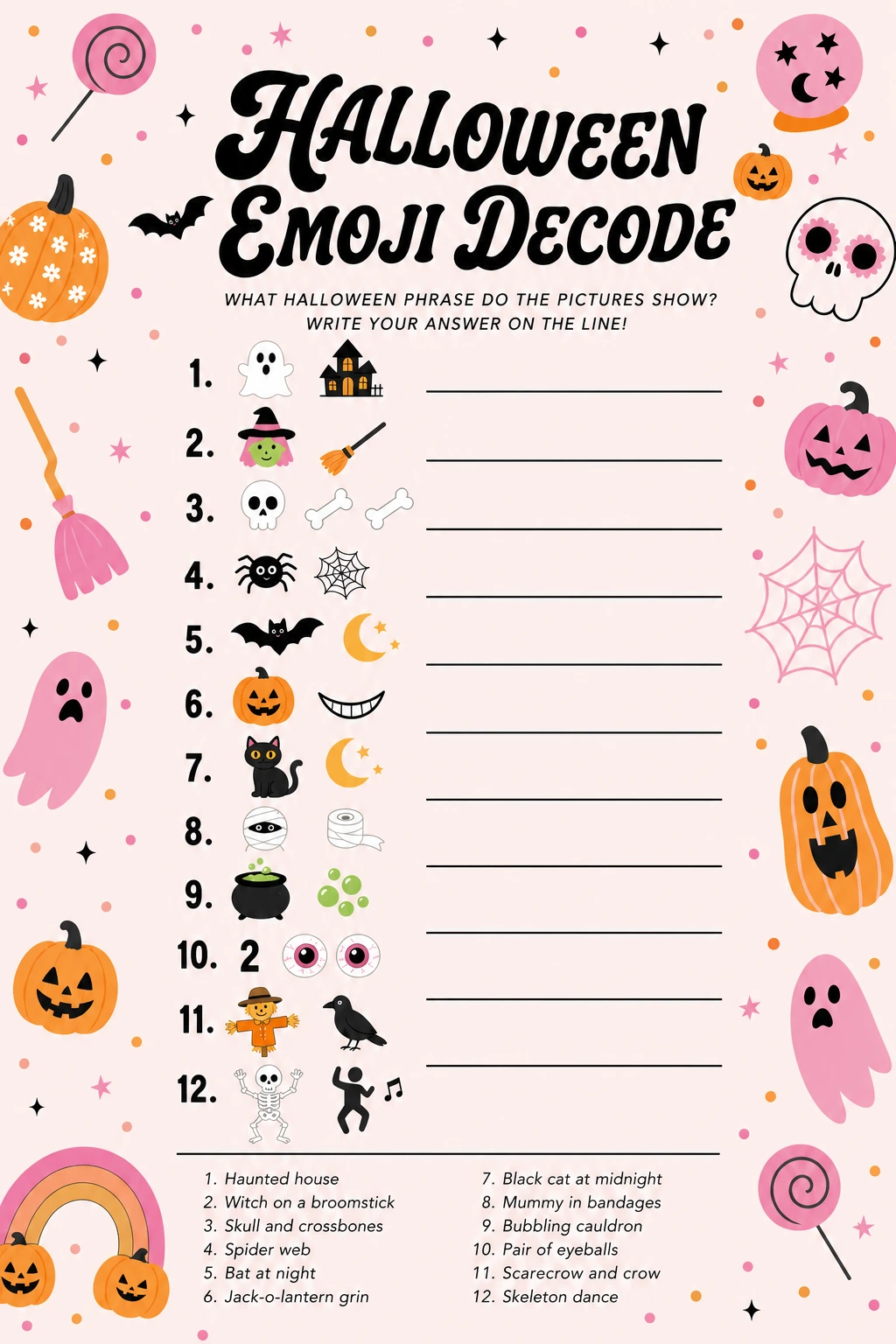
13. Halloween Emoji Decode
Halloween Emoji Decode is pure elementary-school energy in printable form.
Each row on the sheet shows a sequence of three to four small picture icons — a bat, a house, a moon — and kids have to figure out the Halloween phrase those icons represent and write it on the blank line next to the clue row.
It is like a visual riddle where the pictures tell the story: a ghost icon plus a house icon equals ‘haunted house’; a witch icon plus a hat icon plus a broom icon equals ‘witch on a broomstick’; a skull icon plus two bone icons equals ‘skull and crossbones.’
There are 12 emoji-clue rows in total, and kids work through the sheet at their own pace before you reveal answers as a class.
The magic of this game is how it levels the playing field.
Strong readers do not have a built-in advantage the way they do with text-based trivia — everyone is decoding pictures, which is actually a different kind of thinking and one where the kid who struggles with reading sometimes absolutely shines.
Print one per child and run it as either individual work or a partner challenge for the last five minutes of a station rotation.
Including an answer key at the very bottom of the sheet (teacher-facing, printed in tiny subtle grey text) means any parent volunteer can run the reveal without needing a separate answer card.
The one thing to build into your prep: design your icon clues so the pictured icons are genuinely clear and not open to wild interpretation. A bat icon should unambiguously look like a bat, not a butterfly with a bad attitude.
Before printing for the full class, ask one child outside the party context to quickly try one row — if they immediately get it, the icon is clear enough. If they stare blankly for ten seconds, redesign that clue.
This game is one of the most flexible halloween class party games because it doubles as a fun early-finisher activity when kids complete their other stations ahead of time.
- Grades 1–5
- Individual or partner play
- 8–10 minutes
- Great as a station activity or early-finisher option
14. Witch Hat Ring Toss
Witch Hat Ring Toss is Pumpkin Toss Buckets’s quieter, more precise cousin — and it rounds out your active game lineup beautifully because it rewards a completely different skill set.
Set up five small plastic witch hats (or cone-shaped paper party hats painted black) in a triangle formation on the floor or a desk, like bowling pins but in a tidy cluster.
Players stand behind a tape line and try to loop plastic rings (the kind from ring toss sets, or rings cut from pool noodles) around the pointy hat tips.
Each hat has a different point value written on a small card in front of it — the smallest, hardest-to-reach hat scores the most points. Three rings per turn, add up the score, and the high scorer at each station wins a sticker.
This is a natural station game: set up two stations of five hats each so you can run eight to ten kids at once.
The rings travel in a gentle arc, land quietly, and require zero cleanup — just reset the rings on the table between players.
If you do not have a proper ring toss set, circles cut from foam sheets or even braided rubber band loops from the craft closet work fine and cost basically nothing.
The toss line should be about three to four feet from the hats for younger kids and five to six feet for older ones — a quick piece of tape adjustment is all you need to scale the difficulty.
Host tip from the trenches: weight the witch hats slightly by placing a small smooth stone or a folded piece of card inside the base of each cone before the party.
Lightweight paper cones blow over from the air movement of 20 excited kids walking past, and a hat that keeps tipping before anyone even tosses becomes a very frustrating game very quickly.
Weighted bases stay upright through an entire 30-minute party slot without supervision — and that means one less thing you need to monitor while running your other halloween class party games simultaneously.
- 5 small witch hat cones per station (paper party hats work perfectly)
- 10–15 plastic toss rings or foam rings
- painter’s tape for the toss line
- Small stones or folded card to weight hat bases
🛍 Shopping guide
15. Spooky Story Starters Mad Libs
Spooky Story Starters Mad Libs is the printable game that genuinely gets kids excited about writing — and if you teach elementary school, you know how rare that is.
Each child gets a printed half-page sheet with a short Halloween story that has 10 blanks scattered through it, each labeled with a small word-type hint (a noun, an action word, a silly sound, a number, an adjective).
Before the sheet is handed out, you call out each blank number one by one and every child shouts their answer — you write the class’s collective answers on the board.
Then kids fill in their own sheets using those words, and the result is a completely unhinged Halloween story that makes absolutely no sense and is therefore perfect.
The printable sheet has the story text pre-printed with clearly visible blank lines for each missing word — each blank labeled with a tiny hint (‘action word,’ ‘a food,’ ‘a silly sound’) in small print beneath the line so kids know what category to offer.
The blanks are numbered 1–10 so they match the order you call them out on the board.
Running the whole-class word-collection phase first (before distributing sheets) is the secret move: you get ten words on the board in about two minutes of shouting chaos, then distribute sheets and kids fill in silently in about two more minutes, and the read-aloud at the end takes one minute.
Total time: under seven minutes, which is exceptional for a printable game.
The pro tip that dramatically improves the results: when you call out each blank number on the board, do NOT read the sentence context aloud — just say ‘Give me an action word! Any action word!’
The more disconnected the word from the story context, the funnier the result.
When you later read the finished story aloud with full dramatic voice (‘The giant WIGGLING ghost floated into the SPAGHETTI and let out a loud MOOOOOO’) and the kids hear what their words produced, the room absolutely loses it.
This is one of those halloween class party games you will be asked to repeat every single year, which, honestly — same.
Call blank numbers 1–10 one at a time — kids shout word-type answers you write on the board. Distribute sheets. Kids fill in using the board words. Teacher reads the story aloud dramatically at the end.

16. Eyeball Spoon Race
Eyeball Spoon Race is the Halloween spin on the egg-and-spoon classic, and it works spectacularly well in a classroom because white ping pong balls painted with a simple black pupil and red squiggle veins look exactly like cartoon eyeballs and cost about fifty cents each to make.
Each child balances their ‘eyeball’ on a large plastic spoon and walks a relay course around the room without dropping it.
If it drops, they stop, pick it up, return to where they dropped it (honor system — works better than you’d think), and carry on. First team to have all members complete the course wins.
The combination of concentration, wobbling eyeballs, and kids desperately willing their spoon not to tilt makes this one of the quietest active games you will ever run, which is a miracle.
Set up a simple relay route: from the team’s starting desk, around a cone or chair at the far end of the room, and back to tag the next teammate. Teams of five to six work well.
Use large plastic serving spoons rather than regular spoons — the wider bowl keeps the eyeball stable enough that kids do not spend the entire game picking it up off the floor, while still requiring enough balance to be fun.
If a child uses two hands to steady the ball, gently remind them to keep one hand behind their back — it is not a rule you need to enforce sternly, just a gentle nudge that improves the challenge level for everyone.
The only host tip you really need for this one: make the eyeballs BEFORE the party, not during it. Painting ping pong balls with a black-dot pupil and a few red squiggly lines takes about three minutes per ball, but paint needs to dry.
If you try to do it day-of, you will have smeared eyeball paint on 24 small hands and one classroom floor, and Halloween cleanup with wet paint is a special kind of misery.
Make them a day ahead, let them dry overnight, and bring them in a zip-lock bag. Your future self — and the custodian — will thank you generously.
- Ping pong balls painted as eyeballs (one per team lane)
- Large plastic serving spoons (one per child)
- Painter’s tape or cones for the relay route
- Paint (black and red) applied a day before the party
🛍 Shopping guide
17. Halloween This or That Vote
Halloween This or That Vote is a fast, printable, zero-stress game that doubles as a surprisingly fun class data exercise. Each child gets a half-sheet with 10 Halloween-themed This-or-That pairs — each pair presents two Halloween options and the child circles the one they prefer.
The pairs are purely preference-based with no right or wrong answer: pumpkins or skulls, witches or vampires, broomstick or cauldron, trick-or-treating or costume contest, candy corn or gummy worms, haunted house or haunted corn maze, black cats or bats, spooky or silly, full moon or foggy night, jack-o’-lanterns or skeletons.
After everyone has circled their choices, you tally the class vote live on the board for each pair, and the room gets a real-time look at what Halloween things their classmates love.
The tally portion is actually the game — it takes about three minutes of genuine participation and generates a fun snapshot of the class’s collective Halloween personality. Run the tally by asking ‘Hands up for pumpkins!’
then counting and writing the number, then ‘Hands up for skulls!’ — kids love seeing which side wins, especially for the ones where the class is closely split.
This game works wonderfully as a transitional activity between two higher-energy games, giving kids a moment to sit, breathe, and still feel fully engaged without requiring movement or significant mental effort.
The useful host truth here is that ‘no right answer’ games are genuinely the most relaxed ones to run in a classroom, because there is no competitive pressure and no moment where any child feels like they failed.
Every choice is valid, every preference is celebrated, and the resulting class tally is something kids genuinely find interesting about each other.
Teachers often keep these sheets and use the tally data as a quick morning math graphing activity the week after Halloween — sneaky curriculum tie-in, and your halloween class party games just did double duty.
Zero right or wrong answers means zero competitive pressure — every child participates fully and confidently, making this one of the most inclusive printable games on the list.

18. Pumpkin Face Pin-Up
Pumpkin Face Pin-Up is the classroom-safe, totally mess-free version of Pin the Tail on the Donkey — except instead of a donkey tail, kids are placing felt facial features onto a large felt pumpkin poster on the wall.
The pumpkin outline is pre-drawn on orange felt or orange poster board and mounted at kid height.
The facial features — triangle eyes, crooked mouth, square teeth, a curly stem — are cut from black felt and have small loops of reusable adhesive putty on the back.
One at a time, kids put on a blindfold (or simply close and cover their eyes), spin gently twice, walk to the pumpkin, and stick their feature in what they hope is the right place.
The result after six kids have gone is inevitably an absolutely deranged pumpkin face, which is the entire point.
This game runs beautifully as a station that resets instantly — pull the felt features off, hand them to the next player, done. No pins, no tape residue, no damage to the wall.
Use reusable sticky putty rather than actual pins or tape so the features peel on and off cleanly through an entire class period.
A circle of kids watching the blind placement makes for great community laughter as each feature lands somewhere unexpected — a tooth on the pumpkin’s forehead, an eye near the stem. The watching crowd calling out ‘WARMER! COOLER!’
(if you allow it) adds a fun layer of audience participation.
The veteran party host tip: mount the pumpkin at seated eye height, not standing eye height, so when kids walk toward it with their eyes covered they do not overshoot and end up pressing their face against the wall (extremely funny once, extremely less funny the third time).
Also, mark the correct feature placement lightly in pencil beforehand so you can show the ‘right’ pumpkin face at the end of all rounds — the contrast between the correct face and the deranged community creation gets a huge laugh and gives the game a satisfying conclusion even with no formal winner.
- Large orange felt sheet or poster board (pumpkin outline)
- Black felt cut into facial features (eyes, mouth, teeth, stem)
- Reusable adhesive putty for backing
- A simple blindfold or eye-covering scarf
🛍 Shopping guide
19. Halloween Trivia Showdown
Halloween Trivia Showdown gives the class a team quiz format with a printed answer sheet — so everyone is writing simultaneously rather than waiting for one person to answer, which keeps all 20+ kids engaged every single round.
Divide the class into teams of four or five, give each team one answer sheet, and read trivia questions aloud one at a time. Teams huddle quietly, agree on their answer, and one scribe writes it on the numbered line.
After 10 questions you reveal the correct answer to each one, teams self-score, and the team with the most points wins.
The questions are Halloween-appropriate for elementary schoolers: fun facts about pumpkins, bats, owls, the history of trick-or-treating, and spooky-season knowledge kids actually have a shot at.
The printed answer sheet is a clean numbered list — 10 lines, each labeled with a question number (1–10, continuous), a bold line for the team’s written answer, and a small ‘Points:’ box at the end of each row for self-scoring.
Teams fill in the sheet together, which automatically creates a collaborative mini-moment on every single question. Print one sheet per team (not per child) to encourage the huddle-and-agree dynamic that makes this feel like a proper quiz night.
Reading questions at a relaxed pace — about 20 seconds per question — keeps the energy high without stressing kids who need a moment to think.
The host-only tip that makes a real difference: weight the difficulty so questions 1–5 are easier (What vegetable is a jack-o’-lantern made from? What do bats use to navigate in the dark?)
and questions 6–10 get progressively trickier (How many teeth does a bat have on average? What country did the tradition of carving jack-o’-lanterns originally come from?).
This ensures every team gets some early wins, which keeps morale up, while the harder back half separates the teams on the leaderboard for a genuinely exciting finish. Tying into what kids already know is what separates a great trivia game from a demoralizing one.
Read questions aloud one at a time. Teams huddle quietly and agree on an answer. Scribe writes it on the numbered line. Reveal and self-score after all 10 questions. Most points wins!

20. Monster Freeze Sculpt
Monster Freeze Sculpt is a calm, creative close to your halloween class party games lineup — the kind of activity that lets kids decompress after the high-energy relays while still feeling fully festive.
Each child gets a small portion of air-dry modeling clay or a pack of colored Model Magic (orange, black, or purple for maximum Halloween vibes) and three minutes to sculpt the most creative monster they can imagine.
The only rule: it has to be their own invention, no copying from TV or movies.
When time is called, everyone does a brief freeze-pose as their monster, and the class does a quick three-second gallery walk around the desks to admire each other’s creations before sitting back down.
This works brilliantly as the very last game before cleanup because the sculptures can go home as a take-home Halloween keepsake — which means zero cleanup beyond collecting scraps of unused clay.
Set out one small pre-portioned ball of clay per child at their desk before the party begins so there is no distribution scramble mid-party.
If clay is not in the budget, this works equally well with paper plate collage (pre-cut shapes of googly eyes, pipe cleaner tentacles, foam sticker fangs) — slightly messier but still very manageable in a classroom setting.
The host insight that transforms this from ‘craft time’ into a genuine party game: add a ten-second ‘monster pose’ at the end where each child holds up their sculpture and strikes a monster face to match it.
The room doing coordinated monster faces simultaneously is genuinely one of the funniest and most joyful moments of the whole party — and it gives even the kids who are not confident in their sculpting a moment to shine through their performance.
It is the perfect way to close out halloween class party games on a high note that every single child participates in equally.
Pre-portion clay into equal balls and set them at desks before the party — distribution mid-game loses 3 minutes and creates a ‘who got more’ argument you really do not need.
Frequently Asked Questions
How many halloween class party games can you realistically run in 30 minutes?
Realistically, you can run three to five games well in a 30-minute slot, depending on your class size and setup.
The sweet spot is two active games (five to seven minutes each), one printable game (eight to ten minutes), and one quick group game as a closer (three to five minutes).
Running station rotations with three or four simultaneous games lets every child play everything in the same time window, which is the most efficient format for a class of 20 or more.
What do I need to prepare the night before a classroom Halloween party?
The night before, print and cut any printable game sheets, pre-portion any craft supplies (clay, beanbags), mark tape lines on a practice floor if needed, and fill the guessing jar with candy corn (counting as you go).
Crepe paper for Mummy Wrap should already be in rolls. Eyeball ping pong balls need paint-dry time, so make those at least a day ahead. Everything else can be set up the morning of the party in about 10 minutes.
Are these halloween class party games appropriate for kindergarten through fifth grade?
Yes — most games on this list scale across K–5 with minor adjustments. For younger grades (K–1), simplify printable games by reading questions aloud together as a class rather than having children read and write independently.
Active games like Ghost Freeze Dance, Mummy Wrap, and Spider Race Straw Blow need no adjustment at all — they work brilliantly for every age from five to eleven.
Games like Halloween Trivia Showdown can be made easier for younger grades by using picture-based clues instead of written questions.
How do I keep halloween class party games mess-free in a classroom?
Choose games that use self-contained materials: crepe paper for Mummy Wrap cleans up in 90 seconds by balling up the streamers; Spider Race Straw Blow uses small plastic spiders with no mess whatsoever; printable games need only pencils.
Avoid glitter, paint (unless pre-dried), and any food that rolls. Painter’s tape on the floor peels up cleanly. The guessing jar keeps candy contained. With these choices, most classrooms are back to normal in under five minutes after the party.
What prizes work for halloween class party games without using too much candy?
Halloween pencils, mini erasers shaped like pumpkins or ghosts, Halloween stickers, small notebooks, glow-in-the-dark bracelets, and spooky temporary tattoos are all big hits with elementary kids and cost under fifty cents each.
Dollar store Halloween sections are your best friend here — stock up early in October because they sell out fast. If your school allows small candy prizes, individually wrapped items work; if candy-free is the policy, stickers are universally beloved and absolutely festive enough.
How do I run halloween class party games as stations rather than whole-class activities?
Divide your class into groups of four to six and set up one game per station around the room. Assign one parent volunteer or responsible older student per station to explain rules and keep things moving.
Set a timer for eight to ten minutes per rotation and use a fun sound (a cauldron-bubble sound effect on your phone works great) to signal the switch.
With four stations running simultaneously, a class of 24 rotates through all four games in about 35–40 minutes — which fits a standard party slot with a five-minute cleanup buffer at the end.
📌 Save These for Later
Loved these? Pin your favorite image below so you can find this list again when you’re planning.

20 clever adult Halloween party games that are actually fun — active, printable & immersive. No fi
23 DIY cat Halloween costumes that are quick to make, easy to wear, and genuinely cute. No sewing ma
15 easy Halloween party appetizers that look spooky and taste amazing — from Mummy Pigs in Blanket
Leave a Reply