


Somewhere around week six, most yearly goals go quiet. Nobody announces it. There is no failure, no dramatic quitting. The goal just stops coming up in conversation, and by December it has folded itself into “next year” without anyone deciding that on purpose.
I think the twelve months are the problem, not the person. A year is too long to feel urgent and too short to actually forget about, so it sits in that uncomfortable middle where nothing pushes you and nothing lets you off the hook either.
The 12 Week Year gets around that by changing the unit. Instead of a year, you plan in twelve-week blocks.
A year becomes twelve weeks, a month becomes a week, a week becomes a day, and every single one of those weeks gets checked against a number by Friday.
That last part is the whole trick. Once a goal has a weekly number attached to it, it stops being a wish.
Where the System Actually Comes From
The 12 Week Year is a book by Brian P. Moran and Michael Lennington, published in 2013, and the argument at the center of it is almost embarrassingly simple: annual planning fails because a year gives you a false sense of time.
When a deadline sits eleven months out, nothing about today feels connected to it. So the first two quarters drift, and the last one turns into a scramble that everyone privately recognizes and nobody plans around.
Shrink the horizon to twelve weeks and two things change at once.
Your assumptions stay current, because what you believed about your business or your schedule twelve weeks ago is probably still true, while what you believed twelve months ago has usually been overtaken by something. And the deadline gets close enough to actually feel like one.
Miss a week out of twelve and you have lost roughly eight percent of your year in a single week. That math is uncomfortable in exactly the way that makes people show up on a Tuesday they would otherwise have skipped.
Lead Numbers, Not Lag Numbers
The other shift, and the one that took me longer to actually understand, is what you choose to track. Most annual planning tracks results: revenue, pounds, pageviews, whatever the finish line is. The trouble with a result is that it always arrives late.
By the time the number shows up, the work that produced it happened weeks earlier, and you cannot go back and adjust it.
Moran and Lennington split this into lead indicators and lag indicators. A lag indicator is the outcome, the thing you are ultimately after. A lead indicator is the action that produces it, the thing you actually control today.
If the goal is more revenue, the lag indicator is the revenue number itself, and the lead indicators are the sales calls, the content published, the campaigns launched, the things you can point to on a Tuesday and say yes, I did that.
The 12 Week Year asks you to score the lead indicators every week, not the lag ones. You tally how many of your planned actions you actually completed, divide by how many you planned, and that percentage is your weekly execution score.
The benchmark in the book is 85 percent.
Hit that consistently and the results tend to follow on their own, which sounds almost too tidy until you have actually watched a week with a high score and a flat result and realized the plan itself, not your effort, was the thing that needed fixing.
The Five Pages That Carry the Whole Method
What I like about this system, compared to most productivity frameworks, is that it fits on paper. You do not need software, a subscription, or a dashboard with a login screen. Five pages carry the entire method, and once you understand what each one is for, the rest is just showing up to fill them in.
The first is a vision page, and it comes before any goal-setting. You write down what you want your life to look like three years out, in plain language, with no editing pass.
Twelve weeks of consistent effort needs a reason bigger than twelve weeks, and this page is where that reason lives, so that on the Thursday when nothing is going right, you have something to reread that is not the goal itself.
The second is the goals page, and the discipline here is restraint. One to three goals, never more. Each one is specific enough that on the last day of the cycle you can look at it and answer yes or no, nothing softer than that.
“Grow the business” fails this test immediately. “Publish 24 posts and reach 15,000 monthly sessions by week 12” passes it, because there is no ambiguity about whether you got there.
The third page is the plan, where each goal breaks apart into tactics, and every tactic gets a due week. A tactic is something you can physically do on a Tuesday afternoon, not an outcome you are hoping shows up.
“Get more traffic” is not a tactic. “Write and schedule fifteen pins every Monday” is, because you can check it off.
This page quietly becomes your to-do list for the next twelve weeks, which means Sunday night stops being the night you sit there wondering what this week is even for.
The fourth page is the scorecard, and it is the one that keeps everything honest. Every Friday you count what you completed against what you planned. Eight out of ten tactics is 80 percent.
That number does not care how tired you were or how the week felt emotionally, which is exactly what makes it useful. A week stops being vaguely good or vaguely bad and becomes a fact you can act on.
The fifth page is performance time, and it is where the calendar gets built around the plan instead of the other way around. The book splits a week into three kinds of blocks.
A strategic block is a long uninterrupted stretch, close to three hours, reserved for the highest-value work, no email and no phone allowed near it.
A buffer block is a short daily window for the noise that would otherwise eat the whole day in small pieces, the messages and the admin and the invoices.
A breakout block is time scheduled fully away from work, treated as part of the system rather than something you earn later if there is time left over, which there rarely is.
Sunday Plans It, Friday Scores It
The rhythm underneath all five pages is what actually makes the system stick, more than any single page does on its own. On Sunday, you copy the coming week’s tactics from the plan page onto a fresh weekly page.
On Friday, you score what you finished, and you write three short lines: what worked, what didn’t, what you’re adjusting. Neither side takes more than ten minutes once you’re used to it.
If you work with a team or even just one accountability partner, the book adds a short weekly meeting where each person says their execution score out loud. There is something about saying a number to another human that changes behavior faster than any private tracker ever does, even a good one.
Building the Planner I Actually Wanted
I went looking for a template that followed this structure and kept finding one of two things: a spreadsheet with no room to actually think, or a workbook so long that finishing it became its own project.
So I built a twenty-page version instead, organized page by page around the five parts of the method, with a cover for your dates, a one-page how-to-use summary, the vision page with a life balance wheel across seven areas, three goal blocks, a three-column tactics plan, a full scorecard with a shaded execution chart, a performance time grid, twelve individual weekly pages, and a closing review for the end of the cycle.
Each weekly page carries this week’s tactics down the left side, seven day columns across the top for the actual daily work, a scoring box that does the division for you, and a short Friday review at the bottom.
Nothing about it requires an app or an account. You either print it or open it on a tablet, and either way it is ready before the coming Monday.
It comes in two files, because paper and tablets are genuinely different habits and I did not want to force one on people who prefer the other.
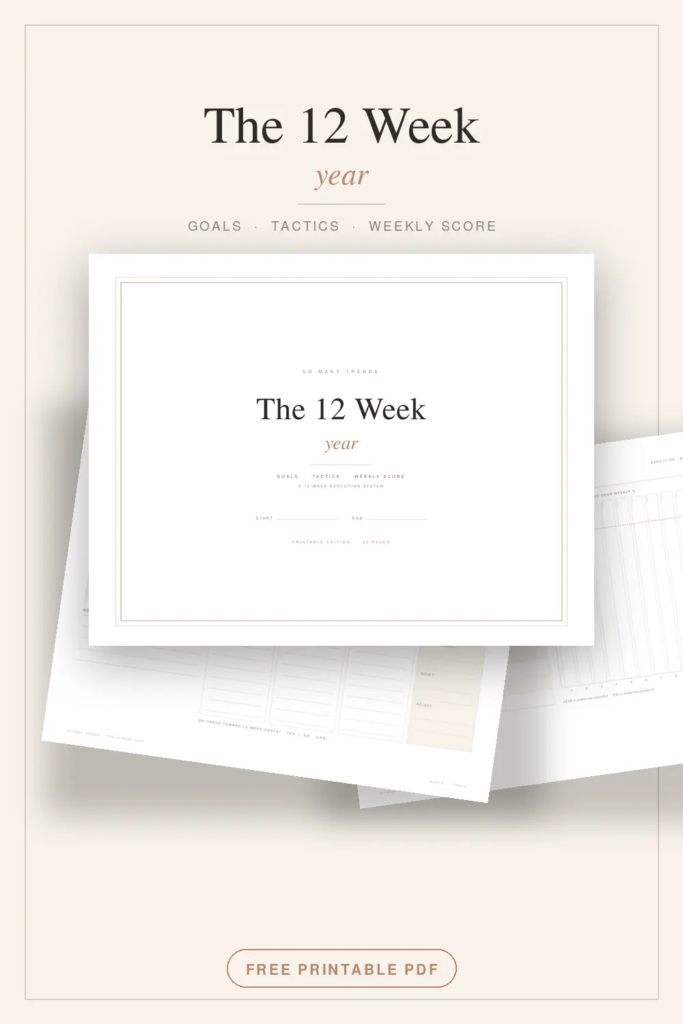
The printable version is a plain white US Letter PDF, landscape, no clickable links inside it, and it prints just as cleanly on A4 if you choose fit to page in your print dialog.
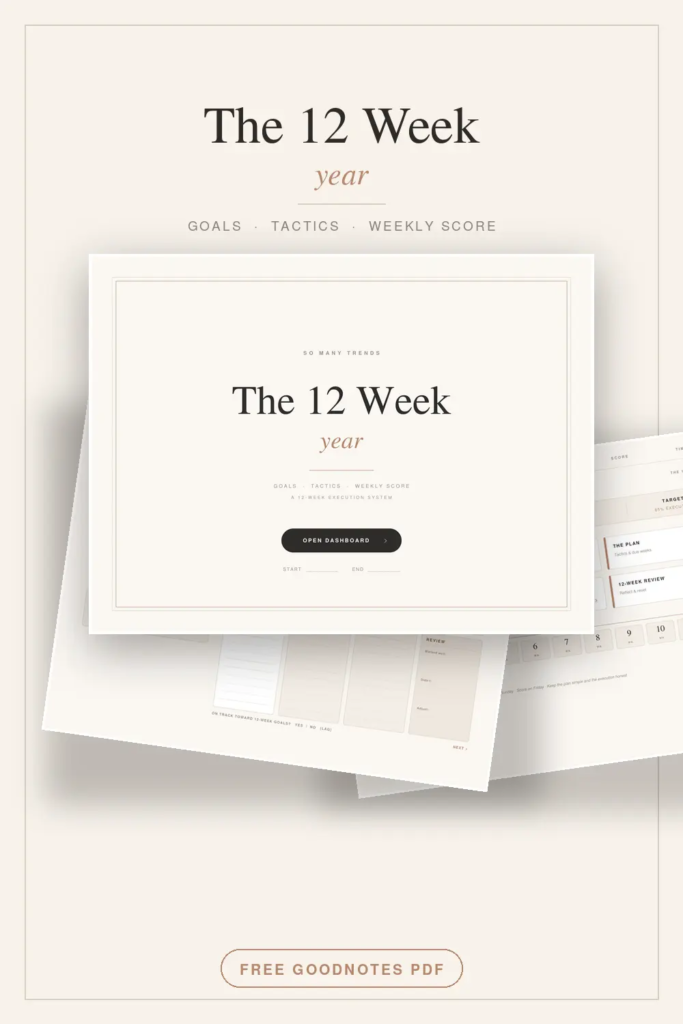
The GoodNotes version keeps the warm cream background and adds the hyperlinked tabs and jump-to-week buttons you would expect from a digital planner, and it opens fine in Notability, Noteshelf, and Samsung Notes as well, since they all read standard PDF links the same way.
If you print, run the twelve weekly pages once per cycle and keep a spare in reserve for the week that falls apart.
If you’re on a tablet, duplicate the file at the end of each cycle so the finished one stays intact as a record instead of getting overwritten by the next.
Your First Hour With It
Start by writing your start and end dates on the cover. Count twelve weeks forward from the coming Monday, and use that Monday, not the first of a month or the start of January.
There is nothing built into the system that cares about the calendar year, and waiting for a tidier starting line is usually just another way of delaying.
Fill the vision page next, and give yourself fifteen minutes of messy handwriting with no editing pass. Then score the seven life areas from one to ten. The two lowest scores usually point directly at where a goal belongs, which is a more honest source of goals than most brainstorming sessions produce.
From there, choose your one to three goals and make sure each one carries a number you can check at week twelve. If you cannot measure it, it isn’t finished yet, so keep rewriting it until you can.
Break each goal into five to twelve tactics, each one starting with a verb and carrying its own due week, and draw your model week before your actual week fills itself in around you.
Block one strategic session, your daily buffer window, and at least one breakout block that nobody is allowed to move.
Copy week one onto the first weekly page and begin. It does not need to be a perfect plan. It needs to exist by Monday morning, which is a much lower bar and the only one that actually matters at the start.
What Friday Actually Tells You
Friday afternoon, count what got done. Say you planned eleven tactics and finished nine. Nine divided by eleven comes out to 82 percent. Write it into the scorecard, shade the bar on the chart, and answer the three review lines honestly rather than generously.
What you do with that number matters more than the number itself.
A score above 85 percent paired with results that are still flat means the plan is the problem, not your effort, so the fix is changing the tactics rather than trying harder at the same ones.
A score below 85 percent almost always traces back to a week that got overloaded on Sunday, and the fix there is cutting two tactics next week rather than promising yourself more discipline. One low week on its own is nothing.
A run of them is the system telling you the plan is too big for the time you actually have.
The Ways a Cycle Usually Falls Apart
Too many goals is the most common one. Five goals is really just an ambitious to-do list wearing a nicer outfit, and twelve weeks of genuine focus tends to fit two goals comfortably and three at the outer limit for most people.
Tactics that are secretly outcomes cause the second kind of trouble. If you cannot physically check something off on a Tuesday afternoon, it is not a tactic yet, no matter how it’s phrased. The fix is rewriting it down to the smallest repeatable action underneath it.
Skipping the Friday score is the third, and it is the one that unravels everything else quietly. The score is the only part of the system that tells you the truth without being asked twice, and three weeks without it puts you right back to hoping instead of knowing.
And then there’s waiting for a clean start date, which might be the most common one of all. Next quarter, next month, after the trip, once things calm down. Twelve weeks from today will end sooner than twelve weeks from whatever day finally feels ready, and the second date never actually arrives on its own.
What It Suits, and What It Doesn’t
This structure works best for anything with a real, measurable finish line inside three months: a business quarter, a launch, a certification, a training block, a manuscript, a renovation.
It works less well for open-ended habit tracking, since the scorecard is built around a fixed set of planned tactics rather than a daily streak.
If you want both, running the twelve-week cycle for the project-shaped goals and keeping a separate simple tracker for daily habits tends to work better than forcing one system to do everything.
Free 12 Week Year Planner Download
Both files are free to use for yourself: save them, print them, mark them up, and start whenever you’re actually ready rather than waiting for a rounder date on the calendar. I’d just ask that you don’t resell or redistribute them as your own. A link back to this page if you share it somewhere is always appreciated.
Grab the printable 12 week year planner here if paper is where you actually think, or the GoodNotes version here if a tablet is where your planning already lives. Both carry the same twenty pages and the same structure, so the only real question is which surface you’ll actually open on a Sunday night.
If you want the reasoning behind the system in more depth than a planner can hold, particularly the chapters on accountability and the weekly team meeting, the original book by Brian P. Moran and Michael Lennington is worth reading once you’ve finished a full cycle yourself. You can find The 12 Week Year on Amazon here.
Questions People Usually Ask Before Starting
Do I need to read the book first?
No. The five pages that carry the system are labeled clearly inside the planner, and the how-to-use page at the front covers the weekly rhythm on its own. The book adds depth and the accountability chapters, and it tends to land better once you’ve already lived through one real cycle.
When should I actually start my twelve weeks?
The Monday right after you download it. Four cycles happen to fill a calendar year evenly, but nothing in the system requires that alignment, and a cycle starting in the middle of a random month works exactly the same. Write your own dates on the cover and go from there.
What happens if I miss an entire week?
Score it honestly, keep your original end date, and move whatever tactics you missed into the next open week. Stretching the cycle out to make the numbers look better defeats the one thing doing the actual work, which is the deadline itself.
Can this work for fitness or studying instead of business?
Yes, easily. The goal-and-tactic structure doesn’t care what category the goal falls into. A training block, an exam period, and a client project all fit the same twelve-week frame, and the life balance wheel on the vision page exists specifically so the goal you land on isn’t automatically a work goal by default.
Will the printable version actually fit A4 paper?
Yes. It’s built for US Letter in landscape, and choosing fit to page in your print dialog on A4 adjusts the margins with nothing getting cut off in the process.
Can I use the digital version somewhere other than GoodNotes?
The hyperlinked file is a standard PDF underneath, so the tabs and the jump-to-week buttons work in most tablet note apps that support PDF annotation, Notability and Noteshelf and Samsung Notes included. The exact feel of tapping a link varies slightly app to app, but the links themselves travel with the file, not with GoodNotes specifically.
Is it actually free, or is there a catch somewhere?
Free, for your own personal use. If you’d like a version for a team or for clients, reach out before you distribute it to more than yourself.
Starting the Next Twelve Weeks
Print it, write your start and end dates on the cover tonight, and put one to three real goals down before you close the tab.
Twelve weeks from that Monday, you’ll either have hit them or have twelve weeks of honest scores showing exactly where the plan needs adjusting. Either one beats another quiet year that folded itself into “next year” without anyone deciding that on purpose.

Have you ever wondered why some people seem blessed with naturally thick, healthy hair while others

Practical self-love strategies that rewire your brain's negativity bias and help you build unshakeab

I’ve always been fascinated by how our morning thoughts can shape our entire day. As someone w
Leave a Reply