

If you’ve been searching for the perfect DIY family game night, I have great news: you literally don’t need to buy a single thing.
This whole pack — 22 games ranging from high-energy buzzer rounds to cozy gratitude circles — is designed to print at home, grab some pencils, and go. The printer IS the party supply store. (You’re welcome.)
Whether your crew is competitive teenagers, little ones who still think losing is a personal attack, or grandparents who take board games very seriously, there is genuinely something here for every age and every mood.
I put this lineup together because I got tired of paying $40 for a boxed game that half the family ignores after one round.
These games cost you nothing but ink and maybe a pair of scissors, and they deliver the kind of loud, laughing, slightly chaotic evening that everyone talks about for weeks.
Grab a big bowl of popcorn (or a crowd-pleasing Amish Breakfast Casserole if you’re doing brunch game night — no judgment), hit print, and let’s get into it.
This post contains affiliate links — if you buy through them, I may earn a small commission at no extra cost to you.
- DIY Game Show Buzzer Round
- DIY Minute to Win It Kit
- DIY Charades Jar
- DIY Pictionary Easel
- Print-and-Play Bingo
- Print-and-Play Trivia Sheet
- Would You Rather Cards
- This or That Sheet
- Mad Libs Sheet
- Scavenger Hunt Sheet
- Charades Card Deck
- Pictionary Card Deck
- Matching Memory Cards
- Maze Sheet
- Coloring Sheet
- Score Sheet
- Awards Certificates
- Roll-a-Challenge Dice Sheet
- Riddles Sheet
- Guess How Many Jar Sheet
- Family Q&A Circle
- Gratitude Round
- Frequently Asked Questions
1. DIY Game Show Buzzer Round
This is the game that gets everyone out of their seats before the night even officially starts — and tbh, it kind of sets the whole competitive tone for the rest of the evening.
The DIY Game Show Buzzer Round transforms your living room into a studio by assigning each player (or team) a DIY buzzer sound: one person slaps the table, one claps twice, one yells ‘ding!’, one stomps.
The host reads trivia questions out loud, and whoever buzzes in first with their assigned sound gets to answer. Get it right: one point. Get it wrong: the question passes to the next buzzer.
To set it up, just jot 20–30 general knowledge or funny family-themed questions on index cards (or grab them from the trivia printable later in this pack — yes, it works perfectly here).
Designate a scorekeeper with the Score Sheet from this pack, assign buzzer sounds before the first question drops, and enforce a strict no-buzzing-until-the-question-is-fully-read rule, because otherwise it devolves immediately. Trust me on that one.
The beauty of this game is that it rewards quick thinking AND confidence — which means the ten-year-old who has been studying random facts about dinosaurs all year suddenly becomes a household legend.
Add a ‘Daily Double’ round where one question is worth triple points to spike the drama. You can also split into two-person teams so the little ones have a confident partner backing them up. Chaos, laughter, glory — this one delivers all three.
Assign buzzer sounds before the game starts and write them on a sticky note so nobody ‘forgets’ their sound mid-round.
🛍 Shopping guide
2. DIY Minute to Win It Kit
Sixty seconds. One ridiculous challenge. Maximum family chaos. The DIY Minute to Win It Kit bundles five household-item challenges into one back-to-back lightning round that keeps everyone screaming from the sidelines.
The challenges in this kit: (1) Stack — stack as many pennies as possible in one column in 60 seconds; (2) Suck It Up — use a straw to transfer 10 small pieces of paper from one plate to another using only suction; (3) Pencil Drop — drop a pencil into a bottle opening from standing height; (4) Cookie Slide — place a cookie on your forehead and slide it into your mouth using only your face muscles (no hands); (5) Tower Build — build the tallest tower possible using only playing cards in 60 seconds.
Print the challenge cards from this pack and lay them face down in a stack — players flip one card per round so the challenge is a surprise each time.
You need almost nothing for this kit: pennies, two paper plates, a straw, a pencil, a bottle, a cookie, and a deck of cards — all things hiding somewhere in your house right now.
Set a phone timer to 60 seconds, elect a referee, and let the pandemonium begin. The player who completes the most challenges wins, but honestly the real prize is watching Dad try to slide a cookie into his mouth for 45 seconds.
Host tip: run it as a round-robin tournament so every player goes head-to-head against every other player, keeping a running score on the Score Sheet from this pack. For younger kids, extend the timer to 90 seconds or simplify challenges (e.g.
stack 5 pennies instead of 20). For teens and adults, shorten to 45 seconds and double the stakes. A small prize — first pick of snacks, gets out of dish duty — amps the competitive energy way up.
- All ages 5+
- Groups of 3–10 players
- Rounds lasting about 20–30 minutes total
🛍 Shopping guide
3. DIY Charades Jar
Everyone thinks they know how to play charades — and then someone draws ‘microwave’ and completely falls apart, and you realize nobody really knows how to play charades.
The DIY Charades Jar is the original no-cost party game: you write clues on slips of paper, fold them up, drop them in any jar or bowl you have on hand, and take turns acting them out without making a single sound.
One person draws a slip, sets the timer for 60 seconds, and acts. Their team shouts guesses. Right answer before the clock hits zero: point for the team.
To DIY your jar, split clues into three categories and color-code the paper slips: Movies & TV (blue), Actions & Situations (yellow), and Famous People & Characters (pink). Aim for 40–50 slips total so the jar lasts all night without repeats.
Fold each slip the same way so nobody can peek at which category they’re drawing. You need: scrap paper, a pen, scissors, and literally any container — a mug, a plastic cup, a cereal bowl. It costs exactly zero dollars.
Why it works so well for mixed ages: little kids can act while older family members guess, making the little ones feel like heroes rather than struggling to keep up.
For a fun variation, try ‘Speed Charades’ — the actor has to act out as many clues as possible in 90 seconds instead of one at a time, and the team scores one point per correct guess.
It creates a completely unhinged, hilarious scramble that even the most reluctant players can’t resist joining.
Let kids under 7 whisper the category to a grown-up helper before acting, so they feel confident instead of stuck.
4. DIY Pictionary Easel
Pictionary is one of those games where talent is completely irrelevant and that’s exactly why families love it.
One player draws, their team guesses, 90 seconds on the clock. No talking, no letters, no numbers, no arrows to the answer. Just increasingly frantic stick figures and a lot of shouting.
To set up your DIY easel: tape a large piece of butcher paper, craft paper, or even a taped-together sheet of printer paper to a wall at drawing height. Stack your Pictionary Card Deck face down nearby.
Teams take turns sending one drawer up to the easel. Shuffle in ‘wild’ cards (draw with your non-dominant hand, draw with eyes closed for 10 seconds, draw without lifting the marker) to shake up the stakes mid-game.
A single black marker is all you need — though colored markers make the chaotic masterpieces significantly more Instagram-worthy.
The real magic of Pictionary as a family game is the accidental comedy: someone draws what they think is a perfectly obvious horse and their entire team yells ‘table!’, ‘dog!’, ‘broom!’ for 80 straight seconds.
It’s the kind of memory that gets brought up at dinner for years. Variation for little ones: give them 2 minutes instead of 90 seconds, and let a sibling or parent draw alongside them so they stay in the game without frustration.
- Large paper or whiteboard
- Thick marker in dark color
- Printed Pictionary Card Deck from this pack
- Phone timer
🛍 Shopping guide
5. Print-and-Play Bingo
Family Bingo is one of those games that somehow works for a three-year-old and a seventy-year-old at the same exact table, which makes it the unsung hero of any DIY family game night.
This isn’t the standard number-call version though — this bingo card is themed to family game night itself, with squares featuring icons and prompts like ‘someone laughs until they cry,’ ‘someone dramatically disputes a score,’ ‘the youngest player wins a round,’ and ‘someone says just one more game at 11pm.’
Each player gets a unique 5×5 card, so everyone’s grid is different and there are no tied winners.
Print one card per player on regular copy paper — no cardstock required, though it does make them feel fancier. For daubers, use a coin, a cheerio, a small piece of torn paper, or anything small enough to mark a square.
The caller reads prompts from the master call list printed on the back of the host’s sheet. First player to get five in a row horizontally, vertically, or diagonally yells ‘BINGO!’ and wins the round.
Run a full-card blackout round at the end for maximum drama.
Why this format is genius for game nights: it runs passively in the background while other games are happening, so players quietly mark off their cards all evening without it ever interrupting the main action.
You can hand these out at the very start of the night and reveal winners at the very end — it becomes a fun side story that threads the whole evening together.
Host tip: offer a small silly prize for bingo (first pick of dessert, choosing the next game) to keep everyone watching their cards.
Print cards on both sides of the paper to save ink — bingo grid on the front, a second game on the back.

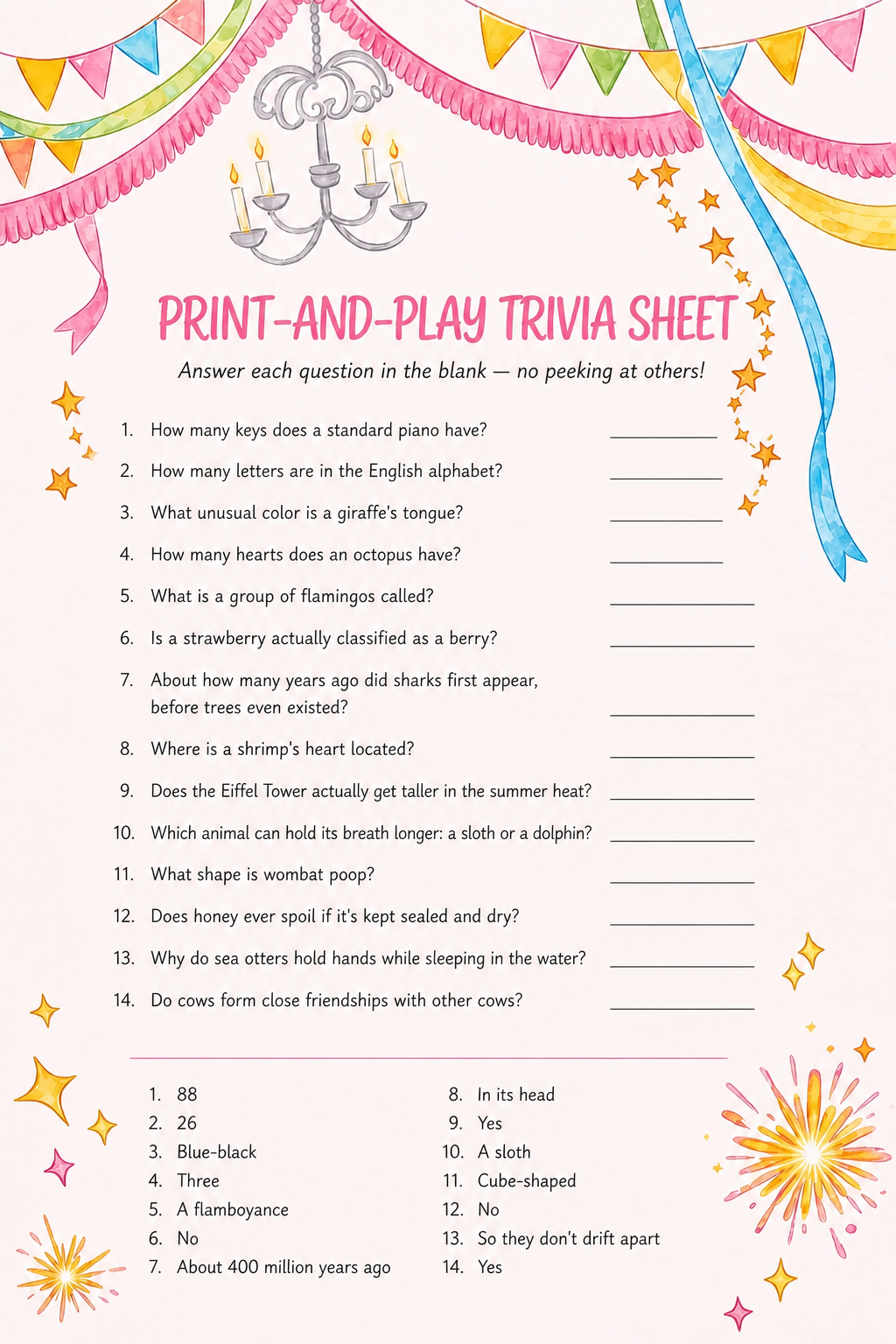
6. Print-and-Play Trivia Sheet
A good family trivia sheet has to walk a very specific tightrope: hard enough that the adults feel genuinely challenged, easy enough that the kids land at least a few answers and feel like absolute geniuses for it.
This Print-and-Play Trivia Sheet does exactly that by splitting 20 questions across four categories — Nature & Animals (Q1–5), Pop Culture & Entertainment (Q6–10), History & Geography (Q11–15), and Random Fun Facts (Q16–20) — with a complete answer key printed subtly at the bottom of the sheet.
Everyone gets their own sheet and pencil, answers individually (no shouting answers out — we’re civilized), and then the host reads the key aloud so everyone can self-score.
Print one sheet per player on regular copy paper. No prep beyond printing — the instructions are right on the sheet.
Players fill in their answers in the blank lines beside each numbered question, then swap sheets with a neighbor for grading when the host calls time (10 minutes is plenty).
The answer key at the bottom uses small light-grey italic text so it doesn’t accidentally spoil anything while you’re playing. Tally final scores on the Score Sheet from this pack and crown a Trivia Champion of the Night.
Here’s what makes this format a keeper: it generates a natural pause in the night’s energy — a quieter, more focused stretch between two active games — which is actually a great pacing move when you have a mixed crowd that needs a breather.
Plus there’s something deeply satisfying about the moment a ten-year-old answers a question about animal migration that the adults got wrong. The collective ‘ohhhh!’ is peak family game night magic. Save the sheet and run it again next time with new questions.
Four categories means every player has a strong category — nobody goes home with a zero.
7. Would You Rather Cards
Would You Rather is one of those deceptively simple games that somehow generates the most passionate, loud, completely unhinged debates of the entire night.
The premise is mercifully easy: flip a card, read the two options aloud, and every player (including the reader) commits to a choice by raising a hand or moving to one side of the room.
Then — and this is the key part — everyone has to explain why. The explanations are where the real comedy lives.
‘I would rather fight 100 duck-sized horses because I feel like I could herd them’ is an actual sentence someone in your family will say tonight.
This deck of Would You Rather Cards is printed as a cut-apart sheet — a grid of 16 double-sided cards on US Letter paper. Print, cut along the lines, and shuffle.
The questions are a mix of silly, thought-provoking, and mildly gross — calibrated for ages 6 to adult — so nobody gets a card that goes over their head or makes anyone uncomfortable.
Each card carries one dilemma per side (two dilemmas per card total), giving you 32 prompts per printed sheet. The more sheets you print, the longer the game.
Here’s a hosting tip I swear by: use these cards as a warm-up game at the very start of the night before anyone’s feeling competitive.
They break the ice faster than anything else I’ve tried, get every personality in the room talking, and require zero scoring, zero tracking, zero pressure. They’re also a perfect filler game between rounds of something more structured.
Save the printed deck in a zip-lock bag and it lives in your game night box forever.
- Ages 6 to adult
- Groups of any size
- Icebreaker at the start of the night or filler between games

8. This or That Sheet
This or That is Would You Rather’s faster, louder cousin — and if you’ve ever wanted to settle the age-old family debate of ‘pizza or tacos,’ ‘beach or mountains,’ or ‘morning person or night owl’ in one decisive, potentially argument-starting evening, this is the sheet for you.
Each player gets their own This or That Sheet and circles their preference for each of the 20 pairs listed. Once everyone’s done, the host tallies who picked what and reads the results aloud — and the revelations are genuinely surprising.
(The kid you thought was a ‘dogs’ person turns out to be Team Cat. Family dynamics: disrupted.)
Print one sheet per player. The format is a clean two-column list: Option A on the left, ‘or’ in the center, Option B on the right. Players circle their choice for each of the 20 rows.
No writing required beyond a circle — which means even younger players who aren’t confident writers can fully participate. After everyone has circled their answers, go around the table for each row and share results.
You can gamify it by giving one point per person who matches the majority pick, and crowning the Most Relatable Family Member of the Night.
What makes this sheet a great palate cleanser between heavier games is the pace: it takes about 5 minutes to complete individually, and the group discussion after is naturally self-limiting because you either agree or you don’t and you move on.
No elaborate scoring to track, no setup, no cleanup. It’s a breather that still feels like a game — and the conversations it kicks off (‘Wait, you actually prefer WINTER over SUMMER?!’) are often the most memorable part of the whole night.
Add it to your regular rotation; you can just print new sheets each time.
Read each pair aloud for younger kids so they can circle along without needing to read the sheet themselves.

9. Mad Libs Sheet
If you’ve never watched a room of people lose their minds over a sentence like ‘My dad drives a purple submarine to the library every Tuesday to buy ninety-seven squeaky socks,’ you have not truly lived.
The Family Game Night Mad Libs Sheet is a single-page fill-in-the-blank story specifically themed around a family game night scenario — a reporter is writing a breaking-news story about the most dramatic game night ever witnessed, and your family’s random words fill in the blanks.
The result is a uniquely chaotic, personalized story that only your family could create and will absolutely save as a keepsake.
Here’s how it works: one player is the Reader and does NOT see the story. They go around the table asking for words by their part-of-speech label only (‘Give me a silly adjective!’ ‘Give me a verb ending in -ing!’).
Each player at the table contributes one word at a time, and the Reader writes each one in the corresponding blank on the sheet without revealing the story.
Once all blanks are filled, the Reader reads the finished story aloud — slowly and dramatically, for maximum effect. Print one sheet per round; keep extras on hand because you’ll want to play at least twice.
Mad Libs are secretly brilliant for families because they’re a stealth vocabulary lesson disguised as comedy — younger kids start to internalize what a ‘noun’ or an ‘adjective’ is without ever being told they’re learning.
There’s also something delightful about the collaborative authorship: this story belongs to all of you. Punch it up by having the Reader use their best newsreader voice for the final reading. Standing up and tapping a rolled-up paper like a microphone is entirely encouraged.
Kids absorb parts of speech naturally — noun, verb, adjective — without realizing it’s also a tiny vocabulary lesson.

10. Scavenger Hunt Sheet
A home scavenger hunt is the one game on this list that gets everyone physically moving, which — after an hour of sitting around the table — is genuinely a gift to everyone’s energy levels (and sanity).
The Family Game Night Scavenger Hunt Sheet is an indoor hunt with 20 clue-based items to find anywhere in the house: things by color, things by texture, things by category, things with a specific number of letters in their name.
Players (or small teams) race to collect or photograph all 20 items first. First team back at the table with a completed and verified list wins.
Print one sheet per team. The format is a numbered checklist — 20 items with a checkbox beside each one and a small ‘Found it!’ line for players to write where they found it or what they grabbed.
Set a time limit (10–15 minutes works perfectly for most homes) so the hunt stays exciting rather than dragging. No materials beyond the printed sheet and a pencil.
Optional twist: instead of collecting physical items, players photograph each find on one phone or tablet per team — no moving anything from its spot, and the photo evidence gets reviewed at the end for a fun highlight reel.
The scavenger hunt is also a great tool for a host who needs a few minutes to reset the snack table or set up the next game — send the family on the hunt and you’ve bought yourself 10–15 minutes of beautiful, productive chaos happening in other rooms.
For a creative variation, add one ‘mystery bonus item’ clue at the bottom that’s extra-cryptic and worth three points, so there’s a dramatic tiebreaker built right in.
This game travels well too — print the sheet and run it at grandma’s house, a vacation rental, or a hotel room.
Run the hunt during snack break — players collect items, you reset the table, everyone wins.

11. Charades Card Deck
This is the printed companion to the DIY Charades Jar from earlier in this list — except instead of handwriting slips of paper, you print a ready-to-cut deck of 30 charades prompt cards organized into three color-coded categories: Movies and TV (10 cards), Actions and Situations (10 cards), and Animals and Characters (10 cards).
Each card is printed in a business-card-sized format on the sheet, so after one cut-apart session you have a proper deck that shuffles, deals, and stores cleanly in an envelope or small bag.
These cards live in your game night box and come out every time, forever.
Print on regular copy paper — or if you want to make them last, print on cardstock (the one small luxury worth mentioning). Cut along the dashed lines, shuffle, and stack face down in the center of the table.
During the Charades Jar game or the DIY Pictionary Easel round, players simply draw from the top of the deck instead of fishing through a jar. Each card shows only the prompt text — no answers, no hints on the front.
Category color-coding (shown by a small colored stripe at the top of each card) lets the host pre-select categories for younger players by pulling cards from specific sections.
Here’s why having a printed card deck rather than handwritten slips elevates the game: the prompts are chosen to be genuinely funny, genuinely challenging, and genuinely appropriate for all ages, which is something that’s surprisingly hard to guarantee when people write their own slips (someone always puts in something impossible or something that makes Grandma raise an eyebrow).
These cards remove that variable and make the game reliably excellent every single time. Laminate them if you’re feeling fancy — they’ll survive years of game nights.
- Printed and cut card deck
- Scissors
- Small envelope or zip-lock bag for storage
- Optional: cardstock for durability

12. Pictionary Card Deck
The Pictionary Card Deck is the essential companion to the DIY Pictionary Easel, and it’s what separates a ‘we’ll just think of stuff to draw’ game from a properly structured, beautifully paced round that can run for 45 minutes without anyone running out of ideas.
This printed deck of 30 prompt cards is sorted into three difficulty tiers: Easy (for younger players and warm-up rounds), Medium (where the real competition lives), and Hard (reserved for competitive adults and anyone who thinks they’re good at drawing — they’re not, and the Hard tier will prove it).
Print and cut exactly like the Charades Card Deck: one US Letter sheet, 30 business-card-sized cards in a grid with dashed cut lines, difficulty labeled with a small badge on each card.
Shuffle each tier separately and stack them in three piles so you can deliberately assign difficulty by player age — younger kids draw from Easy, older players from Medium or Hard.
This flexibility is what makes Pictionary actually work for mixed-age families without anyone feeling set up to fail. Each card shows only the prompt word or phrase on the front, nothing else.
Variation that takes the game to another level: try ‘Team Pictionary’ where one person draws and EVERYONE on their team guesses simultaneously with no time limit — the chaos of overlapping guesses is somehow even funnier than the timed version.
You can also run a ‘Speed Round’ where the drawer races through as many cards as possible in 2 minutes, scoring one point per correct guess, and the team’s total determines the score for that round.
Either way, the card deck is the thing that makes it all possible without spending a dime.
Let kids under 8 draw from the Easy pile only — it keeps the game moving and keeps everyone’s confidence high.

13. Matching Memory Cards
Memory is one of the oldest games on earth, and it has absolutely no right to still be this satisfying.
The Matching Memory Cards printable is a set of 24 pairs (48 cards total) printed on two US Letter sheets, featuring game-night-themed icon illustrations — dice, scorecards, trophies, hourglasses, game pieces, buzzers, pencils, stars, and more.
Print, cut, flip face-down in a grid, and play the classic flip-two-cards-try-to-match game that has been humbling overconfident adults since forever. The player who collects the most matched pairs wins.
Print both sheets on cardstock if you can manage it — the slight stiffness makes flipping cards much easier and they hold up to repeated play. Cut along the grid lines, shuffle thoroughly, and arrange face-down in a 6×8 grid on the table.
Players take turns flipping exactly two cards: if they match, that player keeps the pair and goes again. If they don’t match, both cards are flipped back face-down and it’s the next player’s turn.
The game tests visual memory, and — fair warning — the five-year-old at your table will probably beat everyone because small children have freakishly good short-term visual recall.
This game is excellent for mixed ages because it levels the playing field completely: no reading required, no writing, no prior knowledge — just pure memory and concentration.
It also plays beautifully in total silence, which makes it a perfect choice for the later part of the evening when energy is winding down and you want something engaging but calm.
For a variation, play in timed rounds and see who can clear the whole grid fastest, or play cooperatively where the whole family works together to match all pairs before a 5-minute timer runs out.
- Ages 4 and up
- 2–6 players
- Great for winding down the evening or filling a quiet moment between louder games

14. Maze Sheet
Don’t underestimate the power of a good maze at game night — especially if you have kids in the 5–12 range who are starting to fade during a long adults-are-talking moment and need something to quietly lock into.
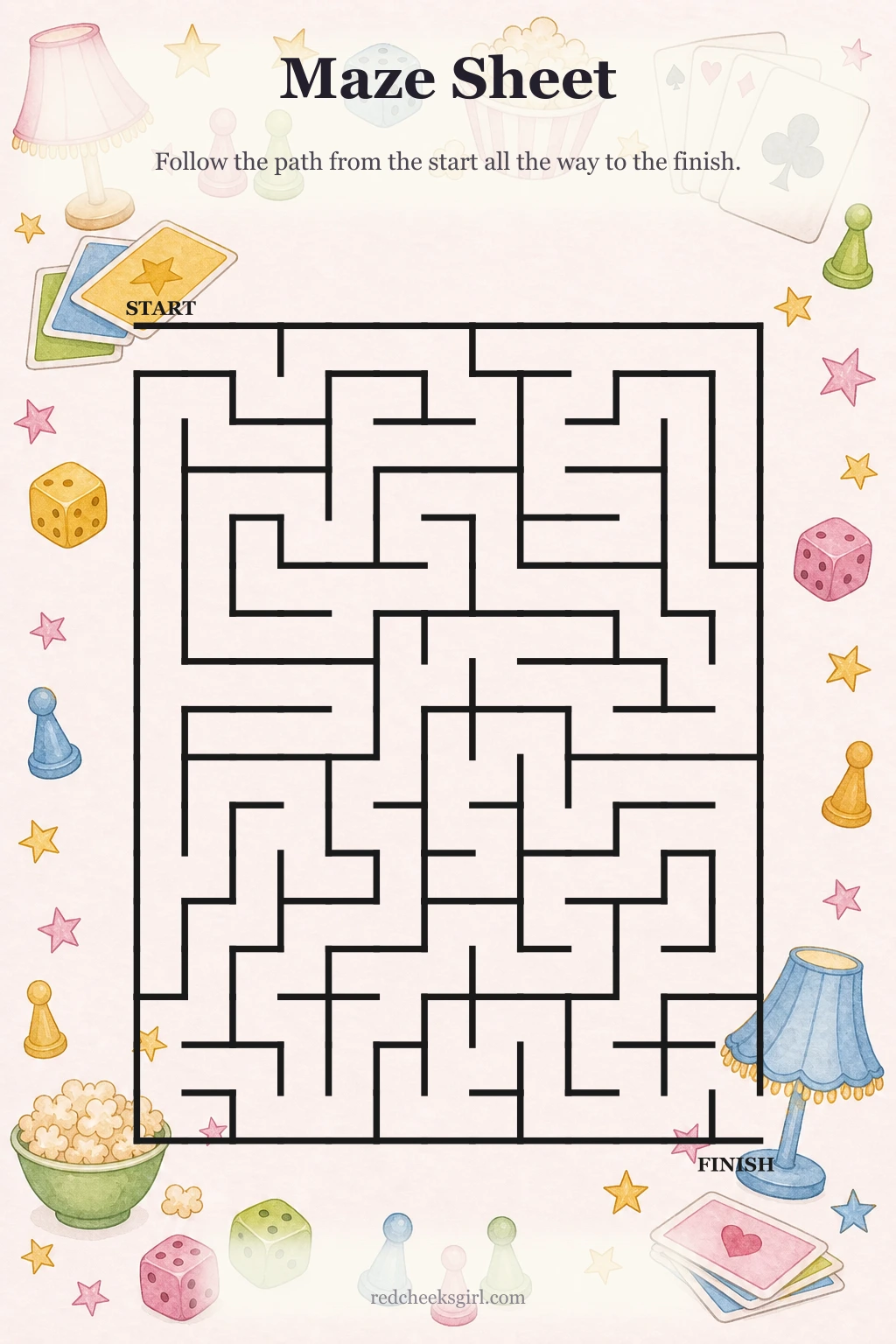
The Family Game Night Maze Sheet features one large main maze styled as a game board path — the goal is to guide a tiny game-piece token from START to FINISH by finding the one correct route through a network of branching corridors.
It’s a hand-drawn-style illustration that doubles as a piece of art when completed, and solving it is genuinely satisfying for all ages.
Print one per player or one per team. Players race to solve the maze first — pencil in hand, tracing the correct path from START to FINISH.
The maze has one correct solution and several convincing dead ends that loop back, which means it takes real focus to solve rather than just luck. No prep, no materials beyond the printed sheet and a pencil.
For a competitive version, everyone gets their sheet at the same time and the first person to trace a complete unbroken line from start to finish — verified by holding it up — wins that round.
Here’s a fun variation that turns this from a solo puzzle into a team game: the Relay Maze. Each person at the table can only trace 10 seconds’ worth of path before passing the pencil to the next person.
The team has to navigate together, communicating directions under pressure. It sounds simple and it is completely chaotic in the best possible way.
You can also use the maze as a calm ‘between rounds’ activity — hand it out during a scoring break so nobody’s just sitting there waiting, and the next round starts with fresh, focused energy.
A maze gives restless kids something absorbing to do during scoring breaks — no extra supplies and zero host effort required.
15. Coloring Sheet
I know what you’re thinking — coloring at game night? Hear me out.
The Family Game Night Coloring Sheet is a detailed line-art illustration of a cozy family game night scene: a table covered in game pieces, cards, dice, a trophy, snacks, and a scoreboard, with cheerful decorative elements around the border.
It’s designed for players of all ages to fill in during downtime, snack breaks, or as a calm cool-down after an intense competitive stretch.
There’s also a subtle competitive angle: the best-colored sheet (voted on by the group) wins a small bragging-rights title — Most Creative Player of the Night.
Print one per player on regular copy paper. Bring out whatever coloring supplies you have: crayons, markers, colored pencils — whatever’s hiding in the junk drawer or the kids’ room. No special materials needed.
This is deliberately designed to have enough detail to keep older players engaged (intricate game pieces, cross-hatched backgrounds, layered border designs) while also having large open areas that are satisfying for younger kids to color quickly without frustration. It’s an ‘all ages simultaneously engaged’ win.
The coloring sheet also works as a clever background activity during the Game Show Buzzer Round or Trivia Sheet — kids who are waiting for adults to finish their trivia answers can color without interrupting.
It gives every age level something to do at every moment, which is genuinely the hardest thing to achieve in a mixed-age family gathering. Bonus: the finished sheets become a little gallery of the evening.
Tape them to the fridge after and let the kids point out ‘their masterpiece’ for the next week. It costs you nothing and buys you weeks of goodwill.
Vote on the best-colored sheet at the end of the night — the winner earns the ‘Most Creative Player’ award certificate from this pack!

🛍 Shopping guide
16. Score Sheet
Every single game in this lineup needs a score tracker, and the humble Score Sheet is the unsung MVP of the whole evening.
This isn’t just a blank grid — it’s a thoughtfully designed game night scoreboard with space for up to 8 players or teams, rows for up to 12 rounds or games, a running total column, and a bold ‘CHAMPION’ banner at the bottom for the final winner’s name.
It’s formatted to cover an entire evening’s worth of games on one sheet, so you’re not scrambling for paper between rounds or trying to decipher someone’s napkin math at the end of the night.
Print one sheet per game night (or one per game if you’re running multiple simultaneous competitions). Fill in player names across the top row and game names down the left column before the evening starts — that five-minute setup investment saves enormous confusion later.
The scorekeeper writes round scores in each cell, the running totals update in the right-hand column after each game, and the final leaderboard is crystal clear when the night wraps. Designate one dedicated scorekeeper from the start (ideally someone competitive enough to care about accuracy).
Host tip: make the Score Sheet visible to all players throughout the night by taping it to a wall, propping it on a cookbook stand, or simply keeping it in the middle of the table.
Visible scores create narrative tension — a close race energizes the room, a big lead creates an underdog story, and either way everyone’s invested.
At the end of the night, write the final winner’s name in the Champion banner, take a photo, and — if you’re the kind of family who appreciates keeping records (hello, fellow competitive households) — save the sheet as a running record of who has won over multiple game nights.
Tape the score sheet to the wall at the start of the night — visible scores keep everyone invested in every round.

17. Awards Certificates
The Awards Certificates sheet is the most guaranteed crowd-pleaser in this entire printable pack — bar none. At the end of game night, every single player walks away with an official-looking certificate acknowledging something specific about how they played.
The sheet includes 8 certificates on a single US Letter page: Game Night Champion, Best Sport, Most Creative, Quickest Thinker, Funniest Moment, Most Improved, Master Strategist, and Fan Favorite.
The host fills in the player’s name on each certificate during the final few minutes of the night and distributes them with all the ceremony of an actual awards show (which means you should absolutely make everyone come up to ‘collect’ their certificate while the others clap).
Print one sheet per game night. Cut the certificates apart along the dashed lines. Each certificate has a bold title, a decorative ribbon or badge graphic, a blank line for the winner’s name, and a blank line for the date — no other pre-filled information.
The host assigns certificates based on the night’s actual events (the Game Show Buzzer Round winner gets Champion, the person who made everyone laugh gets Funniest Moment, the kid who came from last place to second gets Most Improved — you get the idea).
Every player gets exactly one certificate so nobody goes home empty-handed.
This is one of those tiny touches that costs almost nothing and makes people feel genuinely seen and celebrated. Kids especially love the physicality of receiving a ‘real certificate’ — they’ll carry it around proudly and tape it to their wall.
It’s also a nice way to acknowledge contributions that aren’t strictly competitive: the player who set up the games, kept the score, or kept the energy positive all night deserves a certificate just as much as the person who won the trivia round.
Hand out your awards, take a group photo with everyone holding their certificates, and call it a perfect game night.
Everyone gets a certificate — not just the winner — so the night ends on a high note for every player, every age.

18. Roll-a-Challenge Dice Sheet
The Roll-a-Challenge Dice Sheet is the wildcard of the whole game night — and I mean that in the best possible way.
The sheet is a printable dice net (or two) that you fold and tape into a physical paper cube, with a unique challenge printed on each of the six faces.
Roll the cube and whatever face lands on top is your challenge for that round: Sing a Theme Song, Do a Silly Walk, Speak in an Accent, Make a Sound Effect, Draw Blindfolded, or Tell a 30-Second Story.
It’s a pure improv roulette wheel, and it is absolutely chaotic in the best way.
Print and fold the dice net — no scissors needed for most of it, just fold along the dotted lines and use a tiny piece of tape to close the cube. Takes about 3 minutes to assemble.
Make one cube per player so everyone rolls simultaneously, or make two cubes and combine the resulting challenges for a double-dare version.
The faces are clearly labeled with the challenge name and a tiny illustration of what to do, so even younger players can read the die without help.
For extra variety, print two different dice nets from the same sheet — each cube has a different set of six challenges, so combining them gives you 36 possible combinations.
Why this game has special magic: it requires zero supplies, zero prep, zero explanation time, and generates instant entertainment because nobody has any choice but to do the challenge they rolled.
There’s no strategy, no skill advantage, and no way to prepare — it’s completely equalizing. The kid who rolls ‘Sing a Theme Song’ and belts out their favorite cartoon intro will be the talk of the night.
Use Roll-a-Challenge as a mini palate cleanser between heavier structured games, or make it the tiebreaker when two players are tied at the end of the evening.
- Print and fold the cube
- Roll to reveal your challenge
- Complete the challenge in 30 seconds or less
- The table votes if you nailed it — yes = 1 bonus point!

🛍 Shopping guide
19. Riddles Sheet
There is a very specific kind of silence that falls over a room the moment someone reads a riddle aloud — a three-second pause where everyone’s brow furrows simultaneously before the guesses start flying — and it is one of the best silences in game night existence.
The Family Game Night Riddles Sheet features 15 classic-style riddles of graduated difficulty (5 Easy, 5 Medium, 5 Hard) with a complete answer key printed subtly in small light-grey italic text at the very bottom of the sheet.
Players write their guesses in the blank line beneath each riddle, and the host reveals correct answers one by one after everyone’s submitted.
Print one sheet per player for individual play, or one sheet total for group play where the host reads each riddle aloud and the first person to shout the answer earns a point.
The riddles are numbered continuously 1–15 across the three difficulty tiers (Easy = Q1–5, Medium = Q6–10, Hard = Q11–15), and the corresponding numbered answers appear in the complete key at the bottom of the sheet.
The answer appears only in the key — never beside the riddle clue — so there’s no risk of accidentally spoiling the puzzle while reading.
Riddles are genuinely one of the most democratic game night formats because they don’t favor older players as much as trivia does — kids sometimes have fresher lateral thinking than adults and will shout the answer while the grown-ups are still mentally untangling the wordplay.
That equalizing quality makes the room feel fair and lively.
For a competitive variation, assign point values by tier (Easy = 1 pt, Medium = 2 pts, Hard = 3 pts) and let players wager on whether they want to attempt Hard riddles before they hear the full riddle — maximum risk, maximum reward, maximum drama.
- Read each riddle aloud one at a time
- Everyone writes their guess on their own sheet before answers are shared
- Reveal the answer key at the end — not before!
- Tally scores on the Score Sheet

20. Guess How Many Jar Sheet
The Guess How Many Jar is a classic for a reason — it combines math intuition, competitive guessing, and the deeply satisfying moment of revealing the actual count, all in a package that requires one jar, one household item to fill it with (wrapped candies, dried pasta, marbles, coins — whatever’s available), and this one printed sheet.
Before game night starts, the host fills a clear jar with the chosen item and counts as they go (write the count down secretly).
The Guess How Many Jar Sheet is passed around and each player writes their name and best guess in their own numbered row. Closest guess without going over wins the jar — and its contents.
The printed sheet has space for up to 10 players, each with a row containing their name blank, their guess blank, and a ‘Difference from Actual’ column that gets filled in during the reveal. Print one sheet per jar round.
The host writes the actual count on the designated host line only after all guesses are submitted — no peeking allowed.
Reveal the number dramatically (seriously, pause for effect — ‘The actual count is…’), then calculate the difference for each player’s guess and circle the winner.
If you want to skip the math, simply have everyone shout their number and do a quick eyeball check of who’s closest.
The jar game is brilliant as an arrival game — set the jar out on the table at the very start of the night and let players write their guesses as they sit down, before the first official game begins.
This builds anticipation from minute one and gives everyone something to engage with immediately.
You can run multiple rounds with different jars and different contents throughout the night (jar of popcorn kernels for round one, jar of rubber bands for round two) — each round costs nothing and generates a fresh competition. And whoever wins the candy jar?
Instant most popular person at the table.
Set the jar on the table at the very start of the night as an arrival activity — guests write their guess as they sit down, before round one even begins.

🛍 Shopping guide
21. Family Q&A Circle
This is the game that sneaks up on you. You think it’s going to be a calm, low-key moment — and then someone asks ‘What’s one thing you wish you did more as a family?’
and suddenly everyone’s sharing something real, and the youngest kid says something completely unexpected that makes the whole room go quiet in the best way.
The Family Q&A Circle is a structured conversation game: the host reads one question prompt aloud, and every player answers going around the circle — no skipping, no one-word answers.
The questions are a mix of lighthearted (‘What’s your dream vacation and who at this table would you bring?’) and genuinely meaningful (‘What’s something someone in this family does that you really admire?’).
Sit in a circle, designate a starting direction, and go.
The rule is simple: everyone listens while one person answers, no interrupting, no judging.
Younger kids can pass if a question is too abstract — but in practice, kids under 10 often give the most disarmingly honest answers and everyone ends up laughing or slightly emotional.
Slot this game in after the high-energy active rounds and before the very end of the night — it naturally slows the pace and creates a landing moment that makes the evening feel complete rather than just… stopped.
It’s also the game that gets referenced the most in the weeks that follow. ‘Remember when Dad said his dream vacation was Antarctica and we all thought he was joking but he wasn’t?’ That’s the Family Q&A Circle at work.
If you’re looking for more intentional family-connection activities beyond game night, these DIY crafts kids can make together give that same shared-experience energy year-round.
- After high-energy rounds to naturally wind down
- All ages — little kids often give the best answers
- Families who want game night to feel meaningful, not just competitive
22. Gratitude Round
The Gratitude Round is the final game of the night, and it’s the one everyone remembers longest.
Here’s the format: each player draws the name of another player from a hat (or assigns names clockwise around the circle), and then has 60 seconds to think before sharing one specific, genuine thing they appreciate about that person.
Not a generic ‘you’re nice’ — a real, specific observation. ‘I appreciate that you always make sure everyone’s included in the game, even when it slows things down.’ ‘I appreciate that you laugh loudly and it makes everything funnier.’ Specific. Real. Witnessed.
No materials needed beyond slips of paper with names for the drawing (use the scrap paper from cutting your card decks — nothing goes to waste in a DIY game night).
Give players a 60-second thinking window after they draw a name before the sharing begins — this prevents the first person from going while everyone else is still panicking. Go around the circle once. The recipient cannot respond except to say thank you.
That’s the whole rule. It sounds almost too simple, and it creates one of the warmest, most memorable moments of the evening.
Why end on a Gratitude Round rather than another competitive game? Because game nights are really about connection — and this is the moment the whole evening earns its meaning.
The competitive games build energy, inside jokes, and shared memories; the Gratitude Round transforms all of that into something that lasts past bedtime. It’s also, if I’m being honest, the moment the kids suddenly realize game night wasn’t just about winning points.
If you want to build more of this kind of intentional connection into family routines beyond game night, creating a scrapbook together is another beautiful way to celebrate what you love about each other.
End every game night with the Gratitude Round and watch it quietly become everyone’s favorite part.
Specific gratitude lands deeper than general compliments — prompt players to name one real observed thing, not a generic ‘you’re great’.
Frequently Asked Questions
How long does a full DIY family game night last?
A complete game night using all 22 games from this pack would run 3–4 hours, which is genuinely a lot — so don’t try to do everything in one sitting!
A good approach is to pick 6–8 games per evening, mixing active, printable, and quiet types. The whole pack gives you enough content for 3–4 separate game nights, which is even better value for the one-time printing investment.
Do I need cardstock to print the games, or is regular copy paper fine?
Regular copy paper works perfectly for everything in this pack.
The one exception where cardstock is worth it (if you have it) is the Matching Memory Cards and the Pictionary and Charades Card Decks — a little stiffness makes those easier to handle and shuffle, and they’ll hold up to repeated play.
For everything else — trivia sheets, bingo cards, certificates, score sheets — copy paper is completely sufficient.
Which games work best for younger kids (ages 4–6)?
The Matching Memory Cards, Coloring Sheet, Maze Sheet, and Scavenger Hunt Sheet are the strongest picks for very young kids because they require no reading and let small children fully participate.
For active games, Charades and Pictionary both work wonderfully if you pull cards from the Easy tier and give little ones a parent partner. The Bingo card can also be adapted by reading each prompt aloud.
How many people can play at once for a DIY family game night?
Most games in this pack scale from 2 to 10+ players with no modifications — simply print extra sheets. The Score Sheet holds up to 8 players, and the Guess How Many Jar Sheet accommodates up to 10.
For larger groups (10+), run team-based versions of the active games (Charades, Pictionary, Buzzer Round, Minute to Win It) to keep everyone engaged simultaneously without long waiting periods.
How can I make the game night feel special without spending money on decorations?
The printables in this pack do most of the decorating work for you — tape the Score Sheet to the wall as a visible leaderboard, display the Award Certificates on the table before the reveal, and use the Coloring Sheet as a table activity that doubles as decor.
Beyond that: dim the lights slightly, put snacks in the center of the table, and designate one person as the official ‘Game Show Host’ for the evening. The ceremony is what makes it feel special, not the budget.
Can I use these printable games without a printer?
Absolutely — most of the games in this list are fully adaptable to handmade versions. The Charades Jar, Pictionary Easel, Game Show Buzzer Round, Minute to Win It, Family Q&A Circle, and Gratitude Round need no printing at all.
For trivia, riddles, and bingo, you can copy questions onto index cards or read them aloud from a phone or tablet. The printables just make setup faster and the experience more polished.
📌 Save These for Later
Loved these? Pin your favorite image below so you can find this list again when you’re planning.

21 family game night ideas — from Family Feud to cozy closing circles — that turn one evening a

72 this or that questions for kids sorted into six rounds. Read them aloud, print the cards and watc
20 fun family game night ideas that actually work with little kids — simple, no reading needed, do
Leave a Reply