

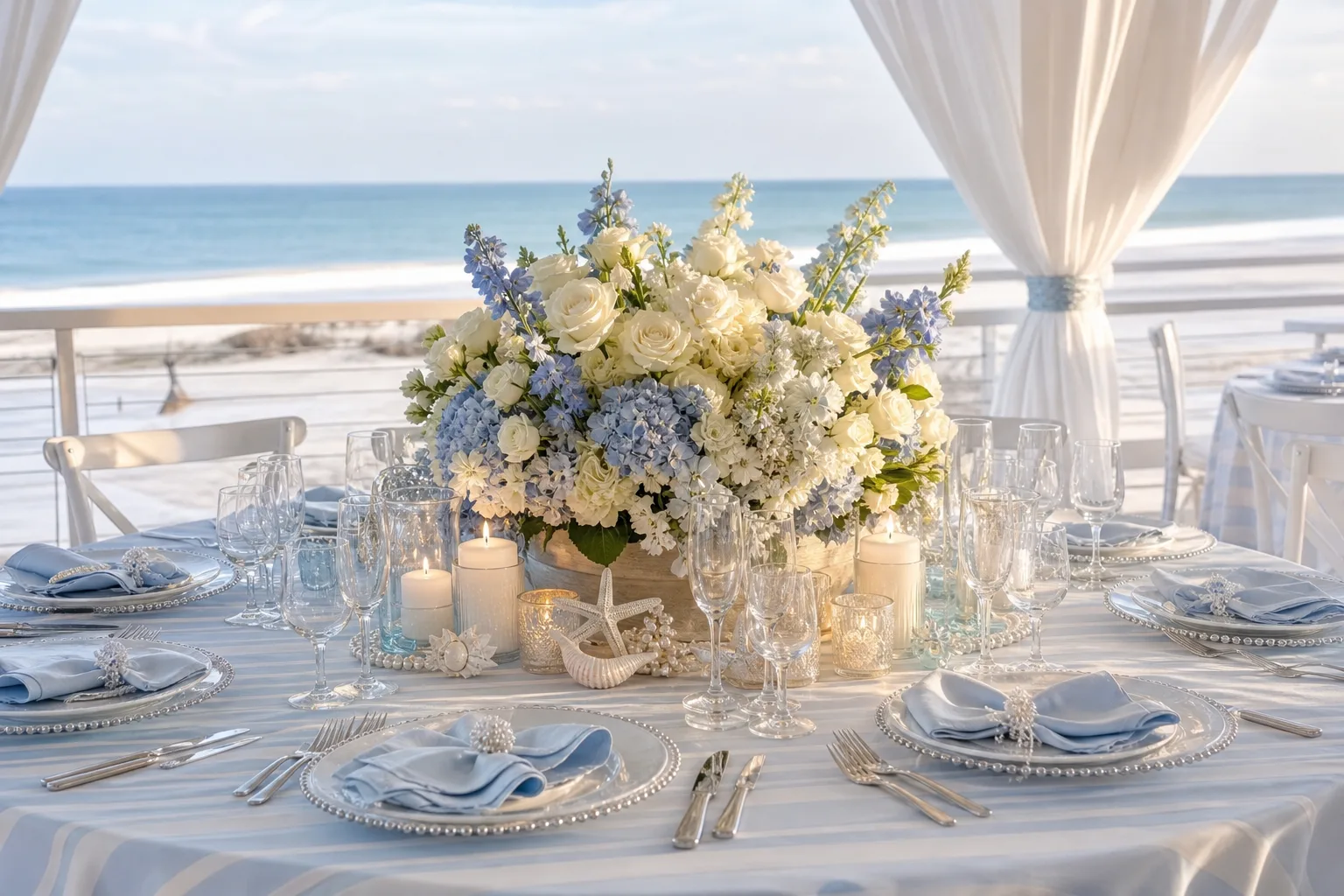
Picture the whole day before a single chair goes down: sand underfoot, a soft blue sky doing most of the decorating for free, and everything on the tables catching the light the way the water does.
That is the coastal wedding, and it works because nobody fights the view. The palette stays put through every part of the day: sand, white, soft blue and pearl, with nothing competing for attention against the horizon.
The motif is the pearl strand and the blue and white stripe, and both get to do different jobs depending on where you find them.
A pearl strand lies along a table one hour and sits at the bride’s waist the next. A stripe turns up on a lounge cushion at cocktail hour and again on the cake an hour later, never quite the same twice.
This suits a wedding right on the shore, obviously, but it travels just as well to a lawn with a water view, a terrace near a lake, or a reception hall you dress with the same sand and blue, if the beach itself is not on the table.
Late spring through early autumn is the easy season for it, though a heated tent stretches that further.
This post contains affiliate links. If you buy through them, I may earn a small commission at no extra cost to you.
Table of Contents
The Ceremony on the Shore
This is the part she will see first and remember longest, so it carries the most weight and the least clutter. The structure, the aisle and the ritual itself all sit in the same sand, white and soft blue, with nothing competing against the water behind them.
A Flowing Fabric Arch at the Water’s Edge
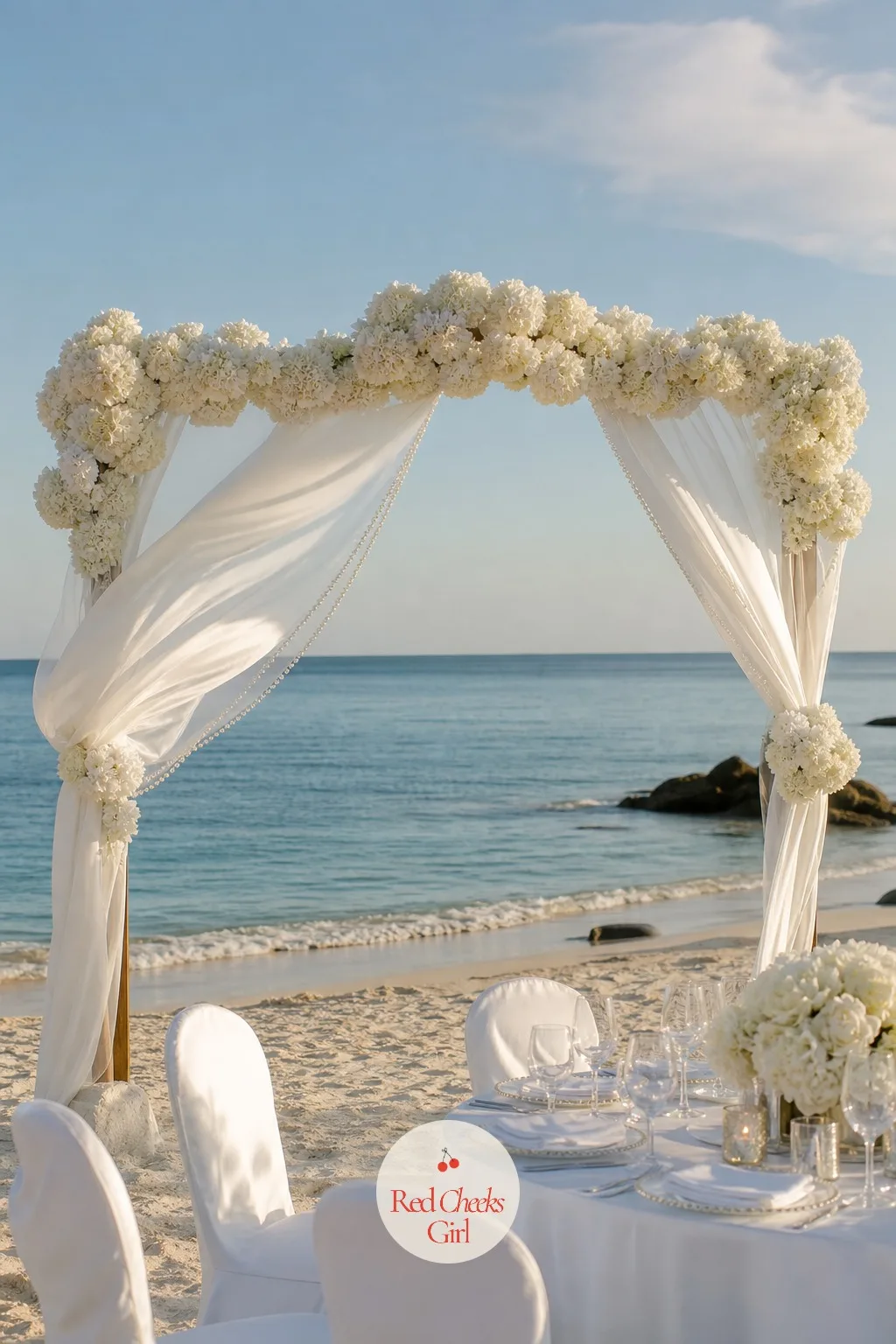
An empty frame on sand looks like scaffolding until the fabric goes up, and then it is the whole ceremony. Two or three panels of ironed white satin or cotton sateen hang from a simple metal or whitewashed wood frame and move with whatever breeze is already there, which is the one piece of decorating the sea does for free.
Build it from the ground up: a weighted or sand-anchored frame first, the fabric panels knotted or looped over the top bar, then a few stems of white hydrangea and a trail of pearl beading at the base where the fabric meets the sand.
Tell the florist and rental company exactly this: a 10 foot arch frame in brushed silver or whitewashed wood, dressed with white hydrangea and pearl spray, with two 20 foot panels of ironed white satin.
The frame and fabric are worth renting rather than building, since wind and salt air are unkind to anything improvised. If the venue will not allow anything staked into the sand, a freestanding weighted base swaps in without anyone noticing.
🛍 Shop this look
A Shell and Pearl Strand Aisle
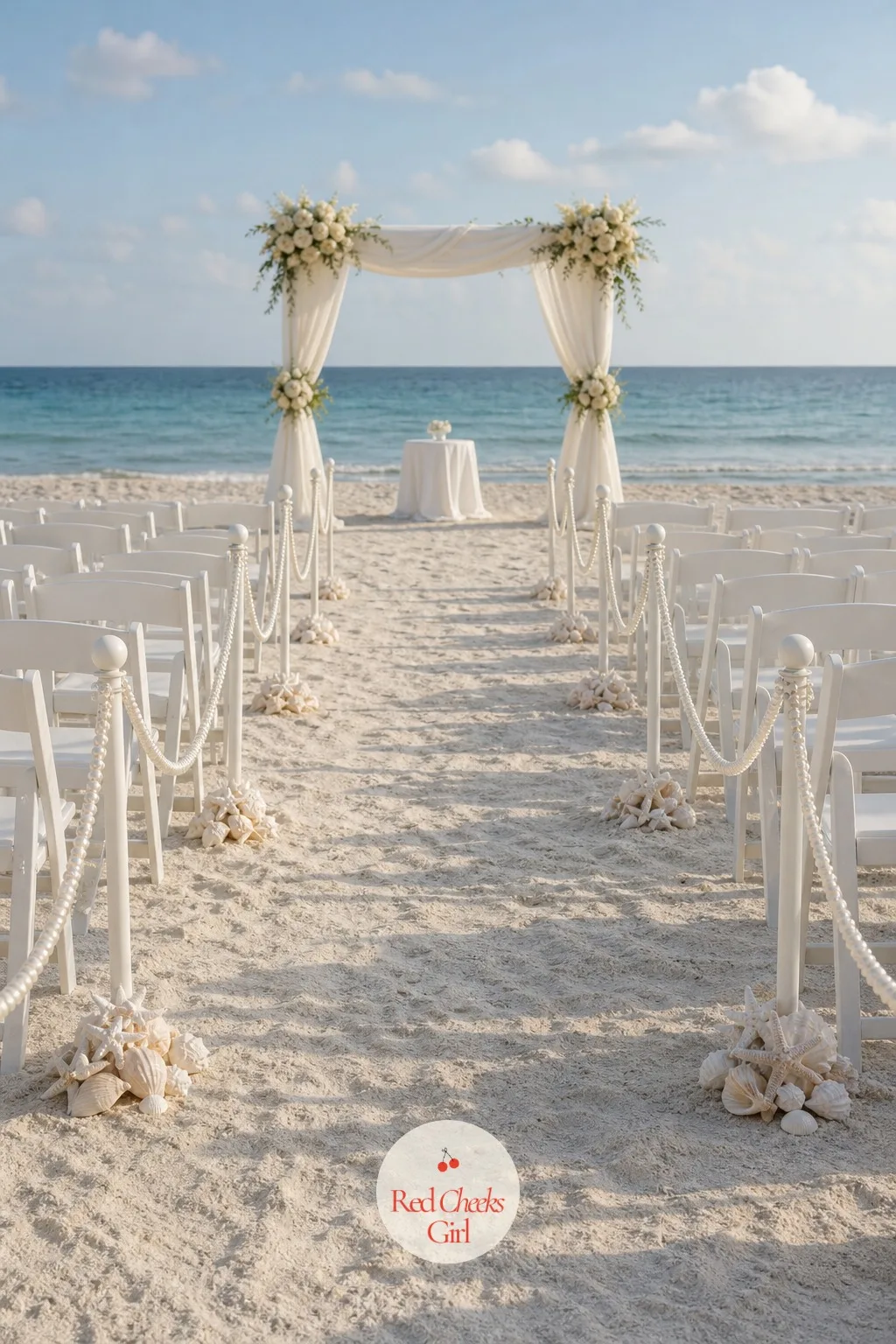
A bare walk to the arch feels unfinished, and scattered shells alone can look like the tide left them there by accident. Line the aisle instead with a low strand of pearls draped between simple shepherd’s hooks or driftwood-free white stakes, with a cluster of pale shells resting at the base of every other one.
From the sand up: a stake or hook every few feet, a single looped pearl strand swagged between them at knee height, and a small dish or cluster of shells sitting where the strand dips lowest.
Give the decorator this line: pearl bead garland in 6 foot lengths, swagged between 24 inch white stakes, with natural shell clusters at the base of every second stake.
This one is easy to build the night before with garland bought by the yard and a bag of craft shells from a florist supplier. If stakes will not hold in soft sand, weighted urns on either side of the aisle do the same job standing still.
🛍 Shop this look
A Two-Tone Sand Ceremony
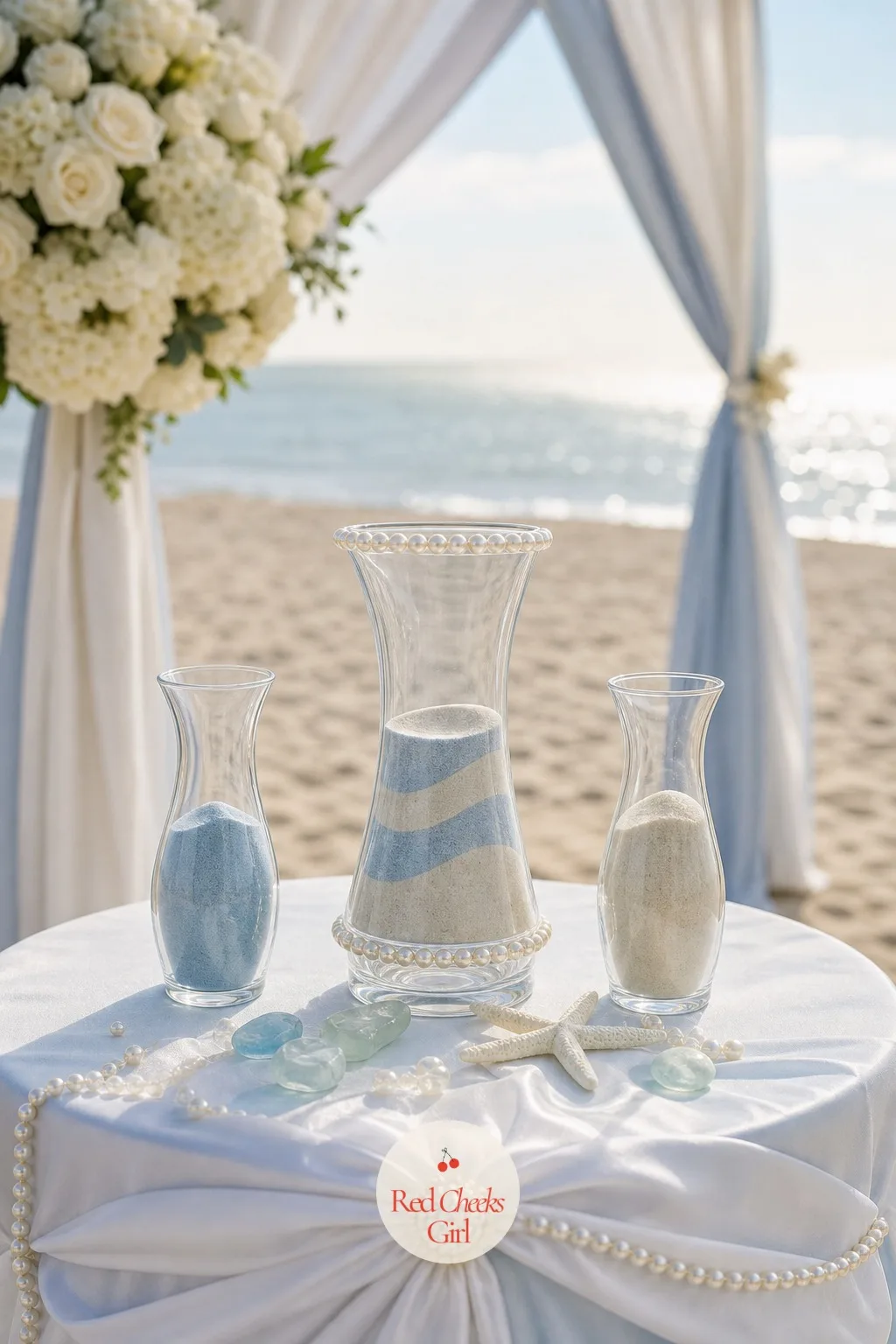
Rings get lost, candles blow out in any real breeze, but sand poured into a vessel stays exactly where it lands, which is why this ritual suits an actual beach better than almost any other. Two glass vessels, one in soft blue sand and one in ivory, pour together into a single pearl-topped glass vase that the couple keeps.
It runs in under two minutes: the officiant names the moment, each partner lifts their own vessel, and both pour at once into the shared vase so the colors layer rather than mix flat. The vase then sits on the table at the reception as a centerpiece in its own right.
Give the stationer or planner this line: two 8 ounce pouring vessels of colored sand, soft blue and ivory, poured into a single 10 inch glass unity vase with a pearl trim lid.
The sand itself is cheap and easy to order online, and a couple who would rather skip the pour can use the same vase simply filled with layered sand ahead of time as decor instead.
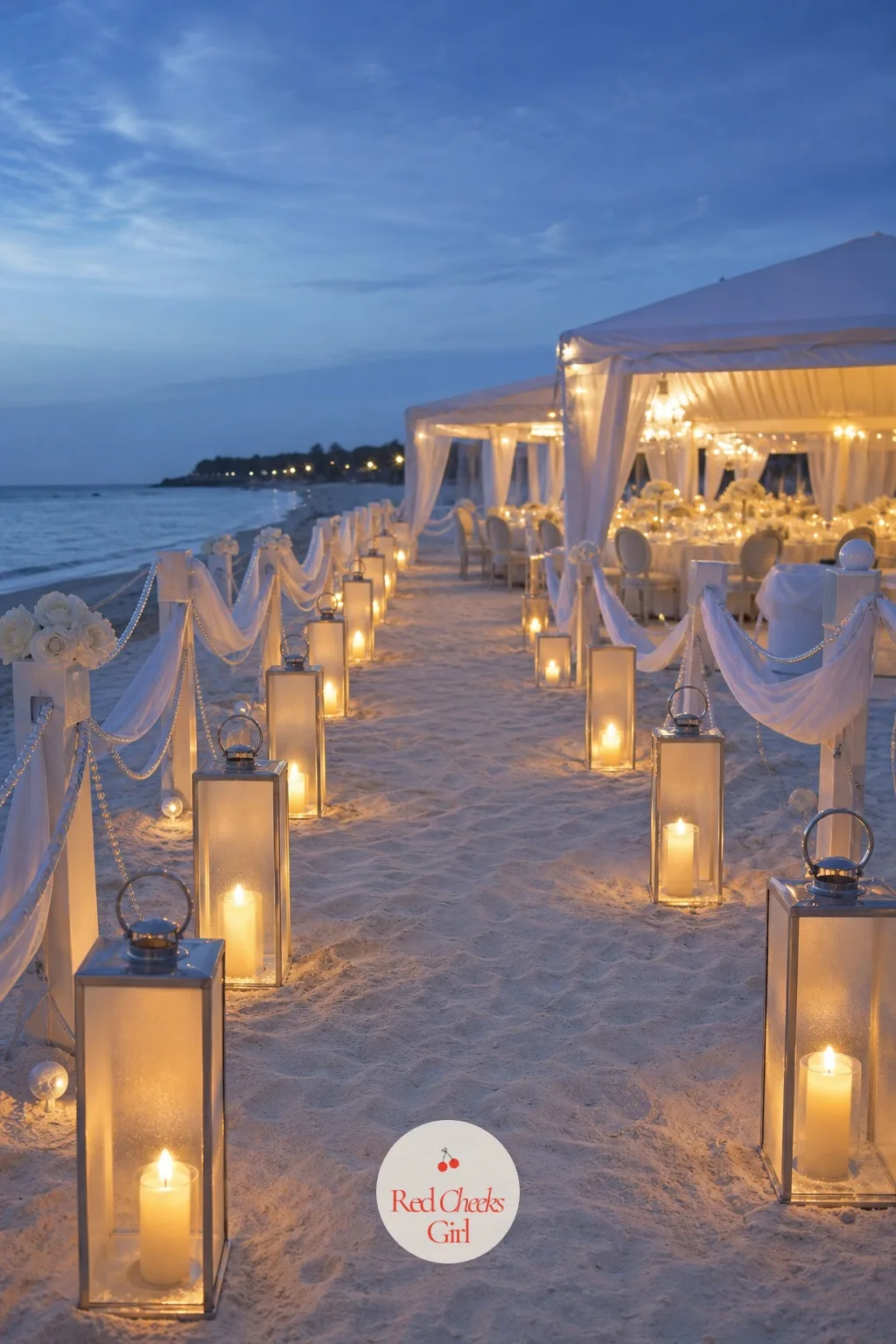
A Lantern-Lined Pathway to the Reception
The walk between the ceremony and the party is dead time unless someone dresses it, and in failing light it is also where guests actually need help seeing their feet. A double row of frosted glass lanterns, each holding a pillar candle in soft blue or ivory, carries people from the shore to wherever dinner waits.
Build it simply: a lantern every four or five feet along each side of the path, a candle inside each, and a scatter of pale shells or pearl beads at the base of a few for texture without clutter.
Tell whoever sets up the space: 20 frosted glass lanterns, ivory pillar candles inside, spaced evenly along both sides of the walking path.
This is one of the cheapest big-looking moves in the whole day, since battery candles do the job just as well once the sun drops and nobody will test them. If an open flame is not allowed near the sand, flameless LED pillars swap straight in.
The Welcome and Cocktail Hour
Guests arrive with sand still on their shoes and need somewhere to land before dinner. This stretch sets the tone for the whole reception in miniature: a sign, a lounge, a place to find their table, a drink in hand.
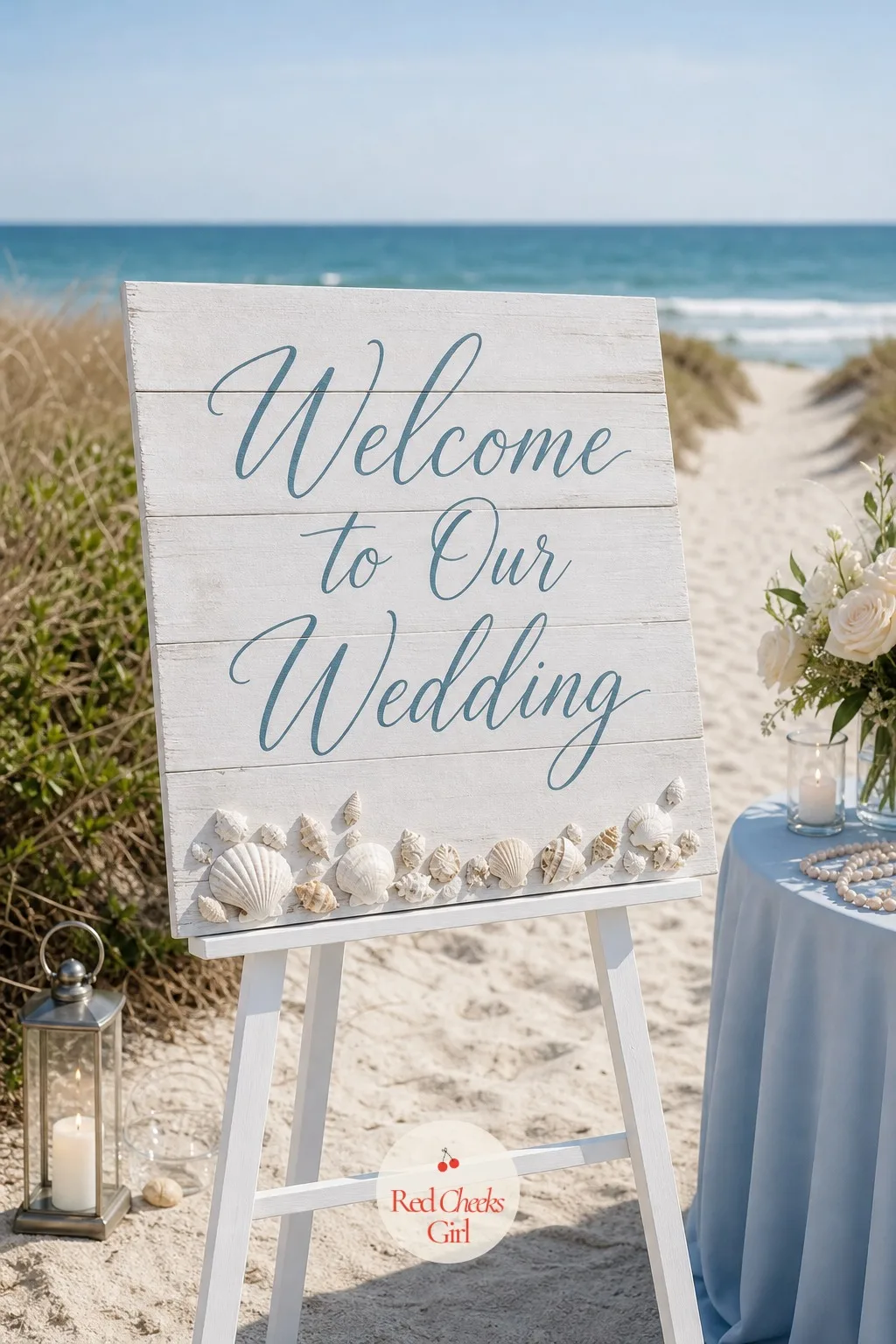
A Whitewashed Welcome Sign with Shell Lettering
She will not want guests squinting at a seating chart to find out they are even in the right place. A single easel sign, painted a soft whitewash, greets everyone before anything else does, the lettering simple and the only ornament a scatter of small pale shells tucked along the bottom edge.
From the ground up: a wooden easel, a flat whitewashed board set into it, hand-lettered or vinyl text in soft blue ink, and the shell scatter glued along the lower corner once the paint is dry.
Give the sign maker this exact wording to paint: Welcome to Our Wedding, with the couple’s names and the date beneath in the same soft blue.
A calligrapher can do this in an afternoon for not much money, and a board from a craft shop plus a paint pen does the job just as well for a bride doing it herself. Where an easel is impractical on sand, a freestanding frame with a weighted base holds just as still.
🛍 Shop this look
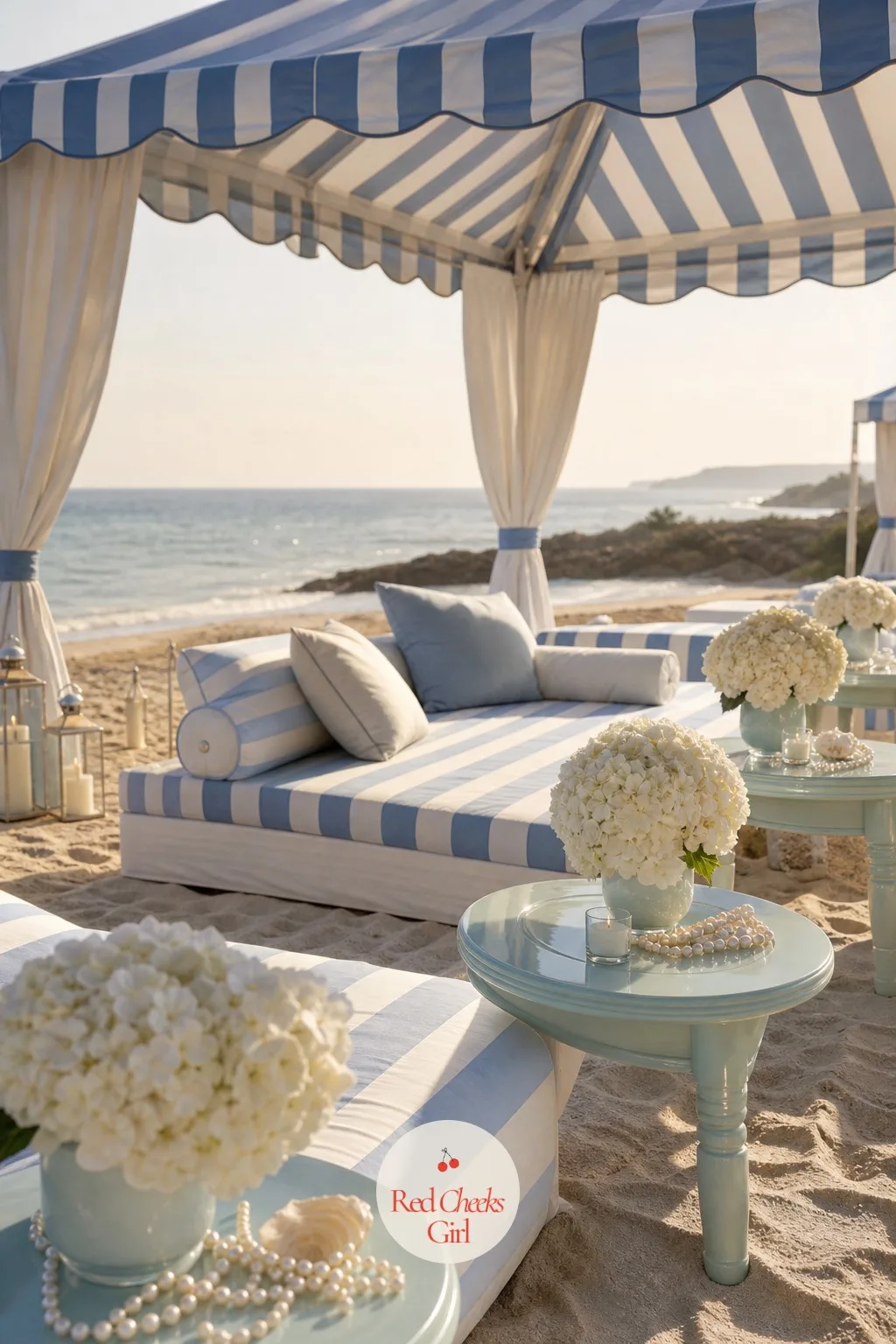
A Blue and White Striped Cabana Lounge
An hour of standing around with a drink goes much better sitting down, and this is where the stripe gets to do its one big turn. A cluster of low sofas or daybeds in crisp blue and white striped cotton sits under a matching striped awning, a round sea glass side table between every pair of seats.
Build from the base: a platform or rug first if the sand is loose, the daybeds and sofas arranged in a loose circle, striped cotton cushions ironed smooth on each, and a sea glass or glass-top side table holding drinks and a small vase of white hydrangea.
Tell the rental company: blue and white striped cotton daybeds and cushions, four side tables, set under a matching striped canopy.
Renting the full lounge set is the one real expense in this stage and worth it, since it photographs as the cocktail hour’s main feature. Where a full cabana setup will not fit, a few striped director’s chairs around one low table carry the same stripe for far less.
🛍 Shop this look
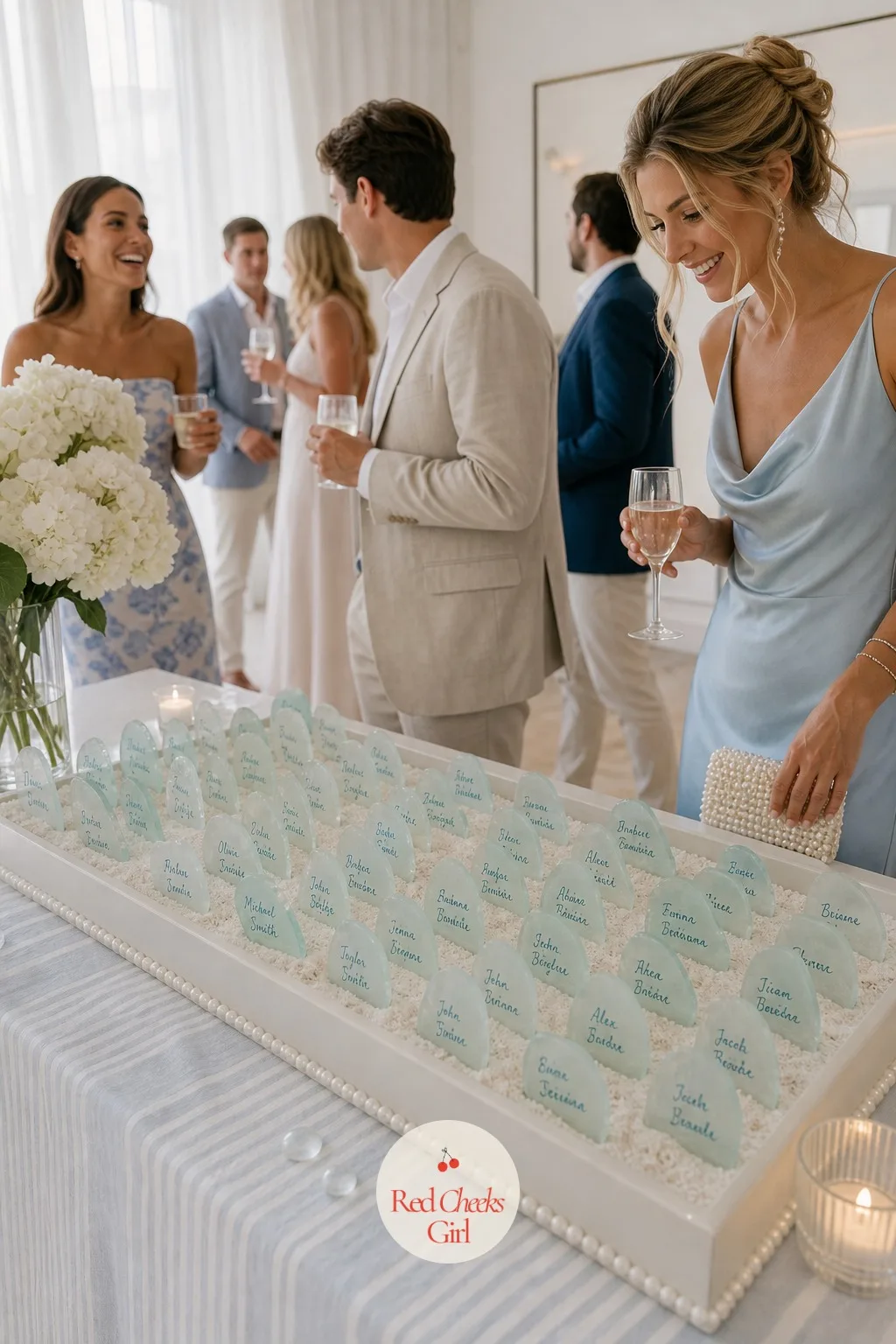
A Sea Glass Escort Card Display
Nobody wants to hunt for their seat with a drink in one hand, and a wall of plain cards does nothing for the room. Set each guest’s name on a small piece of frosted sea glass, arranged in rows across a low table or tucked into a shallow tray of white sand.
Build it in layers: a table or console first, a shallow tray or scattered sand across the surface, the sea glass place cards stood upright in rows, and a single low arrangement of white hydrangea at one end to anchor the display.
Give the stationer this line: guest names hand lettered in soft blue ink on frosted sea glass pieces, arranged upright in a bed of white sand.
Real sea glass is worth sourcing from a craft supplier rather than the beach, since it needs to be flat enough to stand and write on. A bride keeping costs down can do the same look with acrylic sea glass pieces from a wedding supplier, which read identically from table distance.
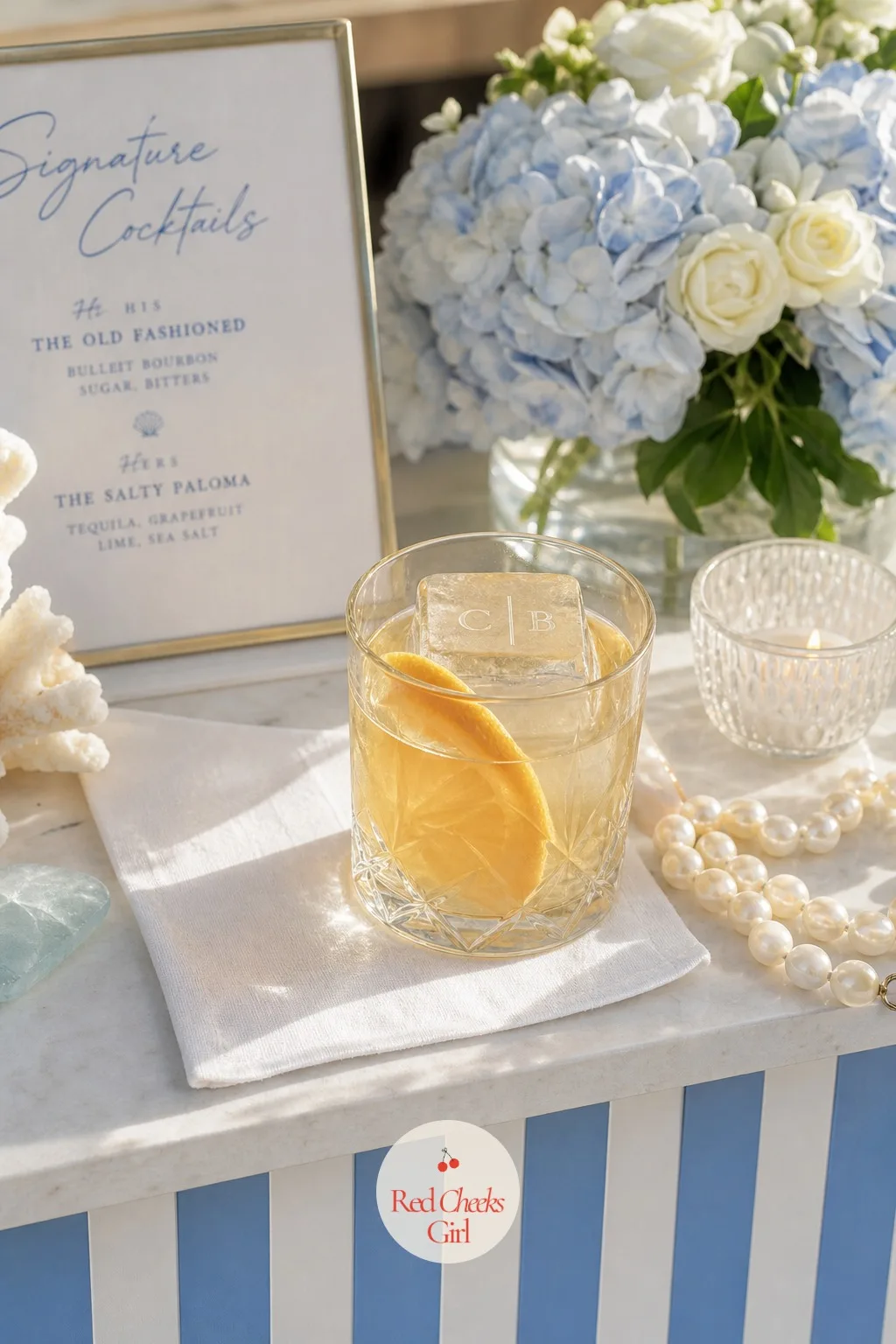
Monogrammed Ice Cubes in the Signature Cocktail
A good cocktail still looks like every other cocktail until something in the glass says whose wedding it is. A single oversized ice cube, stamped with the couple’s monogram, sits in each signature drink and melts slowly enough that the stamp stays visible through most of the glass.
It builds in reverse of how it is drunk: a silicone mold stamped with the monogram first, filtered water frozen slowly for clarity, then the cube dropped into a glass of the signature cocktail, something citrus and gin-forward or a simple rum and pineapple reads coastal without trying hard.
Tell the bartender or caterer: one 2 inch monogram-stamped ice cube per drink, in a clear rum or gin based signature cocktail served at the bar.
A caterer with a cocktail program can usually handle the stamped ice directly, and the molds themselves are cheap enough to buy and freeze at home the week before. Where stamped ice is not available on site, a simple sprig of fresh herb or a curl of citrus peel in the glass still carries the same tidy, finished look.
The Reception Tables
Once everyone sits down, the tables do the talking. Shape, cloth, centerpiece and candlelight all carry the same sand, white and pearl through from one end of the room (or the sand) to the other.
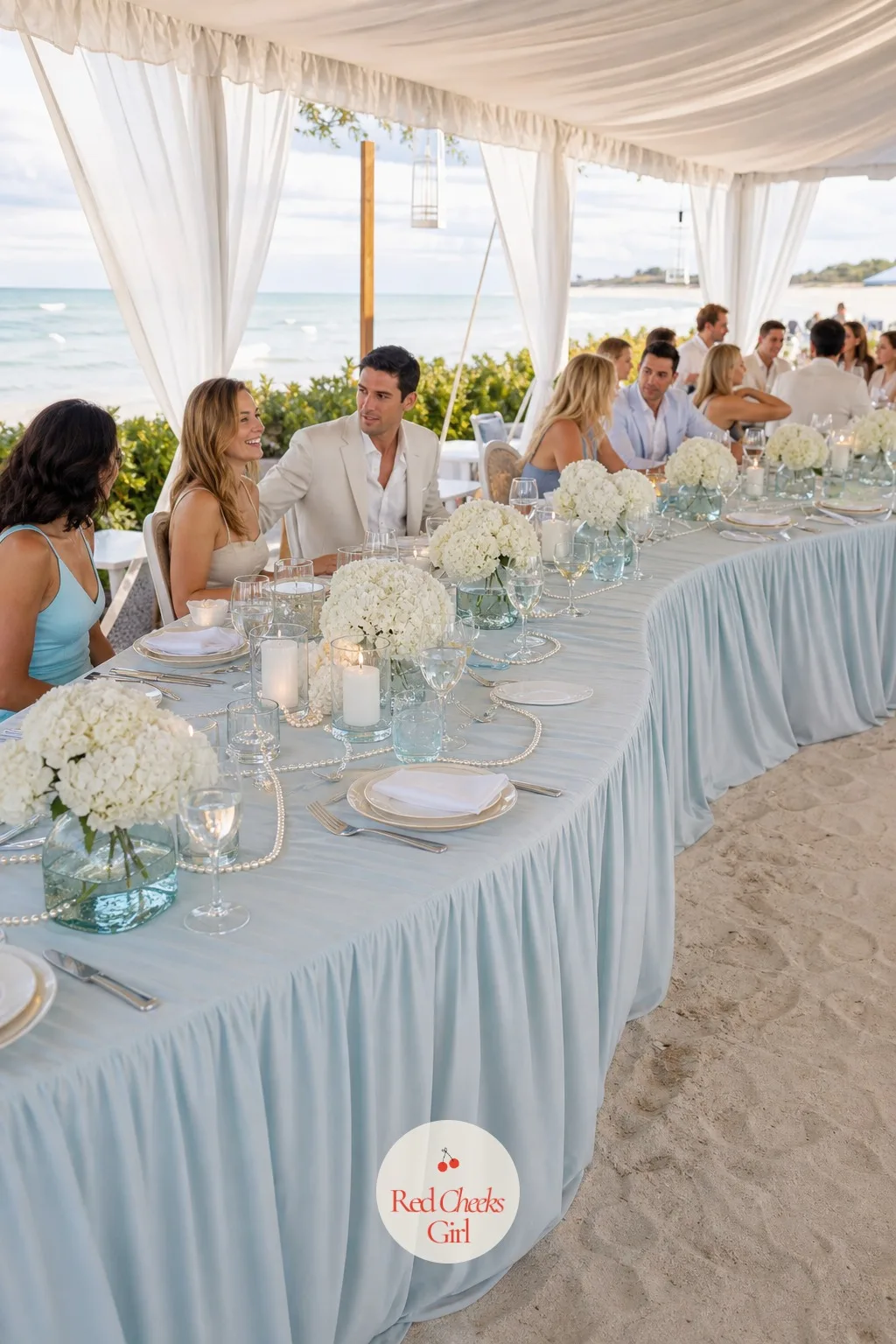
Wave-Shaped Guest Tables with Soft Gathered Cloths
Straight banquet rows can feel like a conference room no matter how nice the flowers are. Curved, wave-shaped tables break that line completely, each one following a soft serpentine edge instead of a straight one, with a gathered cloth pulled snug and pinned rather than left loose.
From the floor up: the curved table base first, a fitted white or soft blue cloth gathered and clipped at intervals along the underside to keep the line clean, then the centerpieces and place settings laid directly onto the smooth top.
Give the rental company this exact brief: curved wave-edge banquet tables, dressed in soft gathered white or pale blue satin-finish cloths, pinned smooth with no loose fabric pooling on the floor.
These tables are a rental, full stop, since building a curved base from scratch costs more than renting one ever would. Where a venue only has straight tables, a soft gathered runner laid in a loose wave line down the center borrows the same movement for a fraction of the price.
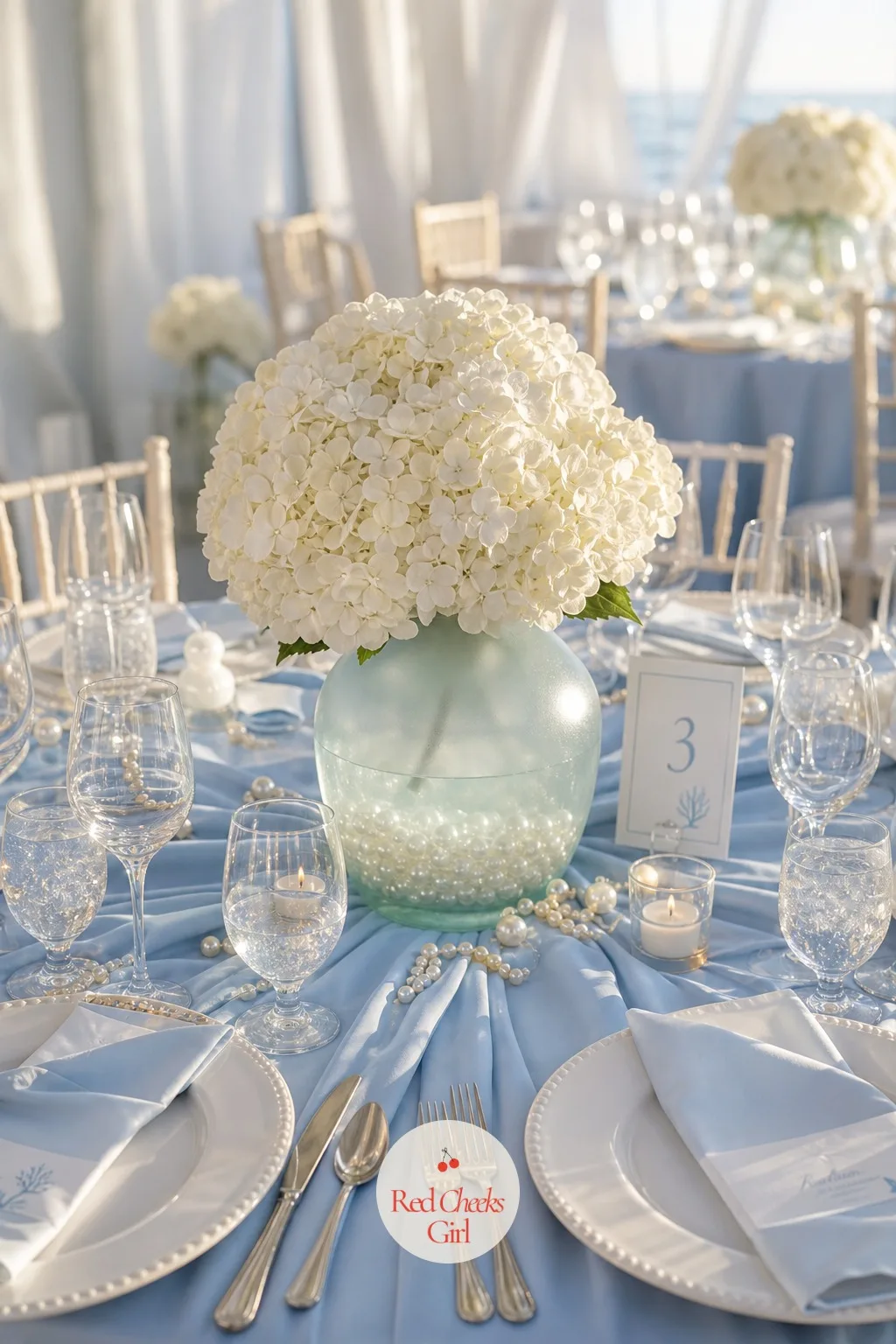
Sea Glass Vases of White Hydrangeas
A centerpiece that tries to do everything, color and height and texture all at once, usually just looks busy next to a view this good. One full, round white hydrangea head sits low in a frosted sea glass vase on every table, nothing else competing for space around it.
Built simply: the vase first, filled with water or floral foam, one or two generous hydrangea stems trimmed short so the bloom sits just above the rim, and a few loose pearl beads scattered in the water at the base.
Tell the florist: one frosted sea glass vase per table, 6 to 8 inches tall, holding a single full head of white hydrangea with loose pearls scattered in the water.
Hydrangea holds up well and is one of the more affordable full-looking blooms a florist can offer, so this centerpiece rarely blows the flower budget. A bride arranging her own tables can buy the sea glass vases online and the hydrangea from any good grocery florist the morning of.
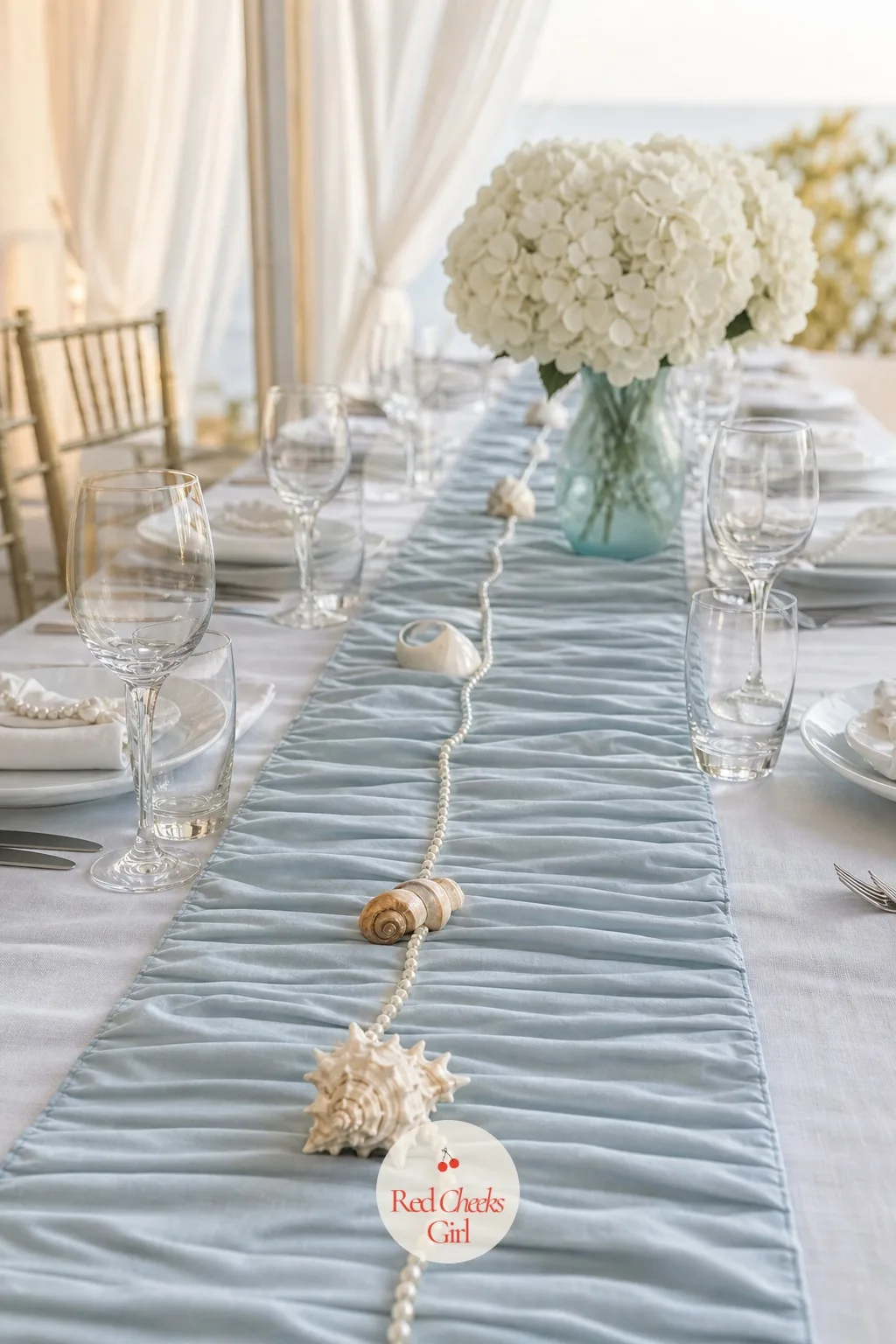
Shell and Pearl Strand Table Runners
A bare table still looks half finished once the centerpiece is in place, and a runner solves that without hiding the cloth underneath it. A narrow strand of pearls lies straight down the center of each table, with a few pale shells placed at even intervals along its length instead of piled in one spot.
From the table up: the ironed white or pale blue cloth first, a thin pearl strand runner laid flat down the center, and three or four individual shells set directly onto the strand at even spacing rather than scattered loosely.
Give the decorator this line: a single pearl bead runner down the center of each table, 6 to 8 feet long, with natural shells placed at even intervals along its length.
This one is genuinely a DIY afternoon, pearl garland and craft shells both sold by the yard and the bag. If pearls feel like too much shine for the room, a narrow white satin ribbon runner with the same shell spacing keeps the same tidy line.
🛍 Shop this look
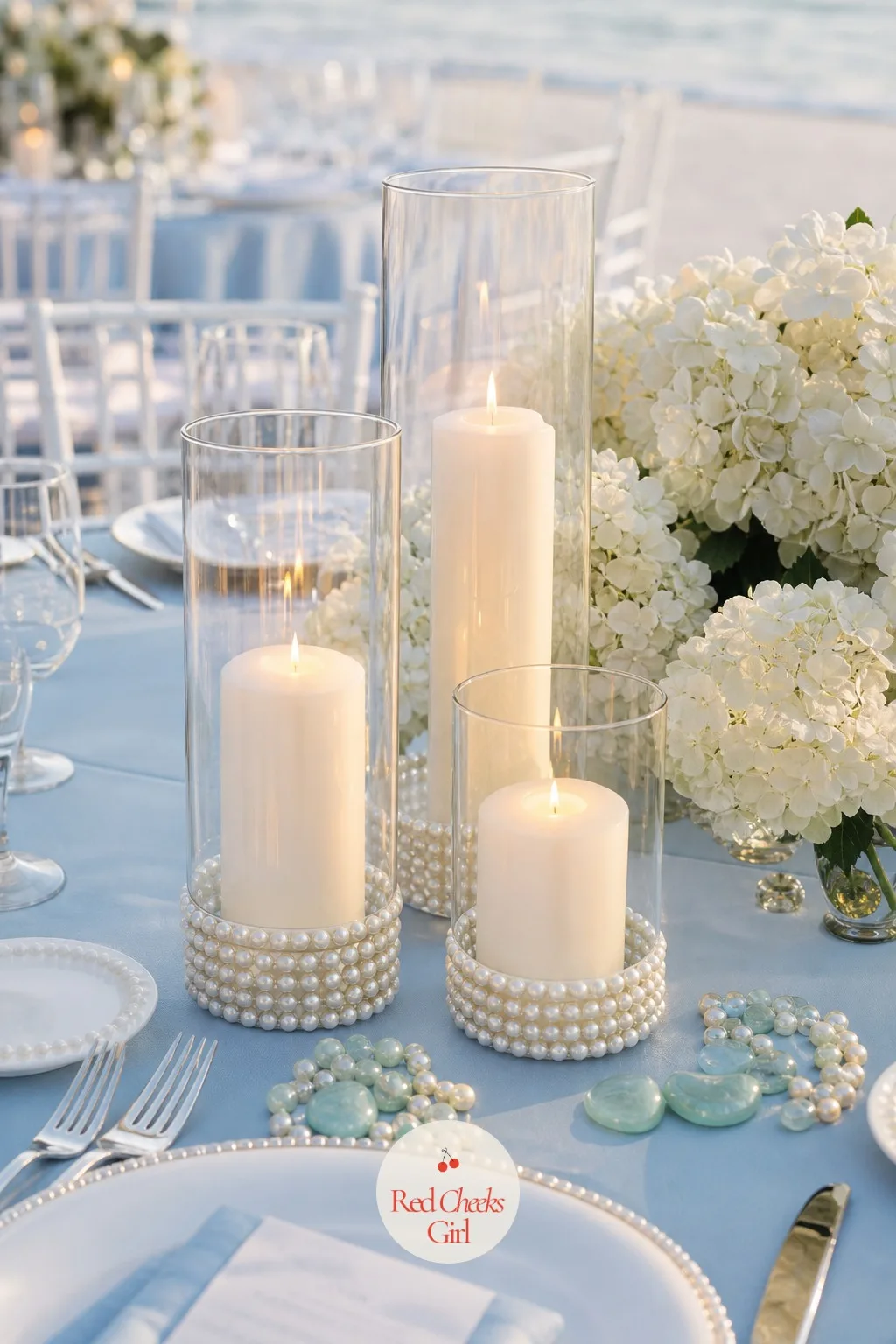
A Candle Cluster in Pearl-Trimmed Hurricanes
Once the sun drops, flowers stop doing the work and light takes over, and a single tall candle per table reads thin against a whole room. Three glass hurricanes of different heights, each with a pearl trim glued around the base, cluster together on one side of every centerpiece with a pillar candle inside each.
Build it from the base up: the hurricanes grouped by height, the pearl trim applied around the bottom rim of each glass, and a pillar or LED candle set inside so the flame sits well below the rim out of any breeze.
Tell the rental company: three clear glass hurricane candle holders per table in varying heights, each trimmed with pearl beading at the base, with ivory pillar candles inside.
Plain glass hurricanes rent cheaply almost anywhere, and the pearl trim is a one-time craft project for whoever is doing table setup the day before. For an outdoor reception where open flame is a concern, battery pillar candles sit inside the same hurricanes without anyone noticing the difference after dark.
🛍 Shop this look
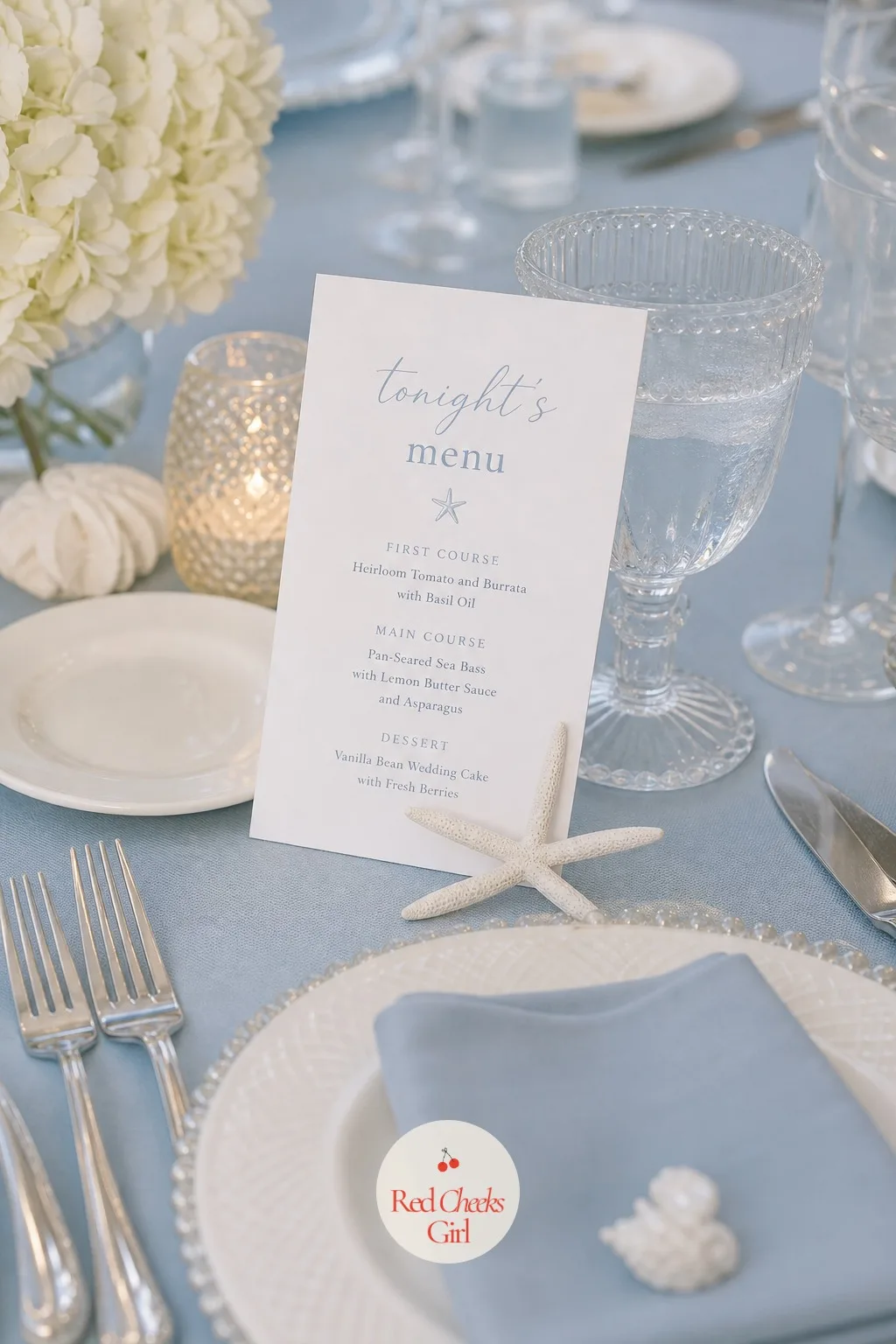
Starfish Menu Cards at Each Place Setting
A place setting with nothing personal on it looks like a hotel banquet, no matter how good the food turns out to be. A small white menu card, printed in soft blue ink, leans against each water glass with a single tiny starfish resting beside it rather than glued onto the paper itself.
From the plate up: the charger and plate set first, the folded menu card standing against the glass, and the starfish placed just beside it on the cloth, loose enough that a guest can pick it up as a small keepsake.
Give the printer this exact wording to set on each card: tonight’s menu, followed by the courses in soft blue type on white cardstock.
Printing these is cheap through almost any online stationer once the final menu is set, and a small bag of craft starfish covers an entire reception for very little money. Where starfish feel like one detail too many, the same card works perfectly well with nothing beside it at all.
🛍 Shop this look
The Food and Cake
Coastal food should taste like the view looks: fresh, cold, a little briny, nothing fussy. The cake gets to be the one properly decorated object on the dessert side of the room.
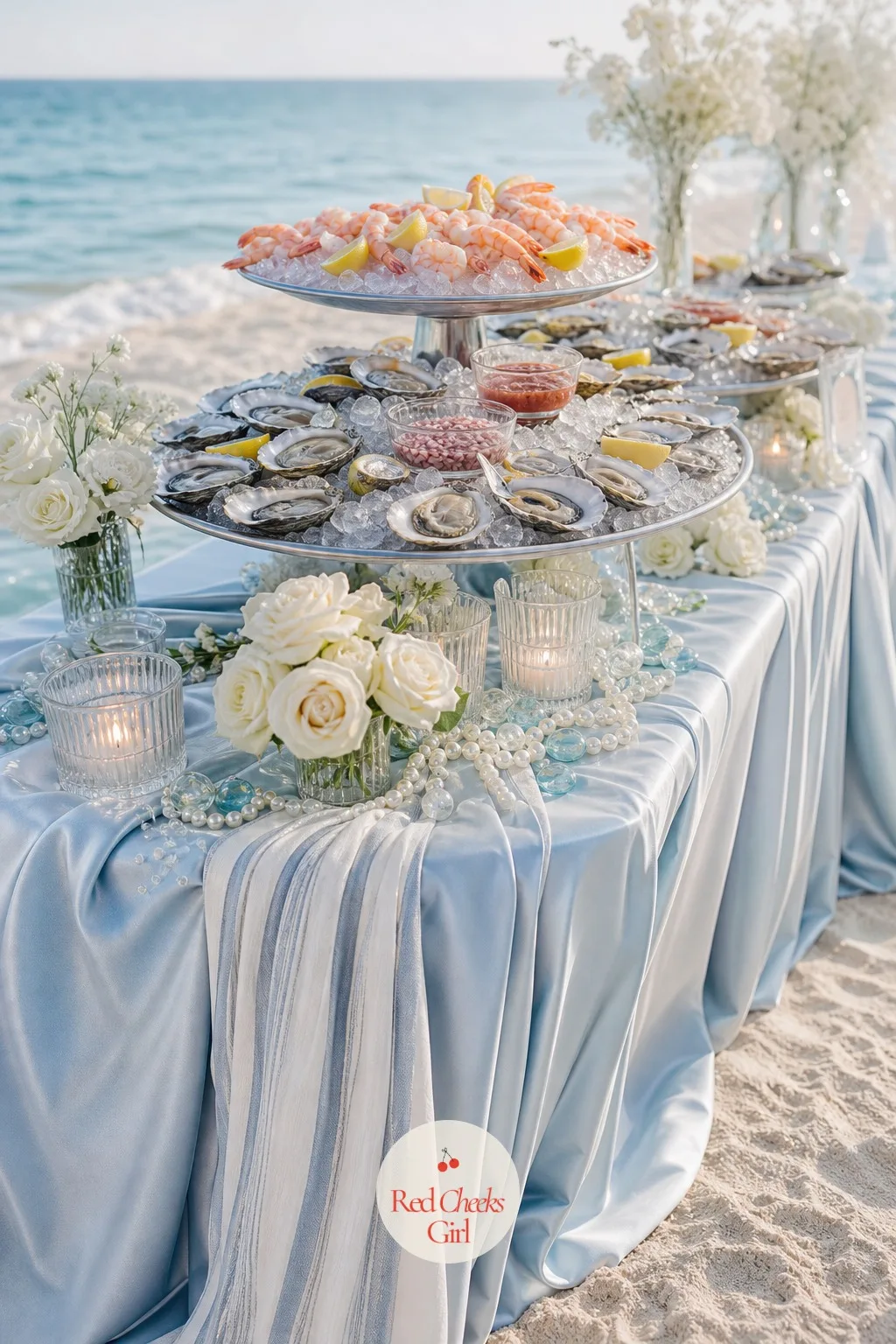
A Raw Bar and Chilled Seafood Display
A buffet table of hot food fights the whole mood of a day built around cool water and open air. A raw bar does the opposite: oysters and shrimp bedded in crushed ice on a long table, a few sea glass bowls of mignonette and cocktail sauce set between the tiers, nothing that needs a chafing dish.
Built in layers: the table draped in a pale blue or white cloth first, a bed of crushed ice piled across tiered trays or a single long platter, the oysters and chilled shrimp arranged shell-side up, and small bowls of sauce tucked into the gaps between seafood.
Tell the caterer directly: a raw bar with oysters on the half shell and chilled shrimp over crushed ice, mignonette and cocktail sauce served in small glass bowls, with lemon wedges throughout.
This is worth hiring a caterer or raw bar company for rather than attempting at home, since the ice and freshness window matter more than almost anything else on the menu.
Where a full raw bar is out of budget, a simpler shrimp cocktail station with the same ice and sauce setup still reads coastal at a fraction of the cost.
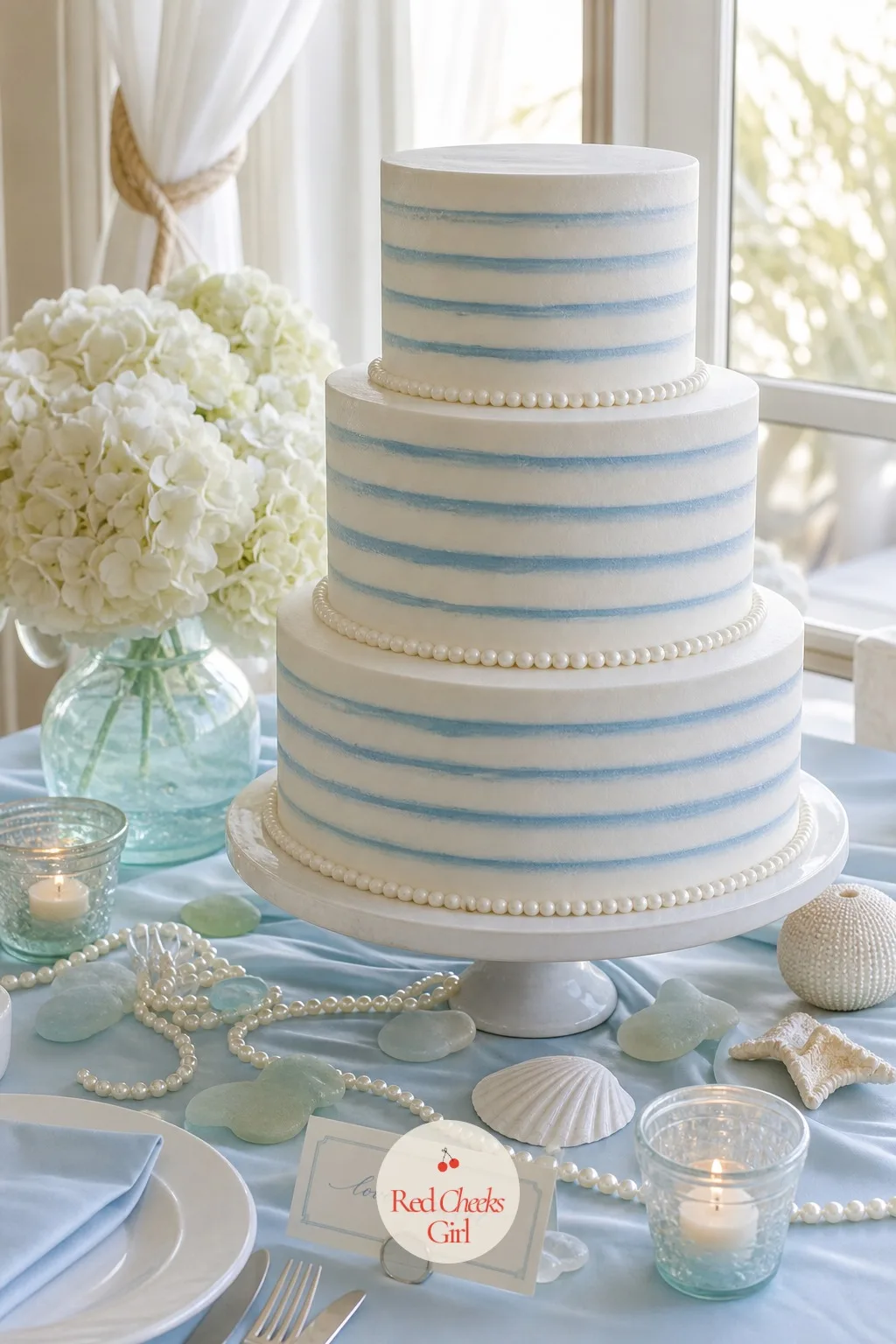
A Blue and White Striped Wedding Cake
A plain white tiered cake disappears into a room already full of white linen and pale blooms, and that is the one place the stripe gets to step forward properly. Each tier wears a hand painted or piped soft blue and white stripe running horizontally, finished with a single cluster of sugar pearls where the tiers meet.
Built tier by tier: a cake board base, the tiers stacked and smoothed in white buttercream or fondant first, the blue stripes piped or painted on once each tier is level, and a cluster of edible sugar pearls pressed in at the seam between tiers.
Give the baker this exact brief: a three tier cake finished in smooth white buttercream with horizontal soft blue stripes on each tier, sugar pearl clusters at the tier seams, no other decoration.
This is a baker’s job, since clean horizontal stripes on a finished cake take a steady hand most home bakers do not get much practice at. A bride making her own dessert can get the same look on cupcakes instead, a simple blue stripe piped around the top of each one.
The Bride and the Dance Floor
Two very different things live here, her finished look and the moment everyone moves, but both borrow the same pearl and the same bare feet in the sand.
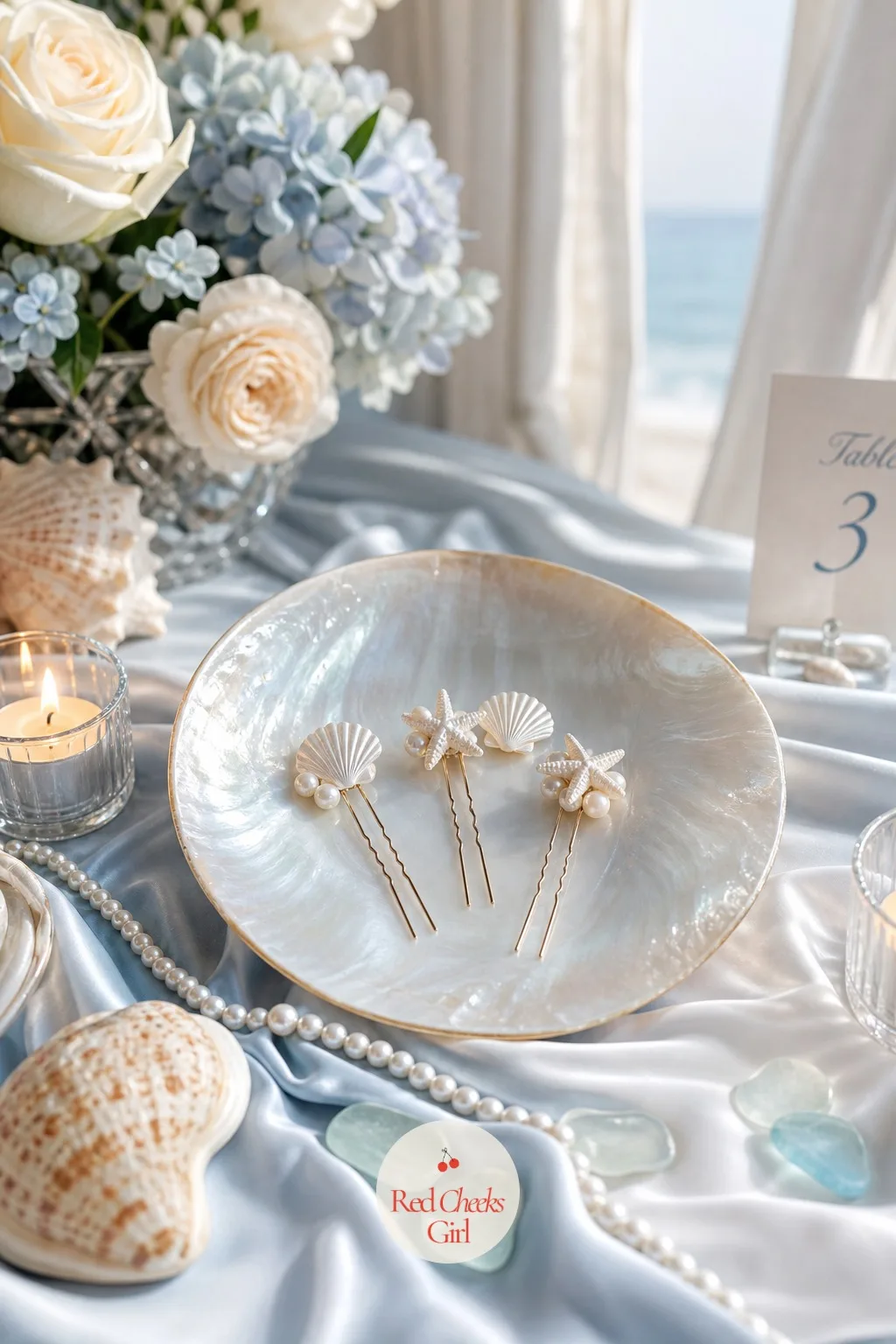
Shell and Starfish Hairpins
A veil alone can feel like it belongs to any other wedding, and a flower crown fights with a sea breeze within the hour. A small cluster of pins, each topped with a tiny mother of pearl shell or starfish, tucks into the hair instead, close enough to the head to survive wind and dancing both.
They sit directly in the hairstyle with nothing underneath them: two or three pins placed just above one ear or along an updo’s part line, mixing one shell shape and one starfish shape rather than repeating the same charm across every pin.
Give the stylist this line: three mother of pearl shell and starfish hairpins, placed asymmetrically along the side part, no additional floral accessories needed.
These are easy and cheap to buy ready-made from a bridal accessory shop, and most brides place them themselves in under five minutes. Where pins keep slipping out of fine hair, the same shell and starfish charms work just as well threaded onto a simple hair comb instead.
🛍 Shop this look
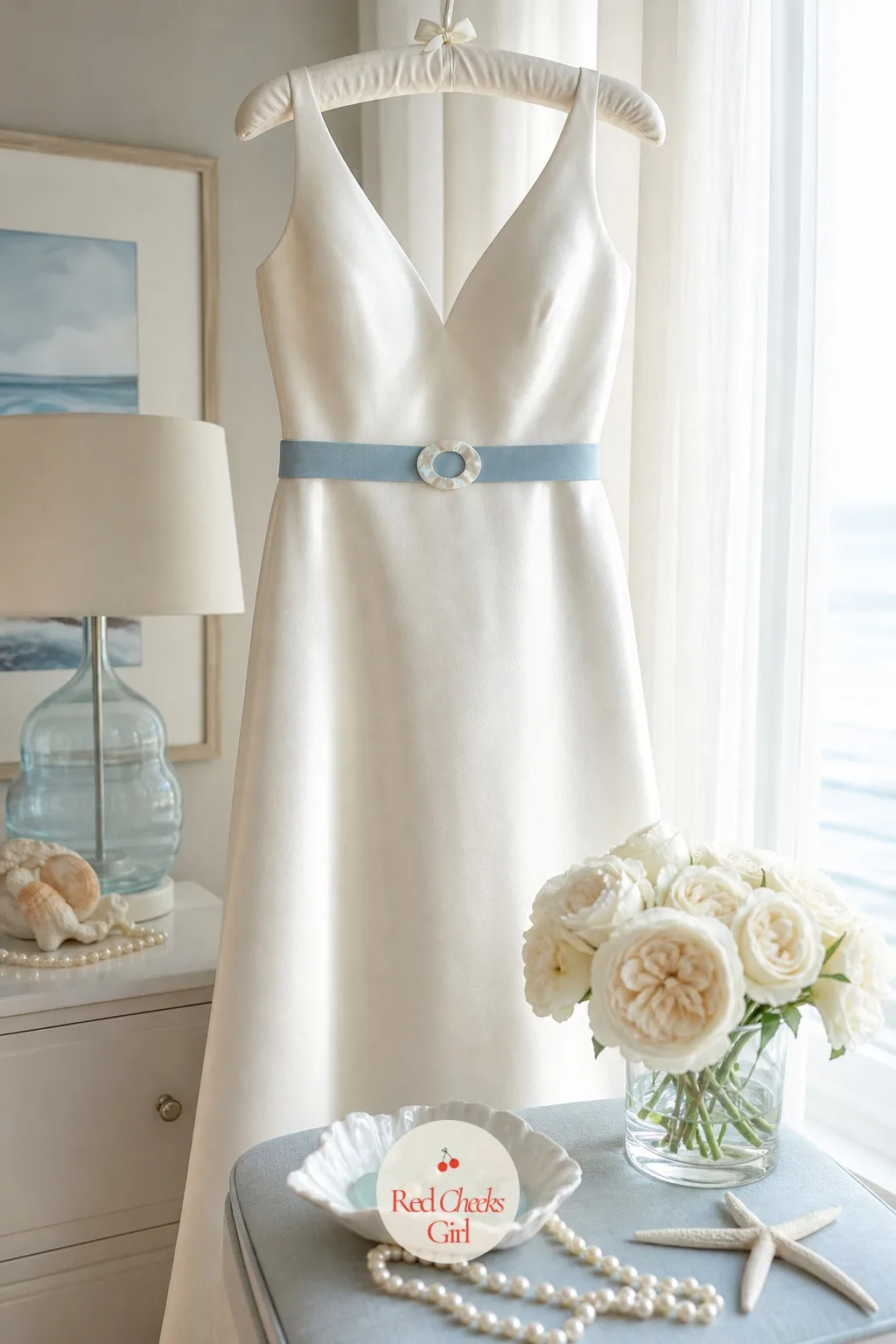
A Mother-of-Pearl Sash at the Bride’s Waist
A plain satin dress can read a little bare at the waist once the ceremony photos are over and the dancing starts. A narrow sash in the same soft blue as the tables, closed with a single mother of pearl buckle, sits at the natural waist and catches light every time she moves.
It builds in one simple layer over the dress itself: the sash wrapped once around the waist, tied or clipped at the back, and the pearl buckle centered at the front as the one piece of visible hardware.
Tell the seamstress or bridal shop this exact brief: a 2 inch wide soft blue satin sash with a mother of pearl buckle centered at the front, worn at the natural waist.
A seamstress can make this in an afternoon from a yard of ribbon and a buckle bought online, which makes it one of the cheapest changes to the whole bridal look. A bride who would rather skip anything at her waist gets the same pearl detail from a single brooch pinned at one hip instead.
🛍 Shop this look
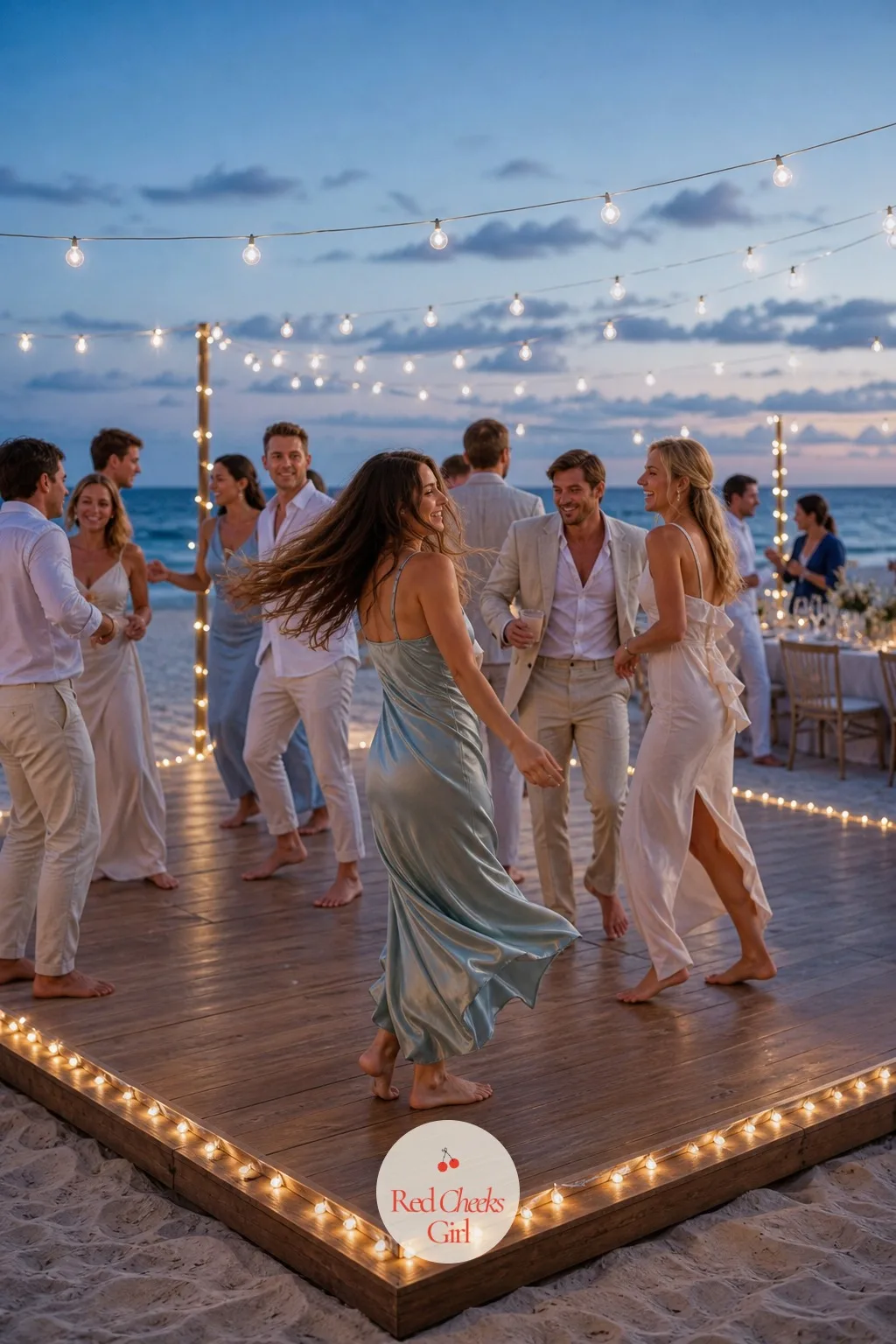
A Barefoot Dance Floor Laid Over the Sand
Heels and loose sand do not mix, and a hard dance floor dropped straight onto the beach looks like a shipping pallet unless someone dresses the edges. A simple raised wooden floor, painted or left pale, sits flush with the sand with a low border of white string lights framing all four sides.
Built from the ground up: a leveling frame set directly into the sand first, the floor panels laid over it, and the string lights run along a low border frame at ankle height so the whole floor glows from its own edge once the sun is down.
Give the rental company this brief: a 16 by 16 foot raised dance floor in pale whitewashed panels, set level on sand, bordered on all sides with warm white string lights at ankle height.
The floor itself is a rental item, full stop, since leveling sand correctly takes equipment most venues already own. Guests are told at the entrance that shoes come off here, baskets set at the floor’s edge for anyone who wants to leave theirs behind for the night.
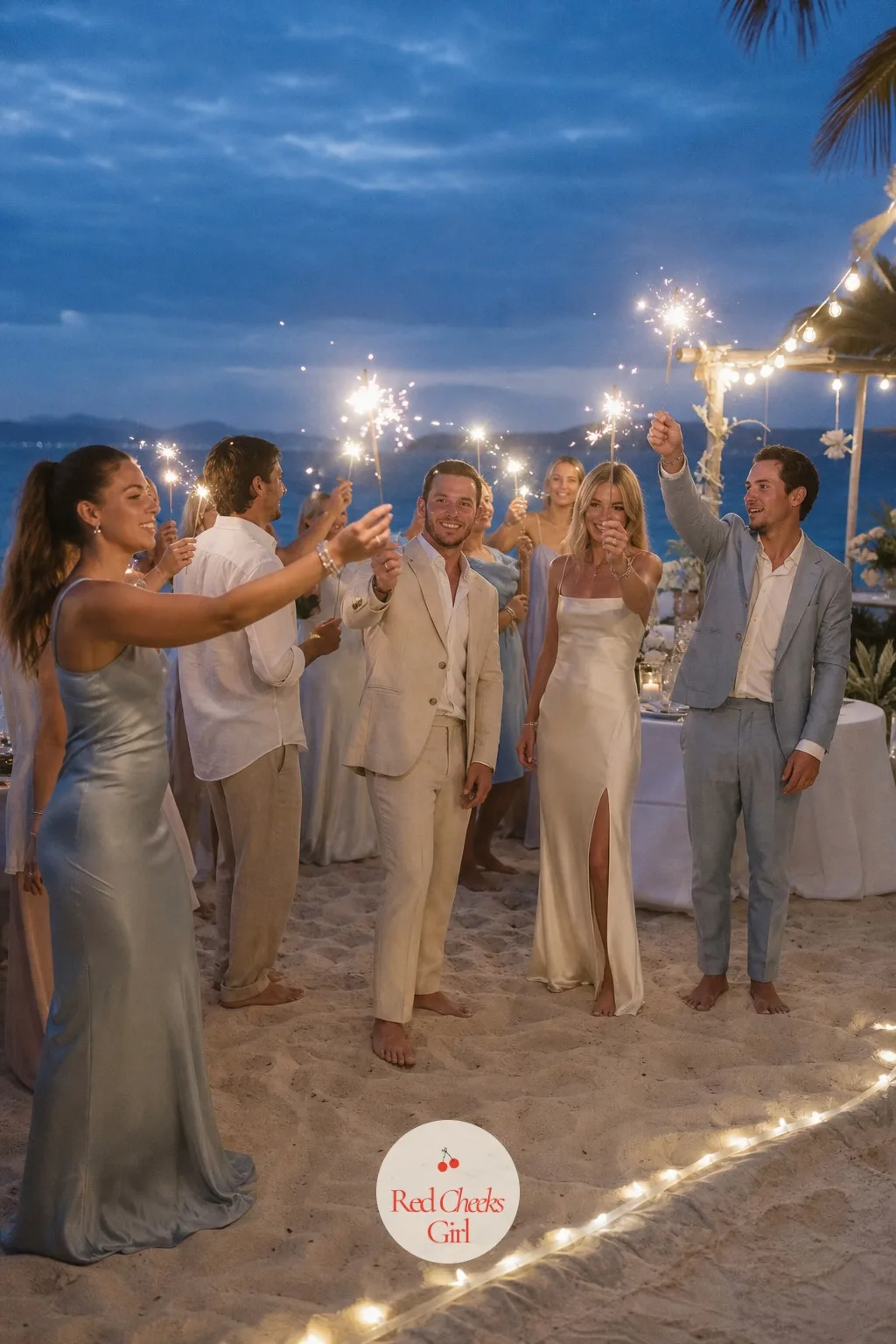
Mini Fountain Sparklers for the First Dance
A grand sparkler exit is a lot of standing in two lines holding your breath, and barefoot guests on sand do not love holding anything that drips wax. A small handheld fountain sparkler, lit for just the first dance itself rather than the exit, gives the same glow without the coordination.
It runs in three steps: a basket of fountain sparklers and a lighter sits at the edge of the dance floor, a few guests closest to the couple light theirs just as the first dance begins, and the sparklers burn down well before the song ends so nobody is left holding a dead one.
Tell whoever is running the reception: a basket of 20 to 30 second fountain sparklers at the dance floor’s edge, lit only for the opening of the first dance.
These are inexpensive to buy in bulk and need almost no setup beyond a fire-safe bucket for the spent ones afterward. Where sparklers are not allowed near a dry beach or a tented floor, battery LED wands in soft blue do the same glowing job with zero fire risk.
Favors and the Invitation
The smallest things, and the ones guests actually keep. The invitation goes last because it is the first thing anyone sees and the last thing this list needs to agree with.
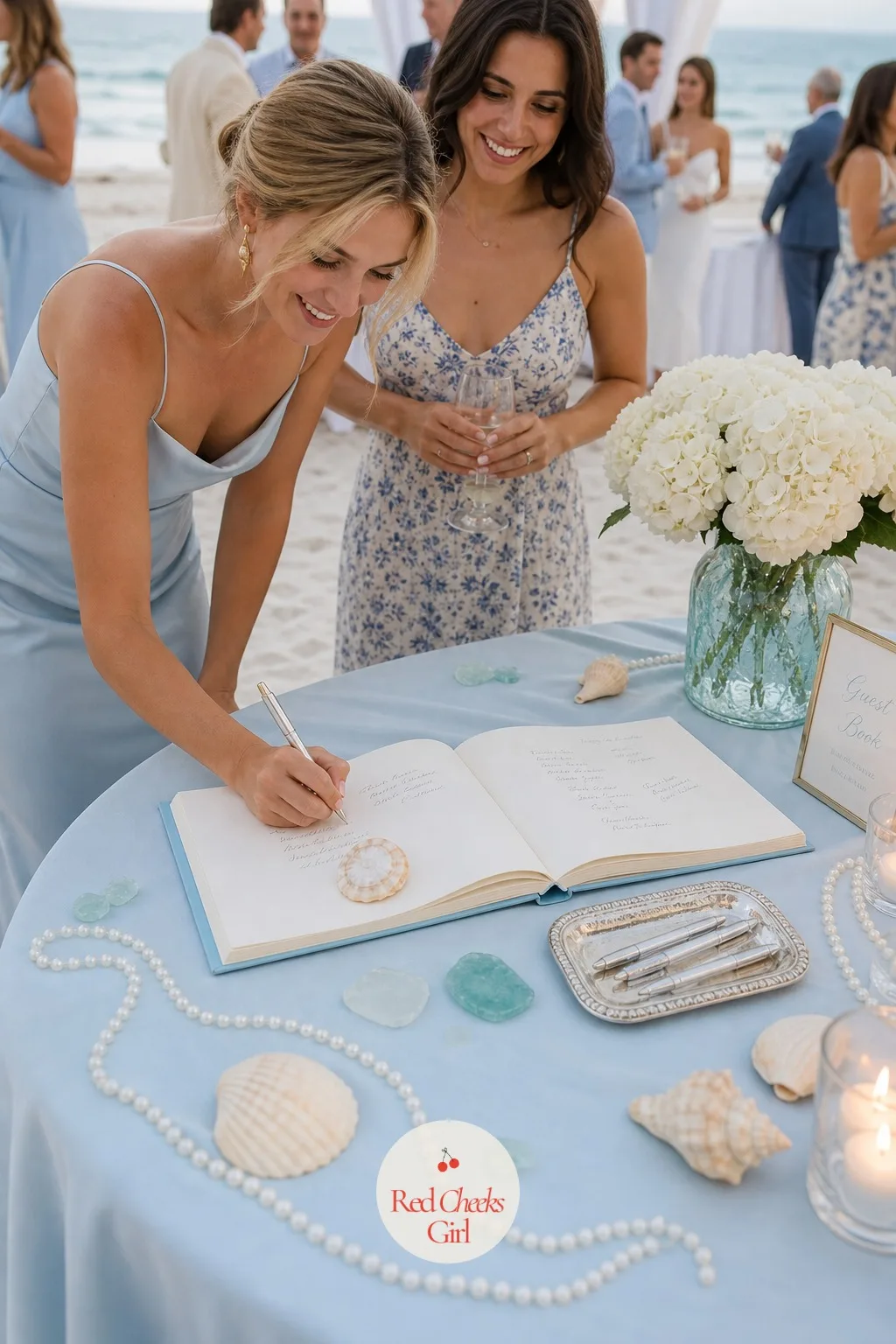
A Shell-Topped Guest Book Table
A plain book on a plain table gets signed in a hurry and then forgotten, which is a shame for the one object that actually holds everyone’s handwriting.
A low table dressed in the same pale blue cloth as the reception holds the guest book itself, a single mother of pearl shell set beside it as a paperweight for the open pages.
Built simply from the table up: the cloth laid first, the open book centered on it, a small tray of pens to one side, and the shell weight holding the pages flat against any breeze.
Give the stationer this brief: a soft blue linen-look hardcover guest book, white interior pages, with a mother of pearl shell weight to hold it open on a draped side table.
The book itself is worth buying rather than making, since binding quality is the one thing that determines whether it survives being handled all night. A couple skipping a traditional book entirely can swap in a single large platter guests sign instead, with the same shell sitting at its center.
Beach Bag Favors Packed for Each Guest
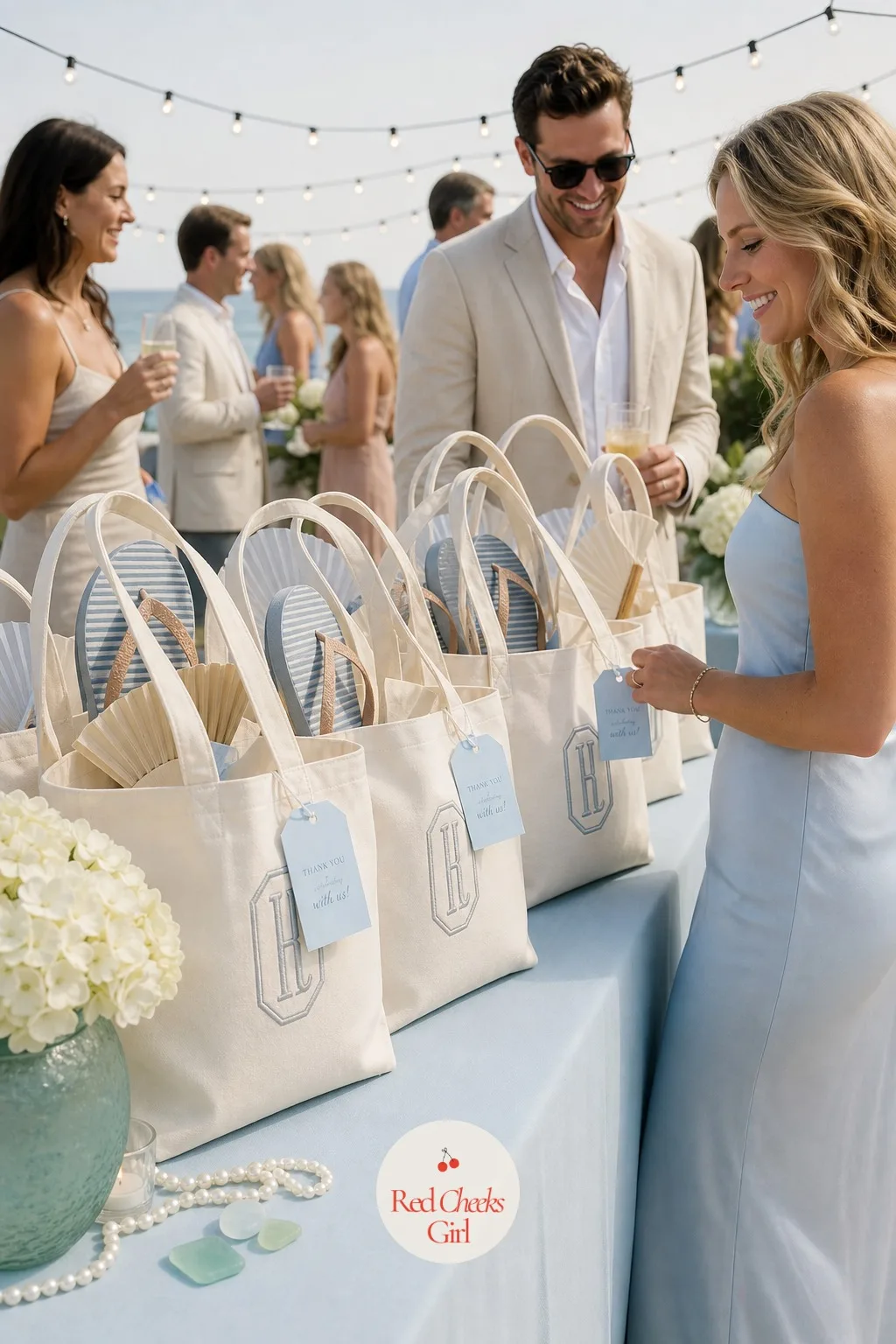
A favor nobody uses is just something to throw away on the drive home, and a tiny box of candy rarely survives a beach wedding’s heat anyway.
A small woven or canvas beach bag, one per guest, holds something they actually reach for before the night is over: a folding fan, a pair of flip flops in their size, a tube of reef-safe sunscreen.
Packed in layers inside the bag: the fan folded flat against one side, the flip flops rolled and tucked beside it, and the sunscreen tube slipped into a small pocket if the bag has one, with a soft blue tag tied to the handle carrying the couple’s names.
Tell whoever is assembling them: a natural canvas beach tote per guest, packed with a folding fan, a pair of flip flops, and travel sunscreen, finished with a soft blue tag on the handle.
Assembling these is genuinely a job for the week before, since nothing inside needs customizing beyond the handle tag. Where flip flops in every size is too much to manage, a simple set of two makes just as warm a gesture on its own.
🛍 Shop this look
The Invitation That Starts It All
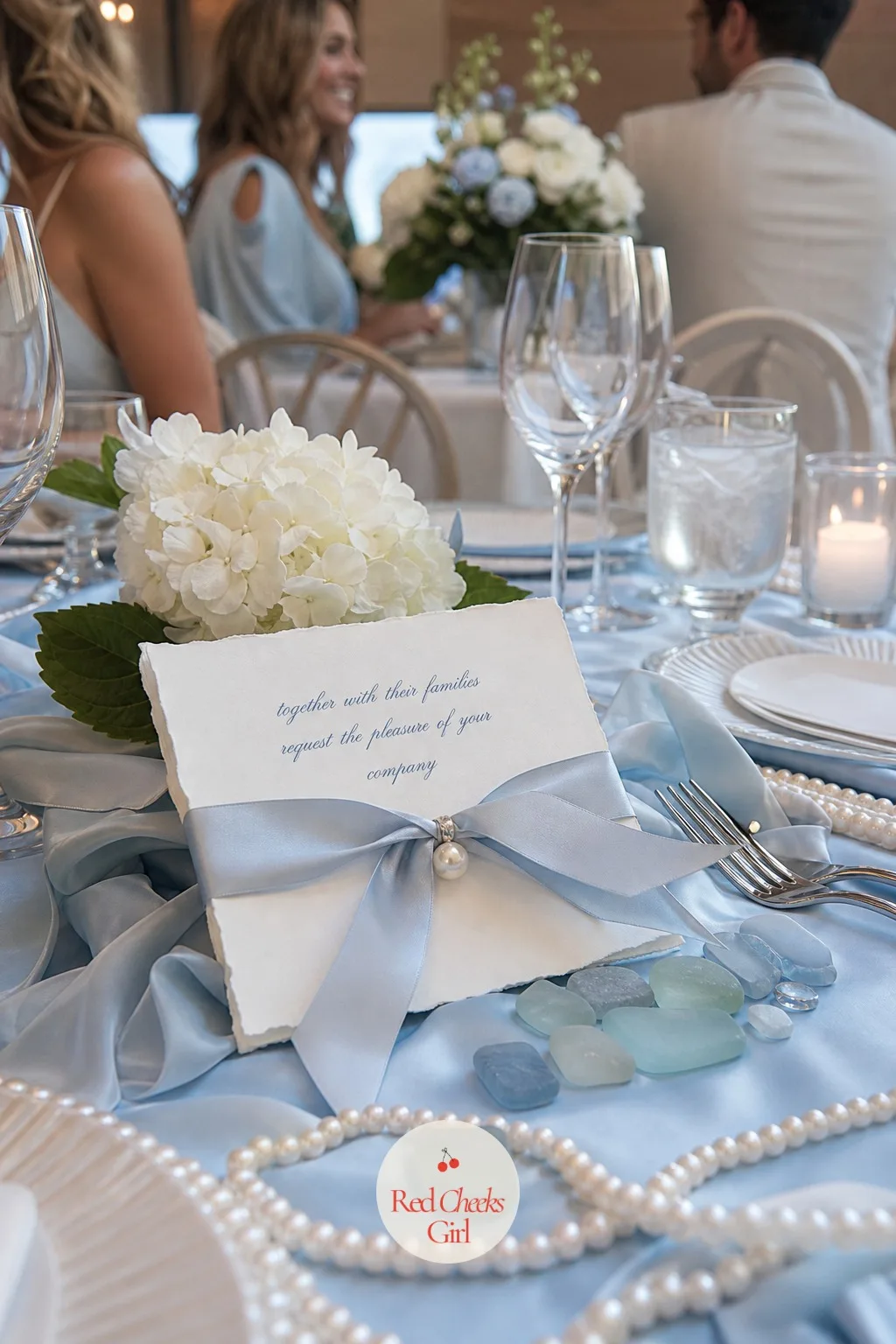
Everything above exists because of this one piece of paper, so it earns the last word rather than the first. A soft white or pale blue card, deckled along one edge to echo a wave line, carries the couple’s names in a simple soft blue script with a single pearl accent printed or embossed in one corner.
Built in layers like any good invitation suite: the main card first, a thin vellum or translucent overlay printed with the details laid over it, and a pearl bead or wax seal closing the whole thing where it ties shut with a soft blue ribbon.
Give the stationer this exact wording to set on the main card: together with their families, request the pleasure of your company, followed by the couple’s names, the date and the venue in soft blue script on a deckled-edge white card.
A stationer handles the printing and the deckled edge far better than a home printer ever will, though the ribbon tying and pearl bead can be added by hand afterward to cut the cost. Where a full deckled edge is not available, a plain straight-edge card in the same soft blue script carries the same tone for less.
🛍 Shop this look
Frequently Asked Questions
What colors are used in a coastal wedding theme?
A coastal wedding usually runs on sand, white and soft blue with pearl or silver accents, echoing the shoreline rather than bright tropical shades. Navy or sea glass green sometimes joins as a deeper accent.
What is the difference between a coastal and a nautical wedding?
A coastal wedding leans soft and sandy with pearl, shell and sea glass details, while a nautical theme is bolder, built on navy and white stripes with anchor and rope motifs.
What flowers work best for a coastal wedding?
White hydrangea is the classic choice since it holds up well and reads as a full, affordable bloom from any florist. Baby’s breath and white roses pair easily alongside it.
What food should be served at a coastal wedding?
A raw bar with oysters and chilled shrimp, plus a seafood-forward dinner like grilled fish or whitefish tacos, fits the theme without feeling heavy in warm weather.
How do you keep a coastal wedding from looking kitschy?
Stick to a tight palette and one or two motifs repeated in different materials, rather than scattering shells, rope and anchors across every surface. Fewer, better-made coastal details read as elegant.
What should guests wear to a coastal wedding?
Guests should avoid white, ivory or very pale outfits that could be mistaken for bridal wear, and lean into breathable fabrics in blue, green, coral or soft prints instead.
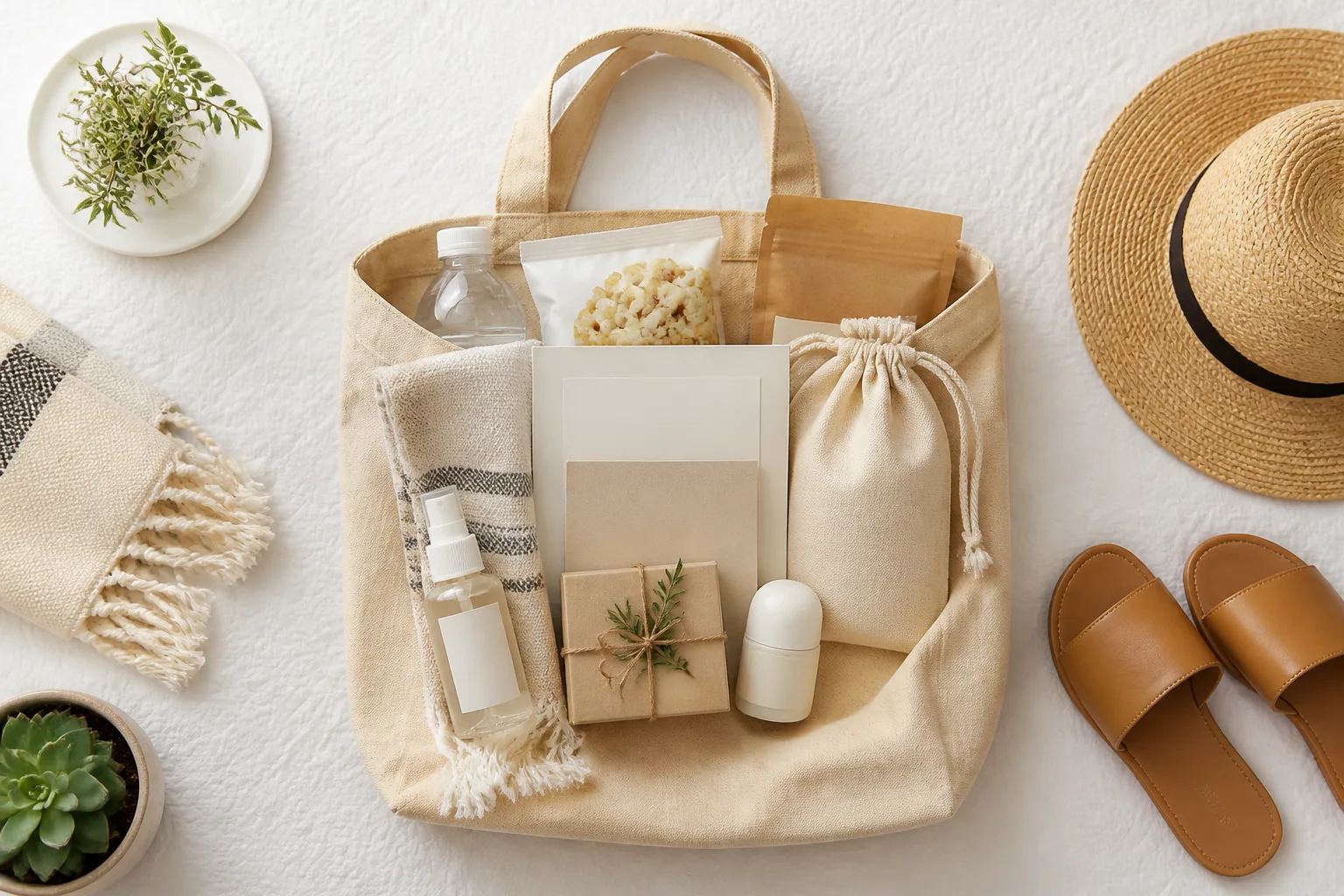
21 wedding welcome bags for hotel guests, sized from the tote bag down to the mints, plus beach and
15 last disco bachelorette party ideas: mirror balls, silver fringe, a roller rink night, mirror-fin
26 white and gold wedding ideas from the ceremony arch to the invitation, with what to order, what t
Leave a Reply