

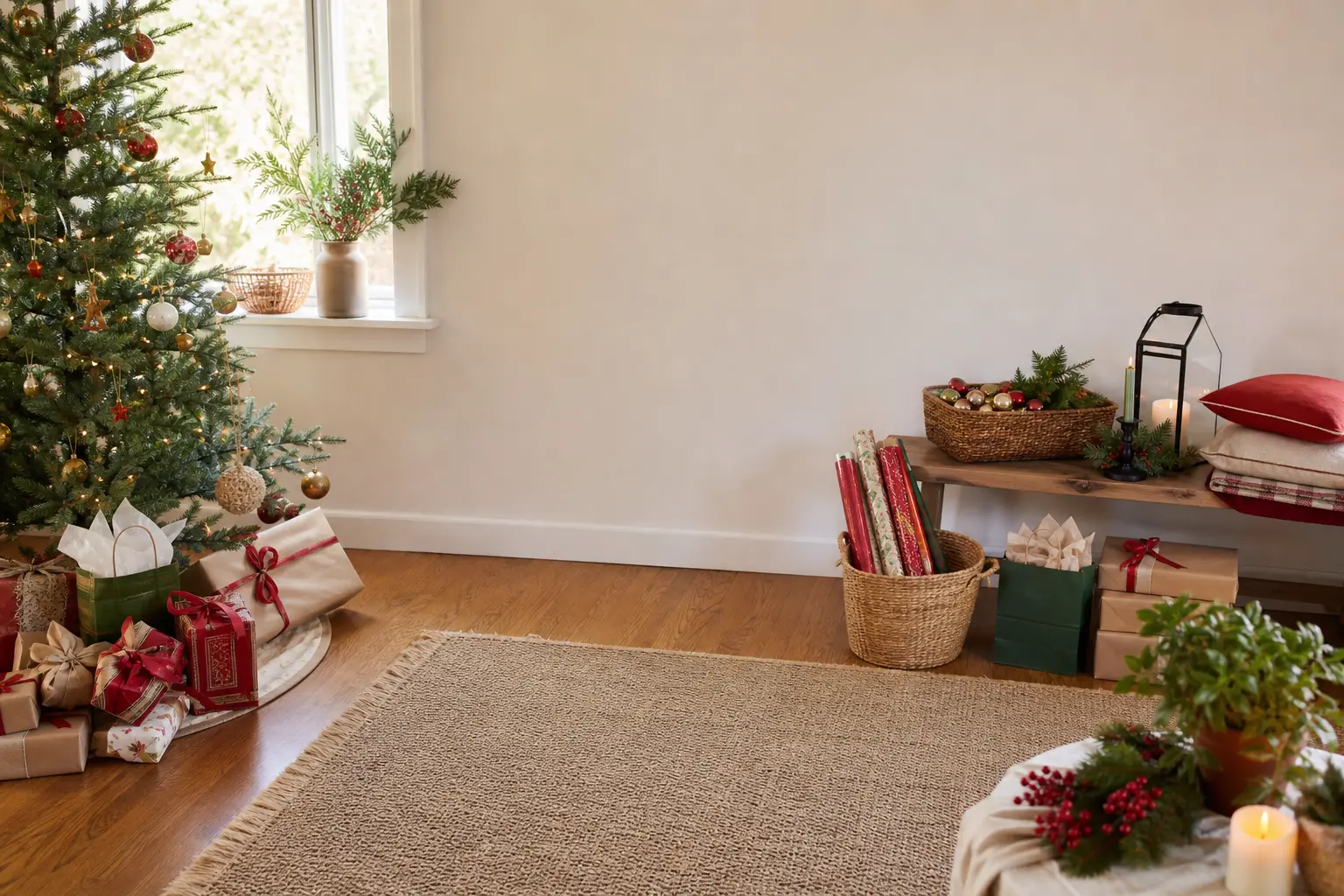
A christmas scavenger hunt is the fastest way to give mixed ages something to do together on a wet December afternoon, and this list covers every setting you might find yourself in: the living room, the garden, the car, the high street, even the walk home from school.
The first eleven rounds come with printable sheets (one per page, portrait, ready to hand out); everything after that needs no printer at all, and the text says so plainly.
Four-year-olds, ten-year-olds and the adults who got roped in can all play the same round, because each hunt is built around three reading levels or no reading at all.
This post contains affiliate links. If you buy through them, I may earn a small commission at no extra cost to you.
- Indoor Picture Hunt for Pre-Readers
- Indoor Word Hunt for Readers
- Mixed-Age Indoor Hunt with Pictures and Words
- Garden Hunt with Weatherproof Items
- Neighbourhood Window Hunt
- Car Journey Hunt
- Shopping Centre Hunt
- Grandparents’ House Hunt
- Church or Nativity Hunt
- Colour Hunt for Toddlers
- Counting Hunt with Numbers to Find
- Sound Hunt with Nothing to See
- Texture Hunt for the Very Young
- Night-Time Torch Hunt
- Photograph Hunt on a Phone
- Hunt Where the Last Item Is the Present
- Two-Team Race Version
- Street Sounds Hunt
- Hunt Written by an Older Child
- Hunt Where Each Clue Is a Photograph
- One-Room Hunt
- Hunt with a Small Prize at Every Third Find
- Advent Calendar Hunt
- Walk Home from School Hunt
- Hunt Where Adults Play Too
- Collect Rather Than Tick
- Frequently Asked Questions
1. Indoor Picture Hunt for Pre-Readers
Children who cannot yet read look at a grid of twelve simple Christmas illustrations, one per box, and tick or circle each picture when they spot the real thing somewhere in the house.
Every item is drawn clearly enough that a three-year-old can match it without help: a bauble, a star, a robin, a candy cane, a stocking, a bell, a present, a candle, a snowflake, a reindeer, a cracker and a holly sprig.
Print one sheet per child on plain paper, hand each child a chunky crayon, and send them off. The hunt works in any decorated living room and takes roughly ten minutes. No reading needed, no adult narration needed, just the sheet and the room.
The most common snag is that a child finishes in two minutes and wants to go again. Print a spare sheet and hide one extra item, a real candy cane clipped to a curtain, that does not exist on the sheet, so the fastest child has something to chase while others catch up.
- Ages 2 to 5
- 10 to 15 minutes
- Any decorated room

🛍 Shopping guide
2. Indoor Word Hunt for Readers
Older children work from a list of fifteen Christmas words printed in two columns, then search the room for objects that match each word exactly. The words range from easy (star, tinsel, card) to slightly harder (advent, wreath, nativity), so a confident seven-year-old and a ten-year-old can use the same sheet without it feeling babyish for either.
One sheet per child, one pen, one room or the whole ground floor. Allow fifteen minutes. No special setup is needed beyond whatever decorations are already up. A tick box sits beside each word so children mark as they go.
If the house is not heavily decorated and some items genuinely do not exist, cross those words out on the master copy before you print. Better a shorter honest list than a child hunting forever for a nutcracker that is not there.
Cross out any item that genuinely is not in the house before printing, so no child hunts for something that does not exist.

3. Mixed-Age Indoor Hunt with Pictures and Words
This sheet does the pairing work for you: each of the twelve items appears as both a picture and its printed word side by side, so a pre-reader follows the drawing while an older sibling reads the label. Both children use exactly the same sheet, and neither feels they have the baby version.
Hand one sheet to a mixed pair, one crayon between them, and let the older child read aloud while the younger one leads the search. The partnership is the point. The hunt covers twelve items and takes about fifteen minutes in a standard living room.
If the age gap is wide and the older child races ahead, give them the extra job of writing a number beside each found item to record the order of discovery. That slows them down pleasantly and gives them something more to do without making the younger child feel left behind.
- Picture and word together means neither child holds a different sheet
- Older child reads, younger child leads the search
- One crayon shared builds cooperation, not competition

4. Garden Hunt with Weatherproof Items
This list targets things that survive December weather in a typical British garden: a red berry, something evergreen, a bird feather, a pine cone, a stone or pebble, something brown, something that has been rained on, a spider web, a bare branch, a piece of bark, moss and something the wind has moved.
All twelve exist in almost any garden regardless of how tidy it is.
Print on cardstock so the sheet does not disintegrate if it drizzles. Send children out in coats and boots with a pencil each. Budget twenty minutes and a towel for boots at the back door. The sheet doubles as a nature record: children can press a small leaf or berry into a scrapbook afterward.
In a very small garden, combine this with the neighbourhood walk. Children tick garden items on the way out, then tick window-display items on the way back, using two separate columns on one sheet.
- Cardstock printouts (paper goes soggy)
- Pencils not pens (pens bleed in rain)
- Boots and coats already on before you hand out the sheets

🛍 Shopping guide
5. Neighbourhood Window Hunt
Children walk the street and tick off Christmas decorations spotted in other people’s windows and gardens: a lit star, a wreath on a door, an elf figure, fairy lights, a Christmas tree visible from outside, a reindeer, a nutcracker, a countdown sign, a snowman, a nativity, a Santa figure and something inflatable.
Twelve targets across a single street will usually yield the full list.
One sheet per child or per pair. Walk slowly. Allow twenty to thirty minutes for a short street. More ideas for keeping children entertained all December are worth bookmarking before you head out.
Keep very young children paired with an adult. If a house has drawn curtains or no decorations at all, children skip it without comment: the sheet asks them to find, not to judge. Keep score on a phone if the group wants a winner.
- Ages 5 and up
- A short street walk of 20-30 minutes
- Works best after dark when lights are on

6. Car Journey Hunt
Passengers scan passing scenery and tick twenty items as the car moves: a red postbox, a church spire, a petrol station, a roundabout, a horse, a tractor, a motorway sign, a lorry with a logo, a blue car, a van, a level crossing, a river or stream, a field of sheep, a flyover, a wind turbine, a road works sign, a bridge, an ambulance, a school sign and a hotel.
Not all of these are Christmas-specific, because motorways are not, but each is real and findable on most UK or US road trips.
Print before leaving home, one sheet per child plus a spare. Pencils only in the car. The hunt fills roughly forty-five minutes of a long drive, and children can restart with a fresh sheet if they want to go again.
The common mistake is printing too few copies. Bring double. The child who finishes first will demand another round immediately, and a second sheet costs nothing.
Laminate one sheet per child and use dry-erase markers so the same sheet resets for a second round

7. Shopping Centre Hunt
Families on a shopping trip tick fifteen things spotted inside a shopping centre: a fake snow machine, a store with a Christmas window display, a Santa grotto or sign, a gift-wrapping station, a charity collection tin, a member of staff in a Christmas jumper, a red ribbon on a shop front, an advent calendar on sale, a shop playing Christmas music, a toy in a window, a gold decoration, a food sample being given out, a queue longer than ten people, a child in a Santa hat and a set of fairy lights inside a shop.
All fifteen appear in almost every large shopping centre in December.
One sheet per family group. Children carry the sheet and lead the spotting. Adults carry the bags. The hunt keeps children purposeful and moving rather than dragging between shops, and it takes as long as the trip takes.
A shopping centre is crowded. Agree a meeting point before anyone splits off, and keep young children in sight. Keep score on a phone if two groups want to race.
Agree a meeting point before you start. A crowded centre needs a fixed spot, not a vague ‘by the entrance’.

8. Grandparents’ House Hunt
Grandparents’ houses often hold a specific kind of Christmas detail that younger homes do not: old glass baubles, a tin of shortbread with a snowy scene, a paper calendar, a fruit bowl with satsumas, a mantelpiece with cards pinned along it, a proper nativity set, a clock that chimes, a decanter, a tin of Quality Street and a knitted something.
This sheet lists twelve things that exist in most grandparent homes and nowhere else, which makes it feel freshly specific rather than generic.
Hand out the sheet on arrival, before coats are even off. Children are often at peak energy and peak boredom in equal measure when they first walk in. The hunt gives them a job immediately, gets them looking at the room rather than at a screen, and warms them up for the rest of the afternoon’s games.
Warn children not to touch anything fragile. The search is visual only, and the rule is look with your eyes, not your hands.
- Hand out on arrival before coats are off
- Look only, do not touch fragile items
- First to tick all twelve calls out ‘found it’ from wherever they are standing

9. Church or Nativity Hunt
Children attending a nativity service or a carol service tick items from the sheet as they appear: a shepherd, a wise man carrying something, an angel with wings, a donkey (real or costume), a stable, a baby, a star above the stable, a king with a crown, a manger filled with straw, someone wearing a tea towel on their head, a speaking part delivered by a child under six and the whole cast on stage at once.
Twelve targets across a standard primary school nativity.
Print on cardstock and keep sheets small enough to hold on a lap. A pencil, not a pen. Children tick quietly without pointing or calling out, which keeps the audience around them happy. This version requires nothing from the host: the cast provides every item on the list.
If the nativity runs short, add a second tier of items on the back of the sheet: a recorder being played, a parent filming on a phone, someone forgetting their lines. That side is for amusement only and does not need a tick box.
- Primary school nativities
- Carol services with a cast
- Ages 4 and up, sitting quietly on a lap

10. Colour Hunt for Toddlers
Each of six large coloured circles on the sheet corresponds to a colour a toddler must find somewhere in the room: red, green, gold, white, blue and silver. No words needed. The child carries the sheet, points at the circle and then points at the object. A grown-up says the colour name aloud. Done.
Print on cardstock, one sheet per toddler, and hand them a fat crayon to scribble in each circle once the colour is found. The whole hunt takes five minutes, which is exactly the right length for a two-year-old. Repeat it immediately if they want to go again.
If a colour is genuinely hard to find in the room, stick a ribbon or a piece of wrapping paper in that colour somewhere low and obvious before handing out the sheets. The toddler should not have to search hard: the point is to look and name, not to search and frustrate.
- Tape a ribbon in each colour at toddler eye height before the hunt starts
- Let the toddler scribble the circle rather than tick a box

11. Counting Hunt with Numbers to Find
Children walk through the house and count specific things, writing the number they find in a box beside each question. How many baubles are on the tree? How many Christmas cards are on display? How many candles can you see? How many stockings?
How many stars? How many presents under the tree? Ten questions, ten number boxes, no right or wrong answer because every house is different.
This version suits children who can write numbers but may not yet read full sentences: an adult reads each question aloud while the child holds the sheet and does the counting. Allow twenty minutes. A pencil with an eraser is essential because counts often change on a second pass.
The game becomes a competition for older children: two players count independently and compare answers at the end. Differences over one or two go back to recount. Keep score on a phone if the group wants a winner.
- Pencils with erasers
- At least some Christmas decorations up in the house
- An adult to read questions aloud for non-readers

12. Sound Hunt with Nothing to See
No printer needed. Players sit still, close their eyes and listen for two minutes.
The goal is to name as many distinct Christmas sounds as possible from memory: a song on the radio, bells outside, a door opening, the crinkle of wrapping paper, a fire crackling, someone humming.
The host calls time, everyone opens their eyes and lists what they heard. No paper, no pens.
Works in any room with any number of players from two upwards. Best played just before or just after a noisy moment (carol singing, a film, a meal) when the contrast makes the sounds more obvious. Takes three minutes including the discussion.
For younger children, the host can pre-hide a sound: shake a bell behind a closed door, rustle paper in the hallway, play eight seconds of a carol on a phone. The child who names the hidden sound first wins a wrapped sweet from the bowl on the table.
- Everyone sits still and closes their eyes
- Two minutes of listening, then eyes open
- Name sounds aloud, youngest goes first
13. Texture Hunt for the Very Young
No printer needed. A grown-up names a texture and a toddler finds something with that texture in the room: something soft, something scratchy, something smooth, something cold, something bumpy, something shiny. Six textures, six finds, done in ten minutes.
The adult crouches to the child’s level and feels the object together with them, naming the texture again as they touch it.
This is a sensory game disguised as a hunt, and it suits the period after lunch when toddlers are overstimulated and need slowing down rather than speeding up. No score, no winner, no sheet. Just a child, a grown-up and a room full of interesting surfaces.
If the toddler hits a wall (they will, around texture four), end there. The point was the touching and the naming, not the completion. Swap to the colour hunt printable if they want to continue in a different mode.
- Ages 18 months to 4
- After lunch, when energy dips
- One adult, one toddler, works best one-to-one
14. Night-Time Torch Hunt
No printer needed. After dark, the host hides ten small Christmas objects around one darkened room: a bauble, a bell, a candy cane, a small gift, a star ornament and similar items. Players get one torch each and search the dark room. No overhead lights.
The child who finds the most objects in three minutes wins. Found items go into a small bag, not back on the floor.
One torch per child. Small head torches are easier than handheld ones for younger children who also want to carry their bag. Three minutes is the right length: shorter and nobody finds anything, longer and the room runs out of objects before time is up.
More low-setup Christmas games for young children sit alongside this one if you need a full afternoon programme.
The room must be genuinely safe to move through in the dark before you start. Remove anything at trip height. A rug edge, a step or a side table leg can end the game badly.
- One small torch per child
- 10 small Christmas objects to hide
- A drawstring bag per child for collecting
- A completely darkened room with nothing to trip on
🛍 Shopping guide
15. Photograph Hunt on a Phone
No printer needed.
The host reads aloud a list of ten things to photograph: a reflection of Christmas lights in a window, a shadow made by a bauble, a close-up of tinsel so it fills the whole screen, the underside of the tree, a hand holding a hot drink, something red next to something green, a blurry fairy light bokeh shot, a decoration reflected in a spoon, the cat near the tree and a festive label on a food tin.
Each player uses their own phone. Time allowed: fifteen minutes.
Works for tweens, teenagers and adults who find traditional scavenger hunts too young for them. Judging is informal: everyone scrolls through their shots and the group picks favourites out loud. No points grid, no paper, keep it on the phone.
The bokeh shot (blurry fairy lights) almost always produces the best image and gives quieter players something to be proud of. Mention it first so everyone attempts it.
Mention the bokeh fairy-light shot first. It always produces the best image and gives camera-shy players an early win.
16. Hunt Where the Last Item Is the Present
No printer needed. The host writes five clues on separate slips of paper, each leading to the next location, with a wrapped gift hidden at the end.
Clues are read aloud by the child (or by an adult for a pre-reader) and each one points to somewhere in the house: the place where coats live, the warmest room, the room with the most lights, where dinner happens and finally under the tree.
Five clues is enough. Ten clues for an older child.
Works for one child or a small group moving together. Budget five to ten minutes of setup and ten minutes of play. The gift at the end can be as small as a chocolate coin: the hunt is the event, not the prize.
Write clues in rhyme for children who find it funnier, or write them as a straightforward sentence for children who find rhymes confusing. Both work. Do not over-engineer the clues: the point is the movement and the suspense, not the wordplay.
- Five clues maximum for under-sixes
- Read each clue aloud together so no child is left behind
- The gift can be a chocolate coin, the hunt is the prize
17. Two-Team Race Version
No printer needed. Split the group into two teams: all ages mixed, not adults versus children. The host reads a list of fifteen items aloud, one at a time. The first team to bring the physical object to a central table wins that round.
Items must come from anywhere in the house: a sock, something green, a toy with wheels, something that makes a noise, a book with a red spine, a photo in a frame, something sweet, a key, a ribbon, a wooden object, something older than the youngest child, something round, something from the kitchen, a hat and a piece of paper with writing on it.
Keep score on a phone. No paper scoring, no leaderboard on a table. This format works with four players or fourteen. Louder and faster than every other version on this list, so save it for the moment energy peaks after a meal.
Teams must put the object back where they found it after each round, or the house descends into chaos by round six.
- Mix ages across both teams, never adults vs children
- First team to bring the physical object to the table wins the round
- Keep score on a phone only
- Object goes back immediately after each round
18. Street Sounds Hunt
No printer needed. Stand outside for five minutes and count how many distinct sounds you can identify coming from the street: a car, a bus, a dog, a child, music, someone’s door, a bicycle, a delivery van, wind, birdsong, a phone, footsteps.
The game is memory-based: after five minutes everyone goes inside and each player writes their list on their own phone notes app, then reads it aloud. Longest list that no one else disputes wins.
This works well as a ten-minute interlude between indoor activities, particularly on a mild December afternoon when the house needs airing anyway. No equipment, no setup, no cleanup. Just ears and a moment of genuine quiet.
For mixed ages, the youngest child goes first and older players may only add sounds the child did not mention. This gives the youngest a fair chance and trains older players to listen more carefully.
- A mild December day
- 4 to 10 players of any age
- A natural break between louder games
19. Hunt Written by an Older Child
No printer needed. A child aged eight or older writes a scavenger hunt list for a younger sibling or cousin. The older child chooses ten items, writes the list by hand (or types it on a phone) and decides which room each item lives in.
The younger child searches. The older child holds the list and says only yes or no.
Setup takes about ten minutes of the older child’s time and occupies both children for twenty minutes of play. The older child gets genuine creative authority, the younger child gets a hunt written specifically for their house and their level. No adult needs to organise either part.
Give the older child one rule: every item on the list must actually exist in the house right now. A list that sends someone hunting for a purple elephant is funny for about four seconds and then miserable.
- Older child leads and creates, younger child searches and finds
- No adult organisation required once the rule is explained
- Builds writing, planning and empathy in the older child without any of those words being mentioned
20. Hunt Where Each Clue Is a Photograph
No printer needed. The host photographs ten locations in the house from an unusual angle: the inside of the fridge, the underside of a chair, a close-up of a door handle, the inside of a cupboard door, the view from under the stairs.
Each photo is shown on the phone screen for five seconds only. Players race to the location. First there wins that round.
Works best with children who can move independently around the house, so ages five and up. The host needs ten minutes before the game to take the photos. No printing, no writing, no clue cards. Just the phone camera roll and a group ready to sprint.
Increase the difficulty for older children by photographing locations from further away, showing more of the room and fewer distinctive details. Younger children get close-up shots with obvious features. Same phone, two different albums, two difficulty levels running simultaneously.
Take photos before guests arrive. Ten images, unusual angles, saved in a dedicated album so you are not scrolling mid-game.
21. One-Room Hunt
No printer needed. The entire hunt takes place in a single room, which makes this the best option when the house is full of guests, the weather is terrible and moving between rooms is impractical.
The host calls out fifteen things to find within that one room: something older than you, something that reflects light, something with a pattern, something soft, something made of metal, something that smells, something that can roll, something with a label, something that opens and closes, something with a picture on it, the oldest object in the room, the smallest object, the heaviest object, something transparent and something no one has touched today.
All ages play together. Younger children point, older children fetch. No printed list, no score sheet. The host reads each item aloud and players call out when they find it. Fast, loud and self-contained. Suits the fifteen minutes between clearing lunch and starting pudding.
If the room is large enough, two teams can race: first to bring the object to the centre table wins the round. Keep score on a phone.
- Any single decorated room
- All ages together
- 15 minutes between activities
22. Hunt with a Small Prize at Every Third Find
No printer needed. A standard spoken or phone-list hunt of twelve items, but items three, six, nine and twelve each have a small sweet or chocolate coin taped to them (or hidden beside them). Every third find is a prize find. Children do not know which items are the prize finds until they get there.
This pacing trick keeps energy steady across a longer hunt because the reward arrives regularly rather than only at the end. Younger children who find fewer items still hit at least one prize find if they stay in the game. No paper score needed.
The host sets this up in about five minutes before the hunt starts. Tape a chocolate coin to the underside of a coaster, tuck one inside a stocking, balance one on a picture frame. The hiding is as much of the fun as the finding.
See more easy Christmas party games you can set up fast for what to run before and after.
- 12 items to hide or find
- 4 chocolate coins or small sweets
- Tape for fixing the prize to item 3, 6, 9 and 12
🛍 Shopping guide
23. Advent Calendar Hunt
No printer needed. On any day in December, the number behind that day’s advent calendar door becomes the target. Children find that many Christmas objects in the house: if today is the 14th, find fourteen things. If it is the 3rd, find three. Simple, infinitely reusable and already built around a prop that is probably on the wall.
Older children find the exact number and name each item. Younger children point and an adult counts aloud. Works in five minutes on a morning when nothing else is planned. No setup, no cleanup, no printing.
On larger numbers (anything above 18) the hunt benefits from a rule: objects must be in different rooms, or the child simply picks up fourteen baubles from the same tree and technically wins. One object per location keeps it moving.
- Open today’s door to get the number
- Find that many Christmas objects anywhere in the house
- One object per location on days 18 and above
24. Walk Home from School Hunt
No printer needed.
On the walk home, children count and name Christmas things they pass: a wreath, a lit window, a bauble on a tree visible from the street, a Santa in a garden, fairy lights in a hedge, a Christmas card visible through a window, a decorated shopfront, a person carrying shopping bags, a Christmas tree being sold outside a shop.
The list lives on the parent’s phone and is read aloud as they walk.
No sheet to carry, no pen to lose, no laminated card to forget at school. The hunt uses the walk that was happening anyway and takes exactly as long as the walk takes. Children who are normally reluctant walkers often cover twice the distance without noticing.
Vary the targets each day through December to keep the walk fresh. Ten targets per walk, a new set of ten tomorrow, same route, different game. The route becomes interesting again rather than the same tiresome pavement.
- Keep the list on your phone and read it aloud as you walk
- Ten targets per walk, swap the list daily
- Youngest child spots, oldest child counts and remembers the total
25. Hunt Where Adults Play Too
No printer needed. The host reads the list aloud and every adult in the room is included: no holding the clipboard, no running the stopwatch, no watching from the sofa.
The list is designed so children and adults have genuinely equal footing: find something you are grateful for, find something that reminds you of Christmas as a child, find something that belongs to someone else in the room, find the oldest thing in the house, find something no one else will pick.
Ten items, everyone plays, all ages together.
Abstract items like these reward instinct and speed rather than physical agility, so a grandparent and a ten-year-old compete on equal terms. Found items are shown and briefly explained before being put back. No paper, no score. More Christmas party games for families that include adults as real participants are worth having ready.
The brief explanation is the point of the game. A grandmother holding a wooden spoon because it reminds her of Christmas pudding from 1974 is worth every minute of setup.
- Abstract items mean no one wins on speed alone
- Found objects spark real stories
- Adults are participants, not referees
26. Collect Rather Than Tick
No printer needed. Instead of ticking a list, each player carries a bag and physically collects the objects.
The host names ten items that are safe to move: a pine cone, a ribbon, a sweet wrapper, a bottle cap, a leaf, a small stone, a piece of string, a button, a folded piece of paper and a coin.
At the end, collections are tipped out and compared. Most items wins.
The collecting mechanic suits children aged three and up because holding the bag and tipping it out is genuinely satisfying. No reading required. No ticking required. Just walking, picking up and carrying. Works indoors with decorations or outside in a garden.
If two children both want the same item, the rule is simple: first hand to touch it keeps it. Establish this at the start. A contested ribbon three minutes in will derail the game if there is no rule already in place.
- One small bag or tote per player
- 10 small safe-to-move objects scattered in advance
- A clear flat surface for tipping out at the end
🛍 Shopping guide
Frequently Asked Questions
What is a Christmas scavenger hunt?
A christmas scavenger hunt is a game where players search for a list of Christmas-themed objects, sounds or sights in a set location and time. Players tick, collect or photograph each item as they find it. The format works for any age and any setting, from a single room to a whole neighbourhood.
How do you do a scavenger hunt with different ages?
Use a sheet that combines pictures and words so pre-readers follow the drawing while older children read the label.
Pair a younger child with an older one so they share a sheet but each has a role: the older child reads, the younger child leads the search.
For verbal rounds with no sheet, abstract items like ‘something you are grateful for’ level the field because they reward instinct, not literacy or speed.
What items go on a Christmas scavenger hunt list?
For an indoor hunt: a bauble, tinsel, a star, a stocking, a candle, a Christmas card, a present, a bell, a wreath, a nativity figure and fairy lights.
For an outdoor hunt: a wreath on a door, a lit window, a pine cone, a holly sprig, a red berry and a decoration visible through glass.
Adjust the list to what actually exists in your location before you start, and cross out anything that does not.
How long should a scavenger hunt take?
For children under five, aim for five to ten minutes. For children aged five to ten, fifteen to twenty minutes is right. For mixed ages including adults, twenty to thirty minutes works well.
A hunt that outruns its welcome by ten minutes loses the room, so build in a clear endpoint: either a time limit or a set number of items that ends the game as soon as someone reaches it.

Who says Christmas magic requires big spending when these 16 brilliant stocking stuffers under $5 wi

21 burgundy christmas decor ideas for a wine-dark, grown-up house, room by room, with the palette, t

12 soy candles DIY recipes with exact wax, wick and fragrance numbers for cozy winter nights, no two
Leave a Reply