

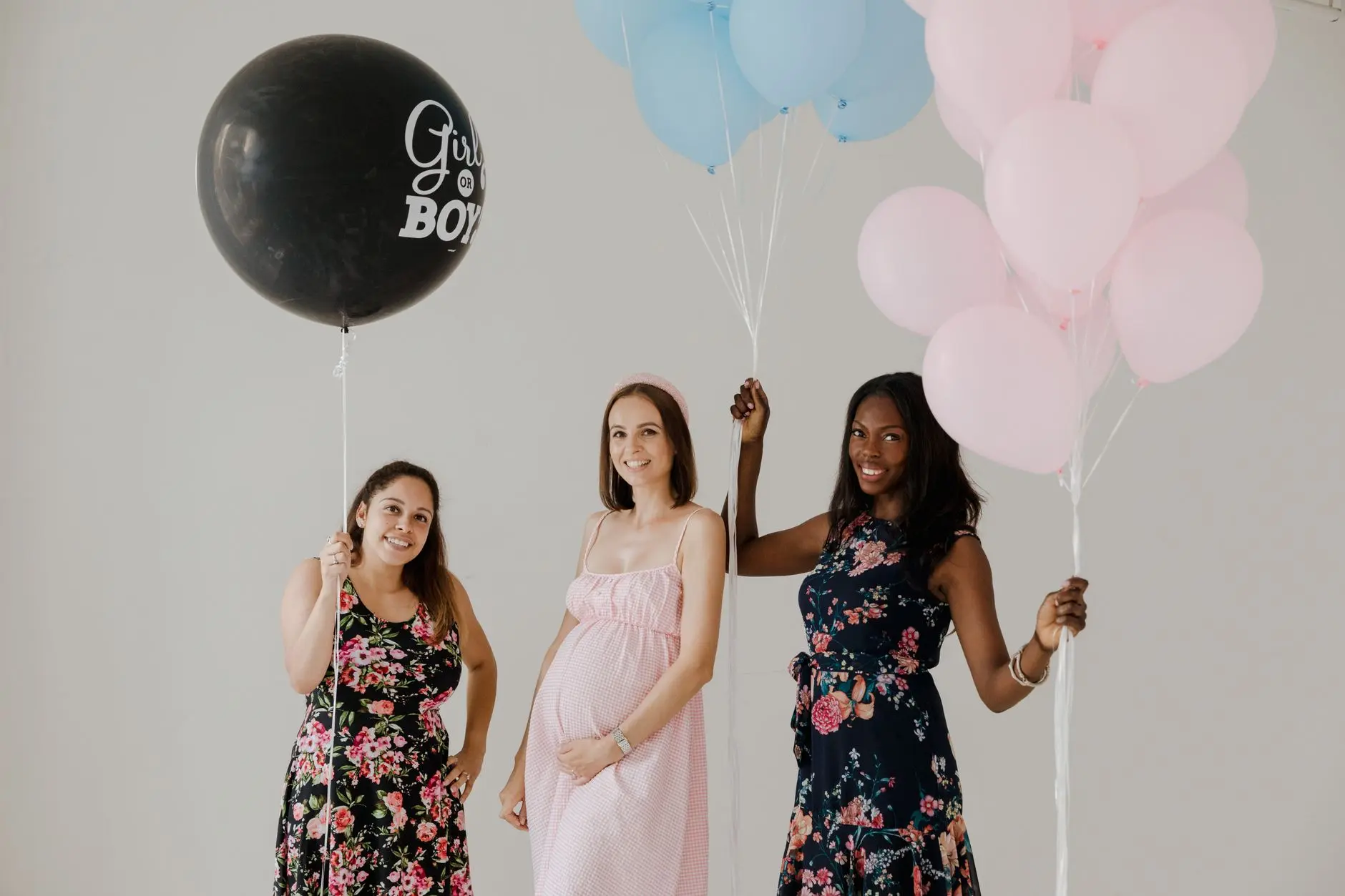
Planning American Girl baby shower games that actually feel grown-up is easier than you think. This list pulls from the full world of historical dolls, eras, outfits and accessories to give your party real personality, whether guests are lifelong collectors or just along for the nostalgia.
You will find eight printable sheets you can download and print the night before, plus active games and quieter keepsake activities to mix in between. If you want more general inspiration before the party, these easy baby shower games are another solid starting point. Pick the ones that fit your crowd and your space, and you are set.
This post contains affiliate links — if you buy through them, I may earn a small commission at no extra cost to you.
- Doll Outfit Match
- Guess the Doll’s Name
- Character Backstory Trivia
- Cabin Charades
- Doll Accessory Hunt
- Pack the Doll’s Trunk
- Pioneer Predictions
- Yarn Craft Relay
- Friendship Bracelet Bingo
- Historical Era Sort
- Book Dedication Station
- Doll Name ABC Race
- Story Starter
- Doll Outfit Price Is Right
- Who Said That? Quote Match
- Ribbon Wish Garland
- Frequently Asked Questions
1. Doll Outfit Match
Players look at eight illustrated outfit clues on the sheet and match each one to the correct historical doll character.
The clues describe the outfit’s era-authentic details: a lacy pinafore and flower crown, a plaid pioneer dress with apron, bell-bottom jeans and a denim vest, a circle skirt with a poodle pattern, a purple Hanukkah dress, a Hawaiian wrap top, a wartime jumper, and a mod pleated skirt with vinyl boots.
Players write the character name on the blank line under each clue.
Print one sheet per guest on cardstock. Give everyone five minutes to fill it out solo, then read the answer key aloud. The answer key on the sheet lists all eight answers so you can check them immediately: 1. Samantha, 2. Kirsten, 3. Julie, 4.
Maryellen, 5. Rebecca, 6. Nanea, 7. Molly, 8. Melody. Award a small point for each correct match if you like keeping score, or simply enjoy the conversation the clues spark.
This works especially well as a table opener because it runs on knowledge guests already have.
Fans who grew up with the catalog will fly through it; guests who are new to the collection will be surprised how much they can piece together from the outfit descriptions alone.
It quietly tells every guest at the table which character she was most like as a child.
Print the answer key on the back of the sheet and fold it under so guests cannot peek, then flip them over together when time is up.

🛍 Shopping guide
2. Guess the Doll’s Name
One guest thinks of any historical doll character while the rest of the table asks yes-or-no questions to figure out who it is.
The host keeps a reference list of all characters with their years: Kaya (1764), Felicity (1774), Josefina (1824), Kirsten (1854), Addy (1864), Samantha (1904), Rebecca (1914), Claudie (1922), Kit (1934), Nanea (1941), Molly (1944), Maryellen (1954), Melody (1964), Julie (1974), and Courtney (1986).
That list sits face-down on the table until a team gets stuck.
Questions can cover era, region, personality or story detail. ‘Is her story set before 1900?’ ‘Is she from the West Coast?’ ‘Does her story involve a war?’ ‘Is she one of the original three?’ Give each round a 20-question cap.
The guest who names the character correctly takes the next turn. With a big group, split into two competing teams and alternate rounds.
This game rewards people who actually read the books as kids, so it tends to set off great storytelling. Someone will inevitably remember a specific plot detail that nobody else does, which is exactly the kind of moment a baby shower should have. Keep rounds short and move fast so everyone gets a turn before the food comes out.
- Groups where most guests have a favourite character or a childhood memory of the books
- Tables of 4 to 10
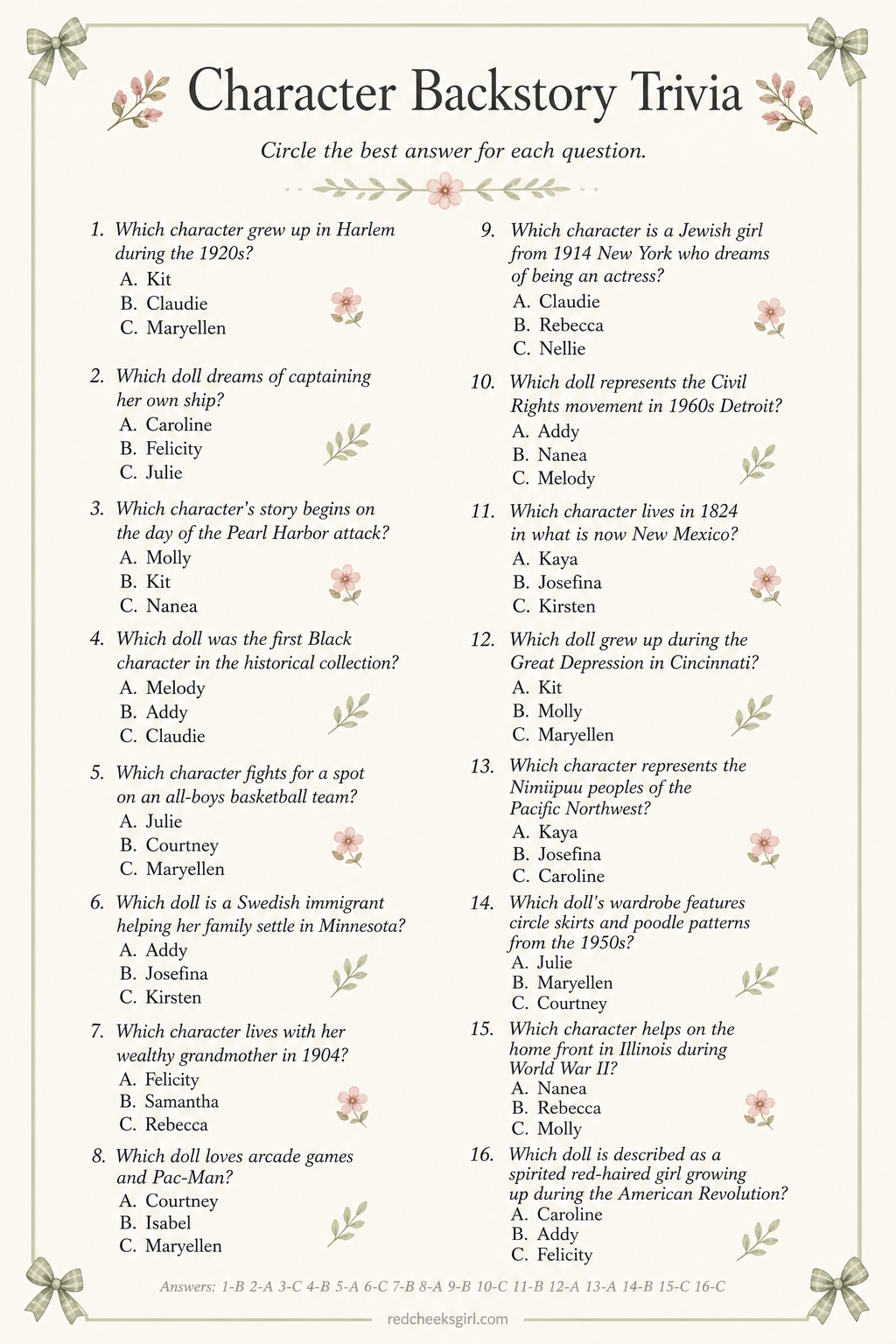
3. Character Backstory Trivia
This sheet has 16 trivia questions about the historical doll characters, covering backstories, eras, home cities and signature traits.
Questions range from straightforward to surprisingly tricky: which character grew up in Harlem during the 1920s, which one dreams of captaining her own ship, which was the first Black character in the collection, which doll’s story begins on the day of the Pearl Harbor attack.
Guests work through the sheet solo, circling their best answer from three options per question.
Print one per guest and set a timer for six minutes. When time is up, the host reads each question and answer aloud. The sheet’s small answer key at the bottom lists all 16 correct answers numbered to match the questions.
Guests total their own score, then share their results with the table. It is genuinely fun to discover that the guest who never owned a doll outscored the one who had five.
The trivia doubles as a gentle history lesson, which fits the shower theme perfectly.
If you want to lean into the storytelling angle, read one short sentence about each correct answer as you reveal it: ‘Claudie Wells searches for her special talent in Harlem in 1922.’
That keeps energy up and gives guests who drew a blank something to remember later. Pair it with a second printable later in the party so the sheets feel like a proper game pack rather than a one-off quiz.
The three-option format means guests are never completely stuck, so the room stays upbeat even for those who are new to the doll collection.
4. Cabin Charades
Players draw a card from the deck and act out the word or phrase printed on it without speaking.
All the prompts are pulled from the world of historical doll stories: pioneer cabin chores, Edwardian tea parties, Harlem Renaissance dancing, wartime victory gardens, 1970s protest marching, 1980s arcade gaming. Because every prompt connects to a real era, the guessing is both hilarious and educational.
Print the card sheet on cardstock and cut along the dotted lines before the party. You get 24 cards per sheet. Shuffle them into a small pile and set a 45-second timer per turn.
The acting guest draws one card, reads it silently and performs while the rest of the group shouts guesses. Whoever guesses correctly keeps the card as a point token. When the stack runs out, count cards.
Charades works at every shower because it gets people out of their seats without any pressure. If a guest draws a card she genuinely cannot mime, she can fold it back into the deck and draw again once.
Keep the rule flexible and the energy relaxed. Putting the cards in a small decorative bowl in the centre of the table makes them feel like a party detail rather than a prop.
- Cardstock for printing and cutting
- Small decorative bowl or tin to hold the card deck
- 45-second timer (a phone works fine)

🛍 Shopping guide
5. Doll Accessory Hunt
Before guests arrive, the host hides 20 small doll-themed objects around the party space: a miniature hairbrush, a tiny book, a spool of ribbon, a brass button, a small floral hair clip, a wooden bead, a piece of gingham fabric, and similar items that match the look of a doll’s accessory collection.
Guests pick up a checklist on arrival and spend ten minutes searching on their own. The list names each item without describing where it might be hidden.
Set clear boundaries so the hunt stays within the party area. The host places items at eye level and below so nobody has to climb or move furniture.
A small basket at the check-in table lets guests drop found items as they go, or you can let everyone hold their finds until time is called. The guest who checks off the most items wins the round.
If two guests tie, ask each a quick doll trivia question as a tiebreaker.
The hunt works because it gets guests moving and talking the moment they walk in, well before everyone has settled.
It also doubles as a natural icebreaker: people compare lists, point each other in the right direction and start chatting without any prompting from the host. Set up the hunt before any gifts are opened so the space is uncluttered and easy to search.
Buy a small bag of wooden craft buttons, tiny ribbon spools and miniature books from a craft store to use as your hunt items. They photograph well on a party table too.
🛍 Shopping guide
6. Pack the Doll’s Trunk
This card-sort game gives each guest a sheet of 18 illustrated item cards and a trunk outline. Players read each item name and decide whether it belongs in the trunk of a specific historical doll character named at the top of the sheet.
Items include a hair ribbon, a school primer, a quilt square, a tin of cookies, a letter from home, a pair of moccasins, a lace handkerchief, a paintbrush, a recipe card, a wartime ration book, a seed packet, and more.
Players circle the items that fit and cross out the ones that do not.
Print one sheet per guest on regular paper. The host calls the doll character aloud at the start of the round (for example, Kirsten, the Swedish pioneer girl from 1854) so that the sheet prompt at the top matches.
Give guests four minutes, then compare answers around the table. Because many items could plausibly belong to several characters, the discussion after the round is often more fun than the sorting itself.
For a longer session, print two sheets with different characters and run two back-to-back rounds. Kirsten and Molly make a good pairing because their eras are far apart and their trunk items have almost no overlap.
The game gently teaches guests the differences between characters without feeling like a lecture, which is a useful trick when the guest of honour wants everyone to understand why she loves the collection.
Write the character’s era and home region at the top of the sheet in parentheses so guests have a context clue. Example: ‘(Kirsten, 1854 Minnesota pioneer)’.

7. Pioneer Predictions
Each guest fills out a keepsake prediction card about the baby on the way. Prompts are written in the voice of a pioneer letter home, which fits the doll-collection aesthetic perfectly.
Guests write their name at the top and fill in answers to prompts like ‘I predict this little one will arrive at: ___’, ‘Her first adventure will be: ___’, ‘A skill she will master early: ___’, ‘The story she will love most: ___’, and ‘A piece of wisdom to carry on the journey: ___.’
The language is warm and slightly old-fashioned without feeling forced.
Print four cards per sheet and cut them apart before the party. Each card is postcard-sized and has a floral and ribbon border in the party palette.
Set a small wicker basket or wooden box on the gift table so guests can fold their completed card and drop it in.
The guest of honour takes the basket home and reads the cards privately, keeping them as a keepsake alongside the baby photos from the day.
Pioneer Predictions works as a quiet breather between the louder games, giving guests a moment to sit and write without any pressure.
Because the prompts are specific but open-ended, even guests who do not know the family well can fill out a card without feeling stuck. The result is a set of cards that actually gets read again years later, which is the point.
The pioneer-letter framing gives even simple wishes a bit of warmth and character, so cards feel personal rather than generic.

8. Yarn Craft Relay
Divide guests into two teams of equal size.
Each team gets a large ball of worsted yarn and a set of simple crafting challenges to complete in relay style: wind the yarn into a neat ball, cut a 12-inch length and tie it into a bow, braid three strands together, and finally loop a bracelet knot around the wrist of the next teammate to tag them in.
Every step connects to the hand-craft tradition that runs through the doll collection’s pioneer and historical stories.
Set the materials at one end of the room and line both teams up at the other.
On ‘go’, the first player on each team walks (no running) to the table, completes step one, tags the next teammate, and returns to the back of the line. The relay ends when every player on a team has completed all four steps.
The first team to finish wins. Give teams a 30-second practice look at all four steps before the timer starts so nobody is confused mid-relay.
Walking pace keeps the game relaxed and inclusive for guests of all ages and mobility levels. The braiding step naturally prompts people to help each other, which is a nice moment at a baby shower.
Keep a spare pair of scissors at each station so a snapped thread does not stall the relay. If your group is small, run the relay solo with a stopwatch and let each guest try to beat the previous player’s time.
- Two large balls of worsted yarn in matching colors
- Blunt-tip scissors for each station
- A small table at one end of the room for the craft station
🛍 Shopping guide
9. Friendship Bracelet Bingo
Each of the eight uniquely arranged bingo cards features a 5×5 grid where every square holds a friendship bracelet pattern name or craft term instead of a number: herringbone, chevron, spiral, diamond, fishtail, candy stripe, arrow, wave, ladder, square knot, loop, macrame, braid, lark’s head, half hitch, overhand, and more.
The host draws from a call bag of matching squares and reads each term aloud. Guests mark off any square that matches on their card. First to five in a row calls ‘Bracelet!’
Print all eight cards on cardstock and cut them apart. For markers, put a small bowl of buttons, dried flower heads or gold beads at each seat, which ties into the party’s look without any extra shopping.
The host keeps the call list and checks the winner’s card before confirming the win. Running three full games gives everyone a fair shot: once across, once down and once diagonal.
The bracelet-pattern theme means the bingo calls feel native to the party rather than borrowed from another occasion.
Guests who actually make friendship bracelets will recognise the terms immediately, and guests who do not will pick them up quickly because the host reads each one clearly.
Keep the call pace steady, about one every 15 seconds, so games stay brisk and guests stay engaged between other activities.
Cut small squares of gingham fabric to use as markers. They are easy to move between games, they look lovely on the cream cards, and guests can take them home.

🛍 Shopping guide
10. Historical Era Sort
This sheet lists 12 historical doll characters on the left and 12 era descriptions on the right. Players draw a line matching each character to her correct time period and setting.
Pairs include Kaya and ‘Pacific Northwest, pre-European settlement’; Addy and ‘Civil War era, 1864’; Claudie and ‘Harlem Renaissance, 1922’; Kit and ‘Great Depression, 1934’; Nanea and ‘Pearl Harbor, 1941 Honolulu’; Melody and ‘Civil Rights movement, 1964 Detroit’; and six more.
Players work through all 12 in five minutes.
Print one sheet per guest. The answer key sits in small italic text at the very bottom of the sheet below the footer line, numbered 1 through 12 to match the characters on the left column.
After time is called, guests check their own work against the key, count their correct matches and share their score. The sheet is self-marking, so the host does not need to read anything aloud. That frees the host to refill drinks while guests score themselves.
The matching format is fast to set up and zero prep beyond printing. It suits the beginning or the end of the games portion equally well.
If you are running the full game pack, place this sheet third or fourth in the lineup, after guests have had a round or two to warm up but before the crafting games slow the pace down.
The discussion that breaks out when someone questions a match is half the fun.
Tell guests the years are listed in chronological order on the right column so they can narrow down options systematically.

11. Book Dedication Station
Set a small stack of board books or picture books on the gift table with a pen at each chair. Every guest writes a short dedication message on the inside front cover of one book, signing their name and the date.
The host assigns each guest a book at the start of the party by tucking a small card with the book title inside their program or favor bag.
Because each guest writes in a different book, nobody is waiting on anyone else and the station runs itself.
Choose books with a storytelling or adventure theme to match the party’s celebration of stories and history. Leave the dedication page completely blank so guests have room.
If a guest is feeling stuck, a small prompt card at the station suggests: ‘Write one wish, one piece of advice, or one favourite line from a story you loved as a child.’ That three-option prompt means nobody stares at a blank page for long.
The dedicated books go directly into the baby’s first library. Unlike a standard advice card that gets filed away, these live on a shelf and get read aloud for years.
For the guest of honour, finding the handwriting of a family friend in a favourite book when the child is old enough to notice it is the kind of detail that stays.
This game pairs naturally right after the Pioneer Predictions cards so the quiet, writing-focused mood carries from one to the next without a jarring transition.
- Groups who enjoy writing over playing
- Closing stretch of the party when energy is warm and guests are settled
12. Doll Name ABC Race
The host calls a letter of the alphabet at random, and each guest has 30 seconds to write down as many doll character names, outfit names or accessory names as she can that start with that letter. A is easy (Addy, Arrow skirt).
K is rich (Kaya, Kirsten, Kit). Q is hard, which is part of the fun. After 30 seconds, players read their lists aloud. Only unique answers count: if two guests both wrote ‘Kaya,’ neither gets the point for it.
The guest with the most unique answers after ten rounds wins.
All you need is a sheet of blank paper and a pen per guest, so there is nothing to print or prep. Run the rounds at a brisk pace to keep energy up.
The host should stay out of the playing rounds to keep track of duplicates fairly. Write the called letter on a whiteboard or a slip of paper held up for the table so everyone sees it clearly at the same time.
The unique-answers-only rule is the key mechanic here because it rewards breadth of knowledge rather than speed of writing. Guests who remember deep-catalog accessory names like ‘Josefina’s Feast Day outfit’ or ‘Kit’s Reporter Set’ will edge out guests who only remember character first names.
That creates a genuinely levelled playing field between hardcore fans and casual ones, which keeps the game competitive right to the last round.
Prepare a list of ten letters in advance and avoid Q, X and Z unless your group is made up of serious collectors.
13. Story Starter
Each guest writes the opening two sentences of a story about the baby, set in the era of her favourite historical doll character.
The host collects all the story starters after five minutes and reads them aloud one by one while guests try to guess who wrote each one.
After the guessing round, the guest of honour chooses her favourite opening and the writer of that one gets a small plant cutting or seed packet as a prize, which fits the pioneer-garden aesthetic.
Provide a half-sheet card at each seat with the prompt pre-printed: ‘Set your story in any era you love. Start with: It was the year _____, and a girl named _____ had just learned the most important thing…’
The fill-in-the-blank format gives guests a structure so nobody freezes up on a blank card. Remind guests to write their name on the back so the host can return the cards after the reveal.
Story Starter works well after a trivia game because guests have just been reminded of character details and eras, so the creative ideas flow faster. The guessing round adds a light competitive layer without any pressure.
For an extra touch, the host can bind all the story cards into a small handmade booklet tied with a ribbon and give it to the guest of honour as a keepsake from the day.
A two-hole punch and a length of grosgrain ribbon is all it takes.
Tying the creative prompt to a real historical era gives guests a scaffold so the writing feels playful rather than intimidating.

14. Doll Outfit Price Is Right
The host prints or writes out a list of ten real doll outfits and accessories, then announces each item by name and a short description. Guests write their best guess for the retail price on a slip of paper.
After all ten items are revealed, the host shares the actual prices and guests score themselves: one point for guessing within two dollars, two points for an exact guess. Outfits and accessories from the collection range widely in price, which makes the guessing genuinely unpredictable.
Keep the host’s price list private until scoring time. Read the item name and description clearly so guests have enough to go on without the price being obvious.
Good items to include: a historical character’s meet outfit with accessories, a character storage trunk, an 18-inch doll, a WellieWisher doll, a character book set, a mini doll, a single accessory set, an outfit-only bundle, a bedroom furniture piece, and a gift set.
The range from under ten dollars to over two hundred dollars creates natural tension.
This game moves fast because each round is just a name, a description and a number. Run through all ten items in about eight minutes.
Guests who grew up buying from the catalog will have a strong feel for pricing and will compete hard with guests who are shopping for the first time.
That gap between experienced and new guests is exactly what makes the game unpredictable and fun at a mixed group shower. If you need more options for table games throughout the party, baby shower card games are easy to layer in.
Check current prices on the official brand’s Amazon storefront the day before the party so every number is accurate.
15. Who Said That? Quote Match
The host reads aloud a short quote or paraphrased line from one of the historical character book series, and guests race to identify which character said it or which book series it comes from.
Kirsten’s determination about family, Addy’s courage in the face of hardship, Kit’s resourcefulness during the Depression, Melody’s belief in using her voice for fairness. The host keeps a printed reference list but does not share it.
Guests shout answers or write them on small cards depending on how loud the room is.
Pull six to eight quotes from the books before the party. Paraphrase each one enough that it cannot simply be Googled but stays close enough to the original spirit that a fan who read the book will recognise it.
Read each quote twice before accepting answers. For a team version, divide guests by which character they knew best as a kid and let teams confer for 20 seconds before answering.
The quotes format rewards the guests who actually read the books rather than just owned the dolls, which creates a fun inversion of expectations.
Someone who never had the dolls but borrowed the books from a library will outperform someone who had the full collection but skipped the reading. That kind of surprise keeps every round feeling open.
Pair this game right after one of the printables so the room has had a chance to sit and now needs to move and talk again.
- Book-readers and longtime fans
- Groups of 6 or more where shouting answers is fun rather than chaotic
16. Ribbon Wish Garland
A long piece of jute twine is strung between two chairs or across a mantel before guests arrive. A basket of pre-cut ribbon strips in cream, sage green and burgundy sits on a side table with a stack of small luggage tags.
Each guest writes one wish for the baby on a tag, ties a ribbon to the loop, and hangs it on the garland.
By the end of the party, the garland holds a full set of wishes in the party’s colours, ready to hang in the nursery or keep as a keepsake.
Cut ribbon strips to about eight inches each so they tie easily with one hand. Pre-punch the luggage tags if they do not come pre-punched.
Set the table up within sight of the main seating area so guests can hang tags throughout the party at their own pace rather than all at once. Put a fine-tip pen in the basket so writing is easy on the small tag surface.
If a guest wants to write more than one tag, that is perfectly fine.
The garland fills up gradually over the course of the party, which means it becomes a visual marker of progress, a living decoration that grows as the afternoon goes on. Guests notice when others add tags and often pause to read what their neighbour wrote.
That organic reading of each other’s wishes is a gentler version of the advice-card read-aloud moment, and it happens without the host having to organize it.
For even more ideas for making your shower special from start to finish, free printable baby shower games can fill any gaps in your lineup.
- Jute or linen twine, at least 6 feet long
- Pre-cut ribbon strips in cream, sage and burgundy
- Small luggage tags with pre-punched holes
- Fine-tip pens in dark ink
🛍 Shopping guide
Frequently Asked Questions
How many games should I plan for a two-hour baby shower?
Four to six games is comfortable for two hours. Use two printables as table activities when guests are arriving or eating, two active games to lift energy mid-party, and one quiet keepsake activity near the end. That pacing leaves plenty of time for gifts and conversation without rushing.
Do guests need to know anything about historical dolls to enjoy these games?
No. Games like Guess the Doll’s Name and Character Backstory Trivia give enough context in the clues and options that new guests can participate without prior knowledge. Longtime fans will have an edge on trivia, but the active and craft games level the field completely.
What is the best printable game for a large group of 20 or more guests?
Friendship Bracelet Bingo works best for large groups because you have eight unique cards and can run multiple rounds. Historical Era Sort and Character Backstory Trivia also scale well because every guest works individually at the same time, so there is no waiting.
Can I run these games at a co-ed shower?
Yes. The active games like Cabin Charades, Yarn Craft Relay and Doll Outfit Price Is Right work for any mix of guests. Skip games that lean heavily on catalog knowledge if most guests are unfamiliar with the doll line, and lean into the storytelling and craft games instead.
What prizes work well with this party theme?
Small succulents or seed packets in kraft paper sleeves, bundles of ribbon, a miniature journal tied with twine, or a small candle in the party palette all fit the look. Keep prizes modest so guests feel appreciated rather than competitive.
Where should I buy supplies for the craft and active games?
Most supplies, including worsted yarn, cardstock, ribbon, luggage tags and craft buttons, are available at any craft retailer or online. For doll-specific items used in games like Doll Accessory Hunt, the official brand’s Amazon storefront carries licensed accessories in the right aesthetic.
Find a baby shower cake for every party theme, from a mossy woodland stump cake to a navy sailboat d
These 20 DIY baby shower decorations each name the one finishing step that separates handmade from h
Baby in bloom shower decorations that make the flower pun literal: real bulbs, climbing vines, edibl
Leave a Reply