

22 European Wedding Aesthetic Ideas for Couples Who Love Slow Dinners and Old Streets

Forget fairy lights and a wall of peonies for a second. The European wedding aesthetic worth copying this year is built on a long table, a chef half in view, and a glass that has clearly been handed down more times than anyone at the party can count.
The palette is cream, olive, terracotta and wine red, warmed by old silver gone soft at the edges and cut crystal that throws candlelight around the room.
The motif that runs through every course is the olive branch: pressed into wax, carved along an arch, tucked under a napkin, dried into a bride’s own clutch. Nothing matches exactly, and that is the point.
This is the look for a slow summer dinner, the kind that starts at golden hour on a terrace or in an ivy-walled courtyard and does not really finish until someone is singing badly into a microphone near midnight.
If she wants a wedding that feels less like a show and more like a long lunch that never quite ended, this is the one to hand the decorator.
This post contains affiliate links. If you buy through them, I may earn a small commission at no extra cost to you.
Table of Contents
The Venue, Set for a Long European Evening
Before anyone sits down, the venue has to feel like one long evening rather than four separate decisions stitched together. If this leans a little quieter than she pictured, the French wedding aesthetic ideas run cooler, and the Italian wedding aesthetic ideas run warmer and a shade more theatrical.
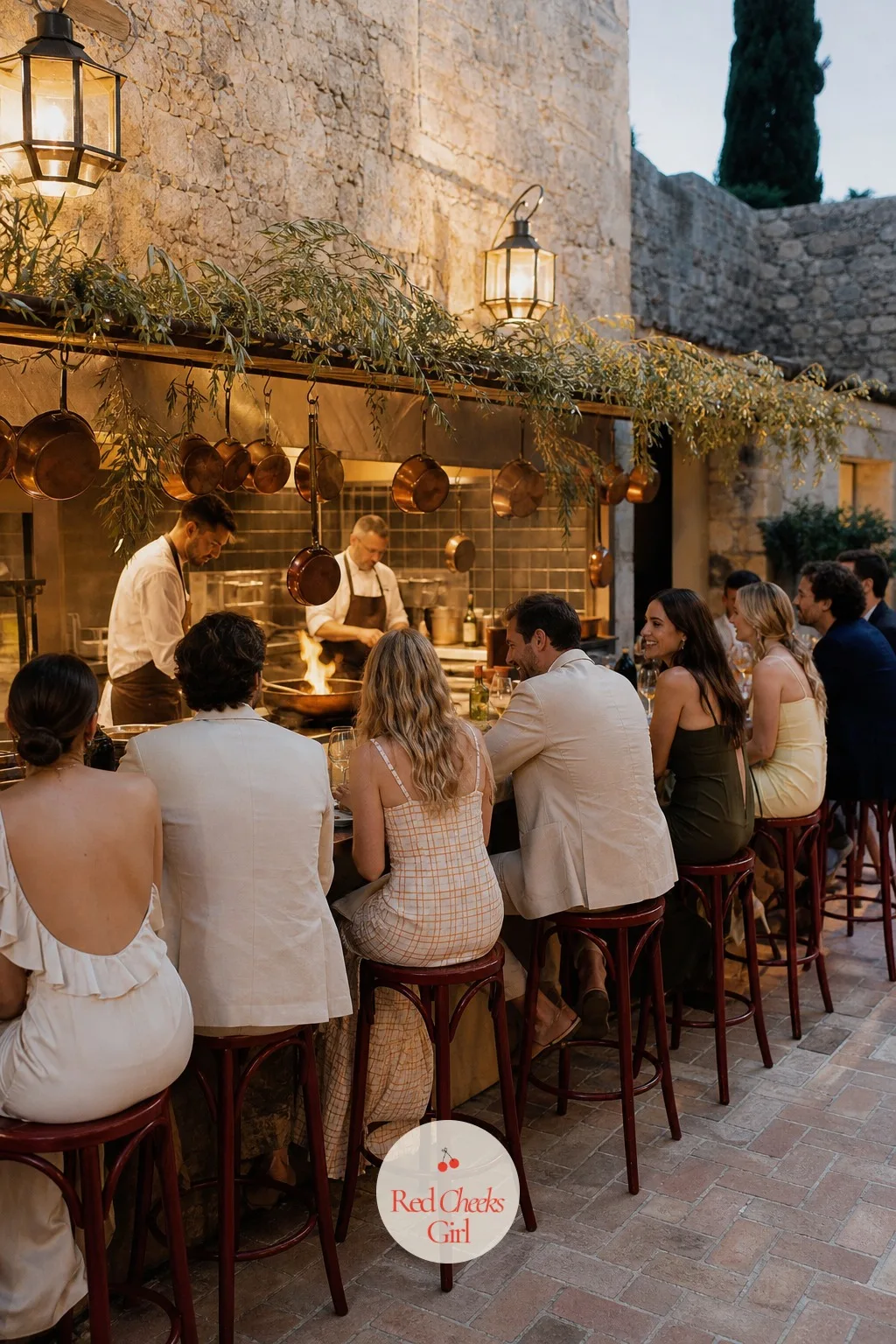
Chef’s Table Dinner Where Guests Watch the Cooking
She might worry a seated dinner feels too formal for a wedding she wants people to remember. Put the cooking in the room instead: a zinc or butcher block counter runs along one wall, copper pans hang above it, and the chef works an open flame while a dozen guests perch on wine-red cushioned stools a few feet away.
Underneath it all sits terracotta tile or reclaimed wood flooring, the counter itself in scrubbed oak, and a rack of copper and cast iron within arm’s reach of the flame. Olive branches knot loosely along the pass-through, with one low lamp keeping the light warm rather than clinical.
Tell the caterer exactly this: an open chef’s counter seating six to eight at a time, cast iron and copper cookware visible, a menu built around one wood-fired course guests can watch from start to plate. This is worth ordering properly rather than improvising, though a tabletop grill station on a terrace does the same job for a smaller budget.
🛍 Shop this look
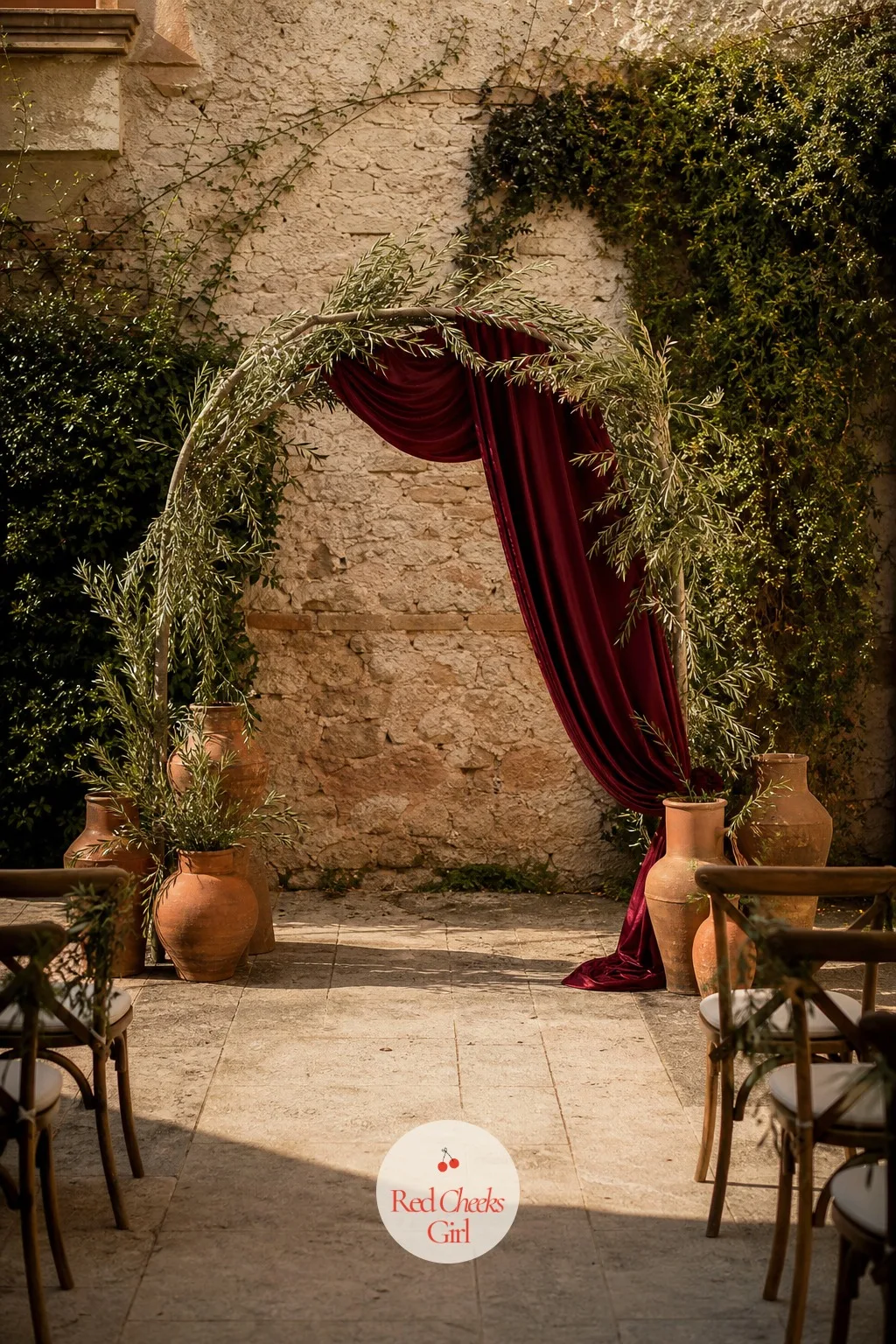
A Terracotta Courtyard Arch for the Vows
A bare arch always looks like it is waiting for something. Build this one from the ground up instead: round terracotta planters anchor each side, a curved wood frame rises out of them, and olive branches wind along the frame with one length of wine-red velvet draping down a single side.
Give the florist this exact brief: a freestanding arch dressed with olive branch and trailing greenery, one run of wine-red velvet drape, terracotta planters at the base rather than woven baskets.
The planters and drape are easy to source and reuse afterward as garden pots, so this half of the job suits a DIY afternoon. The structural frame itself is worth renting. If a full arch is too much, two terracotta urns with olive branches either side of the altar table do the same work.
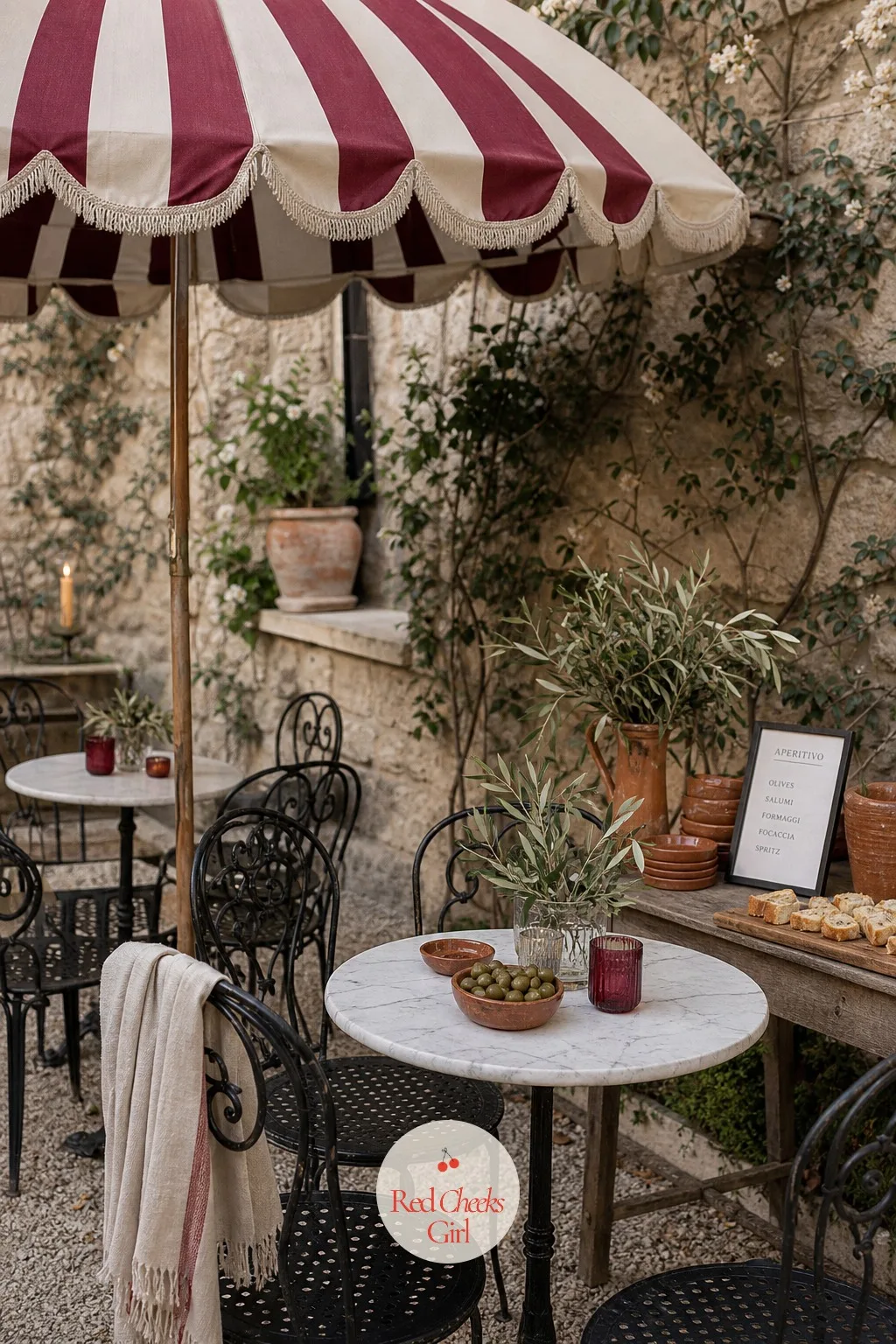
The Cafe-Style Aperitivo Corner
Cocktail hour does not need a bar if it has a corner like this instead. Small wrought iron bistro tables and chairs cluster together, marble-topped and low, sitting under a striped cream and wine-red umbrella with terracotta bowls of olives and nuts set out on top.
Give the rental company this: six bistro sets in black wrought iron, a cream and wine-red striped umbrella, marble-top cafe tables rather than standard cocktail rounds.
Borrowed bistro furniture makes this one easy and cheap to assemble herself, while the striped umbrella is worth ordering for the finish. Indoors, skip the umbrella entirely and hang the same stripe as bunting along the wall instead.
🛍 Shop this look
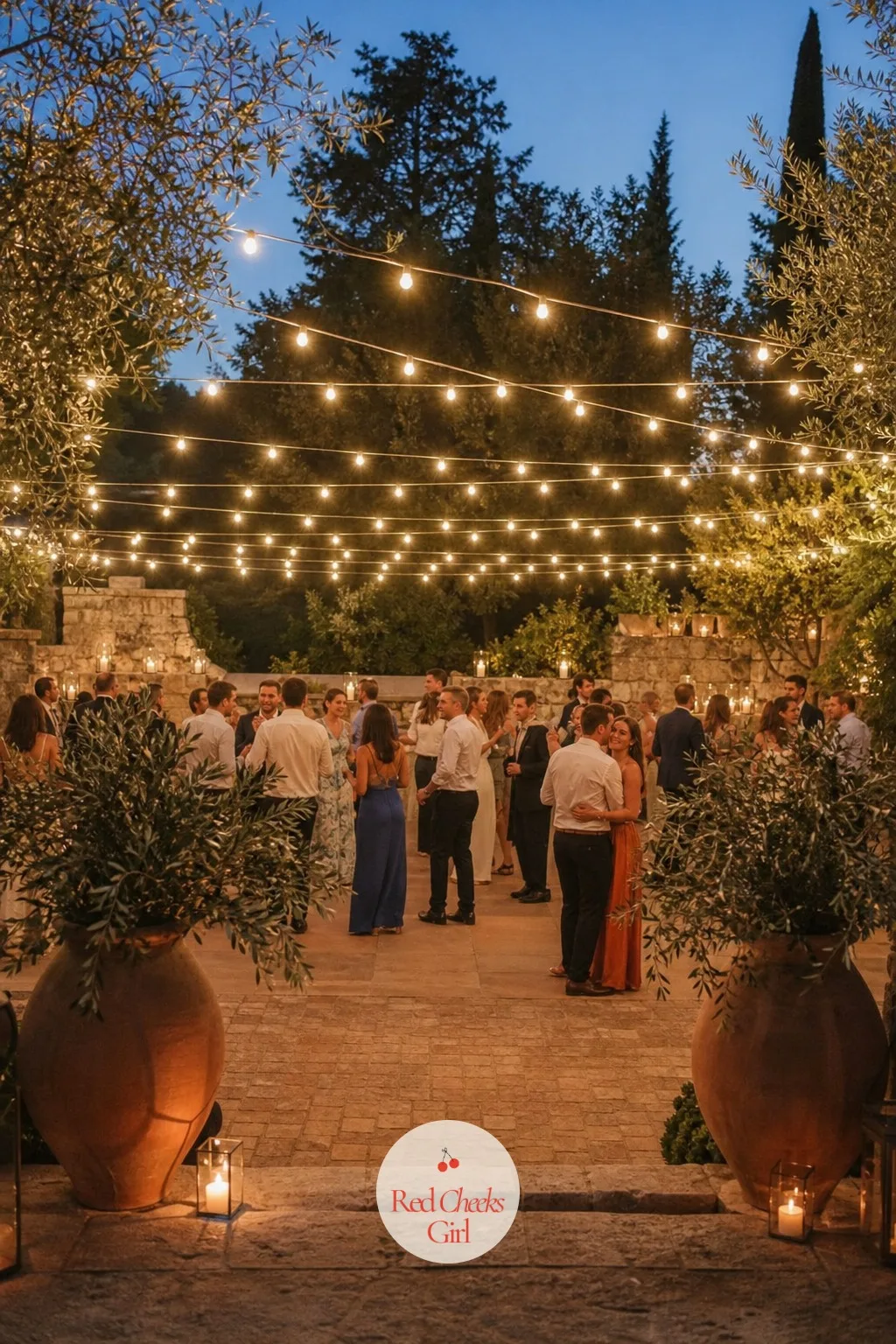
A String-Light Canopy Over the Dance Floor
A dance floor with nothing overhead feels unfinished once the sun goes down. Four anchor poles, or the trees already standing there, carry a crossed grid of warm bulb festoon lighting, with a scatter of smaller lanterns hung lower at the edges and terracotta urns of olive branches marking the entrance.
Tell the lighting company: a crossed grid of warm white festoon lighting across roughly four hundred square feet, hung from four anchor poles, nothing cold white.
A small garden under thirty feet is manageable with a ladder and an evening of patience. Anything larger is worth ordering properly. Paper lanterns in cream and terracotta stand in just as well where festoon wiring is not possible.
🛍 Shop this look
The Long Tables
Once the venue is settled, the table itself does most of the talking: bread, low flowers, old metal and glass, with nothing matched on purpose. For a version that leans more fully into olive groves and long lunches, the Mediterranean wedding ideas sit right next door to this one.
Long Tables Dressed with Baguettes, Pretzels and Butter Dishes
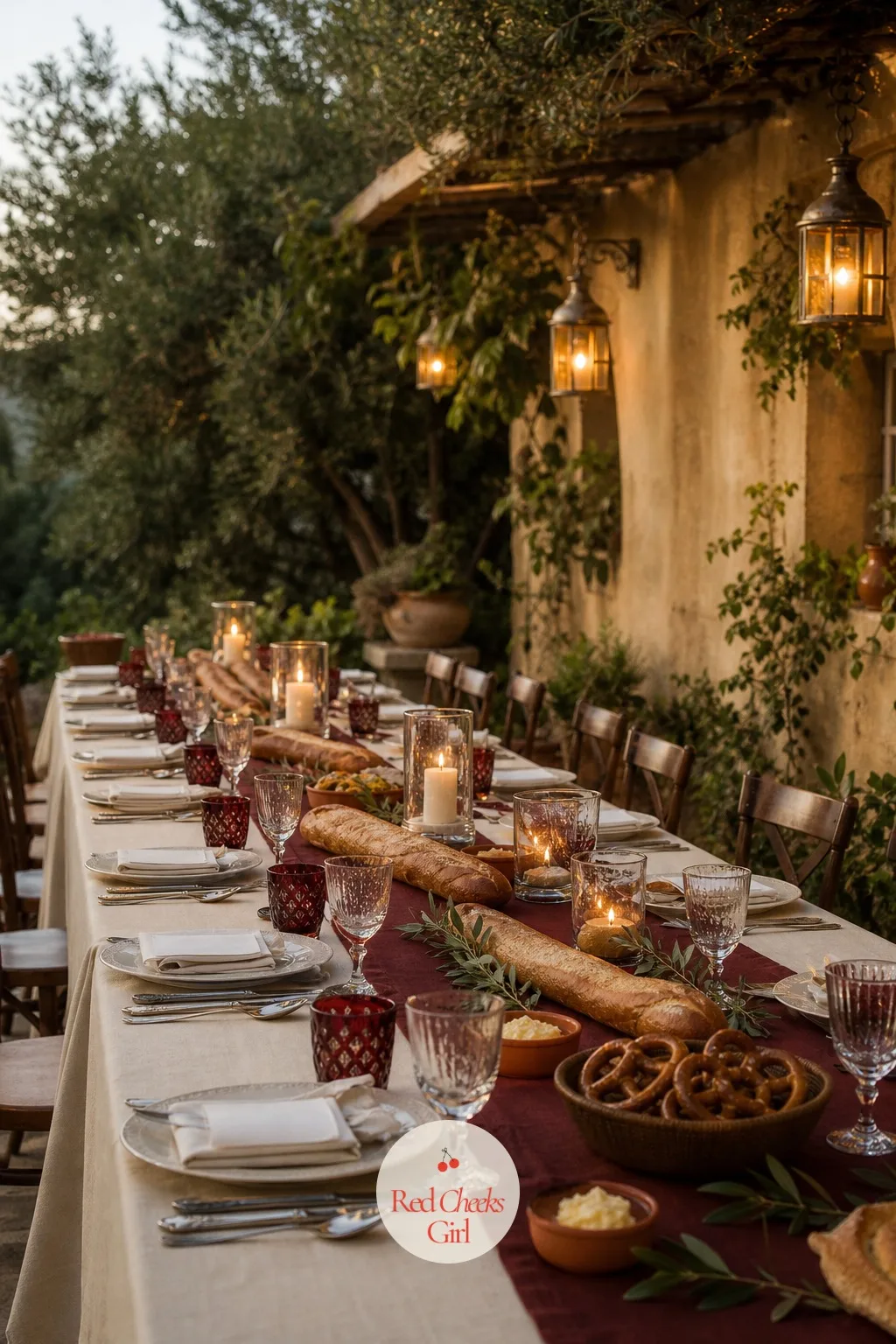
A centerpiece-free table unsettles some brides until they see this. A cream cloth runs the length of the table with a wine-red runner down the centre, and whole baguettes lie lengthwise directly on top at intervals instead of a single florist’s arrangement.
Baskets of soft pretzels sit between place settings, with terracotta butter dishes and a small bowl of olive oil close by for passing hand to hand.
Give the baker and caterer this line: fresh baguettes laid whole down the table every three settings, one basket of pretzels per six guests, butter in terracotta dishes with a bowl of olive oil alongside.
Order the bread fresh the morning of. If baguettes will not hold their shape in heat, a pre-sliced loaf on a board at each setting does the same job.
Low Arrangements on Flower Frogs in Vintage Bowls
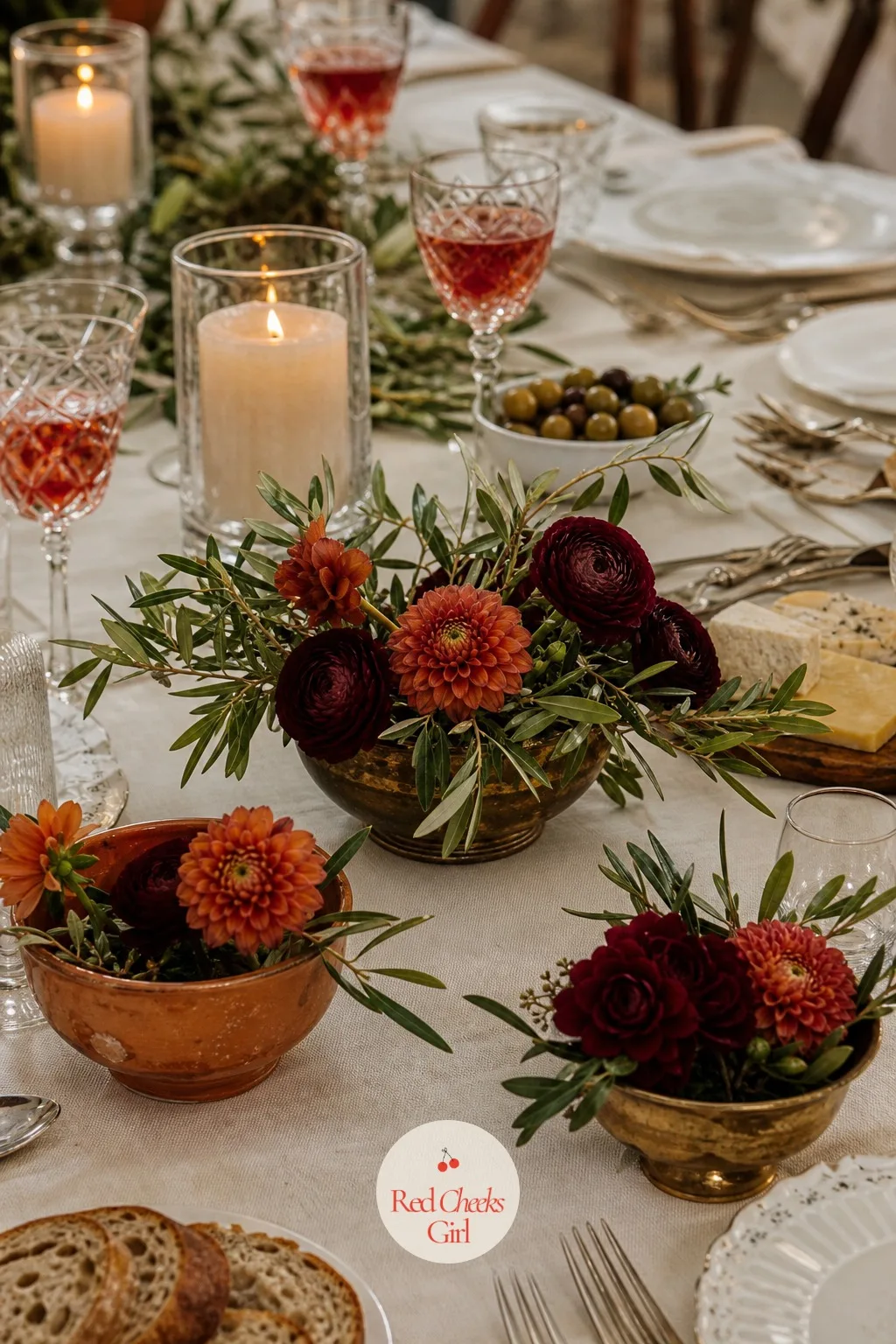
Tall centerpieces block the one thing a long table is for: seeing everyone down it. Keep the flowers low instead, sitting a flower frog directly inside a mismatched vintage bowl, brass here, ceramic there, holding five or six stems under six inches tall.
Dahlias and ranunculus in terracotta, wine and cream do the heavy lifting, with one trailing olive branch escaping each bowl’s edge.
Brief the florist with this: low arrangements under six inches tall, flower frogs inside mismatched vintage bowls, dahlias and ranunculus in terracotta, wine and cream with one trailing olive branch per bowl.
Flea-market bowls and a craft-shop frog make the vessels a genuine DIY job, so only the flowers themselves need ordering. A single bowl of floating garden roses works if frogs prove hard to find.
🛍 Shop this look
Antique Silver and Cut Crystal at Every Place
Matching flatware from a rental catalogue reads flat under candlelight. Layer each place setting instead: a cream charger first, the dinner plate on top, antique or antiqued silver flatware laid either side, deliberately not identical place to place.
Cut crystal water and wine glasses cluster at the top right of each setting, with a cream napkin tied around a single olive sprig in place of a ring.
Give the rental company this: antique or antiqued silver flatware, a cut crystal coupe and wine glass per setting, a cream linen napkin with a wine-red thread border.
Thrifting mismatched silver is half the fun and genuinely cheap. Order the crystal as a set for consistency, or use pressed glass instead of true crystal, which reads almost the same at candlelight.
A Wine-Red Runner Down a Cream Cloth
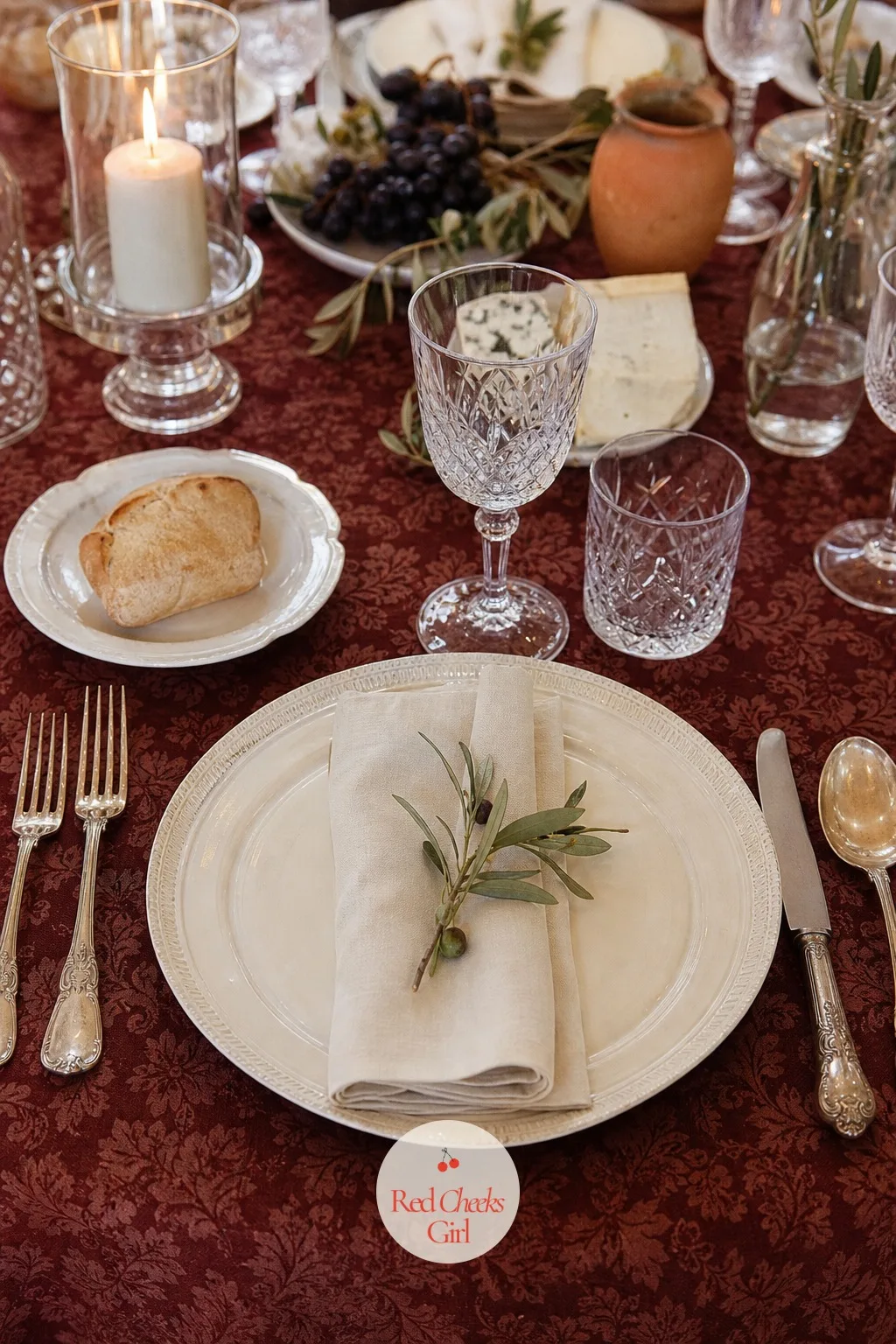
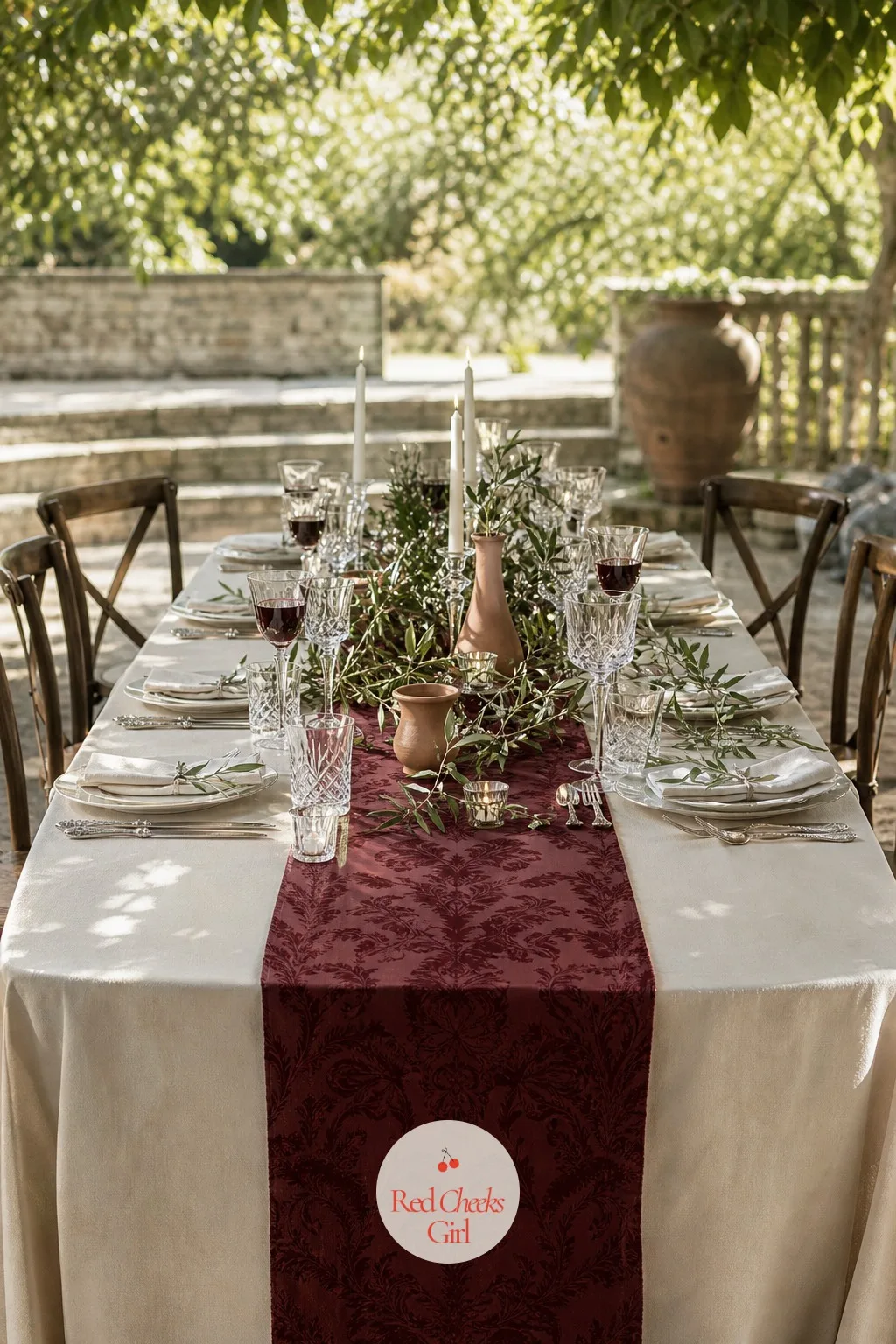
Fabric is doing more quiet work here than any single flower. A pressed cream cotton or satin cloth covers the whole table first, and a wine-red jacquard runner lies centrally over it, both ironed flat with no wrinkle or texture in sight.
Brief the linen rental company exactly like this: a cream tablecloth in pressed cotton or satin, floor length, with a wine-red jacquard runner down the centre, both ironed, no raw or textured linen anywhere.
Renting the set is the easy, mess-free route; pressing it herself the night before works too with a proper iron and some patience. A terracotta-toned runner reads softer than wine red under bright midday sun, if that suits the ceremony time better.
Place Cards Tucked into Olive Sprigs
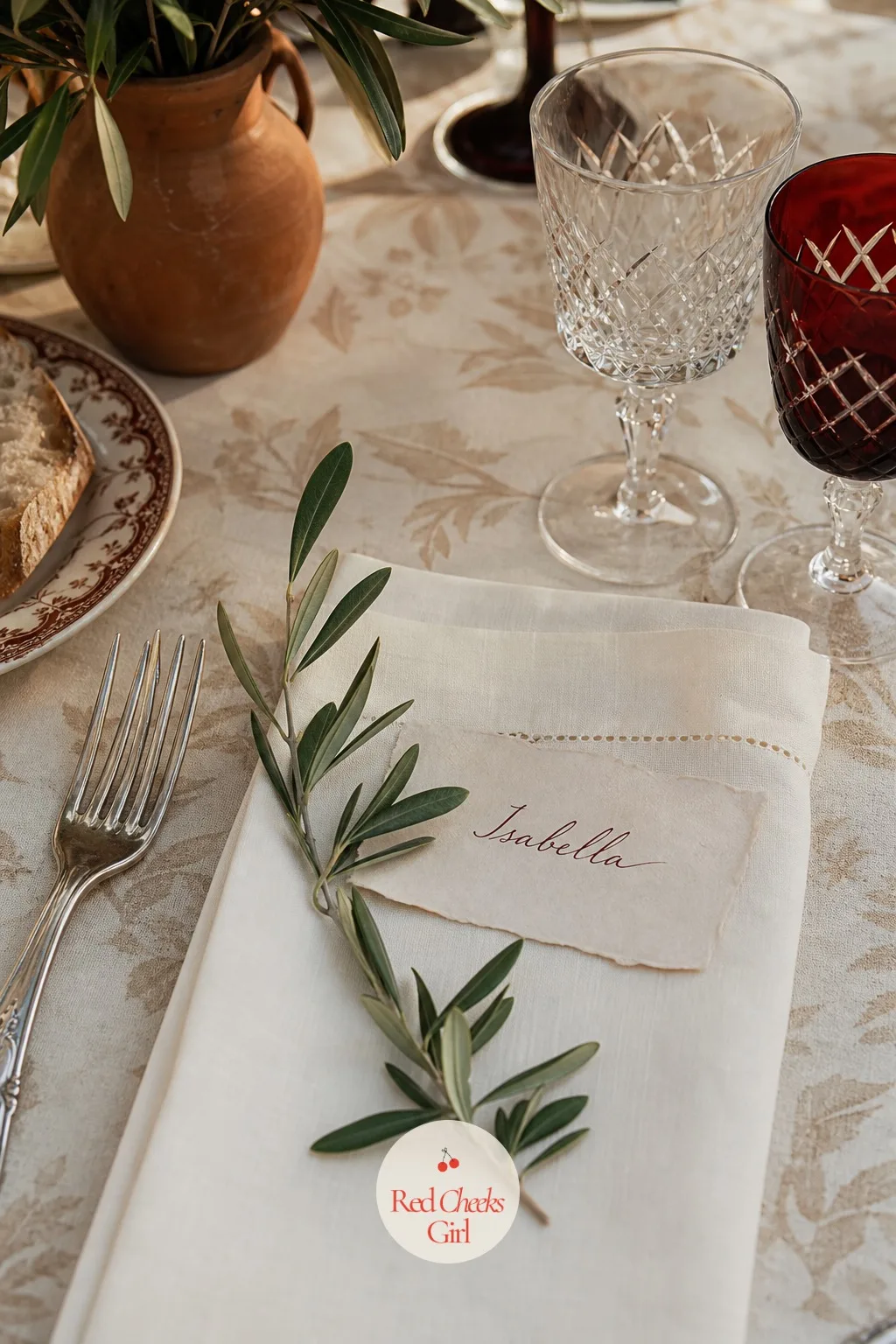
A ribbon on a place card feels like an afterthought once a sprig has done the same job better. The card rests on the folded napkin with a single fresh or dried olive sprig laid diagonally across one corner, pinning it in place without any ribbon at all.
Tell the stationer: cream place cards, wine-red ink or thread edge, one small olive sprig per card instead of a ribbon.
Writing a hundred names by hand is cheap and doable the week of, if her calligraphy can hold up. Order printed cards instead if that sounds like a lot. A dried bay leaf stands in nicely when olive branch is out of season nearby.
Hand-Lettered Menu Cards Leaned Against the Butter Dishes
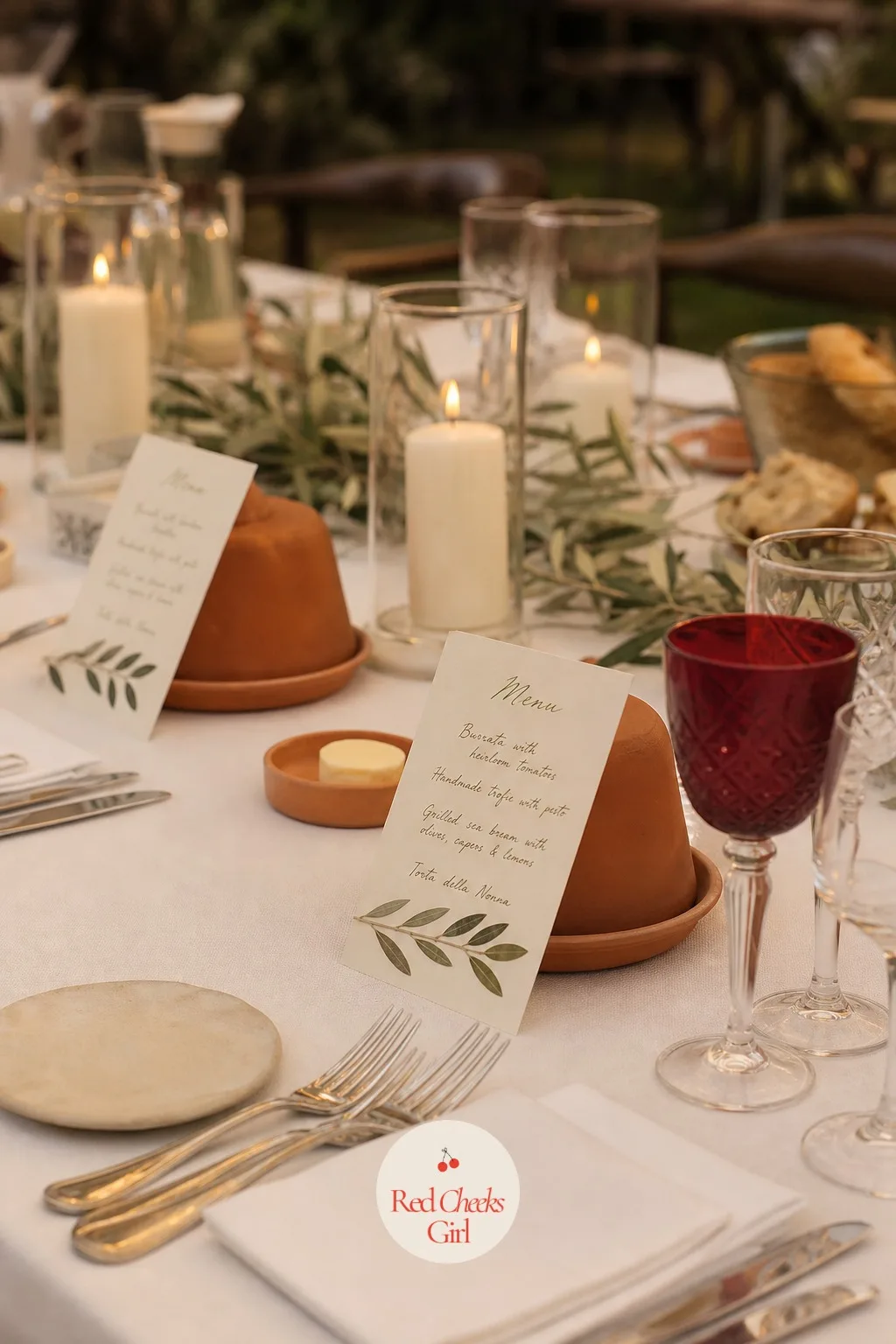
A menu propped in a stand looks like a hotel breakfast buffet. Lean it instead against the terracotta butter dish already sitting on the table, small cream cardstock listing the courses in olive or wine ink with a tiny printed olive branch along the bottom edge.
Give the printer or calligrapher this: cream menu cards, about six inches tall, wine-red or olive ink, a single pressed olive branch motif along the base, printed or hand-lettered.
Ten or twelve cards are manageable by hand over one evening with a decent pen. Order a printed run for anything over thirty guests. A small chalkboard propped the same way against the butter dish works if cards feel like one detail too many.
The Food and Drink Everyone Lingers Over
Nothing here is plated and whisked away. These are stations guests return to twice, built to be picked at slowly over several hours rather than rushed through on a schedule.
The Cheese and Wine Table
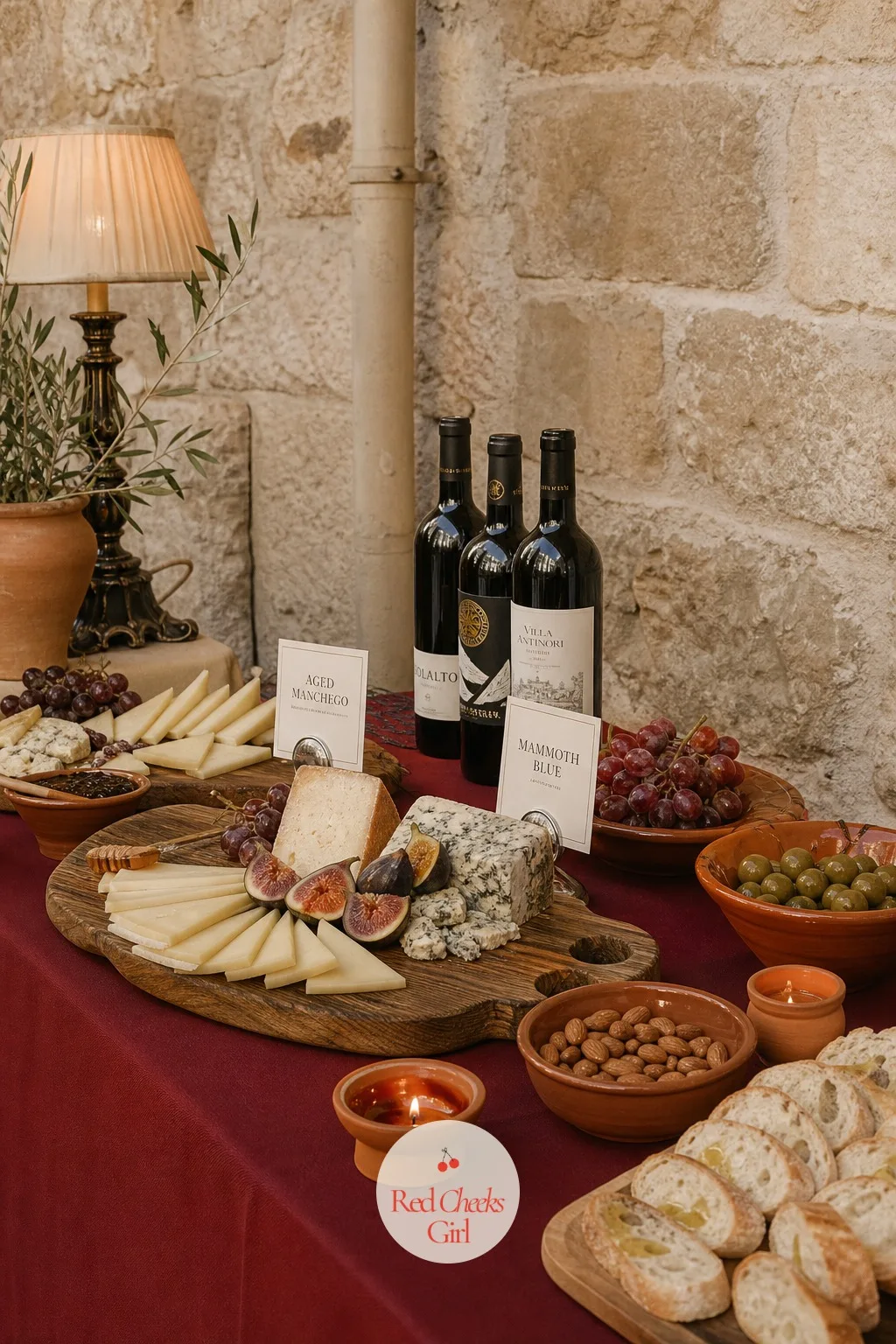
One station does the job of a dessert table and a late-night snack both. A wine-red cloth covers the sideboard, wooden boards and marble slabs stack on top with wedges of cheese, figs and grapes, terracotta ramekins of olives and almonds tucked between them.
Bottles of a dry red stand upright at the back, each cheese carrying its own small chalkboard or cream tag.
Brief the caterer: a mixed board of four or five European cheeses, fresh figs and grapes, terracotta dishes of olives and marcona almonds, bottles of red displayed upright, labeled tags per cheese. Assembling the board herself is genuinely one of the cheapest, most forgiving parts of the day.
Order the wine on a sale-or-return basis from a local shop, and scale it down to a single board on the dinner table if a full station is too much for the headcount.
A Terracotta Urn of Chilled Rose and Spritz
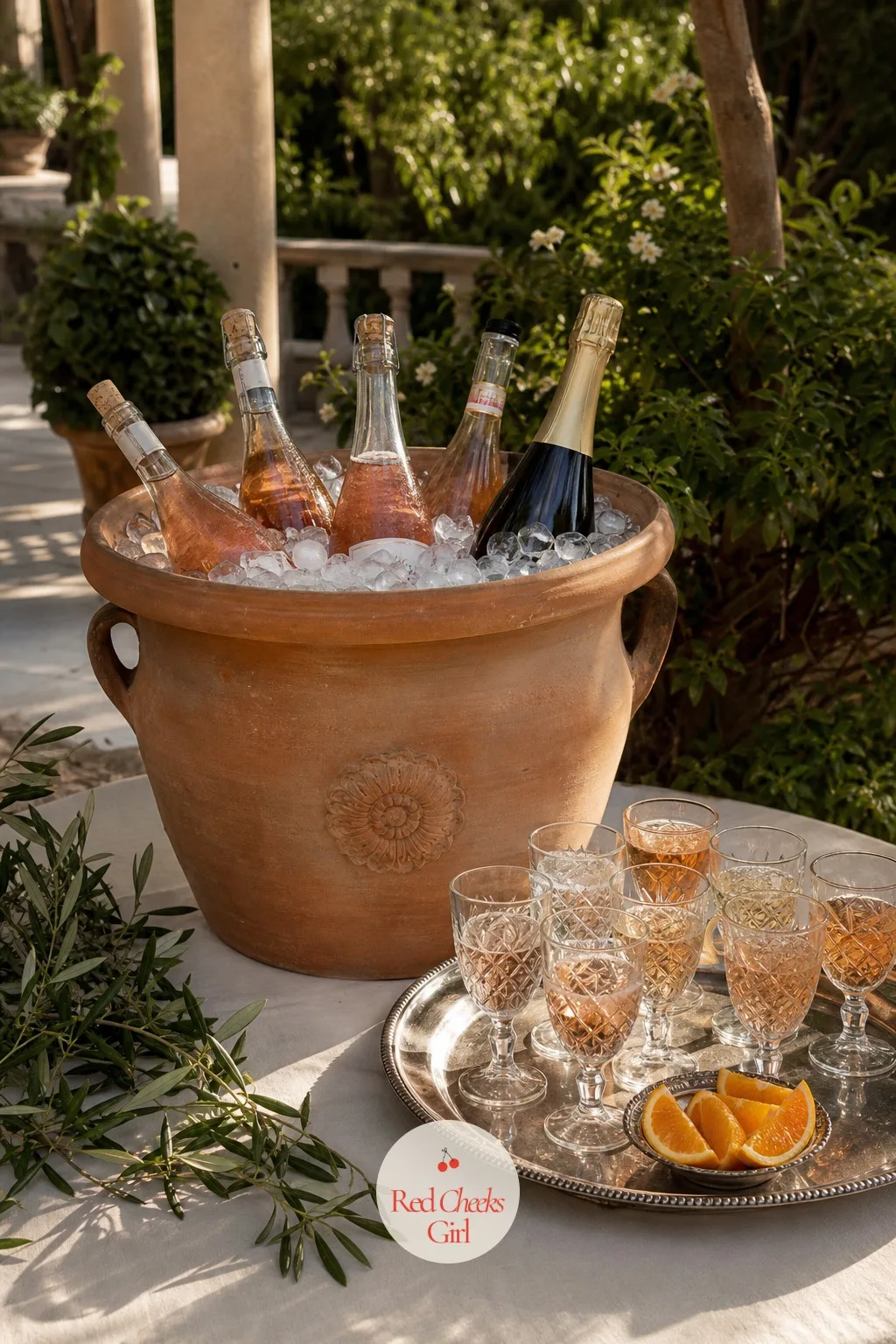
A bar cart feels formal for an afternoon that is meant to drift. A large terracotta urn, packed with ice, holds the bottles instead, with a tray of glasses and a scatter of orange slices and whole olives set beside it.
Brief the bartender or caterer: a large terracotta urn packed with ice, bottles of chilled rose and a prosecco for spritz, garnish of orange slices and olives, self-serve with one tray of glasses alongside.
Any large terracotta planter with a liner works, making this the cheapest station on the whole list to build herself. Order the drinks ready-chilled if the morning is already busy. A galvanized tub wrapped in terracotta-toned fabric stands in where a true clay urn is too heavy to move.
A Late Dessert of Stone Fruit and Honeycomb
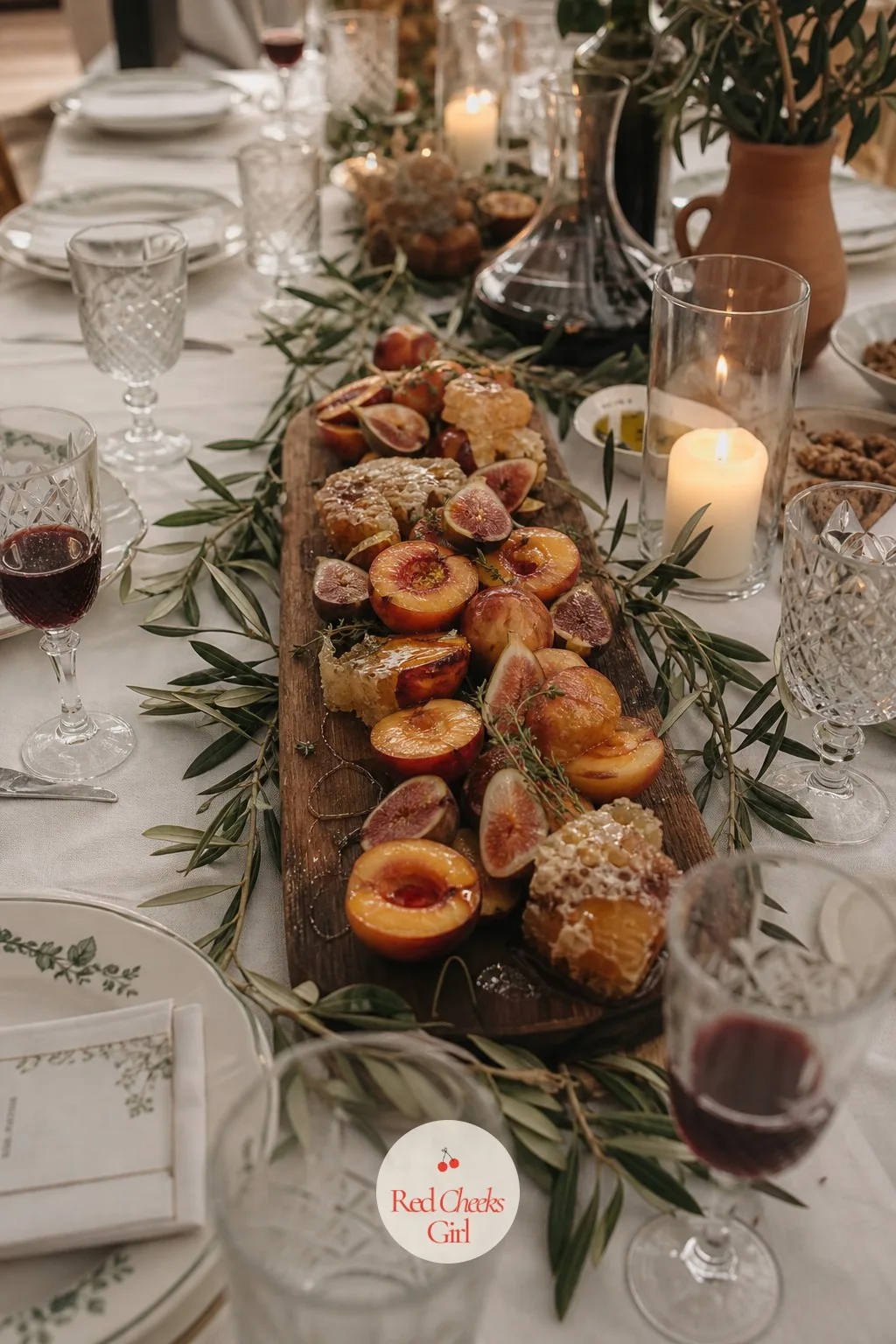
A plated dessert breaks the mood of a dinner that has been family-style all night. Keep it the same way instead: a wooden board carries halved peaches and figs in loose rows with a full chunk of honeycomb set in the centre and a few olive leaves tucked at the edge.
Brief the caterer: a shared dessert platter of halved peaches and figs, a full piece of honeycomb and a soft cheese, served family style down the table, no individual plating.
This one is almost entirely a trip to a good market the morning of, no baking required. Order the honeycomb specifically, since it is the one genuinely hard-to-source item. A bowl of cherries steps in easily when stone fruit is out of season.
What the Bride Wears and Carries
Two small, personal pieces carry the whole palette onto the bride herself, away from the tables and into what she actually wears and holds for photographs.
Veil with a Hand-Embroidered Phrase
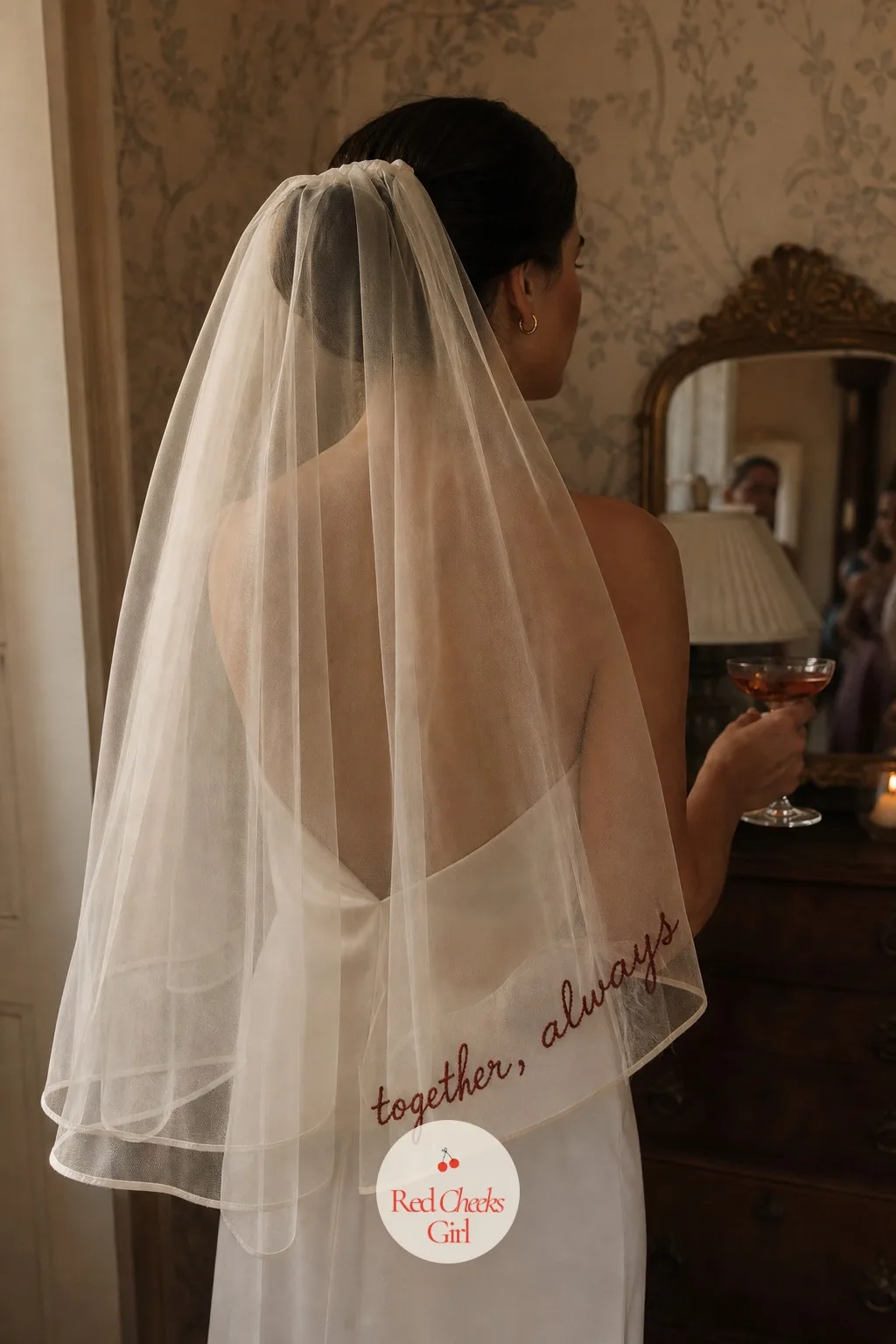
A plain veil can feel like it is missing something personal, and lace trim is not always the answer. A single layer of cream silk tulle carries a short phrase stitched along the bottom edge in wine-red thread instead, reading simply together, always, attached at the crown with a small comb.
Brief the seamstress or embroiderer: a single layer cream silk tulle veil, cathedral or fingertip length, one short phrase hand-embroidered along the bottom edge in wine-red or olive thread, no lace trim.
Embroidering a short phrase herself is a lovely, slow project if she sews even a little. Order it from an embroiderer for anything longer than a few words, or close to the deadline. A single initial or a date keeps both the cost and the time down.
Bread Basket Purse for the Bride
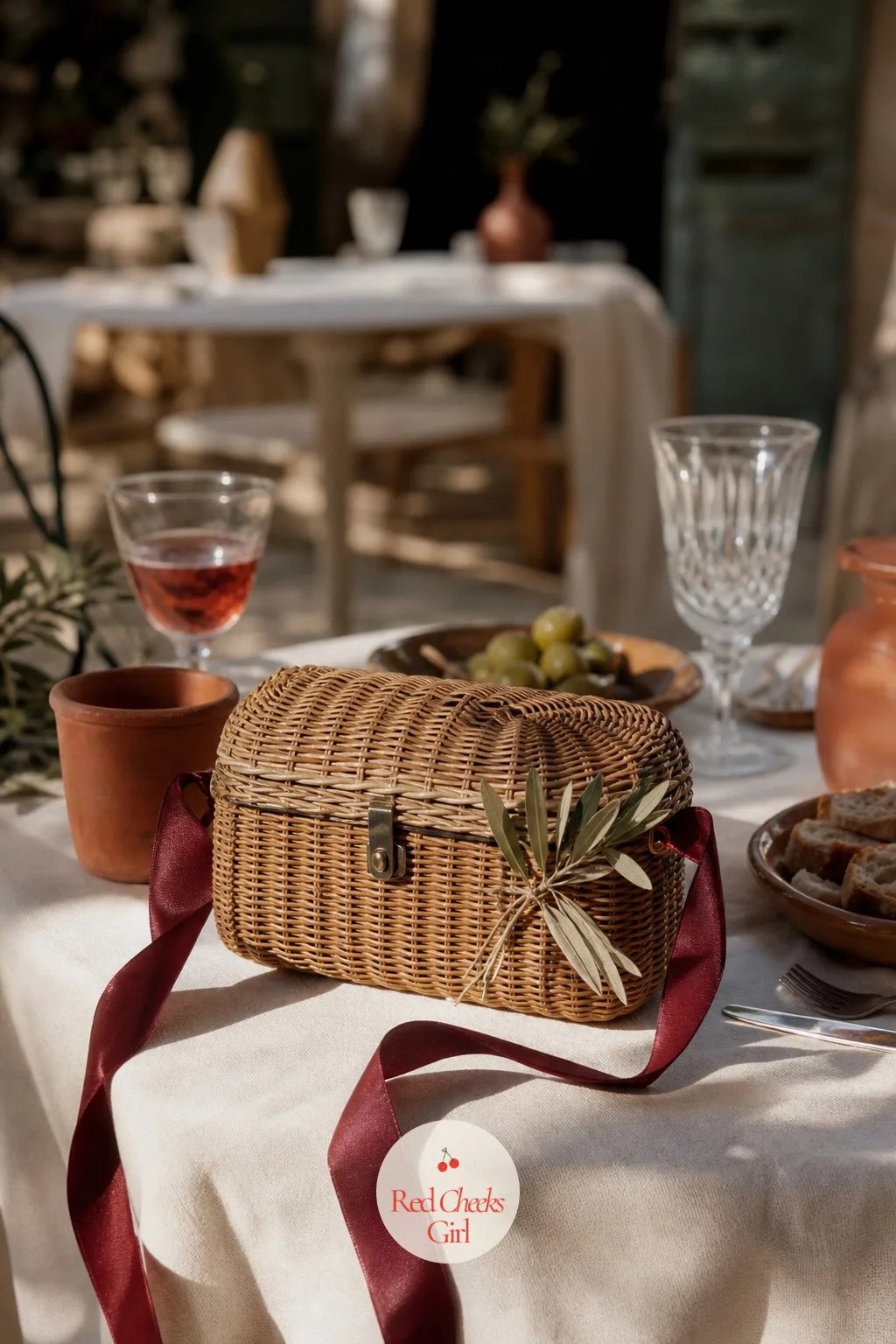
Carrying a clutch through cocktail hour at a dinner this food-led feels almost ironic, so let it play along. A small woven rattan basket, lined in cream satin, carries a wine-red ribbon strap and a few dried olive leaves wired to one side, shaped unmistakably like a mini bread basket.
Brief the maker: a small woven rattan clutch shaped like a mini bread basket, cream satin lining, a wine-red ribbon strap, a few dried olive leaves wired to one side.
A basic rattan clutch base with a hand-sewn lining is very doable over a weekend. Order it ready-made from a small maker if sewing is not her thing. A plain rattan box clutch without the basket weave works if the exact shape proves hard to find.
What the Guests Do All Night
This is where the evening stops being decor and starts being a party. For more ways to get a room singing, toasting or just moving, the best wedding games for every celebration round out the night.
Piano Karaoke Finale
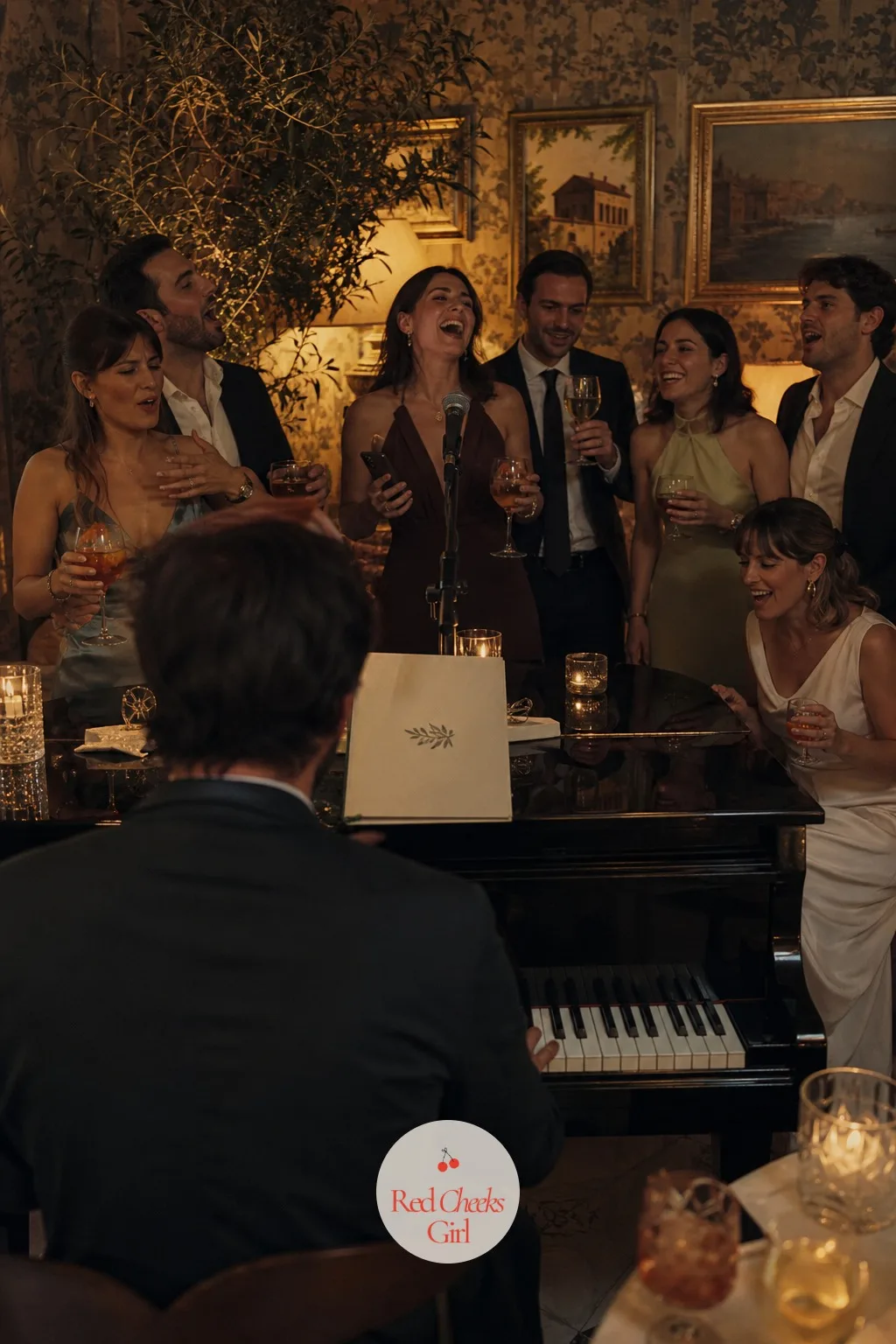
A DJ booth can feel like it belongs to a different party by midnight. Pull a piano into the centre of the room instead, a wireless microphone on a stand beside it, and a small cream songbook stamped with an olive branch resting on the lid.
Brief the band or planner: one piano, a wireless microphone, a printed songbook of twenty sing-along songs in a cream cover with an olive branch stamped on it, set up for the last hour of the night.
After the final toast, someone hands the songbook around and calls up the first singer, then it runs as open floor for the rest of the evening, usually the loosest and loudest part of the whole night.
No pianist in the family is no obstacle, a backing-track app through the venue speakers works just as well, and by then no one needs much convincing to sing!
🛍 Shop this look
A Long-Table Toast with Passed Crystal Coupes
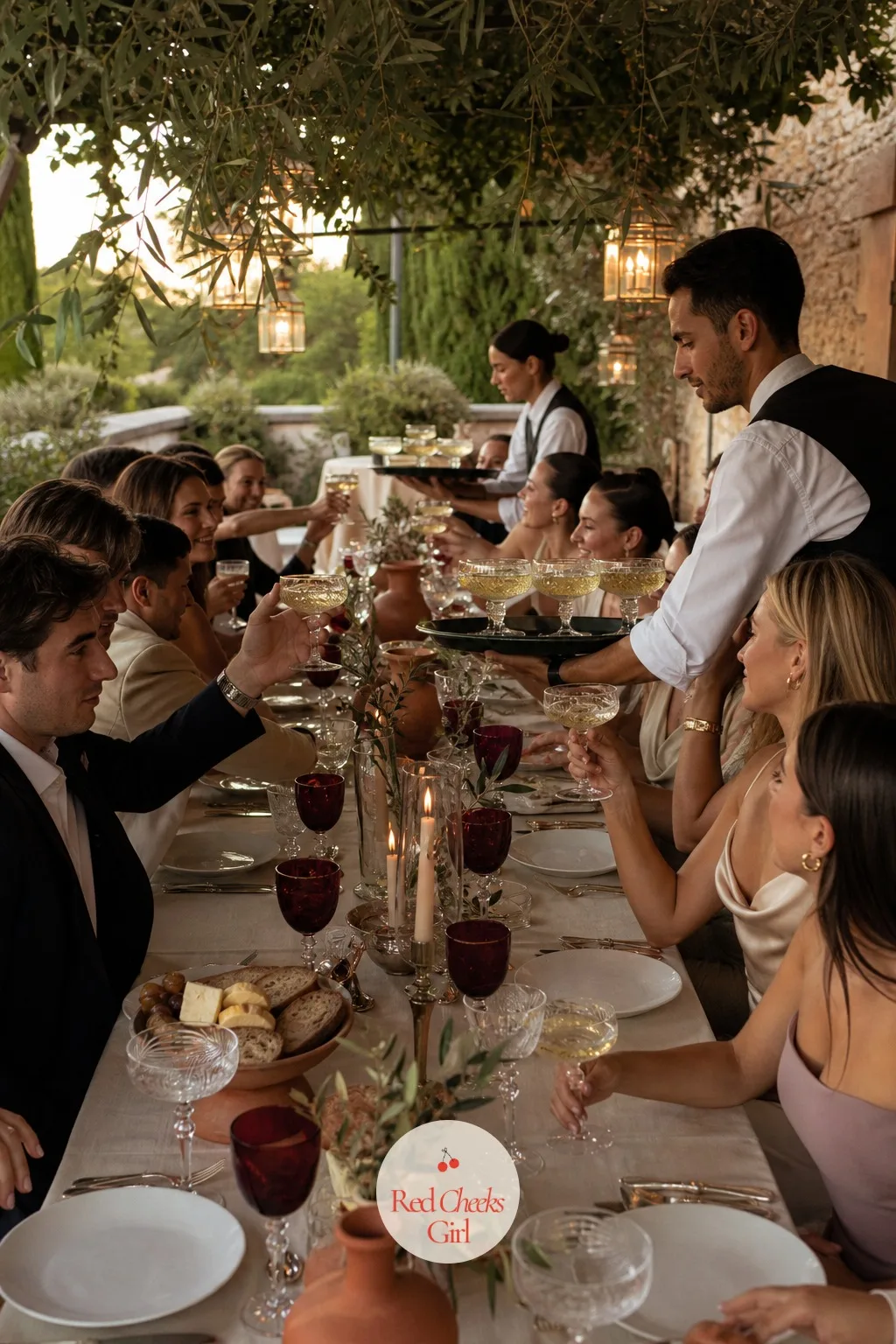
Waiting for a server to pour one glass at a time kills the energy of a toast. Trays of pre-filled crystal coupes move down the long table instead, guests half-rising with glasses already in hand, olive branches strung overhead catching the light.
The toast moves by relationship rather than seating order, usually opened by the best man or an aunt, finishing with the couple themselves, with waitstaff refilling through dessert rather than collecting glasses.
Brief the venue or caterer: pre-poured crystal coupes passed on trays at the toast cue, roughly one per guest, refilled rather than collected. Hand the whole thing to a host rather than the venue for a smaller wedding, and simply pass bottles hand to hand down the table instead of using trays.
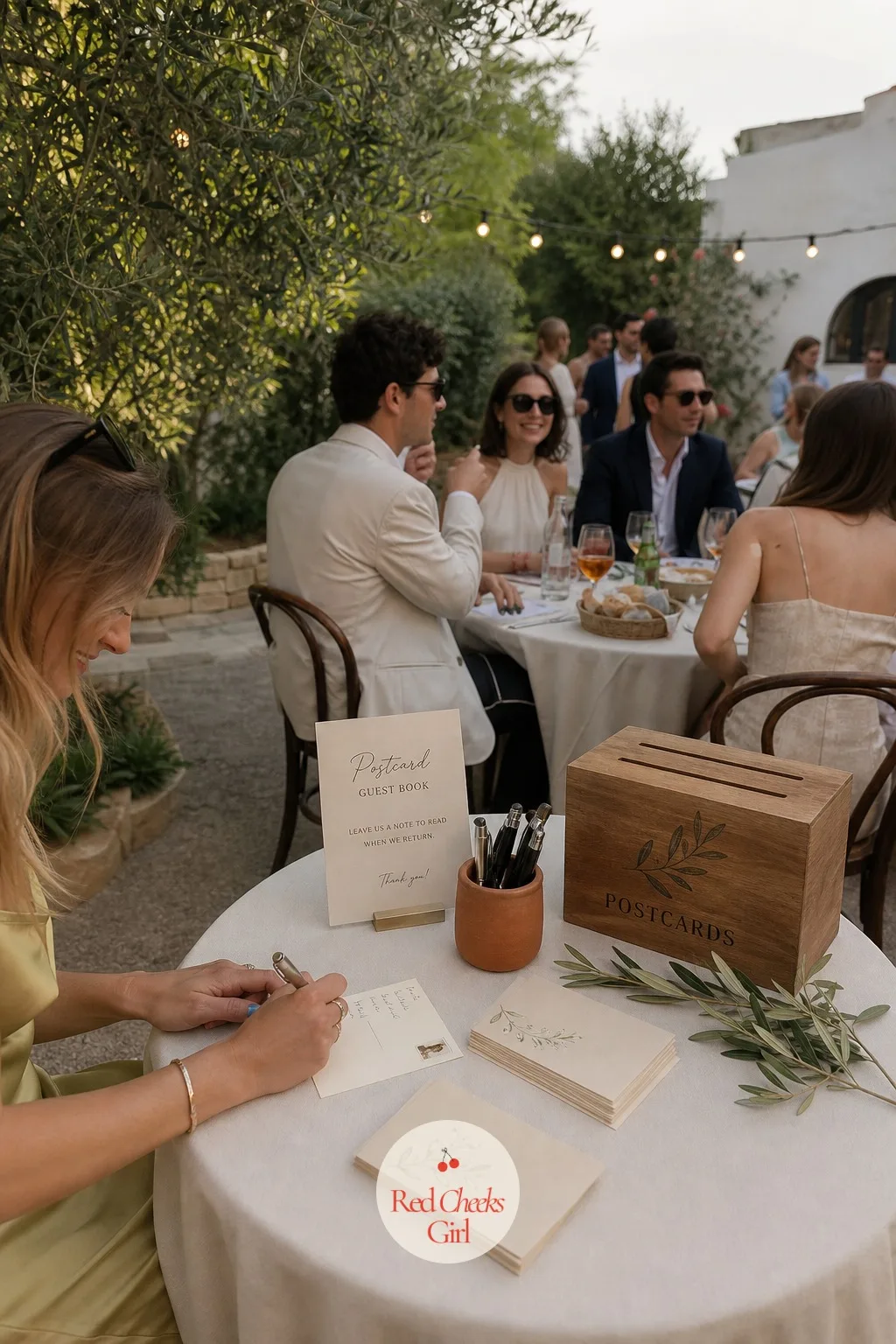
A Postcard Guest Book at a Cafe Table
A guest book sitting by the door rarely gets touched after the first hour. A small bistro table does better work, stacked with blank cream postcards printed with a line drawing of an olive branch, a terracotta cup of pens and a slotted wooden box standing beside it.
Guests write a note any time during cocktail hour or dinner and drop it into the box, for the couple to read together the next morning instead of at the reception itself.
Brief the stationer: cream postcards, a simple line illustration of an olive branch or the venue on the front, blank on the back, printed one per guest. A local printer runs these cheaply from a single drawing. A disposable camera at the same table works if photos matter more than notes.
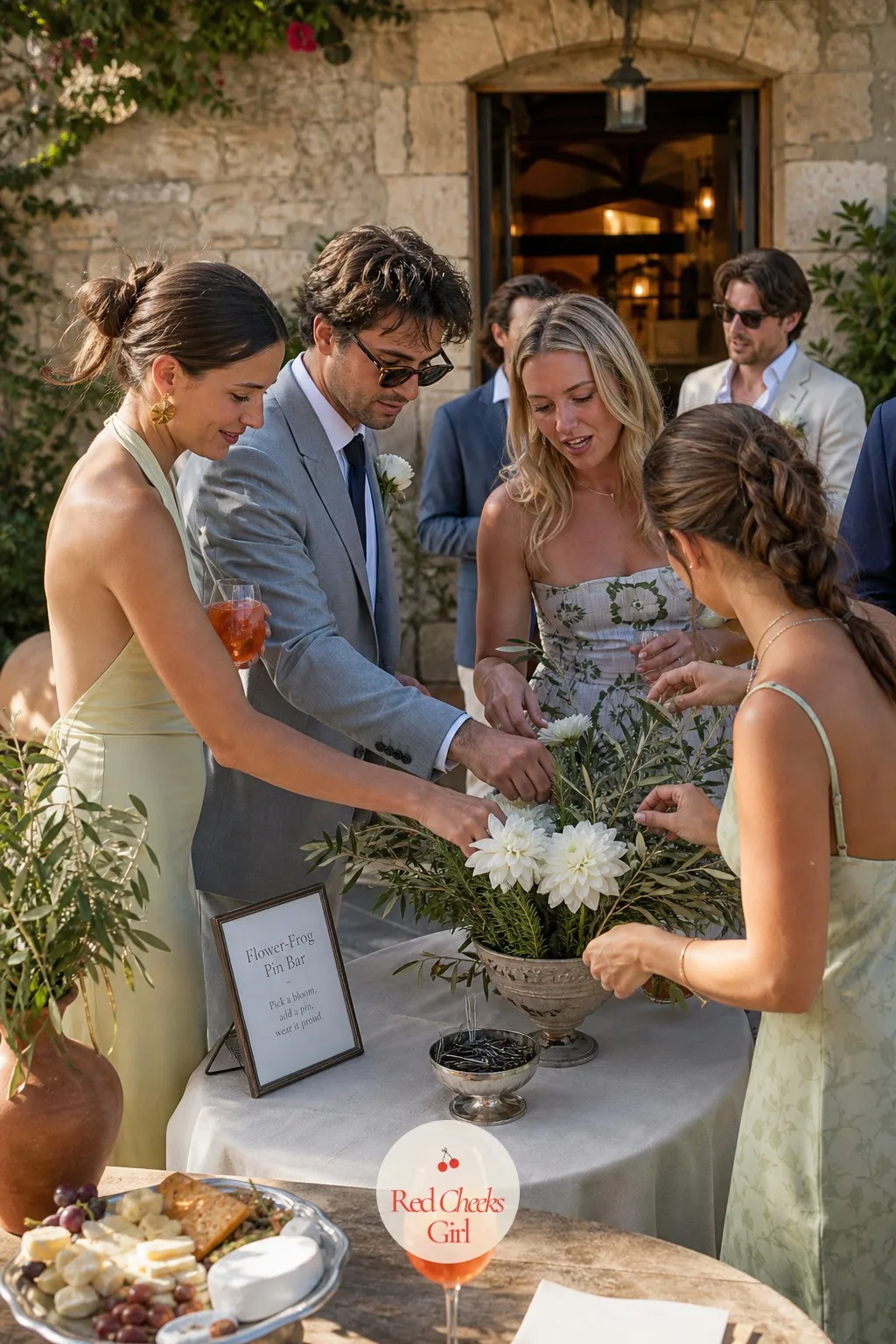
A Flower-Frog Pin Bar for Guests’ Buttonholes
Pre-made boutonnieres sitting in a box by the door often get forgotten entirely. A low vintage bowl with a flower frog does better, holding loose stems of olive, rosemary and a spare dahlia head or two, with floral pins and tape set out beside it.
Guests pick a stem on the way in and pin it on themselves, or ask a bridesmaid stationed nearby for help, no formal instruction needed.
Brief the florist: a self-serve stem bar, one low bowl with a flower frog, a mix of olive, rosemary and spare dahlia heads, floral tape and pins beside it for twenty to thirty guests.
It runs entirely on flowers left over from the centerpiece order. Skip the frog and lay the stems loose in a shallow dish if buying a second batch feels like overkill.
The Little Things They Take Home
The smallest objects in the whole celebration, the ones that travel home in a handbag or a coat pocket, still carry the same cream, olive, terracotta and wine red through to the very last detail.
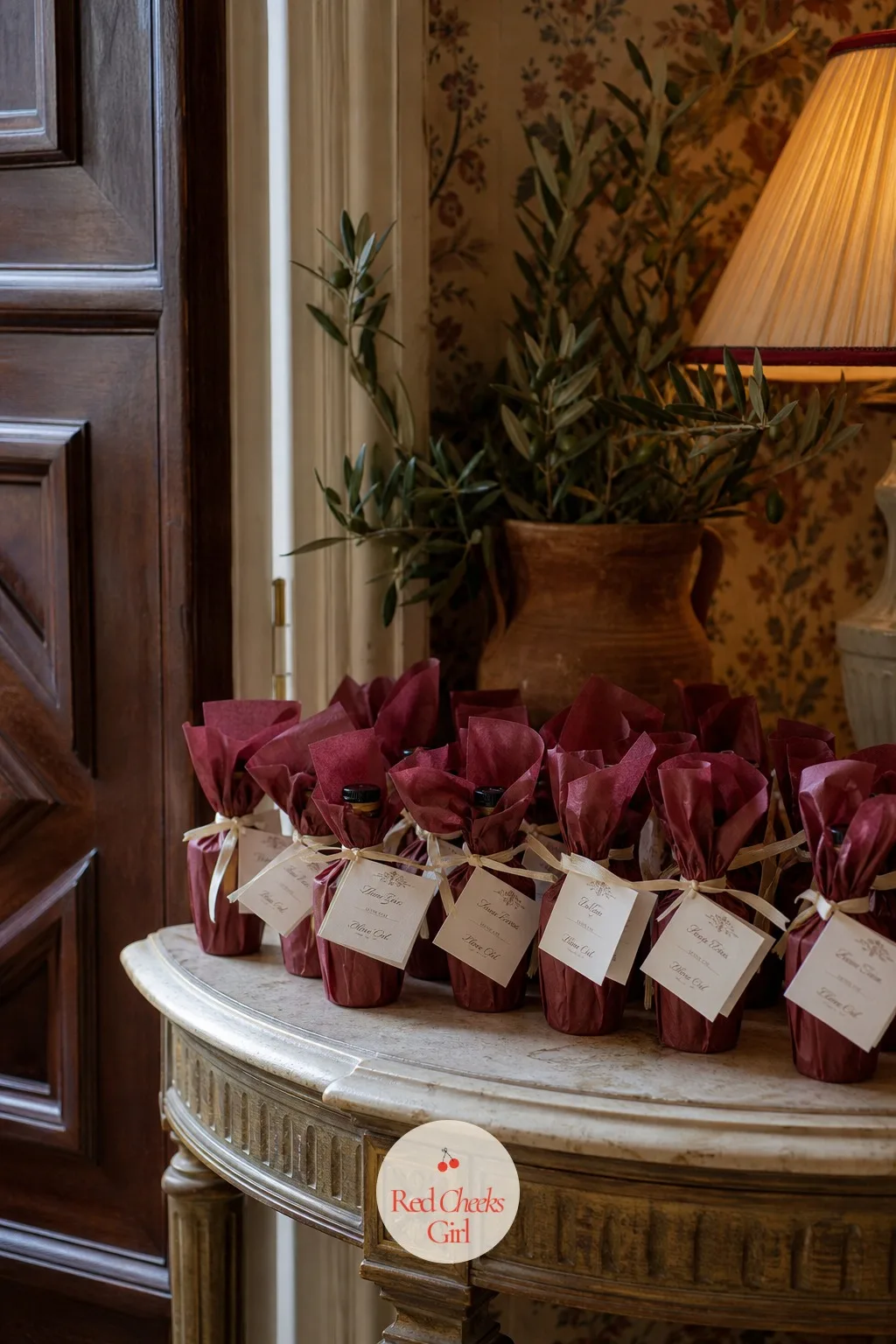
Olive Oil Favors Wrapped in Wine-Red Wax Paper
A favor that sits unused on a shelf afterward is money spent for nothing. A small bottle of olive oil earns its place instead, wrapped in wine-red wax paper and tied with a thin cord, a cream tag threaded through bearing the couple’s names.
Brief the supplier: mini olive oil bottles, about one hundred milliliters each, wrapped in wine-red wax paper, cream tag with the couple’s names and the date, tied with a thin wine-red cord.
Wrapping a hundred bottles over a few evenings is genuinely doable and oddly satisfying. Order the oil itself from a specialty shop rather than decanting it herself. A small jar of tapenade travels easier for out-of-town guests if oil feels tricky to pack.
Terracotta Votive Favors with a Pressed Herb
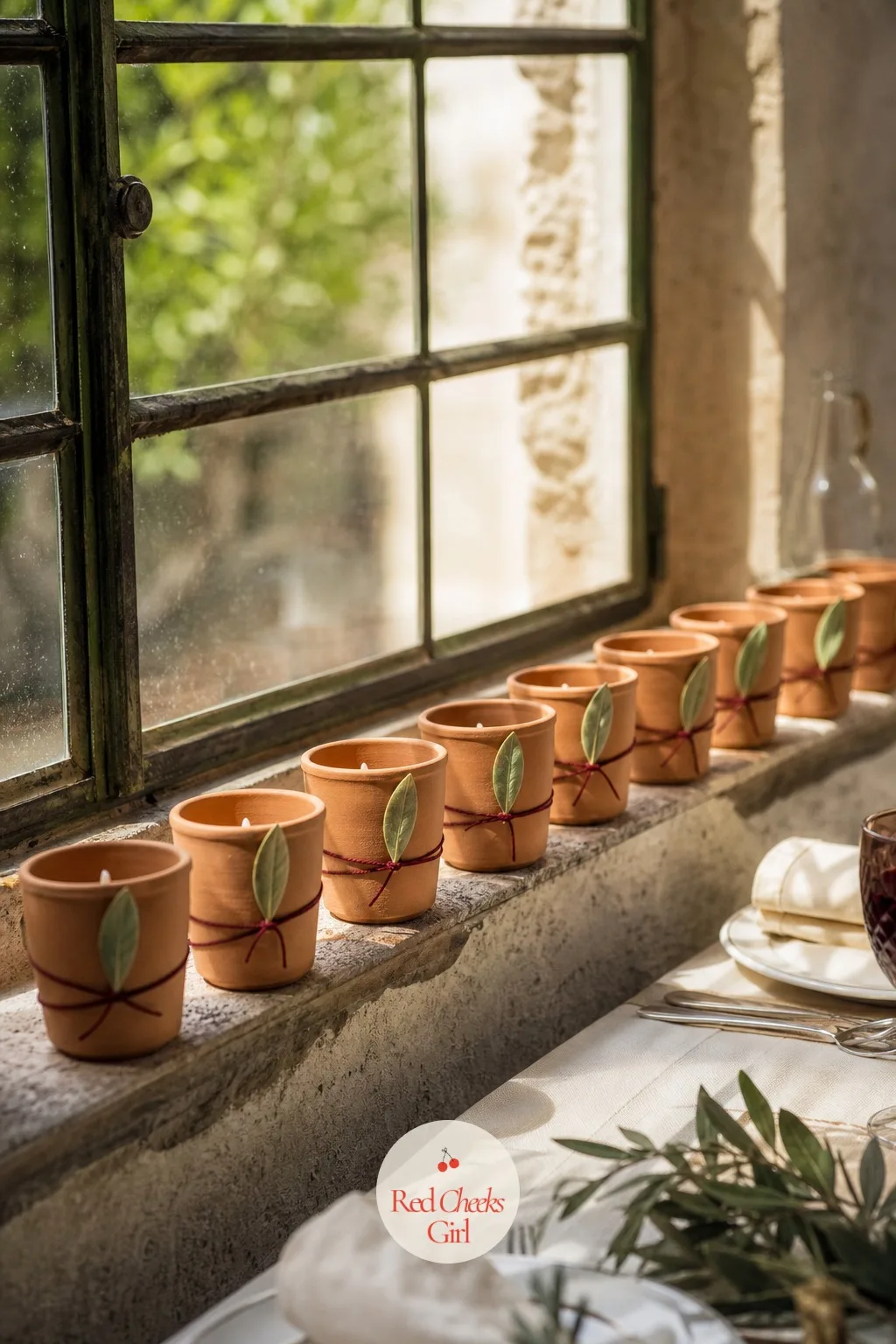
A favor that doubles as table decor earns its spot twice over. A small terracotta votive holder sits at each place, a tea light inside, a single pressed olive leaf tied around the rim with a short length of wine-red thread.
Brief the supplier: small terracotta votive holders, one tea light each, a single pressed olive leaf or rosemary sprig fixed to the outside with wine-red thread.
Pressing leaves takes about two weeks, so start early, though the assembly itself is one easy evening. Order plain terracotta votives in bulk rather than painting her own. A single dried bay leaf stands in nicely where olive leaves are not easy to find locally.
🛍 Shop this look
The Invitation
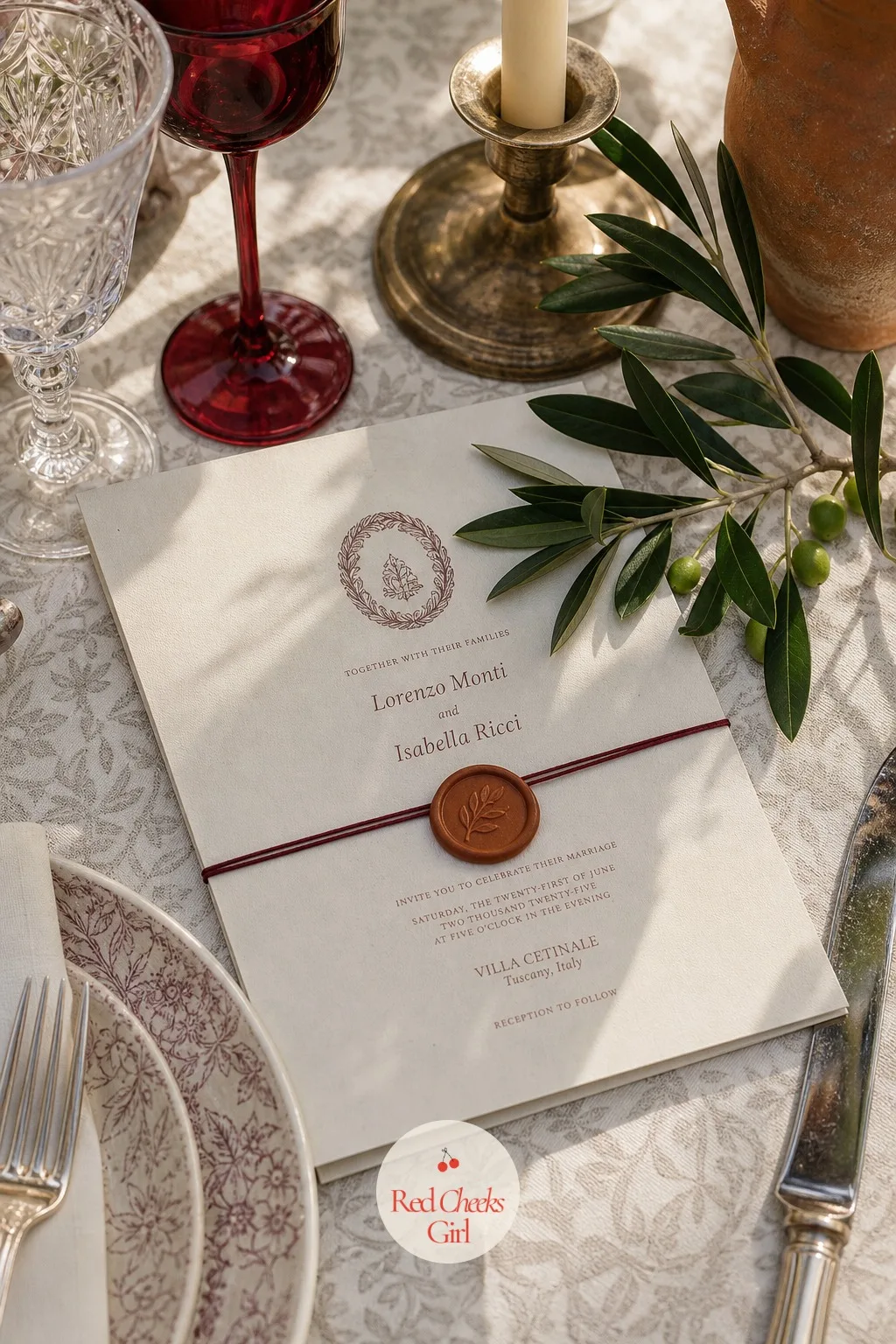
The invitation is the first thing anyone sees, so it carries the whole palette before a single guest arrives. Cream cardstock in wine-red ink, a terracotta wax seal stamped with an olive branch pressed at the flap, the whole suite tied with a thin wine-red cord.
Brief the stationer: cream cardstock invitation, wine-red or olive ink, an olive branch motif pressed into a terracotta wax seal, a thin wine-red cord tying the suite together.
A home wax seal kit handles the stamp beautifully and cheaply. Order the printing itself for crisp type rather than attempting that part by hand. A printed olive branch line drawing in the corner works just as well if a wax seal feels like one more thing to post.
🛍 Shop this look
Frequently Asked Questions
What is the European wedding aesthetic?
European wedding aesthetic means a slow, intentionally unstyled elegance built on old glassware, soft linens and long shared meals rather than a fully matched, florals-heavy look. The style favors intentional, understated choices over opulence, with antique vessels and warm, golden light setting the mood.
What colors are used in a European wedding?
European weddings tend to run a layered, natural palette, often neutrals and deeper tones mixed with texture rather than one bright colour. Colour is treated as a thread running through the stationery, tablescape, flowers and fashion together, which is exactly why this cream, olive, terracotta and wine red mix works.
What’s the difference between a European wedding and an American wedding?
European weddings generally put less emphasis on the bride as the sole focus and more on family, food and atmosphere than on a heavily styled day. One noted difference is a proceeding that leans less bride-centric, favoring fun and good food over polished perfection.
What should guests wear to a European wedding?
Guests dress with quiet polish rather than high drama, favoring tailored, breathable pieces over anything heavily embellished. The style rarely relies on visible effort, since elegance there comes from proportion, fabric and structure rather than dramatic styling.
Can you get a European wedding look without travelling to Europe?
Yes, the look comes from venue character and styling choices more than geography, so a local garden, historic hall or vineyard can stand in easily. Details like columns, crown moulding, vintage rugs and lush greenery are what create that old-world atmosphere, wherever the venue actually sits.
34 bridal shower decorations, zone by zone, from a balloon arch backdrop to peach glassware and plac
27 black and white wedding decor ideas, from a striped tent to the send-off table, each one built to
16 lily of the valley wedding ideas: tiny bouquets, moss centerpieces, teacups, sugar-bell cake and
Leave a Reply