

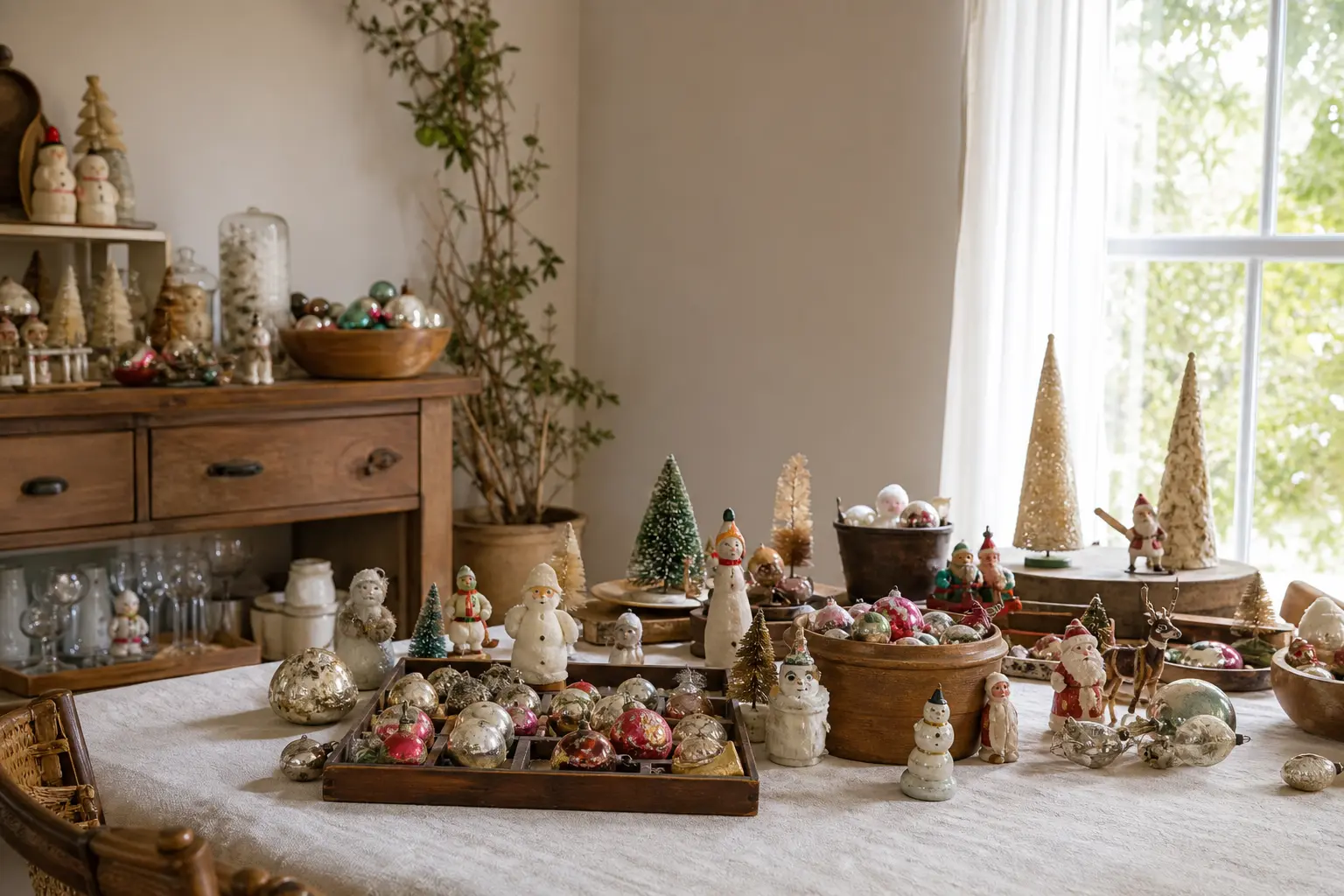
Vintage christmas decor is the best value in seasonal decorating, until you bring home three boxes from three different decades and none of it sits together.
A Shiny Brite bauble next to a ceramic light-up tree next to a foil icicle feels like a jumble sale, not a considered room.
The fix is simpler than it looks: pieces from the same era share a colour logic and a material logic, and they behave.
Every entry tells you what to look for, what the telltale signs of authenticity are, and what a realistic car boot price is. The palette that threads through all of it: mercury silver, antique gold, faded red, bottle green, and cream.
For more context on building a whole room, read the full guide to christmas decor. If you are working with a mantelpiece specifically, the article on vintage christmas mantle decor goes deeper on that one surface.
This post contains affiliate links. If you buy through them, I may earn a small commission at no extra cost to you.
1930s: German Handcraft at Its Peak
The nineteen-thirties represent the last decade of largely handmade German ornament production before the war disrupted supply chains permanently. Everything from this era is light, fragile, and slightly asymmetrical in a way that machine production never replicated.
The colour palette is exactly the one that works here: muted mercury silver, deep bottle green, cream, and a brick-toned red that has nothing in common with modern scarlet.
Car boot prices for genuine thirties pieces sit between two and twelve pounds depending on condition and whether the seller knows what they have. Chips and minor paint loss are expected and do not diminish the decorative value. Avoid anything with a uniform, bright finish, because that is a reproduction.
Hand Blown Glass in Muted Colours
These are the ornaments that started everything.
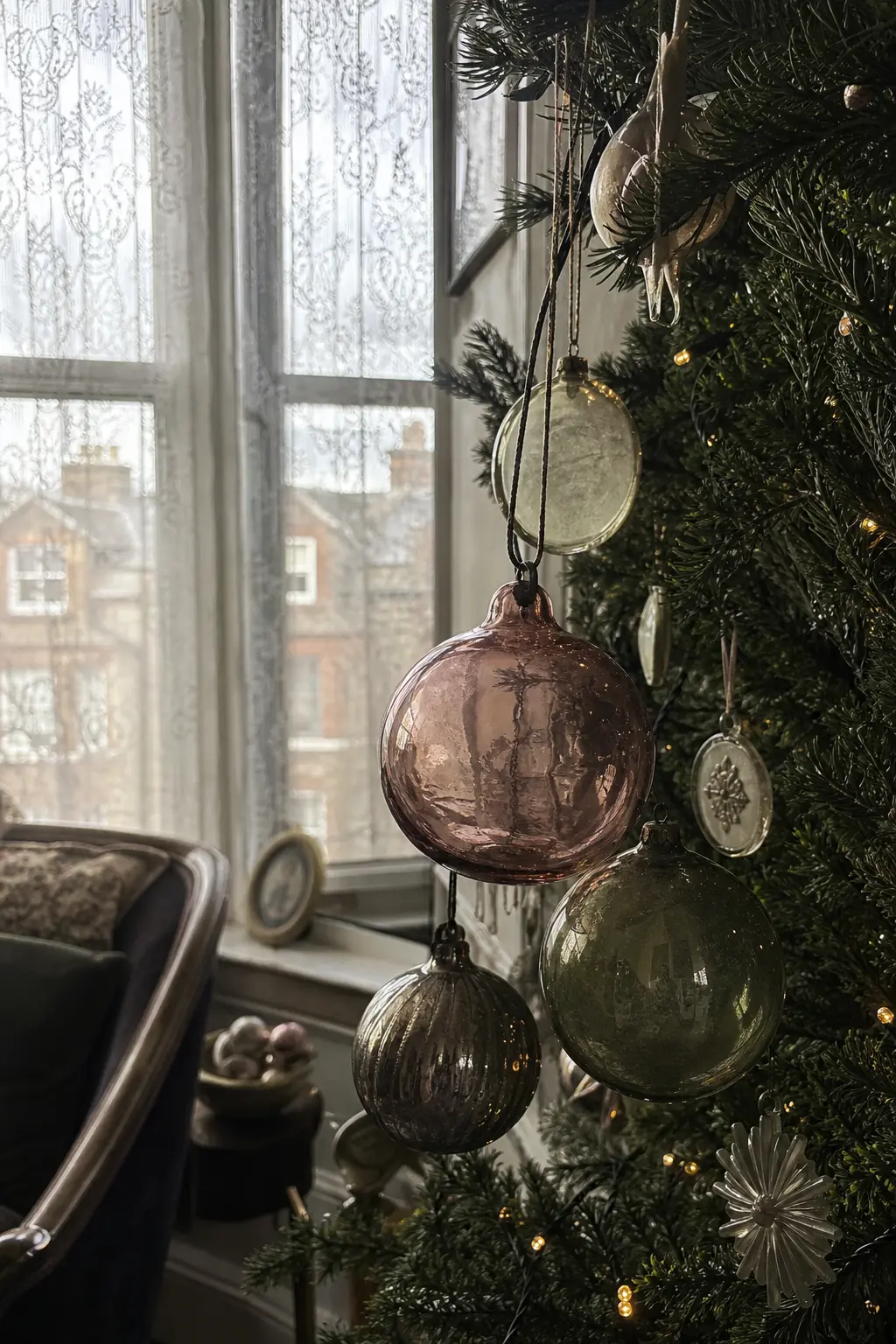
Made in the Lauscha region of Germany, they were blown by hand into moulds and silvered from the inside, then painted in the colours that now read as definitively vintage: dusty rose, sage, pale cobalt, and a warm cream. The muted finish is the giveaway.
Anything with a hard, bright, even colour is a reproduction.
Look for slightly irregular shapes, a seam line that does not quite match up, and a cap that is separate from the glass rather than moulded on. Weight matters: genuine hand-blown glass is almost nothing in your hand. At car boot sales, expect one to eight pounds per ornament, more for intact sets in original boxes.
On a tree, group them in clusters of three odd numbers, never pairs. Odd numbers read as collected; pairs read as kit.
🛍 Shopping guide
Mercury Glass Kugels
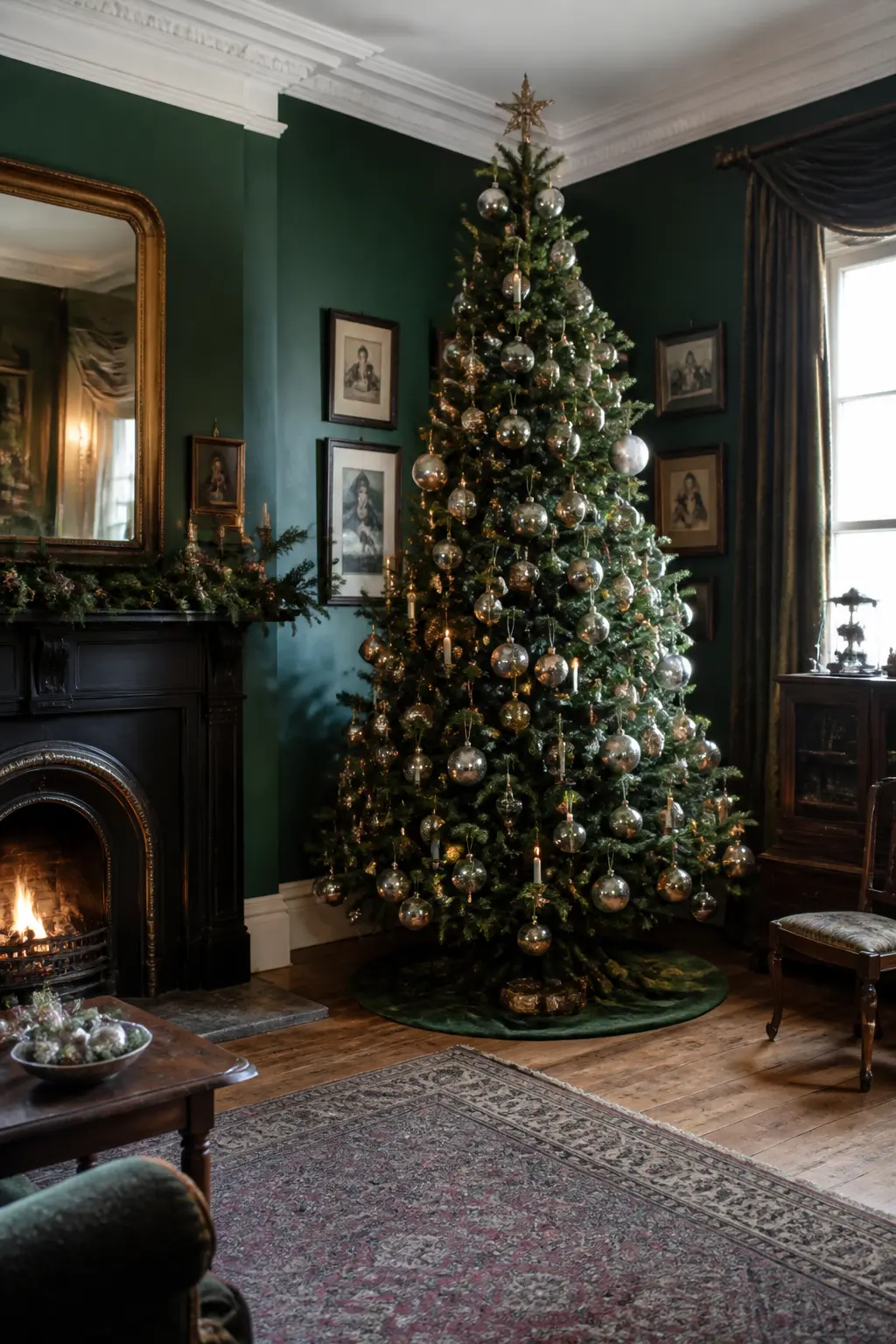
Kugels predate the bauble by decades, but the ones you find at car boot sales are usually from the nineteen-twenties through the nineteen-forties.
They are heavier than a standard ornament, with a thick glass wall and a dense silver or gold interior that reflects light in a way nothing modern replicates. Round kugels are most common.
Grape-cluster and teardrop shapes cost more and are worth the premium if the hang point is intact.
The authentic test: hold it up to a lamp. Genuine mercury glass has a warm, slightly uneven reflection with depth. Reproduction mercury glass looks flat and thin, like a mirrored balloon. Car boot price: two to fifteen pounds for a round, more for coloured examples in green or gold.
Kugels are heavy enough to pull branches down, so hang them on the inner, sturdier branches rather than the tips. They need no company: one per section of tree is enough.
🛍 Shopping guide
Spun Cotton Figures
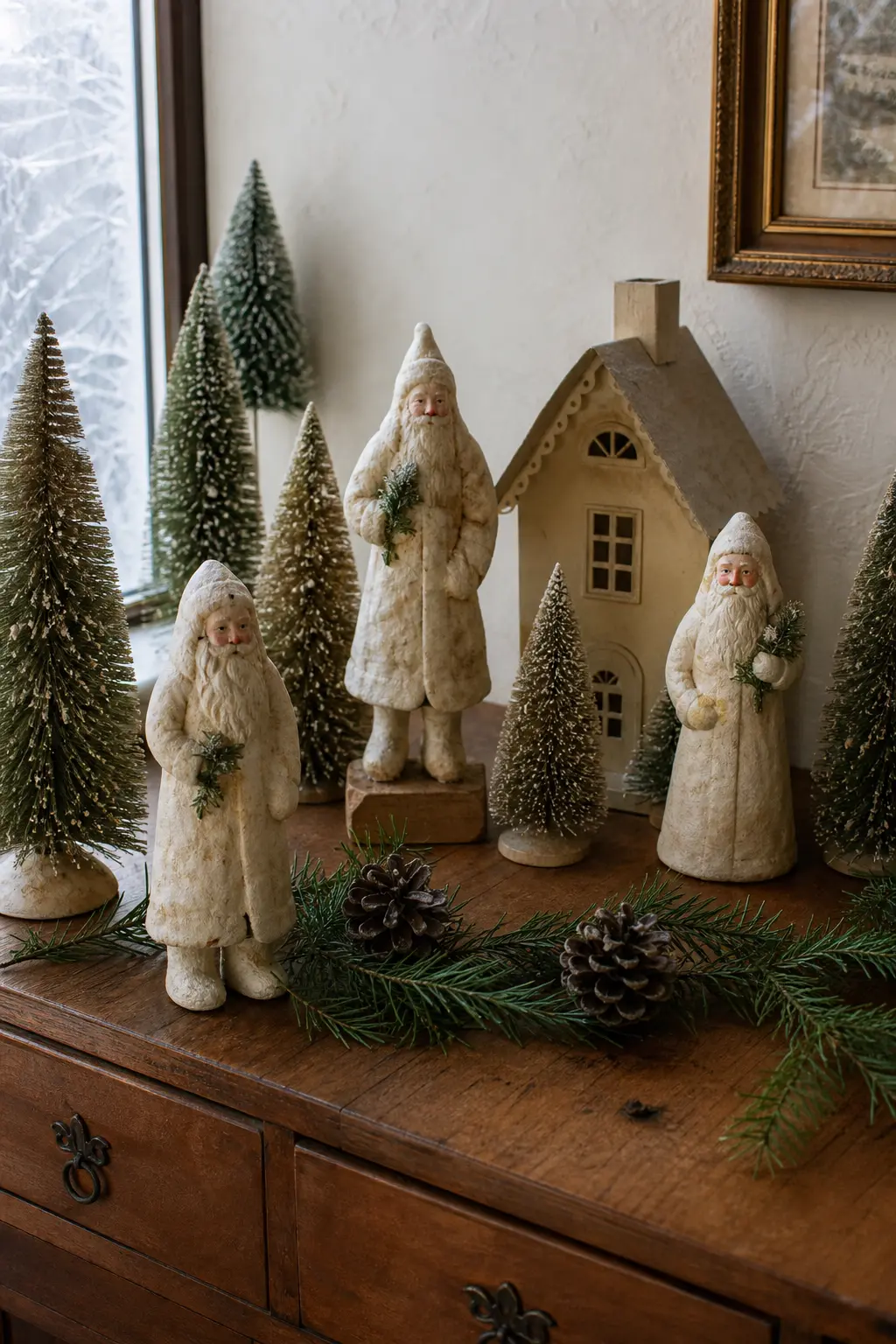
Spun cotton figures from the thirties are among the most tactile and strange ornaments you will find. Cotton was wound wet over a wire armature or a mould, dried hard, and then painted by hand.
The results are Father Christmases, rabbits, snowmen, and fruit, all with a slightly lumpy, handmade quality that photographs beautifully and costs almost nothing at car boot sales: fifty pence to four pounds per figure is standard.
The telltale sign of genuine age is paint that has soaked into the cotton fibres rather than sitting on top of them. Flaking paint on the surface is acceptable. A shiny, sealed exterior is not: it is a reproduction. Chenille pipe cleaner figures from the same era make excellent companions, because both are soft, matte, and clearly handworked.
Use them in groupings on a mantel, inside a cardboard putz house village, or wired to a wreath. They are too fragile and too precious to hang on a branch where they will swing and knock against glass.
🛍 Shopping guide
Cardboard Putz Houses
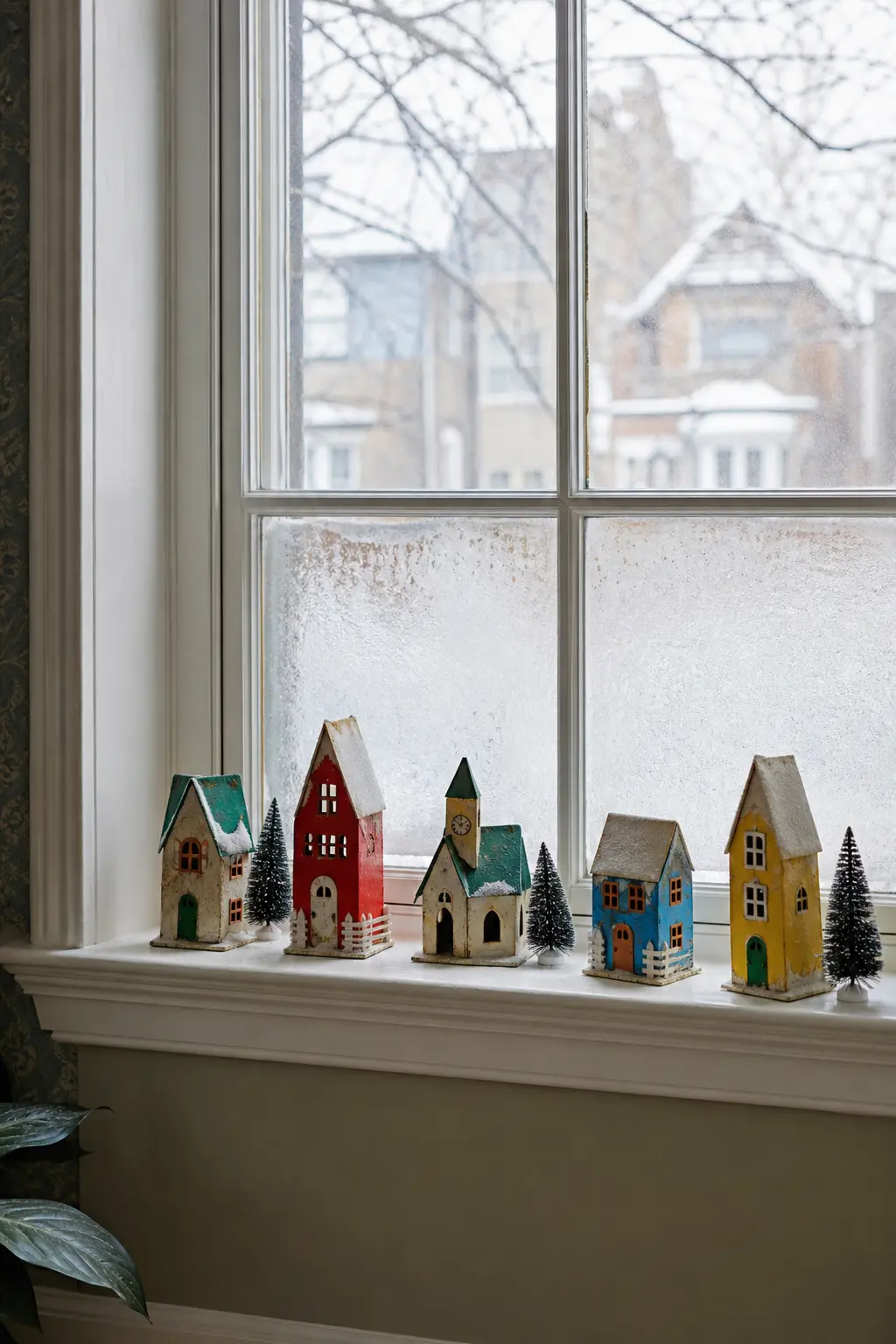
A putz is a nativity-adjacent village scene, and the cardboard houses made for it from the nineteen-twenties through the forties are one of the best-value finds in vintage Christmas.
They were lithographed, scored, and folded flat for storage, which means the printing is often still crisp even on genuinely old examples. Mica dust on the roof gives them their sparkle, and that mica is safe for adult display.
Look for houses with tabs still intact on the fold lines. A house that has been glued shut cannot be stored flat and has usually suffered moisture damage inside.
Car boot price: one to five pounds per house, more for complete village sets with the original tissue-paper wrapping. Arrange them on a mirror tile to suggest ice, with bottle brush trees between them and a spun cotton figure or two on the path.
🛍 Shopping guide
Glass Bird Clips with Spun Tails
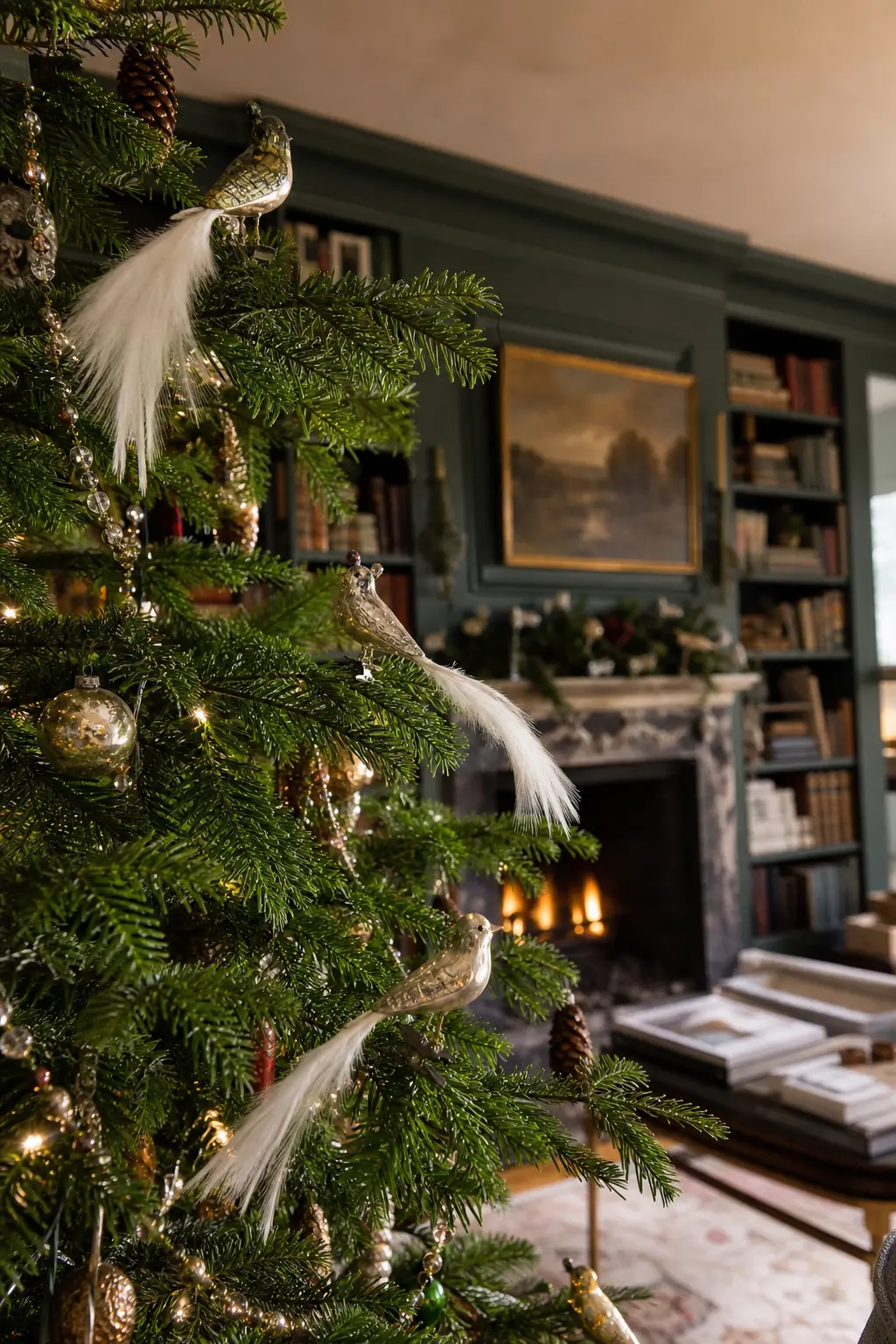
Glass bird ornaments with wire-spun fibre tails are among the most recognisable German Christmas ornaments and have been produced continuously since the eighteen-eighties, which makes dating a specific example genuinely difficult. The pre-war versions have hand-painted details and real feathers occasionally mixed into the tail.
Post-war versions, still from the fifties and sixties, use spun glass or nylon fibre for the tail exclusively.
The clip is the most useful dating clue. A forked wire clip with a coiled spring is earlier. A flat pressed-metal clip is later. Both work. Both are beautiful. Car boot price: one to six pounds each, more for matched pairs or unusual colours.
Clip them to the tips of branches where the tail can hang free: tucking them into the interior of the tree traps the tail and defeats the whole point.
A tree hung only with glass birds and hand-blown glass in matching muted colours is one of the most coherent vintage looks possible, because both items share the same origin, the same era, and the same palette.
🛍 Shopping guide
1940s: Wartime Ingenuity and American Production
The nineteen-forties saw American manufacturers fill the gap left by halted German imports. Shiny Brite became the dominant name, and their ornaments used less silver lining to save materials, which is why forties baubles have that characteristic soft, slightly translucent look rather than a hard mirror finish. Cardboard and spun cotton stepped in where glass was rationed.
This decade pairs cleanly with thirties German pieces because the palette overlaps and both eras favoured similar forms. Forties pieces tend to cost a little less at car boot sales because they were made in higher volume. Expect to pay one to six pounds per piece.
Glass Bead Garlands on Wire
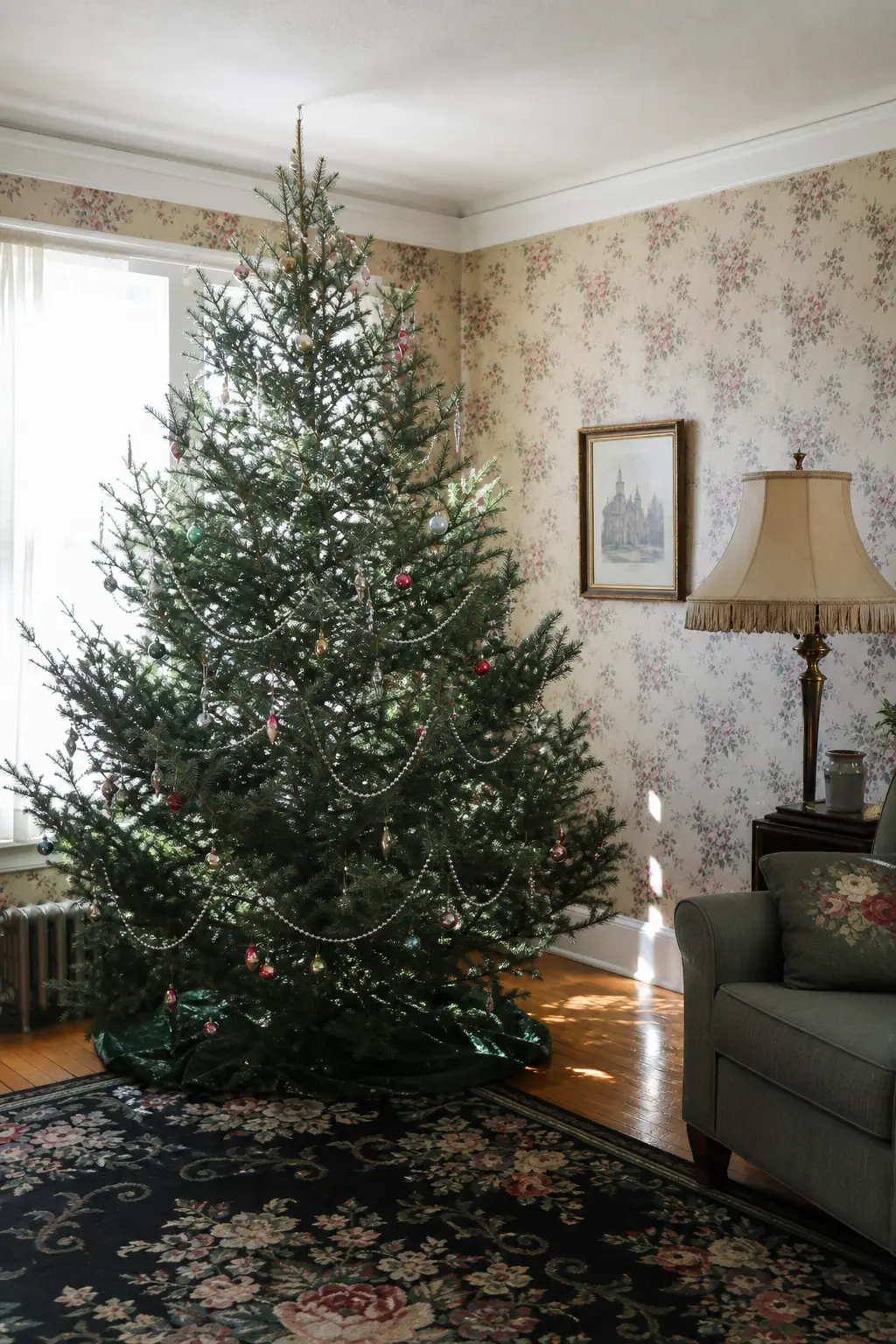
Glass bead garlands on wire are one of the items most often reproduced, so knowing the genuine article matters. Authentic vintage garlands have beads that are slightly irregular in size, threaded on a fine wire that has oxidised to a dull grey or brass tone.
The beads themselves are cold to the touch and have a weight that plastic cannot fake. Bend the wire: it holds its shape. Plastic wire springs back.
Colours to look for in a forties or fifties garland: mercury silver, translucent cream, faded gold, and occasionally a deep bottle green. Avoid anything with vivid primary colours: that skews sixties or later. Car boot price: two to ten pounds per metre depending on bead size and colour. Longer intact strands command a premium because breakage is common.
Drape loosely rather than wrapping tightly. A loose drape catches light at multiple angles. A tight wrap just produces a spiral of glitter.
🛍 Shopping guide
Crepe Paper Bells
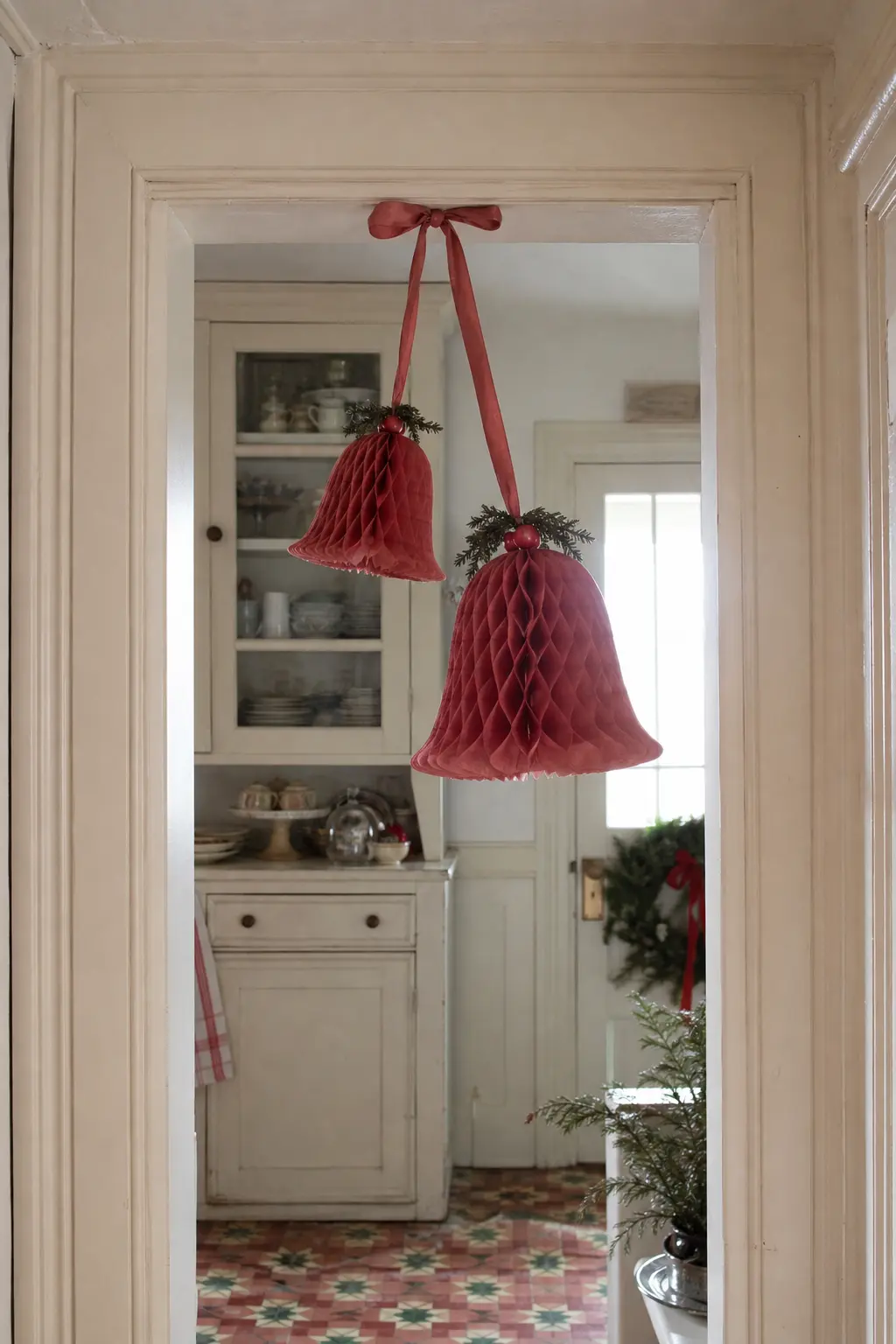
Honeycomb crepe paper bells were a wartime solution: no glass, no metal, no imported materials. They were made in the United States in enormous quantities and have survived in better condition than you might expect because most people stored them carefully, knowing they were fragile.
The honeycomb structure opens out to a full bell shape and then folds flat again for storage.
Look for bells where the honeycomb cells are still intact and the crepe has not split at the fold lines. Faded colour is fine and expected: a deep faded red or a dusty gold is far more interesting than a bright replacement.
Car boot price: fifty pence to three pounds each. Pairs or sets of three are worth the higher end if the hanger ribbon is original.
Hang them from a doorway or a ceiling light rather than on the tree, where they will be overwhelmed by glass ornaments.
🛍 Shopping guide
1950s: Aluminium, Pastels, and the Space-Age Shift
The nineteen-fifties brought a split personality to Christmas decoration. One half of the decade continued the soft, handmade tradition. The other half pivoted hard toward modernity: aluminium trees, matching colour-schemed ornaments, bubble lights, and a general enthusiasm for anything that looked vaguely futuristic.
Both halves have their champions, but they do not mix with each other, let alone with thirties German pieces.
If you are building a fifties-only tree, commit to one direction. Either the soft spun-cotton-and-printed-paper direction or the aluminium-and-bubble-light direction. Mixing them produces the same jumble problem you were trying to solve. Prices at car boot sales range from fifty pence for a postcard to twenty pounds for a working bubble light set.
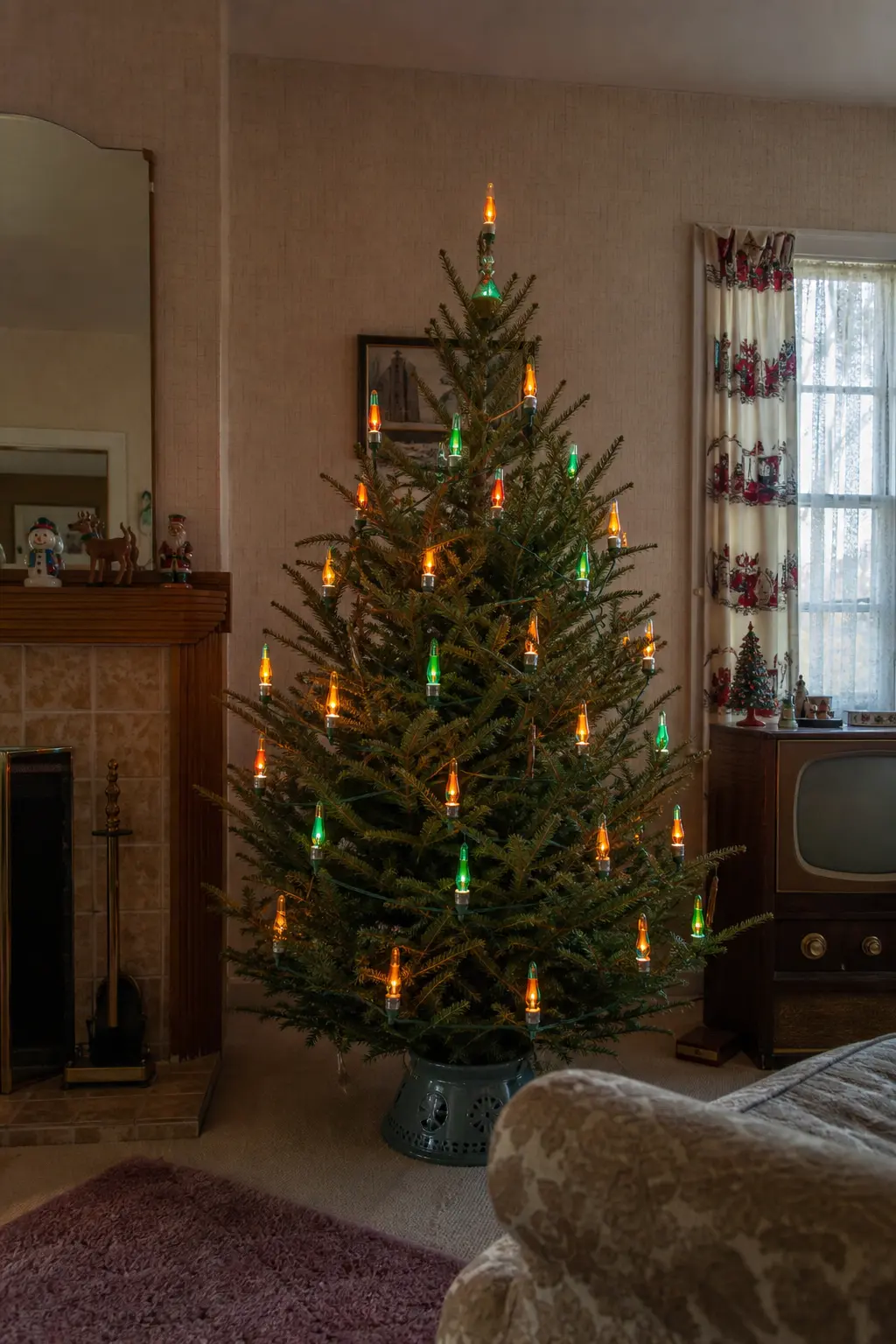
Bubble Lights
Bubble lights are the most theatrical ornament the nineteen-fifties produced. A small light bulb heats coloured liquid in a glass vial above it, and the liquid bubbles continuously once the bulb warms up. The effect is hypnotic and entirely unlike anything a modern LED achieves.
The liquid was originally methylene chloride: safe for display but not for children to handle, which means these are an adult-room decoration.
Working bubble lights are the key requirement. Test before you buy: plug in the set and give it five minutes. If three or more vials fail to bubble after ten minutes of warmth, the liquid has evaporated or the bulbs are dead.
Individual replacement bulbs are still available. Car boot price: two to fifteen pounds for a working set, more for the rarer pastel-coloured liquid versions in pink or blue.
Use them sparingly: one string of bubble lights on a tree is a focal point. Two strings is a competition.
🛍 Shopping guide
Aluminium Tree Branches
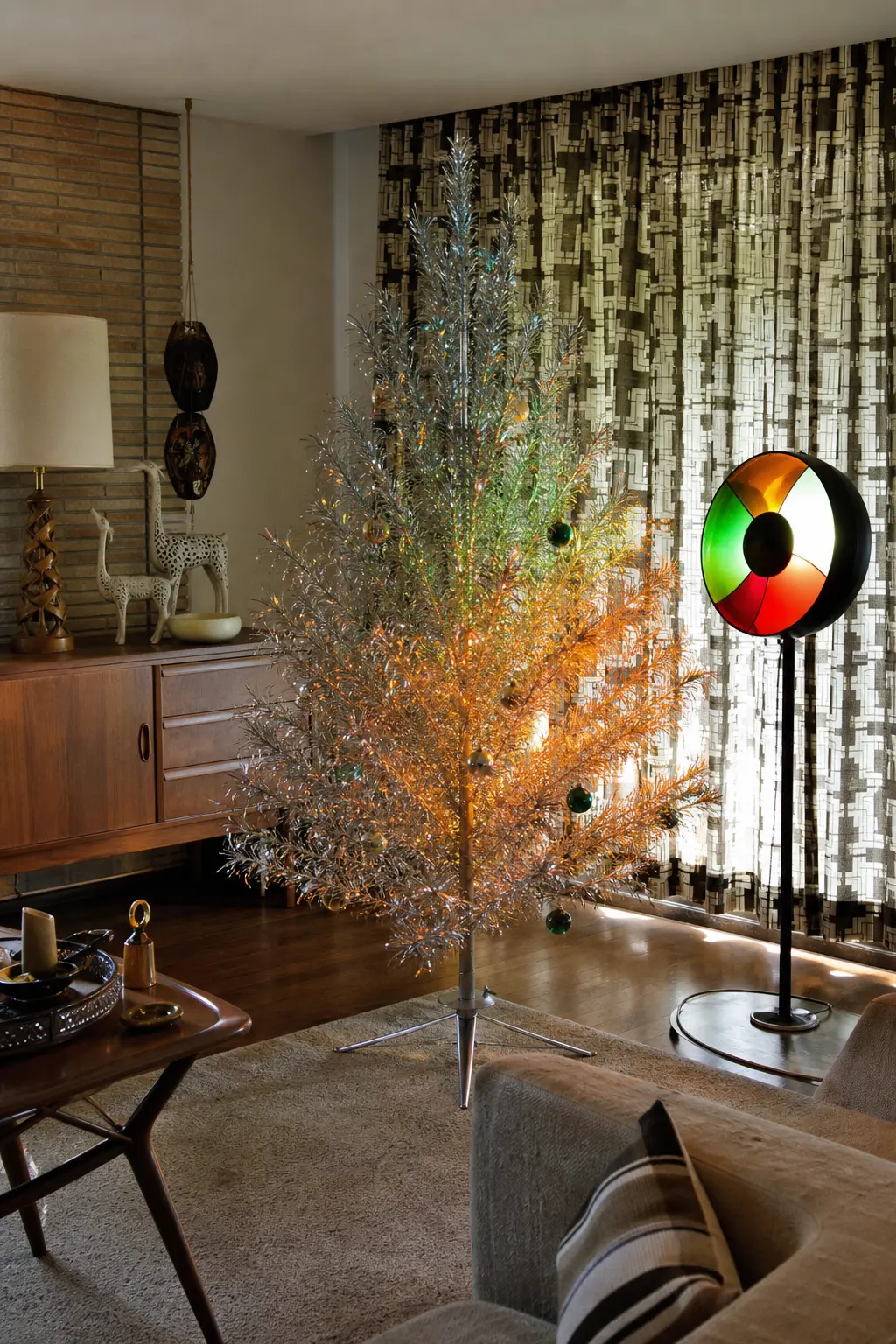
The aluminium Christmas tree is the most polarising vintage find, and also one of the most coherent decorating choices available if you commit to it fully. Evergleam was the best-known brand, but dozens of manufacturers produced them from the late fifties through the mid-sixties.
The branches are aluminium foil strips twisted around a wire core and inserted into a central pole in the same way a feather tree works.
What to look for: branches with most of their foil strips intact, a pole that is not bent, and the original colour wheel if the seller has it (many do not).
The colour wheel rotates in front of a lamp and washes the tree in changing coloured light, which is the correct and only lighting method: you do not put electric lights on an aluminium tree.
Car boot price: five to thirty pounds for a complete tree depending on size and completeness. Missing branches are replaceable from craft wire and aluminium foil.
🛍 Shopping guide
Postcards from the Nineteen Fifties
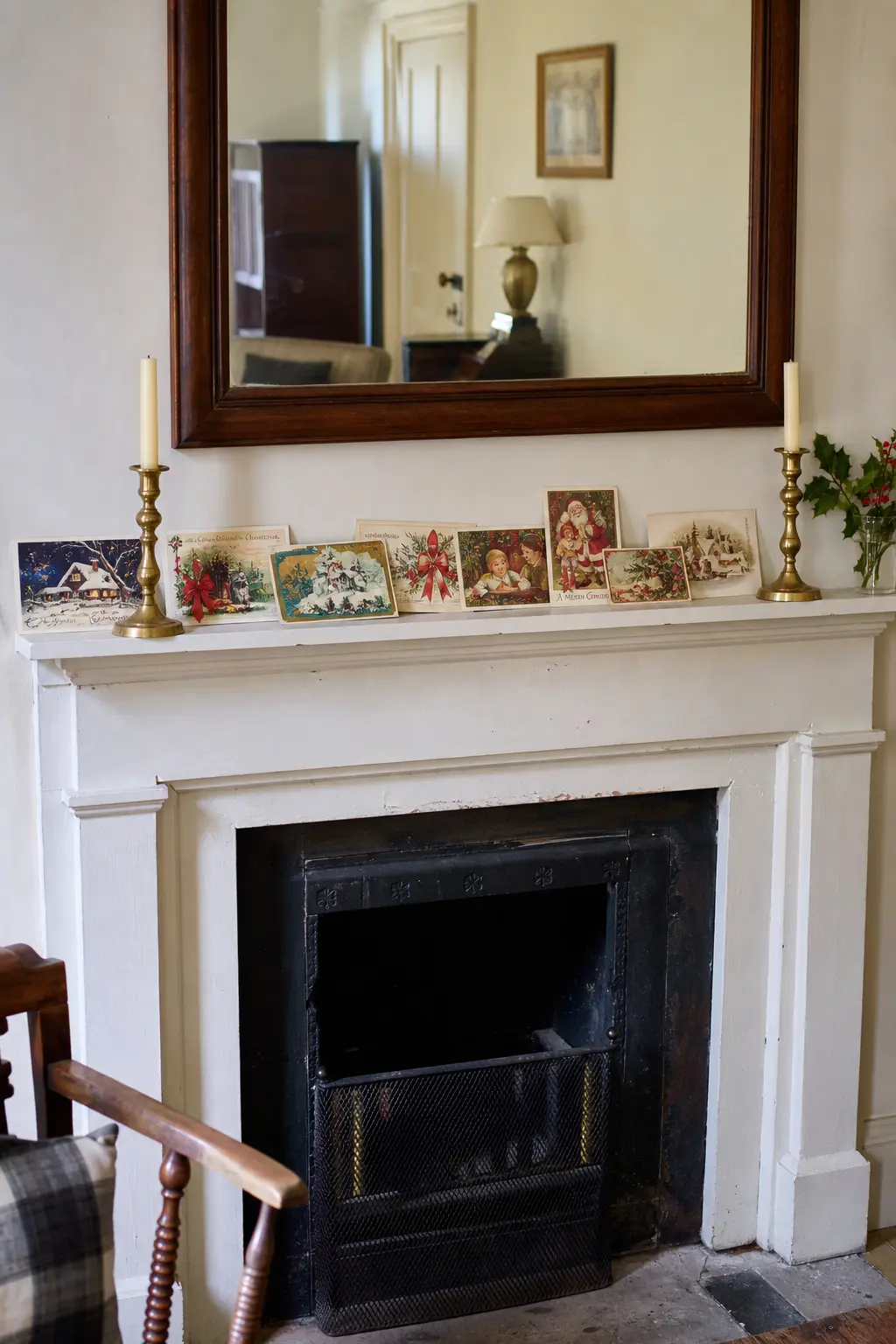
Printed Christmas postcards from the nineteen-fifties are one of the cheapest and most versatile vintage finds available: ten to fifty pence each at car boot sales, sometimes less for a handful bought together. The illustration styles range from sweet snow scenes in exactly the right muted palette to graphic modernist designs that read surprisingly contemporary. Both are worth buying.
The question is what to do with them. Propping them on a mantel or windowsill, overlapping slightly, is the lowest-effort approach and also the most effective.
Alternatively, clip them to a length of twine with small wooden pegs for an advent-calendar effect along a staircase or a shelf. Do not frame them individually: framing a fifty-pence postcard in a ten-pound frame makes both look worse.
Store them flat in an acid-free sleeve between uses. Rolled postcards develop a curl that no amount of weighting will fully remove.
🛍 Shopping guide
Flocked Cardboard Reindeer
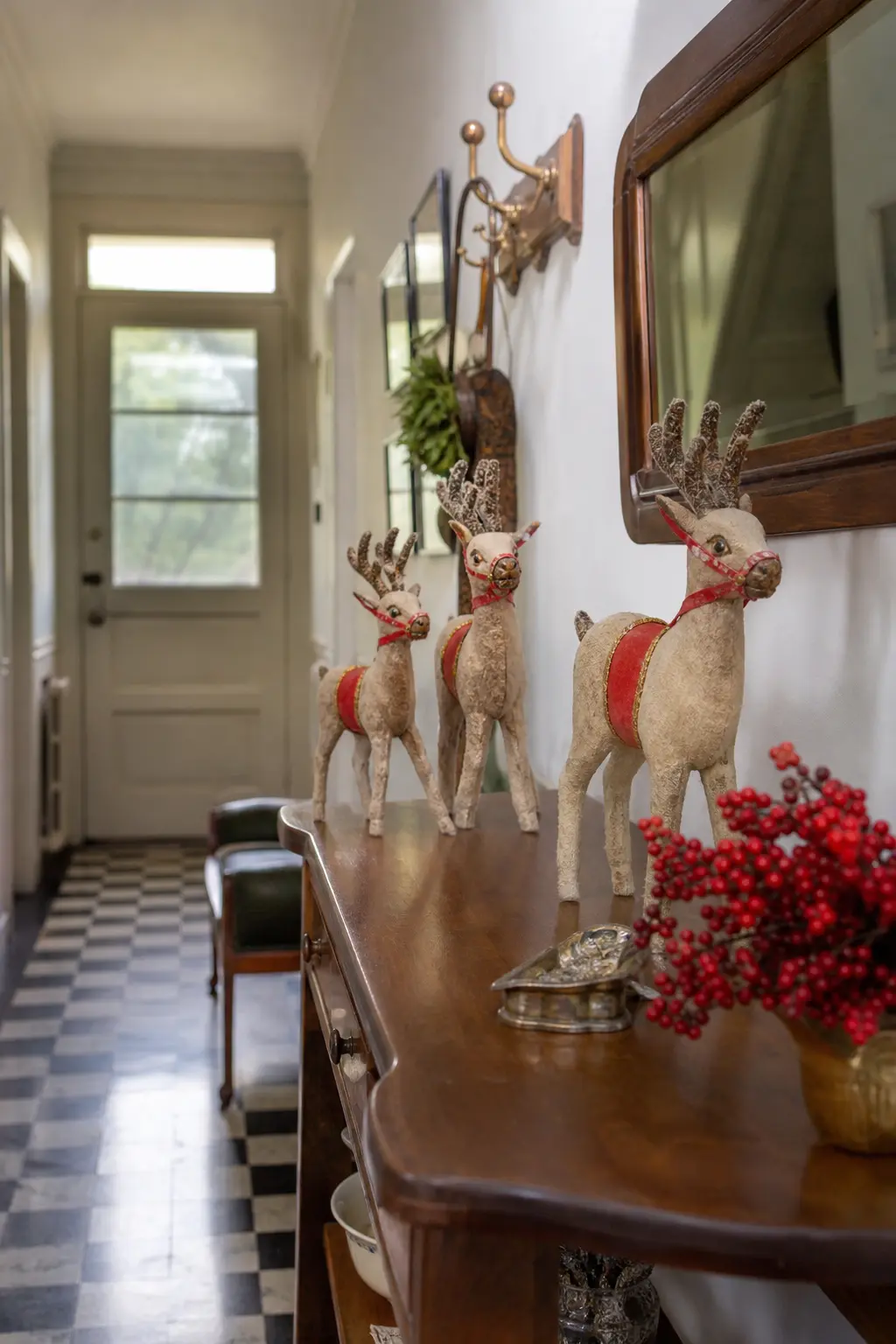
Flocked cardboard reindeer are a fifties and early sixties American production, sold in sets at Woolworths and similar stores as mantel decorations rather than tree ornaments.
They were die-cut from thick card, assembled with tabs, and coated in a fine flock that gave them the texture of felt. The flock sheds over time, which is acceptable: a lightly bare patch reads as age, not damage.
Look for sets where all four legs are still attached and the neck tab has not split. A reindeer with a detached leg can be re-glued with PVA and touched up with flock powder, which is still sold for craft use.
Car boot price: fifty pence to three pounds each. A complete set of eight in original box is a rarer and more expensive find, worth ten to twenty pounds if the box is intact.
Style them with spun cotton figures and bottle brush trees at the same scale.
🛍 Shopping guide
1960s and 1970s: Plastic Arrives, But Craft Survives
The nineteen-sixties and nineteen-seventies are easier to conflate than to separate.
Plastic arrived in force in the sixties, but folk craft traditions ran alongside it in both decades, producing felt stockings, hand-crocheted snowflakes, straw stars, and enamelled tin ornaments that look far more at home with earlier eras than with the plastic pieces from the same years.
Sort by material, not by decade, when you are shopping this period.
The plastic pieces from the sixties and seventies are the cheapest finds at car boot sales, often ten to fifty pence each, but they are also the hardest to make look intentional unless you go all-in on a campy, colourful sixties scheme. The folk and craft pieces cost more, two to eight pounds, and earn every penny.
Ceramic Light-Up Trees
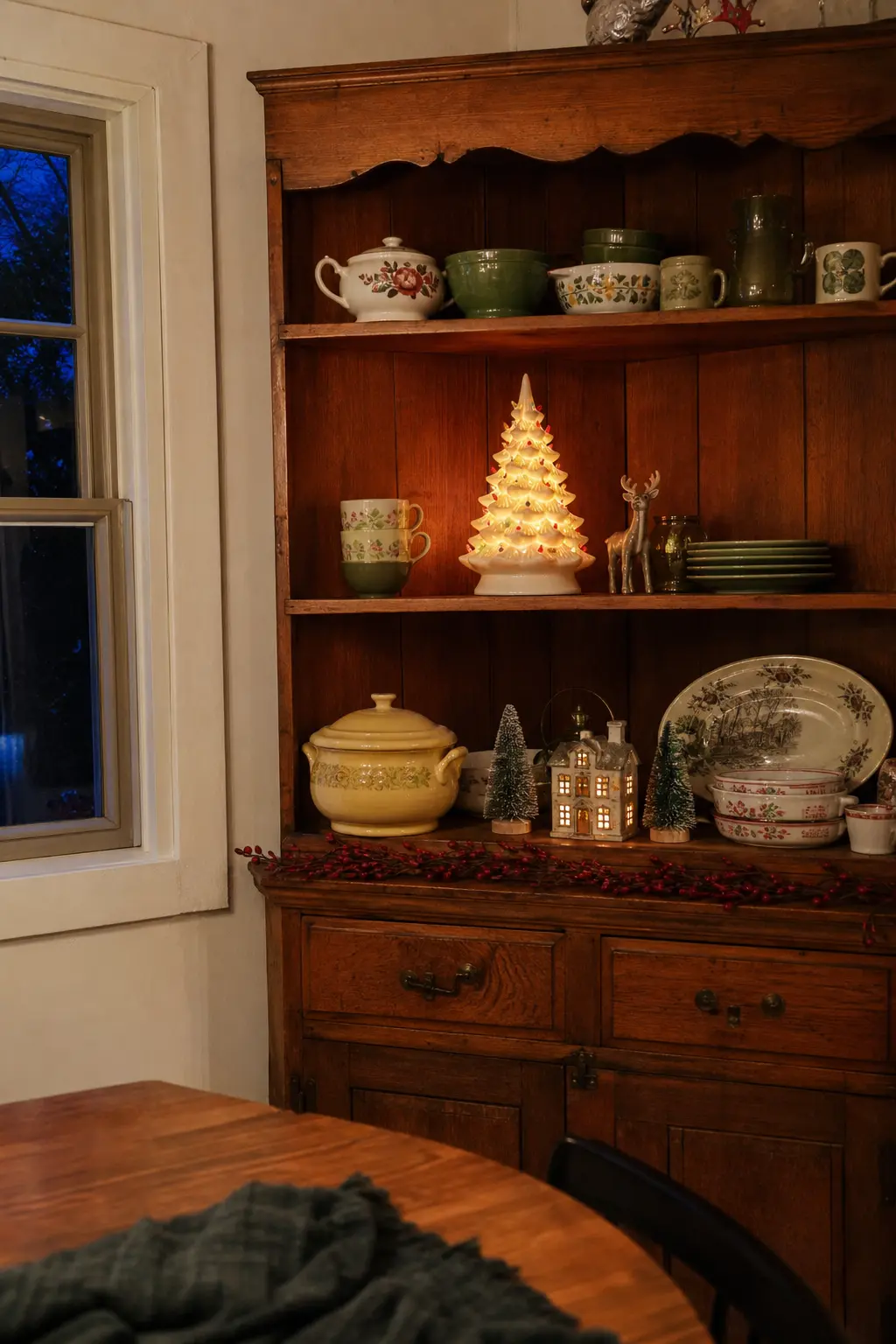
Ceramic light-up trees are the sleeper hit of the seventies. A single bulb inside a hand-thrown or slip-cast ceramic tree glows through small holes or attached glass chips, producing a warm, diffused light that is nothing like a modern LED.
They were sold through craft fairs and hobby catalogues and made by hobbyists with kiln access, which means no two are identical in glaze or form.
The glaze colour determines where they sit in the palette: a white or cream glaze with green chips works anywhere. A bright avocado or orange glaze is a seventies statement piece that works only in a deliberately period scheme.
Look for an intact base, a working bulb socket, and a cord that has not been taped or jury-rigged. Car boot price: two to twelve pounds. Rewiring is straightforward if the original cord is frayed.
These are at their best on a sideboard or a kitchen dresser, lit from within against a dark wall. They disappear in daylight.
🛍 Shopping guide
Straw Stars from Folk Sets
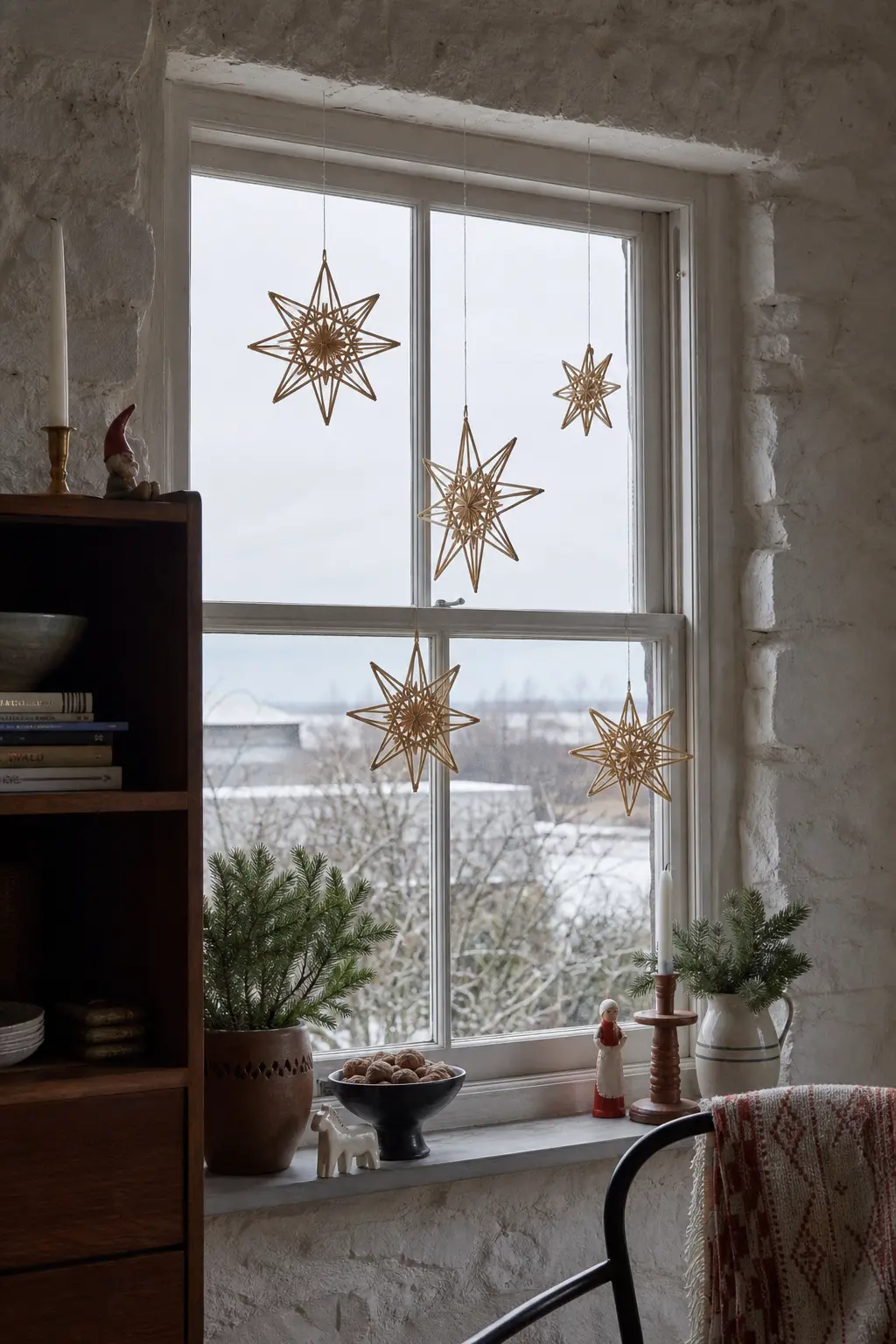
Straw star ornaments are a Scandinavian folk tradition that arrived in British and American shops in the nineteen-sixties and have been made in the same way ever since, which makes dating them genuinely difficult.
The safest guide is the hanger: a genuine vintage straw star will have a cotton thread hanger that has yellowed or a thin wire loop that has oxidised. A monofilament nylon hanger is modern.
Straw stars fit most naturally with the handcraft tradition of the sixties and seventies, alongside felt stockings and hand-crocheted snowflakes, rather than with thirties German glass. Their palette is cream and natural gold, which sits cleanly with antique gold and cream.
Car boot price: twenty to fifty pence each, occasionally sold in bundles. They are among the best-value vintage finds available.
Hang them in a window where backlight shows the structure of the weave. On a tree they disappear between glass ornaments.
🛍 Shopping guide
Felt Stockings with Sequins
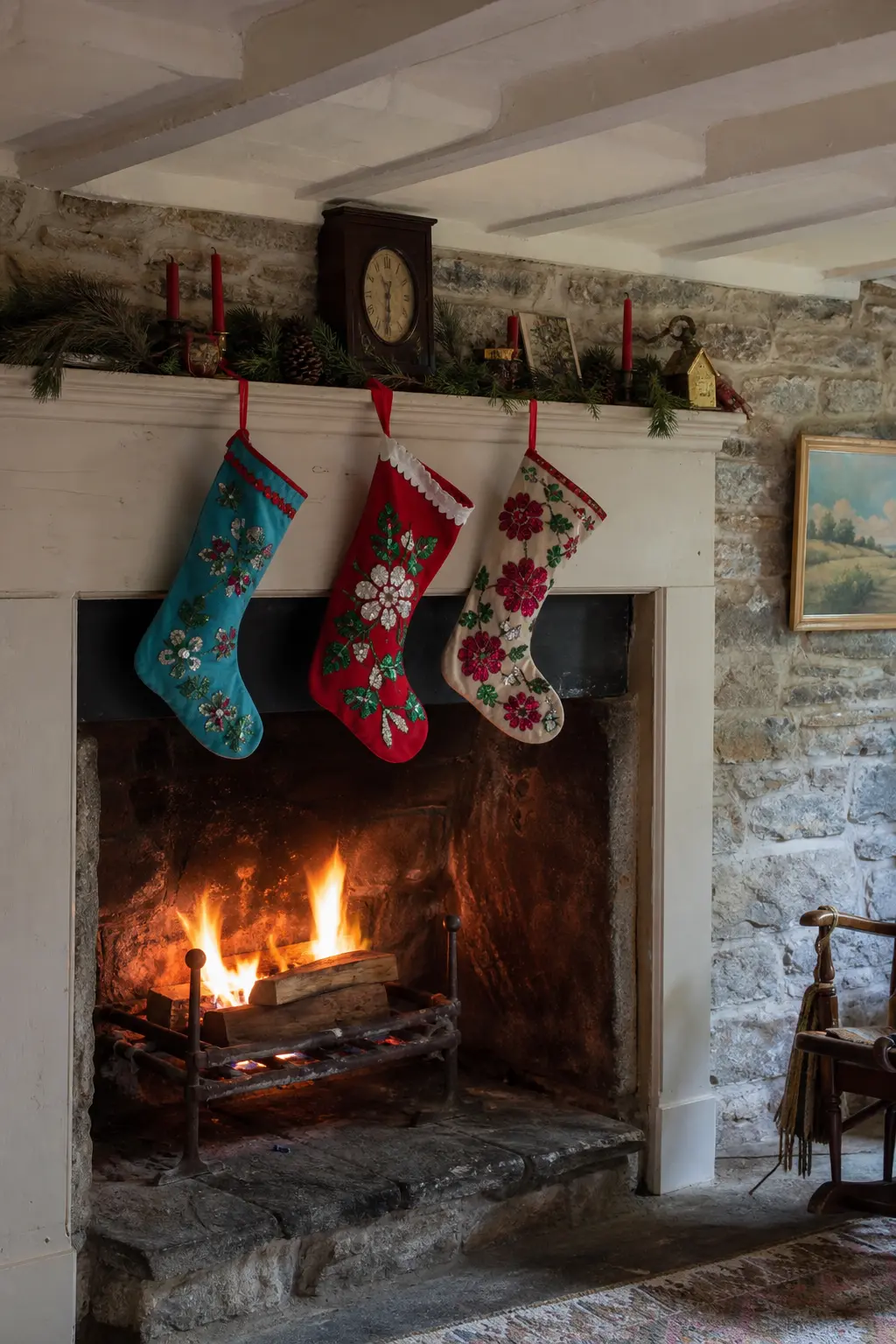
Sequinned felt stockings from the sixties and seventies are a craft-fair product that varies enormously in quality. The best examples have velvet ribbon trim, hand-stitched sequin patterns in geometric or floral designs, and a loop made from the same felt rather than a stapled ribbon. The worst are thin felt with glued-on sequins that shed at the first hanging.
Test the sequins by running a finger firmly across them: if two or three come off on your hand, the glue has failed and the stocking will leave a trail of sequins wherever it goes. Stitched sequins hold indefinitely.
Car boot price: fifty pence to three pounds. Look for the cuff: a velvet or chenille cuff dates the piece to the sixties or early seventies and adds decorative weight. A plain felt cuff is later and less interesting.
Hang a row of three on a mantel rather than one per hook. The repetition turns a craft item into a considered display.
🛍 Shopping guide
Hand Crocheted Snowflakes Stiffened with Starch
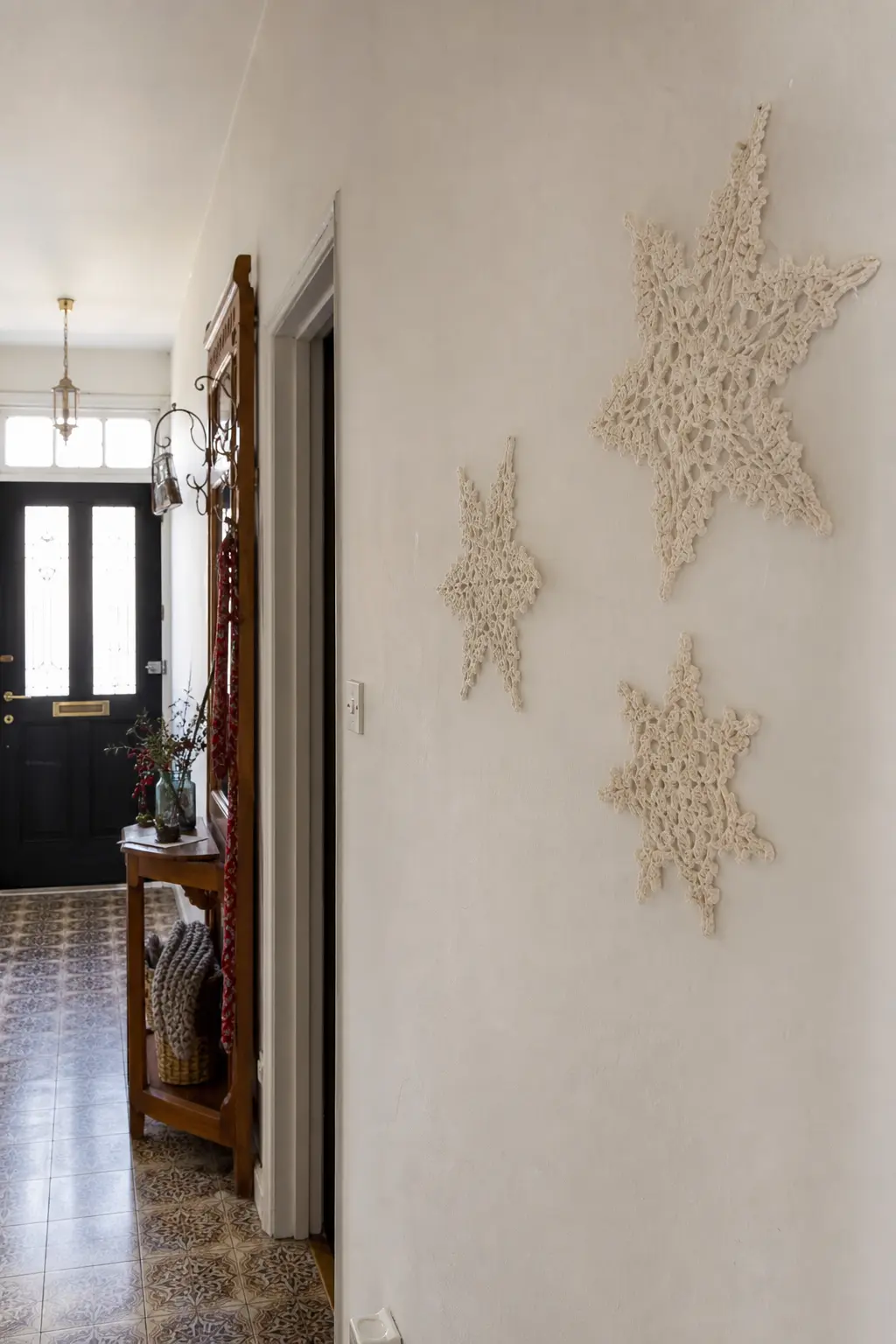
Stiffened crocheted snowflakes are a domestic craft that peaked in the nineteen-seventies, when pattern books for them were sold in every wool shop. The best vintage examples have been starched hard enough to hold a flat, even shape and retain it.
A snowflake that has gone limp has either never been properly starched or has been stored damp: both are fixable with a fresh starch treatment.
To re-stiffen: dissolve a tablespoon of cornflour in cold water, bring to a gentle simmer until clear, cool, and soak the snowflake. Pin to a blocking board and leave to dry flat. The shape returns.
Car boot price: twenty to fifty pence each, sometimes sold in bags of ten.
Use them as backing under a display of glass ornaments on a plate, or pin them inside a picture frame over a piece of cream linen for a wall hanging that costs almost nothing.
🛍 Shopping guide
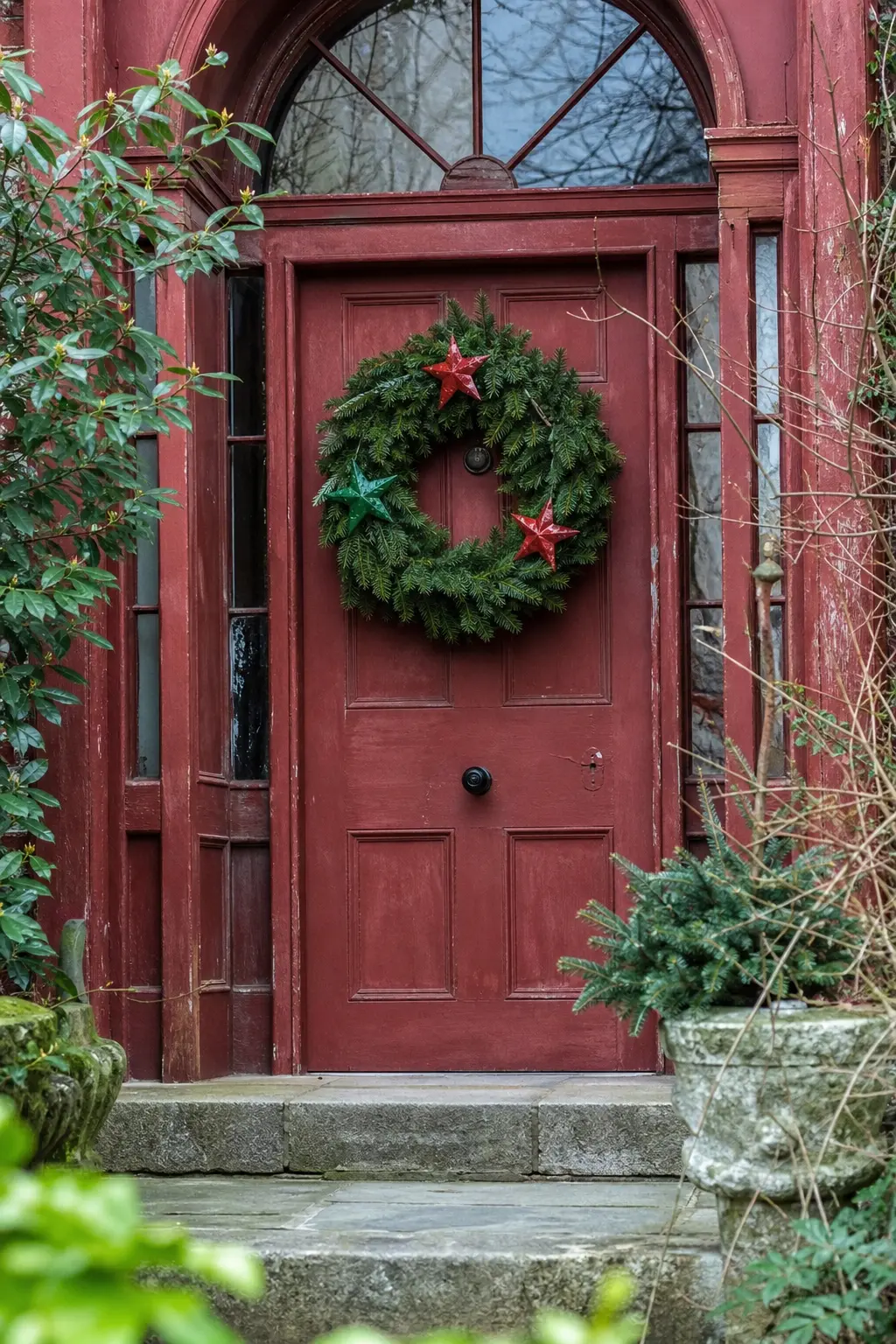
Enamelled Tin Ornaments
Enamelled tin ornaments, mostly made in Eastern Europe for the export market, appeared in British shops from the mid-sixties onward.
They were stamped into simple geometric shapes, stars, bells, moons, and coated in a baked enamel finish in colours that have aged gracefully: deep bottle green, a warm brick red, cream, and a dulled gold.
The enamel chips at the edges, which is how you know the piece is genuine.
Run a fingernail along any flat surface: genuine baked enamel has a slight texture, not a smooth pour. A perfectly smooth, chip-free surface is either very well-stored or a reproduction. Car boot price: fifty pence to two pounds each, occasionally sold loose in a tin.
They are small enough to hang almost anywhere: on a tree, from a wreath, clipped to a napkin for a table setting. Their palette bridges the gap between the thirties German pieces and the seventies folk craft items better than almost any other ornament.
🛍 Shopping guide
Frequently Asked Questions
How do I tell if Christmas decorations are vintage?
Look at three things: materials, marks, and weight. Genuine vintage glass ornaments are lighter than reproductions because the glass wall is thinner. Genuine spun cotton is paint-soaked, not surface-coated. Genuine cardboard items show offset printing with slight colour misregistration rather than a sharp digital print.
Marks help too: Shiny Brite ornaments are often labelled, German export pieces sometimes carry a paper sticker, and Eastern European tin ornaments may have a country-of-origin stamp. No single test is definitive, but materials, weight, and print quality together will catch most reproductions.
What decade is my vintage ornament from?
Start with the material. Hand-blown glass with an irregular silver lining points to pre-1950, most likely German production from the thirties or forties. A Shiny Brite label means American production from the forties through the early sixties. Bubble lights are fifties.
Aluminium trees are late fifties to mid-sixties. Ceramic light-up trees and enamelled tin ornaments are sixties and seventies. Celluloid figures are pre-1950, because celluloid production declined sharply after it was classified as a fire risk.
Spun glass and chenille pieces span a wide range, so rely on paint style and colour palette to narrow the decade.
Where do you buy vintage Christmas decorations?
Car boot sales between October and December are the best source for low prices and genuine finds, because sellers are clearing seasonal storage rather than curating for collectors. Estate sales and house clearances run a close second.
Online, search eBay with condition filters set to ‘used’ and sort by ending soonest to find pieces before they are noticed. Etsy has a large vintage section but prices run higher because the seller has already done the work of identifying and photographing the piece.
Charity shops in affluent residential areas tend to receive better-quality donations than high-street locations.
Are old glass ornaments safe to use?
Generally yes, with two exceptions. Pre-1970 glass ornaments were sometimes silvered with a lead compound rather than a modern silver nitrate solution. The lead is sealed inside the glass and poses no contact risk for adults who handle the ornament normally.
It becomes a risk only if the glass is broken, because the inner residue can then be touched or inhaled. Keep broken ornaments away from children and do not attempt to repair them yourself.
The second exception is lead paint on the exterior: this was used on some painted wooden figures and tin ornaments before lead paint restrictions. Test any brightly painted wooden or tin piece with a lead test swab before placing it where children can reach it.
Otherwise, intact glass ornaments are safe for adult display.
26 pink Christmas decorations for a whole house, blush to bubblegum with gold and velvet bows, room
Twelve elegant Christmas cards ready to print tonight, each with finished wording, a fold and a layo
21 christmas appetizers air fryer batches: exact basket loads, from-frozen notes, and 3-4 component
Leave a Reply