

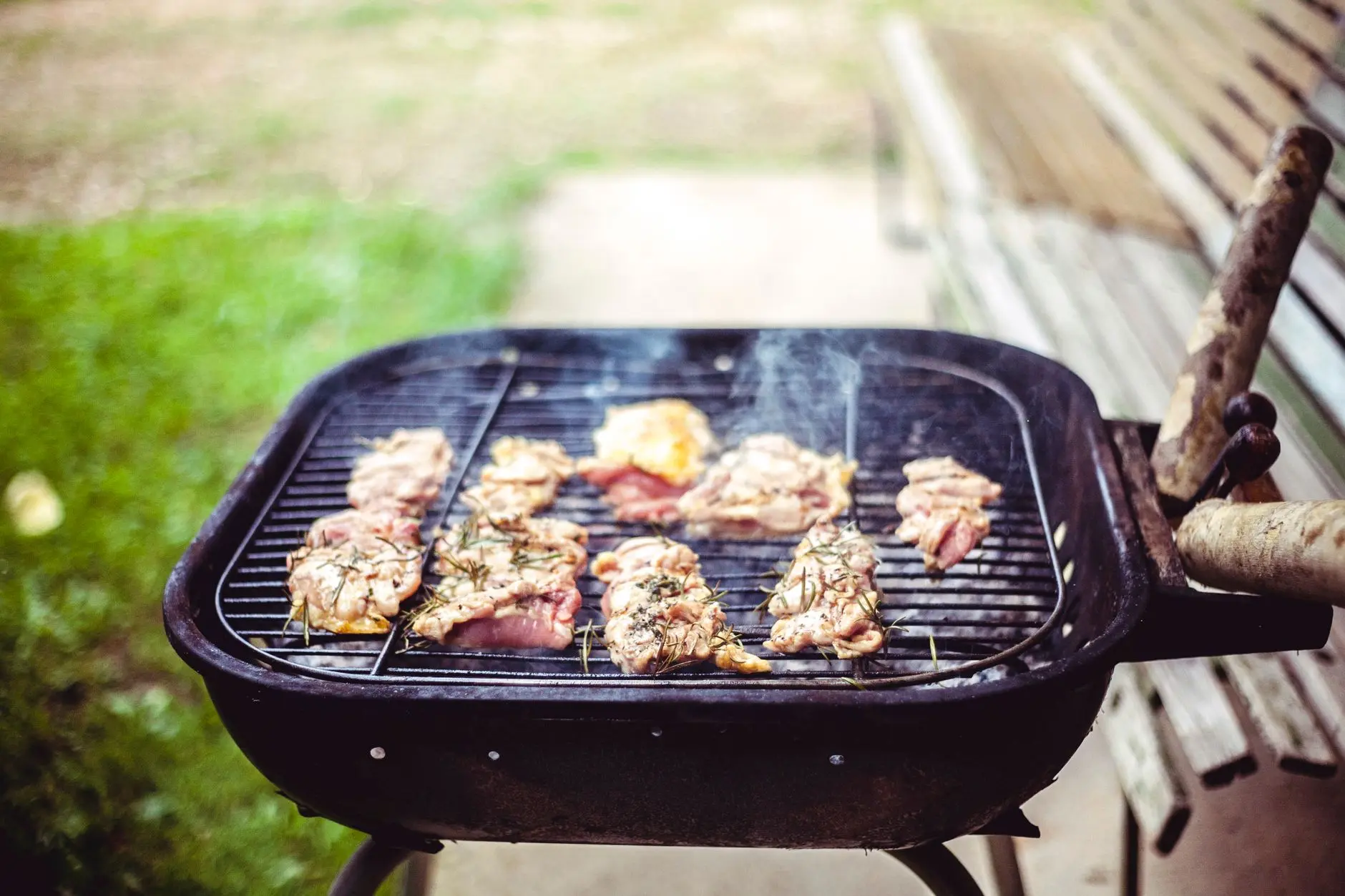
A great backyard BBQ is only partly about the food. The other half is keeping a yard full of people — kids, teens, adults, and grandparents — genuinely entertained between plates.
That means having a mix of games that get bodies moving, spark friendly competition, and give the quieter guests something to enjoy at the picnic table without feeling left out.
The twenty games below cover every corner of that yard and every personality in the crowd.
We’ve organized the list so the big lawn games anchor the action early, printable games give guests something to grab and play at their own pace, and relay-style contests bring everyone together for a roaring finish.
A few items need nothing more than what you already have on hand; others link to simple gear worth grabbing. Either way, print the sheets the night before, set out the equipment before guests arrive, and let the yard run itself.
This post contains affiliate links — if you buy through them, I may earn a small commission at no extra cost to you.
Table of Contents
- Corn Hole Tournament
- Water Balloon Toss
- Sack Race
- Giant Jenga
- Ladder Toss
- Backyard Scavenger Hunt
- Watermelon Eating Contest
- Three-Legged Race
- Ring Toss
- BBQ Trivia Rounds
- Team Relay Race
- Summer Bingo
- BBQ Emoji Decode
- Summer Would You Rather Card Game
- Guess How Many?
- BBQ MAD LIBS
- Name That Song — Emoji Edition
- Bocce Ball
- Spikeball
- Kan Jam
1. Corn Hole Tournament
Set both boards 27 feet apart on a flat section of lawn and divide guests into two-person teams. Each team gets four bean bags in their color.
Players take turns tossing — three points for a bag through the hole, one point for a bag that stays on the board.
The round ends when one team reaches exactly 21 points using “cancellation scoring,” where each team’s points offset the other’s, so only the net difference counts per round.
Run a simple bracket on a sheet of paper and let winners advance while losers cheer from the sidelines with a cold drink.
You need two regulation corn hole boards, eight bean bags in two colors, and a flat patch of grass. Teams of two work best, though you can play singles if the crowd is smaller.
A full four-team bracket takes about 45 minutes; a casual two-board setup where people rotate in runs all afternoon. This game is the reliable backbone of any BBQ because nearly everyone already knows the rules and it accommodates players of wildly different athletic ability.
Host tip: Pre-mark the foul line with a strip of painter’s tape so you never have to argue about foot faults. It takes thirty seconds and saves twenty minutes of mild drama.
🛍 Shopping guide
2. Water Balloon Toss
Fill at least two balloons per pair of players and line everyone up facing a partner about three feet apart. On “go,” Player A tosses their balloon gently to Player B, who catches it without popping it.
After every successful catch, both players take one giant step backward. Any pair whose balloon pops is out. The last pair still tossing — and still dry — wins.
On a hot afternoon this game has a way of making even the losers happy, because getting soaked is half the fun.
You need a bag of latex balloons and access to a hose or outdoor faucet for filling. Pre-fill balloons into a large bucket or cooler before guests arrive so the game starts immediately rather than making everyone wait while you tie knots with wet hands.
Works for any even number of players from 4 to 40 and runs about 15 minutes per round, making it easy to replay two or three times. Keep a trash bag nearby for burst balloon pieces so the lawn stays clean.
Host tip: Fill balloons to only about the size of a large orange — overfilled balloons pop on the first toss and underfilled ones are impossible to catch cleanly. That medium size gives pairs three to four rounds of genuine suspense before someone gets wet.
🛍 Shopping guide
3. Sack Race
Mark a start line and a finish line about 30 feet apart. Each player steps both feet into a burlap or mesh sack, grips the top edge at waist height, and hops to the finish line and back.
First person to cross the return line without falling wins. For larger groups, run heats of four to six players at a time and let winners race each other in a final.
The course can be lengthened for teens and adults or shortened for younger kids — just move the cones.
You need one sack per lane and two cones or lawn stakes to mark the course. Burlap potato sacks are traditional and easy to find online or at farm supply stores; pillowcases work in a pinch but tend to rip.
Plan for groups of 4 to 20 and roughly 20 minutes including heats. Prizes for first, second, and third place — even just a ribbon or a small candy bag — make the finals feel like a real event.
Host tip: Spray a light mist of water on the grass before the race so the sacks don’t drag on dry, scratchy turf and slow smaller kids down unfairly. A slightly damp lawn also cushions the inevitable tumbles.
🛍 Shopping guide
4. Giant Jenga
Stack the 54 oversized wooden blocks in 18 layers of three, alternating direction with each layer, until you have a tall tower on a flat, stable surface — a patio, deck, or firm patch of lawn all work.
Players take turns using one hand to slide out any block from below the top layer and place it on top. The tower gets taller and wobblier with every move. The player who causes the collapse loses the round.
For a BBQ twist, write dares or trivia questions on individual blocks with a marker so each pull becomes a bonus challenge.
You need a giant Jenga set — blocks are typically two to three inches thick and the finished tower stands around two feet tall at the start. No extra supplies are required unless you want to add the written challenges.
Works for 2 to 10 players per tower; if you have a big crowd, run two towers simultaneously and let winners face each other.
A round lasts anywhere from 10 to 30 minutes depending on how cautious players are, making it a perfect slow-burn activity for guests who want to stay near the food table.
Host tip: Set the tower on a small tray or a piece of plywood rather than directly on soft grass. Soft ground lets the base sink unevenly, which makes the tower collapse far too early and frustrates kids who haven’t even had a turn yet.
🛍 Shopping guide
5. Ladder Toss
Set the two ladder frames about 15 feet apart on the lawn. Each player or team gets three bolas — two balls connected by a short rope. Players take turns tossing their bolas underhand toward the opposite ladder, trying to wrap them around the rungs.
The top rung scores three points, the middle rung scores two, and the bottom rung scores one. First team to reach exactly 21 wins, again using cancellation scoring so only the point difference between teams counts each round.
Bolas that bounce off the ground and land on a rung do not count.
You need a ladder toss set, which typically comes with two PVC or metal frames and six bolas in two colors. Sets are inexpensive and pack flat, making them easy to store between parties.
Play with 2 to 4 players in singles or doubles format; a full game runs about 20 minutes. This game is particularly good for guests who want something competitive without running or jumping.
Host tip: Anchor each ladder frame by slipping a tent stake through the base cross-bar. Even a light breeze can tip lightweight frames mid-toss, and a rocking target makes accurate throws nearly impossible and drives players a little crazy.
🛍 Shopping guide
6. Backyard Scavenger Hunt
Hand each player or small team the printed Backyard Scavenger Hunt sheet, which lists a set of items or sights to find around the yard — things like a red leaf, something that makes noise, a bug, a piece of trash to throw away, and so on.
Teams race to find and check off every item on the list. The first team to complete the full list and return to the host wins.
For mixed-age groups, pair a younger child with an older one so the hunt stays competitive without leaving anyone behind.
All you need is the printed sheet and a pen or pencil per team. The hunt works best with 2 to 6 teams of 2 to 4 players each and typically runs 15 to 25 minutes depending on how tricky the list is.
It gets kids away from screens and exploring the yard while giving adults a breather. Hide one or two bonus items — a small flag or a sticker placed somewhere unexpected — to add an extra layer of discovery for sharp-eyed players.
Host tip: Walk the yard yourself before guests arrive and confirm that every item on the list is actually present. It sounds obvious, but running a scavenger hunt where half the items can’t be found turns excitement into frustration in about four minutes.

7. Watermelon Eating Contest
Cut watermelon into same-size wedges — one per contestant — and line players up at a long table or along the edge of a picnic table with their hands behind their backs. On “go,” players eat as fast as they can using only their mouths.
The first person to eat their wedge down to the white rind wins. This is intentionally messy, wonderfully silly, and universally beloved by everyone watching as much as everyone eating. Set it up near the end of lunch so the watermelon doubles as dessert.
You need one large watermelon, a knife, and a cutting board. Paper plates make cleanup easier but aren’t strictly necessary — the rinds can go straight to a compost bin or trash bag.
Works for 4 to 12 contestants at once; larger groups can run heats. The contest itself lasts less than five minutes, but the buildup, countdown, and post-race laughter stretch the entertainment much longer. Award a silly ribbon or a “Seedless Champion” certificate to the winner.
Host tip: Chill the watermelon for at least two hours before cutting. Cold watermelon is both more refreshing and slightly firmer, which makes the contest fairer — warm watermelon gets too mushy and the edges disintegrate unevenly, giving some players an accidental advantage.
8. Three-Legged Race
Pair players up and use a bandana, bungee cord, or strip of fabric to loosely tie the right leg of one partner to the left leg of the other at the ankle and just above the knee.
Pairs line up at the start line and race to the finish — typically 30 to 40 feet away — moving together without falling.
The trick is communication: most pairs do best when they agree on a chant like “left, right, left” and stick to it rather than winging it. First pair to cross the finish line wins.
You need one tie per pair — bandanas are perfect because they’re soft, adjustable, and reusable. Mark the course with cones.
Works for any even number of players from 4 to 30 and takes about 15 minutes including pairing up and running two or three heats.
This is one of the few games where adults and kids can compete together on roughly equal footing, since coordination matters more than raw speed.
Host tip: Let pairs practice walking together for 60 seconds before the race starts. It sounds like it takes away the chaos, but it actually makes the race more competitive and interesting — untrained pairs trip immediately and the race is over in seconds with no real contest.
🛍 Shopping guide
9. Ring Toss
Set up a ring toss game on a flat section of lawn or patio, with pegs or bottles arranged in a grid or row.
Each player stands behind a marked toss line — typically 6 to 10 feet back — and throws rings one at a time, trying to land them around the pegs.
Assign different point values to different pegs based on distance: close pegs score one point, middle pegs two, and the farthest peg three. First player to reach 15 points wins the round. Keep a running leaderboard on a chalkboard or notepad to track the tournament.
You need a ring toss set, which typically includes a base, pegs, and six to twelve rings. Outdoor sets made of wood or durable plastic hold up well on grass.
The game works for 2 to 8 players in a casual rotation format and takes about 20 minutes per bracket. It’s a great station to set up next to the food table so guests can play a quick round while they wait for the grill.
Host tip: If playing on grass, press each peg base firmly into the turf or weigh the base with a sandbag so it doesn’t wobble. A rocking peg means a ring that should score doesn’t stay on, and that one disputed point always becomes the topic of conversation for the next 20 minutes.
🛍 Shopping guide
10. BBQ Trivia Rounds
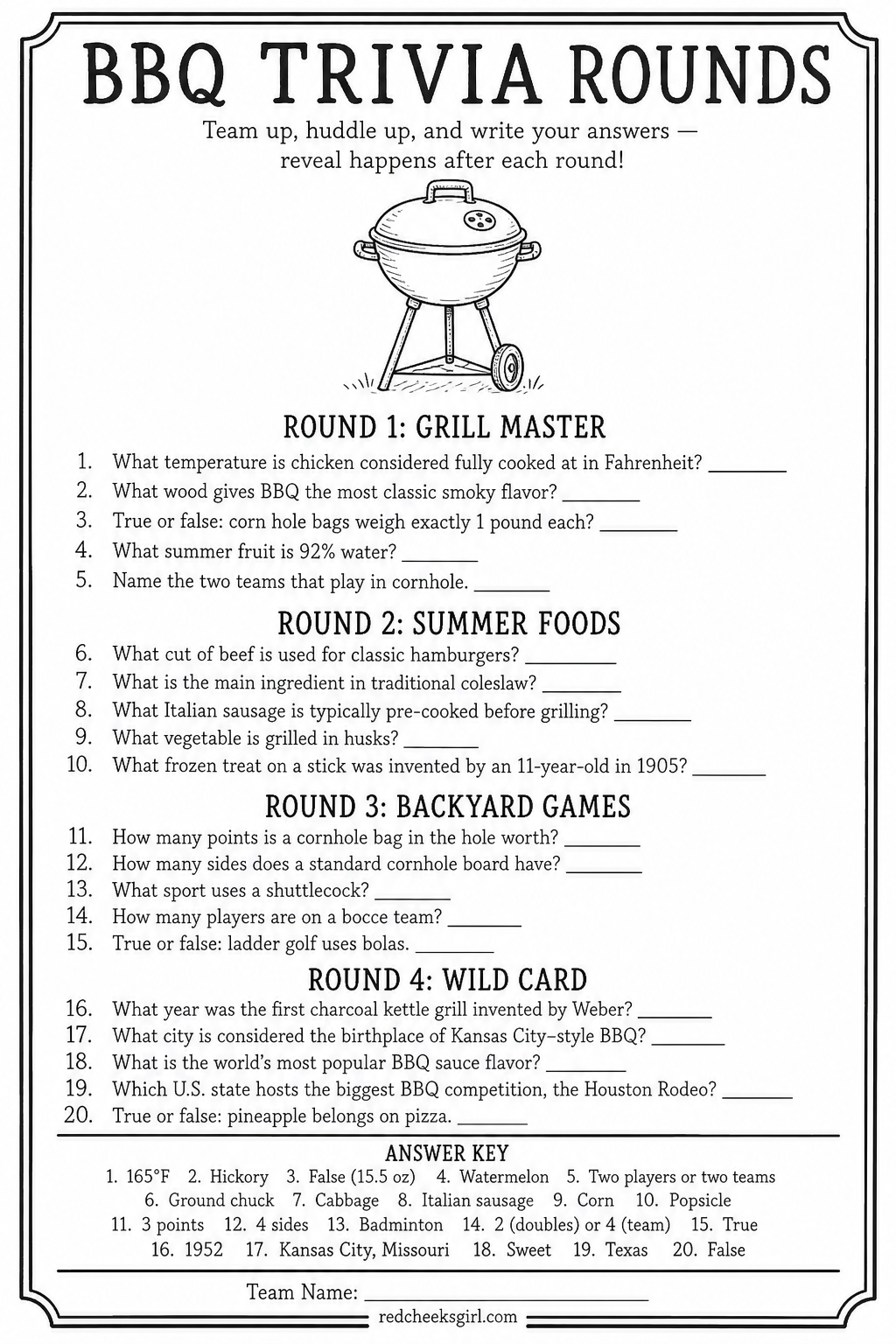
The printed BBQ Trivia Rounds sheet contains multiple rounds of questions covering summer food, backyard history, grilling facts, and general pop knowledge calibrated for a mixed-age crowd.
Divide guests into teams of three to five and designate a host — ideally someone who hasn’t seen the answers — to read questions aloud.
Teams write their answers on scratch paper and hold them up or pass them to the host at the end of each round. Award one point per correct answer and tally scores round by round. The team with the most points after all rounds wins.
You need the printed trivia sheet for the host and scratch paper plus pens for each team. No other materials required.
Works beautifully for 2 to 8 teams and fits into a 30-minute window between the main meal and dessert, when guests are full, comfortable, and not yet ready to run around again.
Read questions at a pace that gives everyone a fair chance — roughly 20 to 30 seconds per question keeps energy up without rushing.
Host tip: Collect all answer slips before revealing any answer. If teams hear the correct answer before they’ve finished writing, half of them will quietly edit their sheets, and suddenly everyone got it right and the scoring makes no sense.
11. Team Relay Race
Divide guests into two or more even teams and set up a relay course across the yard — a starting cone, a turnaround cone about 30 feet away, and a handoff zone back at the start.
Each runner sprints to the turnaround cone and back, then tags the next teammate. The first team to have every member complete the leg wins.
For extra variety, add a challenge at the turnaround — carry an egg on a spoon, balance a balloon between your knees, or dribble a ball — that each runner must complete before heading back.
You need two cones minimum and whatever prop you choose for the challenge leg. Egg-and-spoon variations need a spoon and a hard-boiled egg per team; balloon variations need one balloon per team.
Groups of 6 to 30 work well; just adjust the number of teams so each has 3 to 8 runners. The race itself takes 10 to 15 minutes, but the team-sorting and practice run add another 10, so budget 25 minutes total.
Host tip: Hard-boil the eggs the night before if you’re doing the egg-and-spoon version — a raw egg dropped on the lawn mid-relay creates a cleanup problem and a mild food safety question that nobody wants to think about at a BBQ.
12. Summer Bingo
Hand each guest a printed Summer Bingo card, which features a five-by-five grid filled with summer-themed words and images — things like “firefly,” “sunscreen,” “ice cream cone,” “flip flops,” and “lawn mower.”
The host calls out items one at a time from a shuffled draw list. Players mark off each square they find on their card. First player to complete a row — horizontal, vertical, or diagonal — calls “Bingo!” and wins.
Because each printed card has a different arrangement, every player has a fair shot regardless of where they’re seated.
You need one printed card per player, plus small markers — pennies, dried beans, or candy work perfectly. The host needs the corresponding call list included on the host’s copy of the sheet.
Works for 4 to 50 players simultaneously and a single game runs 10 to 15 minutes. It’s one of the easiest games to run across a wide age range because grandparents and six-year-olds can play side by side with equal enthusiasm.
Host tip: Use M&Ms or Skittles as markers — players get to eat whatever’s on their card at the end of the game, which makes losing a Bingo round considerably more enjoyable than it would otherwise be.

13. BBQ Emoji Decode
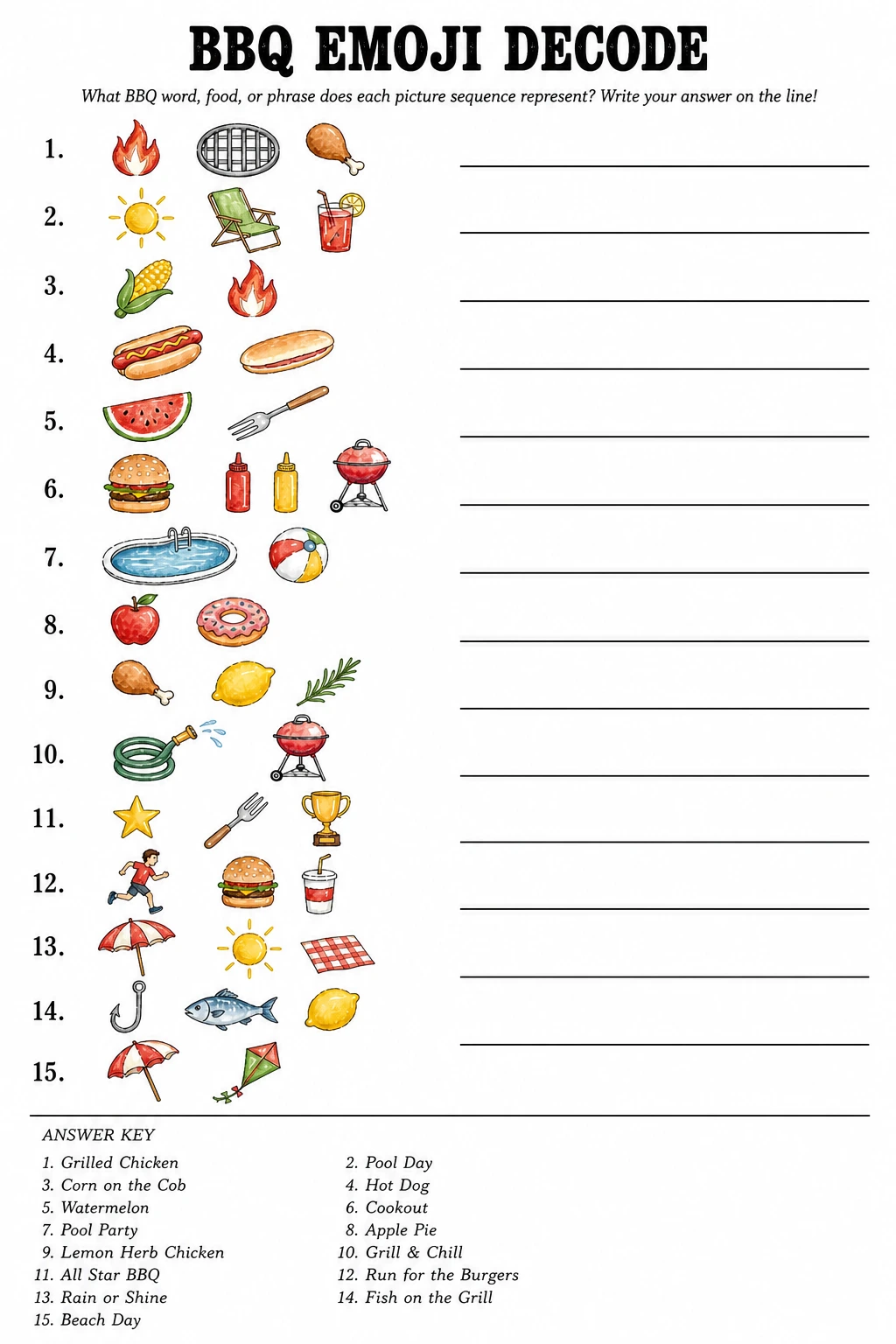
Each guest or team receives the printed BBQ Emoji Decode sheet, which presents rows of illustrated emoji-style food and summer icons that represent common BBQ-related words, phrases, and answers to clues.
Players study each row, read the accompanying clue, and write their best answer in the space provided.
This is not a “guess a famous phrase” game — it’s a themed picture-clue quiz where every answer is a real, specific BBQ or summer term that the images directly represent, like a type of food, a grilling tool, or a summer activity.
You need one printed sheet and a pen per player or team. No other materials required. The game works for any group size — hand sheets out individually for a solo challenge or pair guests up for a collaborative version.
It runs about 15 minutes and fits perfectly at the picnic table while guests are finishing their plates. Collect and score sheets as a group at the end, reading each answer aloud so everyone learns the ones they missed.
Host tip: Go through the answer key yourself before the party so you can confidently settle any disputes. A few images always spark good-natured argument, and being able to point to the official answer immediately keeps the game moving instead of dissolving into a ten-minute debate.
14. Summer Would You Rather Card Game
Print and cut the Summer Would You Rather Card Game sheet into individual cards, each posing a lighthearted dilemma between two summer scenarios — for example, “Would you rather eat only hot dogs for a year or never go swimming again?”
Sit guests in a circle or around the picnic table. Draw a card, read it aloud, and let every player simultaneously declare their choice — thumbs up for Option A, thumbs down for Option B.
Then open the floor for 60 seconds of argument and laughter before moving to the next card.
You need the printed and cut cards — scissors are the only tool required. Works for 4 to 20 players seated together and runs as long as you like, making it a flexible fill-in game between longer activities.
It’s particularly good for mixed-age groups because the questions are accessible to kids but genuinely funny to adults, and nobody needs any prior knowledge or skill to participate fully.
Host tip: Save the most outrageous cards for the end of the stack when the group is warmed up and comfortable with each other. The first few rounds are always a little stiff — by card eight or nine, guests are roasting each other and the table is loud.

15. Guess How Many?
Before the party, fill a large clear jar with a summer-themed item — candy-coated chocolates, gummy bears, sunflower seeds, mini marshmallows, or cherry tomatoes from the garden all work well.
Count the items as you fill the jar and write the exact number on a slip of paper that you seal in an envelope. Set the jar in a visible spot with the printed Guess How Many? sheet beside it.
Guests write their name and their best estimate on the sheet throughout the party. At the end of the event, reveal the number and crown the closest guess the winner.
You need the printed answer sheet, the jar, and whatever you’re filling it with. A pen on a string tied to the jar ensures the sheet always has a writing tool nearby.
Works for any group size — this is a passive game that runs all party long without requiring anyone to stop what they’re doing.
It creates a nice closing moment at the end of the BBQ when you reveal the answer and hand out a small prize.
Host tip: Use an item with a consistent size and shape rather than something irregular like popcorn or chips — irregular items are nearly impossible to count accurately and you’ll lose confidence in your own answer before the party even starts.

16. BBQ MAD LIBS
The printed BBQ Mad Libs sheet presents a short, funny story about a backyard barbecue with key words replaced by blanks, each labeled with a part of speech — “noun,” “adjective,” “verb,” “funny sound,” and so on.
Before reading the story, the host asks players to call out words to fill in each blank without knowing the context. Write each answer in the corresponding space. Once all blanks are filled, read the completed story aloud in full.
The more outrageous the word choices, the funnier the result, and a good round produces a story that gets read three times because nobody stops laughing.
You need the printed sheet and a pen. Works for any group size — one person calls out words, one person records, and everyone listens to the final reading. A single round takes about five minutes, so you can easily run two or three back-to-back.
This game is perfect for the picnic table crowd and for guests who’d rather participate with words than with physical activity.
Host tip: Ask for words fast and don’t let players think too long — the funniest answers come from the first thing that pops into someone’s head, not from five seconds of deliberate strategy. Keep a brisk pace and the room stays energized.

17. Name That Song — Emoji Edition
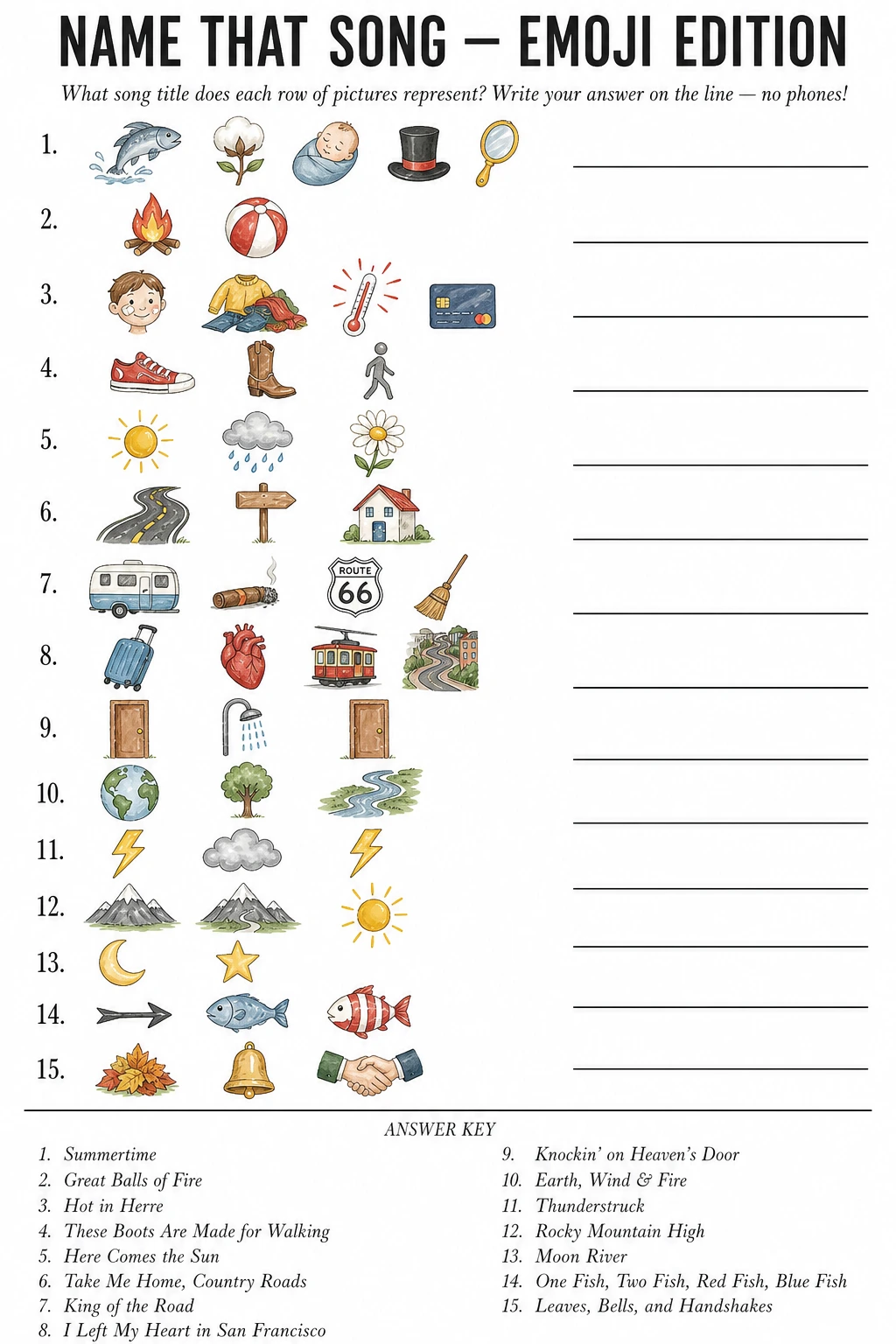
The Name That Song — Emoji Edition sheet presents a list of popular songs represented by sequences of themed illustrated icons — each sequence uses images that correspond to key words in the song’s title, giving players a visual puzzle to decode into a real, recognizable song name.
Players work through the sheet individually or in teams, writing their best guess for each song in the space provided.
Because every answer is an actual well-known song title, the “aha” moment of recognizing a song from its images makes this game genuinely satisfying rather than frustrating.
You need the printed sheet and a pen per player or team. No music or speakers required — this is a purely visual game, though a playlist of the answers makes a great soundtrack reveal at the end.
Works for any group size and runs about 20 minutes as a self-paced activity. Score sheets as a group when time is called, reading each answer and playing a clip of the song if you have a speaker handy for a fun confirmation moment.
Host tip: Set a firm time limit — 15 minutes works well — rather than waiting until everyone finishes. Open-ended timing means fast players sit idle while slow players feel pressure, and the energy drains out of the reveal.
18. Bocce Ball
Toss the small target ball — called the pallino — underhand to land anywhere in the playing area, at least a few feet from the toss line. Players then take turns rolling their colored bocce balls as close to the pallino as possible.
When all balls have been thrown, the team or player with the ball nearest the pallino scores one point for each of their balls that is closer to the pallino than the opponent’s nearest ball. First side to 12 points wins.
The beauty of bocce is that it rewards finesse over strength, making it one of the rare yard games where a ten-year-old can genuinely compete with an adult.
You need a bocce ball set — typically eight balls in two colors plus the pallino — and a flat stretch of lawn at least 30 feet long.
The game works for 2 to 8 players in singles, doubles, or four-player team format and a full game runs 30 to 45 minutes.
It’s a slow, social game that encourages conversation and keeps players near each other, making it ideal for guests who want to stay in the mix without heavy exertion on a hot afternoon.
Host tip: Mow the game area slightly shorter than the rest of the lawn before the party. Long grass creates unpredictable rolls and slows balls to a stop several feet short of where they should land, which makes precise play impossible and frustrates experienced players.
🛍 Shopping guide
19. Spikeball
Set the round Spikeball net — a small circular trampoline frame — in the center of an open area of the lawn. Two teams of two face each other around the net.
One player serves by bouncing the ball off the net to the opposing team, who then have up to three touches among themselves to spike it back off the net. If a team fails to return the ball cleanly, the serving team scores a point.
After the serve, there are no sides — players move freely in 360 degrees around the net. First team to 21 points wins.
You need a Spikeball set, which includes the net frame, legs, and ball — the whole thing collapses into a backpack-sized bag for easy transport. Works for exactly four players at a time, so keep a rotation list ready for larger groups.
A competitive game runs 20 to 30 minutes, and the fast pace makes it electric to watch even when you’re waiting for your turn. Because it plays in a small footprint, it fits in corners of the yard where larger games can’t go.
Host tip: Inflate the ball only until it has a slight give when squeezed — an overinflated ball bounces too high and wild off the net, which slows the game down and makes returning shots nearly impossible for newer players.
🛍 Shopping guide
20. Kan Jam
Place the two goal cans — cylindrical plastic discs with a slot cut in the side — 50 feet apart on the lawn. Teams of two stand at opposite goals.
The thrower hurls a flying disc toward the opponent’s can while their partner deflects, redirects, or guides it.
A disc that hits the side of the can directly scores one point; one that your partner redirects into the can scores two; a disc your partner slaps into the top opening of the can scores three; and a disc that flies directly through the side slot without being touched is an instant win.
First team to exactly 21 points wins.
You need a Kan Jam set, which includes two collapsible goal cans and a flying disc. The cans fold flat for storage and pop open in seconds. Works for exactly four players in a two-on-two format, with easy rotation for larger groups.
A game runs about 20 minutes and moves fast enough to hold the attention of the entire yard — the instant-win slot means any throw can end the game and keeps everyone watching every toss.
Host tip: Orient both cans so their side slots face the throwers at the start of the game. Once play begins, the disc-deflecting action tends to spin cans gradually out of alignment — assign a designated “slot watcher” who quietly straightens them between points so nobody realizes how much drifting happens during a full game.
🛍 Shopping guide
Frequently Asked Questions
How many games should I actually set up for a backyard BBQ?
For a party of 20 to 30 guests, plan for three to four active games running simultaneously — one big lawn game like corn hole or bocce, one relay or group contest, and two or three printable games at the tables.
That way every guest always has something to join without any single game getting overcrowded.
Setting up all 20 at once would turn your yard into a carnival midway and overwhelm guests; instead, rotate new games in every 45 minutes to keep energy fresh throughout the afternoon.
What are the best backyard BBQ games for all ages?
Games that require coordination or observation rather than raw speed or strength work best across age gaps.
Corn hole, bocce ball, ring toss, ladder toss, and giant Jenga are all genuinely competitive for players from age six to eighty because the skill ceiling is high enough to reward practice without the game being physically demanding.
For seated guests, the printable games — Summer Bingo, BBQ Trivia Rounds, Guess How Many, and BBQ Mad Libs — let everyone participate at their own pace without leaving the picnic table.
How do I keep kids and adults from being bored at different times?
The best strategy is to layer fast games and slow games so something is always building toward a climax.
Run quick contests like the water balloon toss or sack race early when energy is high, let the long-form games like giant Jenga and bocce run through the main meal window, and finish with a team relay race or trivia round that pulls the whole group together.
Printable games at the tables fill every gap in between and keep quieter guests engaged while the athletes are busy on the lawn.
Do I need to buy equipment, or can I improvise most of these games?
About half the games on this list need no equipment at all beyond what you print or already have at home.
The three-legged race needs only bandanas, the watermelon eating contest needs only a watermelon, and all the printable games need only a printer and a pen.
The games that do require gear — corn hole, bocce, Spikeball, Kan Jam, ladder toss — are worthwhile investments because all of them store flat or in a small bag and will appear at every BBQ you host for the next decade.
Buy two or three good sets rather than six cheap ones and you’ll be set for years.
How far in advance should I print the game sheets?
Print everything the night before the party and store sheets in a folder or clipboard so they stay flat and dry. Morning-of printing always leads to a printer jam right when you should be prepping food.
If you’re laminating any sheets — Summer Bingo cards or Would You Rather cards that you plan to reuse — give yourself two nights to print and laminate, since laminating pouches need time to cool and flatten before they’re ready to handle.
📌 Save These for Later
Loved these? Pin your favorite image below so you can find this list again when you’re planning.
20 girls sleepover games for the ultimate BFF night — printable sheets, friendship quizzes, active

Guess what the bride chose: 84 this or that questions bride edition, split into 6 scored rounds with

Discover 20 fun housewarming party games that help new neighbours and guests mingle, laugh, and cele
Leave a Reply