

Easter is so much more than a basket full of chocolate eggs. Once the hunt is over and the sugar rush kicks in, you need a lineup of games that will keep children aged 3 to 10 laughing, moving, and begging for one more round.
That is exactly what this list delivers — 22 Easter party games for kids that go well beyond the standard egg hunt, covering everything from giggle-worthy relay races to clever printable activities you can prep the night before.
Whether you are hosting indoors on a rainy spring afternoon or spilling out into the garden on a sunny Easter Sunday, there is something here for every age, every crowd size, and every level of party-planning energy.
Grab a stack of plastic eggs, print a few sheets, and get ready for the most memorable Easter celebration your little guests have ever had.
This post contains affiliate links — if you buy through them, I may earn a small commission at no extra cost to you.
Table of Contents
- Egg and Spoon Race
- Bunny Hop Relay
- Easter Picture Bingo (printable)
- Pin the Tail on the Bunny (printable)
- Egg Toss Buckets
- Easter I Spy Sheet (printable)
- Carrot Ring Toss
- Egg Rolling Race
- Easter Matching Game (printable)
- Chick Freeze Dance
- Egg Colour Sorting Relay
- Easter Colour by Number (printable)
- Golden Egg Riddle Hunt — Clue Cards
- Colour-Coded Team Hunt – Tally Sheet
- Egg Clue Trail Cards
- Numbered Egg Point Race
- Puzzle Piece Egg Hunt
- Easter Egg Hunt Score Sheet
- Easter Egg Bingo
- Easter Trivia Quiz
- Egg Emoji Decode
- Easter Egg Mad Libs
1. Egg and Spoon Race
This classic garden-party favourite needs nothing more than a tablespoon and a plastic egg per child, yet it reliably produces more laughter than almost any other game on the list.
Line children up at a starting mark, balance one egg on each spoon, and race to a finish line without dropping the egg.
If it drops, the child must stop, retrieve the egg, replace it on the spoon, and carry on from where they are standing — no running back to the start.
Run it as a straight race for older children, or as a gentle walking race for the three- and four-year-olds so everyone has a fair chance.
You need one plastic egg and one tablespoon per player, two boundary markers, and a flat strip of garden or hallway at least six metres long. Any group from four to twenty children works well.
Allow about fifteen minutes, including two or three heats so every child gets a proper go. If you are playing indoors, a long corridor or cleared living room works perfectly — just move the coffee table first.
Host tip: Keep a small basket of spare eggs at the start line. In the chaos of small hands, eggs crack or roll under furniture faster than you expect, and having replacements ready means the race never grinds to a halt mid-heat.
🛍 Shopping guide
2. Bunny Hop Relay
Divide the children into two or three teams of equal size and line each team up behind a starting cone.
The first player in each team must travel to a turning cone and back using only bunny hops — both feet together, hands held up by the ears. When they return, they tag the next player, who sets off immediately.
The team whose last player crosses the line first wins. Add a silly rule that if anyone takes a normal step they must hop back to the start of their run, which keeps the laughter going and the competition friendly.
All you need is four cones or painted flowerpots to mark the start and turn points, a clear flat surface, and enough space for children to hop safely without bumping into each other. Works best with six to twenty-four players split into even teams.
The whole relay, including a rematch, usually runs to about twenty minutes. It is ideal straight after a meal when children need to burn energy but are not yet ready for quiet activities.
Host tip: Demonstrate one full bunny-hop run yourself before releasing the children — they will copy the movement exactly, and your silly demonstration sets the fun, pressure-free tone that stops competitive children from getting frustrated.
🛍 Shopping guide
3. Easter Picture Bingo (printable)
Print one unique bingo card per child, each filled with a five-by-five grid of simple Easter illustrations — chicks, eggs, bunnies, carrots, tulips, watering cans, and baskets.
The host holds a matching set of small picture tiles or cards in a bag and draws them one at a time, holding each up or calling its name so younger children can look and listen.
Players mark off the matching image on their card using a bingo dauber, a sticky dot, or a small chocolate button. First to complete a full row — horizontal, vertical, or diagonal — shouts “Happy Easter!” and wins.
You need one printed card per child, a set of caller’s tiles, and something to use as markers. Bingo daubers are brilliant because small hands manage them easily, but chocolate buttons work just as well and double as a treat.
Suits four to thirty children, and a single game runs about ten minutes; most parties play three or four rounds before moving on. The printable sheet for this game features twelve distinct Easter images arranged in randomised grids so no two cards are identical.
Host tip: Laminate a handful of spare blank cards and keep a whiteboard marker nearby — if a card is damaged mid-game you can draw a quick replacement grid in thirty seconds rather than reprinting mid-party.
🛍 Shopping guide
4. Pin the Tail on the Bunny (printable)
Print and assemble the large bunny outline poster and attach it to a wall or door at child height. Cut out the individual fluffy tail pieces — one per child — and write each child’s name on the back.
Blindfold the first player, spin them gently two or three times, point them toward the bunny, and let them walk forward to stick the tail in position. Mark where it lands, then repeat for every guest.
The child whose tail lands closest to the printed target spot wins, but celebrate every wild miss just as enthusiastically so no one feels self-conscious.
You need the printed bunny poster, one tail cutout per child, a blindfold (or a light sleep mask), adhesive putty or rolled masking tape on the back of each tail, and wall space. Any group from three to twenty children can play.
Allow fifteen to twenty minutes including the setup and each child’s turn. This works wonderfully as a calm, seated-audience game between two energetic relay activities.
Host tip: Stick the poster onto a large piece of craft paper before mounting it on the wall so you can draw a running dotted-line scoreboard beneath the bunny, marking each child’s distance from the target — it becomes a keepsake the birthday child loves to take home.
🛍 Shopping guide
5. Egg Toss Buckets
Set out a row of three to five plastic buckets or decorated cardboard boxes at increasing distances from the throwing line, each labelled with a point value — the nearest bucket worth one point, the farthest worth five.
Children take turns tossing soft plastic eggs, one at a time, trying to land them in the buckets. Each player gets five throws per round, then tallies their score. Run two or three rounds so children can refine their aim and improve their score.
For younger players, move the nearest bucket closer or let them step forward one pace before throwing.
You need five to ten plastic or soft foam eggs, three to five buckets or boxes, point-value labels, and a strip of tape or rope for the throwing line.
Four to twenty children can play simultaneously if you set up two identical lanes side by side. A full round per child takes about ten minutes; with two lanes running at once you can keep the queue moving.
This game is ideal for the garden, but it translates indoors using a hallway and lighter foam eggs so walls and shelves stay safe.
Host tip: Weigh down the buckets with a handful of gravel or a damp cloth in the bottom so they do not tip over when a thrown egg clips the rim — tipping buckets cause arguments about whether the egg counts, and preventing that saves a lot of negotiating.
🛍 Shopping guide
6. Easter I Spy Sheet (printable)
This printable sheet features a densely illustrated Easter scene — a garden full of eggs, chicks, bunnies, butterflies, flowerpots, and gardening tools — with a numbered checklist down the side asking players to find and circle a specific quantity of each item.
For example: “Find 4 spotted eggs,” “Find 2 yellow chicks,” “Find 1 watering can.” Children work through the list independently, circling items directly on the sheet with a pencil or crayon.
The first child to correctly find every item on the list and check it off wins, but because the sheet is self-contained, children who finish later still enjoy completing it fully.
Print one sheet per child. Each player needs a pencil or crayon — no other materials required. Works for two to thirty children and is perfectly suited for ages four to eight. Allow ten to fifteen minutes.
Because it is a quiet, seated activity it is ideal as a calming game between boisterous outdoor rounds, or as a welcome activity for guests arriving at staggered times while you wait for everyone to gather.
Host tip: Print a couple of extra sheets without the answer key visible and set them aside — if an early finisher wants another challenge, offer the sheet again and ask them to count every item in the whole picture, not just the listed ones, which keeps them happily occupied for another five minutes.
7. Carrot Ring Toss
Cut orange card or craft foam into carrot shapes — about twenty centimetres long — and attach each one to a wooden dowel or a garden cane pushed into a block of florist’s foam or a bucket of sand so the carrots stand upright.
Make five or six carrot targets and space them at slightly different distances from the throwing line. Children take turns tossing rope rings or rubber quoits over the carrot tops, earning one point per successful ring.
After five throws each, add up the scores and crown a winner. Reset the rings between each player’s turn.
You need card or craft foam, orange paint, wooden dowels or garden canes, florist’s foam or buckets of sand to hold them upright, and a set of rope rings or rubber quoits. Making the carrot props is a nice pre-party craft activity for older children.
Four to twenty players, roughly fifteen minutes per rotation. This game works brilliantly outdoors but can be moved indoors with shorter dowels placed in weighted mugs on a table.
Host tip: Give each carrot a different name written on a small flag — “Tiny,” “Crunch,” “Fluffy” — and tell children which carrot is worth the bonus five points, then swap the bonus carrot each round so the game stays unpredictable and every child gets a moment of triumph.
🛍 Shopping guide
8. Egg Rolling Race
Borrowed straight from Easter traditions dating back centuries, this game is wonderfully simple: each child gets one hard-boiled or large plastic egg and a wooden spoon, but instead of carrying the egg they must roll it along the ground to a finish line as fast as possible using only the back of the spoon or the tip of a finger.
No picking up, no kicking — just rolling. Mark out individual lanes with rope or tape so eggs do not collide, and set the distance at roughly four to six metres depending on the age of the players.
Run it as straight heats with a final between round winners.
You need one egg per child (hard-boiled real eggs for the authentic experience, or plastic for a repeatable game), one wooden spoon or garden trowel per child, lane markers, and a flat surface — grass with a very slight downhill slope is perfect and speeds the game up delightfully.
Four to sixteen children per heat, fifteen to twenty minutes total. Works best outdoors on a warm day.
Host tip: Boil your eggs the morning of the party and let them cool completely before the game — a warm egg picks up grass and mud and rolls in unpredictable arcs, while a properly cooled egg rolls almost perfectly straight and makes the race genuinely competitive.
🛍 Shopping guide
9. Easter Matching Game (printable)
The printable sheet for this game contains two sets of Easter images printed in a grid — each image appears exactly twice, but the pairs are scattered across the page.
Players cut out all the small squares, shuffle them face-down on a flat surface, and play a classic memory-matching game, turning over two squares at a time and trying to find identical pairs.
If the two squares match, the player keeps them and takes another turn. If they do not match, both are flipped back over and it is the next player’s turn. The player holding the most pairs when all squares are claimed wins.
Print one sheet per pair or small group of two to four children. You need scissors to cut the cards and a flat table or floor space.
Ages four and up manage this comfortably; for three-year-olds, reduce the grid to eight cards (four pairs) by simply cutting away the extra rows. Small groups of two to four players, ten to fifteen minutes per game.
It is a wonderful quiet activity to have running at a side table throughout the party so children can drift in and out.
Host tip: Laminate the cut cards before the party and store each set in a small zip bag — laminated cards last all afternoon without curling at the corners, and you can pop the bags straight into the party bags as a take-home gift.
🛍 Shopping guide
10. Chick Freeze Dance
This is freeze dance with an Easter twist: when the music plays, every child must move like a baby chick — waddling, flapping tiny wings, pecking the ground, and cheeping. When the music stops, everyone freezes completely.
Any child spotted moving after the music stops sits out for one round but is brought back in at the next start so no one is excluded for long.
Play five or six rounds, gradually speeding up the music and making the stop-start intervals shorter and more unpredictable so the suspense builds.
You need a music speaker, a playlist of upbeat spring songs, and enough floor space for children to move without bumping into furniture. Any number from four to thirty children can play. A full game lasts ten to fifteen minutes.
It works brilliantly indoors and outdoors, requires zero materials, and is ideal as an energy-burning game mid-party when attention spans are flagging.
Host tip: Between rounds, add a new chick movement challenge — “this round, chicks can only hop on one leg” or “this round, chicks must peck the ground at least three times before the music stops” — which refreshes the game and keeps even children who have played freeze dance many times completely absorbed.
🛍 Shopping guide
11. Egg Colour Sorting Relay
Fill a large basket at one end of the playing area with a jumbled mix of plastic eggs in four or five colours. Place an empty bucket labelled with each colour at the other end. Children line up in teams, and on “Go!”
the first player from each team runs to the basket, picks up one egg of their team’s designated colour, sprints back, drops it in the correct bucket, and tags the next player. The team that correctly collects all of their colour eggs first wins.
Add a rule that picking up the wrong colour costs a five-second penalty, which encourages careful looking over frantic grabbing.
You need at least thirty to forty plastic eggs in four or five distinct colours, one large communal basket, one labelled bucket per team, and a clear running lane. Works best with eight to twenty-four children split into teams of four to six.
Allow fifteen minutes including a replay. This game doubles as a gentle colour-recognition activity for the youngest guests while staying exciting enough for seven- and eight-year-olds.
Host tip: Deliberately include a few trick eggs — eggs with two-tone halves that combine two colours — in the basket. When a child picks one up and has to decide which bucket it belongs in, it creates a funny pause that the watching children love and builds a moment of friendly discussion into the relay.
🛍 Shopping guide
12. Easter Colour by Number (printable)
The printable sheet features a large Easter illustration — a chick hatching from an egg, a rabbit in a flowery meadow, or a basket overflowing with eggs — divided into numbered sections.
A colour key at the bottom of the sheet tells children which crayon or felt-tip colour corresponds to each number. Children work through the picture section by section, revealing the full colourful image as they go.
There are no wrong answers as long as they follow the key, which makes this a wonderfully confidence-building activity for younger guests who might feel nervous about competitive games.
Print one sheet per child. Each player needs a set of crayons or felt-tip pens in the colours listed on the key — six to eight colours is the right range for ages four to eight. Any number of children can do this simultaneously.
Allow fifteen to twenty minutes for a thorough colouring, though children often want to keep going past time. Set up a dedicated colouring table with supplies so children can drift over whenever they need a quiet break.
Host tip: When children finish, collect the sheets and display them on a “gallery wall” of tape near the party table — seeing all the different interpretations of the same picture side by side sparks lovely conversation and gives every child a moment to feel proud of their work.
🛍 Shopping guide
13. Golden Egg Riddle Hunt — Clue Cards
Before the party, hide one special gold-painted plastic egg somewhere in your venue.
The clue cards printable sheet contains a set of illustrated riddle cards that lead children through a chain of locations — from the doormat to the bookshelf to the garden pot — with each card giving a simple rhyming clue pointing to where the next card is hidden.
The final clue leads directly to the golden egg, which is filled with a small prize. Read the first clue aloud together, then let the group race from location to location as a team, cheering when each new card is discovered.
Print and cut the clue card sheet, fill in the location blanks if the template includes them, and hide the cards in sequence around your party space the morning of the event.
You need the printed cards, one gold-painted or gold-foil plastic egg, a small prize to hide inside, and some sticky tape to fix cards in position. Works brilliantly for six to twenty children playing as one big team.
The hunt typically takes ten to fifteen minutes of gleeful searching. Playing as a group rather than individually means no child is ever left behind or left out.
Host tip: Walk the clue trail yourself immediately after hiding everything — it sounds obvious, but one mislaid card can strand the whole group, and a two-minute check saves you from having to rescue a frustrated crowd mid-hunt.

14. Colour-Coded Team Hunt – Tally Sheet
Divide children into small colour-coded teams and send each team hunting for eggs that match their assigned colour — blue team collects blue eggs, red team collects red eggs, and so on.
The tally sheet printable is a simple grid with each team’s colour across the top and rows for recording how many eggs are found in each sweep.
After each timed round of searching (three to four minutes works well), teams return to base, count their eggs, enter the number in the correct column, and an adult totals the running score. After three rounds, the team with the highest tally wins.
You need a large quantity of plastic eggs in matching team colours, the printed tally sheet (one copy for the host), pencils, and a timer. Works for eight to thirty children in teams of two to five.
The structured round format — search, return, count, record — keeps even the youngest players focused because there is always a clear next thing to do. Total playing time is about twenty-five minutes including setup and scoring.
This is the format to choose when you want the egg hunt itself to feel like an organised game rather than a free-for-all scramble.
Host tip: Hide eggs at three different heights — ground level, mid-height on a chair, and up high on a shelf — and tell the children in advance. It naturally distributes the searching and stops taller, older children dominating the hunt at the expense of smaller ones.

15. Egg Clue Trail Cards
Similar in spirit to a treasure hunt but designed for younger children who cannot yet read, each clue card in this printable set features a large, clear picture of a common household or garden location — a flowerpot, a welcome mat, a bookcase, a toy box — rather than written text.
The host hides the cards in sequence and children navigate from picture to picture by matching what they see on the card to the real object in front of them.
At the final location they find a shared prize — a bag of mini eggs or a small Easter basket to split between the group.
Print and cut the card set, then map the trail through your party space before guests arrive. You need the cards, something to attach them with (sticky tape or pegs), and a small group prize at the end.
Ideal for groups of four to twelve children aged three to six. The trail takes eight to twelve minutes to complete and works indoors or in a garden.
Because the clues are pictures, children who cannot read participate fully and often lead the group to the next location.
Host tip: Laminate the cards and add a loop of ribbon to each so they can hang from door handles or fence rails — this makes them far easier for small children to spot, removes the need for tape on wallpaper, and lets you reuse the set for future parties.

16. Numbered Egg Point Race
Write a different point value — 1, 2, 3, 5, or 10 — on the outside of each plastic egg using a permanent marker or a printed sticker, then hide them around the garden or party room.
Children hunt freely, but the goal is not to collect the most eggs — it is to collect the highest total points. When the host calls time, children return and add up the numbers on their eggs.
A child with three high-value eggs can easily outscore a child with ten low-value eggs, which keeps the game competitive and interesting right until the scoring moment. The printed sheet serves as each child’s personal score card.
You need a set of numbered plastic eggs (forty to sixty for a large group), one printed score sheet per child, pencils, and a timer set for five to seven minutes.
Works for four to twenty children and takes about twenty minutes including scoring and a potential tiebreaker round. The scoring element adds a satisfying maths component that appeals to five- to eight-year-olds without feeling like schoolwork.
Host tip: Hide the highest-value eggs (the tens and fives) in genuinely tricky spots — behind plant pots, under a teatowel, balanced in the fork of a low branch — and telegraph this to the children before the hunt begins, which sends the bold ones on an adventure while the younger ones happily collect the easy low-value eggs.

🛍 Shopping guide
17. Puzzle Piece Egg Hunt
Before the party, print and cut a simple Easter picture — a large bunny, a decorated egg, a spring landscape — into jigsaw-style pieces, one piece per plastic egg. Seal one piece inside each egg, hide all the eggs, and then send children to hunt.
When all eggs are found, the whole group opens them together, lays the pieces out, and works as a team to assemble the puzzle. The completed picture reveals a message — “Well done, Easter explorers!”
— or a clue to where a prize basket is hidden. The cooperative ending means every child feels part of the win.
You need the printed picture cut into pieces, one plastic egg per piece, and enough eggs to hide (roughly one per child plus a few extras so hunting feels abundant). Works for four to twenty children as a cooperative team.
Allow fifteen to twenty minutes for the hunt plus the assembly. Because children open eggs and contribute pieces together, there is no moment where one child has won and others have lost — the triumph belongs to the group.
Host tip: Print the picture on card rather than regular paper — card pieces hold their shape after being folded inside an egg, whereas paper pieces arrive crumpled and limp, which makes the assembly far more difficult and frustrating than it should be.

🛍 Shopping guide
18. Easter Egg Hunt Score Sheet
This printable works as a structured tally game in its own right: each child receives a score sheet before heading out on a free-range egg hunt.
The sheet has columns for egg colour, quantity found, and bonus points earned by completing small challenges printed on the sheet — “found one egg hidden higher than your head,” “found an egg in a flowerpot,” “found the egg with the star sticker.”
Children hunt, collect, and simultaneously tick off bonus challenges, then return to a scoring table where an adult helps them calculate their grand total.
The highest combined score wins, but the bonus challenges ensure that a child who finds fewer eggs can still place well by being observant and adventurous.
Print one score sheet per child and supply each player with a pencil. Works for any group size from four to thirty and pairs with any standard egg hunt setup. Allow twenty to twenty-five minutes for the hunt and five minutes for scoring.
The challenges on the sheet naturally slow children down and encourage them to look carefully rather than sprint and grab, which results in a much calmer, more pleasant hunt for everyone.
Host tip: Add one ultra-hard bonus challenge worth fifteen extra points — something genuinely tricky, like finding the single egg that has a tiny paper bow tied around it — and watch the most competitive players become completely absorbed in the search for it while the other children enjoy a relaxed hunt.

19. Easter Egg Bingo
This printable bingo card is designed specifically for egg lovers: instead of numbers or generic pictures, every square features a different decorated egg illustration — striped, spotted, zigzag, starred, flowered, and more.
The caller draws matching tiles from a bag or box, describing each pattern aloud (“the egg with red zigzags,” “the plain yellow egg,” “the egg with a purple star”) and holding it up so children can look.
Players mark off the matching egg on their card. First to complete a row shouts “Cracked it!” and wins a small prize. Run three or four rounds per session to give every child a win.
Print one unique card per player — the printable set includes enough variation that no two cards in a group of up to twenty-four are identical. Players need only a marker: chocolate buttons, small stickers, or bingo daubers all work well.
Ages four and up, any group from four to twenty-four, ten minutes per round. This game is particularly effective as an opening activity while late guests are still arriving because new players can join at any point without disrupting those already playing.
Host tip: Keep a duplicate set of caller tiles in a second bag as spares — if a caller tile is lost mid-game, you can swap in the spare without interrupting play, which matters a great deal when you have twenty children all staring at you expectantly.

🛍 Shopping guide
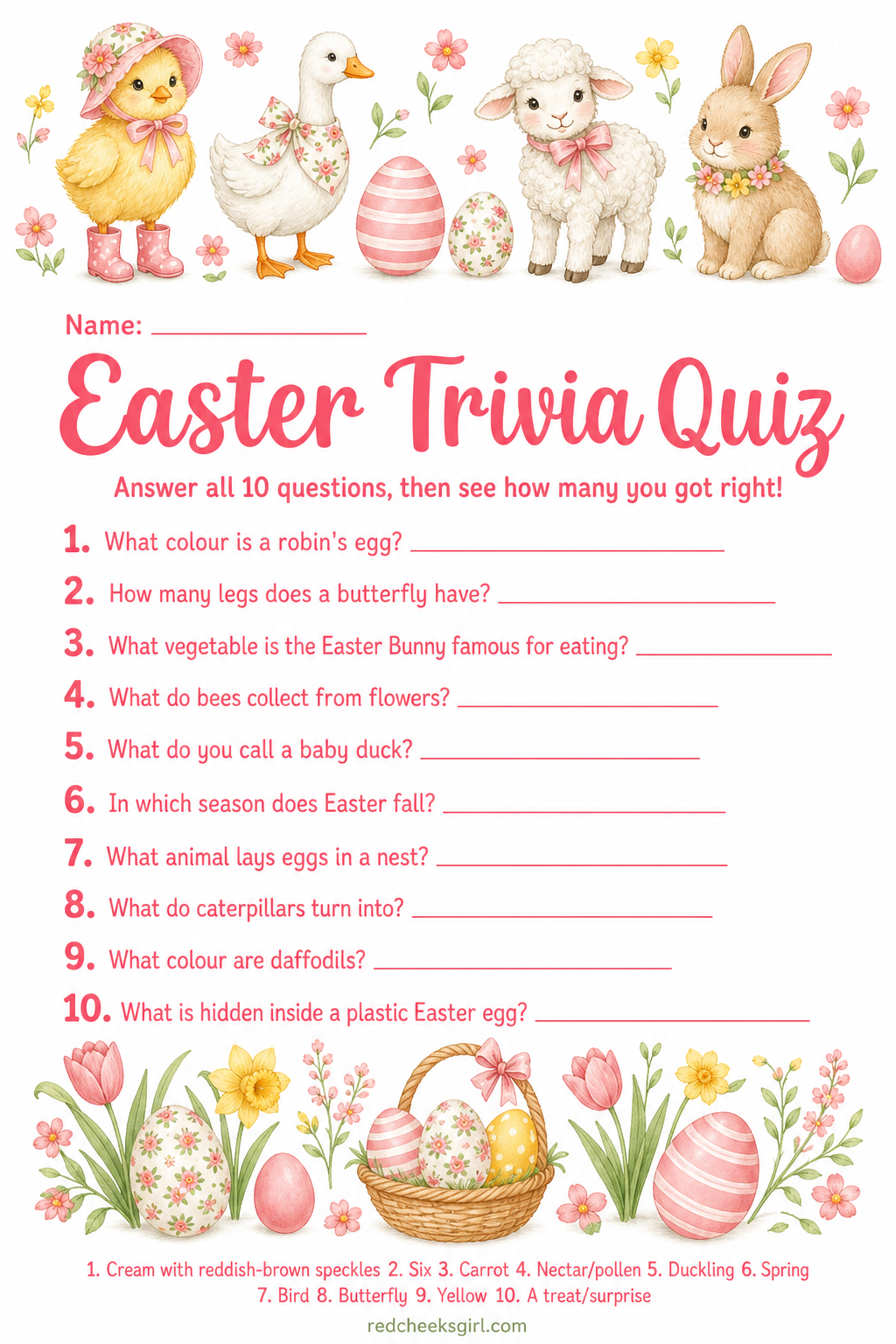
20. Easter Trivia Quiz
The printable Easter Trivia Quiz sheet contains twenty illustrated multiple-choice questions about Easter traditions, spring animals, and fun nature facts — questions like “How many days does a robin’s egg take to hatch?” or “Which animal is famous for delivering Easter eggs in Australia?”
Read each question aloud to the whole group while children circle their answer on their own sheet. After all twenty questions, reveal the answers one by one with a dramatic countdown, and children self-mark as you go.
The child with the most correct answers wins, and ties are settled with a sudden-death tiebreaker question.
Print one sheet per child, or one between two for younger players who can team up with a buddy. Each player needs a pencil.
Works for any group from four to thirty children; the quiz format suits ages six to ten best, though younger children enjoy participating in teams alongside an older sibling or adult. Allow twenty to twenty-five minutes for a full twenty-question quiz.
This is a brilliant activity for immediately after lunch when children need a calm, seated game.
Host tip: Read each question twice before moving on and pause for a full ten seconds — children who are still sounding out the multiple-choice options need that extra time, and rushing the quiz turns a fun challenge into an anxious scramble for anyone who reads more slowly.
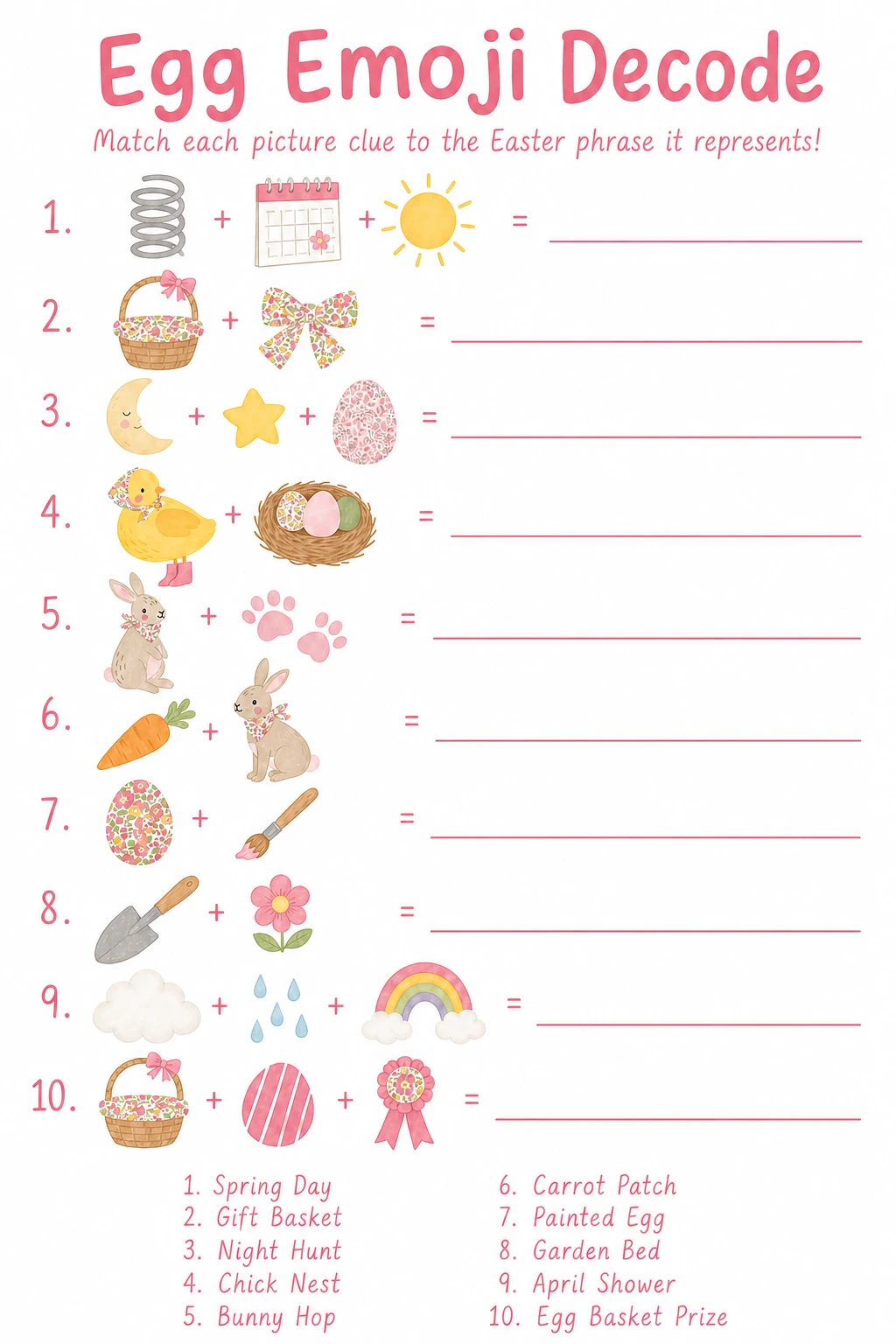
21. Egg Emoji Decode
This printable sheet is a visual matching game: each row shows a decorated Easter egg on the left and a panel of detail clues — colours, patterns, shapes, and symbols — on the right.
Children must study the egg image carefully and circle or tick the correct set of clues that describes it accurately, eliminating the decoy options in each row.
It is a careful observation and visual-reasoning game, not a “guess the phrase” puzzle, so every answer is clear, definite, and satisfying to find.
Work through each row systematically — examine the egg, read the clue options, cross out the ones that do not match, circle the right answer.
Print one sheet per child. Each player needs a pencil or crayon. Ages five and up, any group size, allow ten to fifteen minutes.
Because children work individually and at their own pace, this is ideal as a settle-down activity between boisterous games or as a welcome activity for early-arriving guests.
There are no wrong methods — some children work top to bottom, others jump to the eggs they find most distinctive first, and both approaches reach the same correct answers.
Host tip: Before handing out the sheets, hold up one example egg from your plastic egg collection and describe it aloud together as a warm-up — naming the colour, counting the stripes, spotting the pattern — so even the youngest participants understand exactly what kind of careful looking the game requires.
22. Easter Egg Mad Libs
Mad Libs is a fill-in-the-blank story game: the printable sheet features a short Easter story with key words removed and replaced by a labelled blank — “(animal),” “(colour),” “(silly noise),” “(action verb).”
Without showing anyone the story, the host asks the group to call out a word fitting each label and writes them in.
When all blanks are filled, the completed story is read aloud for the first time, and the random combinations of words create a hilariously nonsensical Easter tale that the children helped create.
Every reading is different, and groups almost always demand a second round with a fresh sheet.
Print one sheet per round — you will want two or three copies so you can play multiple times. The host needs a pencil. No other materials required.
Works brilliantly for six to thirty children as a whole-group activity; the story reading is best done with theatrical flair by an adult who does not mind being silly. Ages five and up. Allow ten minutes per story including the reading.
Mad Libs is one of those rare games that is just as funny the third time as the first, provided you use a fresh sheet each round.
Host tip: Ask for words in a random order rather than working through the blanks top to bottom — starting with “give me a silly sound” and then jumping to “now give me a colour” prevents children from guessing what the story is about and produces far wilder, funnier combinations than a sequential approach would.

Frequently Asked Questions
What Easter party games work best for a mixed age group of three- to ten-year-olds?
Games that allow children to participate at different skill levels work best. The Bunny Hop Relay, Chick Freeze Dance, and Egg Colour Sorting Relay are all naturally self-differentiating — younger children enjoy them at their own pace while older ones bring the competitive energy.
For quieter moments, printable activities like the Easter Matching Game or Easter Colour by Number can be adjusted by difficulty simply by how many cards you put in play or how detailed the sheet is.
How many games should I plan for a two-hour Easter party?
Aim for six to eight games for a two-hour party, mixing active relay-style games with quieter printable activities. A good rhythm is one active game, one seated printable, one active game, a snack break, then two more games and a wind-down colouring activity.
Keep one extra game in reserve in case an activity finishes faster than expected or a game does not land as planned — it almost always does land, but the reserve gives you confidence.
Can these Easter games be played indoors if the weather is bad?
The majority of the games on this list work perfectly indoors with minor adjustments.
Replace hard eggs with soft foam eggs for the Egg Toss Buckets and Egg Rolling Race, clear a corridor for relays, and push furniture back from the centre of the living room for Chick Freeze Dance.
All the printable games — Bingo, Matching Game, Colour by Number, I Spy, Trivia Quiz, Mad Libs — are explicitly designed for a table or floor and need no outdoor space at all.
How far in advance should I print the printable game sheets?
Print everything the day before the party at the latest. This gives you time to discover if your printer is low on ink, if a sheet needs trimming or laminating, or if you need to reprint a page that came out skewed.
For games like the Matching Game and Clue Trail Cards, cut and sort the pieces the evening before and store them in labelled zip bags so morning-of setup is fast and calm.
What prizes work well for Easter party games?
Small prizes keep the focus on fun rather than competition. Mini chocolate eggs, sticker sheets, small spring-themed erasers, tiny pots of bubbles, and seed packets (children love growing their own sunflowers) all work brilliantly.
For the youngest children, make sure every player receives something at the end of the party — a participation sticker or a small treat bag — so no child goes home feeling they lost.
📌 Save These for Later
Loved these? Pin your favorite image below so you can find this list again when you’re planning.



Discover 18 fun Easter games for adults perfect for brunch, backyard gatherings, and lightly competi

22 fun Easter party games for kids ages 3-10 — active races, printable sheets & quiet keepsakes be
Twenty tried-and-tested Easter games for large groups, perfect for church halls, community centers,
Leave a Reply