


There’s a particular kind of magic that happens when you get your favorite people into one living room with snacks, something to sip, and zero obligation to be anywhere else.
The conversation is good, the laughter is loud, and the night has a way of stretching out past the point where anyone planned to leave. The only thing that makes it better?
A handful of games that feel less like structured activities and more like excuses to get everyone talking, reminiscing, and absolutely roasting each other with love.
This list has exactly twenty girls night games built for a night in—twelve of them come with printable sheets you can pull up and print before anyone arrives, and the other eight need nothing more than the people already in your room.
Whether you want a game that sparks confessions, one that tests how well you actually know each other, or one that ends with everyone crying laughing over a shared memory, you’ll find it here.
Pick two or three to anchor the night, or run through five or six if your group has the energy. The only rule is that everyone has a good time.
This post contains affiliate links — if you buy through them, I may earn a small commission at no extra cost to you.
Table of Contents
- How Well Do We Know Each Other?
- Most Likely To
- Confessions Cards
- Rom-Com Trivia Rounds
- Would You Rather Girls Night Edition
- Wine Blind Taste Ranking
- Throwback Music Intro Round
- Two Truths and a Lie
- Compliment Circle Cards
- Photo Memory Match
- Girls Night Bingo
- Storytelling Round Robin
- Emoji Decode – Girls Night Edition
- Secret Role Dinner Guest
- Unpopular Opinions Hot Seat
- Friendship Timeline Challenge
- The Advice Column Game
- Group Sketch Telephone
- Hot Takes Tournament
- Desert Island Draft
1. How Well Do We Know Each Other?
This is the game that sounds sweet and instantly turns competitive. Before the night starts, the host prints the “HOW WELL DO WE KNOW EACH OTHER?”
sheet, which lists questions about the group—things like who would survive a zombie apocalypse, who has the most unread texts, or who cried at the last wedding. Players write their answers privately, then read them aloud to compare.
Points go to anyone who matches the group majority, and the person with the most points at the end wins the title of Most Self-Aware Friend in the Room.
You need: one printed sheet per player, pens. Works best with four to ten people and runs about thirty to forty minutes. The beauty of this game is that it doubles as a conversation starter—every answer someone gets “wrong” leads to a story, a defense, or a dramatic reveal that sends the whole group sideways.
Host tip: read a few sample questions aloud before everyone fills in their sheets so the group understands whether they’re answering about themselves or about each other. That single clarification prevents five minutes of confused looks once scoring starts.

🛍 Shopping guide
2. Most Likely To
Print one “Most Likely To” sheet per person and watch the room immediately get nervous.
Each sheet lists a series of scenarios—most likely to marry a stranger on a dare, most likely to show up an hour late to her own party, most likely to cry over a commercial—and everyone writes in a name for each one.
Answers are collected, read aloud by the host, and tallied. The person who gets nominated most overall earns a title the group invents on the spot.
You need: printed sheets, pens, and optionally a small prize for whoever racks up the most nominations. Four to twelve players, twenty-five to thirty-five minutes. It plays fast but the discussion after each reveal is where the real entertainment lives—expect defenses, counter-nominations, and at least one person saying “you all are terrible” while laughing.
Host tip: add two or three blank lines at the bottom of the sheet before printing so players can write in their own custom categories. Personalized ones—written for this specific group—always get the biggest reaction.

🛍 Shopping guide
3. Confessions Cards
The “Confessions Cards” printable is cut apart before the night starts so each player has a hand of prompt cards.
Prompts might say things like “confess the last white lie you told” or “confess a habit you hide from most people” or “confess your most irrational dealbreaker.” On their turn, each player draws a card, reads it aloud, and answers honestly.
The group votes with a show of hands on whether they believe the confession is the whole truth—majority rules, and the player has to reveal whether they held anything back.
You need: one printed and cut sheet of cards, a flat surface to draw from, pens if you want to track rounds. Three to eight players, thirty to forty-five minutes. This one works especially well mid-evening after everyone has relaxed—it builds on existing comfort rather than forcing vulnerability cold.
Host tip: shuffle in a few “pass and make someone else answer” wild cards before you cut the sheet. It adds a layer of strategy and gives anyone who lands on a prompt that feels too personal an out that keeps the game moving.

🛍 Shopping guide
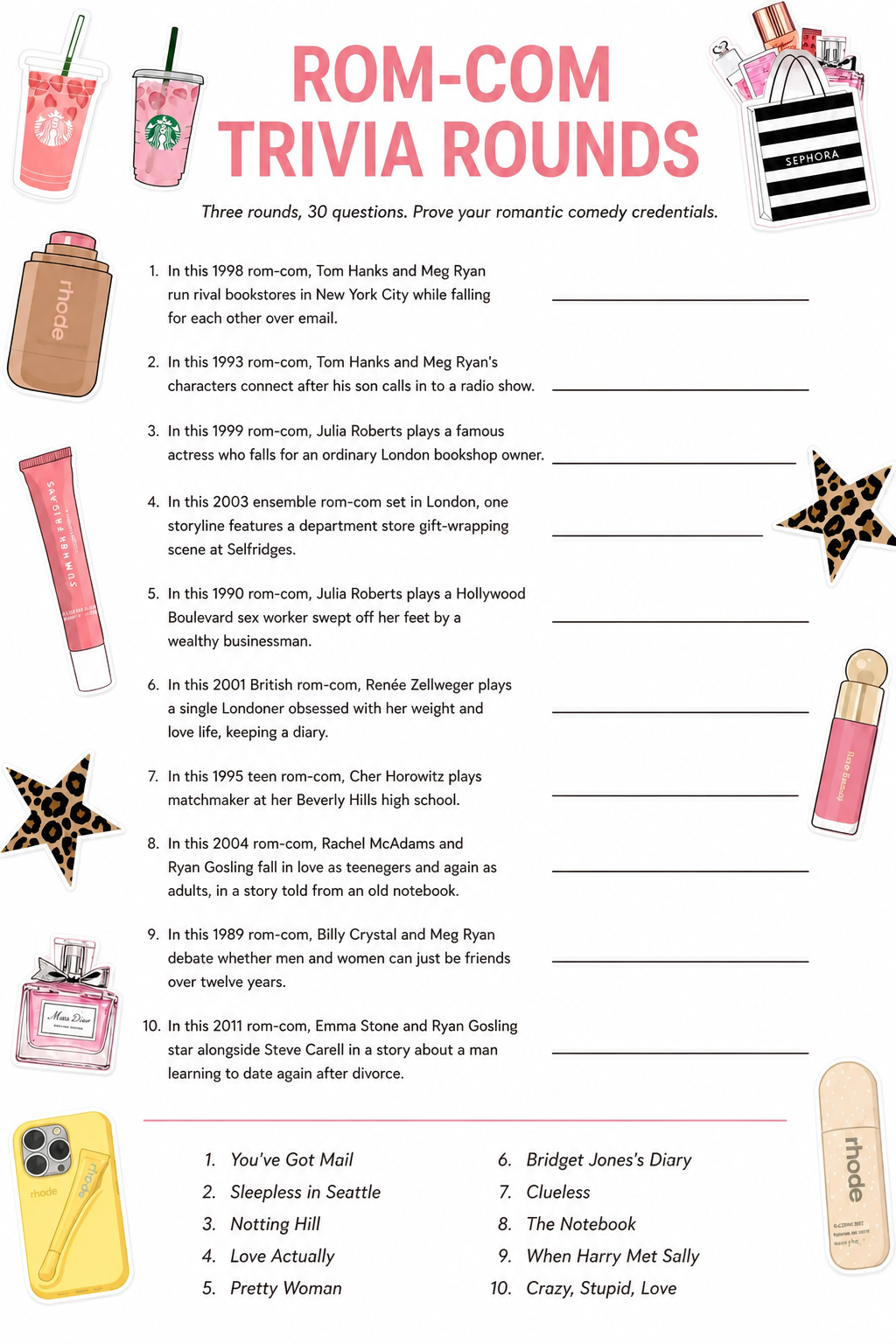
4. Rom-Com Trivia Rounds
The “ROM-COM TRIVIA ROUNDS” sheet is organized into rounds by decade or by theme—classic nineties rom-coms, enemies-to-lovers plots, leading men, famous closing lines. The host reads each question aloud and players write their answers privately before anyone calls it out.
After each round, answers are revealed together and the host reads the correct answer from the sheet. Whoever has the most right at the end of all rounds wins, and anyone who gets a perfect round gets to assign a dare to the last-place player.
You need: one sheet for the host, small answer slips or a notepad for each player, pens. Four to twelve players, thirty to forty-five minutes. This one rewards the friend who has seen every Julia Roberts film twice and finally gives her a moment to shine in a way the group actually appreciates.
Host tip: read each question slowly and give the group fifteen seconds before anyone is allowed to call out—write-first rules keep the person who always answers in 0.3 seconds from dominating every round.
🛍 Shopping guide
5. Would You Rather Girls Night Edition
The “Would You Rather – Girls Night Edition” printable presents a list of either/or scenarios tailored to adult friendships and life choices—would you rather always be five minutes late or always arrive twenty minutes early, would you rather know every secret your friends keep or have your friends know yours.
Players circle their answers privately, then the host reads each scenario and everyone reveals their choice simultaneously. Anyone in the minority has to explain their reasoning, which is always the funniest part.
You need: one printed sheet per player, pens. Four to ten players, twenty to thirty minutes. This game moves quickly, requires zero setup beyond printing, and works perfectly as an opener before you move to something with more rules.
The scenarios are designed for adults—some are funny, some are genuinely thought-provoking, and a few will cause mild arguments that end in agreement.
Host tip: after the printed sheet is finished, go one more round using questions the group improvises. After twenty minutes of play, everyone has a feel for the format and the custom questions are always wilder and more personal than anything pre-written.

🛍 Shopping guide
6. Wine Blind Taste Ranking
The “Wine Blind Taste Ranking” printable turns the classic blind tasting into a structured scoring game. Before guests arrive, the host wraps three to five bottles in foil or brown paper and numbers them.
Each player gets a printed sheet with columns for appearance, aroma, taste, finish, and overall ranking, plus a guess-the-variety section.
Everyone tastes each wine in order and fills in scores, then the host reveals the bottles at the end and players see how their rankings compare—both to each other and to the actual price points.
You need: the printed sheet per player, three to five numbered mystery bottles, wine glasses, palate-cleansing crackers, pens. Four to ten players, forty-five to sixty minutes.
The game works best when the price range is wide—include a twelve-dollar bottle and a forty-dollar bottle and watch how many people prefer the cheaper one. No special wine knowledge required; scoring on personal taste makes everyone an equal competitor.
Host tip: assign one player as the designated pourer so no one accidentally sees the bottles during setup. Also pour in small amounts—enough to taste four or five wines without anyone becoming incapable of tallying their score by the third bottle.

🛍 Shopping guide
7. Throwback Music Intro Round
The “Throwback Music Intro Round” printable lists song titles, artists, and years across multiple decades, organized into themed rounds.
The host plays just the first five to ten seconds of each song—using a streaming service playlist built in advance—and players race to write down the song title on their sheet. Correct title gets one point, correct artist gets a bonus point.
The sheet also includes a “decade guess” column for the songs the group can’t identify—closest guess to the actual release year wins that point.
You need: the printed sheet per player, a playlist prepared in advance, a speaker, pens. Four to twelve players, thirty to forty-five minutes.
Music rounds create a different kind of energy than trivia—there’s a physical reaction when someone hears the first note of a song they forgot they knew, and that split-second of recognition followed by frantic writing is genuinely fun to watch happen around a room.
Host tip: use a mix of songs the whole group would know and one or two deep cuts that only the music obsessive in your crew will get—it levels the playing field and gives the underdog a moment to absolutely destroy the round.

🛍 Shopping guide
8. Two Truths and a Lie
The “Two Truths and a Lie” printable gives each player a structured sheet to fill out privately—three statements about themselves, two true and one convincingly false.
Players take turns reading their three statements aloud while everyone else uses the sheet to vote on which one they think is the lie. Points go to anyone who guesses correctly; the reader earns a point for every person she fools.
After all rounds, the person who fooled the most people is crowned the group’s most accomplished fibber, which is either a compliment or a warning depending on your perspective.
You need: one sheet per player, pens. Four to ten players, thirty to forty minutes. The printable format is an upgrade on the verbal version because players write their statements in advance, which forces more deliberate thinking and results in much better lies than anyone comes up with on the spot.
Host tip: collect all the filled-out sheets and shuffle them before reading so no one knows whose sheet is whose. Reading anonymously creates an extra layer of guessing—not just “which is the lie” but “wait, which friend does this even belong to.”

🛍 Shopping guide
9. Compliment Circle Cards
The “Compliment Circle Cards” printable is cut into individual cards, each bearing a prompt like “the friend in this room who gives the best advice is ___” or “the one who would drop everything if you called is ___.”
Cards are shuffled and drawn one at a time. Whoever draws reads the prompt aloud, writes in a name privately, then reveals it—and gives a one-sentence reason for their choice.
The person named can respond however they like, which is usually somewhere between genuinely touched and mildly flustered.
You need: the printed and cut card set, pens or the option to answer verbally. Four to eight players, twenty to thirty minutes.
This one works best at the end of the night when the mood is warm and everyone has had a chance to settle in. It isn’t competitive—there’s no winner or loser—but it creates moments that people actually remember the next day.
Host tip: make sure the prompts stay specific enough to require real answers rather than generic ones. If a prompt produces a unanimous answer around the circle, pause and let that land before moving on—those moments of agreement are the ones that turn into inside references for years.

🛍 Shopping guide
10. Photo Memory Match
Before the night begins, the host collects old photos of the group—from phones, social media, or old albums—and prints them out, then prints the “Photo Memory Match” sheet, which includes a numbered grid corresponding to those photos.
Players look at the photos for sixty seconds, then the photos are turned over and players use the sheet to answer memory questions about them: what color shirt was she wearing, who was standing on the left, what year does the background suggest this was taken.
The player with the most correct answers wins.
You need: the printed answer sheet, printed or displayed photos, a timer, pens. Four to eight players, twenty to thirty minutes. This game is sneakily emotional—sorting through old group photos to set it up is half the fun, and players spend as much time laughing about the memories during the reveal as they do counting up points.
Host tip: choose a mix of recent photos and genuinely old ones from earlier in the friendship. The contrast between then and now creates its own conversation, and the truly ancient ones always cause at least one extended detour into shared history that nobody wants to cut short.

🛍 Shopping guide
11. Girls Night Bingo
The “Girls Night Bingo” printable gives each player a bingo card filled with squares like “someone says ‘I haven’t told anyone this'” or “a story gets interrupted by laughter three times” or “someone checks their phone then immediately feels guilty.”
Instead of a caller, players mark their squares organically as the night unfolds—whenever something on the card actually happens in real life during the evening, you mark it. First to complete a row calls bingo and wins a small prize chosen by the host.
You need: one printed bingo card per player, small markers (coins, chocolates, or a pen to X the squares). Four to ten players, runs the length of the evening. The genius of this format is that it doesn’t interrupt anything—it just runs alongside the night and makes everyone pay slightly more attention to what’s actually happening in the room.
Host tip: print a few extra cards so you can hand them to anyone who arrives late. Also read all the squares aloud at the start of the night so everyone knows what they’re watching for—this increases the frequency of shouting “that’s my square!” which is entertainment in itself.

🛍 Shopping guide
12. Storytelling Round Robin
The “Storytelling Round Robin – Prompt & Twist Cards” printable is cut into two piles—prompts and twists.
One player draws a prompt card (“tell the story of a trip that didn’t go according to plan”) and begins telling a story, real or invented, for about sixty seconds.
Then the next player draws a twist card (“suddenly a minor character becomes the hero”) and must seamlessly continue the story incorporating the twist. Play continues around the circle, alternating prompt and twist cards, until the story reaches a natural or spectacularly ridiculous conclusion.
You need: the printed and cut card set, a timer, no pens required. Four to ten players, thirty to forty-five minutes.
This is the game for the group that loves improv energy even if they’d never describe it that way—the structure of the cards gives even the shyest person a jumping-off point, and the twist mechanism means no one controls where the story goes.
Host tip: encourage players to call back to earlier details when incorporating twists—stories where later players reference something from the first sixty seconds feel weirdly satisfying and always get a reaction from whoever added that detail originally.

🛍 Shopping guide
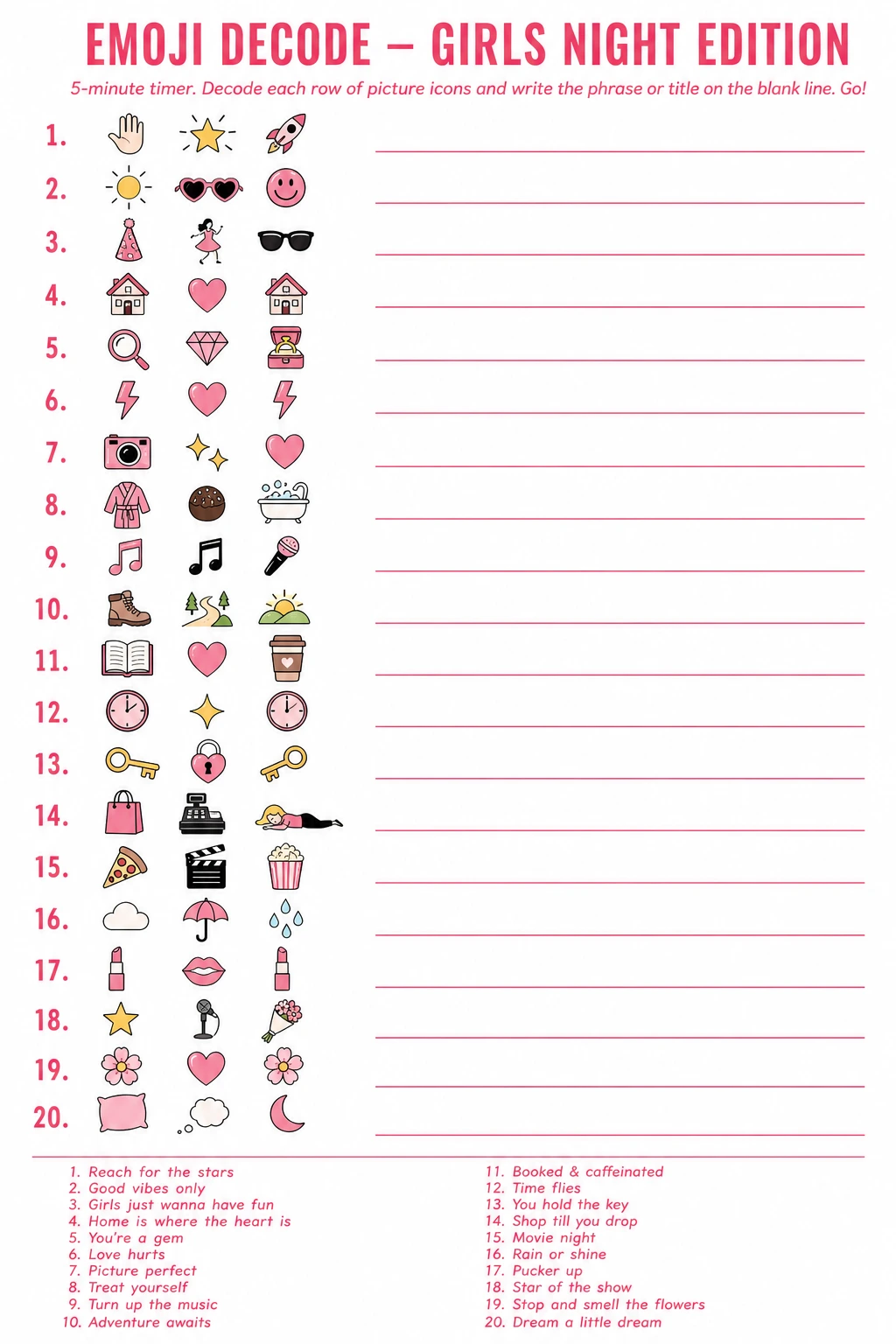
13. Emoji Decode – Girls Night Edition
The “Emoji Decode – Girls Night Edition” printable sheet gives players rows of emoji sequences, each representing a movie title, a phrase, a song, or a feeling.
Players work through the sheet individually or in teams, writing their best guess next to each row within a set time limit—typically five to seven minutes per round. When time is called, the host reads the answers and players check their work.
The player or team with the most correct answers at the end of all rounds wins, and any row that nobody gets right becomes a bonus lightning-round verbal clue.
You need: one printed sheet per player or team, pens, a timer. Four to twelve players, twenty to thirty minutes.
This one moves fast, generates a lot of confident-then-horrified reactions when the real answer is revealed, and works well as a mid-evening palette cleanser between heavier games.
The girls-night theming means most of the references are drawn from pop culture, friendship moments, and experiences the group is likely to share.
Host tip: give a ninety-second warning before calling time so players can skip stuck rows and return to them—people who chase every single emoji sequence in order often run out of time on the easy ones near the end, and that frustration is entirely preventable.
🛍 Shopping guide
14. Secret Role Dinner Guest
Before the evening starts, the host writes a secret role on a small slip of paper for each player—something like “the friend who always redirects every conversation back to herself” or “the one who insists everything was better ten years ago” or “the eternal devil’s advocate.”
Players keep their role secret and try to play the character naturally throughout a structured fifteen-minute discussion on a chosen topic—something like “should we all move to the same city” or “rank these life milestones in order of importance.”
At the end, everyone guesses which role each person was playing.
You need: prepared role slips, a discussion topic decided in advance, no other materials. Four to eight players, twenty-five to thirty-five minutes.
This game rewards subtlety—the best players stay barely detectable for the first half of the discussion and then lean just slightly harder as time runs out. It’s part improv, part social observation, and entirely more entertaining than it sounds on paper.
Host tip: write roles that are affectionate archetypes, not mean-spirited caricatures—the goal is recognizable humor, not roasting. Basing a role loosely on someone in the room only works if that person is in on the joke and laughs loudest at it.
15. Unpopular Opinions Hot Seat
Every player writes two or three unpopular opinions on separate slips of paper—opinions about food, pop culture, travel, relationships, life choices, anything—then folds them and drops them into a bowl. The host draws one at a time and reads each opinion aloud.
The group debates it for two minutes, trying to identify who wrote it before time is called. If no one correctly identifies the author, the author reveals themselves. If someone guesses right, both the guesser and the author earn a point.
The most recognizable thinker in the group—whose opinions gave her away every time—gets a custom title chosen by the group.
You need: small slips of paper, a bowl, pens, a timer. Four to ten players, thirty to forty minutes. The two-minute debate is where the game lives—people get surprisingly animated defending or attacking an anonymous opinion, and the reveal of the author always recontextualizes everything that was just said in a deeply funny way.
Host tip: remind everyone before writing that opinions work best when they’re genuinely held, not performed for shock value. The funniest moments come from sincere, mildly controversial takes—not from someone writing something outrageous just to watch the room react.
16. Friendship Timeline Challenge
The host prepares a set of twenty to thirty events from the group’s shared history—first meeting, memorable trips, group milestones, running jokes that started somewhere specific—written on individual index cards. The events are shuffled and dealt face-down to players.
On a signal, everyone works together to arrange all the cards into chronological order on the floor or table, debating placement as they go.
Once the group is satisfied with the timeline, the host reveals the correct order and the group earns one point for every correctly placed card. The game is cooperative but the discussion is competitive.
You need: prepared index cards or cut slips, a flat surface to arrange them on, the host’s knowledge of the correct order. Four to ten players, twenty-five to thirty-five minutes. The prep is minimal once you know your group—and writing the events down before anyone arrives is itself a lovely exercise in remembering how much has actually happened.
Host tip: include a few events that only some of the group were present for—those cards create natural moments where people explain and re-tell the story to whoever wasn’t there, which extends the game in the best possible way.
🛍 Shopping guide
17. The Advice Column Game
Each player writes a real or invented dilemma on a slip of paper—something she’s genuinely wrestling with or something completely fabricated for maximum drama—without signing it.
Slips go into a bowl and the host draws one, reads it aloud, and players have ninety seconds to write their best advice on a small notepad.
All advice is read aloud anonymously, and the group votes on which response is the most practical, which is the most entertaining, and which is the most “you’d only say that if you’ve never made a bad decision in your life.”
The person whose dilemma was drawn reveals whether it was real or invented after the advice round.
You need: slips of paper, a bowl, small notepads or index cards, pens. Four to ten players, thirty to forty-five minutes. The game creates a surprisingly comfortable space for real conversations because the anonymous format makes it easier to put something genuine into the bowl while maintaining plausible deniability.
Host tip: read each dilemma twice before the advice-writing clock starts—once for the group to absorb it and once to answer the inevitable “wait, can you repeat the last part.” Dilemmas that are too long lose the group’s attention before anyone starts writing.
18. Group Sketch Telephone
Each player starts with a blank sheet of paper and writes a specific, visual sentence at the top—something like “a woman in a ballgown riding a scooter through a farmer’s market.” She passes the sheet to the left.
The next player draws that scene as accurately as she can in forty-five seconds, then folds the paper to hide the written sentence so only the drawing shows.
She passes it again; the next player writes a sentence describing the drawing, folds to hide the drawing, and passes it on. The cycle of draw-then-write continues until the paper returns to its original owner, who reads the full sequence aloud.
You need: blank paper for each player, pens or markers, a timer. Four to ten players, twenty-five to thirty-five minutes. Absolutely no artistic skill is required—in fact, the worse the drawings, the funnier the resulting drift from the original sentence.
The game works because every misinterpretation compounds, and by the time the paper comes back around, the final sentence rarely has any relationship to the first one.
Host tip: use markers instead of pencils so drawings are bold enough to read quickly. Also enforce the forty-five second limit firmly—players given unlimited time overthink and the drawings improve, which paradoxically makes the game less funny.
🛍 Shopping guide
19. Hot Takes Tournament
The host prepares a bracket—written on a whiteboard, large paper, or printed simply—with eight to sixteen debate matchups, each featuring two bold statements about everyday life: “morning people are more productive” versus “night owls do their best work,” or “texting is better than calling” versus “if it’s important, just call.”
Players are divided into two teams and each matchup is a two-minute debate where one team argues for each side, regardless of personal belief.
The group votes on which side made the stronger argument, and winners advance through the bracket until one team holds the championship.
You need: a prepared bracket and debate topics, a whiteboard or large paper and a marker, a timer. Six to twelve players works best, forty-five to sixty minutes. The format is borrowed from competitive debate but stripped of all pretension—the goal is persuasion, humor, and the realization that your quietest friend is apparently terrifying in an argument.
Host tip: assign sides randomly rather than letting teams choose their position. Having to argue the opposite of what you actually believe produces more creative reasoning and stops the debate from becoming a predictable echo of everyone’s real opinions.
🛍 Shopping guide
20. Desert Island Draft
Each player gets three minutes and a notepad to privately draft her desert island list: five songs, three foods, two people from outside the room, and one “wildcard” item she argues is essential for survival.
When time is up, players take turns presenting their lists to the group. After each presentation, the group has two minutes to cross-examine the choices—challenging song selections, questioning food priorities, and interrogating the wildcard item with the energy of a very relaxed Senate hearing.
At the end, everyone votes on whose list they’d most want to be stranded alongside.
You need: small notepads or paper, pens, a timer. Four to ten players, thirty to forty minutes. This game is low-pressure to play and endlessly entertaining to listen to—the wildcard item always reveals something unexpected about the person who chose it, and the cross-examination phase is where the real personalities come out.
Host tip: tell everyone the categories before the three-minute timer starts—players who spend the first ninety seconds figuring out the format instead of drafting always feel cheated when time is called, and the lists they produce under that pressure are noticeably less interesting than everyone else’s.
🛍 Shopping guide
Frequently Asked Questions
How many games should we actually play in one night?
Two to four games is the sweet spot for most groups. Pick one opener that gets everyone talking quickly, one mid-evening game with a bit more structure, and one closer that’s either competitive or sentimental depending on the mood.
If your group has high energy and you started early, five or six shorter games works fine—just don’t feel obligated to play through the whole list in one sitting. The goal is a good night, not a completed checklist.
Do I need to print everything in advance?
For any game marked as a printable, yes—print them before guests arrive. Trying to print mid-evening while people are waiting kills momentum and the printer will inevitably run low on ink.
Print one sheet per person for individual games, and a single host copy for trivia-style games where only the host needs to read from the sheet. Cardstock holds up better than regular paper if the sheets get passed around a lot.
What’s the best game to start the night with?
Games that require no setup and get people revealing something small about themselves work best as openers—Would You Rather and Two Truths and a Lie are both good choices.
They don’t require everyone to be fully settled and they create early laughs that warm the room up fast. Save anything emotionally heavier, like Compliment Circle Cards or Confessions Cards, for mid-evening when everyone is relaxed.
What if someone in the group is shy or doesn’t like being put on the spot?
Choose games that offer written answers before verbal reveals—the writing step gives quieter players time to think and removes the pressure of performing spontaneously. Most of the printable games on this list work exactly that way.
You can also skip individual scoring in favor of team formats, which naturally takes the spotlight off any single person and makes participation feel more comfortable.
Can these games work for a smaller group of three or four people?
Most of them work well with four people, and several—including Two Truths and a Lie, Would You Rather, and Confessions Cards—are actually better with a smaller, more intimate group because there’s more time for each person and the conversations go deeper.
For games that rely on majority voting, just adjust the scoring so a single correct guess earns a point rather than waiting for group consensus.
📌 Save These for Later
Loved these? Pin your favorite image below so you can find this list again when you’re planning.




72 interesting would you rather questions adults will actually debate. Six rounds, printable card de

From printable question rounds to hilarious team challenges, these 20 couples game night games keep

21st birthday activities that get strangers talking fast: 9 free printables plus 5 no-prep games, al
Leave a Reply