


Office parties have a reputation for awkward silences, forced small talk, and the one person who disappears to check emails after fifteen minutes.
The difference between a party people actually enjoy and one they quietly survive usually comes down to structure: give people something to do, and they stop worrying about what to say. That is where a well-chosen game changes everything.
The twenty ideas below are built specifically for mixed groups — different departments, different seniority levels, different personalities — and none of them require alcohol, embarrassing confessions, or a personality type that loves being the center of attention.
Each entry includes exactly what you need to run it, how many people it works for, roughly how long it takes, and one host tip drawn from having actually run these games in real offices.
Thirteen of the twenty come with a printable sheet you can have ready before anyone arrives, so the setup is mostly done the night before.
Work your way through the full list, pick five or six that suit your crowd, and your next office party might be the one people actually request again next year.
This post contains affiliate links — if you buy through them, I may earn a small commission at no extra cost to you.
Table of Contents
- Human Bingo: Office Edition
- Two Truths and a Lie
- Guess the Coworker Baby Photo
- Office Trivia Rounds
- Team Charades: Office Edition
- Desk Scavenger Hunt
- Would You Rather: Work Edition
- Pictionary Teams: Office Edition
- Categories Round: Office Edition
- Guess the Emoji Job Title
- Team Superlatives Ballot
- Name That Tune: Office Playlist
- Who Said It? Quote Match
- Murder Mystery Lunch
- Office Lip Sync Battle
- Blind Drawing Challenge
- The Price Is Right: Office Supplies Edition
- Tower Build Challenge
- Speak for 60 Seconds
- Reverse Trivia
1. Human Bingo: Office Edition
Print one bingo card per person before the party. Each square contains a trait, habit, or experience — things like “has worked here more than five years,” “owns a standing desk,” or “has eaten lunch at their desk every day this week.”
Players circulate around the room and ask colleagues to sign the square that applies to them. The catch: each person can only sign any one card once, which forces players to keep moving and meet people they might not normally talk to.
First person to complete a row, column, or diagonal shouts bingo and wins.
You need the printed bingo cards — one unique or semi-randomized card per player — plus pens. It works beautifully for groups of 15 to 60 and takes about 20 minutes of active play.
The beauty of this game is that the conversation happens naturally while people are scanning their own square and deciding whether it applies; nobody has to perform or be funny on demand.
Host tip: Print at least four or five different card layouts rather than the same card for everyone, otherwise three people will shout bingo in the same thirty seconds and the energy flatlines. Shuffle the square positions digitally before printing so each card has a genuinely different path to a win.

🛍 Shopping guide
2. Two Truths and a Lie
Every player writes down three statements about themselves — two that are true and one that is a convincing lie — on their answer sheet.
Statements should be specific enough to be interesting but vague enough not to be immediately obvious: “I once gave a presentation to 400 people,” “I have never eaten a hot dog,” “I lived abroad for two years.”
Each person reads their three statements aloud and the rest of the group votes on which one is the lie. Points go to players who fool the most colleagues, and to those who correctly identify other people’s lies.
You need the printed answer sheets, pens, and an optional scoring sheet on a whiteboard or flip chart. It runs well for groups of 8 to 30 and a full round takes 25 to 40 minutes depending on group size.
This is one of the best icebreakers for teams that include newer employees alongside long-tenured staff, because surprising truths from senior colleagues tend to instantly level the room.
Host tip: Brief people five minutes before the game starts rather than asking them to write on the spot — people who have a moment to think come up with far better lies, and the game is only as good as the statements in it.
If you spot someone struggling, quietly suggest they think about travel, hobbies, or unusual jobs they had before this one.

3. Guess the Coworker Baby Photo
Ask colleagues in advance to email you a baby or childhood photo of themselves — give them at least a week’s notice and reassure them it will stay within the team.
Print the photos, number them, and post them around the room or display them on a screen one at a time. Players write down on their answer sheet which number they think matches which colleague. The person with the most correct matches wins.
You need the printed or projected photos, numbered clearly, plus an answer sheet for each player and pens. It works for groups of 10 to 50 and takes about 15 to 20 minutes of guessing followed by a reveal.
This game generates a remarkable amount of genuine laughter precisely because it requires zero performance from anyone — the photos do all the work.
Host tip: Chase people individually for their photos rather than sending a group reminder. A group email produces about a 40 percent response rate; a direct message to each person gets you closer to 80. Aim for at least 12 photos so there is enough material to make the guessing genuinely difficult.

🛍 Shopping guide
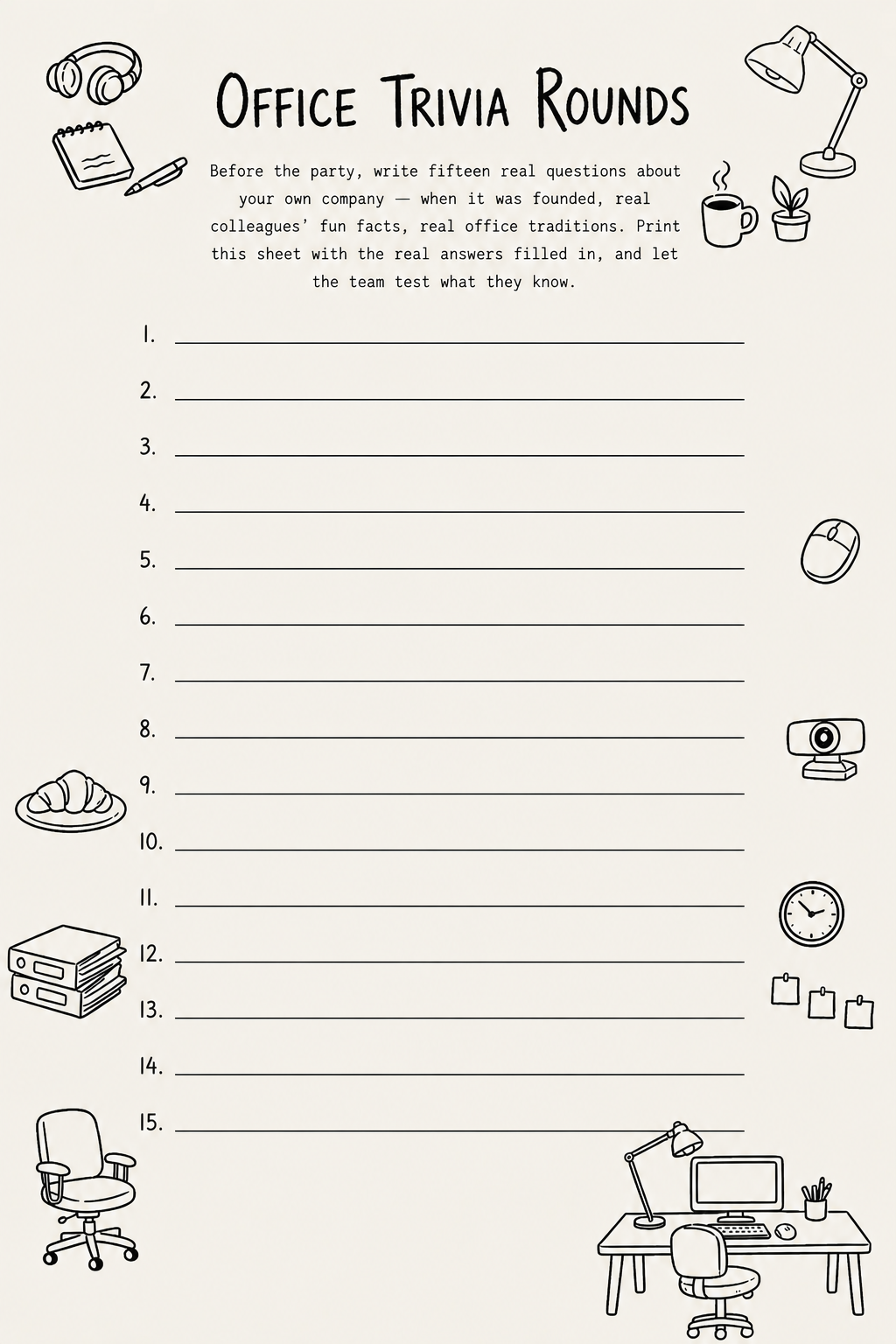
4. Office Trivia Rounds
Divide the room into teams of three to six players. Run four or five themed trivia rounds — general knowledge, pop culture, company history, current events, and a wildcard round work well together.
Read each question aloud, give teams 20 seconds to confer quietly and write their answer on the answer sheet, then collect or reveal answers round by round.
A scorekeeper tallies points on a whiteboard after each round and the winning team at the end of all rounds takes the prize.
You need the printed question sheets for the host, answer sheets for each team, pens, and a whiteboard or large notepad for the running score.
Teams of 15 to 60 people work well, and a five-round game runs about 35 to 45 minutes including scoring pauses.
Mixing departments deliberately when you assign teams means colleagues who rarely work together end up huddled over the same answer sheet — which is quietly the whole point.
Host tip: Calibrate difficulty so that the average team gets roughly 60 to 70 percent of questions right. If the room is getting everything correct, nobody celebrates the win; if they are getting almost nothing, energy drops fast. Test your question set on one or two people beforehand and adjust accordingly.
5. Team Charades: Office Edition
Split the group into two or more teams. One player at a time draws a prompt from the printed card deck — all prompts are workplace-themed: job titles, office objects, meeting room behaviors, corporate jargon — and acts it out silently while their team guesses.
Standard charades rules apply: no speaking, no mouthing words, no pointing at objects in the room. Correct guesses earn a point. Teams alternate until everyone has had a turn, and the team with the most points wins.
You need the printed prompt cards, cut apart before the party, and a timer (a phone works fine). This game runs well for 10 to 40 people in teams of 4 to 8, and a full game takes about 30 minutes.
The office-specific prompts are the secret ingredient — watching someone act out “performance review” or “reply all” lands differently when the audience lives those experiences every day.
Host tip: Seed the card deck with a few genuinely tricky prompts alongside easier ones so every round has variety. If you have a very competitive group, use a 60-second timer per turn; if the crowd is more relaxed, go to 90 seconds and let scenes develop — the longer attempts are often funnier anyway.

6. Desk Scavenger Hunt
Give every player or team a printed list of items to find or tasks to complete within the office space.
Items should be specific enough to require real effort: “a business card from a department you have never contacted,” “something in the kitchen that expires this month,” “a plant that is not yours.”
Teams race to gather or photograph every item on the list within a set time limit — usually 15 to 20 minutes. Whoever completes the most items wins.
You need the printed scavenger hunt lists — one per team is enough — plus a phone for photographing items that cannot physically be collected, and a clear boundary map so people know how far they can roam.
Works for groups of 10 to 50 and the total activity runs about 25 to 35 minutes including the check-in and reveal at the end.
This game gets people physically moving through the office together, which is a genuinely different experience from sitting around a table.
Host tip: Walk the office yourself the day before and make sure every single item on your list actually exists and is accessible. It sounds obvious, but one missing item causes disproportionate frustration and derails the final tally.
Also give teams a single shared phone for photos rather than letting individuals use their own — it keeps the team together instead of everyone scattering.

7. Would You Rather: Work Edition
Players receive a printed sheet with 15 to 20 workplace-themed “would you rather” dilemmas — forced choices between two equally plausible but uncomfortable options: “Would you rather give a presentation every Monday morning or attend a two-hour meeting every Friday afternoon?”
Each player circles their answer silently, then results are shared and debated round by round. You can score it as a majority game (points for matching the most popular answer) or simply use it as a discussion starter with no winner.
You need the printed sheets and pens. No other materials required. This works for groups of 8 to 40 and runs 20 to 30 minutes.
The workplace framing is what elevates it above the generic version — every choice lands because everyone in the room has an opinion rooted in actual daily experience, and the debates reveal personality in a low-stakes, good-humored way.
Host tip: Read each dilemma aloud yourself rather than letting people read silently at their own pace. Pacing matters enormously — give 15 to 20 seconds for individual answers, then open the floor for 60 to 90 seconds of reaction.
Much longer than that per question and the energy drops; much shorter and nobody has time to explain the genuinely funny reasoning behind their choices.

8. Pictionary Teams: Office Edition
Divide into two or more teams. One player at a time draws a word or phrase from the printed prompt list — all office-themed — on a whiteboard or large notepad while their teammates guess. No letters, numbers, or spoken clues allowed.
If the team guesses correctly within 60 seconds, they earn a point. Teams alternate turns until all prompts are used, and the highest score wins.
You need the printed prompt cards cut into strips, a whiteboard or large pad of paper, markers, and a timer. Works for 10 to 40 people in teams of 4 to 8, and a complete game runs about 30 to 40 minutes.
Drawing prompts like “budget freeze,” “open-plan office,” or “conference call” produce instant recognition and laughter because everyone in the room shares the same reference points.
Host tip: Put the whiteboard where both the drawing team and the guessing team can all see it clearly before you start — this sounds obvious but people often set it up facing only half the room.
Also clip a sheet of paper over the prompt list so the drawing player can pull one prompt without the rest of their team seeing the others.

🛍 Shopping guide
9. Categories Round: Office Edition
Teams compete to name as many items as possible within a given category before time runs out. Categories are all workplace-adjacent: “things you find in a break room,” “excuses for being late to a meeting,” “words you hear in every all-hands presentation.”
One team is in the hot seat per round, and they have 60 seconds to list as many answers as they can while the host ticks them off against the printed master answer sheet. Other teams cannot help or sabotage during an active round.
You need the printed category cards and answer sheets for the host, a timer, and something to track scores — a whiteboard is ideal. Works for 10 to 50 people and a full game of eight to ten categories runs 25 to 35 minutes.
The scoring tension — not knowing until the very end whether an answer counts — keeps even the non-playing teams leaning forward.
Host tip: Prepare about twice as many category cards as you think you will need. Groups move through categories faster than you expect when they are on a roll, and running out of material in the middle of a game kills the momentum entirely. Extra cards also let you skip any category that feels flat for your particular group dynamic.

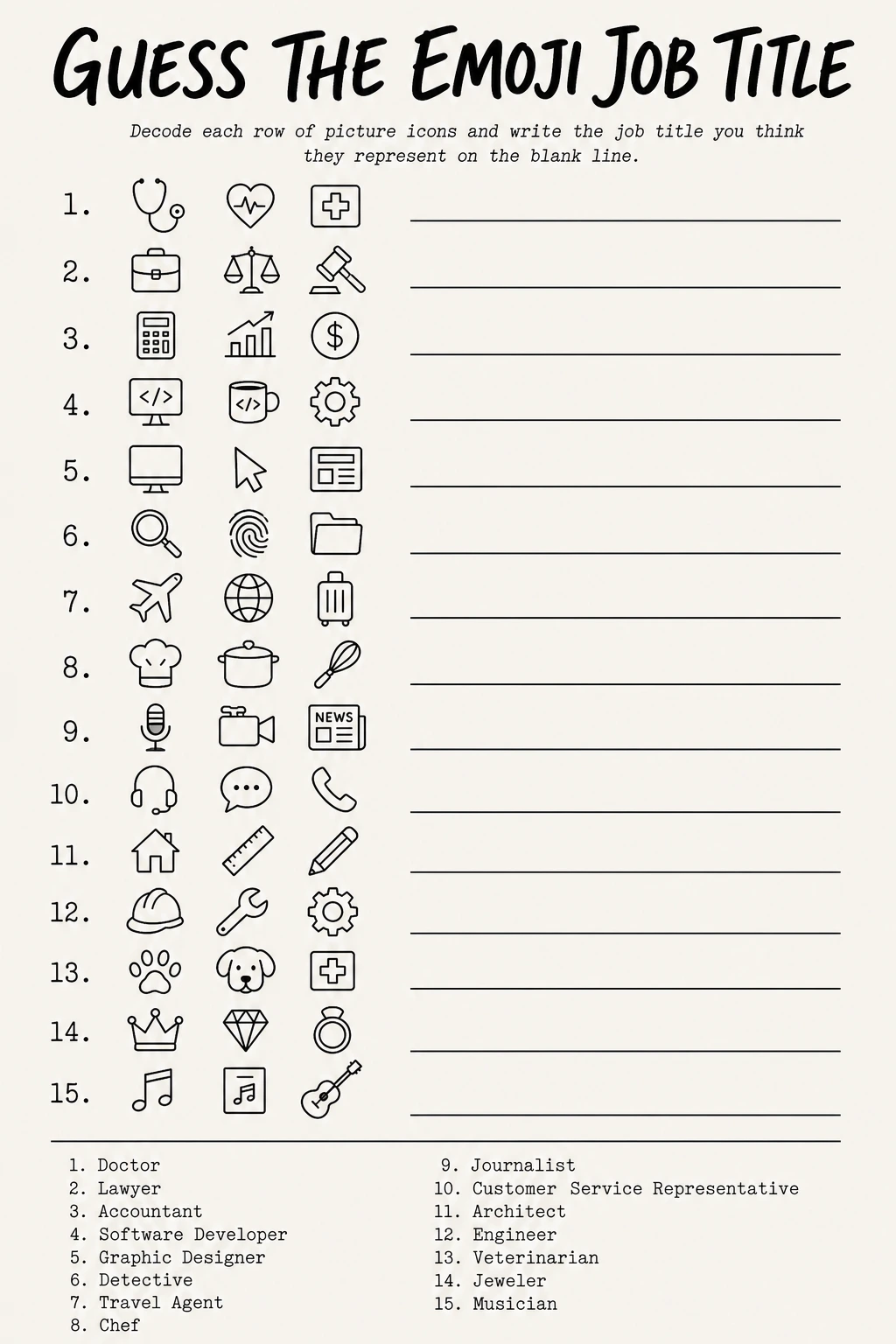
10. Guess the Emoji Job Title
Players receive a printed sheet where each row shows a sequence of emoji that represents a job title or workplace role — think combinations that suggest characteristics of the job rather than spelling it out letter by letter.
Players write their best guess for each one in the answer column. After everyone has filled in their sheet, reveal the answers one by one, award a point per correct answer, and the highest scorer wins.
You need the printed sheets and pens. No other equipment required. Works for any group size from 8 to 60 and takes about 15 minutes of silent guessing followed by a 10-minute reveal.
Because it is played individually rather than in teams, it works well as a warm-up game while latecomers are still arriving — people can join mid-sheet without disrupting anything.
Host tip: When designing or choosing your sheet, make sure every answer is a real, unambiguous job title and that a reasonable person can arrive at it from the emoji without insider knowledge.
Test each row on at least two people outside your planning team before printing. Any row that produces blank stares from both testers should be cut or replaced — an unanswerable question frustrates players and undercuts the whole sheet.
11. Team Superlatives Ballot
Before the party, prepare a printed ballot with workplace superlative categories — “most likely to reply to an email at midnight,” “best at keeping a plant alive on their desk,” “most impressive coffee order” — and distribute one to every attendee.
Players fill in a colleague’s name for each category independently and privately. Collect the ballots, tally the most frequently nominated person for each category, and announce the winners with a brief, warm explanation of why the category fits them.
You need the printed ballots, pens, and a few minutes of quiet counting time. Works for groups of 12 to 60, with the voting portion taking about 10 minutes and the announcement another 10 to 15.
The nominations are anonymous, which removes any social pressure and allows people to be honest and specific. Categories should stay warm and good-humored throughout — the goal is recognition, not roasting.
Host tip: Read through every completed ballot before you announce results and quietly filter out any nomination that could be read as mean-spirited, even accidentally. With anonymous input you occasionally get something that seemed funny to the writer but would land badly in public. A quick editorial review takes two minutes and prevents one very avoidable awkward moment.

12. Name That Tune: Office Playlist
Build a playlist of 20 to 25 well-known songs — a mix of decades and genres works best for mixed-age groups — and play a 10-second clip of each one.
Players or teams write down the song title and artist on their printed answer sheet before you move to the next clip.
After all clips have played, go through the answers one by one, award a point for the correct title and a bonus point for the correct artist, and tally scores.
You need the printed answer sheets, a playlist ready on a phone or laptop, a speaker loud enough for the room, and a way to play exactly 10-second clips cleanly — the Spotify preview function or a YouTube playlist with timestamps both work.
Groups of 10 to 60 work well and the full game takes about 30 to 40 minutes. This is one of the great equalizers: someone who barely speaks in meetings can absolutely dominate a music round.
Host tip: Test your audio setup in the actual room at least 30 minutes before guests arrive — the acoustics in most meeting rooms are worse than you expect, and a song that is clearly recognizable at your desk becomes a muddy blur through a small Bluetooth speaker in a large room.
A mid-range portable speaker makes a meaningful difference and is worth borrowing or buying for the event.

🛍 Shopping guide
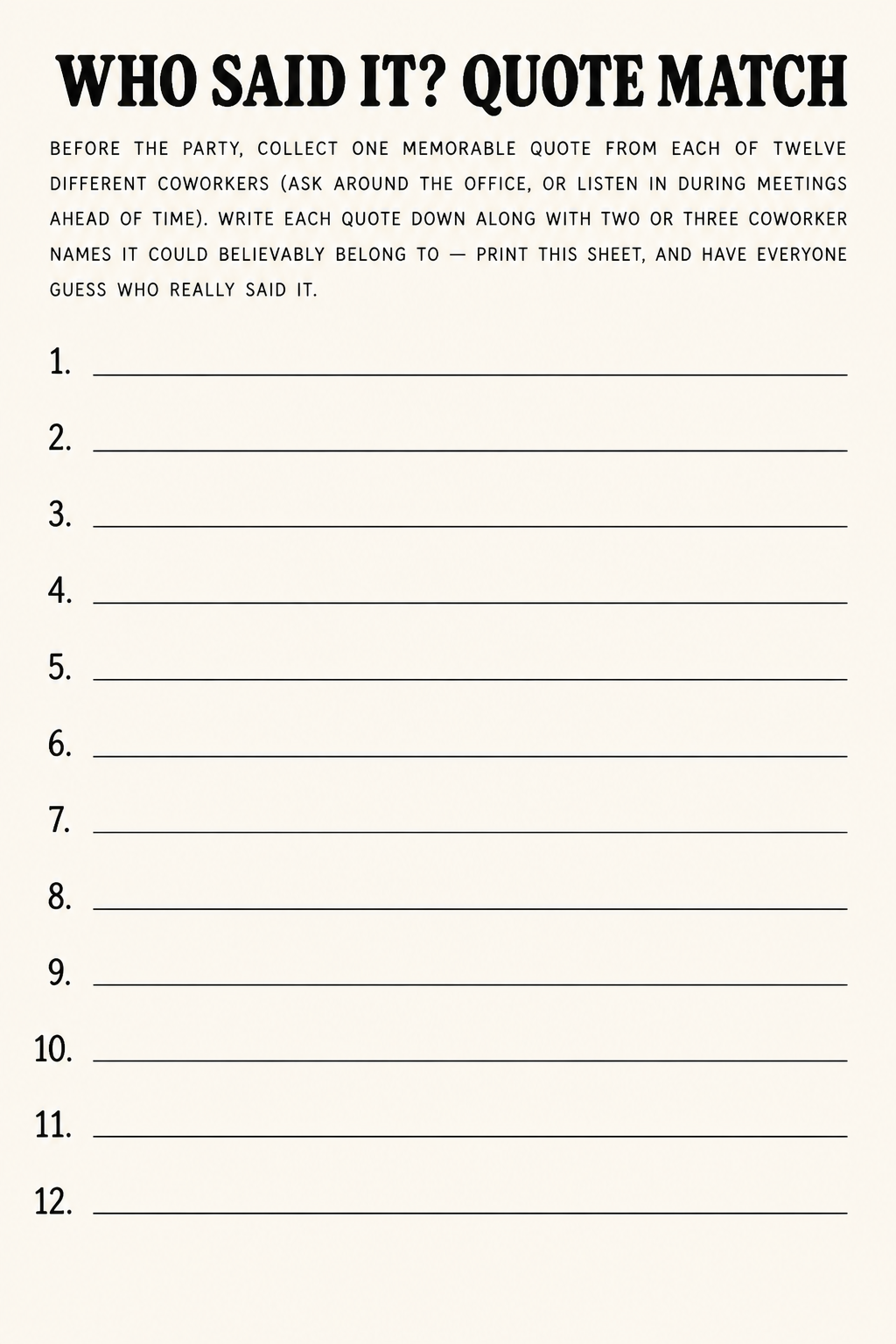
13. Who Said It? Quote Match
Collect genuine quotes from colleagues in advance — pull them from past all-hands meetings, company newsletters, Slack channels, or email sign-offs — and print them on a sheet alongside a numbered list of names.
Players draw lines matching each quote to the person they think said it, working through the full sheet individually. Reveal the answers one by one and award points for each correct match. The player with the most correct pairings wins.
You need the printed match sheets and pens. Works for groups of 10 to 50 and takes about 15 minutes to play plus another 10 for the reveal.
The game rewards people who pay attention to how their colleagues communicate — and it reliably produces the moment where everyone turns to look at the person who apparently said something nobody realized they ever said.
Host tip: Get explicit permission from every colleague whose quote you use before the game, even if the quote was said in a public meeting.
Most people are delighted to be included, but being surprised that your words are on a game sheet in front of fifty people without warning is a very different feeling. A quick message asking “can I include something you said for the party game?”
takes thirty seconds and avoids any awkwardness entirely.
14. Murder Mystery Lunch
Assign every player a character role on arrival — printed role cards work perfectly — and reveal that a fictional “crime” has taken place somewhere in the office.
Players spend 30 to 45 minutes mingling, asking questions, and gathering clues from other characters according to simple rules on their card. At the end of the investigation period, everyone privately votes for who they think the culprit is.
The host reveals the solution and awards points to everyone who guessed correctly, plus a special prize for the designated murderer if they survived undetected.
You need printed role cards with each character’s backstory and a brief list of what they know, a printed clue sheet or two distributed around the room, and ballot slips for the final vote.
Works for groups of 12 to 40 and runs about 60 to 75 minutes including setup and the reveal.
The key is keeping the scenario light and absurd — “who stole the last birthday cake from the break room fridge” plays better at an office party than anything with genuine darkness.
Host tip: Brief the designated culprit privately five minutes before the game starts and give them one or two specific lies to tell. Without that prep, most people are too honest under questioning and the mystery collapses in the first ten minutes. A confident, well-briefed culprit who has a rehearsed alibi makes the whole game work.
🛍 Shopping guide
15. Office Lip Sync Battle
Teams of two to four people each get five minutes to prepare a 60-second lip sync performance to a song of their choice from an approved playlist. They perform in front of the whole group, lip syncing and moving — no actual singing required.
A panel of three judges (rotate colleagues into the role) scores each team on enthusiasm, accuracy, and crowd reaction. The team with the highest combined score wins, but honestly, everyone wins just from watching.
You need a speaker, the playlist, and a basic scoring sheet for the judges — three columns, one row per team.
Works for groups of 15 to 50 and the full event, including prep time and performances, runs about 45 to 60 minutes depending on team count.
The prep time is the secret engine of this game: five minutes of shared panic and improvised choreography bonds a team faster than almost any structured icebreaker.
Host tip: Give teams a private space to rehearse — even a corner of the hallway — so they are not watching each other prepare. Seeing another team’s rehearsal deflates the surprise and competitive instinct simultaneously. Also pre-approve the song list yourself rather than letting teams choose anything: one unexpected explicit lyric mid-performance changes the entire atmosphere of the room.
16. Blind Drawing Challenge
Pairs of players sit back to back. One person holds a printed image — a simple line drawing of an object, scene, or concept — and describes it in words only: shapes, sizes, positions, relative measurements.
The other player draws what they hear without seeing the original. After three minutes, pairs compare the original and the drawing. Results are displayed for the group and a panel or popular vote selects the closest match and the most entertainingly wrong attempt.
You need printed image cards (simple black-and-white line drawings work best), plain paper, and pens or pencils. Works for groups of 10 to 40 in pairs and takes about 20 to 25 minutes including the reveal and voting.
The game exercises something genuinely different from most party games — the ability to give and follow precise instructions — which makes it quietly relevant to actual workplace communication skills without ever feeling like training.
Host tip: Choose images that have clear structure but no single obvious name — a park bench, a lighthouse, an abstract geometric shape. If the image has an obvious name, the describing player says the name and the challenge disappears. Test each image: if you can describe it in two words and be done, find a different image.
🛍 Shopping guide
17. The Price Is Right: Office Supplies Edition
Host displays six to ten common office supply items one at a time — a box of pens, a ream of paper, a stapler, a desk plant, a USB hub — and players write down their best guess for the retail price of each item on an answer sheet.
After all items have been shown and guessed, reveal the actual prices. The player whose total guessed price across all items comes closest to the actual combined retail total without going over wins.
You need the actual physical items (borrow them from the supply room or buy them and keep receipts), an answer sheet per player, pens, and a calculator for the final tally. Works for any group size from 8 to 60 and takes about 20 minutes.
This game produces a surprising amount of lively debate during the reveal — someone who has been ordering office supplies for years is utterly confident about prices that turn out to be completely wrong, and that moment is reliably entertaining.
Host tip: Include at least one item where the price is counterintuitive — something cheap that looks expensive or something surprisingly costly that everyone assumes is a dollar store buy. That single item derails the confident estimators and gives everyone else a genuine shot at winning, which keeps the game interesting for players of every level of office supply expertise.
18. Tower Build Challenge
Divide players into teams of three to five. Each team receives an identical set of materials — 20 sheets of paper, one roll of tape, and ten paperclips — and has exactly eight minutes to build the tallest freestanding tower they can.
Towers must stand unsupported for at least ten seconds to qualify. The host measures each tower after time is called. Tallest standing tower wins.
You need paper, tape, and paperclips in equal quantities per team, a tape measure, and a timer. Works for groups of 10 to 50 and the full activity — briefing, building, and judging — takes about 20 to 25 minutes.
This is one of the most effective games for revealing team dynamics quickly: every group naturally produces a lead designer, a skeptic, and at least one person who starts building before anyone has agreed on a plan.
Host tip: Use the same brand and weight of paper for every team and pre-cut the tape into consistent lengths so no team has a material advantage.
The single most common complaint after this game is “they had better tape,” which is entirely avoidable with thirty seconds of prep. Also enforce the no-external-support rule strictly — a tower leaning on a chair leg is not a freestanding tower.
🛍 Shopping guide
19. Speak for 60 Seconds
Write a list of 25 to 30 absurd, workplace-adjacent topics on slips of paper — “the correct way to load a dishwasher,” “why your desk chair is better than everyone else’s,” “the unwritten rules of the office kitchen” — and fold them into a bowl.
Each player draws a topic and must speak about it continuously for 60 seconds without pausing for more than two seconds, repeating themselves, or going off-topic. If they falter, the turn passes. Players who make the full 60 seconds earn a point.
You need the topic slips in a bowl or hat, a timer, and optionally a small prize for high scorers. Works for groups of 8 to 30 and a full round takes 25 to 35 minutes.
This game rewards confident speakers but is surprisingly accessible for quieter colleagues too — the absurdity of the topics removes any pressure to be authoritative, and rambling entertainingly for a minute about dishwasher philosophy is well within reach of almost anyone.
Host tip: Seed the bowl with a few genuinely easy topics alongside the harder ones so that nervous players who draw early are not immediately eliminated.
The social contract of the game is that everyone gets a real chance, not just the extroverts — and easy topics early in the game also establish the comedic tone that carries the rest of the round.
20. Reverse Trivia
Instead of reading a question and asking for the answer, the host reads the answer and teams must figure out what the question was. For example: “The answer is seventeen minutes” — teams then write down what they think the original trivia question was.
The host reveals the actual question, and teams score a point either for matching it exactly or, in a more generous version, for any question their answer genuinely satisfies. Bonus points for the most creative alternative question.
You need a prepared list of answers — 15 to 20 works well for a party setting — and an answer sheet per team, plus pens and a whiteboard for running scores.
Works for groups of 10 to 50 in teams of three to five, and a full game runs about 30 to 35 minutes.
The format rewards lateral thinking over factual recall, which means the team that knows the most trivia does not automatically win — a welcome equalizer in groups with very different educational backgrounds.
Host tip: Choose answers that are just specific enough to rule out completely random guesses but not so specific that only one question could ever fit — numbers, proper nouns, and unusual phrases tend to hit the sweet spot.
Run through your list yourself and for each answer try to think of three plausible questions; if you can only think of one, the answer is probably too narrow and will frustrate teams rather than energize them.
Frequently Asked Questions
How many office party games should I plan for a two-hour event?
Three to four games is typically the right number for a two-hour party.
Choose one icebreaker to open (Human Bingo or Two Truths and a Lie work well), one active or team game for the middle, and one short game to close on a high note.
Leave buffer time between games for transitions, snacks, and the natural conversation that good games generate — over-programming a party is as big a mistake as under-programming it.
What office party games work best for large groups of 50 or more people?
Team formats scale best for large groups. Office Trivia Rounds, Categories Round, Name That Tune, and Pictionary Teams all work with 50-plus attendees because they split people into smaller competing teams rather than requiring everyone to participate individually at the same time.
Human Bingo also works at scale because it is self-directed — players circulate at their own pace without waiting for a host to manage turns.
Do I need prizes for office party games?
Prizes help but they do not need to be expensive. A coffee shop gift card, a nice pen set, or the choice of leaving 30 minutes early on a Friday afternoon are all genuinely motivating rewards.
What matters more than the prize value is that there is something to play for — even symbolic recognition in front of the group creates competitive energy that makes every game more fun.
If budget is zero, a printed “certificate” read aloud with genuine warmth still lands well.
How do I run office party games for a hybrid team with remote attendees?
Choose games that work equally well on screen. Two Truths and a Lie, Would You Rather, Office Trivia Rounds, Reverse Trivia, and Name That Tune all translate cleanly to a video call format.
Share the screen for any visual element, use the chat box for written answers instead of paper sheets, and appoint a co-host to watch the chat while you run the game — managing both simultaneously is harder than it looks.
Send digital versions of any printable sheets in advance so remote players can follow along.
What if some team members are very reluctant to play games at the office?
Start with low-pressure formats where participation feels optional. Human Bingo, Would You Rather, and Name That Tune require minimal performance and no public speaking, which makes them genuinely comfortable for introverts and game-skeptics.
Frame the games as something to do rather than something everyone must do enthusiastically — once reluctant players see their colleagues enjoying themselves, most will engage naturally.
Never single out someone who is hanging back; the fastest way to lose a skeptic permanently is to put them on the spot in front of the group.
📌 Save These for Later
Loved these? Pin your favorite image below so you can find this list again when you’re planning.

Fresh, interesting truth or dare questions across 6 escalating rounds. Skip the tired ones and play

72 interesting Never Have I Ever questions that spark real stories, not just yes or no answers. Six
72 juicy never have i ever questions for teens that feel daring at 15 and still stay completely clea
Leave a Reply