

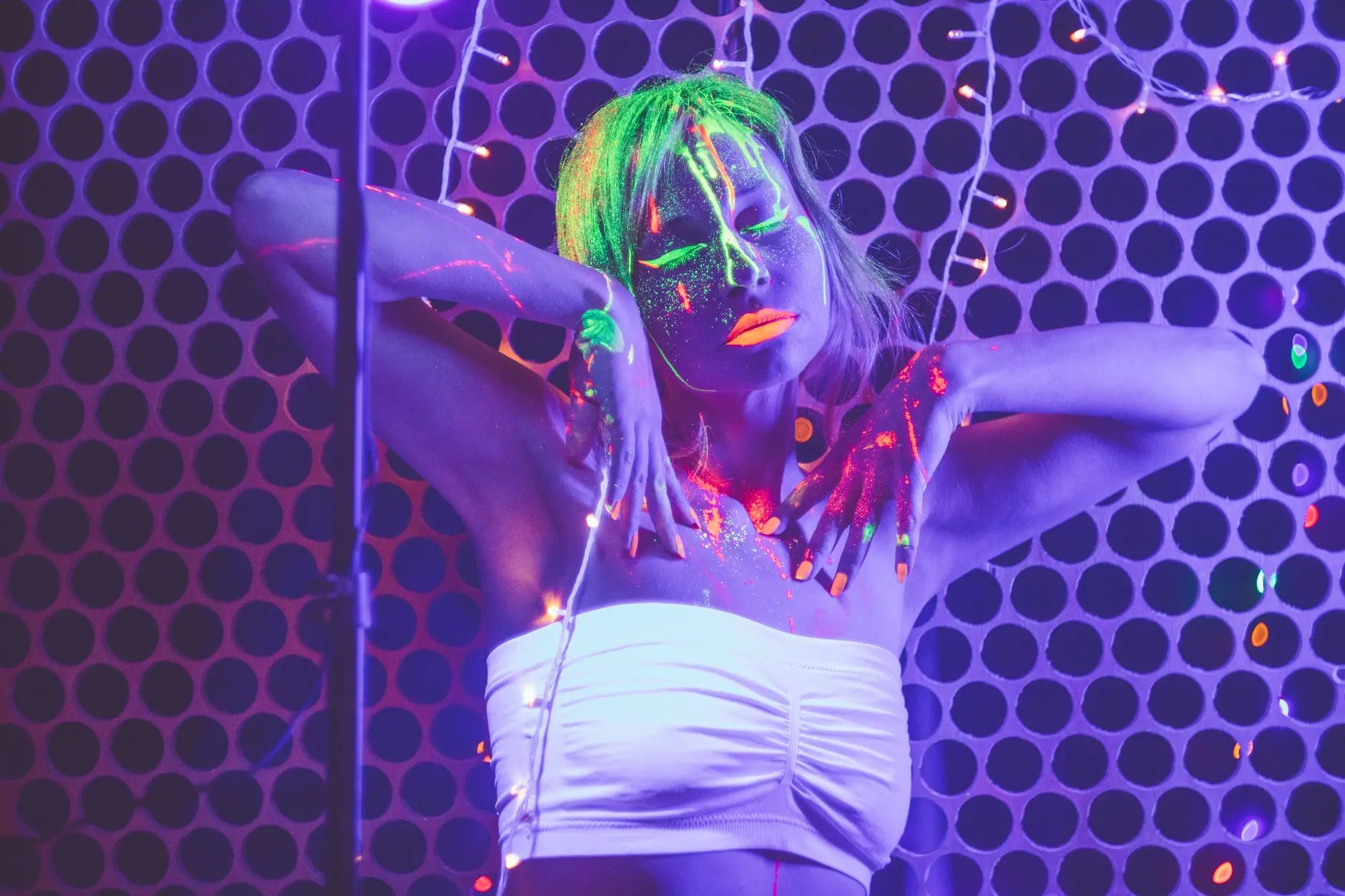
There is something genuinely magical about the moment you kill the regular lights, flip on the blacklights, and watch a plain room transform into a glowing neon universe.
If you are planning a blacklight birthday, end-of-school bash, or just a legendary sleepover for teens aged 13 to 17, neon party games are the secret ingredient that turns a good gathering into an unforgettable one.
These games use glow sticks, neon paint, UV-reactive accessories, and printable activity sheets to keep the energy high from the first guest’s arrival to the very last song.
This list gives you exactly 20 games — a mix of active relays, creative challenges, trivia showdowns, and printable rounds — so you can mix and match to fill any schedule.
Whether your crowd loves fierce competition, wild creative moments, or just an excuse to cover themselves in neon body paint, there is something here for everyone. Grab your blacklights, print your sheets, and get ready for a party that glows all night long.
This post contains affiliate links — if you buy through them, I may earn a small commission at no extra cost to you.
Table of Contents
- Glow Stick Ring Toss
- Neon Freeze Dance
- Glow in the Dark Scavenger Hunt
- Blacklight Charades Card Deck
- Glow Bowling
- Neon Photo Challenge
- Glow Stick Relay
- Neon Would You Rather
- Glow Ball Toss
- Blacklight Pictionary Prompt Cards
- Glow Limbo
- Neon Bingo
- Neon Art Tag
- Neon Emoji Decode
- Neon Trivia Showdown
- Neon Mad Libs
- Neon This or That Quiz
- Neon Balloon Stomp
- Glow Stick Javelin
- Neon Sculptor
1. Glow Stick Ring Toss
Set up a row of empty bottles or short plastic cones on a table or the floor, then give each player a handful of glow stick bracelets to use as rings.
Players stand behind a tape line — start at about six feet back and adjust for your crowd — and take turns tossing rings to land them around the necks of the bottles.
Each successful loop scores a point, and the player with the most points after three rounds wins. Under the blacklight, the looping arcs of glowing bracelets look absolutely electric, and the crowd will naturally start cheering every throw.
You will need about eight to twelve glow stick bracelets per round (they are cheap in bulk), plus six to eight bottles or cones as targets. Crack and shake the glow sticks well before play so they are at peak brightness.
This works brilliantly as a drop-in station during a party where not everyone arrives at the same time — guests can jump in and out without disrupting a bigger group game.
Group size is two to ten players per station, and a full competitive round takes about 15 minutes.
Host tip: weight the bottles slightly by adding a handful of sand or a few pebbles before the party. Unweighted plastic bottles tip too easily from near-misses, which slows the game down and frustrates players.
🛍 Shopping guide
2. Neon Freeze Dance
This is the classic freeze dance, but cranked up to full neon intensity. Players spread out across the room and dance freely while a playlist of high-energy music pumps through the speakers.
When the music cuts — controlled by the host or a designated DJ — everyone must freeze instantly in whatever position they are in. Anyone caught still moving after the music stops is out and takes a seat on the sidelines.
The last dancer still in the game wins, and with neon paint on skin and glowing accessories catching the blacklight, the frozen poses become wildly dramatic mid-air sculptures.
Before the game begins, set up a neon body paint or face paint station and encourage everyone to paint their arms, hands, and faces so their movements really pop under the UV light.
You will need a good Bluetooth speaker, a curated playlist with random pause points (many free music apps have a built-in timer function that works perfectly), and enough open floor space for the whole group to move freely.
This game works best with six to twenty players and takes about 15 to 20 minutes per full game.
Host tip: make the music cuts unpredictable — sometimes pause after just five seconds, sometimes let a full minute run. Predictable timing lets savvy players game the freeze, and the random pauses create far more hilarious frozen positions that everyone will photograph.
🛍 Shopping guide
3. Glow in the Dark Scavenger Hunt
Before guests arrive, hide a collection of small glow-in-the-dark or neon items around the party space — glow balls, neon craft pom-poms, UV-reactive bracelets, mini glow sticks, and similar small objects all work perfectly.
Each player or team receives a printed Glow in the Dark Scavenger Hunt sheet that lists every item they need to find, along with a brief description or clue for each one.
Teams race to locate and collect every item on the list, then return to the host to have their haul checked. The first team to find every item on the sheet wins.
The printable sheet is the heart of this game — it lists items in a randomised order and may include bonus challenge items worth extra points.
You will need enough hiding spots spread across one or two rooms, and it helps to set a hard time limit of 10 to 15 minutes so the hunt does not drag.
Dim the regular lights and rely mostly on blacklights so the hidden neon items are visible only up close, which adds a genuine layer of challenge. This game runs brilliantly with four to twenty players split into teams of two or three.
Host tip: hide a few items in spots that are technically in plain sight but at eye level — guests almost always look low and high and completely miss mid-height obvious spots, which creates a fantastic comic moment when the reveal happens at the end.

🛍 Shopping guide
4. Blacklight Charades Card Deck
This is charades played with a custom printable deck of cards sized and themed for a neon blacklight party. Shuffle the printed Blacklight Charades Card Deck, then split the group into two even teams.
One player draws a card, reads the prompt silently, and then acts it out without speaking, making sounds, or mouthing words while their team calls out guesses. If the team guesses correctly within 60 seconds, they earn a point.
Cards rotate around both teams, and the first team to reach ten points wins. Because everyone is wearing neon and the room is lit only by blacklights, even simple gestures become hilariously dramatic performances.
The prompt cards are written specifically for teens and cover categories including movies, sports, dance moves, animals, technology, and absurd everyday situations.
Print the sheet on white cardstock and cut the cards apart before the party — they will glow slightly under the blacklight, making them easy to read in the dim room.
You will need the printed deck, a 60-second timer (a phone works perfectly), and a scoreboard on a piece of neon cardstock. Best with six to twenty players and typically runs 20 to 30 minutes.
Host tip: appoint a strict timekeeper who is not playing — when the person acting can see their own timer they tend to rush and make frantic gestures that are impossible to decode, but a neutral timekeeper calling “five seconds!” creates the perfect dramatic finale to each round.

🛍 Shopping guide
5. Glow Bowling
Set up ten plastic bottles in a triangle formation at one end of a hallway or cleared floor space, then fill each bottle with a few inches of water and a cracked glow stick so the liquid glows from within.
Players take turns rolling a neon ball — a white ball sprayed lightly with UV paint, or a ball wrapped in glow tape — from behind a tape line toward the pins. Score it exactly like real bowling: strikes, spares, and all.
After each turn, a designated pin-setter resets any knocked-over bottles. The glow from the bottles and the rolling glow ball creates a genuine mini-bowling lane atmosphere that feels far more impressive than it sounds.
You will need ten clear plastic bottles (standard 16-ounce water bottles are ideal), ten activated glow sticks, water to fill the bottles partway, and a ball that shows up under UV light.
Set the lane length at about 15 to 20 feet to keep it challenging without being frustrating. This activity works well as a continuous station where players rotate through rather than a single competitive game, though you can absolutely run a proper scored tournament.
Two to twelve players, roughly 20 minutes for a two-round tournament.
Host tip: add just enough water to hold the glow stick upright inside the bottle — too much water and the glow stick floats sideways, making the pin look dark from the front. About three inches of water is the sweet spot that keeps the stick standing and the glow pointing outward.
🛍 Shopping guide
6. Neon Photo Challenge
The Neon Photo Challenge is a team photography competition powered by the printed prompt sheet. Each team receives the Neon Photo Challenge sheet, which lists 15 to 20 specific photo scenarios they must recreate using only the people, props, and neon accessories at the party.
Scenarios include things like “a four-person silhouette where everyone holds a different glow color,” “your team’s scariest freeze-frame moment,” and “the most creative use of neon paint you can manage in two minutes.”
Teams photograph each prompt on someone’s phone, then all phones are collected and the host scrolls through the results on a shared screen while the group votes on their favourites.
You will need the printed Neon Photo Challenge sheet for each team, phones with decent cameras (most teen guests will already have these), and a selection of neon props — glow bracelets, neon streamers, UV body paint, and glow sticks.
Set a time limit of 25 to 30 minutes for the photo-taking phase so teams move quickly and do not overthink their shots. Works brilliantly with six to twenty players in teams of three to five, and judging takes about ten additional minutes.
Host tip: designate one person per team as the dedicated photographer — when everyone tries to direct the camera at once, teams waste most of their time debating angles rather than actually taking photos, and teams with a clear photographer consistently produce far better and more creative results.

7. Glow Stick Relay
Divide the group into two or more equal teams and line them up single-file behind a starting tape line. Each team gets one long glow stick baton — a jumbo glow stick or a glow stick with a connector piece works best.
On “go,” the first player in each line runs to a turnaround cone placed 20 to 30 feet away, loops around it, sprints back, and hands the glow stick baton to the next teammate. The relay continues until every player on the team has run.
The first team whose last runner crosses the finish line wins. Under the blacklight, the streaking glow stick batons leave trails of light as runners move, turning a simple relay into something that looks spectacular.
You will need one jumbo or connected glow stick per team, cones or markers for the turnaround point, and a clear stretch of floor or outdoor space. Make sure to crack and activate all glow sticks before play so they are at maximum brightness.
This game works with six to thirty players and takes about 10 to 15 minutes including team setup. It is a perfect high-energy opener that gets everyone warm and laughing before you move to more seated games.
Host tip: do a practice walk-through of the baton handoff before the race begins — an awkward handoff causes most dropped batons, and a dropped glow stick rolling under a blacklight in a dark room creates a chaotic 30-second delay that kills the relay’s momentum entirely.
🛍 Shopping guide
8. Neon Would You Rather
The Neon Would You Rather sheet presents players with 20 neon-party-themed “would you rather” dilemmas — two outrageous but completely age-appropriate options per question that players must choose between.
Everyone circles or marks their answers individually first, then the host reads each question aloud and players reveal their choices by raising hands or holding up a glowing bracelet for option A or B.
When a split appears — some choosing one answer, some choosing the other — players debate their reasoning for 60 seconds before the group votes on which answer was the majority pick.
The player whose answers most closely match the group majority at the end wins a small neon prize.
Sample questions from the sheet include choices like “Would you rather glow permanently in one neon colour for a year or only be visible under blacklights after dark?”
and “Would you rather win a dance battle in full neon body paint or perform a stand-up comedy set with a glow stick microphone?”
Print one sheet per player or one per pair, and supply neon pens or markers so players can circle answers in style. Best with four to twenty players; a full round takes 20 to 25 minutes.
Host tip: read the questions in a theatrical voice and pause after revealing the split — that two-second silence before the debate erupts is where the real comedy happens, and rushing past it is the single biggest mistake hosts make with this kind of game.

9. Glow Ball Toss
Players pair up and stand facing each other about five feet apart, each holding a UV-reactive or glow-painted ball. On a signal, both players in each pair throw their ball simultaneously to their partner and catch the incoming one.
After each successful exchange, both players take one large step backward, increasing the distance. Any pair that drops a ball is eliminated. The last pair still making clean catches at the greatest distance wins.
With multiple glowing balls arcing back and forth across a dark room lit only by blacklights, the visual effect is genuinely stunning — like watching a neon juggling act from every direction at once.
You will need at least one UV-reactive ball per pair — white tennis balls, ping-pong balls, or soft foam balls all glow beautifully under blacklights.
Spray a coat of UV paint on standard balls if you cannot source UV-reactive ones, and let them dry completely before the party. This game works with four to thirty players in pairs and runs for about 15 minutes.
It naturally scales to any open space and requires no complicated setup.
Host tip: enforce the simultaneous throw rule strictly — if one player waits for their partner to release first, the backward-stepping elimination never really kicks in because everyone can time their catch perfectly, which means the game drags on far longer than it should.
🛍 Shopping guide
10. Blacklight Pictionary Prompt Cards
This is Pictionary adapted for a blacklight party, played using neon markers on large white paper or a whiteboard, with the entire room lit by UV lights. Divide into two teams.
A player from Team A draws a card from the printed Blacklight Pictionary Prompt Cards deck, reads it silently, then has 60 seconds to draw the prompt on the board using neon markers while their team shouts guesses.
If Team A guesses correctly, they earn a point; if time runs out, Team B gets a 15-second bonus guess. Teams alternate drawers, and the first team to reach ten points wins.
Under blacklights, neon marker lines glow intensely on white paper, making even rough drawings look like electrified masterpieces.
The prompt cards are themed around teen life, pop culture concepts (no licensed brands), nature, sports, technology, and imaginative scenarios — all carefully selected to be drawable in under a minute. Print on white cardstock, cut apart, and shuffle before the party.
You will need the card deck, several neon markers in different colours, large white paper or a whiteboard, and a 60-second timer. Best with six to twenty players; a full game runs 25 to 35 minutes.
Host tip: stock extra sheets of large white paper rather than relying on a single whiteboard — erasing between turns under a blacklight is much harder than it looks because ghost marks from previous drawings remain faintly visible and confuse guessers on the next round.

🛍 Shopping guide
11. Glow Limbo
Glow limbo is exactly as thrilling as it sounds: two people hold the ends of a long lit glow stick or a neon rope at shoulder height, and players take turns shuffling underneath it without touching it, bending backward — never forward — as they go.
After everyone passes under, the bar drops two inches and the next round begins. Anyone who touches the bar, loses their balance and touches the ground with something other than their feet, or bends forward instead of backward is out.
The last person to make it under the lowest possible bar wins. Neon accessories on dancers — glowing bracelets stacked on arms, neon-painted hands and feet — create a spectacular visual as bodies arc under the light.
You will need a long jumbo glow stick, a neon rope, or a strip of glow tape stretched between two dowels. Pair this with neon party music and you have an instant crowd-pleaser.
Encourage players to load up on glow bracelets on both wrists before playing — the more neon on each person, the more spectacular the limbo looks under the blacklight. Works with four to thirty players; a full elimination round takes 15 to 20 minutes.
Host tip: lower the bar in smaller increments early on — two inches per round feels dramatic but keeps the game going long enough for everyone to get multiple turns before the eliminations begin, which prevents the awkward situation where half the group is sitting out for the last ten minutes.
🛍 Shopping guide
12. Neon Bingo
The Neon Bingo sheet replaces the standard numbered grid with a five-by-five card filled with neon-party-themed words and images — things like “glow stick,” “freeze pose,” “neon face paint,” “blacklight,” and “dance battle.”
The host draws from a corresponding call deck and announces each item, and players mark off matching squares on their card using a neon dauber or neon marker. The first player to complete a full row, column, or diagonal calls out “BINGO!”
and wins a small prize. Play multiple rounds using different win patterns — four corners, full card blackout, or a T-shape — to keep the game going.
Print one unique bingo card per player from the Neon Bingo sheet — true bingo only works if every card has a different arrangement, so the printable is formatted with randomised grids.
You will need neon daubers or markers for each player and a container to hold and draw the call cards from. This is a fantastic game to play between more active rounds as a calm-down moment, and it works with four to thirty players.
A single bingo round takes about 8 to 12 minutes.
Host tip: prepare at least three small prizes so you can run three rounds without downtime — announcing “we are playing three rounds tonight” at the start keeps players engaged even after they lose the first round, because everyone knows they have more chances coming.

🛍 Shopping guide
13. Neon Art Tag
Neon Art Tag is a creative wearable art game built around the printed Neon Art Tag — Design Ideas sheet, which gives players a list of specific design prompts to paint on each other using UV body paint.
Each player is assigned a partner, and together they work through the prompt list, taking turns as the canvas and the artist.
Prompts include things like “a geometric pattern on the forearm,” “a lightning bolt down the shin,” “a constellation on the back of the hand,” and “a neon animal silhouette on the shoulder.”
When both partners have completed their designs, the whole group does a slow walkabout “gallery show” under the blacklights while everyone admires the work, and the group votes for the most creative piece.
You will need the printed design prompt sheet, several colours of UV-reactive body paint, small brushes, and a few damp cloths for mistakes. Set up a designated paint station with good blacklight overhead so artists can see exactly how their work looks in real time.
This activity works with four to twenty players and takes 20 to 30 minutes for the creation phase plus 5 minutes for the gallery walk. It doubles as a party activity and a photo opportunity.
Host tip: put a clear acrylic or silicone top coat sealer over the body paint designs after they are dry — it prevents smearing during the rest of the night’s games and means the artwork actually lasts long enough for everyone to photograph it properly at the gallery show.

🛍 Shopping guide
14. Neon Emoji Decode
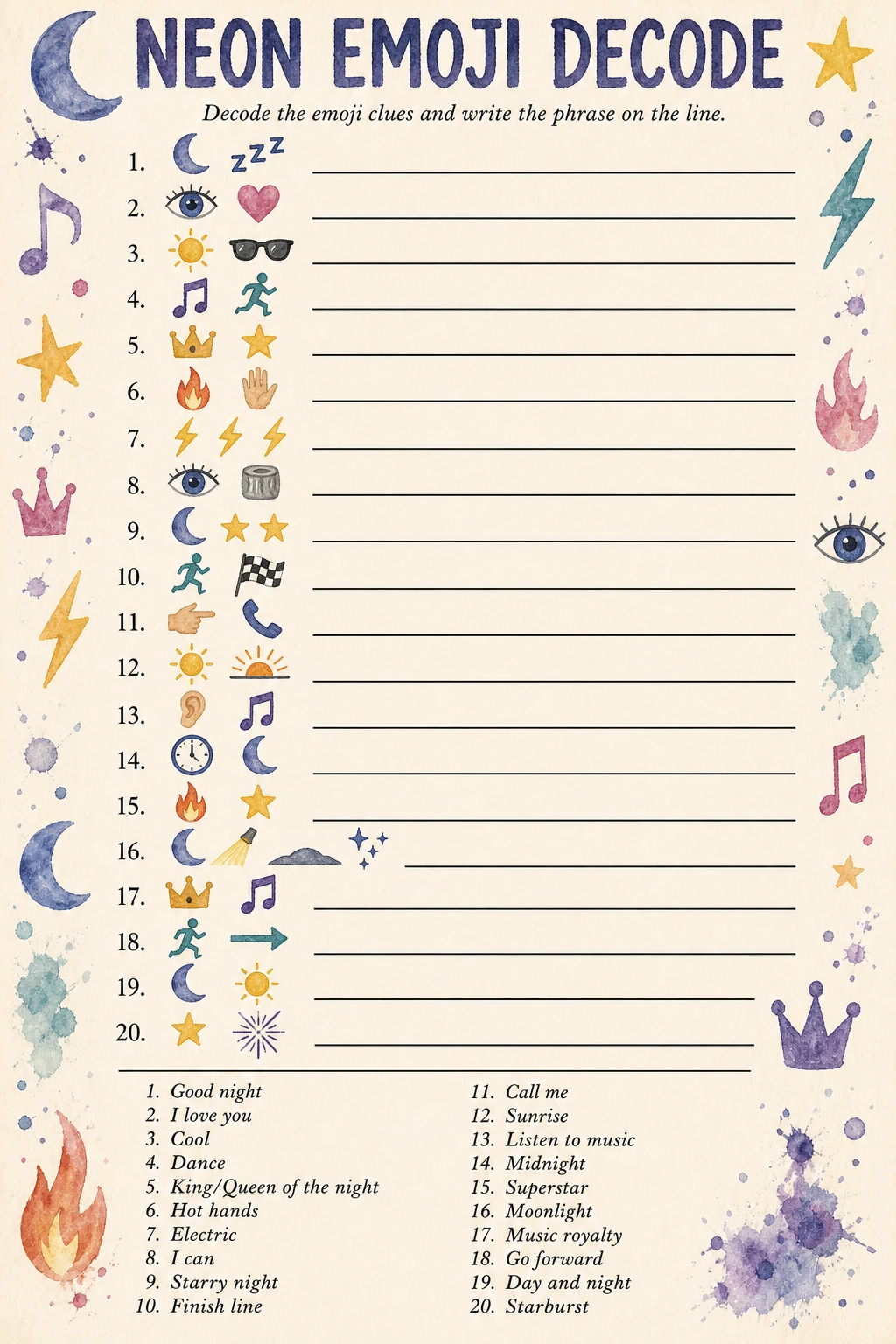
The Neon Emoji Decode sheet presents players with a series of themed challenge rounds — not a “guess the phrase” rebus, but a rapid-fire identification game where players look at a sequence of printed emojis and write down the single category, mood, or emotion that connects them all.
For example, a set of emojis might all relate to things that are “fast,” “cold,” or “competitive,” and players race to be the first to write the correct connecting theme on their sheet.
Every round is timed at 30 seconds, and players score one point per correct answer.
The twist: under the blacklight, the neon-ink printed emojis on the sheet glow dramatically, and players must use a neon pen to write their answers, making the whole experience feel completely on-theme.
Print one sheet per player and provide a neon pen or UV-reactive marker for each person. The host reads out “start” and “stop” for each 30-second round, and answers are scored after every five rounds with a quick show-of-hands check.
Works with four to thirty players and takes about 15 to 20 minutes for a full sheet of eight rounds. It is a great mid-party brain reset between high-energy physical games.
Host tip: go through one sample round together before starting the clock — the concept of “find the connecting theme” rather than “guess a phrase” can confuse players in the first round if they have never played it before, and a 60-second demo eliminates almost all the confusion.
15. Neon Trivia Showdown
The Neon Trivia Showdown sheet contains multiple rounds of trivia questions across categories including music, sports, science, history, internet culture, and a special neon-party bonus round.
Divide the group into teams of two to four players, then have the host read questions aloud while teams huddle to agree on an answer and write it on a shared answer card using a neon marker.
After each category of five questions, the host reveals the correct answers, teams mark their scores, and the points are tallied on a visible scoreboard. The team with the most points at the end of all rounds wins a group prize.
Print one Neon Trivia Showdown sheet for the host to read from, plus one answer card per team (a folded piece of neon cardstock works perfectly).
Keep a running scoreboard on a large sheet of white paper taped to the wall where it glows under the blacklight. This game is ideal for four to twenty-four players and runs 25 to 35 minutes for a full multi-round session.
It pairs well after a high-energy physical game when the group needs to catch their breath but stay engaged.
Host tip: award a small bonus point for any team that delivers their answer with the most creative presentation — a team that shouts their answer dramatically or writes it in the most elaborate neon lettering wins the tiebreaker point, which prevents boring ties and rewards personality.

16. Neon Mad Libs
Neon Mad Libs takes the classic fill-in-the-blank storytelling game and wraps it in a glow party theme.
Each player or small group receives the Neon Mad Libs sheet, which contains three short story templates set at a fictional neon party — complete with blanks labeled “adjective,” “verb,” “animal,” “silly sound,” and so on.
Players take turns calling out a word that fits each labeled blank without hearing the surrounding story first. When all blanks are filled, the completed story is read aloud dramatically, and the more ridiculous the word choices, the funnier the result.
The group votes for the funniest completed story, and that team wins.
Print one Neon Mad Libs sheet per group of three to five players, and supply neon pens so every filled blank glows under the blacklight when the story is held up for reading.
This works brilliantly as an icebreaker at the start of a party when guests are still arriving and warming up, since it requires zero prior game knowledge and anyone can jump in at any point.
Group size is four to twenty-five players; the game takes about 15 minutes per full round.
Host tip: assign one player per group as the “dramatic reader” whose only job is to read the finished story in the most theatrical voice possible — when the reader commits fully to the performance, even a mildly funny story becomes absolutely hilarious, and the theatrical reading is often funnier than the story itself.

17. Neon This or That Quiz
The Neon This or That Quiz sheet is a fast-paced preference game where every question presents two neon-party-adjacent options and players must choose one — no “both” or “neither” allowed.
Questions run through categories like food, adventure, social situations, superpowers, and party scenarios, all themed to fit the glow night. Players mark their answers on the sheet individually, then the host reveals answers one by one and the group compares.
Players earn a point each time their answer matches the most popular answer in the room. After all questions are tallied, the player with the most matching points wins, earning the unofficial title of “most in sync with the group.”
Print one Neon This or That Quiz sheet per player and provide neon pens. The host can run this game in two modes: silent individual scoring (competitive) or open discussion mode where each question sparks a quick group debate before everyone locks in their answer.
Open discussion mode tends to work better for groups that already know each other well, while silent mode is a great icebreaker for groups with a few new faces. Four to thirty players; 15 to 20 minutes.
Host tip: announce the room’s most popular answer for each question before revealing individual scores — hearing that 11 out of 15 people picked the same option creates a shared group reaction that keeps the energy up between questions, rather than letting the game go quiet during individual scoring.

18. Neon Balloon Stomp
Every player gets one inflated neon-coloured balloon tied loosely around their ankle with a short string. On “go,” everyone scrambles to stomp on and pop other players’ balloons while protecting their own.
Once your balloon is popped, you are out and move to the sidelines to cheer. The last player with an intact balloon wins.
Under the blacklight, the neon balloons glow brilliantly, making this chaotic game look like a swarm of bouncing neon lights — and the sound of popping balloons adds an intense, high-energy soundtrack to the whole round.
You will need neon-coloured or white balloons (white glows the most intensely under UV light), lengths of string cut to about 12 inches each, and enough open floor space for players to move freely.
Blow up balloons to a medium size — too small and they pop on the first glancing tap, which ends the round in 30 seconds; too large and players cannot manoeuvre.
Works with six to thirty players and a round lasts two to five minutes, which means you can run four or five rounds in a 20-minute window and crown an overall champion.
Host tip: always pre-tie the string loops loosely onto the balloons before the party — doing it in real time with a group of excited teens waiting is genuinely chaotic, takes forever, and deflates the anticipation completely before the game even begins.
🛍 Shopping guide
19. Glow Stick Javelin
Each player receives three jumbo glow sticks and takes turns throwing them one at a time, like a javelin, down a clear hallway or outdoor lane.
A tape line marks the throwing position, and players use an overhand throw — no spin, no run-up — to launch their glow stick as far down the lane as possible.
After all three throws, the distance of each player’s best throw is measured using a tape measure or a pre-marked floor grid. The player whose glow stick travels farthest from the throw line wins.
Because glow sticks tumble and arc through the dark, the flight paths are genuinely beautiful to watch and impossible to predict, which makes every throw exciting.
You will need jumbo glow sticks (at least three per player), a tape measure or marked floor, and a long clear lane at least 20 to 30 feet in length — a hallway, garden, or cleared garage works well.
Crack and activate glow sticks just before each player’s turn so they are at peak brightness for the throw and easy to see where they land. Works with four to twenty players; a full round with eight players takes about 15 minutes.
Host tip: mark the floor with strips of neon tape every five feet before guests arrive — measuring distances in a dark room with a tape measure during the game is painfully slow, but pre-marked floor strips mean the host can call out distances instantly the moment each glow stick lands.
🛍 Shopping guide
20. Neon Sculptor
Neon Sculptor is a live action art challenge where one player is the “clay” and one is the “sculptor.”
The sculptor has 60 seconds to pose their partner into the most creative frozen shape they can imagine — arranging arms, positioning legs, tilting the head — while the “clay” player holds completely still.
After time is up, every sculptor presents their living statue to the group, and players vote by pointing at their favourite pose. The winning sculptor gets a point, then roles switch.
Because everyone is wearing neon accessories and UV paint, each frozen human statue glows dramatically under the blacklight like an actual art installation.
No materials are strictly required beyond the neon accessories and body paint players are already wearing, though handing out extra glow bracelets and neon props like glow batons for sculptors to incorporate into their compositions really elevates the results.
Works with four to twenty players in pairs and runs about 20 to 25 minutes for a full two-rotation game. It is a natural end-of-night game because the group is usually already loose and comfortable enough to commit fully to the ridiculous poses.
Host tip: give sculptors a theme card — drawn from a small stack of cards you write before the party, each naming a theme like “underwater creature,” “robot malfunctioning,” or “superhero landing” — because open-ended creative tasks stump teens instantly, but a single silly theme produces wildly inventive and immediately funnier results every single time.
Frequently Asked Questions
What do I need to run a blacklight neon party?
The essentials are a few blacklight bulbs or UV LED strip lights (available cheaply online), neon or white decorations that react to UV light, glow sticks in assorted sizes, UV-reactive body paint, and neon balloons.
Dim or turn off all regular lights in the party area for maximum effect. Most of the games on this list are designed to work specifically in this setup, so getting the lighting right is the single most important step.
How many of these games should I plan for a three-hour party?
Aim for six to eight games for a three-hour party.
Mix two or three high-energy active games (like Glow Stick Relay or Neon Balloon Stomp) with two or three seated or printable rounds (like Neon Trivia Showdown or Neon Bingo) and one creative activity (like Neon Art Tag).
That pacing gives everyone time to recover between physical games while keeping energy levels consistently high throughout the night.
What age group is this party designed for?
Every game on this list is designed specifically for teenagers aged 13 to 17. The themes, content, and physical demands are all calibrated for that age range — nothing babyish, nothing adult. All printable sheets use age-appropriate prompts and scenarios, and every activity can run without adult supervision once the host has explained the rules.
Are the printable games easy to prepare?
Yes — print each sheet on standard white cardstock rather than regular copy paper, since cardstock holds up much better through an active party and glows more brightly under blacklight.
For card-based games like Blacklight Charades and Blacklight Pictionary, cut the cards out ahead of time and store them in small envelopes or rubber-banded stacks so they are ready to go the moment you need them.
Can these games be played outdoors?
Several of them work perfectly outdoors at night — Glow Stick Relay, Glow Ball Toss, Glow Stick Javelin, and Neon Balloon Stomp all translate beautifully to a backyard or outdoor space.
For outdoor play, use portable UV blacklight strips or handheld blacklight flashlights positioned around the play area. Printable games are best kept indoors where there is no wind to scatter cards and sheets.
📌 Save These for Later
Loved these? Pin your favorite image below so you can find this list again when you’re planning.
25 bachelorette party games that are cheeky, fun, and easy to run at any venue. Print, play, and cel
22 multigenerational family party games nobody sits out — active, printable & quiet picks for all
17 dinner party games for adults you can play right at the table — no running, no mess, just laugh
Leave a Reply