


Whether you are planning a church youth group night or a cozy family Bible study evening, a well-run trivia night can bring people of every age and knowledge level together around Scripture in a way that feels genuinely joyful rather than academic.
The secret is variety: mix competitive team rounds with icebreakers, quick-fire challenges with creative games, and easy questions with head-scratchers so that the youngest child at the table and the lifelong churchgoer both get their moment to shine.
The 20 games below are organized to flow naturally from a structured trivia night through to icebreakers, acting games, and conversation starters, giving you a complete evening’s worth of programming.
Printable sheets are built into the rounds that need them, so you can run the whole event off a single print run.
Pick and choose what suits your group, or run them all — either way, grab your pens, split into teams, and let the fun begin.
This post contains affiliate links — if you buy through them, I may earn a small commission at no extra cost to you.
Table of Contents
- Bible Trivia Rounds
- Human Bingo Icebreaker
- Would You Rather – Youth Edition
- Charades – Bible Stories Edition
- Two Truths and a Lie
- Scavenger Hunt Teams
- Categories Round
- Memory Verse Challenge
- Discussion Prompt Cards
- Emoji Decode Challenge
- This or That – Values Edition
- Youth Group Mad Libs
- Lightning Round
- Bible Geography Challenge
- Who Said It?
- Parable Pictionary
- Bible Timeline Challenge
- Guess My Verse Relay
- Tie-Breaker Question
- Answer Key Sheets
1. Bible Trivia Rounds
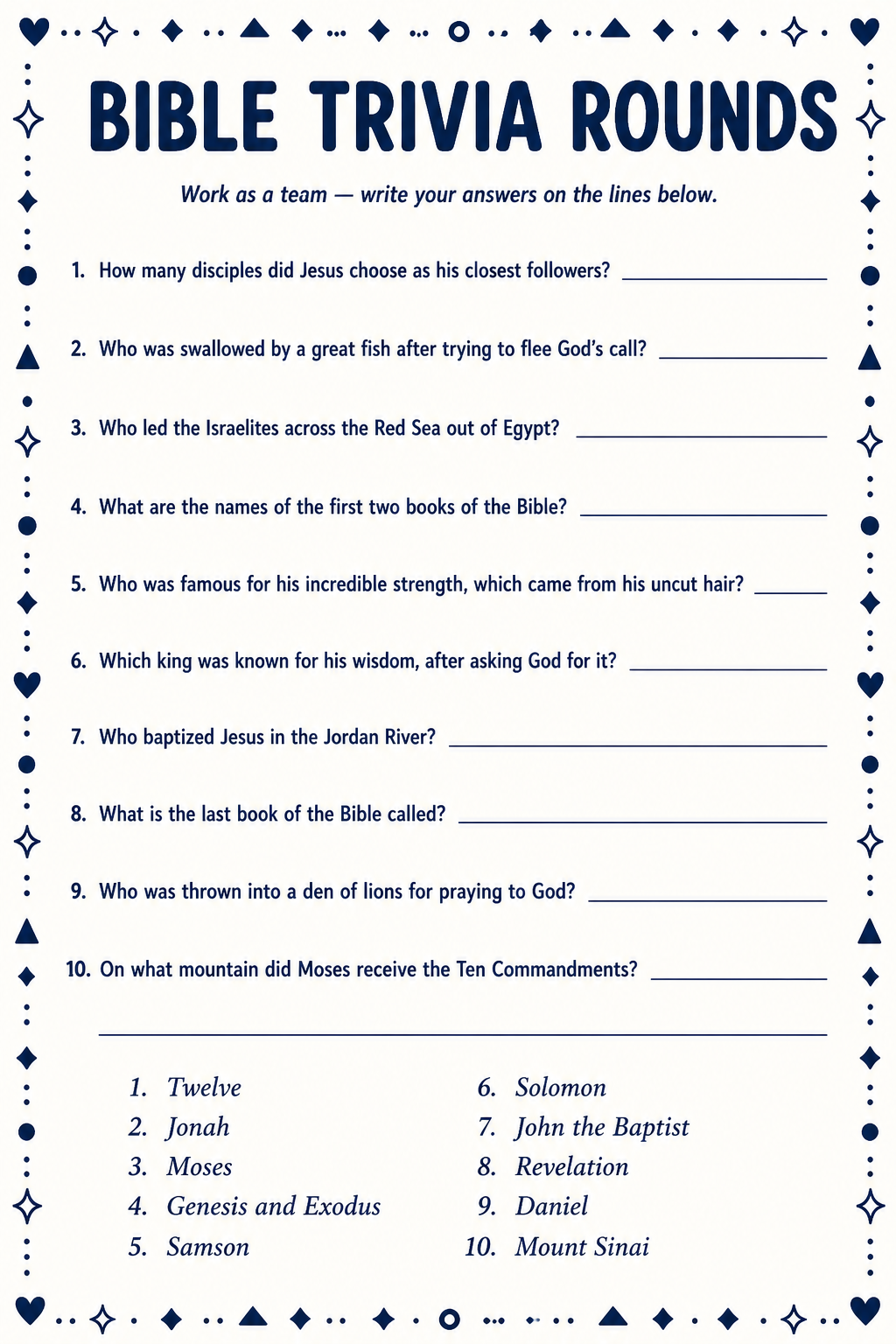
This printable sheet is the backbone of your entire evening. It divides your trivia night into clearly labeled rounds — Old Testament, New Testament, Bible Characters, Parables, and more — so every team knows exactly where they stand and what category is coming next.
Hand one sheet per team at the start of the night and ask them not to peek ahead; part of the fun is not knowing whether the next round will be their strength or their weakness.
To play, the host reads each question aloud from a master list while teams huddle quietly and write their answers in the correct numbered box on their sheet.
No shouting answers out — written responses keep the competition fair and stop faster teams from coaching slower ones.
A typical run through four or five rounds takes about 45 minutes, making it ideal for a 90-minute youth group slot when you add a snack break and scoring time.
Groups of 10 to 60 work equally well; just keep teams to four or five people so everyone gets a voice.
Host tip: number your questions on the master list with the round name and question number (e.g., “OT-3”) so that when a team disputes an answer you can find it instantly rather than flipping through loose papers. Print a few spare sheets in case late arrivals want to join a team mid-evening.
🛍 Shopping guide
2. Human Bingo Icebreaker
Before the competitive trivia rounds begin, Human Bingo is the perfect way to break the ice — especially when your group is a mix of regulars and newcomers.
Each player receives a printed 5×5 grid in which every square contains a Bible-themed prompt such as “has read the book of Jonah,” “can name all four Gospels,” or “has been to a Vacation Bible School.”
Players mingle, find someone who matches each square, and write that person’s name inside it. First to complete a row, column, or diagonal calls out “Bingo!” and wins a small prize.
The game works for groups of 15 to 50 and takes about 10 to 12 minutes — just long enough to get people moving and talking without eating into your trivia time.
It also functions as a natural seating-sorter: by the time Bingo ends, people have already been chatting across age groups and it feels much more natural to sit with a mixed team.
Print one card per person and keep a small prize ready for the first winner.
Host tip: make every square achievable so nobody ends up standing alone with an unmarked card. Avoid squares like “has memorized the entire Sermon on the Mount” — fun to include once as a long-shot square but not as a mandatory line. A good rule is that at least half the squares should be achievable by any churchgoing teenager.

🛍 Shopping guide
3. Would You Rather – Youth Edition
This printable card game poses a series of Bible-and-values-themed “Would You Rather” dilemmas that are genuinely tricky: “Would you rather have the courage of David or the wisdom of Solomon?”
or “Would you rather spend a day with Noah on the ark or with Jonah in the fish?”
There are no right or wrong answers — the goal is to choose a side and then briefly defend it to your team or the wider group, sparking natural conversation about biblical themes without feeling like a Bible study.
Deal out a stack of cards to a host or rotate the deck around the circle so each person draws and reads one.
After everyone votes (thumbs up or thumbs down, standing on one side of the room, or simply calling out their choice), open a 60-second discussion before moving to the next card.
The game suits groups of 6 to 30 and can run as short as 10 minutes or as long as you like depending on how many cards you cycle through. It fits naturally between two heavier trivia rounds as a breather activity.
Host tip: print the cards on cardstock and cut them before the event so you are not frantically snipping during the session.
Keep a few blank cards handy so youth leaders can write a couple of locally relevant questions — a question that references something funny that happened at your last retreat always gets the biggest laugh and reminds the group that Bible values connect to real, everyday life.

🛍 Shopping guide
4. Charades – Bible Stories Edition
In this active, no-technology-needed game, one player draws a card printed with a Bible story, character, or scene — think the parting of the Red Sea, Daniel in the lions’ den, or the feeding of the five thousand — and acts it out silently while their team guesses within a 90-second timer.
No words, no sounds, no pointing at objects in the room that give it away. The team earns a point for every correct guess before time runs out, and then the next team takes their turn.
This game is brilliant for mixed ages because younger children often act with uninhibited physicality that adults would never risk, giving the kids a genuine competitive edge.
It works for groups of 8 to 40 and typically runs 20 to 25 minutes for a full rotation.
You will need the printed card deck, a one-minute sand timer or a phone timer, and enough floor space for someone to flap their arms like a raven delivering bread.
Teams of four to six people work best so the actor always has a lively audience.
Host tip: sort the cards by difficulty before the session and give easier scenes — like Noah’s ark or the nativity — to teams that include younger children. Save the trickier ones (“the Tower of Babel,” “Ezekiel’s vision”) for the adults-only tables. This invisible balancing act means every team wins a round or two and nobody feels embarrassed.

5. Two Truths and a Lie
With a biblical twist, this classic party game asks each player to read three statements from their printed card — two of which are true facts from the Bible and one of which is a cleverly crafted lie.
The rest of the group votes on which statement they think is false. Points can be awarded to players who fool the most people, or simply to anyone who correctly identifies the lie, depending on how competitive your group wants to get.
The printed card format means every statement has already been fact-checked, which saves the host from awkward moments where someone invents a “fact” that is actually correct.
The game is self-running once cards are distributed, making it great for the section of the evening when the host needs a moment to tally scores from the previous round.
It suits groups of any size and takes 15 to 20 minutes for a full rotation, with each person using one card.
Host tip: the lies on the cards should be plausible — statements that sound like they could easily be in the Bible but aren’t. Obvious whoppers (“Moses had a pet dragon”) get spotted immediately and kill the fun.
The best lies are things like a slightly wrong number, a swapped character name, or a location that is one town off.
When you design or review the cards ahead of time, test each lie on one unsuspecting friend; if they spot it instantly, rewrite it.

6. Scavenger Hunt Teams
This team-based scavenger hunt sends groups racing around the venue (or church building) to find items, complete mini-challenges, or answer clues hidden at stations.
The printed sheet lists 12 to 15 tasks of varying point values: easy tasks worth one point (find a pew Bible and open it to Psalms), medium tasks worth two points (ask a leader to recite a memory verse), and hard tasks worth three points (find someone who can name all twelve disciples in under 30 seconds).
The first team back with the most points wins.
It works indoors or outdoors and is enormously scalable — from a small family of six to a youth group of 80 split into six teams. Budget 20 to 25 minutes for the hunt itself plus five minutes to verify answers.
You will need the printed sheets, pens, and ideally a different color sheet per team so you can quickly see that no team is copying another’s answers at the finish line.
Host tip: appoint one adult volunteer per team who does not compete but makes sure the group stays together and is not disturbing other activities in the building.
This also gives shy teenagers someone to quietly ask for help without feeling like they are failing in front of peers. Brief your volunteers beforehand on which station clues are trickiest so they can nudge teams who get stuck without outright giving the answer away.

🛍 Shopping guide
7. Categories Round
In this printable round, teams are given a grid with five Bible-themed categories across the top — such as Books of the Bible, Miracles, Prophets, Women of the Bible, and Places in the Holy Land — and five letters down the side.
For each cell, teams must write a word that belongs to that category and starts with the given letter. For example, the intersection of “Women of the Bible” and the letter “R” might yield “Ruth” or “Rachel.”
Teams have three minutes on the clock, and the scoring rewards originality: a unique answer earns two points while an answer shared by another team earns only one.
This round is especially fun because Bible knowledge and lateral thinking both matter — someone who has never read deeply but has a great memory for names can hold their own against a seasoned Sunday school teacher.
Groups of any size can play simultaneously since everyone writes at the same time; it works for 4 to 60 players and takes about eight minutes including scoring. Print one sheet per team and keep spare pens on every table.
Host tip: the double-point rule for unique answers is the secret ingredient — it stops teams from playing it safe and encourages them to dig for obscure but correct answers.
Warn teams upfront that you will verify unusual answers against a reference Bible, and actually do it. Nothing builds credibility as a host faster than looking up a disputed answer live and saying, “You are correct — two points.”

🛍 Shopping guide
8. Memory Verse Challenge
The Memory Verse Challenge printable gives each team a list of ten well-known Bible verses with the reference removed and two to four key words blanked out. Teams must fill in the missing words and then match the verse to its book and chapter.
Scoring works in tiers: one point for each correct missing word and a bonus two points if the team correctly identifies the reference. This format rewards people who know their Scripture well while still giving partial credit to those who are learning.
The round typically takes 10 to 12 minutes and works for groups of any size.
It is particularly meaningful in a youth group context because it gently encourages young people to revisit familiar verses they may have memorized as children, often surprising themselves with how much they remember.
You will need the printed sheets and pens; no other equipment is required.
Host tip: choose verses that span different translations — a team whose members grew up with different Bible versions will naturally pool their memory and cover more ground together.
Avoid choosing verses so obscure that only a seminary student would recognize them; the goal is joyful recall, not humiliation. A good benchmark: if the verse could plausibly appear on a Sunday school classroom poster, it belongs in this round.

🛍 Shopping guide
9. Discussion Prompt Cards
These printable cards are designed for the quieter, more reflective moment in your evening — the stretch after the competitive rounds when the group is ready to talk rather than compete.
Each card poses a thoughtful, open-ended question rooted in a biblical theme: “If you could ask one question to any person in the Bible, who would it be and what would you ask?”
or “Which Bible story has changed the way you think about a real situation in your life?” The questions are written to be accessible whether someone is a lifelong churchgoer or attending their first youth group meeting.
The cards work best in small circles of five to eight people, though a brave host can use one as a whole-group conversation starter.
Distribute one card per group and let the conversation run for five to seven minutes before rotating to a new card or wrapping up.
They require no scoring, no timer stress, and no right answers — which is often exactly the relief a group needs after a competitive trivia night.
Host tip: print the cards double-sided with a simple design on the back so they feel deliberate and special rather than like a last-minute photocopy. Groups engage more deeply with materials that look like they were prepared with care.
If conversation stalls, the host can share their own answer first — nothing unlocks a quiet room faster than a leader being genuinely vulnerable about a question they find hard.

10. Emoji Decode Challenge
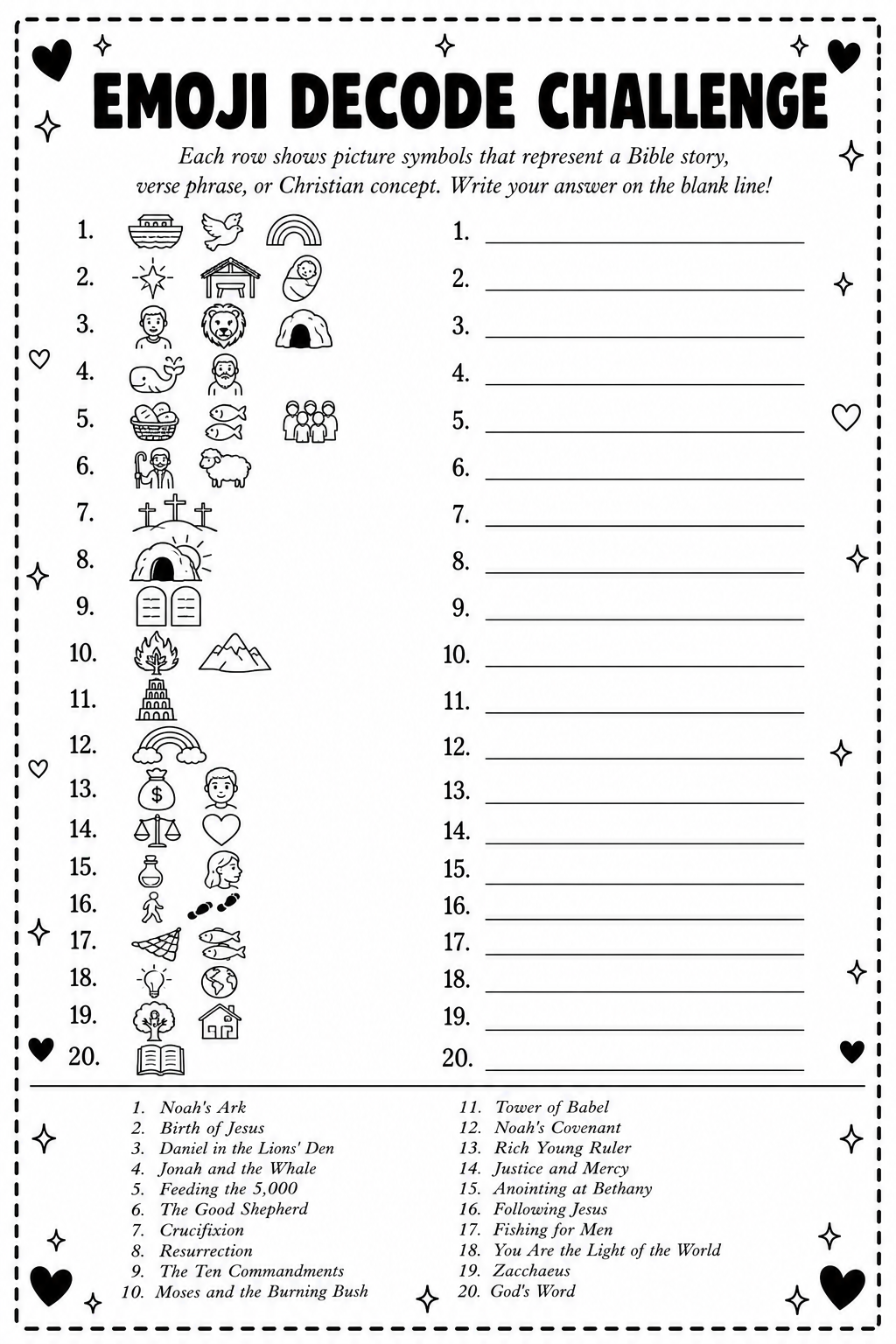
In this fast-paced visual round, teams receive a printed sheet showing rows of emoji sequences, each representing a Bible story, character, or book title.
For instance, a boat, rain clouds, and a dove might point toward the story of Noah, while a star, a baby, and a manger sequence hints at the nativity.
Teams have five minutes to decode as many rows as they can, writing their answers in the space provided beside each sequence.
The game works for groups of 8 to 50 and is particularly popular with younger players who navigate emoji fluently in their daily communication. Keep the answer key sealed until scoring time — the temptation to peek is real.
Teams of three to five work best so that quiet members still have space to contribute without being drowned out by louder voices. The round typically takes about eight minutes including a two-minute scoring pause.
Host tip: choose emoji combinations that have one clear, unambiguous answer rather than sequences that could reasonably mean two or three different things.
Before your event, show each row to someone outside the planning team and confirm they land on the intended answer within 10 seconds. If they hesitate, simplify the sequence. A disputed answer at the scoring table costs you five minutes and a lot of goodwill.
11. This or That – Values Edition
This printable card game moves faster than “Would You Rather” and is designed to spark quick instinctive choices followed by brief conversation. The host or a rotating player reads a prompt — “Faith or courage?” “Prayer or fasting?”
“Solitude like Elijah or community like the disciples?” — and everyone simultaneously points left or right, holds up a colored card, or stands on a designated side of the room.
The point is not to find the right answer but to see where the group lands and spark a 30-second conversation about why.
This game is ideal as a five-minute energizer between longer rounds or as a low-stakes way to introduce a theme for the evening’s discussion.
It works for groups of 6 to 100 and requires no pens, no score-keeping, and no equipment beyond the printed cards for the reader.
The physicality of voting with your feet or your hands keeps energy high even late in an evening when concentration is starting to drift.
Host tip: the 30-second conversation rule is crucial — if you let discussion run unchecked, you will spend 20 minutes on the first card and never finish the set.
Keep a gentle but firm timer and praise the group for their range of answers rather than steering toward one “correct” side. The goal is to show that thoughtful Christians can see the same values slightly differently, and that the conversation itself is valuable.

12. Youth Group Mad Libs
Mad Libs with a biblical twist are a guaranteed crowd-pleaser, especially with younger teens. The printed sheet contains a short narrative based on a well-known Bible story, but with key nouns, verbs, adjectives, and adverbs removed and replaced with blank lines.
Before revealing the story, the host asks the group for words to fill each blank — “Give me an adjective!” “Give me something you find in a kitchen!” — without showing them the story.
The result is a hilariously scrambled retelling that always generates laughter while keeping the original story in mind.
This activity works for groups of 8 to 40 and takes about 10 minutes per story. It is particularly effective right after a snack break when energy levels need lifting but attention spans are not quite ready for a competitive round.
You will need one printed sheet per story (run two or three for a fuller session) and a confident host who can read the completed version dramatically to maximize laughs.
No pens needed — the host fills in the blanks based on shouted answers from the group.
Host tip: choose stories with enough action and variety that the blanks can be genuinely surprising — the feeding of the five thousand, for example, gives you food words, numbers, and verbs that produce wonderfully absurd results.
Read the completed story slowly and with theatrical flair; a flat reading kills the joke. Pause after each unexpected word to let the laughter build before moving on.

13. Lightning Round
The Lightning Round is pure adrenaline: the host fires single-answer Bible questions at the full group at a rapid pace — one question every five seconds — and the first team to buzz in (using a hand signal, a bell, or simply standing up) earns the point.
Questions cover the entire Bible and range from simple (“How many days did creation take?”) to moderately challenging (“What was the name of Moses’ father-in-law?”).
There are no written sheets; it is entirely oral and reactive, which shifts the dynamic completely from the slower written rounds.
This round works best with 3 to 8 teams of 3 to 6 players and takes about 15 minutes for 30 questions.
The energy spike it creates is best deployed two-thirds of the way through the evening when the group needs waking up but is not yet ready for the final scoring.
You will need a master question list for the host, a buzzing or signaling system agreed upon in advance, and a scorekeeper who can track fast changes without getting flustered.
Host tip: have a designated judge who is not the host — someone solely responsible for ruling on which team signaled first.
The host’s attention will be on the question sheet, and disputes about who buzzed first are the single most common source of friction in a Lightning Round.
A clear, pre-agreed signal system (raised hand beats shouted answer) makes the judge’s job easy and keeps the pace from stalling.
14. Bible Geography Challenge
In this round, the host describes a location from the Bible using only geographical and contextual clues — “This sea was crossed on dry ground,” or “This city’s walls fell after seven days of marching” — and teams must identify the place by writing it on their answer slip.
Each correct answer earns one point; a bonus point is awarded if the team can also name the biblical event associated with it.
No maps are provided during the game, though you may choose to reveal a simple unlabeled map at the start to add an extra layer of visual challenge.
The round works wonderfully for mixed-age groups because adults who have studied the Bible geographically and children who remember Sunday school stories are drawing on different but equally valid types of knowledge. Run 15 to 20 clues for a 12-minute round.
Groups of any size can play; keep teams to four or five for the best discussion dynamic. All you need is a printed answer slip per team, pens, and the host’s master clue list.
Host tip: avoid clues so obscure that even experienced Bible readers draw a blank — the goal is recognition, not research. Test every clue on at least one adult volunteer before the event. If they cannot get it with the bonus clue, cut it. The best geography questions produce a satisfying “of course!” moment, not a defeated shrug.
🛍 Shopping guide
15. Who Said It?
In this engaging oral quiz round, the host reads a short quote or paraphrase drawn from something a biblical figure said or did, and teams race to identify the speaker.
Examples might include a paraphrase of Elijah challenging the prophets of Baal, Ruth’s declaration of loyalty to Naomi, or Peter’s bold confession on the road. Teams write their answer on a small whiteboard or folded slip of paper and reveal simultaneously to prevent copying.
Each correct answer scores one point, with a bonus point for naming the specific book the speech appears in.
This round naturally celebrates a wide range of biblical figures — not just the most famous names — which keeps it surprising and teaches the group about lesser-known voices in Scripture.
It works for 4 to 60 players and runs about 15 minutes for 20 quotes. All you need is a host question list, small whiteboards or answer slips, and markers or pens.
Host tip: write the quotes as paraphrases rather than direct quotations from any single translation, which keeps things accessible for people who use different Bible versions and avoids the awkward moment where someone says “that wording doesn’t match my Bible.”
Paraphrase the meaning faithfully but use everyday English so the identification comes from knowledge of the story, not familiarity with a specific translation’s wording.
🛍 Shopping guide
16. Parable Pictionary
Each team takes turns sending one player to the drawing station, where they pick a card naming a Bible parable — the Good Samaritan, the Prodigal Son, the Ten Virgins, the Lost Sheep — and must draw the scene on a large sheet of paper or whiteboard while their team guesses the parable’s name.
No words, letters, or numbers may appear in the drawing. The drawing team has 90 seconds, and every correctly guessed parable earns two points. If time runs out, opposing teams can steal with a correct guess for one point.
This game thrives on the creative tension between an artist who knows exactly what they are drawing and a team that sees only a stick figure carrying something fluffy.
It is also quietly educational: players who were uncertain about a parable often walk away with a vivid mental image they will not forget. Groups of 8 to 40 work best, with teams of four to six players.
You will need large paper pads or a whiteboard, markers, and a printed card deck with parable names.
Host tip: the steal rule is the moment when the whole room leans in — other teams have been half-watching the drawing even while pretending not to, and the chance to steal focuses everyone.
Announce clearly at the start of the evening that stealing is allowed so teams pay attention to every round, not just their own.
Keep the parable list balanced between very well-known stories and slightly less familiar ones so that expert Bible readers do not sweep every round.
🛍 Shopping guide
17. Bible Timeline Challenge
In this kinesthetic team game, each team receives a set of printed cards, each bearing the name of a biblical event or figure.
On the host’s signal, teams race to arrange their cards in chronological order — from creation through to the early church — without using a Bible or phone.
The first team to correctly arrange all their cards and call time wins the round; the host then checks their order against an answer key and subtracts a point for each card out of place.
The game is genuinely challenging because many people have strong knowledge of individual Bible stories but a hazier sense of how they sequence together. It sparks great table-level debate — “Did Ruth come before or after the judges?”
— which is itself a form of Bible learning. Groups of 4 to 40 can play, with teams of three to five. Budget 15 to 20 minutes for a full round.
You will need one printed card set per team and a master answer key for the host.
Host tip: laminate the cards if you plan to reuse this game at multiple events — unlaminated cards get bent, written on, and mixed between sets within one session.
Color-code each team’s set on the back so that when cards inevitably end up on the floor, you can quickly sort them back to the right team.
A different color dot sticker on the back of each set costs almost nothing and saves significant post-game chaos.
🛍 Shopping guide
18. Guess My Verse Relay
This relay-style game combines memory, teamwork, and a little drama. One player from each team reads a printed verse reference aloud — say, “Proverbs 3, verse 5” — without reading the verse itself.
Their teammate must then recite as much of the verse as they can from memory, while the rest of the team silently counts how many key words they get right against the printed text.
Teams accumulate points across multiple relay legs, and the baton passes to a new reader and reciter with each round.
The game works best with 3 to 6 teams of 4 to 6 players and takes about 20 minutes for a full relay of 12 to 15 verses.
It rewards genuine Scripture memory while being gentle enough that partial credit keeps less experienced players engaged rather than embarrassed.
You will need a printed reference card set, a printed answer key per judge, and a quiet room where teams can hear their own reciter over other groups’ simultaneous attempts.
Host tip: if your group has wide variation in Bible memory — some adults who can recite full chapters and some teenagers who are new to Scripture — divide the relay into an easy verse tier and a harder verse tier, letting teams choose which tier they attempt for each leg.
The harder tier earns double points but is riskier. This choice mechanic adds genuine strategy and stops expert teams from dominating without even trying.
🛍 Shopping guide
19. Tie-Breaker Question
When two or more teams finish the main trivia rounds on equal points, the Tie-Breaker Question decides the winner with a single high-stakes question — one that is specific enough to have a clear correct answer but open-ended enough that two teams might approach it differently.
Classic tie-breakers include numerical answers (“How many books are in the Old Testament?”) or a sequence question (“Name the last three plagues of Egypt in order”). The first team to write down the correct answer and hold it up wins.
The tie-breaker is also a useful tool even when teams are not tied — it can serve as a nail-biting final question for the whole group, with the leading team playing to extend their margin and trailing teams playing to close the gap.
Keep three or four spare questions ready so you are not scrambling if the first one is answered instantly. No printed sheet is needed; write the question on a whiteboard or simply read it aloud.
Host tip: the best tie-breakers have a single verifiable answer but require the kind of specific recall that separates true Bible knowledge from a lucky guess.
Avoid questions where someone might argue the answer depends on translation or biblical tradition — this is not the moment for theological debate.
If you are unsure whether a question has one clear answer, do not use it as a tie-breaker; save it for an earlier bonus round instead.
20. Answer Key Sheets
The Answer Key Sheet is the host’s most important tool and deserves as much preparation as any other element of the evening.
Printed clearly with every question, its correct answer, and any acceptable alternative phrasings, the key allows the host to score quickly, handle disputes confidently, and keep the evening moving without long pauses.
Organize the key to mirror the round structure exactly — same question numbers, same categories — so you are never searching across pages while 40 people wait.
Beyond simple scoring, a well-designed answer key includes a brief note on why each answer is correct — a short contextual sentence that the host can read aloud when an answer surprises people.
This turns the scoring phase from a passive waiting period into an additional moment of learning and engagement. Print at least two copies: one for the host and one for a trusted co-host or scorekeeper.
Keep the sheets face-down until scoring begins so the answers stay secure.
Host tip: highlight each correct answer in yellow before the event so that in the heat of the moment, under dim hall lighting, your eye lands on the answer immediately rather than reading the full question again. Add a brief “did you know?”
sentence beside any question where the answer tends to surprise people — reading that extra fact aloud takes five seconds and earns you genuine admiration as a host who actually prepared.
🛍 Shopping guide
Frequently Asked Questions
How many people do you need to run a Bible trivia night?
Bible trivia nights work with as few as six people and as many as 80 or more. The key is team size — aim for four to six players per team so everyone participates rather than watching one dominant voice answer everything.
Smaller gatherings can skip the formal team structure entirely and play as one group, turning competitive rounds into collaborative challenges where everyone works together against the clock.
How do you make Bible trivia fair for mixed ages and knowledge levels?
The best approach is tiered difficulty within each round: include two or three questions that any child who has attended Sunday school could answer, three or four that require adult Bible familiarity, and one or two that will genuinely stretch even the most experienced players.
You can also designate certain questions as “junior bonus” questions where only players under 16 may answer, giving younger participants a genuine moment to be the expert at the table.
Do you need to print everything before the event?
For the smoothest experience, yes — print all sheets the day before and sort them into labeled envelopes by round. Running a trivia night with printed materials means no tech failures, no loading screens, and no font-size squinting from a projected slide.
That said, the oral rounds (Lightning Round, Tie-Breaker, Who Said It) require nothing more than the host’s question list, so even a last-minute organizer can run a solid evening with minimal printing.
What is the best order to run the games in?
Start with an icebreaker like Human Bingo or Would You Rather to warm the room and mix the groups before competitive pressure sets in.
Move into the structured trivia rounds — Old Testament, New Testament, Bible Characters — and place the Lightning Round two-thirds of the way through as an energy boost.
Finish with the scoring, the Tie-Breaker if needed, and then a reflective activity like the Discussion Prompt Cards so the evening ends on a warm, conversational note rather than a competitive one.
Can these games be used in a school or non-church setting?
Yes — the trivia and game formats are educational and inclusive. In a non-church school setting, Bible trivia works well as a cultural literacy or literature activity, since the Bible is one of the most referenced texts in Western history and literature.
Simply frame the evening as exploring one of the world’s most influential books rather than as a devotional activity, and the games translate naturally to a secular educational context.
📌 Save These for Later
Loved these? Pin your favorite image below so you can find this list again when you’re planning.
9 baby first halloween crafts that capture tiny footprints, handprints and keepsakes in under an hou

20 cozy halloween family party games for all ages — active, printable & quiet ideas perfect for a

15 fun halloween icebreaker games to warm up strangers fast — zero prep, big laughs, perfect for p
Leave a Reply