

If you are planning a K-pop-themed sleepover or birthday party and need games that will actually get everyone off their phones and onto their feet, you have landed in exactly the right place.
These 19 kpop party games for teens cover everything from high-energy dance battles to chill conversation circles — plus a whole stack of cut-out printables your guests can build, fold, and spin their way through.
Tbh, this lineup is basically a mini K-pop festival squeezed into your living room, and zero professional choreography skills are required (phew).
Whether your crew is made up of die-hard stans who know every hand gesture or total newcomers who just love the vibe, every single game here is designed to be PG, inclusive, and genuinely fun — not the kind of ‘fun’ that makes everyone sit in awkward silence.
I have tested the flow of this order at a couple of real teen parties, and trust me: starting with the dance games, moving into the crafty printables, and winding down with the quieter ones at the end is the magic formula.
Your guests will thank you. Now let’s get into it!
This post contains affiliate links — if you buy through them, I may earn a small commission at no extra cost to you.
- Random Play Dance
- Dance Cover Battle
- Freeze Dance K-Pop Edition
- Choreography Copycat
- K-Pop Dance-Move Dice (cut-out fold-and-glue cube)
- Fan Chant Challenge
- K-Pop Challenge Dice (cut-out fold-and-glue cube)
- Speed-Learn a Dance Break
- K-Pop Fortune Teller Cootie Catcher (cut-out fold)
- Spin-the-Move Paper Spinner (cut-out arrow on a brad)
- K-Pop Would You Rather Cards
- This or That K-Pop Sheet
- K-Pop Bingo
- Design-Your-Own Photocard Sheet
- K-Pop Culture Trivia Sheet
- Guess the Concept from Emojis Sheet
- K-Pop Charades Card Deck
- Bias Talk Circle
- Dream Concert Share
- Frequently Asked Questions
1. Random Play Dance
Random Play Dance is THE classic K-pop fan game, and it is exactly as chaotic and delightful as it sounds. One person (the DJ) queues up a playlist of K-pop-style dance tracks and hits shuffle. When the music starts, everyone dances.
Here is the twist: the DJ can skip to a new song at any random moment — and anyone who freezes, hesitates, or clearly doesn’t know the move is out for that round.
The goal is to keep moving convincingly through every surprise switch-up, matching the energy of whatever track kicks in.
To set this up, you just need a solid playlist of upbeat K-pop-style instrumental or vocal tracks (YouTube fan-made random play dance playlists work great), a decent speaker, and enough floor space to boogie.
Designate one person as the DJ who controls the skip button — this is a surprisingly powerful role and a fun one to rotate each round.
Mark off a ‘dance floor’ zone with painter’s tape if your space is tight, so everyone stays visible and in the game.
What makes this game so electric is that it rewards genuine fan knowledge and quick reflexes equally — a guest who’s never seen a choreography tutorial can still survive on pure confidence and energy.
Play three to five elimination rounds, letting eliminated players become judges for the next round so nobody is just sitting on the sidelines watching.
It is genuinely one of the best icebreakers to kick the night off, especially if your group has mixed K-pop experience levels.
Prep your playlist ahead of time and keep skips unpredictable — long stretches then sudden rapid-fire switches keep everyone on their toes!
🛍 Shopping guide
2. Dance Cover Battle
Dance Cover Battle turns your living room into a mini K-pop competition stage, and honestly it is the game that gets the most screaming (the good kind). Split guests into small teams of two to four people.
Each team has fifteen to twenty minutes to secretly choreograph a short thirty-second cover routine to any K-pop-style song they choose from your party playlist.
Then, one team at a time takes the ‘stage’ and performs for the audience while the others judge on three criteria: energy, synchronisation, and stage charisma.
Give each judge team a simple scorecard — just a sticky note or a torn piece of paper works fine — and have them hold up a number from one to ten after each performance. Tally the scores aloud for maximum drama.
If you want to lean into the idol aesthetic, designate a backstage area (a hallway or another room) where teams can secretly rehearse without the others peeking.
You can also add a costume element by laying out scarves, hats, and sunglasses as quick styling props before each performance.
The beauty of this game is that it rewards teamwork and creativity far more than actual dance skill, which means even guests who protest ‘I literally cannot dance’ end up having the most fun once they commit to their team’s concept.
A great variation for shy groups: allow teams to perform a lip-sync battle instead of a full dance cover, so the focus shifts to expression and showmanship rather than choreography. Either way, the audience energy makes every performance feel like a real concert moment.
- Groups of 6 or more
- Guests who love performing
- Parties with a clear open floor space
🛍 Shopping guide
3. Freeze Dance K-Pop Edition
You already know the bones of Freeze Dance — music plays, everyone dances, music stops, everyone freezes — but the K-pop edition adds a layer that makes it so much more fun.
When the music pauses, the person running the game calls out a K-pop fan-culture pose for everyone to hold: ‘heart hand pose!’, ‘main vocal power stance!’, ‘idol wave to the fans!’, ‘surprise comeback reaction!’, or ‘photo shoot face!’.
Anyone who moves, wobbles, or breaks their pose before the music restarts is out.
Prep a list of ten to fifteen K-pop-themed freeze poses on index cards before the party so the host can draw and read them quickly without stalling.
You can get really creative here: ‘fanmeet handshake freeze,’ ‘lightstick wave,’ ‘fanchant mouth open,’ ‘slow-motion music video hair flip’ — the sillier the pose, the louder the room gets.
Use a K-pop-style instrumental playlist and vary the lengths of the pauses (sometimes let the music play for thirty full seconds, sometimes cut it after five) to keep everyone guessing.
This is one of those kpop party games for teens that works brilliantly even in a smaller space because everyone just freezes in place — no running or jumping required.
It also scales perfectly for mixed ages if you have younger siblings around, which is a total lifesaver for family-friendly events.
Reward the last person standing with a fun fan-culture title like ‘Main Dancer’ for the rest of the night — it is a small thing but guests absolutely love it.
Write all your freeze poses on index cards in advance so the game flows without awkward pauses between rounds.
4. Choreography Copycat
Choreography Copycat is basically Simon Says meets K-pop dance class, and it is one of those games that looks easy but gets hilarious fast. One player is the ‘Choreographer’ and stands at the front of the room.
They perform a sequence of simple dance moves — think: step-touch left, clap, body roll, point to the sky, spin — and the rest of the group has to mirror them as accurately as possible.
After the sequence, the Choreographer speeds up and adds one new move each round until people start dropping moves or doing them in the wrong order.
The key to making this game work well is keeping the starter move count low (three to four moves) and building up gradually so the sequence reaches six to eight moves before it becomes genuinely impossible.
Play K-pop-style background music quietly so the room feels energised without drowning out the visual cues.
Rotate the Choreographer role every two to three rounds so everyone gets a turn leading — and trust me, watching your shyest guest suddenly invent their own signature move as Choreographer is one of those party moments you will never forget.
A fun variation: challenge the Choreographer to incorporate a specific ‘concept’ called out by the group — cute, fierce, retro, or dreamy — and then perform their sequence in that style while the group copies.
It adds a layer of improv comedy that totally transforms the energy of the game and ties in beautifully with the K-pop world of concept-based performances. No supplies needed beyond your party playlist and a dance floor.
Rotating the Choreographer role means every guest feels like a star for at least one round — great for building confidence in shy teens.
5. K-Pop Dance-Move Dice (cut-out fold-and-glue cube)
This printable cut-out paper dice is one of the most satisfying crafty-meets-game moments of the whole party — guests actually build the thing themselves before they play with it!
The sheet features a classic cross-shaped unfolded cube template (a net of six squares), with each face printed with a different K-pop-inspired dance move prompt: ‘Do a body roll,’ ‘Strike a power pose and hold for five seconds,’ ‘Do the robot for ten seconds,’ ‘Do your best idol hair flip,’ ‘Moonwalk across the room,’ and ‘Teach the group a move you just made up.’
Dashed fold lines and solid cut lines are clearly marked, with small glue tabs on the four side flaps.
Print the sheet on regular cardstock (heavier paper holds the cube shape much better than printer paper), cut along the outer solid lines, fold on every dashed line, and glue or tape the tabs to close the cube — the whole build takes about three minutes per person.
Once everyone has their dice, sit in a circle and take turns rolling. Whatever move lands face-up, you have to perform it in front of the group immediately.
No skipping allowed (that is the rule — and yes, ‘teach the group a move you just made up’ is intentionally the chaotic wildcard).
This is one of those kpop party games for teens that doubles as a little craft keepsake — guests love taking their handmade dice home at the end of the night.
You can also use the dice as a warm-up before Dance Cover Battle or Choreography Copycat to loosen everyone up. Print one per guest or one per team, depending on how many rounds of rolling you want.
Pair with the K-Pop Challenge Dice (game #6) for a double-dice combo round where each player rolls both and combines their results.
- Cardstock paper (one sheet per guest)
- Scissors
- Glue stick or clear tape

🛍 Shopping guide
6. Fan Chant Challenge
Every K-pop fandom has its iconic chant — the rhythmic call-and-response that fans shout back at performers during concerts — and in the Fan Chant Challenge, your guests get to invent and perform their own.
Divide the group into teams of two to three people and give each team five minutes to create an original fan chant for an imaginary K-pop act.
The chant must include the group’s made-up name, at least one repeated rhythmic phrase, and a call-and-response section (one person shouts, the others answer back).
After the creation time is up, each team performs their chant live while the rest of the room plays the audience.
The audience judges on volume, rhythm, and how hype the chant feels — scored informally by noise level (whoever gets the loudest audience reaction wins the round). Encourage teams to really commit: clapping patterns, stomping, and shaking imaginary lightsticks all count as performance points.
The sillier the made-up group name, the better — past party gold has included acts with names like ‘Mega Sparkle’ and ‘Fierce Galaxy Unit’ (I am not making those up).
This game is brilliant for building group energy mid-party because it requires zero supplies and gets even the quietest guests shouting along within thirty seconds.
It also sneaks in a genuinely creative challenge — constructing a chant with rhythm and structure is harder than it sounds, and you will see guests completely surprise themselves.
After the challenge, keep the best chant going as a recurring bit throughout the rest of the party — bring it back every time a new game starts for maximum comedic effect.
Give teams a ‘Fan Chant Template’ prompt: [Group name] + [cheer phrase] + call: ‘[word]!’ response: ‘[word]!’ — it helps shy teams get started fast.
7. K-Pop Challenge Dice (cut-out fold-and-glue cube)
The K-Pop Challenge Dice is the wild sibling of the Dance-Move Dice — while that one is all movement, this one is all about fan-culture dares and funny idol-life scenarios.
Same build process (cross-shaped cube template, cut on solid lines, fold on dotted lines, glue the tabs), but the six faces each carry a different K-pop-style challenge: ‘Introduce yourself like a K-pop idol in a fancafe post,’ ‘Give the person to your left a fan-made nickname and explain why,’ ‘Demonstrate your best high note (no words — just the note),’ ‘Act out a dramatic music video plot in ten seconds,’ ‘Invent a lightstick concept for your imaginary group and pitch it,’ and ‘Do your best idol surprised-by-a-camera reaction.’
Print on cardstock, build the cube, and then use it in two different ways depending on what the group feels like. Option A: pass the die around the circle — whoever rolls it must complete the challenge.
Option B: combine it with the Dance-Move Dice from game #5 for a double-roll round where each guest must perform the dance move AND the challenge simultaneously for maximum comedic chaos.
Both versions work brilliantly and the combo option in particular is an absolute highlight of any K-pop sleepover.
Like the Dance-Move Dice, this sheet is print-one-per-guest to take home, or print a single copy for the whole group to share during game time.
The challenges are written to be inclusive and non-embarrassing — nothing here requires real singing ability or athletic skill, just a willingness to be a little dramatic (which, let’s be honest, is the entire point of being a K-pop fan).
The ‘invent a lightstick concept’ challenge in particular never fails to generate the most genuinely creative responses of the whole party.
The challenges reward personality and creativity over talent, so every guest — stan or newcomer — can shine equally on their roll.

🛍 Shopping guide
8. Speed-Learn a Dance Break
Speed-Learn a Dance Break is exactly what the name promises: one guest teaches the whole group a short eight-count dance sequence in under three minutes flat.
The ‘teacher’ picks a simple move sequence they already know (or makes one up on the spot), demonstrates it twice slowly, then leads the group in a full-speed run-through while the music plays.
The catch is the three-minute hard limit — there is a countdown timer running visibly on someone’s phone, and when the buzzer hits, everyone freezes and performs the sequence one final time together for a group photo moment.
Rotate the teacher role after every round so multiple guests get the spotlight.
If someone freezes up when it is their turn to teach, give them a ‘dance concept card’ to spark ideas — tiny slips of paper with prompts like ‘retro,’ ‘fierce,’ ‘dreamy,’ or ‘space-themed’ that they have to interpret in their routine.
Keep a running list of all the mini-routines taught throughout the night; at the end of the party, try stringing them all together into one long group dance — it becomes this totally ridiculous and wonderful patchwork choreography that is completely your group’s own creation.
The real magic of this game is that it creates a shared group achievement in a very short time. Teaching someone something — even a silly eight-count dance — builds genuine confidence, and learning it fast builds group trust and laughter.
It also serves as a brilliant energy reset between the more competitive games on this list, bringing everyone back to the same team-oriented headspace before moving on. No props required, just your playlist and an open floor.
- Energy reset between competitive rounds
- Groups with at least one confident dancer who can lead
- Mid-party momentum boost
9. K-Pop Fortune Teller Cootie Catcher (cut-out fold)
Every person who grew up with cootie catchers in their hands knows the irresistible draw of ‘pick a colour, pick a number, here is your fate’ — and the K-pop edition turns that nostalgic format into a genuinely hilarious group activity.
The printed sheet features a single large square template with diagonal fold lines and horizontal-vertical fold lines clearly marked, turning it into the classic four-flap fortune teller with zero glue required.
The eight inner flaps each carry a K-pop fan-life prompt: things like ‘Your fan era is: soft stan,’ ‘Your imaginary group concept is: fairytale royalty,’ ‘Your idol power is: never forgetting a fancam link,’ ‘Your concert role: the one who memorises all the fan chants,’ and four more equally fun results.
The four outer flaps are labelled with K-pop-style colour names (Starlight Silver, Concert Pink, Fandom Blue, Stage Gold) and the four number positions are labelled 1 through 4.
To play: one guest holds the cootie catcher, another picks a colour, the holder spells it out while opening and closing the flaps, then the picker chooses a number, and the holder opens the corresponding inner flap to reveal the fan-life fortune.
Pass it around the circle so everyone gets a reading, then swap to a new cootie catcher builder for round two.
Print one per guest so they each build their own during a five-minute craft break — folding cootie catchers from scratch is one of those activities that generates surprisingly deep conversation (‘wait, how do you do the last fold again?’)
and is a lovely calm moment between the more active games.
The fold instructions are printed directly on the sheet in simple numbered steps beside the template: fold in half diagonally both ways, fold in half book-style both ways, push the four corners to the centre, flip and repeat.
No scissors needed — just fingers and fold lines.
- One printed sheet per guest
- No scissors or glue required — just fold!

10. Spin-the-Move Paper Spinner (cut-out arrow on a brad)
The Spin-the-Move Paper Spinner is a beautifully simple cut-out game that produces genuinely unpredictable results every single time — which is basically the definition of a good party game.
The printable sheet features a large circle divided into eight equal labelled segments, each containing a different K-pop dance-or-dare move: ‘Solo freestyle for fifteen seconds,’ ‘Teach a move to the group right now,’ ‘Mimic the person across from you,’ ‘Strike an idol arrival pose,’ ‘Do a slow-motion hair flip,’ ‘Invent a new signature move and name it,’ ‘Group body roll — everyone join in,’ and ‘Pick someone to battle dance with you for ten seconds.’
A separate arrow shape is printed below the circle to cut out independently.
To build the spinner: cut out the large circle, cut out the arrow, use a sharp pencil or pen tip to carefully poke a small hole through the centre dot of the circle and through the base of the arrow, then push a paper fastener (brad) through both holes and splay the legs flat on the back.
Done — you now have a working spinner in under five minutes. Lay the spinner flat on a table, flick the arrow, and whatever segment it lands on, the current player must complete that move. Pass the spinner clockwise after each turn.
What elevates this above a simple dare wheel is the physical act of spinning — there is something weirdly satisfying about watching the arrow slow to a stop and everyone leaning in to see what lands.
It also means the game requires zero reading or decision-making from the host mid-round, which is a genuine relief when you are also trying to manage snacks, music, and six excited teenagers simultaneously.
Print one spinner for the whole group to share, or print multiples for small breakout groups if your party is large. Pro tip: laminate the circle before assembly and it will survive the whole night without getting crumpled.
- One printed sheet
- Scissors
- One brad/paper fastener per spinner
- Optional: laminator for durability

🛍 Shopping guide
11. K-Pop Would You Rather Cards
Would You Rather is already a classic sleepover game, but the K-pop fan-culture version hits completely differently because the scenarios are so specific and so relatable that they instantly generate the kind of loud, passionate debate that makes a great party.
The printable sheet features twelve Would You Rather cards, each with two fan-life scenarios and a big OR in the middle. Examples: ‘Would you rather be the main dancer or the main vocalist of your group?’
/ ‘Go to one concert with front-row seats OR stream every album release live from home?’ / ‘Have your bias notice your fan art OR get chosen for a fan meet?’
Every scenario is K-pop-world specific and designed to spark genuine opinion-sharing rather than just a yes-or-no answer.
Print the sheet on cardstock, then cut along the dashed lines to create twelve individual cards. Shuffle the deck and take turns drawing a card and reading it aloud.
The reader states their answer first — and must give a reason — then opens it up for everyone else to share and debate.
You can play casually in a circle or add a competitive element by splitting into two teams and awarding a point to whichever team’s answer generates the most group agreement (majority rules).
Either way, keep the energy moving by giving each card a sixty-second discussion cap before drawing the next one.
The genius of this format for a K-pop party is that it doubles as a genuine ‘get to know your fellow fans’ exercise — you learn so much about someone from whether they choose main dancer over main vocal, or whether they prioritise concerts over streaming.
It is one of those kpop party games for teens that works perfectly as a transition game between the high-energy active rounds and the quieter wind-down games later in the evening.
It also works beautifully as an icebreaker at the very start if your guest list includes people who don’t all know each other well.
Keep a timer running — sixty seconds per card keeps the energy up and prevents any single debate from taking over the whole night.

12. This or That K-Pop Sheet
This or That is the snappier, faster sibling of Would You Rather — no debate, just instant gut-reaction answers, and that speed is exactly what makes it such a great contrast after the Would You Rather cards.
The printable sheet has twenty This or That prompts arranged in two columns, each one presenting two K-pop fan-culture options side by side with a big slash between them.
Guests circle or tick their choice with a pen, race through the whole sheet as fast as possible, and then compare answers around the group.
It sounds simple, but the moment someone reveals they chose ‘studio album / live concert tour’ differently from their best friend, the room erupts.
To play: hand each guest their own printed sheet and a pen. Set a two-minute timer and everyone fills in all twenty prompts individually and silently (no peeking at each other’s answers).
When the timer ends, go through the prompts one by one as a group — the host reads each one aloud, and everyone holds up their sheet to show their circled answer.
Any prompt where the group is perfectly split fifty-fifty gets a star marked on the board and becomes a tie-breaker conversation topic at the end.
Print one sheet per guest so everyone has a permanent record of their K-pop preferences — it is a genuinely fun keepsake to look back on later.
The twenty prompts range from fan-activity choices (‘fan art / fan fiction’), to concert experiences (‘pit / seated’), to aesthetic preferences (‘bold fierce concept / soft dreamy concept’), to group dynamics (‘big group energy / tight duo chemistry’), making the sheet feel personal and specific without ever naming a real group or artist.
It works brilliantly early in the party as an icebreaker or mid-party as a breather, and the sheet takes less than three minutes to print and distribute — zero prep time, maximum engagement.
Your guests will genuinely be surprised how much they learn about each other from twenty fast questions.
- Quick icebreaker at party start
- Calm moment between active games
- Groups where not everyone knows each other well

13. K-Pop Bingo
Bingo gets an instant upgrade when the squares are filled with K-pop fan experiences rather than numbers — and I mean a real upgrade, not just a rebrand.
The K-Pop Bingo sheet features a classic five-by-five grid with a FREE space in the centre, and each of the twenty-four surrounding squares contains a different K-pop fan-life experience that guests mark off if it applies to them: ‘Pulled an all-nighter for a comeback,’ ‘Knows a full fan chant by heart,’ ‘Has made fan art,’ ‘Cried during a slow song,’ ‘Has a bias wrecker,’ ‘Owns a lightstick,’ ‘Has streamed to help chart numbers,’ ‘Has a photocard collection,’ and sixteen more equally specific and relatable moments.
To play: hand each guest a bingo sheet and a marker, pen, or highlighter. The host calls out experiences one by one from a separate list (or just let guests self-mark if you want the faster version).
Each guest marks off any square that applies to them. First to complete a row, column, or diagonal shouts ‘Comeback!’ (because shouting ‘Bingo’ at a K-pop party feels like a missed opportunity, tbh) and wins that round. Play two to three rounds for maximum fun.
Because the squares are personal experiences rather than random numbers, guests love comparing their sheets and discovering unexpected overlaps — ‘wait, you also pulled an all-nighter for a comeback?! Same!’
This is one of those kpop party games for teens that requires zero hosting skill to run — once the sheets are handed out, it practically runs itself. Print one sheet per guest on regular printer paper and have pens or markers available.
If you want to add a prize element, keep the rounds going until someone gets a full blackout card (all twenty-five squares), which in practice leads to some gloriously dramatic full-group debates about whether streaming counts as a K-pop fan experience or a personality trait.
(Hint: it is both.)
Print a separate caller list from the sheet so you can run the called version — or let guests self-mark for a relaxed ‘compare and chat’ version with no formal calling needed.

14. Design-Your-Own Photocard Sheet
Photocards — those small, glossy, collectible cards included with K-pop albums — are one of the most beloved elements of K-pop fan culture, and this printable game lets every guest design their very own.
The sheet features six equally-sized blank photocard templates arranged in two rows of three, each the classic small rectangular portrait format.
Every card has a structured layout with clearly labeled blank sections: a large rectangular portrait area (where the guest draws or doodles their idol self-portrait or character), a blank title line for their stage name, a blank line for their imaginary group name, and a small decorative border frame that guests can colour in.
Hand each guest a sheet, fine-tip markers or coloured pencils, and about ten minutes to design all six cards. Encourage them to think about their idol concept — are they going for soft and dreamy or fierce and bold?
— and design their photocard to match. After the design time, guests cut out their six cards along the dashed lines and trade them with other guests, just like the real fan-trading culture!
Set a rule: you must trade at least three of your six cards with different people, and you can politely decline any trade (because real fan culture also includes very intentional trading strategy, which is always funny to watch in practice).
This is one of the most beloved kpop party games for teens because it sits at the crossroads of craft, self-expression, and fan culture in a way that feels genuinely authentic.
Guests treasure their traded cards as real party keepsakes, and the design process itself is a lovely calm moment in the party schedule.
You can even punch a hole in the corner of each finished card and add a keyring so guests leave with a little photocard keychain of their collection — a detail that costs almost nothing but makes the whole thing feel extra special.
If you enjoy craft-based party activities like these, you might also love these easy air dry clay ideas for a creative follow-up project.
- Fine-tip markers or coloured pencils
- Scissors for cutting cards apart
- Optional: hole punch and keyrings for a keychain keepsake

🛍 Shopping guide
15. K-Pop Culture Trivia Sheet
A solid trivia sheet is a must-have in any collection of kpop party games for teens, and this one is specifically designed around generic K-pop fan culture concepts rather than specific artists — which means it works for every level of fan at the party, from the person who discovered K-pop last week to the person who has been stanning for five years.
The sheet features twenty questions across four categories: Fan Vocab (what does ‘bias,’ ‘comeback,’ ‘maknae,’ ‘stan,’ and ‘fanchant’ mean?), Concert Culture (what is a lightstick used for? What does ‘encore stage’ mean?), Music & Format (what is a mini-album vs a full album?
What is a pre-release single?), and Fandom Life (what is a photocard? What does ‘ship’ mean in fan culture?). Each question has a clear blank answer line.
Questions are numbered continuously 1 through 20 across all four categories (Q1–5 Fan Vocab, Q6–10 Concert Culture, Q11–15 Music and Format, Q16–20 Fandom Life) so the sheet reads as one unbroken numbered list.
A complete answer key runs at the very bottom of the sheet in small light-grey italic text for the host to check answers against. To play: give each guest a sheet and pen, set a five-minute timer, and let everyone answer independently.
When time is up, the host reads out answers from the key while guests self-mark. Add up scores and award the highest scorer the honorary title of ‘Stan of the Night.’
What I love about trivia in this fan-culture format is that the questions feel educational in the best possible way — guests who are newer to K-pop genuinely learn things from hearing the answers, while seasoned fans get the satisfaction of knowing every single one.
It also naturally sparks conversation: ‘wait, what IS the difference between a mini-album and a full album?’ is genuinely interesting to debate around a circle of teens who care about the answer.
Print one sheet per guest and keep the scoring casual — this is not a high-stakes elimination, just a fun way to learn and share.
- Mixed fan experience levels
- Groups where some guests are new to K-pop
- Mid-party calm moment after active games

16. Guess the Concept from Emojis Sheet
Emoji decode games are endlessly fun because they turn a string of little pictures into a puzzle that makes your brain work harder than expected — and when the theme is K-pop concepts, the guesses get wonderfully creative and weird.
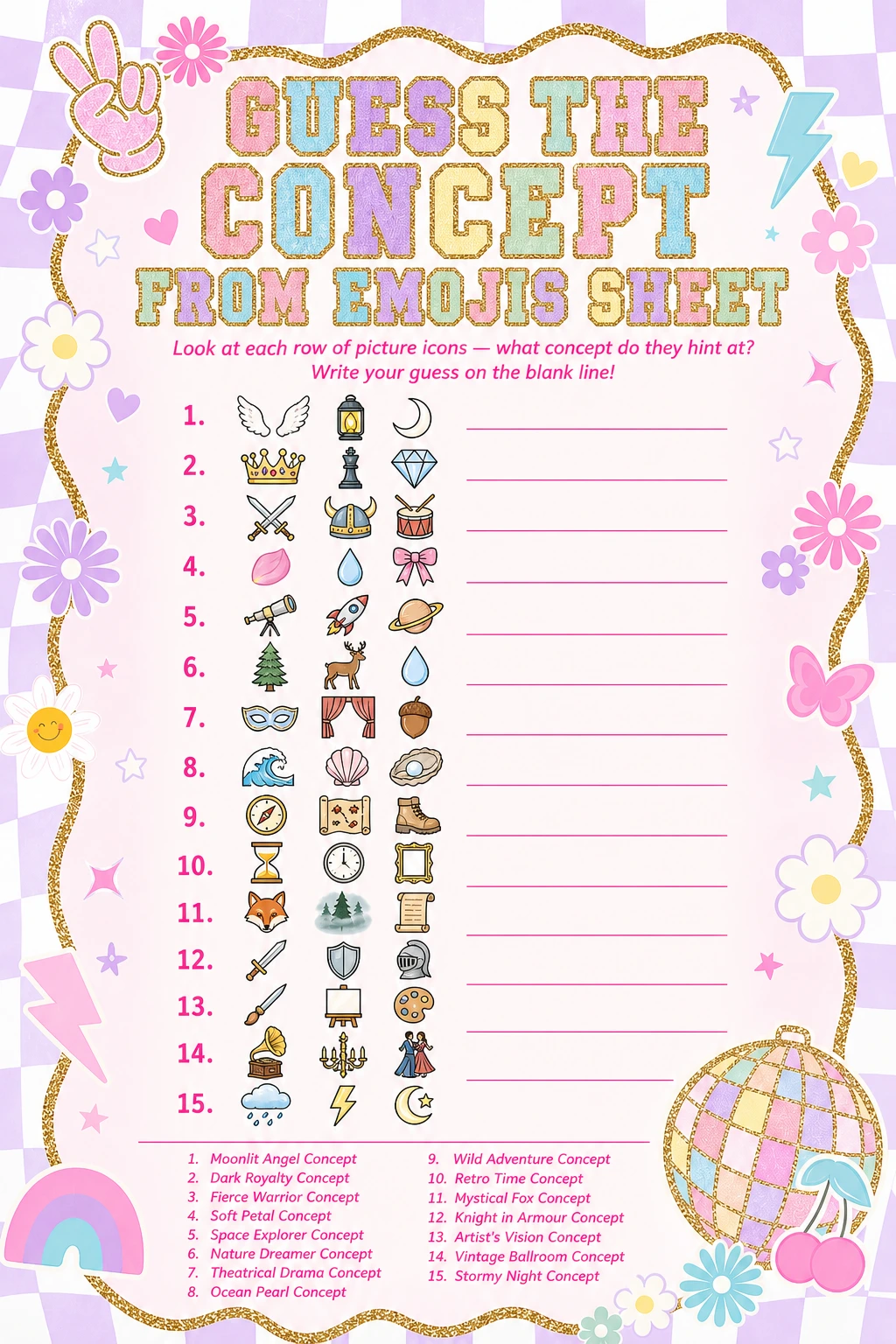
The printable sheet features fifteen numbered emoji clues, each represented as a row of two to four small picture-symbol icons drawn as simple illustrations (a little moon, a crown, a star, a flame, etc.)
that together hint at a K-pop-style album concept, group concept, or fan-culture term. Guests look at each row of emoji pictures and write their guess for the concept on the blank line beneath.
Examples: a moon + wings + silver star hints at ‘moonlit angel concept’; a crown + chess piece + black diamond hints at ‘dark royalty concept.’
Questions are numbered 1 through 15, each with a row of illustrated picture-symbol icons followed by a visible blank underline for the answer.
A complete answer key in small light-grey italic text runs at the very bottom of the sheet — fifteen numbered answers matching every clue. To play: hand each guest a sheet, set a four-minute timer, and let everyone guess independently without discussing.
When time is up, read the answers aloud and award one point per correct guess.
Accept creative near-matches generously — the fun is in the interpretation, and a guest who writes ‘dark queen concept’ for the crown-diamond clue probably deserves that point even if the key says ‘dark royalty.’
The most important design rule for this game — and it is one I feel strongly about — is that the emoji clues must be drawn as actual small picture icons rather than written as word labels in brackets, because spelling out the answer next to the clue defeats the entire puzzle.
The sheet achieves this by illustrating simple recognisable symbols that any teen will interpret correctly without needing a word label.
This is one of those kpop party games for teens that travels really well: you can also play it verbally at the party by projecting the emoji rows on a TV screen if you have a large group, and save the printed sheet for smaller circles or take-home play.
For younger or newer K-pop fans, give a word bank at the bottom of the sheet with the fifteen concept names in jumbled order so they are matching rather than free-guessing.
17. K-Pop Charades Card Deck
Charades is a timeless party game and the K-pop fan-culture edition is an absolute blast because the things you have to act out are so specific and so recognisable to fans that even the silliest attempts get immediate recognition from the audience.
The printable sheet features twenty-four charades prompt cards arranged in a four-by-six grid, each card containing one K-pop fan-or-idol scenario to act out silently: ‘Performing a dramatic music video final pose,’ ‘A fan meeting a bias for the first time,’ ‘Recording a fancam at a concert,’ ‘Learning choreography from a YouTube tutorial,’ ‘Opening a new album looking for your bias photocard,’ ‘Reacting to a surprise comeback announcement,’ and eighteen more equally vivid, PG, and funny scenarios.
Print the sheet on cardstock, cut along the dashed lines to create twenty-four individual cards, and shuffle the deck. Divide into two teams.
One player draws a card, reads it silently, and has sixty seconds to act it out for their team without speaking, mouthing words, or pointing to objects in the room.
The team shouts guesses; if they get it right within sixty seconds, they score a point. Alternate teams each round.
The team with the most points after all twenty-four cards are used wins, but honestly the real prize is watching your quietest guest absolutely commit to acting out ‘opening an album searching for a bias photocard’ with their whole chest.
These kpop party games for teens work best when the scenarios are vivid enough that the actor has a clear physical action to mime — and every card in this deck meets that standard.
There are no vague or abstract concepts: every prompt has an obvious physical expression that even a non-fan could figure out within five seconds of reading the card.
Keep the deck shuffled and in a pile face-down so the element of surprise stays alive throughout every round, and consider playing this game after the trivia and bingo sheets so guests have warmed up their K-pop vocabulary and can recognise the scenarios faster.
If you love creative craft-and-game crossovers like this party lineup, check out these cute scrapbook ideas for a fun follow-up project after the party.
- Draw a card, read silently
- Act it out — no talking, no mouthing words, no pointing
- Team shouts guesses — 60 seconds on the clock
- Score a point for each correct guess

18. Bias Talk Circle
After all the dancing and competing and crafting, Bias Talk Circle is the game that brings the whole group together in the most genuinely warm way — and yes, I know ‘a circle where everyone talks about their favourite’ sounds a bit like a group therapy session, but trust me, it is anything but.
Everyone sits in a circle, and going around one by one, each guest answers a rotating question about their K-pop ‘bias’ (their favourite member of their favourite group) using the rule that they can describe their bias in terms of the fictional imaginary idol version — no real names required.
The questions are things like: ‘What is your bias’s best quality as a performer?’, ‘If your bias were a season, which would they be and why?’, ‘What concept suits your bias perfectly?’, and ‘What would your bias order at a café?’
The game runs best when the host has a stack of ten to fifteen question prompt cards prepared in advance — index cards or folded slips of paper work perfectly.
Draw a new question card each time the turn passes to a new person, so the conversation never repeats.
Encourage guests to be specific and descriptive rather than just saying ‘they’re the best’ — the game is far more interesting when someone explains that their bias ‘would definitely order an iced caramel latte because they give off organised-but-secretly-chaotic energy.’
That kind of answer makes everyone laugh and nod.
What makes Bias Talk Circle feel like a real game rather than just a conversation is the structure: there is a timer (ninety seconds per person), a new question each turn, and a gentle challenge at the end where the rest of the group tries to guess whose bias has been described from the clues given — without naming any real person.
It is intimate and funny and genuinely lovely as a late-night wind-down activity.
It also naturally leads into the final game of the evening, Dream Concert Share, because both activities sit in that warm, reflective headspace that is perfect for the end of a great party.
If you love thoughtful, creativity-sparking activities like this, you might enjoy these junk journal ideas for a fun follow-on creative project.
Prep 15 question cards before the party — having them ready keeps the circle moving without awkward pauses between turns.
19. Dream Concert Share
Dream Concert Share is the perfect closer for a K-pop party — it is reflective, creative, a tiny bit dreamy, and it ends the night on a genuinely high note (pun fully intended).
Each guest gets two to three minutes to describe their ultimate dream K-pop concert experience from start to finish — as if it is real and they are reviewing it the morning after.
They cover: the venue (‘sold-out stadium, raining confetti at the encore’), the setlist shape (‘opened with the fierce title track, ended with the debut song’), the fan culture moment (‘the crowd did a perfect silent fan project during the ballad’), the outfit concept, and one specific memory that made it unforgettable.
The only rule is that the concert they describe cannot feature any real existing group — it must be a completely imaginary act, either their own dream group they invented or one of the fictional groups that came up during the night’s other games.
This constraint is what transforms the game from a simple sharing activity into a genuine creative exercise: teens have to world-build their entire dream concert on the fly, and the results are spectacular.
Give guests sixty seconds of thinking time before their turn begins so they arrive at the circle with at least a skeleton concept in their head.
This game works brilliantly as the final activity of the evening because it channels the energy of everything the group has experienced together during the party — the dances, the trivia, the photocards, the charades — and turns it into one collective act of imagination.
It also produces the most quotable moments of the whole night (someone will inevitably describe a pre-encore fan project involving synchronised phone flashlights and perfect silence that genuinely sounds more thought-out than most real concert planning).
Send guests home with a little memory: scrapbooking and creative journaling after a great party is always a lovely continuation, and you might find some inspiration in these scrapbook ideas if anyone wants to document the night.
Ending on a creative, imaginative note sends guests home feeling genuinely inspired — which means they will talk about this party for weeks.
Frequently Asked Questions
What are the best K-pop party games for teens?
The best kpop party games for teens mix active dancing games (like Random Play Dance and Dance Cover Battle), creative printable games (like the cut-out dice, cootie catcher, and photocard design sheet), and quieter bonding activities (like Bias Talk Circle).
The key is to interleave the energy levels so the party never goes flat or exhausts everyone at once — start high-energy, dip into printables mid-party, and wind down with the cosy circle games at the end.
How do you play Random Play Dance at a party?
Queue up a K-pop-style playlist on shuffle, designate one person as the DJ who controls the skip button, and have everyone dance to whatever track plays.
The DJ can skip to a new song at any random moment — anyone who freezes, hesitates, or clearly loses the plot is out for that round. Rotate the DJ role and play three to five elimination rounds.
It is chaotic, hilarious, and works for any experience level.
Do guests need to know K-pop to enjoy these games?
Absolutely not — and that is one of the things I love most about this lineup. Games like Freeze Dance K-Pop Edition, Choreography Copycat, and the cut-out printables require zero K-pop knowledge to participate in and enjoy.
Even the trivia sheet is built around generic fan-culture concepts (what does ‘bias’ mean? what is a comeback?) that newcomers will genuinely learn from while playing. The goal is for every guest to feel included regardless of how deep their K-pop knowledge goes.
How many printable sheets do I need to print?
It depends on the game. Print one sheet per guest for the Would You Rather Cards, This or That Sheet, K-Pop Bingo, Design-Your-Own Photocard Sheet, K-Pop Culture Trivia Sheet, and Guess the Concept from Emojis Sheet — everyone needs their own copy.
For the cut-out dice, cootie catcher, and spinner, you can print one per guest (great keepsake) or one per small group to share during play. The Charades Card Deck only needs one copy for the whole group.
How long does a K-pop party game session last?
A full run-through of all 19 games takes approximately three to four hours, which is perfect for an afternoon party or a sleepover.
For a shorter party of two hours, pick a mix of two to three active games, three to four printable games, and one quiet closer.
The dance games (Random Play Dance, Dance Cover Battle) each take fifteen to twenty minutes; printable games average ten to fifteen minutes; and the quiet games at the end take around twenty minutes total for a group of six to eight guests.
Are these K-pop games appropriate for all ages of teens?
Yes — every game in this list is fully PG and designed to be fun for teens aged approximately eleven and up.
There are no elimination-heavy mechanics that leave people sidelined for long, no adult themes, no alcohol references, and no dares that could feel uncomfortable or embarrassing. The Would You Rather Cards and Bias Talk Circle questions are all fan-culture focused and completely safe.
The cut-out craft printables also work well for younger tweens (ages nine to eleven) if you are hosting a mixed-age group.
📌 Save These for Later
Loved these? Pin your favorite image below so you can find this list again when you’re planning.
Twenty easy, no-stress preschool party games for children aged 3–5, complete with printable sheets

20 birthday party games for adults that are actually fun — witty, competitive & nostalgic. No crin
Eighteen camping games perfect for around the fire and before bed, from storytelling chains to glow
Leave a Reply