

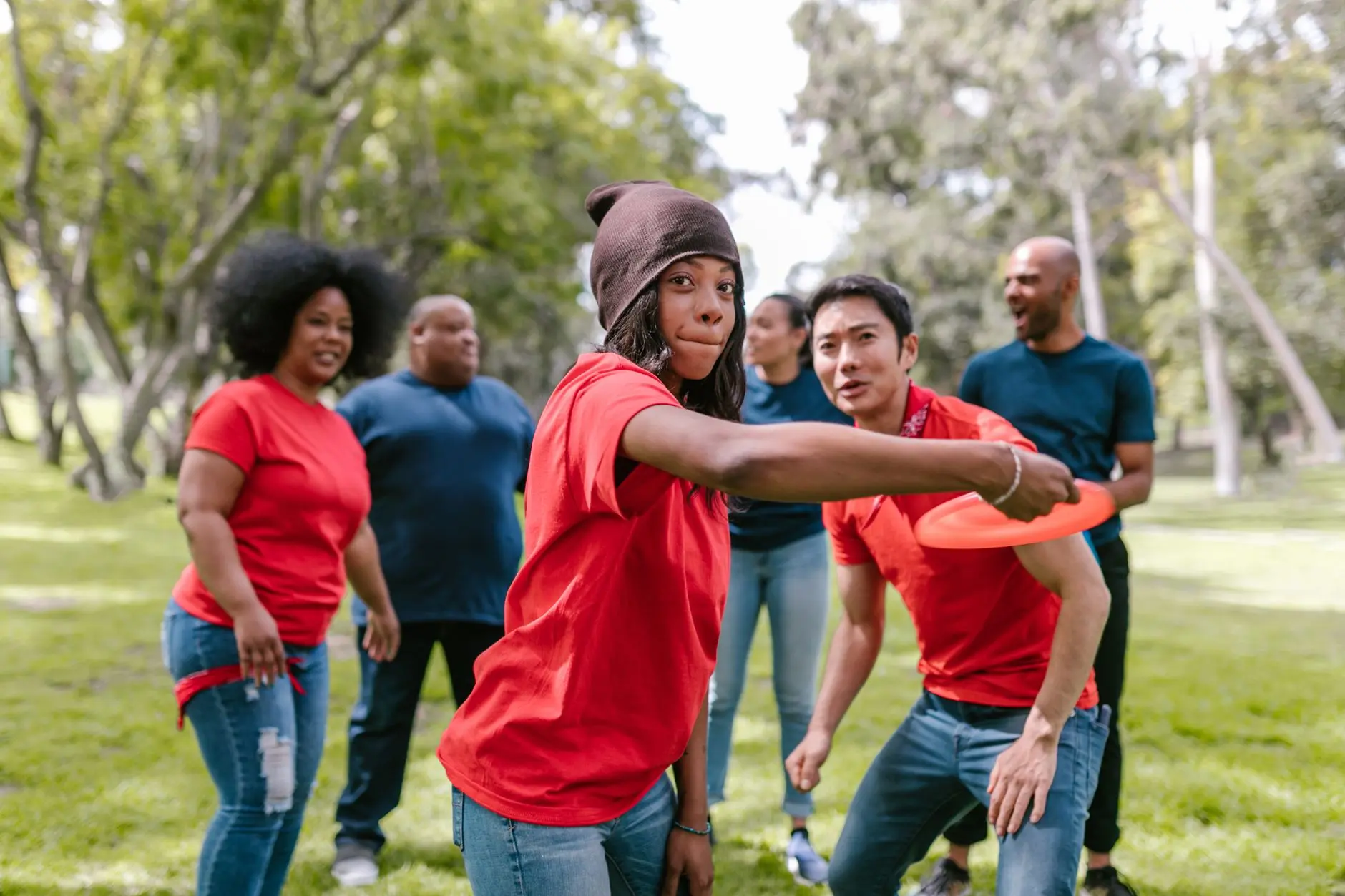
Let’s be honest: the words ‘okay everyone, let’s do an icebreaker’ can send a very specific shudder down a room. But here’s the thing — icebreaker games don’t have to be awkward, forced, or make your guests secretly wish they’d RSVP’d no. The right ones?
They’re genuinely fun, they get strangers chatting within minutes, and nobody ends up staring at the floor wondering why they came.
Whether you’re hosting a birthday party, a work social, a casual hangout, or a celebration of pretty much anything, this list of 20 icebreaker games has you covered from the moment the first guest walks in.
I’ve sorted these into a mix of active crowd-pleasers, quiet connection moments, and a full set of 13 printable game sheets you can download and print before the party — so you’re not scrambling the night before with scissors and a hot glue gun (not that I’ve ever done that).
Scroll through, pick your favorites, or honestly? Just print the whole set. Your guests will thank you.
This post contains affiliate links — if you buy through them, I may earn a small commission at no extra cost to you.
- Two Truths and a Lie
- Never Have I Ever (Clean)
- Find Someone Who
- Human Knot
- Line Up Silently
- Human Bingo Sheet
- Two Truths and a Lie Sheet
- Would You Rather Cards
- This or That Sheet
- Find Someone Who Sheet
- Conversation Starter Cards
- Get-to-Know-You Question Sheet
- Question Dice Sheet
- Icebreaker Bingo
- Guess Who Sheet
- Team Name Sheet
- Icebreaker Riddles Sheet
- Name Tag Templates
- One Word Check-In
- Share a Fun Fact Circle
- Frequently Asked Questions
1. Two Truths and a Lie
Two Truths and a Lie is the ultimate icebreaker game for any mixed group because everyone has an interesting story they haven’t told yet — they just need a reason to share it.
Each person thinks of two true statements about themselves and one convincing lie, then announces all three to the group. Everyone else votes on which one they think is the fib. Cue the gasps, the debates, and the ‘wait, you actually climbed a volcano?!’
moments that turn strangers into friends in about twenty minutes flat.
No supplies, no setup — you literally just need people and a willingness to be slightly deceptive for entertainment purposes.
Go around in a circle so no one gets skipped, and give the group fifteen to thirty seconds to confer and vote before the big reveal.
The key to a great round is encouraging players to make their lie plausible and their truths a little surprising. The weirder and more specific the true facts, the better the game gets.
This one works for groups of five to fifty, which makes it one of the most flexible icebreaker games in your arsenal.
For a fun variation at bigger parties, have everyone write their three statements on a slip of paper, collect them, and read them aloud anonymously — then the whole group has to guess who said what.
It layers a ‘guess the person’ element on top that gets surprisingly competitive, tbh.
Go first yourself to model a great example — pick one truth that surprises people and a lie that sounds almost believable. It sets the tone and gets everyone laughing before it’s their turn.
2. Never Have I Ever (Clean)
Never Have I Ever is a party classic that gets a bad reputation because of its more, shall we say, adult versions.
But the clean take on this icebreaker game is genuinely brilliant for mixed groups — it’s laugh-out-loud funny, surprisingly revealing, and completely appropriate for every age around the table.
Players hold up five fingers (or ten, if you want a longer game), and the host reads out ‘Never have I ever…’ statements. Anyone who HAS done the thing puts a finger down.
Last person with fingers still up wins — or just survives with their dignity intact.
The secret sauce here is the prompts.
Stick to universally relatable experiences: ‘Never have I ever gotten lost using GPS,’ ‘Never have I ever pretended to be busy to avoid a phone call,’ ‘Never have I ever eaten food off the floor and absolutely not told anyone.’
You want prompts that are funny, maybe slightly self-incriminating, but never crossing into uncomfortable territory. Have a list of at least twenty ready so the game doesn’t stall when the group runs dry on ideas.
This game works brilliantly as a five-minute warm-up before dinner or as the opener while guests are still arriving and finding their seats.
You can even turn it into a team game — split into two groups, and the team with the most fingers still raised after ten rounds wins a silly prize (a ribbon that says ‘Most Sheltered Life’ is always a crowd-pleaser).
For a printable version of the prompts, scroll down to the Would You Rather Cards or Conversation Starter Cards sections — they pair perfectly with this vibe.
- Groups of 6–30 people
- Guests who don’t all know each other yet
- Pre-dinner warm-up or arrival activity
3. Find Someone Who
Find Someone Who is one of those icebreaker games that feels like a social mission rather than a game — and that’s exactly why it works so well.
Each guest gets a list of fun statements like ‘Find someone who has been to three or more countries,’ ‘Find someone who can name all the planets,’ or ‘Find someone who has a hidden talent they’ve never performed publicly.’
The goal: mingle around the room and get a different person’s signature (or initials) next to each statement that applies to them. First person to fill their sheet wins.
The genius of this format is that it forces conversation without any pressure.
Instead of ‘so, how do you know the host?’, guests have a specific reason to approach someone new: ‘Hey, have you ever eaten something you thought was going to be disgusting but actually loved it?’
It’s a built-in conversation starter that takes all the awkward out of mingling. Guests often end up chatting for way longer than the task requires, which is exactly the point.
Set a time limit of ten to fifteen minutes to keep the energy up, then call everyone back and compare sheets.
Read out some of the best discoveries — ‘Did anyone find the person who once accidentally called their teacher ‘mum’ in front of the whole class?’ — for a final round of laughs.
We’ve got a printable version of this one in the list below (Find Someone Who Sheet) with themed prompts ready to go, so you don’t have to write the list yourself.
It gives every guest a purpose the moment they walk in — no standing awkwardly by the snacks wondering what to do with their hands. (Not that any of us have ever done that.)
4. Human Knot
The Human Knot is a legendary icebreaker game that sounds chaotic on paper (because it is) and ends up being one of the funniest five minutes of any party.
Everyone stands in a circle, reaches both hands into the middle, and grabs two different hands — making sure not to grab the hands of the people directly beside them.
The result is a gloriously tangled web of arms and bodies, and the challenge is to untangle back into a clean circle without letting go of anyone’s hand. Spoiler: there will be laughter. There will be very undignified positions. It’s perfect.
Groups of eight to twelve work best — sweet spot where it’s complex enough to be a real puzzle but not so large that nobody knows what’s happening. If your party is bigger, split into two competing knots and race to untangle first.
The only rule is no releasing hands; if a grip breaks, that group restarts from scratch. Encourage verbal communication — this game quietly reveals who the natural leaders and problem-solvers in your group are, which is a fun thing to call out afterward.
The Human Knot is a fantastic transition game: play it right after arrivals, when everyone needs to physically get out of their heads and into the party. Once you’ve untangled (or cheerfully given up — both valid), the room will feel noticeably warmer and looser.
It’s the physical reset button that no other icebreaker quite manages. Make sure there’s enough floor space and everyone’s wearing something they can move in — nobody needs to attempt a limbo move in a pencil skirt.
For groups that aren’t comfortable with close physical contact, try a rope-loop variation: each person holds one end of a short rope loop instead of another person’s hand. Same puzzle, slightly more personal space.
5. Line Up Silently
Line Up Silently is one of those icebreaker games that sounds almost too simple — until you try it and the room descends into the most spectacular silent chaos you’ve ever witnessed.
The challenge: the whole group must arrange themselves in a specific order (by birthday, by shoe size, by number of siblings, by first letter of middle name) without speaking a single word. No whispering, no mouthing words, no lip-reading cheats.
Just gestures, expressions, and increasingly creative non-verbal communication.
It takes literally zero setup and zero materials, which makes it a brilliant back-pocket game for hosts who forgot to prepare something (not me, obviously, never). Announce the category, start a two-minute timer, and watch the magic unfold.
Guests write their answers on their palm or hold up fingers for numbers. The charades-level miming that happens when someone’s trying to communicate ‘my birthday is November 3rd’ without speaking is — genuinely hilarious.
Once the line is formed, reveal how you’re checking accuracy (ask everyone to call out their answer in order) and see how close they got.
Then play again with a new category — ‘alphabetically by the city you were born in’ is a wonderful chaos-inducer for a second round.
This game works for groups of eight and up, gets everyone on their feet, and has the bonus effect of making people remember small details about each other — like the fact that your colleague was born in a tiny town in Portugal, which naturally becomes a fifteen-minute conversation at dinner.
- Pick a category (birthdays work great for a first round)
- Set a 2-minute timer
- No talking, no mouthing, no whispering — gestures only
- Check the line by having everyone announce their answer in order
6. Human Bingo Sheet
Human Bingo is the printable icebreaker game that practically runs itself — hand out a sheet, tell guests to mingle, and watch the room transform from politely stilted to genuinely buzzing within minutes.
Instead of numbers, each square on the bingo card has a ‘find someone who…’ description: ‘has visited more than five countries,’ ‘can speak a second language,’ ‘has a pet with a human name,’ ‘has binge-watched an entire TV series in one weekend.’
Guests find real people who match each square and get their signature (or initials) in the box. First to complete a row calls ‘Bingo!’
Print one card per guest on standard cardstock — the printable sheet below has a 5×5 grid with 24 unique, inclusive prompts and a free center square.
You don’t need pens beyond what guests already have in their bags, but having a small cup of pens at each table is a nice touch.
Set the tone by announcing there are no boring squares on this card — every prompt was chosen to spark a real conversation, not just a checkbox tick.
The beauty of Human Bingo is that winning isn’t really the point — the chatting is. But if you want to reward the first winner, a small prize (a candle, a fun keyring, bragging rights) adds a nice competitive edge.
For an extra layer, after the game, go through a few squares and ask the group: ‘Who found someone who has a totally irrational fear of a common household object?’ The answers are almost always gold.
Print a few extra sheets — some guests will want to keep theirs as a conversation souvenir, especially if they ended up with a full card covered in signatures.

🛍 Shopping guide
7. Two Truths and a Lie Sheet
The printable Two Truths and a Lie Sheet takes the classic verbal icebreaker game and turns it into a structured, pass-around activity that works especially well at seated gatherings — dinner parties, work events, or any occasion where guests are at tables rather than mingling around a room.
Each guest fills in their two truths and one lie on their own card, then cards get shuffled and redistributed. Guests read the card they’ve received, guess which statement is the lie, and then find the card’s owner to see if they were right.
The sheet is designed with three large write-in boxes, each with a wide blank line and a small label: ‘Statement 1: ________’, ‘Statement 2: ________’, ‘Statement 3: ________’.
Below those is a small scoring section with a blank for ‘Card belongs to: ________’ — left empty for the owner to sign after the guess is made.
This simple structure means no verbal instructions are needed; guests pick up the sheet and immediately understand what to do, which is exactly what you want when half your guests are still arriving and half are already on their second drink.
For the biggest laughs, encourage guests to think beyond the obvious — nobody needs to know you’ve read all the Harry Potter books (though valid), but ‘I once accidentally joined a professional salsa dancing competition’ is a truth that stops conversations across the room.
The printable format means you can collect and archive the best cards at the end of the night, which makes a genuinely fun keepsake for the host.
Pair this with the 14 Cute Scrapbook Ideas post for a creative way to preserve the best answers after the party.
- One printed card per guest
- Pens at each place setting
- A basket or bowl to collect and shuffle the filled-in cards

8. Would You Rather Cards
Would You Rather Cards are the printable icebreaker game that requires zero explanation, zero setup, and genuinely zero cringe — which is a rare and beautiful combination.
Each card poses a fun, completely clean dilemma: ‘Would you rather always speak in rhymes OR always speak in song lyrics?’, ‘Would you rather have a photographic memory OR be able to read minds for one hour a day?’, ‘Would you rather explore the deep ocean OR deep space?’
Guests draw a card, answer out loud, and defend their choice. The defending is always the funniest part.
The printable set includes sixteen cards formatted to print on one US Letter sheet — just print, cut along the dotted lines, and you have a ready-to-go card deck.
They’re designed to be passed around a table, pulled from a bowl, or used as place-card conversation starters so guests have something to discuss before the event officially kicks off.
The prompts are deliberately varied: some are silly, some are thought-provoking, and a few are just absurd enough to make people forget they’re doing an ‘icebreaker.’
Would You Rather Cards also double as a terrific buffer game — if the main activity hasn’t kicked off yet or the energy dips mid-party, just pull out the card deck and pass it around.
No hosting experience required, no explaining the rules, no prizes needed. They work at tables of four and rooms of forty.
And honestly, some of the best conversations I’ve ever had at parties started with ‘okay but hear me out — I’d pick the deep ocean because…’
- Dinner tables or seated groups
- Filling time during arrivals or between activities
- Any group size from 4 to 40+

🛍 Shopping guide
9. This or That Sheet
This or That is the faster, snappier cousin of Would You Rather — and as an icebreaker game, it’s incredibly effective precisely because it forces quick, gut-reaction choices.
The printable sheet gives guests twenty rapid-fire pairings: ‘Coffee or Tea?’, ‘Early Bird or Night Owl?’, ‘Mountains or Beach?’, ‘Text or Call?’, ‘Dogs or Cats?’, ‘Cook at Home or Eat Out?’, and so on.
Guests circle their choice for each one, then compare sheets with their neighbors. Instant conversation, zero awkward silence.
The sheet is designed as a quick personal survey, not a competition — there are no right answers and no scoring, just preferences.
This makes it wonderfully low-pressure: even the most introverted guest can fill theirs in solo and then find a natural way into conversation when someone leans over and says ‘wait, you chose mountains AND cats? We need to talk.’
Print one per guest on regular paper or cardstock and have them waiting at place settings, or put a stack at the door for guests to grab as they arrive.
What makes this sheet a smart host move is that it works on multiple levels simultaneously. Guests who arrive early have something to do immediately. Guests who arrive mid-party can still pick one up.
And at any point during the event, you can call out a category — ‘Okay, everyone stand up if you chose ‘night owl” — and turn the individual sheets into a whole-group activity without any additional planning.
Maximum fun-to-effort ratio, which is the dream for any host.
Fast choices remove the performance anxiety of longer games — there’s no ‘wrong’ answer to ‘mountains or beach,’ which means even shy guests jump right in.

10. Find Someone Who Sheet
The printable Find Someone Who Sheet is the structured version of the classic mingle game — and having it on paper makes all the difference between guests actually doing it versus nodding politely and heading straight to the snack table (we see you).
Each sheet has sixteen prompts with a blank line or initial box next to each one. Guests walk around collecting signatures from people who match the description, and the first to fill their sheet wins.
But really, everyone wins because they’ve just had sixteen different conversations with people they might never have spoken to otherwise.
The prompts on this sheet are crafted to be equal parts fun and revealing: ‘Find someone who has a totally irrational fear (write it here: ________),’ ‘Find someone who has lived in more than two cities,’ ‘Find someone who can name every country in a continent,’ ‘Find someone who has cooked a meal from scratch this week.’
Each prompt has a blank initial box and, where the prompt calls for it, a short write-in line so the person collecting can jot down the fun detail — not just the signature, but the actual answer.
As host, you can use the completed sheets after the game to do a quick debrief: ‘Who found the most interesting answer on their sheet?’ and read a few out.
This turns a solo mingle activity into a shared group moment that ties the whole room together.
If you’re planning a party with a big crowd of people who don’t all know each other yet, this sheet is the single best thing you can put on every chair before guests arrive — it sets the expectation that tonight, we’re actually going to talk to each other.
Novel concept, truly.
Set a 12-minute timer and announce it at the start — a deadline creates just enough friendly urgency to get even the most reluctant minglers out of their seats.

11. Conversation Starter Cards
Conversation Starter Cards are the icebreaker game equivalent of a social safety net — they’re there for every guest who’s ever stood at a party thinking ‘what on earth do I even say to this person?’
Each card carries a single open-ended prompt designed to spark a genuine, interesting conversation rather than the usual weather-and-work routine.
Prompts like ‘What’s the best piece of advice you’ve ever ignored?’, ‘What would you do with an unexpected free afternoon?’, ‘What’s something you changed your mind about recently?’ — the kind of questions that make people actually think before they answer.
The printable sheet contains sixteen cards in a 4×4 grid, ready to cut out and place in a decorative bowl, scatter across tables, or clip to name tags.
Guests draw a card when they arrive and are encouraged to use it as a conversation opener with at least two people during the event.
The prompts are deliberately designed to be emotionally safe but not shallow — they invite real answers without putting anyone on the spot or demanding vulnerability they’re not ready for.
These cards are the icebreaker game that keeps on giving throughout the whole party, not just the first ten minutes. Long after the opening games are done, guests will still be pulling cards and finding new people to talk to.
They work beautifully alongside a creative keepsake activity if you want guests to write down the best answers they heard — a lovely way to end the evening with something to remember it by.
Open-ended questions with no right answer take the performance pressure completely off — guests are sharing opinions, not being tested. That one shift makes all the difference.

🛍 Shopping guide
12. Get-to-Know-You Question Sheet
The Get-to-Know-You Question Sheet is a personal reflection meets group sharing icebreaker game that works beautifully for seated parties, team events, or any gathering where you want people to come away knowing actual things about each other — not just names and job titles.
Guests fill in their own answers to twenty fun questions, then pass their sheet to a neighbor who reads it and tries to guess which answer they find most surprising. It’s low-key, it’s warm, and it somehow generates the best ‘wait, seriously?!’
conversations every single time.
The sheet includes prompts across a few fun categories: favorite things (‘My go-to comfort food is: ________’), quirky facts (‘A talent most people don’t know I have: ________’), life moments (‘Something I’m looking forward to this year: ________’), and playful rankings (‘My ideal Saturday in one word: ________’).
Every answer has its own blank line clearly marked, and the whole sheet takes about five minutes to fill in — perfect for the pre-party settling-in window when not everyone has arrived yet.
After everyone fills in their sheet, you can collect them and do a group ‘match the sheet to the person’ round — the host reads a few answers from a sheet and the group guesses whose it is.
This creates a really natural, laugh-filled moment where people learn surprisingly delightful things about each other. It’s the kind of icebreaker game that doesn’t feel like a game at all, which is genuinely its superpower.
If you enjoy this style, the creative DIY corner has some lovely follow-up craft ideas if you want to give your party an extra personal touch.
Fill one in yourself before the party and use it as a sample to show guests — it gives everyone permission to be honest and a little funny with their answers.

13. Question Dice Sheet
The Question Dice Sheet is a printable icebreaker game with a wonderfully tactile twist — guests cut out, fold, and assemble a paper cube printed with six different conversation questions, one on each face.
Then they roll their custom dice and answer whatever question lands face up. Roll again, answer again. Pass it to the next person. Repeat until the whole table is laughing and nobody wants to stop.
It’s genuinely one of those icebreakers where you look up and realize forty minutes have passed and you haven’t touched the snacks.
The sheet prints as a flat die net — the cross-shaped layout that folds into a cube — with clear fold lines and a small tab for gluing.
Each face of the die has a different prompt: ‘Tell us your most embarrassing travel story in thirty seconds,’ ‘What was your first job and what did you learn from it?’, ‘What’s a movie everyone loves that you secretly can’t stand?’, ‘What’s on your ‘learn this someday’ list?’, and two more.
Assembly takes about two minutes per cube and is genuinely fun for guests to do together at the table — a little craft moment that’s also an icebreaker in itself.
For a larger group, print multiple sheets so each table has their own set of dice. You can even print two different versions with different question sets so tables can trade and get a fresh set of prompts midway through the evening.
The Question Dice Sheet is one of those rare icebreaker game ideas that feels like a surprise — guests don’t expect to be making something at a party, and that element of ‘oh, this is fun AND interactive’ lands really well every single time.
- Scissors to cut out the die net
- A small amount of glue stick or tape to assemble
- One sheet per table (or one per 4–6 guests)

🛍 Shopping guide
14. Icebreaker Bingo
Icebreaker Bingo is the crowd-pleasing printable that works for literally any party, any group size, any vibe — which is why it earns its spot even in a list that already has Human Bingo.
And yes, these are genuinely different games: Human Bingo is a mingle-and-get-signatures activity, while Icebreaker Bingo is a host-called game played together as a group.
The host reads out prompts one at a time — ‘Mark off your square if you’ve ever accidentally sent a text to the wrong person’ — and guests mark their card. Classic bingo rules: five in a row wins.
Each card in the printable set is uniquely randomized — a 5×5 grid of twenty-four prompts (plus free center space) arranged in a different order on each card, so there’s no risk of everyone winning at the same time.
The prompts are warm, funny, and universally relatable: ‘Have you ever ugly-cried at a movie?’, ‘Have you ever been the only person who got a joke?’, ‘Have you ever pretended to know a song and absolutely faked the lyrics?’, ‘Have you ever stayed in a job too long because of the office snacks?’
No materials required beyond the printed card and a pen or marker to cross off squares.
As the host, pace your prompt-reading to give the room time to react — the moments after each announcement, when half the room groans ‘oh my gosh yes, who writes these?’, are exactly the energy you’re going for.
Keep a list of all twenty-four prompts handy so you can check any winning card for accuracy.
Play two or three rounds with small prizes for each, and you’ll have a room that’s completely warmed up and ready for anything that comes next in the party.
This is the icebreaker game that reliably gets the whole room laughing at the same moment — which is a genuinely magical thing to create.
After someone calls ‘Bingo!’, read their winning row aloud and ask them to briefly share their story for one of the marked squares. It turns a win into a whole-group moment.

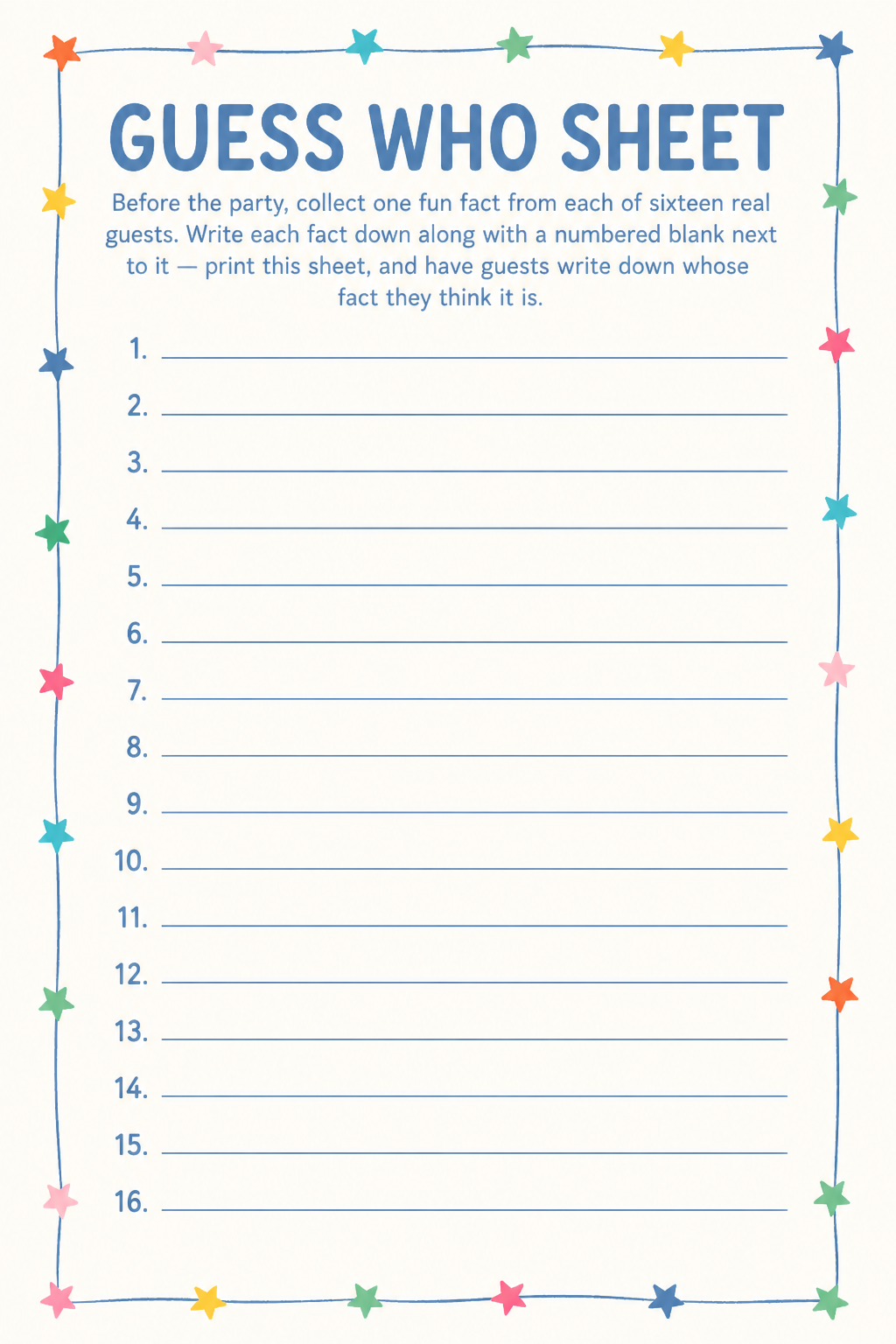
15. Guess Who Sheet
The Guess Who Sheet is the icebreaker game that turns the whole group into the content. Before the party, guests submit two to three fun facts about themselves via text or a quick online form.
The host compiles these into the printable sheet — a grid of ‘who said it?’ clue boxes, each with a fun fact and a blank line for guests to write in their guess.
Guests mingle, share clues, compare guesses, and reveal answers at the end for a big group moment. It’s personalized, it’s warm, and it gets people genuinely curious about each other.
The printable template has space for up to sixteen ‘Who am I?’ clue boxes, arranged in a 4×4 grid. Each box has the fun fact printed in the clue space and a clearly visible blank write-in line labeled ‘I think this is: ___________’ underneath.
An answer key appears discreetly at the very bottom of the sheet in small, light-grey italic text, listing all sixteen names matched to their clue numbers — so the host can check answers without spoiling the reveal for guests mid-game.
Number the clue boxes 1 through 16 continuously, and the answer key mirrors that numbering exactly.
The Guess Who Sheet works perfectly as a table activity, a take-home keepsake, or both.
Print before the party — you’ll need the fun facts at least a day ahead, which gives you a great excuse to send guests a fun pre-party message asking them to submit something interesting about themselves.
Half the time, the responses you get are so good they become conversation topics before the party even starts.
It’s also a lovely way to celebrate the guest of honor at a milestone party — mix their facts in with everyone else’s and see who can spot them.
- Collect fun facts from guests before the party via text or a quick form
- Print the completed sheet with all facts anonymized
- Guests guess who each fact belongs to by writing a name on the blank line
- Reveal answers together at the end for the big reaction moment
16. Team Name Sheet
The Team Name Sheet is a deceptively simple icebreaker game that works as both a warm-up activity and a practical tool for any party with team-based games.
Groups of four to six people receive a sheet and must collectively agree on a team name, a team motto, and a team hand signal — all within five minutes.
The collaborative brainstorming process is itself the icebreaker: it requires negotiation, humor, and at least one person volunteering a completely ridiculous suggestion (which becomes the team’s unofficial identity for the rest of the evening regardless of what they officially choose).
The printable sheet has four clearly labeled sections: ‘Our Team Name: ________________’, ‘Our Team Motto: ________________’, ‘Our Team Hand Signal (draw it here): [large blank box]’, and ‘Team Members: ________________’ with enough blank lines for six names.
Each section has a visible blank line or box — nothing pre-filled, so the sheet is genuinely blank-slate for every group. Below the main sections, there’s a fun prompt box: ‘In one sentence, why is our team going to win tonight?
________________’ — optional but guaranteed to produce comedy gold.
At the end of the five minutes, each team presents their name, performs their hand signal, and delivers their motto to the whole group.
This thirty-second introduction per team does something really powerful: it gives every person in the room a micro-moment of shared identity with their teammates, and a funny memory they’ll reference all night.
Teams that come up with a great name always hold onto it with surprising loyalty — I’ve seen ‘The Overconfident Sloths’ beat genuinely competitive teams just on team spirit alone.
Naming something together is one of the fastest ways to create group identity — it gives every small cluster of strangers an instant ‘us’, which is the foundation of every good party energy.

17. Icebreaker Riddles Sheet
The Icebreaker Riddles Sheet is the printable icebreaker game for people who love a puzzle — and it turns out, far more party guests love a puzzle than will admit it upfront.
The sheet has twelve classic lateral-thinking and wordplay riddles, each with a blank write-in line for the answer. Guests work through them solo or in pairs, then compare answers with people around them. The collaborative ‘wait, is it this?’
energy that forms around a tricky riddle is one of the fastest ways to break conversational ice, because everyone has an opinion and everyone wants to be the one who figures it out first.
The prompts are carefully chosen to be satisfying rather than frustrating — the ‘oh, of course!’ reaction rather than the ‘that’s not fair!’ reaction.
Each riddle has one clear, correct answer, and the full answer key appears at the very bottom of the sheet in small, discreet, light-grey italic type, numbered to match the questions.
This means the sheet is fully self-contained: guests can check their own answers without needing the host to play referee. The twelve riddles are numbered continuously 1 through 12, and the answer key lists all twelve answers in matching order.
For a group activity version, give each table one sheet and let them work as a team — whichever table gets the most correct answers within ten minutes wins.
Read out the tricky ones afterward and enjoy the groans of ‘oh COME ON, that’s so obvious’ that follow every reveal.
The Icebreaker Riddles Sheet is also a fantastic self-directed activity for guests who arrive early and want something to do while others are still trickling in — it’s engaging enough to hold attention solo, and naturally becomes a conversation starter the moment a second person sits down.
- Groups that love trivia or puzzles
- Early arrivals with time to fill
- Team vs. team competitive rounds with a small prize for the winning table

18. Name Tag Templates
Name tags are the most underrated icebreaker game tool at any party — but only if they do more than just display a name.
These Name Tag Templates are designed as mini conversation starters in themselves: each tag has a large space for the guest’s name plus two small fill-in prompts that guests complete as they arrive.
Prompts like ‘I’m secretly good at: ________’ and ‘Ask me about: ________’ turn every name tag into an invitation to start a conversation, so other guests have an instant, natural reason to approach someone new beyond just reading their name.
The printable sheet has twelve name tags per page in a standard badge size, each with clear blank lines and small prompt labels.
The name field is the largest element on each tag — a wide, obvious blank line with the label ‘Hi, I’m:’ above it — and the two mini-prompts sit below in a smaller font with their own underlines.
The host leaves all fields blank; guests fill them in at the welcome table using the pens provided.
A simple design with a clean border means the tags look polished without being fussy, and they can be worn with a pin, a lanyard clip, or adhesive backing depending on your setup.
The two prompts on these tags are what make them work as an actual icebreaker game — they spark the ‘wait, what are you secretly good at?’ conversations that you genuinely can’t engineer any other way.
Change the mini-prompts to suit your group: for a work event, try ‘My current obsession: ________’ and ‘One thing on my bucket list: ________.’ For a friend group gathering, try ‘My spirit animal right now: ________’ and ‘I need more: ________’ in my life.
The template is neutral so you can swap prompts to fit any occasion perfectly.
- A printer and standard paper or cardstock
- Scissors or a paper cutter
- Pins, adhesive backing stickers, or lanyard clips
- Pens at the welcome table for guests to fill in their own details

🛍 Shopping guide
19. One Word Check-In
One Word Check-In is the quietest, gentlest icebreaker game on this list — and sometimes that’s exactly what a room needs before anything louder kicks off.
The host asks everyone to close their eyes for five seconds and think of a single word that describes how they’re arriving at this gathering today. Just one word.
Then, going around the circle or the table, each person says their word with zero explanation required. That’s it. No justifying, no elaborating unless you want to. The simplicity is the point.
What makes this work so beautifully is what happens in the silence between words. When someone says ‘exhausted’ and three other people immediately nod, a connection forms without a single additional sentence. When someone says ‘ridiculously excited’ and the room laughs, the energy shifts.
When someone says a word nobody expected — ‘wistful,’ ‘grateful,’ ‘chaotic’ — it opens a door to a conversation that might happen later, organically, over drinks.
The One Word Check-In creates emotional permission to be exactly where you are, which is a genuinely rare and lovely thing to give a room full of people.
This is a perfect opener for smaller gatherings of six to twenty people where depth of connection matters more than breadth — think dinner parties, team gatherings, or any event where the host wants the evening to feel meaningful rather than just fun.
No materials, no printing, no setup. You can pair it beautifully with the Share a Fun Fact Circle that follows, using One Word to open and the fun fact to lighten the mood back up.
If you’re interested in the science behind why low-pressure connection moments like these actually reduce social anxiety, the research on cortisol and social stress is genuinely fascinating.
Go first. Say your own one word before asking anyone else — it models that any honest answer is welcome, which is the whole point of the exercise.
20. Share a Fun Fact Circle
Share a Fun Fact Circle is the warm, cozy, low-pressure icebreaker game that closes out this list — and honestly, it might be the one guests remember most fondly.
Everyone sits (or stands) in a circle, and going around in order, each person shares one fun fact about themselves.
It can be a hobby, a quirky habit, an unexpected skill, a surprising life experience — anything they find genuinely interesting about themselves and think others might not know. No theme, no rules, no wrong answers. Just the simple radical act of sharing something true.
The key to running this well as a host is to set the tone with your own fun fact first, and to pick something that’s neither too impressive nor too self-deprecating — something genuinely fun, a little unexpected, and easy for others to respond to.
‘I can name every country in Africa’ lands differently than ‘I once accidentally joined a competitive pie-eating contest in a town I was just driving through.’ Both are valid, but one naturally invites more follow-up.
Encourage specificity over vague claims, and resist the urge to turn it into a quiz — it’s a share, not a performance.
What this icebreaker game does, quietly and without fanfare, is give every single person in the room a moment of being genuinely seen. In a world of surface-level small talk, that’s no small thing.
It’s also a lovely way to end an opening round of icebreaker games before transitioning to the main event — everyone now knows something real about everyone else, the room feels warmer, and the party can properly begin.
And if you’re looking for more ways to set a thoughtful, welcoming tone — from the games you choose to the food you serve — the ideas in this piece on low-stress mornings remind us that a little intentionality goes a long way in any gathering.
For groups that might freeze up, give everyone thirty seconds of thinking time before you start the circle — it removes the ‘I can’t think of anything!’ panic and means every share is genuinely thought through.
Frequently Asked Questions
What are the best icebreaker games for a mixed group of people who don’t know each other?
For a truly mixed group, the best icebreaker games are ones with low stakes and clear rules that don’t require any prior knowledge or shared references.
Find Someone Who, Human Bingo, and Two Truths and a Lie are perennial favorites because they’re self-explanatory, flexible for any group size, and generate genuine conversation rather than just activity.
The printable games in this list — especially the Conversation Starter Cards and Would You Rather Cards — are ideal because guests can engage at their own pace without feeling put on the spot.
How long should icebreaker games last at a party?
Most icebreaker games work best when they run for ten to twenty minutes — long enough to break down social barriers, short enough that guests aren’t desperate to stop.
Active games like Human Knot and Line Up Silently tend to be naturally self-limiting (they end when the puzzle is solved). Printable mingle games like Find Someone Who Sheet and Human Bingo Sheet work well with a fifteen-minute timer.
The quiet games like One Word Check-In and Share a Fun Fact Circle can run as short as five minutes for a large group or stretch comfortably to thirty minutes for an intimate dinner party circle.
Can icebreaker games work for large parties of 30 or more people?
Absolutely — you just need to choose the right format. Printable games like Icebreaker Bingo, Human Bingo Sheet, and This or That Sheet scale effortlessly to any size because everyone works on their own sheet simultaneously.
For active games with large groups, split into smaller teams: Human Knot works brilliantly with multiple groups of ten racing to untangle simultaneously.
Never Have I Ever (Clean) and Two Truths and a Lie can also scale if you run them in small breakout groups rather than one giant circle.
What icebreaker games work best for shy or introverted guests?
The quieter and more structured the game, the better for introverted guests. The printable activities — This or That Sheet, Get-to-Know-You Question Sheet, and Would You Rather Cards — let guests engage thoughtfully without pressure to perform in front of the whole room.
One Word Check-In and Share a Fun Fact Circle are also excellent because they give everyone a clear, contained moment that requires only one short contribution. Avoid cold-calling specific guests; instead, use opt-in structures where everyone knows they’ll get a turn and can prepare mentally.
Do I need to buy anything to run these icebreaker games?
Most of these icebreaker games need nothing at all — Two Truths and a Lie, Never Have I Ever, Human Knot, Line Up Silently, One Word Check-In, and Share a Fun Fact Circle are completely free to run with zero supplies.
The printable games require a printer, paper (cardstock is nicer but regular works fine), and pens for guests.
A few games benefit from optional small extras — a decorative bowl for the Conversation Starter Cards, a paper cutter for clean card edges — but none of them are essential. Check the individual game sections above for specific supply suggestions.
How do I make icebreaker games feel natural rather than forced?
The biggest secret: go first yourself. When the host participates genuinely — and shares something real, a little funny, and not too polished — it signals to guests that authenticity is welcome.
Also, frame games as optional adventures rather than mandatory participation: ‘we’re going to play a quick game and it’s honestly really fun’ lands better than ‘okay everyone, icebreaker time.’
Start with a low-stakes printable activity that guests can ease into solo (like the This or That Sheet or Name Tag Templates at arrival), then build to more interactive games once the room has warmed up naturally.
📌 Save These for Later
Loved these? Pin your favorite image below so you can find this list again when you’re planning.


Fresh, interesting truth or dare questions across 6 escalating rounds. Skip the tired ones and play

20 icebreaker games for adults that actually work — perfect for work groups, with printable questi

From printable question rounds to hilarious team challenges, these 20 couples game night games keep
Leave a Reply