

If you have ever watched a room full of teens glaze over the second you say ‘let’s open our Bibles,’ you are not alone — and honestly, same.
But here’s the thing: the right bible games for youth can flip that whole vibe in about thirty seconds flat. We’re talking loud, competitive, slightly chaotic fun that also, somehow, sneaks in real Scripture knowledge.
It’s the holy grail of youth ministry, and yes, it absolutely exists.
This list has 20 games that actually work with real teenagers — not just the eager front-row kids, but the ones slouched in the back too. You’ll find high-energy active games, a full set of printable sheets and card decks your teens can take home, and a couple of quieter moments that land surprisingly deep. Ready? Let’s go.
This post contains affiliate links — if you buy through them, I may earn a small commission at no extra cost to you.
- Bible Charades
- Sword Drill Race
- Bible Kahoot Quiz
- Minute-to-Win-It Bible Stations
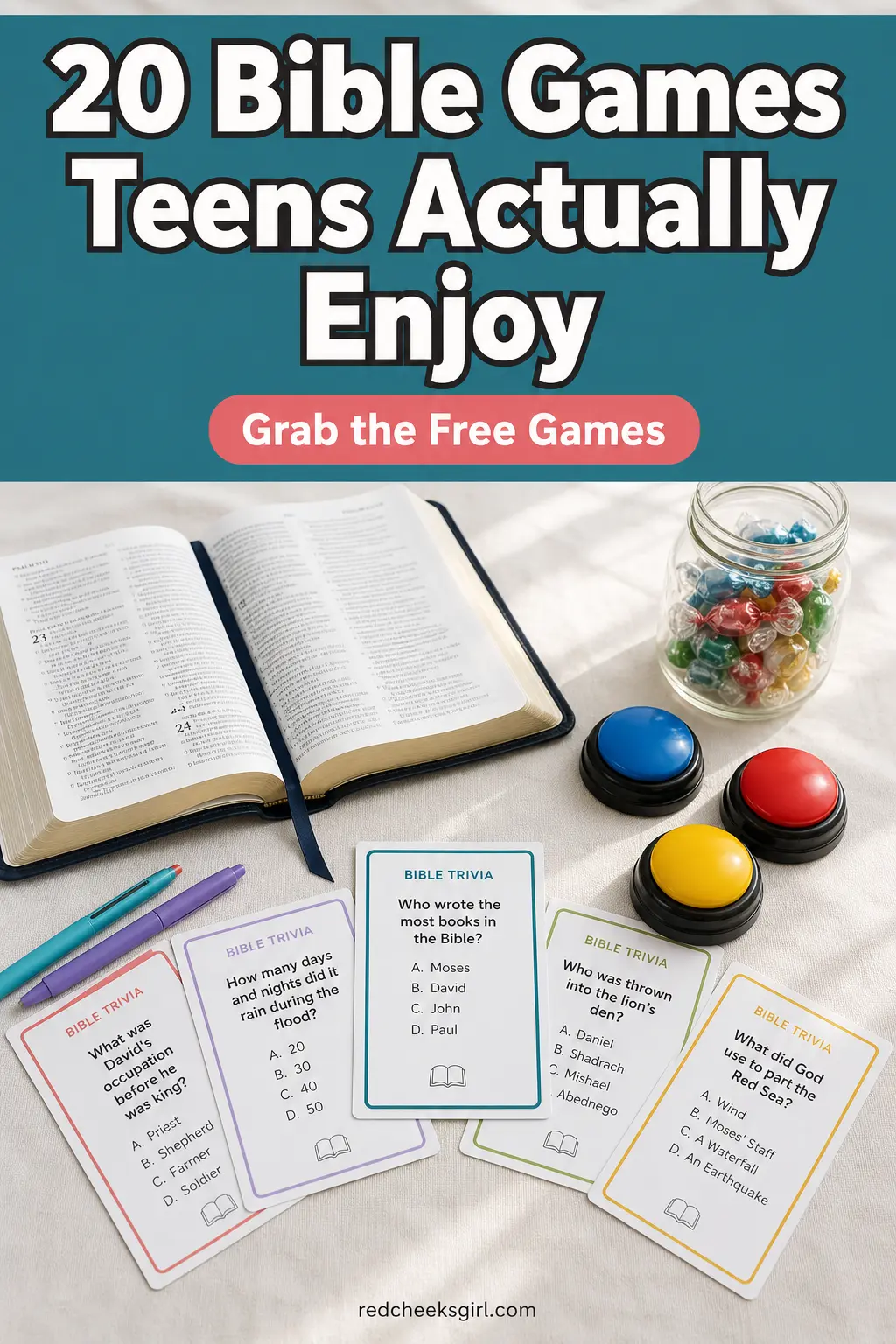
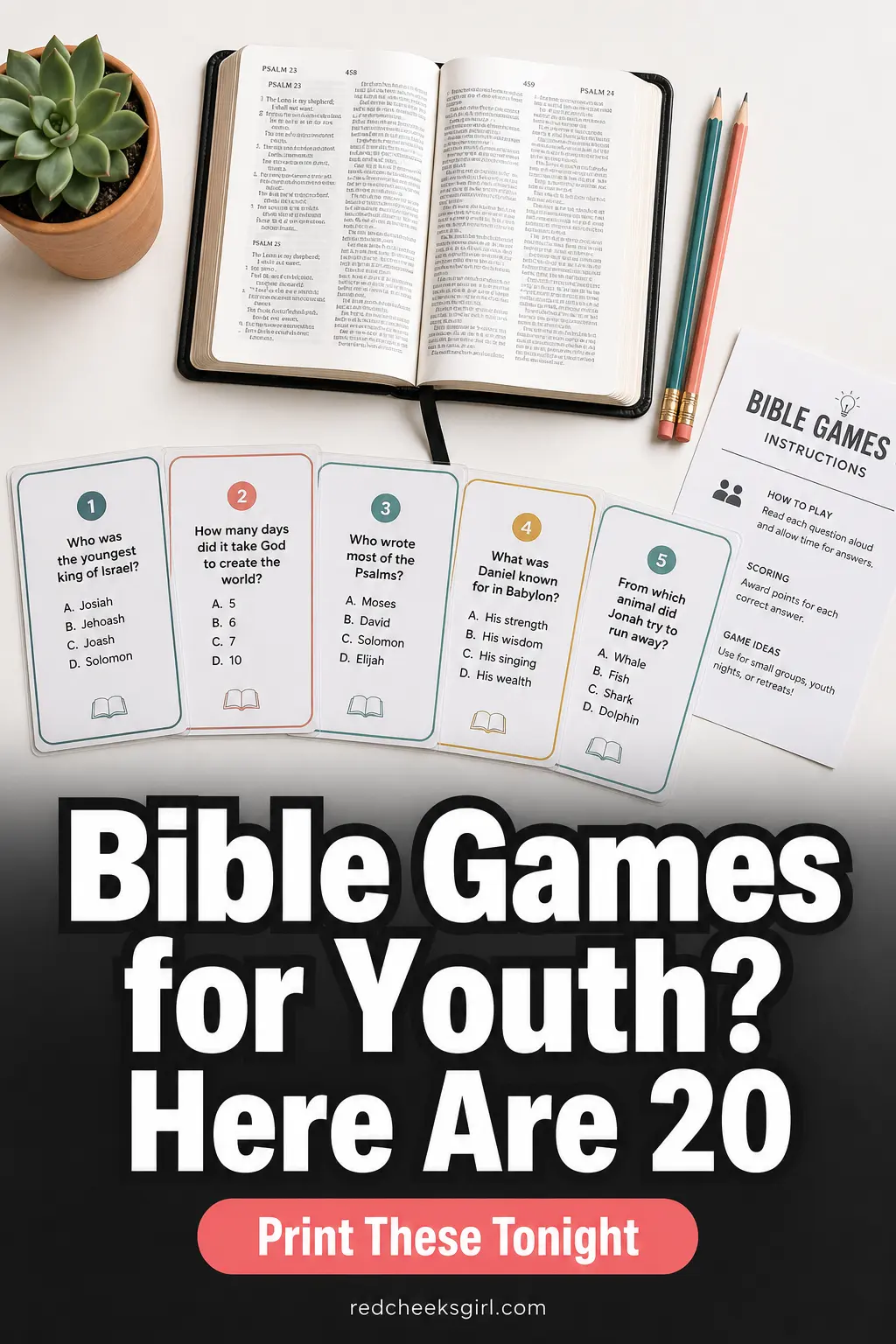
- Bible Trivia Cards
- Team Relay Bible Challenge
- Bible Would You Rather Sheet
- Bible This or That Sheet
- Guess the Bible Story Cards
- Bible Charades Card Deck
- Bible Emoji Story Sheet
- Name That Bible Book Sheet
- Memory Verse Cards
- Team Score Sheet
- Awards Certificates
- Bible Bingo
- Guess the Character Cards
- Bible Riddles Sheet
- Testimony Share
- Highs and Lows Circle
- Frequently Asked Questions
1. Bible Charades
Bible Charades is the ultimate crowd-pleaser for a reason — it’s loud, it’s hilarious, and it works every single time. Split your group into two teams.
One player draws a card (or pulls a folded slip from a bowl) with a Bible character, story, or verse written on it, and then acts it out in total silence while their team shouts guesses. Moses parting the Red Sea? Jonah in the whale?
David and Goliath? The acting alone is worth the price of admission, tbh.
To set it up, you’ll need a stack of cards or slips pre-written with prompts across three categories: Bible characters (Elijah, Mary Magdalene, Paul), Bible stories (feeding the 5,000, the Tower of Babel, the road to Emmaus), and Bible verses acted out as concepts (peace, forgiveness, light of the world).
Give each team 60 seconds on the clock per turn. A correct guess scores one point, and the team with the most points after all cards are played wins. Keep it moving fast — the energy dies if you let rounds drag.
What makes this game work so well is that it forces teens to actually think about WHO these Bible figures were and WHAT they did — you can’t act out something you know nothing about.
Plus, watching someone try to mime ‘water into wine’ without using their voice is genuinely the funniest thing you’ll see all week. Pro tip: throw in a wild-card round where the whole team acts together for double points. They go absolutely feral for it.
Pre-sort cards into ‘easy,’ ‘medium,’ and ‘hard’ piles so you can adjust difficulty on the fly for your specific group.
🛍 Shopping guide
2. Sword Drill Race
Sword Drill Race is a classic for a reason — it gets teens into their physical Bibles in the most competitive, adrenaline-pumping way possible.
The name comes straight from Ephesians 6:17, which calls the Bible the ‘Sword of the Spirit,’ and the game leans right into that energy. Every player starts with their Bible closed and held flat in front of them (that’s the ‘sheathed’ position).
The leader calls out a verse reference — say, Psalm 23:1 or John 3:16 — and then shouts ‘Charge!’ First player to find the verse, stand up, and read it aloud wins the round and scores a point for their team.
You will want one physical Bible per player (same translation if possible, to keep it fair), plus a pre-prepared list of 15-20 verse references ranging from well-known to genuinely tricky. Mix Old and New Testament references so no one has a home-field advantage.
Play it as individuals for a free-for-all, or divide into two teams where the winner of each round earns a team point. The team variation is especially good for larger groups because everyone stays invested even when it isn’t their turn.
Here’s why this game is low-key brilliant for youth ministry: it builds actual Bible navigation skills without feeling like homework. Teens who struggle to find Habakkuk in week one are flipping there confidently by week four.
You can level it up with a ‘Reverse Drill’ variation — read the verse aloud and make them call out the reference — which turns the difficulty up to eleven and has the whole room gasping when someone actually knows it.
- One physical Bible per player (matching translation)
- A prepared list of 15-20 verse references, easy to hard
- A scoreboard or whiteboard for team points
🛍 Shopping guide
3. Bible Kahoot Quiz
If your teens have phones (spoiler: they do), Bible Kahoot Quiz is basically a guaranteed hit. Head to Kahoot.com, build a free quiz with 15-20 multiple-choice Bible questions, and project it on your screen.
Every player joins the game on their phone, answers race against the clock, and a leaderboard updates after every question. The room gets loud, competitive, and weirdly invested in a way that is honestly hard to manufacture any other way.
Build your question bank across a few categories: Old Testament stories, New Testament parables, Bible geography, ‘who said it?’ quotes, and one category of total wild-card trivia (like ‘how many days did it rain during Noah’s flood?’).
Keep individual questions short and punchy — 20-second timers feel more intense than 30. Kahoot automatically ranks players by speed AND accuracy, which means knowing the answer fast actually matters, and teens respond really well to that pressure.
Award a small prize to the top three finishers to seal the deal.
What makes Kahoot especially smart for youth group is that you can save and reuse the quiz — or share the link so teens can replay it at home, which sneakily extends the learning beyond Sunday night.
You can also duplicate the quiz and edit it each week to introduce new content progressively throughout a series. The leaderboard mechanic creates a running rivalry that keeps attendance up, and that is a youth leader win on every level.
- Groups of 8-40 teens
- Rooms with a projector or large screen
- Leaders who want zero-prep setup after building the quiz once
4. Minute-to-Win-It Bible Stations
Minute-to-Win-It Bible Stations takes the wildly popular party game format and gives it a Scripture spin — and the result is absolute chaos in the best way.
Set up four to six stations around the room, each with a 60-second physical challenge tied loosely to a Bible theme.
Think: stack ten ‘stone tablets’ (foam blocks) without them falling (like Solomon building the temple), bounce ping-pong balls into cups labeled with books of the Bible, or transfer cotton balls with a spoon like ‘manna from heaven.’
Teams rotate through stations, collect points, and the highest-scoring team at the end wins.
Each station needs a simple instruction card, its props, and a timer. You can run stations simultaneously with a countdown timer projected on screen, or rotate teams one at a time while others cheer.
Add a trivia twist by having each station include one Bible question worth bonus points — get the question right AND beat the clock and your team gets double points.
This hybrid of physical and mental challenge keeps the game from feeling like just another trivia night, and even your most athletic teens will be humbled by a cotton-ball spoon challenge.
The beauty of this format is how infinitely customizable it is — you can theme each station around a specific Bible series or character your group is studying that season. Running a series on David? Make one station ‘slingshot accuracy’ (tossing balled-up socks at targets).
On the Sermon on the Mount? Create a ‘bless and stack’ tower challenge. It ties the active game directly to your teaching content in a way teens genuinely remember, and your baby shower guests will — wait, wrong crowd.
Your youth group will thank you for this one.
- Foam blocks or stacking cups
- Ping-pong balls
- Cotton balls and plastic spoons
- Station instruction cards
- 60-second timer or projected countdown
🛍 Shopping guide
5. Bible Trivia Cards
Bible Trivia Cards are the workhorse of any youth group game night — printable, reusable, and genuinely competitive in a way that gets even the quietest teens talking.
Print the sheet on cardstock, cut the cards apart, and you have a ready-to-go quiz deck that works for team face-offs, speed rounds, or a full tournament bracket across multiple weeks.
Each card carries one question on the front and the answer on the back, covering Old Testament, New Testament, characters, geography, and ‘did you know?’ fun facts.
To run a round, split into two to four teams. One reader draws a card and reads the question aloud.
The first team to buzz in (hand slap on the table works perfectly as a buzzer) and answer correctly earns the card as a point token. Play through the full deck or set a 20-card target for a 15-minute game.
You can also go individual and make it a straight knockout tournament — last player standing wins. Print two sets if your group is larger than 20 so multiple games can run simultaneously in small groups.
The real reason these cards earn their place in every youth leader’s kit is versatility — they work as a standalone game, as a warm-up before a lesson, as a bonus challenge mid-relay, or as the tiebreaker round in any other game on this list.
Laminate them and they’ll last for years. This is the kind of printable where you’ll think ‘I just need this once’ and then reach for it literally every week for the next three years.
Print on cardstock and laminate for a durable set you reuse all year — your future self will be very grateful.

🛍 Shopping guide
6. Team Relay Bible Challenge
Team Relay Bible Challenge is full-room, on-your-feet chaos — and teens absolutely love it. Divide the group into teams of four to six. Each relay has two parts: a physical leg and a Bible knowledge leg.
One player sprints to the other side of the room, picks up a folded question card, runs it back to their team, and the team huddles to answer it before the next player can run their leg.
Teams race simultaneously, and the first team to correctly complete all five relay legs wins the round.
Set up a question station at one end of the room with a stack of folded Bible question cards face-down for each team (give each team the same questions in the same order so it’s fair).
Keep questions tight and answerable in about 10 seconds as a team — ‘Name one of Paul’s letters,’ ‘How many disciples did Jesus have?’, ‘Who built the ark?’
The physical element can be anything: a quick hop-scotch grid taped on the floor, a cone weave, or just a straight sprint. The combination of moving bodies and mental pressure creates the best kind of productive panic.
This game works beautifully as an anchor at the midpoint of your evening when energy dips after a slower game or lesson. It resets the room’s energy instantly.
For a fun twist, add a ‘sabotage card’ to each deck — one wild card that makes the runner perform a silly physical challenge (three jumping jacks, spin five times) before returning with the question.
The room loses its mind every time one of those cards gets drawn, and that shared laughter? That’s community building happening in real time.
Combines movement and Bible knowledge so both athletic and studious teens get a chance to shine — great for mixed groups.
7. Bible Would You Rather Sheet
Bible Would You Rather Sheet is the sneakily perfect icebreaker printable — it gets teens thinking about Scripture from unexpected angles without ever feeling like a pop quiz.
Each prompt pairs two Biblical scenarios and asks the player to circle their choice and write a one-sentence reason why. Would you rather have fed the 5,000 OR walked on water?
Would you rather spend a night in the lion’s den OR three days in a whale? The theology is real, the debate is loud, and nobody feels put on the spot.
Print one sheet per teen and give everyone two minutes to circle their answers independently before opening it up to group discussion.
Call on volunteers to share their choices and reasons — you’ll be amazed how quickly this sparks genuine conversation about faith, character, and what the Bible stories actually mean.
It also works as a totally silent individual activity during transition time, or as a small-group discussion starter split into pairs or trios.
The reason this format hits differently than straight trivia is that there’s no wrong answer — it invites personal reflection and creativity. Teens who aren’t confident in their Bible knowledge can still fully participate because it’s about opinion and imagination, not recall.
It’s especially great for new members or visitors who don’t yet know the group well — everyone has something to say when the question is ‘would you rather,’ and that shared vulnerability is a quiet kind of bonding. Definitely one to keep in the rotation.
- Icebreaker openers
- New member nights
- Smaller groups of 4-15 where discussion can happen naturally

8. Bible This or That Sheet
Bible This or That Sheet is the fastest printable game in the lineup — you can literally explain the rules in one sentence and start playing immediately, which is extremely useful when your youth group has two minutes before chaos sets in.
Each row presents two Bible-themed options side by side and the player circles one. Old Testament or New Testament? David or Solomon? Proverbs or Psalms? Miracles or Parables? Fast, instinctive, and surprisingly revealing about what teens actually know and love about Scripture.
Hand out one sheet per person. Players work through all 20 prompts in about 90 seconds, circling their gut-reaction answer. Then pair teens up and have them compare sheets — any prompt where they chose differently becomes a discussion question.
‘Why did you pick Psalms over Proverbs?’ leads to better Scripture conversations than most lesson openers ever do.
You can also tally the whole room’s answers by a show of hands for each question and chart the results on a whiteboard — teens love seeing where they land versus the rest of the group.
What makes this printable so repeatable is that you can create new versions themed to whatever your group is currently studying — a ‘Gospels Edition,’ a ‘Paul’s Letters Edition,’ or a ‘Women of the Bible Edition’ — without the format ever getting old.
The This-or-That mechanic is so intuitive that it feels like play, not work. And genuinely? Watching a room of teens argue passionately about whether Moses or Elijah is the more underrated Bible hero is a really good problem to have.
For younger or newer teens, add a tiny Scripture reference hint beside each option so they have context before choosing.

9. Guess the Bible Story Cards
Guess the Bible Story Cards are a brilliant ‘no-talking’ printable that tests whether teens actually know their Bible narratives — not just the character names, but the actual events and details.
Each card presents three clue words or short phrases from a specific story, and the player must write the name of the story on the blank line provided.
Clues get progressively more specific (the third clue is always a near-giveaway), so players who guess on clue one earn more points than those who wait for clue three. It rewards real knowledge without humiliating anyone who needs a hint.
Print the sheet, cut the cards apart, and deal five to each player. Set a three-minute silent work time where everyone writes their guesses on the blank lines on each card.
Then reveal the answers together using the answer key printed at the bottom of the sheet in small grey italic text. Award three points for a clue-one guess, two points for clue two, one point for clue three, and zero for a miss.
Tally totals on the Team Score Sheet (which — spoiler — is also in this printable set). The speed of play and the sliding point scale makes this genuinely exciting.
You can easily customize the difficulty for your specific group by adjusting which stories you include. Brand-new believers? Stick to major narratives: the Nativity, the Exodus, David and Goliath. More experienced group?
Include lesser-known stories: the Valley of Dry Bones, the Witch of Endor, Philip and the Ethiopian.
Mixing difficulty levels across the deck keeps every player in the game — the ringers score big on the hard cards while newer teens hold their own on the familiar ones, and nobody feels left out.
- Each card has 3 clues in order of difficulty
- Guess on Clue 1 = 3 points; Clue 2 = 2 points; Clue 3 = 1 point
- Write your answer on the blank line — reveal together at the end

10. Bible Charades Card Deck
The Bible Charades Card Deck printable gives every youth group leader a ready-to-go stack of act-it-out prompts without the last-minute scramble of writing slips by hand at 6:45pm before group starts.
The deck is organized into three tiers by difficulty: green-border cards (easy — major characters and famous stories), yellow-border cards (medium — parables and miracles), and red-border cards (hard — minor prophets, obscure events).
Print on cardstock, cut apart, shuffle within tiers, and you have an instant charades kit that runs itself.
Each card shows a single bold prompt word or short phrase and a tiny category label in the corner (Character / Story / Concept).
The category label helps the guesser’s team know what TYPE of thing they’re looking for, which keeps rounds from stalling when someone is making increasingly desperate gestures for ‘Nebuchadnezzar.’
Run the game exactly like regular charades: one person acts, teammates guess, 60 seconds on the clock, rotate. Use the tiered system strategically — easier cards for the first few rounds while the room warms up, harder cards once the competitive juices are flowing.
Having a proper printed deck instead of handwritten slips also means you can reuse it week after week, add new cards at any time (just print one more sheet), and lend it to other youth leaders in your network.
It’s one of those humble little printables that quietly becomes an absolute staple. You’ll reach for this deck at lock-ins, retreats, camp, VBS — basically any time you need a five-minute game that everyone already knows how to play and secretly loves.
Print the three difficulty tiers on different colored cardstock so you never have to sort them again after a game — shuffle each color separately and stack them in order.

🛍 Shopping guide
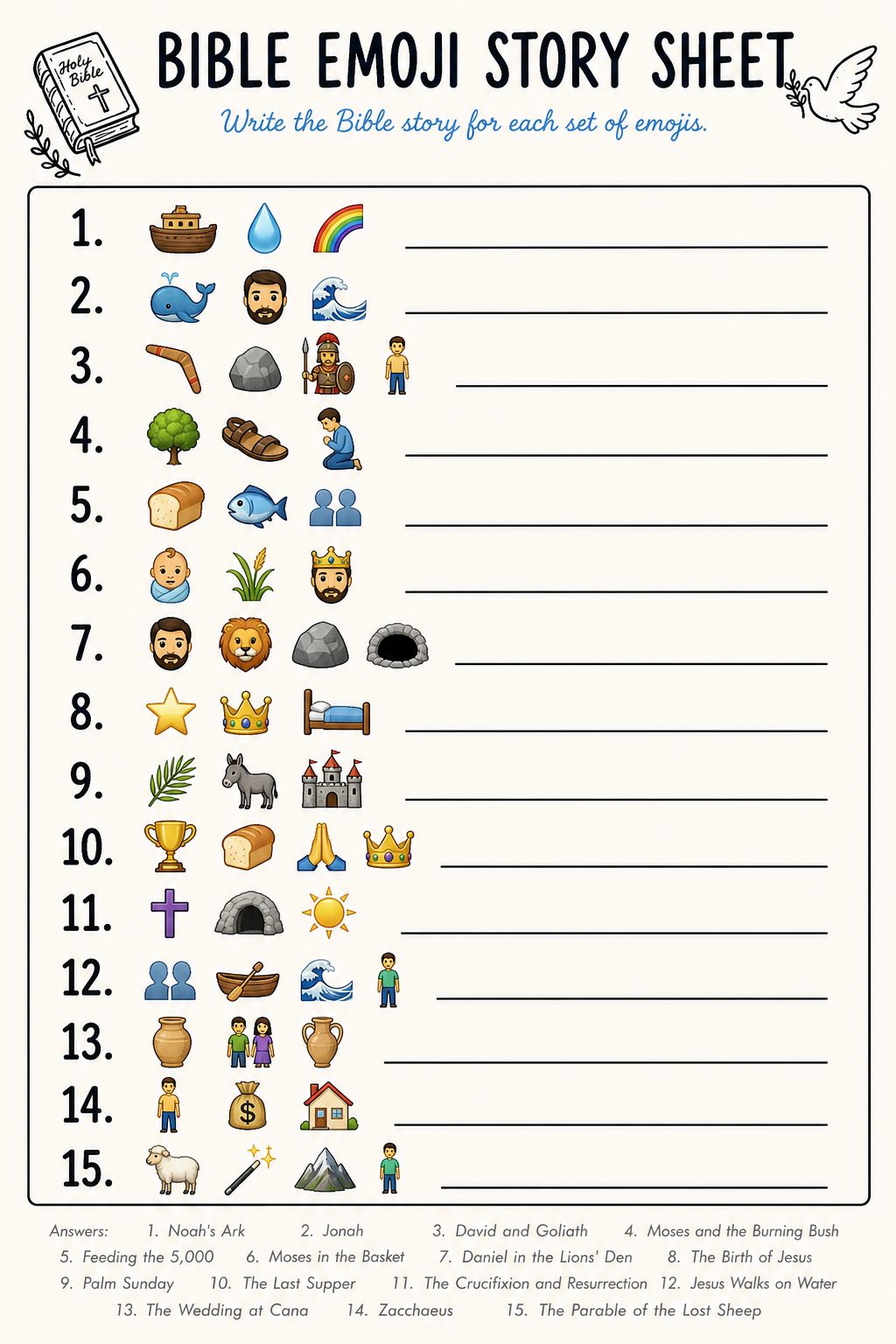
11. Bible Emoji Story Sheet
Bible Emoji Story Sheet is the printable teens reach for the fastest — because it looks like something from their world (emojis!) hiding something from the Bible.
Each row shows a sequence of simple illustrated picture icons arranged left to right, and players must figure out which Bible story the emoji string is telling, then write the story name on the blank line.
No letters, no words on the clue line — just the picture icons in a row, which means players have to actually decode the visual story. It’s quick to understand, surprisingly hard to ace, and creates the best table debate energy.
Give everyone their sheet and 10 minutes to work through all 15 emoji story clues individually.
Then go through the answers together, letting anyone who got one right explain their thinking — that’s where the real teaching happens, because they’re literally narrating Bible stories in their own words.
The answer key sits at the very bottom of the sheet in tiny light-grey italic text so teens can check their own work. Award a point per correct answer and track scores on the Team Score Sheet for a running leaderboard across the night.
A quick note about what makes this format so powerful for faith formation: teens who consume a LOT of visual media are using those same decoding skills they use for memes and reels to interpret Bible narratives — and the crossover is genuinely exciting to watch happen.
A teen who has never voluntarily opened a Bible will lean over their sheet squinting hard at a fish + man icon trying to remember if that’s Jonah or the feeding of the 5,000, and in that moment they are actively engaging with Scripture.
Sneak-attack discipleship. It works.
Uses the visual decoding skills teens already have from social media and applies them directly to Bible story recall — engagement is instant.
12. Name That Bible Book Sheet
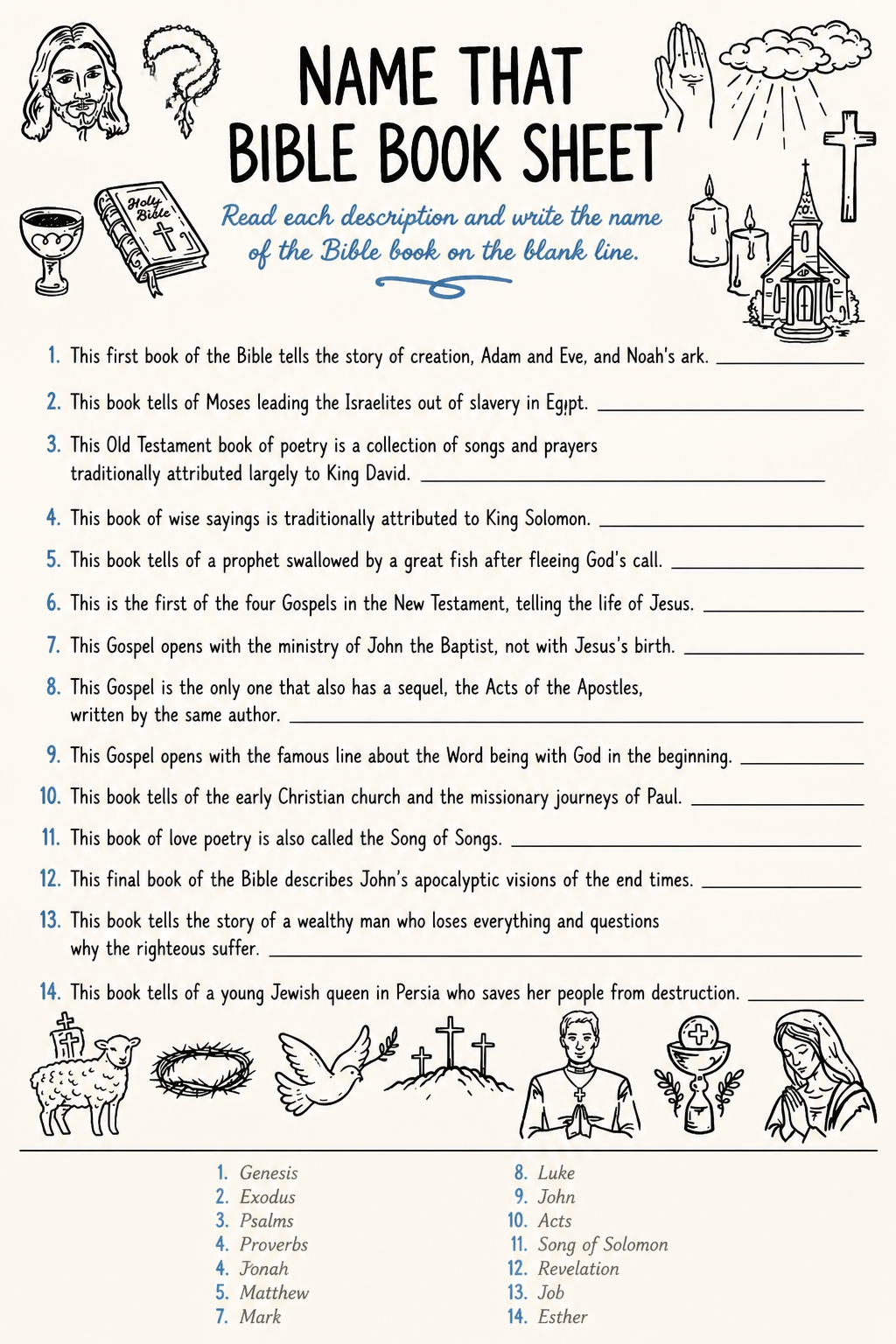
Name That Bible Book Sheet challenges teens to identify books of the Bible from a single-sentence description of what that book is about — no title given, no clues beyond the content summary.
It’s trickier than it sounds, even for teens who’ve grown up in church, and that difficulty level is exactly what makes it feel like a real challenge rather than a filler activity.
Descriptions are written in plain, accessible language so it’s about Bible knowledge, not reading level: ‘This book contains the most famous sermon ever preached and a collection of teachings from Jesus’ becomes ‘The Gospel of Matthew’ — but you have to actually know that to get it.
Each player works through 20 descriptions and writes the book name on the numbered blank line next to each one. Give a five-minute silent work period, then read the answers aloud from the key at the bottom and have players tally their own score.
Scoring is simple: one point per correct answer, full title or commonly accepted shortened name both count.
Post the final scores on the Team Score Sheet and watch teens immediately start debating which answers they were ‘almost right’ about — which is genuinely one of the most productive Bible conversations you can engineer without it feeling engineered.
What makes this printable especially great is that it doubles as a study tool teens can take home.
If they got eight out of 20, they now know exactly which 12 books they need to learn more about — the sheet tells them where their gaps are without anyone having to have that awkward conversation.
It’s quietly formative in a way that feels like a game and not a report card, which is the whole point of a well-designed Bible game for youth.
For newer groups, add a word bank of 20 book names at the top of the sheet so it becomes a matching challenge rather than pure recall.
13. Memory Verse Cards
Memory Verse Cards are a printable set of wallet-sized cards, each featuring a single Bible verse front and center — the verse on one side, the reference on the other — designed so teens can literally tuck them in a pocket or backpack and review them between sessions.
But here’s how to actually make them a game: do a timed recitation challenge at the start of each youth night. Every teen who can recite their card from last week’s session from memory gets a point added to their running total on the leaderboard.
The points accumulate across weeks, and the teen who memorizes the most verses by the end of the month wins a prize.
The sheet prints 12 cards per page in a clean grid.
Cut them apart and hand one out to each teen at the end of every session — this becomes your ‘homework’ that actually gets done because it takes about two minutes a day and fits in a jacket pocket.
Run the same version all in one session too: give teams five minutes to study a card together and then quiz each other. The team that recites the most verses accurately in 90 seconds wins the round.
Both formats work because the card mechanic is tactile, personal, and feels low-stakes even though it’s building genuine Scripture retention.
The lasting value of this printable goes beyond the game night itself — these cards have a way of sticking around. You’ll hear from parents that they found the cards on the kitchen counter, in car cup holders, tucked in textbook covers. That’s the point.
Casual, repeated exposure to a short verse across a week of ordinary life does more for memorization than a single Sunday spotlight ever could, and a well-designed little card is the vehicle that makes it happen. Understated, inexpensive, and wildly effective.
Choose verses that connect to your current teaching series so the memory work reinforces the lesson — the combination lands much deeper than either one alone.

🛍 Shopping guide
14. Team Score Sheet
The Team Score Sheet might be the most unglamorous printable in the set, but it is genuinely the one that makes every other game feel more official and competitive — and teens care about that more than you’d think.
A clean, fillable score tracker that covers up to four teams across eight game rounds with space to tally points, record round winners, and calculate a final total.
Post it on the wall, fill it in with a marker in real time as games progress, and suddenly the entire evening has a throughline. It turns a collection of individual games into a tournament — and tournaments are serious business to teenagers.
The sheet has blank underlined fields for team names at the top (teens name their own teams, which alone generates five minutes of chaotic joy) and numbered rows for each game round.
Each cell has space to write a point total per team per round, with a running total column on the right.
A designated ‘Round Winner’ star column next to each row gives the leader a visual quick-reference for who’s pulling ahead without having to do math mid-chaos.
Print one large copy on cardstock and stick it to the wall, or print smaller copies so each team tracks their own.
The psychology here is real: visible, public scorekeeping raises the stakes of every game without adding any complexity to the rules.
Teens who might coast through a game when it feels low-stakes suddenly lock in when there’s a number next to their team name on a wall. You’re not adding pressure — you’re adding meaning.
And that shift from ‘just a game’ to ‘we are actually competing’ is exactly the energy that keeps a youth group night feeling exciting from the first game to the last.
- Game nights running 3 or more rounds
- Groups that respond well to friendly competition
- Leaders who want to run a tournament-bracket style evening

15. Awards Certificates
Awards Certificates are the finishing touch that transforms a great game night into a memory teens actually talk about the next day.
This printable sheet includes four individual certificate frames per page — ‘Bible Champion,’ ‘Most Enthusiastic Player,’ ‘Quickest Sword Drill,’ and ‘Most Improved’ — each with a blank line for the recipient’s name.
Print the sheet, fill in names with a marker before the final round, and hand them out at the close of the evening with a little ceremony. It sounds simple but the reaction is always bigger than you expect.
Teens will joke about them, but they will also absolutely keep them.
The certificate design is simple and bold — large title, decorative frame border, a blank name line, and a small descriptor line at the bottom.
Because the name field is a visible blank underline (no pre-filled example names ever), you write each recipient’s name by hand before presenting it, which makes it feel personal rather than mass-produced.
The four award categories are intentionally designed so that every type of teen in your group has a category where they could plausibly win: the trivia ace wins Bible Champion, the loudest most joyful player wins Most Enthusiastic, the Sword Drill speed demon wins Quickest, and someone who took a risk and stepped up gets Most Improved.
Handing out certificates at the close of your Bible game night serves one very practical purpose beyond the fun: it gives teens something to bring home that connects them to the group.
A certificate on a bedroom door or refrigerator is a subtle but real signal that this community matters to them.
It’s also a wonderful way to specifically celebrate teens who wouldn’t typically win a straight trivia competition but who showed up fully and contributed to the group energy — and those are often the teens who most need to feel seen.
Add one blank certificate to the sheet so you can create a custom award on the spot for an unexpected standout moment — every great youth night has at least one.

16. Bible Bingo
Bible Bingo is one of those games that works for literally every group size, every age, and every energy level — which is exactly why it belongs in this lineup.
Instead of numbers, each bingo card square contains a Bible word: a character name, a place, a book title, or a theme word.
The caller reads out clue descriptions (never the word itself) and players scan their card and mark the matching square if they have it. ‘This person built an ark’ = Noah. ‘City where Jesus was born’ = Bethlehem.
First player to get five in a row — horizontal, vertical, or diagonal — shouts ‘Bingo!’ and wins the round.
Print one unique card per player (the sheet provides six different card layouts so a room of up to 24 players gets variety — print multiple sheets for larger groups).
You’ll also need the caller’s clue list, which is printed on a separate half-sheet with the clue for each Bible word so any leader or teen can run the game without prep.
Use small coins, torn paper squares, or dry beans as markers — whatever is easiest to grab.
Play multiple rounds by just clearing the cards and reshuffling who calls, making this a game that can fill 10 minutes or a full 45 depending on how many rounds you run.
Here’s the sneaky genius of Bible Bingo that elevates it above regular bingo: because players are matching clue descriptions to words, they are constantly making quick Bible knowledge associations in real time. Even marking a square requires active recall.
And the free-space square in the center? Swap it for ‘John 3:16’ — teens have to recite the verse to claim the space, which adds a memory verse challenge into the middle of every single card without making it feel like extra homework.
Youth leaders who do this come back and tell me it’s their group’s most-requested game, and honestly, I believe it.
- Printed bingo cards (one per player)
- Small markers: coins, dry beans, or torn paper squares
- Caller’s clue list from the bottom of the sheet

🛍 Shopping guide
17. Guess the Character Cards
Guess the Character Cards is the printable version of ’20 Questions’ with a Bible twist — and it is one of the highest-engagement formats you can run because it demands both knowledge and deduction strategy at the same time.
Each card describes a Bible character using five clues that get progressively more obvious, but never names the person directly. Players read the clues in order, make their guess, and write the character’s name on the blank line.
The fun is in committing to a guess before all five clues are revealed — the earlier the guess, the more points earned.
Print and cut the cards, then deal three to five per player or team. Give a five-minute silent work period where players make their guesses.
Then reveal answers together from the answer key at the bottom of the sheet, and have anyone who guessed correctly on the first or second clue explain why — those explanations turn into genuinely rich Bible story retellings without anyone having to be ‘taught at.’
Scoring: 5 points for a Clue 1 correct guess, 4 points for Clue 2, down to 1 point for Clue 5. Miss entirely and you score zero but get to learn something new.
Character variety matters for this card set — include major figures (Jesus, Moses, Paul) alongside lesser-known ones (Deborah, Barnabas, Zacchaeus, the Rich Young Ruler) so the game doesn’t feel like a giveaway after round two.
The lesser-known characters spark the best conversations because some teens will have never encountered them before, and suddenly they’re asking ‘wait, who is Zacchaeus?’ — and you have an organic teaching moment handed to you on a card.
That’s the magic of a well-designed Bible game for youth: the fun creates the questions that create the learning.
Scoring rewards Bible knowledge depth — teens who know their minor characters and lesser-known stories have a real competitive advantage here.

18. Bible Riddles Sheet
Bible Riddles Sheet is the printable that produces the most dramatic gasps and facepalm moments of the entire game night — in the best way.
Each riddle is a short rhyming or wordplay clue that points to a Bible person, place, or object, and players must write the answer on the blank line.
‘I am the sea that split in two, to let God’s chosen people through — what am I?’ (The Red Sea.) ‘I was a woman of courage who led an army to war, a judge of Israel who settled each score — who am I?’
(Deborah.) They range from satisfying to truly tricky, and the room noise when someone gets a hard one first is very, very good.
Work through the sheet individually or in pairs. Pairs are especially good because debating a riddle aloud with a partner is half the fun — the back-and-forth reasoning process is where the Scripture recall actually happens.
Give 8-10 minutes for the full sheet of 15 riddles, then go through answers together from the key at the bottom. Have players self-score: one point per correct answer. Post totals on the Team Score Sheet if you are running a tournament format.
For extra drama, read each riddle aloud to the whole room before revealing the key — a 10-second dramatic pause before the answer adds surprisingly good theatrical tension for a piece of paper.
Riddles earn their place in Bible game nights for youth because they demand creative thinking rather than just recall.
A teen who has memorized John 3:16 but has never thought about Deborah might still crack that riddle through lateral thinking — ‘woman, judge, army, Israel’ — and in doing so encounters a new character for the first time.
The riddle format is also genuinely different from trivia in feel, so it breaks up the rhythm of the evening nicely and keeps the night from feeling like one long quiz.
Variety is the whole secret to a great youth game night, and this sheet delivers exactly that.
- Work individually or in pairs
- 8-10 minutes silent work time, then reveal answers together
- Read riddles aloud for dramatic effect before showing the key

19. Testimony Share
Testimony Share is the game night moment that shifts the whole temperature of the room — in the best, most unexpected way.
After the competitive rounds are done and the energy has peaked, Testimony Share creates a natural landing space where teens get to be real with each other.
One teen at a time (or one per team) shares a short, specific story from their own life where they saw God show up — not a polished speech, just one real moment. The rule is it has to be specific and personal, not abstract.
‘God was with me when…’ is the sentence starter. Two to three minutes per person. Everyone else listens without comment until the share is done.
Set the tone deliberately before you start. Dim the room slightly if you can, have everyone put down their phones, and let there be a brief moment of quiet before the first person shares.
A leader going first lowers the vulnerability barrier enormously — if the adult in the room shares something real, teens will follow. You don’t need to force participation; offer it as an open invitation and let silence be okay.
Usually at least three to five teens will share naturally once someone breaks the ice, and the rest of the room listens with a focus that no competitive game can manufacture.
What makes Testimony Share the perfect closer for a high-energy Bible game night is contrast — after an hour of loud competitive fun, the quiet sincerity of one teen sharing ‘I was really scared and I prayed and something shifted’ lands with tremendous weight.
It connects everything you just played — the charades, the trivia, the Sword Drill — to a real, lived faith. It’s the moment that turns a fun evening into a formative one. No supplies needed. No setup.
Just space, intentionality, and the willingness to go first. That’s it.
Go first yourself. A leader who shares something genuine and specific before asking teens to do the same changes the whole energy of the room — vulnerability is contagious in the best possible way.
20. Highs and Lows Circle
Highs and Lows Circle is one of those deceptively simple activities that quietly becomes the thing teens look forward to most about youth group.
Everyone sits in a circle — leaders included — and takes a turn sharing one high (something good from the past week) and one low (something hard, disappointing, or heavy). That’s it. No judgment, no fixing, no advice unless specifically asked.
Just being witnessed by your community. It sounds almost too simple to work, but the consistency of it over weeks builds a group trust that is genuinely hard to replicate with any game or activity.
Keep the format tight to respect everyone’s time and attention: 60 to 90 seconds per person, one high and one low. The leader keeps gentle time and models vulnerability in their own turn.
Encourage teens to stay specific — ‘I got a good grade’ is less connective than ‘I was really nervous about my history exam and I actually felt calm when I started writing, which surprised me.’
After everyone shares, the leader can briefly tie the themes of the highs and lows to whatever Scripture or topic the group is exploring that season, which makes the connection between real life and faith feel immediate rather than theoretical.
Use Highs and Lows Circle as the very last thing you do before teens head home — it sends them out having been seen and heard, which is a profoundly different feeling than heading out after a trivia game.
Over time, you will notice teens arriving at youth group already thinking about what their high and low is, which means they are processing their week through a communal, faith-framed lens.
That habit of reflection and sharing is one of the most valuable things a youth ministry can cultivate, and it starts with a circle, some chairs, and a willingness to go first.
Consistent weekly practice of Highs and Lows builds group trust over time — teens start looking forward to being heard as much as they look forward to the games.
Frequently Asked Questions
What are the best Bible games for youth group that don’t require much prep?
Sword Drill Race and Bible Charades require almost zero prep beyond a list of verse references or a stack of scribbled slips — you can set both up in under five minutes.
Bible Kahoot Quiz takes a one-time setup of 15-20 questions and then saves and replays forever. Highs and Lows Circle and Testimony Share need no materials at all.
If you want printables ready to go with zero-design work, the full set of 13 printable sheets in this article covers your whole game night in one print session.
How many teens do you need for these Bible games to work?
Most of the active games — Sword Drill Race, Bible Charades, Minute-to-Win-It Bible Stations, Team Relay Bible Challenge — work best with 8-30 players.
Bible Kahoot Quiz scales beautifully all the way up to 40+ teens as long as you have a projector and stable Wi-Fi.
Printable games like Bible Trivia Cards, Bible Riddles Sheet, and Guess the Character Cards work even for groups as small as 4-6, making them great for small group breakouts.
The quiet games (Testimony Share, Highs and Lows Circle) actually work better in smaller groups of 8-15 where everyone gets a real turn.
Are these Bible games appropriate for mixed Bible-knowledge levels?
Yes — that’s actually baked into the design of most of them. Sword Drill Race lets you mix easy and hard verse references so newer teens stay competitive alongside experienced ones.
The Guess the Bible Story Cards and Guess the Character Cards use a sliding point scale (guess early for more points) that rewards depth of knowledge without humiliating anyone who needs more clues.
Would You Rather and This or That have no wrong answers, so every teen can participate fully regardless of how long they’ve been in church. Mixing difficulty levels across an evening is the key to keeping everyone engaged.
Can I use these Bible games for youth in a Sunday school class instead of a youth group?
Absolutely. The printables especially — Bible Trivia Cards, Bible Bingo, Bible Riddles Sheet, Name That Bible Book Sheet — slot right into a Sunday school format with zero modification.
Sword Drill Race and Bible Charades are Sunday school classics for a reason and work even in a 20-minute class period. The quieter reflective games (Testimony Share, Highs and Lows Circle) can close out any age-appropriate small group setting.
Just adjust the question difficulty on any trivia-based game to match your class’s current unit of study and you’re set.
What supplies do I actually need to run a full Bible game night with these activities?
For the full 20-game evening, your core supply list is pretty minimal: one physical Bible per player (same translation) for Sword Drill Race, access to Kahoot.com and a projector for Bible Kahoot Quiz, cardstock and a printer for the 13 printable sheets, pens or pencils for every player, a whiteboard or flip chart for scores, a few basic station props for Minute-to-Win-It (foam blocks, ping-pong balls, spoons), and coins or dry beans for Bible Bingo markers.
Total cost for a well-stocked game night kit is under $30, most of which you likely already have.
How do I keep teens engaged for a full game night with Bible games?
Variety and pacing are everything. Alternate active games with printable rounds so energy levels ebb and flow naturally — this list is already sequenced that way.
Keep active rounds to 10-15 minutes each, printable activities to 8-12 minutes, and save the quiet reflective games for the close.
Use the Team Score Sheet to create a tournament throughline that runs across the whole evening — having a scoreboard keeps teens invested in every game, not just the one they’re currently playing.
And end with Highs and Lows Circle or Testimony Share to give the night meaningful closure beyond just announcing a winner.
📌 Save These for Later
Loved these? Pin your favorite image below so you can find this list again when you’re planning.

20 Bible quiz games with buzzer rounds, team play & free printables. Perfect for any group — compe

100 Bible trivia questions for youth groups split into four escalating rounds with printable questio

21 fun bible study games for small groups — printable sheets, trivia, discussion starters & more.
Comments
-
-

Helen
Thank you, Susette! I hope your 6th graders have a blast. I’d love to hear which game ends up being their favorite!
-

Susette Redwine
Can’t wait to try with my 6th graders