


Good youth group games are not the ones that make the front row cheer louder, they are the ones that get the kid in the hoodie at the back to put his phone down and lean forward. This list runs on team scores, not solo performances, so nobody has to be brave in front of a crowd to play. Everything below works in an ordinary church hall with folding chairs, masking tape, paper cups and a stack of Bibles, and every game ends with a one-line bridge into your message instead of a lecture.
- Bible Trivia Lightning Round Cards
- Sword Drill Showdown
- Encouragement Card Swap
- True or False Faith Blitz Cards
- Cup Stack Relay
- Fill in the Blank Verse Sprint
- Masking Tape Line Tug
- Match the Verse to the Reference
- Prayer Request Circle Cards
- Steal the Bible
- Bible Book Bingo
- Musical Chairs: Names of God
- Rank It: Bible Order Challenge
- Blindfold Obstacle Trust Walk
- Highs and Lows Testimony Circle
- Odd One Out Bible Grid
- Bible Charades Relay
- Sanctuary Scavenger Hunt Checklist
- Cup Toss: Fill the Faith Jar
- Team Challenge Card Deck
- Verse Memory Keepsake Card
- Whisper Down the Lane: Verse Edition
- This or That Faith Battle Cards
- Elbow Freeze Tag: Fruit of the Spirit
- Two Truths and a Bible Lie Cards
- Silent Line-Up Challenge
- Team Huddle Prayer Chain
- Old Testament or New Testament Sort
- Categories Shout Out Countdown
- Category Countdown Brainstorm Sheet
- Praise Freeze Dance
- Frequently Asked Questions
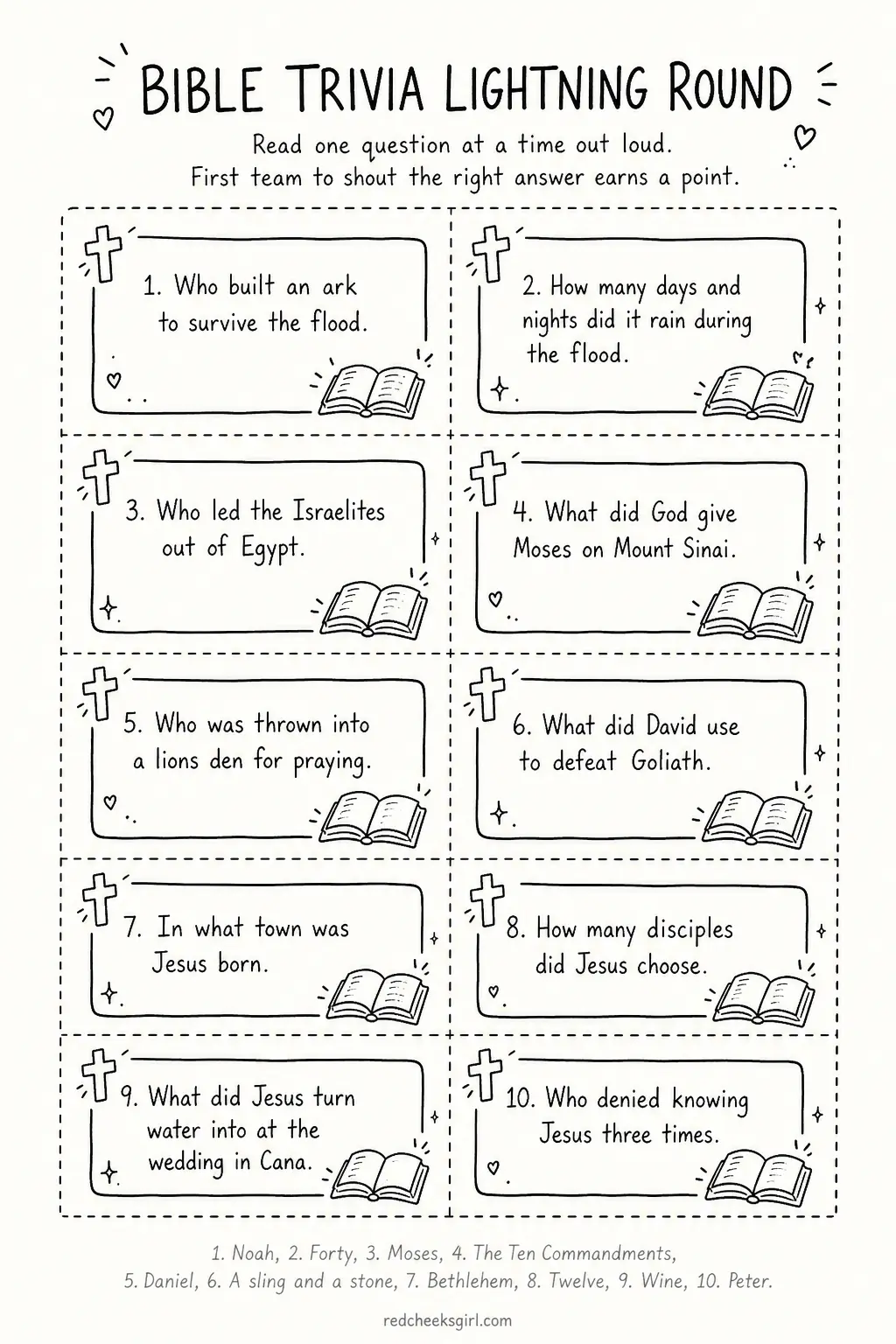
1. Bible Trivia Lightning Round Cards
One leader reads a question out loud, teams have five seconds to answer, and whoever shouts the right answer first through their team captain gets the point on the whiteboard. It moves fast enough that nobody has time to check their phone under the table.
Print the cards on cardstock, cut them into a stack, and run through as many as the room has energy for, usually eight to twelve minutes. Works with two teams or six, and needs zero setup beyond the cards and something to track score.
The trap is letting one loud table answer every single round. Rotate which team gets to answer first each question, or require a different person on the team to call out the answer each time.
Bridge it in under a minute by picking one trivia answer, like Peter denying Jesus three times, and asking the room what it looks like to mess up badly and still get a second chance.
- cardstock for printing the cards
- a whiteboard or phone note to track team scores
- a simple kitchen timer for the five-second count
2. Sword Drill Showdown
Every teen holds their own closed Bible at their side like a sword. The leader calls out a reference, says go, and the first person to find the verse and stand up reading it out loud wins the round for their team.
Needs one Bible per person and nothing else, works for groups of eight to forty, and each round takes under a minute once teens get the hang of the format. Start with easy books like John or Psalms before moving to trickier ones like Habakkuk.
The usual mess is teens who do not own a Bible or cannot find books fast. Pair a strong reader with a slower one on the same team so the game stays about speed, not about who feels behind.
Bridge it in under a minute by pointing out that finding a verse fast only works if you already know where to look, same as knowing where to turn when life gets hard.
groups where most teens already carry or own a personal Bible
3. Encouragement Card Swap
Each teen writes one honest, specific encouragement to a teammate whose name they drew from a bowl, then hands it over at the end of the night instead of reading it out loud. No performance, no group reaction, just a note that goes home in a pocket.
Give each person one index card and a pen, draw names at the start of the night so there is time to think between activities, and keep the writing part under five minutes right before you close.
Do not let anyone see who wrote their card unless they want to share it themselves. If a teen gets nothing meaningful because they drew a name of someone who does not know them well, have a leader quietly write a backup card so nobody walks out empty handed.
Bridge it in under a minute by reading one line from Proverbs about how a good word makes the heart glad, then let the cards speak for themselves.
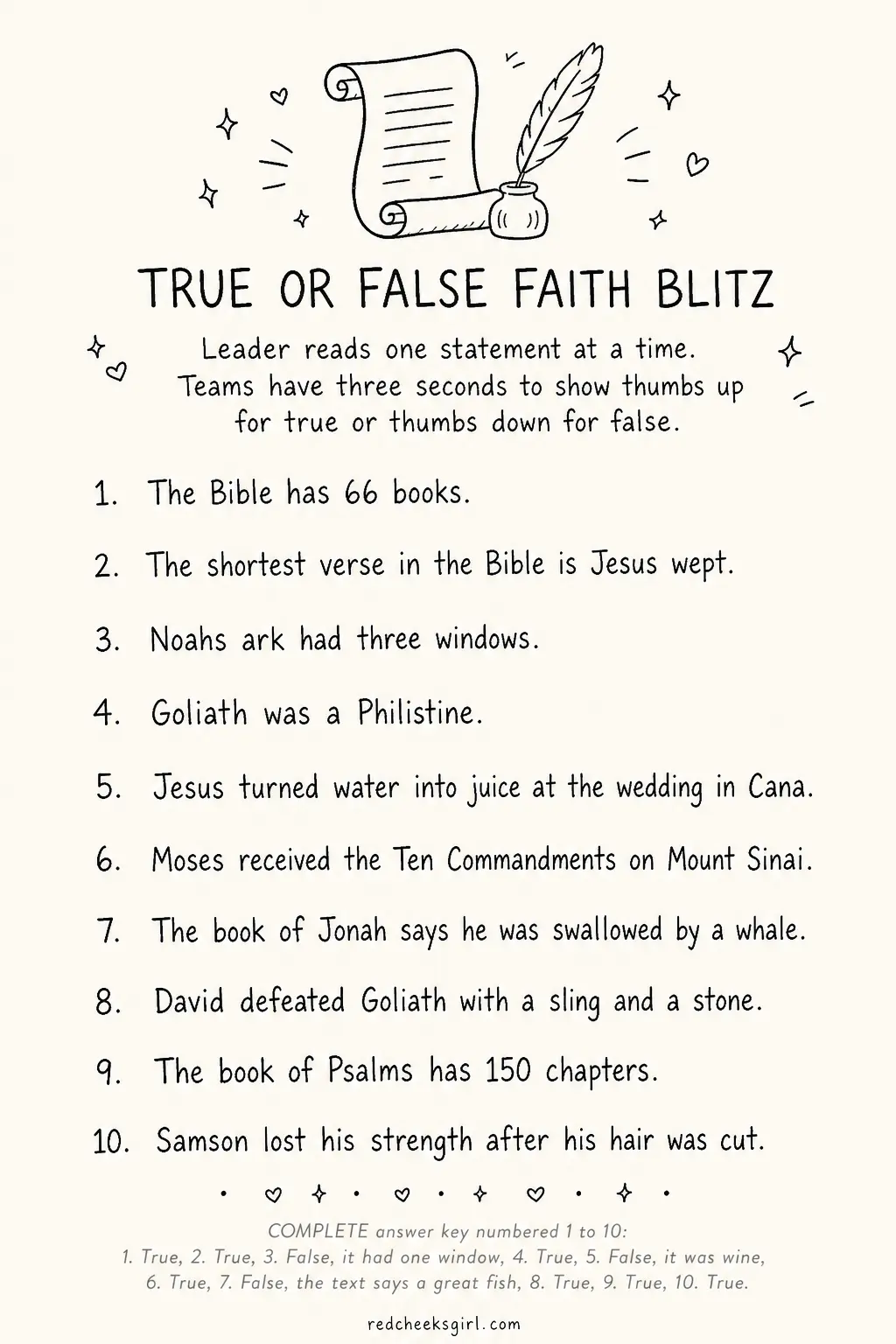
4. True or False Faith Blitz Cards
A leader reads one statement about the Bible, teams have three seconds to decide true or false and hold up a thumbs up or thumbs down together, and every team that guesses right scores. Ten rounds in, everyone is fully awake.
All you need is the printed card for the leader to read from and a way to see every team’s answer at once, so seat teams apart or have them huddle before showing their thumbs. Runs in about eight minutes for all ten statements.
Some of these statements sound like a trick even when they are true, which teens will call out loudly. Let them argue for ten seconds before revealing the answer, that argument is half the fun.
Bridge it in under a minute using the Goliath statement to talk about how the Bible does not always match up with the version of the story we grew up hearing, and that is worth reading for yourself.
count down three, two, one out loud before teams reveal their thumbs so nobody can copy the table next to them
5. Cup Stack Relay
Teams line up, and one at a time each teen runs to a table, stacks a pyramid of paper cups as fast as they can, then knocks it flat before tagging the next runner. First team through the whole line wins.
Needs about twenty paper cups per team and a table or the floor, works with relay lines of four to eight per team, and one full round usually takes three to five minutes depending on group size.
Cups sliding off a shaky table is the most common mess, so tape a folded towel under the stack point if the table wobbles. For a twist, make the last runner stack the pyramid without using their thumbs.
Bridge it in under a minute by asking what it feels like to build something carefully and then have to knock it down, and connect that to how quickly plans change when we are following God instead of our own timeline.
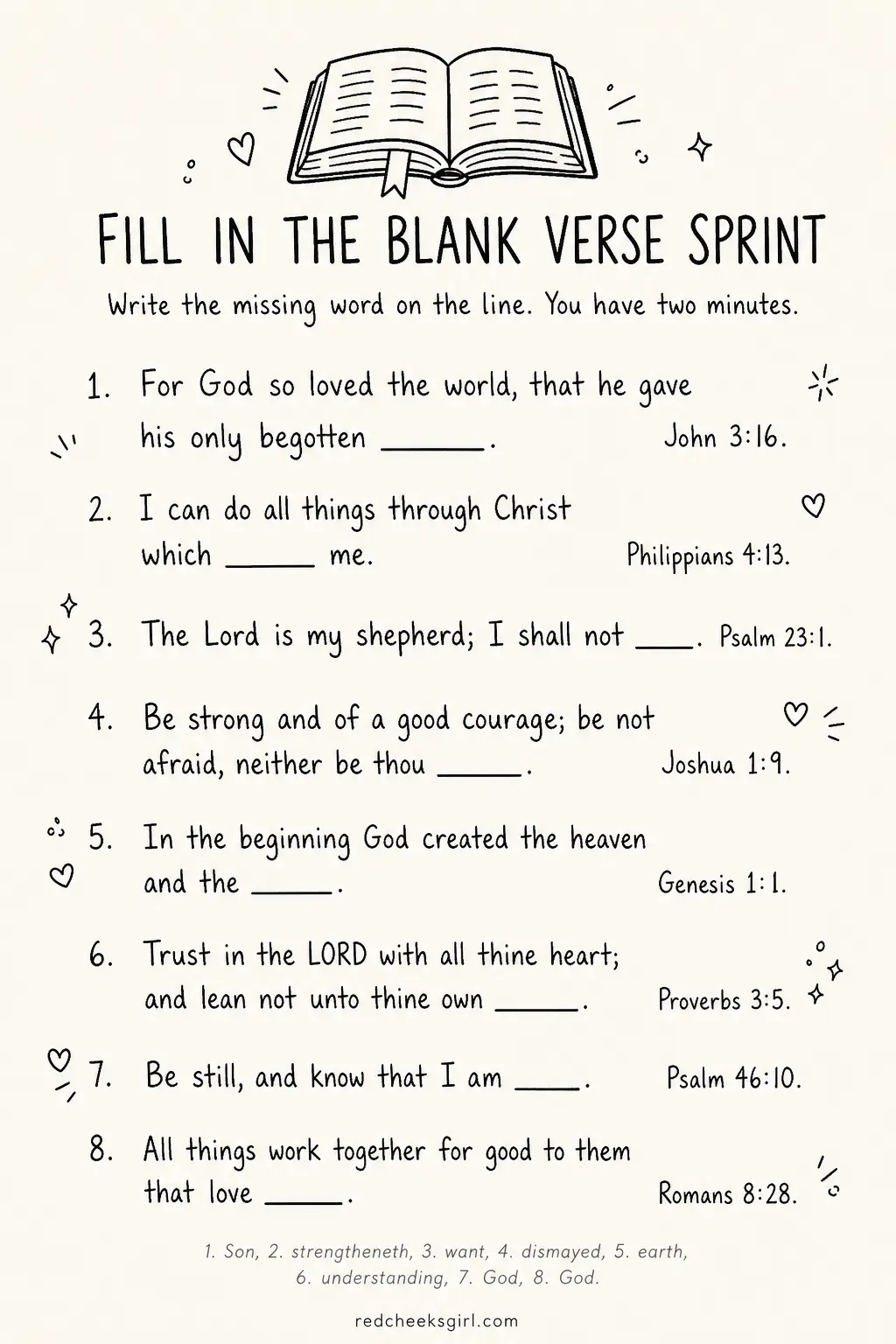
6. Fill in the Blank Verse Sprint
Teams get a sheet of well known verses with one word missing from each, and race to fill in every blank before time runs out. It rewards teens who have grown up hearing these verses without ever making them feel quizzed on it.
Print one sheet per team, give a pencil, and set a two minute timer for eight blanks. Works well right after a lesson that touched on any of these verses, since teens who just heard it have an edge.
Some verses have slightly different wording across Bible translations, so a leader should accept any reasonable version of the missing word rather than marking strictly one spelling correct. Read the full verse out loud after scoring so nobody leaves confused about the right word.
Bridge it in under a minute by picking the Joshua verse about not being afraid and asking what part of life right now needs that reminder most.
let younger teens flip through their own Bible to find the missing word instead of relying on memory
7. Masking Tape Line Tug
Lay one long strip of masking tape across the floor, split the group into two lines facing each other holding hands or wrists in a chain, and on go each end pulls the whole line trying to drag the other side across the tape.
Works best with even teams of six or more, no rope needed since teens just link arms, and each pull lasts under thirty seconds. Clear chairs well back from the tape line before starting.
Uneven team sizes make it lopsided fast, so count heads before every round and shuffle a person over if one side is heavier. Best of three keeps it from ending in one obvious blowout.
Bridge it in under a minute by talking about how much easier the pull got once everyone leaned the same direction at the same time, same as a group of believers pulling together instead of everyone doing their own thing.
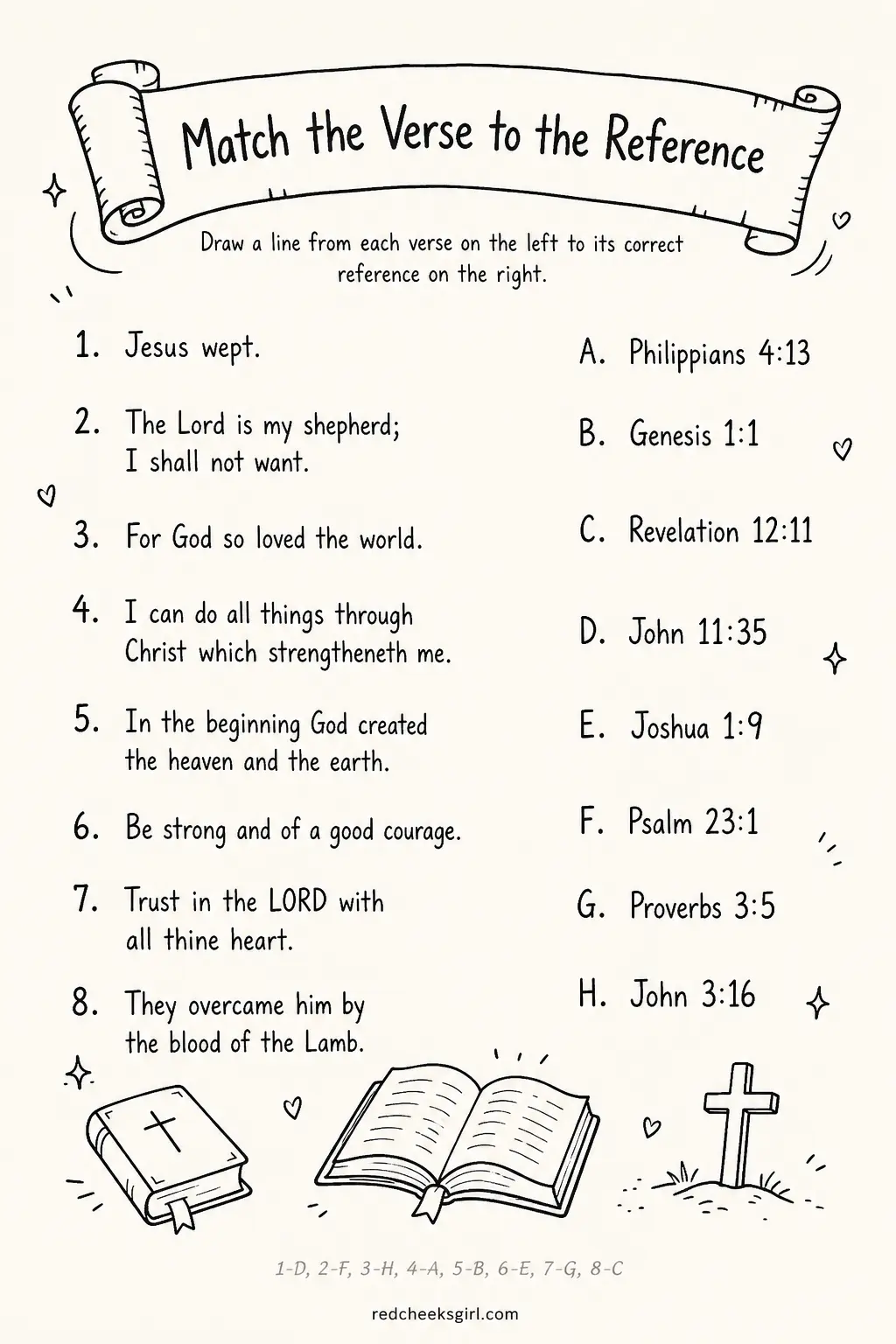
8. Match the Verse to the Reference
Each team gets a sheet with eight short verse snippets on the left and eight scrambled references on the right, and races to draw a line connecting each verse to where it is actually found in the Bible.
One sheet and one pencil per team, five minutes on the clock, works for teams of any size since only one person needs to hold the pencil while the rest call out guesses. Good as a quieter game right after something loud.
Teens who half remember a verse will confidently match it to the wrong reference, which is fine, that mistake is part of the fun when you reveal the key. If a team finishes early, have them try to recite one matched verse from memory for a bonus point.
Bridge it in under a minute by pointing out that knowing where a verse lives makes it a lot easier to actually go back and read the whole chapter around it later.
matching mixes recall with quick decision making, so quieter readers who know their Bible well finally get to lead the table
9. Prayer Request Circle Cards
Teens sit in their small groups and each writes one real prayer request on a card, folds it, and drops it in a cup for their leader to keep and actually pray over during the week, not to read aloud to the room.
One card and pen per teen, five minutes near the end of the night, works best once the loud games have already burned off the wiggles and the room has settled down a little.
Some teens will write something silly to avoid being vulnerable in front of peers, which is fine, do not force sincerity. Leaders should follow up privately with anyone whose card hints at something heavier.
Bridge it in under a minute by reminding the room that this is the one part of the night that is just between them and God, no score attached.
10. Steal the Bible
Two teams line up facing each other with numbers assigned to matching players on each side. A Bible sits in the middle. The leader calls a number, and both matching players race to grab the Bible and get it back to their own line without being tagged.
Needs one Bible, a big enough open floor, and works great with teams of eight to twenty split down the middle. Rounds are fast, ten to fifteen seconds each, so you can run through the whole group in one song’s worth of time.
Collisions happen when two fast teens both dive for the same object, so set a clear rule up front that grabbing counts the moment fingers touch the Bible, no wrestling over it. Swap in a bean bag if the group is rougher than expected.
Bridge it in under a minute by asking what it looks like to run toward Scripture the same way they just ran toward that Bible on the floor.
assign numbers randomly at the start so nobody knows who they are racing until their number gets called
11. Bible Book Bingo
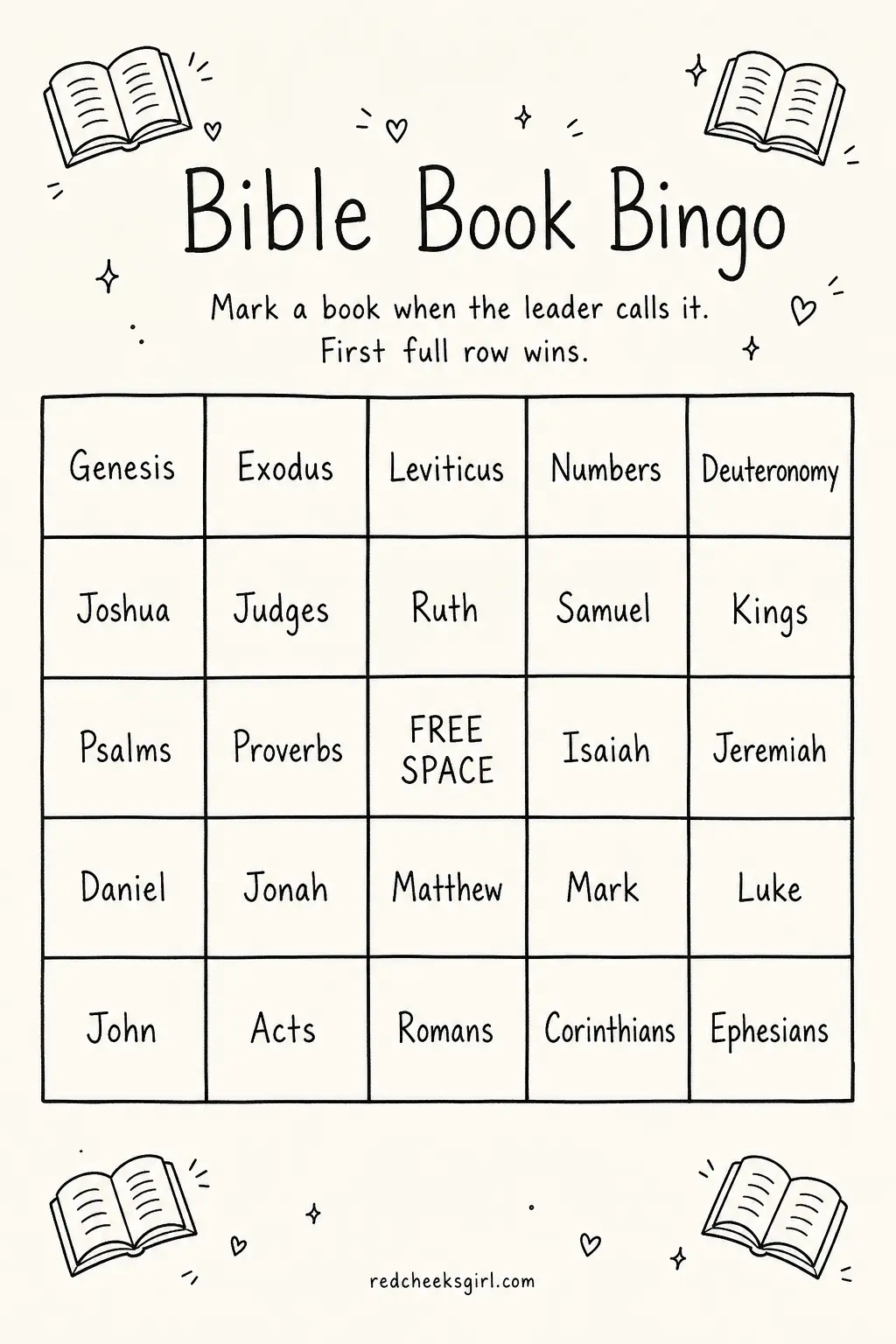
Each teen or pair gets a card filled with Bible book names instead of numbers. The leader calls out books in random order from a master list, teens mark the ones on their card, and first to fill a row shouts bingo.
Print one unique card per pair from a shared pool of book names, give each a stack of scrap paper squares or bingo chips to cover spaces, and one round runs eight to ten minutes depending on group size.
Ties happen when two tables call bingo at once, so keep calling until every claimed row is verified against the master list before awarding the point. Free space in the center keeps every card winnable.
Bridge it in under a minute by noting how many of these books they had never heard of before tonight, and that there is a whole shelf of Scripture left to explore.
- a small pile of scrap paper squares or dried beans per player to mark spaces
- a dry erase board to track which books have already been called
12. Musical Chairs: Names of God
Set up chairs in a circle, one fewer than the number of players, and play music while teens circle around. When the music stops, the last one standing has to name an attribute or name of God, like Provider or Healer, to stay in the game instead of being eliminated.
Needs a chair per player minus one, any music source, and takes about ten to fifteen minutes to whittle a group of twenty down to a winner. Works better as a knowledge game than a pure elimination since teens who freeze up get one more chance to think before actually sitting out.
Repeated answers are the biggest snag, so keep a running list on the whiteboard of names already used and require a new one each round. If the group runs dry on names, allow a Bible character instead.
Bridge it in under a minute by pointing out how many different names for God the group came up with, and that no single one of them captures who He fully is.
13. Rank It: Bible Order Challenge
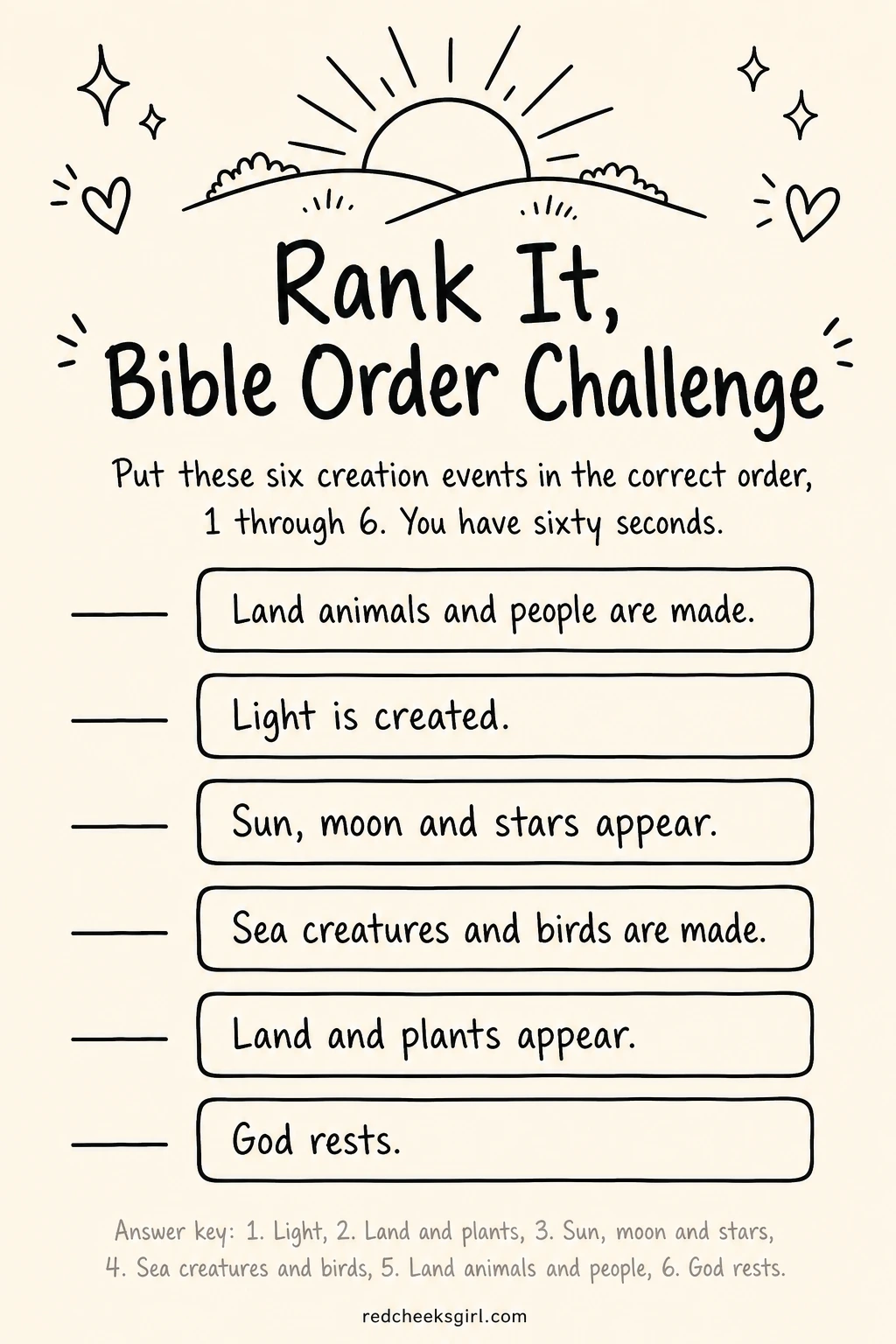
Teams get a card listing six events from the creation account out of order, and have sixty seconds to write the correct order on a shared whiteboard or scrap paper before holding it up for the leader to check.
One printed card per team and a whiteboard or paper per team, sixty seconds per round, works well as a fast reset between bigger games. Read the full list out loud after scoring so everyone hears the correct sequence once.
Teens who know the Bible cold will finish in ten seconds and then heckle everyone else, so give a bonus challenge, like naming which day each event happened on, to keep fast finishers busy.
Bridge it in under a minute by noting that even something as ordered as creation still took six full days, and rushing the process is not usually how God works.
- hand out the scrambled list
- start a sixty second timer
- teams write the correct 1 to 6 order and hold it up
- read the real order out loud to check
14. Blindfold Obstacle Trust Walk
Pair teens up, blindfold one partner, and set a path of chairs as obstacles across the room. The seeing partner can only give verbal directions from the sidelines, no touching, guiding their blindfolded partner through without knocking over a chair.
Needs one blindfold per pair, six to ten chairs scattered as obstacles, and takes about a minute per pair to walk the course. Run two or three pairs at a time on parallel paths to keep the whole group from standing around waiting.
Teens who peek under the blindfold ruin the point fast, so use a folded bandana or sleep mask rather than just closed eyes, and have a spotter walk alongside for safety near any real hazards like a step or doorway.
Bridge it in under a minute by asking what it took to actually trust a voice they could not see, and connect that to what it means to trust God’s direction without seeing the whole path.
- a soft blindfold or sleep mask for each pair
- six to ten chairs to use as obstacles
15. Highs and Lows Testimony Circle
In small groups of five or six, each teen shares one high and one low from their actual week, no game mechanic, no winner, just the group listening and a leader closing with a short prayer over what was shared.
Works best seated in a circle with no phones out, takes about ten minutes for a group of six, and needs a leader in each circle to model going first with something real instead of surface level.
Silence after the prompt is normal at first, do not rush to fill it. If one teen dominates every week, ask them directly to share last so quieter kids get room to go first.
Bridge it in under a minute by picking one low that was shared and gently connecting it to a truth about God being present in hard weeks, without turning it into a full sermon.
16. Odd One Out Bible Grid
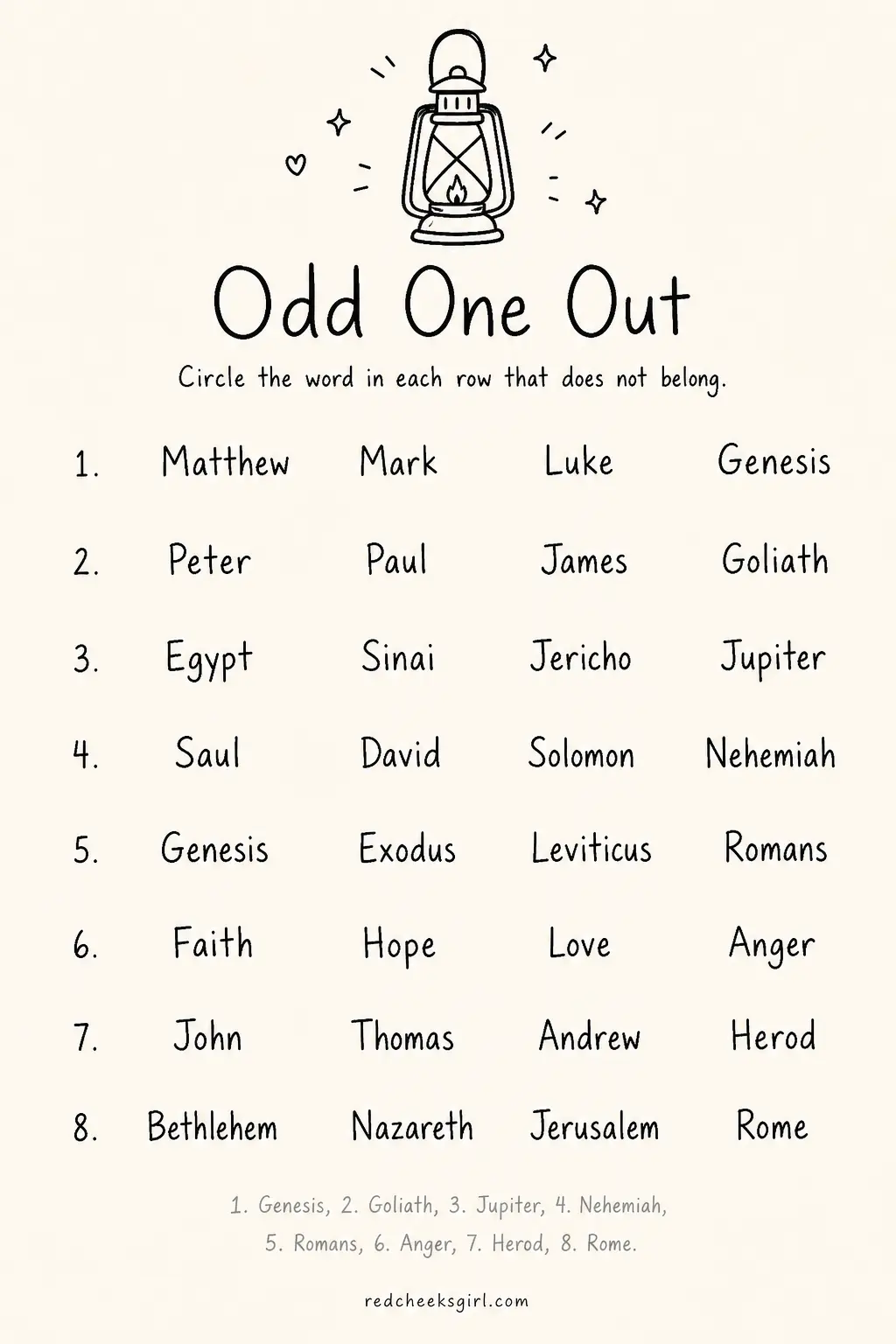
Each row on the sheet has four names or words, three of which belong together and one that clearly does not. Teams race to circle the odd one out in every row before time is called.
One sheet per team, ninety seconds for eight rows, works well as a short brain-teaser between two more active games. No supplies needed beyond the printed sheet and a pencil.
A few rows will spark real debate, especially the ones grouping virtues or places, so let teams defend their answer for a few seconds before revealing the key rather than shutting the argument down immediately.
Bridge it in under a minute by using the fruit of the Spirit row to ask which of those the room feels like they need more of this month.
mixed middle and high school rooms, since some rows are obvious and others take real Bible knowledge to catch
17. Bible Charades Relay
One teen from each team runs to a leader, silently reads a card naming a Bible story or character, runs back, and acts it out for their team to guess with no talking or sound effects, then the guesser becomes the next runner.
Needs a small stack of premade character or story names, an open floor to run across, and works with teams of five to eight. A full relay through eight cards per team takes roughly ten minutes.
Vague acting leads to shouting matches over the guess, so pick very physical, well known stories like Noah, Jonah, or David and Goliath rather than obscure ones that are hard to mime. Add a thirty second cap per card to keep it moving.
Bridge it in under a minute by picking whichever story got acted out worst and retelling the real version in one sentence before moving on.
18. Sanctuary Scavenger Hunt Checklist
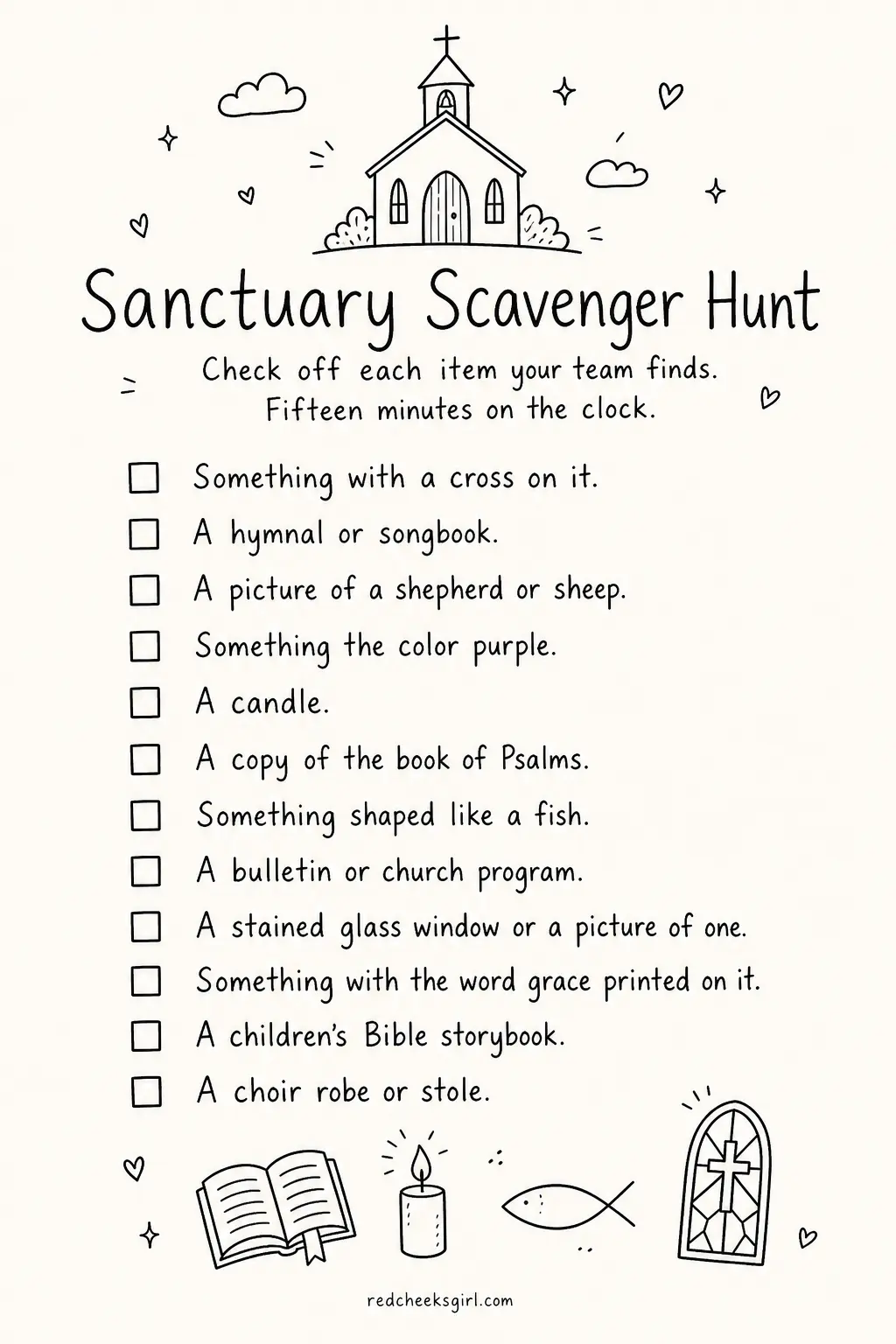
Teams get a checklist of things to find around the church building, from something with a cross on it to a hymnal with a torn page, and race to check off as many as possible before time runs out.
One checklist per team, a leader posted at each area teens are allowed into, and fifteen minutes works well for a building the size of a typical fellowship hall and sanctuary. Set clear boundaries on which rooms are off limits before releasing teams.
Teens will try to claim an item that technically does not match the clue, so a leader should verify each find in person before it counts, and anything borrowed gets returned to exactly where it came from.
Bridge it in under a minute by pointing out how many small, ordinary objects around the building point back to something in Scripture once you actually look for it.
shrink the hunt to one hallway or classroom for a smaller building or a younger group
19. Cup Toss: Fill the Faith Jar
Stack rows of paper cups on a table, and one teen at a time tosses crumpled paper balls trying to knock cups off, or land a ball inside a cup, for team points, with each miss passing the toss to the next teammate.
Needs a table, a big stack of paper cups, and a supply of scrap paper balled up for ammo. Each team’s turn lasts about a minute, so a round of six teams runs under ten minutes total.
Cups scattering everywhere between turns slows things down, so assign one teen per team to reset the stack fast while the next thrower steps up. For extra difficulty, back the throwing line up a few extra feet each round.
Bridge it in under a minute by asking how many tries it took to land one shot, and comparing that to how persistence in prayer does not always land on the first throw either.
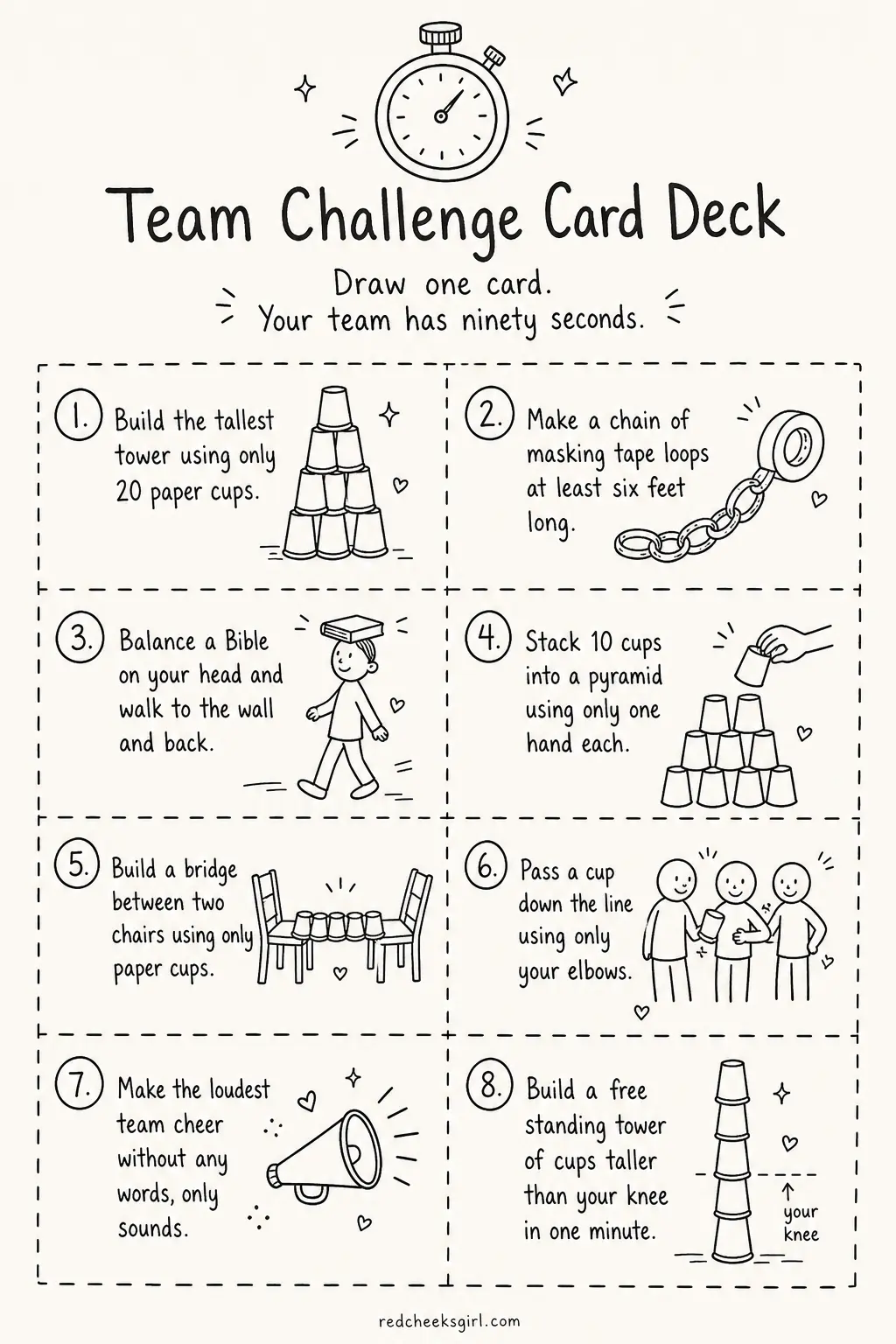
20. Team Challenge Card Deck
Draw one card at a time and give the team sixty to ninety seconds to complete the physical challenge written on it, using only the materials named, for a point if they pull it off before time runs out.
Print the cards, cut them apart, and keep a bin of paper cups, masking tape and chairs nearby since most challenges pull from those three items. Runs well as a full rotating station or as a quick filler between bigger games.
Some challenges are harder than they look on paper, so a leader should test each one before youth group to set a fair time limit. Let teams that fail try again once for half credit rather than a hard zero.
Bridge it in under a minute by pointing out that a few teams needed a second try to succeed, same as most people need more than one attempt to build a real habit of faith.
- blank index cards to write the challenges on
- a supply of paper cups and masking tape for teams to use
21. Verse Memory Keepsake Card
Each teen picks one verse from a short list a leader offers, copies it by hand onto a small card, and keeps it to tuck in a wallet, backpack, or Bible as something to actually memorize during the week.
One blank card and pen per teen, five minutes near the end of the night, works well right after a lesson has already named a key verse worth remembering.
Some teens will pick the shortest verse available just to finish fast, which is fine, a short verse remembered beats a long one abandoned. Check back in the following week and ask who still has theirs.
Bridge it in under a minute by explaining that this card is not homework, it is one sentence small enough to actually carry with them all week.
22. Whisper Down the Lane: Verse Edition
Line teams up single file, whisper a short verse or phrase into the first person’s ear, and have it passed down the line whisper to whisper until the last person says out loud what they heard.
No supplies beyond the phrase itself, works with lines of six or more, and each round takes under a minute. Start with something short and simple before working up to a longer phrase.
The garbled final result is the whole point, so resist the urge to correct anyone mid pass. Read the original phrase out loud at the end so everyone hears how far it drifted.
Bridge it in under a minute by comparing how much a message changes passed person to person, and why reading Scripture directly matters more than trusting what someone else says it says.
keep the starting phrase under ten words or the drift happens too fast to be funny
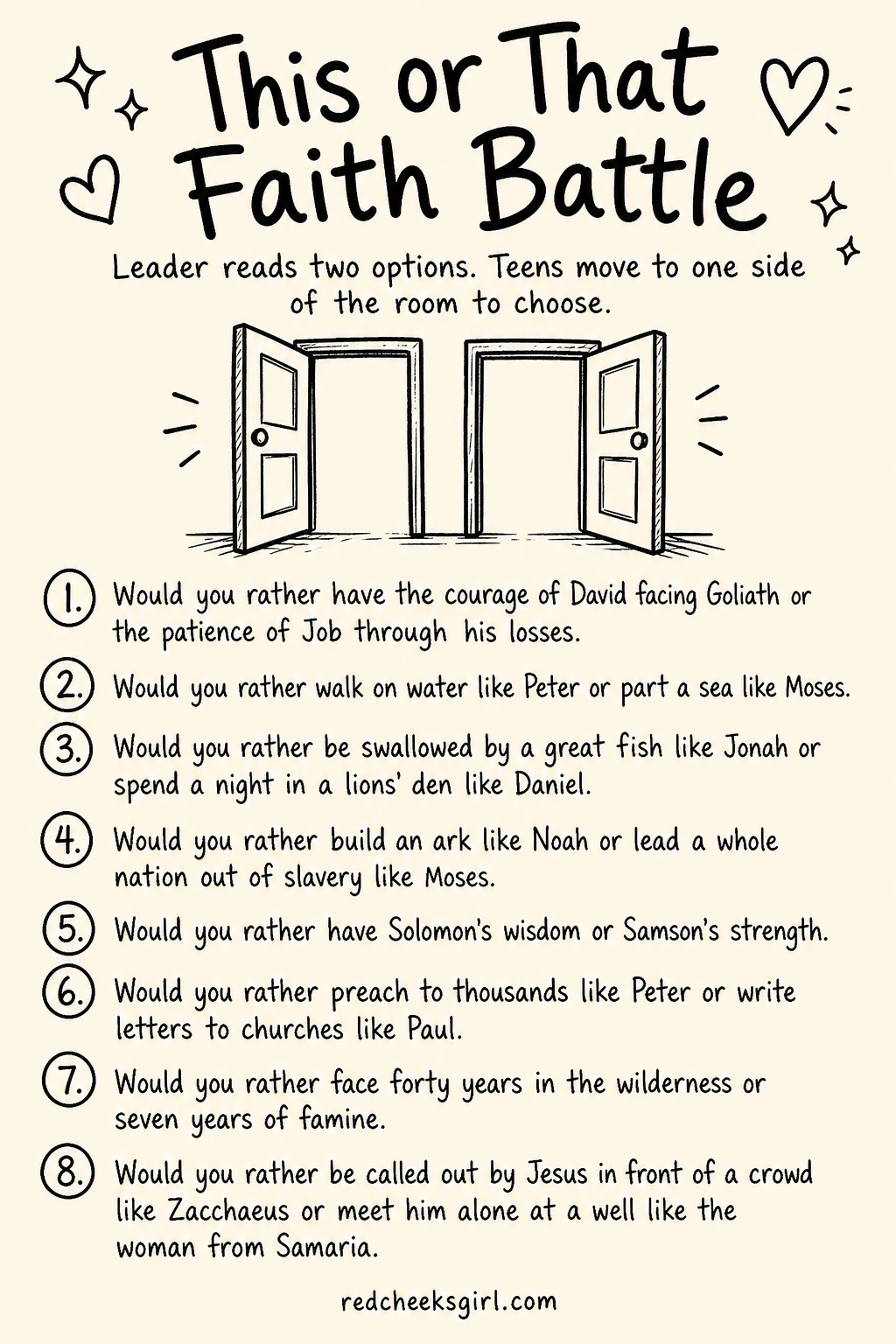
23. This or That Faith Battle Cards
A leader reads two tough options off a card, and teens physically move to one side of the room or the other to show which they would rather face, then a few get asked to explain their pick before the next round.
Print one deck for the leader to read from, no supplies needed for the teens beyond space to move, and eight to ten rounds fill about ten minutes. A related list of Bible would you rather questions works well as a backup deck if this one runs short.
Some picks are too easy and the room splits ninety to ten, which kills the debate. Mix in a few genuinely hard ones where both options carry real weight, those are the rounds that spark the best conversation.
Bridge it in under a minute by picking whichever round split the room most evenly and asking why that one was so hard to choose.
24. Elbow Freeze Tag: Fruit of the Spirit
One or two teens are it and try to tag others, but anyone can escape being tagged by linking elbows with another player. Once frozen or tagged, a teen has to name a fruit of the Spirit before they can rejoin the game.
Needs open floor space and works best with fifteen or more players so there is always somewhere to run. Swap who is it every two or three minutes to keep fresh legs chasing.
Names get repeated fast since there are only nine fruits of the Spirit, so once all nine are taken, allow teens to name one already used as long as they can also explain what it means.
Bridge it in under a minute by asking which fruit came up the least tonight and whether that is the one the room could use more practice with.
bigger groups with real running room, like a gym or large fellowship hall
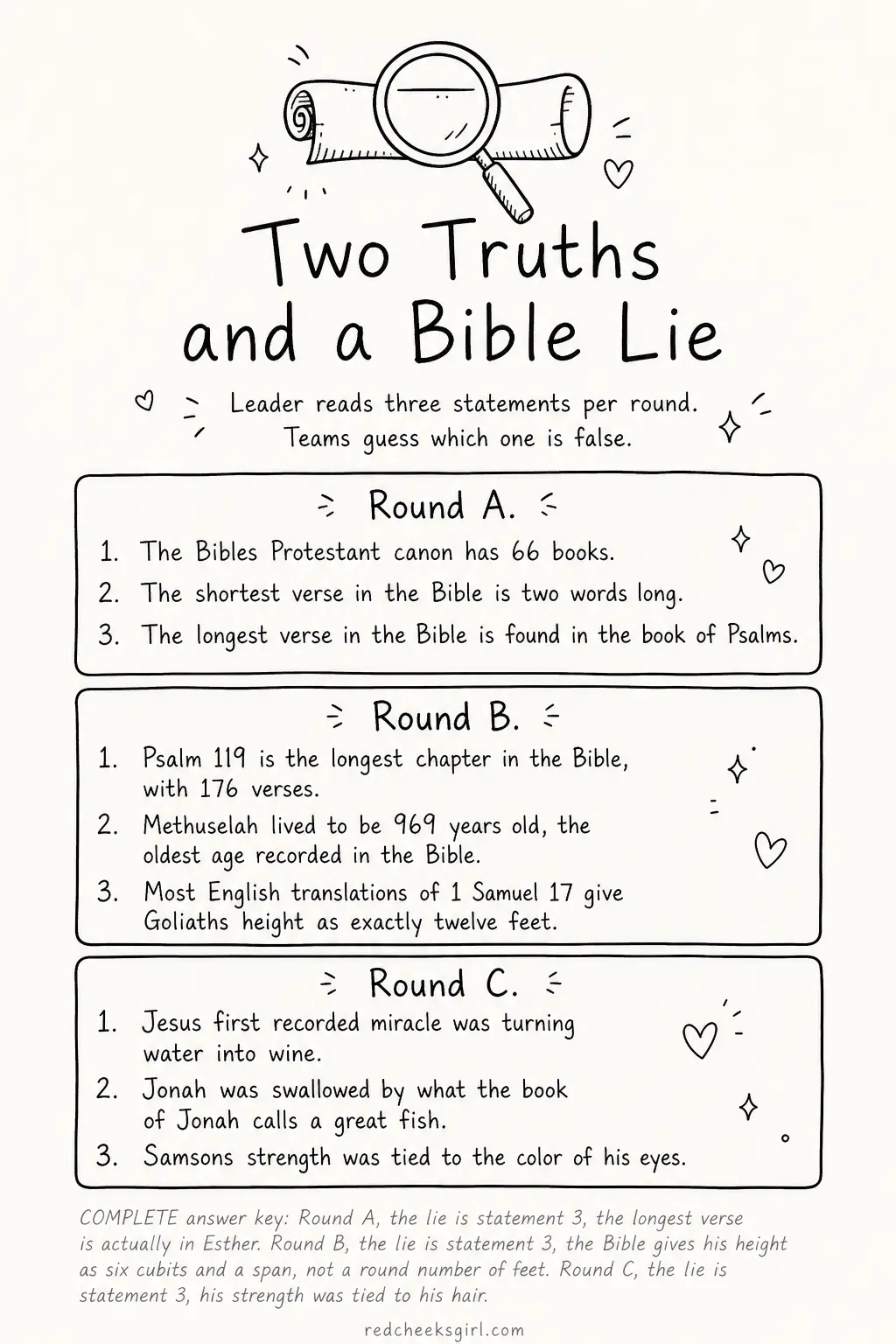
25. Two Truths and a Bible Lie Cards
A leader reads three statements about a Bible topic, two true and one false, and teams have to guess which one is the lie by writing their answer down before the reveal.
One printed card for the leader per round, three rounds covers most groups in about eight minutes, and teams just need something to write their guess on. Read the real answer with a short explanation each time so the false one does not stick in anyone’s memory as fact.
Teens will swear they have heard the false statement before somewhere, which is exactly why this format works, it catches half remembered trivia and corrects it on the spot.
Bridge it in under a minute by pointing out how confidently the room guessed wrong at least once, and how that is a decent argument for reading a passage yourself instead of trusting whatever gets repeated.
it exposes half remembered Bible facts and corrects them in the same breath, without anyone feeling singled out
26. Silent Line-Up Challenge
Teams have to arrange themselves in a specific order, like by birthday month or height, without speaking a single word or writing anything down, using only gestures and pointing to communicate.
No supplies needed, works with any team size from five to twenty, and each round takes two to four minutes depending on how tricky the order is. Birthdays work well since they force real problem solving without talking.
Someone always breaks and whispers, so restart the round from scratch if any sound is heard rather than letting it slide. For a harder version, do it with eyes closed and only touch to communicate.
Bridge it in under a minute by asking how hard it was to work as a team without the easiest tool, talking, and connect that to times when actions have to speak louder than words.
27. Team Huddle Prayer Chain
Every small group forms a tight circle, holds hands, and passes a squeeze around the circle while each person, one at a time, prays a single short sentence out loud before passing the squeeze to the next person.
No supplies needed beyond a quiet moment at the end of the night, works in circles of four to eight, and takes about three minutes per group depending on size.
Some teens freeze up when it is their turn to pray out loud, so make it clear that passing the squeeze without speaking is always an option, no pressure to perform.
Bridge it in under a minute by pointing out that even one sentence prayed out loud counts, and closing with a short group amen.
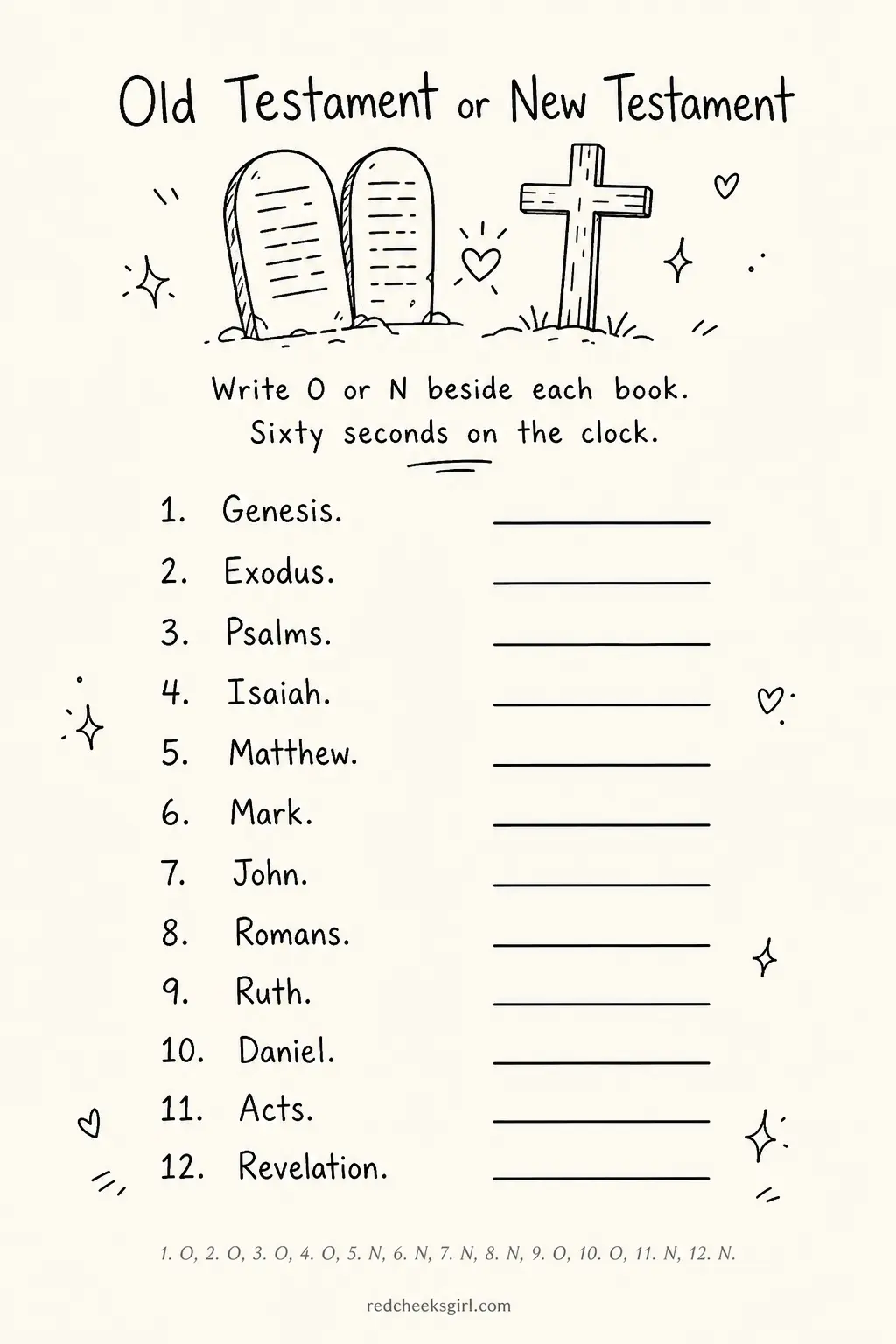
28. Old Testament or New Testament Sort
Teams get a list of Bible book names and have sixty seconds to write an O or an N beside each one to mark whether it belongs to the Old or New Testament, then swap sheets with another team to grade.
One sheet and pencil per team, sixty seconds for twelve books, and works great as a fast warmup before a lesson that references specific books, since it primes teens to remember where things live. Pair it with the Bible trivia games for youth group if the room wants a longer trivia block afterward.
A few books trip up even confident teens, especially ones with unfamiliar names, so read the answer key out loud slowly and let teams check each other’s work rather than rushing the grading.
Bridge it in under a minute by asking why it might matter to know whether a story happened before or after Jesus, not just what happened in it.
group the twelve books into two obvious clusters of six for a younger group instead of mixing them randomly
29. Categories Shout Out Countdown
Call out a category, like Old Testament kings or things Jesus is called, and teams have thirty seconds to shout out as many unique answers as they can, with a leader tallying valid ones on the whiteboard.
No supplies needed beyond a whiteboard for tallying, works with any group size, and each category round takes about thirty to forty five seconds. Run through four or five categories in one sitting.
Teams that shout in unison get points counted twice for the same answer sometimes, so require one designated speaker per team to call out final answers instead of a chaotic free for all.
Bridge it in under a minute by picking the category with the fewest answers and using it to introduce something new the room clearly does not know much about yet.
pick one category the room will crush and one that will genuinely stump them, the mix keeps energy from spiking then dying
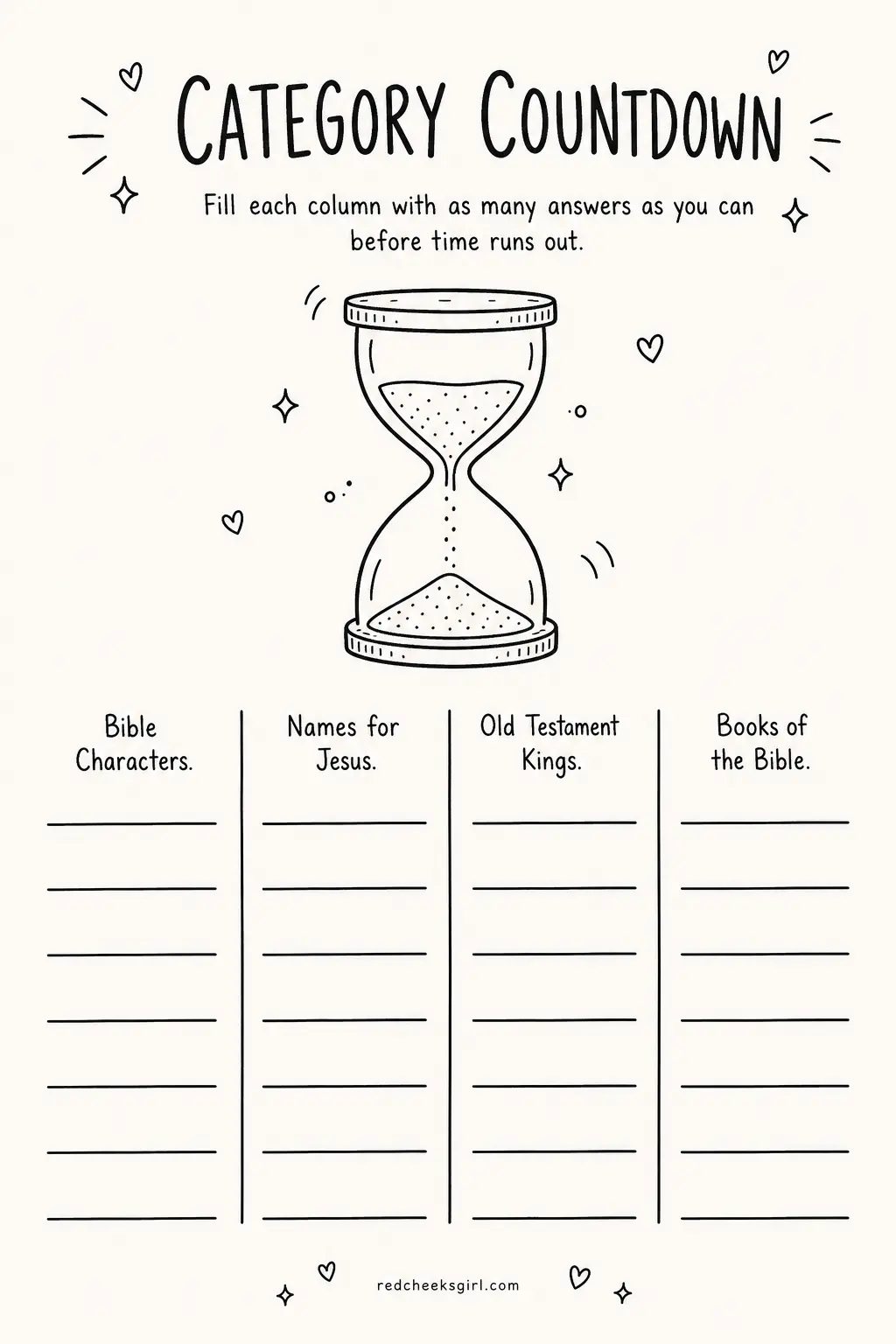
30. Category Countdown Brainstorm Sheet
Teams get a sheet with several open categories, like Bible characters or things Jesus is called, and race to fill each column with as many correct entries as they can before the timer runs out.
One sheet per team, sixty seconds per category, and works well as a written version of the shout out game for a quieter stretch of the night. Read a few strong answers out loud afterward for teams to compare against.
Since many answers can be valid, there is no single fixed key here, so let teams challenge any answer they think does not fit and have a leader make the final call on the spot. A related list of icebreaker games for youth group pairs well right before this one to warm the room up.
Bridge it in under a minute by counting how many names the room came up with for one category and pointing out how much bigger the Bible is than the handful of stories most teens already know well.
31. Praise Freeze Dance
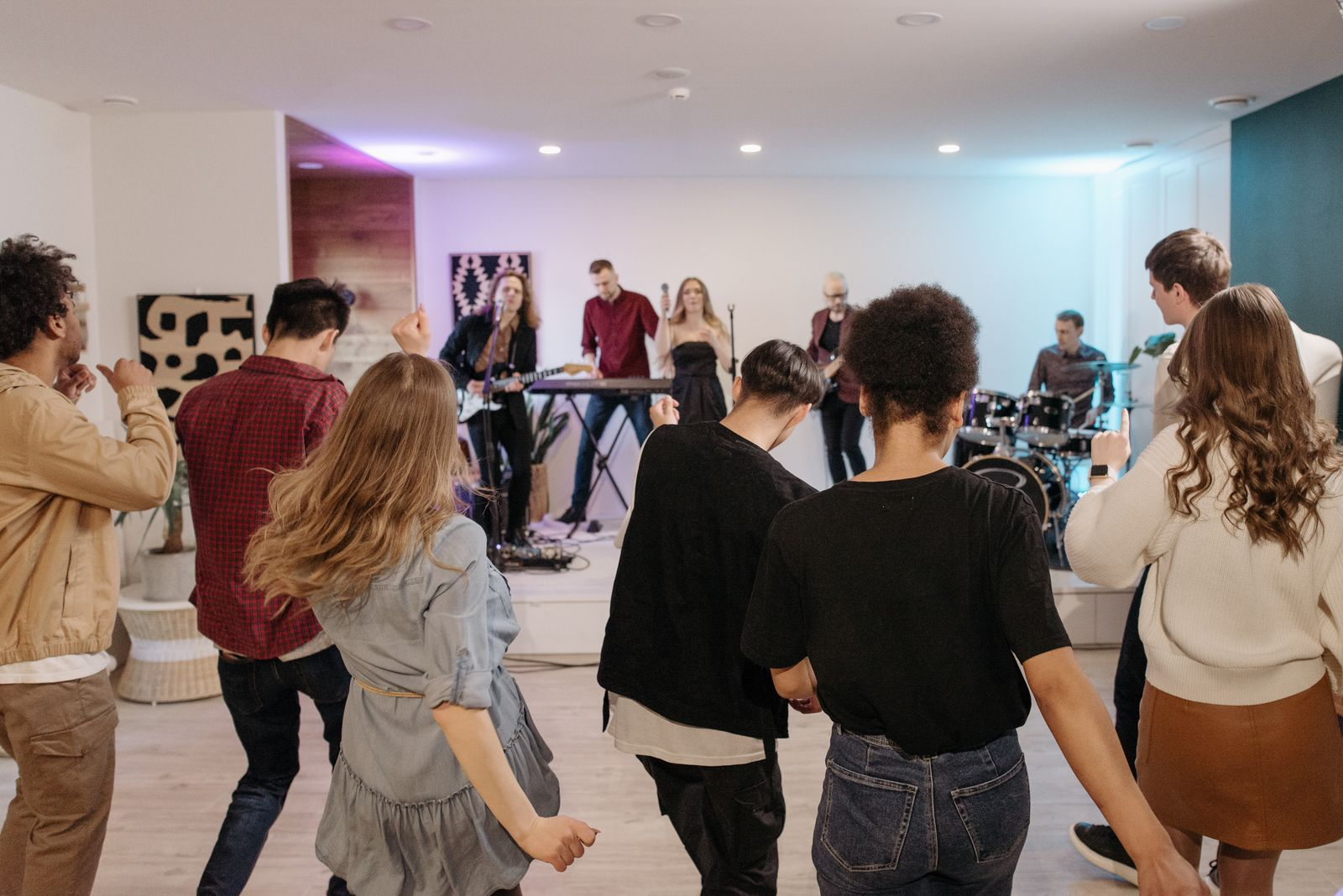
Play upbeat worship or praise music and let everyone dance freely, then cut the music without warning. Anyone still moving when it stops is out, or on team mode, their whole team loses a point for the round.
Needs a phone or speaker with a playlist ready, open floor space, and runs in quick thirty second bursts so a full game lasts eight to ten minutes with plenty of rounds.
Teens who barely move to avoid getting caught out will try to game the system, so add a rule that everyone has to be visibly dancing before the music cuts, not just standing still the whole time.
Bridge it in under a minute by asking what it felt like to freeze mid movement, and connect that to how quickly plans stop when God asks for a pause.
a phone or bluetooth speaker with a playlist of upbeat worship songs queued up
Frequently Asked Questions
What are the best youth group games for a large group of teens?
Team-based games that do not require every single person to perform in front of the room work best for a crowd. Relay games like the cup stack relay, elimination games like steal the Bible, and shout-out formats like categories countdown all scale easily past twenty or thirty teens because the group is split into smaller competing teams instead of one long line of individual turns.
How long should a youth group game actually last?
Most of these run best between five and fifteen minutes, including setup and the one-line Scripture bridge at the end. Anything longer starts losing the back row again, so it usually works better to run three shorter games back to back than to stretch one game out to fill the same block of time.
What supplies do most youth group games need?
Almost everything on this list runs on things a church hall already has on hand: folding chairs, masking tape, paper cups, personal Bibles, index cards, and a whiteboard or phone to track score. A handful of printable games need cardstock for durability, and one or two active games benefit from a cheap blindfold or a bluetooth speaker.
How do you tie a game back to a Bible point without it feeling like a lesson?
Keep the bridge to one sentence, right after the game ends, before anyone moves on to the next activity. Point at something that actually happened in the round, like a team that froze up or argued over an answer, and connect it directly to the Scripture point rather than recapping the whole game or turning it into a mini sermon.
What games work for teens who do not want to participate?
Team scoring instead of individual scoring takes the pressure off any one teen to be the center of attention. Games like whisper down the lane, categories shout out, and the printable sheets let a quiet teen contribute from the back of their team without ever having to stand up alone in front of the group.
How do you keep score at youth group without printing scorecards?
A whiteboard on an easel or a simple notes app on a phone works fine for tallying team points across an entire night of games. Since none of these games need individual scorecards or certificates, the only thing that has to survive the night is one running tally that everyone in the room can see.
20 Bible games for youth group teens actually love — fast, competitive, printable cards & quizzes

20 Bible quiz games with buzzer rounds, team play & free printables. Perfect for any group — compe

18 whole-evening youth group activities built from supermarket and church cupboard supplies, from a
Leave a Reply