

If you’ve ever tried to wrangle twenty-plus people into one board game and watched half the room drift toward their phones within ten minutes, you already know the struggle is very real.
The secret to a genuinely epic family game night ideas large group situation isn’t one giant game — it’s a lineup that keeps every single person in the action at the same time, whether that means splitting into rowdy teams, rotating through activity stations, or handing out a printable sheet that everyone fills in simultaneously while chaos happily unfolds around them.
That’s exactly what this list delivers: 20 crowd-tested ideas built around team formats and station play so nobody gets benched, nobody gets bored, and the host (hi, that’s you) actually gets to enjoy the night too.
I’ve organized them in a flow that goes from big crowd-pleasers to active station games to printable sheets you can download and print before guests arrive, then winds down with a couple of quieter mixers that work beautifully at the end of the night.
Grab some snacks — maybe something easy like an Amish Breakfast Casserole prepped the night before so you’re not stressed — and let’s get this party started.
This post contains affiliate links — if you buy through them, I may earn a small commission at no extra cost to you.
- Family Feud Big Teams
- Family Jeopardy
- Kahoot Family Quiz
- Relay Station Rotation
- Minute to Win It Stations
- Human Bingo Mixer
- Team Trivia Sheet
- Big Group Bingo
- Would You Rather Cards
- This or That Sheet
- Team Score Sheet
- Tournament Bracket Sheet
- Team Name Sheet
- Category Race Sheet
- Scavenger Hunt Sheet
- Awards Certificates
- Charades Card Deck
- Family Mad Libs Sheet
- Find the Guest Mixer
- Team Cheer Circle
- Frequently Asked Questions
1. Family Feud Big Teams
Family Feud is basically the gold standard of big-group games for a reason: it naturally scales to massive crowds because you split everyone into two large teams, and only two players from each team actually face off at the buzzer while the rest of their teammates cheer, coach, and occasionally yell the wrong answer at the top of their lungs.
The host reads a survey question — think ‘Name something you’d find in a junk drawer’ — and the two face-off players slap a table (or clap once) to buzz in first.
The faster buzzer gets to answer first, and if their answer is on the board, their team plays the round trying to uncover all remaining answers before racking up three strikes.
To set this up for a large group, you need a host, a printed or laptop-displayed ‘board’ of answers (free Family Feud answer generators are everywhere online), and a buzzer sound — even a phone app works perfectly.
Rotate which two team members come up for each face-off so everyone gets a turn in the spotlight. Keep a running tally on a whiteboard or just use your Team Score Sheet printable from later in this list.
Aim for five to eight rounds so the game has a satisfying arc without dragging.
Why this works for a big crowd: the bench is never silent.
Even when your cousin is up at the buzzer, the entire rest of your team is furiously debating what answers might still be on the board, which means everyone is engaged every single second.
Host tip: stick to broadly relatable survey topics (food, household items, things kids do) so every generation in the room has a fighting chance — and watch out for the family member who has inexplicably memorized every Family Feud episode ever aired.
You know the one.
Print or display answers on a laptop so the whole room can see. Free Family Feud slide templates on Canva make this genuinely easy.
🛍 Shopping guide
2. Family Jeopardy
Family Jeopardy is the team trivia format that makes even the most trivia-averse person feel like a genius at least once during the night — because when you play in big teams, someone on your squad almost always knows the answer even if you don’t.
Set up five categories (Movies, Food, History, Pop Culture, Wild Card) with four questions each valued at 100, 200, 300, and 400 points. Teams take turns picking a category and dollar amount, then have thirty seconds to huddle and deliver one team answer.
Correct answers earn the points; wrong answers either pass to the other team or simply move on, depending on how competitive you want the vibe to be.
The easiest setup is a free Jeopardy PowerPoint or Google Slides template — just type in your own questions, click to reveal answers, and you’re running a proper game show from your living room.
Project it on a TV or pull it up on a laptop that everyone can see. Assign one person per team as the official answer-deliverer so you don’t have five people shouting different answers simultaneously (trust me on this one).
A small bell or the buzzer set from Family Feud works perfectly here too.
The beauty of Jeopardy for a large group is that the category-picking strategy creates genuine team drama — do you play it safe with 100-point questions or swing for the 400 to close the gap? That strategic layer keeps even the non-trivia people deeply invested.
Vary the difficulty within each category so younger players can confidently grab the lower-value squares, and save the spiciest, most-debated questions for the final Jeopardy round where everyone wagers points simultaneously and absolute mayhem ensues.
- Groups of 10–40+
- Ages 8 and up
- Mixed generations who love a little healthy trash-talk
🛍 Shopping guide
3. Kahoot Family Quiz
Kahoot turns every smartphone in the room into a buzzer, which is genuinely one of the cleverest things to happen to big-group party games.
The host creates a free quiz at kahoot.com — or grabs one of the millions of ready-made family-friendly ones already on the platform — projects it on a screen, and shares a PIN code.
Every guest joins from their own phone and answers multiple-choice questions in real time, with faster correct answers earning more points. The leaderboard pops up between every question, and the ensuing trash talk is absolutely free of charge.
For a truly large group, set Kahoot to Team Mode so small clusters of guests share one device and huddle to pick their answer together — this gets strangers talking immediately and removes the ‘I’m bad at trivia’ anxiety because no individual is singled out.
Build your quiz with a mix of easy, medium, and ‘how does anyone know this’ questions across categories everyone at the party can relate to: family trivia, general knowledge, food, movies, and a cheeky ‘guess that song intro’ round if you can pull it off with your Bluetooth speaker.
One practical note worth knowing: Kahoot’s free plan caps individual players at ten, so for a bigger crowd either use Team Mode (where each team shares one device, keeping you well within limits) or consider a paid session for the night.
Either way, the energy in the room when that countdown music plays is absolutely unmatched — kids will be elbowing grandparents out of the way to tap their answer first, and that is the whole point.
- One shared screen or TV
- Wi-Fi for all devices
- Kahoot account (free works for team mode)
- A curated question mix: easy, medium, and one absolute stumper per category
4. Relay Station Rotation
Station rotation is the format that makes a big group feel like a well-oiled, slightly chaotic carnival, and everyone loves it.
Set up four to six activity stations around the room or yard — think balloon-stomp, cup-stack relay, hula-hoop pass, sack race lane, paper-airplane distance throw, or a beanbag toss — and divide your crowd into teams of four to six.
Every team starts at a different station simultaneously, completes a sixty-to-ninety-second challenge, earns points for their performance, and rotates clockwise on a whistle. By the end, every team has played every station and the scores add up for an overall winner.
The genius of the rotation format is that all teams are active at exactly the same time — nobody watches, everybody plays.
Assign one dedicated ‘station judge’ at each stop (this is a fantastic job for older kids or teens who don’t want to compete) with a simple scoring rubric like ‘most cups stacked wins 3 points, second wins 2, third wins 1.’
Set up each station with clear printed instructions on a small card so teams know what to do the moment they arrive without needing you to explain everything from scratch.
Keep the stations simple enough that a ten-year-old and a sixty-year-old can both compete without one having an unfair advantage — it’s more about effort and teamwork than raw athleticism.
The rotation whistle moment is genuinely thrilling: teams scramble, points get shouted, and the scoreboard shifts dramatically right up until the final station.
Pro tip: designate a five-minute ‘setup window’ between the last team finishing and the final tally so you can do a dramatic reading of results — the suspense is half the fun.
- 4–6 activity stations with printed instruction cards
- A whistle or timer for rotation
- Point tally sheet (use the Team Score Sheet printable below)
- Station prizes optional but highly recommended
5. Minute to Win It Stations
Minute to Win It is, at its core, the most democratizing game format ever invented for a big crowd — because ‘move a cookie from your forehead to your mouth using only your face muscles’ requires absolutely no prior skill, and watching a grown adult attempt it with deadly serious concentration is peak entertainment for everyone else in the room.
Run four to six challenges simultaneously at stations around the room: the cookie-face challenge, stacking Oreos on your elbow then catching them, blowing a cotton ball across a table with one breath, or keeping a balloon aloft using only your hands for sixty seconds.
Each player or team pair has exactly sixty seconds to complete their challenge, and a buzzer or phone timer keeps it honest.
For a large group, pair players across teams at each station — one from Team A versus one from Team B — so every round is a direct head-to-head.
The winner earns three points for their team and the loser earns one just for finishing (because finishing the cookie face challenge with any dignity deserves recognition).
Rotate pairs to a new station every ninety seconds so the challenges stay fresh and each person faces a different opponent each round. A scorekeeper with the Team Score Sheet tracks cumulative team points across all the matchups.
The secret ingredient that makes Minute to Win It legendary at big parties is the audience. While two people are battling it out over a tower of tissue boxes, every other person in the room is absolutely losing it — coaching, heckling, gasping.
Set the stations in a loose circle if space allows so spectators naturally ring the action.
And for the love of all things good, do a practice run of each challenge yourself before guests arrive so you know which ones are genuinely sixty-second achievable and which ones are secretly impossible (looking at you, pencil-balance challenges).
Pre-bag all supplies for each station in a labeled zip-lock bag so setup takes under five minutes the day of the party.
🛍 Shopping guide
6. Human Bingo Mixer
Human Bingo is the icebreaker that doesn’t feel like an icebreaker — which is the highest compliment you can pay any party game.
Every guest gets a bingo card with a five-by-five grid where each square contains a description like ‘has visited more than five countries,’ ‘can whistle loudly,’ ‘has a middle name that starts with J,’ or ‘once ate an entire pizza alone and has no regrets.’
The goal is to mingle through the room, find a real person who matches each square, have them sign it with their name, and race to get five in a row.
First to shout BINGO wins, but you keep going for a full blackout winner too.
The beauty of Human Bingo for a genuinely large group is that everyone is moving simultaneously — there’s no sitting and waiting for your turn, no one person in the spotlight, just pure organized social chaos.
Make the squares specific enough to be interesting but broad enough that almost everyone will qualify for several of them.
Avoid anything too personal or potentially embarrassing; ‘loves a specific TV show’ or ‘has a pet’ works; ‘had a weird phase in high school’ does not. Print one card per guest on cardstock so they hold up through the scribbling.
To keep the energy up, put on an upbeat background playlist and give everyone a two-to-three-minute warning before time’s up if nobody has called Bingo yet — this creates a wonderful frantic scramble at the end.
Hand out a small prize for the first Bingo and a separate prize for the full blackout so two different people get crowned, which doubles the victory celebrations and keeps everyone motivated past the first winner.
Your guests will be chatting and laughing within thirty seconds of starting, guaranteed.
- Pre-print one card per guest
- Write the rules on the back of the card so you don’t have to explain twice
- Use different grid randomization for each card so everyone isn’t racing to the same five squares
🛍 Shopping guide
7. Team Trivia Sheet
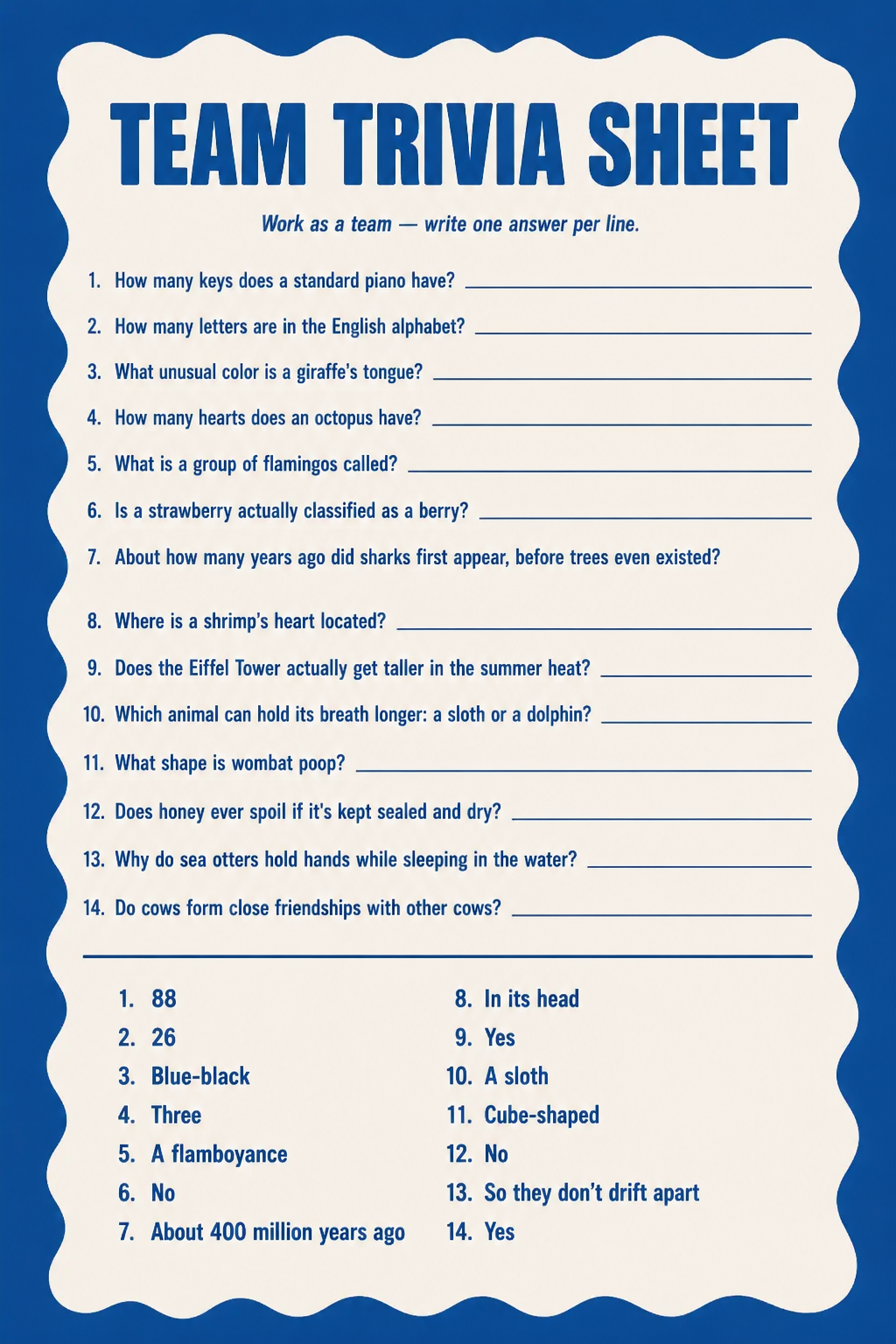
A Team Trivia Sheet is the quieter, more strategic cousin of Kahoot — and it’s secretly brilliant for large groups because every team huddles over one sheet, debates every single answer, and hands it in as a unified voice.
Print one sheet per team (not per person), then read questions aloud as host while teams confer in urgent whispers.
Categories span General Knowledge, Food and Cooking, Pop Culture, Geography, and Science so every generation and interest in the room has at least one category where they feel like the expert.
The team with the most correct answers at the end wins, with a sudden-death tiebreaker question delivered live if scores are tied.
This format is wonderful precisely because it rewards collaborative thinking over individual recall — the person who knows zero geography might save the day on the Food round, which creates beautiful unexpected moments of everyone being impressed by Grandma’s encyclopedic knowledge of international cuisine.
Print on regular paper or cardstock, hand out one pen per team, and collect sheets after the final question for simultaneous grading. Reading answers aloud at the end is its own mini ceremony: teams gasp, argue, and celebrate in equal measure.
Host tip: include one deliberately tricky question per category — not cruel, just the kind that makes people second-guess a confident answer — because those are invariably the ones that produce the loudest table debate.
Also include one absurdly easy question per category so every team gets at least a few wins and stays engaged.
The sweet spot is a sheet where the average team scores around 60 to 70 percent, which means it felt appropriately challenging without leaving anyone demoralized.
- Teams of 3–6
- All ages 10+
- Groups who love a little competitive knowledge-flexing
🛍 Shopping guide
8. Big Group Bingo
Big Group Bingo is the format that magically keeps thirty people on the edge of their seats over called words, which is a minor miracle and you should appreciate it.
Unlike standard bingo with letters and numbers, this version uses themed picture or word squares — think things every family or group would recognize: ‘pizza night,’ ‘road trip,’ ‘board game,’ ‘someone’s dog,’ ‘late to everything’ — and the host draws from a call bag or shuffled deck of matching cards.
Players mark their squares with tokens, pennies, or just a pen dot, and the first to complete a row calls it out loud to collect their prize.
Because every guest gets a different randomized card, everyone is in a genuinely different race even in a crowd of fifty.
Print a full set of twenty-five to thirty unique cards before the party — free bingo card generators online do this in under two minutes — and laminate them if you want to reuse them at future events (a solid investment, tbh).
Provide small bags of tokens or dried beans for marking; they’re cheaper than daubers, easier to source, and you can reset cards between rounds in seconds.
Run three to four rounds in a single sitting — First Row, Blackout, and a ‘T’ or ‘X’ shape for variety — so guests get multiple chances to win without the game feeling repetitive.
In between rounds, have players swap cards with someone across the room to add a social shuffle element. The moment everyone collectively holds their breath when only one square is left on a card?
That’s the kind of shared tension that makes people remember a game night for years. (No pressure, but it’s kind of your responsibility now.)
Laminate cards after printing and hand out dry-erase markers — cards wipe clean and survive every future game night you ever host.

9. Would You Rather Cards
Would You Rather is one of those games that sounds simple until someone poses a genuinely impossible dilemma and the entire table splits into two passionate factions arguing for four minutes about why their choice is objectively correct.
The card-deck format scales to any crowd size because there’s no turn order — the host or a rotating reader draws a card, reads it aloud, and everyone simultaneously votes by raising a hand, moving to a side of the room, or holding up a red or green card.
The real game happens in the debate that follows every vote, which is why this format is equal parts game and conversation starter.
Print the deck on cardstock and cut along the guides — each card has one Would You Rather scenario in big, readable text so the reader doesn’t fumble.
Scenarios should be universally accessible and genuinely funny without being edgy: ‘Would you rather always speak in rhymes OR always speak in questions?’ works beautifully across generations; anything that crosses into adult-only territory obviously does not.
Aim for forty to sixty unique cards so you can run multiple rounds on multiple game nights without repeating.
Use this as a transition game between high-energy rounds to let the room breathe and laugh together without requiring anyone to stand up or compete.
It also works perfectly as a warm-up at the start of the night when people are still arriving and the full crowd hasn’t assembled yet — latecomers can walk in mid-card and instantly understand what’s happening, which is a logistical gift to every host who has ever tried to explain rules to someone who missed the beginning.
No wrong answers means no losers — just enthusiastic arguing, which is genuinely the whole point.

10. This or That Sheet
This or That is Would You Rather’s more decisive, faster-moving sibling — every choice is binary, time is short, and the goal is to vote fast and then defend your answer with your whole chest.
The printable sheet lists twenty-five to thirty This or That pairings in a clean two-column layout: guests circle their choice for each one individually, then the host reads through them while everyone raises hands to show their pick.
The magic is in seeing how the room splits on what seemed like obvious choices — ‘morning person or night owl’ will surprise you every time — and the mini-debates that follow.
Unlike Would You Rather, which benefits from discussion after each prompt, This or That works best when you race through the whole sheet first and then revisit the most divided ones.
Have guests pair up with someone who made opposite choices on five or more questions and give them two minutes to make their case — this creates instant lively conversation between guests who may not know each other well.
It’s especially fantastic for groups that include people meeting for the first time, because preferences are low-stakes and endlessly revealing.
The sheet works as a standalone warm-up game, a filler between rounds, or a fun post-dinner activity while people are still seated.
Pair it with the Team Score Sheet to turn it into a competitive team vote: whichever team has more members matching the majority answer on each question earns a point.
Suddenly a chill preference game has stakes, which delights approximately one hundred percent of competitive family members and you know exactly who I’m talking about.
Pre-fold sheets and place them at seats before guests arrive — no mid-party scrambling to hand things out.

11. Team Score Sheet
Here is a truth that every game night host learns the hard way: the moment you’re tracking scores in your head across four different games for six teams, someone will dispute a number and you will have absolutely no evidence to back yourself up.
A dedicated Team Score Sheet fixes that completely.
It’s a clean tally grid where you list team names down the left column, game rounds or activities across the top row, and fill in points after each round — running totals update automatically because basic arithmetic is doing the heavy lifting.
The whole room can see the standings, which maintains competitive tension from the first activity to the last.
Print one large version to display on a wall or whiteboard easel and individual pocket-sized copies for each team so they can track their own points and cross-check yours (because they absolutely will).
The sheet should have space for up to eight team names and at least ten activity columns, plus a prominent ‘Grand Total’ column at the far right.
Leave a row at the bottom for bonus points or tiebreaker results — things get interesting when a bonus round dramatically reshuffles the standings in the final stretch.
Beyond pure utility, a well-designed Team Score Sheet also creates a psychological element: teams that can visually see how close the race is tend to play harder and cheer louder. That poster on the wall becomes the dramatic centerpiece of the whole night.
After the party, photograph it as a keepsake — it’s genuinely a fun artifact to look back on, especially if one team made an improbable comeback that everyone will be talking about at the next gathering.
Tape the large version to a foam board and prop it on a chair so the whole room can see standings at a glance — no squinting required.

12. Tournament Bracket Sheet
The Tournament Bracket Sheet transforms any head-to-head competition into a full-blown championship event with the satisfying visual logic of March Madness — except the prize is bragging rights over your family members, which is honestly more meaningful.
Use it when you’re running best-of-one matchups in a game like Minute to Win It challenges, table tennis, trivia face-offs, or any activity where two players or two teams go head-to-head.
Teams are seeded randomly (or dramatically, if you want to do a live draw) into the bracket, winners advance, and the bracket visually fills in round by round until one name lands in the champion slot at the center.
Print one large bracket sheet on standard paper, or blow it up to 11×17 if you have access to a wider printer, and hang it where everyone can see.
Write team names in the entry slots before the night begins, then fill in winners in marker as matches conclude.
The bracket creates a natural pacing structure for the night: everyone knows what comes next, who’s playing who, and exactly how many rounds stand between any given team and the championship.
That clarity reduces host stress enormously — instead of constantly announcing what happens next, you just point at the bracket.
The bracket sheet also doubles as a party keepsake: after the night, photograph it with the champion’s name filled in and send it to everyone in the group chat.
It becomes a running reference point (‘remember when Aunt Diane went undefeated in three consecutive brackets’) that cements family game night mythology for years. True story: competitive families will start asking to see the bracket before they even take their coats off.
- 8, 16, or 32 team entries (powers of two keep it clean)
- Any head-to-head game format
- Groups who love a championship narrative arc to their night

13. Team Name Sheet
Naming your team is, against all odds, one of the most contentious and hilarious activities of any game night — a fact that will become immediately apparent the moment you ask six adults to agree on a name within sixty seconds.
A dedicated Team Name Sheet turns this chaos into a structured, fun mini-event at the start of the night.
Each team gets a sheet with a list of prompt-style brainstorming sparks — ‘an animal plus a adjective,’ ‘your team’s secret superpower,’ ‘a food that describes your strategy’ — plus three blank lines where they vote on and commit to their final team name.
The name then gets written on the Team Score Sheet and the Tournament Bracket, making it official and permanent for the night.
The sheet also has space for each team member to sign their name below the team name — essentially a team roster — so you always know who belongs to which squad when things inevitably get chaotic mid-game.
Include a small box for teams to sketch or describe a quick team logo or mascot, because this five-minute creative exercise generates an absurd amount of group bonding and results in some truly inspired crayon drawings.
Hand these out along with markers or crayons in each team color if you’re organized enough, which, tbh, is the goal.
Beyond the practical function, the Team Name Sheet signals to guests that this is a proper event with structure and intention, not just ‘let’s figure it out as we go.’ That psychological framing raises everyone’s engagement level immediately.
Plus, the names themselves become running jokes throughout the night — every time a team earns points, call them by their full ridiculous team name with the enthusiasm of a sports announcer, and watch the room react accordingly.
Naming your team creates instant group identity — suddenly strangers are a unit, and units compete harder and cheer louder.

14. Category Race Sheet
Category Race is a team speed-writing challenge that requires nothing but a sheet of paper, a pen per team, and the willingness to think fast under pressure — which is exactly the kind of low-supply, high-energy format that large groups love.
The sheet lists ten categories down the left side: Animals, Countries, Foods, Movie Titles, Things in a Kitchen, Sports, Colors, Famous People’s First Names, Things That Are Blue, and Things You’d Find at a Party.
Teams have exactly three minutes on the clock to list as many items as they can think of for each category.
When time’s up, teams read their lists aloud; you score one point per unique answer — any answer that another team also wrote cancels out and earns nobody a point, which adds a brilliant layer of strategy to what feels like a pure speed game.
The cancellation rule is the stroke of genius that separates Category Race from a simple list-writing exercise: teams quickly realize that obvious answers (‘cat,’ ‘dog’) will almost certainly be on every other team’s sheet and earn zero points, while obscure but still valid answers (‘margay,’ ‘axolotl’) are unique gold.
This shifts the game from frantic brainstorming to deliberate lateral thinking, and you’ll see teams huddled in intense debate about whether a niche answer is legitimate — a conversation that is absolutely entertaining for the host to referee.
Establish before you start that the host’s ruling is final and there are no appeals, or you will be there until midnight arguing about whether a ‘portobello’ counts as a Thing in a Kitchen.
Run two or three rounds with different category lists and a three-minute timer each time so momentum builds.
You can also run Category Race as a standalone tiebreaker — if two teams are tied on the Team Score Sheet after all other games are done, one lightning round with five categories and ninety seconds decides the champion.
The whole game takes fifteen minutes and requires printing one sheet per team, which is about as low-effort as a game host can get while still delivering enormous group entertainment.
- One sheet + one pen per team
- 3 minutes per round — teams list as many items as possible per category
- Read answers aloud: unique answers score 1 point each; any answer shared with another team scores 0
- Highest unique-answer total wins the round

15. Scavenger Hunt Sheet
A Scavenger Hunt Sheet designed specifically for a big-group game night turns the party space itself into the playing field, sending teams scrambling through the room (or the whole house) to find, photograph, or physically collect items from a checklist.
The list should contain twenty to twenty-five items that mix physical finds (‘something blue,’ ‘an item older than you,’ ‘a coin from before the year 2000’) with photo or action challenges (‘take a team selfie with the host,’ ‘get someone to teach you a secret handshake,’ ‘find someone born in a different state than you’).
Teams have fifteen minutes on the clock and earn one point per completed item, with bonus points for the most creative interpretation of an ambiguous clue.
The mixed format — some items require actual finding, others require social interaction — ensures the hunt isn’t just a room-rummaging exercise but a genuine whole-group social adventure.
Teams will naturally need to interact with other teams to complete certain challenges, which means the scavenger hunt functions as a secondary icebreaker woven into a competition.
Assign a phone-based photo log: teams take pictures of completed items rather than physically collecting them, which is both more hygienic and dramatically more fun to review when everyone reconvenes at the end.
End the hunt with a five-minute show-and-tell where each team walks through their photo log on someone’s phone screen and the host judges creative interpretations aloud.
Award the points per item plus one bonus point for the funniest or most creative photo — this judging segment is often more entertaining than the hunt itself and a perfect bridge into the next game.
The sheet should be clean and easy to scan quickly while on the move, so use large checkboxes and short bold text rather than paragraphs of tiny description.
- One printed sheet per team
- One pen or phone per team for the photo log
- A 15-minute timer
- A small prize for the winning team (optional but motivating)

16. Awards Certificates
Every great game night deserves a proper awards ceremony — and handing out a physical certificate to the Most Valuable Player, the Best Team Name, the Comeback Kid, the Ultimate Trivia Champion, or the Funniest Moment of the Night transforms a fun evening into a genuinely memorable event.
The Awards Certificate sheet is a set of pre-designed certificates you print and fill in by hand as the night progresses, with titles for eight to ten different award categories so multiple people get recognized across various skill types and personality traits rather than just the one team that dominated the scoreboard.
Design each certificate to feel substantial — a bold decorative border, a clear award title, a blank line for the recipient’s name, a blank line for the date, and a signature line for the host — so that even if the prize is just a candy bar, the presentation feels ceremonial and meaningful.
Categories should celebrate a range of achievements: include some competitive ones (Grand Champion, Best Overall Score) and some personality-based ones (Most Enthusiastic, Best Sportsmanship, Most Likely to Challenge a Call) so the kids, the newbies, and the people who genuinely don’t care about winning still have a chance to be called up.
That inclusivity is what makes people want to come back next game night.
Run the ceremony at the very end of the night, announce each award with a tiny speech in your most theatrical announcer voice, and let recipients hold up their certificates for a group photo.
It takes about ten minutes and costs you the price of printing, and it somehow manages to feel like the highlight of the whole evening. True story: I have seen actual tears over a game night certificate with a clip-art trophy on it.
People love being recognized. Use this power wisely.
Fill in names during the final game so you’re ready to hand them out the moment scores are tallied — a seamless ceremony is a confident ceremony.

17. Charades Card Deck
Charades needs absolutely no introduction, but what it does need for a large-group game night is a proper printed card deck so nobody wastes thirty seconds trying to think of a prompt while twenty impatient people stare at them.
The Charades Card Deck is a full set of print-and-cut cards divided into four categories — Movies, Actions, Animals, and Famous People — with fifteen cards per category for sixty cards total.
One player draws a card, silently reads the prompt, and has sixty seconds to act it out with no words, no sounds, and no pointing at objects in the room. Their team guesses; every correct guess in the sixty seconds earns one point.
For a large group, split into teams of five to eight and run charades as a team relay: the actor draws a card, acts it out for their team for thirty seconds, then passes to the next actor who draws a new card immediately, continuing the relay until the sixty-second team timer ends.
However many cards a team successfully guesses in that minute is their round score. This format keeps every team member active multiple times per round and eliminates the awkward one-person-stands-alone dynamic that can make shy guests dread their turn.
Everyone is equally ridiculous together, which is the natural state of a good charades game.
Laminate the cards if you plan to reuse them — they hold up beautifully for years and you can expand the deck with new cards anytime.
Shuffle all categories together for a wilder, more unpredictable draw, or let teams call which category they want to pull from for a strategic element.
Either way, the physical card deck feels more official and party-ready than scribbled slips of paper, and your guests will appreciate the polish even as they are desperately flapping their arms trying to convey ‘pelican.’
- Draw a card — act it out in 60 seconds, no words or sounds
- Team relay format: rotate actors every 30 seconds within the team minute
- Each correct guess = 1 point for the team
- Laminate cards for reuse at every future game night

🛍 Shopping guide
18. Family Mad Libs Sheet
Mad Libs is the rare game that is simultaneously appropriate for a seven-year-old and capable of making a roomful of adults lose it completely — and the family edition, which keeps all content thoroughly G-rated, is the version you want when the group spans multiple generations.
The host collects the words first: going around the group and asking for a noun, an adjective, a verb, a body part, an animal, a number, and so on, writing them in numbered blanks on their host copy without revealing the story.
Once all blanks are filled, the host reads the completed story aloud in their most dramatic voice, inserting the crowd-contributed words. The result is almost always spectacular nonsense that earns a standing ovation.
For a large group, collect words from different people in the room — shout out ‘I need a silly adjective from someone in the back row!’ — so the resulting story represents contributions from across the whole crowd.
This makes the final read-aloud feel like a collaborative creation rather than one person’s joke, and everyone who contributed a word experiences a little thrill when theirs lands.
Run two or three different Mad Libs stories per game night so the format doesn’t wear out its welcome, and save the best story on your phone to read again at the end of the night as a callback bit.
Print one sheet per game-night session for the host to fill in, plus a bonus copy for each guest to take home as a keepsake — they’re genuinely fun to reread later and serve as a little time capsule of who said what ridiculous word.
The Family Mad Libs sheet format pairs especially well with scrapbook ideas if you want to get creative with how guests preserve their game night memories. Tuck the completed sheet into a photo album alongside a group picture and you’ve accidentally created a tradition.
Collect all the fill-in words BEFORE revealing the story — the surprise of the completed read-aloud is 100% of the comedic payoff.

19. Find the Guest Mixer
Find the Guest Mixer is the structured social game that works like a human-scale puzzle: before the night begins, the host secretly collects one fun or surprising fact from every guest via a text message or a quick digital form — something genuinely unexpected, like ‘once ate an entire jar of peanut butter in a single sitting’ or ‘can name every country in South America in alphabetical order.’
The host types all the facts onto a single printed sheet numbered one through however-many-guests, and everyone gets a copy. The goal is to mingle, ask questions, and match each fact to the right person by writing their name beside the number.
First guest to correctly match all facts wins.
For large groups, this format is brilliant because it creates genuine one-on-one conversations with natural starting points — instead of the social agony of ‘so what do you do,’ guests approach each other with ‘wait, are you the one who can name all the capitals in five minutes?’
That specificity immediately sparks real dialogue, laughter, and surprise. Set a time limit of fifteen to twenty minutes so guests are motivated to keep circulating rather than chatting with just one person for the whole time.
When time’s up, everyone reveals their answers and the host confirms the correct matches — the reveal round is full of ‘wait, WHAT’ moments that warm up the room beautifully.
This game works especially well at the very start of the night, while people are still arriving and mingling naturally anyway. It gives people a mission, which removes the awkward standing-around energy that often accompanies the first thirty minutes of a large gathering.
It also sneakily tells every guest something memorable about every other guest, which means by the time the competitive games start, the room already feels like a crew rather than a collection of strangers.
That shift is worth its weight in gold for everything that comes after.
Collect facts via text or a quick Google Form the week before the party so the sheet is ready to print before guests arrive — no awkward on-the-spot collection required.
20. Team Cheer Circle
Team Cheer Circle is the warm, slightly competitive wind-down activity that closes a game night on an emotional high — and yes, you do actually need something intentional at the end, because otherwise the night just fades out with people checking their phones and the host wondering if it was fun enough.
In this activity, each team gets three minutes to create an original team cheer, handshake, or chant that incorporates their team name, at least one callback to something funny that happened during the night, and ends with a synchronized physical move like a clap pattern or a jump.
Teams practice briefly, then perform for the whole room in a round-robin showcase.
The host (or a designated panel of judges) scores each performance on three criteria: creativity, enthusiasm, and crowd reaction — which are wonderfully subjective categories that ensure every team can legitimately excel at something.
Announce scores after each cheer with the maximum comedic dramatic pause between ‘and the score is…’ and the actual number, which the room will appreciate every single time.
The team with the highest total performance score earns bonus points added to the Team Score Sheet, potentially reshuffling the final standings and creating a last-minute comeback narrative that nobody expected.
Beyond the competitive element, Team Cheer Circle creates a collective closing ritual that makes the night feel intentional and memorable rather than just something that ended when people got tired.
Guests leave having genuinely collaborated with a small group of people, having laughed together, and having contributed something creative to the shared experience. That sense of group authorship is what turns a one-time game night into an annual tradition people specifically request by name.
And honestly, if the cheers are good enough, someone will post a video — which is its own reward. For more ideas on turning your creativity into a lasting keepsake, check out these junk journal ideas for capturing the memory of a great night.
Ending with a shared creative performance locks in the group bond — guests leave feeling like they were part of something, not just spectators at it.
Frequently Asked Questions
How many people can play these family game night ideas for a large group?
Most games on this list scale to fifteen to fifty or more people with no modifications. The key is the team format: instead of playing as individuals, everyone joins a team of four to eight, which means any crowd size works.
Station games like Relay Station Rotation and Minute to Win It Stations are specifically designed for simultaneous play across multiple stations, so the bigger the group, the better they actually run.
What supplies do I need for a big-group family game night?
The printable games on this list require only a printer, cardstock or regular paper, and pens — most of the supplies you likely already have.
Active games may need a few extras like ping pong balls, plastic cups, or hula hoops for station activities, but nothing that requires a specialty store.
The biggest investment is your prep time the day before: print the sheets, label the station bags, and set up the bracket so the night itself runs without scrambling.
How do I keep everyone engaged and nobody sitting out?
The secret is simultaneous play. Every game on this list is designed so all teams or all guests are doing something at the same time — there’s no format here where one person acts while thirty watch and wait their turn.
Printable sheets give everyone something in their hands immediately. Team station games rotate groups through challenges concurrently. Even the quieter games like Find the Guest Mixer have everyone circulating at once.
If someone isn’t naturally competitive, put them in a role like station judge, scorekeeper, or timekeeper so they’re still essential to the flow.
What are the best games for mixed ages at a large family game night?
Family Feud Big Teams, Big Group Bingo, Human Bingo Mixer, and Would You Rather Cards all work beautifully across generations because they don’t require specialized knowledge or physical skill.
For tech-forward moments, Kahoot Family Quiz lets you mix easy and hard questions so younger kids can answer some and adults can shine on others.
The Charades Card Deck and Relay Station Rotation are especially popular with kids who want to move around, while quieter games like Team Cheer Circle let less physically active guests participate fully.
How long should a large-group family game night last?
A full game night with six to eight games from this list, including setup and scoring, typically runs two to three hours — which is the sweet spot before people’s energy starts to flag.
Front-load with the big crowd-pleaser formats (Family Feud, Kahoot) to grab everyone’s attention early, drop in printable sheet games in the middle as a natural breather, run the high-energy station games when momentum is highest, and close with Team Cheer Circle as a ceremonial wrap.
Use the Awards Ceremony as your official finale so the night has a clear, satisfying ending.
Can I run these games without any special technology?
Absolutely — the majority of games on this list require no tech at all beyond a printer. Family Feud, station games, all twelve printable sheets, charades, and the quieter mixer games all run on paper, pens, and the energy in the room.
Kahoot and Family Jeopardy benefit from a screen and internet connection, but both have low-tech alternatives: Family Jeopardy can be run with handwritten question cards and a point-tracking whiteboard, and Kahoot can be replaced with a printed trivia sheet like the Team Trivia Sheet included in this list.
📌 Save These for Later
Loved these? Pin your favorite image below so you can find this list again when you’re planning.

72 this or that questions for kids sorted into six rounds. Read them aloud, print the cards and watc
72 would you rather questions for kids aged 8-12, sorted into six silly rounds with free printable c

72 would you rather questions for siblings across 6 rounds. Balanced, funny and family-safe prompts
Leave a Reply