

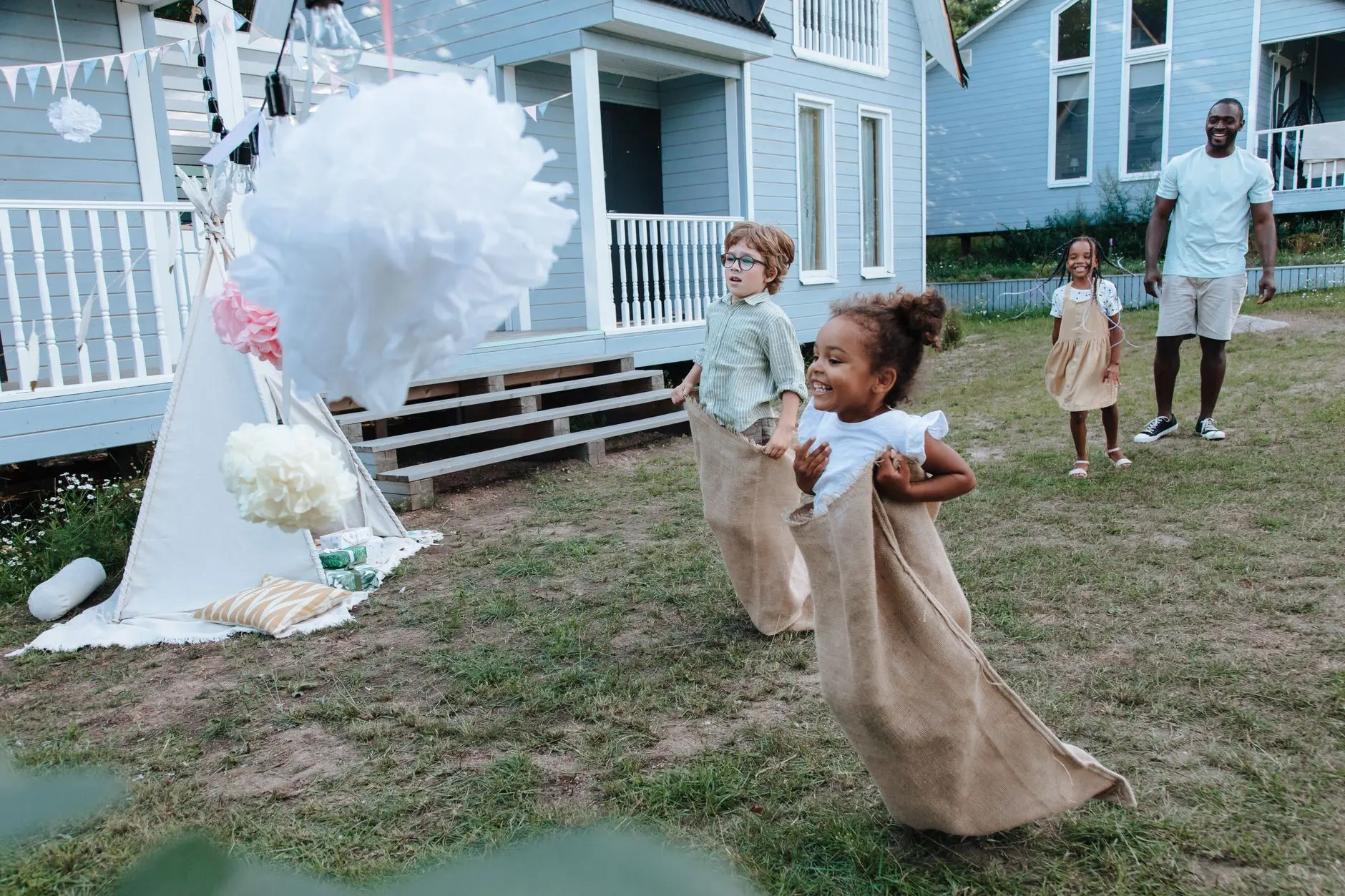
If you’ve ever watched a dozen sugar-fuelled kids stare at you blankly after cake and thought, ‘now what?’, congratulations — you’ve found the right list.
These 25 birthday party games for kids are designed for real life: mixed ages from toddler to tween, a solo parent running the whole show, and a budget that doesn’t require selling a kidney.
Every single game can be explained in under a minute, set up in minutes, and — most importantly — actually burns off that frosting energy before anyone starts crying.
And if you’re curious about the birthday star themselves, the secret language of birth month flowers is a surprisingly fun rabbit hole to fall down while you’re party-planning at midnight.
I’ve organised these 25 games to flow through the party naturally — active bursts followed by a printable breather, then a quiet moment before ramping back up again.
You’ll find age suggestions and rough prep times on every entry so you can swap things around to suit your crowd. (Spoiler: the four-year-olds and the ten-year-olds will both lose their minds over Parachute Games, and that is a fact I will die on.)
Let’s get into it.
This post contains affiliate links — if you buy through them, I may earn a small commission at no extra cost to you.
- Piñata Smash
- Kids Party Bingo
- Musical Statues
- Coloring Contest Sheet
- Pass the Parcel
- Kids Riddles Sheet
- Pin the Tail Classic
- Birthday Maze Sheet
- Sack Race
- Kids I-Spy Sheet
- Egg and Spoon Race
- Roll-a-Cake Dice Sheet
- Duck Duck Goose
- Simon Says
- Freeze Dance
- Treasure Hunt
- Balloon Pop Relay
- Limbo
- Musical Chairs
- Sleeping Lions
- Hot Potato
- Birthday Wishes for the Star
- Bean Bag Toss
- Obstacle Course Race
- Parachute Games
- Frequently Asked Questions
1. Piñata Smash
Is it even a birthday party without a piñata? Piñata Smash is the crowd-pleaser that kicks off the energy from the very first swing, and it works perfectly for ages 3 and up with zero complicated rules.
One child at a time is blindfolded, spun gently three times, handed a stick (a plastic bat or a rolled cardboard tube works great), and pointed in the general direction of the hanging piñata.
The rest of the group cheers, points, and shouts helpful — okay, mostly unhelpful — directions. When the piñata finally bursts, every child scrambles for the falling candy and trinkets.
Prep time is about 5 minutes once you have the piñata; hanging it from a tree branch or a doorframe is the only real task.
Pick up a pre-filled piñata from a party shop or buy a plain one and stuff it yourself with wrapped sweets, mini toys, and stickers.
For mixed-age groups, let the littlest kids take a few swings without the blindfold so they feel included and genuinely dangerous.
Hang it at a height that’s reachable for the youngest player — roughly chest height on an adult — and adjust your rope after each swing round so the older kids have a real challenge.
Have a parent stand nearby as the rope-handler so you can lower it or raise it on the fly.
Piñata Smash works brilliantly as the FIRST game of the party because the sugar rush hasn’t peaked yet and the excitement of the hits draws everyone out of shy-new-arrival mode instantly.
If you want a variation that keeps going longer, try a pull-string piñata for the little ones and save the bash version for the bigger kids — two piñatas, double the chaos, double the joy.
The loot scramble at the end practically runs itself, which means you get thirty seconds to breathe. Cherish it.
Give each child a small bag or cup before the candy drops so the scramble stays fair and the tears stay minimal.
🛒 What you’ll need
2. Kids Party Bingo
Bingo is one of those rare birthday party games for kids that genuinely works from age 4 to age 10 without anyone feeling talked down to — or totally lost.
In this birthday-themed version, each card is a 4×4 grid filled with colourful birthday pictures instead of numbers: party hats, cake slices, balloons, presents, candles, streamers, ice cream cones, stars, confetti bursts, party poppers, cupcakes, and more.
You call out each image name one at a time (draw them from a paper bag or a hat for maximum drama), and kids mark off the matching square on their card.
First to get four in a row — horizontal, vertical, or diagonal — shouts ‘BINGO!’ and wins a small prize. Print a different card for every guest so no two are identical.
All you need is cardstock, a printer, a pen per child, and a handful of small tokens (coins, dried beans, or birthday sticker dots all work as markers).
Print the cards before the party and stack them face-down by age if you want — give the 4-year-olds cards with slightly larger images for easier spotting.
Call each item slowly and clearly, holding up a drawn slip so the littlest guests can match by picture rather than word.
A complete round takes roughly 8–12 minutes, so it’s a great calm-down activity right after an active game when you need everyone sitting for two minutes.
Why it works so beautifully at a mixed-age party: older kids can help younger siblings find their squares, which keeps the big kids engaged even when they’re not in the lead.
Play three rounds in a row with small prizes for each winner and every child is guaranteed a turn in the spotlight.
Host tip: if you have a very competitive crowd, call ‘BINGO’ for a full house (all 16 squares) as the ultimate grand-prize round and watch the tension build gloriously.
This printable is ready to download and print at home on standard US Letter paper — no laminating required, no fancy supplies needed.
- Ages 4–10
- Groups of 6–20 kids
- Indoor or outdoor tables
- A calm-down moment mid-party

🛒 What you’ll need
3. Musical Statues
Musical Statues is Freeze Dance’s slightly more dramatic cousin and one of the most reliable birthday party games for kids of any age — honestly, ages 3 to 10 all go absolutely feral for it in the best way.
When the music plays, every child dances, wiggles, and does their silliest moves. The moment the music stops, everyone must freeze completely still like a statue. Anyone still moving is ‘out’ and takes a seat on the side.
The last child standing wins — though if your group is younger, just play for fun with no elimination so nobody cries into their party bag.
You need: a phone or speaker, a playlist (birthday hits, pop bangers, whatever the birthday child loves), and a bit of open floor space. Prep time is literally zero — just hit play.
The adult running the game controls the music, so ideally stand with your back to the kids as you pause it so you can’t be accused of favouritism (speaking from personal experience here, it gets heated).
For elimination rounds, eliminated kids can become your ‘judges’ to spot movement, which keeps them involved and gives them a little authority they will absolutely abuse.
The real magic of Musical Statues is that it burns off enormous amounts of energy in a tiny amount of space — it works indoors, outdoors, in a living room, or in a garden.
Variation: call out a pose they have to freeze in (‘freeze like a robot!’ or ‘freeze like a melting ice cream!’) to add extra giggles. Ages 3–10, prep time under 2 minutes.
This one fills time between structured games perfectly and you can run it for as long as the group stays hyped, which, tbh, is usually longer than you’d expect.
Zero prep, zero supplies — just a playlist and some floor space. Works in any room size and scales from 4 kids to 40.
4. Coloring Contest Sheet
A Coloring Contest Sheet sounds simple, and honestly, that’s the whole point — it’s a brilliant reset game that gives you five minutes of blissful quiet in the middle of a high-energy party.
Print one sheet per child, hand out a cup of crayons or markers per table, set a timer for 8–10 minutes, and let everyone colour their birthday scene.
At the end, display all finished sheets on a wall or table and have the birthday child (and one or two adults) judge for categories like ‘most colourful,’ ‘most creative,’ ‘most detail,’ and ‘most festive’ — so every single child wins something.
Prizes can be as simple as a sticker or a small sweet.
The sheet features a large birthday scene to colour: a birthday cake with candles, balloons floating up from a table, a pile of presents with ribbons, a party banner, and a friendly cartoon character wearing a party hat.
The image is bold-outlined and simple enough for a 3-year-old to colour but detailed enough that an 8-year-old won’t feel like it’s babyish. Print on cardstock for best results — the colours pop more and it holds up to enthusiastic small-person colouring pressure.
Prep time: 5 minutes to print and lay out supplies.
Here’s the hosting secret no one tells you: the Coloring Contest Sheet is the perfect buffer game to deploy right before cake is served.
It sits kids down, quietens the group, and gives you the window you need to light the candles and arrange the plates without anyone careening into you at full speed.
Older kids often get genuinely competitive about their art and produce incredibly detailed work, which is adorable. Younger kids are just happy to make something purple when it should be blue, and that is also perfect. Ages 3–10, works for any group size.
Use multiple prize categories so every child wins one — ‘most colourful’ and ‘most creative’ mean no tears and no arguments at the table.

🛒 What you’ll need
5. Pass the Parcel
Pass the Parcel is practically a rite of passage at kids’ birthday parties, and for good reason — it’s fast, suspenseful, and costs almost nothing to set up.
Wrap a small prize (a chocolate bar, a little toy, a book) in as many layers of wrapping paper as you have guests, tucking a tiny forfeit or a small sweet between each layer. Everyone sits in a circle.
Music plays, and the parcel gets passed around the circle as quickly as possible. When the music stops, whoever is holding the parcel unwraps one layer. Whoever removes the final layer wins the main prize.
The supplies list is genuinely humble: one prize, wrapping paper, tape, and some small between-layer treats or forfeits on slips of paper (‘do your best robot dance for 10 seconds’ is always a winner).
Wrap the parcel the night before the party while watching TV — it takes about 10 minutes and you can do it completely in autopilot. Prep time for the game itself on party day: 2 minutes.
For a mixed-age group, make sure younger kids are positioned near the adult controlling the music so the stops feel fair and every child gets at least one layer unwrap during the game.
The between-layer forfeits are the secret ingredient that makes this land better with older kids who might roll their eyes at the ‘baby version.’
Things like ‘name three things you love about the birthday child,’ ‘do ten star jumps right now,’ or ‘swap seats with the person to your left’ keep the energy alive between unwraps and make the whole circle howl with laughter.
Ages 3–10, prep time 10 minutes the night before. A word to the wise: control the music facing away from the group. Trust me.
- One wrapped prize (book, small toy, or treat)
- Wrapping paper and tape for multiple layers
- Small sweets or forfeit slips between each layer
- A phone or speaker for the music
6. Kids Riddles Sheet
A Kids Riddles Sheet is the printable that surprises you — you hand it out expecting five minutes of quiet and instead get a genuinely rowdy group of kids arguing passionately about whether a candle or a lightbulb is the right answer.
This sheet gives each child 12 birthday-themed riddles to solve individually (or in pairs for the younger guests).
The riddles are age-calibrated: the first six are gentle enough for a 5-year-old (‘I have layers and candles on top — what am I?’), and the last six are trickier for the 8–10-year-olds in the group.
Everyone gets the same sheet; the challenge scales naturally by age.
Print one sheet per child on standard paper, hand out a pencil each, and set a 10-minute timer. After time’s up, go through the answers together out loud as a group — read the riddle, pause dramatically, then reveal the answer.
The child with the most correct answers wins a small prize, but honestly, the group answer-reveal is where the real entertainment happens because every child is absolutely certain they had it right.
The answer key lives in small italic text at the very bottom of the sheet, for your reference as host, well away from the riddles themselves so nobody peeks during play.
What makes the Riddles Sheet a smart addition to any birthday party games for kids lineup is that it genuinely works across a wide age gap without any adjustments from you.
A 4-year-old can guess at the pictures, a 7-year-old can puzzle through the wordplay, and a 10-year-old will race to finish first and then helpfully (read: smugly) help their little sibling.
It’s also the easiest possible printable to run solo — hand it out and you have 10 free minutes. Ages 4–10, prep time 3 minutes to print.
Pair each under-5 with an older buddy to work through the riddles together — the big kids love feeling like the expert.

7. Pin the Tail Classic
Pin the Tail on the Donkey is the kind of game that sounds old-fashioned until you watch a blindfolded six-year-old confidently stride toward the wall and slap their tail directly onto the donkey’s nose — and the whole room collapses.
It’s a birthday party classic for a reason. One at a time, each child is blindfolded, spun gently three times, handed their tail (with a sticky tack or rolled tape on the end), and pointed toward the large donkey poster on the wall.
The closest tail to the actual tail spot wins a prize. Everybody else wins the satisfaction of laughing very loudly.
You can buy a traditional Pin the Tail set for a few dollars at any party shop, or make your own version with a printed or hand-drawn image and paper tails.
Write each child’s name on their tail before the game starts so you can identify placements after all turns are done. Use a scarf or bandana as the blindfold.
For safety with mixed ages, do the spinning very gently for littler ones and skip the spinning altogether for toddlers — just lead them forward a few steps and let them pin wherever they land.
Prep time: 5 minutes to tape the poster to the wall.
The beauty of this game for solo parents is that once the blindfold is on, the crowd runs itself — the other children do all the work of cheering, heckling, and shouting directions (accurate and wildly inaccurate in equal measure).
Variation: swap the donkey for a birthday-themed image — pin the candle on the cake, pin the tail on the unicorn, pin the star on the party hat. Same mechanic, instant theme upgrade. Ages 3–10, prep time 5 minutes.
Leave the poster on the wall afterward so kids can compare their placements — it sparks a solid five minutes of post-game debate.
Number each tail and keep a small sketch of the poster so you can determine the winner even after all the tails overlap.
🛒 What you’ll need
8. Birthday Maze Sheet
The Birthday Maze Sheet is the printable that even the kids who claim to be ‘too cool’ for party games quietly bend over and work on with complete concentration.
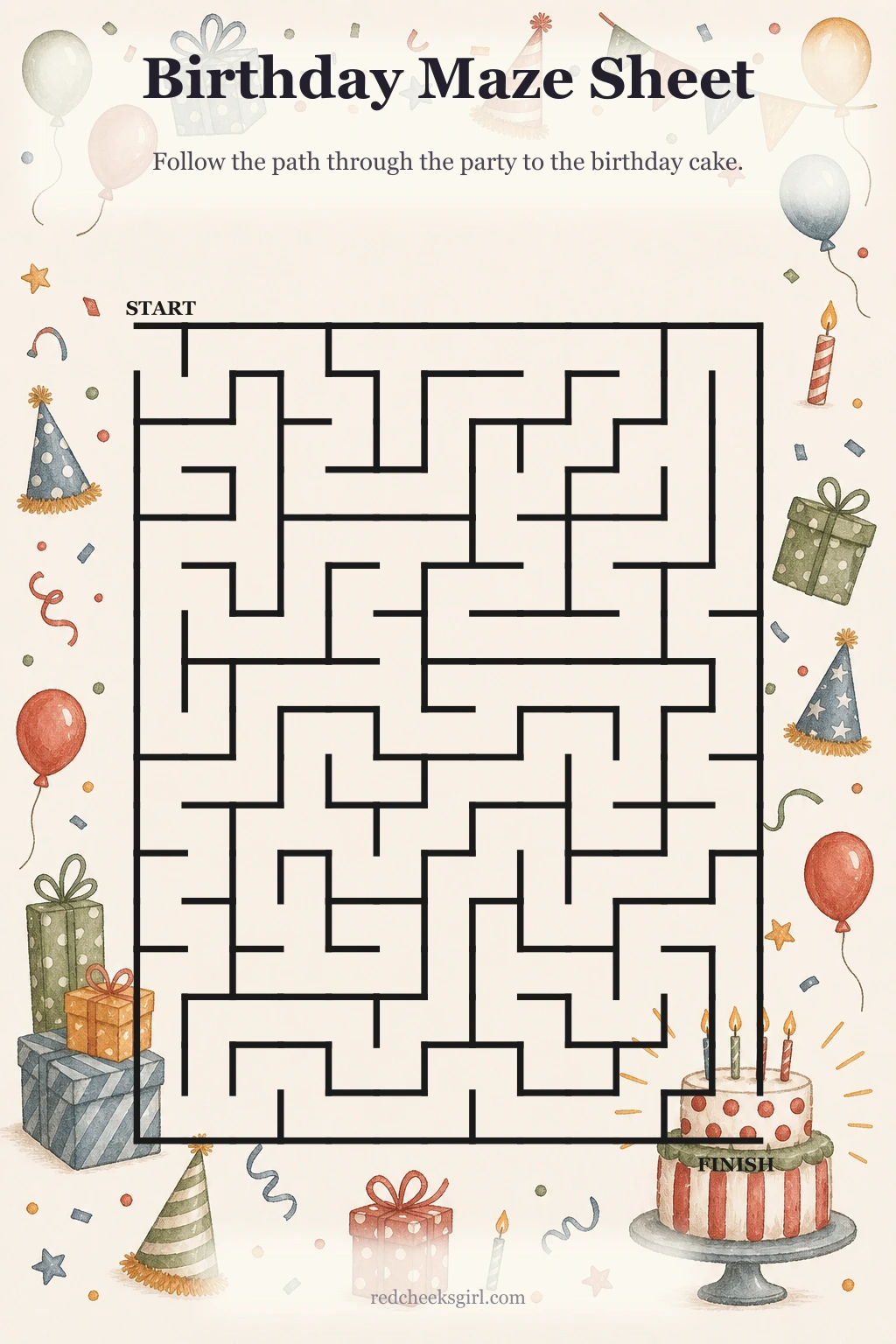
Each child gets a sheet with a fun birthday-themed maze: help the birthday child navigate from ‘START’ (at the front door clutching balloons) through a winding path of party rooms — past the present pile, the dance floor, the limbo stick, the piñata — to reach the cake at the centre marked ‘FINISH.’
The path has dead ends, loops, and cheeky shortcuts that only look like shortcuts. It’s genuinely tricky enough for older kids without losing the 5-year-olds entirely.
Print one sheet per child on regular copy paper. No special supplies needed — just a pencil each. Set a timer for 8 minutes and let them go.
The first child to correctly navigate from START to FINISH and show you the completed path wins a small prize.
You can also run it as a group activity for the little ones, with an adult tracing the path on a big printed version while kids shout directions.
For extra replay value, bring a spare sheet of each maze so children can try again with a different colour pencil and try to beat their own time.
Mazes work especially well for birthday party games for kids because they’re completely self-contained — once you hand out the sheets, the game runs itself and you can spend those precious 8 minutes checking on the cake or herding parents toward the snack table.
They also serve as a natural keepsake: kids take their completed maze home in their party bag as a little memento. Ages 4–10, prep time 5 minutes to print and lay out pencils.
Pro tip: have a couple of extra sheets on hand because approximately 100% of kids will want to try again after finishing.
- Ages 4–10
- Indoor parties
- A quiet breather between active games
- Solo-parent hosting — it runs itself!
9. Sack Race
The Sack Race is basically a guaranteed laugh-fest from the moment the first child tries to hop and immediately falls sideways — in the most delightful way.
Each child steps into a burlap or fabric sack, grabs the top edge with both hands, and on ‘GO!’ hops as fast as they can from the start line to the finish line.
First to cross wins, and everyone who didn’t win still looks absolutely hilarious, so truly, all participants are winners.
This is a best-outdoors game — you need a flat patch of grass of at least 10 metres — but it works on a smooth indoor floor too if it’s long enough.
Sack race bags are cheap to buy as a multipack, or you can use large hessian potato sacks, large pillow cases, or even large reusable shopping bags in a pinch (test them first — they need to be big enough to fit around a child’s body without tripping hazards at the seams).
Set a clear start and finish line with chalk on grass or a strip of coloured tape indoors. For mixed ages, run heats by age group so a three-year-old isn’t racing a ten-year-old; or, mix ages and just make it non-competitive for the youngest group.
Prep time: 5 minutes to mark the course and untangle the bags.
The Sack Race earns its spot in every birthday party games for kids lineup because it requires zero skill beyond enthusiastic hopping — which means a small child can beat a bigger kid purely by staying upright longer, and that pure randomness is exactly what makes it feel fair and thrilling.
For a variation, try a relay format where two teams race in turns, hopping to a cone and back before passing the sack to the next teammate. Ages 3–10 (3–5 year olds may need a shorter course — about 5 metres is plenty).
Pure, magnificent chaos that tires everyone out nicely.
- Sack race bags or large pillowcases (one per child per heat)
- Chalk or coloured tape to mark start and finish lines
- Open flat space of at least 8–10 metres
🛒 What you’ll need
10. Kids I-Spy Sheet
The Kids I-Spy Sheet turns a simple observation challenge into a proper sit-down party game, and it’s one of those printable birthday party games for kids that somehow works for the whole age range in the room without you doing anything extra.
The sheet features one large, busy, hand-drawn birthday party scene packed with 20 hidden objects for children to find and tick off.
The scene shows a party room filled with guests, decorations, and food — and hidden within are specific items listed down the side of the sheet. Each found item gets ticked in the checkbox beside it.
The child who finds the most items in the allotted time wins.
Print one sheet per child on standard copy paper. Give each child a pencil and set a timer for 8–10 minutes.
For younger children who can’t read yet, pair them with an older buddy or read the item list aloud slowly while they scan the picture. For older kids, add a challenge: not only find the item but circle it on the sheet to prove it.
All you need is a printer, paper, and a pencil each — total prep time 5 minutes. The items are varied enough that no two children will spot them in the same order, which makes it a genuinely fair competition across age groups.
I-Spy Sheets are a stealth crowd-pleaser because they look calm and quiet from the outside, but actually generate a low-level hum of intense concentration and whispered ‘I found it!’ cheers that is extremely satisfying to watch as a host.
It’s also a perfect filler game when there’s a gap between activities — hand it out, set a timer, and you’ve bought yourself ten uninterrupted minutes.
For a fun variation, project or print a giant version on A3 paper and let the whole group hunt together, calling out finds to you and you ticking them off on a whiteboard. Ages 3–10, prep 5 minutes.
Read the item list aloud for under-5s rather than expecting them to read — they can still spot the pictures perfectly well.

11. Egg and Spoon Race
The Egg and Spoon Race is the game where the most athletic kid in the room is frequently beaten by the most careful kid in the room, which is honestly beautiful.
Each child balances a hard-boiled egg (or a plastic egg — wise choice for indoors) on a large spoon and walks or runs from the start line to the finish line without dropping it.
Drop the egg and you have to go back to the start and begin again. The catch is that you cannot touch the egg with your hand after the race begins.
First child to cross the finish line with their egg still on the spoon wins. Simple, chaotic, brilliant.
For birthday party use, plastic Easter eggs filled with a small sweet are the practical option — no mess if they drop, and the child gets a treat at the end regardless of placement.
Use large dessert spoons (not teaspoons — even adults struggle with teaspoons, it’s genuinely demeaning). Mark a start and finish line with tape or chalk. The course length should match the age group: 5 metres for little ones, 10–15 metres for older kids.
Run children in heats of four to six so it doesn’t drag, and keep eliminated kids cheering on the sidelines. Prep time: 5 minutes to gather spoons and set up the course.
For a relay variation that keeps teams involved the whole time, have children race to a cone and back before handing the spoon to their next teammate — no one sits around waiting and the competition runs hot right to the final handoff.
You can also add obstacles: a chair to walk around, a hoop to step through, a low rope to step over.
This game ages surprisingly well — even 9- and 10-year-olds get completely absorbed in the concentration required and forget they’re supposed to be too cool for party games. Ages 3–10, prep 5 minutes.
Bonus: bring a hard-boiled egg as the ‘champion’s egg’ for an extra bit of theatre.
Use plastic eggs filled with a small sweet for indoor parties — zero mess, zero tears, and the kids get a prize just for finishing.
🛒 What you’ll need
12. Roll-a-Cake Dice Sheet
Roll-a-Cake is one of those printable birthday party games for kids that sounds low-key and turns into surprisingly competitive fun within about ninety seconds flat.
Each child gets a sheet featuring a blank outline of a birthday cake — layers, decorations, and all — plus a dice roll chart on the side.
Each number on the die corresponds to a cake element: roll a 1 and draw a candle, roll a 2 and draw a layer of frosting, roll a 3 and add sprinkles, roll a 4 and draw a cherry on top, roll a 5 and add a star decoration, roll a 6 and draw balloons beside the cake.
Players take turns rolling a shared die (or each roll their own), and the first child to complete their entire cake — all six elements — wins. The winner yells ‘CAKE!’ instead of ‘Done!’ because everything is better with a theme.
All you need per player is one printed sheet and one crayon or marker. One shared die works for up to eight players; for bigger groups, have one die per table of four.
Print on cardstock for sturdier play if you plan to use the sheets as keepsakes (the kids often love taking their completed cakes home in their party bag). Prep time: 5 minutes to print and gather dice and markers.
Each round takes 10–15 minutes depending on dice luck, and you can play multiple rounds by using a different colour to redecorate the same cake — more rounds, more drama, and a very multi-coloured cake by the end.
Roll-a-Cake works brilliantly as a structured table activity when kids first arrive and you need something to settle the early birds before the rest of the guests show up — it’s self-explanatory, immediately engaging, and requires zero adult involvement once the rules are stated.
It also makes a lovely parallel to actually eating cake later, which kids find deeply satisfying. Display all completed cakes on the party table next to the real cake for a gallery effect that the birthday child genuinely loves.
Ages 4–10, a complete natural hit at any birthday party. The birthday child’s cake gets displayed in the place of honour, obviously.
Pure dice-luck means a 4-year-old has an equal shot at winning as a 10-year-old — and the completed sheets make gorgeous little party bag keepsakes.

🛒 What you’ll need
13. Duck Duck Goose
Duck Duck Goose is one of those birthday party games for kids that feels ancient in the best way — it’s been running on playgrounds for generations because it genuinely works, costs nothing, and gets absolutely everyone moving.
Everyone sits in a circle on the floor except one child, who walks slowly around the outside tapping each person on the head and saying ‘duck.’ When they tap someone and say ‘GOOSE!’
that person leaps up and chases the tapper around the full circle, trying to tag them before they can steal the empty spot and sit down. If the tapper makes it back safely, the goose becomes the new tapper.
If the goose tags them, the tapper goes again.
Zero supplies, zero prep, zero cost. You need enough floor space for all children to sit in a circle with some room to run around the outside — roughly 3 metres in diameter for a group of 10.
This game is best run with 5 to 16 children; any more and the wait between turns gets too long for little ones. To speed things up with a large group, run two circles simultaneously.
For the littlest children (age 3–4), drop the chasing element and just play as a walking lap game where the ‘goose’ simply becomes the new tapper — it keeps the game inclusive and prevents pile-ups. Ages 3–9, prep time 0 minutes.
The game has a natural built-in energy regulator: the running happens in short bursts between calm sitting moments, which makes it ideal for right after a meal when you don’t want a full-throttle sprint game but need to keep the group moving.
Let the birthday child go first as the initial tapper — there is nothing more delightful than a birthday child gleefully whispering ‘duck… duck… duck…’ while eyeing up their best friend. Variation: theme the words to the party — ‘balloon, balloon, CAKE!’
or ‘candle, candle, WISH!’ and watch five-year-olds absolutely love you for it.
- Ages 3–9
- Groups of 5–16 kids
- Zero prep, zero supplies
- Post-meal energy wiggle before the next big game
14. Simon Says
Simon Says is a masterpiece of a party game because it requires zero materials, works in any space, and the adult running it controls the entire pace — which means you can wind kids up OR calm them right down depending on the commands you choose.
One person is Simon (start with yourself or the birthday child) and issues instructions: ‘Simon says pat your head!’ Everyone must obey. But if Simon gives a command WITHOUT saying ‘Simon says’ first and a child still does it, that child is out.
The last child remaining wins. The trick as Simon: deliver commands in rapid fire to catch people out, then slow down to lull everyone into false security before a sneaky trap.
Absolutely zero prep or supplies needed — it’s pure you and the group. The game works from ages 4 to 10 and plays best with 5–20 children.
For birthday party use, theme the commands to the occasion: ‘Simon says act like you’re blowing out birthday candles!’ ‘Simon says do your best robot dance!’ ‘Simon says pretend to open a big present!’
The themed commands get giggles even from the eliminated kids watching on the side.
Let the birthday child be Simon for at least one round — watching a 6-year-old wield that much power over a roomful of peers is genuinely one of the best things you’ll see all day.
Simon Says has a stealth superpower for the solo-parent host: it works as a wind-down game (slow, silly commands), a wind-up game (fast physical commands like jumping jacks and spinning), or a transition tool (‘Simon says walk quietly to the table for cake!’).
I’ve used that last one approximately 47 times and it works every single time. Ages 4–10, prep time 0 minutes.
The only equipment you need is a slightly theatrical voice and a willingness to get completely outplayed by a seven-year-old who spots your non-Simon command immediately.
Use ‘Simon says walk to the table’ as your secret weapon to transition the group to cake time — kids follow it without thinking. Every. Single. Time.
15. Freeze Dance
Freeze Dance is the game that burns the most energy per square metre of any birthday party game for kids, which makes it scientifically the ideal post-cake activity.
Hit play on a playlist of the birthday child’s favourite songs, and every child dances with full commitment. The moment the music pauses, every child must freeze completely still — no wobbling, no giggling (okay, giggling is unavoidable), no shifting feet.
Anyone who moves gets a fun ‘mission’ to complete (five star jumps, a silly dance alone for five seconds) before rejoining — no elimination, maximum mayhem. Last song standing: everyone collapses dramatically and you have a few minutes of recovery time.
You need a phone or Bluetooth speaker and a playlist. That’s it. Prep time: 2 minutes to queue up songs.
For the birthday child’s playlist, let them choose 8–10 songs in the week before the party — they will take this responsibility very seriously and feel deeply honoured by the task.
Play this game in a clear open space; push any furniture to the edges and roll up rugs if indoors.
For mixed ages, position yourself near the speaker so you can vary the pause frequency — pause more often for a raucous group, less often for a focused one. The whole game works for 5–25 kids simultaneously.
Freeze Dance has the rare quality of being genuinely more fun with a bigger group, which makes it perfect for the large mixed-age party where other games would get unwieldy.
Adding a theme to the dancing instructions keeps older kids from going through the motions: ‘dance like you’re underwater!’, ‘dance like a robot who just got an update!’, ‘dance like you’re carrying a very tall cake!’
The parent controlling the music is the entire engine of this game, so plan your pauses like a DJ — build anticipation, surprise them, catch them right when they relax. Ages 3–10, prep 2 minutes.
No eliminations means nobody sulks — and dancing-challenge forfeits keep every child in the game laughing rather than sitting on the sidelines.
16. Treasure Hunt
A Treasure Hunt is the game that gets kids sprinting around the party space with purpose, which is exactly what you want when sugar levels are approaching critical.
Hide 15–20 small ‘treasure’ items (wrapped sweets, sticker sheets, mini toys) around the party space before guests arrive — tuck them behind cushions, under chairs, in plant pots, along windowsills, behind the birthday banner. Give every child a small bag to collect their finds.
Set a timer for 8–10 minutes and let them search. At the end, each child counts their haul privately, and you give a small bonus prize to the child with the most finds — but everyone keeps everything they found, so every child wins something.
The prep is the slightly time-intensive part — budget 15–20 minutes to hide items before guests arrive, or rope in a partner to help.
Make a rough mental map of where everything is so you can guide the very young children who look baffled after three minutes.
For mixed age groups, stagger the start: let the under-5s search for two minutes before the older kids join, giving the littlest ones a head start that levels the playing field beautifully.
Alternatively, give different-coloured items to different age groups so everyone has their own ‘target’ items and can’t pinch each other’s finds. Budget: very low — pound-shop treats and sticker packs work perfectly.
The Treasure Hunt is a brilliant birthday party game because it scales to any space — indoors, outdoors, in a garden, in a flat, at a village hall.
For a storyline version that older kids adore, write a simple series of four clue cards that lead from one hiding spot to the next before revealing the final ‘treasure’ (a party-sized prize like a puzzle or a craft kit).
Reading the clues aloud at each location creates a little theatre that even 3-year-olds enjoy even if they can’t read. Ages 3–10, prep 15–20 minutes.
If you enjoy simple games that kids go absolutely wild for, a Treasure Hunt belongs in your permanent hosting toolkit.
- 20+ small prizes to hide (sweets, stickers, mini toys)
- One small bag or cup per child
- A timer
- 15–20 minutes of pre-party prep time to hide items
17. Balloon Pop Relay
The Balloon Pop Relay is exactly what the title promises: balloons get popped, children run relay-style, chaos ensues, everyone has an absolute blast. Split the group into two equal teams (mix ages within teams for fairness).
The first player in each team sits on an inflated balloon and pops it by sitting on it, then runs to a turning cone and sprints back to tag the next player, who then grabs a fresh balloon, blows it up themselves (for older kids) or pops a pre-inflated one (for younger kids), and repeats.
First team to pop all their balloons wins. The popping sound alone will generate screams of laughter from the entire party.
You need: a bag of balloons (inflate half in advance for the younger children’s team), a clear relay track of about 8–10 metres, and a cone or marker to turn around. Prep time: 10 minutes to inflate the younger-group balloons ahead of time.
If you’re running this indoors on a hard floor, lay down a mat or rug at the sitting-popping station so knees don’t suffer.
For safety, check that no children have latex allergies before you bring balloons out — mylar or foil balloons don’t pop as satisfyingly but are a safe swap. Ages 4–10 for the popping version; supervised under-4s can just stomp on balloons laid on the floor.
Balloon Pop Relay is one of those birthday party games for kids where the noise and physical comedy of popping balloons becomes its own entertainment — the child dramatically sitting on a balloon and bouncing twice before it finally pops is genuinely Oscar-worthy content.
For a non-relay variation, tie an inflated balloon to each child’s ankle and let them try to pop each other’s balloons while protecting their own — last balloon intact wins.
This is the ankle-balloon battle version and it is absolute carnage (in the best possible way). Ages 4–10, prep 10 minutes.
- Large bag of balloons (latex-free if needed)
- Cones or floor tape for the relay course
- A flat clear space of 8–10 metres
🛒 What you’ll need
18. Limbo
Limbo is one of those birthday party games for kids that requires exactly two adults and a stick — and produces an enormous amount of joy per metre of clearance.
Two adults hold the ends of a broomstick, pool noodle, or ribbon at roughly shoulder height to begin. Each child takes a turn leaning back and shuffling forward under the stick without touching it or falling over.
After everyone has had a go, the stick drops one notch lower. Anyone who touches the stick, falls, or can’t make it under is out. The last child to remain in the game wins.
Crank some music and you’ve got a party centrepiece game that runs for 10–15 minutes easily.
You need: a broomstick, pool noodle, or long stick, and two adults (or a door frame with a ribbon taped across it works solo). A pool noodle is the ideal limbo bar because it’s soft — no shin injuries, no drama.
You can buy inexpensive limbo sets from party shops that include a freestanding bar and clips for height adjustment, which is even easier for solo hosting because you don’t need a second adult to hold the ends.
Start high enough that even the tallest child can walk under comfortably — the game is about the slow descent, not immediately weeding out anyone. Ages 3–10, prep time 3 minutes.
The unofficial rule of Limbo at a kids’ party is that the adults have to attempt it at some point, and the children will absolutely demand it. This is both humbling and incredibly entertaining for the group, so I’d recommend leaning into it fully.
Variation: play Limbo in reverse — start low and raise the stick, seeing who can jump over it! This ‘High Jump Limbo’ gets older kids genuinely athletic and competitive and requires slightly less spinal flexibility from the adults involved.
The birthday child gets an automatic extra life (two chances before they’re out) because it’s their party and they can limbo if they want to.
Use a foam pool noodle as your limbo bar — it is soft, lightweight, and snaps back to shape if a child walks into it, which they will.
🛒 What you’ll need
19. Musical Chairs
Musical Chairs is the elimination classic that makes every child simultaneously terrified and thrilled — and that delicious tension is exactly what makes it one of the most enduring birthday party games for kids ever invented.
Set up one fewer chair than the number of players, arranged in a circle or a line facing outward. When the music plays, everyone walks briskly around the chairs. The moment the music stops, every child scrambles for a seat.
The child left standing is out, and one chair is removed. This repeats until one child, one chair, and one very intense final showdown remain. Crowd the eliminated kids together to cheer on the finalists.
You need chairs (or cushions on the floor, which works equally well and is safer for younger kids), a speaker, and a playlist. Arrange cushions on the floor as a great alternative for under-5s — softer landings, less shoving, same excitement.
For a large group, run two parallel games so no one waits more than a minute before their round. Prep time: 5 minutes to arrange the seating.
Pro tip: vary the music length between pauses from 4 seconds to 30 seconds so children can never predict when the music will stop — that unpredictability is the whole game. Ages 3–10, though 5–10-year-olds play it with the most intensity.
A hosting trick that makes Musical Chairs run smoother: have a parent stand at the chair arrangement calling ‘everybody walk, no running!’ because the sprint-and-shove version can end in tears. Enforce a ‘gentle sit’ rule and demonstrate it beforehand.
For a variation that removes the elimination element (great for very young or sensitive groups), simply let everyone sit on whatever chair or cushion they can find when the music stops — the child without a spot gets a small sticker prize and watches the next round as the Official Music Stopper, which they love.
Ages 3–10, prep 5 minutes.
Swap chairs for floor cushions for under-5s — safer, softer, and still exactly as exciting when the music stops.
🛒 What you’ll need
20. Sleeping Lions
Sleeping Lions is the game that saves parties. Genuinely.
After three high-energy games in a row, when you can see that one child is about to reach their emotional limit and you need the group to decompress without admitting the party is winding down, Sleeping Lions is your secret weapon.
Every child lies down on the floor, completely still, eyes closed (or at least semi-closed), pretending to be asleep. The adult tiptoeing around them tries to get them to move, laugh, or open their eyes using only words or silly noises — no touching.
Any child who moves, laughs, or opens their eyes is ‘woken up’ and becomes a helper, joining you in trying to wake the remaining lions. Last lion ‘asleep’ wins.
Zero supplies. Zero prep. Announce the game, watch every child immediately fling themselves dramatically to the floor, and enjoy the three to five minutes of near-silence that follows.
For a birthday party, this game works beautifully as the bridge between active games and cake time — it resets the group’s energy, gives overstimulated children a moment of sensory calm, and gives you time to light candles, arrange plates, and compose yourself.
The helpers-who-were-woken-up can whisper or do very gentle silly dances beside the sleeping lions, which keeps them involved rather than sulking about being out.
Sleeping Lions is deeply underrated as a birthday party game for kids because it looks like a wind-down game but is actually very strategic — older kids especially get genuinely competitive about lasting the longest, which means you get a room of children lying quietly still while also intensely invested in the outcome.
The funniest moment is always when the adult crouches down next to a child and whispers something silly and the child’s face slowly contorts trying not to laugh. It’s beautiful. Ages 3–10, prep time 0 minutes. Play this right before cake. Thank me later, honestly.
Zero supplies, zero prep, and it genuinely calms a hyped group in under five minutes — slot it right before cake lighting for maximum effect.
21. Hot Potato
Hot Potato is fast, frantic, and deeply funny — every child passes a small object around the circle as quickly as possible while music plays, because nobody wants to be holding the ‘hot potato’ when the music stops.
Use a soft ball, a bean bag, a small stuffed toy, or literally any object that’s safely passable — no sharp edges, nothing that splatters.
Sit or stand in a circle, start the music, and watch the potato fly around the group at increasing speeds as the tension builds.
Whoever is holding it when the music stops is out and takes a seat in the middle to cheer on the remaining players. Last player in wins.
The setup is the same as Musical Chairs but without any furniture: just a circle of children and one object. Music is essential — the stopping of music is the entire mechanism of the game. Keep the pause intervals unpredictable and dramatic for maximum tension.
For younger kids, run the game without elimination: everyone stays in, and whoever holds the potato gets to choose a silly forfeit from a jar (do five bunny hops! Make your best monster roar!) before the game continues.
This keeps the energy level high without the sadness of being out. Ages 3–10, prep time 1 minute.
Hot Potato is one of those birthday party games for kids that accelerates naturally — at the start, kids pass it at a normal pace, but within two minutes, everyone is basically flinging it at the next person and the laughter volume doubles.
For a birthday spin, use a small wrapped ‘surprise ball’ (layers of tape with tiny treats hidden inside) as the potato, so whoever is holding it when the music stops gets to unwrap one layer before the game continues.
This adds a reward element that keeps eliminated kids from being sad — they actually secretly want to be holding it. Ages 3–10, prep 1 minute.
Use a surprise ball as the potato — wrap layers of tape around small treats so each elimination reveals a tiny prize. No one minds being out.
22. Birthday Wishes for the Star
Birthday Wishes for the Star is the one quiet keepsake moment every birthday party for kids deserves — and it takes about five minutes to run but lasts forever.
Every child at the party gets a small card and a pencil, and writes (or draws, for the little ones) one birthday wish or favourite memory for the birthday child.
The cards are collected in a decorated box or envelope and given to the birthday child to read either at the party or at bedtime.
This is the game that makes the birthday child feel genuinely, warmly celebrated beyond the presents and cake — and it usually makes the parents a little emotional too, which is just a bonus.
Print simple wish cards in advance (a card with ‘My birthday wish for you is…’ and a blank write-in line plus a space to draw a picture), or just use blank index cards. Provide a variety of pens, pencils, and stickers for decorating.
For children under 5 who can’t write yet, a helper adult can scribe their words while they draw a picture. Set a timer for 5 minutes, play soft background music, and the group settles into a genuinely sweet moment between all the noise and running.
Collect the finished cards in a little box or a tied-up envelope and present it to the birthday child as a ‘secret gift from all your friends.’ Prep time: 5 minutes to print and cut cards.
Birthday Wishes for the Star works best right before the birthday child opens their presents or right after cake, when the group is naturally calmer.
It gives every single guest — including the shy children who perhaps didn’t shine in the running games — a moment to contribute something meaningful to the celebration.
For older children (7–10), encourage a full sentence or a specific memory: ‘My favourite thing about you is…’ or ‘My birthday wish for you this year is…’ The depth of what a child writes when given space to reflect is genuinely touching.
Slide these wish cards into the birthday child’s birth month keepsake if you’re building one — a beautiful time capsule moment.
Have a helper scribe for under-5s — they can dictate the most heartfelt wishes while drawing a picture, and those are usually the best ones in the whole collection.

23. Bean Bag Toss
Bean Bag Toss is the carnival-game classic that works beautifully at birthday parties because the skill requirement scales naturally with age — a three-year-old can stand one metre away and toss straight down into a bucket, while a ten-year-old lines up a proper throw from three metres.
Set up three to five containers at increasing distances: a large laundry basket up close, a bucket in the middle, and a smaller bucket or hoop furthest away. Assign point values (1 point for the big basket, 5 for the smallest bucket).
Each child gets three bean bags per turn and adds up their score. The child with the highest score after two rounds wins a prize.
Bean bags can be bought cheaply in multipacks or made at home by filling old socks with dry rice and tying the ends — I’m not going to tell you which method is more impressive to guests, but I will say rice socks have a specific satisfying weight that’s actually great for throwing.
Mark the throwing distances with chalk or tape. The containers can be cardboard boxes, large tubs, or hula hoops flat on the ground if you don’t have buckets. Prep time: 10 minutes to set up the course and mark distances.
For a birthday theme, write the point values on paper and tape them to each container in matching party colours.
Bean Bag Toss works particularly well mid-party as a ‘station game’ that runs alongside other activities — set it up in one corner and let kids drift over to take turns rather than running it as an all-group game.
This gives you flexibility when the group splinters into different energy levels (some kids are ready to crash, others want more action).
Bean bag toss games are simple enough for little ones but still competitive for older kids, making it one of the most genuinely mixed-age friendly options in the whole birthday party games for kids toolkit. Ages 3–10, prep 10 minutes.
Let younger children stand closer and toss into the large basket — no one feels left out and they get to participate at exactly their own level.
🛒 What you’ll need
24. Obstacle Course Race
An Obstacle Course Race is the kind of birthday party game that every single child thinks is specifically designed for them — the fast ones want to set a time record, the creative ones want to find clever shortcuts, and the younger ones are just thrilled to crawl through a tunnel.
You design a short course using whatever you have: crawl under a table, step through hula hoops laid flat on the ground, hop over a low foam noodle, run around two chairs, balance across a chalk line, throw a bean bag into a bucket, then sprint to the finish.
Children run one at a time while you time them on your phone, then post the times on a scoreboard. Fastest time wins.
Supplies depend entirely on what you have available — the goal is to assemble 5–8 obstacles from household items and garden gear. A tunnel can be two chairs with a blanket draped between them. Balance beams can be two strips of tape on the floor.
Hurdles are pool noodles laid across stacked books. The more thematic the obstacle names, the better: ‘crawl through the birthday cave,’ ‘jump over the candle,’ ‘toss the present into the box.’
Set up the course before the party (prep time 15–20 minutes) and run it as a timed event with each child cheered on by the watching group. Ages 3–10 (adapt obstacle difficulty by age — a simpler route for the little ones).
The Obstacle Course Race is pure gold as a party game because it’s simultaneously competitive for the older kids and completely unthreatening for the youngest, who are just happy to have a go.
For a team variation, split into two teams and run a relay race format: each child completes the course, tags the next player, and the team whose last player finishes first wins.
This version keeps the entire group engaged throughout rather than just during their individual run. For an even wilder option, run it as a two-person simultaneous race down parallel courses — head-to-head racing with a live crowd is absolute theatre. Ages 3–10, prep 15–20 minutes.
- Hula hoops for stepping through
- Pool noodles as hurdles
- Chairs and blankets for a tunnel
- Chalk or tape for balance lines
- A stopwatch or timer app
🛒 What you’ll need
25. Parachute Games
Parachute Games are in a category of their own — they’re collaborative rather than competitive, which makes them uniquely brilliant for mixed-age birthday parties where you want every child involved at exactly the same time without anyone losing.
Every child grabs a handle around the edge of a colourful play parachute and the whole group moves together.
The classic starter is ‘Mushroom’: everyone lifts the parachute high above their heads simultaneously, steps forward, and pulls it down behind them, trapping a giant dome of air that the kids sit inside — it billows up like a parachute canopy and the children go absolutely wild for it.
Then try ‘Popcorn’: toss a dozen soft foam balls onto the parachute surface and have everyone shake it as fast as they can to pop the balls into the air like popcorn.
A play parachute is the one purchase worth making if you’re hosting regular birthday parties — a good one costs around £15–25 and lasts for years.
Parachutes are inclusive, and everyone can participate; they are an enjoyable sensory experience for many kids. You need enough open space for children to stand in a circle with arms extended — outdoors is ideal, but a cleared large room works.
For the ‘Swap’ game, lift the parachute high and call out a shared trait (‘everyone wearing red!’ or ‘everyone with a summer birthday!’) — those children dash under and swap spots before the parachute falls.
As the kids lift the parachute high above them, call out a detail that some players will have in common — whichever players share that detail must run and trade places with each other before the parachute falls. Prep time: 5 minutes to clear space and unpack the parachute.
The magic of Parachute Games at a birthday party is that the birthday child can shout out the swap categories (‘everyone who gave me a present!’ or ‘everyone who loves chocolate cake!’), which gives them a glorious moment of being the centre of the game.
The energy burns hard — all that shaking, running, and lifting is legitimately good exercise — but it never feels competitive or exclusionary.
Parachute games promote working together, physical activity, and more, all while kids have fun. Ages 3–10, group size 6–20 kids, prep 5 minutes.
If you end with the Mushroom dome and sing Happy Birthday inside it, you will become an actual legend in that child’s memory forever.
Everyone plays at once, nobody gets eliminated, and it burns serious energy while feeling like pure magic — especially the mushroom dome moment.
🛒 What you’ll need
Frequently Asked Questions
How many birthday party games for kids should I plan for a 2-hour party?
Plan 6–8 games for a two-hour party, but only expect to run 4–6 of them. Having extras up your sleeve means you’re never stuck if a game ends faster than expected or flops with your specific group (it happens to everyone — no shame).
Mix active games with one or two printable activities and a quiet moment near cake time. For a two-hour party, plan 4-6 games and include a mix of active and calm games, with 1-2 backup games ready.
What are the best birthday party games for kids of mixed ages?
Games that use luck, teamwork, or observation tend to equalise across ages beautifully. Parachute Games, Freeze Dance, Musical Chairs, Pass the Parcel, and printable sheets like Bingo and I-Spy all work across wide age ranges because the skill requirement isn’t fixed.
The best games for mixed ages include scavenger hunts, musical chairs, freeze dance, charades, and relay races, which can be easily adapted with simpler rules for younger players. For active games, shorter courses for younger children level the playing field physically.
Can one parent run birthday party games for kids solo?
Absolutely — every game in this list is designed with the solo parent in mind. The key is choosing games that are self-explanatory (Simon Says, Duck Duck Goose, Sleeping Lions), or setting up printable activities that run themselves once the sheets are handed out.
Transition games like Sleeping Lions and Simon Says are especially useful because you control the pace entirely. Lay out your game sequence in order before the party starts so you’re never searching for supplies mid-game.
What supplies do I actually need for birthday party games for kids?
The most useful items to have on hand are: a Bluetooth speaker with a charged playlist, a bag of balloons, a set of bean bags or soft balls, a roll of painter’s tape (for marking lines and courses), and a printer for the printable game sheets.
Optional but brilliant: a play parachute, a piñata, and a box of small prizes like stickers, mini toys, and wrapped sweets.
Most games on this list need zero or minimal supplies — Freeze Dance, Simon Says, Duck Duck Goose, and Sleeping Lions all run on nothing but imagination.
At what age can kids play birthday party games?
Most of the games on this list work from age 3 upward with minor adjustments. For under-3s, focus on sensory-friendly, non-competitive options: Parachute Games, Pass the Parcel (no elimination), and simple Freeze Dance. Ages 4–6 love Duck Duck Goose, Musical Statues, and Limbo.
Ages 7–10 are ready for fully competitive versions of everything, including timed Obstacle Course Races and the Riddle Sheet. For younger kids (ages 3-5), plan shorter games of 5-10 minutes each.
How do I keep birthday party games from turning into tears and meltdowns?
The golden rule: avoid pure elimination games with young children, or add a redemption element (a forfeit that keeps them involved as a helper or judge). Alternate high-energy games with calmer ones to prevent overstimulation.
Always have small prizes for everyone, not just winners — stickers, sweets, or a completed printable sheet all count. Have prizes for everyone, not just winners — small party favours for participation prevent meltdowns. And deploy Sleeping Lions before cake. Seriously.
📌 Save These for Later
Loved these? Pin your favorite image below so you can find this list again when you’re planning.



20 road trip games for every seat in the car — plus a printable pack to prep before you leave. Hou

20 road trip games for families that keep every age happy — plus 13 free printable sheets to downl
20 sleepover games for kids perfect for a first big-girl slumber party — active, quiet & lots of p
Leave a Reply