

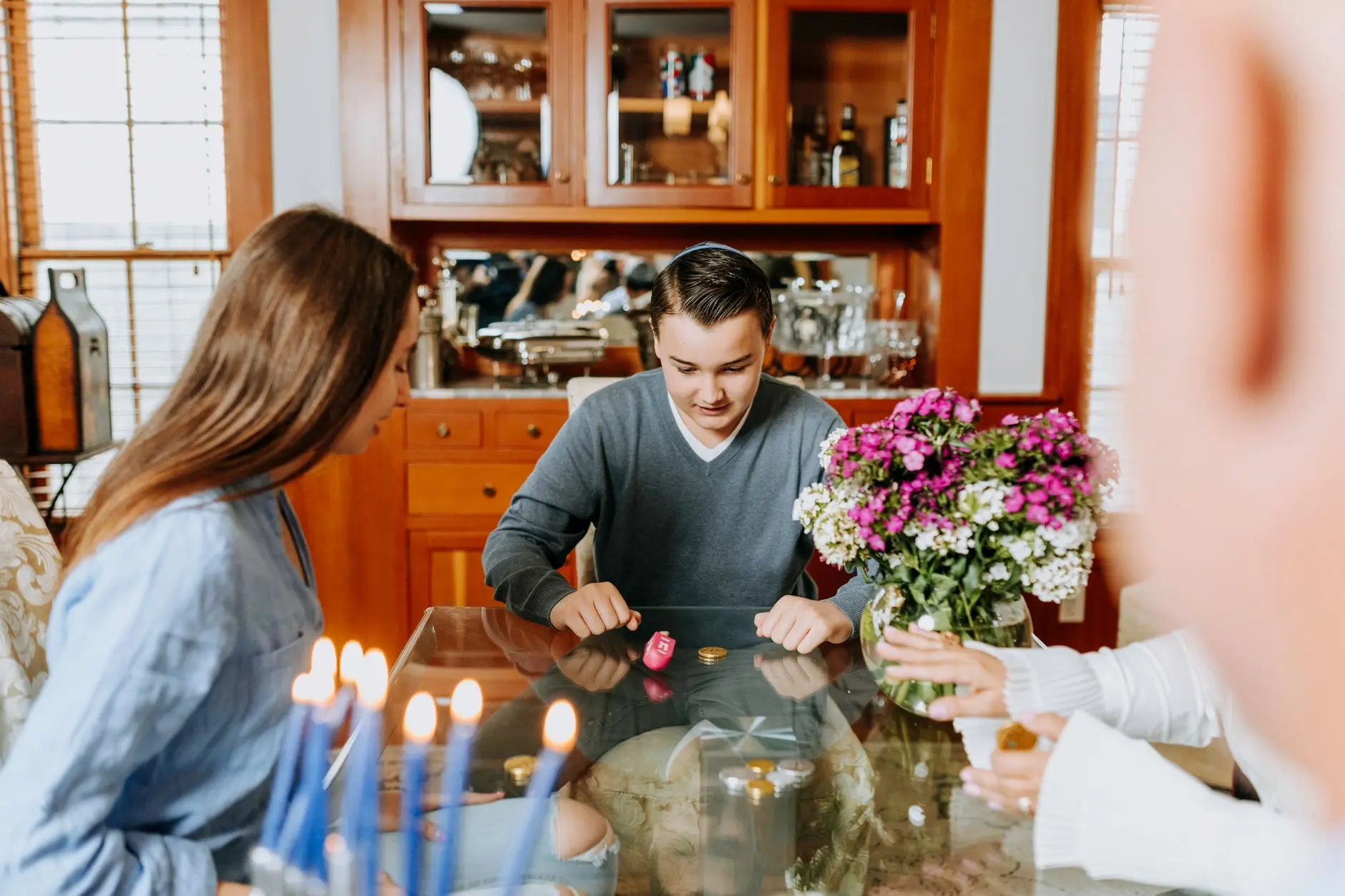
If you are planning a Hanukkah party and want more than just a round of dreidel before everyone drifts toward the latke table, you have landed in exactly the right place.
These 18 hanukkah games cover everything from lively active competitions to calm, meaningful moments — all rooted in the real traditions of the Festival of Lights: the menorah, gelt, sufganiyot, the eight nights, and the incredible story of the Maccabees.
Whether your crowd is five years old or eighty-five, there is something here that will make this Hanukkah genuinely memorable.
The beauty of Hanukkah is that it already comes loaded with game-ready elements — spinning tops, chocolate coins, jelly doughnuts, candles. All we are doing is leaning into the holiday that already exists, which tbh is the most fun way to host anything.
So grab your dreidels, stock up on gelt (you will need it for more than one game on this list), and get ready for eight nights of laughter.
And if you are also hunting for gift ideas while you are in full holiday-planning mode, the Christmas Gift Guide next door has some great picks for the people on your list who celebrate both seasons.
This post contains affiliate links — if you buy through them, I may earn a small commission at no extra cost to you.
- Classic Dreidel Game
- Hanukkah Bingo
- Gelt Scavenger Hunt
- Eight Nights Trivia
- Dreidel Spinning Contest
- Hanukkah Would You Rather
- Hanukkah Family Feud
- Guess How Many Gelt
- Pin the Shamash on the Menorah
- Latke Flipping Race
- Hanukkah Charades
- Hanukkah Wishes Circle
- Menorah Building Relay
- Sufganiyot Decorating
- Festival of Lights Memory Share
- Guess the Hanukkah Song
- Gelt Coin Stacking
- What Are You Grateful For Round
- Frequently Asked Questions
1. Classic Dreidel Game
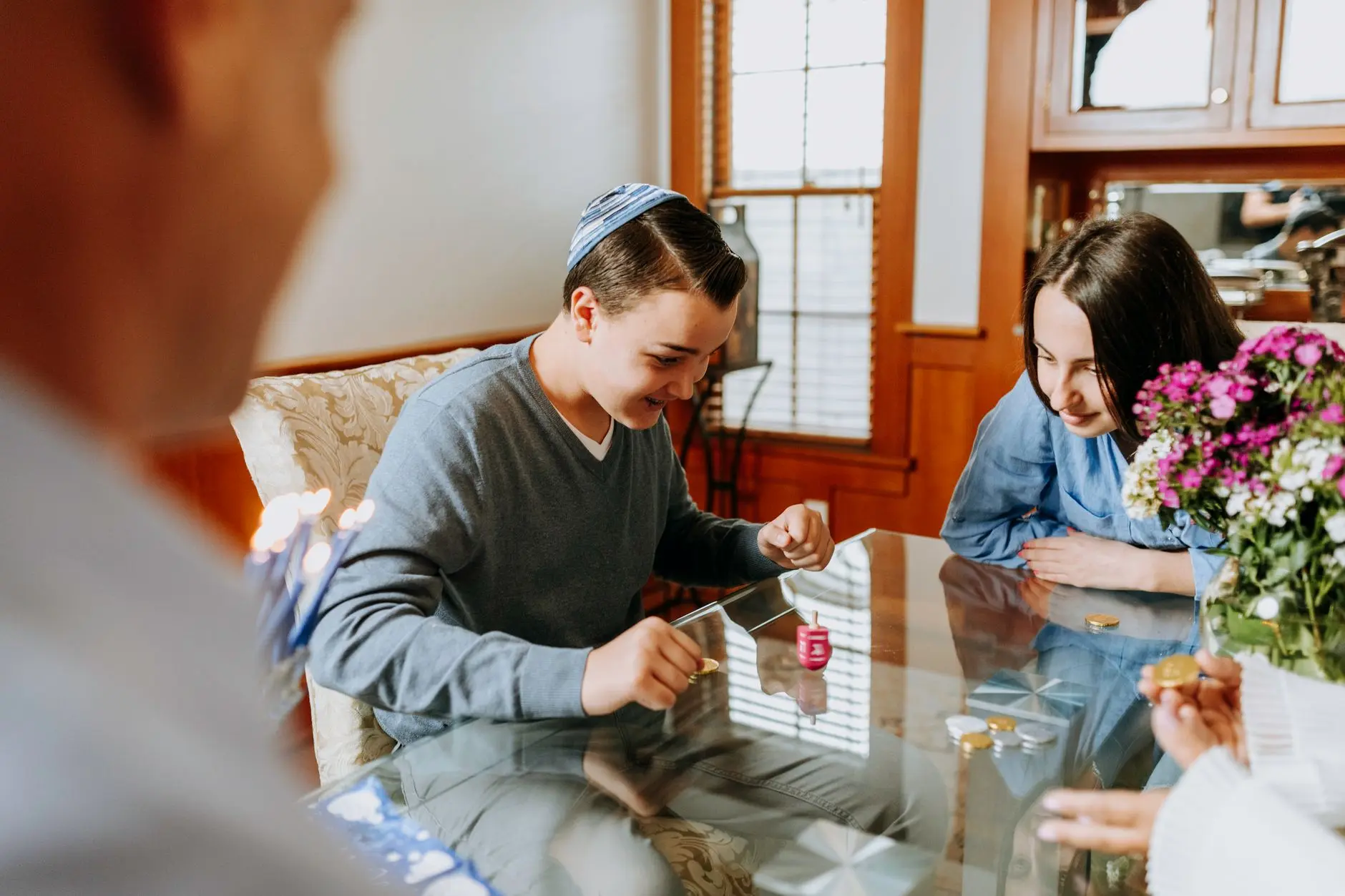
The classic dreidel game is the undisputed heartbeat of Hanukkah and the perfect way to kick off any party.
Every player starts with an equal pile of gelt — chocolate coins work beautifully, but real pennies, nuts, or even small wrapped candies are all fair game. Before each round, everyone antes one piece into the center pot, then players take turns spinning the dreidel.
The four Hebrew letters on its sides each carry an instruction: Nun (do nothing), Gimel (take the whole pot), Hey (take half), and Shin (add one to the pot).
Play continues until one triumphant soul has collected everything — or until the latkes are ready, whichever comes first.
To set up, sit everyone in a circle and divide the gelt evenly — about ten to fifteen pieces per person is the sweet spot.
Any time the pot runs empty or is down to a single piece, everyone antes in again to keep the game moving.
The beauty of dreidel is that it genuinely scales: a round for two people is just as fun as a chaotic table of twelve, and the pace adjusts naturally to the group.
Keep a small reserve of extra gelt nearby because someone will always run out faster than expected (it will be the person who was bragging about their strategy).
Here is the part that makes this so much more than a game: the four letters — Nun, Gimel, Hey, Shin — are an acronym for the Hebrew phrase Nes gadol hayah sham, meaning ‘a great miracle happened there.’
Every spin is a small nod to that story. For a grown-up version, swap the chocolate coins for a small prize pool — everyone throws a dollar or a wrapped gift into the center — and suddenly the stakes feel very real.
It is also a lovely game to explain to guests who have never played before; the history tends to spark the best dinner-table conversations of the whole night.
Buy at least two or three dreidels — they have a habit of spinning off the table and into the abyss between the cushions.
🛒 What you’ll need
2. Hanukkah Bingo
Hanukkah Bingo swaps the usual numbers for holiday symbols and vocabulary, turning a timeless party game into a genuinely educational and festive experience.
Each card is a 5×5 grid packed with Hanukkah images and words: menorah, dreidel, gelt, shamash, latke, sufganiyah, Maccabee, Star of David, candle, olive oil, miracle, eight nights, Judah, sevivon, blue and white, flame, temple, dedication, Hanukkiah, nes, gimel, chai, hora, sov, and FREE SPACE in the center.
The caller draws from a matching deck of cards or a bag of tiles and reads each one aloud — guests dab their matching square and race to five in a row.
Print one unique card per guest (shuffle the grid order on each sheet so no two cards are identical), and use small pieces of gelt as daubers — it doubles the holiday theme and means every winner already has their prize sitting right on their card.
For a larger group, print extra cards and let people play two at once for double the chaos. The caller can add a short fun fact with each draw — ‘Sufganiyah! Did you know that Israelis eat millions of these jelly doughnuts during Hanukkah?’
— which makes the game feel more like a celebration than a contest.
Bingo is hands-down one of the best games for a mixed-age crowd because zero skill is required and everyone has a genuine shot at winning.
Offer a small gelt prize for a single line, a bigger one for a full card blackout, and watch the competitive grandparents emerge.
You can also theme the prizes: a little bag of chocolate coins, a mini dreidel, or a Hanukkah-scented candle all make sweet, on-theme rewards that feel intentional rather than random.
- Mixed ages from kids to grandparents
- Groups of 6–30 players
- Opening game to warm up the party

🛒 What you’ll need
3. Gelt Scavenger Hunt
A Gelt Scavenger Hunt is exactly what it sounds like: you hide chocolate coins all over the party space and everyone races to find as many as they can. But the real magic is in the clues.
Instead of just pointing people to hidden spots, write eight Hanukkah-themed riddles — one for each night — that lead hunters from location to location, with a small stash of gelt waiting at every stop.
The final clue leads to the grand prize: a bigger bag of gelt, a Hanukkah gift, or the honor of spinning first in the evening’s dreidel game.
Write clues that reference real Hanukkah traditions and the actual layout of your home or party venue. For example: ‘Where do we place the light that chases away the dark? Look near the window where the Hanukkiah sparks.’
Hide five coins behind the menorah, then the next clue leads to the kitchen (‘Where the oil sizzles and the latkes fry’) with coins tucked beside the stove.
For adult parties, make the riddles wordplay-heavy and genuinely tricky — nobody wants a scavenger hunt that is over in ninety seconds.
Teams of two or three work better than solo play; it is more collaborative and way funnier when a pair confidently goes the wrong direction.
This game works beautifully as a way to pull guests away from the food table and actually explore the space, which is great for parties where not everyone knows each other yet.
For families with young children, simplify the clues and let kids partner with an adult — they love the adventure, and the grown-ups love watching the excitement when a clue is cracked.
Award bonus gelt for teams that can recite what each clue referenced in the holiday story. It turns a treasure hunt into a genuinely meaningful journey through Hanukkah traditions.
- Chocolate gelt coins (lots of them)
- 8 printed or handwritten riddle clues
- Small bags or cups to collect coins in
- A ‘grand prize’ for the winning team
🛒 What you’ll need
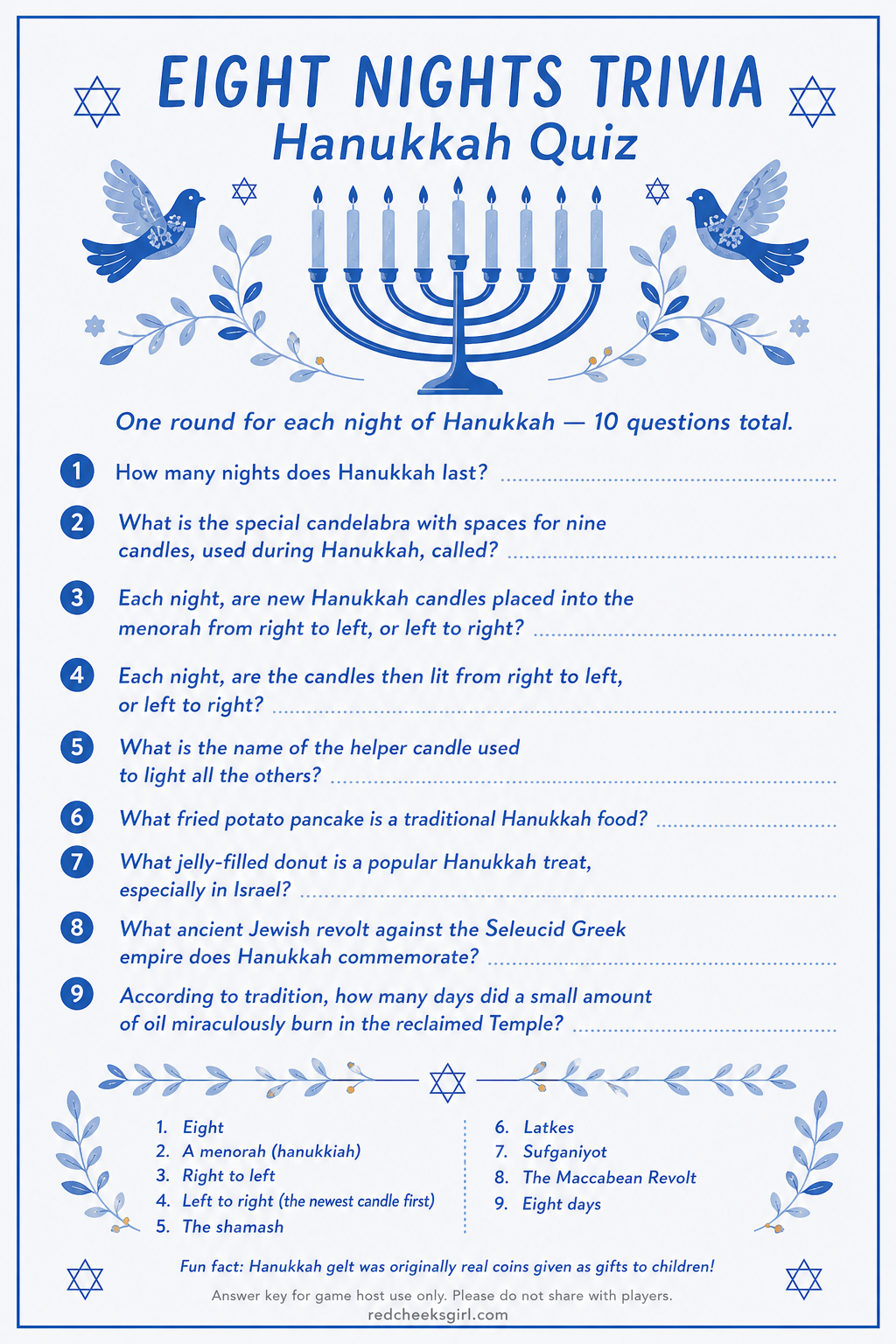
4. Eight Nights Trivia
Eight Nights Trivia is your classic Hanukkah quiz, organized into eight themed rounds — one for each night of the holiday. Round 1 covers the history of the Maccabees. Round 2 digs into menorah and candle-lighting traditions. Round 3 tests knowledge of Hanukkah foods.
Round 4 is all about the dreidel. Round 5 explores Hanukkah music. Round 6 covers Hebrew words and their meanings. Round 7 features Hanukkah-themed pop culture. Round 8 is the lightning-round ‘true or false’ finale.
Each round has three questions, giving guests twenty-four questions total to work through on their printed sheet.
Sample questions to include: ‘What do the four letters on a dreidel stand for?’ (Answer: Nes gadol hayah sham — a great miracle happened there.) ‘How many total candles are used across all eight nights of Hanukkah?’ (Answer: 44, including the shamash each night.)
‘What does the word Hanukkah mean in Hebrew?’ (Answer: Dedication.) ‘Which candle lights all the others on the Hanukkiah?’ (Answer: The shamash.)
Guests fill in their answers on the printed sheet, then the host reads the answer key aloud — awarding one point per correct answer and a bonus point for any answer that includes an interesting extra fact.
This game works wonderfully as a sit-down activity between courses, and it is a subtle way to share the holiday’s rich history with guests who may be less familiar with it.
The team format — four players per table, one sheet — sparks great conversation and gentle arguments (‘Wait, is it 44 or 36 candles?!’) that last well into dessert.
Crown the table with the highest score as the night’s official Hanukkah historians and award them the first piece of sufganiyah. Not a bad prize, honestly.
Read the answers aloud slowly and share the ‘why’ behind each one — guests learn more that way than they would from any quiz app.
5. Dreidel Spinning Contest
Unlike the classic dreidel game where the letters decide your fate, the Dreidel Spinning Contest is pure skill — or as close to skill as a spinning top allows. Every player gets their own dreidel, and on the count of three everyone spins simultaneously.
The last dreidel still spinning wins the round. Run it as a single-elimination tournament bracket: pair players up, run head-to-head heats, and crown the ultimate Spinning Champion after the final round.
It sounds simple, and it is — but the competitiveness that emerges is truly something to behold.
For a fair contest, make sure all the dreidels are roughly the same size and material (plastic tends to outlast wood in a speed competition, fyi).
Clear the center of the dining table, set a flat hard surface for best spinning performance, and designate a judge to call the official ‘last spin.’
A round timer of sixty seconds keeps things moving — if two dreidels are still going strong after a minute, call it a tie and re-spin.
You can also award style points for the most dramatic spin technique, because some people take the wind-up extremely seriously and they deserve acknowledgment.
This one is genuinely all-ages and endlessly replayable. Run one tournament early in the evening as a warm-up, then hold a ‘championship rematch’ after dinner when everyone has gotten more practice (and more confident).
Kids love the head-to-head format, and adults get weirdly invested in technique — you will catch people practicing their spin in the corner when they think no one is watching. Award the champion a novelty crown or a special dreidel to keep as a trophy.
The bragging rights last well past the eighth night.
- Each player spins their dreidel simultaneously on the count of three
- Last dreidel still spinning wins the round
- Run single-elimination brackets until one champion remains
- Judge calls the official stop — no self-reporting!
🛒 What you’ll need
6. Hanukkah Would You Rather
Hanukkah Would You Rather is a printed card game that gets everyone talking, laughing, and — occasionally — passionately defending their latke preferences.
Each card poses a lighthearted holiday dilemma with two Hanukkah-themed options, and guests circle their answer, then share their choice and reasoning with the group.
It sounds low-key, but nothing reveals personality quite like ‘Would you rather eat latkes every day for eight nights OR sufganiyot every day for eight nights?’ The debates get surprisingly heated (in the best way).
Print one sheet per guest, cut along the dotted lines to make individual prompt cards, or simply play the sheet as a group by going question by question and raising hands.
Good prompts for this game: Would you rather spin a dreidel for an hour straight OR eat gelt for an hour straight? Would you rather light the first candle on night one OR the last candle on night eight?
Would you rather only ever use applesauce on latkes OR only ever use sour cream? Would you rather memorize all the dreidel rules in Hebrew OR learn to make sufganiyot from scratch? Would you rather celebrate Hanukkah in Jerusalem OR in New York City?
The sheet works best as a conversation-starter activity during cocktail hour before the main games begin.
For a scored version, designate one answer per question as the ‘popular choice’ (tallied from the room after everyone votes), and award a point each time your answer matches the majority.
The player who is most in sync with the group wins — or the one who goes completely against the grain every single time, depending on how you choose to award the prize.
Either way, Would You Rather generates more genuine laughter and storytelling than almost any other game in the lineup, and it requires zero setup beyond printing and a pen.
- Icebreaker during cocktail hour
- Groups where not everyone knows each other well
- All ages — from curious kids to opinionated grandparents

7. Hanukkah Family Feud
Hanukkah Family Feud is the ultimate party game for a crowd that loves a little competitive energy. Split your guests into two teams — family versus family, table versus table, or simply whoever raises their hand first.
The host reads a Hanukkah-themed survey question (‘Name something you find on a Hanukkah table’ or ‘Name a word associated with the Maccabees’), and one player from each team buzzes in with their best guess.
If it is on the pre-prepared answer board, the team scores those points. Three strikes and the other team gets a chance to steal. It is loud, fast, and ridiculously fun.
Prepare ten to fifteen survey questions in advance, writing the top five answers for each on an answer sheet only the host can see.
Great Hanukkah Feud questions include: ‘Name something you do on Hanukkah,’ ‘Name a traditional Hanukkah food,’ ‘Name a Hebrew word associated with the holiday,’ ‘Name a gift people give during Hanukkah,’ and ‘Name something on a menorah.’
Use a small bell or even a phone buzzer app as the ‘buzz in’ mechanism, and appoint a scorekeeper so the host can focus on the drama.
Write scores on a whiteboard or big piece of paper the whole room can see — visible scoring doubles the energy.
The host’s delivery is everything in this game, so lean into the Steve Harvey energy: dramatic pauses, exaggerated reactions to wrong answers, and enthusiastic celebrations of every correct one.
For a Hanukkah twist, give the ‘Fast Money’ bonus round a holiday name — call it the ‘Festival of Lights Lightning Round’ — and have one player from each team race to answer five rapid-fire questions in thirty seconds.
The team with the highest combined score after all rounds wins a grand prize, which should absolutely be a jumbo bag of gelt.
Write your answer board on a large folded sheet of paper and dramatically reveal answers one by one — the reveal moment is half the fun.
8. Guess How Many Gelt
Guess How Many Gelt is exactly the kind of game that looks effortless to set up but generates disproportionate amounts of excitement.
Fill a clear glass jar with chocolate gelt coins before the party, count as you fill it, and write the exact number on a small paper that goes straight into a sealed envelope.
Set the jar in a prominent spot — near the entrance or on the food table — with a stack of guess cards and pens. Every guest writes their name and their best estimate on a card and drops it in a collection bowl.
The closest guess at the end of the night wins the whole jar. Yes, the prize is edible. Yes, that makes it better.
The trick to making this game genuinely challenging (and therefore more satisfying to win) is filling the jar in a non-obvious way.
Layer different sizes of coins, tilt the jar slightly when packing the bottom half, or mix a few larger foil-wrapped coins among the smaller ones.
Most people wildly over- or under-estimate and the range of guesses is always hilarious to read aloud at the end of the night.
Print a guess card sheet so every guest gets a properly formatted slip with a name line, estimate box, and a small fun fact about Hanukkah gelt on the card itself — it makes even this simple game feel intentional and festive.
This game runs itself completely passively, which is a genuine gift to the host who has twelve other things to manage. No rounds, no elimination, no explaining rules mid-party. Just a jar, some coins, and human curiosity doing all the heavy lifting.
Announce the winner near the end of the evening for maximum drama — read a few of the wildest guesses aloud first (‘Someone wrote 4,000. I admire the confidence.’) before revealing the actual number.
It is a crowd-pleasing finale that takes approximately zero effort to execute.
Zero host management required during the party — guests play it completely on their own, on their own schedule.

🛒 What you’ll need
9. Pin the Shamash on the Menorah
Think Pin the Tail on the Donkey, but make it Hanukkah. In this festive twist, a large illustrated poster of a Hanukkiah hangs on the wall with the shamash candle position clearly empty in the center.
Players are blindfolded one at a time, spun gently three times, and then sent to place their paper shamash flame on the poster.
Closest to the correct center shamash spot wins — and you will be shocked how far off even the most confident guests end up. (The ones who strut up like they have this in the bag always land somewhere completely unhinged.)
You can make the poster easily with a large sheet of butcher paper or a piece of poster board: draw or print a simple nine-branched Hanukkiah with eight candle positions filled and the center shamash position marked with a faint dotted outline.
Cut individual shamash flame pieces from orange and yellow cardstock, stick a loop of masking tape or a dot of poster putty on the back of each one, and write each player’s name on their flame before the game begins.
Use a soft sleep mask or a tied scarf as the blindfold, and have a designated spotter stand close to make sure nobody walks into the furniture.
For adults, add a fun handicap rule: after being blindfolded, a player must also answer a quick Hanukkah trivia question before being allowed to walk toward the board.
Having to hold a fact in your head while also navigating the room blind is both harder and funnier than it sounds. Give everyone a turn, then reveal all the placements at once for maximum comedy.
Frame the poster and take a group photo with it — it makes a genuinely sweet Hanukkah party keepsake that everybody will want a copy of.
- Large Hanukkiah poster (store-bought or hand-drawn)
- Paper shamash flames with guest names written on them
- Poster putty or masking tape loops
- A blindfold (sleep mask or tied scarf)
🛒 What you’ll need
10. Latke Flipping Race
The Latke Flipping Race is a relay game that celebrates one of the best parts of Hanukkah — the cooking — without actually requiring anyone to touch hot oil.
Each player gets a small frying pan and a round beanbag or frisbee standing in for a latke. The goal: flip your ‘latke’ ten times without dropping it, then pass the pan to the next teammate. First team to complete the relay wins.
It sounds easy. It is not. And the people who think it is going to be easy are always the most entertaining to watch.
Set up two parallel relay lanes in your largest open space, one for each team. Mark the start and end points with tape on the floor.
Give each team one small non-stick pan (a cheap dollar-store skillet works perfectly) and a flat round object to serve as the latke — a flat beanbag, a thick felt circle, or even a folded cloth all work great.
The rule is that flips must go at least six inches in the air and be caught cleanly in the pan before the next flip counts. Drops mean you start your count over from zero.
Appoint an enthusiastic referee for each lane because the counting disputes are legendary.
For a more challenging adult version, add a second rule: while flipping, each player must recite the name of a traditional Hanukkah food for every flip. Miss a name, drop the latke — restart.
It turns a simple physical relay into a hilarious memory challenge that even the most competitive players will struggle with by flip seven (‘Um… applesauce? Sour cream? The… potato?’).
Finish the game by serving actual latkes immediately afterward — the smell of the real thing cooking while the race is happening is honestly just perfect party hosting.
For younger kids, reduce the required flips to five and allow two-hand catches — nobody leaves empty-handed, and the game still runs perfectly.
🛒 What you’ll need
11. Hanukkah Charades
Hanukkah Charades is the team guessing game where players act out holiday words, traditions, and figures without making a single sound — and the results are always comedy gold. Divide guests into two teams.
One player draws a card from the Hanukkah charades deck, reads it silently, then has ninety seconds to act it out while their team shouts guesses.
Words like ‘menorah,’ ‘Maccabees,’ ‘latke frying,’ ‘dreidel spinning,’ and ‘lighting candles’ are approachable for all ages, while tougher options like ‘the miracle of the oil,’ ‘Antiochus,’ or ‘dedicating the Temple’ will have even the most seasoned charades players sweating.
Write or print your charades cards in advance — aim for thirty to forty cards total so the game has plenty of momentum.
Good categories to pull from: Hanukkah foods (latke, sufganiyah, gelt, applesauce, sour cream), holiday symbols (dreidel, menorah, shamash, Star of David, Hanukkiah), characters and figures (Judah Maccabee, the high priest, a Greek soldier), actions (spinning a dreidel, lighting candles, frying latkes, hiding scrolls), and songs (mime the general vibe of a Hanukkah tune without humming).
Alternate which team goes each round and keep a running score on a whiteboard. Award one point for a correct guess within the time limit.
The pure physical comedy of watching someone try to mime ‘the miracle of the oil lasting eight days’ is worth the price of admission alone.
For a host tip: shuffle the difficulty level so you are not front-loading all the hard cards or burning through the easy ones first — a mix of easy and challenging in every round keeps the energy even and means nobody’s team gets crushed in the first five minutes.
End each round by having the actor explain what they were going for if the team did not guess correctly — those reveals are often funnier than the guessing itself.
Charades needs zero supplies on the day (just the prepared cards) and scales effortlessly from 4 players to 40 — perfect for a busy Hanukkah party.
12. Hanukkah Wishes Circle
The Hanukkah Wishes Circle is a quiet, meaningful ritual that gives every person at the table — from the youngest child to the oldest guest — a moment to speak and be heard.
Gather everyone in a circle (at the table or on the living room floor) and pass around a lit battery candle or a small keepsake item, like a decorative dreidel.
Whoever holds the object shares one wish for the people in the room, for their community, or for the world in the year ahead. No pressure, no judgment, no speeches required — just one genuine thought spoken aloud in the warm glow of the Hanukkiah.
The host sets the tone by going first with something warm and specific: not ‘world peace’ (although lovely), but something that connects to the holiday — a wish for the lights in people’s lives to burn longer than expected, or for every person in the room to find their own miracle moment in the coming year.
Once the first person models the right spirit, the rest of the circle flows naturally. Have a small basket of gelt nearby and let each person take a coin after sharing — a small, sweet symbol that the wish was received by the group.
This game (and yes, it counts as a game — the best kind) is one of those moments that guests talk about for years.
It works especially well on the eighth and final night of Hanukkah when the full Hanukkiah is lit and the room feels naturally reflective.
For families who do this every year, it becomes a cherished ritual rather than an activity — the kind of thing kids grow up expecting and asking for. Keep it pressure-free, keep it short, and let it be imperfect. The sincerity is the whole point.
- The final night of Hanukkah when the mood is most reflective
- Intimate family gatherings of any size
- A warm close to an evening full of lively games
13. Menorah Building Relay
The Menorah Building Relay turns the iconic nine-branched Hanukkiah into an obstacle course finale. Split players into two teams.
At one end of the room, place a pile of foam blocks, cups, cardboard tubes, or craft supplies — enough for each team to build a freestanding nine-arm menorah structure from scratch.
On ‘go,’ one player from each team runs to the pile, grabs one piece, runs back, adds it to the team’s growing menorah structure, tags the next player, and so on.
The first team to construct a recognizable standing menorah — nine arms clearly visible, a shamash in the center position — wins.
The funniest part of this relay is that building a structurally sound menorah out of random craft supplies while your teammates are screaming encouragement is considerably harder than it sounds.
Use paper cups in two sizes (wide for the base, narrow for the arms), cardboard tubes for the candle positions, and small yellow pom-poms or pipe cleaners as the flames.
Or keep it entirely simple and use a set of stackable foam blocks in two colors — blue for the base and branches, yellow for the flames.
Either way, designate one judge per team whose sole job is to assess whether the final structure is actually menorah-shaped before declaring a winner.
For a bonus challenge, require teams to place their nine ‘candles’ (the yellow pom-poms or pipe cleaners) in the correct Hanukkah lighting order — shamash first, then night-one candle through night-eight.
Any team that can do this correctly gets an extra bonus point, which rewards Hanukkah knowledge alongside pure speed. It is a great way to sneak in some holiday learning while everyone is too busy running and laughing to notice.
The resulting structures are always gloriously wonky and make fantastic photo backdrops.
- Paper cups or cardboard tubes (9 per team)
- Foam blocks or cardboard for the base
- Yellow pom-poms or pipe cleaners as candle flames
- A flat surface to build on at each team’s end of the room
🛒 What you’ll need
14. Sufganiyot Decorating
Sufganiyot — the jelly-filled doughnuts eaten throughout Hanukkah — are the Festival of Lights’ most delicious contribution to the party snack table, and turning their decoration into a game is pure genius.
Set up a decorating station with plain round doughnuts (store-bought is perfectly fine — nobody is judging), small bowls of icing in blue and white, sprinkles, edible gold stars, chocolate drizzle, and any other toppings that look festive.
Each player has three minutes to decorate one doughnut as beautifully — or as hilariously — as possible. A panel of judges (or a group vote) crowns the winner in three categories: most beautiful, most creative, and most Hanukkah-themed.
Set up the station before guests arrive so it is ready to go immediately after the main dinner — the sweet smell of doughnuts and icing is an irresistible draw.
Lay down butcher paper or a plastic tablecloth for easy cleanup, give each decorator a small paper plate and a popsicle stick or spoon for spreading, and set a kitchen timer for exactly three minutes per round.
The time pressure is what makes this a game rather than just a craft activity — people get delightfully frantic trying to pipe a Star of David in icing with thirty seconds left on the clock.
This is one of those activities where the prize is truly the journey, because every participant walks away with a custom-decorated sufganiyah they immediately want to eat.
Run the judging formally — hold up each doughnut for the group to see and collect applause for each entry — then let everyone enjoy their creation while you transition into the quieter end-of-night games.
Pro host tip: buy a few extra plain doughnuts for people who eat theirs before judging. (It happens every single time. Every. Single. Time.)
Set out twice as many doughnuts as you have guests — decorating is hungry work, and the extras disappear faster than you expect.
🛒 What you’ll need
15. Festival of Lights Memory Share
The Festival of Lights Memory Share is a structured storytelling circle that invites everyone in the room to share one personal memory connected to Hanukkah — a favorite childhood moment, the first year they hosted their own celebration, a funny mishap with a menorah, a family tradition that has been passed down for generations.
There is no competition, no scoring, and no wrong answer. Just a room full of people listening carefully to each other, which honestly is one of the most radical and underrated things you can do at a party.
Start by going around the circle and giving each person two to three minutes. The host opens with a genuine personal story to set the emotional tone — something warm and specific that makes the activity feel safe rather than performative.
A simple prompt card on the table helps guests who feel put on the spot: ‘Share your earliest Hanukkah memory,’ ‘Describe the most memorable menorah lighting you have witnessed,’ or ‘Tell us about a Hanukkah tradition in your family that nobody outside your family knows about.’
Let the stories flow at their own pace — some will be funny, some surprisingly moving, and a few will be both at once.
What makes this activity genuinely special is that it honors the oral tradition that sits at the very heart of Jewish culture — the passing of stories from one generation to the next.
Guests who are not Jewish often share what the holiday means to them as outside observers, which sparks its own kind of beautiful conversation. Plan this one for after the candles are lit and the energy has naturally softened.
It pairs perfectly with a cup of tea and the last of the sufganiyot. Keep the room lights low and let the Hanukkiah do the rest of the work.
Place a simple prompt card at each seat (‘Your earliest Hanukkah memory…’) so guests have a moment to think before the circle reaches them — it makes the stories much richer.
16. Guess the Hanukkah Song
Guess the Hanukkah Song is a music-based party game where teams race to identify traditional and well-known Hanukkah songs from a few hummed bars, a short instrumental clip, or a one-line lyric clue read aloud.
Songs to include: ‘I Have a Little Dreidel,’ ‘Maoz Tzur (Rock of Ages),’ ‘Oy Chanukah Oy Chanukah,’ ‘Sevivon Sov Sov Sov,’ ‘Mi Yimalel,’ ‘Ocho Kandelikas,’ ‘Light One Candle’ by Peter Paul and Mary, and for the pop culture round, Adam Sandler’s Chanukah Song.
The first team to buzz in and correctly name the song gets the point.
The host can hum the melody, play a three-second clip from a playlist on their phone, or simply recite a single line from the song without naming the artist.
Build in a mix of difficulty levels: everyone gets ‘I Have a Little Dreidel’ on the first bar, but ‘Ocho Kandelikas’ in the original Ladino will genuinely stump even committed Hanukkah enthusiasts — and that moment of ‘wait, I KNOW this one’ is what makes the game sing (no pun intended).
Use a buzzer app on a phone or a small bell to regulate the buzz-in process and keep things fair.
For a bonus round, play ‘Name That Night’: the host plays a snippet and asks not just the song title but which night of Hanukkah the lyrics reference, or what tradition is being described. Award double points for a fully correct answer.
This game moves fast and generates a lot of energy — it works best right after dinner when everyone is full and settled but before the evening winds all the way down.
If your group skews toward great singers, let the winning team choose the next song and sing it together as a group. There is nothing quite like an unexpected round of Hanukkah karaoke to close out a party.
- Host hums or plays a 3-second clip of a Hanukkah song
- Teams buzz in to guess the title
- Bonus points for naming the tradition the song references
- First to 10 points wins
17. Gelt Coin Stacking
Gelt Coin Stacking is one of those deceptively simple games that has absolutely no business being as tense as it is.
Give each player a stack of real coins (quarters work best — chocolate gelt is too unstable, as you will discover one chaotic second in). The goal: stack as many coins as possible into a single freestanding tower in sixty seconds, using only one hand.
The player with the tallest standing tower at the buzzer wins. Sounds easy. Your hands will be shaking. You will hold your breath. The room will go completely silent in a way that is genuinely eerie for a game involving spare change.
Set up one flat hard surface per player — a stack of hardcover books or a cutting board works great if table space is limited.
Give every competitor the exact same type and number of coins (fifteen quarters each is a good starting pile), set a visible countdown timer where everyone can see it, and designate a referee who calls the official end and measures tower height with a ruler.
Disqualify any tower that falls before the time is called — your hand must leave the stack before the measurement is taken.
Run it as an elimination tournament if your group is large, or do a single round with everyone playing simultaneously for a chaotic, circus-like effect.
The best part of this game is watching the different strategies emerge: some players go slow and careful, some go fast and reckless, and one person will always attempt something architecturally wild that has no business working — and sometimes does.
Award the winner an actual bag of chocolate gelt coins, because thematic prize integrity matters.
For a Hanukkah connection, point out that the eight nights of the holiday are like a tower of miracles — each one building on the last — which is either a lovely metaphor or a big stretch, depending on your crowd.
For kids or guests with shakier hands, switch from coins to wooden blocks or large checkers pieces — the same game, friendlier physics.
🛒 What you’ll need
18. What Are You Grateful For Round
The What Are You Grateful For Round is the warm, grounding close to a Hanukkah party that leaves everyone feeling genuinely full — not just from the latkes.
Sitting together as a group, each person shares one thing they are grateful for from the past year. It can be big or small, funny or tender, personal or communal. The only rule is that it must be sincere.
This game is rooted in the spirit of Hanukkah itself: a holiday that, at its core, is about recognizing miracles — the small, persistent ones that somehow keep burning long after they should have run out.
The host frames the game simply: ‘We just spent Hanukkah celebrating a miracle. Let’s take a minute to name our own.’ Go around the circle, giving each person sixty to ninety seconds. No interrupting, no commentary — just listening.
For larger parties, split into smaller table groups of six to eight and do the round simultaneously rather than all together, so no one waits too long and the intimacy stays intact.
Have a small candle or a battery-powered Hanukkiah lit at the center of each group as a focal point — it transforms a simple sharing exercise into something that actually feels ceremonial.
This is the game that guests mention months later when they talk about that Hanukkah party. Not because it was the loudest or the most competitive, but because it was real.
Gratitude rounds work especially well at the end of the eight-night celebrations when people are in a naturally reflective mood — and if you are also looking for thoughtful holiday gifts to accompany the sentiment, a quick scroll through gift ideas for the parents in your life might spark some perfect ideas.
Keep a box of tissues nearby. Not because it will definitely get emotional, but because it might — and that is completely okay.
- The final night of Hanukkah as a meaningful closing ritual
- Intimate family gatherings
- Any group that has been together all evening and is ready to slow down
Frequently Asked Questions
What is the traditional game played during Hanukkah?
The dreidel game is the most iconic traditional Hanukkah game. Players use a four-sided spinning top called a dreidel and wager pieces of gelt — traditionally chocolate coins — on the outcome of each spin.
The four Hebrew letters on the dreidel’s sides (Nun, Gimel, Hey, Shin) are an acronym for the phrase ‘Nes gadol hayah sham,’ meaning ‘a great miracle happened there,’ connecting every spin to the holiday’s deeper story.
How do you play the dreidel game?
Each player starts with an equal number of playing pieces — chocolate gelt, pennies, or candy. At the beginning of each round, everyone places one piece into the center pot.
Players take turns spinning the dreidel: Nun means do nothing; Gimel means take the whole pot; Hey means take half; Shin means add one to the pot. When the pot is empty or down to one piece, everyone antes in again.
The game ends when one player has collected all the pieces — or when the latkes arrive.
What are some fun Hanukkah games for kids?
Kids love the Classic Dreidel Game, the Dreidel Spinning Contest, Pin the Shamash on the Menorah, the Latke Flipping Race, the Gelt Scavenger Hunt, and Hanukkah Bingo. All of these are accessible to younger players, involve movement and excitement, and are rooted in real Hanukkah traditions rather than just being generic party games with a holiday label slapped on them.
What are good Hanukkah games for the whole family?
The best all-ages Hanukkah games are ones that mix action with storytelling: Hanukkah Family Feud, Hanukkah Charades, Hanukkah Bingo, Guess the Hanukkah Song, the Menorah Building Relay, and the Hanukkah Wishes Circle all work beautifully across generations.
The quiet games — like the Festival of Lights Memory Share and the Gratitude Round — are especially meaningful when grandparents, parents, and children are all in the same room.
What games can you play at a Hanukkah party for adults?
Adults tend to love the competitive edge of Hanukkah Family Feud, the wit required for Hanukkah Charades, the genuine challenge of Gelt Coin Stacking, and the storytelling warmth of the Festival of Lights Memory Share and the Gratitude Round.
Eight Nights Trivia is also a hit with adults who want to test their holiday knowledge — and find out exactly how many total candles are used across all eight nights (it is 44, including the shamash).
And if holiday shopping is also on your mind while you plan, the gift guide for him has some great ideas for the men at your Hanukkah table.
What are some Hanukkah games to play in the classroom?
Hanukkah Bingo, Hanukkah Would You Rather, Eight Nights Trivia, and Guess How Many Gelt all work wonderfully in a classroom setting because they are printable, require minimal setup, and can accommodate large groups.
Hanukkah Charades is also a great low-prep option for classroom parties — write the cards in advance and let students take turns acting out holiday vocabulary, which doubles as language learning.
What is the origin of the dreidel game?
According to tradition, the dreidel dates back to the time when the Greek army of King Antiochus IV occupied the Holy Land and outlawed Jewish religious practices, including Torah study.
Jewish communities continued studying in secret, keeping dreidels nearby so that if Greek soldiers appeared, they could quickly hide their scrolls and pretend to be playing a game of chance.
Today, playing dreidel during Hanukkah honors that act of quiet defiance and the resilience of the Jewish people.
What can you use instead of a dreidel for Hanukkah games?
If you do not have a dreidel handy, you can write the four letters (Nun, Gimel, Hey, Shin) on the four sides of a square pencil and spin it, or make a simple spinner from cardstock divided into four labeled sections with a pencil through the center.
For digital play, there are free online dreidel-spin simulators and apps available. You could also use a six-sided die and assign outcomes to each number pair to mimic the dreidel’s four results.
What are some Hanukkah trivia questions for a game night?
Great Hanukkah trivia questions for game night include: What do the four letters on a dreidel stand for? (A great miracle happened there.) How many candles are used across all eight nights including the shamash? (44.) What does the word Hanukkah mean in Hebrew? (Dedication.)
What is the helper candle called? (The shamash.) In which direction are candles placed in the Hanukkiah? (Right to left.) Who were the Jewish fighters who defeated the Greek army and rededicated the Temple? (The Maccabees.)
A full round of these is included in the Eight Nights Trivia printable in this article.
Are there any virtual or online Hanukkah games to play?
Absolutely — most of the games in this list can be adapted for video calls with minimal adjustments. Eight Nights Trivia works perfectly on Zoom using the host’s shared screen and a Google Form for answers.
Hanukkah Bingo can be played with digital bingo card generators. Hanukkah Charades and Would You Rather both adapt easily to video calls.
For a fully hosted virtual experience, platforms like Kahoot let you run Hanukkah trivia as a live multiplayer quiz game that remote family members can join from anywhere.
📌 Save These for Later
Loved these? Pin your favorite image below so you can find this list again when you’re planning.
15 fun Hanukkah games for kids rooted in real traditions — dreidel, gelt, menorahs & more. Perfect
Fresh hanukkah party games for family night: 8 free printables plus 6 no-prep activities that fill e
Leave a Reply