

If you have ever Googled ‘winter class party games’ at 11 p.m. the night before the party, hi — welcome, you are in the right place.
This list has 18 low-mess, whole-class games that actually work with 20 to 30 wiggly elementary kids, whether you are teaching kindergartners who can barely sit still or fifth graders who think everything is embarrassing (until they are doing it, and then they love it).
Every single game here needs minimal supplies, takes under five minutes to explain, and can be managed by one teacher or a couple of room parents without losing anyone’s mind. No glitter. No cleanup nightmares. Just fun.
I have broken the list into active games to burn off that pre-break energy, printable game sheets you can print and hand out in seconds, and a quiet closer to send kids home with warm fuzzy feelings instead of a sugar crash.
And because classroom parties should be inclusive for every student — no matter what holidays their family celebrates — most of these games are winter-themed rather than tied to one specific holiday.
If you are also trying to keep the party budget in check this season, you will love how many of these games cost basically nothing. Let’s get into it!
This post contains affiliate links — if you buy through them, I may earn a small commission at no extra cost to you.
- Winter Kahoot Quiz
- Snowball Toss (Paper)
- Winter Emoji Pictionary
- Winter Charades
- Winter Riddles
- Silent Snowball Pass
- Guess the Winter Animal Sheet
- Snowman Heads Up
- Winter I-Spy Count
- Desk Snowball Relay
- Color the Snowman Contest
- Snowball Bucket Toss
- Winter Scattergories Sheet
- Winter Freeze Dance
- Winter Math Facts Race
- Snowflake Match-Up Sheet
- Winter Maze
- Winter Kindness Circle
- Frequently Asked Questions
1. Winter Kahoot Quiz
Winter Kahoot Quiz is the ultimate low-effort, high-excitement opener for any winter class party, and honestly, it might be every teacher’s secret weapon.
Load up a free winter-themed quiz on kahoot.com — there are dozens of ready-made options covering winter animals, winter science, holiday traditions around the world, and seasonal fun facts — then project it on your classroom screen.
Every student joins on a Chromebook, tablet, or shared device using the game PIN, and suddenly your classroom sounds like a game show. Best for grades 2 through 5, though eager first graders absolutely can play with a little extra reading support.
The setup takes less than five minutes: search Kahoot’s free library for ‘winter holidays’ or ‘winter trivia kids,’ preview the questions, and hit ‘Host.’ Students log in at kahoot.it and enter the PIN you display.
Each question shows four color-coded answer choices on the big screen, and kids tap their answer on their own device.
The platform automatically tracks scores and builds a leaderboard between rounds, so you do not need to keep score at all — the app does the work while you enjoy the chaos.
Pro tip: bump the answer timer up to 30 seconds for younger grades so nobody feels rushed.
Kahoot works brilliantly as a party opener because the sound effects and countdown music get the whole room hyped from the very first question.
It is also wonderfully inclusive — kids who are quieter or less physically confident still get to shine here because the game rewards quick thinking, not athletic ability.
Bonus: if you want to make it extra special, let the top three finishers pick their seat for the next activity or choose the next song for Freeze Dance later in the party. Little perks like that go a long way.
Search kahoot.com for ‘winter fun facts elementary’ and preview 10-15 questions before party day — swap any that are too hard or too easy for your grade level.
2. Snowball Toss (Paper)
There is something deeply satisfying about crumpling up a piece of paper and throwing it across the room — and when you call it a Snowball Toss, even your most reserved students will go for it.
Every student gets one sheet of scratch paper, crumples it into a tight ball, and then on your signal the whole class tosses their ‘snowball’ toward the front of the room.
The goal is simply to land their snowball in (or closest to) a designated bucket, laundry basket, or recycling bin that you have set up as the target. Works beautifully for grades K through 5 with just a simple distance adjustment.
For 20 to 30 kids, have students take turns in rows of four to six rather than all at once, so you can actually see who lands the closest shot and celebrate them.
Give each row three turns, call out the row, have them stand, toss on your count, and then sit back down. The rest of the class cheers.
Cleanup is genuinely the easiest part: all the ‘snowballs’ are already paper, so you just scoop them into the recycling bin when the game is done. Zero mess. Zero fuss. Pure joy.
Want a competitive twist for older grades? Split the class into two teams and count how many snowballs land inside the bucket per team at the end of three rounds — highest count wins.
For younger kids, skip the competition entirely and just let everybody cheer for every toss. You can also upgrade the target to a box decorated like a snowman’s mouth for extra adorable factor (which costs you exactly five minutes and a marker).
Tbh, the decorated box always gets the biggest reaction from the kindergarteners.
- Scratch paper or scrap paper (one sheet per student)
- A large bucket, laundry basket, or decorated cardboard box as the target
- Optional: painter’s tape to mark a toss line on the floor
🛒 What you’ll need
3. Winter Emoji Pictionary
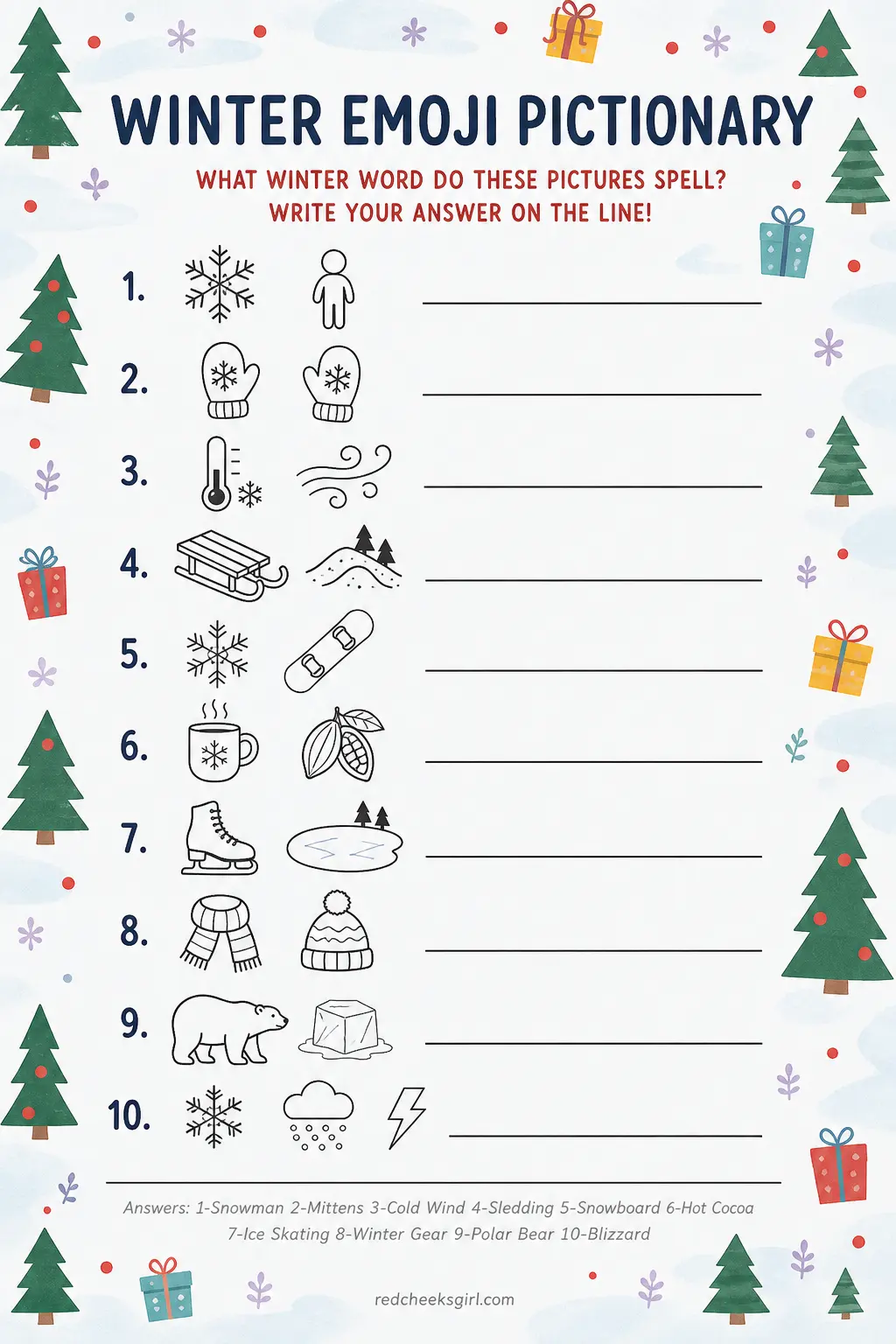
Winter Emoji Pictionary is a printable sheet packed with rows of small illustrated emoji-style icons that spell out a winter word or phrase when you read them together — and it is genuinely tricky in the best possible way.
Each row shows a sequence of two to four tiny picture icons (think: a sun with lines crossed out + a cloud + white flakes falling = BLIZZARD), and kids must figure out what winter word or phrase the icons represent and write it on the blank line provided.
No words are pre-printed as clues — only the picture icons appear, so solving the puzzle is entirely about visual thinking. Great for grades 2 through 5, and a perfect desk activity that every single student can do at their own pace.
Print one sheet per student on cardstock if you have it (regular copy paper works fine, too). Hand them out face-down, say ‘Go!’, and set a five-minute timer.
The competitive energy that emerges from a roomful of kids squinting at tiny snowflake and mitten icons is genuinely hilarious. When time is up, reveal the answers on the board while students self-check.
Award a small prize — a sticker, a piece of candy, first pick of a snack — to whoever solved the most clues correctly.
What makes this game a party-night hero is that it works for every personality type: kids who love puzzles go deep on the hard clues, social kids whisper and nudge neighbors (in a good way), and even kids who finish early stay engaged checking their answers.
It is also a brilliant filler game between active games — hand it out while you reset the room for the next activity and everyone stays busy. No scissors, no glue, no cleanup — just pencils and pure puzzle-solving fun.
- Grades 2-5
- Works as a desk filler between active games
- Self-checking with answer key at the bottom of the sheet
🛒 What you’ll need
4. Winter Charades
Winter Charades is the classic silent acting game dressed up in its warmest coat, and it is always, without fail, the game that makes the whole class completely lose it laughing.
Write 20 to 25 winter-themed words and phrases on separate slips of paper — things like ‘building a snowman,’ ‘making a snow angel,’ ‘putting on snow boots,’ ‘a penguin waddling,’ ‘hot chocolate too hot to drink,’ and ‘catching snowflakes on your tongue’ — fold them up, and drop them in a hat or cup.
One student at a time draws a slip, acts it out silently, and the class races to guess. Best for grades 1 through 5; younger kids especially love the acting part.
For a class of 20 to 30, run this in whole-group mode with the actor standing at the front of the room. Set a 60-second timer per turn so things keep moving.
If the class guesses correctly before the timer runs out, the actor gets a point for their team — split the class into two or three teams to keep the competitive energy going.
If nobody guesses in time, the actor reveals the card and a new student from the other team is up. You can collect and re-use slips multiple times so you do not need a massive word bank to fill a full game round.
The reason Charades is a party staple is that literally everyone can play, regardless of reading level or language background — the acting makes it visual and universal.
For kindergarten and first grade, whisper the word to the actor rather than having them read a card. For older grades, level up the difficulty by adding longer phrases like ‘a snowplow stuck in a traffic jam’ and watch the increasingly dramatic interpretations unfold.
(I once watched a fourth grader perform ‘avalanche’ so realistically that two kids fell off their chairs laughing. Ten out of ten, would recommend.)
- Paper slips with winter words/phrases written on them
- A hat, cup, or bag to draw from
- Optional: a 60-second sand timer or phone timer
5. Winter Riddles
Winter Riddles is a printable sheet full of clever ‘What am I?’
style riddles, each with a blank line for kids to write their guess — and it is the kind of game that has every child muttering clues under their breath like a tiny detective.
Each riddle gives two to three clue sentences that describe a winter object or animal without naming it, and the student writes their answer on the blank line below. No fill-in-the-letter shortcuts, no word banks — just pure riddle-solving glory.
Perfectly calibrated for grades 1 through 5, with riddle difficulty scaling from ‘delightfully obvious’ to ‘wait, actually tricky.’
Print one per student and hand them out when you need a calm, focused five minutes between bigger activities.
Kids work individually and silently (good luck with the ‘silently’ part, tbh) and then you reveal all the answers together at the end, which inevitably produces a chorus of ‘OHHH!’ from kids who were one word away.
The answer key sits in tiny print at the very bottom of the sheet, so you can also let kids self-grade before the big reveal, which they love doing with enormous dramatic flair.
Here is the teacher superpower move: read the riddles aloud one by one for younger grades or for any students who need extra support, giving the whole class time to write before moving to the next one.
It turns a solo printable into a fun whole-group listening activity without any extra prep. Bonus: riddles are 100 percent inclusive and holiday-neutral — not a single mention of any specific celebration, just pure winter wonderland logic.
Read riddles aloud for K-2 classes to make this a whole-group listening game instead of an independent sheet — works beautifully either way.

6. Silent Snowball Pass
Silent Snowball Pass is deceptively simple and sneakily hilarious: students sit in a circle (or pass desk-to-desk across rows), and a crumpled paper ‘snowball’ is passed around the circle in complete silence. The twist?
Every time the teacher claps — no warning, no pattern — whoever is holding the snowball at that exact moment has to answer a winter trivia question or complete a silly winter dare before passing it on.
The silence rule is what makes it electric; kids are desperately trying to move the snowball fast while staying completely quiet, and the whole room is watching. Best for grades K through 5 — you just adjust the trivia difficulty.
Prepare 10 to 15 trivia question cards or dare cards before the party (things like ‘Name three things you wear in winter!’ or ‘Waddle like a penguin for five seconds!’ or ‘What animal sleeps all winter?’). Draw one card when a student is caught.
A fun variation for older grades is to have the caught student choose trivia or dare, which adds a delicious layer of suspense.
Keep the snowball moving quickly — the anticipation of who gets caught next keeps the whole class fully engaged even when it is not their turn.
What teachers love about Silent Snowball Pass is that it is basically self-managing: kids enforce the silence rule on each other (because nobody wants to be the one who makes noise and slows the snowball down), which means you can just watch and enjoy.
The game also takes exactly zero prep if you skip the cards and just ask questions off the top of your head — ‘Name something you find in a snowstorm! Go!’ And cleanup is just recycling one piece of paper. That’s it.
Winter class party games do not get more low-effort than this.
For K-1, skip trivia questions and use simple dares only — ‘roar like a polar bear’ or ‘pretend to make a snow angel standing up’ — so no reading is required.
7. Guess the Winter Animal Sheet
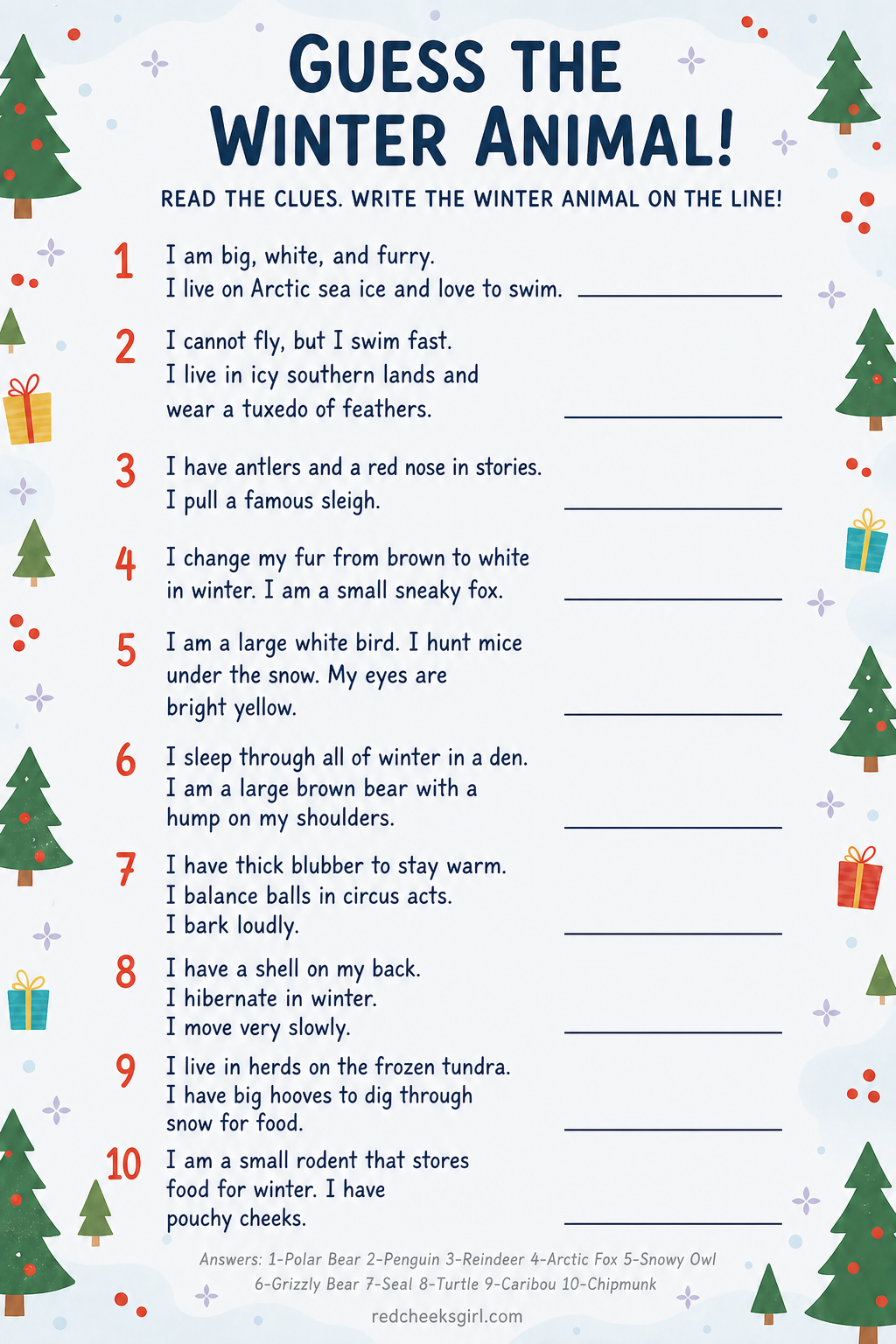
Guess the Winter Animal is a printable matching-and-identification game where each clue gives two fun facts about a winter or Arctic animal, and students write the animal’s name on the blank line below — no multiple-choice options, no hints, just the clues and a blank line.
The sheet covers a mix of well-known animals like polar bears, penguins, and reindeer alongside slightly trickier ones like the Arctic fox, snowy owl, and hibernating bear, which creates a natural easy-to-hard difficulty arc on a single page.
Ideal for grades 1 through 5; the clue complexity scales beautifully across grade levels.
Print one per student on regular copy paper — no special supplies needed at all.
Give the class three to four minutes to work independently, then go through the answers together as a class, which gives you a natural window to drop a fun fact about each animal.
Kids absolutely love learning that Arctic foxes change color with the seasons, or that penguins actually propose with pebbles (which is objectively the cutest thing in the animal kingdom).
The answer key is at the very bottom of the sheet in tiny type so you can choose whether to let kids self-check or collect them for a quick teacher-led reveal.
This game quietly doubles as a science moment — which is a very handy card to play if anyone ever questions why you are partying instead of teaching. ‘We are exploring Arctic ecosystems through inquiry-based identification, actually.’ (Wink.)
For advanced students or a longer time block, challenge them to add one additional fact they know about each animal next to their answer. For struggling readers, pair the game with a buddy or read the clues aloud whole-group before releasing kids to write.
Sneaks in science content during party time — Arctic habitats, animal adaptations, and winter ecosystems all covered while kids think they are just playing a game.
8. Snowman Heads Up
Snowman Heads Up is a whole-class twist on the classic forehead-guessing game, and it is exactly as chaotic and wonderful as it sounds.
Write 20 winter- and snowman-related words on index cards — snowflake, carrot nose, coal eyes, blizzard, scarf, frost, reindeer, hot cocoa, icicle, polar bear, mittens, etc. — and have a student volunteer hold a card to their forehead without peeking.
The rest of the class gives verbal clues (no saying the word itself or rhymes!) and the holder guesses. First correct guess wins a small prize, and then a new student is up.
Rounds take about 60 to 90 seconds each, so you can cycle through eight to ten students in a ten-minute block.
Run this as a whole-group game with the guesser at the front of the room and the class seated.
The teacher holds up each card from a small stack, places it gently against the guesser’s forehead so only the class can see, and then opens the floor to clues.
Set a ‘no shouting’ rule and instead use a raised-hand system — the teacher calls on a student, that student gives one clue, then another hand goes up. This keeps it orderly and makes sure quieter students get a chance to give clues too.
Works brilliantly for grades K through 5; for younger grades, let them describe with full sentences, and for older grades add the rule that clues can only be one word.
If you have the Heads Up app on a teacher device, you can use the ‘Animals’ or ‘Act It Out’ deck and project it via screen share — but honestly, a stack of hand-written index cards works just as well and does not require any technology.
The low-tech version is our go-to because it means zero risk of app glitches during the party (speaking from painful experience here). Either way, this one always gets the room absolutely buzzing.
- 20 index cards with winter words written in large print
- Optional: Heads Up app on a teacher tablet for a digital version
🛒 What you’ll need
9. Winter I-Spy Count
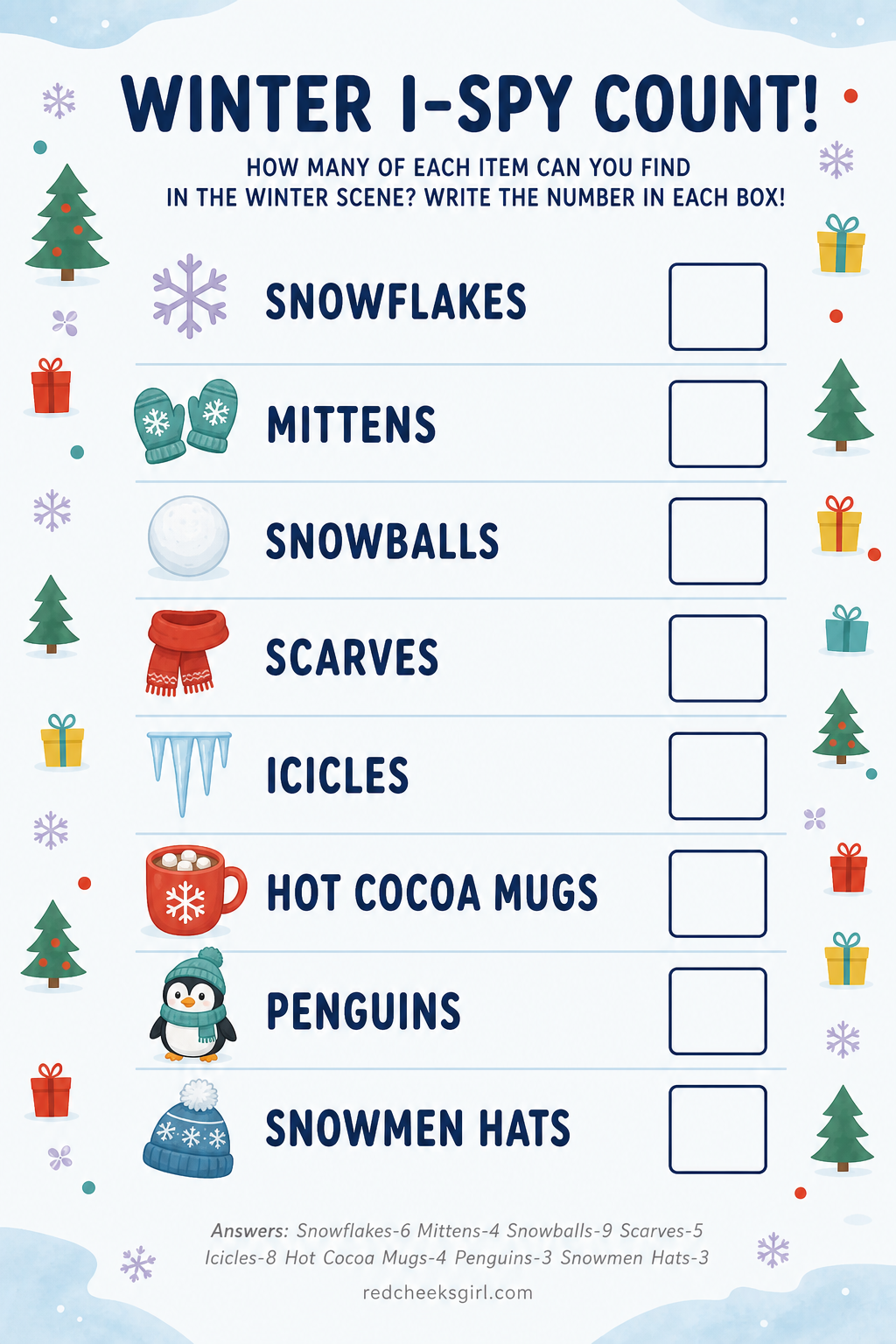
Winter I-Spy Count is a printable sheet featuring a detailed, busy winter scene packed with hidden objects — snowflakes, mittens, snowballs, scarves, icicles, hot cocoa mugs, penguins, and more — and students must count how many of each item they can spot in the scene and write the number in the box provided.
Unlike a traditional word search or dot-to-dot, this is a genuine count-and-find challenge: the numbers matter, and a student who miscounts a cluster of tiny snowflakes in the corner will get a different answer than their neighbor.
That slight uncertainty is what keeps everyone searching even after they think they are done. Best for grades K through 3, though competitive older kids enjoy it too.
Print one per student and hand them face-down for a dramatic countdown start. Set a three-minute timer and let kids work solo.
The beauty of the counting format is that there is one definitive correct answer per item, so the reveal at the end is super satisfying — you read out the answer, and kids either pump a fist or gasp.
No gray areas, no ‘well, that one could be either’ debates. For an extra layer of fun, have students compare their tallies with a neighbor before the reveal, which creates this wonderful low-stakes ‘wait, you got seven mittens? I only found five!’ energy.
From a logistics standpoint, this is the ultimate party game for busy room parents: it requires zero verbal explanation (the instructions are on the sheet), zero materials beyond a pencil, and keeps 28 kids quietly occupied for a solid three to five minutes.
If you loved using printable games at Halloween parties, this winter version will be just as big a hit. Stack a few extra copies in your bag because teachers always end up needing more than they thought.
- Grades K-3 (primary grades love the searching)
- Pairs perfectly as a quiet starter while late students arrive
- Zero verbal setup needed — instructions are printed on the sheet
10. Desk Snowball Relay
Desk Snowball Relay is the contained, teacher-manageable cousin of a full snowball fight — and it delivers all the energy without anyone leaving their row. Each row of desks becomes a relay team. One paper snowball starts at the front desk of each row.
On ‘Go!’, the student at the front passes it back over their shoulder to the student behind them, who passes it back, and so on down the row — no tossing, just pass-to-pass contact.
The first row to get the snowball to the last desk and have that student hold it up wins the round.
Run four or five rounds; for variety, switch up the passing style each round (under the arm, over the head, with eyes closed while seated, two hands only).
Setup is absolutely zero work: you need one crumpled paper ball per row, and those take about five seconds each to make. Mark the relay with a simple ‘start here’ card at the front desk so there is no confusion.
For classes with desks in clusters rather than rows, run it cluster-to-cluster and have students stand momentarily to pass.
The key teacher management tip is to have students put both hands on their desk and freeze as soon as a team wins — this gives you a clear visual of who is done and stops the ‘but we were almost there!’ disputes instantly.
Desk Snowball Relay hits that sweet spot of being genuinely active — kids are leaning, reaching, twisting, cheering — without anyone leaving their seat, which is the holy grail of indoor winter class party games management.
It is also naturally self-correcting: if a student drops the snowball, they pick it up and keep going, which teaches resilience in the most painless possible way.
Variations for older grades: penalize any row that drops the snowball by making them start from the beginning, which ramps the tension up dramatically in rounds two and three.
- Each desk row = one relay team
- Pass the paper snowball back desk-by-desk — no tossing, contact pass only
- First team to reach the last desk wins the round
- Change the passing style each round for variety
11. Color the Snowman Contest
Color the Snowman Contest is a printable coloring game with a playful judging twist: students receive a line-art snowman sheet featuring a blank snowman outline with all the classic accessories — top hat, scarf, three buttons, stick arms, carrot nose, and a smile — and their goal is to color and decorate it as creatively as possible in exactly three minutes.
The catch? You announce a judging category that nobody knows in advance, so students cannot just play it safe with a classic look. Announce the category only when you call time, and the most creative interpretation wins.
Works for all grades K through 5; younger kids love the coloring, older kids love trying to predict the secret category.
The categories are where this game really shines. Rotate between rounds (if time allows) or use just one for a single-round version.
Great options: ‘Most Colorful Snowman,’ ‘Most Likely to Win a Fashion Show,’ ‘Most Likely to Survive a Blizzard,’ ‘Most Likely to Be a Famous Chef,’ or ‘Best Use of the Color Purple.’
The mystery category is announced after pencils are down, which means every snowman has a fair shot at winning — even the kid who drew their snowman wearing a tutu and rocket boots has a real chance. (Especially that kid, actually.)
All you need is the printed sheet and crayons or colored pencils. This game is a tremendous mood-setter because everyone is creating something unique, the judging is lighthearted and fun, and even the ‘winners’ are silly enough that it feels inclusive rather than competitive.
For room parents running the game, judging a table’s snowmen and giving out sticker prizes is genuinely the most delightful three minutes of the whole party. Keep a stack of extras — kids will want to make a second one if time allows.
Write 5 secret judging categories on folded slips and let a student draw the winning category after time is called — it turns the reveal into its own mini-event!

🛒 What you’ll need
12. Snowball Bucket Toss
Snowball Bucket Toss is the point-scoring upgrade of a simple toss game: set up three buckets or containers at increasing distances from a toss line — one close, one medium, one far — and label them 1 point, 3 points, and 5 points.
Each student gets three paper snowballs and tries to land them in whichever buckets they choose, then adds up their score.
The student with the highest total score at the end wins, but here is the strategic layer that makes this so engaging: kids have to decide whether to play it safe for guaranteed low points or risk the far bucket for the big score.
Even kindergarteners grasp this immediately.
Run students in groups of four to six at a time while the rest of the class cheers, works on a printable sheet, or rests — this rotating format means nobody waits too long and the energy stays up.
Put down a painter’s tape line as the toss boundary and keep a class scoreboard on the whiteboard so everyone can track. Between groups, a room parent quickly collects the snowballs from the floor (five-second cleanup) and hands them to the next group.
Total active floor time per group is under two minutes, so a class of 25 cycles through in about ten minutes.
The scoring system is the secret weapon here: even a student who misses all three shots gets to try and the math adds up to a real number, so there is no total-failure outcome.
Kids who get the top score almost always want ‘one more turn’ (don’t we all), which is a very nice problem to have.
For a class party energy boost, announce that any student who lands the 5-point bucket gets to do a victory dance in front of the class — you will get the most enthusiastic over-the-shoulder trick shots you have ever seen.
- 3 buckets or containers labeled 1pt, 3pt, 5pt
- Paper snowballs (3 per student)
- Painter’s tape toss line
- Whiteboard for scoring
🛒 What you’ll need
13. Winter Scattergories Sheet
Winter Scattergories is a printable timed-brainstorm game where each student tries to fill in winter-themed categories — Winter Animals, Things You Wear Outside, Winter Sports, Things That Are Cold, and so on — with words that start with a given letter, which you reveal by rolling a die or drawing a letter from a cup at the start of the round.
The scoring rule: you only get a point for an answer that nobody else in the room wrote, which makes every single category a little strategic gamble — do you go for the obvious answer and risk everyone matching, or take a creative risk on the unusual word?
Works brilliantly for grades 3 through 5 and is a genuinely elite game for competitive classrooms.
Print one sheet per student. Roll a large letter die (or draw from an alphabet cup) to reveal the mystery letter — write it on the board where everyone can see.
Set a two-minute timer and have students fill in as many categories as they can with words beginning with that letter.
When the timer runs out, go category by category: read your answer aloud, and if anyone else has the same answer you both cross it out. Whoever has unique answers that no one else wrote earns one point each.
Tally up and the student with the most unique answers wins the round. Run two rounds with different letters for a full mini-tournament feel.
What makes this printable such a party-night winner is that it scales perfectly by grade: third graders are thrilled to write ‘SLED’ for the letter S in the Winter Sports category, while fifth graders are frantically writing ‘SNOWSHOEING’ to try to stump their classmates.
There is also a wonderful chaotic energy during the read-aloud phase when someone’s very left-field answer — ‘my letter was C and I wrote CARIBOU STEW for the Things You Eat In Winter category, and nobody else had it!’
— earns them points AND the room’s admiration. Just like themed party games at Halloween, the more specific the theme, the better the answers get.
- Grades 3-5
- Classes that love friendly competition
- Works as a 2-round mini-tournament with different letters each round

14. Winter Freeze Dance
Winter Freeze Dance is the one game that requires zero prep, zero materials, and zero explanation time — and yet it is guaranteed to be remembered as a party highlight.
Put on an upbeat winter playlist (think: ‘Winter Wonderland,’ ‘Frosty the Snowman,’ instrumental snow-day jams, or any kid-friendly bops) and let the class dance freely in their personal space around their desks. When you pause the music, everyone must freeze instantly like a snowman statue.
Anyone who moves after the pause gets ‘melted’ — they sit for one round but rejoin the next so nobody is left out for long.
Last snowman standing wins, but honestly the game is most fun when you just keep rounds short and keep everyone dancing.
The winter twist that elevates this beyond a basic Freeze Dance is to call a ‘Snowman Style’ move when you restart the music — everyone has to dance like they have stick arms, or like they are melting, or like they are shuffling through two feet of snow.
The moves get progressively sillier, which makes even the kids who think they are too cool to dance let loose completely.
Set a one-song rule: the whole class dances for one song’s worth of pauses, and whoever is standing at the song’s end wins a small prize or gets first pick at the snack table.
Freeze Dance is genuinely the perfect energy-burning game to slot right before a calmer printable activity — it gives kids a physical outlet, gets their hearts pumping, and then they are ready to sit, focus, and actually enjoy the quieter games that follow.
It works for every single grade from kindergarten to fifth because the rules fit on one sentence.
And as a bonus, you get to watch a class of 25 kids try to freeze mid-‘Gangnam Style’ which is, objectively, the funniest thing in elementary school party history.
- Burns off pre-break energy in under 10 minutes with zero prep
- Non-elimination variation (sit out one round, rejoin next) keeps all kids included and happy the whole time
15. Winter Math Facts Race
Winter Math Facts Race is a timed printable game sheet packed with grade-appropriate math problems wrapped in a winter theme — snowman-hat multiplication problems, snowflake addition grids, mitten subtraction chains, and so on — and the goal is simple: solve as many correctly as you can before the timer goes off.
Every student gets the same sheet face-down. On ‘Go!’ they flip it, work as fast and as carefully as they can, and when the teacher calls time (two to three minutes depending on grade level) they put their pencil down. Most correct answers wins.
This game is sneakily brilliant because kids are doing genuine math practice while absolutely convinced they are just playing a party game.
Print grade-differentiated versions if your class is mixed-ability: the K-1 version has single-digit addition in snowflake patterns, the 2-3 version includes double-digit addition and subtraction in mitten outlines, and the 4-5 version features multiplication and division facts inside snowball clusters.
Every problem has a blank box or underline for the answer — no fill-in-the-bubble, no guessing format, just clean write-the-answer boxes. After the timer, project or read out the answers so kids can self-check and circle their correct ones before counting up their score.
Teachers love this one because it doubles as a real formative check — you can quickly scan sheets to see who is flying through multiplication facts and who needs more support, all while the class thinks they are competing for glory.
Room parents love it because the sheet needs zero explanation: kids see math problems, they know what to do.
If you are running this party on a shoestring budget this season, a single ream of paper and your printer is all you need for this one.
Print different difficulty levels for different grade spans — K-1 uses addition, 2-3 uses double-digit operations, 4-5 uses multiplication and division — so every student is appropriately challenged.

16. Snowflake Match-Up Sheet
Snowflake Match-Up is a visual-matching printable game where students look at six detailed snowflake designs on the left column and draw a line to their exact matching snowflake in a scrambled right column — but there are decoy snowflakes mixed in that look almost identical, so only careful observers will match every pair correctly.
This is a genuine visual discrimination challenge, not just a simple mirror-match, because the decoys are intentionally close: one extra branch on a crystal arm, a slightly different center pattern, a rotation that changes the silhouette.
Best for grades K through 4, though perfectionists of any age will spend a very engaged three minutes on it.
Print one per student. The game works either as a timed race (first to correctly match all six pairs wins) or as a calmer ‘take your time’ activity set to soft background music while the class winds down.
Both formats work beautifully; just match the pacing to what the party energy needs at that moment.
After everyone has completed the sheet, do a class reveal by projecting the answer key on the board — kids hold up their sheets and check their lines, and there is always at least one snowflake pair that trips up half the room, which produces a satisfying collective groan.
This game is a fantastic palette-cleanser between higher-energy activities because it requires focus, quiet, and deliberate visual scanning — exactly the kind of reset kids need mid-party without feeling like work.
It also requires nothing but a pencil, works for all reading levels (completely wordless gameplay!), and produces zero mess. The wordless nature makes it extra special for English language learners, who can participate fully and confidently alongside their classmates without any language barrier.
Truly one of those rare games that is as inclusive as it is fun.
- Completely wordless — perfect for English language learners and non-readers
- Great pace-changer between high-energy active games
- Visual discrimination builds focus and concentration skills

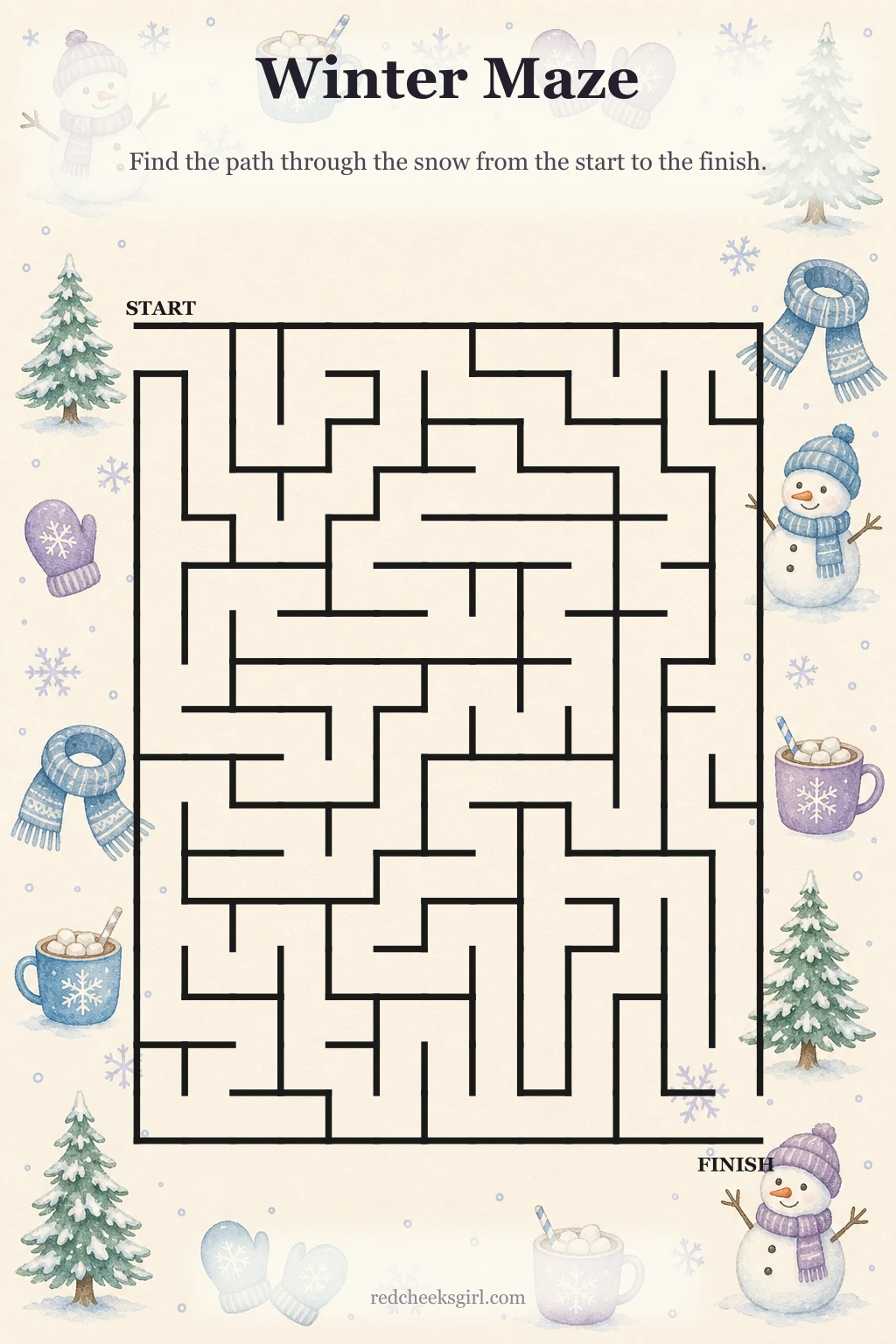
17. Winter Maze
Winter Maze is a printable path-finding puzzle game where students must guide a character — a small penguin, a sled, or a snowflake — from Start to Finish through a twisting, branching maze filled with winter-themed dead ends and fun illustrated obstacles like snowdrifts and frozen ponds.
The maze is designed to have one clear correct path and multiple convincing dead ends so that it offers a real challenge without being frustrating — the sweet spot for classroom play is a maze solvable in one to three minutes for the grade level targeted.
Works beautifully for all grades K through 5 with grade-appropriate complexity levels.
Print one per student and hand them out face-down for a synchronized start. Pencils only — no erasing as a challenge mode for older grades. Set a three-minute timer and whoever reaches Finish first raises their hand silently.
The teacher walks over to verify (quick visual check), awards a small sticker or prize, and then everyone else continues at their own pace until the timer runs out. Finished early?
Flip the sheet and try to trace a second path from a different starting branch — there usually is not one, but the hunting is half the fun.
Maze games are a classroom party staple for a very good reason: they require zero explanation (the instructions are literally ‘get from here to there’), they work for every reading level, they are completely self-contained, and cleanup is just recycling the paper.
They also have a built-in reward loop — every branching choice gives immediate feedback, so kids feel like they are making progress even in dead ends.
For the coloring bonus: invite kids to color the maze path a bright color once they find it, which turns the solved maze into a little piece of winter art they can take home.
For K-1, use a simple maze with wide paths and few branches. For grades 3-5, increase complexity with narrow passages and more dead ends to match their longer attention spans.
18. Winter Kindness Circle
Winter Kindness Circle is the perfect closing game to end your winter class party on the warmest possible note — and I promise you, even the squirmiest kid will be genuinely moved by it.
Students sit in a circle (or stay at desks arranged in a U-shape) and the teacher starts a ‘warm words’ round: each student says one kind, specific thing about the classmate to their right.
Not generic (‘you are nice’) but specific and real (‘I noticed you always share your colored pencils and that is so generous’).
The winter theme: frame each compliment as a ‘warm thought to fight the winter cold,’ and call the whole round a ‘Warmth Circle’ to give kids a phrase to anchor to. Works beautifully for all grades K through 5.
The teacher models the first compliment to set the tone and calibrate the specificity level — this is crucial, because kids will follow your lead exactly.
Go slowly and genuinely, name a real quality you have observed in that student, and watch the class absorb that this is a real game with real stakes.
Then pass it around: student by student, the compliment moves around the circle until everyone has both given and received one. If a student is stuck, prompt them with questions: ‘What is something you have seen them do in class that was kind or impressive?’
Give them as long as they need; nobody rushes the Kindness Circle.
Winter Kindness Circle works as a party closer because it channels all of that end-of-year, pre-break emotional energy into something genuinely beautiful instead of anxious.
Kids leave the party feeling seen and celebrated — which is, honestly, the whole point of a class party, isn’t it? It also costs absolutely nothing, requires no materials, and takes about eight to ten minutes for a class of 25.
Just like low-cost gathering traditions at Thanksgiving, the most meaningful party moments are almost always the ones that do not cost a thing. Teachers who try this once always, always bring it back next year.
- Ends the party on an emotionally positive note kids carry with them into winter break
- Takes 8-10 minutes, costs nothing, and requires zero materials or prep
- Doubles as a social-emotional learning moment that teachers can build on after the holiday
Frequently Asked Questions
What are the best winter party games for elementary school classrooms?
The best winter class party games for elementary school balance active, printable, and quiet formats to keep energy levels manageable while ensuring every student is engaged.
Top picks include Winter Kahoot Quiz (zero-mess, whole-class tech game), Snowball Toss with paper balls (active, easy cleanup), Winter Emoji Pictionary (printable, works at every desk), Winter Freeze Dance (burns energy fast with no supplies), and Winter Kindness Circle (a warm, inclusive closer).
The games in this list were specifically chosen to work for 20-30 kids with minimal prep and cleanup.
What indoor winter games can kids play at a class party without a lot of prep?
The lowest-prep winter class party games are Winter Freeze Dance (just need a playlist), Snowball Toss (one piece of scrap paper per student), Silent Snowball Pass (one paper ball, no other supplies), Winter Charades (a stack of hand-written word cards), and Desk Snowball Relay (one paper ball per row).
All of these can be set up in under five minutes and need nothing you would not already have in a classroom.
What are some non-Christmas winter class party game ideas that are inclusive for all students?
Almost every game in this list is deliberately winter-themed rather than tied to one specific holiday.
Snowball Toss, Silent Snowball Pass, Desk Snowball Relay, Snowball Bucket Toss, Winter Freeze Dance, Winter Maze, Snowflake Match-Up, Guess the Winter Animal, Winter I-Spy Count, and Winter Kindness Circle are all 100% holiday-neutral.
They celebrate the season — snow, cold, winter animals, cozy vibes — without referencing any specific religious or cultural celebration, making them safe and welcoming for every student in any school.
How do you play snowball toss as a classroom party game?
Snowball Toss is played by having each student crumple one sheet of scrap paper into a tight ball (‘snowball’). Set up a target — a bucket, laundry basket, or cardboard box — at the front or center of the room.
Students take turns by row (groups of 4-6 at a time) standing at a marked line and tossing their snowball at the target. Each student gets three throws.
You can score by counting how many land in the bucket, run it as a team relay with totals per team, or keep it completely non-competitive for younger grades. Cleanup is instant: toss all the paper snowballs into the recycling bin.
What are good Minute to Win It games for a winter class party?
The best Minute to Win It-style games for a winter class party include Snowball Bucket Toss (land paper snowballs in scored buckets in under 60 seconds), Desk Snowball Relay (pass a snowball down a row of desks before time runs out), and Silent Snowball Pass (pass without making a sound until the teacher claps).
These micro-challenge games work in timed rounds of 60-90 seconds each and can cycle through an entire class of 20-30 students in under 15 minutes total, making them perfect for the fast-moving format of a class party.
What printable games work well for a winter classroom party?
The printable games in this list that work best for a winter classroom party are Winter Emoji Pictionary, Winter Riddles, Guess the Winter Animal Sheet, Winter I-Spy Count, Color the Snowman Contest, Winter Scattergories Sheet, Winter Math Facts Race, Snowflake Match-Up Sheet, and Winter Maze.
Each one is designed to work at individual desks, requires only a pencil (and crayons for the snowman coloring), takes 3-5 minutes to complete, and can be handed out between active games to keep the whole class occupied and calm.
How many game stations should you set up for a class winter party?
Most elementary class parties run 45-60 minutes, so two to three stations plus one or two whole-class games is the sweet spot.
A solid party structure is: one whole-class opener (Kahoot Quiz or Freeze Dance), two to three desk-based printable games handed out sequentially, one active whole-class game (Snowball Toss or Charades), and one quiet closer (Kindness Circle).
Rotating stations work best for larger parties with multiple room parent volunteers — assign one adult per station and rotate groups every 8-10 minutes. For smaller parties or solo-teacher setups, sequential whole-class games are easier to manage.
What winter party games work for both younger and older elementary students?
Winter Freeze Dance, Snowball Toss, Silent Snowball Pass, Desk Snowball Relay, Snowman Heads Up, Winter Charades, and Winter Kindness Circle all work across the full K-5 range because the core mechanic is physical or verbal rather than reading-dependent.
For printable games, Winter Emoji Pictionary, Snowflake Match-Up, Winter I-Spy Count, and Winter Maze are all wordless or minimally worded, making them accessible for younger grades while still engaging for older students.
Adjust difficulty by changing time limits, toss distances, or clue complexity rather than swapping out the games entirely.
What are some active indoor winter games for a classroom holiday party?
The best active indoor winter class party games that stay classroom-contained and low-mess are Snowball Toss, Snowball Bucket Toss, Desk Snowball Relay, Silent Snowball Pass, Winter Freeze Dance, Winter Charades, and Snowman Heads Up.
All seven keep kids moving and energized without anyone leaving their row or the designated play area.
The key trick for managing energy indoors: run active games in groups of 4-6 while the rest of the class watches and cheers, which keeps every student engaged even when it is not their turn.
What are easy winter class party games that room parents can organize?
Room parents who want minimal stress should reach for the printable games (Winter Riddles, Snowflake Match-Up, Winter Maze, Color the Snowman) because these require zero verbal explanation — just hand them out and start a timer.
For active games, Snowball Toss and Snowball Bucket Toss are perfect for room parents because setup is a bucket and a tape line, rules fit in one sentence, and cleanup is five seconds.
Kahoot Quiz is also ideal for a tech-comfortable room parent — load the free quiz before the party, hit ‘Host,’ and the app runs itself.
📌 Save These for Later
Loved these? Pin your favorite image below so you can find this list again when you’re planning.

18 popsicle stick Christmas crafts for kids, from snowflakes to a gingerbread house, with full steps
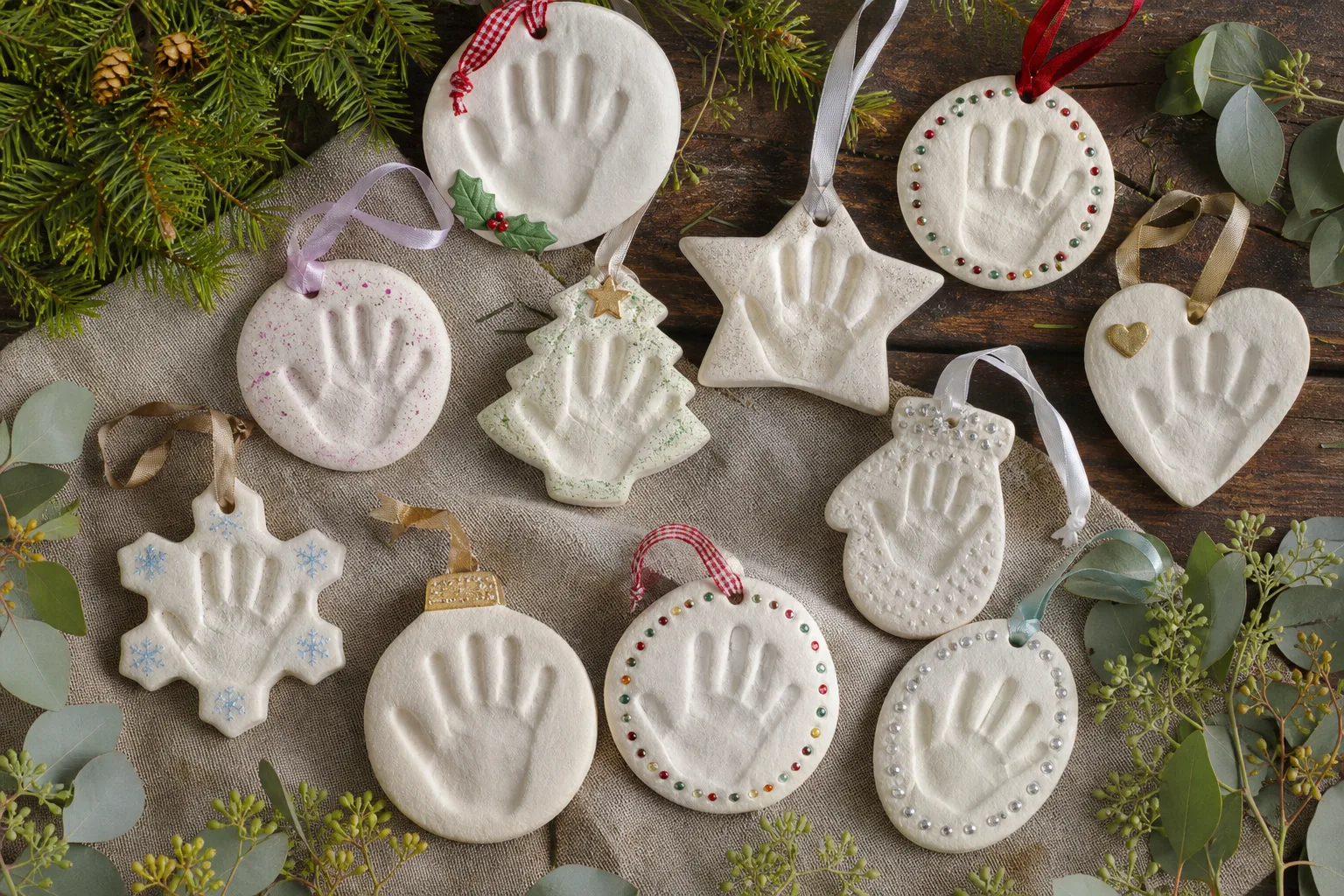
12 salt dough handprint ornaments with exact ratios, bake times and finishes, from classic discs to

15 colored Christmas lights on house ideas, from big C9 bulbs to bubble lights, each with its own pa
Leave a Reply