


Let’s be honest — the words ‘work Christmas party games’ can send a little shiver of dread down your spine that has nothing to do with the weather outside. The dreaded icebreaker where you have to share your ‘fun fact.’
The trivia round where only the same three people answer every question. The game that technically involves a blindfold and a piñata and somehow ends with HR getting a call. Yeah, we’ve all been there.
That’s exactly why I put together this list of 18 work Christmas party games that are genuinely, actually fun — inclusive enough for every personality type, quick enough to fit into a lunch break, and absolutely no alcohol required to make them enjoyable.
Every game on this list takes between 5 and 15 minutes, works for mixed comfort levels, and includes a remote or hybrid variation so your colleagues dialling in from their kitchen tables don’t feel like afterthoughts.
And hey — if you’re still sorting out the gift side of things, check out what to give colleagues for Christmas and what to get your boss for Christmas while you’re at it. Now, let’s get this party started.
- Christmas Kahoot Quiz
- Christmas Trivia Quiz
- White Elephant Gift Exchange
- Christmas Scattergories
- Christmas Bracket Vote
- Holiday Would You Rather
- Desk Ugly Sweater Contest
- Guess the Christmas Movie Emoji
- Guess the Coworker’s Christmas Photo
- Name That Carol
- Two Truths and a Christmas Lie
- Gratitude Snowflake Wall
- Holiday Movie Emoji Race
- Secret Santa Clue Guess
- Candy Cane Fishing
- Regifting Roulette
- Christmas Cubicle Decorating Contest
- Highs and Lows of the Year
- Frequently Asked Questions
1. Christmas Kahoot Quiz
If there is one work Christmas party game that has completely taken over office parties in 2026, it’s a Christmas-themed Kahoot quiz — and honestly, it deserves every bit of the hype.
The premise is beautifully simple: your host pulls up a pre-built (or custom) Christmas quiz on Kahoot, everyone joins on their phone or laptop, and then the race is on to tap the right answer faster than your colleagues.
Questions cover everything from Christmas movie quotes and carol lyrics to holiday traditions around the world, and the leaderboard pops up after every round to fuel exactly the right amount of friendly trash-talk. Time needed: 10–15 minutes.
Setting it up takes about five minutes of prep.
Head to kahoot.com, search ‘Christmas’ in the public library, and you’ll find dozens of ready-to-go quizzes — or build your own in under 20 minutes with inside jokes about your office sprinkled in (highly recommended for maximum chaos).
You just need one screen to display the game and a Wi-Fi connection that isn’t held together with duct tape and prayers.
For scoring, individual mode works great for small teams; team mode lets bigger groups pair up, which also means your quieter colleagues have a buddy to confer with instead of being put on the spot solo.
Here’s why it works so well in an office setting: it’s genuinely competitive without being physically intimidating, it’s self-paced (you either know the answer or you don’t — no performing required), and the music and countdown timer do all the energy-building work for you so you don’t have to ‘hype up the room’ like some kind of reluctant holiday DJ.
Remote variation: share your screen on Zoom or Teams and have everyone join with their own devices — it works identically online, which is part of the genius of it.
- A free Kahoot account
- One display screen or shared screen on Zoom
- Participants’ phones or laptops
- Wi-Fi (the reliable kind, ideally)
2. Christmas Trivia Quiz
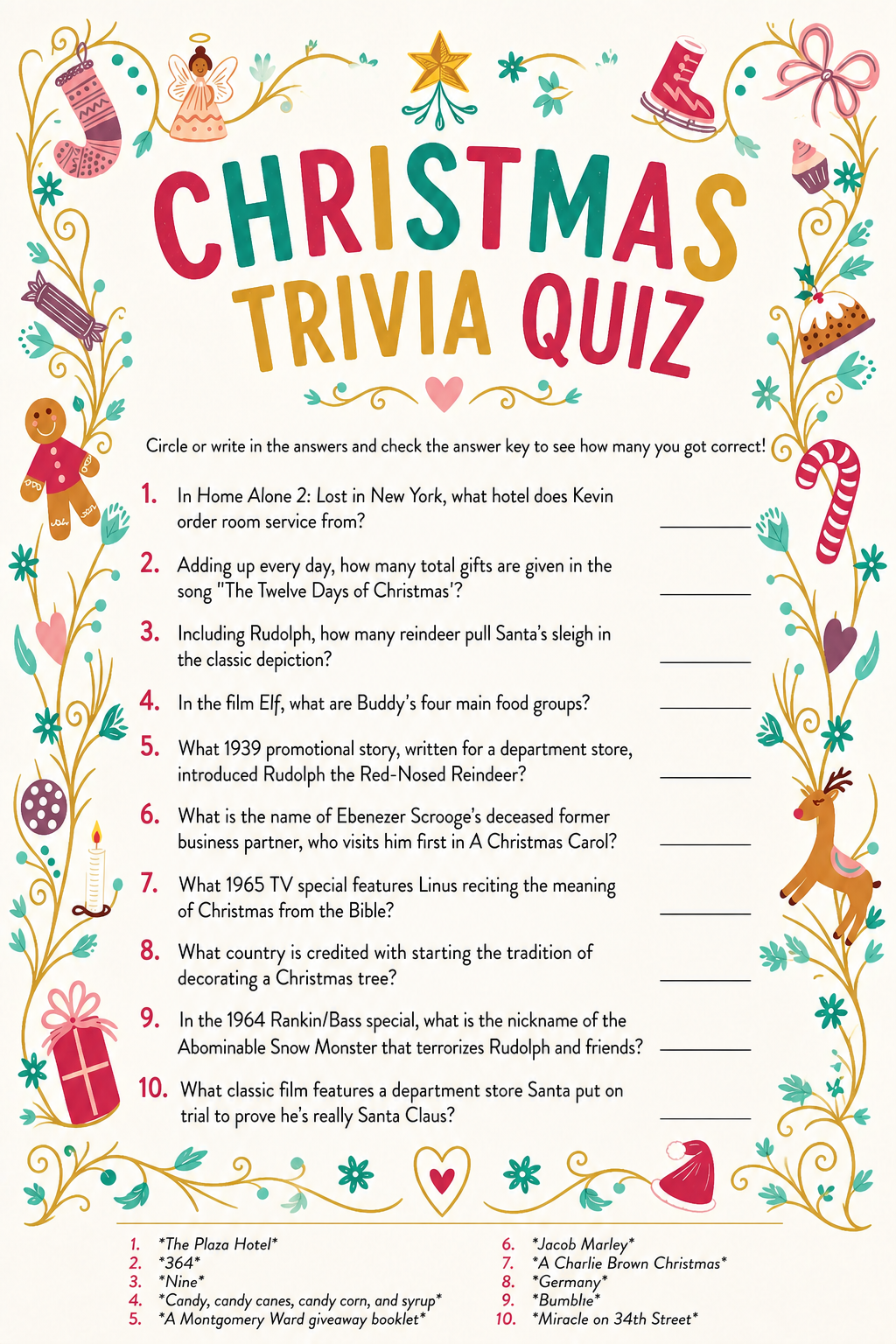
A printed Christmas trivia quiz is one of those work Christmas party games that looks effortless from the outside — guests just pick it up, grab a pen, and get stuck in — but it quietly does a lot of heavy lifting for the room.
It’s a brilliant equaliser: the film buff, the carol expert, the person who only knows Christmas through Hallmark movies, and the colleague who celebrates a completely different holiday all have a fair shot at a few questions each.
No one has to perform, no one gets singled out, and you can run the whole thing in about 10 minutes flat. Time needed: 10–12 minutes.
Print one sheet per person before the party (the infographic below has you covered).
Split guests into pairs or small teams of three — this alone turns it from a solo quiz into a social moment, because suddenly everyone is whispering and debating whether Die Hard counts as a Christmas movie.
Read questions aloud as a group or let teams work through the sheet independently, then go through answers together at the end.
Award a point per correct answer and hand the winning team a small prize: a candy bar, a gift card, or simply the very satisfying bragging rights of being crowned ‘Chief Christmas Know-It-All.’
Host tip: build your quiz with a mix of difficulty levels — a couple of easy softballs everyone gets right, a few mid-range questions, and one or two genuine stumpers that get people gasping.
That range is what keeps the energy high from first question to last.
Remote variation: paste the questions into a shared Google Doc or drop them one by one into the Zoom chat, then have everyone submit scores on the honour system (or, you know, just enjoy the chaos).
Mix difficulty levels — easy questions first to warm the room up, tricky ones in the middle, and one genuinely hard stumper at the end to spark debate.
3. White Elephant Gift Exchange
White Elephant is basically the unofficial mascot of work Christmas parties, and for good reason — it takes a potentially awkward ‘gift for a coworker you barely know’ situation and turns it into a genuinely hilarious group event.
Here’s the basic setup: everyone brings one wrapped gift (set a budget, usually $10–$25 works well for offices), gifts are piled in the centre, and players take turns either unwrapping a new gift from the pile or stealing one that’s already been opened.
The catch — and the comedy — is that any opened gift can be stolen, but each gift can only be stolen a set number of times (usually three) before it’s ‘frozen’ with its current holder.
Time needed: 15 minutes for smaller groups, scale up for larger teams.
Set the ground rules clearly at the start: establish the steal limit, clarify the turn order (usually draw numbers from a hat), and decide whether the person who went first gets a final steal at the end (they usually do, and it’s always dramatic).
For an office setting, nudge people toward funny or universally useful gifts — a novelty mug, a good candle, a nice chocolate box — rather than anything too personal or themed toward one specific hobby.
Post a budget and a ‘keep it work-appropriate’ reminder in the party invite and you’ll be golden. Prizes are the gifts themselves, which is both the simplest and most satisfying possible outcome.
Why does this work so beautifully for mixed groups? Because everyone is invested — even people watching someone else’s turn are loudly weighing in on whether the fancy coffee set is about to get stolen.
The social dynamics of who steals from whom is genuinely entertaining and gives introverts permission to just react and laugh rather than perform.
Remote variation: use an online White Elephant platform like Elfster or Giftster — participants mail gifts in advance to a central address (or use digital gift cards), then ‘unwrap’ and ‘steal’ virtually during a video call.
- Teams of 8–30 people
- Budget: $10–$25 per gift
- Time: 15–30 mins depending on group size
- Works in-person or virtually with Elfster
4. Christmas Scattergories
Christmas Scattergories is one of those work Christmas party games that looks low-key on paper (literally) but immediately gets competitive the moment someone realises their ‘unique’ answer is the same as three other people’s.
The premise: players get a printed sheet with 10 Christmas-themed categories — things like ‘Something you find in a Christmas stocking,’ ‘A Christmas movie character,’ ‘Something red at Christmas’ — and a randomly chosen letter.
They have two minutes to fill in one answer per category that starts with that letter.
The twist: duplicate answers score zero, so originality is rewarded and there is genuinely nothing better than watching a colleague try to justify why ‘Xylophone’ counts as a Christmas tree decoration when the letter is X. Time needed: 10–12 minutes per round.
For setup, print one sheet per person and prep a few folded paper slips with different letters of the alphabet inside a mug or bowl — whoever draws the letter announces it to the room and starts the timer. Two minutes goes surprisingly fast.
At the end, go around the table and have each person share their answers; any answer someone else also has gets crossed off. Tally unique answers per person and add up scores across two or three rounds.
You can easily run three rounds in under 15 minutes, and the game genuinely gets funnier as people get more inventive — or more desperately wrong — with their answers.
The reason this game is such a reliable hit in office settings is that it’s a dead-even playing field regardless of personality or seniority.
The quietest person in the room can win with genuinely clever answers, and no one has to speak in front of the group until the reveal stage, which makes participation feel low-pressure.
Remote variation: drop the categories and the chosen letter into the Zoom chat, set a shared timer, and have everyone type their answers into a private note — then go round-robin sharing on camera. It works just as smoothly as the in-person version.
- Skip tricky letters like Q, X, Z — stick to B, C, G, M, R, S for smoother rounds
- Allow 3 minutes per round instead of 2 for bigger, slower-paced groups

5. Christmas Bracket Vote
Think March Madness bracket — but for Christmas, and the stakes are the very important question of whether ‘Home Alone’ beats ‘Elf’ in a head-to-head showdown, or whether a candy cane is objectively better than a mince pie.
Christmas Bracket Vote is one of the freshest work Christmas party games trending in 2026 because it sparks genuine debate without anyone having to know a single trivia fact.
The host sets up a bracket of 8 or 16 Christmas-themed options in a chosen category — holiday movies, Christmas foods, Christmas songs, holiday traditions — and the whole group votes each matchup until one champion is crowned. Time needed: 10–15 minutes.
To set it up, draw or print a blank bracket and fill in your contenders before the party. Display it on a whiteboard, a shared screen, or a large printout on the wall.
Run each head-to-head matchup by a quick show of hands, a poll in Slido, or a shout-out vote. The host tallies results, advances the winner, and moves to the next match.
The bracket format means every vote matters, results feel satisfyingly decisive, and the ‘upsets’ (when the crowd picks a dark horse) are genuinely exciting. Add a running commentary if you have a natural host personality in the room — it helps, tbh.
What makes the bracket format particularly brilliant for a work setting is that it’s completely opinion-based, so there’s no right or wrong answer, no one looks silly for not knowing something, and the whole thing naturally generates exactly the kind of playful argument that makes people feel like they actually know their colleagues a little better.
Remote variation: use a free polling tool like Mentimeter or Slido — guests vote from their phones in real time and results appear live on screen, making it work seamlessly for hybrid rooms where some people are in the office and others are dialling in from their sofa.
- Choose a category: Christmas movies, foods, songs, or traditions
- Set up an 8 or 16-item bracket before the party
- Vote round by round — show of hands or live poll
- Advance winners until one champion is crowned
6. Holiday Would You Rather
Holiday Would You Rather is the work Christmas party game equivalent of a great conversation starter disguised as a piece of paper — and it is so much more fun than it sounds, I promise.
Each player gets a printed sheet of festive ‘Would You Rather’ dilemmas — all Christmas-themed, all completely work-safe — and has to circle their choice for each one.
Think: ‘Would you rather only be able to listen to one Christmas song on repeat for a month, or have to wear a Santa suit to every meeting in December?’ Nobody gets it wrong. Nobody gets put on the spot.
And the reveal of what everyone chose sparks exactly the kind of light, easy conversation that makes a party feel like an actual party rather than a mandatory gathering. Time needed: 8–10 minutes.
Print one sheet per person, give everyone a minute or two to make their choices, and then go through each question as a group — ask for a show of hands on each option and see where the room is divided.
The best questions are the ones that split the group roughly 50/50, because that’s where the defending of choices starts, and that’s where the laughs come from.
You can do this as a standalone game or use it as a warm-up before a bigger activity to get people talking.
Either way, it requires zero setup beyond printing the sheets and takes up practically no room, which is ideal if you’re working with a cramped office break room or a restaurant private dining space.
Why it works especially well for offices: ‘Would You Rather’ naturally reveals personality quirks and holiday opinions in a totally non-threatening way.
You learn that your quiet colleague from accounting is absolutely team ‘no Christmas music until December 1st’ while your manager is firmly ‘all year round’ — and suddenly you’ve had a genuine, memorable moment without anyone having to share a deep personal anecdote.
Remote variation: the host reads each question aloud, participants vote by dropping a 1 or 2 in the chat or holding up fingers to the camera, and the host tallies votes live. It takes about 30 extra seconds per question and is completely seamless.
- Any group size — works for 5 or 50 people
- Great as a warm-up before bigger games
- Zero prep beyond printing one sheet per person

7. Desk Ugly Sweater Contest
The Ugly Sweater Contest is a classic work Christmas party game for a reason — it asks basically nothing of participants (just wear a sweater!)
and delivers a lot in return, from genuine laughs to some truly baffling fashion decisions that will live rent-free in your memory until next December.
But the ‘Desk’ twist elevates it: instead of (or in addition to) judging wearable sweaters, you invite people to decorate their own desk, cubicle, or a small designated zone with Christmas-ugly-sweater energy — think clashing patterns, tinsel overkill, googly-eyed reindeer, and whatever else comes out of the bottom of a Dollar Store Christmas bin.
It’s expressive, low-commitment, and mess-contained to one spot. Time needed: decorating happens before the party; voting takes 5 minutes.
Set up the contest by sharing the theme at least a day in advance so people can come prepared. Give each participant a small budget (or simply raid the office supply of leftover Christmas decorations) and a designated area.
On party day, everyone does a walk-around to admire all the entries — this ‘gallery walk’ format naturally gets people moving and chatting — and then voting happens via sticky-note ballots or a quick show of hands.
Award categories beyond just ‘ugliest’ to maximise winners and inclusivity: Most Creative, Most Festive, Most Outrageously Over-the-Top, and Best Use of Office Supplies are all fair game.
The reason this game works brilliantly as an opener is that the decorating process itself is social — you’ll catch people laughing at each other’s choices and swapping ideas before the official party even starts.
It also gives the naturally crafty members of your team a chance to shine in a way that a trivia quiz never would.
For the sweater-wearing element, reassure your team that participation is genuinely optional and that a small holiday accessory (a festive pin, a Santa hat, a pair of reindeer antlers) absolutely counts — zero pressure, full fun.
Remote variation: participants decorate their home background or wear their sweater on video; everyone votes via a quick emoji reaction or poll in your video call platform.
- Christmas decorations (tinsel, baubles, mini lights)
- Sticky notes for voting ballots
- Small prizes per category
- Optional: a ‘best sweater’ sash or crown for the winner
8. Guess the Christmas Movie Emoji
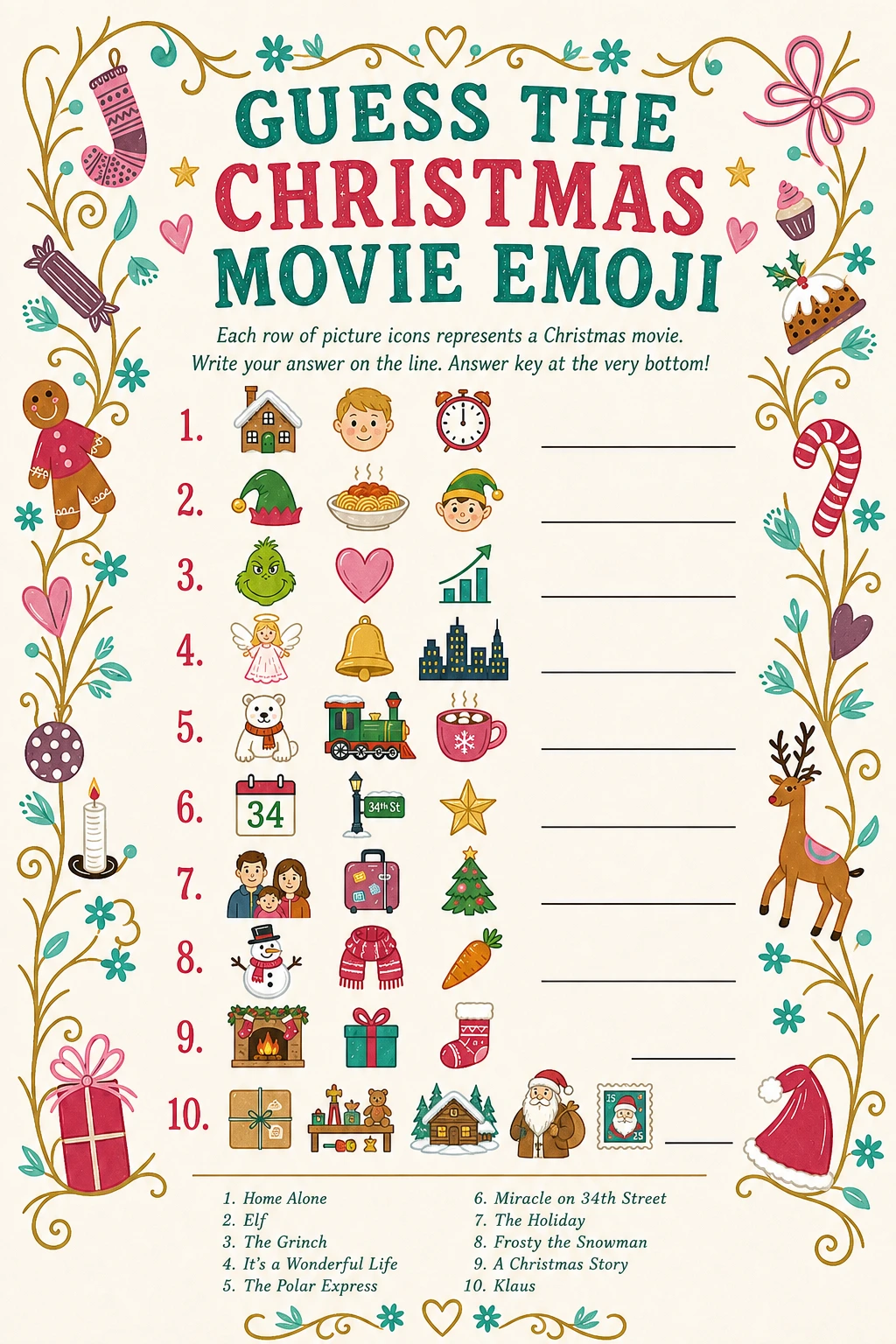
Guess the Christmas Movie Emoji is exactly what it sounds like — and it is significantly harder and more addictive than you’d expect. Each row on the printed sheet shows a sequence of small picture icons representing a Christmas movie title.
No words, no hints beyond the pictures themselves, just your own pop-culture instincts and the increasingly desperate sense that the answer is absolutely on the tip of your tongue.
It’s one of the most shareable, instantly-engaging work Christmas party games out there right now, and it works for literally every age and personality type because everyone has seen at least a few Christmas films. Time needed: 8–10 minutes.
Print one sheet per player (or per team of two for a more social experience) and set a timer for five to eight minutes. Players write their guesses on the blank lines provided next to each emoji sequence.
When time’s up, go through the answers together as a group — this is where the room erupts, because half the answers are obvious in hindsight and at least one will have everyone arguing about whether the host’s interpretation was fair (it wasn’t, but that’s part of the fun).
Score one point per correct answer and the highest score wins. The answer key lives at the very bottom of the sheet in tiny, low-contrast text so no one accidentally cheats.
Pro tip for the host: when you’re designing or sourcing the emoji clues, aim for a spread from obvious (Home Alone, Elf, The Grinch) to genuinely tricky (Miracle on 34th Street, The Holiday, Klaus) so the game has a natural difficulty curve.
That range keeps competitive players engaged while making sure casual participants get at least a few satisfying wins.
Remote variation: share the sheet as a PDF download before the call and have everyone play simultaneously, or display the clues one at a time on a shared screen and use the chat to collect answers — both work perfectly.
- Each row shows emoji picture icons for a Christmas movie
- Write your guess on the blank line — no peeking at the answer key!
- Score 1 point per correct answer
- Tiny answer key is at the very bottom of the sheet
9. Guess the Coworker’s Christmas Photo
This one is my personal favourite work Christmas party game for building actual team connection — and I say that as someone who is not naturally a ‘let’s share personal photos’ kind of person.
Here’s how it works: a week before the party, ask everyone to submit one childhood Christmas photo of themselves (the more chaotic the holiday outfit, the better).
On party day, display all the photos on a wall, a slideshow, or a shared screen numbered but without names attached. Everyone has to guess which photo belongs to which colleague.
The results are always delightful, occasionally unrecognisable, and sometimes reveal that your CFO had a perm in 1987 that nobody was ever going to guess. Time needed: 10–12 minutes.
For the logistics: collect photos by email or via a shared Google Form in advance. Number each photo (rather than labelling it with the person’s name) and display them all at once.
Give everyone a slip of paper or a printable answer sheet to write their guesses — ‘Photo 3 = Sarah, Photo 7 = Marcus’ — and then reveal the answers one by one, asking each person to identify themselves.
The person who guessed the most correctly wins a small prize. Keep the photos anonymous right up until the reveal to preserve the mystery and the drama.
Importantly, make photo submission genuinely optional — some people don’t have childhood photos easily accessible, and that’s totally fine.
Why this game earns its place in the lineup: it creates genuine, warm ‘oh I can’t believe that’s you!’ moments between colleagues who might have worked together for years without ever having a personal conversation.
It’s nostalgic, funny, and completely pressure-free because you’re not performing — you’re just looking at photos.
Remote variation: collect photos in advance, drop them all into a numbered slide deck, share your screen during the video call, and have everyone submit guesses in a shared Google Form or in the chat. Works beautifully online.
Send a friendly reminder that photo submission is totally optional — never pressure anyone. Anonymous submission via a Google Form keeps the mystery alive until reveal day.
10. Name That Carol
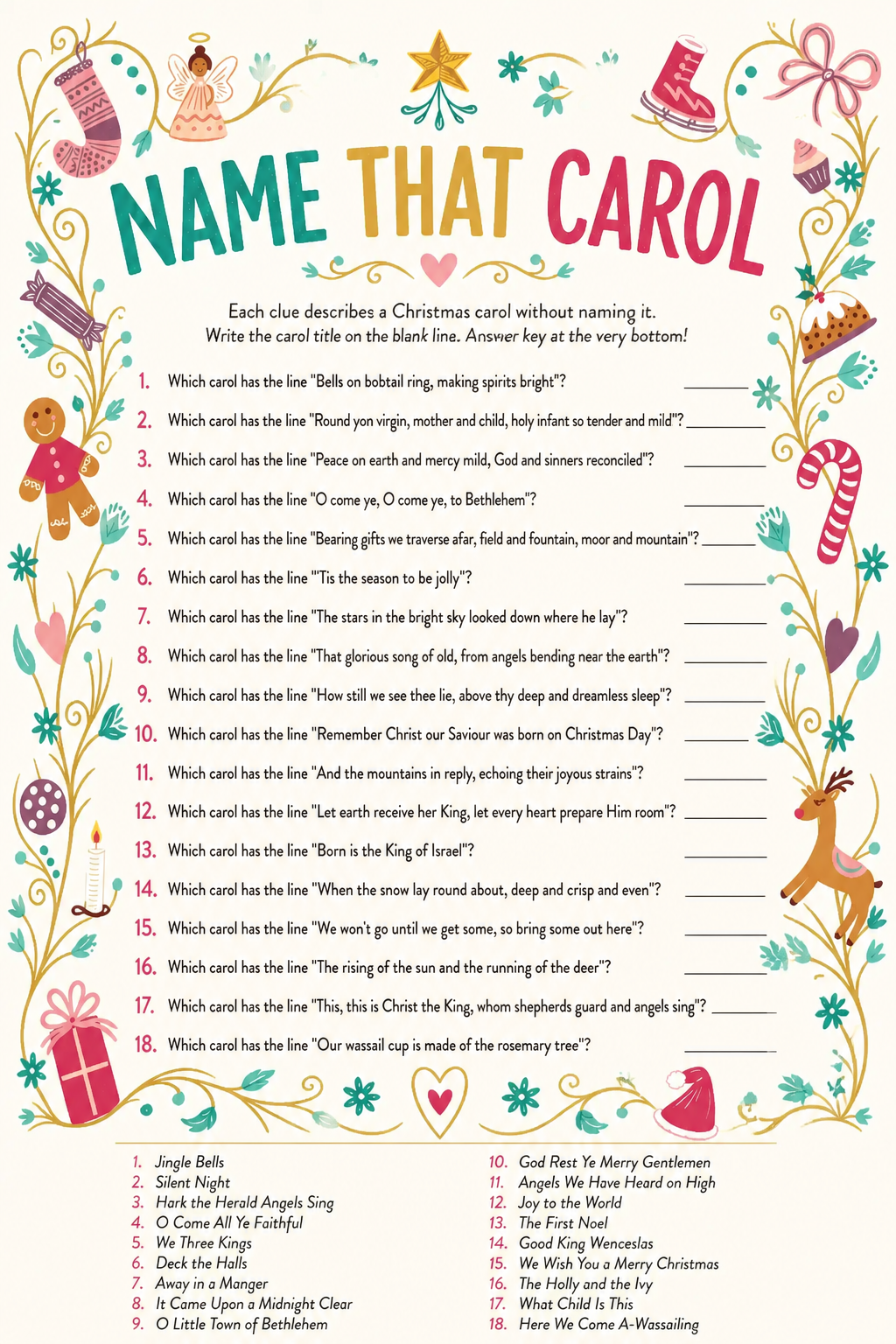
Name That Carol is one of those work Christmas party games that sounds extremely simple right up until you’re staring at the paper going ‘I absolutely know this one’ for a solid 30 seconds before it comes to you.
The game gives players a sheet of clues — each clue describes a well-known Christmas carol using only a neutral description of what the song is about, without naming the carol or quoting any lyrics. Players have to identify the carol from the description alone.
For example: ‘A song about joyful bells ringing on a winter day’ or ‘A carol asking for a simple white seasonal weather event.’ It’s a clever twist that levels the playing field beautifully. Time needed: 8–10 minutes.
Print one sheet per player or team. Set a timer for five to seven minutes and let everyone work through the clues in silence (or in quiet conferring pairs — that works well too).
Then go through the answers aloud as a group, reading each clue again and calling on teams to share their answer before revealing the correct carol. This call-and-response format keeps the whole room engaged rather than just the people who finished fastest.
Score one point per correct answer; ties can be broken by a sudden-death final clue read aloud, first correct shouted answer wins.
The format rewards general musical knowledge over lyric memorisation, which makes it genuinely accessible for people who don’t consider themselves ‘music people’ but absolutely hum along to carols every December without realising it.
It’s also much harder than it looks — which is the secret ingredient. A game that’s just a bit too easy is forgettable; a game that makes you feel very clever when you finally crack it is one people mention at the next party.
Remote variation: the host reads each clue aloud one at a time and teams post their answers in the chat simultaneously — reveal the right answer after everyone has submitted so no one can copy.
- Levels the playing field — no lyric memorisation needed, just recognition
- Generates satisfying ‘of course!’ moments that keep energy high
- Works equally well as a solo or team game
11. Two Truths and a Christmas Lie
Two Truths and a Christmas Lie is the festive, office-appropriate upgrade of the classic icebreaker — and tbh, the Christmas framing is what makes it actually fun instead of mildly excruciating.
Each person comes up with three Christmas-related statements about themselves: two are true, one is a lie. Maybe you genuinely did once cry at the John Lewis Christmas advert three times in a row (two truths can be very relatable things).
Maybe you claim you once ate 14 mince pies in a single sitting, but you actually don’t even like mince pies. The group has to guess which one is the lie, and the real magic is in the defending and the reveals.
Time needed: 8–10 minutes for groups of 8–12; scale up accordingly.
Ask everyone to take a minute to think of their three statements before starting — this prevents the awkward ‘umm, give me a second’ pause that can kill the momentum of any party game.
Go around the room or the video call one person at a time; the group discusses and then collectively points to or calls out which statement they think is the lie.
The player then reveals the answer and, crucially, tells the real story behind the true ones.
That ‘real story’ moment is where this game earns its keep, because it consistently produces unexpected, memorable revelations — like discovering the apparently mild-mannered person from logistics once dressed as a Christmas tree for a charity 5K. Nobody saw that coming.
The reason Two Truths and a Christmas Lie works specifically for work parties (when ‘generic’ Two Truths often falls flat) is that the Christmas theme gives everyone an equal footing of shared cultural reference points and keeps the statements light, seasonal, and funny rather than veering into territory that’s too personal.
It’s a starter game — run it first to break the ice and you’ll notice the whole room visibly relax before you move on to the next activity.
Remote variation: participants can type their three statements into the chat all at once (or use a shared Google slide), and the group votes on the lie using emoji reactions — tree emoji for statement one, snowflake for two, gift for three.
- Each person writes 3 Christmas statements — 2 true, 1 lie
- Group debates and guesses which is the lie
- Player reveals the answer and tells the true stories
- No voting needed — just confident group consensus (and arguing)
12. Gratitude Snowflake Wall
Okay, hear me out — I know ‘gratitude’ sounds like the kind of thing that gets printed on a motivational poster above the printer, but the Gratitude Snowflake Wall is genuinely one of the loveliest work Christmas party games in this list, and I say that as someone who is naturally suspicious of anything too feelings-adjacent.
Here’s how it works: each person gets a paper snowflake (cut in advance or provided as a pre-cut template) and writes one thing they’re grateful for from the past year — it could be professional, personal, or just ‘the fact that the office got a coffee machine in March.’
Snowflakes go up on a designated wall or window, and by the end of the party you have a collective, visible record of your team’s year. Time needed: 5–8 minutes of active participation; the wall stays up for the whole event.
Set up a roll of craft paper or a blank section of wall as your ‘snowflake canvas’ before the party starts, with double-sided tape or a washi tape border ready to go.
Pre-cut snowflakes from white or blue paper are ideal — the more intricate they look, the more impressive the final display, and it takes about 20 minutes to cut a batch for the whole office.
Put a small table near the wall with markers and the snowflakes ready, and let people contribute at their own pace throughout the event rather than making it a compulsory ‘everyone stop and do this now’ moment.
That self-directed approach is the key — it respects different comfort levels beautifully.
The snowflake wall serves double duty: it’s a quiet, reflective counterpoint to the more active and competitive games on the list, and it leaves something visual and warm in the room that makes the space feel genuinely festive rather than just decorated.
It’s also a lovely thing to photograph before the party wraps up — the image of a wall full of handwritten gratitudes is the kind of thing that genuinely means something when you look back on it.
Remote variation: use a virtual collaboration board like Miro or Padlet — participants drop their gratitude onto a shared digital ‘snowflake’ template during the call, and the host screenshares the board so everyone can see the wall building in real time.
- Pre-cut paper snowflakes (white or iridescent card)
- Fine-tip markers in black or dark blue
- Double-sided tape or sticky tack for the wall
- Optional: a polaroid photo of the finished wall for each person to take home
13. Holiday Movie Emoji Race
Holiday Movie Emoji Race is the live, competitive, everyone-shouts-at-once version of the printed emoji game — same fun concept, completely different energy.
The host displays one emoji sequence at a time on a screen (or reads them aloud if you’re working with a whiteboard setup) and the first person or team to correctly shout out the Christmas movie title wins a point.
It’s fast, it’s loud, it’s surprisingly contentious, and it is one of the best work Christmas party games for filling the 10-minute slot between dinner and dessert when you need something that requires zero materials and zero setup. Time needed: 10–12 minutes.
Prepare your emoji clue slides or cards in advance — you’ll want at least 15 clues for a 10-minute game so you can keep the pace up.
Display them one at a time using a PowerPoint, Google Slides, or even just your phone held up to the group (a projected screen is better for larger rooms, obviously).
For team format, divide the group and have team captains buzz in first — you can use an actual buzzer app on a phone or just the classic ‘hand on the table’ system.
Keep score on a whiteboard or flip chart where everyone can see it; visible running scores dramatically increase the competitive energy without you having to do anything extra.
What makes the live race format work differently from the printable version is the social pressure of speed — you know the answer, your brain just needs to fire faster than your colleague’s, and that split-second race is genuinely thrilling in a group setting.
It also means people who didn’t get the first clue are immediately back in contention for the next one, so engagement stays high throughout rather than dropping off after a confident team takes an early lead.
Remote variation: use a live poll tool like Slido or Mentimeter where answers are submitted by typing — the first correct answer displayed wins the point, and the host keeps a running leaderboard on screen throughout.
- 15+ emoji clue slides (PowerPoint or Google Slides)
- A display screen or shared screen for remote
- A whiteboard or flip chart for the scoreboard
- Optional: a phone buzzer app for fair first-answer calls
14. Secret Santa Clue Guess
Secret Santa Clue Guess is a clever twist on the classic gift exchange that transforms a transactional ‘here’s your present’ moment into a little mystery game — and it works beautifully as one of the most thoughtful work Christmas party games in the lineup.
Here’s how it plays: instead of just handing over their gift, each Secret Santa writes three cryptic clues about who they are on a small card tucked inside or attached to the gift.
The recipient reads the clues out loud and the whole group tries to guess who their Secret Santa is before the gift-giver reveals themselves.
It’s warm, it’s personal, and it adds a layer of engagement to a gift exchange that can otherwise feel a bit transactional. Time needed: 2–3 minutes per person, woven into the existing gift exchange.
Set this up by adding a note to your Secret Santa sign-up instructions: ‘Write 3 clues about yourself on the provided card — keep them vague enough to be a mystery but specific enough to be guessable!’
Provide small index cards or folded notelets for people to write their clues on.
Clues can be about shared work memories (‘I once spilled coffee on the printer and blamed the intern — not really’), personality traits, or cryptic references that will mean something to the team.
The more specific-to-your-office the clues are, the better the game works, because it rewards the people who actually pay attention to their colleagues day-to-day.
This game’s particular magic in an office context is that it reframes Secret Santa as a moment of connection rather than obligation.
Instead of the slightly awkward ‘oh thanks, a candle’ silence, you get everyone leaning forward, shouting guesses, and then a warm reveal moment where the Santa and their recipient actually have a genuine interaction.
It also doesn’t require anyone to do anything extra on the day — all the prep happens at home when they’re wrapping the gift anyway.
Remote variation: digital Secret Santa platforms like Elfster include a built-in messaging feature — your Santa can send their three clues via the platform and you reveal them on the video call before the gift is ‘unwrapped.’
Include the clue-writing instructions in your initial Secret Santa email — give people two weeks to think about it so nobody’s scribbling on a Post-it in the car park five minutes before the party.
15. Candy Cane Fishing
Candy Cane Fishing is a Minute-to-Win-It style challenge that is objectively hilarious to both play and watch, which makes it one of the best work Christmas party games for the moment when you need the room to actually make noise and have fun rather than politely smile at things.
The basic version: each player gets an unwrapped candy cane, places the straight end in their mouth (hands behind their back, no cheating), and must use their candy cane ‘hook’ to fish other candy canes off a plate or out of a bowl — without using their hands at all.
First person to hook a set number wins, or you time each player and score by how many they collect in 60 seconds. Time needed: 5–10 minutes depending on number of players.
For office setup, you need a table, a plate or shallow bowl with the curved hooks of several candy canes hanging over the edge, one unwrapped candy cane per player, and an empty cup at the far end of the table to deposit caught candy canes into.
The rule of no hands is non-negotiable — it’s what makes the game funny rather than just easy.
Run players in heats of two or three if your group is large; spectators are immediately invested because watching people try to hook a candy cane using only their face is genuinely comedy gold.
Keep a paper towel roll nearby just in case of any candy cane casualties (they’re fragile and they will break).
The reason this game earns its place on a work party list despite being a bit silly is that it’s 100% opt-in, requires zero skill or prior knowledge, and produces real laughter from real effort — not polite chuckling but actual, involuntary ‘I can’t believe that just happened’ laughter.
Even the people watching are having a great time. It’s also extremely fast to run a full tournament-style round for a 20-person team, so it never overstays its welcome.
Remote variation: everyone grabs candy canes from home and races simultaneously on camera — first person to hook three candy canes wins, and the whole video call becomes one chaotic, joyful mess.
- 1 bag of standard candy canes
- A shallow plate or bowl per station
- An empty plastic cup per player (to deposit caught canes)
- Paper towels for inevitable candy cane breakages
16. Regifting Roulette
Regifting Roulette is a game that turns the slightly embarrassing reality of office gift-giving — that sometimes you end up with a novelty mug you absolutely do not need — into the entire point, and it is one of the funniest work Christmas party games for a team that knows each other reasonably well.
Here’s the setup: everyone brings one wrapped ‘regift’ — something from home they genuinely don’t need or want (kept clean and work-appropriate, of course), or something from a designated ‘funny gifts’ pile the organiser pre-collects. Gifts are shuffled and distributed randomly.
Players then go around the room and — without opening their gift — have to sell it to the group using only creative, completely made-up descriptions of what’s inside.
The group votes on which fictional description is the most convincing or funniest, and that player wins. Time needed: 10–15 minutes.
Run Regifting Roulette as a quick pitch-style game: give each player 30–45 seconds to describe their mystery gift in the most persuasive or ridiculous way possible before everyone votes.
Then, after all the pitches are done, open the gifts one by one and reveal the actual contents — the gap between the pitch and the reality is consistently hilarious.
To keep it work-safe, brief participants in advance that contributions should be clean, intact items (not genuinely broken things, not gag gifts that cross a line), and reassure people that no one is judging the quality of the regift because the point is entirely the game, not the gift itself.
What makes Regifting Roulette a standout among work Christmas party games is that it completely reframes the social anxiety of gift-giving. Nobody feels bad about receiving something odd because ‘odd’ is the whole aesthetic.
Nobody feels awkward about contributing a regift because that’s literally the brief.
And the pitching element rewards creativity and quick thinking in a low-stakes, silly context — which means it often surfaces a funny, unexpected side of colleagues you might never have seen in a meeting.
Remote variation: participants photograph their regift (still wrapped) and share the image on screen while delivering their pitch; gifts are then mailed to their new owner after the call as a bonus surprise.
- Teams of 8–20 who know each other reasonably well
- A light-touch way to do a gift exchange without a budget
- Pairs well with White Elephant if you want two exchange-style games
17. Christmas Cubicle Decorating Contest
The Christmas Cubicle Decorating Contest is one of those work Christmas party games that technically starts before the party and ends when someone takes the decorations down in January, and I mean that as a compliment — it’s a slow-burn, ambient kind of fun that gives the creative people in your team a genuine outlet and gives everyone else something to enjoy on their daily walk to the coffee machine.
Teams or individuals are given a budget (or a box of shared supplies) and challenged to transform their desk, cubicle, or designated office zone into the most festive, most creative, most outrageously decorated space possible.
Time needed: decorating happens across a day or two; judging takes 10 minutes.
Set clear but generous parameters: a decoration budget (if applicable), whether lights are allowed (usually yes, as long as they’re battery-powered and not a fire hazard — always worth checking with facilities), and a list of judging categories.
Have a panel of three judges (ideally people who aren’t competing) or open the vote to the whole office via a anonymous ballot box or an online form.
Judge on multiple criteria — Most Festive, Most Creative, Best Theme, Best Use of Limited Budget — so more people can win something and the contest doesn’t just become ‘whose desk looks most like a department store window.’
Small prizes work great here: gift cards, a festive afternoon tea for the winning team, or just a printable certificate if budget is tight.
The real value of this game as a work Christmas party activity is the way it transforms the physical environment.
Walking into an office that has been enthusiastically decorated by the people who work there feels completely different from walking into one where facilities have put up the same tinsel every year — it creates a sense of ownership and seasonal excitement that lasts the whole month.
It’s also one of the most genuinely inclusive work Christmas party games because it happens at people’s own desks, on their own schedule, which means nobody is put on the spot in front of a crowd.
Remote variation: participants decorate their home office setup and share a photo in a team Slack channel or group chat — colleagues react and vote using emoji, and the most-reacted photo wins.
- A shared box of supplies: tinsel, baubles, battery lights, ribbon
- A judging panel or anonymous voting form
- Small prizes per category
- A reminder to check fire safety rules before allowing lights or candles
18. Highs and Lows of the Year
Highs and Lows of the Year is the one game on this list that isn’t really a ‘game’ in the traditional sense — and honestly, that’s exactly why it belongs here.
At the end of the year, people genuinely want a moment to reflect, and Highs and Lows gives the room a structured, safe way to do that without it turning into a therapy session or an awkward HR situation.
Each person shares one professional or personal high from the year — a project they’re proud of, a milestone reached, something that went better than expected — and one low that taught them something or that they’re glad to be leaving behind as December closes.
It’s brief, it’s warm, and it consistently produces the most memorable moments of any work party I’ve seen. Time needed: 2 minutes per person; plan accordingly based on team size.
Run this one near the end of the party when the energy has softened and people are in the right headspace for a genuine moment rather than another competitive round.
The host goes first to model the format and set the tone — keep your own contribution light and honest, not overly emotional or too polished, just real.
Remind participants that they can share anything from the professional side only if they prefer to keep things work-focused; there’s no pressure to get personal.
If someone genuinely draws a blank on a low, ‘something I’m looking forward to leaving in 2025’ is always a valid alternative framing. Keep it moving by sticking to roughly two minutes per person.
The reason this quiet closer works so well as a work Christmas party game is that it reframes the party from a ‘mandatory fun event’ into a genuine moment of team acknowledgement — and that shift is meaningful.
It lets people feel seen and heard in a way that a trivia quiz, however fun, simply can’t replicate.
It also tends to surface surprising stories: the colleague who seemed to have a perfectly smooth year had a genuinely hard few months; the person everyone assumed was coasting achieved something they’re quietly really proud of. Those revelations build real empathy and connection.
Remote variation: run exactly the same format on video call — if anything, the slightly more intimate setting of everyone on their own screen makes the sharing feel more natural, not less.
Go first yourself to model the tone — keep your high and low genuine but professionally appropriate, and the rest of the room will follow your lead naturally.
Frequently Asked Questions
What are the best Christmas party games for a large group of coworkers?
For large groups, the best work Christmas party games are ones that scale without losing energy. Christmas Kahoot Quiz is a standout because every single person plays simultaneously on their own device — it works just as well for 50 people as for 10.
Christmas Bracket Vote and Holiday Movie Emoji Race also scale beautifully for big rooms because they use a shared screen and group voting rather than one-person-at-a-time turns.
For a structured social moment, the Desk Ugly Sweater Contest or Christmas Cubicle Decorating Contest gives large groups something to react to together.
The key for any large-group game is to keep individual ‘turns’ short, keep scoring visible, and choose formats where watching is just as fun as playing.
What are some fun Christmas party games for work that don’t require much setup?
Two Truths and a Christmas Lie requires literally zero materials — just people and a festive theme. Holiday Movie Emoji Race needs only a slide deck you can throw together in 10 minutes.
Christmas Bracket Vote can be run with a hand-drawn bracket on a whiteboard. Highs and Lows of the Year needs nothing at all beyond a circle of chairs and a couple of minutes per person.
What are good Christmas party games for adults at the office?
The best work Christmas party games for adults lean into friendly competition, creative thinking, and genuine connection rather than physical challenges or anything that could feel infantilising. Christmas Scattergories, Guess the Christmas Movie Emoji, and Name That Carol all reward wit and pop-culture knowledge.
White Elephant Gift Exchange and Regifting Roulette are perennial adult favourites because they’re socially dynamic rather than just trivia-based.
For something with real depth, Highs and Lows of the Year and the Gratitude Snowflake Wall offer an adult-appropriate moment of reflection that you won’t find in a kids’ party game lineup.
How do you play White Elephant or Dirty Santa at a work Christmas party?
White Elephant (also called Dirty Santa or Yankee Swap) works like this: everyone brings one wrapped gift within the agreed budget, usually $10–$25. Draw numbers to establish turn order. Person 1 picks and unwraps a gift from the pile.
Person 2 can either steal person 1’s gift or unwrap a new one. Stolen gifts must be replaced by the person who lost them, who can then steal from someone else or unwrap from the pile.
Each gift can usually only be stolen a maximum of three times before it’s ‘frozen’ with its current holder. The person who went first typically gets a final steal at the very end.
For offices, set a budget in advance and gently remind participants to keep gifts work-appropriate and universally usable — novelty, funny, or genuinely useful gifts work best.
What are some virtual Christmas party game ideas for remote teams?
Almost every game in this list has a built-in remote variation! Christmas Kahoot Quiz is arguably even smoother online than in person — participants join on their own devices and a shared screen displays the game.
Christmas Bracket Vote works perfectly with Mentimeter or Slido for live polling. Guess the Coworker’s Christmas Photo translates beautifully to a shared slide deck on a video call. Printable games like Christmas Trivia Quiz and Christmas Scattergories can be sent as PDFs before the call.
For connection-focused games, Two Truths and a Christmas Lie and Highs and Lows of the Year both work naturally over video. The Gratitude Snowflake Wall has a lovely virtual version on Miro or Padlet.
What Christmas games are appropriate for an inclusive, work-safe holiday party?
The golden rules for inclusive work Christmas party games: no alcohol required (or implied), no physical contact, no mandatory sharing of personal information, opt-in participation wherever possible, and games that can accommodate observers who prefer to watch rather than play.
Every game in this list was selected with those criteria in mind.
Particularly inclusive choices include Christmas Scattergories (fully equal playing field regardless of seniority or background), Gratitude Snowflake Wall (self-directed, no time pressure), Holiday Would You Rather (no wrong answers), and Highs and Lows of the Year (flexible framing — participants can keep it professional).
Always brief participants in advance on what games are planned so nobody is caught off guard.
What are easy Christmas icebreaker games for work parties?
Two Truths and a Christmas Lie is the classic work Christmas party icebreaker for good reason — it’s light, reveals something interesting about each person, and requires no materials.
Holiday Would You Rather works brilliantly as a warm-up because it sparks instant conversation and debate without anyone needing to share personal information. Guess the Coworker’s Christmas Photo is a slower-burn icebreaker that works beautifully if you collect photos in advance.
For a quieter opener, having the Gratitude Snowflake Wall available from the moment guests arrive gives shy attendees something to engage with immediately without needing to join a group activity.
How do you organize a Christmas trivia game for a work party?
For a printed Christmas Trivia Quiz, print one sheet per person (or per team of two or three), set a timer for 10 minutes, then go through answers aloud as a group.
For a digital version, build a quiz in Kahoot or use a platform like Mentimeter for live answer submissions.
Divide into teams of 3–5 for larger groups — this makes it more social and means no individual is isolated if they draw a blank on a question.
Mix difficulty levels: a few easy questions to warm the room up, several medium questions, and one or two genuinely hard stumpers.
Read all answers aloud at the end rather than revealing them question by question — this keeps everyone engaged through the full quiz rather than checking out after they finish.
What Minute-to-Win-It games work well for a work Christmas party?
Candy Cane Fishing is the standout Minute-to-Win-It work Christmas party game — it’s fast, funny, requires only candy canes, and works as a solo race or a team relay.
The format (hook candy canes off a plate using only a candy cane held in your mouth, no hands) is both genuinely challenging and completely hilarious to watch.
It runs in 60-second rounds per player, so you can run a full tournament for a 20-person team in under 10 minutes. Other Minute-to-Win-It style formats include the Holiday Movie Emoji Race (speed-based buzzer-style game) and the Christmas Bracket Vote (run in rapid-fire voting rounds).
The key for any Minute-to-Win-It work game is keeping rounds short, keeping spectators entertained, and never requiring physical exertion that not everyone can participate in.
What are some Christmas party game ideas that work for both small and large office teams?
The games that scale most reliably from 5 to 50+ people are: Christmas Kahoot Quiz (simultaneous play, everyone participates at once), all five printable games in this list (you just print more sheets), Christmas Bracket Vote (works on a whiteboard for 5 or a projected screen for 500), and Two Truths and a Christmas Lie (adjust time by doing it as a full group for small teams or in breakout groups for large ones).
White Elephant and Regifting Roulette work best for groups of 8–30; for larger teams, consider running them in department sub-groups simultaneously. The Gratitude Snowflake Wall scales infinitely — more participants just means a more impressive wall.
There you have it — 18 work Christmas party games that are genuinely worth your colleagues’ time, your planning energy, and the precious 15 minutes between the canapés and the inevitable departmental karaoke situation.
Mix and match from the active, printable, and quiet options in this list to build a party agenda that covers all personality types, and remember: the best office party game is always the one where people forget for a moment that they’re at a work event and just have fun.
Print the sheets, queue up the Kahoot, pre-cut some snowflakes, and you are ready. Happy planning — and if you’re still sorting out what to actually put in that White Elephant pile, our 2025 Christmas Gift Guide has you covered from every angle.
Pin this list now so you can find it again in December when the party planning panic sets in!
📌 Save These for Later
Loved these? Pin your favorite image below so you can find this list again when you’re planning.



20 fun Christmas party games for every age — from hilarious active relays to printable sheets ever

12 christmas charcuterie cup combinations for a standing or office party, from classic salami and ch

Forty-eight christmas would you rather for kids questions across four silly rounds, plus free printa
Leave a Reply