

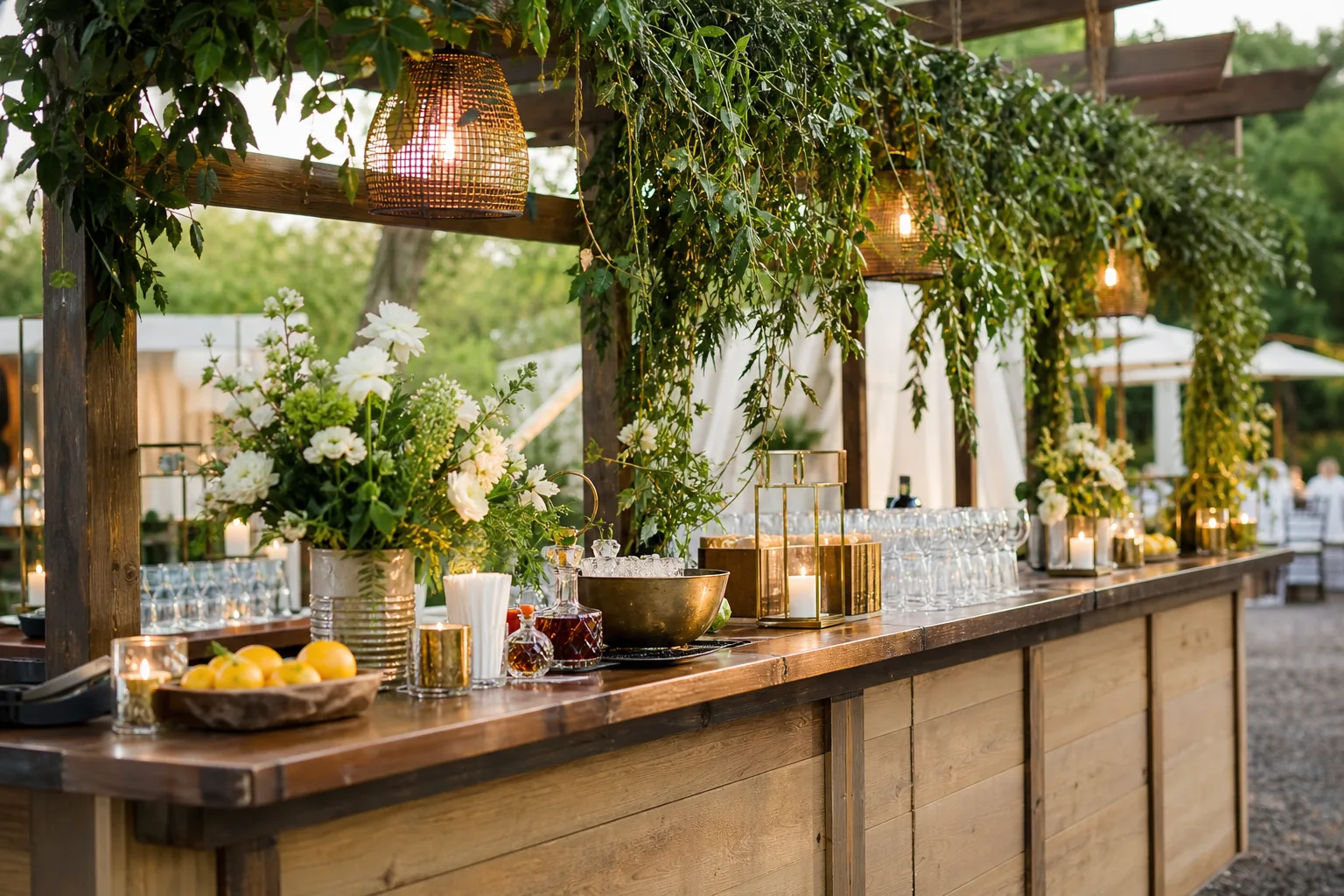
Every reception photographer says the same thing: guests spend more time at the bar than anywhere else in the room, so the bar had better earn the attention. A folding table with a tablecloth thrown over it reads as an afterthought, even when the flowers and the cake are perfect. The bar is the one surface that works all night, under the same lights, in front of the same lens, so it is worth the ten extra minutes.
None of this needs a second mortgage. A garland costs less than a centerpiece, a monogrammed napkin is a stationery order you were already placing, and a mirrored panel can be a rental line item instead of a build. Pick two or three ideas that match your venue and your nerve, not all twenty seven.
What follows runs in the order the bar itself reads: the front you see walking up, the signage and light above it, the trays and menus on its surface, the stations that do the actual pouring, and the small things guests slip into a pocket on the way out.
This post contains affiliate links. If you buy through them, I may earn a small commission at no extra cost to you.
Table of Contents
The Bar Facade and Front Display
The front of the bar is the part every guest photographs without meaning to, because it sits at exactly the height a phone comes up to. Dress this panel and the whole station looks finished even if the back shelf is a mess of open boxes.
Floral Installation on the Bar Front
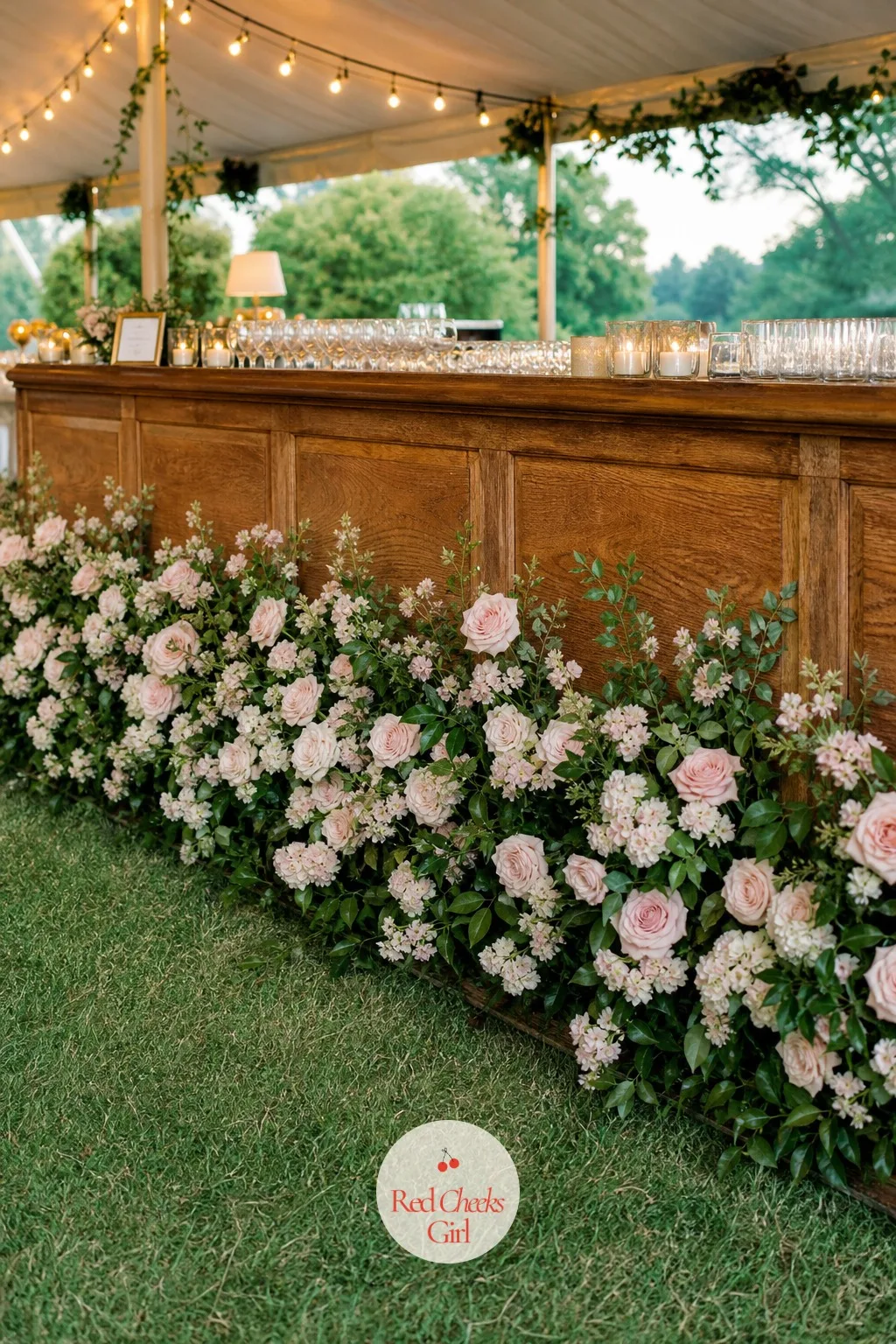
A bare bar front under a marquee always looks like it is still waiting for something, and this is the fix that makes it look finished before a single glass goes out. Floral Installation on the Bar Front runs as a dense, low band of blooms wired directly onto chicken wire frames that clip to the counter edge, so nothing touches the actual tablecloth underneath.
Build it from the bottom: a strip of floral foam cages or wire mesh along the lower third of the bar, garden roses and ranunculus packed in close, trailing greenery left to spill over the edge so the seam never shows. It suits a garden marquee or a barn with good natural light behind it, where the flowers read against timber or canvas rather than disappearing against a plain wall.
If a full installation is too much flower budget, run a single garland of the same blooms along the top edge instead and let the counter stay bare. Rentable, reusable for the welcome sign the next morning, and it never needs water once it is wired in.
Mirrored Bar Facade
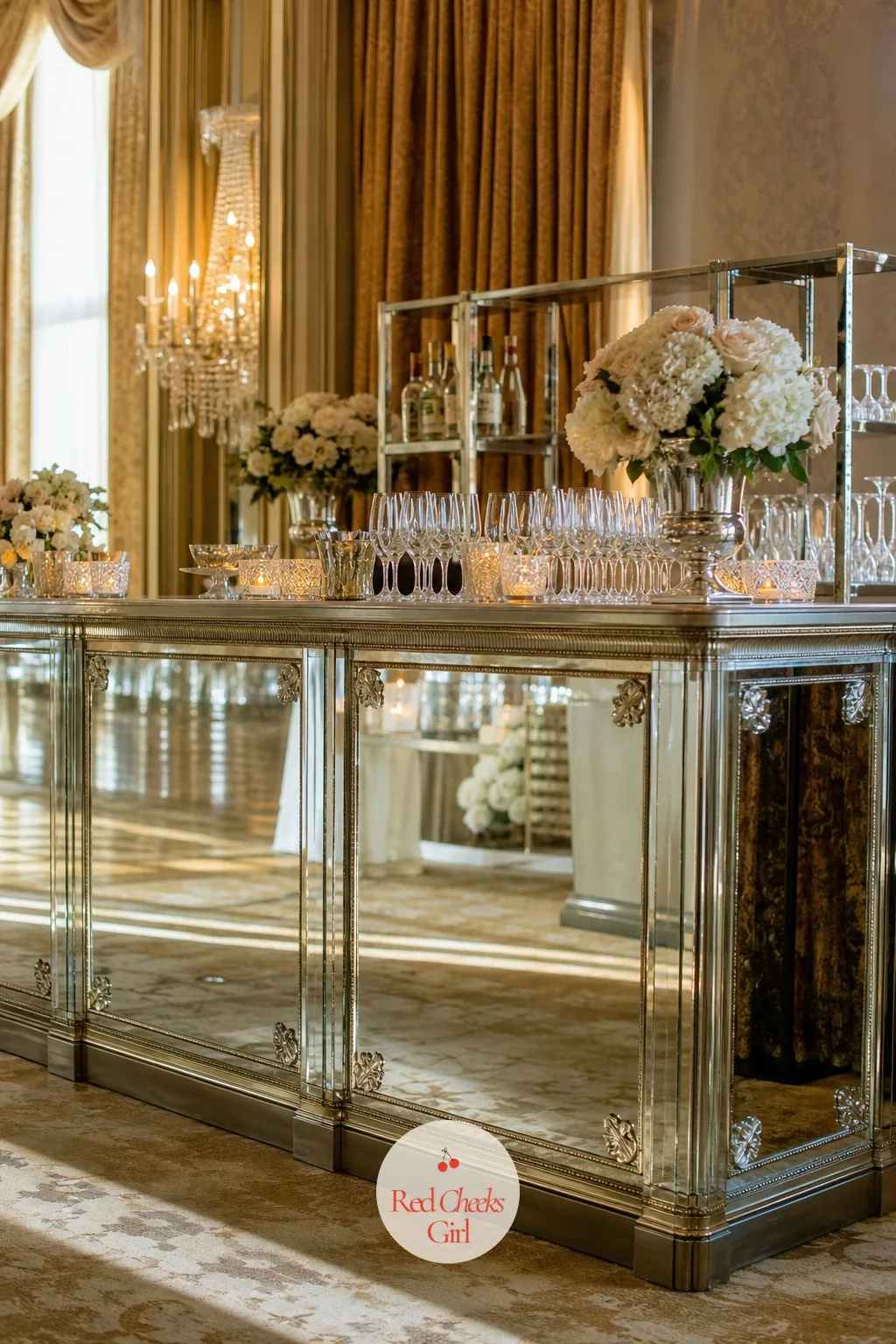
A ballroom bar under a chandelier either reflects that light or wastes it, and a plain wood front wastes it every time. Mirrored Bar Facade covers the front panel in antiqued mirror tiles or rented mirrored cladding, so every candle on the counter doubles itself in the surface below.
It is built as panels, not a single sheet: individual mirrored tiles or acrylic mirror sheeting mounted onto a plywood or foam core backing, then slotted against the existing bar front so nothing is glued to a rental piece. It is at home in a hotel ballroom or a restaurant private room with existing chandeliers, where there is already light worth bouncing.
Skip the full mirror wall and rent just a mirrored top for the counter instead if the venue will not allow anything fixed to the bar itself. Hire this through an event rental company rather than building it from scratch; it is one of the few items here worth paying someone else to source.
Greenery Garland
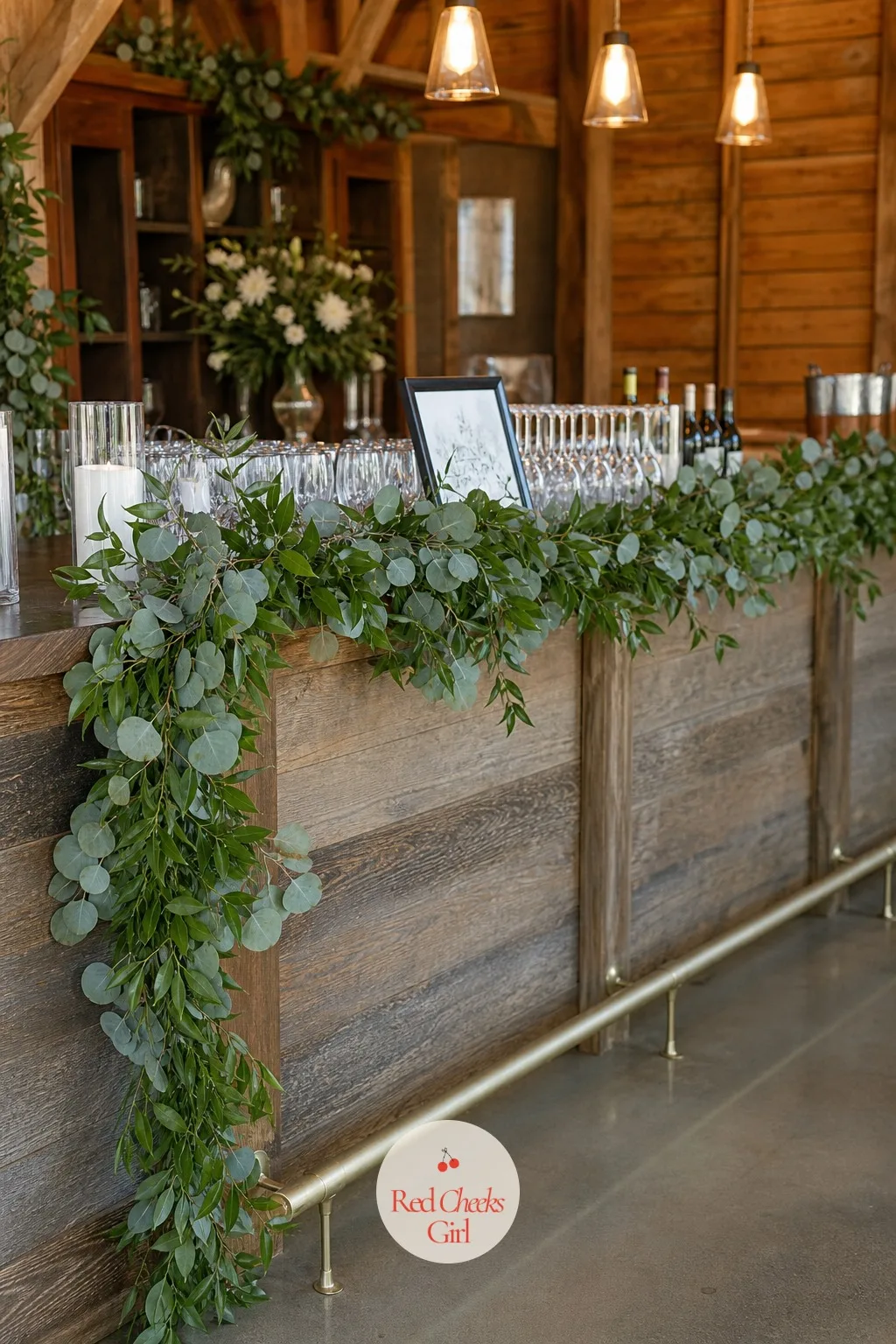
This is the one nobody argues about, because it costs almost nothing and looks deliberate even when it is thrown together the morning of. Greenery Garland runs along the top lip or down the front edge of the bar in a single trailing line, eucalyptus and ruscus mixed so it has both weight and movement.
Build it as fresh or preserved stems wired or zip tied in overlapping clusters onto a length of rope or florist wire, then tacked or clipped to the bar edge so it drapes rather than lies flat. It works equally well at a barn wedding against raw timber or a terrace against stone, which is part of why it shows up at so many venues.
Swap fresh eucalyptus for a preserved or silk version if the wedding is outdoors in heat, since real foliage wilts by cocktail hour in direct sun. Buy it by the foot from a florist or in pre made garland lengths online, whichever is cheaper that week.
Pleated Velvet Bar Skirt
Rental bars almost always come in plain black or beige, and a plain front under warm light just looks unfinished. Pleated Velvet Bar Skirt hides that rental panel under a floor length velvet skirt, box pleated so the fabric catches light instead of lying flat and dull.
It goes on as a fitted fabric cover: a velvet panel cut to the bar’s height and width, pleated and pinned or Velcroed along the top rail so it hangs straight to the floor with no visible seams. It suits a ballroom or restaurant private room where the rest of the linens are already satin or velvet, so the bar matches the table rather than standing apart from it.
Choose a deep emerald or burgundy velvet if the florals are pale, so the bar front reads as the anchor color in the room. A rental company can usually supply this skirted to measure; it is not worth sewing one for a single use.

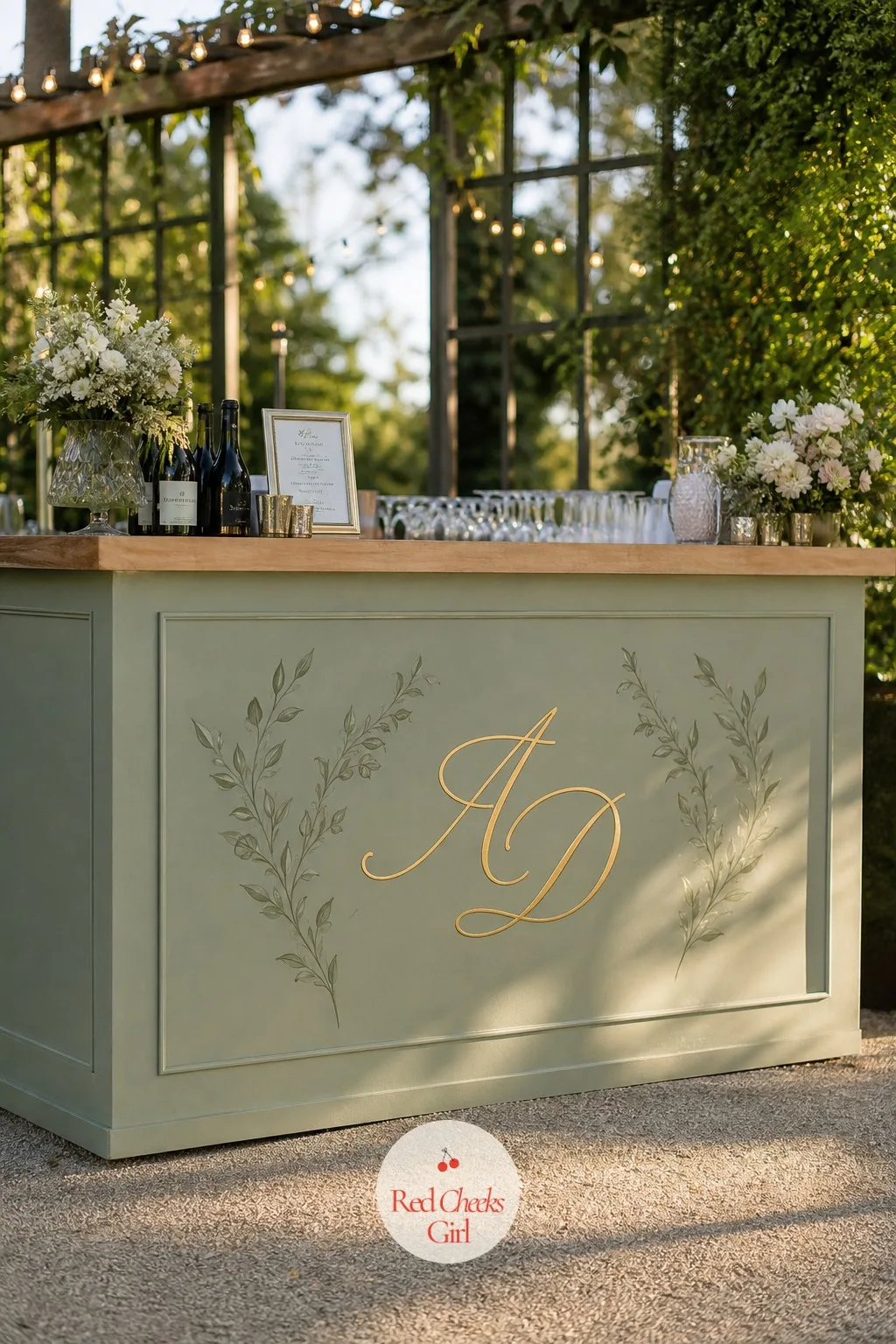
Painted Monogram Panel
Guests look for something to tell them whose wedding this is the moment they walk up to order a drink, and a bare counter gives them nothing. Painted Monogram Panel sits a single large initial or interlocking monogram panel against the center of the bar front, hand painted or vinyl cut in a color pulled from the florals.
It is built from a flat MDF or foam board panel, painted or wrapped in the chosen color, with the monogram cut from vinyl or hand lettered in gold or cream, then leaned or mounted against the center of the bar front. It reads best at a garden ceremony reception where there is enough soft daylight to catch the gold without glare.
If painting is not an option, a printed vinyl banner achieves the same read for far less. Order it from any wedding stationer alongside the welcome sign so the fonts match.
Signage and Light Behind the Bar
Once the sun goes down, the back wall of the bar becomes the brightest thing in the room. This is where a sign earns its keep and where ordinary string lights start to look like a design decision instead of an extension cord.
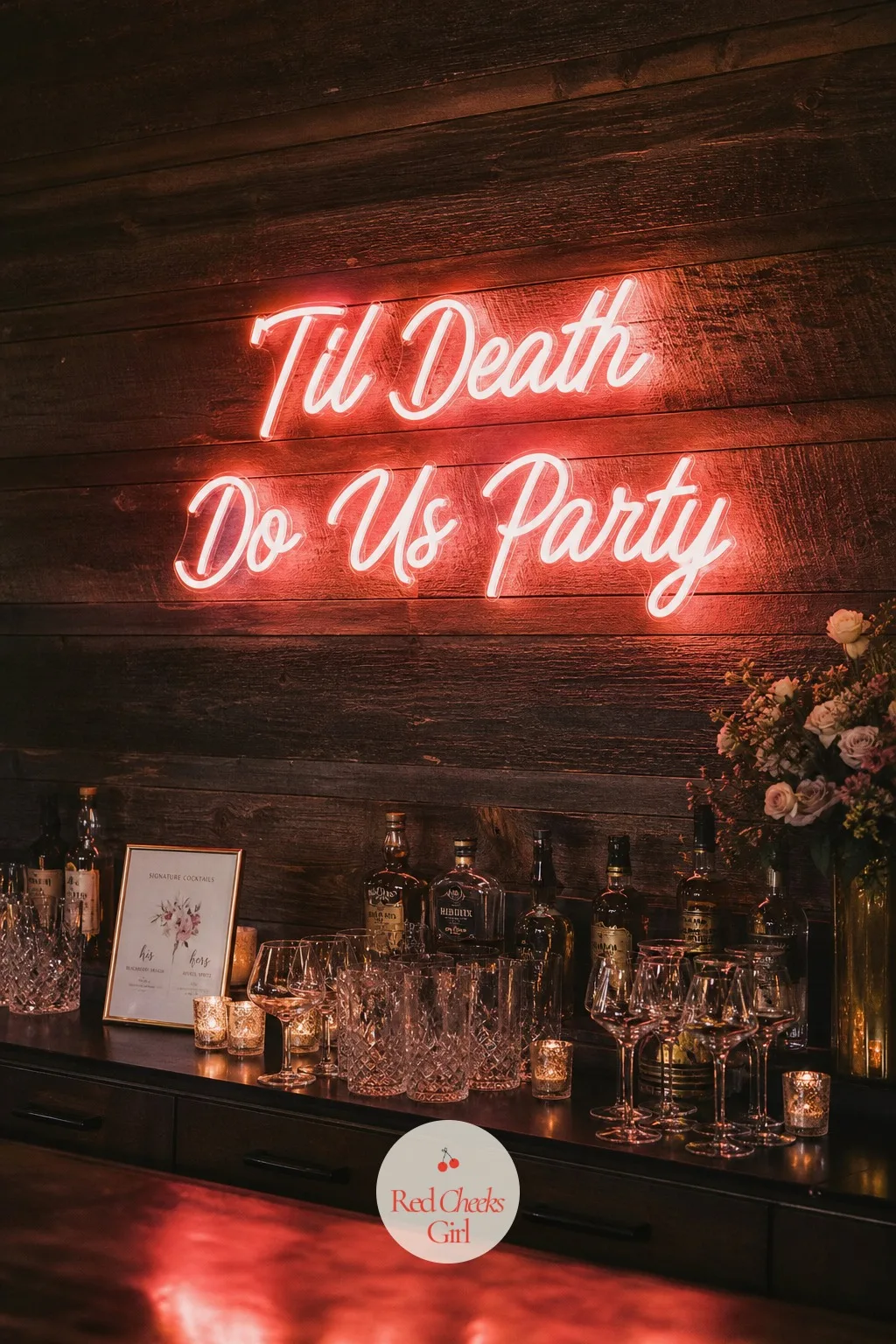
Neon-Style Sign
A bar without a sign is just a counter with bottles on it, and guests will stand there scrolling a phone menu that does not exist. Neon-Style Sign hangs a custom LED neon script, usually the couple’s names or a short line like cheers, against the wall or shelving directly behind the bar.
It is built as a flexible LED neon tube bent into script, mounted on a clear acrylic backing board, then hung from a hook or propped on the back bar shelf with its cord tucked behind bottles. It belongs in a restaurant, lounge, or any indoor venue dark enough to let the glow actually show; outdoors in daylight it disappears completely.
Rent rather than buy if this is a one night event, since most sign companies deliver and collect the same evening. Choose a warm white or soft pink tube over true neon colors if the rest of the palette is muted, so the sign complements instead of competing.
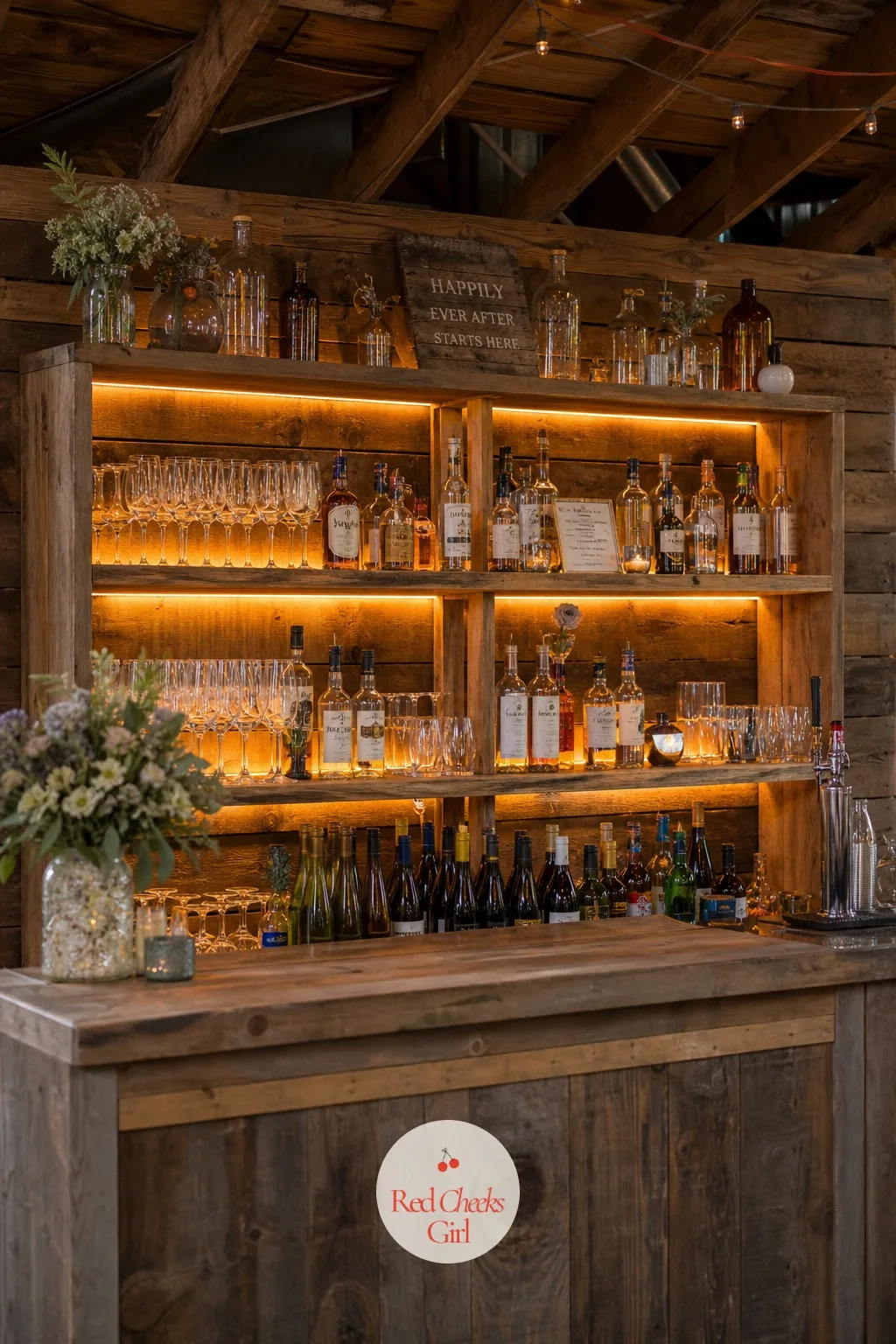
Lights Behind the Bar
Bottles on an open shelf look like storage until there is light behind them, and then suddenly they look like a display. Lights Behind the Bar runs warm string lights or thin LED strips along the shelving or backdrop wall, so every bottle and glass catches a rim of gold.
Build it from the back forward: LED strip lighting fixed along the underside of each shelf or the top of the back wall, then bottles and glassware arranged in front so the light falls through and around them rather than on top. It works in a barn with exposed shelving or reclaimed wood, where the warm bulbs read against raw timber instead of disappearing into drywall.
Battery powered LED strips skip the extension cord problem entirely if the venue has no outlet near the bar. Swap warm white for a soft amber bulb if the rest of the lighting in the room already leans warm, so nothing clashes.
🛍 Shopping guide
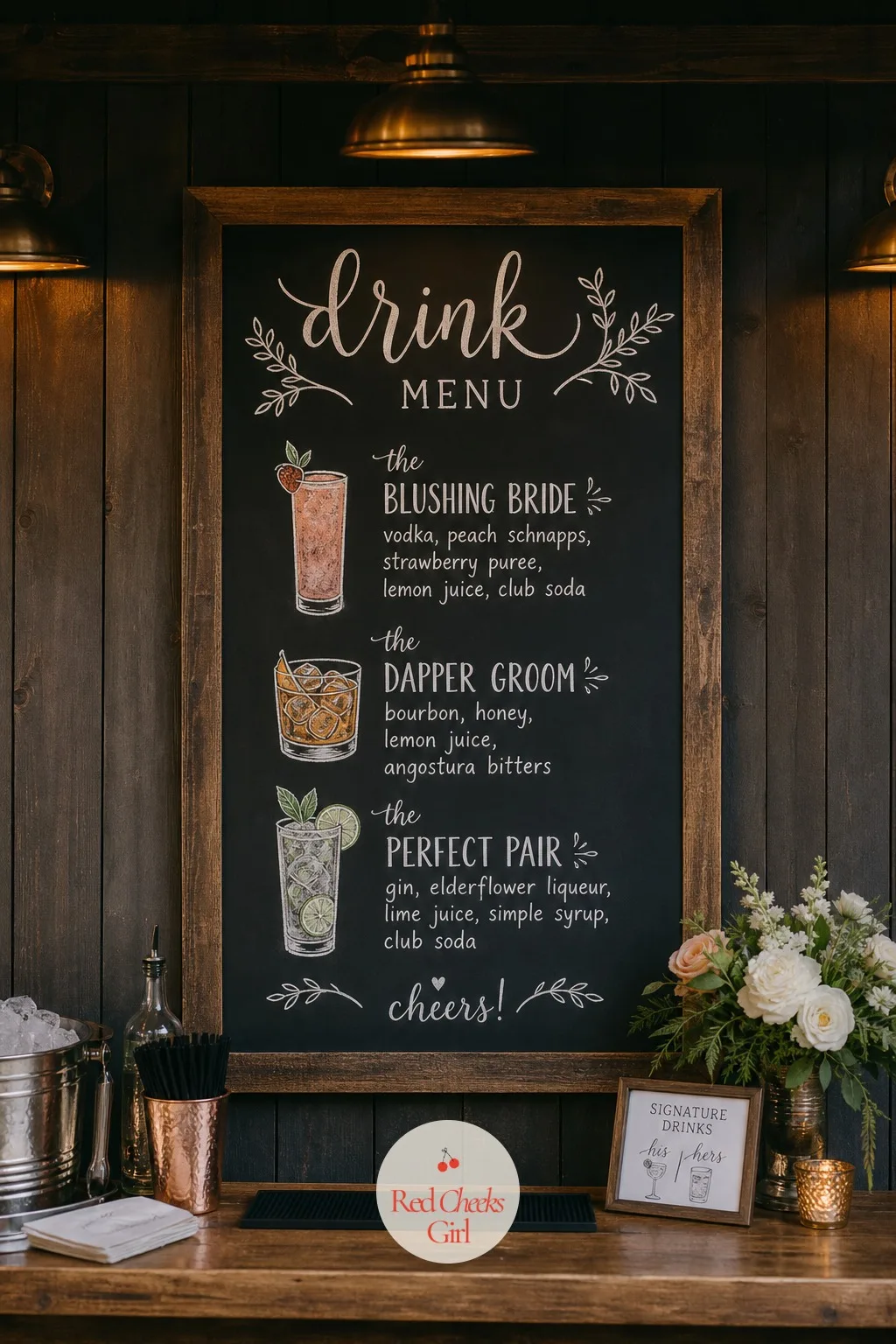
Chalkboard Drink Menu
A printed menu laminated to a clipboard reads like a diner, not a wedding, and that gap shows up in every close up photo. Chalkboard Drink Menu hangs a large framed chalkboard above the back bar, hand lettered in white or gold chalk pen with the signature cocktail names and a short line of ingredients.
It is built from a wood framed chalkboard panel, hung or leaned against the shelving behind the bar, lettered in advance so there is no wet chalk risk on the day. It fits a rustic restaurant, barn, or any venue with existing dark wood tones that a black board will blend into rather than fight.
If lettering by hand feels risky, a chalk pen stencil kit gets a clean result without freehand pressure. Swap the full chalkboard for a smaller tabletop easel version if the back bar wall is already busy with lights or garland.
🛍 Shopping guide
Hanging Glass Orb Lights
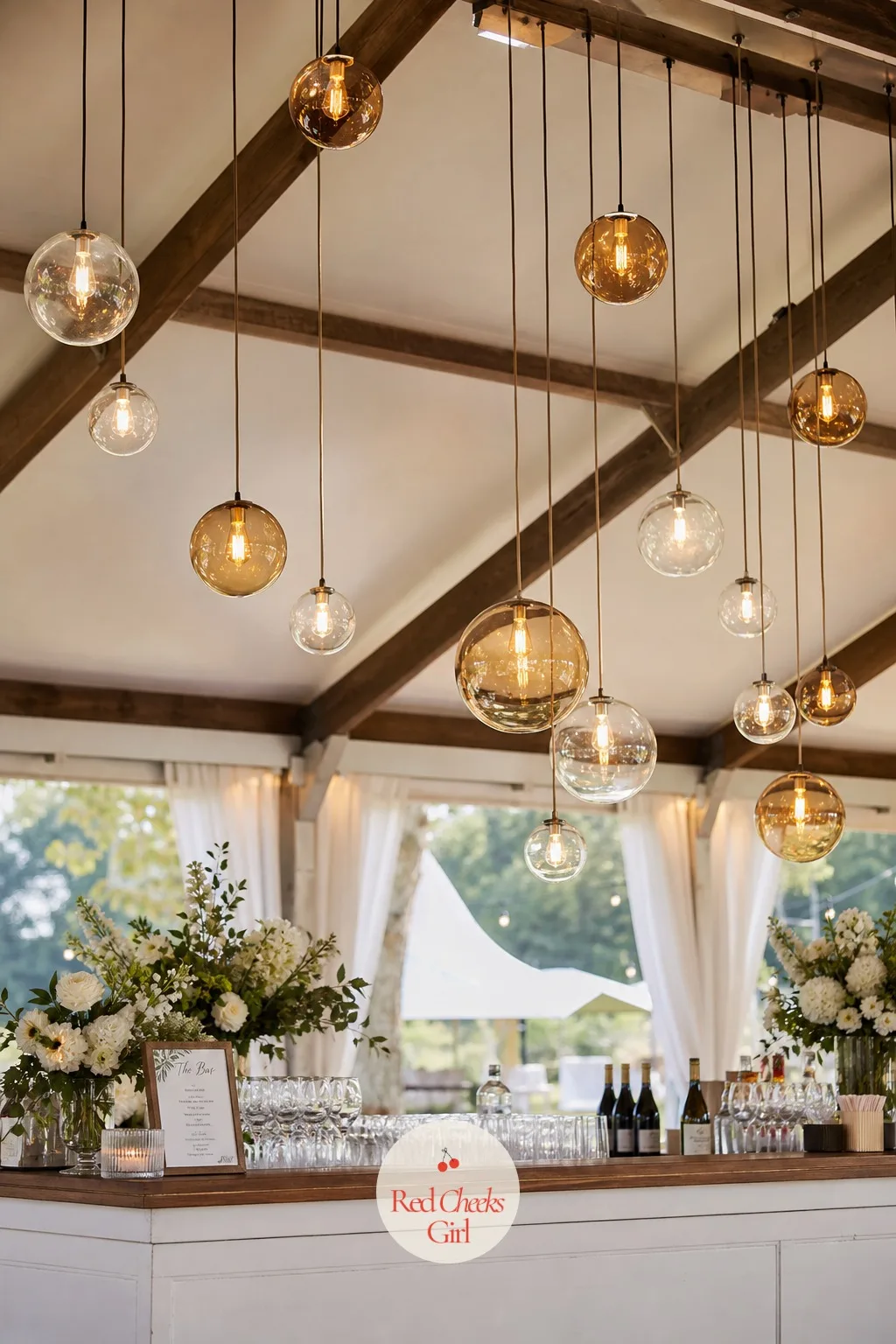
A flat string of lights overhead is pretty but forgettable, and a bar under a marquee has the ceiling height to do more than that. Hanging Glass Orb Lights suspends a cluster of clear and amber glass globe bulbs at varying heights directly above the bar, so the light itself becomes the decor rather than just illumination.
It is built from a wire or cable grid strung across the marquee frame, individual globe bulbs on cord clipped at staggered lengths so they hang like a loose chandelier. It belongs under a marquee or in a ballroom with enough ceiling height to hang things properly, since in a low room it reads as clutter instead of atmosphere.
Rent the rigging through the lighting vendor rather than improvising with hooks into a tent frame, since that is usually against the venue’s insurance terms. A single long strand of globe lights looped loosely above the bar gets most of the same effect for less setup.
🛍 Shopping guide
Lantern-Lined Pathway to the Bar
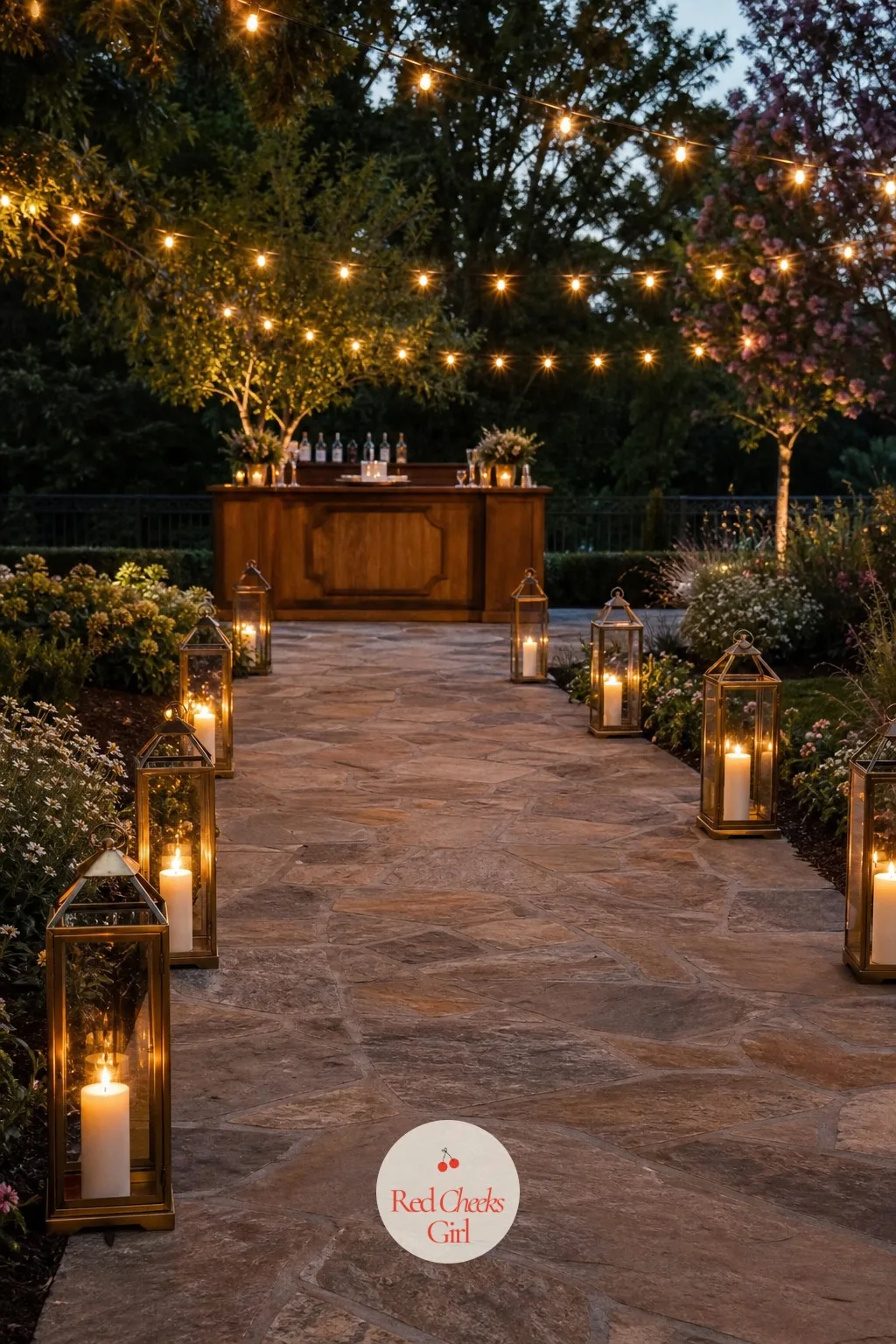
An outdoor bar set apart from the main tent can feel like an afterthought once the sun goes down and the path to it disappears into the dark. Lantern-Lined Pathway to the Bar lines the walking route with brass or glass lanterns at ground level, spaced evenly so guests follow the glow without a phone flashlight.
It is built from a row of hurricane lanterns or flameless candle lanterns set directly on the grass or stone path, spaced about three feet apart, with the bar itself lit a shade brighter at the far end so it reads as the destination. It only makes sense for a garden or terrace venue where the bar sits a short walk from the main reception space.
Battery flameless candles avoid any open flame concern on grass or near fabric, and most rental companies carry them already weighted against wind. Swap brass for simple glass hurricane jars if lanterns are not in the rental budget; the effect reads almost the same from a distance.
🛍 Shopping guide
Menus, Trays and Serving Details
These are the pieces a guest actually touches: the napkin under the glass, the tray the bartender sets a drink on, the card she reads before ordering. Small, cheap to upgrade, and the first thing that photographs badly if it is left generic.
Signature Drink Menu on an Easel
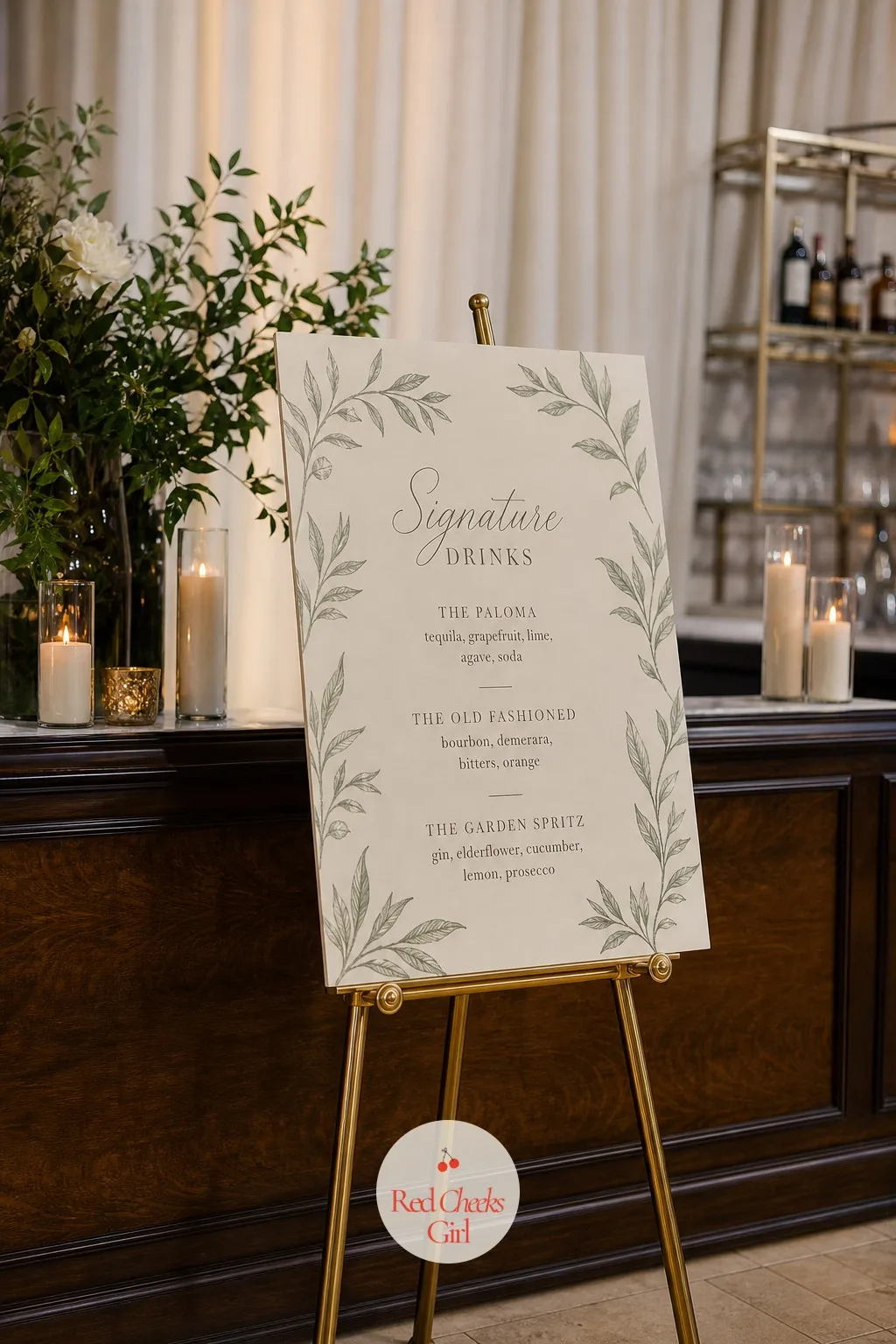
Guests hesitate at an open bar when there is no list to point at, and a hesitant guest is a slow line. Signature Drink Menu on an Easel props a printed or calligraphed cocktail card on a small wood or gold easel at eye level beside the bar, listing two or three named drinks.
It is built from a printed cardstock menu, slipped into a frame or clipped to an easel stand set on a side table draped in a matching linen. It suits any indoor venue, especially a ballroom where the easel can match the gold of the place settings.
Keep the list to two cocktails and one mocktail so the bartender never has to explain a long menu under pressure. Order the printing from the same stationer doing the invitations so the font carries through.
Vintage Silver Trays
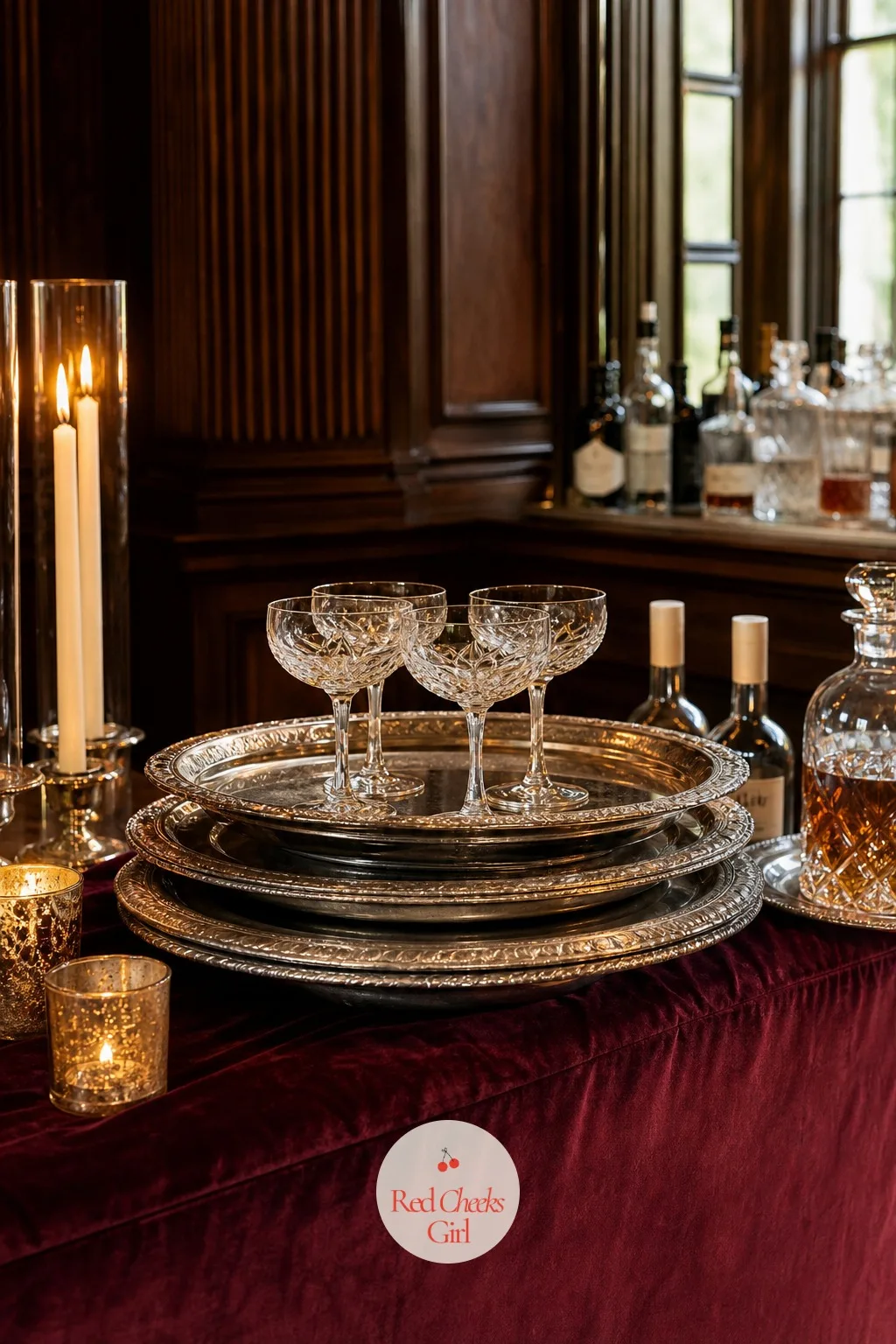
Drinks handed over a bare counter feel transactional, and a wedding bar should feel like a party, not a transaction. Vintage Silver Trays uses tarnished or polished silver trays to stage pre poured drinks, so a bartender can pass a full round in one lift instead of four separate hands.
Stack them simply: one or two large round trays set on the bar’s marble or linen surface, coupes or flutes arranged in a loose circle on top, a folded napkin tucked under each glass. It suits a restaurant or manor house venue where the existing silverware and candelabras already lean toward that old world register.
Thrifted or rented silver plate trays work just as well as sterling, and a slight tarnish actually photographs better than a mirror polish under warm light. Swap silver for brushed brass trays if the wedding’s metal accents are gold rather than silver.
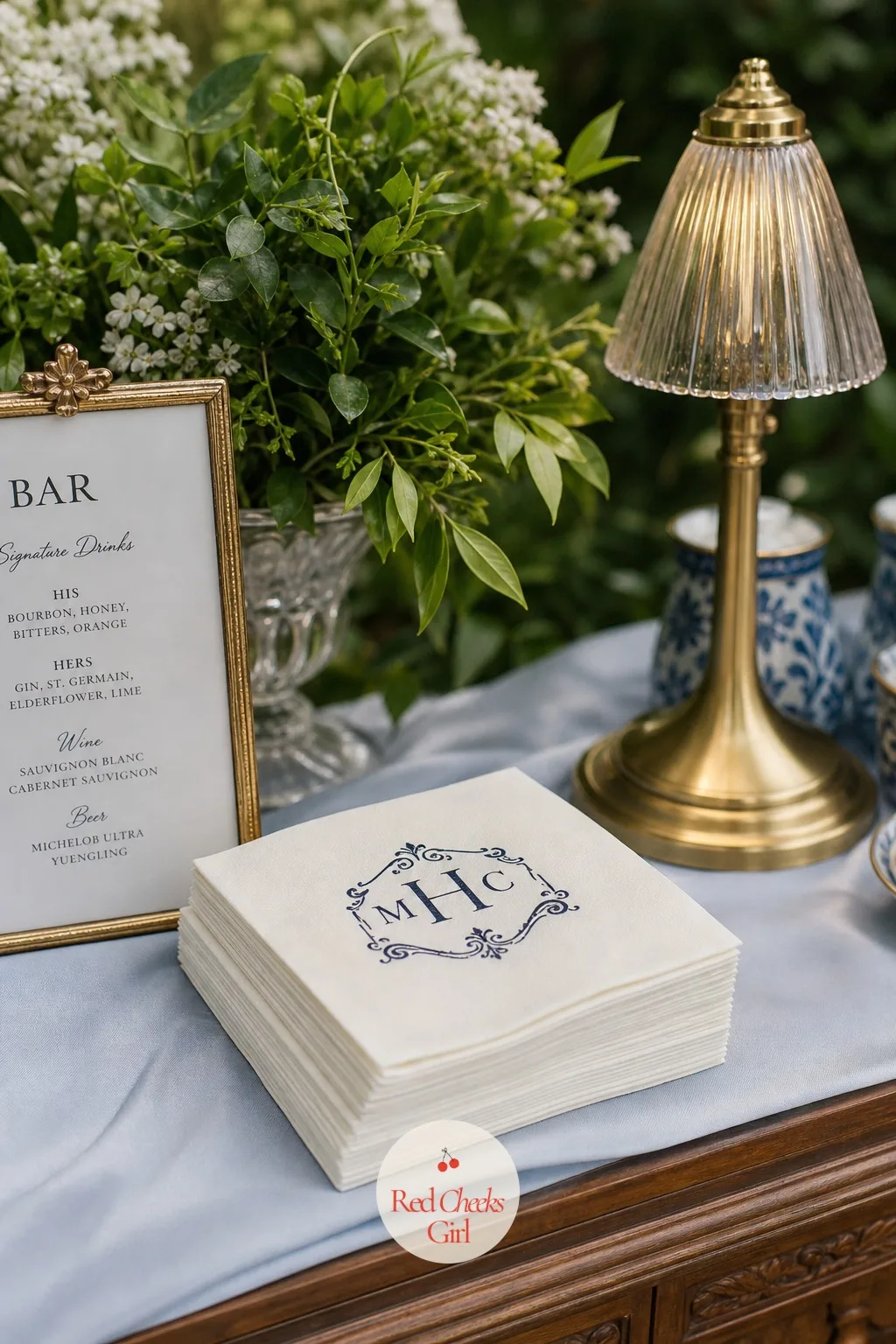
Cocktail Napkins with Monogram
A plain white napkin under a glass disappears the second it is used, and that is the whole point of a monogrammed one instead. Cocktail Napkins with Monogram stacks custom printed or embossed napkins in a short tower near the drinks, the couple’s initials or wedding date printed small in one corner.
Build the stack directly on the bar: a small stand or simple stack set on the satin runner, napkins fanned slightly so the monogram corner shows on top. It works anywhere, since it is one of the few items here that does not depend on venue style, only on whether the rest of the stationery already has a monogram to match.
Order them printed through any stationery site alongside the invitation suite for a consistent font. Paper cocktail napkins keep the cost down; fabric ones work if the budget allows for laundering afterward.
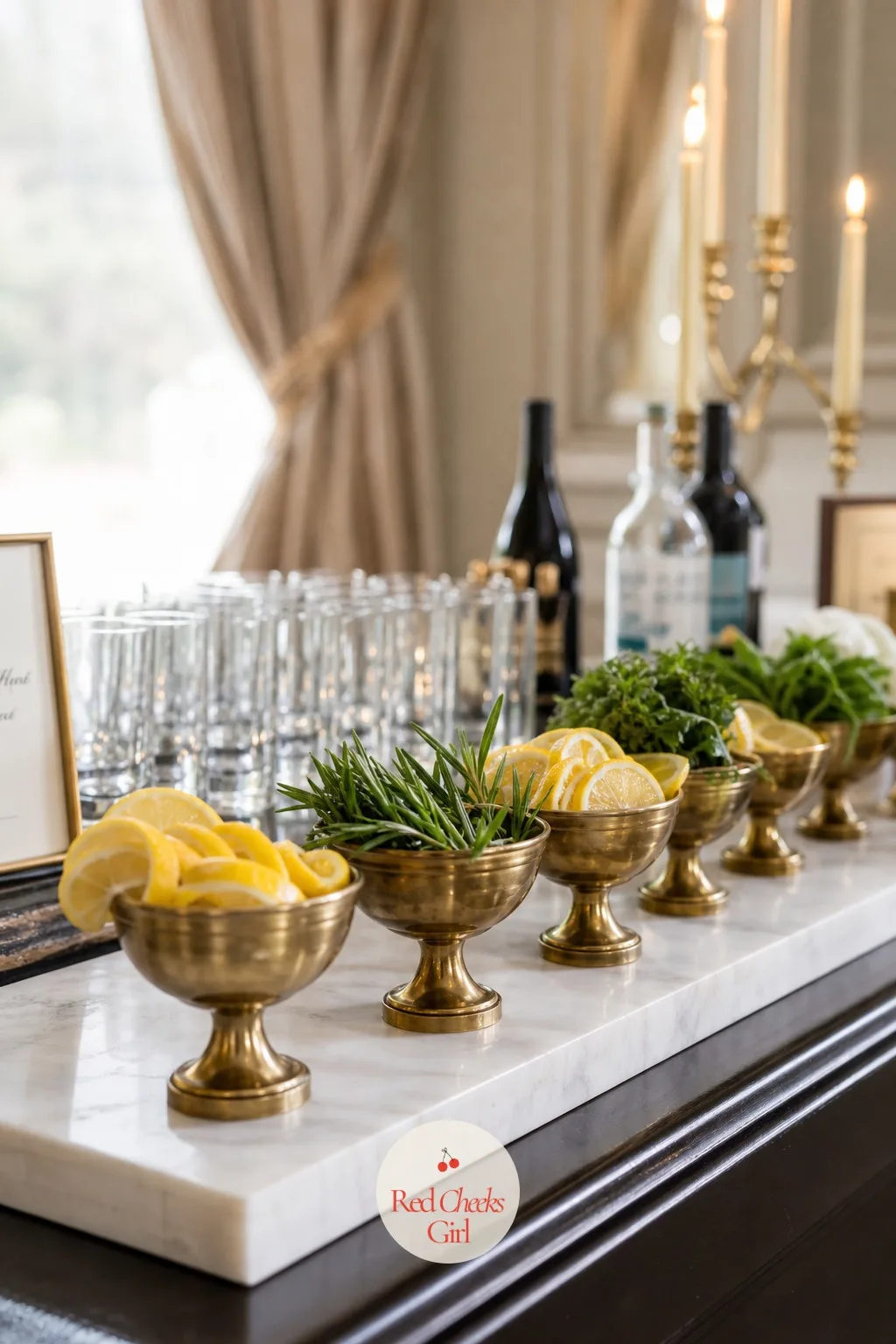
Marble Garnish Ledge
Loose garnish bowls scattered across a bar top always look messier than the drinks they are meant to improve. Marble Garnish Ledge sets a single long marble board or slab along one end of the bar, small brass bowls of citrus twists, olives, and herb sprigs lined along its length.
It is built from a marble serving board as the base, shallow brass or glass bowls arranged on top in a straight row, small tongs or spoons resting beside each. It fits a ballroom or restaurant bar where marble already appears elsewhere on the tables, so the look carries through rather than standing alone.
A marble patterned contact paper over a plain board gets a similar look for far less than real stone. Swap brass bowls for white ceramic ones if the metal accents elsewhere are silver.
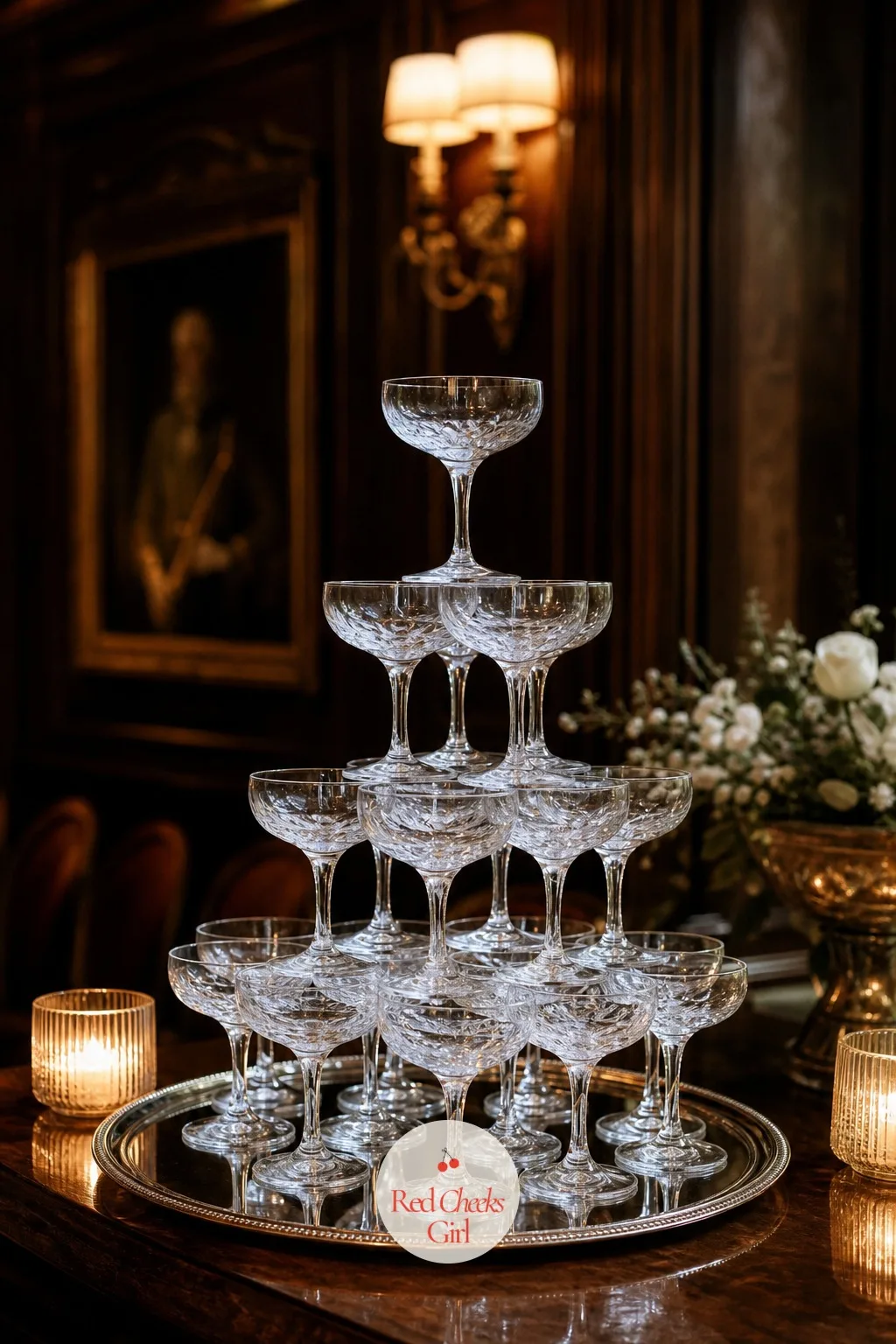
Crystal Coupe Pyramid Display
A stack of empty glasses waiting to be filled usually just looks like inventory, until it is arranged on purpose instead of set down in a hurry. Crystal Coupe Pyramid Display stacks empty coupe glasses into a low three tier pyramid at one end of the bar, purely as a display piece rather than for pouring into.
Build it from the base up: a wide bottom row of coupes set on a mirrored or marble tray, a slightly smaller row nested on top of the rims, a single glass crowning the peak, the whole structure left unfilled and untouched until it is time to clear it for actual service. It suits a manor house or restaurant bar lit by candlelight, where the crystal catches the flicker from every angle.
Rent sturdy, identical coupes for this rather than using the actual service glassware, since a mismatched stack reads as improvised. Keep it as a photo moment only; swap to a full champagne tower nearby if the display also needs to pour.
🛍 Shopping guide
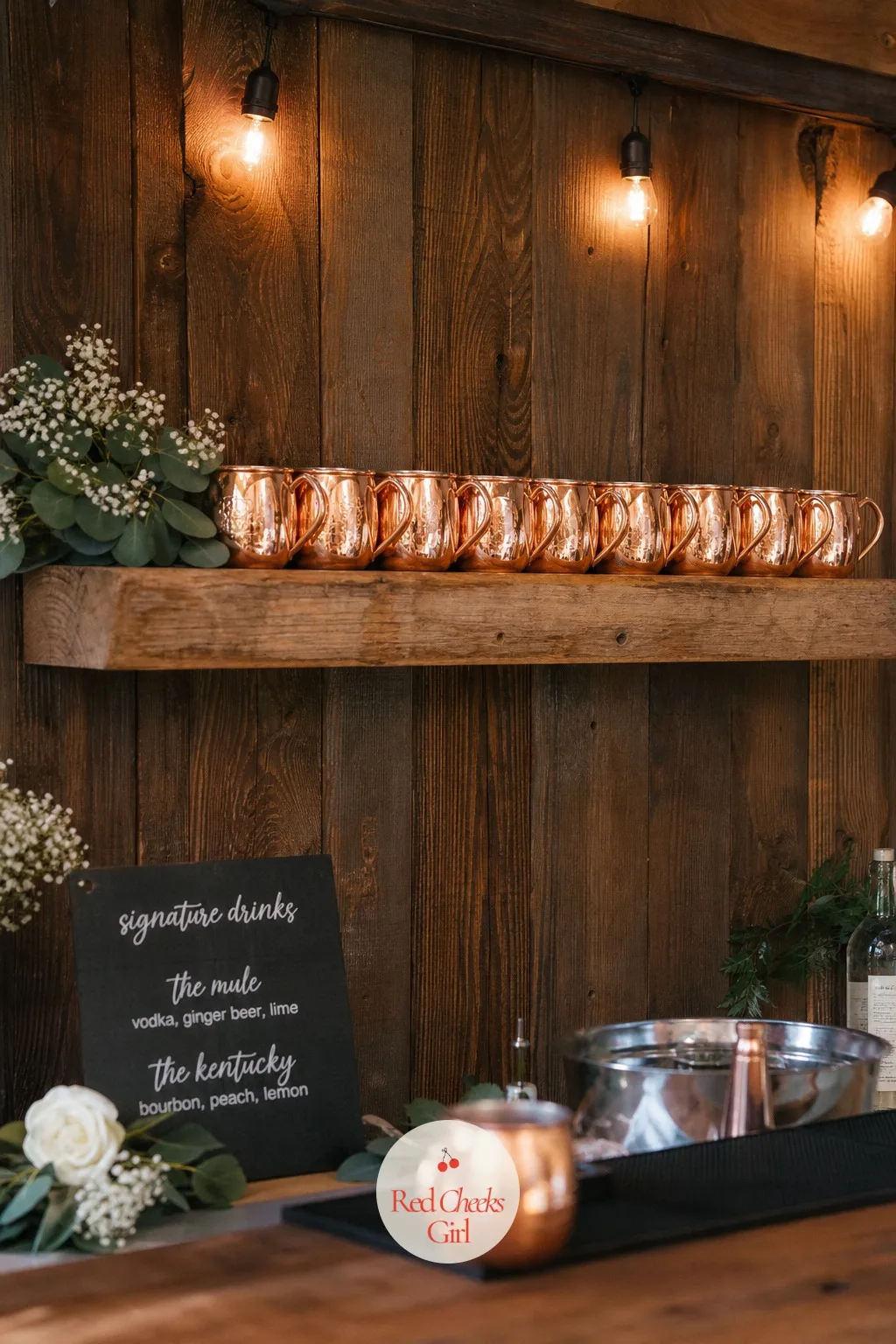
Copper Mule Mug Display
A row of identical glasses looks fine but a row of hammered copper catches light that glass never will, and it signals exactly what drink is on offer before anyone asks. Copper Mule Mug Display lines polished copper mugs along an open wood shelf behind the bar, ready and waiting for the moscow mule order.
Build it from a floating wood shelf fixed to the back wall, copper mugs lined up handle out in a single even row, a small bowl of lime wedges set beside them. It belongs at a barn or rustic restaurant venue where warm metal tones already run through the rest of the decor.
Polished copper photographs better than brushed under warm bulb light, so skip the matte finish if this is purely for the display shelf. Swap copper for brass mugs if the budget calls for a cheaper metal with the same warm glow.
Specialty Drink and Garnish Stations
A station gives guests something to do besides wait in line, and it gives the caterer a built in visual that does not need extra decor budget. Pick one that matches the hour it serves: bright and citrus for cocktail hour, warm and dark for the dance floor stretch.
If the venue has a short cocktail hour, one station outperforms three half built ones. Stock it properly and let it be the whole show for that hour.
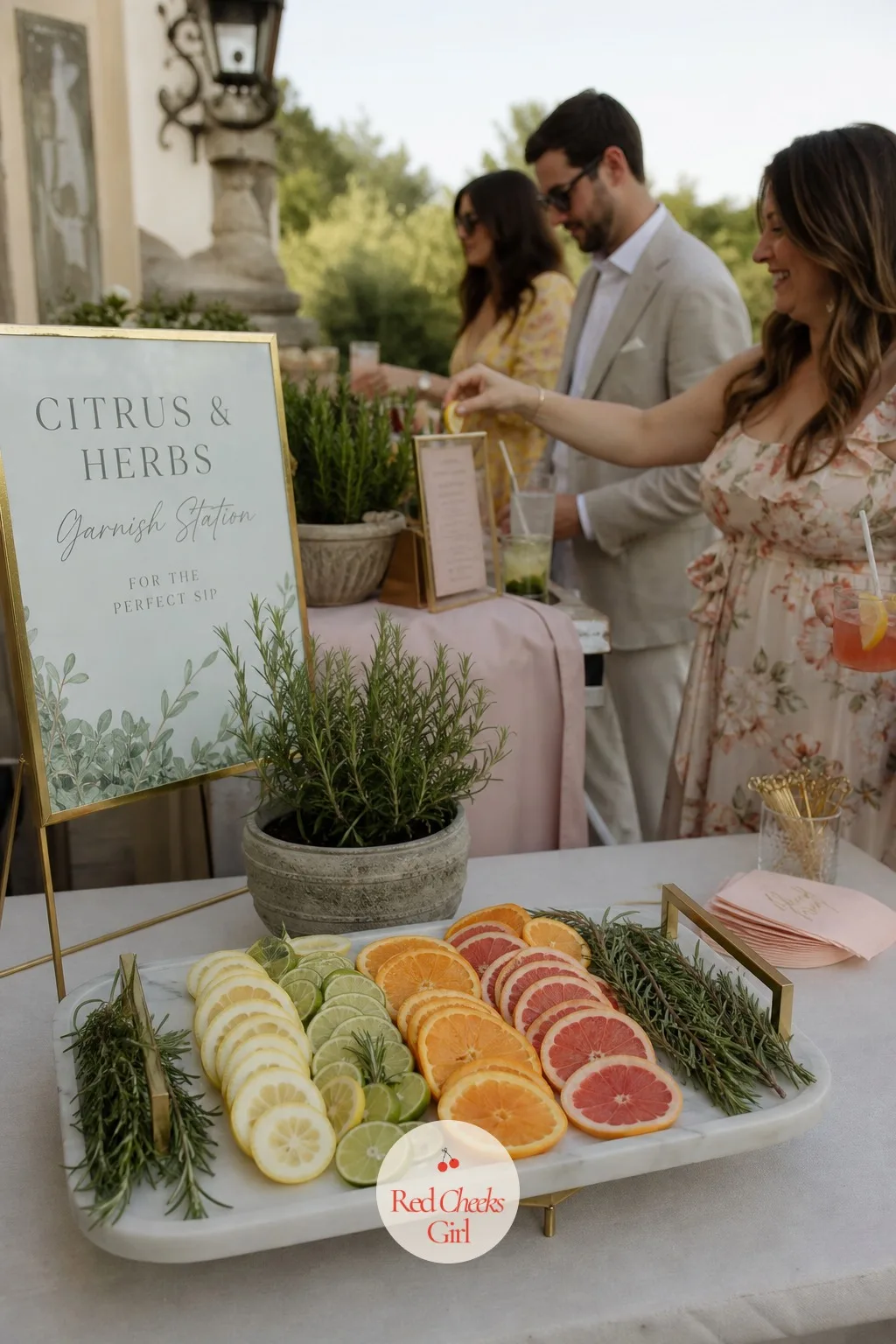
Citrus and Herbs Garnish Station
Guests like choosing their own garnish more than they let on, and a self serve station takes that small decision off the bartender’s hands entirely. Citrus and Herbs Garnish Station sets out sliced citrus wheels, twists, and fresh herb sprigs across a tray so guests can finish their own drink exactly how they like it.
Build it on a wide marble or wood tray: citrus slices fanned in rows, small jars of rosemary and mint sprigs standing upright, a tiny labeled card for each option so nobody has to ask what it is. It works especially well at a garden or terrace wedding, where the fresh green and citrus tones echo the planting around the venue.
Slice citrus the morning of and keep it chilled until an hour before service so it does not dry out under warm lights. Swap rosemary for basil or thyme depending on what the caterer is already using in the food, so nothing feels mismatched.
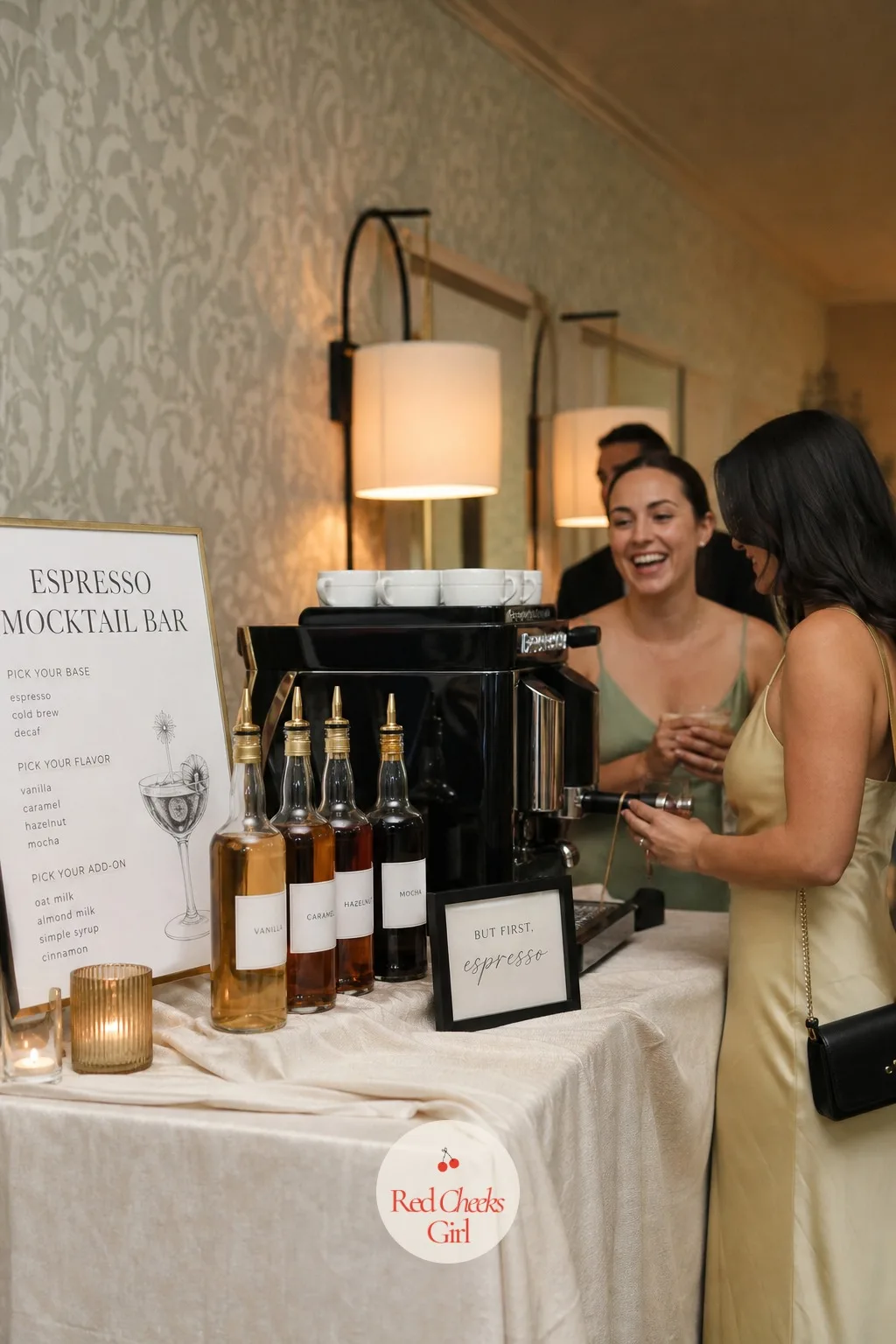
Espresso Mocktail Bar
Not every guest wants alcohol by the second hour, and a sleepy late reception benefits from something with actual caffeine in it. Espresso Mocktail Bar sets up a small espresso machine alongside milk, syrups, and tonic so guests can build their own espresso martini, mocktail, or straight shot.
It is built as a compact station: the espresso machine as the centerpiece, small glass bottles of syrup lined beside it, a short stack of coupe or rocks glasses, and a cream linen runner underneath to catch any spills. It fits best indoors near an outlet, in a ballroom corner or a converted lounge space away from the main dance floor noise.
A rented espresso cart with a barista covers this without anyone needing to pull shots themselves. Swap the machine for a large thermos of cold brew and a tonic station if there is no power source nearby.
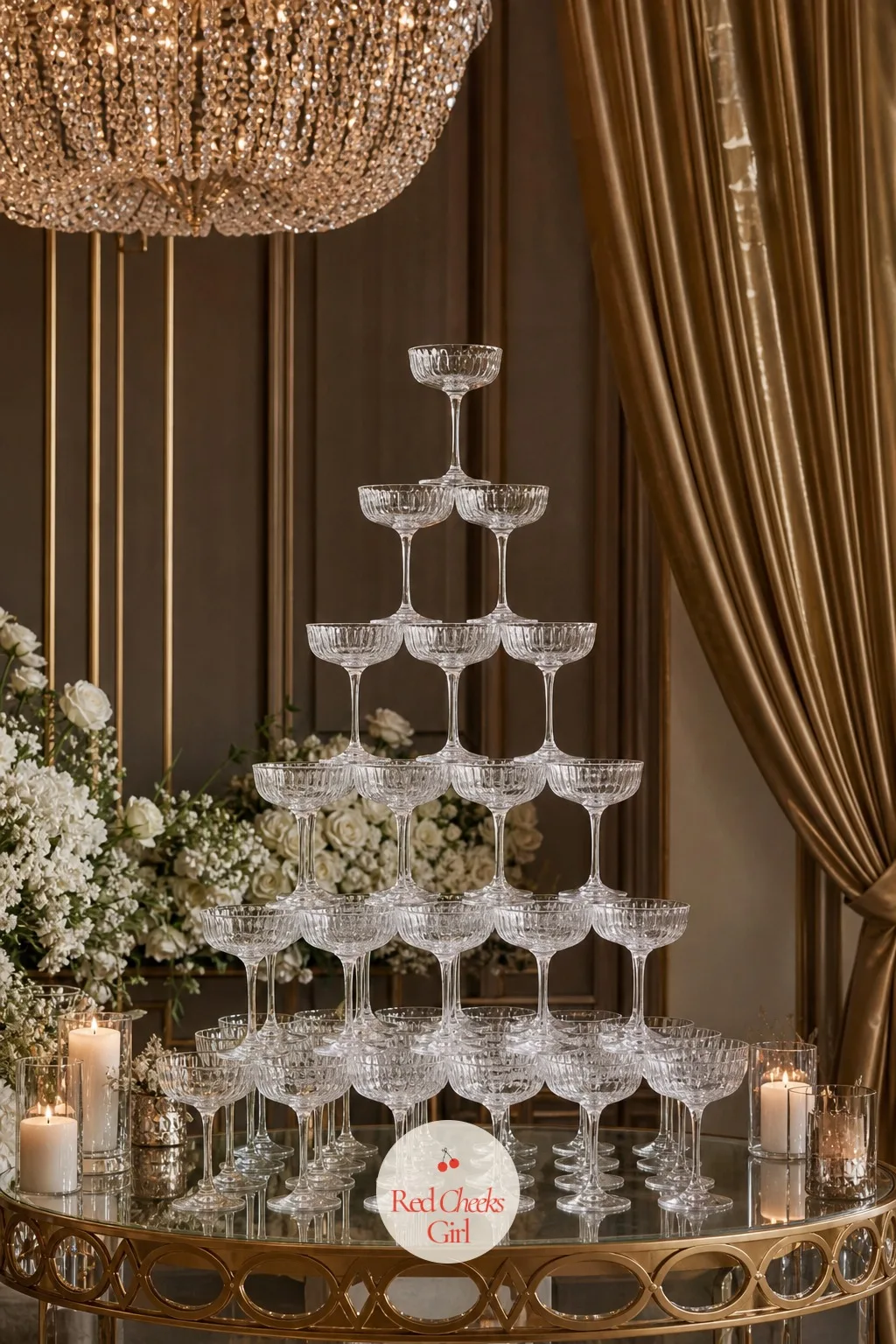
Champagne Tower
Nothing announces a toast is about to happen quite like a tower of glasses waiting to be poured into from the top, and it is the one moment everyone actually stops talking to watch. Champagne Tower stacks coupe glasses in tiers on a sturdy round stand so a single bottle poured from the top cascades down through every level.
Build it from the base: a weighted round stand or table as the foundation, a wide bottom ring of coupes set rim to rim, each successive tier nested slightly offset so the champagne flows down evenly, topped with a single glass at the peak. It belongs in a grand ballroom with enough ceiling height and floor space for guests to gather around it for the pour.
Practice the pour with water the day before if nobody on staff has done it, since an uneven base ring is what causes a wobble. Swap champagne for sparkling cider in the lower tiers if some glasses are meant for guests who are not drinking.
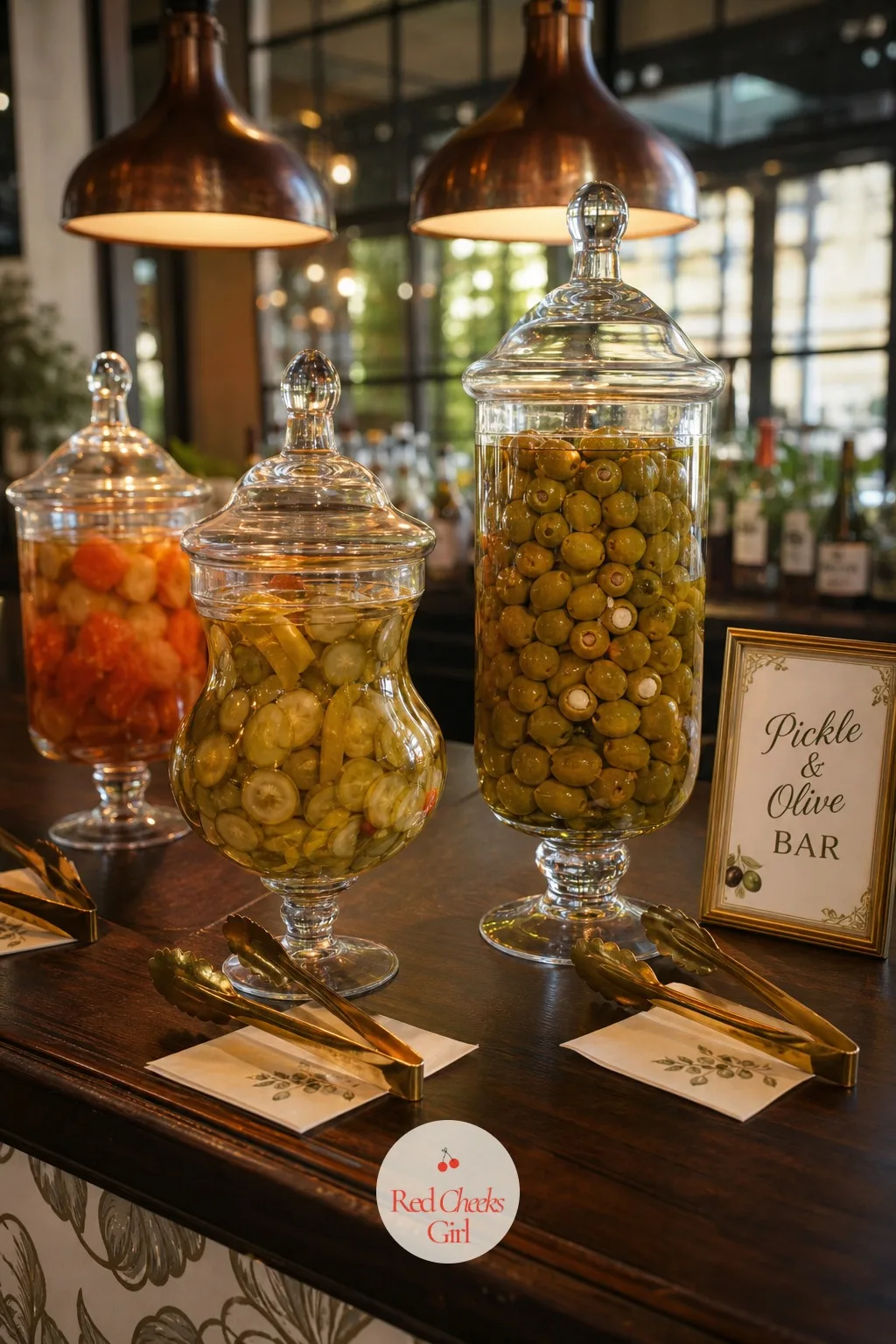
Pickle and Olive Bar
Somewhere between the signature cocktail and midnight snacks, guests want something briny to go with the martinis, and a plain bowl of olives does not quite cover it. Pickle and Olive Bar lines up small glass jars of pickled vegetables, stuffed olives, and pearl onions along the bar for guests to spear and drop into their own drink.
Build it as a row: glass apothecary jars holding each variety, small wooden skewers or tiny tongs set beside them, a dark wood or marble tray underneath to catch any brine. It suits a restaurant or lounge style reception where a slightly retro, speakeasy feel already runs through the rest of the decor.
Use jars with tight lids so the station can be prepped the day before and simply opened on arrival. Swap stuffed olives for cocktail onions only if any guests are allergic to the usual pimento filling.
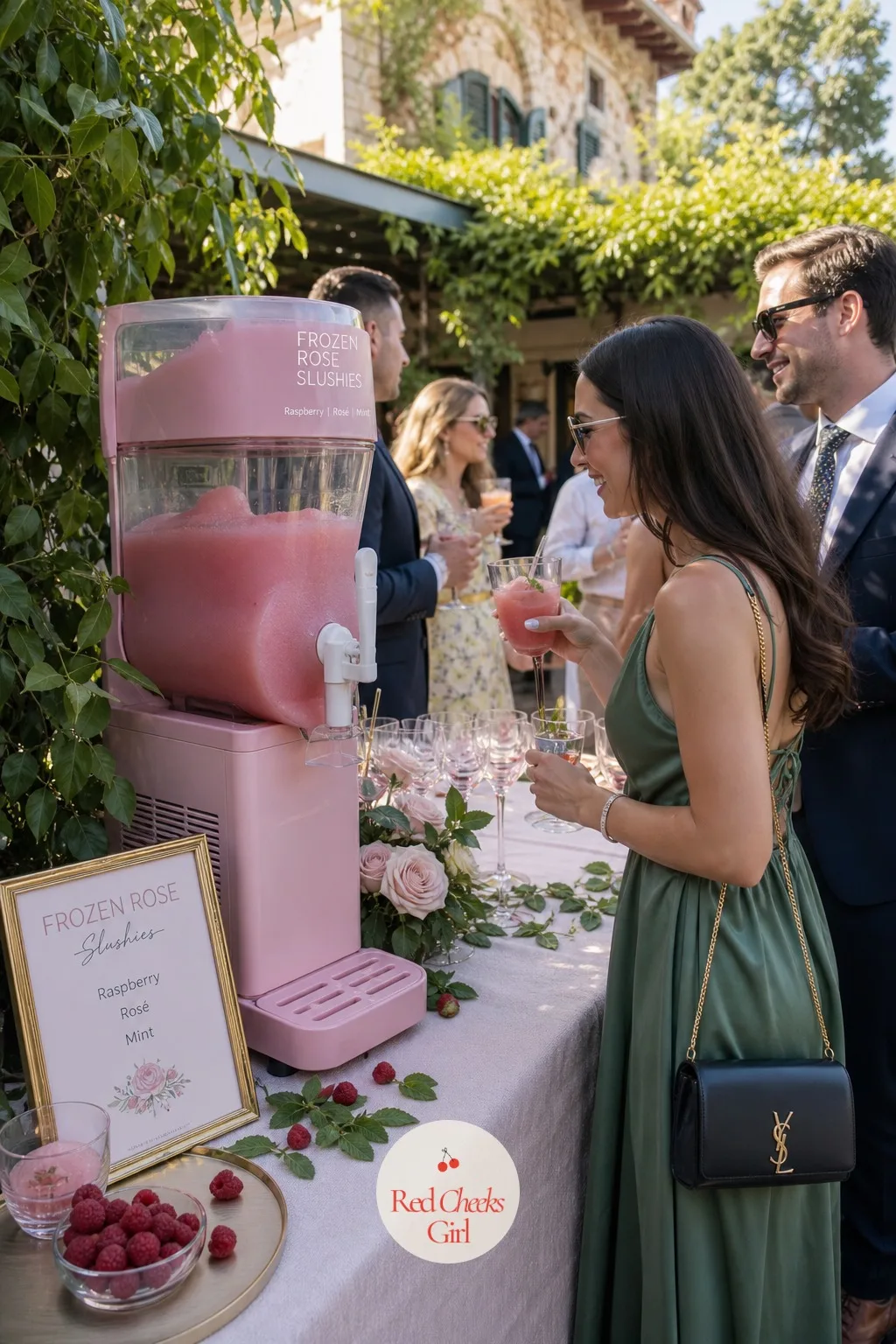
Frozen Rose Slushie Station
A warm afternoon reception needs something cold that is not just ice in a bucket, and this is the station that actually gets a line without anyone being asked to stand in it. Frozen Rose Slushie Station runs a small frozen drink machine dispensing pale pink sparkling slush, fresh raspberries and mint floated on top of each pour.
Build it as a single focal machine: the slushie dispenser centered on the table, pastel linen underneath, a small bowl of fresh raspberries and mint sprigs beside the glasses for garnish. It works best outdoors in warm weather, on a terrace or garden lawn where guests are already looking for something cold.
Most event rental and catering companies carry a frozen drink machine as a standalone rental, so this does not need to be built from scratch. Swap the rose base for a frozen lemonade if any guests are not drinking.
Infused Water and Spritz Station
The first thirty minutes of cocktail hour are often the hottest and the least prepared for, since everyone heads straight outside before the full bar is even stocked. Infused Water and Spritz Station sets out large glass beverage dispensers of cucumber and mint water alongside a simple prosecco spritz, so guests have something immediately on arrival.
Build it from two or three glass dispensers with spigots lined on a table, fresh fruit and herbs visible inside each one, a short stack of glasses and a small chalkboard label for each flavor. It suits any outdoor garden ceremony arrival point, set up before guests even reach the main bar.
Refill the dispensers from a cooler kept just out of sight so the display never runs visibly low. Swap prosecco for sparkling water with the same fruit if the arrival drink needs to stay alcohol free.

🛍 Shopping guide
Hot Toddy Station
A late autumn or winter reception needs a warm drink option once the dancing starts and the doors have been open too long, and nobody wants to queue for a hot drink made to order. Hot Toddy Station sets a large copper kettle or urn of pre batched warm whiskey and honey toddy beside a stack of heatproof mugs.
Build it as a single warm focal point: the kettle or urn on a trivet, cinnamon sticks and lemon wheels in a small dish beside it, a deep red velvet runner underneath to hold the warmth visually as well as literally. It belongs at a barn or any venue hosting a cold season wedding, set near the dance floor rather than the main bar so it catches guests coming off the floor.
Keep the batch in a slow cooker on low rather than an open flame urn if the venue has fire restrictions. Swap whiskey for apple cider as the base if the crowd skews younger or dry.

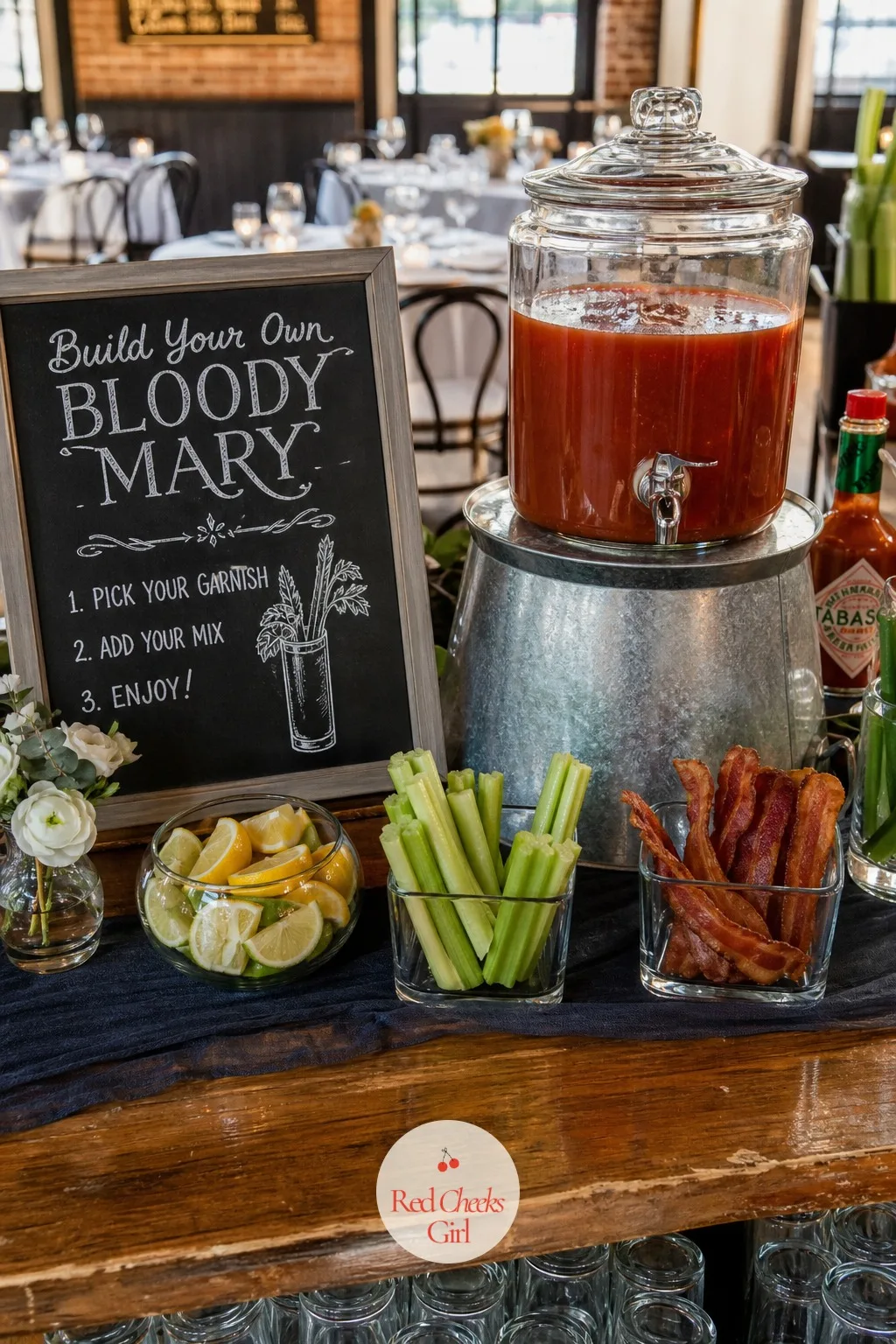
Build-Your-Own Bloody Mary Bar
A brunch wedding or a late morning ceremony calls for something other than champagne by nine, and a bloody mary station lets guests make it as mild or as loaded as they want. Build-Your-Own Bloody Mary Bar lines up a tomato juice base with small bowls of celery, pickled beans, bacon, and hot sauce for guests to assemble their own glass.
Build it as a row of glass jars and small bowls on a dark linen runner: the juice base in a large dispenser at one end, garnish bowls arranged in order of how a guest would build the drink, a short printed card suggesting a combination for anyone unsure where to start. It suits a restaurant brunch reception or a garden wedding with a late morning ceremony time.
Prep every garnish the night before and keep it chilled until service, since celery and bacon both wilt fast under warm lights. Swap hot sauce varieties based on the couple’s actual favorites rather than a generic bottle, since this is the one station guests remember by name.
Favors and Finishing Touches at the Bar
The last thing a guest picks up before they leave the bar for the night should feel like it belongs to the same party as everything before it, not like a separate favor table bolted on at the end.
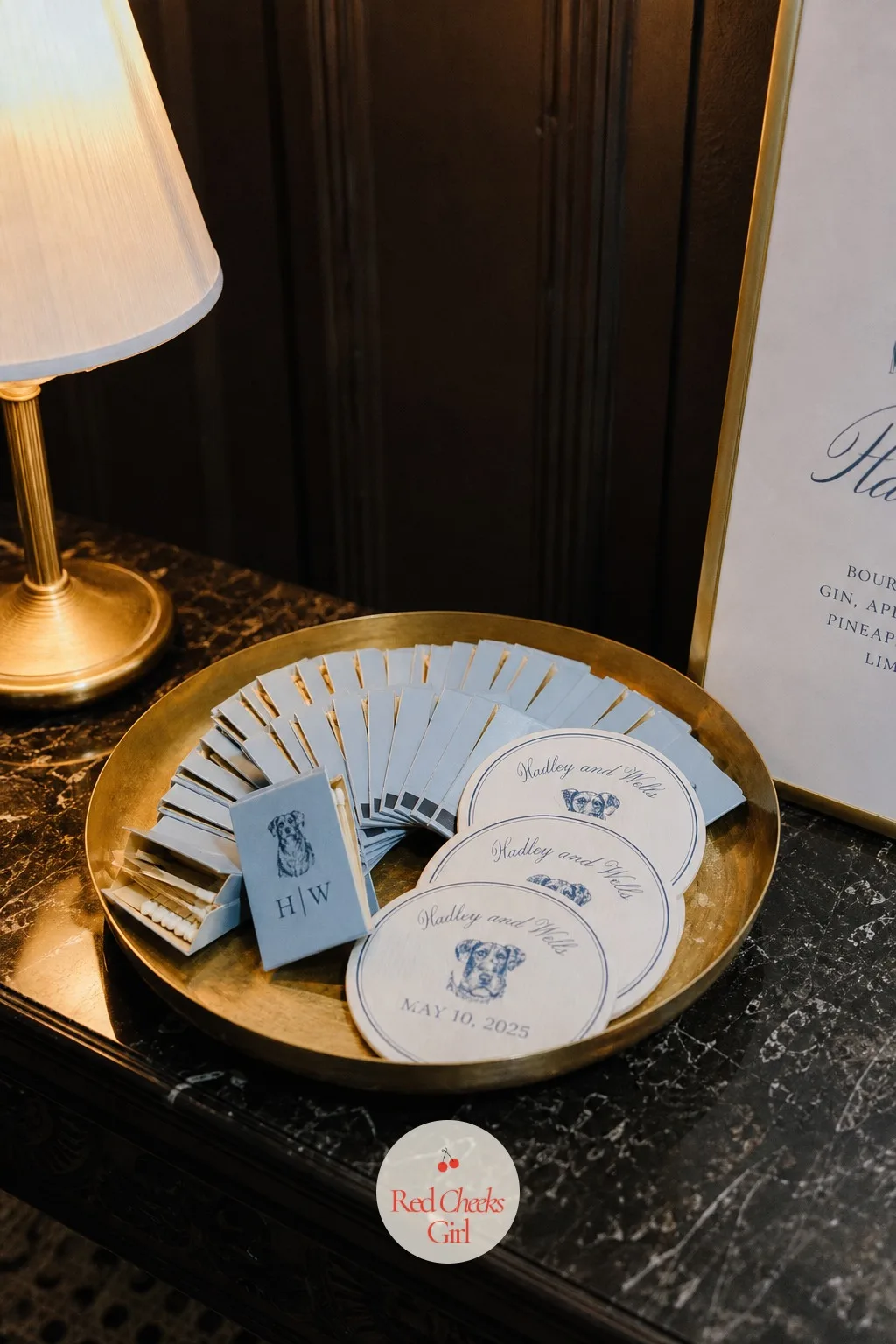
Matchbook and Coaster Display
Guests at the bar always end up holding something small in their free hand, and a printed matchbook is a far better thing to find in a jacket pocket the next morning than a receipt. Matchbook and Coaster Display fans a stack of custom printed matchbooks and round coasters in a shallow dish at the end of the bar.
Build it simply: a shallow ceramic or brass dish set on the counter, matchbooks fanned on one side, coasters stacked on the other, both printed with the couple’s names or wedding date. It works at any indoor venue with a lounge feel, especially a restaurant or converted warehouse space.
Order both through the same stationer printing the napkins so every small paper good at the bar matches. Skip the matchbooks if the venue has an open flame restriction and keep just the coasters.
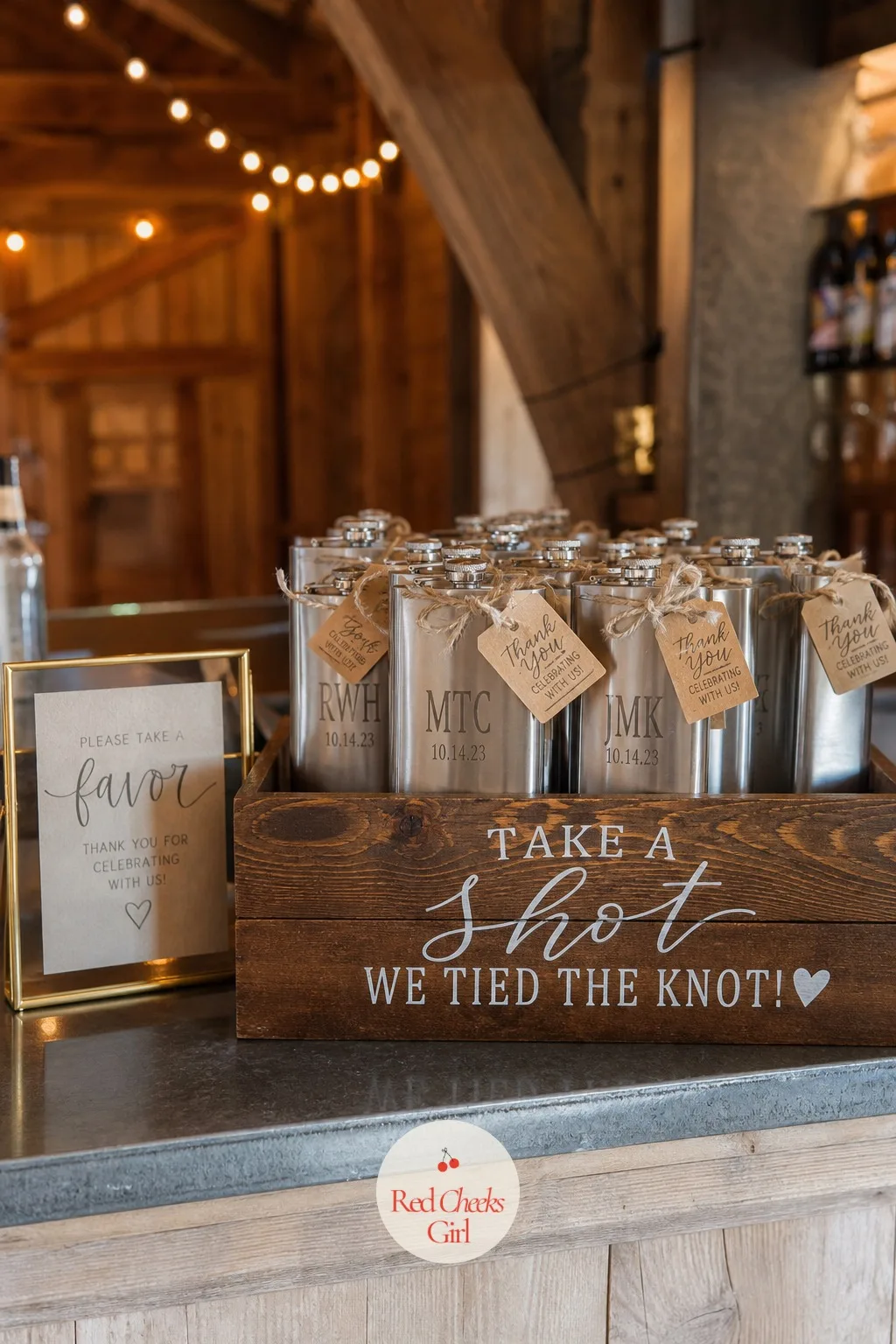
Engraved Flask Favor Display
A favor table across the room often gets ignored until the very end of the night, but a favor sitting right at the bar gets picked up the moment a guest orders their first drink. Engraved Flask Favor Display lines a wooden crate with small engraved metal flasks, each tagged with a guest’s name or a short thank you line.
Build it from the bottom up: a rustic wood crate lined with a folded cloth, flasks stood upright in rows inside it, small paper tags tied to each one with twine, the whole crate set at the corner of the bar under warm light. It suits a barn or outdoor wedding where a wood crate already fits the surroundings rather than looking out of place.
Order flasks in bulk through a personalization site well ahead of time, since engraving takes longer than most other wedding orders. Swap flasks for small bottle openers if the guest list skews toward non drinkers.
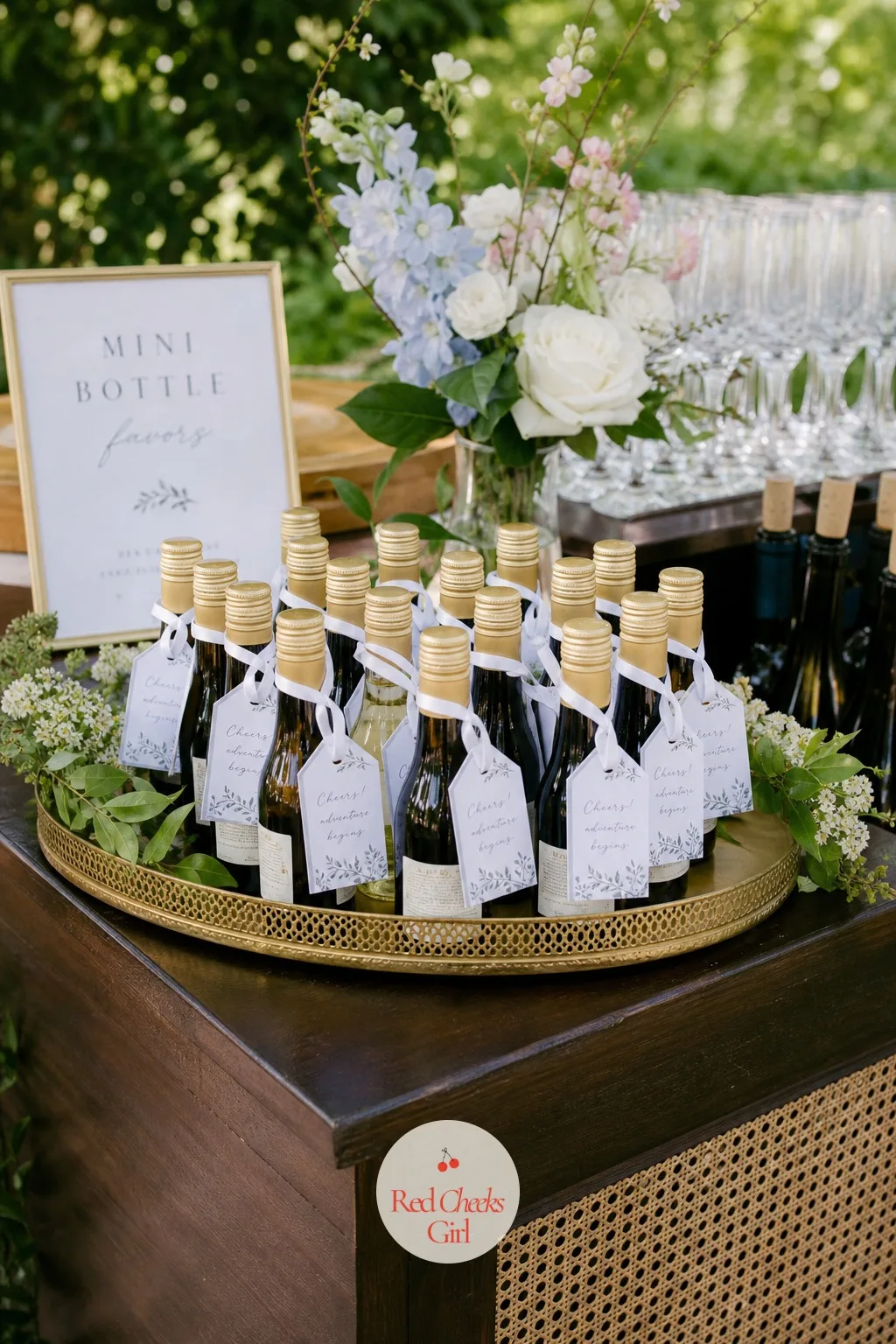
Mini Bottle Favor Station
The very last thing a guest reaches for before heading to the car should feel like a small gift, not an afterthought grabbed off a cluttered side table. Mini Bottle Favor Station arranges a tray of miniature wine or spirit bottles with handwritten ribbon tags at the end of the bar, free for guests to take on their way out.
Build it as a tray display: miniature bottles stood upright in neat rows on a mirrored or floral lined tray, a ribbon and paper tag tied around each neck, a small sign propped beside it inviting guests to take one. It suits a garden or vineyard style wedding where mini bottles of the house wine already fit the setting.
Order the minis from the same vineyard or distillery supplying the main bar for consistency. Swap wine minis for small jars of local honey or jam if the couple is not big on spirits, keeping the same tray and tag setup.
Frequently Asked Questions
How do you decorate a wedding bar?
Dress the front panel with florals, garland, or fabric, add a sign or light behind it, and finish the counter with a menu, trays, and garnish so it reads as a full scene, not a bare table.
What should be on a wedding bar table?
A signature drink menu, glassware, garnish, cocktail napkins, and a tray for passing pre poured drinks cover the essentials, with any specialty station added only if there is room and staff to run it.
How many signature cocktails should a wedding have?
Two signature cocktails plus one non alcoholic option keeps the bartender fast and the menu easy to read, which matters more at a busy reception than offering a long list of choices.
How many glasses do you need for a champagne tower?
A standard five tier tower uses around 56 coupe glasses, though smaller three tier versions for intimate weddings use closer to 20, depending on the base width chosen.
Do you need a drink menu at a wedding bar?
A menu is not required but it speeds up ordering and gives guests something to look at while they wait, especially useful when the bar is serving named signature cocktails.
How can I make my wedding bar look expensive on a budget?
Greenery garland, a monogrammed napkin stack, and warm string lights behind the bar create the most visual impact for the least cost, far more than any single large rental item.
Vintage Mexican wedding ideas in terracotta, marigold and bougainvillea, from a papel picado canopy
21 wedding table centerpieces that skip the all-floral quote: fruit, amber glass, vintage lamps, cer
23 brunch bridal shower ideas built around a mimosa bar, in blush, cream, butter yellow and gold, wi
Leave a Reply