


Valentine’s Day in a classroom is pure magic — foil hearts taped to every bulletin board, a table stacked with frosted cookies, and twenty-something kids buzzing on fruit punch before the first game even starts.
The challenge for any room parent or teacher is turning all that energy into organised fun that fits inside a forty-five-minute party block, requires almost zero clean-up, and keeps every single child happily involved. That is exactly what this list is built to do.
You will find twenty-two valentine class party games below, ranging from calm printable activities you can drop on desks the moment kids walk in, to giggling relay races that burn off the sugar rush before the bell rings.
A good chunk of them come with ready-to-print sheets so your prep is just a matter of clicking, printing, and cutting.
Work through the list, pick a mix of active and seated games, and you will have a party plan that practically runs itself — candy hearts and all.
This post contains affiliate links — if you buy through them, I may earn a small commission at no extra cost to you.
Table of Contents
- Valentine Bingo
- Heart Bean Bag Toss
- Kindness Compliment Cards
- Candy Heart Stacking Race
- Valentine I Spy Sheet
- Cupid Arrow Ring Toss
- Valentine Charades Cards
- Heart Matching Game
- Musical Hearts
- Valentine Colour by Number
- Straw Heart Transfer
- Friendship Bingo
- Valentine Trivia Quiz!
- Valentine Emoji Decode!
- Valentine Mad Libs!
- Guess How Many Hearts?
- Valentine Would You Rather?
- Heart Freeze Dance
- Valentine Hot Heart
- Pink and Red Relay Race
- Valentine Story Cubes
- Heart Ping-Pong Blow
1. Valentine Bingo
Print one unique Bingo card for every child — each card should have a five-by-five grid filled with Valentine images such as hearts, arrows, envelopes, roses, chocolates, and little love notes.
The caller (a teacher or room parent) draws picture tiles or calls out the names of images one at a time while children place a small candy heart, a button, or a torn piece of paper on every matching square.
First player to cover five in a row shouts “Valentine Bingo!” and wins a small treat. Play as many rounds as time allows so more winners get a moment to celebrate.
This game works beautifully as an opener because it settles a noisy room down almost instantly. Every child is focused on their own card, the pace is gentle, and even the shyest student can win.
You will need one printed card per child, a bag of calling tiles or a simple list of image names, and small tokens for daubing. Twenty to thirty children can all play simultaneously, and a single round takes about eight minutes.
Host tip: Print at least four or five extra cards. Some children will crumple theirs the moment they sit down, and having spares prevents a meltdown before round one is over.

🛍 Shopping guide
2. Heart Bean Bag Toss
Set up three to five cardboard boxes or plastic buckets at increasing distances from a throwing line, and label each one with a point value — ten, twenty, thirty, and so on.
Give each player three small bean bags (or rolled pairs of socks work perfectly in a pinch) and let them toss from behind the line.
Children add up their own score on a slip of paper, and whoever has the highest total after three rounds earns a Valentine sticker or small prize.
Keep the line short enough that every child can land at least one bag, so nobody walks away empty-handed.
This is your best tool for burning off energy in a contained way. You only need a few feet of open floor space, which most classrooms can manage by pushing desks back slightly.
A rotation of four to six children at the toss line while others cheer keeps things moving without chaos. The whole station runs continuously and can accommodate a class of twenty-five or more in about fifteen minutes of rotation time.
Host tip: Place a strip of masking tape on the floor as the throwing line and a second strip two feet closer for anyone who needs a shorter toss — offering it casually as “the junior line” removes any embarrassment for younger or smaller children.
🛍 Shopping guide
3. Kindness Compliment Cards
Each child receives a printed card with five to eight fill-in-the-blank prompts designed to help them write genuine compliments — things like “One thing I admire about you is ___” or “You always make me smile when you ___.”
Children choose a classmate (or are paired up by the teacher), fill in their card thoughtfully, and then hand it to that person. The receiver reads it silently and writes a short thank-you note on the back before returning it.
By the end of the activity, every child has given and received one kind, personalised message.
This game is deliberately calm and emotionally warm, making it a wonderful contrast to the rowdier activities on your list. It doubles as a social-emotional learning moment without feeling like a lesson.
You need one printed card per child and a pencil; no other supplies are required. It works with any group size and takes about ten to twelve minutes from start to finish.
Host tip: Pair children yourself rather than letting them choose freely — self-selection can leave some kids feeling overlooked, and teacher-assigned pairs ensures every child receives genuine, thoughtful attention.

4. Candy Heart Stacking Race
Give each player a small pile of conversation candy hearts and challenge them to stack as many as they can into a single vertical tower without the pile toppling. Set a sixty-second timer and let everyone build simultaneously.
When time is up, count each player’s tower height (number of hearts stacked) and the child with the tallest standing tower wins.
If a tower falls, the child simply starts again — the goal is the tallest tower still standing when the buzzer sounds, not the most attempted.
The game sounds simple but it is genuinely nail-biting to watch, and the room gets wonderfully quiet as children concentrate on balancing hearts with surgical precision.
You need one bag of candy hearts (the slightly chalky variety stack better than the sugary-smooth ones), a one-minute timer, and a flat desk surface for each player.
Twenty to thirty children can all race at once, and the whole game including a couple of rounds fits into about ten minutes.
Host tip: Buy the store-brand or generic candy hearts rather than the name-brand ones — they tend to have flatter, more uniform surfaces that actually stack more reliably, which keeps the game fair and frustration-free.
🛍 Shopping guide
5. Valentine I Spy Sheet
Each child gets a printed “Valentine I Spy!” sheet packed with a busy illustrated scene — think a jumbled pile of hearts, arrows, envelopes, lollipops, flowers, and teddy bears in varying sizes and colours.
Along the bottom of the sheet is a checklist of specific items to find, each with a number beside it (“Find 4 pink hearts,” “Find 2 striped arrows”).
Children work through the sheet at their own pace, circling or ticking off each item as they locate it. The first child to correctly find everything raises their hand for the host to check their sheet.
This is one of the best desk-drop activities in the collection because it requires zero explanation — children pick up the sheet and immediately understand what to do.
It works as a starter while the room is still filling up, or as a calming cool-down between energetic games. All you need is one printed sheet per child and a pencil or crayon.
Group size is unlimited and the activity naturally takes five to ten minutes depending on the complexity of the sheet.
Host tip: Have a small “bonus challenge” written at the bottom of the sheet — such as “Can you count every single heart on the page?” — so fast finishers stay quietly occupied while the rest of the class catches up.

6. Cupid Arrow Ring Toss
Stick several arrow-shaped dowels or pencils upright in a foam block or a lump of air-dry clay at the front of the playing area, spacing them a few inches apart.
Assign each arrow a point value and give each player five rings (plastic jar rings, rubber bracelets, or homemade cardboard rings all work well). Players toss from a set line and try to land rings over the arrows.
Tally each child’s score on a slip of paper, award a Valentine sticker or treat to the top scorer each round, and rotate players through.
The arrow-and-heart theme ties directly into Valentine’s Day imagery and children find it immediately charming. The station-style format means four to six children toss while the rest watch and cheer, keeping the energy social and positive.
You need the ring stand, five rings per turn, and score slips. A class of twenty-five can rotate through in about twelve to fifteen minutes if you keep turns brisk.
Host tip: Space the arrows unevenly — some very close together, some far apart — so landing a ring becomes a satisfying mix of skill and luck rather than pure distance, which keeps older and younger children equally engaged.
🛍 Shopping guide
7. Valentine Charades Cards
Print and cut a set of Valentine-themed charades cards in advance.
Each card has a word or phrase on it — things like “blowing a kiss,” “wrapping a present,” “a heart beating fast,” or “writing a love letter” — and players act it out without speaking while their team guesses.
Divide the class into two or three teams. One player draws a card, acts it out for sixty seconds, and their team earns a point for every correct guess. Rotate through players so everyone gets at least one turn in front of the group.
Charades is a natural Valentine fit because the silly, expressive actions get everyone laughing without anyone needing to read particularly well — the actor is doing the heavy lifting. Teams of seven to ten children work well in a standard classroom.
You need the printed and cut card set and a one-minute timer; nothing else. The game runs for as long as you like and typically fills fifteen to twenty minutes when every child takes a turn.
Host tip: Before the game begins, do one demonstration round yourself with an easy card so even the most reluctant child can see that the goal is to be expressive and funny, not perfect — this dramatically lowers the hesitation barrier.

8. Heart Matching Game
Print two copies of a sheet filled with Valentine-themed images — pairs of identical hearts in different patterns, colours, and sizes. Cut the images into individual cards, shuffle them, and lay them face-down in a grid on a desk or the floor.
Children take turns flipping two cards at a time; if they match, the child keeps the pair and goes again. If they don’t match, both cards are turned back over and the next player takes their turn.
The player with the most pairs when all cards are claimed wins.
This is a classic memory game dressed up for Valentine’s Day, and it is genuinely effective at keeping small groups quietly absorbed.
It plays best with four to eight children per set, so for a large class you will want to print and set up three or four separate games running at the same time. Each set needs two printed sheets, scissors, and a flat surface.
A single game takes about ten minutes, making it easy to fit into a party rotation.
Host tip: Laminate or print on heavier cardstock so the cards don’t become see-through after a few rounds of enthusiastic small hands — transparency ruins the memory element of the game almost immediately.

🛍 Shopping guide
9. Musical Hearts
Cut large paper hearts — one fewer than the number of players — and tape or place them in a circle on the floor, spread well apart. Play upbeat music while children walk around the outside of the circle.
When the music stops, every child must step onto a heart. The child left without a heart is not eliminated; instead, they pick the next song or do a funny Valentine’s Day pose for five seconds, and then a heart is removed and play continues.
Keep going until one giant heart has a crowd of children balancing on it together.
By removing the elimination element and replacing it with a tiny, fun “consequence,” this version of the classic game keeps every child engaged and laughing rather than sitting on the sidelines watching.
You need large paper hearts (construction paper works perfectly), tape, and a music source with a helper to control the pause. Twenty to thirty children can play in a cleared area of the classroom. The game runs for about ten to twelve minutes.
Host tip: Make your hearts large enough that two or three children can comfortably share one from the very start — this teaches the cooperative balancing act early and prevents the final round from becoming a pile-on scramble.
🛍 Shopping guide
10. Valentine Colour by Number
Hand each child a printed “Valentine Colour by Number” sheet featuring a Valentine-themed illustration — a bouquet of roses, a pair of birds, a heart-shaped box of chocolates — where each region is numbered and a colour key at the bottom tells them which crayon to use for each number.
Children work independently and at their own pace, revealing the finished picture as they go. There is no winner or loser; the completed sheet itself is the prize, and children can take it home as a keepsake.
This is your quietest, most flexible game — it can run for five minutes or twenty-five depending on how much time you have left in the party block.
It is ideal as a “landing pad” activity at the very beginning when children are arriving at staggered times, or as a calm wind-down at the end. Each child needs one printed sheet and a set of crayons or coloured pencils.
Any group size works perfectly.
Host tip: Choose or design a sheet with a moderate level of detail — not so simple that it’s done in two minutes, but not so finely divided that younger children feel frustrated. Eight to twelve numbered regions is the sweet spot for most elementary ages.

🛍 Shopping guide
11. Straw Heart Transfer
Give each child a drinking straw, a small pile of paper heart confetti, and two plates or cups — one at the start and one at the finish.
The challenge is to transfer as many paper hearts as possible from the start container to the finish container using only the suction of the straw (no hands, no tipping the plate). Set a sixty-second timer and count how many hearts each player moved successfully.
The child with the most hearts transferred wins a small Valentine treat. Play multiple rounds so everyone gets a fair chance.
This game is a brilliant fine-motor challenge that looks deceptively easy until children actually try it — the focus and concentration it produces is remarkable in a group that has been eating sugar all afternoon.
You need paper straws (they grip better than plastic for suction), paper heart confetti, and two containers per player. Four to eight children can race side by side at a table, and the activity rotates quickly.
Each round is sixty seconds, so a full rotation of the class takes roughly fifteen minutes.
Host tip: Use thicker paper hearts cut from construction paper rather than ultra-thin tissue paper confetti — the tissue version is so light it blows away with the slightest breath and the game becomes impossibly frustrating within seconds.
🛍 Shopping guide
12. Friendship Bingo
Hand out a printed “Friendship Bingo” card to every child — but instead of Valentine images, the squares are filled with friendly statements and kind actions, such as “has helped someone today,” “knows how to make you laugh,” “has the same favourite colour as you,” or “has read a book this week.”
Children walk around the room asking classmates questions, and when they find someone who matches a square, that classmate signs their name in the box. First child to get five signatures in a row calls out “Friendship Bingo!”
This is a people-bingo or “find someone who” game, and it is one of the best classroom icebreakers in existence because it gets children genuinely talking to classmates they might not usually approach.
It builds community and connection at the same time as being a competitive game. Each child needs a printed card and a pencil. Twenty to thirty players is the ideal range — you need enough people that filling a row requires some searching.
The game typically takes ten to twelve minutes.
Host tip: Add the rule that no classmate’s name can appear in more than two squares on the same card — this prevents the most popular child from filling every box on every card and forces kids to circulate more widely.

13. Valentine Trivia Quiz!
Hand each child or pair of children a printed “Valentine Trivia Quiz!”
sheet packed with age-appropriate Valentine’s Day questions — things like the history of heart symbols, fun facts about roses and chocolates, how many Valentine cards are sent in a typical year, and which countries celebrate the holiday.
Children read each question, think it over, and write their best answer. When time is up, the host reads the correct answers aloud and children mark their own sheets. The highest score wins a small Valentine prize.
Trivia works wonderfully in a classroom because it levels the playing field — a child who is not the fastest runner or the most coordinated thrower can absolutely shine as the trivia champion.
Running it as a partner activity lowers the pressure further and adds a cooperative element. You need one printed sheet per child or pair and a pencil. Any class size works, and the game takes about twelve to fifteen minutes including the answer reveal.
Host tip: Read each question aloud as children work through it rather than letting everyone race ahead — this keeps the group together, gives slower readers equal access to every question, and builds the satisfying shared moment of the reveal.

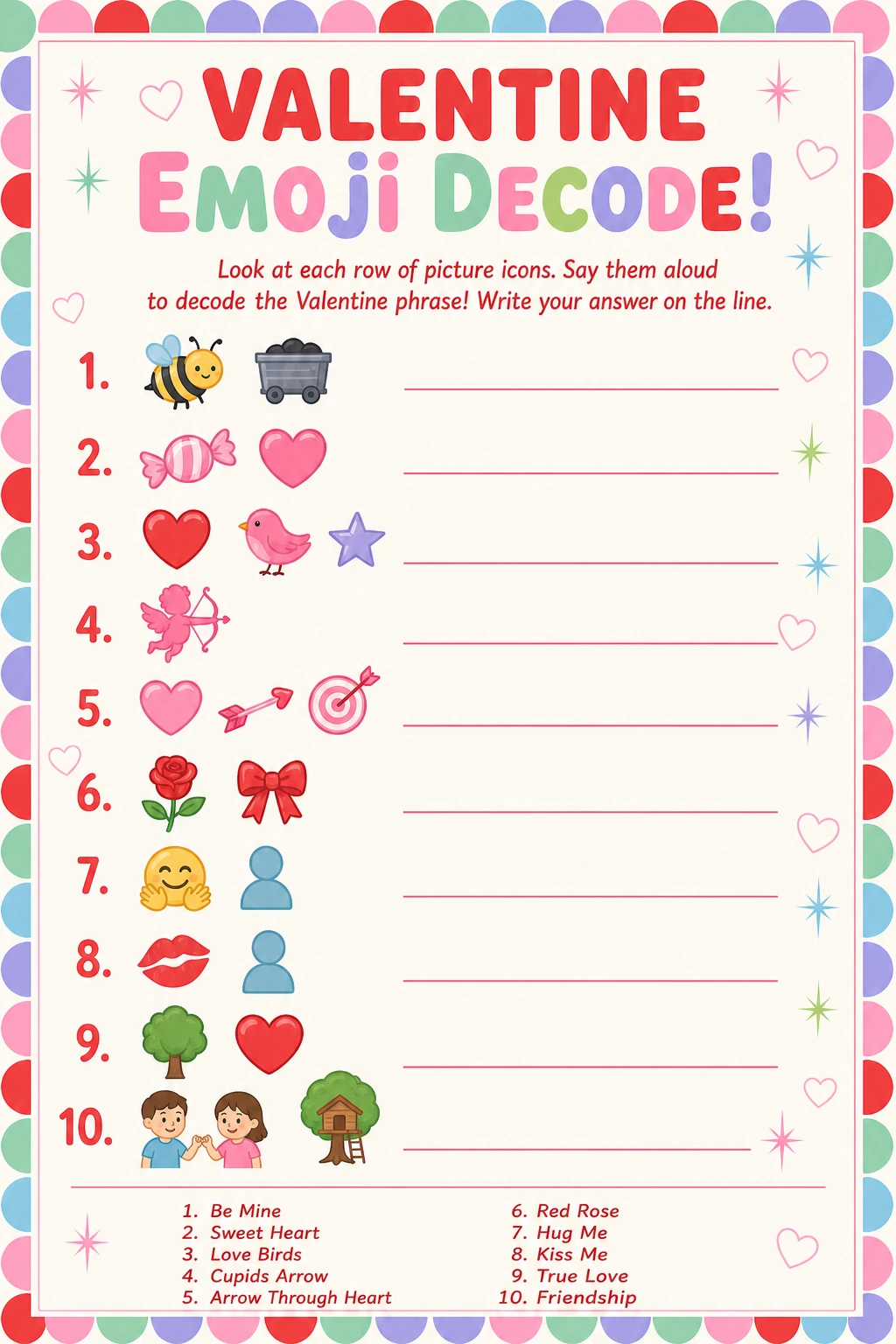
14. Valentine Emoji Decode!
Each child receives a printed “Valentine Emoji Decode!”
sheet where sequences of simple drawn symbols — not standard emoji, but original hand-drawn icons like a small heart, a star, a flower, a sun, and an arrow — correspond to letters via a decoder key printed at the top of the page.
Children use the key to translate each coded line into a Valentine’s Day word or short phrase, writing their answers in the blanks provided.
It works like a substitution cipher, and the decoder key is right there on the sheet so no prior knowledge is needed.
The decoding activity is genuinely absorbing because children feel like detectives cracking a secret Valentine message, and the key-based format means every child can succeed regardless of reading level — they are matching symbols to letters rather than sounding out words.
Each child needs one printed sheet and a pencil. Any group size works, and the activity runs for about eight to ten minutes, making it a great filler between more energetic games.
Host tip: Keep the phrases short and cheerful — four to six letters each — so children who crack the first one feel a burst of success that motivates them through the harder ones further down the sheet.
15. Valentine Mad Libs!
Give each child a printed “Valentine Mad Libs!” sheet — a short Valentine’s Day story with key words replaced by blanks, each labelled with a part of speech (noun, verb, adjective, colour, name, and so on).
Before seeing the story, children fill in the blanks by thinking of words in each category. Then they read the completed story aloud (to a partner or to the class) and discover the wonderfully ridiculous results.
The sillier the word choices, the funnier the finished story.
Mad Libs are a guaranteed laughter generator and they quietly reinforce parts of speech without children realising they are doing anything remotely educational. Partnering children up and having them read their finished story to each other doubles the fun.
Each child needs one printed sheet and a pencil. Any group size works, and the activity takes about eight to ten minutes — slightly longer if you include a few children sharing their funniest results with the whole class.
Host tip: Ask children to fill in ALL the blanks before they peek at the story — let them know they cannot look at the surrounding words yet. Enforce this cheerfully, because the payoff of reading it all at once at the end is far funnier than filling it in while reading along.

16. Guess How Many Hearts?
Before the party, fill a clear glass jar with small candy hearts, conversation hearts, or foil-wrapped chocolate hearts, and count them carefully as you fill it. Place the jar at the front of the room where everyone can see it.
Each child receives a printed “Guess How Many Hearts?” slip (or writes their guess on a sticky note) with space to write their name and their estimate.
At the end of the party, the host reveals the real number and the child whose guess is closest without going over wins the jar itself.
This game has almost zero running costs beyond the jar and the candy, and it creates a wonderful thread of anticipation that runs through the entire party — children keep sneaking glances at the jar all afternoon and revising their estimates in their heads even after they have submitted their slip.
The printed guess sheet makes the submission feel official and exciting. Any number of children can enter, and the “game” technically lasts the whole party, making it a perfect background activity.
Host tip: Use a very wide jar with an irregular shape rather than a tall thin cylinder — irregular containers are genuinely harder to estimate and level the playing field between children who are naturally mathematical and those who are not.

🛍 Shopping guide
17. Valentine Would You Rather?
Print the “Valentine Would You Rather?” sheet and either hand one to each child or project it on a screen. Each question presents two Valentine-themed choices — “Would you rather receive a giant bouquet of roses OR a box of one hundred chocolates?”
— and children circle or call out their answer. After each question, invite a few children to explain their reasoning in one sentence. There are no wrong answers, just delightfully strong opinions, and the explanations are where the real fun begins.
This game is pure conversation starter and it works at any energy level — you can play it as a quiet desk activity or a raucous stand-on-one-side-of-the-room debate.
It is also one of the most inclusive activities in the list because every child has an opinion and every opinion is completely valid. Each child needs a printed sheet and a pencil, or no supplies at all if you run it verbally.
Any group size works and the game fills five to fifteen minutes depending on how much discussion you encourage.
Host tip: Plant one or two genuinely tricky questions in the middle of the sheet — choices where the options are nearly equal — because those are the ones that produce the most passionate, hilarious debate and get even quiet children suddenly very vocal.

18. Heart Freeze Dance
This is freeze dance with a Valentine twist. Play upbeat music and let children dance freely in the open floor space. When the music stops, the host calls out a Valentine-themed freeze pose — “Freeze like a Cupid drawing a bow!”
or “Freeze like a rose just opening up!” — and children must hold that specific shape until the music starts again. No one is ever eliminated; the game is purely about creativity, silliness, and the joy of dancing together.
The named freeze pose is the secret ingredient that makes this version far more engaging than standard freeze dance — children have to actually listen and think rather than just stopping dead, and the resulting frozen tableaux of Cupids and roses around the room is genuinely entertaining.
You need a music source with a volume control, a cleared floor area, and a short list of Valentine poses prepared in advance. Twenty to thirty children play easily, and the game fills ten to twelve minutes beautifully.
Host tip: Prepare your list of eight to ten freeze poses in advance and keep it in your pocket — ad-libbing in the moment under twenty pairs of staring eyes leads to blank-mind panic and awkward silences that break the flow completely.
19. Valentine Hot Heart
Sit children in a circle and pass a large foam or plush heart around the group while music plays — this is your classroom version of hot potato.
When the music stops, the child holding the heart draws a Valentine challenge card from a small stack in the centre.
Challenges are gentle and fun: “Tell us one thing you love about school,” “Do your best robot dance for five seconds,” or “Give the person to your left a compliment.”
After completing the challenge, that child places the heart back in the circle and play continues.
By replacing elimination with a fun challenge, this version transforms a potentially stressful game into something genuinely joyful — children actually start hoping they are the one holding the heart when the music stops.
You need a soft heart (a foam heart cut from craft foam or a small plush works perfectly), a music source, and a stack of ten to fifteen pre-written challenge cards.
Twelve to twenty-five children sit comfortably in a circle; the game runs for ten to twelve minutes.
Host tip: Keep every challenge card achievable in under ten seconds so the game’s momentum never stalls — long or complicated challenges break the energy of the circle and make the other children restless while waiting.
🛍 Shopping guide
20. Pink and Red Relay Race
Divide the class into two or three equal teams and set up a simple relay course using pink and red objects — a pink pool noodle to carry, a red plastic cup to balance on a spoon, or a heart-shaped beanbag to pass.
Each team member completes the course (run to the cone, perform a small task, run back, and hand off to the next player) before tagging the next teammate. First team to have every member complete the course wins.
Keep the tasks simple enough that the youngest child in the room can do them with a little focus.
A relay race is the highest-energy game on the list and it belongs toward the end of the party when children need one final outlet before returning to their seats for goodbyes and treat bags.
The Valentine colours tie it to the theme without requiring any special props — nearly every school already has pool noodles and plastic cups somewhere. Teams of six to ten work best; for a class of twenty-five you will want three teams of roughly eight.
The race from start to finish takes about eight to ten minutes.
Host tip: Assign teams yourself using a fun method — have children draw a pink or red heart from a bag rather than letting children self-select — because self-selected teams almost always result in uneven ability distribution and hard feelings before a single step is taken.
🛍 Shopping guide
21. Valentine Story Cubes
Create simple story cubes by covering plain wooden or foam cubes with Valentine-themed stickers or hand-drawn images — a heart, a stamp, a letter, a rose, a pair of wings, and a sunshine, for example. Divide the class into groups of four or five.
One child rolls all six cubes and the group has sixty seconds to invent a short Valentine’s Day story together that includes every image showing on the top faces of the cubes.
Each group shares their story in one to two sentences, and the class votes for their favourite with a thumbs up.
Story cubes build creativity and collaborative language skills inside a genuinely competitive and fun structure. Children are often amazed at how different each group’s story is from exactly the same set of rolled images — it sparks great discussion.
You need one set of decorated cubes per group (plain wooden cubes from a craft store decorated with stickers take about five minutes to make), a timer, and enough floor or desk space for small groups to huddle.
The activity takes twelve to fifteen minutes for a full class.
Host tip: Make a rule that every group member must contribute at least one sentence to the story — otherwise one confident storyteller tends to take over and quieter children disengage within thirty seconds of the round beginning.
🛍 Shopping guide
22. Heart Ping-Pong Blow
Place a strip of tape across the middle of a long table to act as a “net.” Give each pair of children a lightweight paper heart cut from tissue paper or very thin copy paper and a drinking straw each.
The goal is to blow the heart across the table and over the tape to the other player’s side — but neither player can touch the heart with their hands or the straw, only with their breath through the straw.
The first player to blow the heart completely over the net and off the other player’s edge of the table scores a point. Play to five points and then rotate partners.
The game is hilarious to watch and deceptively athletic — children discover within seconds that controlling the direction of a paper heart with a breath is far harder than it looks, and the resulting zigzag paths of the heart produce constant laughter.
You need a long table or two pushed together, paper straws, and pre-cut tissue paper hearts (one per pair). Four to eight children can play at one table simultaneously with pairs facing each other across the net.
A full rotation of the class takes about twelve to fifteen minutes.
Host tip: Cut your tissue-paper hearts to about the size of a playing card — larger hearts catch too much air and drift uncontrollably off the sides of the table, while smaller hearts move too quickly and the game is over before anyone has fun.
🛍 Shopping guide
Frequently Asked Questions
How many of these valentine class party games can I run in a forty-five-minute party?
Realistically, plan for four to six games in forty-five minutes.
Choose one calm printable activity to greet children as they arrive (Valentine Bingo or Valentine Colour by Number are ideal), two or three active or group games for the middle of the party, and one final printable or quiet game to bring the energy back down before treat bags are handed out.
Keep transitions tight — have the next game completely set up before the previous one ends — and you will fill the time without rushing.
Do I need to buy a lot of supplies for these games?
Most of the games on this list need very little beyond a printer and cardstock.
The active games — bean bag toss, ring toss, straw transfer — each need a handful of inexpensive items, and many of those can be substituted with things already in the classroom (rolled socks instead of bean bags, rubber bracelets instead of rings).
Budget roughly five to ten dollars in supplies for a class of twenty-five if you use the printable games as your backbone and only add one or two active stations.
How do I handle a child who doesn’t want to participate in a game?
Always have a quiet printable activity — the Colour by Number or the Valentine I Spy sheet — available as a no-pressure alternative.
Letting a reluctant child sit with a sheet while the group plays an active game removes the spotlight without making them feel excluded.
Most children who start on the sidelines quietly join in once they see the group is having fun and no one is being singled out or embarrassed.
What is the best game to start with when the whole class is hyper?
Counterintuitively, start with a calm, seated game rather than a big active one. Valentine Bingo is ideal — it requires every child to pay attention and listen, which naturally quiets a buzzy room within two minutes of starting.
Save the relay race and freeze dance for the middle of the party when you actually want to harness that energy, and bring everyone back down at the end with a printable activity.
Can these games work for mixed-age classrooms?
Yes, most of them adapt easily. For printable games, simply prepare two versions of the sheet — one with simpler language for younger children and one with more detail for older ones.
For active games like the relay race or bean bag toss, adjust the throwing line or task difficulty.
The social games — Would You Rather, Friendship Bingo, and Story Cubes — actually work better in mixed-age groups because older children naturally scaffold the conversation for younger ones without any adult prompting.
📌 Save These for Later
Loved these? Pin your favorite image below so you can find this list again when you’re planning.


23 valentine cake ideas from showstopper heart cakes to bento cakes for two and Galentine's bakes, e
Free printable valentine cards for kids with cute puns and matching pictures, one card per sheet wit

12 valentine chocolate covered strawberries, one easy method, from a dark drizzle to gold leaf and p
Leave a Reply