

15 Thanksgiving Party Games With Free Printables for Friendsgiving Rather Than Family

These thanksgiving party games are built for the dinner where everyone is a chosen person: no relatives, no talking points, just people who showed up with a casserole and a decent bottle.
Half the list prints on one sheet of cardstock; the other half needs nothing but the people already sitting there. Pick three to five, run them loose, and the evening handles itself.
This post contains affiliate links. If you buy through them, I may earn a small commission at no extra cost to you.
- Friendsgiving Trivia in Two Rounds (2 quiz sheets + 2 keys + scorecard)
- The Blind Taste Test of Everyone’s Gravy
- Guess Who Brought Which Dish
- The Playlist Everyone Adds To
- Two Truths About the Group
- Would You Rather, Friendsgiving Edition
- Charades After the Second Bottle
- The Dish Rating Card
- The Memory Tray of Things From the Table
- Gratitude Cards for Friends
- One Word Story Around the Table
- The Sweepstake (single shared poster)
- The Guessing Jar
- Guess the Recipe Source, Homemade or Shop
- Predictions for the Group Next Year
- Frequently Asked Questions
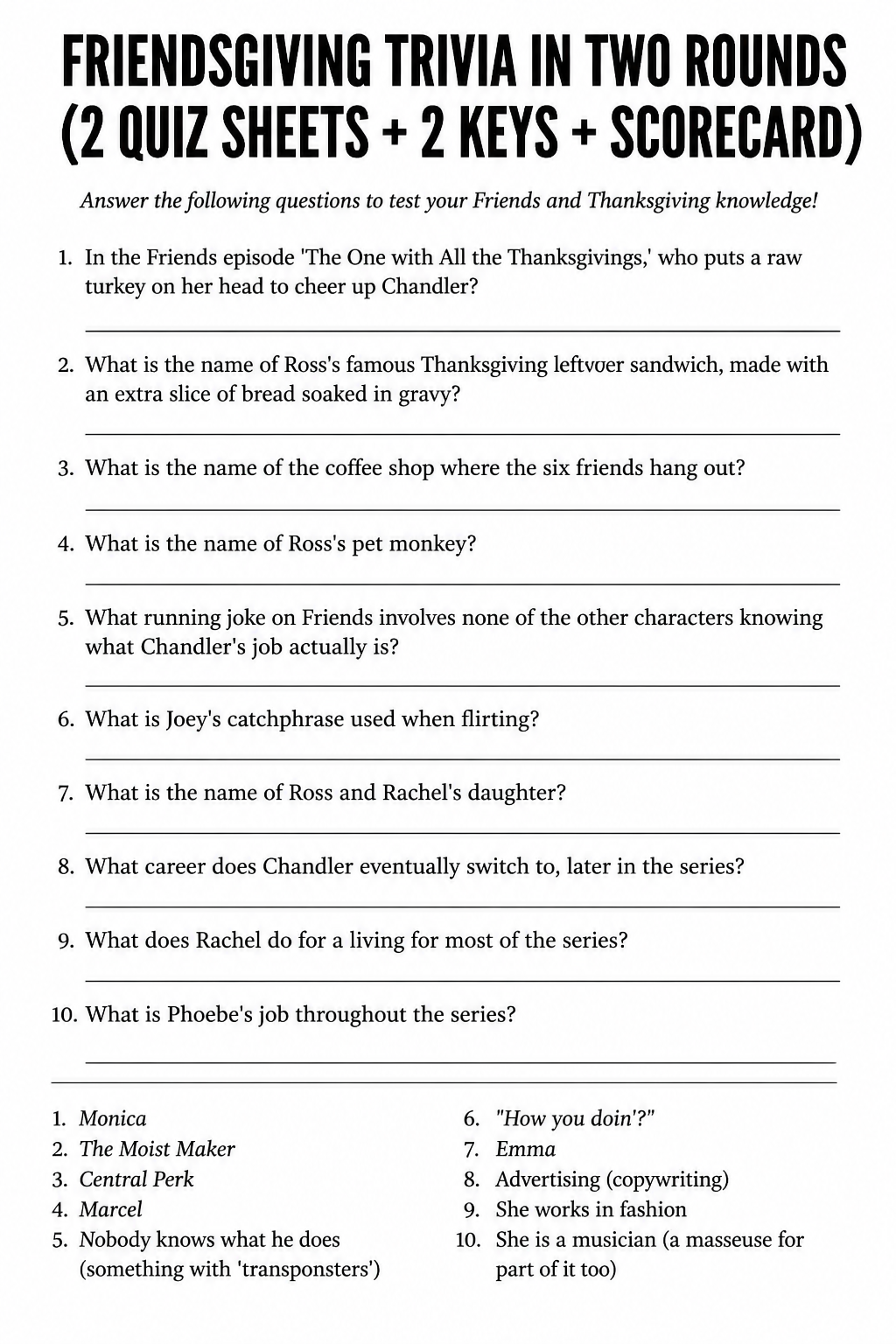
1. Friendsgiving Trivia in Two Rounds (2 quiz sheets + 2 keys + scorecard)
Round one covers Thanksgiving history and food facts: the actual origin of the holiday, weird presidential pardons, which side dish Americans consume most.
Round two flips to pop culture and shared-friend knowledge, so the table history nerd and the person who barely knows what year the Mayflower landed both have a window. Teams of two or three work better than solo play because the arguing counts as entertainment.
Print one quiz sheet per person for round one, collect them, then distribute round two. The host holds both answer keys. A scorecard on a half-sheet tracks running totals between rounds, which gives everyone something to complain about during the turkey carving. Total playing time lands around twenty-five minutes for both rounds combined.
The most common failure is making round two too easy after a hard round one, so the swing feels unfair. Fix it by treating round two as equally weighted: ten questions, same point value, the only difference is the subject matter.
If you want a tiebreaker, add one bonus question on the scorecard and read it aloud only if scores are level.
Read each question aloud even if everyone has their own sheet. It keeps the pace and stops people from racing ahead.
🛍 Shopping guide
2. The Blind Taste Test of Everyone’s Gravy
No printing needed. Every person who brought gravy (or can pour some from their dish into a ramekin) contributes a labeled sample numbered, not named.
Guests taste each one with a spoon, write their ranking on a napkin or scrap of paper, and the host reads the results before revealing which gravy belonged to whom. It sounds civilized. It becomes a roast within four minutes.
You need small ramekins or shot glasses, a marker for numbering, and teaspoons. Six samples is the practical maximum before palates collapse. Run it before the main meal so people are actually hungry; the tasting means more when it is not the fifth thing they have eaten. Keep water and plain bread on the table for cleansing between samples.
Someone always tries to identify a gravy by color rather than taste, which is fine, let them. The real risk is a guest who is nervous about their cooking: frame the reveal as celebration rather than competition.
Avoid announcing a single winner; instead, give each gravy a fake award category (most savory, most surprising, the one we would drink straight) so no one leaves feeling judged.
- Small ramekins or shot glasses (one set per sample)
- Numbered sticky labels or a marker
- Teaspoons and plain bread for palate cleansing
- Water pitcher on the table
🛍 Shopping guide
3. Guess Who Brought Which Dish
Before guests arrive, the host lists every dish on the card with a blank line next to each one. Guests fill in a name for each dish: who do you think made the green bean thing, who panic-bought the rolls.
The person with the most correct guesses at the end of the night wins, though bragging rights alone are sufficient prize.
Print four cards per sheet and cut along the crop marks. Hand them out as guests arrive and collect them before dinner is served, so no one can update their answers after tasting.
The host needs a master list of who actually brought what, kept private until the reveal. Ten to twelve dishes is the sweet spot; fewer than six and it is too easy, more than fifteen and people lose interest filling out the card.
The fill-in format works better than multiple choice here because guessing a name cold is funnier and harder than recognizing it in a list. The mistake hosts make is revealing answers one by one too slowly.
Read the whole list in one pass, pause for the gasps, then do a second pass for the scores. The whole reveal takes under three minutes that way.
Groups of 8 to 16 where most people know each other but not everyone knows everyone’s cooking habits

4. The Playlist Everyone Adds To
No printing needed. The host opens a shared playlist on Spotify, Apple Music, or YouTube Music and passes the phone around once before dinner. Every person adds exactly three songs. No skips, no vetoes. Whatever goes in plays during the meal.
The playlist reveals more about people than two hours of conversation, and everyone gets quietly territorial about their songs when they come on.
Set the ground rules in one sentence: three songs each, no more, shuffle is on, no removing other people’s choices. This takes about eight minutes of passing the phone before dinner and then runs itself all evening.
If the group is large, cap each person at two songs to keep the runtime manageable. A thirty-minute playlist for ten people is roughly right.
Someone will add something divisive on purpose. That is the point. The host’s only job is to resist the urge to edit the playlist, because the collective weirdness of the full list is the actual game. If the vibe genuinely collapses, the host can queue-jump one recovery song without comment, then return to shuffle.
Start a playlist before guests arrive with three of your own songs already in it. It signals the tone without a briefing.
5. Two Truths About the Group
This is Two Truths and a Lie with a twist: every statement must be about the group itself, not about the individual holding the card.
One player reads three statements about the people in the room, two true and one invented, and the group votes on which one is the lie. It rewards people who have been paying attention across the years and exposes anyone who has been faking it.
Print six cards per sheet and cut them apart. Each card has three numbered blank lines for statements and a small prompt at the top reminding players to make all three statements about the group.
No prep is needed beyond printing; guests write their own statements on the spot, which takes about two minutes per person. Works best with groups that share at least a year of history together.
The trap is statements so obscure only one person could verify them, which kills the vote. The card has a small note: keep statements something at least half the room might know. If a group is newer, shift the prompt to two truths about this dinner and one lie, which lowers the barrier and still produces good arguments.
Give people five minutes to write their statements before the game starts rather than asking them to think on the spot.

6. Would You Rather, Friendsgiving Edition
Each card carries two Friendsgiving-specific dilemmas and the player reads one aloud, everyone answers simultaneously (hands up, or just shouting), and then whoever has the minority opinion has to defend it for thirty seconds. The questions are calibrated to this occasion: food choices, social situations, hypotheticals about the dinner itself. Nothing political, nothing pointed at real people in the room.
Print six cards per sheet, cut them apart, and place a small stack face-down in the center of the table. Players take turns drawing. The deck works as a table-starter during the meal or as a proper round after dessert.
Around fifteen cards in rotation is plenty for a two-hour window; the game winds down naturally rather than needing a declared ending.
Write questions that actually divide the room: ‘Would you rather eat only your own dish all night, or eat only someone else’s and not know whose?’ splits people evenly and produces a better thirty-second defense than easy ones do. Avoid questions with an obvious correct answer, because nobody defends the thing everyone agrees on.
The thirty-second defense rule is what separates this from a poll. It forces people to articulate something they usually just feel, and the table gets loud.

7. Charades After the Second Bottle
No printing needed. The categories are Thanksgiving movies, food that was on the table tonight, and things you have genuinely said at a dinner party. That last category is the one that derails the game in the best way.
Someone mimes ‘I brought a bottle of orange wine and I do not know if that was appropriate’ and the table collapses. Standard charades rules apply: no sounds, one minute on the clock.
The host writes prompts on torn pieces of paper or napkin scraps, folds them, drops them in a bowl. Two teams, alternating turns. A phone timer works fine.
The only setup is five minutes of the host writing prompts before the game starts; ten to fifteen prompts is enough for a group of eight to ten.
If the group is small, skip teams and play as a circle with one person acting per round.
The timing matters: this game plays better after dinner and at least one dessert, when everyone is loose and nobody needs to impress anyone. Before the meal it falls flat because people are still performing. The second bottle in the title is not a rule, it is a calibration point.
Write at least three prompts per person in the room so the bowl never runs dry mid-game. Extras just go unused.
8. The Dish Rating Card
Every guest gets a card and rates each dish on three criteria: taste (out of five), presentation (out of five), and a written comment they must complete in exactly five words.
The five-word rule is the mechanic that makes it: ‘I would eat this for breakfast’ and ‘needed more salt, sorry bestie’ are equally valid and equally revealing. The host collects cards, reads comments aloud anonymously, and the table guesses who wrote each one.
Print four cards per sheet and cut them out. The host fills in the dish names before printing, the same way as the Guess Who card.
Collecting the cards before the reveal works better than having people keep them, because anonymous comments are funnier than attributed ones. Plan about ten minutes for the reading-aloud portion, longer if the group is enjoying the attribution game.
The only thing to manage is a guest who gets precious about their dish receiving a dry comment. Frame the whole game as a restaurant critic exercise from the start: everyone’s dish gets commented on equally, including the host’s, which defuses the sensitivity.
If someone brought store-bought and is worried about it, the five-word format is actually kinder than open-ended feedback.
- Host fills in dish names before printing
- Guests rate each dish: taste /5, presentation /5, plus a 5-word comment
- Host reads all comments aloud anonymously
- Group guesses who wrote each one

9. The Memory Tray of Things From the Table
No printing needed. The host loads a tray with fifteen to twenty small objects taken from the table: a wine cork, a sprig of rosemary from the centerpiece, a folded napkin ring, a small candle, the pepper grinder, a ramekin.
Guests study the tray for sixty seconds, then it disappears into the kitchen. Everyone writes down everything they can remember on a napkin or scrap of paper. Most correct wins.
Setup is two minutes. The host assembles the tray during dinner prep and keeps it in the kitchen until the moment of reveal. One person needs a phone timer for the sixty-second study window.
After the writing window closes, the host brings the tray back out and reads the object list aloud while people score their own sheets. Honest scoring on the honor system is fine for a friends group.
The variation worth running: instead of most correct, the winner is whoever wrote the most specific description of one object (not just ‘candle’ but ‘small white pillar candle, half burned’). It changes the strategy from quantity to attention, and the descriptions people write are genuinely interesting to read aloud.
A natural pause after the main course, before dessert comes out, when the table needs a reset without requiring anyone to move
10. Gratitude Cards for Friends
Each person gets a card and writes one specific thing they are grateful for about the person to their left, one thing they want for that person in the coming year, and signs it.
The host then passes the cards so everyone reads the one written about them. It is quiet and it lands, especially later in the evening when the room is warm and the pie is gone.
Print four cards per sheet and cut them apart. Place one at each seat before guests arrive, with a pen already on the table, so there is no scrambling mid-evening. Run this game last: it is a closer, not an opener.
Five to seven minutes of writing, then a slow pass around the table, then silence while people read. No facilitation needed beyond telling people to write something specific, not general.
The instruction to be specific is what separates a meaningful card from a hollow one. ‘You always check in when things are hard’ works; ‘you are so kind’ does not. Put that note on the card itself as a small printed reminder. Let people keep the card they received; that is the point of the format.
Specificity is the instruction and the product. A card that says one real thing is worth more than five general ones, and the person who receives it keeps it.

11. One Word Story Around the Table
No printing needed. One person says a single word, the next person adds one word, and the story builds around the table one word at a time.
The constraint is that it has to be a Thanksgiving story: it can go anywhere, but it starts with ‘The turkey’ and must include a guest, a disaster, and a resolution before it ends.
The host decides when to call the ending, usually when the story has reached peak absurdity.
No materials, no setup, no teams. Works with four people or fourteen. The pace is the mechanic: going fast means the story escapes anyone’s control, which is funnier. Going slow lets people try to steer it, which produces better plot but fewer accidents.
Let the group find its own speed. One round takes about four minutes; three rounds is a natural set.
The rule about ‘one word only’ is the one worth enforcing. People naturally try to sneak in ‘the turkey’ as one turn, or pause so long they lose the thread. A light tap on the table from the host to keep pace is enough.
If the story stalls, the host adds a word that derails it: ‘suddenly’ is the most reliable reset.
Give everyone a two-second limit per word. The artificial pressure produces better stories than open-ended thinking time.
12. The Sweepstake (single shared poster)
One large shared poster with a grid of Friendsgiving predictions: who falls asleep first, whose dish disappears first, who brings up their ex, who proposes a second location, who cries (happy tears, but still).
Each guest writes their name in the box next to their chosen prediction, and the host checks off outcomes as the evening progresses. Whoever predicted the most correct outcomes by 11pm wins the remaining wine.
This prints as a single US Letter sheet, landscape orientation, posted on the fridge or a wall with one piece of tape. Guests fill it in during the first half hour, so everyone can see what everyone else has predicted.
The visible nature of the poster is half the fun: people start performing for the predictions, or trying to avoid them, which creates its own game inside the game.
The categories need to be calibrated to the group: use outcomes that are plausible but not guaranteed. If someone always falls asleep after dinner, that box is not interesting. The best predictions are ones where the room is genuinely split on whether they will happen.
Update the poster publicly throughout the evening rather than at the end, so it stays live.
Tape the poster at eye height near the kitchen, not the bathroom. It needs to be seen constantly, not only when someone wanders off.

🛍 Shopping guide
13. The Guessing Jar
No printing needed. A clear jar filled with something Thanksgiving-adjacent: candy corn, mini marshmallows, pecan halves, whole peppercorns. Every guest writes their guess on a scrap of paper with their name, folds it, and drops it in a bowl.
The closest guess wins the jar and its contents. Simple, zero facilitation, and it gives people something to do the moment they walk in the door.
The host fills and seals the jar before guests arrive and counts the contents exactly. Leave the jar visible on the table all evening so people can study it obsessively. A sticky label on the jar with the question (‘How many pecans?’)
is the only setup needed. The reveal happens after dinner, which gives it a built-in moment in the evening’s rhythm.
The variation that produces more engagement: use two jars with different contents and have guests guess both. Award one point for the closest on each jar, and the person with two points wins both. It doubles the investment without doubling the complexity, and having two objects to examine gives the group something to debate during cocktail hour.
- Clear glass jar with a lid
- Smallish countable items (candy corn, pecans, whole cranberries)
- Sticky label for the question
- Scrap paper and pens near the jar
🛍 Shopping guide
14. Guess the Recipe Source, Homemade or Shop
No printing needed. The host reveals each dish one by one and the table votes: genuinely homemade from scratch, adapted from a recipe (counts as homemade), or shop-bought with varying degrees of enhancement. The person who brought the dish reveals the truth after the vote.
The only rule is that the dish-bringer must answer honestly, and the table agrees not to judge, which they will not honor, which is the point.
This runs as a quick round during the meal, with the host as emcee. No materials needed beyond the dishes already on the table. It works best after people have already been eating for twenty minutes, because opinions are more confident once tasted.
Budget about ninety seconds per dish: thirty for the vote, sixty for the reveal and the ensuing conversation.
The game is more interesting when at least one person admits to a strategic enhancement: the jarred gravy finished with butter and fresh herbs, the store-bought pie in a homemade dish. Those are the reveals the table talks about for three years.
Pair this game with a reference to thanksgiving drinking games if the group wants to add a forfeit layer for wrong guesses.
Every person who brought something has skin in the game, which means every single person at the table is engaged for the entire round.
15. Predictions for the Group Next Year
Each person fills in a card with five predictions about the group for the coming year: who moves cities, who gets a dog, who starts something new, who finally quits the thing they have been quitting for three years.
Cards go into an envelope, the host seals it and writes the date, and it opens at next year’s Friendsgiving. The game at next year’s dinner is reading them aloud and scoring them.
You can find more ways to extend the fun through a whole evening in this list of free printable thanksgiving games.
Print four cards per sheet and cut them out. The host provides a large envelope and a marker for sealing and labeling.
Each guest keeps a photo of their own card on their phone as a personal record, so the envelope is not the only copy. The card itself has five numbered prompt lines, no hints, just space. Writing time is about three minutes per person.
The temptation is to write safe predictions that are likely to come true. The more interesting cards are the ones with at least one risky prediction, something the writer genuinely does not know.
Prompt the group with that distinction before they write: four reasonable predictions and one wild one per card. The wild ones are always the most discussed at next year’s opening.
Photograph the sealed envelope and set a calendar reminder for the same weekend next year. Groups are good at forgetting to bring the envelope.

🛍 Shopping guide
Frequently Asked Questions
How many thanksgiving party games should you actually play in one evening?
Three to four is the practical ceiling for a dinner that also involves cooking, eating, and talking. Run one game before dinner (the guessing jar or gravy taste test), one during the meal (the rating card or recipe source game), and one after dessert (trivia or charades). The evening fills itself; games are punctuation, not the whole sentence.
What are the best thanksgiving party games for a group that does not usually play games?
Anything that uses the dinner itself as the material: the dish rating card, the blind taste test, the homemade-or-shop guessing round. These feel like conversation rather than a game, so non-game people participate without noticing they have signed up for anything.
Do Friendsgiving games work for groups where not everyone knows each other well?
Yes, with a few adjustments. Stick to games that require no group history: trivia, would you rather, the guessing jar, the one-word story. Avoid games that assume everyone knows everyone’s cooking habits or personal history until the group warms up, which usually happens faster than expected once the food is out.
What printable thanksgiving party games require the least prep the day of?
The would you rather cards, the two truths cards, and the gratitude cards all require nothing from the host on the day itself beyond printing and cutting. The dish-specific ones (rating card, guess who brought which dish) need the host to fill in dish names, which takes five minutes the morning of.
How do you run thanksgiving party games without it feeling forced?
Introduce each game as something available rather than mandatory. Place cards on the table, announce the guessing jar when people arrive, and let participation build naturally. The games that require the whole table work best after the meal when everyone is settled; forcing group participation during the first thirty minutes rarely lands.
Can these thanksgiving party games work for smaller groups of four to six people?
Most of them work better small. Trivia plays well in two teams of two or three. The one-word story is tighter and funnier at a small table.
The only games that need a crowd are the sweepstake (more names in the grid) and the gravy taste test (more samples). Scale the dish-based games by reducing the number of categories to match the number of dishes on the table.
10 collections of Thanksgiving games for kids, from quick classroom fun to family field days, so you

19 Thanksgiving charcuterie board ideas where guests do the assembling. Tasting tables, craft-paper
Thanksgiving class party games that print in minutes and send every kid home with something. 8 print
Leave a Reply