

Super Bowl Squares: 12 Printable Boards for a Party Pool or Fundraiser Night
Super bowl squares turns a room full of people who could not name a single starting lineman into a group that screams at a third-quarter field goal. The appeal is simple: everyone has a square, nobody needs to know football, and the whole thing runs itself once the grid is full.
Below are twelve printable boards and party moves built around the squares pool, from the full 100-square classic to a 25-square version for a small living room, a fundraiser board with a price line, and a kids version where the prize is a snack bowl instead of cash.
This post contains affiliate links. If you buy through them, I may earn a small commission at no extra cost to you.
Table of Contents
- The Classic 100-Square Board
- Filling the Grid
- The Quarter by Quarter Payout Chart
- The Number Draw
- The 25-Square Board for Small Parties
- Square Auction Night
- The Fundraiser Board With a Price Per Square Line
- Reverse Squares Bonus Round
- Kids Snack Squares
- Halftime Re-Draw
- The Sign-Up Sheet
- The Squares Winner Tally Card
- Frequently Asked Questions
1. The Classic 100-Square Board
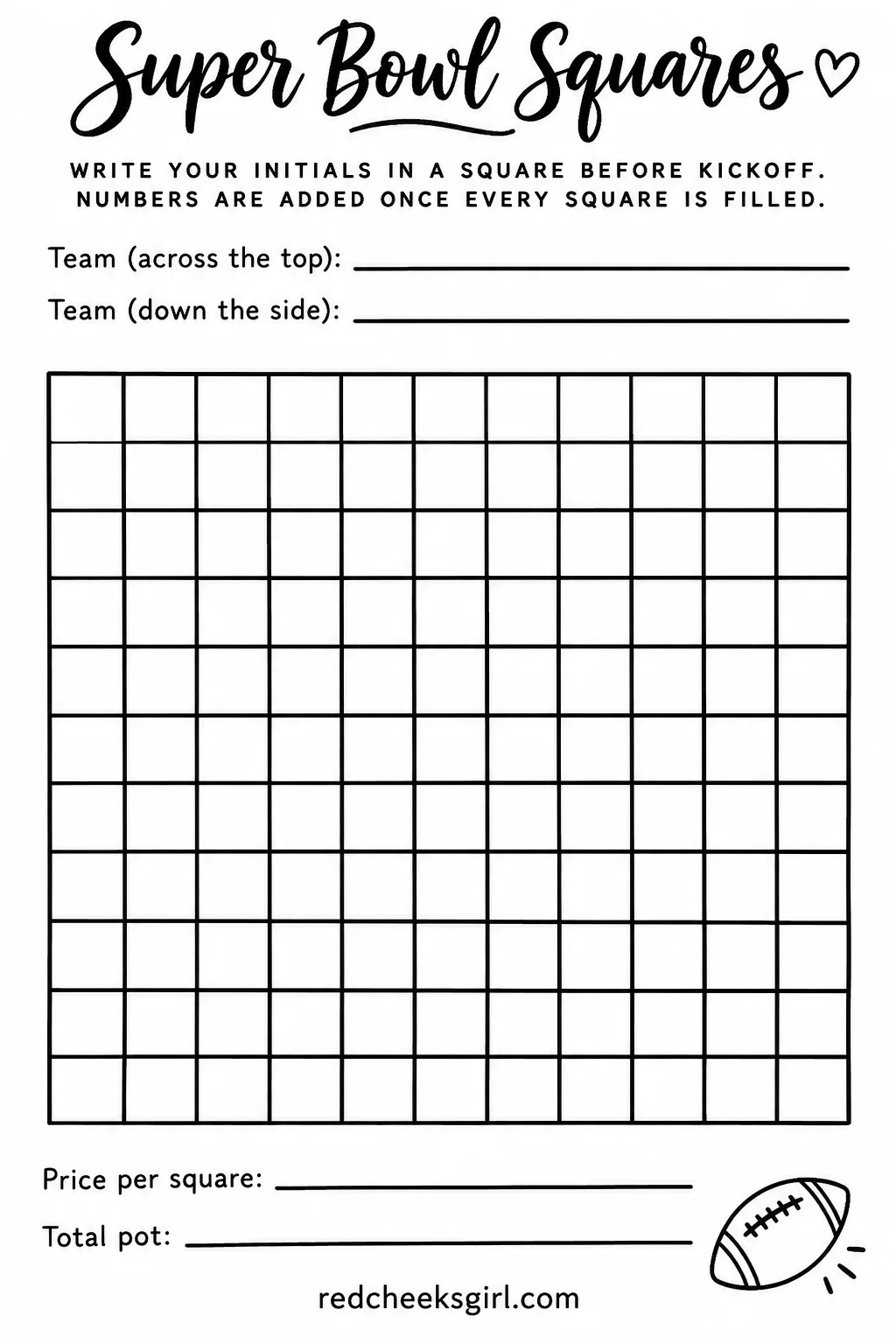
This is the board everyone pictures: a ten by ten grid where. Guests during the pregame, before anyone knows which square is actually good. Once every box has a name in it, the host draws digits 0 through 9 for each axis, and.
It works for up to one hundred people, though most house parties run it with twenty to forty guests and let people take a few squares each. Setup takes ten minutes: tape the board somewhere visible, hand out a marker, and let it fill during kickoff snacks.
The thing that goes wrong is someone trying to claim a specific square after peeking at early plays. Fix it by locking the grid the moment the numbers go up, no exceptions. For a smaller gathering, skip straight to the 25-square version below instead of running a half-empty hundred.
cardstock or heavy printer paper”, “fine tip markers for writing initials”, “a bowl or hat for the number draw”, “painter’s tape to post the board
2. Filling the Grid
Before kickoff, the board goes around the room, and each guest writes their initials into any open square, one at a time, the same way a guest book gets passed at a wedding. The round ends the moment the last square is claimed, or when kickoff arrives, whichever comes first, since any empty squares just sit out the game.
It needs no equipment beyond the printed board and a pen on a string so it never wanders off with someone’s coat. Any number of guests can play, and it naturally fills the dead time between the food spread and the opening kickoff, which pairs nicely with whatever is laid out from Game Day Party Food.
People sometimes hover over the board hoping to land a favorite number, which stalls the whole line. Remind them the numbers are not assigned yet, so no square is better than another at this point, and the stalling usually stops. For a bigger fundraiser crowd, swap this for the square auction further down instead of a simple claim.
3. The Quarter by Quarter Payout Chart
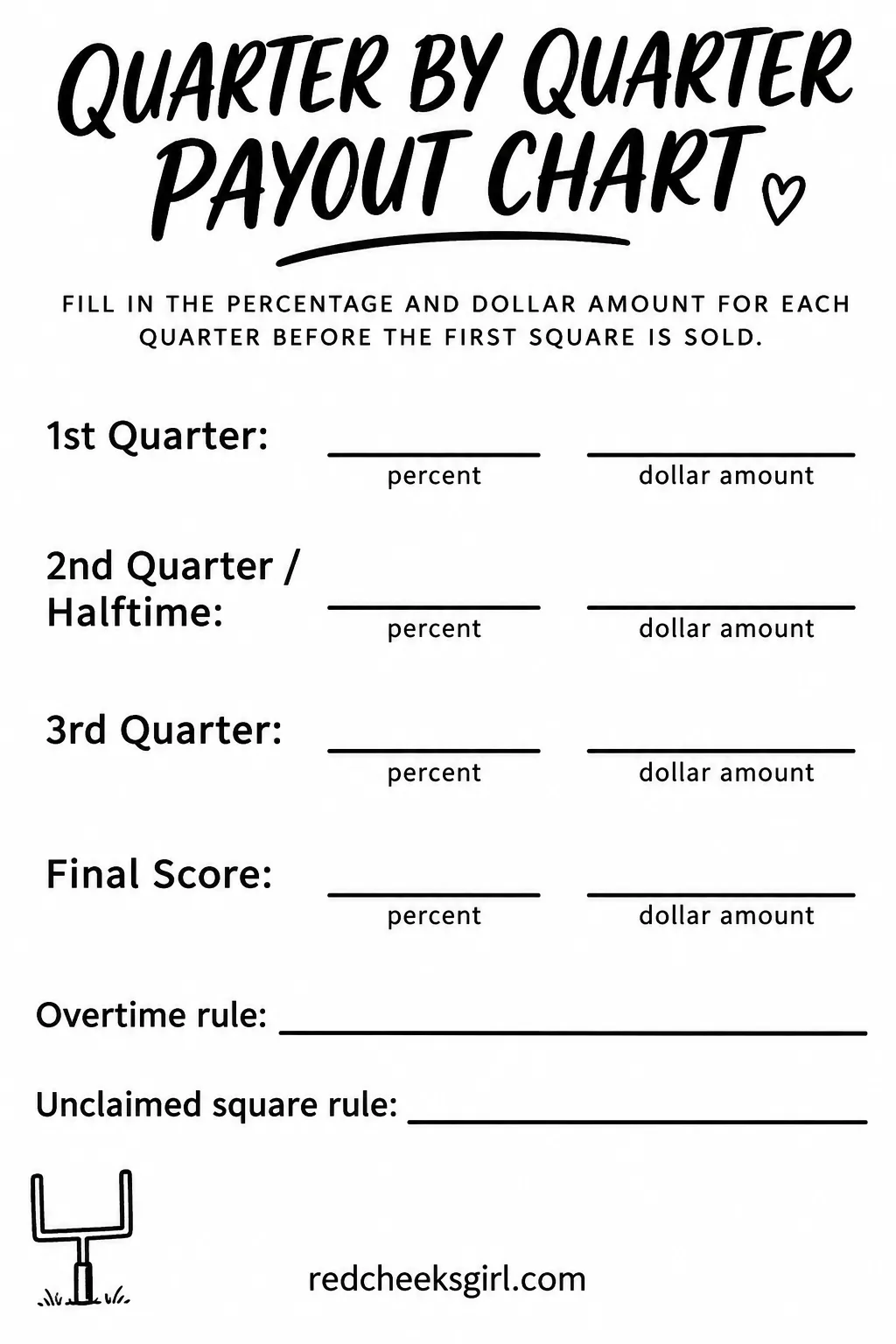
This sheet gets filled out before a single square sells, so nobody argues about money after the final whistle. Most house pools follow a simple split where, commonly twenty percent for each of the first three and the rest for the final score.
It takes five minutes to complete once the total pot is known, and one copy taped near the TV settles any confusion mid-game. No extra supplies needed beyond the printed sheet and a pen.
Arguments happen when the split was never written down, so somebody insists halftime should have paid more. Fix it by filling this in before kickoff and treating it as final. For a simpler version with a smaller group, an even quarter split works fine instead of the weighted one.
Post the payout chart next to the board itself so nobody has to ask what each quarter is actually worth.
4. The Number Draw
Once the grid is completely full, this is the moment that actually decides the game. The rule that matters:. One person draws ten slips numbered 0 through 9 for one team, writes them along the top, then draws a fresh set of ten for the other team down the side.
It takes about five minutes with one reader and one writer. all work equally well, as long as the method is visible to the room.
Mistakes happen when digits get written in the wrong row or skipped entirely in the shuffle. Fix it by having the reader call each number out loud before the writer puts it down, so the table can catch an error in real time. For a longer, higher-stakes version, redraw a fresh set of numbers every quarter instead of just once.
🛍 Shopping guide
5. The 25-Square Board for Small Parties
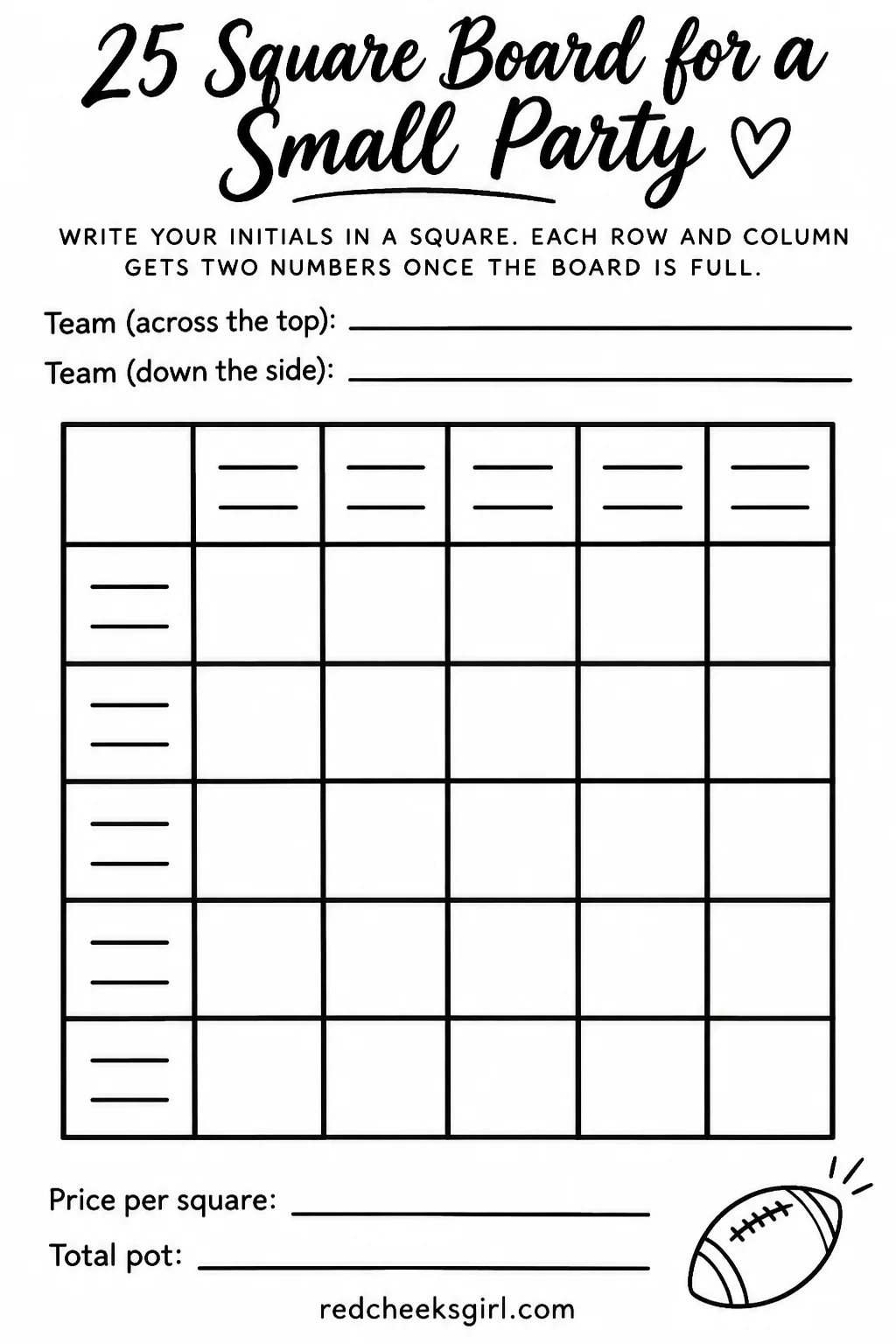
A full hundred squares can feel silly for eight people around a coffee table, so this shrinks the grid to five by five. The mechanic barely changes, since, and the winner is still whoever owns the square matching the score at the end of each quarter.
It suits ten to twenty five people, each claiming one or two squares, and takes less than five minutes to fill since there is simply less board to cover. If someone would rather not bother with two-digit headers at all, a one-digit version works too, it just changes the odds slightly.
Confusion usually comes from the double digits on each header, since a new player assumes only one number applies. Write both digits clearly and announce the rule once before the draw, and it settles quickly. This pairs well with a group that also wants ideas for Super Bowl party ideas beyond just the board itself.
A party of ten to twenty five people who want a short list instead of a hundred initials to track.
6. Square Auction Night
Instead of a flat price, every square gets opened to bidding, one at a time or in small blocks, and the highest bidder claims it. The round ends when all squares are sold, and the numbers still only get drawn afterward, keeping the game fair since nobody bids knowing which digits they will end up with.
This suits fundraiser crowds who want to raise more than a flat per-square price allows, since a desirable corner can go for several times a plain square. It needs one person acting as auctioneer, paper slips to track winning bids, and twenty to thirty minutes to clear a full grid.
It drags badly if every single square gets its own round of bidding. Fix it by auctioning blocks of five squares at once, or offering a flat buy-it-now price for anyone who wants to skip the bidding entirely. For a quieter version, cap every bid at a set maximum so nobody overspends chasing one box.
Open each square or block of squares to bids”, “Highest bidder writes their initials in”, “Repeat until every square is claimed”, “Draw the numbers only after the grid is full
🛍 Shopping guide
7. The Fundraiser Board With a Price Per Square Line
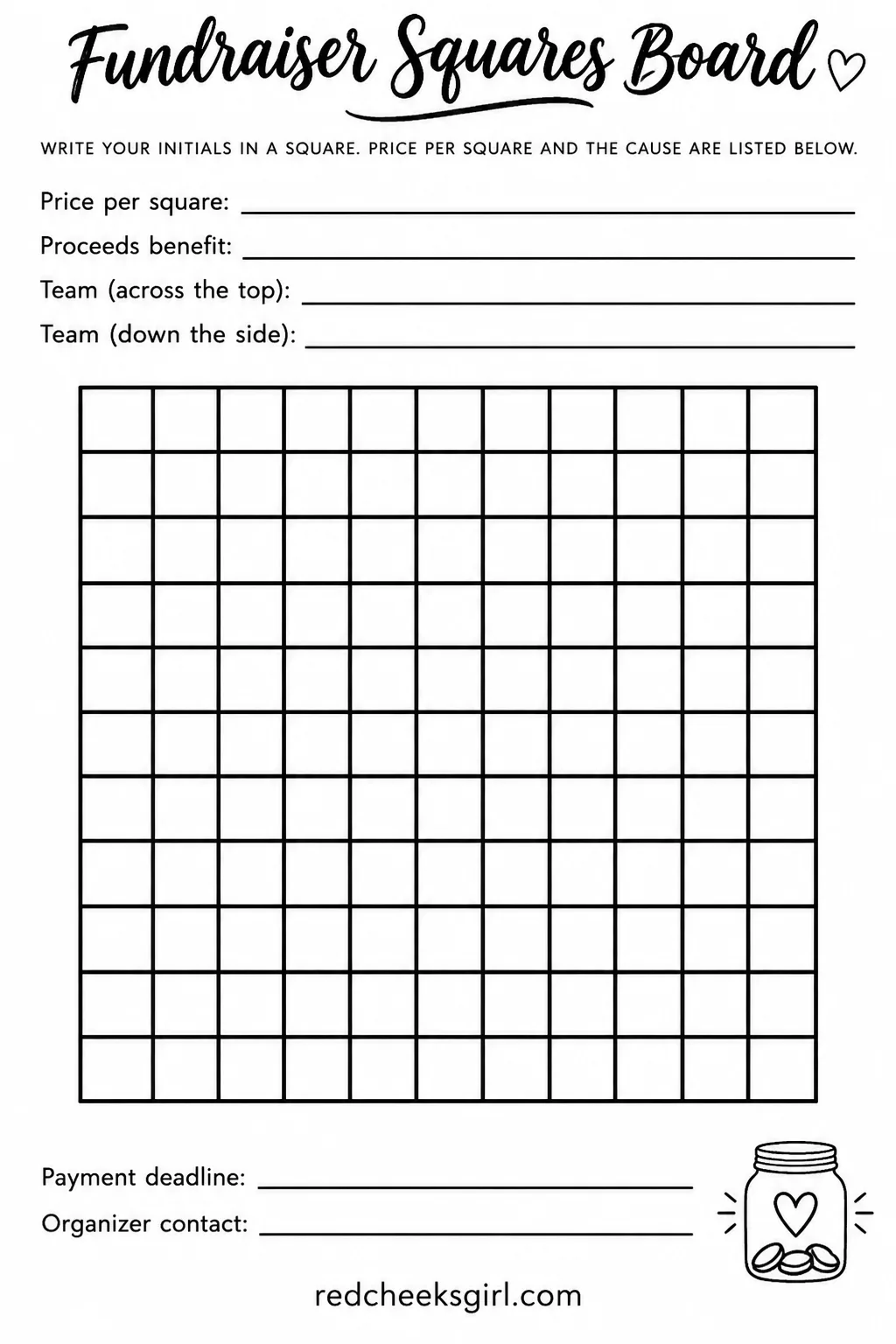
This is the same grid as the classic board, but the price and the cause sit printed at the top instead of being announced out loud, which matters for a school, church, or team pool. and many fundraiser boards keep the split simple, with roughly half of what comes in going to the cause and half going back to the winners.
It works for any group selling squares to raise money, and whoever is running it should plan to act as treasurer, tracking who paid and who still owes. Give the board a full week if possible rather than filling it the night of the game.
The usual headache is a square that gets claimed but never actually paid for. Fix it by setting a clear payment deadline before kickoff and releasing any unpaid squares back into the pool at that point. For an easier version with kids or casual guests, drop the price to a dollar or two so everyone can join without thinking twice.
🛍 Shopping guide
8. Reverse Squares Bonus Round
This is an add-on rule rather than a separate board: announce before kickoff that. The round still ends at the same four checkpoints, there are just two winners instead of one at every stop.
It needs nothing extra beyond saying the rule out loud and writing it on the payout chart, so it works with any board size, from the 25-square version to the full hundred.
Confusion shows up when someone forgets there is a second winner and only pays out one person. Fix it by labeling it plainly as “reverse winner” on the payout chart itself. To keep it simple for a first-time group, run reverse squares only on the final score instead of all four checkpoints.
It spreads the winnings across more guests instead of one person sweeping the whole pot, which keeps more of the room invested through the fourth quarter.
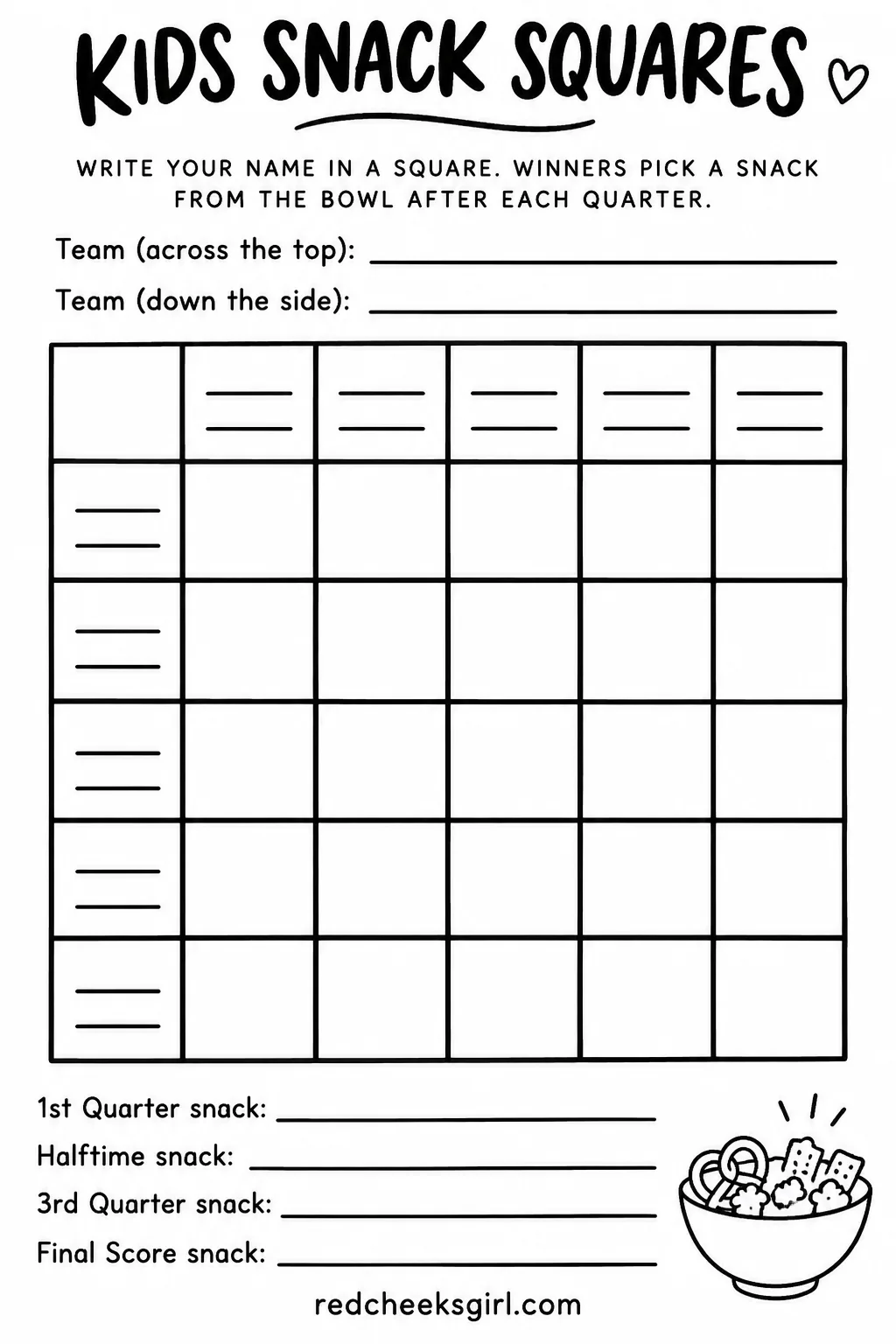
9. Kids Snack Squares
Same grid, smaller stakes: instead of cash, the quarter winner picks a snack out of the prize bowl, which keeps younger guests just as invested without any money changing hands.
Whoever owns the square matching the score digits at each checkpoint gets first pick from the bowl, and the game ends the same way the adult version does, at the final score.
It suits a kids’ table at the party or a family-friendly corner of a bigger fundraiser, and needs only the printed board, markers, and a bowl stocked with small wrapped treats, maybe something pulled from a list like Super Bowl Desserts portioned into grab-and-go pieces.
Younger kids often struggle to match two digits on their own, which leads to disputes over who actually won. Fix it by having one adult read the score aloud and point to the winning square on the board each time.
To make it easier for very young players, let every child pick one snack regardless of the outcome and keep the squares purely for bragging rights.
🛍 Shopping guide
10. Halftime Re-Draw
Instead of one number draw for the whole game, this version draws a second, completely fresh set of digits at halftime for the back half of the game, so. The first half plays out on the original draw, then everyone gets new digits for the third and fourth quarters.
It needs a second blank header row and column drawn in for the second half, and works best for groups who want more people to get a real shot at winning, since a bad first-half draw does not follow a square through the whole night.
People sometimes forget which number set applies to which half mid-game. Fix it by labeling the two draws clearly as “1st Half numbers” and “2nd Half numbers” on the board, and announce the redraw out loud as halftime starts. For maximum chances, some groups go further and redraw fresh numbers every single quarter instead of just once at the break.
Stick to one single draw for the whole game if the group is small or this is the first time anyone has run squares.
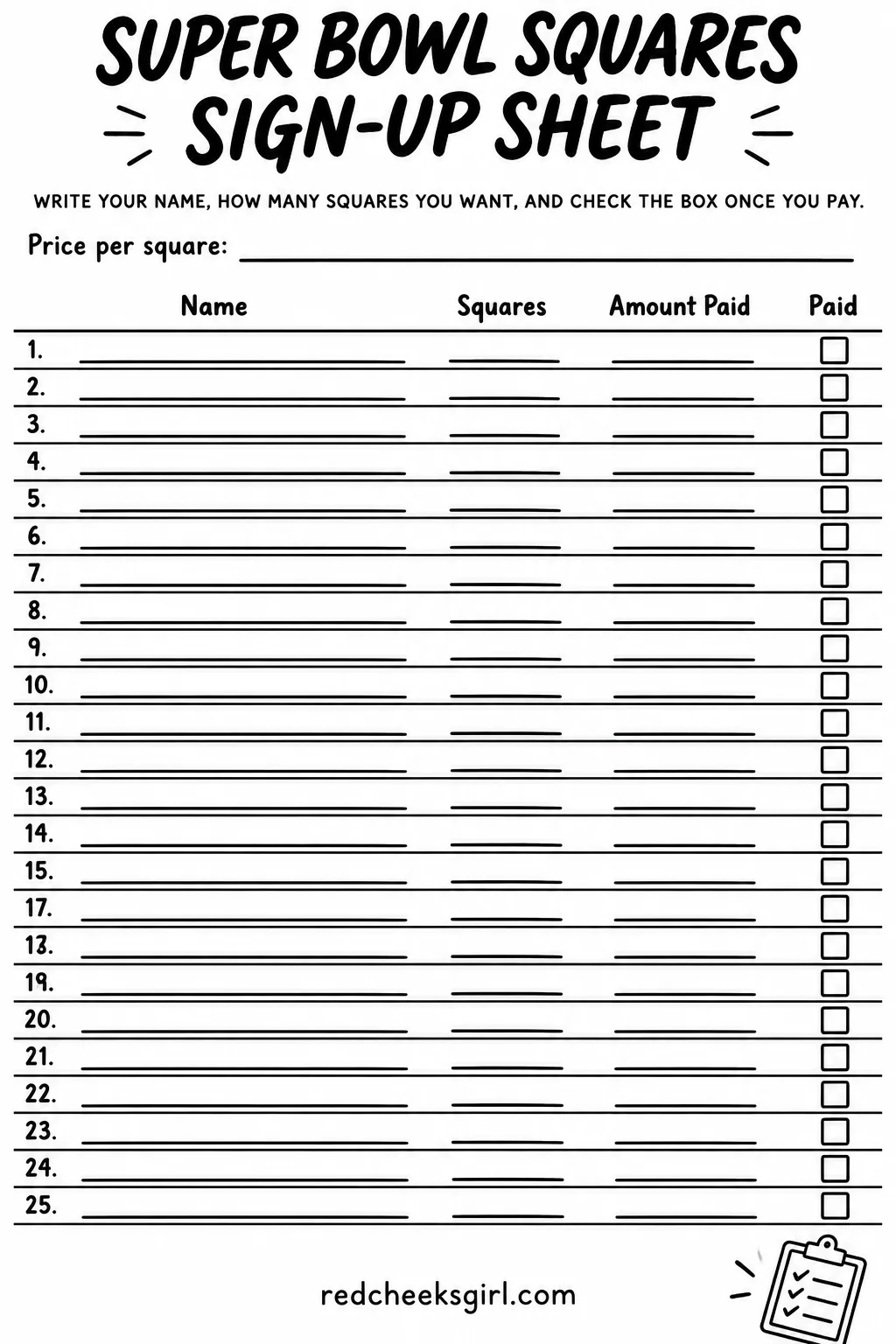
11. The Sign-Up Sheet
This is the tracking sheet, not the board itself: it records who claimed how many squares and whether they actually paid, which the host or a designated treasurer keeps separate from the grid. Guests sign in, list how many squares they want, and the organizer checks each one off once money changes hands.
It matters most for any paid pool, whether that is a handful of friends or a school fundraiser, and keeps disputes from happening later over who owes what. One sheet taped near the board with a pen on a string covers it.
Squares get claimed and then quietly never paid for, which is the single biggest source of post-game arguments. Fix it with a clear deadline, written right on the sheet, after which unpaid squares get released back into the pool for someone else to grab.
For a casual, money-free night among close friends, skip this sheet entirely and let bragging rights be the only prize.
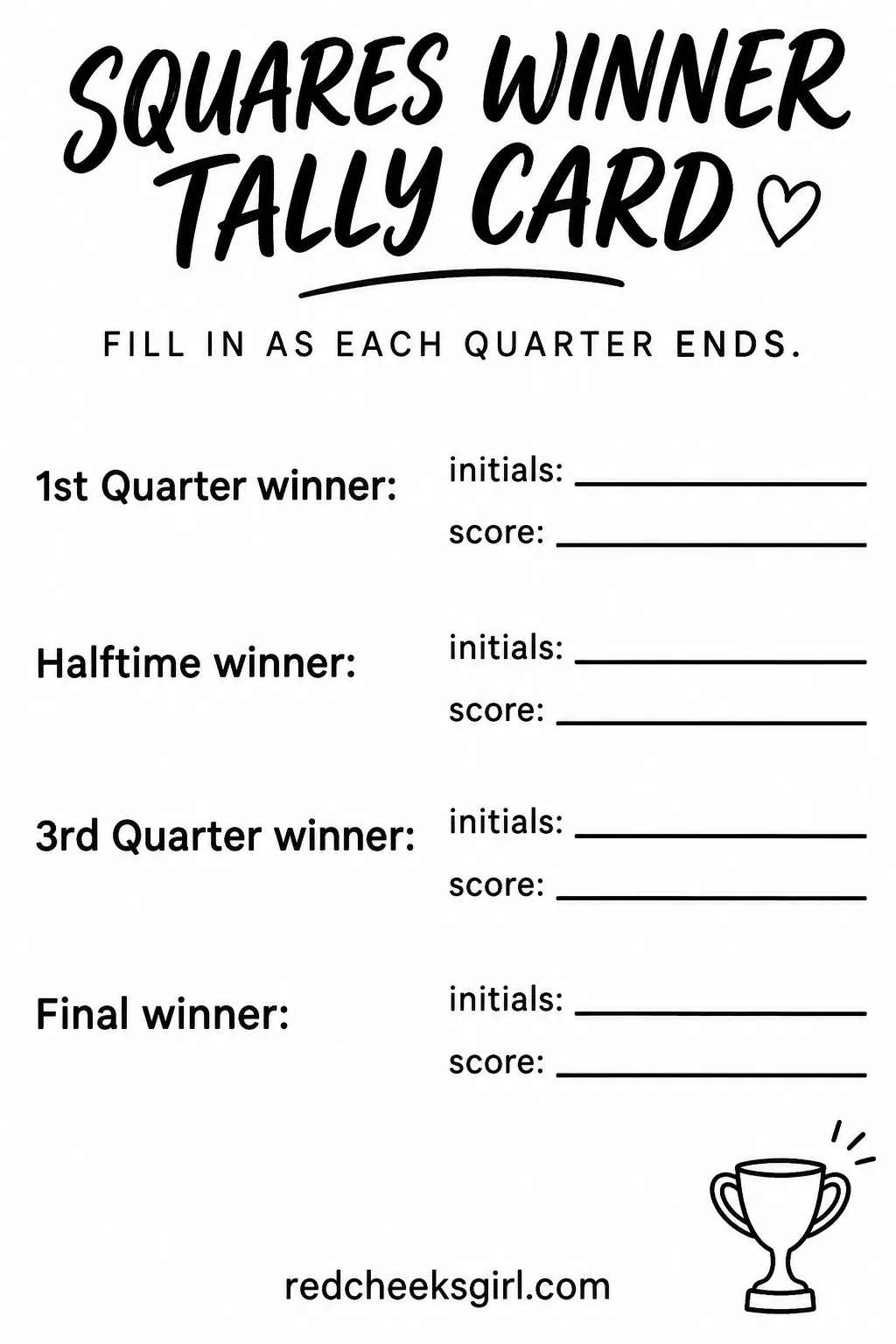
12. The Squares Winner Tally Card
While the payout chart decides how much each quarter is worth, this card keeps the actual record: who won, what the score was, and at which checkpoint.
One designated person fills it in as each quarter ends, so by the final whistle there is a complete, tidy history of the whole board rather than a scramble to remember who had what.
It takes seconds to fill per entry and needs nothing but a pen, making it the quietest item on this list. It works for any board size and any group, from a living room to a full fundraiser.
The usual slip-up is forgetting to note a quarter in the middle of an exciting play. Fix it by assigning one person as the designated scorekeeper for the entire game rather than leaving it to whoever remembers. For a simpler night, skip the tally card altogether and let the payout chart double as the only written record.
Frequently Asked Questions
What happens if a square never gets claimed before kickoff?
The square sits out the game, and if a winning score lands on it, most house rules let that quarter’s prize roll into the next quarter or go to the nearest claimed square instead.
How much should each square cost?
Whoever runs the pool sets the price, and it is set equally across every square, so a casual party might charge a dollar while a fundraiser charges five or ten.
Does overtime count in Super Bowl squares?
Yes, overtime is usually folded into the final score payout rather than treated as its own separate round, though the host should say this out loud before kickoff to avoid confusion.
Is running a Super Bowl squares pool for money actually legal?
It depends on the state: pools among friends are generally treated as legal social gambling if nobody running it profits and winners get paid in full, though the activity is technically restricted in many states when money is involved.
What are the best numbers to have in Super Bowl squares?
Zero, one, three, four, and seven hit most often, since touchdowns and field goals push scores toward those final digits more than any others.
Can you play Super Bowl squares without using real money?
Yes, plenty of groups run it purely for bragging rights or swap cash for small prizes like snacks, which is exactly how the kids version on this list works.
20 gifts for girly girls, from pearl jewelry to cashmere, sorted by what they cost and who she is so
22 travel gifts for women organised by packing, flying and landing, with the real problem each one s

30 wellness gifts for her that match a real routine: sleep, skin, movement, supplements and a few th
Leave a Reply