


St Patrick’s Day needs more than a green tablecloth and a playlist. It needs the kind of rowdy, laughing-until-someone-spills-their-drink energy that only a proper game night can deliver. Whether you are hosting ten close friends in a kitchen or thirty colleagues in a living room cleared of furniture, the right games turn a gathering into a genuine event — something people will quote back at you for months.
Every game on this list has been chosen for adult crowds who want real competition, genuine laughs, and zero fuss. You will find printable rounds for trivia and matching, physical challenges that need nothing more than a handful of coins, and listening games that expose just how little anyone actually knows about Irish music. Dip in and pick five or six, or run the whole twenty across an evening with a running scoreboard and a prize for the winner. Either way, top up the glasses, tape a shamrock to the door, and let the chaos begin.
This post contains affiliate links — if you buy through them, I may earn a small commission at no extra cost to you.
Table of Contents
- Irish Trivia Rounds
- Guess the Irish Song Intro
- Lucky Would You Rather
- Shamrock Ring Toss
- Pot of Gold Coin Toss
- Irish Slang Match-Up
- Leprechaun Charades Prompt Cards
- Green Food Taste Test
- Four-Leaf Clover Hunt
- Irish Blessing Fill-In
- Coin Stack Race
- St Patrick’s Day Bingo
- Irish County Map Challenge
- Emoji Irish Decode
- Sláinte or Shite — Irish This or That
- Pass the Parcel — Irish Edition
- Name That Irish Pub Song
- Green or Bluff — St Patrick’s Day Fact Challenge
- Lucky Dip Challenges
- Irish Accent Telephone
1. Irish Trivia Rounds
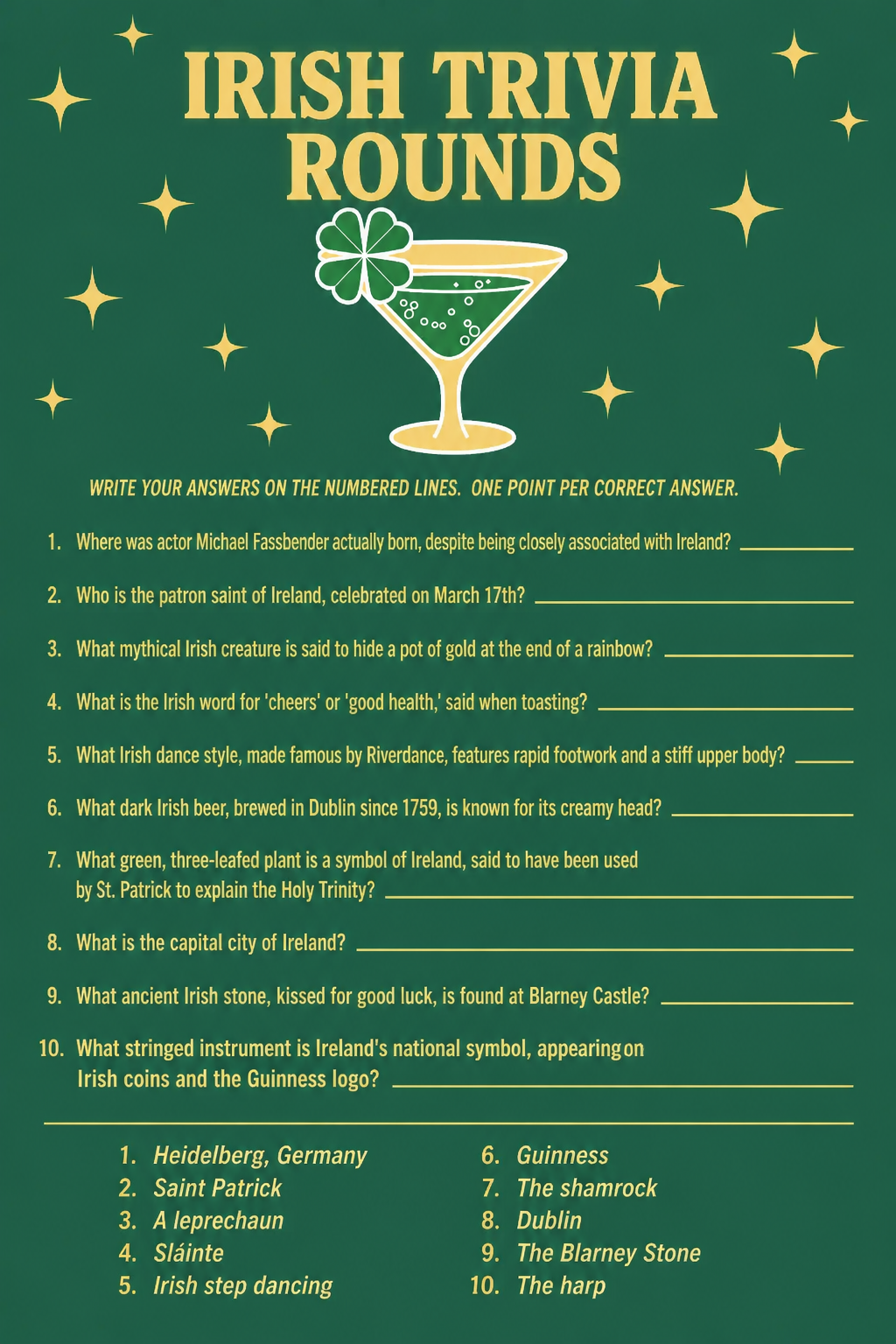
Print one answer sheet per player — or one per team if you have a big crowd — and work through four rounds of ten questions covering Irish history, geography, culture, food, and famous Irish figures. A host reads questions aloud at a steady pace, giving players about fifteen seconds per answer. Sheets are collected and swapped between teams for marking before scores are totalled on a running leaderboard.
The beauty of a printed answer sheet is that everyone plays simultaneously, so there is no awkward waiting or shouting over each other. It works brilliantly as an icebreaker at the top of the night when guests are still arriving, because latecomers can slot into a team mid-round without derailing anything. You need the printed sheets, pens, and a host confident enough to keep the pace brisk.
Group size is four to forty, and four rounds take roughly thirty to forty minutes depending on debate during marking. Host tip: prepare a tiebreaker question in your back pocket — something like “How many counties are there in the Republic of Ireland?” — because tied scores after the final round are almost guaranteed and you want a clean winner without a protracted argument.
🛍 Shopping guide
2. Guess the Irish Song Intro
Build a Spotify or YouTube playlist of twenty Irish songs — a mix of traditional tunes, rebel ballads, and contemporary Irish artists — and play only the opening five to ten seconds of each. Players write down their guess before the next clip starts. No conferring mid-clip; discussion happens after each reveal. Award one point per correct title and a bonus point for naming the artist.
The genius of this game is the range of difficulty you can engineer simply by choosing your tracks. Open with something universally known to warm the room up, then slide in an obscure tin-whistle reel that will have even self-described Irish music fans staring at the ceiling. It needs nothing more than a decent speaker, a phone or laptop, and a blank answer sheet — no printing required if you just have people jot guesses on paper.
Works perfectly for six to thirty players and runs for about twenty-five minutes across twenty clips. Host tip: preview every clip the night before on the actual speaker you plan to use — streaming dropouts and volume mismatches between tracks are the number-one thing that kills the momentum of a music round, and a smooth playback matters far more than people realise until it goes wrong.
3. Lucky Would You Rather
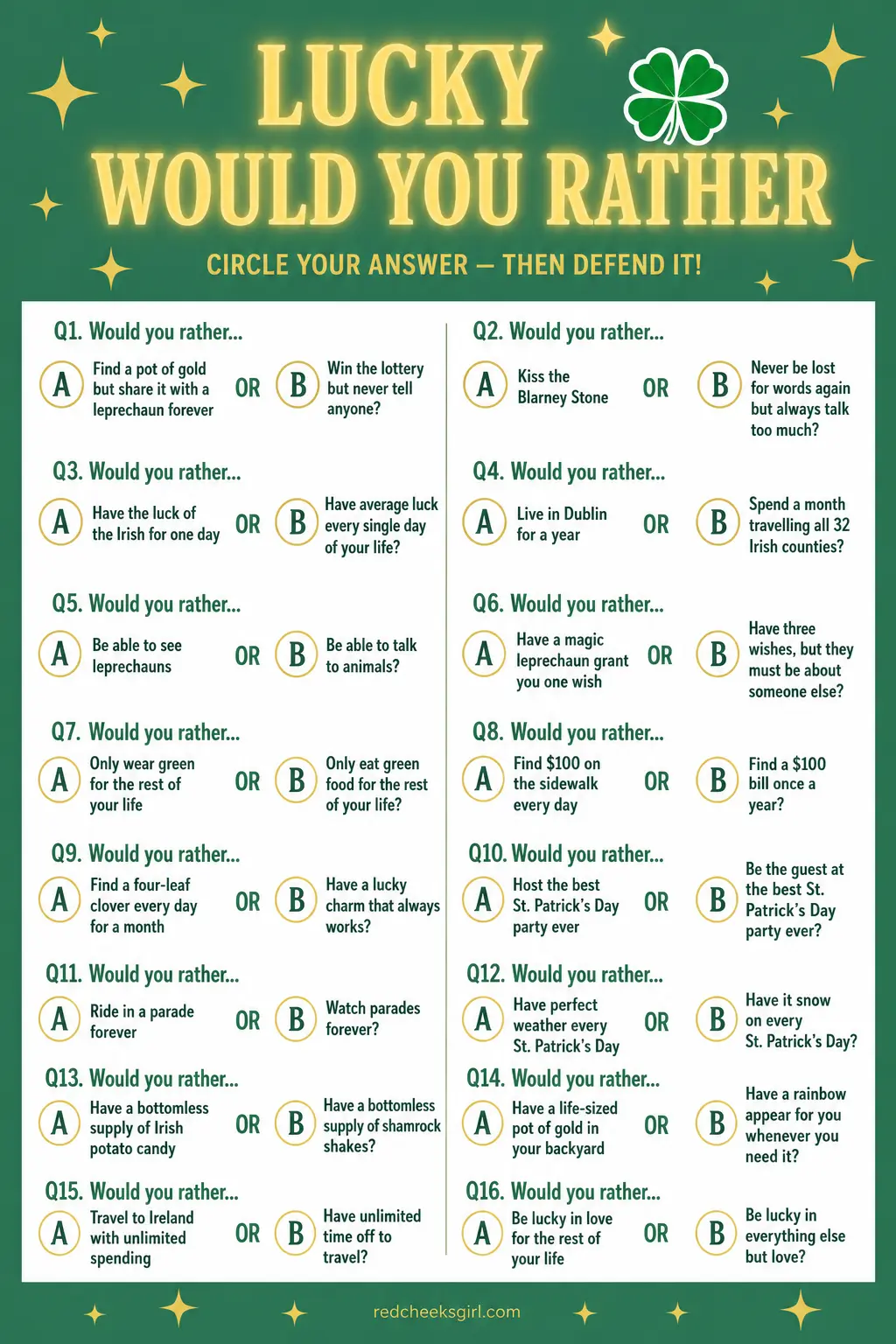
Print one card per player — or project the questions on a TV — and work through a list of St Patrick’s Day–themed “Would You Rather” dilemmas. Questions might include choices like “Would you rather wear green for an entire year or be followed by a bagpipe player for a week?” After a ten-second thinking pause, players simultaneously reveal their choice by raising a hand or holding up a coloured card: green for option A, gold for option B.
After each reveal, invite two or three players to defend their choice in twenty seconds or fewer. No justification is too ridiculous; in fact the more absurd the reasoning, the better the game plays. There is no scoring if you want it purely social, but you can award a point to the most persuasive argument each round and crown a winner at the end.
Ideal for eight to thirty players with zero setup beyond printed sheets and pens — or nothing at all if you project it. A full game of twenty questions takes fifteen to twenty minutes. Host tip: seed a couple of genuinely divisive questions near the end when the room is warmed up; the mild controversy is what gets people talking long after the game finishes.
4. Shamrock Ring Toss
Set up three to five bottles — glass bottles work perfectly and look the part — at varying distances across a table or on the floor. Cut shamrock shapes from green card or use green glow rings as the tossers. Players take turns throwing three rings each, scoring points by distance: closest bottle worth one point, farthest worth five. First to twenty-one wins each heat, and heat winners play a final.
The physical silliness of ring toss is exactly what a party needs midway through the evening when everyone has been sitting for a while. It is naturally loud, draws a crowd of spectators, and creates instant rivalry. You need bottles, green rings or homemade shamrock rings cut from craft foam, and a strip of tape on the floor as the throwing line.
Runs well as a side station for two to four players at a time, with a tournament bracket for larger groups. Each heat takes about five minutes. Host tip: weight the bottles slightly with a splash of water so they do not topple when a ring grazes them — nothing derails the scoring faster than bottles falling over on near-misses and causing arguments about whether it counted.
🛍 Shopping guide
5. Pot of Gold Coin Toss
Place a large black pot — a cooking pot spray-painted or wrapped in black paper works fine — in the centre of the room, and mark a throwing line about two metres back. Players take turns tossing ten gold-foil chocolate coins, scoring a point for each coin that lands inside the pot. The player with the most coins in after three rounds is the winner.
It sounds simple because it is, and that simplicity is entirely the point. Coin toss games have a way of becoming intensely competitive very quickly, with everyone developing strong opinions about their technique by the second round. You need the pot, a bag of gold foil coins (which double as prizes for the winner), and a clear floor space. A single tournament for eight players takes under twenty minutes.
Best for four to sixteen players competing in elimination heats. Host tip: line the inside of the pot with a tea towel so coins land with a satisfying thud rather than bouncing straight back out — it dramatically reduces disputes over borderline coins and keeps the game moving at pace.
🛍 Shopping guide
6. Irish Slang Match-Up
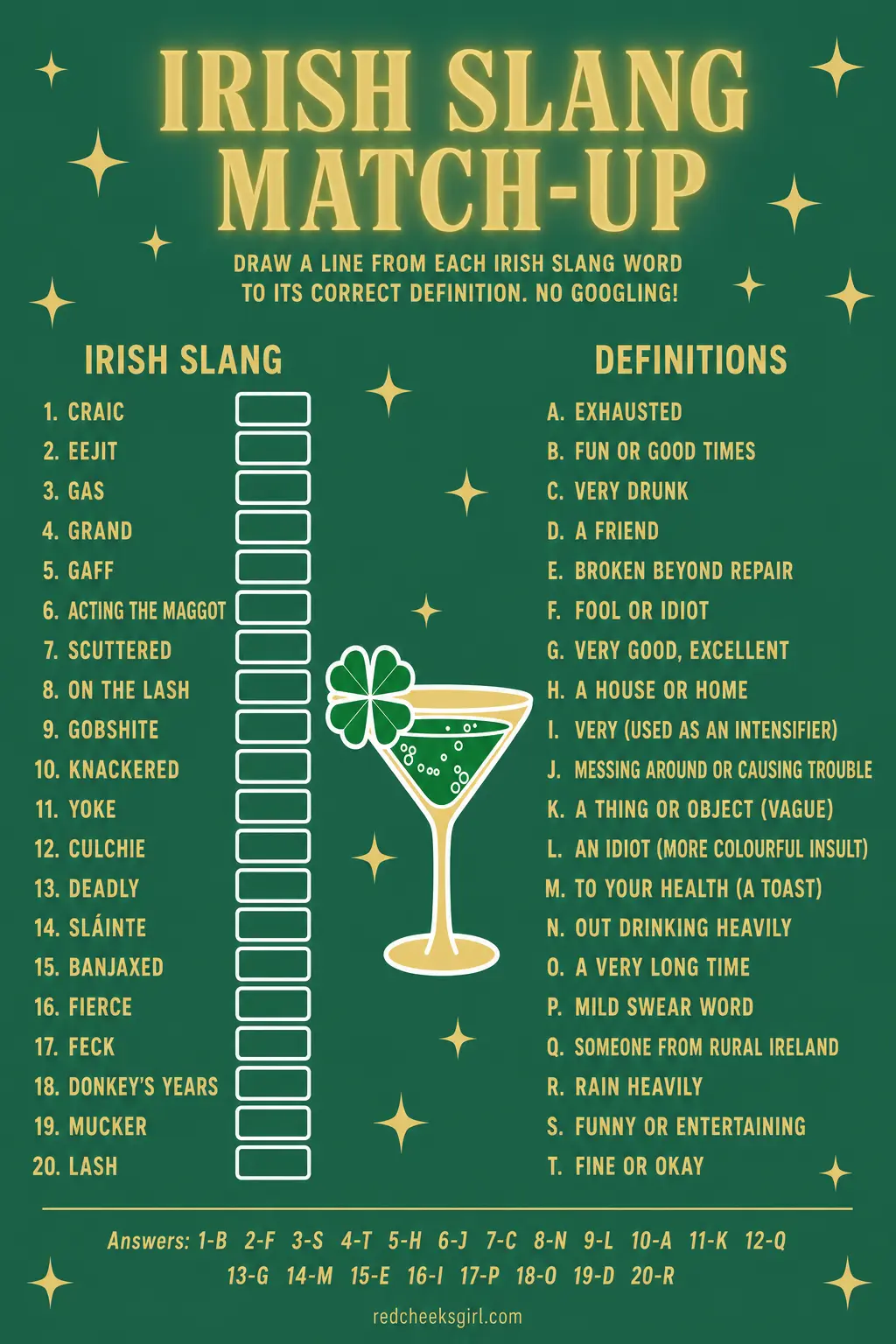
The printed sheet lists twenty Irish slang terms on the left — words and phrases like “sláinte,” “craic,” “acting the maggot,” “eejit,” and “feck” — alongside twenty definitions shuffled on the right. Players draw lines to match each term to its correct meaning, working individually against the clock. Two minutes on the timer, then sheets are swapped and marked by a neighbour using the host’s answer key.
What makes this game land so well is the confident wrongness it produces. Players who have visited Ireland once are absolutely certain they know what “cod” or “gas” means in context, and they are frequently, entertainingly incorrect. The brief marking phase generates as much laughter as the game itself as people read each other’s answers aloud.
Works for any group size from four upward; each round takes about five minutes including marking. Host tip: include two or three terms that sound rude but are entirely innocent, and two or three that sound innocent but have a cheeky meaning — the room will be dramatically wrong in both directions, which is exactly the chaos you want.
7. Leprechaun Charades Prompt Cards
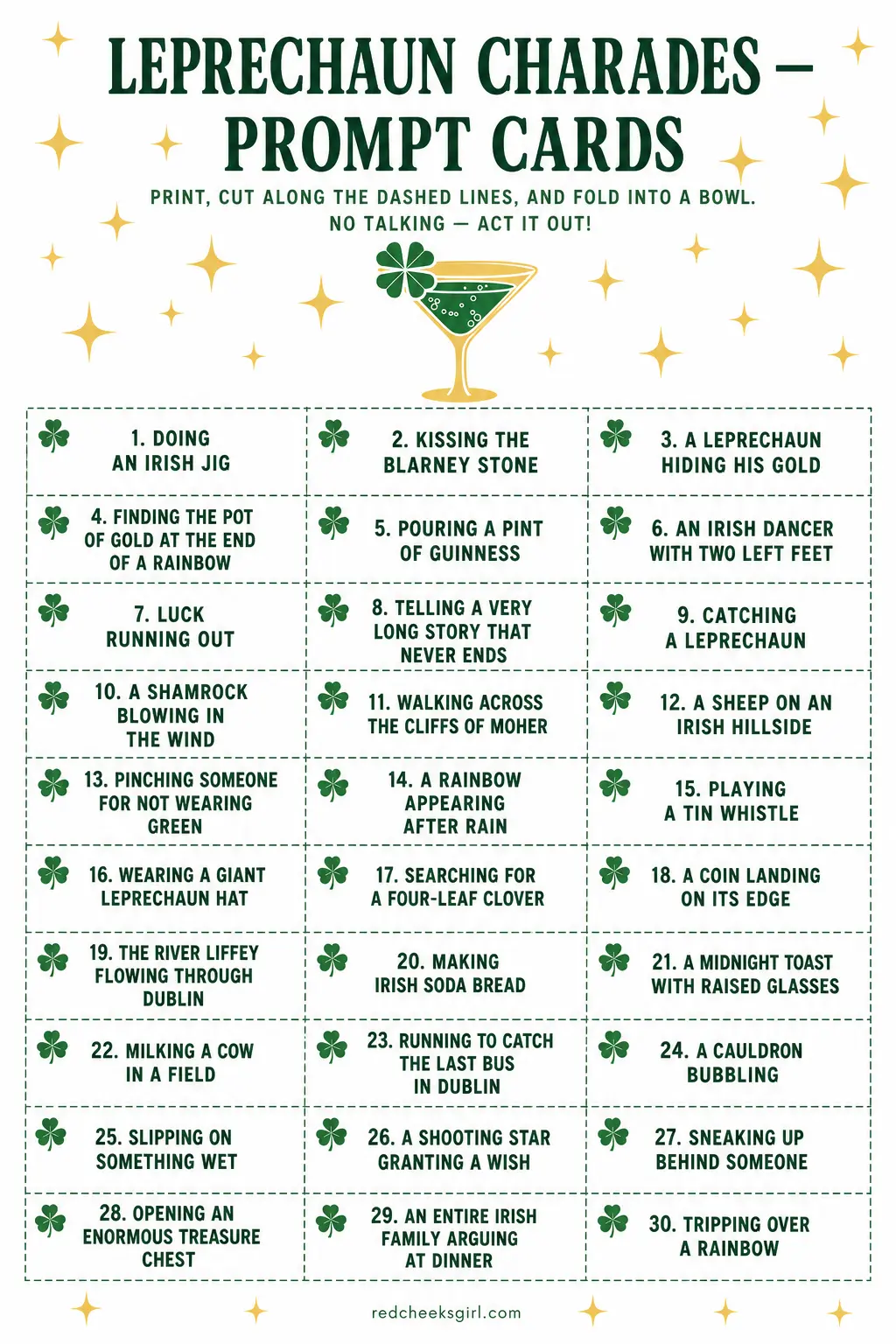
Print and cut the prompt cards, shuffle them face-down in a pile, and split guests into two teams. One player from the acting team draws a card — each card features a St Patrick’s Day or Irish-themed prompt such as a famous landmark, a traditional activity, or an Irish cultural reference — and must act it out in silence for their team to guess within sixty seconds. Correct guesses score a point; teams alternate until the deck is exhausted.
Charades always works at parties, but the themed prompt cards sharpen the focus and stop people defaulting to whatever film they last watched. The printed cards are essential here: they keep the game moving without players wasting time thinking up prompts on the spot. All you need beyond the cards is a timer and a willingness to make a fool of yourself.
Perfect for six to twenty-four players in teams of three to six; a full deck of twenty-four cards takes about thirty minutes. Host tip: stack the deck so the easiest prompts sit near the top — a cold room that fails on the first three cards loses confidence fast, and starting with a quick win gets energy moving in the right direction before the harder cards appear.
8. Green Food Taste Test
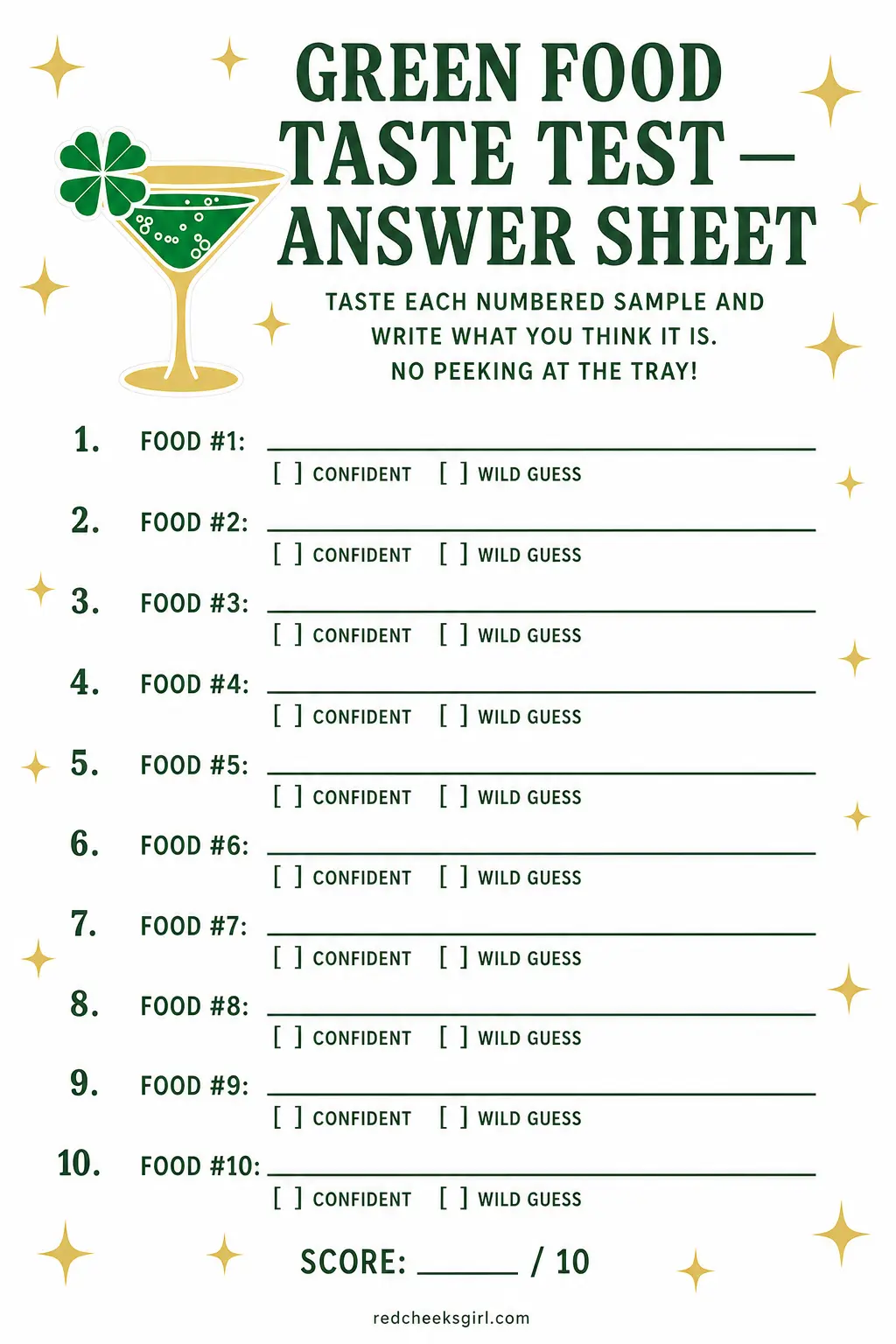
Prepare eight to twelve small, unlabelled samples of green food and drink — think lime jelly, matcha cake, green-dyed hummus, cucumber, kiwi, avocado, green tea, and mint chocolate — and number each cup or ramekin. Players use their printed answer sheet to write what they think each sample is, scoring a point per correct identification. The player with the most correct answers wins, with a tiebreaker decided by a bonus sensory round.
This is one of those games that plays completely differently depending on the crowd: food-confident guests breeze through the obvious samples and get humbled by the tricky ones, while guests who claim not to be “food people” occasionally win outright by pure instinct. Preparation takes some effort — you need to shop, prepare, and label everything in advance — but the game itself runs with almost no hosting from you once samples are on the table.
Works for four to twenty players; the tasting and guessing phase takes about fifteen minutes. Host tip: serve water and plain crackers between samples or the flavours blur together after the fourth or fifth taste, causing wildly incorrect guesses and a lot of frustrated squinting that is funny once but frustrating twice.
🛍 Shopping guide
9. Four-Leaf Clover Hunt
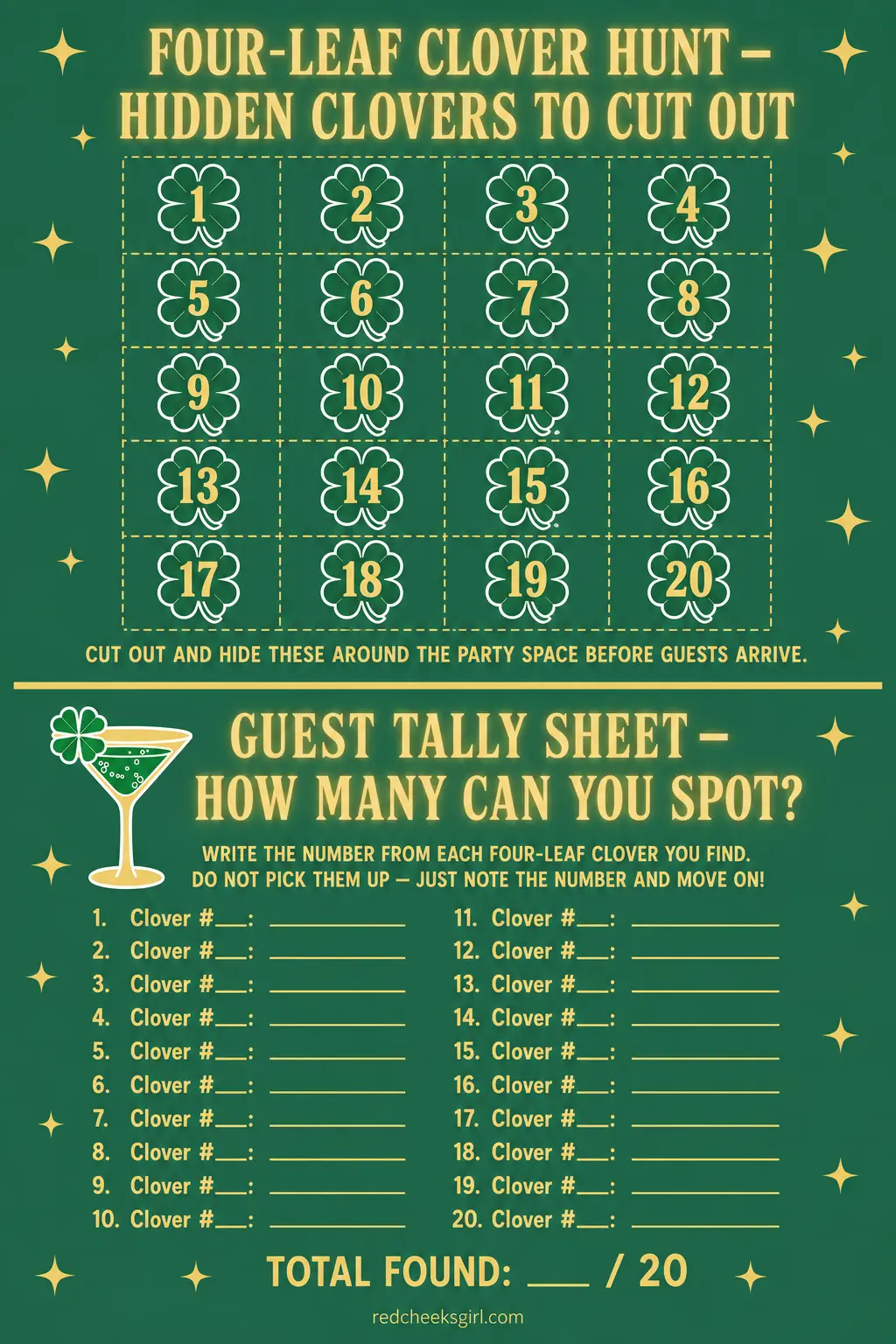
Before guests arrive, hide thirty to fifty small paper four-leaf clovers — cut from green card or printed on the sheet and pre-cut — all around your party space: under chairs, tucked behind picture frames, taped beneath tables, and folded into napkins. When the hunt is announced, players have five minutes to find as many as possible. The player with the most clovers at the end wins; all found clovers go into a prize draw regardless of count, so every hunter has a reason to keep looking.
A scavenger-style hunt works brilliantly mid-party when energy needs a physical jolt and guests have been standing or sitting for a while. It also naturally breaks conversational clusters, which is useful if you want people to mingle beyond their existing friend groups. You need the printed and cut clovers, a timer, and hiding spots you can actually remember.
Runs for any group size from six upward; the hunt itself lasts five to seven minutes. Host tip: keep a master list of every hiding spot so you can do a sweep after the game — a forgotten clover discovered weeks later behind the radiator is harmless, but several unclaimed ones will skew any recount if someone contests the result.
🛍 Shopping guide
10. Irish Blessing Fill-In
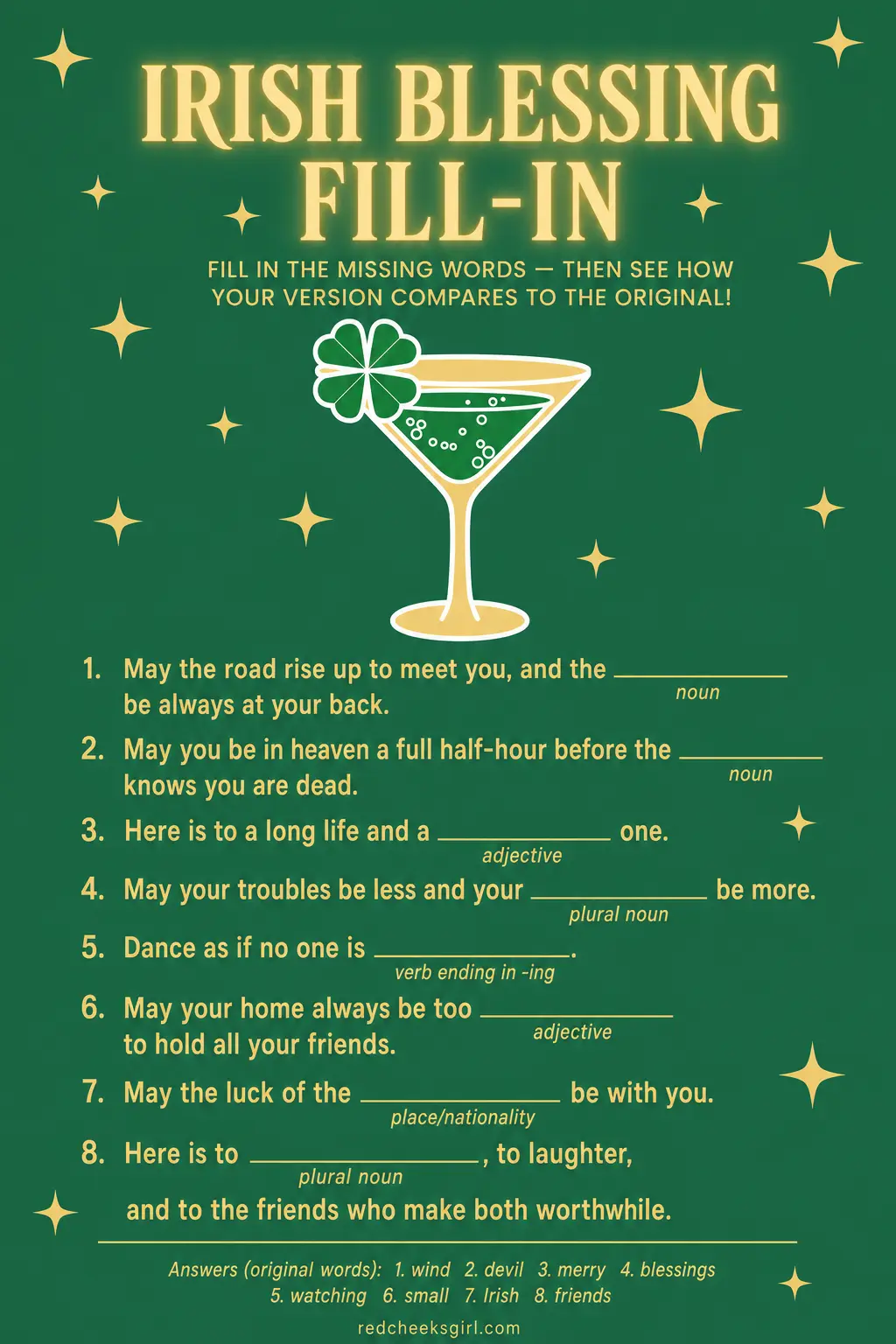
The printed sheet presents five or six classic Irish blessings with key words blanked out — not silly random words, but genuinely meaningful ones that test whether players know the real text. Players fill in what they believe the original words to be, working individually in silence. After two minutes, the host reads the correct versions aloud and players self-mark, scoring one point per correctly filled blank.
This game has a quieter, more reflective quality than most on this list, which makes it an ideal palate cleanser between two noisier rounds. People who consider themselves well-versed in Irish culture often discover they have been misremembering a beloved blessing for years, which produces a particular kind of delighted outrage that is very good for a party atmosphere.
Works for any number of players; each round takes six to eight minutes. Host tip: read the completed blessings aloud slowly and with genuine warmth at the reveal — rushing through them kills the moment, and letting the room actually absorb the words turns a quick filler game into something people genuinely remember.
11. Coin Stack Race
Give each player a stack of ten gold-coloured coins and a flat surface. On the host’s signal, every player must stack all ten coins into a single tower using only one hand. The first player to build a standing tower of all ten without it toppling calls time and wins the round. Run three rounds, awarding a point per round, and the player with the most points after three wins.
It is absurdly simple and absurdly tense — the combination of concentration, slight physical awkwardness, and the knowledge that everyone is watching makes coin stacking far more nerve-wracking than it has any right to be. No printing required, no technology needed: just coins, a table, and the will to win. A bag of large, flat coins works best as they stack more reliably than thin ones.
Works for four to sixteen players competing simultaneously; three rounds take about ten minutes. Host tip: ban the use of a flat surface to steady the stack partway through building — some players instinctively lean the growing tower against a cup or bottle, which removes all the challenge and causes immediate protests from everyone who was playing honestly.
🛍 Shopping guide
12. St Patrick’s Day Bingo
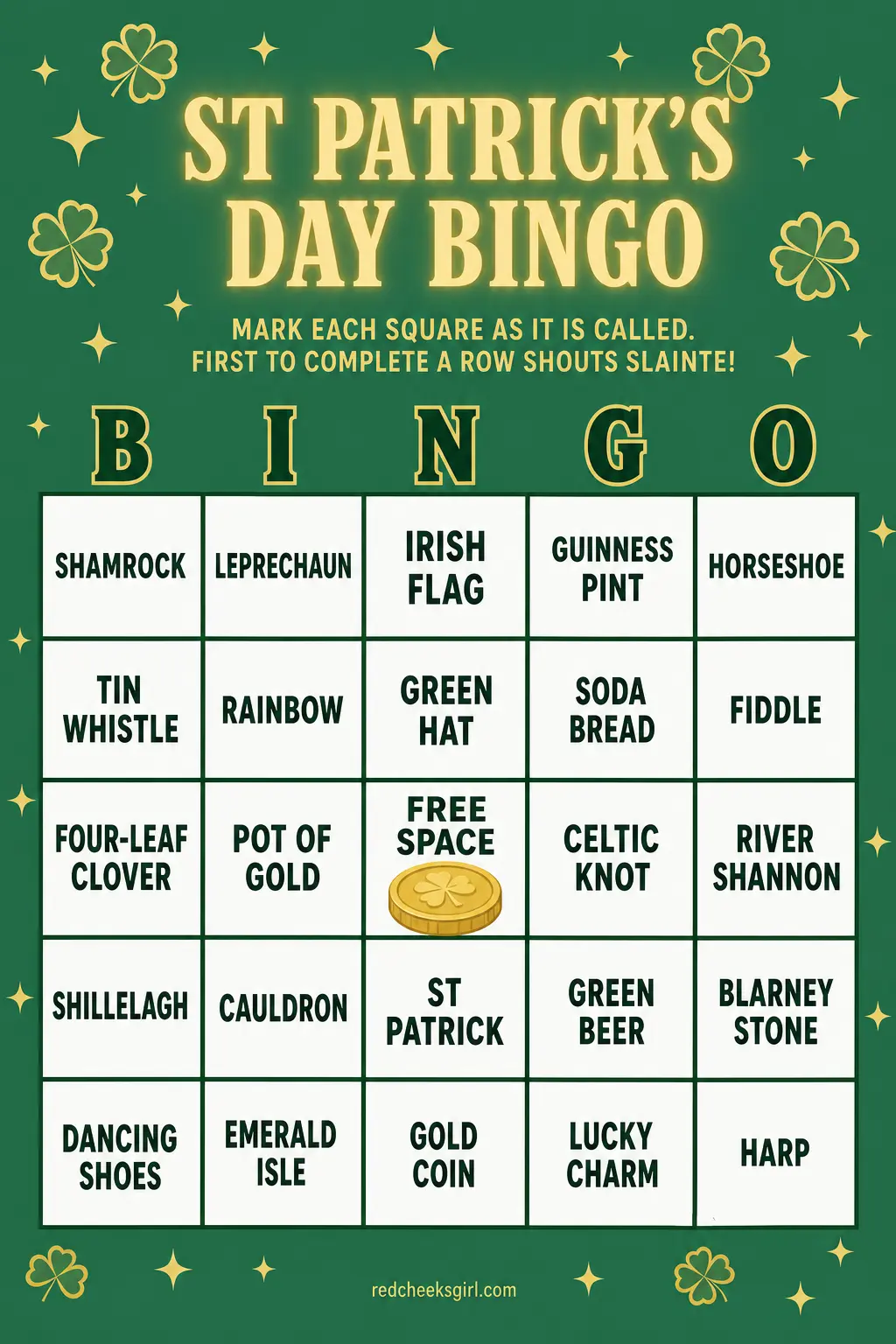
Print one unique bingo card per player — each card is a five-by-five grid filled with St Patrick’s Day words and images rather than numbers — and give everyone a handful of small markers (coins, dried peas, or torn paper squares work fine). The host calls items from a shuffled master list; players mark off matches. First to complete a row, column, or diagonal shouts “Sláinte!” and wins the round.
Bingo is one of those games that scales effortlessly: it is equally fun with eight people around a kitchen table and with thirty in a living room, because everyone is playing simultaneously and the communal tension of the last-square moment never loses its charge. Running three or four rounds keeps the game fresh and gives more players a chance to win.
Plays for any group size; each round lasts five to eight minutes. Host tip: prepare a small prize for each round winner — even something as simple as a chocolate coin or a joke prize — because the physical handover of a prize in front of the group generates a disproportionate amount of applause and energy, and that momentum carries into the next round.
🛍 Shopping guide
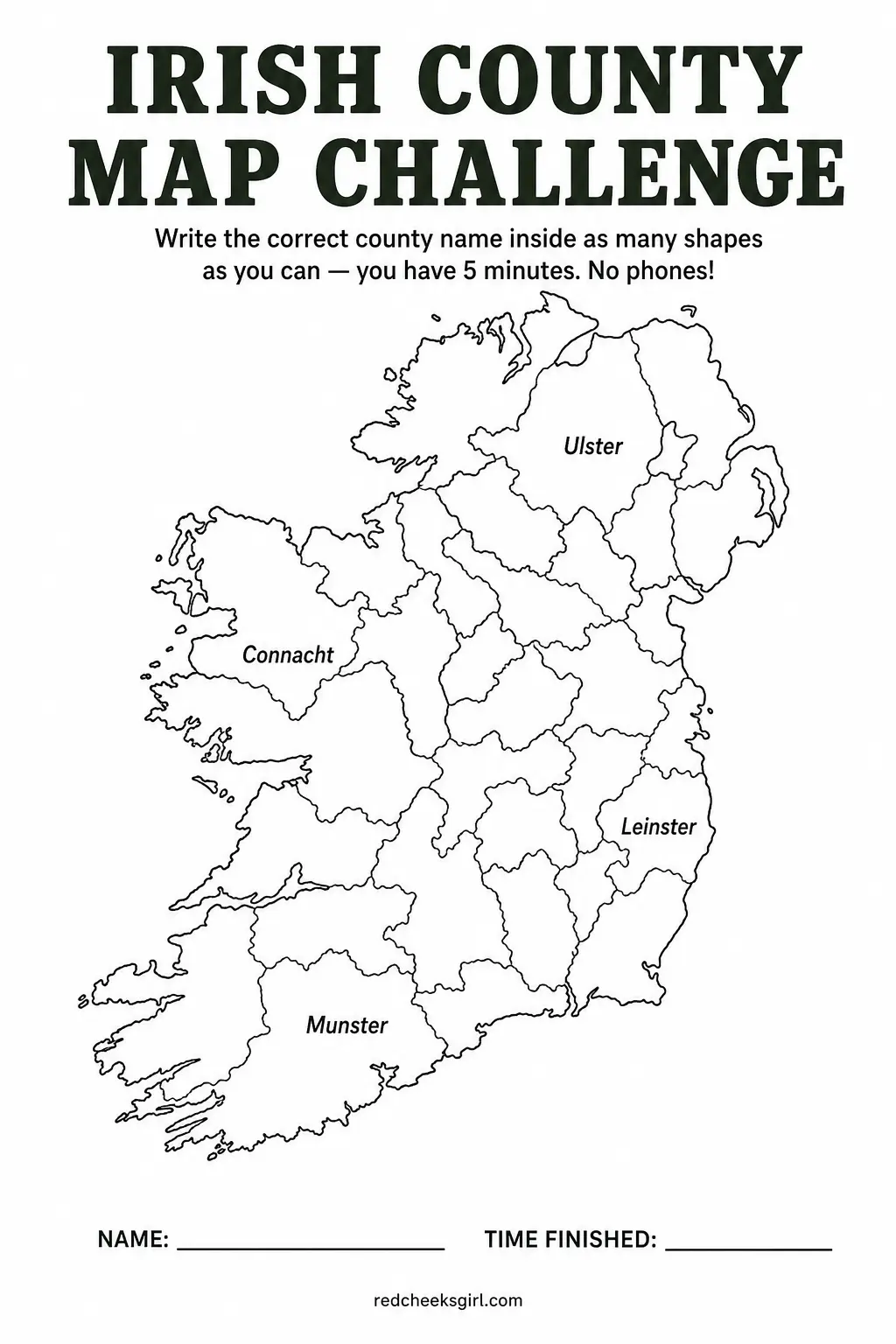
13. Irish County Map Challenge
The printed sheet shows an outline map of Ireland with the thirty-two counties left blank. Players have three minutes to label as many counties as they can from memory, writing each county name in the correct space. After time is called, the host reveals the answer map and players mark their own sheets: one point per correctly placed county name, half a point if the name is right but the county is in the wrong province.
This is a genuinely humbling game for people who consider themselves knowledgeable about Ireland, and a surprisingly successful one for people who do not — guessing becomes a tactical art form when you know roughly where the west coast is but cannot separate Mayo from Roscommon. The printed map sheet makes this entirely self-contained: no technology, no extra materials beyond pens.
Works for any group size; the labelling phase takes three minutes and marking takes another four. Host tip: award a bonus point to anyone who can correctly name the four provinces as well — it adds a second tier of difficulty that separates the geography enthusiasts from the rest without making anyone feel left out of the main scoring.
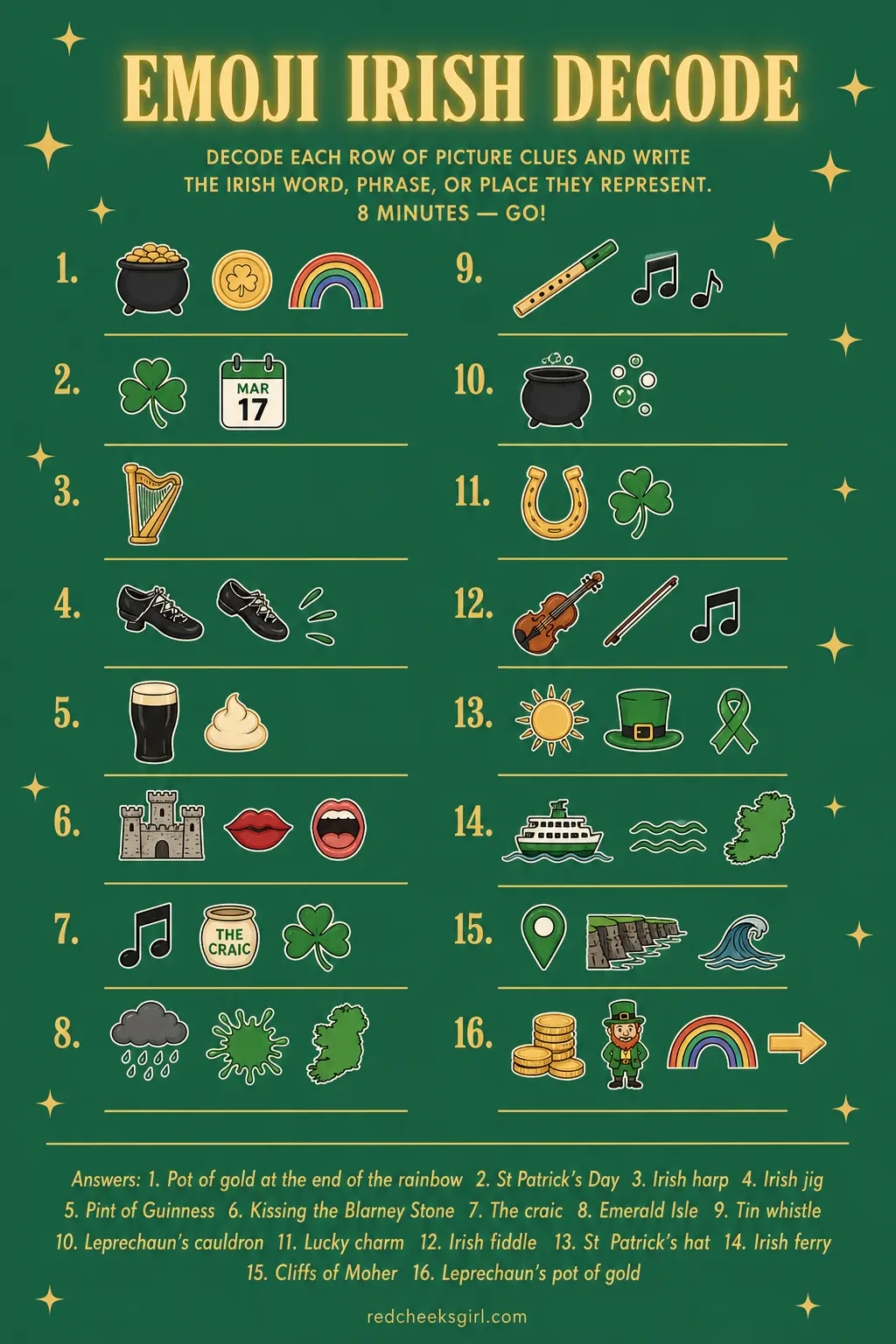
14. Emoji Irish Decode
The printed sheet presents a series of rows, each containing a sequence of emoji that collectively represent an Irish phrase, place name, cultural reference, or famous Irish saying. Players work through the sheet individually, writing their answer beside each row. The host collects and marks sheets against an answer key, awarding one point per correct answer and announcing the results aloud so the room hears every answer — including the ones people got gloriously wrong.
Note that every puzzle on this sheet has been designed so that the emoji sequence maps directly to a single, unambiguous correct answer — a specific Irish county, a well-known cultural phrase, or a named tradition — rather than an open-ended “guess the proverb” format. That precision is what makes this a real game with real winners rather than a frustrating guessing exercise. Players work individually in silence for the allotted time, then answers are compared and scored.
Works for four to thirty players; completing the sheet takes six to eight minutes. Host tip: read the most-missed answer aloud last and explain the logic behind it — the collective “oh!” moment when the room finally sees it is one of the best sounds a host can hear, and it rounds the game off with a satisfying payoff rather than a shrug.
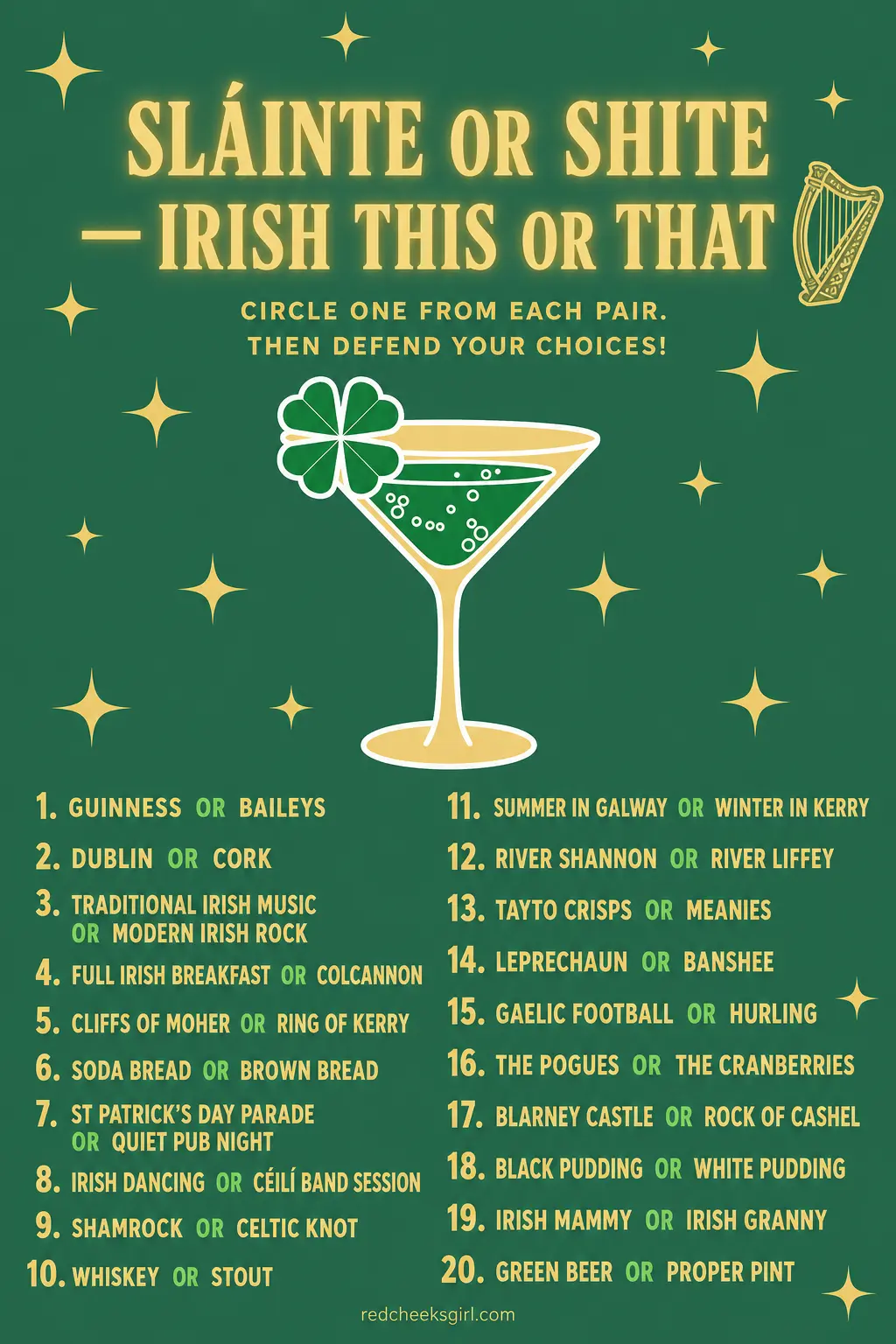
15. Sláinte or Shite — Irish This or That
The printed sheet lists twenty statements about Irish culture, history, food, and traditions, and players must mark each one as either “Sláinte” (true, brilliant, genuinely Irish) or “Shite” (false, made up, or wildly exaggerated). Some statements are obvious; others are designed to be deceptively plausible. Players work through the sheet individually, then sheets are swapped and marked against the host’s answer key.
The name alone gets a laugh before the game starts, which immediately lowers the room’s guard — and then the questions do the real work. Mixing genuine Irish facts with convincing fabrications means even confident players second-guess themselves repeatedly, and the post-game debate about which answers were which is often louder than the game itself. This is a printed sheet game that requires nothing else beyond pens.
Works for any group size from four upward; completing the sheet takes five to seven minutes. Host tip: include at least three statements that are so outrageous they seem false but are completely true — those are the answers that generate the most noise at the reveal, and noise is exactly what you want in the room at that point in the night.
16. Pass the Parcel — Irish Edition
Wrap a small prize in eight to twelve layers of green and gold paper, tucking a St Patrick’s Day dare or challenge inside each layer — something like “do your best Irish accent for thirty seconds,” “name five famous Irish musicians,” or “teach the group one Irish phrase.” Guests sit in a circle and pass the parcel while music plays; whoever is holding it when the music stops unwraps one layer and completes the challenge before music resumes.
This is one of those games that adults claim is childish right up until they are the one holding the parcel and the music stops. The combination of mild performance pressure, peer audience, and the genuine mystery of the prize makes it work just as well at thirty-five as it did at eight. You need wrapping paper, tape, a prize, printed or handwritten challenges, and a music controller who is willing to be merciless about timing.
Works for six to twenty players seated in a circle; a twelve-layer parcel takes fifteen to twenty minutes. Host tip: make sure every challenge is completable in under a minute — long, complicated tasks kill the game’s rhythm, and a dare that gets abandoned halfway through sets a bad precedent for the rest of the layers.
🛍 Shopping guide
17. Name That Irish Pub Song
The host hums or whistles — no words, no instruments — the melody of a well-known Irish pub song, one at a time. Players race to be first to shout the correct title, scoring a point per correct answer. The host works through ten songs, and the player with the most points at the end wins. Suitable songs include drinking ballads, rebel songs, and ceili standards that any regular pub-goer would likely recognise.
Humming rather than playing the recording shifts the difficulty in a fascinating direction — people who know a song well can identify it from a rough melody in two bars, while people who only sort-of know it cannot place it at all. It also means the game costs absolutely nothing and requires zero technology. The only thing you need is a host willing to hum badly in public, which, after sufficient encouragement, is never hard to find.
Works for six to thirty players; ten songs take about fifteen minutes including disputes. Host tip: if your humming voice is genuinely unrecognisable, recruit the guest with the most musical confidence to be the hummer instead — the game plays better when at least some songs are identifiable, and a truly tone-deaf host can accidentally make every round unsolvable.
18. Green or Bluff — St Patrick’s Day Fact Challenge
Players sit in a circle. On their turn, each player states one “fact” about St Patrick’s Day, Ireland, or Irish culture — it can be true or completely invented. The rest of the group votes simultaneously: thumbs up for “I believe it,” thumbs down for “That’s a bluff.” The speaker scores a point for every person they fool if bluffing, or a point for every person who correctly believes them if telling the truth. Play three rounds per player.
This is a social deduction game dressed in green, and it rewards both genuine knowledge and convincing delivery. A player who knows that St Patrick was not actually Irish has a ready-made true fact that sounds false; a player who knows nothing can still win by stating something absurd with total confidence. No materials needed whatsoever — just people, voices, and enough trust in the group to keep the bluffs creative.
Works best for six to sixteen players; three rounds per player in a group of ten takes about twenty-five minutes. Host tip: set a firm rule that all facts must relate to Ireland, St Patrick’s Day, or Irish culture — without this boundary, players default to unverifiable personal trivia that cannot be ruled true or false, which collapses the scoring entirely.
19. Lucky Dip Challenges
Fill a cauldron or bowl with folded strips of paper, each bearing a different thirty-second physical or creative challenge: things like “balance a coin on your nose for ten seconds,” “hop on one foot while singing a bar of an Irish song,” “mime rowing a boat while someone guesses what you are doing,” or “name six green things in the room before time runs out.” Players take turns drawing and completing a challenge, with the group voting thumbs up or thumbs down on whether it was achieved.
Lucky dip challenges work as a standalone game or as a palate cleanser slotted between two more structured rounds. The unpredictability of the draw is half the entertainment — watching a usually composed guest desperately name green things while the room counts down is a specific kind of joy. You need a cauldron or bowl, the written challenges, and a thirty-second timer.
Works for six to twenty players; ten challenges take roughly fifteen minutes. Host tip: write at least twice as many challenges as you expect to use and draw randomly — if players can see the remaining strips diminishing, they start trying to influence who draws next, which creates politics that have no place in a party game.
🛍 Shopping guide
20. Irish Accent Telephone
Players sit or stand in a line. The host whispers a short Irish phrase — something like “the craic was mighty at the fair in Galway” — to the first player, who must then repeat it to the next player in their best attempt at an Irish accent, whispering all the way down the line. The last player says the phrase aloud to the room in full voice. Points are awarded for the phrase reaching the end recognisably intact, and bonus points go to the most committed accent performance.
Telephone games are consistently brilliant at parties because the combination of whispering, accent distortion, and human memory produces results that bear almost no relation to the original phrase by the time they reach the end of a ten-person line. The Irish accent requirement adds another layer of chaos because every player’s idea of an Irish accent is slightly different, compounding the distortion with every pass.
Works for six to twenty players in a single line, or two parallel lines competing to see whose phrase survives more intact; five phrases take about fifteen minutes. Host tip: choose phrases with specific, unusual words rather than common ones — the unusual words are the canary in the coalmine that lets the room hear exactly where the message started to fall apart, which is always the funniest part of the reveal.
Frequently Asked Questions
How many of these St Patrick’s Day party games need printed sheets?
Eleven of the twenty games come with a dedicated printable sheet — Irish Trivia Rounds, Lucky Would You Rather, Irish Slang Match-Up, Leprechaun Charades Prompt Cards, Green Food Taste Test, Four-Leaf Clover Hunt, Irish Blessing Fill-In, St Patrick’s Day Bingo, Irish County Map Challenge, Emoji Irish Decode, and Sláinte or Shite. The remaining nine games need nothing more than everyday items you likely already have at home.
How far in advance should I set up these games?
Print all your sheets and cut any prompt cards the day before so you are not rushing on the night. Hide the four-leaf clovers, wrap the pass-the-parcel, and set up the ring toss or coin toss stations an hour before guests arrive. The music-based games — Guess the Irish Song Intro and Name That Irish Pub Song — are worth testing on your actual speaker the evening before to catch any volume or connectivity issues early.
What is a good order to run these games across an evening?
Start with a printable round like Irish Trivia or Irish Slang Match-Up while guests are still settling in — seated games ease people into the night. Move to the physical games like Shamrock Ring Toss and Coin Stack Race once the room is warm and people are on their feet. Save the loudest, most social games — Irish Accent Telephone, Pass the Parcel, and Lucky Dip Challenges — for later in the evening when inhibitions are lower and energy is high.
Do I need a separate host, or can one of the guests run the games?
Most of these games run themselves once the rules are explained, but having one designated host for the night makes a noticeable difference. The host controls the pace, keeps scores, and calls time — without that role filled, games tend to drag or collapse into argument. It does not have to be the same person all evening; handing the host role to a different guest for each game keeps everyone involved and spreads the workload.
How do I manage prizes without spending a lot?
Small prizes work better than expensive ones at a party because they are about recognition rather than value. Gold foil chocolate coins, mini bottles of something Irish, novelty shamrock accessories, or even a handwritten “winner” certificate read aloud in front of the group all land well. The key is to actually award a prize every time rather than promising one and forgetting — the physical moment of handing something over is what the room responds to, not the monetary value of the item.
📌 Save These for Later
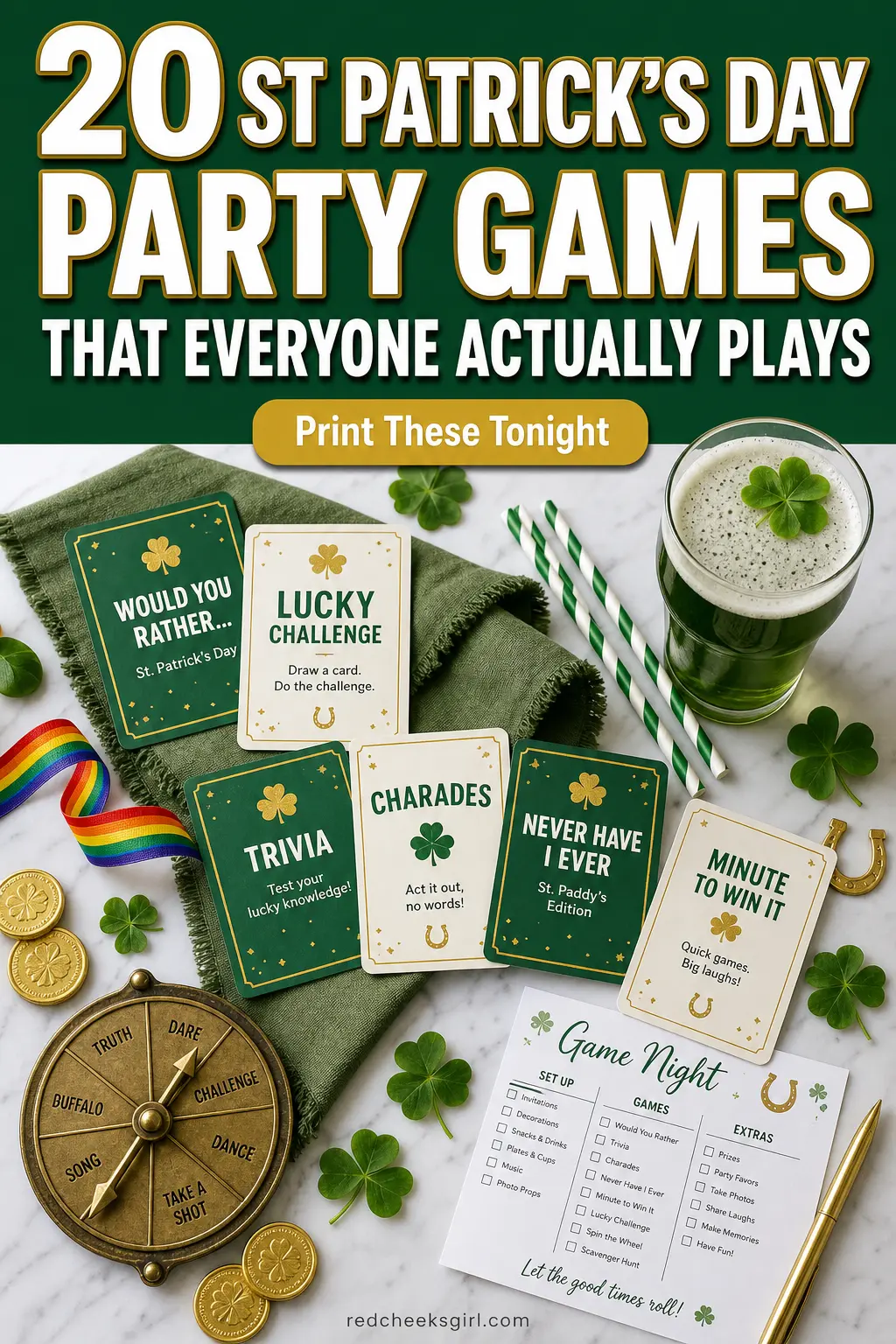
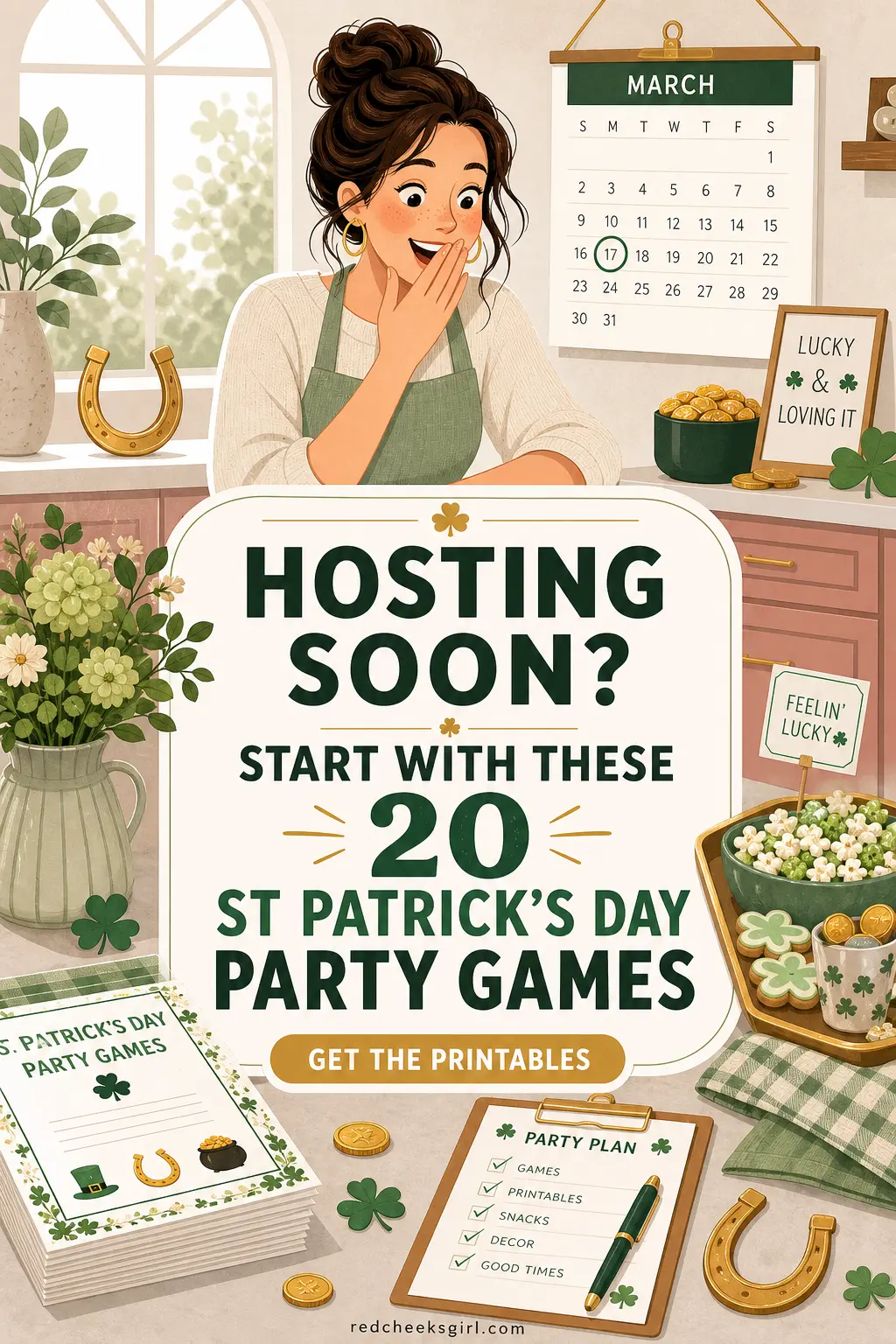
Loved these? Pin your favorite image below so you can find this list again when you’re planning.



There’s something specific that happens when a baby is coming into a family that has really ne
15 Thanksgiving Minute To Win It Games for kids — fast, funny 60-second challenges perfect for hom

My son handed me a folded piece of notebook paper about three months before his seventh birthday. On
Leave a Reply