

School Halloween party games are the make-or-break ingredient of any classroom celebration — and if you’ve ever watched a room of costumed third-graders turn into absolute chaos while you frantically searched for something, anything, to play, you already know that. I’ve been there.
That’s exactly why this list exists: 18 teacher-approved games that are low-mess, fast to set up, and genuinely fun enough to keep a full class engaged from bell to bell.
Whether you’re a room parent volunteering for the first time or a veteran teacher who just needs fresh ideas, these are the school Halloween party games your class actually deserves. Need inspiration for what the kids can wear?
Check out these cheap Halloween costumes you can make in 30 minutes — because half the fun is the outfit!
I’ve organised the lineup to mix lively active games, downloadable printable sheets, and calm quiet games so the energy ebbs and flows instead of spiking into a full sugar-fuelled meltdown (we’ve all seen it).
You’ll find everything from a trending 2026 Scream Contest to a printable Halloween Maze and a cosy Flashlight Storytelling wind-down.
And because I know your supply budget is approximately three dollars and a prayer, every single game here is low-cost and easy to pull off with minimal prep.
For even more ideas beyond this list, peek at these simple Halloween games for kids’ parties — they pair perfectly with everything below!
- Scream Contest (Scream-Meter Costume Vote)
- Halloween Maze
- Shake the Eyeballs (Tissue Box)
- Guess the Candy
- Eyeball Spoon Race
- Halloween Pictionary Cards
- Tournament of Terror (Team Relays)
- Halloween Riddles Sheet
- Eyeball Toss (Bucket)
- Halloween Scavenger Hunt List
- Trick-or-Treat Punch Board
- Fishing for Eyeballs
- Guess the Pumpkin Weight
- Donut on a String
- Ghost Bowling
- Glow Stick Ring Toss
- Flashlight Storytelling
- Spooky Story One Word
- Frequently Asked Questions
1. Scream Contest (Scream-Meter Costume Vote)
This is the 2026 classroom costume vote with serious dramatic flair, and honestly it might be my new favourite thing. Instead of a plain show-of-hands vote for best costume, the class becomes the judge — using the volume of their screams.
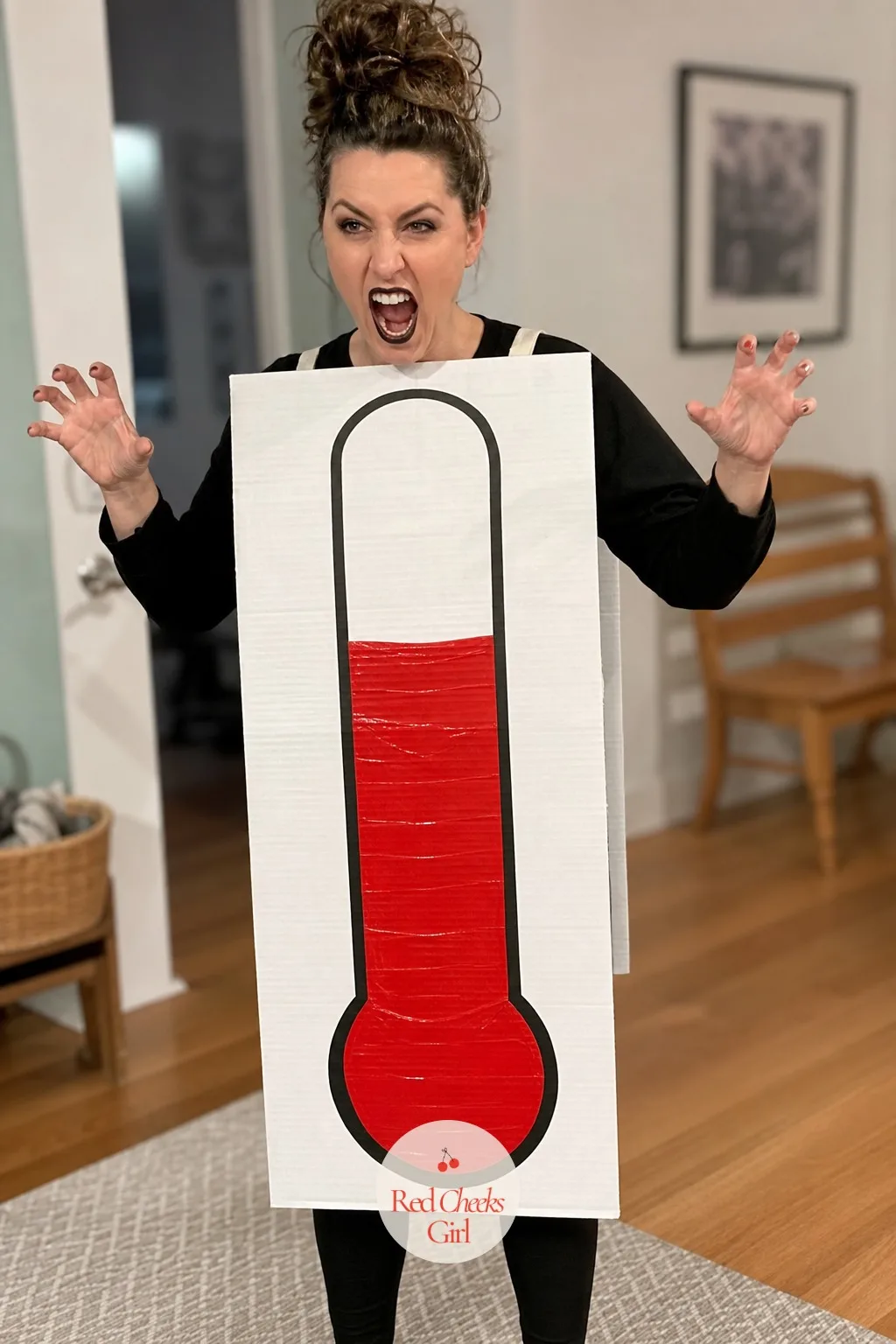
Each costumed student does a quick ‘costume reveal’ walk to the front of the room while the teacher holds up a large hand-drawn or printed Scream-Meter (think of a thermometer going from ‘Meh’ to ‘AHHHHH!’).
The louder the class screams, the higher the needle goes — and the student with the loudest reaction wins the crown. It is gloriously chaotic for exactly 90 seconds and then it’s done.
To set it up, draw your Scream-Meter on a whiteboard or piece of poster board before the party. Designate a ‘reveal runway’ — even just the space between two rows of desks.
Call students up one at a time, give them a three-second dramatic pause, and then let the screaming commence. Have a helper tally scores (or just wing it — the class will absolutely know who won).
Pro tip: do the whole thing in rounds of five so you’re not sustaining scream energy for 25 kids in a row. Your vocal cords will thank you.
Why does this work so well? Because every single kid gets a moment in the spotlight, which is genuinely rare during a class party.
It also channels that big chaotic Halloween energy into one contained, time-limited burst rather than letting it simmer and boil over all afternoon.
Variation: for older grades, add category awards — ‘Scariest,’ ‘Funniest,’ ‘Most Creative’ — and let small panels of three students do the Scream-Meter reading for each category. The peer-judging element takes the pressure off you and adds a fun layer of suspense.
- Poster board or whiteboard for the Scream-Meter drawing
- Marker to fill in the ‘needle’ live
- A brave voice (yours, for MC duties)
2. Halloween Maze
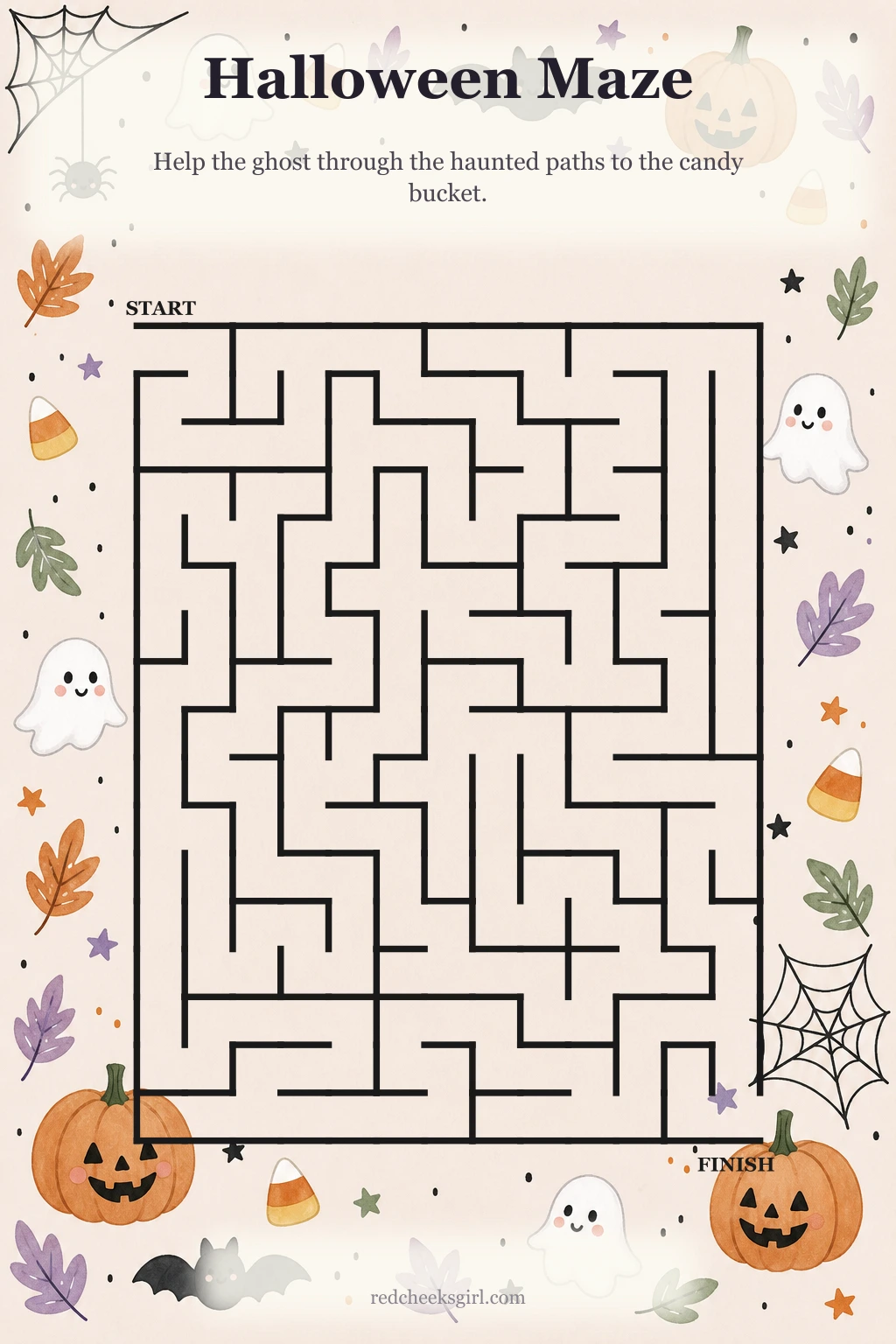
A Halloween Maze printable is one of those low-key classroom game heroes that works for every single age group — even when half the class finishes at wildly different speeds.
Kids receive their sheet, grab a pencil, and race to guide a lost little ghost through a spooky haunted mansion filled with dead ends, bats, and cobwebs to reach the bucket of candy at the exit.
It’s independent, silent, and keeps early finishers busy while the rest of the class catches up on other activities — which, tbh, is basically a gift to every teacher who’s ever dealt with the ‘I’m done, what do I do now?’ situation.
Print one sheet per student. No other materials needed — just pencils. For a competitive twist, set a timer and see who can solve it first; for a cooperative version, pair students and let them solve it together.
You can also laminate a few copies and use dry-erase markers so the sheets are reusable across multiple class periods. Stick a small sticker on the papers of students who finish correctly — it costs nothing and kids absolutely love it.
The maze doubles as a sneaky fine-motor and problem-solving activity, so if an admin wanders in during your party, you can confidently say the kids are doing spatial reasoning work. (You’re welcome.)
Difficulty tip: draw or print two versions — a simpler path for younger students and a more complex multi-layer maze for upper elementary — so every student is appropriately challenged rather than frustrated or bored.
- Grades K–5
- Independent seat work during rotating station parties
- Early finishers who need an extra challenge
3. Shake the Eyeballs (Tissue Box)
This one went mega-viral for good reason — it is absolutely unhinged in the best possible way and kids completely lose it watching each other play.
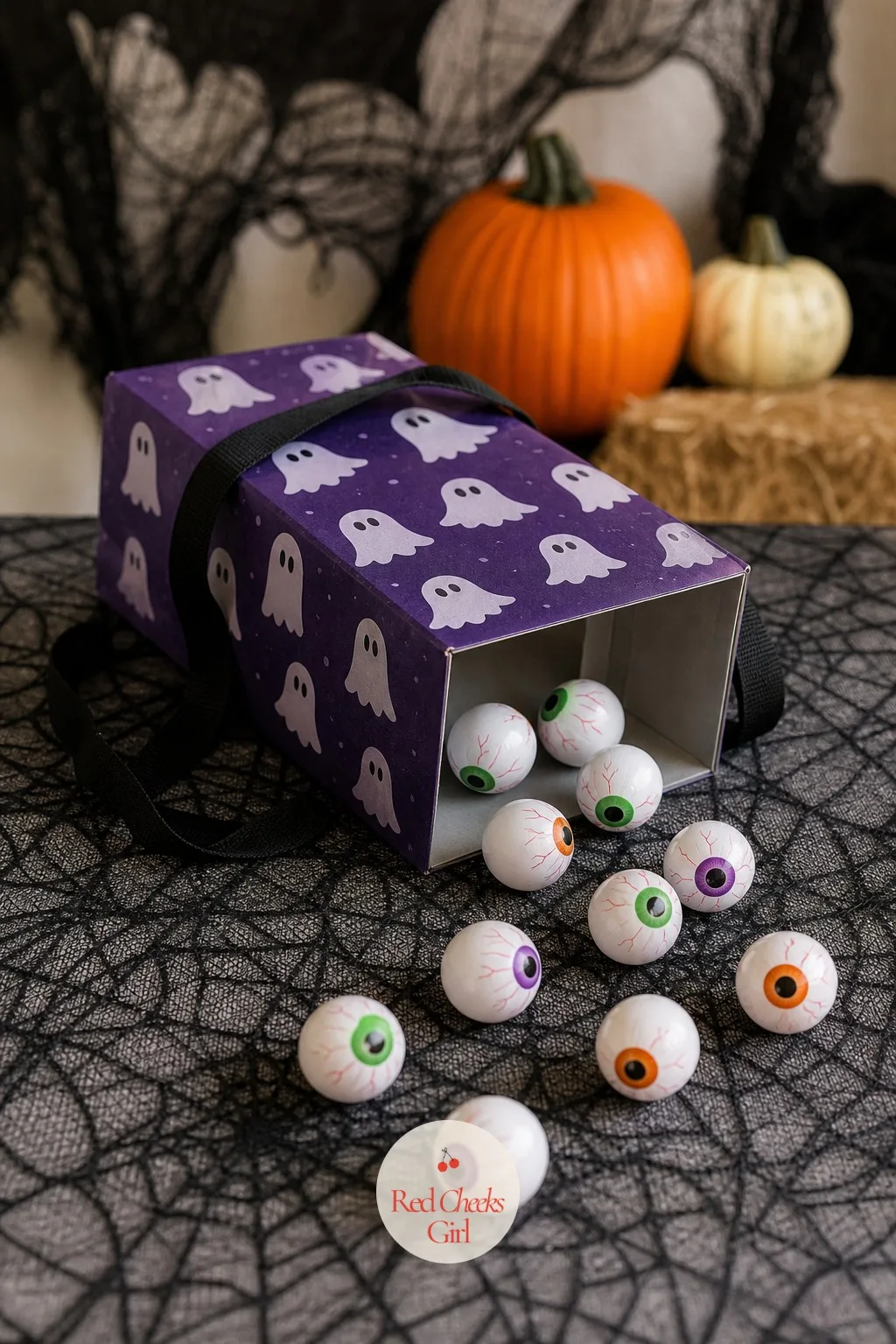
Each player straps an empty tissue box to their backside (filled with ping-pong eyeballs) and must shake, wiggle, and shimmy until all the eyeballs have dropped out through the open end of the box. Hands must stay at shoulder height the entire time.
The player who empties their box fastest wins — and the wiggling is something you will not soon forget.
Prep is simple: grab a tissue box per student (or per team if you’re doing heats), punch two holes on the sides near the bottom and thread a belt, ribbon, or long strip of fabric through so the box can be tied around the player’s waist with the open end facing down.
Drop 5–8 ping-pong balls painted to look like eyeballs inside, tie it up, and go. For a full classroom, run it as heats of four at a time so the audience gets to laugh and the players get a moment to shine.
Takes about 60 seconds per round.
Host tip: do a quick demo yourself first. Not only does it clarify the rules instantly, it also immediately endears you to the class for the rest of the party (and probably the rest of the school year, tbh).
This game is a fantastic energy burner mid-party when you need to reset the room’s vibe after a quieter activity.
For a team relay twist, the next person on the team can’t start strapping on until every eyeball has hit the floor — adding a frantic handoff element that the class will absolutely go wild for.
- 1 tissue box per player or team
- 5–8 ping-pong balls per box (draw red veins with marker for eyeball effect)
- Ribbon or fabric strips for strapping the box around the waist
4. Guess the Candy
Guess the Candy is a printable Halloween guessing game that turns a jar of mixed Halloween candy into a full class competition — and it’s genuinely thrilling in a way that feels disproportionate to how simple it is.
Before the party, fill a large clear jar with a single type of Halloween candy (candy corn, mini Reese’s cups, small gummies — your call) and count them carefully as you drop them in.
Students receive a printable sheet, study the jar, and write their best guess for the total count. At the end of the party, the closest guess wins the whole jar. Every. Single. Student. Is invested.
The printable sheet elevates this beyond just a sticky note on the board.
It includes spaces for the student’s name, their guess, their reasoning (great for a sneaky math estimation moment!), and a fun row of Halloween candy illustrations they can match to identify what’s inside.
Print one per student, and set the jar somewhere visible but out of reach. Want to add stakes?
Announce mid-party that the winner also gets to be the one to open the jar and distribute candy to the class — the power move of the year.
The real magic here is that this game runs itself. You set the jar, hand out the sheets, and let the quiet competition simmer in the background while every other game is happening. No timer needed, no facilitation mid-game.
Students can revise their guess once (and only once!) if you want to add a second-chance rule — it teaches estimation, revision, and graceful losing all in one go.
You can also swap the candy for small plastic spiders or Halloween erasers if your school has a no-candy policy — and if that’s your situation, definitely check out these healthy Halloween treat alternatives for some great non-candy prize ideas too!
Write the actual count on a sticky note and seal it in an envelope displayed next to the jar — it builds suspense and proves the game is fair when you reveal it!

5. Eyeball Spoon Race
The Eyeball Spoon Race is the Halloween version of the classic egg-and-spoon relay that never, ever gets old — and the eyeball twist makes it a hundred times more dramatic.
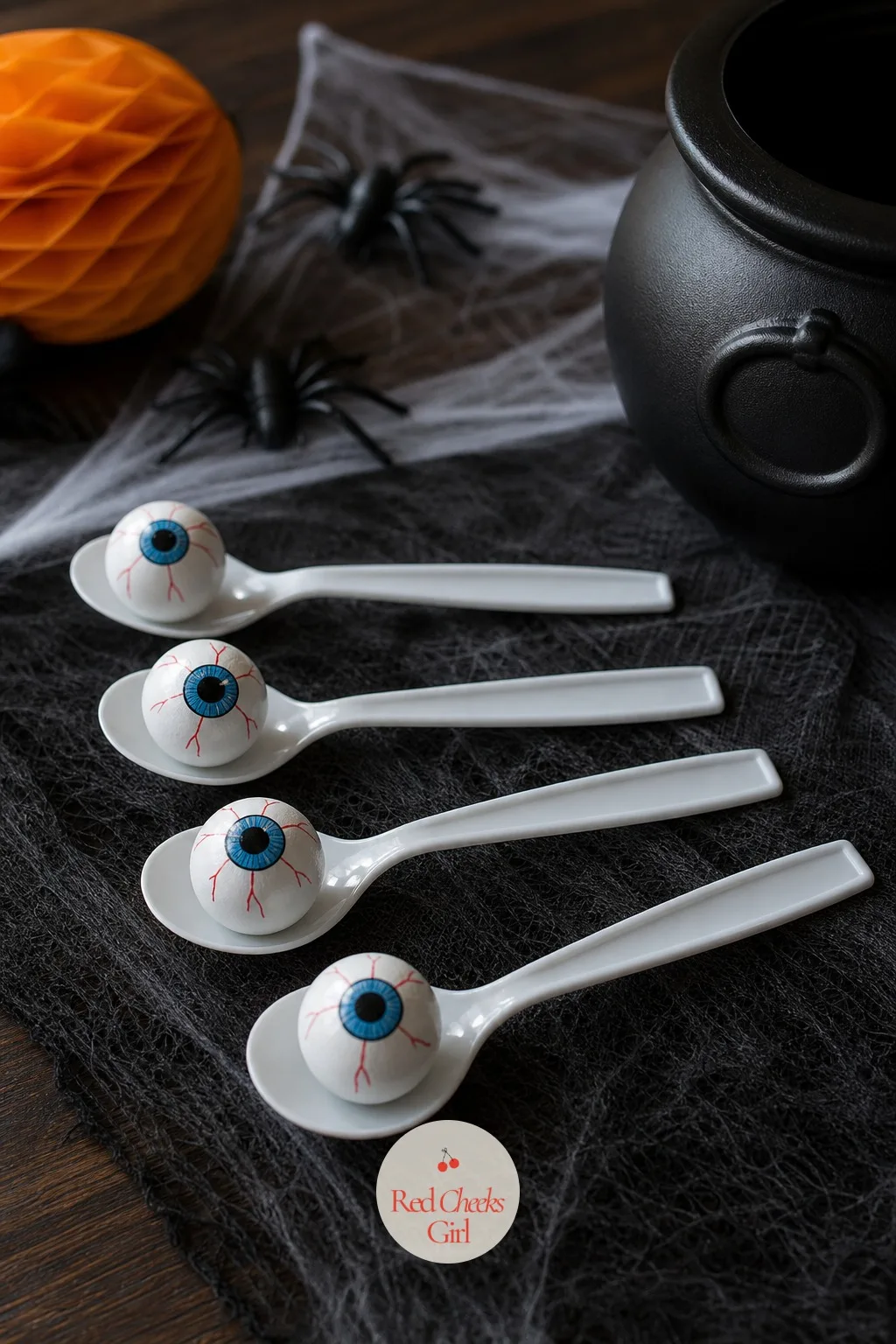
Players balance a ping-pong ball painted to look like a bloodshot eyeball on a plastic spoon, race from the start line to a turning point, and return without dropping it. Drop the eyeball?
You pick it up and start your leg of the race over from the beginning. First team to get every player through the relay wins. The combination of focus, wobble, and competitive panic is genuinely hilarious for the whole class to watch.
You need ping-pong balls (use a red marker to draw veins and a black Sharpie for the pupil — it takes maybe 90 seconds per ball) and one plastic spoon per team. Mark your start line with tape.
For a class of 25–30, split into four or five teams of five to six and run heats simultaneously so everyone is moving at once rather than standing in a long queue.
The turning-point cone can be a mini plastic pumpkin, a witch’s hat, or just a book on the floor — whatever you have. Zero cost, maximum chaos.
For younger students (K–2), allow players to carry the spoon handle in their hand.
For older grades, ramp up the drama by requiring the spoon to be held in the mouth, hands clasped behind the back — suddenly it’s a completely different and infinitely funnier challenge.
You can also add a gentle obstacle course using chairs or cones to weave around, which slows the pace and increases the concentration factor.
Either way, your class will beg to play this one again, and you’ll happily oblige because cleanup is literally just scooping up a few ping-pong balls.
- For K–2: hold the spoon by the handle in one hand
- For grades 3+: hold the spoon handle in the mouth with hands behind back
- Dropped eyeball = return to the start of that player’s leg only, not the whole team’s start
6. Halloween Pictionary Cards
Halloween Pictionary Cards turn the beloved drawing-guessing classic into a full-class Halloween spectacular — and it works brilliantly as a station game, a full-class heads-up showdown, or a team tournament.
One student draws a Halloween word from the card deck (ghost, haunted house, cauldron, vampire, spider web, black cat — you get the idea) while their team frantically calls out guesses before the timer runs out.
No clue cards to read aloud, no complicated rules — just draw, guess, and absolutely do not draw the actual word anywhere on the board (yes, that always happens).
The printable sheet doubles as both a set of prompt cards you cut apart before the party AND a score-tracking sheet for each team. Print on cardstock, cut the cards into a deck, shuffle, and you’re done.
For a whole-class simultaneous version, project one card on the board and have four students (one per team) race to draw it at the same time on mini whiteboards — first team to guess correctly scores a point.
This version is so fast and so loud and so incredibly fun that the 45 minutes will evaporate.
A great host tip: create two difficulty tiers — easier single-noun cards (bat, pumpkin, zombie) for younger students and trickier concept cards (trick-or-treating, haunted, potion, eerie) for older or more advanced groups. Shuffle both decks together or separate them deliberately depending on your class.
Running Halloween Pictionary Cards as a team tournament also subtly encourages kids who are shy about drawing to participate because the team energy carries them. Plus, the results are always absolutely unhinged artwork that the class will talk about for weeks.
- Draw a card from the deck — do NOT say the word aloud
- Sketch the word for your team — no letters or numbers allowed
- Team calls out guesses — first correct guess scores a point
- First team to 10 points wins!

7. Tournament of Terror (Team Relays)
Tournament of Terror is the ultimate class party anchor game — a multi-round team relay tournament where tables (or rows) compete against each other across a series of mini challenges.
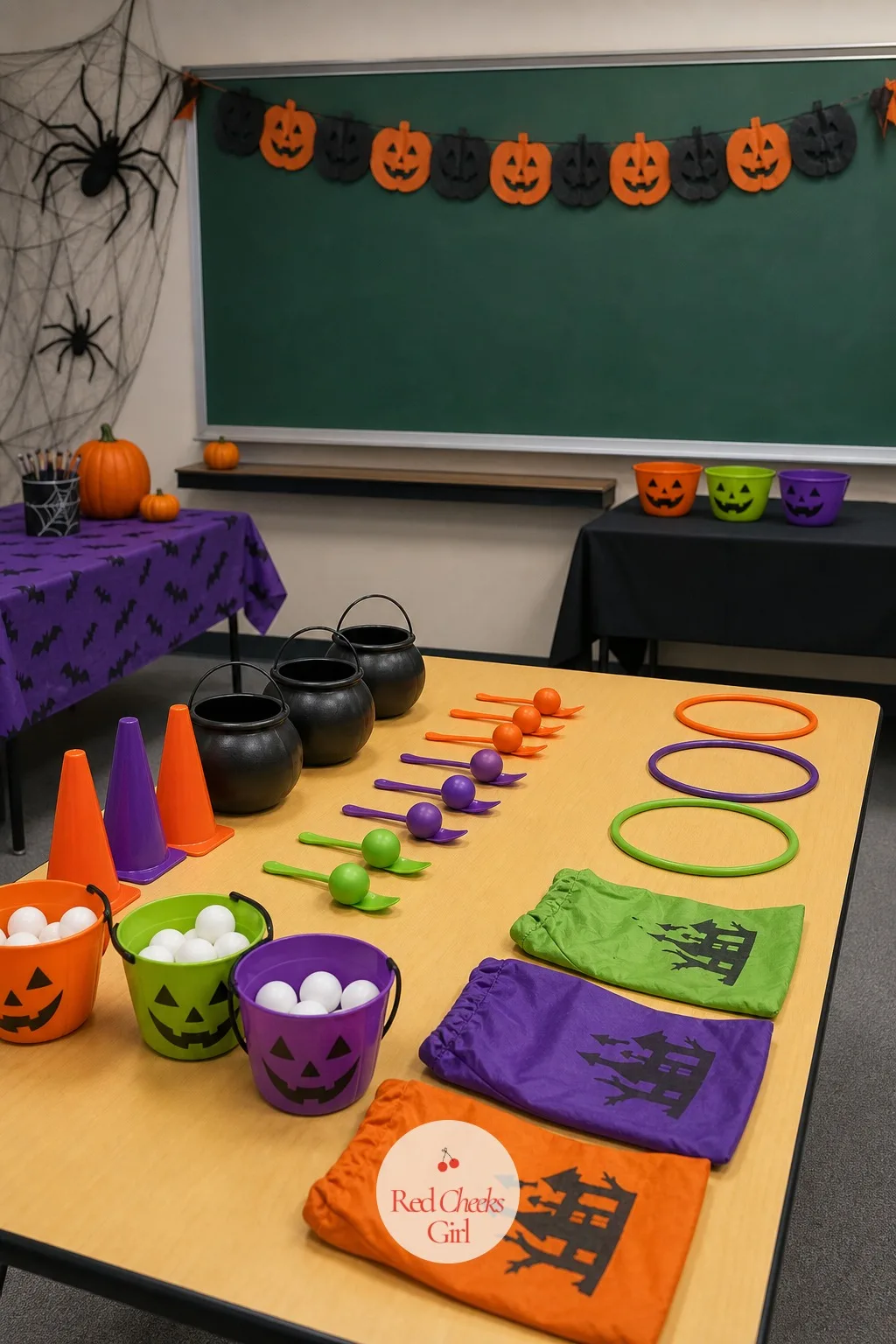
Think of it as Olympic Halloween: each round has a different silly relay task, points are tallied on the board after each event, and the team with the most points at the end of all the rounds wins the grand championship and some truly coveted bragging rights.
It’s structured enough for a teacher to manage solo, energetic enough for the class to absolutely love it, and flexible enough to mix in whatever materials you already have.
Pick three to five relay challenges to run in sequence — for example: (1) pass a mini pumpkin down the line using only your elbows, (2) stack three plastic cups wearing oven mitts, (3) carry a balloon between your knees to a cone and back, (4) sort a bowl of Halloween candy by colour in 30 seconds.
Before the party, write each challenge name on the board in a numbered list. Teams sit at their table between rounds; you call the challenge, set the 60-second timer, and then score.
The scoreboard does the heavy lifting — kids are watching it like a hawk the entire party.
The reason this format is so teacher-friendly is that you control the pace entirely. If a round runs long, cut it short. If the class has extra time, add a bonus challenge.
The team structure also means every kid has a moment to contribute — even students who wouldn’t voluntarily volunteer for a solo game get swept up in the team momentum.
For a fun 2026 twist, add a ‘Curse Card’ mechanic: each team gets one Curse Card they can play to make the opposing team do their next relay challenge blindfolded or hopping on one foot. The class will absolutely lose their minds over this.
Pre-write all relay challenges on a whiteboard or slide so transitions between rounds take under 30 seconds — momentum is everything with this format!
8. Halloween Riddles Sheet
A Halloween Riddles Sheet is one of those deceptively simple printable games that keeps kids quietly busy for a solid 10–15 minutes while also making them feel genuinely clever — and honestly, that teacher-approved combo is basically the holy grail of class party activities.
Each student gets a sheet filled with age-appropriate Halloween riddles (‘I have a tail and I fly on a broomstick — what am I?’) and must write the answer in the blank space below each clue.
Some kids will power through in 90 seconds; others will sit and puzzle beautifully for the whole window. Either way: everyone is occupied and engaged.
Print one sheet per student and have pencils ready — that’s genuinely the entire setup. For a competitive classroom version, race against a timer and see who answers the most correctly.
For a cooperative station version, pair students up and let them work through the riddles together — it naturally sparks great conversation and is a fantastic way to mix up social groupings during the party.
An answer key at the bottom of the sheet means you don’t have to memorise every answer or flip back to a teacher copy mid-party chaos.
The secret sauce of riddles as a game is the ‘aha!’ moment — that little burst of satisfaction when a student figures out a tricky one is genuinely magical to watch from across the room.
Include a mix of easy, medium, and slightly-challenging riddles so every student gets both some quick wins and at least one that makes them think. For extra engagement, add a blank at the bottom of the sheet that says ‘Write your OWN Halloween riddle here!’
— you’ll get submissions ranging from impressively creative to absolutely incomprehensible, and it’s delightful either way.
- Grades 2–6
- Quiet station rotation during class parties
- Early finishers or between-game filler activity

9. Eyeball Toss (Bucket)
Eyeball Toss is exactly what it sounds like — players toss ping-pong eyeballs into a plastic cauldron or Halloween bucket from a set distance — and somehow it never, ever gets less fun no matter how many times you play it.
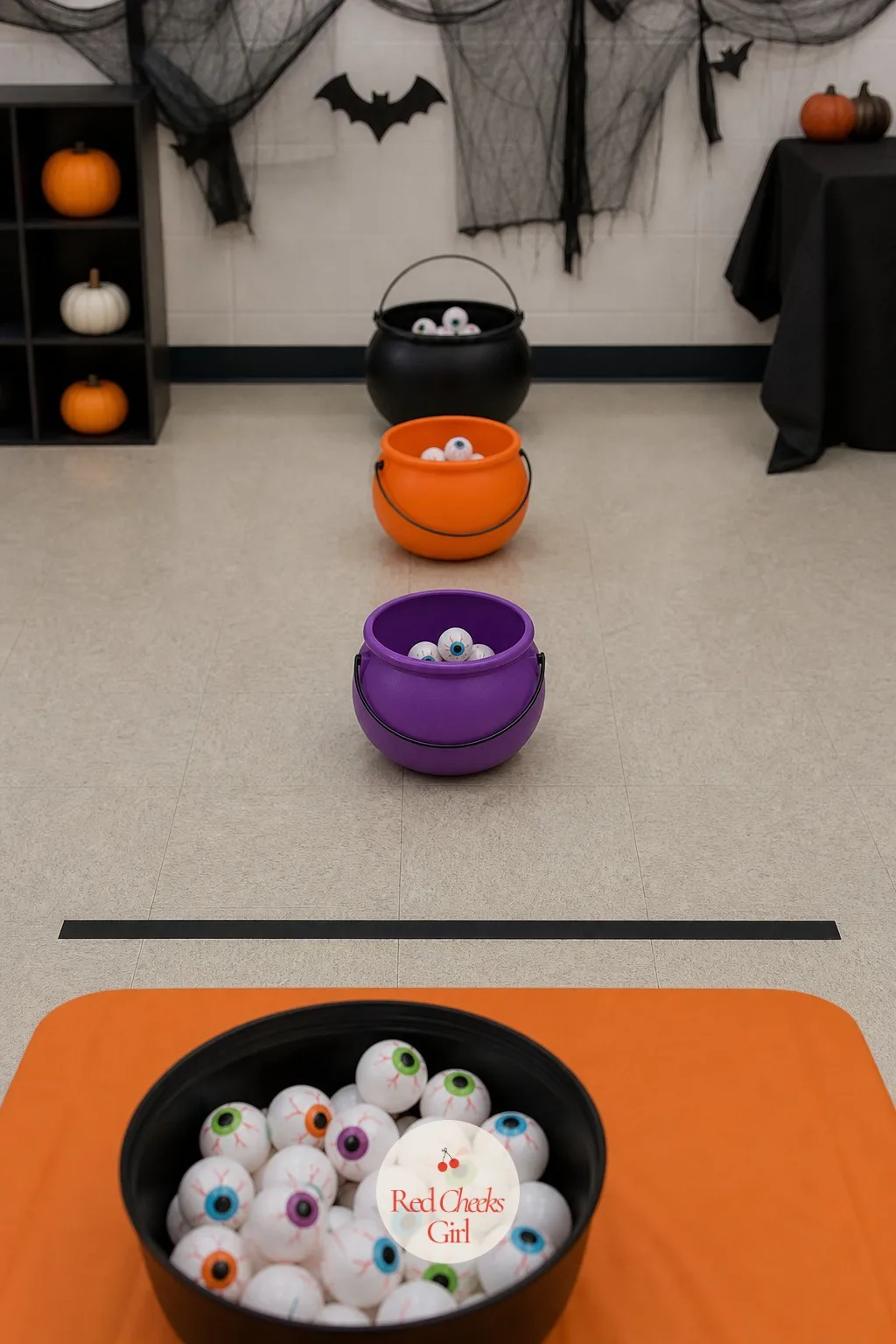
Set up three buckets at increasing distances from a tossing line, assign them point values (5, 10, and 20 points, say), and give each player three tosses per turn.
Add up the points, rotate through the line, and tally totals on the board at the end. It’s carnival-style, it’s fast, and kids who are still waiting in line are genuinely watching and cheering.
Materials: ping-pong balls (draw eyeball designs on them with Sharpie — takes two minutes), three plastic pumpkin buckets or small cauldrons from the dollar store, and masking tape for the tossing line.
Set the buckets at roughly two, four, and six feet from the line for younger students; push them back to three, six, and ten feet for older grades. Tape a number card to each bucket so the point value is visible from the tossing line.
The whole setup takes under five minutes and costs under five dollars.
For a full-class tournament version, run this as a bracket competition where the top two scorers from each group advance to the championship round. It adds suspense and gives every student a reason to try their best even on their very first turn.
Alternatively, make it purely cooperative — the class has a collective target score to reach together and everyone cheers for every single successful toss.
The cooperative version is especially great for younger students who may feel defeated by losing, and it builds that lovely ‘whole class is one team’ energy that makes a party feel really special.
- Ping-pong balls (draw red veins + black pupil with Sharpie for eyeball effect)
- 3 small Halloween buckets or plastic cauldrons
- Masking tape for the tossing line
- Point value cards (5, 10, 20)
10. Halloween Scavenger Hunt List
A Halloween Scavenger Hunt is an absolute classic for good reason — it gets kids moving, observing, and thinking all at the same time while requiring almost zero live facilitation from you.
Each student (or pair) gets a printed list of Halloween-themed items to find or check off within the classroom or school space.
Items can range from ‘something orange,’ ‘a decoration with a bat on it,’ ‘a word that rhymes with ‘ghost,” and ‘something that makes a spooky shadow’ — mixing physical finds with creative observation tasks. First team to complete their list wins.
Print one sheet per student or per pair depending on how you want to run it.
Before the party, hide 8–10 small physical items around the classroom (a plastic spider under a desk, an orange piece of construction paper taped to the wall, a small ghost cutout near the window) alongside the observation-based tasks that require no hidden props at all.
This hybrid approach means the hunt works even in a space you haven’t had time to fully decorate. Set a 10-minute timer, send them off, and enjoy the most productive 10 minutes of your entire party.
The printable format is what makes this teacher-approved gold: because every student has the same sheet, there’s no arguing about the rules, no repeating instructions, and no chaos about what counts and what doesn’t.
Include a tiebreaker at the bottom of the sheet — ‘Bonus: draw a mini jack-o-lantern face in this box!’ — so that even if two teams finish at the same moment, there’s still a winner to crown.
And psst — if you want to pair the hunt with some adorable dollar-store classroom decor to hide around the room, check out these fast Halloween decorations using Dollar Store items. Your setup just got a whole lot easier.
- Print one sheet per student or pair
- Hide 8–10 small physical Halloween items around the room before the party
- Set a 10-minute timer and go!
- First to complete the full list wins — bonus box breaks ties

11. Trick-or-Treat Punch Board
The Trick-or-Treat Punch Board is hands-down the most exciting ‘prize reveal’ game you can run at a school Halloween party — and it’s trending hard in 2026 because the suspense is absolutely unreal for something so simple to make.
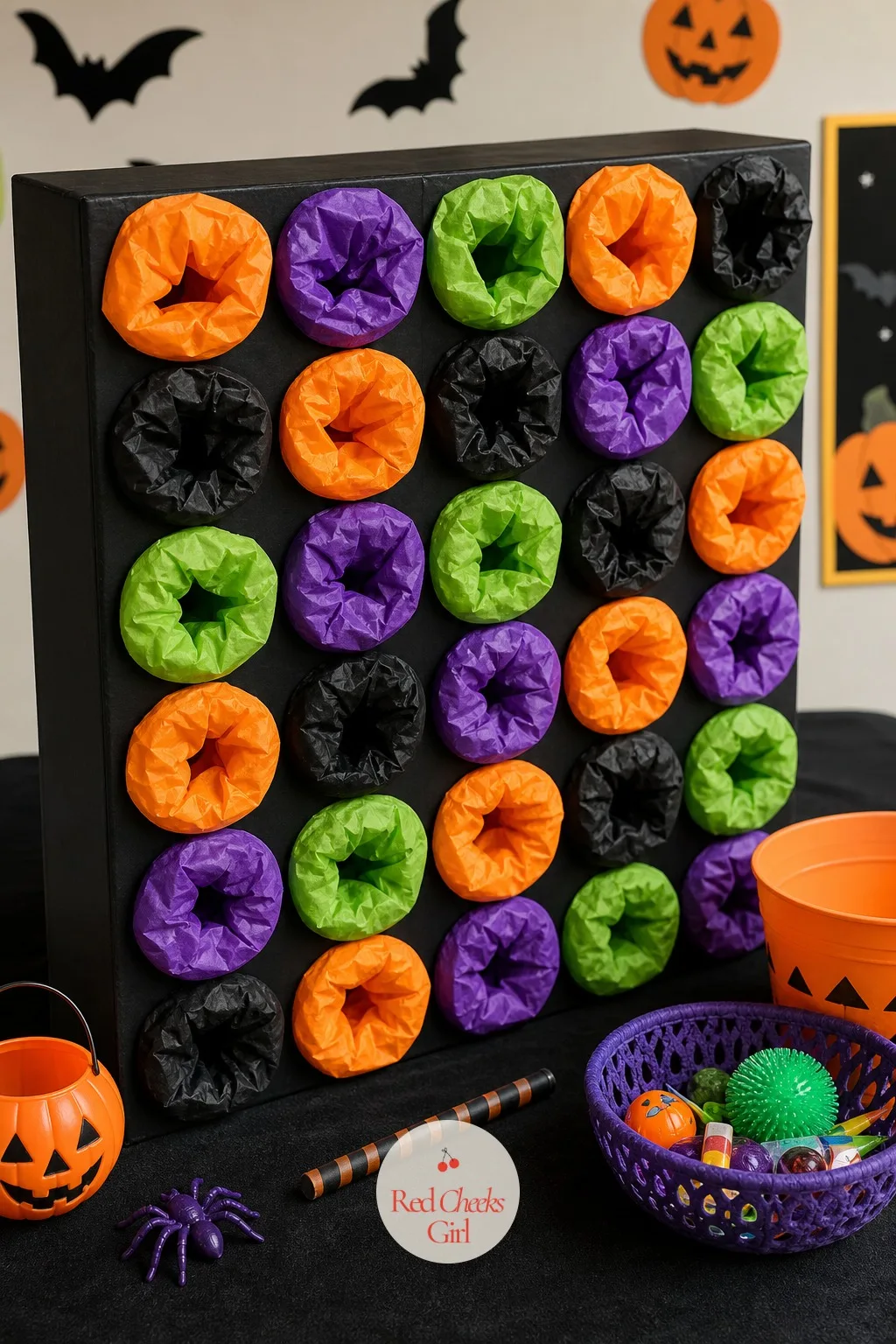
Cover a cardboard box or foam board with individual tissue-paper-wrapped holes, each hiding a small prize or a fun ‘trick’ (a silly dare, a funny note, a sticker). Kids take turns punching through a hole and discovering what’s inside.
Treat or trick — you won’t know until your fist goes through!
To build one: take a sturdy cardboard box and use a pencil to punch 20–25 evenly spaced holes through one face.
Stuff each hole from behind with a small rolled prize (mini eraser, pencil, Halloween sticker sheet, small toy) or a ‘trick’ slip (do 10 jumping jacks, say a spooky tongue twister, howl like a wolf).
Cover each hole with a single layer of orange or black tissue paper secured with a loop of tape at the edges. Stand it upright, and let the class line up.
The punching-through-the-tissue-paper moment is legitimately thrilling every single time — even watching it happen to someone else is exciting.
This game works beautifully as a one-student-at-a-time reward mechanic woven throughout the party rather than a standalone game — students earn a punch by winning a round of another game, finishing a printable correctly, or just because it’s their birthday week.
It also completely eliminates the ‘everyone gets the same prize’ flatness of a standard treat bag.
One host tip: mix your ratio of treats to tricks about 60/40 so that tricks are genuinely possible but treats are still the most common outcome — kids love the risk-reward tension, and a silly dare is honestly almost as exciting as the prize itself.
- Large cardboard box or foam board
- Pencil or scissors to punch/cut 20–25 holes
- Orange and black tissue paper squares
- Small prizes: mini erasers, stickers, pencils, small toys
- ‘Trick’ slips: printed silly dares or funny Halloween notes
12. Fishing for Eyeballs
Fishing for Eyeballs is one of those games that sounds absolutely unhinged on paper and then turns out to be the surprise hit of the whole party — especially with younger students.
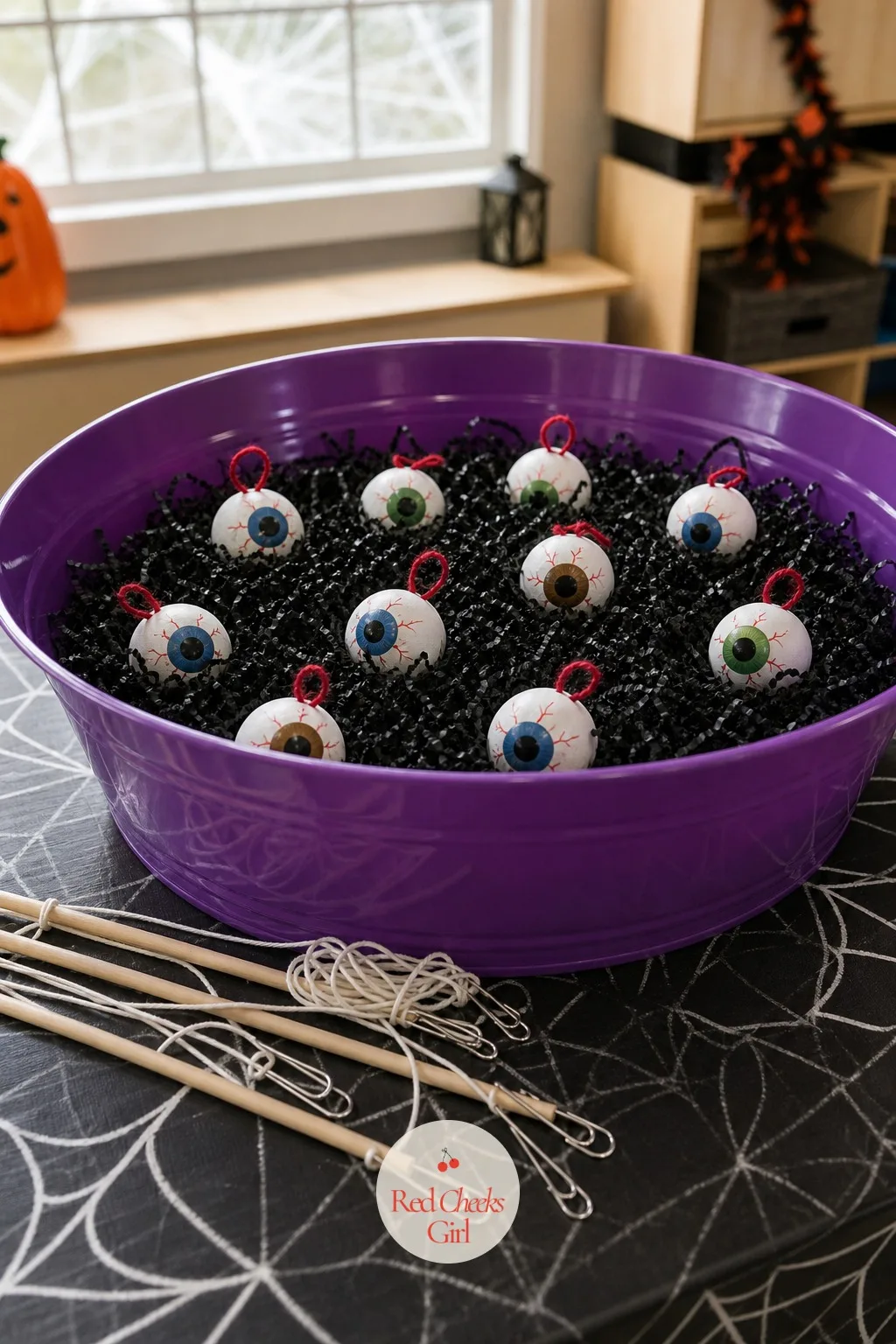
Kids use a simple DIY fishing rod (a wooden dowel or pencil with a string and a paper clip hook) to ‘fish’ plastic eyeballs (ping-pong balls with a small taped loop of yarn attached) out of a large bin, box, or kiddie pool filled with crinkle paper or shredded black tissue.
Each successful catch earns a point. The eyeball-fishing mechanic is silly, tactile, and incredibly satisfying.
Setup: hot-glue or tape a small loop of yarn to each ping-pong ball eyeball, then toss them all into your ‘pond’ — a large plastic tub, a decorated cardboard box, or even a plastic cauldron works perfectly.
Make the fishing rod by tying a 24-inch length of string to a stick or pencil and bending a paper clip into a hook shape at the end. Students fish for 30 seconds each, count their catch, and the highest tally wins.
For a class of 30, run four fishing stations simultaneously with one tub each so wait times stay short.
This game is especially magical for K–2 classes because it builds fine motor skills while feeling completely like play — and fine motor development disguised as a Halloween game is honestly the teacher flex of the century.
For older students, increase the challenge by requiring players to fish with their non-dominant hand, or add a rule that the eyeball must be lifted completely out of the bin before it counts.
You can also make this a team relay where each catch earns the team a point and players rotate every 30 seconds, keeping the whole group engaged and cheering the whole time.
- Ping-pong balls with small yarn loops attached (the ‘eyeballs’)
- Large plastic tub or decorated cardboard box (the ‘pond’)
- DIY fishing rods: stick + string + bent paper clip hook
- Black crinkle paper or shredded tissue to fill the pond
@lovetheajs Fun Halloween Games #halloweengames #gametok #familygamesnight #fungamestoplay #halloweenparty
13. Guess the Pumpkin Weight
Guess the Pumpkin Weight is a classic carnival-game meets math-class-moment that always surprises teachers with how much engagement it generates — kids who wouldn’t normally care about estimation are suddenly fiercely invested in being right.
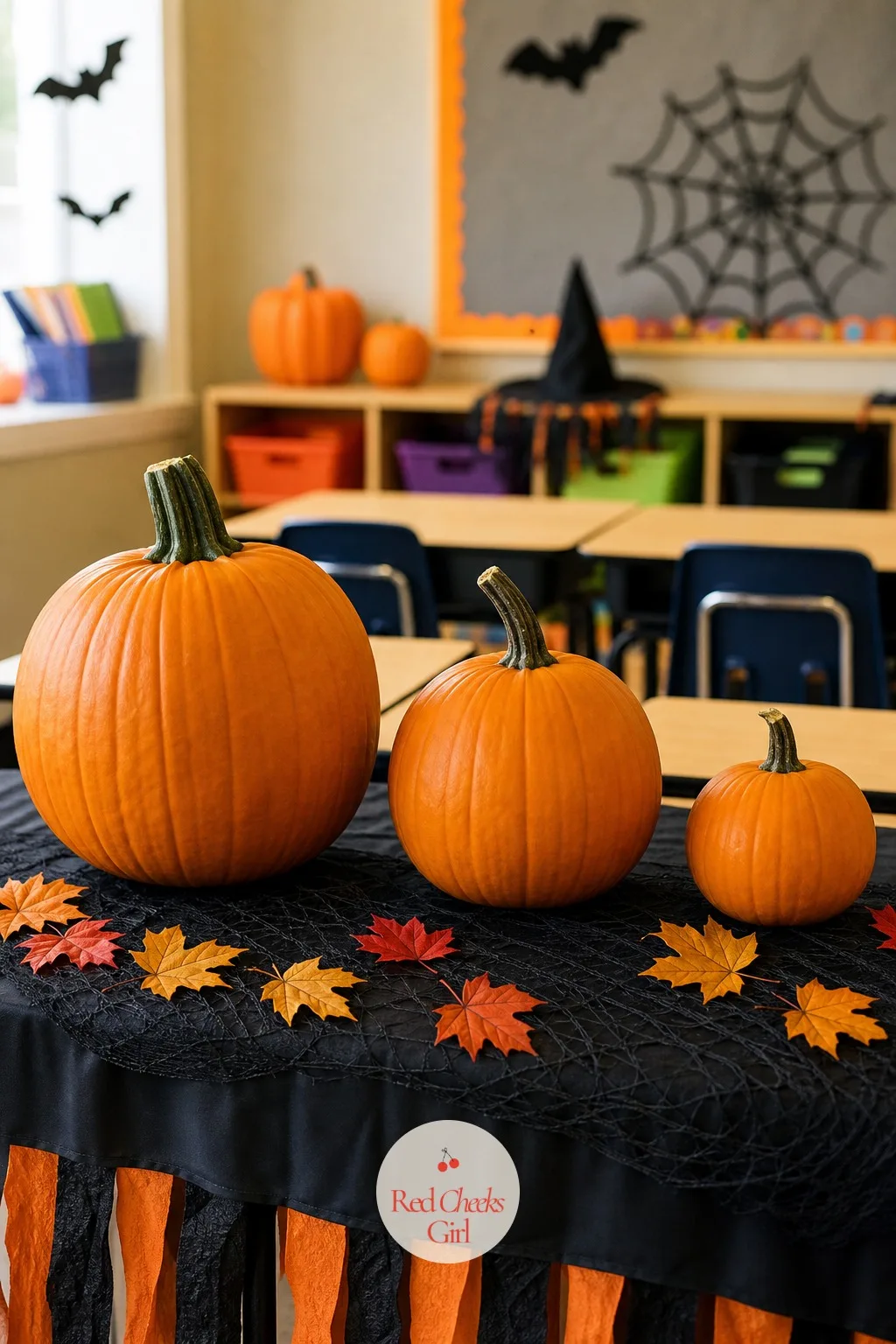
Display two or three pumpkins of clearly different sizes at the front of the class before the party.
Students walk up, lift each pumpkin briefly (with two hands — this is also an injury-prevention teaching moment, lol), and then write down their weight guess in ounces or pounds on their sheet.
At the reveal, the closest guesser wins a prize and eternal classroom glory.
Grab the pumpkins from any grocery store or dollar store in the week before Halloween, then weigh each one at home with a kitchen scale before the party.
Write the actual weight on a sticky note and seal it in a labelled envelope displayed dramatically next to each pumpkin — it’s a small theatrical touch that adds a lot of atmosphere.
Students can guess all three pumpkins on the same slip of paper, so scoring is fast: tally who had the closest guess per pumpkin, and give a small prize for each one. Three winners, three moments of triumph.
Beyond the pure fun, this game is a sneaky curriculum win — estimating real-world weights connects directly to measurement standards in elementary math, so if your principal walks by you can explain with a straight face that students are engaged in hands-on mathematical estimation activities.
(You’re so welcome.) For an extra twist, blind-weigh one pumpkin by wrapping it completely in black fabric and not letting students see its size before lifting — just the feel.
The blind-lift guesses are always hilariously all over the place, and the reveal is pure joy.
- Covers measurement and estimation curriculum standards (sneaky learning win!)
- Runs itself in the background — no live facilitation needed
- Works for every age group from K through 6th grade
14. Donut on a String
Donut on a String is a straight-up Halloween party legend — one of those games that is objectively chaotic, delightfully messy (but only on the kids’ faces, not on your floor, which is key), and gets every single person in the room laughing including the class guinea pig.
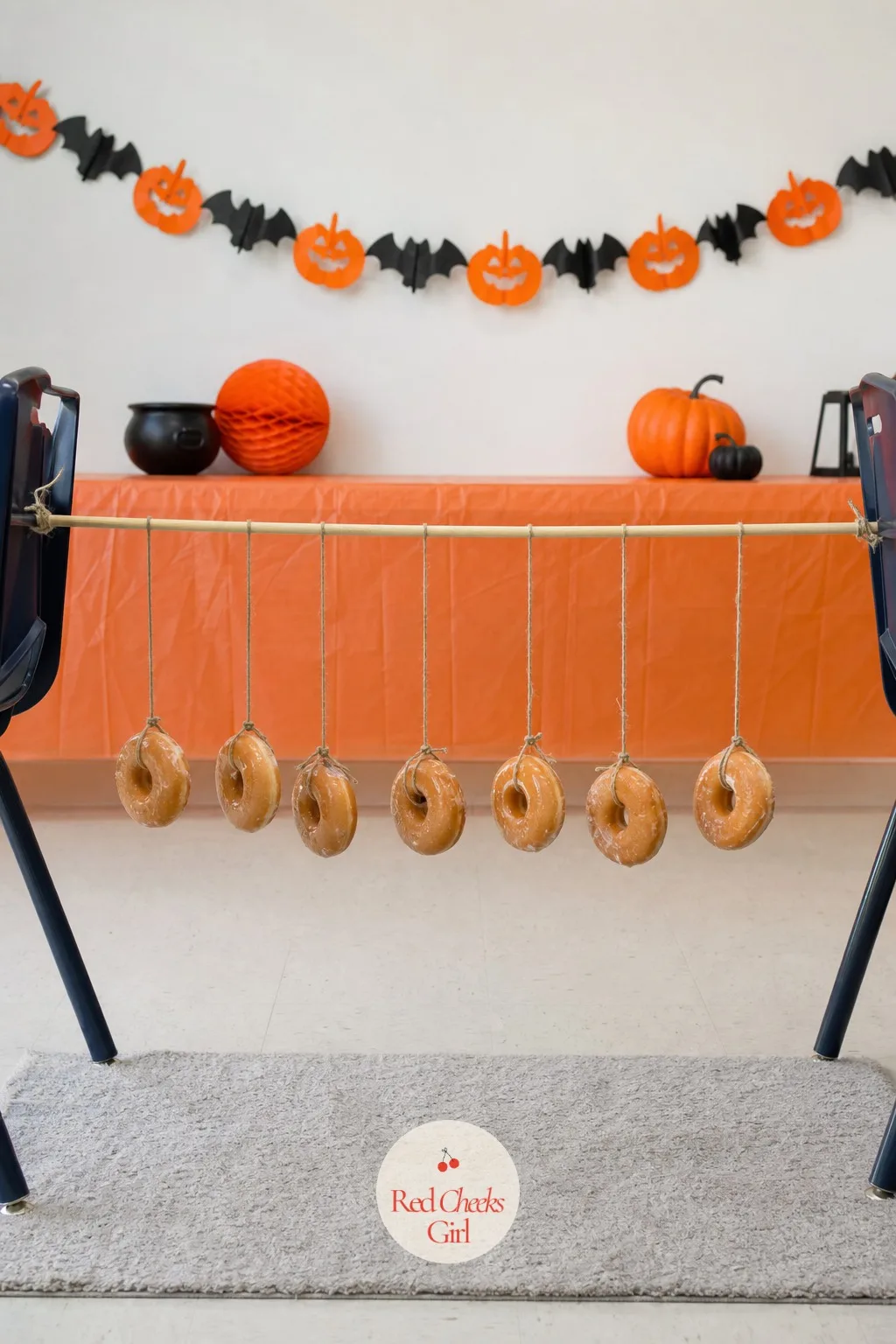
String glazed donuts from a dowel rod or a length of twine strung between two chairs, hang them at each student’s mouth height, and challenge players to eat their donut from the string without using their hands. First one to finish wins.
The wiggling, the faceplanting, the powdered sugar noses — it’s pure gold.
Practical setup: buy one plain or glazed donut per student from any grocery store, thread a length of string or thin twine through each donut (loop it twice around and tie firmly so it doesn’t slide), and hang them all from a long horizontal dowel rod or a rope strung between two chairs adjusted to mouth height.
Lay a plastic tablecloth or tarp underneath for easy cleanup — this is literally the one mess of the whole game and it’s contained to below the string.
Run it in heats of five or six at a time so the rest of the class watches and cheers.
Fair warning: this game is genuinely hilarious and will eat up party time faster than you expect because every single heat becomes its own mini event. The audience commentary alone is worth the price of admission.
For a Halloween twist, use chocolate-frosted donuts decorated to look like spooky faces, or add a light dusting of powdered sugar to regular glazed donuts for the dramatic ‘ghost donut’ effect.
One more host tip: have wet wipes or paper towels ready at the end of each heat — the sticky-faced walk back to their seat is adorable but your chairs don’t need to suffer for it.
- 1 glazed or plain donut per student
- String or thin twine threaded through each donut
- A long dowel rod or rope strung between two chairs
- A plastic tablecloth underneath for easy cleanup
15. Ghost Bowling
Ghost Bowling turns an empty school hallway or classroom aisle into a miniature Halloween bowling alley — and it is so satisfying that kids will immediately want to play again the second they knock all the pins down.
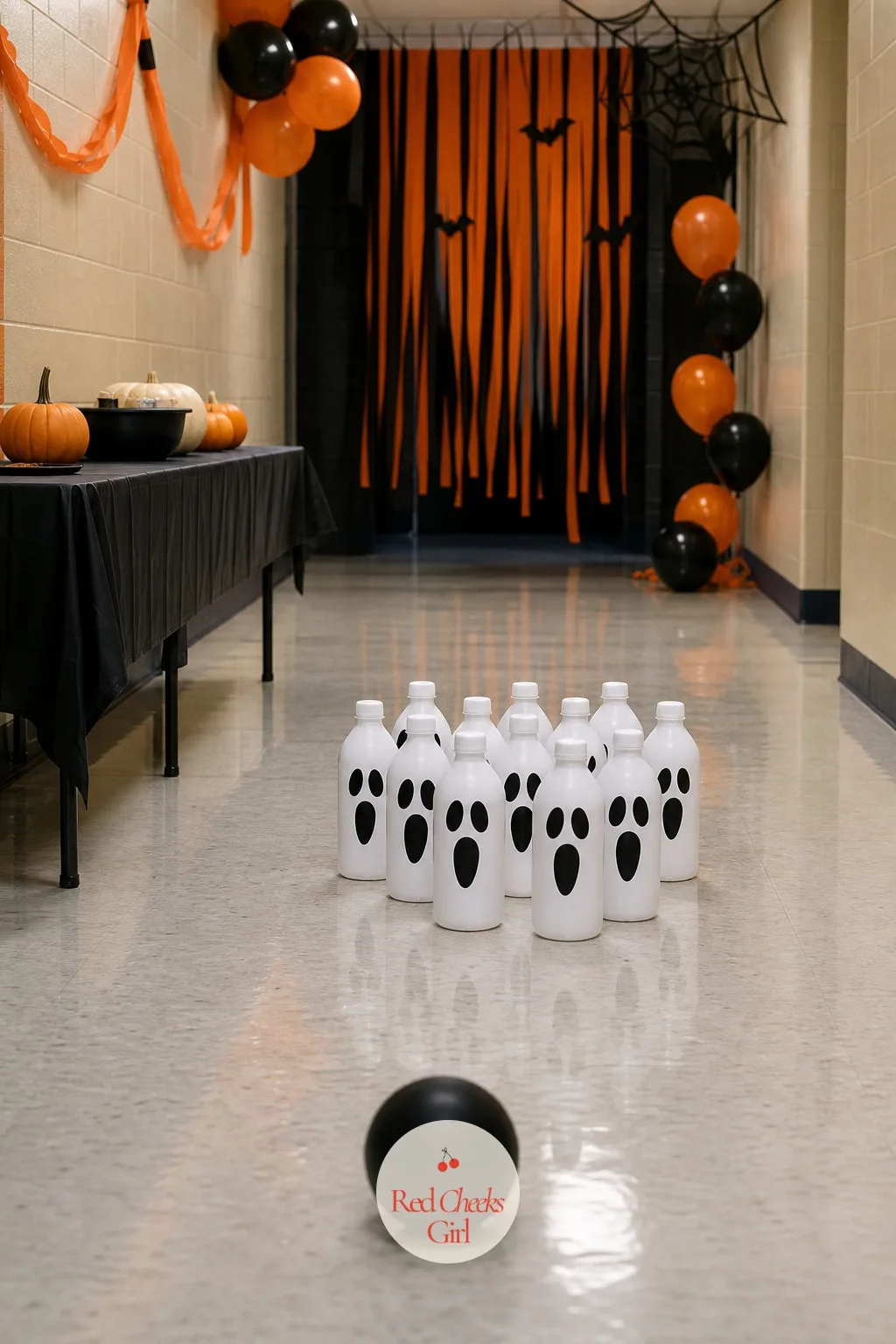
Set up ten white plastic bottles (spray-painted or covered in white paper with ghost faces drawn on in Sharpie) in a triangular pin formation at one end of your space.
Players roll a black or orange foam ball from a tape-mark tossing line and try to knock down as many ghost pins as possible in two rolls. Track scores on the board for a tournament format, or keep it casual and just celebrate every strike.
Assembly is almost embarrassingly simple: collect ten identical plastic bottles (water bottles, two-liter soda bottles — all the same size), fill the bottom with an inch of sand or water for stability, and either paint them white or wrap them in white paper.
Draw ghost faces with a Sharpie or black marker. Use a small foam ball, a lightweight rubber ball, or even a rolled-up pair of socks in a pinch.
Set the pins on a strip of tape on the floor so they reset to the same position every round. One student sets the pins; another rolls. Rotate after each pair of rolls.
Ghost Bowling works brilliantly as a permanent station during a rotating-stations party format because it runs continuously without teacher facilitation — students naturally police the rules themselves (the pin-setter, the roller, and the scorekeeper are organic roles that kids adopt immediately).
It’s also incredibly satisfying for students who might struggle with faster-moving games: the act of knocking things over is universally, timelessly pleasing.
For a Halloween bonus, every strike earns the player the right to make a dramatic ghost sound of their choosing, which the rest of the class must echo back. Your classroom will sound wonderfully unhinged.
- 10 matching plastic bottles (with sand/water for stability)
- White paint or white paper + Sharpie for ghost faces
- Small foam or rubber ball
- Masking tape for pin formation and tossing line
@robsy_schmidt POV: you decide to throw a children’s Halloween festival. Here’s an easy craft to do with and for your kids! (Not my idea, found it on Pinterest) #halloween #summercamp #halloweenatcamp #spooky #ghosts #pumpkin #orange #bowling #halloweengames #kidsgames #kidsfun #childrensgames #childrensfun #fun #fall #summercampcrafts
16. Glow Stick Ring Toss
Glow Stick Ring Toss is the game you pull out when the classroom lights go dim and the whole vibe shifts — and it is absolutely magical, even for older students who think they’re too cool for party games (they are not).
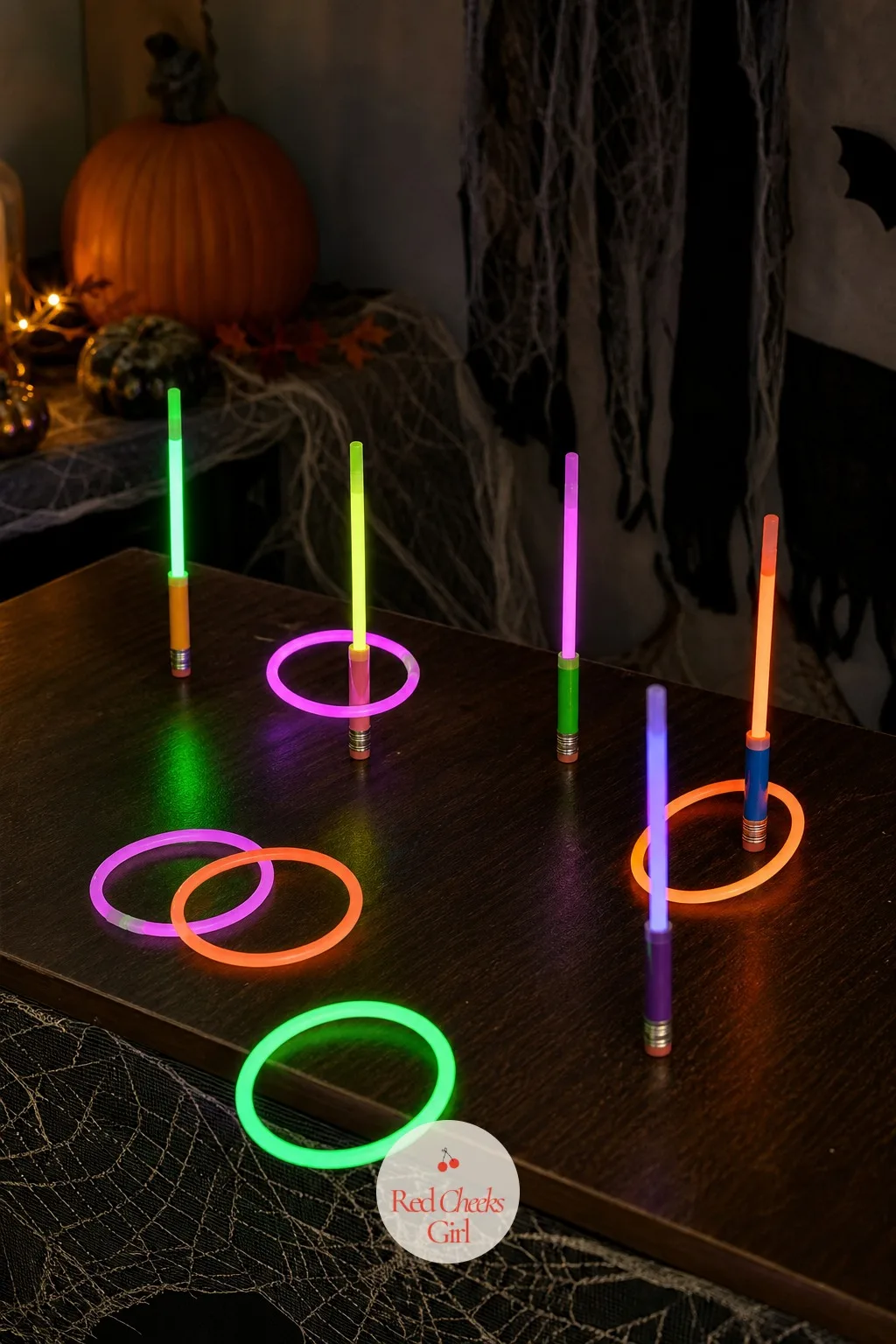
Bend glow sticks into rings (most dollar-store glow sticks snap and connect at the ends into a hoop) and toss them over glowing upright targets: more glow sticks taped vertically to pencils stuck in a lump of playdough, or tall plastic cups weighted with sand.
Turn off the overhead lights, switch on whatever ambient orange lighting you have, and suddenly your classroom is a glowing, spooky carnival station.
Dollar stores typically stock packs of 15–25 glow stick bracelets for about a dollar in the Halloween season — grab two packs and you’re set. Activate the ring glow sticks and the target glow sticks by snapping and shaking them right before the game.
Set up three to five targets in a row at increasing distances and assign point values — 5 points for the nearest, 20 for the farthest. Give each player five ring tosses per turn.
Keep overhead lights off or very dim for maximum effect; even classroom blinds drawn partway makes a big difference. The glow-in-the-dark element transforms an ordinary ring toss into something genuinely special.
This game is a particularly perfect choice for the last 15 minutes of the party when energy is starting to flag and you need something visually exciting to bring it back.
Because it requires very little movement or coordination (making it naturally inclusive for all students), it’s also a great station for students who need a lower-key active option.
Post-party, let students keep their glow rings as a take-home party favour — zero extra cost and maximum goodwill. Send them home glowing like tiny little Halloweeners and your room parent reviews will be immaculate.
Buy glow sticks from the Dollar Tree Halloween section — two packs covers a full class with rings to spare!
@pixiedustkids 🧙Such a fun Halloween game for kids! Just grab some glow sticks, make a ring, and try to toss it onto the witch hats! 🧙♀️ 🧙Perfect for classroom parties, Halloween night, or even family game night. Add candy prizes for extra excitement! #PixieDustKids #HalloweenPartyIdeas #ClassroomParty #HalloweenGames #SpookyFun
17. Flashlight Storytelling
Flashlight Storytelling is the calm-down magic trick every class Halloween party desperately needs — a way to bring the energy back to earth after 45 minutes of relay races and scream contests without anyone feeling like the fun is ending.
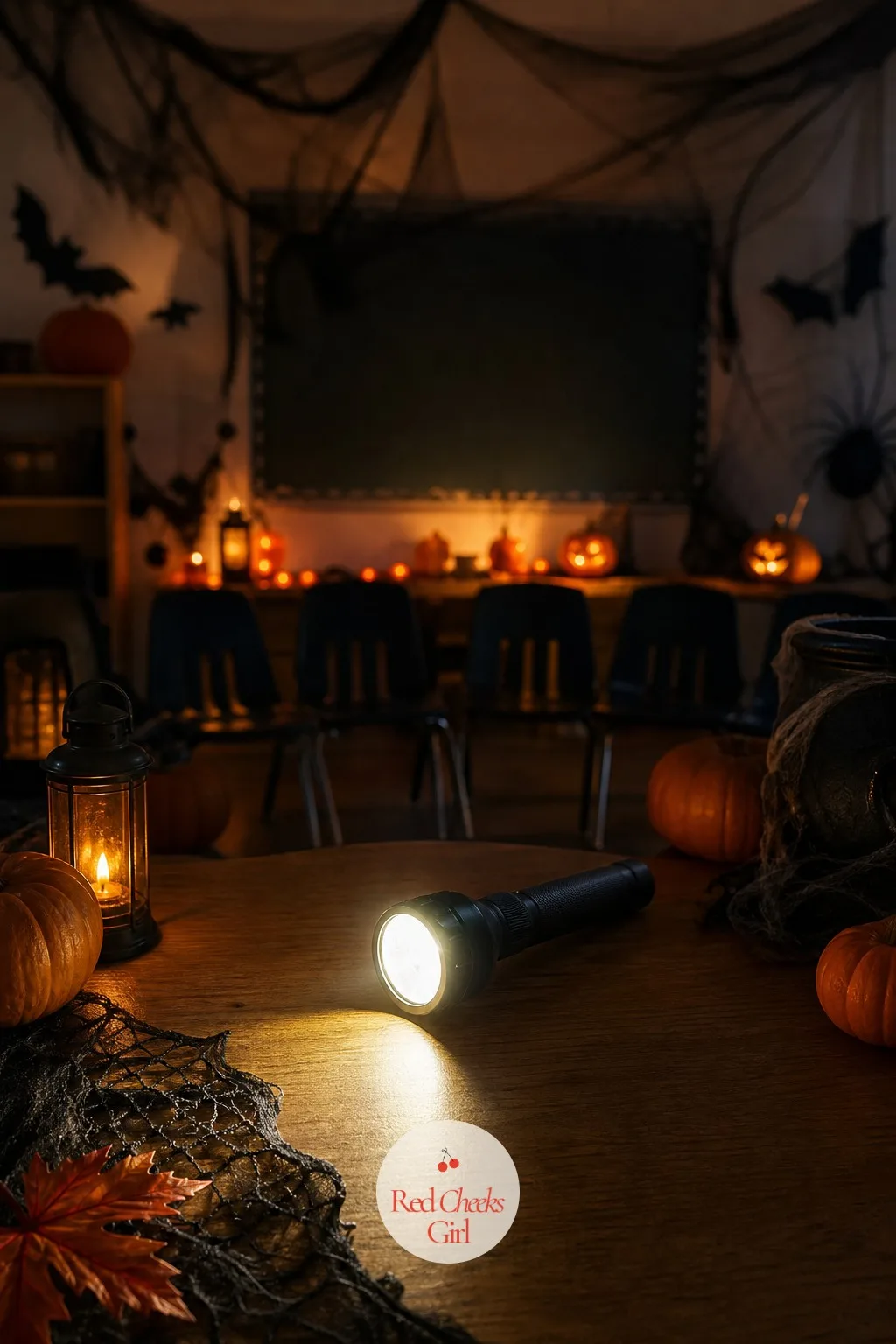
Dim the lights, hand one student a flashlight, and ask them to shine it on their face from below (the classic spooky storytelling angle) while beginning a Halloween ghost story with just one sentence.
They pass the flashlight to the next student, who must continue the story with one to three more sentences, and so on around the circle or class until the story reaches a natural (and probably wonderfully absurd) conclusion.
Zero materials needed beyond a single flashlight — which you already own or can borrow from the school office. Arrange students in a circle on the floor or keep them in their seats and pass the flashlight row by row.
Set one gentle rule before you start: each storyteller must say at least one sentence but no more than three, so every student gets a turn and no single narrator runs away with the whole plot.
(There will always be one student who tries to resolve the entire story in their turn. Bless them.) Starting the story yourself with a dramatic opening line immediately sets the tone and models the format.
The magic of this game is that it produces an entirely unique story every single time, and students are genuinely invested in what’s going to happen next because they helped build it.
It’s also a stealth literacy activity — speaking in complete sentences, building on a narrative, maintaining story logic — that fits beautifully into a classroom context without feeling like work.
Wind it down by passing the flashlight to yourself for the final turn and delivering the most dramatic conclusion you can manage. The class will lose it, and you’ll end the party on the highest possible note.
- Dim the lights and sit in a circle
- Shine flashlight from below chin for spooky effect
- Each student adds 1–3 sentences to continue the story
- Pass the flashlight — keep it moving!
18. Spooky Story One Word
Spooky Story One Word is the lightning-fast, hilarious cousin of Flashlight Storytelling — and where that game builds atmosphere, this one builds pure comedic chaos one syllable at a time.
The whole class sits in a circle or stays in rows, and together you build a Halloween story by going around the room with each person contributing exactly ONE word. One. Single. Word. The result is usually something like ‘The… zombie… ate… seventeen… calculators… and…
then… sneezed… glitter’ and the class absolutely collapses every time. It’s the perfect warm-up before a quieter activity or a gentle cool-down after a big relay.
No materials needed whatsoever — this is a truly zero-prep game. Start the story yourself with ‘The…’ or ‘One Halloween…’ and point to the next student to continue. Move quickly around the room; the faster the pace, the funnier the results.
You can add a light rule that every 10th word must be a Halloween word (ghost, witch, pumpkin, skeleton, etc.) to keep it loosely on theme, but honestly the game is so inherently funny that themed content tends to emerge naturally anyway.
The total class story time runs about 5–8 minutes depending on class size.
What makes this game quietly brilliant for a teacher is the complete equity of participation — every single student contributes equally, no one can dominate, and there’s no right or wrong answer ever.
Students who are shy, students who struggle with Halloween language, students who are already sugared to the ceiling — they all find success in this format because one word is achievable for everyone.
It’s also a genuinely lovely way to end the party: the whole class has created something together, even if that something involves a vampire who inexplicably opened a taco stand. Perfect. Ten out of ten. No notes.
- Zero prep, zero materials, zero mess
- Every student participates equally — no one can be left out
- Naturally generates laughter which is the best party energy reset
Frequently Asked Questions
What are good Halloween party games for elementary school students?
Elementary students love games that are active, fast, and a little silly — think Eyeball Spoon Race, Ghost Bowling, Donut on a String, and the Trick-or-Treat Punch Board.
Printable games like Halloween Riddles and a Scavenger Hunt also work brilliantly because they keep kids busy independently.
The sweet spot for elementary is games with simple rules you can explain in under 60 seconds, no complicated scorekeeping, and a clear winner at the end of each round.
What Halloween games can you play in a classroom with a large group?
Large-group classroom games work best when they run as simultaneous stations or team relays so everyone is active at once rather than waiting in a long line.
Tournament of Terror (team relays), Scream Contest, and Glow Stick Ring Toss all handle 25–30 students smoothly when split into groups.
Printable games like Halloween Pictionary Cards and the Scavenger Hunt also scale effortlessly to any class size since everyone gets their own sheet and plays simultaneously.
What are some low-prep Halloween party games for teachers?
The lowest-prep games on this list are Spooky Story One Word (literally zero materials), Flashlight Storytelling (just a flashlight), Guess the Pumpkin Weight (buy pumpkins, done), and the Eyeball Spoon Race (ping-pong balls + plastic spoons).
For printable options, the Halloween Maze, Halloween Riddles Sheet, and Guess the Candy all require only a printer and pencils. Most of these can be fully prepped in under 10 minutes the morning of the party.
How do you play the mummy wrap game at a school Halloween party?
The mummy wrap is a team relay classic: divide students into groups of three to six, give each team one roll of toilet paper, and have two ‘wrappers’ race to cover a standing teammate from head to toe (skipping eyes and mouth for safety) before the timer runs out.
The best-wrapped mummy wins. It’s loud, fast, hilarious, and takes about five minutes per round. For a classroom-friendly version, use one shared roll per team and set a 90-second time limit to keep rounds short and snappy.
What Halloween party games are appropriate for all ages?
Games that scale well across ages include Guess the Pumpkin Weight (the estimation element challenges any age), Glow Stick Ring Toss (low physical barrier, high visual payoff), the Trick-or-Treat Punch Board (universally exciting regardless of age), and Halloween Pictionary Cards (adjustable difficulty).
Printable games like the Halloween Scavenger Hunt and Halloween Riddles Sheet also work across a wide age range by simply adjusting the difficulty level of the clues.
What are fun Halloween party games that don’t involve candy?
Plenty of these games are completely candy-free! Ghost Bowling, Eyeball Spoon Race, Fishing for Eyeballs, Glow Stick Ring Toss, Shake the Eyeballs (Tissue Box), Flashlight Storytelling, and Spooky Story One Word all involve zero candy.
For the Guess the Candy and Trick-or-Treat Punch Board, simply swap candy for small non-food prizes like Halloween erasers, mini toys, stickers, or pencils. Check out these healthy Halloween treat alternatives for more non-candy prize inspiration.
What are easy Halloween party games for kindergarten and preschool kids?
For the youngest students, focus on tactile, simple-rule games with lots of repetition and no elimination. Fishing for Eyeballs (great for fine motor development), Ghost Bowling (knocking things over is universally satisfying), and Donut on a String (so silly and sensory) are perfect.
Keep rounds very short (30–60 seconds per player), celebrate every attempt not just wins, and avoid any game where students sit and watch for long periods. The Flashlight Storytelling wind-down is also wonderfully calming for little ones at the end of the party.
What Halloween games can you play indoors at school?
Every single game on this list is designed for indoor classroom play!
The key to successful indoor Halloween games is keeping the movement contained to one lane or station area, using soft or lightweight objects (ping-pong balls, foam balls, glow stick rings) instead of anything that could break something, and running active games in heats with clear boundaries.
Games like Glow Stick Ring Toss, Ghost Bowling (in a hallway or aisle), Shake the Eyeballs, and all the printable games work perfectly in a standard-size classroom.
What are some Halloween party game ideas for middle school students?
Middle schoolers respond best to games with a competitive or social edge — think Tournament of Terror (team relays with a points bracket), Scream Contest (with peer judging categories), Glow Stick Ring Toss (the low-light atmosphere is instantly cool), and Halloween Pictionary Cards (fast-paced and social).
Add a slight level of difficulty or time pressure to any game and middle schoolers are immediately more invested. The Spooky Story One Word game also kills with this age group because the results are genuinely hilarious.
How do you keep students calm and focused during a school Halloween party?
The single best strategy is to alternate high-energy active games with quieter printable or seated games throughout the party — never run three active games in a row.
Build in a specific cool-down moment near the end (Flashlight Storytelling and Spooky Story One Word are perfect for this). Using a rotation schedule posted on the board gives students a visual structure that reduces the ‘what’s next?!’ anxiety.
And starting the party with clear, short rules and a brief demonstration of each game prevents the chaos that comes from confusion mid-game.
There you have it — 18 teacher-approved school Halloween party games that will take your class from first-bell chaos to end-of-party smiles without a single moment of ‘I’m bored!’
Print the sheets, grab some ping-pong balls and glow sticks, and you are genuinely ready to throw the most fun classroom Halloween party your students will talk about all the way through Thanksgiving.
(Speaking of which, if your party budget is looking a little thin after buying all those pumpkins, here are 6 ways to save on Thanksgiving to help balance things out!)
Pin this list for later, share it with your fellow room parents, and don’t forget to check out more inspiration over at 20 Simple Halloween Games for Kids’ Parties — because honestly, you can never have too many ideas up your witch’s sleeve.
Happy haunting! 🎃
📌 Save These for Later
Loved these? Pin your favorite image below so you can find this list again when you’re planning.
20 DIY Halloween party games made from dollar-store supplies. Spooky fun for every age — active, p
28 purple painted pumpkin ideas sorted by depth of shade, from soft lavender to near-black aubergine

20 cute Halloween party games that are camera-ready, zero scary vibes, and SO much fun for everyone!
Leave a Reply