


Let’s be honest: office Christmas party games have a reputation, and it’s not a great one. Someone always suggests something that leaves the new intern staring at the floor and the CFO inching toward the exit.
If you’re the one planning this year’s party, I see you — and I’ve got you. These 18 office Christmas party games are designed for real, mixed-seniority workplaces where the goal is genuine laughs, not awkward silences.
No drinking games, nothing embarrassing, and absolutely nothing that requires HR to send a follow-up email on Monday.
I’ve road-tested most of these at actual office parties (yes, including the gift wrap relay, which revealed some truly alarming scissor-handling among the finance team), and I’ve rounded up a mix of printable sheets, active team challenges, and quieter group games so there’s something for every personality in the room.
Whether your crew is fifteen people in a conference room or a hundred in a rented hall, this list has you covered.
Grab a mug of something warm, print a few of these out, and get ready for the best office Christmas party games your team has ever played.
This post contains affiliate links — if you buy through them, I may earn a small commission at no extra cost to you.
- Desk Decorating Vote
- Christmas Two Truths and a Lie
- Guess the Coworker Holiday Photo
- Secret Santa Guess Who
- Christmas Movie Trivia
- Holiday Emoji Pictionary
- Gift Wrap Relay Teams
- Christmas Bingo for Teams
- Office Holiday Would You Rather
- Name That Tune Christmas Edition
- Snowball Paper Toss
- Festive Scavenger Hunt
- Office Christmas Carol Karaoke Challenge
- Holiday Mad Libs
- Christmas Charades Sprint
- Naughty or Nice Office Edition
- Christmas Minute-to-Win-It Relay
- Festive Finish the Lyric
- Holiday Trivia Head-to-Head
- Frequently Asked Questions
1. Desk Decorating Vote
A few days before the party, announce a desk decorating competition and let teams or individuals go wild decking out their workspaces with tinsel, lights, paper snowflakes, and whatever festive chaos they can muster on a budget.
On the day of the party — or during a dedicated walk-around window — everyone tours the office with a printed ballot in hand and casts votes in categories like Most Creative, Most Over-the-Top, Best Use of Office Supplies, and Most Likely to Be Seen from Space.
The ballots get collected, tallied, and announced at the party with small prizes for each winner.
Print one ballot per person. Each ballot lists all four award categories with a blank line beneath each one where voters write in the desk or team they’re voting for.
Keep voting anonymous by having everyone fold their completed ballots and drop them in a collection box. Designate one trusted non-competing colleague to count the votes and seal the results until the announcement moment.
You’ll want to allow about 15 minutes for the walk-around and 10 minutes at the party for the big reveal.
This one is a gift for introverts because the ‘game’ is really just a leisurely stroll around the office with a clipboard — no performance required.
It also pulls the decorating energy into the party itself, which means your venue is already festive before anyone even arrives. Host tip: walk the floor yourself beforehand and snap photos of every decorated desk so you can display a slideshow during the award ceremony.
It makes the reveal feel like a real Oscars moment (complete with dramatic pause before opening the envelope).
Announce the competition at least 3 days ahead so people actually have time to decorate — a same-day surprise just results in one sad piece of tinsel taped to a monitor.

2. Christmas Two Truths and a Lie
This is the classic icebreaker with a holiday makeover that makes it feel fresh even for teams who’ve played the original a dozen times.
Each player gets a printed card and writes down three statements about their own Christmas or holiday experiences — two of them true, one of them a convincing lie.
Think things like ‘I once drove four hours on Christmas Eve just to buy a specific toy,’ ‘I have never eaten a Brussels sprout in my life,’ or ‘I dressed as Santa at a children’s hospital.’
The group then takes turns reading their three statements aloud while everyone else tries to spot the fib.
The printed card gives each person three numbered blank lines to fill in their statements before the game starts, plus a small ‘My lie is number ___’ box at the bottom that stays folded over until the big reveal.
You can play in one large circle for groups under 20, or break into smaller tables of 6–8 for bigger parties. Award one point to each person who correctly identifies the lie, and one point to the statement-writer for every person they fool.
The player with the most points at the end wins a prize.
What makes this version work especially well in an office setting is that the Christmas framing gives people natural, low-stakes material to work with — holiday travel disasters, regrettable gift purchases, and childhood Christmas memories are universally relatable without getting personal in uncomfortable ways.
Host tip: play a quick demo round yourself first so people understand the reveal mechanic. Without seeing it modeled once, at least three people will accidentally blurt out their lie before everyone’s finished guessing.
- Teams of 8–30 people
- 15–25 minutes
- Works great as a warm-up game right when guests arrive

3. Guess the Coworker Holiday Photo
A week before the party, ask everyone to submit one childhood holiday photo — the more festive and era-appropriate the better. Think matching pajamas, enormous bows, a suspicious-looking Santa at the mall, the works.
Collect all the photos and display them on a projector, a TV screen, or printed and taped to a wall with numbered labels. Players grab a sheet of paper and write down their guesses for who each photo belongs to.
The person who correctly identifies the most coworkers wins.
For setup, number each photo and keep a master key on your phone.
Give everyone 10–15 minutes to circulate and write down their guesses before you run through the reveal together, photo by photo, with each person standing up when their childhood self appears on screen.
You don’t need any special tech — a printed booklet of numbered photos works just as well as a slideshow if you’re working with a limited setup. Groups of 10–50 people work best, and the game runs about 20–30 minutes including the reveal.
The reveal portion is genuinely the best part — there’s something wonderfully leveling about watching your most senior VP get identified instantly by their unfortunate 1980s haircut. It’s a great equalizer in the nicest possible way.
Host tip: collect photos two weeks in advance, not one — you will always have three people who forget and need a reminder, and you do not want to be chasing them down the day before while also handling catering questions.
- Childhood holiday photos submitted in advance by each guest
- Projector, TV, or printed numbered photo sheets
- Pens and blank paper or guess sheets for each player
4. Secret Santa Guess Who
This game turns the Secret Santa gift exchange into a guessing game that fills the room with suspense and laughter.
Once gifts have been given, players fill out a printed sheet listing every gift-giver in the room and their best guess about which gift belongs to which colleague.
The twist is that each Secret Santa has left a single written clue on their gift tag — something cryptic but fair, like ‘I own more houseplants than I should’ or ‘I have been to more than five countries’ — and those clues are the only hints players have to work with.
Print one Guess Sheet per player. The sheet lists all participants’ names in a numbered column on the left, with a blank line to the right of each name where players write their gift-pairing guess.
A second column gives space to jot the clue from each gift. After everyone has filled in their sheets, go around the room having each Secret Santa reveal themselves. Award a point for every correct match.
The game plays in about 20 minutes on top of whatever time the gift exchange itself takes.
This adds a layer of strategy to the gift exchange without slowing it down at all, and people who might otherwise drift to the snack table during the exchange suddenly have a reason to pay close attention to every single reveal.
Host tip: remind people when they write their clue that it should identify them without being so obvious it spoils the game instantly — ‘I like coffee’ for the person who is famously obsessed with coffee is not a clue, it’s a confession.
- Each Secret Santa writes one personal clue on their gift tag
- Players use printed sheets to match each giver to their gift
- Reveal happens during the exchange — most correct matches wins

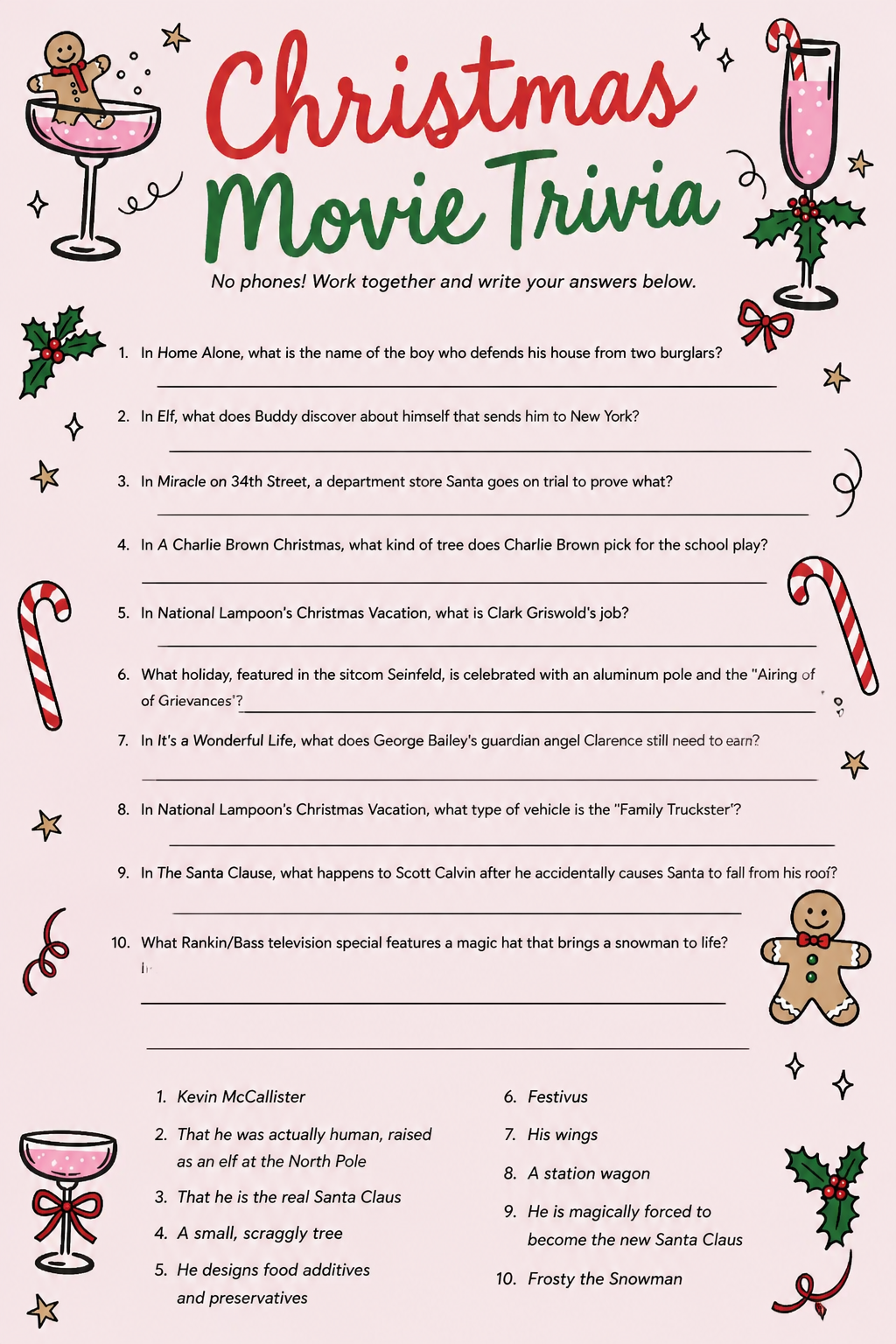
5. Christmas Movie Trivia
Christmas Movie Trivia is one of those office Christmas party games that looks simple but has genuine legs — the right mix of easy, medium, and hard questions keeps every table competitive right until the final question.
Players fill out their printed answer sheets individually or as a team, working through 20 questions spanning classic holiday films.
Questions cover everything from what toy Ralphie desperately wants in a classic 1983 Christmas film, to which 1988 action movie famously takes place on Christmas Eve, to how many ghosts appear in a beloved Victorian Christmas tale.
No phones, no searching — just pure festive brain power.
Print one sheet per person or one per team depending on your group size. The sheet is divided into four categories of five questions each: Classic Films, Modern Comedies, Animated Specials, and Bonus Round — with questions numbered continuously 1–20 across all sections.
Teams write their answers in the blank beside each numbered question and hand in their sheets for scoring. A host answer key is printed separately and kept face-down until scoring time.
Run the game in 15 minutes, then spend another 5 going through the answers with the whole room.
The team format is particularly good for office parties because it immediately creates organic conversation — someone at the table will confidently claim the 1988 Christmas Eve action film is definitely not a Christmas movie, and suddenly everyone has an opinion and the party has truly started.
Host tip: include at least two or three genuinely easy questions near the top of each category so even the most movie-averse colleague gets something right and stays engaged instead of giving up by question four.
- Teams of 2–6 per sheet
- Groups of 10–60 total
- 15–20 minutes to play, 5 minutes for scoring
6. Holiday Emoji Pictionary
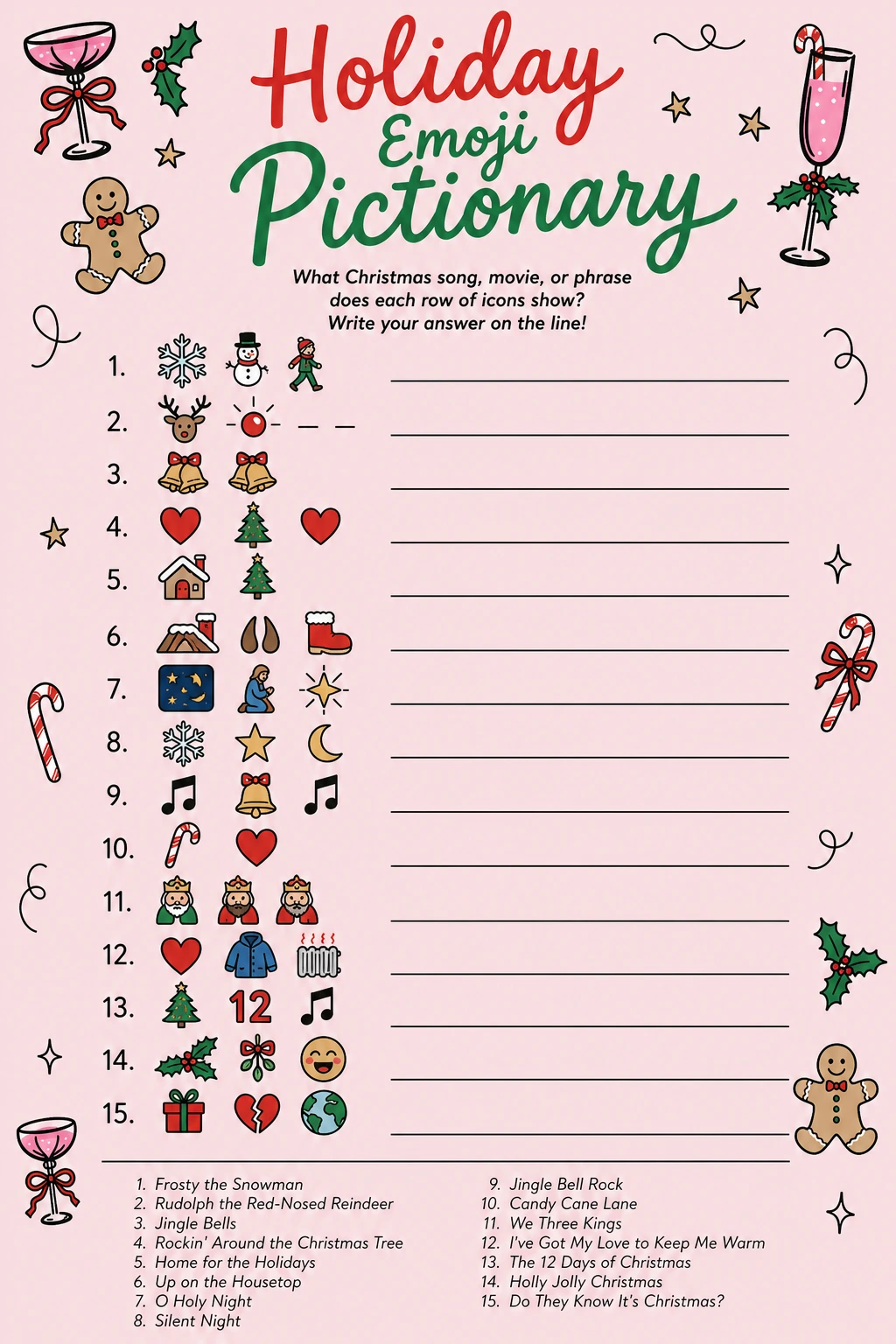
Holiday Emoji Pictionary is the printable game that consistently gets the loudest reaction at office parties, because it turns out adults are spectacularly overconfident about their emoji-reading skills.
The printed sheet shows 15 rows of small picture icons arranged in sequence — a combination of symbols that together represent a Christmas song title, holiday movie, or festive phrase.
Players look at each row of icons and write their best guess on the blank line provided. No words, no letters — just the pictures themselves, so the puzzle is genuine and unspoiled.
Print one sheet per person or one per table. Give everyone 10 minutes to work through all 15 clues, then go through the answers together as a group. The scoring is simple: one point per correct answer.
You can play individually for a quieter group, or let tables collaborate for a noisier, more chaotic experience (recommended). The game takes about 15–20 minutes total including the reveal, and works for groups of any size.
What makes this one particularly fun in an office setting is that it’s completely silent during play — everyone is intensely staring at their sheet murmuring things like ‘okay, that’s definitely a star… and a bell… jingle bells?
No, wait—’ It’s a wonderful 10 minutes of collective concentration before the room absolutely erupts during the reveal.
Host tip: include at least three clues that are almost-but-not-quite obvious, because the groan when someone figures out what they should have gotten three minutes ago is genuinely one of the best sounds at a party.
Zero setup beyond printing — no props, no special equipment, no tech required. Everyone plays at the same time so no one is waiting around.
7. Gift Wrap Relay Teams
Divide the group into teams of four to six and give each team an identical set of supplies: a box, a roll of wrapping paper, a length of ribbon, a gift tag, and a roll of tape.
On ‘go,’ the first person on each team wraps the box as neatly — or as wildly — as they can, then passes the finished package to the next person, who must unwrap it completely before the third person rewraps it, and so on down the line.
The first team to complete their full relay wins. Speed is the obvious goal, but you can also award a bonus point to the team whose final wrap looks the least catastrophic.
Clear a space in the room and set up identical relay stations side by side so all teams can see each other — the competitive atmosphere doubles the energy.
Keep boxes roughly the same size and shape for fairness, and make sure each station has the same amount of tape so no one gets an unfair adhesive advantage (yes, this matters more than you’d think).
The game runs beautifully in about 10 minutes and can be repeated with a second round if the crowd wants a rematch, which they usually do.
This is one of those office Christmas party games that reveals personality immediately and ruthlessly — the overthinker spends 45 seconds folding perfect corners while their team screams at them, the chaos agent folds the paper once and drowns it in tape, and the efficient colleague silently completes their section before anyone has noticed they’ve started.
It’s joyful every single time. Host tip: buy a few extra rolls of tape before the party, because someone will always use approximately six times more than any reasonable person should need, and running out mid-relay kills the momentum entirely.
- One box per team (same size)
- One roll of wrapping paper per team
- Ribbon and gift tags
- Tape — more than you think you need
🛍 Shopping guide
8. Christmas Bingo for Teams
This is not your grandmother’s bingo — it’s a team-based version where tables of four to six people share one bingo card and collaborate on every call.
The caller draws from a deck of holiday-themed clue cards (think riddles, descriptions, or emoji clues rather than plain words) and teams huddle to decide which square on their card matches the clue before covering it with a marker.
First team to cover five in a row in any direction shouts ‘Bingo!’ and wins the round. Play three rounds with fresh cards each time so multiple teams get a chance to win.
Print a set of four to six different bingo card layouts so teams aren’t all working with identical cards — this prevents a simultaneous five-way bingo in round one, which sounds fun until you’re the person trying to figure out who actually won.
Each 5×5 card is pre-filled with 24 different Christmas-themed words or images (with a free center square), and the caller reads from a list of 30 clue prompts with answers noted on the host’s key.
Each round takes about 8–12 minutes, so three rounds fills a comfortable 30-minute slot.
The team format transforms a game people sometimes find passive into something genuinely interactive — there’s real debate, real strategy, and real chaos when two teammates are absolutely certain a clue means different squares.
It’s also great for mixed-seniority groups because the game gives everyone an equal voice and a reason to lean toward the person next to them regardless of their job title.
Host tip: print cards on cardstock and provide small wrapped candy pieces as markers — they double as a tiny prize for everyone at the winning table, which means less logistics around individual prizes.
Print at least 6 different card layouts so no two neighboring tables match — identical cards lead to the exact same Bingo moment, which feels anticlimactic for everyone except the fastest shouter.

🛍 Shopping guide
9. Office Holiday Would You Rather
Would You Rather is perfectly calibrated for a mixed-seniority office crowd because it requires zero knowledge, no special skill, and no potentially awkward personal revelation — just genuine opinions about delightfully absurd holiday hypotheticals.
The printed sheet presents 12 pairs of festive scenarios and players circle their pick for each one.
Things like: ‘Would you rather have to wrap every gift you ever give with your non-dominant hand OR have to sing Happy Birthday in full every time you send an email?’
or ‘Would you rather wear a Christmas sweater to every meeting for an entire year OR eat fruitcake as your only dessert until January?’ All PG-13, nothing personal, just fun.
Print one sheet per person and give everyone five minutes to fill it out independently before comparing answers with their table.
The real game happens in the discussion — tally how the room splits on each question using a show of hands, reveal the results, and let people argue passionately for their choices.
You can award a point to anyone who picked the majority answer on each question, making the ‘most average person in the office’ the official winner, which is its own excellent joke. The whole game runs in 15–20 minutes.
The genius of this format for office parties is that it generates conversation across the room without anyone having to make small talk from scratch.
Suddenly the quiet person in accounting is defending their right to eat fruitcake forever while the CEO is horrified, and that’s exactly the kind of moment that makes a party memorable.
Host tip: read two or three of the best questions out loud to the whole room as a group activity first, before letting people fill out their sheets — it warms the room up and shows everyone the tone so they fill in the rest with more enthusiasm.
- Any group size from 8 to 100+
- No team setup required — works at individual tables
- Great as an arrival activity while people are still finding seats

10. Name That Tune Christmas Edition
The rules are simple and the chaos is immediate: play the first three to five seconds of a Christmas song and let the teams race to name it.
Teams buzz in by raising their hand or slapping a designated table bell, and the first team to correctly name the song earns a point. If they get the artist as a bonus challenge, they earn a second point.
Run 20 songs in total — a mix of classic carols, beloved pop holiday hits, and a few genuinely tricky deep cuts to separate the casual listeners from the true festive fanatics. First team to 20 points wins, or whoever leads after all 20 rounds.
You need a playlist prepared in advance (test every clip on the actual party speaker before guests arrive, not just your laptop), a way to play short clips, and either table bells or a clear buzzer system for teams.
Split your group into teams of four to eight, give each team a fun festive team name, and keep a visible scoreboard on a whiteboard or flip chart where everyone can track the standings in real time.
The game runs beautifully in 20–25 minutes, which is just long enough to feel satisfying without outstaying its welcome.
This is one of those office Christmas party games that works for absolutely every personality type because music is universal, and the three-second clip format makes even the most recognizable songs feel thrillingly uncertain for just a moment.
The moment someone slams the bell for a song that everyone else immediately recognizes as their own ringtone is peak office party energy.
Host tip: include at least two songs that are very famous but just unfamiliar enough that teams will doubt themselves — the collective groan when the answer is revealed is absolutely worth it.
- Pre-built playlist of 20 Christmas song clips (3–5 seconds each)
- Bluetooth speaker tested on party venue speakers in advance
- Table bells or hand-raise system for buzzing in
- Visible scoreboard (whiteboard or flip chart)
🛍 Shopping guide
11. Snowball Paper Toss
This one is exactly as delightful as it sounds and requires almost zero setup.
Everyone crumples a full sheet of plain white paper into a tight ball — their ‘snowball’ — and you divide the room into two teams facing each other across a line of tape on the floor.
On ‘go,’ teams have 60 seconds to throw as many snowballs as possible to the other side of the line. The goal is to have the fewest snowballs on your side when time is called.
Play three rounds with a 30-second break between each, and tally the round winners. The team that wins two out of three rounds wins the game.
Setup takes literally two minutes: a strip of painter’s tape down the middle of the room, a stack of plain printer paper on a side table, and a timer on someone’s phone.
You need enough space for people to move and throw without knocking into furniture, so push tables and chairs to the edges first. The game is best with groups of 10–40 people and runs for about 15 minutes including rounds and breaks.
Give each player a couple of sheets to start so the snowball supply is plentiful.
There is something deeply satisfying about an office game that lets adults lob paper balls at each other in a conference room while everyone is wearing their nice party clothes.
It’s silly, it’s physical without being strenuous, and the strategy of whether to throw fast or aim carefully genuinely divides the room into competing philosophies.
Host tip: designate someone as the official timekeeper and have them count down the final 10 seconds out loud — the countdown single-handedly doubles the energy in the room during those last frantic seconds.
For smaller rooms, use balled-up holiday wrapping paper scraps instead of full sheets — smaller balls require a bit more aim and slow the pace to a manageable level.
🛍 Shopping guide
12. Festive Scavenger Hunt
Teams of three to five people race around the office completing a printed list of festive challenges and finding hidden items before time runs out.
The sheet includes a mix of find-it tasks (locate a candy cane hidden somewhere in the office), do-it tasks (take a group selfie in front of the most festive spot you can find), and know-it tasks (find out the first name of the person who decorated the lobby).
Each completed task is worth one point, with bonus points for optional stretch challenges. Teams have 20 minutes before everyone reconvenes to tally scores.
Print one list per team, hide a handful of small items around the office beforehand (candy canes, paper stars, small bells), and designate a few fixed challenge stations where teams must check in and complete a quick physical task — like stacking six plastic cups in a tower in under 30 seconds — to earn that square’s points.
The combination of movement, observation, and teamwork makes this one of the most energizing office Christmas party games on the list. It works best when you have an office with multiple rooms or hallways to explore.
The scavenger hunt is also quietly brilliant for mixing up the social groups at a party, because teams are deliberately formed across departments and seniority levels, and nothing bonds colleagues faster than jointly losing 90 seconds to a stubborn cup-stacking challenge.
Host tip: include one challenge that requires teams to get a signature or answer from a member of senior leadership — it’s an incredibly low-pressure way to get executives involved in the party without putting them on the spot, and teams love the excuse to approach them directly.
- Printed hunt list per team
- Small hidden items (candy canes, paper stars, mini bells)
- Timer for the 20-minute hunt window
- Point tally sheet for the host

13. Office Christmas Carol Karaoke Challenge
This is not regular karaoke — it’s a structured team challenge with a scoring panel, which makes it feel more like a game show than a vulnerability exercise, and that distinction matters enormously in an office setting.
Teams of three to five people draw a Christmas song from a hat and have 90 seconds to perform it together. No solo performances required — the whole team sings, which distributes the awkwardness evenly and turns it into something genuinely funny rather than uncomfortable.
A three-person judging panel (rotate the judges so more people get involved) scores each team on Festive Spirit, Harmony (loosely defined), and Crowd Enthusiasm.
You need a simple karaoke setup — a laptop with song lyrics on screen works perfectly, no special machine required — or just printed lyric sheets if you want to keep it analog. A microphone isn’t essential but adds to the game-show energy considerably.
Plan for five to eight teams, each performing one song. With 90-second performances plus scoring and applause time, the whole game runs in 25–30 minutes.
Have a small prize ready for the winning team and a ‘Most Committed Performance’ prize so a second team gets recognized.
The magic here is that nobody is performing alone.
The moment three or more people are singing together, the whole dynamic shifts from ‘oh no, I have to perform’ to ‘we are all in this ridiculous thing together,’ and that shared silliness is the exact energy you want at an office party.
Host tip: seed the song hat with a couple of very short, very well-known carols early in the rotation so the first teams have an easy win — this sets a relaxed, fun tone before the trickier songs come out later.
Put the simplest, most universally known songs at the top of the hat so early teams get a confidence-boosting win — it sets the tone for the whole room before the more ambitious teams tackle the harder carols.
🛍 Shopping guide
14. Holiday Mad Libs
Holiday Mad Libs are the printable game that works for every personality at the table, from the quiet analyst who loves words to the extrovert who cannot wait to read the finished result aloud.
One person holds the sheet without reading the story and asks the group for words by category — ‘give me an adjective,’ ‘give me a type of food,’ ‘give me a verb ending in -ing’ — filling in the blanks as they go.
When all the blanks are filled, they read the completed holiday story aloud in its full, gloriously absurd glory. The funnier the words people suggest, the better the story gets.
Print one Mad Libs sheet per table of four to eight people. Each sheet contains a short seasonal story with 15–20 blanks, each labeled with the word category needed beneath the blank line.
Stories can cover classic holiday scenarios — a letter to a fictional gift-bringer, a weather forecast for the North Pole, a news report from a festive village — keeping everything thematic without relying on any licensed characters or brand names.
Tables play simultaneously, then each table reads their version aloud so the whole room can compare the different results.
The table-versus-table comparison at the end is genuinely the best part, because the same story structure produces wildly different results at each table depending on who was feeling creative.
The version with ‘spreadsheet’ as the adjective and ‘shareholder meeting’ as the place is going to be different from the one at table three, and the contrast is where all the laughs live.
Host tip: when asking for words, pause before asking for nouns and give the faintest contextual hint (‘something you’d find in an office’ or ‘something you’d see in December’) — it gently steers people away from going rogue in a way that makes reading out loud uncomfortable.
- Tables of 4–8
- 10–15 minutes per round
- Brilliant as an early arrival activity or a quieter wind-down game after active rounds

15. Christmas Charades Sprint
Christmas Charades Sprint is the turbo-charged, team-based version of the classic game that keeps energy high from the very first round.
Teams of five to eight take turns sending one member to the front to act out a festive prompt — Christmas songs, holiday movie titles, gift-giving traditions, winter activities — without speaking, making sounds, or mouthing words. Their team has 60 seconds to guess correctly.
Every correct guess in that 60 seconds earns a point. Run three rounds of five prompts per team and tally the final scores.
You need a stack of prompt cards (or a phone app if you want to go digital) and enough space at the front of the room for the actor to move around freely.
Divide your group into two to four teams depending on total headcount, and keep a visible running score so the competitive tension stays real.
The 60-second clock is non-negotiable — it creates the urgency that turns a calm word-guessing game into something that has the whole room shouting. Plan for about 20 minutes for a full game including the rotation between teams.
What makes the Sprint version work better than traditional charades for office parties is that the time pressure means no one has time to overthink whether a gesture is ‘appropriate for work’ — they just perform, the team guesses, and it’s over in 60 seconds.
The absurdity is contained, the fun is immediate, and even the most reserved colleague tends to produce absolutely unhinged mime when the clock is ticking.
Host tip: put the most physically expressive people in the first round so the rest of the room sees the game played with full commitment — it gives everyone else permission to let go of their professional dignity for 60 seconds.
- Prepared prompt cards with Christmas themes
- 60-second timer (phone works perfectly)
- Visible scoreboard for team points
16. Naughty or Nice Office Edition
This is a workplace-safe spin on a classic sorting game where players read a list of 20 office-Christmas-party-related scenarios and mark each one as either ‘Naughty’ (a party foul) or ‘Nice’ (a model guest move).
Scenarios are written to be relatable and funny without being personal or embarrassing — think things like ‘Eating three plates of food before the official dinner starts: Naughty or Nice?’ or ‘Volunteering to set up the party decorations the morning of: Naughty or Nice?’
or ‘Taking all the best gift exchange items and not leaving any for the people who went last: Naughty or Nice?’ There’s an official answer key, but half the fun is arguing with it.
Print one sheet per person. Players read through all 20 scenarios and circle their verdict — Naughty or Nice — then the host reads out the ‘official’ answer for each one and players tally how many they agreed with.
The person whose answers match the official key the most wins. The answers are deliberately designed so some are genuinely subjective, which sparks small debates around the table that are far more entertaining than any predetermined correct answer.
The game runs in about 15 minutes and works for any group size.
The beauty of this format is that it’s completely non-personal — no one is being judged, everyone is judging fictional scenarios together, and the light debate it sparks (‘stealing someone’s White Elephant gift on the third round should absolutely be Naughty, fight me on this’) is exactly the kind of easy, laugh-filled conversation that makes a mixed-seniority party feel genuinely comfortable.
Host tip: write a few scenarios that have a genuinely surprising ‘official’ answer — the audible gasp when the room discovers they were wrong about something they were completely certain about is comedy gold.
Zero personal disclosure required — every scenario is fictional — so it’s safe, inclusive, and fun for every seniority level in the room.

17. Christmas Minute-to-Win-It Relay
Minute-to-Win-It gets a full holiday makeover in this relay format where teams rotate through five quick physical challenges, each with a 60-second time limit.
Challenges are festive and funny without requiring any athletic ability: balance a wrapped mini gift box on your head and walk ten steps without dropping it; transfer five ‘snowballs’ (cotton balls) from one bowl to another using only a spoon; stack six candy canes end-to-end in a standing tower without letting them topple; unwrap a small gift box while wearing oven mitts; and hook five ornament hooks together into a chain using only one hand.
Each team member completes one challenge and earns a point for their team if they succeed within the minute.
Set up five challenge stations around the room before the party, each with its own props and a laminated instruction card. Teams rotate as a unit, sending one representative to attempt each station while the rest of the team cheers.
A timekeeper with a phone manages the 60-second windows and calls results.
The beauty of rotating stations is that the whole game happens simultaneously, so there’s no waiting around — every team is active at once and the room is full of noise and laughter at all times. The whole relay takes about 20–25 minutes.
Minute-to-Win-It challenges are categorically excellent office Christmas party games because the 60-second format makes failure funny rather than embarrassing — you genuinely cannot be mortified when your candy cane tower collapses at the 58-second mark, because the entire room has been audibly willing it to survive for the past minute.
Host tip: test every challenge yourself in advance, because some will be harder than they look and others will be easier — you want each one to feel possible but not guaranteed, and a quick practice run tells you which ones need adjusting.
- Cotton balls and two bowls per station
- Candy canes for stacking
- Oven mitts and small wrapped boxes
- Ornament hooks
- Laminated instruction cards per station
🛍 Shopping guide
18. Festive Finish the Lyric
This is a fill-in-the-blank game where players complete the missing word or phrase from 20 well-known Christmas song lyrics — but here’s the twist that makes it genuinely fun rather than just a quiz: the blank is never at the end of the line.
It’s always buried in the middle, which means even lyrics you’ve sung a thousand times suddenly feel weirdly uncertain when you’re trying to recall the exact word.
Players work individually to fill in each blank, then compare their answers with their table before the host reads out the full answer key.
Print one sheet per person. Each of the 20 numbered items shows a lyric with one key word or short phrase replaced by a blank underline.
The category label under each blank is simply the number of letters in the missing word, giving a gentle hint without giving anything away.
Players have 10 minutes to fill in as many as they can, then the host reveals the answers one by one to the whole room. Award one point per correct answer and announce a winner per table and an overall room winner.
The game runs in about 20 minutes total.
This one is particularly satisfying to play as a group because the mid-lyric blanks create these wonderful moments where someone is absolutely certain they have it, writes it in confidently, and then the answer is revealed and it turns out the word they’ve been singing wrong for fifteen years is different from the actual lyric.
The room loves nothing more. Host tip: include at least three lyrics where the commonly misheard or missung version of the word is temptingly close to the real answer — those questions generate the most discussion and the most laughter during the reveal.
No singing required and no performance pressure — just a pen and a sheet. Perfect for every introvert in the room who loves music but does not love being watched.

19. Holiday Trivia Head-to-Head
This is a one-on-one bracket-style tournament where pairs of players face off in rapid-fire holiday trivia rounds, with winners advancing through the bracket until one ultimate Holiday Trivia Champion is crowned.
Each head-to-head match is three questions — the person who answers the most correctly advances. Questions cover a broad mix: Christmas traditions from around the world, festive food and drink history, holiday film facts, and seasonal pop culture.
The bracket format means everyone plays at least once, and the tournament builds genuine suspense as the field narrows round by round.
Draw up a simple single-elimination bracket before the party and post it visibly so everyone can follow the progress. The host reads questions to each pair and awards the advancement.
Matches take about two minutes each, so a bracket for 16 people runs in approximately 30 minutes including announcements. For groups under 16, run a double-elimination format so no one is knocked out after a single bad round.
Keep a visible scoreboard and make a small ceremony out of each advancement to keep the whole room watching even when it’s not their turn.
The head-to-head format is one of those understated office Christmas party games that actually gets the whole room invested in matches between people they know — suddenly the competition between two specific colleagues is the most important thing happening in the room, and everyone has a rooting interest.
Host tip: deliberately seed the bracket so the two most competitive people in the office are on opposite sides and can only meet in the final — the anticipation of that potential showdown keeps everyone watching every round leading up to it.
Print and post the bracket visibly before the tournament starts — half the fun is watching it fill in as the evening progresses, and an unmarked bracket board is almost as exciting as a game in itself.
Frequently Asked Questions
How many games should we plan for a 2-hour office Christmas party?
For a two-hour party, plan for three to four games at most, and aim for a mix of one active game, one printable game, and one group activity.
Build in transition time between games and leave at least 30 minutes unscheduled for food, drinks, and organic mingling. Overprogramming is the most common mistake — guests need breathing room, and the best party moments often happen between games rather than during them.
What are the best office Christmas party games for large groups of 50 or more people?
Games that work simultaneously across tables — like Christmas Movie Trivia, Holiday Emoji Pictionary, Office Holiday Would You Rather, and Festive Finish the Lyric — are your best options for large groups because everyone plays at the same time and no one is waiting for their turn.
Active games like Gift Wrap Relay and Snowball Paper Toss also scale well if you set up multiple stations or lanes. Avoid games that require a single spotlight on one person at a time when you have more than 30 guests.
How do we handle mixed seniority at office party games without making anyone uncomfortable?
Choose games that require no personal disclosure and no physical vulnerability. Team-based formats work beautifully because they distribute attention across the whole group rather than spotlighting individuals.
Games like Christmas Bingo for Teams, Gift Wrap Relay, and Christmas Charades Sprint are all team efforts where no single person carries the moment alone.
Avoid anything competitive between individuals from different levels of seniority, and skip any game with elimination mechanics that could single out senior staff.
How far in advance should I print the printable games?
Print all your sheets at least two days before the party, not the morning of. This gives you time to catch any printing issues — wrong paper size, faded ink, formatting that looked fine on screen but printed strangely — and reprint without stress.
Print 10–15% more copies than you have guests, because a few will be filled in incorrectly, and you want extras available without making it obvious. Store printed sheets flat so they don’t arrive to the party wrinkled.
Do we need prizes for office Christmas party games?
Prizes help, but they don’t need to be expensive or elaborate.
The best office party prizes are small, universally appealing, and feel like a genuine bonus rather than a transaction — think a nice candle, a fancy hot chocolate mix, a small plant, a gift card to a coffee shop, or a box of good chocolates.
Having four to six small prizes spread across multiple games means more people go home with something, which is far better than one grand prize that only one person wins.
If budget is tight, printed certificates with funny award titles work surprisingly well with the right crowd.
Can these office Christmas party games work for a hybrid team with some people joining remotely?
Several games on this list adapt well to hybrid formats.
Christmas Movie Trivia, Holiday Emoji Pictionary, Festive Finish the Lyric, and Office Holiday Would You Rather can all be shared as digital PDFs for remote participants to print or fill in on screen, with results compared via video call.
Name That Tune works perfectly over video with a shared screen playing the audio.
The physical games like Gift Wrap Relay and Snowball Paper Toss are best kept to the in-person group, with a separate simultaneous challenge for the remote team to keep everyone equally included.
📌 Save These for Later
Loved these? Pin your favorite image below so you can find this list again when you’re planning.


15 Christmas games with solo cups that are cheap, easy, and actually fun — stacking, tossing, flip

Uncover 15 thoughtful last-minute gifts that will transform you from panicked shopper to beloved dau

18 pipe cleaner wreath ideas from mini gift tags to full door wreaths, grouped by size and occasion,
Leave a Reply